

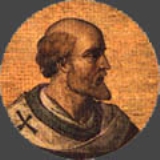
Pope Silvester II

Encyclopedia
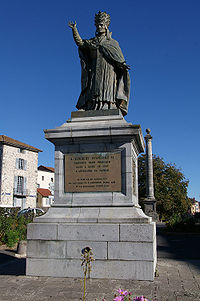
Pope Sylvester II (c. 946 – May 12, 1003), born Gerbert d'Aurillac, was a prolific scholar, teacher, and Pope
. He endorsed and promoted study of Arab/Greco-Roman arithmetic
, mathematics
, and astronomy
, reintroducing to Europe the abacus
and armillary sphere
, which had been lost to Europe since the end of the Greco-Roman era. He was the first French Pope, reigning from 999 until his death. Due to his efforts to root out simony
and other corruption within the Church, and his connection with science and intellectualism, there were many rumors and legends spread of Sylvester II being a sorcerer in league with the devil
.
, France
. Around 963, he entered the monastery of St. Gerald of Aurillac
. In 967, Borrell II of Barcelona
(947–992), visited the monastery, and the abbot asked the Count to take Gerbert with him so that the lad could study mathematics
in Spain
and acquire there some knowledge of Arabic learning. In the following years, Gerbert studied under the direction of Atto, Bishop of Vic, some 60 km north of Barcelona, and probably also at the nearby Monastery of Santa Maria de Ripoll.
Borrell II of Barcelona
was facing major defeat from the Andalusian
powers so he sent a delegation to Córdoba
to request a truce. Bishop Atto was part of the delegation that met with Al-Hakam II
of Cordoba, who received him with honor. Atto was mesmerized by the Arabic palaces in Cordoba and returned with great respect for the Arabs. Gerbert insisted that Atto teach him more about these Arabic princes who seemed to him more interested in the sciences and literature than warfare. Gerbert was fascinated by the stories of the Christian Bishops and judges who dressed and talked like the Arabs, well-versed in mathematics and natural sciences like the great teachers of the Islamic universities. This sparked Gerbert's veneration for the Arabs and his passion for mathematics and astronomy. Gerbert learned from the Arab teachers in Spain subjects that no one in the rest of Europe
had even heard of, the most important being Arabic numbers. It used to be rumored that he would sneak out from the monastery at night to study under the Arabs.
In 969, Count Borrell II made a pilgrimage to Rome
, taking Gerbert with him. There Gerbert met Pope John XIII
(965–972) and the Emperor Otto I
, surnamed the Great (936–973). The Pope persuaded Otto I to employ Gerbert as tutor for his young son, the future Emperor Otto II (973–983). Some years later, Otto I gave Gerbert leave to study at the cathedral school of Rheims where he was soon appointed a teacher by Archbishop Adalberon.
When Otto II became Holy Roman Emperor
in 973 (he was co-emperor with Otto I from 967), he appointed Gerbert the abbot of the monastery of Bobbio
and also appointed him as count of the district, but the abbey had been ruined by previous abbots, and Gerbert soon returned to Rheims.
After the death of Otto II in 983, Gerbert became involved in the politics of his time. In 985, with the support of his archbishop, he opposed Lothair of France
's (954–986) attempt to take the Lorraine
from Emperor Otto III (983–1002) by supporting Hugh Capet (987–996). Capet became King of France, ending the Carolingian
line of Kings in 987.
 Adalberon died on January 23, 989. Gerbert was a natural candidate for his succession, but Hugh Capet appointed Arnulf
, an illegitimate son of Lothair
instead. Arnulf was deposed in 991 for alleged treason against the King, and Gerbert was elected his successor. There was so much opposition to Gerbert's elevation to the See of Rheims, however, that Pope John XV
(985–996) sent a legate to France who temporarily suspended Gerbert from his episcopal office. Gerbert sought to show that this decree was unlawful, but a further synod in 995 declared Arnulf's deposition invalid.
Gerbert now became the teacher of Otto III, and Pope Gregory V
(996–999), Otto III's cousin, appointed him Archbishop of Ravenna
in 998. With the Emperor's support, he was elected to succeed Gregory V as Pope in 999. Gerbert took the name of Sylvester II, alluding to Pope Sylvester I (314–335), the advisor to Emperor Constantine I
(324–337). Soon after he was elected Pope, Sylvester II confirmed the position of his former rival Arnulf as archbishop of Rheims. As Pope, he took energetic measures against the widespread practices of simony
and concubinage
among the clergy
, maintaining that only capable men of spotless lives should be allowed to become bishops.
In 1001, the Roman populace revolted against the Emperor, forcing Otto III and Sylvester II to flee to Ravenna
. Otto III led two unsuccessful expeditions to regain control of the city, and died on a third expedition in 1002. Sylvester II returned to Rome soon after the Emperor's death, although the rebellious nobility remained in power, and died a little later. Sylvester is buried in St. John Lateran.
(arithmetic
, geometry
, astronomy
, music
), which he taught using the basis of the trivium (grammar
, logic
, and rhetoric
). Walid Amine Salhab asserts that Gerbert's reintroduction of the emphasis on these liberal arts
in Europe was inspired by the educational institution of Cordoba in Islamic Spain. In Rheims, he constructed a hydraulic-powered organ
with brass pipes that excelled all previously known instruments, where the air had to be pumped manually. In a letter of 984, Gerbert asks Lupitus of Barcelona
for a book on astrology
and astronomy
, two terms historian S. Jim Tester says Gerbert used synonymously. Gerbert may have been the author of a description of the astrolabe
that was edited by Hermannus Contractus
some 50 years later. Besides these, as Sylvester II he wrote a dogmatic treatise, De corpore et sanguine Domini—On the Body and Blood of the Lord.
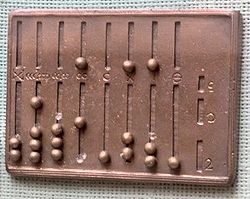 Gerbert learned of Hindu–Arabic digits
and applied this knowledge to the abacus
, but according to Charles Seife
without the numeral of zero. According to William of Malmesbury
(c. 1080–c. 1143), Gerbert got the idea of the computing device of the abacus from a Spanish Arab. The abacus that Gerbert reintroduced into Europe had its length divided into 27 parts with 9 number symbols (this would exclude zero, which was represented by an empty column) and 1,000 characters in all, crafted out of animal horn
by a shieldmaker of Rheims. According to his pupil Richer, Gerbert could perform speedy calculations with his abacus that were extremely difficult for people in his day to think through in using only Roman numerals
. Due to Gerbert's reintroduction, the abacus became widely used in Europe once again during the 11th century.
to Latin Europe via Al-Andalus in the late 10th century. The details of Gerbert's armillary sphere are revealed in letters from Gerbert to his former student and monk Remi of Trèves
, his colleague Constantine, the abbot
of Micy
, as well as the accounts of his former student and French nobleman Richer, who served as a monk in Rheims. Richer stated that Gerbert discovered that stars coursed in an oblique direction across the night sky. Richer described Gerbert's use of the armillary sphere as a visual aid for teaching mathematics and astronomy in the classroom, as well as how Gerbert organized the rings and markings on his device:
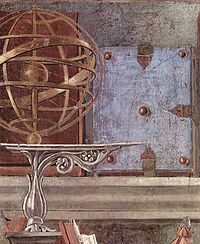
Given this account, historian Oscar G. Darlington asserts that Gerbert's division by 60 degrees instead of 360 allowed the lateral lines of his sphere to equal to six degrees. By this account, the polar circle
on Gerbert's sphere was located at 26 degrees, just several degrees off from the actual 23° 28'. Furthermore, this account illustrates that his positioning of the Tropic of Cancer
was nearly exact, while his positioning of the equator
was exactly correct. Richer also revealed how Gerbert made the planets more easily observable in his armillary sphere:
Richer wrote about another of Gerbert's last armillary sphere, which had sighting tubes fixed on the axis of the hollow sphere that could observe the constellations, the forms of which he hung on iron and copper wires. This armillary sphere was also described by Gerbert in a letter to his colleague Constantine. Gerbert instructed Constantine that, if doubtful of the position of the pole star
, he should fix the sighting tube of the armillary sphere into position to view the star he suspected was it, and if the star did not move out of sight, it was thus the pole star. Furthermore, Gerbert instructed Constantine that the north pole could be measured with the upper and lower sighting tubes, the Arctic Circle through another tube, the Tropic of Cancer through another tube, the equator through another tube, and the Tropic of Capricorn
through another tube.
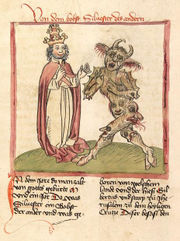 Gerbert was accused by his enemies of having studied magical
arts and astrology
at the Islam
ic cities of Córdoba
and Seville
and even at the University of Al Karaouine
in Morroco. This gave rise to legends that portray him as a sorcerer in league with the Devil
. There have been other Popes who were suspected of sorcery, for example John XXI (1276–77) and Benedict XII (1334–42). Pope Gregory XII
(1406–15) was questioned about magical practices in 1409 at the Council of Pisa
.
Gerbert was supposed to be in possession of a book of spells stolen from an Arab philosopher in Spain. Gerbert fled, pursued by the victim, who could trace the thief by the stars, but Gerbert was aware of the pursuit, and hid hanging from a wooden bridge, where, suspended between heaven and earth, he was invisible to the magician.
Gerbert was supposed to have built a brazen head
. This "robotic" head would answer his questions with "yes" or "no". He was also reputed to have had a pact with a female demon called Meridiana, who had appeared after he had been rejected by his earthly love, and with whose help he managed to ascend to the papal throne (another legend tells that he won the papacy playing dice with the Devil).
According to the legend, Meridiana (or the bronze head) told Gerbert that if he should ever read a mass
in Jerusalem, the Devil would come for him. Gerbert then cancelled a pilgrimage to Jerusalem, but when he read mass in the church of Saint Mary of Jerusalem (also called "Jerusalem church") in Rome, he became sick soon afterwards and, dying, he asked his cardinals to cut up his body and scatter it across the city. In another version, he was even attacked by the Devil while he was reading the Mass, and the Devil mutilated him and gave his gouged-out eyes to demons to play with in the Church. Repenting, Sylvester II then cut off his hand and his tongue.
The inscription on Gerbert's tomb reads in part Iste locus Silvestris membra sepulti venturo Domino conferet ad sonitum ("This place, at the advent of the Lord, will yield to the sound [of the last trumpet] the buried members of Sylvester II", mis-read as "will make a sound") has given rise to the curious legend that his bones will rattle in that tomb just before the death of a Pope.
In fact, Sylvester was said to be petrified at the thought of the new millennium: on the last night of the year A.D. 999, Sylvester nervously celebrated mass, thinking the world might end even as he consecrated the bread and wine.
The alleged story of the crown and papal legate
authority given to Stephen I of Hungary by Sylvester in the year 1000 (hence the reign title 'Apostolic King
') is noted by the 19th century historian Lewis L. Kropf as a possible forgery of the 17th century. Likewise, the 20th century historian Zoltan J. Kosztolnyik states that "it seems more than unlikely that Rome would have acted in fulfilling Stephen's request for a crown without the support and approval of the emperor
."
Pope
The Pope is the Bishop of Rome, a position that makes him the leader of the worldwide Catholic Church . In the Catholic Church, the Pope is regarded as the successor of Saint Peter, the Apostle...
. He endorsed and promoted study of Arab/Greco-Roman arithmetic
Arithmetic
Arithmetic or arithmetics is the oldest and most elementary branch of mathematics, used by almost everyone, for tasks ranging from simple day-to-day counting to advanced science and business calculations. It involves the study of quantity, especially as the result of combining numbers...
, mathematics
Mathematics
Mathematics is the study of quantity, space, structure, and change. Mathematicians seek out patterns and formulate new conjectures. Mathematicians resolve the truth or falsity of conjectures by mathematical proofs, which are arguments sufficient to convince other mathematicians of their validity...
, and astronomy
Astronomy
Astronomy is a natural science that deals with the study of celestial objects and phenomena that originate outside the atmosphere of Earth...
, reintroducing to Europe the abacus
Abacus
The abacus, also called a counting frame, is a calculating tool used primarily in parts of Asia for performing arithmetic processes. Today, abaci are often constructed as a bamboo frame with beads sliding on wires, but originally they were beans or stones moved in grooves in sand or on tablets of...
and armillary sphere
Armillary sphere
An armillary sphere is a model of objects in the sky , consisting of a spherical framework of rings, centred on Earth, that represent lines of celestial longitude and latitude and other astronomically important features such as the ecliptic...
, which had been lost to Europe since the end of the Greco-Roman era. He was the first French Pope, reigning from 999 until his death. Due to his efforts to root out simony
Simony
Simony is the act of paying for sacraments and consequently for holy offices or for positions in the hierarchy of a church, named after Simon Magus , who appears in the Acts of the Apostles 8:9-24...
and other corruption within the Church, and his connection with science and intellectualism, there were many rumors and legends spread of Sylvester II being a sorcerer in league with the devil
Satan
Satan , "the opposer", is the title of various entities, both human and divine, who challenge the faith of humans in the Hebrew Bible...
.
Life
Gerbert was born about 946 in the town of Belliac, near the present-day commune of Saint-Simon, CantalSaint-Simon, Cantal
Saint-Simon is a commune in the Cantal department in south-central France.The medieval town of Belliac, located near the present-day Saint-Simon, was the birthplace of the prolific scholar Gerbert d'Aurillac, who became Pope Sylvester II, the first of the French popes.-Population:-References:*...
, France
France
The French Republic , The French Republic , The French Republic , (commonly known as France , is a unitary semi-presidential republic in Western Europe with several overseas territories and islands located on other continents and in the Indian, Pacific, and Atlantic oceans. Metropolitan France...
. Around 963, he entered the monastery of St. Gerald of Aurillac
Gerald of Aurillac
Gerald of Aurillac is a French saint of the Roman Catholic Church, also recognized by other religious denominations of Christianity....
. In 967, Borrell II of Barcelona
Borrell II, Count of Barcelona
Borrell II was Count of Barcelona, Girona, and Ausona from 945 and Count of Urgell from 948.Borrell is first seen acting as count during the reign of his father Marquis Sunyer in 945 at the consecration of the nunnery church of Sant Pere de les Puelles in Barcelona, and succeeded Sunyer along with...
(947–992), visited the monastery, and the abbot asked the Count to take Gerbert with him so that the lad could study mathematics
Mathematics
Mathematics is the study of quantity, space, structure, and change. Mathematicians seek out patterns and formulate new conjectures. Mathematicians resolve the truth or falsity of conjectures by mathematical proofs, which are arguments sufficient to convince other mathematicians of their validity...
in Spain
Spain
Spain , officially the Kingdom of Spain languages]] under the European Charter for Regional or Minority Languages. In each of these, Spain's official name is as follows:;;;;;;), is a country and member state of the European Union located in southwestern Europe on the Iberian Peninsula...
and acquire there some knowledge of Arabic learning. In the following years, Gerbert studied under the direction of Atto, Bishop of Vic, some 60 km north of Barcelona, and probably also at the nearby Monastery of Santa Maria de Ripoll.
Borrell II of Barcelona
Borrell II, Count of Barcelona
Borrell II was Count of Barcelona, Girona, and Ausona from 945 and Count of Urgell from 948.Borrell is first seen acting as count during the reign of his father Marquis Sunyer in 945 at the consecration of the nunnery church of Sant Pere de les Puelles in Barcelona, and succeeded Sunyer along with...
was facing major defeat from the Andalusian
Al-Andalus
Al-Andalus was the Arabic name given to a nation and territorial region also commonly referred to as Moorish Iberia. The name describes parts of the Iberian Peninsula and Septimania governed by Muslims , at various times in the period between 711 and 1492, although the territorial boundaries...
powers so he sent a delegation to Córdoba
Córdoba, Spain
-History:The first trace of human presence in the area are remains of a Neanderthal Man, dating to c. 32,000 BC. In the 8th century BC, during the ancient Tartessos period, a pre-urban settlement existed. The population gradually learned copper and silver metallurgy...
to request a truce. Bishop Atto was part of the delegation that met with Al-Hakam II
Al-Hakam II
Al-Hakam II was the second Caliph of Cordoba, in Al-Andalus , and son of Abd-ar-rahman III . He ruled from 961 to 976....
of Cordoba, who received him with honor. Atto was mesmerized by the Arabic palaces in Cordoba and returned with great respect for the Arabs. Gerbert insisted that Atto teach him more about these Arabic princes who seemed to him more interested in the sciences and literature than warfare. Gerbert was fascinated by the stories of the Christian Bishops and judges who dressed and talked like the Arabs, well-versed in mathematics and natural sciences like the great teachers of the Islamic universities. This sparked Gerbert's veneration for the Arabs and his passion for mathematics and astronomy. Gerbert learned from the Arab teachers in Spain subjects that no one in the rest of Europe
Europe
Europe is, by convention, one of the world's seven continents. Comprising the westernmost peninsula of Eurasia, Europe is generally 'divided' from Asia to its east by the watershed divides of the Ural and Caucasus Mountains, the Ural River, the Caspian and Black Seas, and the waterways connecting...
had even heard of, the most important being Arabic numbers. It used to be rumored that he would sneak out from the monastery at night to study under the Arabs.
In 969, Count Borrell II made a pilgrimage to Rome
Rome
Rome is the capital of Italy and the country's largest and most populated city and comune, with over 2.7 million residents in . The city is located in the central-western portion of the Italian Peninsula, on the Tiber River within the Lazio region of Italy.Rome's history spans two and a half...
, taking Gerbert with him. There Gerbert met Pope John XIII
Pope John XIII
Pope John XIII of Crescenzi family served as Pope from October 1, 965, until his death.Born in Rome, he spent his career in the papal court...
(965–972) and the Emperor Otto I
Otto I, Holy Roman Emperor
Otto I the Great , son of Henry I the Fowler and Matilda of Ringelheim, was Duke of Saxony, King of Germany, King of Italy, and "the first of the Germans to be called the emperor of Italy" according to Arnulf of Milan...
, surnamed the Great (936–973). The Pope persuaded Otto I to employ Gerbert as tutor for his young son, the future Emperor Otto II (973–983). Some years later, Otto I gave Gerbert leave to study at the cathedral school of Rheims where he was soon appointed a teacher by Archbishop Adalberon.
When Otto II became Holy Roman Emperor
Holy Roman Emperor
The Holy Roman Emperor is a term used by historians to denote a medieval ruler who, as German King, had also received the title of "Emperor of the Romans" from the Pope...
in 973 (he was co-emperor with Otto I from 967), he appointed Gerbert the abbot of the monastery of Bobbio
Bobbio
Bobbio is a small town and commune in the province of Piacenza in Emilia-Romagna, northern Italy. It is located in the Trebbia River valley southwest of the town Piacenza. There is also an abbey and a diocese of the same name...
and also appointed him as count of the district, but the abbey had been ruined by previous abbots, and Gerbert soon returned to Rheims.
After the death of Otto II in 983, Gerbert became involved in the politics of his time. In 985, with the support of his archbishop, he opposed Lothair of France
Lothair of France
Lothair , sometimes called Lothair IV, was the Carolingian king of West Francia , son of Louis IV and Gerberga of Saxony.-Regency:...
's (954–986) attempt to take the Lorraine
Lorraine (province)
The Duchy of Upper Lorraine was an historical duchy roughly corresponding with the present-day northeastern Lorraine region of France, including parts of modern Luxembourg and Germany. The main cities were Metz, Verdun, and the historic capital Nancy....
from Emperor Otto III (983–1002) by supporting Hugh Capet (987–996). Capet became King of France, ending the Carolingian
Carolingian
The Carolingian dynasty was a Frankish noble family with origins in the Arnulfing and Pippinid clans of the 7th century AD. The name "Carolingian", Medieval Latin karolingi, an altered form of an unattested Old High German *karling, kerling The Carolingian dynasty (known variously as the...
line of Kings in 987.
Arnulf
Arnulf , a Germanic name common in the Middle Ages and rare at present, may refer to:*Arnulf of Metz, saint *Arnulf of Eynesbury, saint*Arnulf of Carinthia...
, an illegitimate son of Lothair
Lothair of France
Lothair , sometimes called Lothair IV, was the Carolingian king of West Francia , son of Louis IV and Gerberga of Saxony.-Regency:...
instead. Arnulf was deposed in 991 for alleged treason against the King, and Gerbert was elected his successor. There was so much opposition to Gerbert's elevation to the See of Rheims, however, that Pope John XV
Pope John XV
Pope John XV , Pope from 985 to 996, succeeding Boniface VII . He was said to have been Pope after another Pope John that reigned four months after Pope John XIV and was named "Papa Ioannes XIV Bis" or "Pope John XIVb"...
(985–996) sent a legate to France who temporarily suspended Gerbert from his episcopal office. Gerbert sought to show that this decree was unlawful, but a further synod in 995 declared Arnulf's deposition invalid.
Gerbert now became the teacher of Otto III, and Pope Gregory V
Pope Gregory V
Pope Gregory V, né Bruno of Carinthia , Pope from May 3, 996 to February 18, 999, son of the Salian Otto I, Duke of Carinthia, who was a grandson of the Emperor Otto I the Great . Gregory V succeeded Pope John XV , when only twenty-four years of age...
(996–999), Otto III's cousin, appointed him Archbishop of Ravenna
Ravenna
Ravenna is the capital city of the Province of Ravenna in the Emilia-Romagna region of Italy and the second largest comune in Italy by land area, although, at , it is little more than half the size of the largest comune, Rome...
in 998. With the Emperor's support, he was elected to succeed Gregory V as Pope in 999. Gerbert took the name of Sylvester II, alluding to Pope Sylvester I (314–335), the advisor to Emperor Constantine I
Constantine I
Constantine the Great , also known as Constantine I or Saint Constantine, was Roman Emperor from 306 to 337. Well known for being the first Roman emperor to convert to Christianity, Constantine and co-Emperor Licinius issued the Edict of Milan in 313, which proclaimed religious tolerance of all...
(324–337). Soon after he was elected Pope, Sylvester II confirmed the position of his former rival Arnulf as archbishop of Rheims. As Pope, he took energetic measures against the widespread practices of simony
Simony
Simony is the act of paying for sacraments and consequently for holy offices or for positions in the hierarchy of a church, named after Simon Magus , who appears in the Acts of the Apostles 8:9-24...
and concubinage
Concubinage
Concubinage is the state of a woman or man in an ongoing, usually matrimonially oriented, relationship with somebody to whom they cannot be married, often because of a difference in social status or economic condition.-Concubinage:...
among the clergy
Clergy
Clergy is the generic term used to describe the formal religious leadership within a given religion. A clergyman, churchman or cleric is a member of the clergy, especially one who is a priest, preacher, pastor, or other religious professional....
, maintaining that only capable men of spotless lives should be allowed to become bishops.
In 1001, the Roman populace revolted against the Emperor, forcing Otto III and Sylvester II to flee to Ravenna
Ravenna
Ravenna is the capital city of the Province of Ravenna in the Emilia-Romagna region of Italy and the second largest comune in Italy by land area, although, at , it is little more than half the size of the largest comune, Rome...
. Otto III led two unsuccessful expeditions to regain control of the city, and died on a third expedition in 1002. Sylvester II returned to Rome soon after the Emperor's death, although the rebellious nobility remained in power, and died a little later. Sylvester is buried in St. John Lateran.
Works and teaching
Gerbert, as a scientist, was said to be far ahead of his time. Gerbert wrote a series of works dealing with matters of the quadriviumQuadrivium
The quadrivium comprised the four subjects, or arts, taught in medieval universities, after teaching the trivium. The word is Latin, meaning "the four ways" , and its use for the 4 subjects has been attributed to Boethius or Cassiodorus in the 6th century...
(arithmetic
Arithmetic
Arithmetic or arithmetics is the oldest and most elementary branch of mathematics, used by almost everyone, for tasks ranging from simple day-to-day counting to advanced science and business calculations. It involves the study of quantity, especially as the result of combining numbers...
, geometry
Geometry
Geometry arose as the field of knowledge dealing with spatial relationships. Geometry was one of the two fields of pre-modern mathematics, the other being the study of numbers ....
, astronomy
Astronomy
Astronomy is a natural science that deals with the study of celestial objects and phenomena that originate outside the atmosphere of Earth...
, music
Music
Music is an art form whose medium is sound and silence. Its common elements are pitch , rhythm , dynamics, and the sonic qualities of timbre and texture...
), which he taught using the basis of the trivium (grammar
Grammar
In linguistics, grammar is the set of structural rules that govern the composition of clauses, phrases, and words in any given natural language. The term refers also to the study of such rules, and this field includes morphology, syntax, and phonology, often complemented by phonetics, semantics,...
, logic
Logic
In philosophy, Logic is the formal systematic study of the principles of valid inference and correct reasoning. Logic is used in most intellectual activities, but is studied primarily in the disciplines of philosophy, mathematics, semantics, and computer science...
, and rhetoric
Rhetoric
Rhetoric is the art of discourse, an art that aims to improve the facility of speakers or writers who attempt to inform, persuade, or motivate particular audiences in specific situations. As a subject of formal study and a productive civic practice, rhetoric has played a central role in the Western...
). Walid Amine Salhab asserts that Gerbert's reintroduction of the emphasis on these liberal arts
Liberal arts
The term liberal arts refers to those subjects which in classical antiquity were considered essential for a free citizen to study. Grammar, Rhetoric and Logic were the core liberal arts. In medieval times these subjects were extended to include mathematics, geometry, music and astronomy...
in Europe was inspired by the educational institution of Cordoba in Islamic Spain. In Rheims, he constructed a hydraulic-powered organ
Organ (music)
The organ , is a keyboard instrument of one or more divisions, each played with its own keyboard operated either with the hands or with the feet. The organ is a relatively old musical instrument in the Western musical tradition, dating from the time of Ctesibius of Alexandria who is credited with...
with brass pipes that excelled all previously known instruments, where the air had to be pumped manually. In a letter of 984, Gerbert asks Lupitus of Barcelona
Lupitus of Barcelona
Lupitus of Barcelona, identified with a Christian archdeacon called Sunifred, was an astronomer in late 10th century Barcelona, then part of the Marca Hispanica between Islamic Al-Andalus and Christian France .Lupitus was instrumental in the transfer of Arabic mathematics, including the...
for a book on astrology
Astrology
Astrology consists of a number of belief systems which hold that there is a relationship between astronomical phenomena and events in the human world...
and astronomy
Astronomy
Astronomy is a natural science that deals with the study of celestial objects and phenomena that originate outside the atmosphere of Earth...
, two terms historian S. Jim Tester says Gerbert used synonymously. Gerbert may have been the author of a description of the astrolabe
Astrolabe
An astrolabe is an elaborate inclinometer, historically used by astronomers, navigators, and astrologers. Its many uses include locating and predicting the positions of the Sun, Moon, planets, and stars, determining local time given local latitude and longitude, surveying, triangulation, and to...
that was edited by Hermannus Contractus
Hermannus Contractus
Hermann of Reichenau , also called Hermannus Contractus or Hermannus Augiensis or Herman the Cripple, was an 11th century scholar, composer, music theorist, mathematician, and astronomer. He composed the Marian prayer Alma Redemptoris Mater...
some 50 years later. Besides these, as Sylvester II he wrote a dogmatic treatise, De corpore et sanguine Domini—On the Body and Blood of the Lord.
Abacus and Hindu–Arabic numerals
Hindu–Arabic numeral system
The Hindu–Arabic numeral system or Hindu numeral system is a positional decimal numeral system developed between the 1st and 5th centuries by Indian mathematicians, adopted by Persian and Arab mathematicians , and spread to the western world...
and applied this knowledge to the abacus
Abacus
The abacus, also called a counting frame, is a calculating tool used primarily in parts of Asia for performing arithmetic processes. Today, abaci are often constructed as a bamboo frame with beads sliding on wires, but originally they were beans or stones moved in grooves in sand or on tablets of...
, but according to Charles Seife
Charles Seife
Charles Seife is an American author, journalist and professor.His first published book was Zero: The Biography of a Dangerous Idea. He had written within the scientific community for years before this, having done freelance work for New Scientist, Scientific American, The Economist, Science, Wired...
without the numeral of zero. According to William of Malmesbury
William of Malmesbury
William of Malmesbury was the foremost English historian of the 12th century. C. Warren Hollister so ranks him among the most talented generation of writers of history since Bede, "a gifted historical scholar and an omnivorous reader, impressively well versed in the literature of classical,...
(c. 1080–c. 1143), Gerbert got the idea of the computing device of the abacus from a Spanish Arab. The abacus that Gerbert reintroduced into Europe had its length divided into 27 parts with 9 number symbols (this would exclude zero, which was represented by an empty column) and 1,000 characters in all, crafted out of animal horn
Horn (anatomy)
A horn is a pointed projection of the skin on the head of various animals, consisting of a covering of horn surrounding a core of living bone. True horns are found mainly among the ruminant artiodactyls, in the families Antilocapridae and Bovidae...
by a shieldmaker of Rheims. According to his pupil Richer, Gerbert could perform speedy calculations with his abacus that were extremely difficult for people in his day to think through in using only Roman numerals
Roman numerals
The numeral system of ancient Rome, or Roman numerals, uses combinations of letters from the Latin alphabet to signify values. The numbers 1 to 10 can be expressed in Roman numerals as:...
. Due to Gerbert's reintroduction, the abacus became widely used in Europe once again during the 11th century.
Armillary sphere and sighting tube
Although lost to Europe since the terminus of the Greco-Roman era, Gerbert reintroduced the astronomical armillary sphereArmillary sphere
An armillary sphere is a model of objects in the sky , consisting of a spherical framework of rings, centred on Earth, that represent lines of celestial longitude and latitude and other astronomically important features such as the ecliptic...
to Latin Europe via Al-Andalus in the late 10th century. The details of Gerbert's armillary sphere are revealed in letters from Gerbert to his former student and monk Remi of Trèves
Trier
Trier, historically called in English Treves is a city in Germany on the banks of the Moselle. It is the oldest city in Germany, founded in or before 16 BC....
, his colleague Constantine, the abbot
Abbot
The word abbot, meaning father, is a title given to the head of a monastery in various traditions, including Christianity. The office may also be given as an honorary title to a clergyman who is not actually the head of a monastery...
of Micy
Micy
Saint-Mesmin de Micy Abbey, sometimes referred to as Micy, was an abbey near Orléans at the confluence of the Loire and the Loiret, located on the territory of today's commune of Saint-Pryvé-Saint-Mesmin. It was founded around 501 AD. The land upon which it was built was granted by Clovis I to...
, as well as the accounts of his former student and French nobleman Richer, who served as a monk in Rheims. Richer stated that Gerbert discovered that stars coursed in an oblique direction across the night sky. Richer described Gerbert's use of the armillary sphere as a visual aid for teaching mathematics and astronomy in the classroom, as well as how Gerbert organized the rings and markings on his device:
First [Gerbert] demonstrated the form of the world by a plain wooden sphere...thus expressing a very big thing by a little model. Slanting this sphere by its two poles on the horizon, he showed the northern constellations toward the upper pole and the southern toward the lower pole. He kept this position straight using a circle that the Greeks called horizon, the Latins limitans, because it divides visible stars from those that are not visible. On this horizon line, placed so as to demonstrate practically and plausibly...the rising and setting of the stars, he traced natural outlines to give a greater appearance of reality to the constellations. . .He divided a sphere in half, letting the tube represent the diameter, the one end representing the north pole, the other the south pole. Then he divided the semicircle from one pole to the other into thirty parts. Six lines drawn from the pole he drew a heavy ring to represent the arctic polar circle. Five divisions below this he placed another line to represent the tropic of Cancer. Four parts lower he drew a line for the equinoctial circle [the equator]. The remaining distance to the south pole is divided by the same dimensions.
Given this account, historian Oscar G. Darlington asserts that Gerbert's division by 60 degrees instead of 360 allowed the lateral lines of his sphere to equal to six degrees. By this account, the polar circle
Polar circle
A polar circle is either the Arctic Circle or the Antarctic Circle. On Earth, the Arctic Circle is located at a latitude of N, and the Antarctic Circle is located at a latitude of S....
on Gerbert's sphere was located at 26 degrees, just several degrees off from the actual 23° 28'. Furthermore, this account illustrates that his positioning of the Tropic of Cancer
Tropic of Cancer
The Tropic of Cancer, also referred to as the Northern tropic, is the circle of latitude on the Earth that marks the most northerly position at which the Sun may appear directly overhead at its zenith...
was nearly exact, while his positioning of the equator
Equator
An equator is the intersection of a sphere's surface with the plane perpendicular to the sphere's axis of rotation and containing the sphere's center of mass....
was exactly correct. Richer also revealed how Gerbert made the planets more easily observable in his armillary sphere:
He succeeded equally in showing the paths of the planets when they come near or withdraw from the earth. He fashioned first an armillary sphere. He joined the two circles called by the Greeks coluri and by the Latins incidentes because they fell upon each other, and at their extremities he placed the poles. He drew with great art and accuracy, across the colures, five other circles called parallels, which, from one pole to the other, divided the half of the sphere into thirty parts. He put six of these thirty parts of the half-sphere between the pole and the first circle; five between the first and the second; from the second to the third, four; from the third to the fourth, four again; five from the fourth to the fifth; and from the fifth to the pole, six. On these five circles he placed obliquely the circles that the Greeks call loxos or zoe, the Latins obliques or vitalis (the zodiac) because it contained the figures of the animals ascribed to the planets. On the inside of this oblique circle he figured with an extraordinary art the orbits traversed by the planets, whose paths and heights he demonstrated perfectly to his pupils, as well as their respective distances.
Richer wrote about another of Gerbert's last armillary sphere, which had sighting tubes fixed on the axis of the hollow sphere that could observe the constellations, the forms of which he hung on iron and copper wires. This armillary sphere was also described by Gerbert in a letter to his colleague Constantine. Gerbert instructed Constantine that, if doubtful of the position of the pole star
Pole star
The term "Pole Star" usually refers to Polaris, which is the current northern pole star, also known as the North Star.In general, however, a pole star is a visible star, especially a prominent one, that is approximately aligned with the Earth's axis of rotation; that is, a star whose apparent...
, he should fix the sighting tube of the armillary sphere into position to view the star he suspected was it, and if the star did not move out of sight, it was thus the pole star. Furthermore, Gerbert instructed Constantine that the north pole could be measured with the upper and lower sighting tubes, the Arctic Circle through another tube, the Tropic of Cancer through another tube, the equator through another tube, and the Tropic of Capricorn
Tropic of Capricorn
The Tropic of Capricorn, or Southern tropic, marks the most southerly latitude on the Earth at which the Sun can be directly overhead. This event occurs at the December solstice, when the southern hemisphere is tilted towards the Sun to its maximum extent.Tropic of Capricorn is one of the five...
through another tube.
Gerbert in legend
Magic (paranormal)
Magic is the claimed art of manipulating aspects of reality either by supernatural means or through knowledge of occult laws unknown to science. It is in contrast to science, in that science does not accept anything not subject to either direct or indirect observation, and subject to logical...
arts and astrology
Astrology
Astrology consists of a number of belief systems which hold that there is a relationship between astronomical phenomena and events in the human world...
at the Islam
Islam
Islam . The most common are and . : Arabic pronunciation varies regionally. The first vowel ranges from ~~. The second vowel ranges from ~~~...
ic cities of Córdoba
Córdoba, Spain
-History:The first trace of human presence in the area are remains of a Neanderthal Man, dating to c. 32,000 BC. In the 8th century BC, during the ancient Tartessos period, a pre-urban settlement existed. The population gradually learned copper and silver metallurgy...
and Seville
Seville
Seville is the artistic, historic, cultural, and financial capital of southern Spain. It is the capital of the autonomous community of Andalusia and of the province of Seville. It is situated on the plain of the River Guadalquivir, with an average elevation of above sea level...
and even at the University of Al Karaouine
University of Al Karaouine
The University of Al-Karaouine or Al-Qarawiyyin is a university located in Fes, Morocco which was established in 1947. Its origins date back to 859, when it was founded as a mosque school or madrasa...
in Morroco. This gave rise to legends that portray him as a sorcerer in league with the Devil
Devil
The Devil is believed in many religions and cultures to be a powerful, supernatural entity that is the personification of evil and the enemy of God and humankind. The nature of the role varies greatly...
. There have been other Popes who were suspected of sorcery, for example John XXI (1276–77) and Benedict XII (1334–42). Pope Gregory XII
Pope Gregory XII
Pope Gregory XII , born Angelo Correr or Corraro, Pope from 1406 to 1415, succeeded Pope Innocent VII on 30 November 1406....
(1406–15) was questioned about magical practices in 1409 at the Council of Pisa
Council of Pisa
The Council of Pisa was an unrecognized ecumenical council of the Catholic Church held in 1409 that attempted to end the Western Schism by deposing Benedict XIII and Gregory XII...
.
Gerbert was supposed to be in possession of a book of spells stolen from an Arab philosopher in Spain. Gerbert fled, pursued by the victim, who could trace the thief by the stars, but Gerbert was aware of the pursuit, and hid hanging from a wooden bridge, where, suspended between heaven and earth, he was invisible to the magician.
Gerbert was supposed to have built a brazen head
Brazen Head
A Brazen Head was a prophetic device attributed to many medieval scholars who were believed to be wizards, or who were reputed to be able to answer any question. It was always in the form of a man's head, and it could correctly answer any question asked of it...
. This "robotic" head would answer his questions with "yes" or "no". He was also reputed to have had a pact with a female demon called Meridiana, who had appeared after he had been rejected by his earthly love, and with whose help he managed to ascend to the papal throne (another legend tells that he won the papacy playing dice with the Devil).
According to the legend, Meridiana (or the bronze head) told Gerbert that if he should ever read a mass
Mass (liturgy)
"Mass" is one of the names by which the sacrament of the Eucharist is called in the Roman Catholic Church: others are "Eucharist", the "Lord's Supper", the "Breaking of Bread", the "Eucharistic assembly ", the "memorial of the Lord's Passion and Resurrection", the "Holy Sacrifice", the "Holy and...
in Jerusalem, the Devil would come for him. Gerbert then cancelled a pilgrimage to Jerusalem, but when he read mass in the church of Saint Mary of Jerusalem (also called "Jerusalem church") in Rome, he became sick soon afterwards and, dying, he asked his cardinals to cut up his body and scatter it across the city. In another version, he was even attacked by the Devil while he was reading the Mass, and the Devil mutilated him and gave his gouged-out eyes to demons to play with in the Church. Repenting, Sylvester II then cut off his hand and his tongue.
The inscription on Gerbert's tomb reads in part Iste locus Silvestris membra sepulti venturo Domino conferet ad sonitum ("This place, at the advent of the Lord, will yield to the sound [of the last trumpet] the buried members of Sylvester II", mis-read as "will make a sound") has given rise to the curious legend that his bones will rattle in that tomb just before the death of a Pope.
In fact, Sylvester was said to be petrified at the thought of the new millennium: on the last night of the year A.D. 999, Sylvester nervously celebrated mass, thinking the world might end even as he consecrated the bread and wine.
The alleged story of the crown and papal legate
Papal legate
A papal legate – from the Latin, authentic Roman title Legatus – is a personal representative of the pope to foreign nations, or to some part of the Catholic Church. He is empowered on matters of Catholic Faith and for the settlement of ecclesiastical matters....
authority given to Stephen I of Hungary by Sylvester in the year 1000 (hence the reign title 'Apostolic King
Apostolic King
Apostolic King was a hereditary title borne by the King of Hungary. Saint Stephen was supposed to have received it from Pope Sylvester II. The king's efforts to Christianize his people led to his comparison to one of the apostles. It was first used by the Holy Roman Emperor Leopold I as King of...
') is noted by the 19th century historian Lewis L. Kropf as a possible forgery of the 17th century. Likewise, the 20th century historian Zoltan J. Kosztolnyik states that "it seems more than unlikely that Rome would have acted in fulfilling Stephen's request for a crown without the support and approval of the emperor
Holy Roman Emperor
The Holy Roman Emperor is a term used by historians to denote a medieval ruler who, as German King, had also received the title of "Emperor of the Romans" from the Pope...
."
Further reading
- Brown, Nancy Marie. The Abacus and the Cross: The Story of the Pope Who Brought the Light of Science to the Dark Ages (Basic Books; 2010) 310 pages; shows he was the leading scientist and mathematician of his day.
- A translation of the letters of Gerbert (982–987) with introduction and notes, Harriet Pratt Lattin, tr., Columbus, OH, H. L. Hedrick, 1932.
- Letters of Gerbert, with His Papal Privileges as Sylvester II, Translated with an introduction by Harriet Pratt Lattin, Columbia University Press (1961), ISBN 0231022018 ISBN 9780231022019
- The Peasant Boy who Became Pope: Story of Gerbert, Harriet Pratt Lattin, Henry Schuman, 1951.
- The Policy of Gerbert in the Election of Hugh Capet, 987: Based on a Study of His Letters, Harriet Pratt Lattin, Ohio State University, 1926.
External links
- Catholic Encyclopedia
- Betty Mayfield, "Gerbert d'Aurillac and the March of Spain: A Convergence of Cultures"
- Gerbert of Aurillac (ca. 955–1003), lecture by Lynn H. Nelson.
- Women's Biography: Adelaide of Burgundy, Ottonian empress, includes four of his letters to Adelaide of ItalyAdelaide of ItalySaint Adelaide of Italy , also called Adelaide of Burgundy, was the second wife of Otto the Great, Holy Roman Emperor...
.