


Carloman, son of Pippin III

Encyclopedia
Bertrada of Laon
Bertrada of Laon, also called Bertha Broadfoot , was a Frankish queen.- Biography :...
. He was a younger brother of Charlemagne
Charlemagne
Charlemagne was King of the Franks from 768 and Emperor of the Romans from 800 to his death in 814. He expanded the Frankish kingdom into an empire that incorporated much of Western and Central Europe. During his reign, he conquered Italy and was crowned by Pope Leo III on 25 December 800...
.
Carloman I stands in the unfortunate position of having been written of only by writers prejudiced against him, who portray him as peevish, self-pitying and easily flattered. Little is known of him, except such as touches upon his more famous father and brother.
Split of the Frankish kingdom
At the age of 3, he was, together with his father, Pepin the Short, and his elder brother, Charlemagne, anointed King of the Franks and titled "Patrician of the Romans" by Pope Stephen IIPope Stephen II
Pope Stephen II was Pope from 752 to 757, succeeding Pope Zachary following the death of Pope-elect Stephen. Stephen II marks the historical delineation between the Byzantine Papacy and the Frankish Papacy.-Allegiance to Constantinople:...
, who had left Rome to beg the Frankish King for assistance against the Lombards
Lombards
The Lombards , also referred to as Longobards, were a Germanic tribe of Scandinavian origin, who from 568 to 774 ruled a Kingdom in Italy...
. Together with Charlemagne, he inherited a half of the Kingdom of the Franks upon Pepin's death. His share was based in the centre of the Frankish Kingdom, with his capital at Soissons, and consisted of the Parisian basin, the Massif Central, the Languedoc, Provence, Burgundy, southern Austrasia, Alsace and Alemannia; the regions were poorly integrated and surrounded by those bequeathed to Charlemagne, and, although Carloman's territories were easier to defend than those of Charlemagne, they were also poorer in income.
It is commonly agreed that Carloman and Charlemagne disliked each other, although the reasons behind this are unclear: some historians suggest that each brother considered himself rightfully to be the sole heir of their father – Charlemagne as the elder child, Carloman as the legitimate child (Charlemagne is sometimes claimed to have been born a bastard in 742, a claim not always accepted). Be that as it may, Pepin the Short's disposal of his kingdom appears to have exacerbated the bad relations between the pair, since it required co-operation between the pair and left both feeling cheated.
Competition with Charlemagne
Carloman's reign proved short and troublesome. The brothers shared possession of Aquitaine, which broke into rebellion upon the death of Pepin the Short; when Charlemagne in 769 led an army into Aquitaine to put down the revolt, Carloman led his own army there to assist, before quarrelling with his brother at Moncontour, near Poitiers, and withdrawing, troops and all. This, it had been suggested, was an attempt to undermine Charlemagne's power, since the rebellion threatened the latter's rule; Charlemagne, however, successfully crushed the rebels, whilst Carloman's behaviour had simply damaged his own standing amongst the Franks. Relations between the two then degenerated further, requiring the mediation of their mother, Bertrada, who appears to have favoured Charlemagne, with whom she would live out her widowhood, over Carloman.In 770, his mother Bertrada began implementing her great strategy. After spending the Easter with Charlemagne at Liege, she visited Carloman at Seltz: her motives for visiting him are unknown, although it is suggested that she was trying to allay his fears of his brother, or persuade him to be more co-operative with Charlemagne, or even secure his agreement and collusion in her plans. However it was, by the end of the year Bertrada and Charlemagne had successfully encircled Carloman: Charlemagne had married Desiderata, the daughter of the Lombard king Desiderius
Desiderius
Desiderius was the last king of the Lombard Kingdom of northern Italy...
, Carloman's immediate eastern neighbor, and the marriage created an alliance between Charlemagne and the Lombards; Bertrada had also secured for Charlemagne the friendship of Tassilo, Duke of Bavaria
Tassilo III of Bavaria
Tassilo III was duke of Bavaria from 748 to 788, the last of the house of the Agilolfings.Tassilo, then still an infant, began his rule as a Frankish ward under the tutelage of the Merovingian Mayor of the Palace Pepin the Short after Tassilo's father, Duke Odilo of Bavaria, had died in 747 and...
, her husband's nephew; she had even attempted to secure Papal support for the marriage by arranging for Desiderius to cede to Rome certain territories to which the Papacy laid claim, although Pope Stephen III
Pope Stephen III
Pope Stephen III was pope from August 1 or August 7, 768 to January 24, 772. He was a native of Sicily.He came to Rome during the pontificate of Gregory III and gradually rose to high office in the service of successive popes....
remained in theory hostile to an alliance between his allies the Franks and his enemies the Lombards, and in reality deeply conflicted between the threat the Lombards posed to him and the chance to dispose of the anti-Lombard Christopher the Primicerius, the dominant figure at the Papal court.
These maneuvers had been favorable to the Franks in general, but posed a serious threat to Carloman's position. He had been left without allies: he attempted to use his brother's alliance with the Lombards to his own advantage in Rome, offering his support against the Lombards to Stephen III and entering into secret negotiations with the Primicerius, Christopher, whose position had also been left seriously isolated by the Franco-Lombard rapprochement; but after the violent murder of Christopher by Desiderius, Stephen III chose to give his support to the Lombards and Charlemagne. Carloman's position was rescued, however, by Charlemagne's sudden repudiation of his Lombard wife, Desiderius' daughter. Desiderius, outraged and humiliated, appears to have made some sort of alliance with Carloman following this, in opposition to Charlemagne and the Papacy, which took the opportunity to declare itself against the Lombards.
Death and legacy
Carloman died on 9 December 771, at the Villa of Samoussy; the death, sudden and convenient though it was, was set down to natural causes (a severe nosebleed is sometimes claimed as being at fault). At the time of his death, he and his brother Charlemagne were close to outright war, which Charlemagne's biographer EinhardEinhard
Einhard was a Frankish scholar and courtier. Einhard was a dedicated servant of Charlemagne and his son Louis the Pious; his main work is a biography of Charlemagne, the Vita Karoli Magni, "one of the most precious literary bequests of the early Middle Ages."-Public life:Einhard was from the eastern...
attributes to the miscounsel of Carloman's advisors. Carloman was buried in Reims
Reims
Reims , a city in the Champagne-Ardenne region of France, lies east-northeast of Paris. Founded by the Gauls, it became a major city during the period of the Roman Empire....
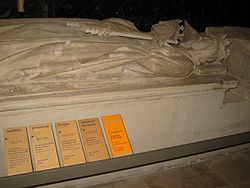
, but he was reburied in the Basilique Saint-Denis in the 13th century.
Carloman had married a beautiful Frankish woman, Gerberga
Gerberga, wife of Carloman I
Gerberga was the wife of Carloman I, King of the Franks, and sister-in-law of Charlemagne. Her flight to the Lombard kingdom of Desiderius following Carloman's death precipitated the last Franco-Lombard war, and the destruction of the Lombard Kingdom.Very little is known of Gerberga...
, who according to Pope Stephen III
Pope Stephen III
Pope Stephen III was pope from August 1 or August 7, 768 to January 24, 772. He was a native of Sicily.He came to Rome during the pontificate of Gregory III and gradually rose to high office in the service of successive popes....
was chosen for him, together with Charlemagne's concubine, Himiltrude
Himiltrude
Himiltrude was the mother of Charlemagne's first-born son Pippin the Hunchback.-Life:Little is known about Himiltrude's origins. Paulus Diaconus calls her a "noble girl"...
, by Pepin the Short. With Gerberga he had two sons, the older of whom was named Pepin after his grandfather, marking him according to Carolingian tradition as the heir of Carloman, and of Pepin the Short. After Carloman's death, Gerberga expected her elder son to become King, and for herself to rule as his regent; however, Carloman's former supporters – his cousin Adalhard, Abbot Fulrad of Saint Denis and Count Warin – turned against her, and invited Charlemagne to annex Carloman's territory, which he duly did. Gerberga then fled ("for no reason at all") with her sons and Count Autchar, one of Carloman's faithful nobles, to the court of Desiderius, who demanded of the new Pope Hadrian I that he anoint Carloman's sons as Kings of the Franks. Gerberga's flight ultimately precipitated Charlemagne's destruction of the Kingdom of the Lombards; he responded to Desiderius' support of Carloman's children, which threatened Charlemagne's own position, by sweeping into Italy and subjugating it. Desiderius and his family were captured, tonsured, and sent to Frankish religious houses; the fate of Gerberga and her children by Carloman is unknown, although it is likely that they, too, were sent by Charlemagne to monasteries and nunneries.
Despite their difficult relationship, and the events following Carloman's death, Charlemagne would later name his second legitimate son 'Carloman' after his deceased brother. This had, perhaps, been a public gesture to honour the memory of the boy's uncle, and to quell any rumours about Charlemagne's treatment of his nephews. If so, it was swept away in 781, when Charlemagne had his son renamed as Pippin
Pippin of Italy
Pepin was the son of Charlemagne and king of the Lombards under the authority of his father.Pepin was the second son of Charlemagne by his then-wife Hildegard. He was born Carloman, but when his half-brother Pepin the Hunchback betrayed their father, the royal name Pepin passed to him...
.