
In Depth
See Also

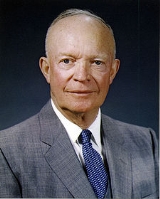
Dwight D. Eisenhower

Dwight David "Ike" Eisenhower was an American United States

The United States of America, also known as the United States, the U.S., the U.S.A., a... 

 soldier and politician. During World War II World War II

World War II, or the Second World War, was a worldwide [i] conflict [i] fought betwe ... 

, he served as Supreme Commander of the Allied forces in Europe, with responsibility for planning and supervising the successful invasion of France and Germany in 1944-45. In 1949 he became the first supreme commander of NATO NATO

Aznar also proposed a strategic co-operation with India [i] and Colombia [i]. ... 

. As a Republican History of the United States Republican Party

The Republican Party [i] of the United States [i] was established in 1854 and is one of the t ... 

, he was elected the 34th President of the United States President of the United States

The President of the United States of America is the head of state [i] of the United States [i]. ... 

 . As president he ended the Korean War Korean War

The Korean War began on June 25 [i], 1950 [i] and ended with a truce [i] on July 27 [i], 1953 [i] . ... 

, kept up the pressure on the Soviet Union during the Cold War, reoriented the defense budget toward nuclear weapons, launched the space race, enlarged the Social Security program, and built the interstate highway system.

Discussions

  Discussion Features

   Ask a question about 'Dwight D. Eisenhower'

   Start a new discussion about 'Dwight D. Eisenhower'

   Answer questions about 'Dwight D. Eisenhower'

   'Dwight D. Eisenhower' discussion forum

Timeline

1943   World War II: United States United States

The United States of America, also known as the United States, the U.S., the U.S.A., a... 

 General Dwight D. Eisenhower publicly announces the surrender of Italy Italy

Italy, officially the Italian Republic , is a Southern European [i] country. ... 

 to the Allies and the USAAF bombed the German General Headquarter for the Mediterranean zone Frascati bombing raid September 8, 1943.

1943   World War II: US General Dwight D. Eisenhower becomes the Supreme Allied Commander in Europe.

1952   U.S. presidential election, 1952 United States presidential election, 1952

The U.S. presidential election of 1952 took place after over two years of stalemate in the [[Korean War]... 

: Republican Republican Party (United States)

For a detailed history and bibliography see History of the United States Republican Party [i]. ... 

 Dwight D. Eisenhower defeats Democrat Democratic Party (United States)

The Democratic Party is one of two major contemporary political parties [i] in the United States [i] ... 

 Adlai Stevenson Adlai Stevenson

Adlai Ewing Stevenson II was an American politician [i], noted for intellectual demeanor ... 

 (correctly predicted by the UNIVAC UNIVAC I

The UNIVAC I (UNIVersal Automatic Computer I) was the first commercial compu... 

 computer).

1952   Korean War Korean War

The Korean War began on June 25 [i], 1950 [i] and ended with a truce [i] on July 27 [i], 1953 [i] . ... 

: U.S. President President of the United States

The President of the United States of America is the head of state [i] of the United States [i]. ... 

-elect Dwight D. Eisenhower fulfills a political campaign Political campaign

A political campaign is an organized effort to influence the decision making process within a group.... 

 promise by traveling to Korea Korea

Korea One of the world's oldest civilization [i]s, Korea began with the founding of Gojoseon [i] in 2333 ... 

 to find out what can be done to end the conflict.

1953   Change of US presidency President of the United States

The President of the United States of America is the head of state [i] of the United States [i]. ... 

 from Harry S. Truman Harry S. Truman

Harry S. [i] Truman was the thirty-third President of the United States [i]; as ... 

 (1945-1953) to Dwight D. Eisenhower (1953-1961).

1953   President Eisenhower Dwight D. Eisenhower

Dwight David "Ike" Eisenhower was an American [i] soldier and politician. ... 

 refuses clemency appeal for Ethel and Julius Rosenberg Julius and Ethel Rosenberg

Julius Rosenberg and Ethel Greenglass Rosenberg were American [i] Communists [i] ... 

.

1953   Cold War Cold War

The Cold War was the protracted geopolitical [i], ideological [i], and economic [i] ... 

: US President Dwight D. Eisenhower formally approves the top secret document National Security Council Paper No. 162/2, which states that the United States United States

The United States of America, also known as the United States, the U.S., the U.S.A., a... 

' arsenal of nuclear weapon Nuclear weapon

A nuclear weapon derives its destructive force from nuclear reaction [i]s of fission [i] ... 

s must be maintained and expanded to counter the communist Communism

Communism is an ideology that seeks to establish a future classless [i], stateless [i] ... 

 threat.

1953   US president Dwight D. Eisenhower delivers his Atoms for Peace Atoms for Peace

"Atoms for Peace" was the title of a speech delivered by Dwight D. Eisenhower [i] to the UN General Assembly [i] ... 

 address to the UN General Assembly United Nations General Assembly

The United Nations General Assembly is one of the five principal organs of the United Nations [i] ... 

 in New York City New York City

[i] in the [[United States]... 

1954   President Dwight D. Eisenhower authorizes the creation of the United States Air Force Academy United States Air Force Academy

The United States Air Force Academy, located in Colorado Springs [i], Colorado [i] ... 

 in Colorado Colorado

Colorado is a state [i] in the western United States [i]. ... 

.

1954   Dwight D. Eisenhower gives his "domino theory" speech during a news conferen

   More Events >>


Quotations

Un-American activity cannot be prevented or routed out by employing un-American methods; to preserve freedom we must use the tools that freedom provides.

The White House Years, p. 331

       More Quotes >>


Encyclopedia

Dwight David "Ike" Eisenhower was an American United States

The United States of America, also known as the United States, the U.S., the U.S.A., a... 

 soldier and politician. During World War II World War II

World War II, or the Second World War, was a worldwide [i] conflict [i] fought betwe ... 

, he served as Supreme Commander of the Allied forces in Europe, with responsibility for planning and supervising the successful invasion of France and Germany in 1944-45. In 1949 he became the first supreme commander of NATO NATO

Aznar also proposed a strategic co-operation with India [i] and Colombia [i]. ... 

. As a Republican History of the United States Republican Party

The Republican Party [i] of the United States [i] was established in 1854 and is one of the t... 

, he was elected the 34th President of the United States President of the United States

The President of the United States of America is the head of state [i] of the United States [i]. ... 

 . As president he ended the Korean War Korean War

The Korean War began on June 25 [i], 1950 [i] and ended with a truce [i] on July 27 [i], 1953 [i] . ... 

, kept up the pressure on the Soviet Union during the Cold War, reoriented the defense budget toward nuclear weapons, launched the space race, enlarged the Social Security program, and built the interstate highway system.

Early life and family

Eisenhower was born to a German American German American

German Americans are citizens of the United States [i] of German [i] ancestry. ... 

 family in Denison, Texas, the third of seven sons born to David Jacob Eisenhower and Ida Elizabeth Stover, and their only child born in Texas. He was named David Dwight and was called Dwight. Later, the order of his given names was switched . The Eisenhower family is of Pennsylvania Dutch Pennsylvania Dutch

The Pennsylvania Dutch are descendants of German speaking immigrants who came to Pennsylvania [i] in the ... 

 descent. His ancestors were Mennonites Mennonite

The Mennonites are a group of Christian [i] Anabaptist [i] denominations named after and in ... 

 who fled from Germany to Switzerland in the 17th century. Hans Nicol Eisenhauer and family came to Lancaster, Pennsylvania in 1741. The family joined the River Brethren and were pacifists during the nation's wars. They joined some 300 River Brethren in creating a colony in Kansas. After a brief sojourn in Texas the family resettled in Abilene, Kansas Abilene, Kansas

Abilene is a city in Dickinson County [i], Kansas [i], United States [i], 163 m ... 

, in 1892. Eisenhower's father was a college-educated engineer. Eisenhower graduated from Abilene High School in 1909.

Eisenhower married Mamie Geneva Doud Mamie Eisenhower

Mamie Geneva Doud Eisenhower, was the wife of General and President Dwight D. Eisenhower [i] and First Lady of the United States [i] ... 

 , of Denver, Colorado Denver, Colorado

The City and County of Denver is the capital [i] and largest city of the U.S. state [i] of Colorado [i].... 

, on July 1, 1916. They had two children, Doud Dwight Eisenhower , whose tragic death in childhood haunted the couple, and John Sheldon David Doud Eisenhower . John Eisenhower served in the United States Army United States Army

The United States Army is the largest branch of the United States armed forces [i] ... 

, then became an author and served as U.S. Ambassador to Belgium Belgium

The Kingdom of Belgium is a country in northwest Europe [i] bordered by the Netherlands [i] ... 

. John's son, David Eisenhower, after whom Camp David Camp David

The Naval Support Facility Thurmont, popularly known as Camp David, is the rustic 125-acre mounta... 

 is named, married Richard Nixon Richard Nixon

Richard Milhous Nixon was the 37th President of the United States [i], serving from 1969 to 1974. ... 

's daughter Julie in 1968.

Early military career

Eisenhower enrolled at the United States Military Academy United States Military Academy

The United States Military Academy, also known as West Point, or simply USMA , is a United States Army [i] ... 

, West Point, New York West Point, New York

West Point is a federal military base located in the Town of Highlands [i] in Orange County, New York [i]... 

, in June 1911. His parents were pacifist Pacifism

Pacifism is the opposition to war [i] or violence [i] as a means of settling disputes. ... 

s but did not object to his entering West Point as they were strong proponents of education.

Eisenhower was a strong athlete, but his football career came to an end after he injured his knee attempting to tackle Jim Thorpe Jim Thorpe

Jacobus Franciscus "Jim" Thorpe is considered one of the most versatile athletes in modern sports [i]. ... 

.

Eisenhower graduated in 1915. He served with the infantry until 1918 at various camps in Texas Texas

Texas is a state [i] in both the Southern [i] and Western [i] ... 

 and Georgia Georgia

Georgia may mean:
  • Georgia [i], a sovereign state in the Caucasus region of Eurasia: **Formerly ... 

    . During World War I World War I

    World War I, also known as the First World War, the Great War and "The War to End All War... 

    , Eisenhower became the #3 leader of the new tank Tank

    A tank is a tracked [i] armoured fighting vehicle [i], designed to engage enemy force ... 

     corps Corps

    A corps is either a large military unit [i] or formation [i], an administrative grouping of tr ... 

     and rose to lieutenant colonel in the National Army. He spent the war training tank crews in Pennsylvania Pennsylvania

    The Commonwealth of Pennsylvania is a state [i] in the northeastern [i] ... 

     and never saw combat. After the war Eisenhower reverted to his regular rank of captain  before assuming duties at Camp Meade Fort George G. Meade

    Fort George G. Meade, 5 miles northeast of the city of Laurel, Maryland [i], is an active US Army [i] ... 

    , Maryland Maryland

    Maryland , is a Mid-Atlantic [i] state [i] located on the East Coast [i] ... 

    , where he remained until 1922. His interest in tank warfare was strengthened by many conversations with George Patton George S. Patton

    George Smith Patton, Jr. was a leading U.S. Army [i] general [i] in World War II [i]. ... 

     and other senior tank leaders; however their ideas on tank warfare were strongly discouraged by superiors.


Eisenhower became executive officer to General Fox Conner in the Panama Canal Zone Panama Canal Zone

The Panama Canal Zone, was a 553 square mile territory inside of Panama [i], consisting of the Panama Canal [i] ... 

, where he served until 1924. Under Conner's tutelage, he studied military history and theory , and later cited Conner's enormous influence on his military thinking. In 1925-26, he attended the Command and General Staff College Command and General Staff College

The Command and General Staff College at Fort Leavenworth [i], Kansas is a United States Army [i] facili... 

 at Fort Leavenworth, Kansas Kansas

Kansas is a Midwestern [i] state [i] in the Central [i] United States [i] ... 

, and then served as a battalion Battalion

A battalion is a military unit [i] usually consisting of between two and six companies [i] and ... 

 commander at Fort Benning Fort Benning

Fort Benning is a United States Army [i] base, located southwest of Columbus, Georgia [i] in Muscogee County [i] ... 

, Georgia, until 1927.

During the late 1920s and early 1930s Eisenhower's career in the peacetime Army stagnated; many of his friends resigned for high paying business jobs. He was assigned to the American Battle Monuments Commission American Battle Monuments Commission

The American Battle Monuments Commission is a small independent agency of the Executive Branch [i] of th ... 

, directed by General John J. Pershing John Pershing

John Joseph "Black Jack" Pershing was an officer in the United States Army [i]. ... 

, then to the Army War College U.S. Army War College

The United States Army War College is a United States Army [i] school located in Carlisle, Pennsylvania [i] ... 

, and then served as executive officer to General George V. Moseley, Assistant Secretary of War, from 1929 to 1933. He then served as chief military aide to General Douglas MacArthur Douglas MacArthur

Douglas MacArthur was an American [i] general [i] and Medal of Honor [i] recipient, who w ... 

, Army Chief of Staff, until 1935, when he accompanied MacArthur to The Philippines Philippines

The Philippines , officially the Republic of the Philippines , is an island nation [i] located in ... 

, where he served as assistant military adviser to the Philippine government. This assignment would prove valuable preparation for handling the egos of Winston Churchill Winston Churchill

Sir Winston Leonard Spencer-Churchill, KG [i], OM [i], CH [i] ... 

, Patton and Bernard Montgomery Bernard Montgomery, 1st Viscount Montgomery of Alamein

Field Marshal [i] Bernard Law Montgomery, 1st Viscount Montgomery of Alamein, KG [i] ... 

 during World War II. Eisenhower was promoted to lieutenant colonel in 1936 after sixteen years as a major. He also learned to fly, although was never rated as a military pilot.

Eisenhower returned to the U.S. in 1939 and held a series of staff positions in Washington, D.C. Washington, D.C.

Washington, D.C. is the capital [i] city [i] of the United States of America [i]. ... 

, California California

California is a state [i] spanning the southern half of the west coast [i] ... 

, and Texas. In June 1941, he was appointed Chief of Staff to General Walter Krueger, Commander of the 3rd Army, at Fort Sam Houston, Texas. He was promoted to brigadier general Brigadier General

Brigadier General is the lowest rank of general [i] officer in some countries, usually ranking just abov ... 

 in September 1941. Although his administrative abilities had been noticed, on the eve of the U.S. entry into World War II he had never held an active command and was far from being considered as a potential commander of major operations.

World War II

After the Japan Japan

is an island country [i] in East Asia [i]. ... 

ese attack on Pearl Harbor Attack on Pearl Harbor

The Imperial Japanese Navy [i] made its attack on Pearl Harbor on the morning of Sunday, December 7 [i], ... 

, Eisenhower was assigned to the General Staff in Washington, where he served until June 1942 with responsibility for creating the major war plans to defeat Japan and Germany Germany

Germany , officially the Federal Republic of Germany , is a country [i] in central Europe [i]. ... 

. He was appointed Deputy Chief in charge of Pacific Defenses under the Chief of War Plans Division, General Leonard T. Gerow, and then succeeded Gerow as Chief of the War Plans Division. Then he was appointed Assistant Chief of Staff in charge of Operations Division under Chief of Staff General George C. Marshall George Marshall

General of the Army George Catlett Marshall, GCB [i], US Army was an American [i] ... 

. It was his close association with Marshall which finally brought Eisenhower to senior command positions. Marshall recognized his great organizational and administrative abilities.

In 1942, Eisenhower was appointed Commanding General, European Theater of Operations  and was based in London London

London is the capital [i] city of England [i] and of the United Kingdom [i]. ... 

. In November, he was also appointed Supreme Commander Allied Force of the North African Theater of Operations  through the new operational Headquarters AFHQ. The word "expeditionary" was dropped soon after his appointment for security reasons. In February 1943, his authority was extended as commander of AFHQ across the Mediterranean basin to include the British 8th Army, commanded by General Bernard Montgomery Bernard Montgomery, 1st Viscount Montgomery of Alamein

Field Marshal [i] Bernard Law Montgomery, 1st Viscount Montgomery of Alamein, KG [i] ... 

. The 8th Army had advanced across the Western Desert Western Desert Campaign

The Western Desert Campaign was the primary early theatre of the North African Campaign [i] of World War II [i] ... 

 from the east and was ready for the start of the Tunisia Campaign Tunisia Campaign

The Tunisia Campaign, was a series of World War II [i] battles that took place in Tunisia [i] in the North African Campaign [i] ... 

. Eisenhower gained his fourth star and gave up command of ETOUSA to be commander of NATOUSA. After the capitulation of Axis Axis Powers

The Axis Powers were those nations opposed to the Allies [i] during the Second World War [i] ... 

 forces in North Africa North Africa

North Africa or Northern Africa is the northernmost [i] region [i] of the Africa [i]n continent [i] ... 

, Eisenhower remained in command of the renamed Mediterranean Theater of Operations , keeping the operational title and continued in command of NATOUSA redesignated MTOUSA. In this position he oversaw the invasion of Sicily Allied invasion of Sicily

Husky was also the codename of Australia [i]n military support to Sierra Leone [i] ending in February... 

 and the invasion of the Italian mainland.


In December 1943, it was announced that Eisenhower would be Supreme Allied Commander in Europe Europe

Europe is one of the seven traditional continent [i]s of the Earth [i]. ... 

. In January 1944, he resumed command of ETOUSA and the following month was officially designated as the Supreme Allied Commander of the Allied Expeditionary Force Supreme Headquarters Allied Expeditionary Force

Supreme Headquarters Allied Expeditionary Force, was the headquarters of the Commander of Allied [i] for... 

 , serving in a dual role until the end of hostilities in Europe in May 1945. In these positions he was charged with planning and carrying out the Allied assault on the coast of Normandy Battle of Normandy

The Battle of Normandy was fought in 1944 [i] between Nazi Germany [i] in Western Europe [i] and the in ... 

 in June 1944 under the code name Operation Overlord Battle of Normandy

The Battle of Normandy was fought in 1944 [i] between Nazi Germany [i] in Western Europe [i] and the in ... 

, the liberation of western Europe and the invasion of Germany Germany

Germany , officially the Federal Republic of Germany , is a country [i] in central Europe [i]. ... 

. A month after the Normandy D-Day D-Day

In English military [i] parlance, D-Day is a term often used to denote the day on which a combat attack ... 

 on June 6 1944, the invasion of southern France Operation Dragoon

Operation Dragoon was the Allied [i] invasion of southern France [i], on 15 August [i], 1944 [i], ... 

 took place, and control of the forces which took part in the southern invasion passed from the AFHQ to the SHAEF. From then until the end of the War in Europe End of World War II in Europe

The final battles of the European Theatre [i] of World War II [i] and the Ger ... 

 on May 8 1945, Eisenhower through SHAEF had supreme command of all operational Allied forces2, and through his command of ETOUSA, administrative command of all U.S. forces, on the Western Front Western Front

Western Front was a term used during the First [i] and Second [i] World Wars to ... 

 north of the Alps Alps

The Alps is the name for one of the great mountain range [i] systems of Europe [i], stretching from Austria [i] ... 

.

As recognition of his senior position in the Allied command, on December 20 1944, he was promoted to General of the Army equivalent to the rank of Field Marshal in most European armies. In this and the previous high commands he held, Eisenhower showed his great talents for leadership and diplomacy. Although he had never seen action himself, he won the respect of front-line commanders. He dealt skillfully with difficult subordinates such as Omar Bradley Omar Bradley

Omar Nelson Bradley was one of the main U.S. Army [i] field commanders in North Afric ... 

 and George Patton George S. Patton

George Smith Patton, Jr. was a leading U.S. Army [i] general [i] in World War II [i]. ... 

 and allies such as Winston Churchill Winston Churchill

Sir Winston Leonard Spencer-Churchill, KG [i], OM [i], CH [i] ... 

, Field Marshal Bernard Montgomery Bernard Montgomery, 1st Viscount Montgomery of Alamein

Field Marshal [i] Bernard Law Montgomery, 1st Viscount Montgomery of Alamein, KG [i] ... 

 and General Charles de Gaulle Charles de Gaulle

Charles Andr Joseph Marie de Gaulle , in France [i] commonly referred to as Gnral de Gaulle, ... 

. He had fundamental disagreements with Churchill and Montgomery over questions of strategy, but these rarely upset his relationships with them. He negotiated with Soviet Soviet Union

The Union of Soviet Socialist Republics , more commonly known as the Soviet Union, was a Communist state [i] ... 

 Marshal Zhukov Georgy Zhukov

Georgy Konstantinovich Zhukov, GCB [i] , was a Soviet [i] military comma ... 

, and such was the confidence that President Franklin D. Roosevelt Franklin D. Roosevelt

Franklin Delano Roosevelt served as the 32nd President of the United States [i] and was elected to four... 

 had in him, he sometimes worked directly with Stalin Joseph Stalin

Joseph Vissarionovich Stalin , alternatively transliterated Josef Stalin, was the de facto [i] ... 

.

Eisenhower was offered the Medal of Honor Medal of Honor

The Medal of Honor is the highest military decoration [i] ... 

 for his leadership in the European Theater but refused it, saying that it should be reserved for bravery and valor.


It was never a certainty that Overlord would succeed. The tenuousness surrounding the entire decision including the timing and the location of the Normandy invasion might be summarized by a short speech that Eisenhower wrote in advance, in case he might need it. In it, he took full responsibility for catastrophic failure, should that be the final result. Long after the successful landings on D-Day and the BBC broadcast of Eisenhower's brief speech concerning them, the never-used second speech was found in a shirt pocket by an aide. It read:

"Our landings have failed and I have withdrawn the troops. My decision to attack at this time and place was based on the best information available. The troops, the air and the Navy did all that bravery could do. If any blame or fault attaches to the attempt it is mine alone."


Following the German Nazi Germany

Nazi Germany, or the Third Reich, refers to Germany in the years 1933 to 1945, when it was governe... 

 unconditional surrender on May 8, 1945, Eisenhower was appointed Military Governor of the U.S. Occupation Zone Allied Occupation Zones in Germany

The Allied [i] powers who defeated Germany [i] in World War II [i] divided the country west of the Oder-Neisse line [i] ... 

, based in Frankfurt am Main Frankfurt

For the capital of the U.S.... 

. Germany was divided into four Occupation Zones, one each for the U.S., Britain, France, and the Soviet Union. In addition, upon full discovery of the death camp Extermination camps in the Holocaust

The extermination camps were the facilities established by Nazi Germany [i] in World War II [i] initiall... 

s that were part of the Final Solution Final Solution

The so-called "Final Solution of the Jewish Question [i]" refers to the German [i] Nazis [i] ... 

 , he ordered camera crews to comprehensively document evidence of the atrocity so as to prevent any doubt of its occurrence. He made the controversial decision to reclassify German prisoners of war Prisoner of war

A prisoner of war is a combatant [i] who is imprisoned by an enemy power during or immediately after an ... 

  in U.S. custody as Disarmed Enemy Forces . As DEFs, they could be compelled to serve as unpaid conscript labor. An unknown number may have died in custody as a consequence of malnutrition, exposure to the elements, and lack of medical care . Eisenhower was an early supporter of the Morgenthau Plan Morgenthau Plan

The Morgenthau Plan was a plan for the occupation of Germany [i] after the Second World War [i] that adv ... 

 to permanently remove Germany's industrial capacity to wage future wars. In November 1945 he approved the distribution of 1000 free copies of Morgenthau's Henry Morgenthau, Jr.

[i]
... 

 book Germany is Our Problem, which promoted and described the plan in detail, to American military officials in occupied Germany. Historian Stephen Ambrose Stephen Ambrose

Stephen Edward Ambrose, Ph.D.... 

 draws the conclusion that, despite Eisenhowers later claims that the act was not an endorsement of the Morgenthau plan, Eisenhower both approved of the plan and had previously given Morgenthau at least some of his ideas on how Germany should be treated.


Eisenhower served as Chief of Staff of the U.S. Army from 1945-48. In December 1950, he was named Supreme Commander of the North Atlantic Treaty Organization NATO

Aznar also proposed a strategic co-operation with India [i] and Colombia [i]. ... 

 , and given operational command of NATO forces in Europe. Eisenhower retired from active service on May 31, 1952, upon entering politics. He wrote Crusade in Europe, widely regarded as one of the finest U.S. military memoirs. During this period Eisenhower served as president of Columbia University Columbia University

Columbia University is a private [i] university [i] whose main campus lies in the Morningside Heights [i] ... 

 from 1948 until 1953, though he was on leave from the university while he served as NATO NATO

Aznar also proposed a strategic co-operation with India [i] and Colombia [i]. ... 

 commander.

After his many wartime successes, General Eisenhower returned to the U.S. a great hero. Not long after his return, a "Draft Eisenhower Draft Eisenhower

The Draft Eisenhower movement was the first successful political draft [i] to take a private citiz ... 

" movement in the Republican party persuaded him to declare his candidacy in the the 1952 presidential election United States presidential election, 1952

The U.S. presidential election of 1952 took place after over two years of stalemate in the [[Korean War]... 

 to counter the candidacy of isolationist Senator Robert A. Taft Robert Taft

Robert Alphonso Taft, of the Taft political family [i] of Ohio [i], was a Republican [i] ... 

. Eisenhower defeated Taft for the nomination but came to an agreement that Taft would stay out of foreign affairs while Eisenhower followed a conservative domestic policy. Eisenhower's campaign was a crusade against the Truman Harry S. Truman

Harry S. [i] Truman was the thirty-third President of the United States [i]; as ... 

 administration's policies regarding "Korea Korea

Korea
One of the world's oldest civilization [i]s, Korea began with the founding of Gojoseon [i] in 2333 ... 

, Communism Communism

Communism is an ideology that seeks to establish a future classless [i], stateless [i] ... 

 and Corruption." Eisenhower promised to go to Korea himself and end the war and maintain both a strong NATO abroad against Communism and a corruption-free frugal administration at home. He and his running mate Richard Nixon Richard Nixon

Richard Milhous Nixon was the 37th President of the United States [i], serving from 1969 to 1974. ... 

 easily defeated Adlai Stevenson Adlai Stevenson

Adlai Ewing Stevenson II was an American politician [i], noted for intellectual demeanor ... 

 in a landslide, marking the first Republican return to the White House White House

The White House is the official home and principal workplace of the President of the United States of America [i] ... 

 in 20 years. He was the only general to serve as president in the 20th century.

Presidency 1953-1961


Interstate Highway System

One of Eisenhower's most famous achievements as president was building the Interstate Highway System Interstate Highway System

The Dwight D. Eisenhower [i] National System of Interstate and Defense Highways, commonly called the ... 

. He justified the highways through the National Defense Highway Transportation Act as essential to American security during the Cold War Cold War

The Cold War was the protracted geopolitical [i], ideological [i], and economic [i]... 

. Large cities would be targets in a future war, and the highways were designed to evacuate them .

Dynamic Conservatism

Throughout his presidency, Eisenhower preached a doctrine of Dynamic Conservatism. Although he maintained a conservative economic policy, he continued all the major New Deal New Deal

The New Deal is the name given to the series of programs implemented between 1933-37 under President Franklin D. Roosevelt [i] ... 

 programs still in operation, especially Social Security, He expanded its programs and rolled them into a new cabinet level agency, the Department of Health, Education and Welfare, while extending benefits to an additional 10 million more workers. His cabinet, consisting of several corporate executives and one labor leader, was dubbed by one journalist "Eight millionaires and a plumber." Eisenhower was extremely popular, winning his second term with 457 of the 530 votes in the Electoral College Electoral college

An electoral college is a set of elector [i]s who are empowered as a deliberative body [i] to elect some ... 

, and 57.6% of the popular vote.

Eisenhower Doctrine

After the Suez Crisis Suez Crisis

The Suez Crisis was a war [i] fought on Egyptian territory in 1956. ... 

, the United States became the protector of most Western interests in the Middle East Middle East

The Middle East is a subcontinent [i] for the historical [i] and cultural [i] ... 

. As a result, Eisenhower felt the need to announce that the United States, in relation to the Middle East, would be "prepared to use armed force...[to counter] aggression from any country controlled by international communism." This was one of Eisenhower's contributions to the Cold War, in which many third-world countries were used as backdrops for friction between the United States and Soviet Union. In July 1958, the U.S. sent 14,000 Marines to Lebanon to put down a rebellion against a pro-Western government.

Civil Rights

Eisenhower supported the 1954 Brown v. Board of Education of Topeka Brown v. Board of Education

Brown v. Board of Education of Topeka, 347 U.S. 483 [i] , is a landmark decision [i] o ... 

, in which segregated schools were ruled to be unconstitutional. The very next day he told District of Columbia officials to make Washington a model for the rest of the country in integrating Negro and white public school children. Liberal critics complained Eisenhower was never enthusiastic about civil rights, but in 1957 he did support and sign the first significant civil rights bills since the 1870s, sent soldiers to Little Rock to integrate their schools, and admitted multi-racial Hawaii as a state in 1959.

The Little Rock Little Rock, Arkansas

Little Rock is the capital and largest city of the U.S. state [i] of Arkansas [i]. ... 

 Central High Central High School (Little Rock)

Central International Studies High School is a secondary school in Little Rock, Arkansas [i]. ... 

 crisis of 1957 involved state refusal to honor a federal court order to integrate the schools. Eisenhower placed the Arkansas National Guard under federal control and sent Army troops to escort nine black students Little Rock Nine

The Little Rock Nine is the common term applied to the nine African-American [i] students who were preve ... 

 into the all-white school; this incident did not occur without violence. Eisenhower and Arkansas governor Orval Faubus Orval Faubus

Orval Eugene Faubus was a six-term Democratic [i] Governor of Arkansas [i] ... 

 engaged in tense arguments during this tumultous period in history.

States admitted to the Union

  • Alaska Alaska

    Alaska is a U.S. state [i], located on the northwest tier [i] of North America [i] ... 

     – January 3, 1959
  • Hawaii Hawaii

    Hawaii became the 50th state [i] of the United States [i] on August 21 [i], 1959 [i]. ... 

     – August 21, 1959

Retirement and death


On January 17 1961, Eisenhower gave his final televised speech from the Oval Office Oval Office

The Oval Office is the official office of the President of the United States [i]. ... 

. In his farewell speech to the nation, Eisenhower raised the issue of the Cold War and role of the U.S. armed forces. He described the Cold War saying: "We face a hostile ideology global in scope, atheistic in character, ruthless in purpose and insidious in method..." and warned about what he saw as unjustified government spending proposals and continued with a warning that "we must guard against the acquisition of unwarranted influence, whether sought or unsought, by the military-industrial complex... Only an alert and knowledgeable citizenry can compel the proper meshing of the huge industrial and military machinery of defense with our peaceful methods and goals, so that security and liberty may prosper together."

After Eisenhower left office his reputation declined, and he was seen as having been a "do-nothing" President. This was partly because of the contrast between Eisenhower and his young activist successor, John F. Kennedy John F. Kennedy

John Fitzgerald Kennedy (May 29, 1917 – November 22, 1963), also referred to as John F.... 

, but also because of his reluctance to support the civil rights Civil rights

Civil rights are the protections and privileges of personal liberty given to all citizens by law.... 

 movement or to stop McCarthyism McCarthyism

McCarthyism is the term describing a period of intense anti-Communist [i] suspicion in the United States [i] ... 

. Such omissions were held against him during the liberal climate of the 1960s and 1970s. Since that time, however, Eisenhower's reputation has risen because of his non-partisan nature, his wartime leadership, his action in Arkansas Arkansas

Arkansas is a Southern [i] state [i] in the United States [i].... 

, his being the last President to balance the budget , and an increasing appreciation of how difficult it is today to maintain a prolonged peace. In recent surveys Historical rankings of United States Presidents

Many surveys have been conducted in order to construct rankings of the success of individuals who have served ... 

 of historians, Eisenhower often is ranked in the top 10 among all U.S. Presidents.

Eisenhower retired to the place where he and Mamie had spent much of their post-war time, a working farm adjacent to the battlefield at Gettysburg, Pennsylvania Gettysburg, Pennsylvania

Gettysburg is a borough [i] 38 miles south by southwest of Harrisburg [i] in Adams County [i] ... 

. The Gettysburg farm is a National Historic Site . In retirement, he did not completely retreat from political life; he spoke at the 1964 Republican National Convention and appeared with Barry Goldwater Barry Goldwater

Barry Morris Goldwater was the American [i] politician most often credited for sparking t ... 

 in a Republican campaign commercial from Gettysburg.


Because of legal issues related to holding a military rank while in a civilian office, Eisenhower resigned his permanent commission as General of the Army before entering the office of President of the United States. Upon completion of his Presidential term, his commission on the retired list was reactivated and Eisenhower again was commissioned a five-star general in the United States Army.

Eisenhower died at 12:25 p.m. on March 28 1969, at Walter Reed Army Hospital Walter Reed Army Medical Center

Walter Reed Army Medical Center is the U.S. Army's [i] premier medical center on the ... 

 in Washington D.C., of congestive heart failure at the age of 78. He lies alongside his wife and their first child, who died in childhood, in a small chapel called the Place of Meditation, at the Eisenhower Presidential Library Eisenhower Presidential Center

The Eisenhower Presidential Center includes the Eisenhower presidential library [i], President Dwight David Eisenhower [i] ... 

, located in Abilene. His state funeral State funeral

A state funeral is a public funeral ceremony held to honour heads of state [i] or other important people ... 

 was unique because it was presided over by Richard Nixon Richard Nixon

Richard Milhous Nixon was the 37th President of the United States [i], serving from 1969 to 1974. ... 

, who was Vice President under Eisenhower and was serving as President of the United States.

Legacy


Eisenhower's picture was on the dollar coin Eisenhower Dollar

The Eisenhower Dollar is a dollar [i] coin issued by the United States [i] government from 1971–19 ... 

 from 1971 to 1979. Nearly 700 million of the copper-nickel clad coins were minted for general circulation, and far smaller numbers of uncirculated and proof Proof coinage

[i] issue, historically made for checking the [[die]... 

 issues were produced for collectors. He reappeared on a commemorative silver dollar issued in 1990, celebrating the 100th anniversary of his birth, which with a double image of him showed his two roles, as both a soldier and a statesman.

He is remembered for ending the Korean War and avoiding military intervention in Vietnam. USS Dwight D. Eisenhower, the second Nimitz-class Nimitz class aircraft carrier

The Nimitz-class supercarrier [i]s are a line of nuclear-powered [i] aircraft carriers [i] in servic ... 

 supercarrier Supercarrier

Supercarrier is a word sometimes used to describe a form of aircraft carrier [i]. ... 

, was named in his honor.

In 1971, the Eisenhower Medical Center Eisenhower Medical Center

The Eisenhower Medical Center of Rancho Mirage, California [i], USA is the Coachella Valley [i]'s only n ... 

 in Rancho Mirage, California was named after him.

In 1983, The Eisenhower Institute was founded in Washington, D.C., as a policy institute to advance Eisenhower's intellectual and leadership legacies.

In 1999, the United States Congress United States Congress

The United States Congress is the legislature [i] of the United States federal government [i]. ... 

 created the Dwight D. Eisenhower Memorial Dwight D. Eisenhower Memorial

The Dwight D. Eisenhower Memorial is a proposed United States presidential memorial [i] to be constructe ... 

 Commission, which is in the planning stages of creating an enduring national memorial National Memorial

National Memorial is a designation in the United States [i] for a protected area [i] that commemorates a ... 

 in Washington, D.C., across the street from the National Air and Space Museum National Air and Space Museum

The National Air and Space Museum of the Smithsonian Institution [i] in the United States [i] maintains... 

 on the National Mall National Mall

[i], the [[capital]... 

.

Religion

When Eisenhower was 5, his parents became followers of the Bible Students, whose members later took the name Jehovah's Witnesses Jehovah's Witnesses

Jehovah's Witnesses are members of an international religion [i] who believe they are the restoration [i] ... 

.The Eisenhower home served as the local WatchTower meeting Hall from 1896 to 1915, when Eisenhower's father stopped regularly associating due to the WatchTower's failed prophesies that Armageddon would occur in October 1914 and 1915. Ike's father received a WatchTower funeral when he died in the 1940s. Ike's mother continued as an active Jehovah's Witness until her death. Ike and his brothers also stopped associating regularly after 1915. He enjoyed a close relationship with his mother throughout her lifetime. In later years, Eisenhower became a communicant in the Presbyterian Presbyterianism

Presbyterianism is a form of Protestant [i] Christianity, primarily in the Reformed branch of Christendo... 

 church in 1953; in his retirement years, he was a member of the Gettysburg Presbyterian Church.

References


Secondary sources

  • Albertson, Dean. ed. Eisenhower as President
  • Alexander, Charles C. Holding the Line: The Eisenhower Era, 1952-1961
  • Ambrose, Stephen E. Eisenhower: Soldier, General of the Army, President-Elect, 1890-1952 ; Eisenhower. The President ; Eisenhower: Soldier and President one volume version. standard biography
  • Bowie, Robert R. and Richard H. Immerman; Waging Peace: How Eisenhower Shaped an Enduring Cold War Strategy Oxford University Press, 1998
  • Damms, Richard V. The Eisenhower Presidency, 1953-1961
  • David Paul T. , Presidential Nominating Politics in 1952. 5 vols., Johns Hopkins Press, 1954.
  • D'Este, Carlo. Eisenhower: A Soldier's Life , military biography to 1945
  • Divine, Robert A. Eisenhower and the Cold War
  • Eisenhower, David. Eisenhower at War 1943-1945 , detailed study by his grandson
  • Greenstein, Fred I. The Hidden-Hand Presidency: Eisenhower as Leader
  • Harris, Douglas B. "Dwight Eisenhower and the New Deal: The Politics of Preemption" Presidential Studies Quarterly, Vol. 27, 1997.
  • Harris, Seymour E. The Economics of the Political Parties, with Special Attention to Presidents Eisenhower and Kennedy
  • Krieg, Joann P. ed. Dwight D. Eisenhower, Soldier, President, Statesman . 24 essays by scholars
  • Mary S. McAuliffe, "Eisenhower, the President," Journal of American History 68 : 625-632
  • Medhurst; Martin J. Dwight D. Eisenhower: Strategic Communicator Greenwood Press, 1993
  • Olson, James S. Historical Dictionary of the 1950s
  • Pach, Chester J. And Elmo Richardson. Presidency of Dwight D. Eisenhower , standard scholarly survey
  • Parmet, Herbert S. Eisenhower and the American Crusades . Scholarly biography of post 1945 years.
  • Pogue; Forrest C. The Supreme Command official Army history of SHAEF
  • Sixsmith, E. K.G. Eisenhower, His Life and Campaigns
  • Russell Weigley . Eisenhower's Lieutenants. Indiana University Press, 1981. Ike's dealing with his key generals in WW