


Alicante

Encyclopedia
Alicante or Alacant (alaˈkant) is a city in Spain
, the capital of the province of Alicante and of the comarca
of Alacantí
, in the south of the Valencian Community
. It is also a historic Mediterranean
port. The population of the city of Alicante proper was 334,418, estimated , ranking as the second-largest Valencian
city. Including nearby municipalities, Alicante conurbation
was populated by 458,843 residents. Population of the metropolitan area
(including Elche/Elx
and satellite towns) was 769,284 estimates, ranking as the eighth-largest metropolitan area of Spain.
. By 1000 BC Greek
and Phoenicia
n traders had begun to visit the eastern coast of Spain, establishing small trading ports and introducing the native Iberian tribes to the alphabet, iron and the pottery wheel. By the 3rd century BC, the rival armies of Carthage
and Rome
began to invade and fight for control of the Iberian Peninsula. The Carthaginian general Hamilcar Barca
established the fortified settlement of Akra Leuka (Greek
: , meaning "White Mountain" or "White Point"), where Alicante stands today.
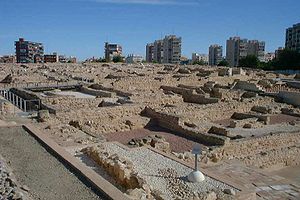 Although the Carthaginians conquered much of the land around Alicante, the Romans would eventually rule Hispania Tarraconensis
for over 700 years. By the 5th century AD, Rome was in decline and the Roman predecessor town of Alicante, known as Lucentum
(Latin), was more or less under the control of the Visigothic warlord Theudimer. However neither the Romans nor the Goths put up much resistance to the Arab conquest
of Medina Laqant in the 8th century. The Moors ruled southern and eastern Spain until the 11th century reconquista
(reconquest). Alicante was finally taken in 1246 by the Castilian king Alfonso X, but it passed soon and definitely to the Kingdom of Valencia
in 1298 with the King James II of Aragon
. It gained the status of Royal Village (Vila Reial) with representation in the medieval Valencian Parliament
.
After several decades of being the battlefield where the Kingdom of Castile
and the Crown of Aragón
clashed, Alicante became a major Mediterranean trading station exporting rice, wine, olive oil, oranges and wool. But between 1609 and 1614 King Felipe III
expelled thousands of morisco
s who had remained in Valencia after the Reconquista, due to their cooperation with Barbary pirates who continually attacked coastal cities and caused much harm to trade. This act cost the region dearly; with so many skilled artisans and agricultural labourers gone, the feudal nobility found itself sliding into bankruptcy. Things got worse in the early 18th century; after the War of Spanish Succession, Alicante went into a long, slow decline, surviving through the 18th and 19th centuries by making shoes and growing agricultural produce such as oranges and almonds, and thanks to its fisheries. The end of the 19th century witnessed a sharp recovery of the local economy with increasing international trade and the growth of the city harbour leading to increased exports of several products (particularly during World War I
when Spain was a neutral country).
During the early 20th century, Alicante was a minor capital which enjoyed the benefit of Spain's neutrality during World War I
, which provided new opportunities for the local industry and agriculture. The Rif War
in the 1920s saw numerous alicantinos drafted to fight in the long and bloody campaigns in the former Spanish protectorate (Northern Morocco) against the Rif rebels. The political unrest of the late 1920s led to the victory of Republican candidates in local council elections throughout the country, and the abdication of King Alfonso XIII. The proclamation of the Second Spanish Republic
was much celebrated in the city on 14 April 1931. The Spanish Civil War
broke out on 17 July 1936. Alicante was the last city loyal to the Republican government to be occupied by dictator Franco's troops on 1 April 1939, and its harbour saw the last Republican government officials fleeing the country. Even if not as infamous as the bombing of Guernica
by the German Luftwaffe, some vicious air bombings were targeted on Alicante during the three years of civil conflict, most notably the bombing by the Italian Aviazione Legionaria
of the Mercado de Abastos in 25 May 1938 in which more than 300 civilians perished.
 The next 20 years under Franco's dictatorship were difficult for Alicante, as they were for the entire country. However, the late 1950s and early 1960s saw the onset of a lasting transformation of the city by the tourist industry. Large buildings and complexes rose in nearby Albufereta and Playa de San Juan, with the benign climate being the biggest draw to attract prospective buyers and tourists who kept the hotels reasonably busy. New construction benefited the whole economy, as the development of the tourism sector also spawned new businesses such as restaurants, bars and other tourist-oriented enterprises. Also, the old airfield at Rabasa was closed and air traffic moved to the new El Altet Airport, which made a more convenient and modern facility for charter flights bringing tourists from northern European countries.
When dictator Franco died in 1975, his successor Juan Carlos I
played his part as the living symbol of the transition of Spain to a democratic constitutional monarchy. The governments of regional communities were given constitutional status as 'nationalities', and their governments were given more autonomy, including that of the Valencian region.
The port of Alicante
has been reinventing itself since the industrial decline the city suffered in the 1980s (with most mercantile traffic lost to Valencia's harbour). In recent years, the Port Authority has established it as one of the most important ports in Spain for cruises, with 72 calls to port made by cruise ships in 2007 bringing some 80,000 passengers and 30,000 crew to the city each year. The moves to develop the port for more tourism have been welcomed by the city and its residents, but the latest plans to develop an industrial estate
in the port have caused great controversy.
and particularly the second residence construction boom which started in the 1960s and reinvigorated again by the late 1990s. Services and public administration also play a major role in the city's economy. The construction boom has raised many environmental concerns and both the local autonomous government and city council are under scrutiny by the European Union. The construction surge is the subject of hot debates among politicians and citizens alike. The latest of many public battles concerns the plans of the Port Authority of Alicante to construct an industrial estate on reclaimed land in front of the city's coastal strip, in breach of local, national and European regulations. (See Port of Alicante
for the details).
The city is the headquarters of the Office for Harmonization in the Internal Market
and a sizeable population of European public workers live here.
The University of Alicante
is located in San Vicente del Raspeig
, right next to Alicante. More than 25,000 students attend the University.
Since 2005 Alicante has been home to Ciudad de la Luz, one of the largest film studios in Europe. Spanish and international movies such as Asterix at the Olympic Games
by Frédéric Forestier and Thomas Langmann, Manolete
by Menno Meyjes
have been shot there.
, Ecuador
, and Colombia
who have arrived in the previous 10 years. There are also immigrants from other countries such as Romania
, Russia
, Ukraine
and Morocco
, many of whom are under illegal alien status and therefore are not accounted for in official population figures. The real percentage of foreign residents is higher, since the Alicante metropolitan area is home to many Northern European retirees who are officially still residents of their own countries. In the same pattern, a sizable number of permanent residents are Spanish nationals who officially still live in Madrid
, the Basque provinces
, or other areas of the country.
(born in 1971) is the mayor of the city. She was elected for the post in an extraordinary plenary of the Alicante City Council on September 17, 2008, following the resignation of Luis Díaz Alperi
. She is the first woman ever to occupy this position.
In the latest municipal elections
of May 2011, Sonia Castedo
(1971) of the People's Party
(Partido Popular) won the elections with an absolute majority, larger than the one the former major (Luis Díaz Alperi) had, while the opposition (Socialist Party) lost some of their popular support.
At the foot of the main staircase of the City Hall Building (Ayuntamiento
) is the zero point (cota cero), used as the point of reference for measuring the height above or below sea level of any point in Spain, due to the marginal tidal variations of the Mediterranean sea in Alicante.
with mild temperatures throughout the year and little rain, concentrated in equinoctial periods. On average the temperature ranges between 16.8 °C (62 °F) and 6.2 °C (43 °F) in January and between 30.6 °C (87 °F) and 20.4 °C (69 °F) in August, with an average annual temperature of 17.8 °C (64 °F). Daily oscillations in temperature are very small due to the influence of the sea, although occasional periods of Westerly wind can result in temperature ranges in excess of 15 C-change. Annual oscillations in temperature are also small meaning that winters are mild and summers are warm.
The average amount of rainfall is 336 mm (13.2 in) per year. September and October are the wettest months due to torrential rain caused by the cold drop
, which can reach over 200 mm in a single 24 hour period causing severe flooding. Because of this irregularity, only 37 rainy days are observed on average per year, and the annual number of sunshine hours is 2,864.
The record maximum temperature of 41.4 °C (107 °F) was observed in Alicante on 4 July 1994. The record minimum temperature of -4.6 °C was registered on 12 February 1956. The worst flooding in modern history occurred on 30 September 1997 when 270.2 mm (10.6 in) of rainfall fell within six hours.
is among the busiest airports in Spain after Madrid, Barcelona, Palma de Mallorca
and Málaga
. It is connected with Madrid and Barcelona by frequent Iberia
and Spanair
flights, and with many Western European cities through carriers such as Ryanair
, Easyjet
, Air Berlin
, Monarch Airlines
, and Jet2.com
. There are also regular flights to Algeria
and Russia
from the airport.
Alicante railway station
is used by cercanías
linking Alicante with suburbs and Murcia
. Long-range RENFE
trains run frequently to Madrid
, Barcelona
, and Valencia.
Alicante Tram
connects the city with outlying settlements along Costa Blanca
. As of 2010, electric tram-train
s run up to Benidorm
, and diesel trains go further to Denia
.
The city has regular ferry
services to the Balearic Islands
and Algeria
. The city is strongly fortified, with a spacious harbour.
 Amongst the most notable features of the city are the Castle of Santa Bárbara
, which sits high above the city, and the port of Alicante
. The latter was the subject of bitter controversy in 2006-2007 as residents battled to keep it from being changed into an industrial estate.
The Santa Bárbara castle
is situated on Mount Benacantil
, overlooking the city. The tower (La Toreta) at the top, is the oldest part of the castle, while part of the lowest zone and the walls were constructed later, on the 18th century.
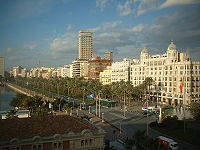
The promenade Explanada de España, lined by palm trees, is paved with 6.5 million marble floor tiles creating a wavy form and is one of the most lovely promenades in Spain. For the people of Alicante, it is the meeting place for the traditional Spanish paseo, or stroll along the waterfront in the evenings, and a venue for outdoor musical concerts. At the end of the promenade is a monument by the artist Mark Hersch, who still lives in the city.
Barrio de la Santa Cruz is a colourful quarter of the old city, situated on the south-west of Santa Bárbara castle
. Its small houses climb up the hill leading to the walls and the castle, through narrow streets decorated with flags and tubs of flowers.
L'Ereta Park is situated on the foothills of Mount Benacantil
, on the way to the castle. It runs from the Santa Bárbara castle down to the old part of Alicante and consists of several levels, routes, decks and rest stops which offer a panoramic view overlooking the city.
El Palmeral Park is one of the favorite parks of Alicante's citizens. It includes walking trails, children's playgrounds, ponds and brooks, picnic tables and an auditorium for concerts.
Just a few kilometers from Alicante on the Mediterranean Sea lies Tabarca
island. What was once a haven for Barbary pirates is now a beautiful tourist attraction.
Other sights include:
There are a dozen museums in Alicante. On exhibition at the Archaeological Museum of Alicante
(MARQ) are local artifacts dating from 100,000 years ago till the 19th century. The collection is divided into different rooms representing three divisions of archaeological methodology: ground, urban and underwater archaeology, with dioramas, audiovisual and interactive zones. The archaeological museum won the European Museum of the Year Award
in 2004. Gravina Museum of Fine Arts
presents a number of paintings and sculptures from the 16th century to 19th century. Asegurada Museum of Contemporary Art houses a major collection of twentieth-century art, composed mainly of works donated by Eusebio Sempere.
(Fogueres de Sant Joan), takes place during the summer solstice
. This is followed a week later by seven nights of firework and pyrotechnic contests between companies on the urban beach Playa del Postiguet. Another well-known festival is Moros i Cristians in Altozano or San Blas district. Overall, the city boasts a year-round nightlife for the enjoyment of tourists, fun-loving residents, and a large student population of the University of Alicante
. The nightlife social scene tends to shift to nearby Playa de San Juan (St. John's Beach) during the summer months.
Every summer in Alicante, a two-month-long programme of music, theatre and dance is staged in the Paseo del Puerto.
, which competes in the Spanish Segunda División
, and Alicante CF
, which plays in Segunda División B
. Hercules CF
hosts their home games at Estadio José Rico Pérez
. Alicante CF
plays at Campo Municipal de Villafranqueza.
Alicante serves as headquarters and the starting point of Volvo Ocean Race
, a yacht race around the world. The latest race starts in October 2011.
, France
Carloforte
, Italy
Herzliya
, Israel
León
, Nicaragua
Matanzas
, Cuba
Oran
, Algeria
Riga
, Latvia
Toyooka, Japan
Wenzhou
, People's Republic of China
In 2009 a bid was made to twin Newcastle
, United Kingdom with Alicante.
Spain
Spain , officially the Kingdom of Spain languages]] under the European Charter for Regional or Minority Languages. In each of these, Spain's official name is as follows:;;;;;;), is a country and member state of the European Union located in southwestern Europe on the Iberian Peninsula...
, the capital of the province of Alicante and of the comarca
Comarca
A comarca is a traditional region or local administrative division found in parts of Spain, Portugal, Panama, Nicaragua, and Brazil. The term is derived from the term marca, meaning a "march, mark", plus the prefix co- meaning "together, jointly".The comarca is known in Aragonese as redolada and...
of Alacantí
Alacantí
Alacantí is a comarca in the Valencian Community, Spain. It is bordered by the comarques of Marina Baixa and Alcoià to the north and Baix Vinalopó to the south....
, in the south of the Valencian Community
Valencian Community
The Valencian Community is an autonomous community of Spain located in central and south-eastern Iberian Peninsula. Its capital and largest city is Valencia...
. It is also a historic Mediterranean
Mediterranean Sea
The Mediterranean Sea is a sea connected to the Atlantic Ocean surrounded by the Mediterranean region and almost completely enclosed by land: on the north by Anatolia and Europe, on the south by North Africa, and on the east by the Levant...
port. The population of the city of Alicante proper was 334,418, estimated , ranking as the second-largest Valencian
Valencian Community
The Valencian Community is an autonomous community of Spain located in central and south-eastern Iberian Peninsula. Its capital and largest city is Valencia...
city. Including nearby municipalities, Alicante conurbation
Conurbation
A conurbation is a region comprising a number of cities, large towns, and other urban areas that, through population growth and physical expansion, have merged to form one continuous urban and industrially developed area...
was populated by 458,843 residents. Population of the metropolitan area
Metropolitan area
The term metropolitan area refers to a region consisting of a densely populated urban core and its less-populated surrounding territories, sharing industry, infrastructure, and housing. A metropolitan area usually encompasses multiple jurisdictions and municipalities: neighborhoods, townships,...
(including Elche/Elx
Elx
Elche or Elx is a city located in the comarca of Baix Vinalopó, in the Alicante province which, in turn, is a part of the Valencian Community, Spain...
and satellite towns) was 769,284 estimates, ranking as the eighth-largest metropolitan area of Spain.
History
The area around Alicante has been inhabited for over 7000 years, with the first tribes of hunter gatherers moving down gradually from Central Europe between 5000 and 3000 BC. Some of the earliest settlements were made on the slopes of Mount BenacantilMount Benacantil
Mount Benacantil is a mount that dominates the urban part of Alicante, and is the characteristic image of the city. The mount name appears as Banu-l-Qatil in the work of Muslim geographer Al-Idrisi in the 12th century, but it is possible that this is an error of transcription...
. By 1000 BC Greek
Ancient Greece
Ancient Greece is a civilization belonging to a period of Greek history that lasted from the Archaic period of the 8th to 6th centuries BC to the end of antiquity. Immediately following this period was the beginning of the Early Middle Ages and the Byzantine era. Included in Ancient Greece is the...
and Phoenicia
Phoenicia
Phoenicia , was an ancient civilization in Canaan which covered most of the western, coastal part of the Fertile Crescent. Several major Phoenician cities were built on the coastline of the Mediterranean. It was an enterprising maritime trading culture that spread across the Mediterranean from 1550...
n traders had begun to visit the eastern coast of Spain, establishing small trading ports and introducing the native Iberian tribes to the alphabet, iron and the pottery wheel. By the 3rd century BC, the rival armies of Carthage
Carthage
Carthage , implying it was a 'new Tyre') is a major urban centre that has existed for nearly 3,000 years on the Gulf of Tunis, developing from a Phoenician colony of the 1st millennium BC...
and Rome
Ancient Rome
Ancient Rome was a thriving civilization that grew on the Italian Peninsula as early as the 8th century BC. Located along the Mediterranean Sea and centered on the city of Rome, it expanded to one of the largest empires in the ancient world....
began to invade and fight for control of the Iberian Peninsula. The Carthaginian general Hamilcar Barca
Hamilcar Barca
Hamilcar Barca or Barcas was a Carthaginian general and statesman, leader of the Barcid family, and father of Hannibal, Hasdrubal and Mago. He was also father-in-law to Hasdrubal the Fair....
established the fortified settlement of Akra Leuka (Greek
Greek language
Greek is an independent branch of the Indo-European family of languages. Native to the southern Balkans, it has the longest documented history of any Indo-European language, spanning 34 centuries of written records. Its writing system has been the Greek alphabet for the majority of its history;...
: , meaning "White Mountain" or "White Point"), where Alicante stands today.
Hispania Tarraconensis
Hispania Tarraconensis was one of three Roman provinces in Hispania. It encompassed much of the Mediterranean coast of Spain along with the central plateau. Southern Spain, the region now called Andalusia, was the province of Hispania Baetica...
for over 700 years. By the 5th century AD, Rome was in decline and the Roman predecessor town of Alicante, known as Lucentum
Lucentum
Lucentum is the name of the Roman predecessor of the city of Alicante, Spain. Particularly, it refers to the archaeological site in which the remains of this ancient settlement lie, at a place known as El Tossal de Manises, in the neighborhood of Albufereta.-Ancient History:Before the arrival of...
(Latin), was more or less under the control of the Visigothic warlord Theudimer. However neither the Romans nor the Goths put up much resistance to the Arab conquest
Umayyad conquest of Hispania
The Umayyad conquest of Hispania is the initial Islamic Ummayad Caliphate's conquest, between 711 and 718, of the Christian Visigothic Kingdom of Hispania, centered in the Iberian Peninsula, which was known to them under the Arabic name al-Andalus....
of Medina Laqant in the 8th century. The Moors ruled southern and eastern Spain until the 11th century reconquista
Reconquista
The Reconquista was a period of almost 800 years in the Middle Ages during which several Christian kingdoms succeeded in retaking the Muslim-controlled areas of the Iberian Peninsula broadly known as Al-Andalus...
(reconquest). Alicante was finally taken in 1246 by the Castilian king Alfonso X, but it passed soon and definitely to the Kingdom of Valencia
Kingdom of Valencia
The Kingdom of Valencia , located in the eastern shore of the Iberian Peninsula, was one of the component realms of the Crown of Aragon. When the Crown of Aragon merged by dynastic union with the Crown of Castile to form the Kingdom of Spain, the Kingdom of Valencia became a component realm of the...
in 1298 with the King James II of Aragon
James II of Aragon
James II , called the Just was the King of Sicily from 1285 to 1296 and King of Aragon and Valencia and Count of Barcelona from 1291 to 1327. In 1297 he was granted the Kingdom of Sardinia and Corsica...
. It gained the status of Royal Village (Vila Reial) with representation in the medieval Valencian Parliament
Corts Valencianes
The Corts Valencianes are the main legislative body of the Generalitat Valenciana and therefore of the Valencian Community. The main location of the Corts is in the Palace of Benicarló in Valencia; however it can meet at any location in Valencian territory. The Corts has its origins in bodies...
.
After several decades of being the battlefield where the Kingdom of Castile
Kingdom of Castile
Kingdom of Castile was one of the medieval kingdoms of the Iberian Peninsula. It emerged as a political autonomous entity in the 9th century. It was called County of Castile and was held in vassalage from the Kingdom of León. Its name comes from the host of castles constructed in the region...
and the Crown of Aragón
Crown of Aragon
The Crown of Aragon Corona d'Aragón Corona d'Aragó Corona Aragonum controlling a large portion of the present-day eastern Spain and southeastern France, as well as some of the major islands and mainland possessions stretching across the Mediterranean as far as Greece...
clashed, Alicante became a major Mediterranean trading station exporting rice, wine, olive oil, oranges and wool. But between 1609 and 1614 King Felipe III
Philip III of Spain
Philip III , also known as Philip the Pious, was the King of Spain and King of Portugal and the Algarves, where he ruled as Philip II , from 1598 until his death...
expelled thousands of morisco
Morisco
Moriscos or Mouriscos , meaning "Moorish", were the converted Christian inhabitants of Spain and Portugal of Muslim heritage. Over time the term was used in a pejorative sense applied to those nominal Catholics who were suspected of secretly practicing Islam.-Demographics:By the beginning of the...
s who had remained in Valencia after the Reconquista, due to their cooperation with Barbary pirates who continually attacked coastal cities and caused much harm to trade. This act cost the region dearly; with so many skilled artisans and agricultural labourers gone, the feudal nobility found itself sliding into bankruptcy. Things got worse in the early 18th century; after the War of Spanish Succession, Alicante went into a long, slow decline, surviving through the 18th and 19th centuries by making shoes and growing agricultural produce such as oranges and almonds, and thanks to its fisheries. The end of the 19th century witnessed a sharp recovery of the local economy with increasing international trade and the growth of the city harbour leading to increased exports of several products (particularly during World War I
World War I
World War I , which was predominantly called the World War or the Great War from its occurrence until 1939, and the First World War or World War I thereafter, was a major war centred in Europe that began on 28 July 1914 and lasted until 11 November 1918...
when Spain was a neutral country).
During the early 20th century, Alicante was a minor capital which enjoyed the benefit of Spain's neutrality during World War I
World War I
World War I , which was predominantly called the World War or the Great War from its occurrence until 1939, and the First World War or World War I thereafter, was a major war centred in Europe that began on 28 July 1914 and lasted until 11 November 1918...
, which provided new opportunities for the local industry and agriculture. The Rif War
Rif War (1920)
The Rif War, also called the Second Moroccan War, was fought between Spain and the Moroccan Rif Berbers.-Rifian forces:...
in the 1920s saw numerous alicantinos drafted to fight in the long and bloody campaigns in the former Spanish protectorate (Northern Morocco) against the Rif rebels. The political unrest of the late 1920s led to the victory of Republican candidates in local council elections throughout the country, and the abdication of King Alfonso XIII. The proclamation of the Second Spanish Republic
Second Spanish Republic
The Second Spanish Republic was the government of Spain between April 14 1931, and its destruction by a military rebellion, led by General Francisco Franco....
was much celebrated in the city on 14 April 1931. The Spanish Civil War
Spanish Civil War
The Spanish Civil WarAlso known as The Crusade among Nationalists, the Fourth Carlist War among Carlists, and The Rebellion or Uprising among Republicans. was a major conflict fought in Spain from 17 July 1936 to 1 April 1939...
broke out on 17 July 1936. Alicante was the last city loyal to the Republican government to be occupied by dictator Franco's troops on 1 April 1939, and its harbour saw the last Republican government officials fleeing the country. Even if not as infamous as the bombing of Guernica
Bombing of Guernica
The bombing of Guernica was an aerial attack on the Basque town of Guernica, Spain, causing widespread destruction and civilian deaths, during the Spanish Civil War...
by the German Luftwaffe, some vicious air bombings were targeted on Alicante during the three years of civil conflict, most notably the bombing by the Italian Aviazione Legionaria
Aviazione Legionaria
The Legionary Air Force was an expeditionary corps from the Italian Royal Air Force. It was set up in 1936 and sent to provide logistical and tactical support to Francisco Franco's Nationalists during the Spanish Civil War, alongside its German equivalent, the Condor Legion, and the Italian ground...
of the Mercado de Abastos in 25 May 1938 in which more than 300 civilians perished.
When dictator Franco died in 1975, his successor Juan Carlos I
Juan Carlos I of Spain
Juan Carlos I |Italy]]) is the reigning King of Spain.On 22 November 1975, two days after the death of General Francisco Franco, Juan Carlos was designated king according to the law of succession promulgated by Franco. Spain had no monarch for 38 years in 1969 when Franco named Juan Carlos as the...
played his part as the living symbol of the transition of Spain to a democratic constitutional monarchy. The governments of regional communities were given constitutional status as 'nationalities', and their governments were given more autonomy, including that of the Valencian region.
The port of Alicante
Port of Alicante
The Port of Alicante is a seaport in Alicante, Spain on the Mediterranean Sea used for commercial and passenger traffic. The port is administered by the Port Authority of Alicante.-History:...
has been reinventing itself since the industrial decline the city suffered in the 1980s (with most mercantile traffic lost to Valencia's harbour). In recent years, the Port Authority has established it as one of the most important ports in Spain for cruises, with 72 calls to port made by cruise ships in 2007 bringing some 80,000 passengers and 30,000 crew to the city each year. The moves to develop the port for more tourism have been welcomed by the city and its residents, but the latest plans to develop an industrial estate
Industrial park
An industrial park is an area zoned and planned for the purpose of industrial development...
in the port have caused great controversy.
Economy
Alicante is one of the fastest-growing cities in Spain. The local economy is based upon tourism directed to the beaches of the Costa BlancaCosta Blanca
Costa Blanca refers to the over 200 kilometres of coastline belonging to the province of Alicante in Spain. The name "Costa Blanca" was devised as a promotional name used by BEA when they launched their air service between London and Valencia in 1957. It has a well-developed tourism industry...
and particularly the second residence construction boom which started in the 1960s and reinvigorated again by the late 1990s. Services and public administration also play a major role in the city's economy. The construction boom has raised many environmental concerns and both the local autonomous government and city council are under scrutiny by the European Union. The construction surge is the subject of hot debates among politicians and citizens alike. The latest of many public battles concerns the plans of the Port Authority of Alicante to construct an industrial estate on reclaimed land in front of the city's coastal strip, in breach of local, national and European regulations. (See Port of Alicante
Port of Alicante
The Port of Alicante is a seaport in Alicante, Spain on the Mediterranean Sea used for commercial and passenger traffic. The port is administered by the Port Authority of Alicante.-History:...
for the details).
The city is the headquarters of the Office for Harmonization in the Internal Market
Office for Harmonization in the Internal Market
The Office for Harmonization in the Internal Market , or OHIM is the trademark and designs registry for the internal market of the European Union. It is based in Alicante, Spain, and its president is António Campinos.- Task :...
and a sizeable population of European public workers live here.
The University of Alicante
University of Alicante
The University of Alicante was established in 1979 on the basis of the Center for University Studies , which was founded in 1968. The University main campus is located in San Vicente del Raspeig/Sant Vicent del Raspeig, bordering the city of Alicante to the north...
is located in San Vicente del Raspeig
San Vicente del Raspeig
San Vicente del Raspeig or Sant Vicent del Raspeig is a municipality located in the comarca of Alacantí, in the province of Alicante, Spain, inside the conurbation of Alicante city ....
, right next to Alicante. More than 25,000 students attend the University.
Since 2005 Alicante has been home to Ciudad de la Luz, one of the largest film studios in Europe. Spanish and international movies such as Asterix at the Olympic Games
Astérix at the Olympic Games (film)
Asterix at the Olympic Games is a French film, adapted from René Goscinny and Albert Uderzo's Astérix comic series. It was filmed essentially in Spain in the course of the year 2006. Its €78 million budget makes it one of the most expensive European movies ever...
by Frédéric Forestier and Thomas Langmann, Manolete
Manolete (film)
The Passion Within , Blood and Passion , and A Matador’s Mistress , is a 2007 biopic of bullfighter Manuel Laureano Rodríguez Sánchez better known as Manolete, was written and directed by Menno Meyjes. This is the first film from HandMade Films since Lock, Stock and Two Smoking Barrels...
by Menno Meyjes
Menno Meyjes
Menno Meyjes is a Dutch-born screenwriter, film director and producer.He moved to the United States in 1972 and studied at the Art Institute of California – San Francisco. He was nominated for several awards for his screenplay to the 1985 film The Color Purple, adapted from the novel by Alice Walker...
have been shot there.
Population
The official population of Alicante in 2010 was 334,418 inhabitants and 769,284 in the metropolitan area "Alicante-Elche". About 15% of the population is foreign, most of them immigrants from ArgentinaArgentina
Argentina , officially the Argentine Republic , is the second largest country in South America by land area, after Brazil. It is constituted as a federation of 23 provinces and an autonomous city, Buenos Aires...
, Ecuador
Ecuador
Ecuador , officially the Republic of Ecuador is a representative democratic republic in South America, bordered by Colombia on the north, Peru on the east and south, and by the Pacific Ocean to the west. It is one of only two countries in South America, along with Chile, that do not have a border...
, and Colombia
Colombia
Colombia, officially the Republic of Colombia , is a unitary constitutional republic comprising thirty-two departments. The country is located in northwestern South America, bordered to the east by Venezuela and Brazil; to the south by Ecuador and Peru; to the north by the Caribbean Sea; to the...
who have arrived in the previous 10 years. There are also immigrants from other countries such as Romania
Romania
Romania is a country located at the crossroads of Central and Southeastern Europe, on the Lower Danube, within and outside the Carpathian arch, bordering on the Black Sea...
, Russia
Russia
Russia or , officially known as both Russia and the Russian Federation , is a country in northern Eurasia. It is a federal semi-presidential republic, comprising 83 federal subjects...
, Ukraine
Ukraine
Ukraine is a country in Eastern Europe. It has an area of 603,628 km², making it the second largest contiguous country on the European continent, after Russia...
and Morocco
Morocco
Morocco , officially the Kingdom of Morocco , is a country located in North Africa. It has a population of more than 32 million and an area of 710,850 km², and also primarily administers the disputed region of the Western Sahara...
, many of whom are under illegal alien status and therefore are not accounted for in official population figures. The real percentage of foreign residents is higher, since the Alicante metropolitan area is home to many Northern European retirees who are officially still residents of their own countries. In the same pattern, a sizable number of permanent residents are Spanish nationals who officially still live in Madrid
Madrid
Madrid is the capital and largest city of Spain. The population of the city is roughly 3.3 million and the entire population of the Madrid metropolitan area is calculated to be 6.271 million. It is the third largest city in the European Union, after London and Berlin, and its metropolitan...
, the Basque provinces
Basque Country (autonomous community)
The Basque Country is an autonomous community of northern Spain. It includes the Basque provinces of Álava, Biscay and Gipuzkoa, also called Historical Territories....
, or other areas of the country.
EWLINE
|
|
Government
Sonia CastedoSonia Castedo
Sonia Castedo Ramos is a Spanish politician and the current mayor of Alicante.Sonia was born in Ribadeo, Galicia in 1971, and has been living in Alicante since her childhood. She graduated from the University of Alicante with a degree in Sociology....
(born in 1971) is the mayor of the city. She was elected for the post in an extraordinary plenary of the Alicante City Council on September 17, 2008, following the resignation of Luis Díaz Alperi
Luis Díaz Alperi
Luis Bernardo Diaz Alperi is a Spanish politician and a former mayor of Alicante.Luis was born in Oviedo in 1945. He was mayor of Alicante from 1995 to 2008 having won four consecutive municipal elections....
. She is the first woman ever to occupy this position.
In the latest municipal elections
Spanish local and regional elections, 2011
Local and regional elections were held on 22 May 2011 in Spain. Local elections are held at once across all of Spain, while regional elections were held in 13 of Spain's 17 autonomous communities; Andalusia, Catalonia, Galicia, and the Basque Country have different electoral cycles.The days before...
of May 2011, Sonia Castedo
Sonia Castedo
Sonia Castedo Ramos is a Spanish politician and the current mayor of Alicante.Sonia was born in Ribadeo, Galicia in 1971, and has been living in Alicante since her childhood. She graduated from the University of Alicante with a degree in Sociology....
(1971) of the People's Party
People's Party (Spain)
The People's Party is a conservative political party in Spain.The People's Party was a re-foundation in 1989 of the People's Alliance , a party led and founded by Manuel Fraga Iribarne, a former Minister of Tourism during Francisco Franco's dictatorship...
(Partido Popular) won the elections with an absolute majority, larger than the one the former major (Luis Díaz Alperi) had, while the opposition (Socialist Party) lost some of their popular support.
At the foot of the main staircase of the City Hall Building (Ayuntamiento
Ayuntamiento
Ayuntamiento In other languages of Spain:*Catalan/Valencian .*Galician .*Basque . is the general term for the council of a municipality, or sometimes the municipality itself, in Spain and Latin America. Historically Ayuntamiento was often preceded by the word excelentísimo , when referring to...
) is the zero point (cota cero), used as the point of reference for measuring the height above or below sea level of any point in Spain, due to the marginal tidal variations of the Mediterranean sea in Alicante.
Climate
Alicante enjoys a Mediterranean climateMediterranean climate
A Mediterranean climate is the climate typical of most of the lands in the Mediterranean Basin, and is a particular variety of subtropical climate...
with mild temperatures throughout the year and little rain, concentrated in equinoctial periods. On average the temperature ranges between 16.8 °C (62 °F) and 6.2 °C (43 °F) in January and between 30.6 °C (87 °F) and 20.4 °C (69 °F) in August, with an average annual temperature of 17.8 °C (64 °F). Daily oscillations in temperature are very small due to the influence of the sea, although occasional periods of Westerly wind can result in temperature ranges in excess of 15 C-change. Annual oscillations in temperature are also small meaning that winters are mild and summers are warm.
The average amount of rainfall is 336 mm (13.2 in) per year. September and October are the wettest months due to torrential rain caused by the cold drop
Cold drop
The cold drop is a meteorological phenomenon that appears when a front of very cold polar air, a jet stream, advances slowly over Western Europe, at high altitude ....
, which can reach over 200 mm in a single 24 hour period causing severe flooding. Because of this irregularity, only 37 rainy days are observed on average per year, and the annual number of sunshine hours is 2,864.
The record maximum temperature of 41.4 °C (107 °F) was observed in Alicante on 4 July 1994. The record minimum temperature of -4.6 °C was registered on 12 February 1956. The worst flooding in modern history occurred on 30 September 1997 when 270.2 mm (10.6 in) of rainfall fell within six hours.
Transport
Alicante AirportAlicante Airport
Alicante Airport , , originally named El Altet, is the sixth busiest airport in Spain, and the main airport for the Province of Alicante and the Region of Murcia. The airport is situated southwest of Alicante and east of Elche in the municipality of Elche on Mediterranean coast. Up to eighty...
is among the busiest airports in Spain after Madrid, Barcelona, Palma de Mallorca
Palma de Mallorca Airport
Palma de Mallorca Airport is an airport located east of Palma, Majorca, adjacent to the village of Can Pastilla. Also known as Son Sant Joan Airport or Aeroport de Son Sant Joan, it is the third largest airport in Spain, after Madrid's Barajas Airport and Barcelona Airport...
and Málaga
Málaga Airport
Málaga Airport , also known as Malaga Costa Del Sol Airport and Pablo Ruiz Picasso Airport, is the fourth busiest airport in Spain after Madrid-Barajas, Barcelona and Palma de Mallorca. It is an important airport for Spanish tourism as it is the main international airport serving the Costa Del Sol....
. It is connected with Madrid and Barcelona by frequent Iberia
Iberia Airlines
Iberia Líneas Aéreas de España, S.A., commonly known as Iberia, is the flag carrier airline of Spain. Based in Madrid, it operates an international network of services from its main bases of Madrid-Barajas Airport and Barcelona El Prat Airport....
and Spanair
Spanair
Spanair is a Spanish airline, with its head office in the Spanair Building in L'Hospitalet de Llobregat, near Barcelona. It was, until 2009, a subsidiary of Scandinavian Airlines, which now holds slightly under 20% of the company. Spanair provides a scheduled passenger network within Spain and...
flights, and with many Western European cities through carriers such as Ryanair
Ryanair
Ryanair is an Irish low-cost airline. Its head office is at Dublin Airport and its primary operational bases at Dublin Airport and London Stansted Airport....
, Easyjet
EasyJet
EasyJet Airline Company Limited is a British airline headquartered at London Luton Airport. It carries more passengers than any other United Kingdom-based airline, operating domestic and international scheduled services on 500 routes between 118 European, North African, and West Asian airports...
, Air Berlin
Air Berlin
Air Berlin PLC & Co. Luftverkehrs KG is Germany's second largest airline, after Lufthansa, and Europe's sixth largest airline in terms of passengers....
, Monarch Airlines
Monarch Airlines
Monarch Airlines, often shortened to and trading as Monarch, is a British charter and scheduled airline based at London Luton Airport in Luton. It is one of the United Kingdom's largest charter airlines, operating to Europe, the United States, the Caribbean, India and Africa, serving mainly leisure...
, and Jet2.com
Jet2.com
Jet2.com Limited is a British low-cost airline based at Leeds Bradford Airport, England. It operates services from eight UK bases to 54 destinations. The airline also offers contract charter and air cargo services. Its main base and headquarters is at Leeds Bradford Airport, with smaller bases at...
. There are also regular flights to Algeria
Algeria
Algeria , officially the People's Democratic Republic of Algeria , also formally referred to as the Democratic and Popular Republic of Algeria, is a country in the Maghreb region of Northwest Africa with Algiers as its capital.In terms of land area, it is the largest country in Africa and the Arab...
and Russia
Russia
Russia or , officially known as both Russia and the Russian Federation , is a country in northern Eurasia. It is a federal semi-presidential republic, comprising 83 federal subjects...
from the airport.
Alicante railway station
Alicante railway station
Alicante terminal is the central railway station of Alicante, Spain. Commonly referred locally as the RENFE station, the station is part of Adif system, and is a terminal station....
is used by cercanías
Cercanías
Cercanías is the name given to the commuter rail systems of Spain's major metropolitan areas. In Catalonia and Valencia, however, the term is replaced by Rodalies , while the designation Aldirikoak is used in the Basque Country....
linking Alicante with suburbs and Murcia
Murcia
-History:It is widely believed that Murcia's name is derived from the Latin words of Myrtea or Murtea, meaning land of Myrtle , although it may also be a derivation of the word Murtia, which would mean Murtius Village...
. Long-range RENFE
RENFE
Renfe Operadora is the state-owned company which operates freight and passenger trains on the 1668-mm "Iberian gauge" and 1435-mm "European gauge" networks of the Spanish national railway infrastructure company ADIF .- History :The name RENFE is derived from that of the former Spanish National...
trains run frequently to Madrid
Madrid
Madrid is the capital and largest city of Spain. The population of the city is roughly 3.3 million and the entire population of the Madrid metropolitan area is calculated to be 6.271 million. It is the third largest city in the European Union, after London and Berlin, and its metropolitan...
, Barcelona
Barcelona
Barcelona is the second largest city in Spain after Madrid, and the capital of Catalonia, with a population of 1,621,537 within its administrative limits on a land area of...
, and Valencia.
Alicante Tram
Alicante Tram
The Alicante Metropolitan TRAM operates in the Spanish city of Alicante and its surrounding area and, like other narrow gauge railways in the Valencian Community, is run by Ferrocarrils de la Generalitat Valenciana...
connects the city with outlying settlements along Costa Blanca
Costa Blanca
Costa Blanca refers to the over 200 kilometres of coastline belonging to the province of Alicante in Spain. The name "Costa Blanca" was devised as a promotional name used by BEA when they launched their air service between London and Valencia in 1957. It has a well-developed tourism industry...
. As of 2010, electric tram-train
Tram-train
A tram-train is a light-rail public transport system where trams run both on an urban tramway network and on main-line railways to combine the tram's flexibility and availability and the train's greater speed...
s run up to Benidorm
Benidorm
Benidorm is a coastal town and municipality located in the comarca of Marina Baixa, in the province of Alicante, Valencian community, Spain, by the Western Mediterranean....
, and diesel trains go further to Denia
Dénia
Dénia is a city in the province of Alicante, Spain, on the Costa Blanca halfway between Alicante and Valencia, the judicial seat of the comarca of Marina Alta...
.
The city has regular ferry
Ferry
A ferry is a form of transportation, usually a boat, but sometimes a ship, used to carry primarily passengers, and sometimes vehicles and cargo as well, across a body of water. Most ferries operate on regular, frequent, return services...
services to the Balearic Islands
Balearic Islands
The Balearic Islands are an archipelago of Spain in the western Mediterranean Sea, near the eastern coast of the Iberian Peninsula.The four largest islands are: Majorca, Minorca, Ibiza and Formentera. The archipelago forms an autonomous community and a province of Spain with Palma as the capital...
and Algeria
Algeria
Algeria , officially the People's Democratic Republic of Algeria , also formally referred to as the Democratic and Popular Republic of Algeria, is a country in the Maghreb region of Northwest Africa with Algiers as its capital.In terms of land area, it is the largest country in Africa and the Arab...
. The city is strongly fortified, with a spacious harbour.
Main sights
Castle of Santa Bárbara
The Castle of Santa Bárbara is a fortification in the center of Alicante, Spain. It stands on the Mount Benacantil .-History:Bronze Age, Iberian, and Roman artifacts have been found on the slopes of the mountain, but the origins of the castle date to the 9th century at the time of Muslim control...
, which sits high above the city, and the port of Alicante
Port of Alicante
The Port of Alicante is a seaport in Alicante, Spain on the Mediterranean Sea used for commercial and passenger traffic. The port is administered by the Port Authority of Alicante.-History:...
. The latter was the subject of bitter controversy in 2006-2007 as residents battled to keep it from being changed into an industrial estate.
The Santa Bárbara castle
Castle of Santa Bárbara
The Castle of Santa Bárbara is a fortification in the center of Alicante, Spain. It stands on the Mount Benacantil .-History:Bronze Age, Iberian, and Roman artifacts have been found on the slopes of the mountain, but the origins of the castle date to the 9th century at the time of Muslim control...
is situated on Mount Benacantil
Mount Benacantil
Mount Benacantil is a mount that dominates the urban part of Alicante, and is the characteristic image of the city. The mount name appears as Banu-l-Qatil in the work of Muslim geographer Al-Idrisi in the 12th century, but it is possible that this is an error of transcription...
, overlooking the city. The tower (La Toreta) at the top, is the oldest part of the castle, while part of the lowest zone and the walls were constructed later, on the 18th century.
The promenade Explanada de España, lined by palm trees, is paved with 6.5 million marble floor tiles creating a wavy form and is one of the most lovely promenades in Spain. For the people of Alicante, it is the meeting place for the traditional Spanish paseo, or stroll along the waterfront in the evenings, and a venue for outdoor musical concerts. At the end of the promenade is a monument by the artist Mark Hersch, who still lives in the city.
Barrio de la Santa Cruz is a colourful quarter of the old city, situated on the south-west of Santa Bárbara castle
Castle of Santa Bárbara
The Castle of Santa Bárbara is a fortification in the center of Alicante, Spain. It stands on the Mount Benacantil .-History:Bronze Age, Iberian, and Roman artifacts have been found on the slopes of the mountain, but the origins of the castle date to the 9th century at the time of Muslim control...
. Its small houses climb up the hill leading to the walls and the castle, through narrow streets decorated with flags and tubs of flowers.
L'Ereta Park is situated on the foothills of Mount Benacantil
Mount Benacantil
Mount Benacantil is a mount that dominates the urban part of Alicante, and is the characteristic image of the city. The mount name appears as Banu-l-Qatil in the work of Muslim geographer Al-Idrisi in the 12th century, but it is possible that this is an error of transcription...
, on the way to the castle. It runs from the Santa Bárbara castle down to the old part of Alicante and consists of several levels, routes, decks and rest stops which offer a panoramic view overlooking the city.
El Palmeral Park is one of the favorite parks of Alicante's citizens. It includes walking trails, children's playgrounds, ponds and brooks, picnic tables and an auditorium for concerts.
Just a few kilometers from Alicante on the Mediterranean Sea lies Tabarca
Tabarca
Tabarca , is an islet located in the Mediterranean Sea, close to the town of Santa Pola, in the province of Alicante, Valencian community, Spain...
island. What was once a haven for Barbary pirates is now a beautiful tourist attraction.
Other sights include:
- Basilica of Santa MaríaBasilica of Santa Maria, AlicanteThe Basilica of Santa Maria is the oldest active church in Alicante, Spain. It was built in Gothic style between the 14th and 16th centuries over the remains of a mosque....
(14th-16th centuries), built in GothicGothic architectureGothic architecture is a style of architecture that flourished during the high and late medieval period. It evolved from Romanesque architecture and was succeeded by Renaissance architecture....
style over the former main mosque. Other features include the high altar, in Rococo style, and the portal, in BaroqueBaroqueThe Baroque is a period and the style that used exaggerated motion and clear, easily interpreted detail to produce drama, tension, exuberance, and grandeur in sculpture, painting, literature, dance, and music...
style, both from the 18th century. - Co-cathedral of St. Nicholas of BariSan Nicolas Cathedral, AlicanteThe San Nicolas Cathedral is a Roman Catholic co-cathedral located in Alicante, Spain. The church, under the Diocese of Orihuela-Alicante is dedicated to Saint Nicholas and was elevated to the title of cathedral on 9 March 1959 by Pope John XXIII....
(15th-18th centuries), also built over a mosque. It is the main church of Alicante and the bishop's seat. - Monastery of Santa Faz (15th century), located 5 km outside the city, in Baroque style.
- Defence towers of the Huerta de Alicante (15th-18th centuries), built to defend against the Barbary pirates. Today some 20 towers are still extant.
- Baroque Casa de La Asegurada (1685), the most ancient civil building in the city. (s. XVII). Today it is home to the Museum of Contemporary Art of Alicante.
- Casa consistorial de Alicante (18th century), also in Baroque style.
- Convent of the Canónigas de San Agustín (18th century).
- Gravina Palace (1748–1808), nowadays hosting Gravina Museum of Fine ArtsGravina Museum of Fine ArtsGravina Museum of Fine Arts is a museum in the city of Alicante, Spain, located in the Palacio del Conde de Lumiares, a four floor building constructed between 1748 and 1808 and declared a historical monument.The museum is devoted to painting and sculpture of Alicante from the sixteenth century...
. - Castle of San Fernando.
There are a dozen museums in Alicante. On exhibition at the Archaeological Museum of Alicante
Archaeological Museum of Alicante
The Archaeological Museum of Alicante is an archaeological museum in Alicante, Spain. The museum won the European Museum of the Year Award in 2004, a few years after significant expansion and reallocation to renovated buildings of the antique hospital of San Juan de Dios...
(MARQ) are local artifacts dating from 100,000 years ago till the 19th century. The collection is divided into different rooms representing three divisions of archaeological methodology: ground, urban and underwater archaeology, with dioramas, audiovisual and interactive zones. The archaeological museum won the European Museum of the Year Award
European Museum of the Year Award
The European Museum of the Year Award , established in 1977, is presented each year by the European Museum Forum , under the Council of Europe...
in 2004. Gravina Museum of Fine Arts
Gravina Museum of Fine Arts
Gravina Museum of Fine Arts is a museum in the city of Alicante, Spain, located in the Palacio del Conde de Lumiares, a four floor building constructed between 1748 and 1808 and declared a historical monument.The museum is devoted to painting and sculpture of Alicante from the sixteenth century...
presents a number of paintings and sculptures from the 16th century to 19th century. Asegurada Museum of Contemporary Art houses a major collection of twentieth-century art, composed mainly of works donated by Eusebio Sempere.
Festivals
The most important festival, the Bonfires of Saint JohnBonfires of Saint John
Bonfires of Saint John is a popular festival celebrated around 24 June Saint John's day throughout many cities and towns in Spain; however, the largest is in Alicante, where it is considered the most important festival in the city...
(Fogueres de Sant Joan), takes place during the summer solstice
Solstice
A solstice is an astronomical event that happens twice each year when the Sun's apparent position in the sky, as viewed from Earth, reaches its northernmost or southernmost extremes...
. This is followed a week later by seven nights of firework and pyrotechnic contests between companies on the urban beach Playa del Postiguet. Another well-known festival is Moros i Cristians in Altozano or San Blas district. Overall, the city boasts a year-round nightlife for the enjoyment of tourists, fun-loving residents, and a large student population of the University of Alicante
University of Alicante
The University of Alicante was established in 1979 on the basis of the Center for University Studies , which was founded in 1968. The University main campus is located in San Vicente del Raspeig/Sant Vicent del Raspeig, bordering the city of Alicante to the north...
. The nightlife social scene tends to shift to nearby Playa de San Juan (St. John's Beach) during the summer months.
Every summer in Alicante, a two-month-long programme of music, theatre and dance is staged in the Paseo del Puerto.
Sport
The two established Alicante football teams are Hércules CFHércules CF
Hércules Club de Fútbol, S.A.D. is a Spanish football team based in Alicante, in the autonomous community of Valencia. Founded in 1922, it currently plays in the Spanish second division, and holds home games at the Estadio José Rico Pérez, which seats 30,000 spectators.-History:After first...
, which competes in the Spanish Segunda División
Segunda División
The Segunda División is the lower tier of the two professional football leagues in Spain. From the season 2008-09 onwards, the name of the league is Liga Adelante.-History:...
, and Alicante CF
Alicante CF
Alicante Club de Fútbol is a Spanish football team based in Alicante, in the autonomous community of Valencia. Founded in 1918, it plays in Tercera División – Group 6, holding home matches at Ciudad Deportiva Villafranqueza.-History:...
, which plays in Segunda División B
Segunda División B
Segunda División B is the third level of the Spanish football league system. It is administered by the RFEF. The top two levels are La Liga, also referred to as the Primera División, and the Segunda División. Immediately below Segunda División B is the Tercera Division...
. Hercules CF
Hércules CF
Hércules Club de Fútbol, S.A.D. is a Spanish football team based in Alicante, in the autonomous community of Valencia. Founded in 1922, it currently plays in the Spanish second division, and holds home games at the Estadio José Rico Pérez, which seats 30,000 spectators.-History:After first...
hosts their home games at Estadio José Rico Pérez
Estadio José Rico Pérez
Estadio José Rico Pérez is a multi-purpose stadium in Alicante, Spain. It is currently used mostly for football matches, being home to Hércules CF. It also held World Cup matches when Spain organized the event in 1982. The stadium can hold up to 30,000 people...
. Alicante CF
Alicante CF
Alicante Club de Fútbol is a Spanish football team based in Alicante, in the autonomous community of Valencia. Founded in 1918, it plays in Tercera División – Group 6, holding home matches at Ciudad Deportiva Villafranqueza.-History:...
plays at Campo Municipal de Villafranqueza.
Alicante serves as headquarters and the starting point of Volvo Ocean Race
Volvo Ocean Race
The Volvo Ocean Race is a yacht race around the world, held every three years. It is named after its current owner, Volvo...
, a yacht race around the world. The latest race starts in October 2011.
Famous citizens
- George Washington Montgomery (1804–1841), born in Alicante, United StatesUnited StatesThe United States of America is a federal constitutional republic comprising fifty states and a federal district...
diplomat and editor/publisher of the first Spanish languageSpanish languageSpanish , also known as Castilian , is a Romance language in the Ibero-Romance group that evolved from several languages and dialects in central-northern Iberia around the 9th century and gradually spread with the expansion of the Kingdom of Castile into central and southern Iberia during the...
translation of the works of Washington IrvingWashington IrvingWashington Irving was an American author, essayist, biographer and historian of the early 19th century. He was best known for his short stories "The Legend of Sleepy Hollow" and "Rip Van Winkle", both of which appear in his book The Sketch Book of Geoffrey Crayon, Gent. His historical works...
. - Carlos ArnichesCarlos ArnichesCarlos Arniches was a Spanish playwright. His work, drawing on the traditions of the género chico, the zarzuela and the grotesque, came to dominate the Spanish comic theatre in the early twentieth century....
(1866–1943), novelist - Rafael Altamira y CreveaRafael Altamira y CreveaRafael Altamira y Crevea was a Spanish historian and jurist.Born in Alicante, Altamira is considered to be one of the most significant Spanish historians of the 20th century, was a multi-faceted scholar who also took interest in journalism, pedagogy, politics, and literature.In 1898 Altamira,...
(1866–1951), co-founder of Permanent Court of International JusticePermanent Court of International JusticeThe Permanent Court of International Justice, often called the World Court, was an international court attached to the League of Nations. Created in 1922 , the Court was initially met with a good reaction from states and academics alike, with many cases submitted to it for its first decade of...
so-called the World Court, after 1945 International Court of JusticeInternational Court of JusticeThe International Court of Justice is the primary judicial organ of the United Nations. It is based in the Peace Palace in The Hague, Netherlands... - Francisco Javier de BalmisFrancisco Javier de BalmisFrancisco Javier de Balmis was a Spanish physician who headed an 1804 expedition to Spanish America to vaccinate the populations against smallpox....
(1753–1819), physician who headed the Balmis expeditionBalmis ExpeditionThe Balmis Expedition was a three year mission to the Americas led by Dr Francisco Javier de Balmis with the aim of giving thousands the smallpox vaccine. He set off from La Coruña on 30 November 1803...
to vaccinate the Spanish-colonies population against smallpox. - Gabriel MiróGabriel MiróGabriel Miró Ferrer .Most critics believe that Gabriel Miró's literary maturity begins with Las cerezas del cementerio , whose plot revolves around the tragic love of the super-sensitive young man Félix Valdivia for an older woman and presents—with an atmosphere of voluptuousness and lyrical...
(1879–1930), novelist - Antonio GadesAntonio GadesAntonio Gades was a Spanish flamenco dancer and choreographer . He helped to popularise the art form on the international stage...
(1936–2004), Flamenco dancer - Juan EscarréJuan EscarréJuan Escarré Urueña is a Spanish field hockey player, who competed for Spain in three Summer Olympics, starting in 1996, when he captured the silver medal with his national side...
(1969), field hockey player - Belen RuedaBelén RuedaMaría Belén Rueda García-Porrero is a Spanish actress. She is best known for her roles as Lucía in the TV series Los Serrano, as Julia in The Sea Inside, for which she won a Goya Award and as Laura in The Orphanage for which she received another Goya Award nomination...
, actress - Miriam BlascoMiriam BlascoMiriam Blasco Soto is a professional judo competitor, who resides in Alicante, Spain. She competed at the 1992 Summer Olympics in Barcelona, Spain where she won the gold medal in Women's Judo in the 57 kg division...
, judoka Olympic winner - Isabel FernándezIsabel FernándezMaría Isabel Fernández Gutiérrez is a Spanish judoka. She is an Olympic champion, a world champion and six-time European champion. She won a gold medal in the lightweight division at the 2000 Summer Olympics in Sydney, and received an Olympic bronze medal in 1996.-References:...
, judoka Olympic winner - Vanessa Romero, model and actress
- Maria Jurado, model and actress
- Esther CañadasEsther CañadasEsther Cañadas is a Spanish actress and model.- Biography :Originally, Cañadas wanted to pursue a career as a criminologist, but her mother persuaded her to give modeling a try....
, model and actress - Pedro FerrándizPedro FerrándizPedro Ferrándiz González is a Spanish basketball coach. He is most famous for coaching Real Madrid basketball club in the 1960s and 1970s. He won record 12 titles in Spanish League, 4 titles in European Champions Cup and 10 titles in Spanish Cup. His combined record coaching Real is 437-90. He...
, basketball coach - Hannibal Laguna, fashion designer
- Francisco RufeteFrancisco RufeteFrancisco Joaquín Pérez Rufete is a Spanish footballer who plays for Hércules CF....
, footballer - Miguel HernándezMiguel HernándezMiguel Hernández Gilabert was a 20th century Spanish poet and playwright.-Biography:Hernández was born in Orihuela, in the Valencian Community, to a poor family and received little formal education; he published his first book of poetry at 23, and gained considerable fame before his death...
, poet - Ricardo LlorcaRicardo LlorcaRicardo Llorca is a Spanish-born composer of classical music and opera. A member of the Juilliard School faculty since 1996, he was a recipient of the Premio Virgen de la Almudena for Composition in 1999 and a Guggenheim Fellowship in 2001.-Biography:Llorca was born in the Spanish city of Alicante...
(born 1962), composer - Belinda James (Born 1967), Photographer
International relations
The city of Alicante has established sister-city relationship with the following towns: NiceNice
Nice is the fifth most populous city in France, after Paris, Marseille, Lyon and Toulouse, with a population of 348,721 within its administrative limits on a land area of . The urban area of Nice extends beyond the administrative city limits with a population of more than 955,000 on an area of...
, France
France
The French Republic , The French Republic , The French Republic , (commonly known as France , is a unitary semi-presidential republic in Western Europe with several overseas territories and islands located on other continents and in the Indian, Pacific, and Atlantic oceans. Metropolitan France...
Carloforte
Carloforte
Carloforte is a fishing and resort town of located on Isola di San Pietro , approximately 7 km off the South Western Coast of Sardinia, Italy....
, Italy
Italy
Italy , officially the Italian Republic languages]] under the European Charter for Regional or Minority Languages. In each of these, Italy's official name is as follows:;;;;;;;;), is a unitary parliamentary republic in South-Central Europe. To the north it borders France, Switzerland, Austria and...
Herzliya
Herzliya
Herzliya is a city in the central coast of Israel, at the western part of the Tel Aviv District. It has a population of 87,000 residents. Named after Theodor Herzl, the founder of modern Zionism, Herzliya covers an area of 26 km²...
, Israel
Israel
The State of Israel is a parliamentary republic located in the Middle East, along the eastern shore of the Mediterranean Sea...
León
León, Nicaragua
León is a department in northwestern Nicaragua . It is also the second largest city in Nicaragua, after Managua. It was founded by the Spaniards as Santiago de los Caballeros de León and rivals Granada, Nicaragua, in the number of historic Spanish colonial homes and churches...
, Nicaragua
Nicaragua
Nicaragua is the largest country in the Central American American isthmus, bordered by Honduras to the north and Costa Rica to the south. The country is situated between 11 and 14 degrees north of the Equator in the Northern Hemisphere, which places it entirely within the tropics. The Pacific Ocean...
Matanzas
Matanzas
Matanzas is the capital of the Cuban province of Matanzas. It is famed for its poets, culture, and Afro-Cuban folklore.It is located on the northern shore of the island of Cuba, on the Bay of Matanzas , east of the capital Havana and west of the resort town of Varadero.Matanzas is called the...
, Cuba
Cuba
The Republic of Cuba is an island nation in the Caribbean. The nation of Cuba consists of the main island of Cuba, the Isla de la Juventud, and several archipelagos. Havana is the largest city in Cuba and the country's capital. Santiago de Cuba is the second largest city...
Oran
Oran
Oran is a major city on the northwestern Mediterranean coast of Algeria, and the second largest city of the country.It is the capital of the Oran Province . The city has a population of 759,645 , while the metropolitan area has a population of approximately 1,500,000, making it the second largest...
, Algeria
Algeria
Algeria , officially the People's Democratic Republic of Algeria , also formally referred to as the Democratic and Popular Republic of Algeria, is a country in the Maghreb region of Northwest Africa with Algiers as its capital.In terms of land area, it is the largest country in Africa and the Arab...
Riga
Riga
Riga is the capital and largest city of Latvia. With 702,891 inhabitants Riga is the largest city of the Baltic states, one of the largest cities in Northern Europe and home to more than one third of Latvia's population. The city is an important seaport and a major industrial, commercial,...
, Latvia
Latvia
Latvia , officially the Republic of Latvia , is a country in the Baltic region of Northern Europe. It is bordered to the north by Estonia , to the south by Lithuania , to the east by the Russian Federation , to the southeast by Belarus and shares maritime borders to the west with Sweden...
Toyooka, Japan
Japan
Japan is an island nation in East Asia. Located in the Pacific Ocean, it lies to the east of the Sea of Japan, China, North Korea, South Korea and Russia, stretching from the Sea of Okhotsk in the north to the East China Sea and Taiwan in the south...
Wenzhou
Wenzhou
Wenzhou is a prefecture-level city in southeastern Zhejiang province, People's Republic of China. The area under its jurisdiction, which includes two satellite cities and six counties, had a population of 9,122,100 as of 2010....
, People's Republic of China
People's Republic of China
China , officially the People's Republic of China , is the most populous country in the world, with over 1.3 billion citizens. Located in East Asia, the country covers approximately 9.6 million square kilometres...
In 2009 a bid was made to twin Newcastle
Newcastle upon Tyne
Newcastle upon Tyne is a city and metropolitan borough of Tyne and Wear, in North East England. Historically a part of Northumberland, it is situated on the north bank of the River Tyne...
, United Kingdom with Alicante.
External links
- Official website of Alicante
- Official website of the Diputación Provincial de Alicante
- Dates and numbers of the municipalities of Alicante Province. Diputación Provincial de Alicante, Area of Presidency, Documentation Unit