

Necho II

Encyclopedia
Necho II was a king of the Twenty-sixth dynasty of Egypt
(610 BCE – 595 BCE).
Necho II is most likely the pharaoh mentioned in several books of the Bible
(see Hebrew Bible
/ Old Testament
). The Book of Kings
states that Necho met King Josiah of the Kingdom of Judah
at Megiddo
and killed him (see Battle of Megiddo (609 BC)
). The Book of Chronicles gives a lengthier account and 2 Chronicles 35:20 states that when Josiah had prepared the temple, Necho king of Egypt came up to fight against the Babylonians at Carchemish
on the Euphrates River
and that King Josiah was fatally wounded by an Egyptian
archer. He was then brought back to Jerusalem to die. Necho is quoted as saying:
However, at Carchemish in the summer of 605 BC an important battle was fought by the Babylon
ian army of Nebuchadrezzar II
and that of Pharaoh Necho II of Egypt (see the record contained in the Book of Jeremiah
chapter 46 regarding Egypt and its defeat). The aim of Necho's campaign was to contain the Westward advance of the Babylonian Empire and cut off its trade route across the Euphrates. However, the Egyptians
were defeated by the unexpected attack of the Babylonians and were eventually expelled from Syria.
by his Great Royal Wife
Mehtenweskhet. His prenomen or royal name Wahem-Ib-Re means "Carrying out [the] Heart (ie. Wish) [of] Re
."
and the Kingdom of Judah
. Upon his ascension, Necho was faced with the chaos created by the raids of the Cimmerians
and the Scythians, who had not only ravaged Asia west of the Euphrates, but had also helped the Babylonians shatter the Assyrian Empire. That once mighty empire was now reduced to the troops, officials, and nobles who had gathered around a general holding out at Harran
, who had taken the throne name of Ashur-uballit II
. Necho attempted to assist this remnant immediately upon his coronation, but the force he sent proved to be too small, and the combined armies were forced to retreat west across the Euphrates.
 In the spring of 609 BC, Necho personally led a sizable force to help the Assyrians. At the head of a large army, consisting mainly of his mercenaries, Necho took the coast route Via Maris
into Syria
, supported by his Mediterranean fleet along the shore, and proceeded through the low tracts of Philistia and Sharon. He prepared to cross the ridge of hills which shuts in on the south the great Jezreel Valley
, but here he found his passage blocked by the Judean army. Their king, Josiah
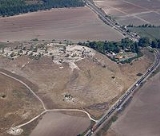
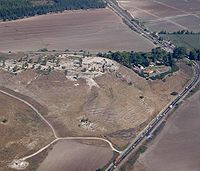
, sided with the Babylonians and attempted to block his advance at Megiddo
, where a fierce battle
was fought and Josiah was killed (2 Kings
23:29, 2 Chronicles
35:20-24).
Herodotus
reports the campaign of the pharaoh in his Histories:
Necho soon captured Kadesh on the Orontes and moved forward, joining forces with Ashur-uballit and together they crossed the Euphrates and laid siege to Harran. Although Necho became the first pharaoh
to cross the Euphrates since Thutmose III
, he failed to capture Harran, and retreated back to northern Syria
. At this point, Ashur-uballit vanished from history, and the Assyrian Empire was conquered by the Babylonians.
Leaving a sizable force behind, Necho returned to Egypt
. On his return march, he found that the Judeans had selected Jehoahaz
to succeed his father Josiah, whom Necho deposed and replaced with Jehoiakim
. He brought Jehoahaz back to Egypt as his prisoner, where Jehoahaz ended his days (2 Kings 23:31; 2 Chronicles 36:1-4).
captured Kumukh
, which cut off the Egyptian army, then based at Carchemish
. Necho responded the following year by retaking Kumukh after a four month siege, and executed the Babylonian garrison. Nabopolassar gathered another army, which camped at Qurumati on the Euphrates. However, Nabopolassar's poor health forced him to return to Babylon
in 605 BC. In response, in 606 BC the Egyptians attacked the leaderless Babylonians (probably then led by the crown prince Nebuchadrezzar) who fled their position.
At this point, the aged Nabopolassar, passed command of the army to his son Nebuchadrezzar II
, who led them to a decisive victory over the Egyptians at Carchemish
, and pursued the fleeing survivors to Hamath. Necho's dream of restoring the Egyptian Empire in the Middle East as had occurred under the New Kingdom was destroyed as Nebuchadrezzar conquered Egyptian territory from the Euphrates to the Brook of Egypt
(Jeremiah
46:2; 2 Kings
23:29) down to Judea
. Although Nebuchadrezzar spent many years in his new conquests on continuous pacification campaigns, Necho was unable to recover any significant part of his lost territories. For example, when Ashkalon rose in revolt, despite repeated pleas the Egyptians sent no help, and were barely able to repel a Babylonian attack on their eastern border in 601 BC. When he did repel the Babylonian attack, Necho managed to capture Gaza while pursuing the enemy. Necho turned his attention in his remaining years to forging relationships with new allies: the Caria
ns, and further to the west, the Greeks.
from the Pelusiac
branch of the Nile
to the Red Sea
. Necho's Canal
was the earliest precursor of the Suez Canal
.
It was in connection with this new activity that Necho founded a new city of Per-Temu Tjeku which translates as 'The House of Atum
of Tjeku' at the site now known as Tell el-Maskhuta, about 15 km west of Ismailia
. The waterway was intended to facilitate trade between the Mediterranean Sea and the Indian Ocean. Necho also formed an Egyptian navy by recruiting displaced Ionian Greeks. This was an unprecedented act by the pharaoh since most Egyptians had traditionally harboured an inherent distaste for and fear of the sea. The navy which Necho created operated along both the Mediterranean and Red Sea coasts.
Herodotus (4.42) also reports that Necho sent out an expedition of Phoenicians, who in three years sailed from the Red Sea around Africa back to the mouth of the Nile. Some current historians tend to believe Herodotus' account, primarily because he stated with disbelief that the Phoenicians " as they sailed on a westerly course round the southern end of Libya (Africa), they had the sun on their right - to northward of them" (The Histories 4.42) -- in Herodotus' time it was not known that Africa extended south past the equator
; however, Egyptologists also point out that it would have been extremely unusual for an Egyptian Pharaoh to carry out such an expedition. Alan B. Lloyd doubts the event and attributes the development of the story by other events.
Twenty-sixth dynasty of Egypt
The Twenty-sixth Dynasty of Egypt was the last native dynasty to rule Egypt before the Persian conquest in 525 BC . The Dynasty's reign The Twenty-sixth Dynasty of Egypt (also written Dynasty XXVI or Dynasty 26) was the last native dynasty to rule Egypt before the Persian conquest in 525 BC...
(610 BCE – 595 BCE).
Necho II is most likely the pharaoh mentioned in several books of the Bible
Bible
The Bible refers to any one of the collections of the primary religious texts of Judaism and Christianity. There is no common version of the Bible, as the individual books , their contents and their order vary among denominations...
(see Hebrew Bible
Hebrew Bible
The Hebrew Bible is a term used by biblical scholars outside of Judaism to refer to the Tanakh , a canonical collection of Jewish texts, and the common textual antecedent of the several canonical editions of the Christian Old Testament...
/ Old Testament
Old Testament
The Old Testament, of which Christians hold different views, is a Christian term for the religious writings of ancient Israel held sacred and inspired by Christians which overlaps with the 24-book canon of the Masoretic Text of Judaism...
). The Book of Kings
Books of Kings
The Book of Kings presents a narrative history of ancient Israel and Judah from the death of David to the release of his successor Jehoiachin from imprisonment in Babylon, a period of some 400 years...
states that Necho met King Josiah of the Kingdom of Judah
Kingdom of Judah
The Kingdom of Judah was a Jewish state established in the Southern Levant during the Iron Age. It is often referred to as the "Southern Kingdom" to distinguish it from the northern Kingdom of Israel....
at Megiddo
Megiddo (place)
Megiddo is a tell in modern Israel near Megiddo Kibbutz, known for its historical, geographical, and theological importance especially under its Greek name Armageddon. In ancient times Megiddo was an important city-state. Excavations have unearthed 26 layers of ruins, indicated a long period of...
and killed him (see Battle of Megiddo (609 BC)
Battle of Megiddo (609 BC)
This Battle of Megiddo is recorded as having taken place in 609 BC with Necho II of Egypt leading his army to Carchemish to fight with his allies the Assyrians against the Babylonians at Carchemish in northern Syria. This required passing through territory controlled by the Kingdom of Judah and...
). The Book of Chronicles gives a lengthier account and 2 Chronicles 35:20 states that when Josiah had prepared the temple, Necho king of Egypt came up to fight against the Babylonians at Carchemish
Carchemish
Carchemish or Kargamış was an important ancient city of the Mitanni, Hittite and Neo Assyrian Empires, now on the frontier between Turkey and Syria. It was the location of an important battle between the Babylonians and Egyptians, mentioned in the Bible...
on the Euphrates River
Euphrates
The Euphrates is the longest and one of the most historically important rivers of Western Asia. Together with the Tigris, it is one of the two defining rivers of Mesopotamia...
and that King Josiah was fatally wounded by an Egyptian
Ancient Egypt
Ancient Egypt was an ancient civilization of Northeastern Africa, concentrated along the lower reaches of the Nile River in what is now the modern country of Egypt. Egyptian civilization coalesced around 3150 BC with the political unification of Upper and Lower Egypt under the first pharaoh...
archer. He was then brought back to Jerusalem to die. Necho is quoted as saying:
"What quarrel is there between you and me, O king of Judah? It is not you I am attacking at this time, but the house with which I am at war. God has told me to hurry; so stop opposing God, who is with me, or he will destroy you." (NIV)
However, at Carchemish in the summer of 605 BC an important battle was fought by the Babylon
Babylon
Babylon was an Akkadian city-state of ancient Mesopotamia, the remains of which are found in present-day Al Hillah, Babil Province, Iraq, about 85 kilometers south of Baghdad...
ian army of Nebuchadrezzar II
Nebuchadrezzar II
Nebuchadnezzar II was king of the Neo-Babylonian Empire, who reigned c. 605 BC – 562 BC. According to the Bible, he conquered Judah and Jerusalem, and sent the Jews into exile. He is credited with the construction of the Hanging Gardens of Babylon and also known for the destruction...
and that of Pharaoh Necho II of Egypt (see the record contained in the Book of Jeremiah
Book of Jeremiah
The Book of Jeremiah is the second of the Latter Prophets in the Hebrew Bible, following the book of Isaiah and preceding Ezekiel and the Book of the Twelve....
chapter 46 regarding Egypt and its defeat). The aim of Necho's campaign was to contain the Westward advance of the Babylonian Empire and cut off its trade route across the Euphrates. However, the Egyptians
Egyptians
Egyptians are nation an ethnic group made up of Mediterranean North Africans, the indigenous people of Egypt.Egyptian identity is closely tied to geography. The population of Egypt is concentrated in the lower Nile Valley, the small strip of cultivable land stretching from the First Cataract to...
were defeated by the unexpected attack of the Babylonians and were eventually expelled from Syria.
Family
Necho II was the son of Psammetichus IPsammetichus I
Psamtik I , was the first of three kings of that name of the Saite, or Twenty-sixth dynasty of Egypt. His prenomen, Wah-Ib-Re, means "Constant [is the] Heart [of] Re." The story in Herodotus of the Dodecarchy and the rise of Psamtik is fanciful...
by his Great Royal Wife
Great Royal Wife
Great Royal Wife or Chief King's Wife is the term used to refer to the chief wife of the pharaoh of Ancient Egypt. While most Ancient Egyptians were monogamous, the pharaoh would have had other, lesser wives and concubines in addition to the Great Royal Wife...
Mehtenweskhet. His prenomen or royal name Wahem-Ib-Re means "Carrying out [the] Heart (ie. Wish) [of] Re
Ra
Ra is the ancient Egyptian sun god. By the Fifth Dynasty he had become a major deity in ancient Egyptian religion, identified primarily with the mid-day sun...
."
Reign
Necho played a significant role in the histories of the Assyrian Empire, BabyloniaBabylonia
Babylonia was an ancient cultural region in central-southern Mesopotamia , with Babylon as its capital. Babylonia emerged as a major power when Hammurabi Babylonia was an ancient cultural region in central-southern Mesopotamia (present-day Iraq), with Babylon as its capital. Babylonia emerged as...
and the Kingdom of Judah
Kingdom of Judah
The Kingdom of Judah was a Jewish state established in the Southern Levant during the Iron Age. It is often referred to as the "Southern Kingdom" to distinguish it from the northern Kingdom of Israel....
. Upon his ascension, Necho was faced with the chaos created by the raids of the Cimmerians
Cimmerians
The Cimmerians or Kimmerians were ancient equestrian nomads of Indo-European origin.According to the Greek historian Herodotus, of the 5th century BC, the Cimmerians inhabited the region north of the Caucasus and the Black Sea during the 8th and 7th centuries BC, in what is now Ukraine and Russia...
and the Scythians, who had not only ravaged Asia west of the Euphrates, but had also helped the Babylonians shatter the Assyrian Empire. That once mighty empire was now reduced to the troops, officials, and nobles who had gathered around a general holding out at Harran
Harran
Harran was a major ancient city in Upper Mesopotamia whose site is near the modern village of Altınbaşak, Turkey, 24 miles southeast of Şanlıurfa...
, who had taken the throne name of Ashur-uballit II
Ashur-uballit II
Ashur-uballit II , was the last king of the Assyrian empire. He reigned in the last capital city of Harran from 612 BC to 609 BC, having escaped Nineveh during the siege and capture of that city by the Babylonian-Mede army in 612 BC....
. Necho attempted to assist this remnant immediately upon his coronation, but the force he sent proved to be too small, and the combined armies were forced to retreat west across the Euphrates.
First campaign
Via Maris
Via Maris is the modern name for an ancient trade route, dating from the early Bronze Age, linking Egypt with the northern empires of Syria, Anatolia and Mesopotamia — modern day Iran, Iraq, Turkey and Syria....
into Syria
Syria
Syria , officially the Syrian Arab Republic , is a country in Western Asia, bordering Lebanon and the Mediterranean Sea to the West, Turkey to the north, Iraq to the east, Jordan to the south, and Israel to the southwest....
, supported by his Mediterranean fleet along the shore, and proceeded through the low tracts of Philistia and Sharon. He prepared to cross the ridge of hills which shuts in on the south the great Jezreel Valley
Jezreel Valley
-Etymology:The Jezreel Valley takes its name from the ancient city of Jezreel which was located on a low hill overlooking the southern edge of the valley, though some scholars think that the name of the city originates from the name of the clan which founded it, and whose existence is mentioned in...
, but here he found his passage blocked by the Judean army. Their king, Josiah
Josiah
Josiah or Yoshiyahu or Joshua was a king of Judah who instituted major reforms. Josiah is credited by most historians with having established or compiled important Jewish scriptures during the Deuteronomic reform that occurred during his rule.Josiah became king of Judah at the age of eight, after...
, sided with the Babylonians and attempted to block his advance at Megiddo
Megiddo (place)
Megiddo is a tell in modern Israel near Megiddo Kibbutz, known for its historical, geographical, and theological importance especially under its Greek name Armageddon. In ancient times Megiddo was an important city-state. Excavations have unearthed 26 layers of ruins, indicated a long period of...
, where a fierce battle
Battle of Megiddo (609 BC)
This Battle of Megiddo is recorded as having taken place in 609 BC with Necho II of Egypt leading his army to Carchemish to fight with his allies the Assyrians against the Babylonians at Carchemish in northern Syria. This required passing through territory controlled by the Kingdom of Judah and...
was fought and Josiah was killed (2 Kings
Books of Kings
The Book of Kings presents a narrative history of ancient Israel and Judah from the death of David to the release of his successor Jehoiachin from imprisonment in Babylon, a period of some 400 years...
23:29, 2 Chronicles
Books of Chronicles
The Books of Chronicles are part of the Hebrew Bible. In the Masoretic Text, it appears as the first or last book of the Ketuvim . Chronicles largely parallels the Davidic narratives in the Books of Samuel and the Books of Kings...
35:20-24).
Herodotus
Herodotus
Herodotus was an ancient Greek historian who was born in Halicarnassus, Caria and lived in the 5th century BC . He has been called the "Father of History", and was the first historian known to collect his materials systematically, test their accuracy to a certain extent and arrange them in a...
reports the campaign of the pharaoh in his Histories:
Necho soon captured Kadesh on the Orontes and moved forward, joining forces with Ashur-uballit and together they crossed the Euphrates and laid siege to Harran. Although Necho became the first pharaoh
Pharaoh
Pharaoh is a title used in many modern discussions of the ancient Egyptian rulers of all periods. The title originates in the term "pr-aa" which means "great house" and describes the royal palace...
to cross the Euphrates since Thutmose III
Thutmose III
Thutmose III was the sixth Pharaoh of the Eighteenth Dynasty. During the first twenty-two years of Thutmose's reign he was co-regent with his stepmother, Hatshepsut, who was named the pharaoh...
, he failed to capture Harran, and retreated back to northern Syria
Syria
Syria , officially the Syrian Arab Republic , is a country in Western Asia, bordering Lebanon and the Mediterranean Sea to the West, Turkey to the north, Iraq to the east, Jordan to the south, and Israel to the southwest....
. At this point, Ashur-uballit vanished from history, and the Assyrian Empire was conquered by the Babylonians.
Leaving a sizable force behind, Necho returned to Egypt
Ancient Egypt
Ancient Egypt was an ancient civilization of Northeastern Africa, concentrated along the lower reaches of the Nile River in what is now the modern country of Egypt. Egyptian civilization coalesced around 3150 BC with the political unification of Upper and Lower Egypt under the first pharaoh...
. On his return march, he found that the Judeans had selected Jehoahaz
Jehoahaz of Judah
Jehoahaz or Joachaz in the Douay-Rheims and some other English translations was king of Judah and son of king Josiah whom he succeeded and Hamautal, daughter of Jeremiah of Libnah. He was born in 633/632 BC and his birth name was Shallum...
to succeed his father Josiah, whom Necho deposed and replaced with Jehoiakim
Jehoiakim
Jehoiakim .On Josiah's death, Jehoiakim's younger brother Jehoahaz was proclaimed king, but after three months pharaoh Necho II deposed him and replaced him with the eldest son, Eliakim, who adopted the name Jehoiakim and became king at the age of twenty-five...
. He brought Jehoahaz back to Egypt as his prisoner, where Jehoahaz ended his days (2 Kings 23:31; 2 Chronicles 36:1-4).
Second campaign
Meanwhile, the Babylonian king was planning on reasserting his power in Syria. In 609 BC, King NabopolassarNabopolassar
Nabopolassar was the king of the Babylonia and played a key role in the demise of the Assyrian Empire following the death of the last powerful Assyrian king, Ashurbanipal...
captured Kumukh
Kummuh
thumb|250px|right|Historical map of the Neo-Hittite states, ca. 800 BC, showing the location of Kummuh.Kummuh is an Iron Age Neo-Hittite kingdom located on the west bank of the Upper Euphrates within the easternly loop of the river between Malatya and Carchemish. Assyrian sources refer both to the...
, which cut off the Egyptian army, then based at Carchemish
Carchemish
Carchemish or Kargamış was an important ancient city of the Mitanni, Hittite and Neo Assyrian Empires, now on the frontier between Turkey and Syria. It was the location of an important battle between the Babylonians and Egyptians, mentioned in the Bible...
. Necho responded the following year by retaking Kumukh after a four month siege, and executed the Babylonian garrison. Nabopolassar gathered another army, which camped at Qurumati on the Euphrates. However, Nabopolassar's poor health forced him to return to Babylon
Babylon
Babylon was an Akkadian city-state of ancient Mesopotamia, the remains of which are found in present-day Al Hillah, Babil Province, Iraq, about 85 kilometers south of Baghdad...
in 605 BC. In response, in 606 BC the Egyptians attacked the leaderless Babylonians (probably then led by the crown prince Nebuchadrezzar) who fled their position.
At this point, the aged Nabopolassar, passed command of the army to his son Nebuchadrezzar II
Nebuchadrezzar II
Nebuchadnezzar II was king of the Neo-Babylonian Empire, who reigned c. 605 BC – 562 BC. According to the Bible, he conquered Judah and Jerusalem, and sent the Jews into exile. He is credited with the construction of the Hanging Gardens of Babylon and also known for the destruction...
, who led them to a decisive victory over the Egyptians at Carchemish
Battle of Carchemish
The Battle of Carchemish was fought about 605 BC between the allied armies of Egypt and Assyria against Babylonia.- Background :When the Assyrian capital Nineveh was overrun by the Babylonians in 612 BC, the Assyrians moved their capital to Harran...
, and pursued the fleeing survivors to Hamath. Necho's dream of restoring the Egyptian Empire in the Middle East as had occurred under the New Kingdom was destroyed as Nebuchadrezzar conquered Egyptian territory from the Euphrates to the Brook of Egypt
Brook of Egypt
The Brook of Egypt is the name used in some English translations of the Bible for the Hebrew Nachal Mitzrayim used for the river defining the westernmost border of the Land of Israel. Popular Bible commentaries identify it with Wadi El-Arish although the identification is problematic...
(Jeremiah
Book of Jeremiah
The Book of Jeremiah is the second of the Latter Prophets in the Hebrew Bible, following the book of Isaiah and preceding Ezekiel and the Book of the Twelve....
46:2; 2 Kings
Books of Kings
The Book of Kings presents a narrative history of ancient Israel and Judah from the death of David to the release of his successor Jehoiachin from imprisonment in Babylon, a period of some 400 years...
23:29) down to Judea
Judea
Judea or Judæa was the name of the mountainous southern part of the historic Land of Israel from the 8th century BCE to the 2nd century CE, when Roman Judea was renamed Syria Palaestina following the Jewish Bar Kokhba revolt.-Etymology:The...
. Although Nebuchadrezzar spent many years in his new conquests on continuous pacification campaigns, Necho was unable to recover any significant part of his lost territories. For example, when Ashkalon rose in revolt, despite repeated pleas the Egyptians sent no help, and were barely able to repel a Babylonian attack on their eastern border in 601 BC. When he did repel the Babylonian attack, Necho managed to capture Gaza while pursuing the enemy. Necho turned his attention in his remaining years to forging relationships with new allies: the Caria
Caria
Caria was a region of western Anatolia extending along the coast from mid-Ionia south to Lycia and east to Phrygia. The Ionian and Dorian Greeks colonized the west of it and joined the Carian population in forming Greek-dominated states there...
ns, and further to the west, the Greeks.
Ambitious projects
At some point during his Syrian campaign, Necho II initiated but never completed the ambitious project of cutting a navigable canalCanal
Canals are man-made channels for water. There are two types of canal:#Waterways: navigable transportation canals used for carrying ships and boats shipping goods and conveying people, further subdivided into two kinds:...
from the Pelusiac
Pelusium
Pelusium was a city in the eastern extremes of Egypt's Nile Delta, 30 km to the southeast of the modern Port Said. Alternative names include Sena and Per-Amun , Pelousion , Sin , Seyân , and Tell el-Farama...
branch of the Nile
Nile
The Nile is a major north-flowing river in North Africa, generally regarded as the longest river in the world. It is long. It runs through the ten countries of Sudan, South Sudan, Burundi, Rwanda, Democratic Republic of the Congo, Tanzania, Kenya, Ethiopia, Uganda and Egypt.The Nile has two major...
to the Red Sea
Red Sea
The Red Sea is a seawater inlet of the Indian Ocean, lying between Africa and Asia. The connection to the ocean is in the south through the Bab el Mandeb strait and the Gulf of Aden. In the north, there is the Sinai Peninsula, the Gulf of Aqaba, and the Gulf of Suez...
. Necho's Canal
Canal of the Pharaohs
The Canal of the Pharaohs also called the Ancient Suez Canal or Necho's Canal is the forerunner of the Suez Canal, constructed in ancient times. It followed a different course than its modern counterpart, by linking the Nile to the Red Sea via the Wadi Tumilat. Work begun under the Pharaohs...
was the earliest precursor of the Suez Canal
Suez Canal
The Suez Canal , also known by the nickname "The Highway to India", is an artificial sea-level waterway in Egypt, connecting the Mediterranean Sea and the Red Sea. Opened in November 1869 after 10 years of construction work, it allows water transportation between Europe and Asia without navigation...
.
It was in connection with this new activity that Necho founded a new city of Per-Temu Tjeku which translates as 'The House of Atum
Atum
Atum, sometimes rendered as Atem or Tem, is an important deity in Egyptian mythology.- Name :Atum's name is thought to be derived from the word 'tem' which means to complete or finish. Thus he has been interpreted as being the 'complete one' and also the finisher of the world, which he returns to...
of Tjeku' at the site now known as Tell el-Maskhuta, about 15 km west of Ismailia
Ismaïlia
-Notable natives:*Osman Ahmed Osman, a famous and influential Egyptian engineer, contractor, entrepreneur, and politician, was born in this town on 6 April 1917....
. The waterway was intended to facilitate trade between the Mediterranean Sea and the Indian Ocean. Necho also formed an Egyptian navy by recruiting displaced Ionian Greeks. This was an unprecedented act by the pharaoh since most Egyptians had traditionally harboured an inherent distaste for and fear of the sea. The navy which Necho created operated along both the Mediterranean and Red Sea coasts.
Herodotus (4.42) also reports that Necho sent out an expedition of Phoenicians, who in three years sailed from the Red Sea around Africa back to the mouth of the Nile. Some current historians tend to believe Herodotus' account, primarily because he stated with disbelief that the Phoenicians " as they sailed on a westerly course round the southern end of Libya (Africa), they had the sun on their right - to northward of them" (The Histories 4.42) -- in Herodotus' time it was not known that Africa extended south past the equator
Equator
An equator is the intersection of a sphere's surface with the plane perpendicular to the sphere's axis of rotation and containing the sphere's center of mass....
; however, Egyptologists also point out that it would have been extremely unusual for an Egyptian Pharaoh to carry out such an expedition. Alan B. Lloyd doubts the event and attributes the development of the story by other events.
Death and succession
Necho II died in 595 BC and was succeeded by his son, Psamtik II, as the next pharaoh of Egypt. Psamtik II, however, later removed Necho's name from almost all of his father's monuments for unknown reasons.Further reading
- Peter Clayton (1994). Chronicle of the Pharaohs, Thames and Hudson.
- Nekau (II) Wehemibre., digitalegypt.ucl.ac.uk
- Necho II, touregypt.net.