
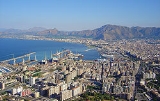
Palermo is a city in Southern Italy, the capital of both the
autonomous regionAn autonomous area or autonomous entity is an area of a country that has a degree of autonomy, or freedom from an external authority. Typically it is either geographically distinct from the rest of the country or populated by a national minority. Countries that include autonomous areas are often...
of
SicilySicily is a region of Italy, and is the largest island in the Mediterranean Sea. Along with the surrounding minor islands, it constitutes an autonomous region of Italy, the Regione Autonoma Siciliana Sicily has a rich and unique culture, especially with regard to the arts, music, literature,...
and the
Province of PalermoThe Province of Palermo is a province in the autonomous region of Sicily, a major island in Southern Italy. Its capital is the city of Palermo. The Province of Palermo has 82 comuni , 1,239,272 inhabitants, and is 4,992 km² .-External links:...
. The city is noted for its
historyHistory is the discovery, collection, organization, and presentation of information about past events. History can also mean the period of time after writing was invented. Scholars who write about history are called historians...
,
cultureCulture is a term that has many different inter-related meanings. For example, in 1952, Alfred Kroeber and Clyde Kluckhohn compiled a list of 164 definitions of "culture" in Culture: A Critical Review of Concepts and Definitions...
,
architectureArchitecture is both the process and product of planning, designing and construction. Architectural works, in the material form of buildings, are often perceived as cultural and political symbols and as works of art...
and
gastronomyGastronomy is the art or science of food eating. Also, it can be defined as the study of food and culture, with a particular focus on gourmet cuisine...
, playing an important role throughout much of its existence; it is over 2,700 years old. Palermo is located in the northwest of the island of Sicily, right by the Gulf of Palermo in the
Tyrrhenian SeaThe Tyrrhenian Sea is part of the Mediterranean Sea off the western coast of Italy.-Geography:The sea is bounded by Corsica and Sardinia , Tuscany, Lazio, Campania, Basilicata and Calabria and Sicily ....
.
The city was founded by the
PhoeniciaPhoenicia , was an ancient civilization in Canaan which covered most of the western, coastal part of the Fertile Crescent. Several major Phoenician cities were built on the coastline of the Mediterranean. It was an enterprising maritime trading culture that spread across the Mediterranean from 1550...
ns, but named by the
Ancient GreeksThe Greeks, also known as the Hellenes , are a nation and ethnic group native to Greece, Cyprus and neighboring regions. They also form a significant diaspora, with Greek communities established around the world....
as
Panormus meaning “always fit for landing in.” Palermo became part of the
Roman RepublicThe Roman Republic was the period of the ancient Roman civilization where the government operated as a republic. It began with the overthrow of the Roman monarchy, traditionally dated around 508 BC, and its replacement by a government headed by two consuls, elected annually by the citizens and...
, the Roman Empire and eventually part of the
Byzantine EmpireThe Byzantine Empire was the Eastern Roman Empire during the periods of Late Antiquity and the Middle Ages, centred on the capital of Constantinople. Known simply as the Roman Empire or Romania to its inhabitants and neighbours, the Empire was the direct continuation of the Ancient Roman State...
, for over a thousand years. From 827 to 1071 it was under
Arab ruleThe history of Islam in southern Italy begins with the Islamic conquest and subsequent rule of Sicily and Malta, a process that started in the 9th century. Islamic rule over Sicily was effective from 902, and the complete rule of the island lasted from 965 until 1061...
during the
Emirate of SicilyThe Emirate of Sicily was an Islamic state on the island of Sicily , which existed from 965 to 1072.-First Arab invasions of Sicily:...
when it first became a capital. Following the
Norman reconquestThe Norman conquest of southern Italy spanned the late eleventh and much of the twelfth centuries, involving many battles and many independent players conquering territories of their own...
, Palermo became capital of a new kingdom (from 1130 to 1816), the
Kingdom of SicilyThe Kingdom of Sicily was a state that existed in the south of Italy from its founding by Roger II in 1130 until 1816. It was a successor state of the County of Sicily, which had been founded in 1071 during the Norman conquest of southern Italy...
. Eventually it would be united with the
Kingdom of NaplesThe Kingdom of Naples, comprising the southern part of the Italian peninsula, was the remainder of the old Kingdom of Sicily after secession of the island of Sicily as a result of the Sicilian Vespers rebellion of 1282. Known to contemporaries as the Kingdom of Sicily, it is dubbed Kingdom of...
to form the
Two SiciliesThe Kingdom of the Two Sicilies, commonly known as the Two Sicilies even before formally coming into being, was the largest and wealthiest of the Italian states before Italian unification...
until the
Italian unificationItalian unification was the political and social movement that agglomerated different states of the Italian peninsula into the single state of Italy in the 19th century...
of 1860.
The population of the Palermo urban area is estimated by
EurostatEurostat is a Directorate-General of the European Commission located in Luxembourg. Its main responsibilities are to provide the European Union with statistical information at European level and to promote the integration of statistical methods across the Member States of the European Union,...
to be 855,285, while its metropolitan area is the fifth most populated in Italy with around 1.2 million people. In the central area, the city has a population of around 650,000 people. The inhabitants are known as
Palermitans or poetically
panormiti. The languages spoken by its inhabitants are the
Italian languageItalian is a Romance language spoken mainly in Europe: Italy, Switzerland, San Marino, Vatican City, by minorities in Malta, Monaco, Croatia, Slovenia, France, Libya, Eritrea, and Somalia, and by immigrant communities in the Americas and Australia...
and the
Sicilian languageSicilian is a Romance language. Its dialects make up the Extreme-Southern Italian language group, which are spoken on the island of Sicily and its satellite islands; in southern and central Calabria ; in the southern parts of Apulia, the Salento ; and Campania, on the Italian mainland, where it is...
, in its Palermitan variation.
Palermo is Sicily's
culturalCulture is a term that has many different inter-related meanings. For example, in 1952, Alfred Kroeber and Clyde Kluckhohn compiled a list of 164 definitions of "culture" in Culture: A Critical Review of Concepts and Definitions...
,
economicAn economy consists of the economic system of a country or other area; the labor, capital and land resources; and the manufacturing, trade, distribution, and consumption of goods and services of that area...
and
touristicTourism is travel for recreational, leisure or business purposes. The World Tourism Organization defines tourists as people "traveling to and staying in places outside their usual environment for not more than one consecutive year for leisure, business and other purposes".Tourism has become a...
capital. It is a city rich in
historyHistory is the discovery, collection, organization, and presentation of information about past events. History can also mean the period of time after writing was invented. Scholars who write about history are called historians...
,
cultureCulture is a term that has many different inter-related meanings. For example, in 1952, Alfred Kroeber and Clyde Kluckhohn compiled a list of 164 definitions of "culture" in Culture: A Critical Review of Concepts and Definitions...
,
artArt is the product or process of deliberately arranging items in a way that influences and affects one or more of the senses, emotions, and intellect....
,
musicMusic is an art form whose medium is sound and silence. Its common elements are pitch , rhythm , dynamics, and the sonic qualities of timbre and texture...
and
foodFood is any substance consumed to provide nutritional support for the body. It is usually of plant or animal origin, and contains essential nutrients, such as carbohydrates, fats, proteins, vitamins, or minerals...
. Numerous tourists are attracted to the city for its good Mediterranean weather, its renowned
gastronomyGastronomy is the art or science of food eating. Also, it can be defined as the study of food and culture, with a particular focus on gourmet cuisine...
and
restaurantA restaurant is an establishment which prepares and serves food and drink to customers in return for money. Meals are generally served and eaten on premises, but many restaurants also offer take-out and food delivery services...
s, its
RomanesqueRomanesque architecture is an architectural style of Medieval Europe characterised by semi-circular arches. There is no consensus for the beginning date of the Romanesque architecture, with proposals ranging from the 6th to the 10th century. It developed in the 12th century into the Gothic style,...
,
GothicGothic architecture is a style of architecture that flourished during the high and late medieval period. It evolved from Romanesque architecture and was succeeded by Renaissance architecture....
and
BaroqueThe Baroque is a period and the style that used exaggerated motion and clear, easily interpreted detail to produce drama, tension, exuberance, and grandeur in sculpture, painting, literature, dance, and music...
churches,
palaceA palace is a grand residence, especially a royal residence or the home of a head of state or some other high-ranking dignitary, such as a bishop or archbishop. The word itself is derived from the Latin name Palātium, for Palatine Hill, one of the seven hills in Rome. In many parts of Europe, the...
s and
buildingIn architecture, construction, engineering, real estate development and technology the word building may refer to one of the following:...
s, and its
nightlifeNightlife is the collective term for any entertainment that is available and more popular from the late evening into the early hours of the morning...
and
musicMusic is an art form whose medium is sound and silence. Its common elements are pitch , rhythm , dynamics, and the sonic qualities of timbre and texture...
. Palermo is the main Sicilian
industrialIndustry refers to the production of an economic good or service within an economy.-Industrial sectors:There are four key industrial economic sectors: the primary sector, largely raw material extraction industries such as mining and farming; the secondary sector, involving refining, construction,...
and
commercialWhile business refers to the value-creating activities of an organization for profit, commerce means the whole system of an economy that constitutes an environment for business. The system includes legal, economic, political, social, cultural, and technological systems that are in operation in any...
center: the main industrial sectors include
tourismTourism is travel for recreational, leisure or business purposes. The World Tourism Organization defines tourists as people "traveling to and staying in places outside their usual environment for not more than one consecutive year for leisure, business and other purposes".Tourism has become a...
, services,
commerceWhile business refers to the value-creating activities of an organization for profit, commerce means the whole system of an economy that constitutes an environment for business. The system includes legal, economic, political, social, cultural, and technological systems that are in operation in any...
and
agricultureAgriculture is the cultivation of animals, plants, fungi and other life forms for food, fiber, and other products used to sustain life. Agriculture was the key implement in the rise of sedentary human civilization, whereby farming of domesticated species created food surpluses that nurtured the...
. Palermo currently has an international airport, and a significant
underground economyA black market or underground economy is a market in goods or services which operates outside the formal one supported by established state power. Typically the totality of such activity is referred to with the definite article as a complement to the official economies, by market for such goods and...
.
In fact, for cultural, artistic and economic reasons, Palermo was one of the largest cities in the Mediterranean and is now among the top tourist destinations in both Italy and Europe. The city is also going through careful redevelopment, preparing to become one of the major cities of the Euro-Mediterranean area.
Roman CatholicismThe Catholic Church, also known as the Roman Catholic Church, is the world's largest Christian church, with over a billion members. Led by the Pope, it defines its mission as spreading the gospel of Jesus Christ, administering the sacraments and exercising charity...
is highly important in Palermitan culture. The
patron saintA patron saint is a saint who is regarded as the intercessor and advocate in heaven of a nation, place, craft, activity, class, clan, family, or person...
of the city is Saint Rosalia. Her
feast dayThe calendar of saints is a traditional Christian method of organizing a liturgical year by associating each day with one or more saints and referring to the feast day of said saint...
on July 15 is perhaps the biggest social event in the city. The area attracts significant numbers of
touristsTourism is travel for recreational, leisure or business purposes. The World Tourism Organization defines tourists as people "traveling to and staying in places outside their usual environment for not more than one consecutive year for leisure, business and other purposes".Tourism has become a...
each year and is widely known for its colourful fruit, vegetable and fish
marketA market is one of many varieties of systems, institutions, procedures, social relations and infrastructures whereby parties engage in exchange. While parties may exchange goods and services by barter, most markets rely on sellers offering their goods or services in exchange for money from buyers...
at the heart of Palermo, known as the
Vucciria.
Ancient era
Evidence for
human settlementColonization occurs whenever any one or more species populate an area. The term, which is derived from the Latin colere, "to inhabit, cultivate, frequent, practice, tend, guard, respect", originally related to humans. However, 19th century biogeographers dominated the term to describe the...
in the area now known as Palermo goes back to the
Pleistocene EpochThe Pleistocene is the epoch from 2,588,000 to 11,700 years BP that spans the world's recent period of repeated glaciations. The name pleistocene is derived from the Greek and ....
, around
8000 BCIn the 8th millennium BC, agriculture became widely practised in the Fertile Crescent and Anatolia.Pottery became widespread and animal husbandry spread to Africa and Eurasia. World population was approximately 5 million.-Events:*c. 8000 BC—The last glacial period ends.*c...
. This evidence is present in the form of cave drawings at nearby Addaura writ by the
SicaniThe Sicani or Sicanians were one of three ancient peoples of Sicily present at the time of Phoenician and Greek colonization.-History:The Sicani are thought to be the oldest inhabitants of Sicily with a recorded name...
who, according to
ThucydidesThucydides was a Greek historian and author from Alimos. His History of the Peloponnesian War recounts the 5th century BC war between Sparta and Athens to the year 411 BC...
, arrived from the
Iberian PeninsulaThe Iberian Peninsula , sometimes called Iberia, is located in the extreme southwest of Europe and includes the modern-day sovereign states of Spain, Portugal and Andorra, as well as the British Overseas Territory of Gibraltar...
(perhaps
CataloniaCatalonia is an autonomous community in northeastern Spain, with the official status of a "nationality" of Spain. Catalonia comprises four provinces: Barcelona, Girona, Lleida, and Tarragona. Its capital and largest city is Barcelona. Catalonia covers an area of 32,114 km² and has an...
). During
734 BC-Events and trends:* 739 BC—Hiram II becomes king of Tyre.* 738 BC—King Tiglath-Pileser III of Assyria invades Israel, forcing it to pay tribute.* 738 BC—The Biskupin settlement northeast of Poznan is built....
the
PhoeniciaPhoenicia , was an ancient civilization in Canaan which covered most of the western, coastal part of the Fertile Crescent. Several major Phoenician cities were built on the coastline of the Mediterranean. It was an enterprising maritime trading culture that spread across the Mediterranean from 1550...
ns, a sea trading peoples from the north of ancient
CanaanCanaan is a historical region roughly corresponding to modern-day Israel, Palestine, Lebanon, and the western parts of Jordan...
, built a small settlement on the natural habour of Palermo. Some sources suggest they named the settlement "Ziz." The
GreeksThe Greeks, also known as the Hellenes , are a nation and ethnic group native to Greece, Cyprus and neighboring regions. They also form a significant diaspora, with Greek communities established around the world....
, who were the most dominant culture on the island of Sicily due to the powerful
city stateA city-state is an independent or autonomous entity whose territory consists of a city which is not administered as a part of another local government.-Historical city-states:...
of Syracuse to the east, instead called the settlement
Panormus. Its Greek name means "all-port" and it was named so because of its fine
natural harbourA harbor or harbour , or haven, is a place where ships, boats, and barges can seek shelter from stormy weather, or else are stored for future use. Harbors can be natural or artificial...
. Palermo was then passed on to the Phoenician's descendants and successors, the
CarthaginiansCarthage , implying it was a 'new Tyre') is a major urban centre that has existed for nearly 3,000 years on the Gulf of Tunis, developing from a Phoenician colony of the 1st millennium BC...
.
During this period it was a centre of
commerceWhile business refers to the value-creating activities of an organization for profit, commerce means the whole system of an economy that constitutes an environment for business. The system includes legal, economic, political, social, cultural, and technological systems that are in operation in any...
; however a power struggle between the Greeks and the Carthaginians broke out in the form of the
Sicilian WarsThe Greek-Punic wars or, less properly, Sicilian Wars, were a series of conflicts fought between Carthaginians and the Greeks headed by Syracusans, over control of Sicily and western Mediterranean between the years 600 to 265 BC....
, causing unrest. It was from Palermo that
HamilcarHamilcar Barca or Barcas was a Carthaginian general and statesman, leader of the Barcid family, and father of Hannibal, Hasdrubal and Mago. He was also father-in-law to Hasdrubal the Fair....
's fleet (which was defeated at the
Battle of HimeraThe Battle of Himera , supposedly fought on the same day as the more famous Battle of Salamis, or on the same day as the Battle of Thermopylae, saw the Greek forces of Gelon, King of Syracuse, and Theron, tyrant of Agrigentum, defeat the Carthaginian force of Hamilcar the Magonid, ending a...
) was launched. Palermo eventually became a
Greek colonyColonies in antiquity were city-states founded from a mother-city—its "metropolis"—, not from a territory-at-large. Bonds between a colony and its metropolis remained often close, and took specific forms...
when
Pyrrhus of EpirusPyrrhus or Pyrrhos was a Greek general and statesman of the Hellenistic era. He was king of the Greek tribe of Molossians, of the royal Aeacid house , and later he became king of Epirus and Macedon . He was one of the strongest opponents of early Rome...
gained it during the
Pyrrhic WarThe Pyrrhic War was a complex series of battles and shifting political alliances among the Greeks , Romans, the Italian peoples , and the CarthaginiansThe Pyrrhic War initially started as a minor conflict between Rome and the city of Tarentum over a naval...
period in
276 BCYear 276 BC was a year of the pre-Julian Roman calendar. At the time it was known as the Year of the Consulship of Gurges and Clepsina...
. However, as the
RomansAncient Rome was a thriving civilization that grew on the Italian Peninsula as early as the 8th century BC. Located along the Mediterranean Sea and centered on the city of Rome, it expanded to one of the largest empires in the ancient world....
flooded into Sicily during the
First Punic WarThe First Punic War was the first of three wars fought between Ancient Carthage and the Roman Republic. For 23 years, the two powers struggled for supremacy in the western Mediterranean Sea, primarily on the Mediterranean island of Sicily and its surrounding waters but also to a lesser extent in...
, the city came under
Roman ruleThe Roman Republic was the period of the ancient Roman civilization where the government operated as a republic. It began with the overthrow of the Roman monarchy, traditionally dated around 508 BC, and its replacement by a government headed by two consuls, elected annually by the citizens and...
only three decades later. The Romans made sure that, in the words of
Roman consulA consul served in the highest elected political office of the Roman Republic.Each year, two consuls were elected together, to serve for a one-year term. Each consul was given veto power over his colleague and the officials would alternate each month...
M. Valerian to the
Roman SenateThe Senate of the Roman Republic was a political institution in the ancient Roman Republic, however, it was not an elected body, but one whose members were appointed by the consuls, and later by the censors. After a magistrate served his term in office, it usually was followed with automatic...
; "no Carthaginian remains in Sicily". This period was quite a calm time for Palermo, which was growing into an important
Roman tradeRoman trade was the engine that drove the Roman economy of the late Republic and the early Empire. Fashions and trends in historiography and in popular culture have tended to neglect the economic basis of the empire in favor of the lingua franca of Latin and the exploits of the Roman legions...
centre. Also during this period
ChristianityChristianity is a monotheistic religion based on the life and teachings of Jesus as presented in canonical gospels and other New Testament writings...
first began to be practised in Palermo.
The Middle Ages
As the
Roman EmpireThe Roman Empire was the post-Republican period of the ancient Roman civilization, characterised by an autocratic form of government and large territorial holdings in Europe and around the Mediterranean....
was falling apart, Palermo fell under the control of several
Germanic tribesThe Germanic peoples are an Indo-European ethno-linguistic group of Northern European origin, identified by their use of the Indo-European Germanic languages which diversified out of Proto-Germanic during the Pre-Roman Iron Age.Originating about 1800 BCE from the Corded Ware Culture on the North...
. The first were the
VandalsThe Vandals were an East Germanic tribe that entered the late Roman Empire during the 5th century. The Vandals under king Genseric entered Africa in 429 and by 439 established a kingdom which included the Roman Africa province, besides the islands of Sicily, Corsica, Sardinia and the Balearics....
in 440 AD under the rule of their king Geiseric. The Vandals had occupiedall the Roman provinces in North Africa by 455 establishing themselves as a significant force. They acquired Corsica, Sardinia and Sicily shortly afterwards. However, they soon lost these newly acquired possessions to the Ostrogoths. The Ostrogothic conquest under
Theodoric the GreatTheodoric the Great was king of the Ostrogoths , ruler of Italy , regent of the Visigoths , and a viceroy of the Eastern Roman Empire...
began in 488; although the Goths were Germanic, Theodoric supported Roman culture
Roman cultureAncient Roman culture existed throughout the almost 1200-year history of the civilization of Ancient Rome. The term refers to the culture of the Roman Republic, later the Roman Empire, which, at its peak, covered an area from Lowland Scotland and Morocco to the Euphrates.Life in ancient Rome...
and government instead. The Gothic War took place between the Ostrogoths and the Eastern Roman Empire, also known as the
Byzantine EmpireThe Byzantine Empire was the Eastern Roman Empire during the periods of Late Antiquity and the Middle Ages, centred on the capital of Constantinople. Known simply as the Roman Empire or Romania to its inhabitants and neighbours, the Empire was the direct continuation of the Ancient Roman State...
. Sicily was the first part of Italy to be taken under control of
General BelisariusFlavius Belisarius was a general of the Byzantine Empire. He was instrumental to Emperor Justinian's ambitious project of reconquering much of the Mediterranean territory of the former Western Roman Empire, which had been lost less than a century previously....
who was commissioned by
Eastern Emperor Justinian IJustinian I ; , ; 483– 13 or 14 November 565), commonly known as Justinian the Great, was Byzantine Emperor from 527 to 565. During his reign, Justinian sought to revive the Empire's greatness and reconquer the lost western half of the classical Roman Empire.One of the most important figures of...
who solidified his rule in the following years.
After the Byzantines were betrayed by Admiral Euphemius, who fled to
TunisiaTunisia , officially the Tunisian RepublicThe long name of Tunisia in other languages used in the country is: , is the northernmost country in Africa. It is a Maghreb country and is bordered by Algeria to the west, Libya to the southeast, and the Mediterranean Sea to the north and east. Its area...
and begged the
AghlabidThe Aghlabids were a dynasty of emirs, members of the Arab tribe of Bani Tamim, who ruled Ifriqiya, nominally on behalf of the Abbasid Caliph, for about a century, until overthrown by the new power of the Fatimid.-History:...
leader
Ziyadat AllahZiyadat Allah I was the third Aghlabid Emir in Ifriqiya 817 until his death.Abu Muhammand Ziyadat Allah I succeeded his brother Abdallah I to the Emirate of Ifriqiya. During his rule the relationship between the ruling dynasty on the one hand and the jurists and Arab troops on the other remained...
to help him, there was a
MuslimA Muslim, also spelled Moslem, is an adherent of Islam, a monotheistic, Abrahamic religion based on the Quran, which Muslims consider the verbatim word of God as revealed to prophet Muhammad. "Muslim" is the Arabic term for "submitter" .Muslims believe that God is one and incomparable...
conquest of Sicily in 831, which took until 904 against fierce resistance. The
Emirate of SicilyThe Emirate of Sicily was an Islamic state on the island of Sicily , which existed from 965 to 1072.-First Arab invasions of Sicily:...
was established. The Arab rulers allowed the natives
freedom of religionFreedom of religion is a principle that supports the freedom of an individual or community, in public or private, to manifest religion or belief in teaching, practice, worship, and observance; the concept is generally recognized also to include the freedom to change religion or not to follow any...
on the condition that they paid
a taxUnder Islamic law, jizya or jizyah is a per capita tax levied on a section of an Islamic state's non-Muslim citizens, who meet certain criteria...
. The Muslims rule lasted for almost 250 years. Palermo (Balharm during Arab rule) displaced Syracuse as the prime city of Sicily. It was said to have then begun to compete with
Córdoba-History:The first trace of human presence in the area are remains of a Neanderthal Man, dating to c. 32,000 BC. In the 8th century BC, during the ancient Tartessos period, a pre-urban settlement existed. The population gradually learned copper and silver metallurgy...
and
CairoCairo , is the capital of Egypt and the largest city in the Arab world and Africa, and the 16th largest metropolitan area in the world. Nicknamed "The City of a Thousand Minarets" for its preponderance of Islamic architecture, Cairo has long been a centre of the region's political and cultural life...
in terms of importance and splendor. For more than two hundred years Palermo was the capital of a flourishing
Islamic civilisationDuring the Islamic Golden Age philosophers, scientists and engineers of the Islamic world contributed enormously to technology and culture, both by preserving earlier traditions and by adding their own inventions and innovations...
in Sicily. The
Arabs also introduced many agriculturalThe Arab Agricultural Revolution is a term coined by the historian Andrew Watson in his influential 1974 paper postulating a fundamental transformation in agriculture from the 8th century to the 13th century in the Muslim...
items which remain a mainstay of Sicilian cuisine.
After dynastic quarrels however, there was a
Christian reconquestThe Norman conquest of southern Italy spanned the late eleventh and much of the twelfth centuries, involving many battles and many independent players conquering territories of their own...
in 1072. The family who returned the city to
ChristianityChristianity is a monotheistic religion based on the life and teachings of Jesus as presented in canonical gospels and other New Testament writings...
were called the
HautevillesThe family of the Hauteville was a petty baronial Norman family from the Cotentin which rose to prominence in Europe, Asia, and Africa through its conquests in the Mediterranean, especially Southern Italy and Sicily...
, including
Robert GuiscardRobert d'Hauteville, known as Guiscard, Duke of Apulia and Calabria, from Latin Viscardus and Old French Viscart, often rendered the Resourceful, the Cunning, the Wily, the Fox, or the Weasel was a Norman adventurer conspicuous in the conquest of southern Italy and Sicily...
and his army, who is regarded as a hero by the natives. It was under
Roger II of SicilyRoger II was King of Sicily, son of Roger I of Sicily and successor to his brother Simon. He began his rule as Count of Sicily in 1105, later became Duke of Apulia and Calabria , then King of Sicily...
that Norman holdings in Sicily and the southern part of the
Italian PeninsulaThe Italian Peninsula or Apennine Peninsula is one of the three large peninsulas of Southern Europe , spanning from the Po Valley in the north to the central Mediterranean Sea in the south. The peninsula's shape gives it the nickname Lo Stivale...
were promoted from the
County of SicilyThe County of Sicily was a Norman state comprising the islands of Sicily and Malta from 1071 until 1130. The county began to form during the Christian reconquest of Sicily from the Muslim Emirate, established by conquest in 965. The county is thus a transitionary period in the history of Sicily...
into the
Kingdom of SicilyThe Kingdom of Sicily was a state that existed in the south of Italy from its founding by Roger II in 1130 until 1816. It was a successor state of the County of Sicily, which had been founded in 1071 during the Norman conquest of southern Italy...
. The kingdom was ruled from Palermo as its capital, with the king's court held at
Palazzo dei NormanniThe Palazzo dei Normanni or Royal Palace of Palermo is a palace in Palermo, Italy. It was the seat of the Kings of Sicily during the Norman domination and served afterwards as the main seat of power for the subsequent rulers of Sicily...
. Much construction was undertaken during this period, such as the building of the Palermo Cathedral. The Kingdom of Sicily became one of the wealthiest states in Europe, as wealthy as the fellow Norman state, the
Kingdom of EnglandThe Kingdom of England was, from 927 to 1707, a sovereign state to the northwest of continental Europe. At its height, the Kingdom of England spanned the southern two-thirds of the island of Great Britain and several smaller outlying islands; what today comprises the legal jurisdiction of England...
.
Sicily, in 1194, fell under the control of the
Holy Roman EmpireThe Holy Roman Empire was a realm that existed from 962 to 1806 in Central Europe.It was ruled by the Holy Roman Emperor. Its character changed during the Middle Ages and the Early Modern period, when the power of the emperor gradually weakened in favour of the princes...
. Palermo was the preferred city of the Emperor
Frederick IIFrederick II , was one of the most powerful Holy Roman Emperors of the Middle Ages and head of the House of Hohenstaufen. His political and cultural ambitions, based in Sicily and stretching through Italy to Germany, and even to Jerusalem, were enormous...
. Muslims of Palermo were migrated and expelled during Holy Roman rule. After an interval of
AngevinThe Capetian House of Anjou, also known as the House of Anjou-Sicily and House of Anjou-Naples, was a royal house and cadet branch of the direct House of Capet. Founded by Charles I of Sicily, a son of Louis VIII of France, the Capetian king first ruled the Kingdom of Sicily during the 13th century...
rule (1266–1282), Sicily came under the house of
AragonThe Crown of Aragon Corona d'Aragón Corona d'Aragó Corona Aragonum controlling a large portion of the present-day eastern Spain and southeastern France, as well as some of the major islands and mainland possessions stretching across the Mediterranean as far as Greece...
. By 1330, Palermo's population had declined to 51,000. From 1479, it was ruled by the Kingdom of Spain until 1713 and between 1717–1718. Palermo was also managed by
SavoySavoy is a region of France. It comprises roughly the territory of the Western Alps situated between Lake Geneva in the north and Monaco and the Mediterranean coast in the south....
between 1713–1717 and 1718–1720 and
AustriaAustria , officially the Republic of Austria , is a landlocked country of roughly 8.4 million people in Central Europe. It is bordered by the Czech Republic and Germany to the north, Slovakia and Hungary to the east, Slovenia and Italy to the south, and Switzerland and Liechtenstein to the...
between 1720–1734.
Two Sicilies
After the
Treaty of UtrechtThe Treaty of Utrecht, which established the Peace of Utrecht, comprises a series of individual peace treaties, rather than a single document, signed by the belligerents in the War of Spanish Succession, in the Dutch city of Utrecht in March and April 1713...
(1713), Sicily was handed over to the
SavoiaThe House of Savoy was formed in the early 11th century in the historical Savoy region. Through gradual expansion, it grew from ruling a small county in that region to eventually rule the Kingdom of Italy from 1861 until the end of World War II, king of Croatia and King of Armenia...
, but by 1734 it was again a
BourbonThe House of Bourbon is a European royal house, a branch of the Capetian dynasty . Bourbon kings first ruled Navarre and France in the 16th century. By the 18th century, members of the Bourbon dynasty also held thrones in Spain, Naples, Sicily, and Parma...
possession.
Charles IIICharles III was the King of Spain and the Spanish Indies from 1759 to 1788. He was the eldest son of Philip V of Spain and his second wife, the Princess Elisabeth Farnese...
chose Palermo for his coronation as King of Sicily. Charles had new houses built for the increased population, while trade and industry grew as well. However, Palermo was now just another provincial city as the royal court resided in Naples. Charles' son Ferdinand, though disliked by the population, took refuge in Palermo after the
French RevolutionThe French Revolution , sometimes distinguished as the 'Great French Revolution' , was a period of radical social and political upheaval in France and Europe. The absolute monarchy that had ruled France for centuries collapsed in three years...
in 1798. His son
AlbertoAlberto of Naples and Sicliy was a Prince of Naples and Sicily. He died on board HMS Vanguard, a British Royal navy vessel.-Biography:...
died on the way to Palermo and is buried in the city.
From 1820 to 1848 all Sicily was shaken by upheavals, which culminated on January 12, 1848, with a popular insurrection led by Giuseppe La Masa, the first one in Europe that year. A parliament and constitution were proclaimed. The first president was Ruggero Settimo. The Bourbons soon reconquered Palermo (May 1849), which remained under their rule until the appearance of
Giuseppe GaribaldiGiuseppe Garibaldi was an Italian military and political figure. In his twenties, he joined the Carbonari Italian patriot revolutionaries, and fled Italy after a failed insurrection. Garibaldi took part in the War of the Farrapos and the Uruguayan Civil War leading the Italian Legion, and...
. This famous general entered Palermo with his troops (the “Thousands”) on May 27, 1860. After the plebiscite later that year Palermo and the whole of Sicily became part of the new
Kingdom of ItalyItaly , officially the Italian Republic languages]] under the European Charter for Regional or Minority Languages. In each of these, Italy's official name is as follows:;;;;;;;;), is a unitary parliamentary republic in South-Central Europe. To the north it borders France, Switzerland, Austria and...
(1861).
Italian unification and today
From that year onwards, Palermo followed the history of
ItalyItaly , officially the Italian Republic languages]] under the European Charter for Regional or Minority Languages. In each of these, Italy's official name is as follows:;;;;;;;;), is a unitary parliamentary republic in South-Central Europe. To the north it borders France, Switzerland, Austria and...
as the administrative centre of
SicilySicily is a region of Italy, and is the largest island in the Mediterranean Sea. Along with the surrounding minor islands, it constitutes an autonomous region of Italy, the Regione Autonoma Siciliana Sicily has a rich and unique culture, especially with regard to the arts, music, literature,...
. A new cultural, economic and industrial growth was spurred by more families, like the
Florio'Florio' is the surname of a prominent Sicilian family who started many lucrative activities involving above all the exportation of Sicilian products in the nineteenth century.-Florio winery:...
, the Ducrot, the Rutelli, the Sandron, the Whitaker, the Utveggio, and other families. In the early twentieth century Palermo expanded outside the old city walls, mostly to the north along the new boulevard, the Via della Libertà. This road would soon boast a huge number of villas in the
Art NouveauArt Nouveau is an international philosophy and style of art, architecture and applied art—especially the decorative arts—that were most popular during 1890–1910. The name "Art Nouveau" is French for "new art"...
style or Stile Liberty as it is known in Italy. Many of these were designed by the famous architect
Ernesto BasileErnesto Basile was an Italian architect and an exponent of modernism and Art Nouveau. He became well-known because of his stylistic fusion of ancient, medieval and modern elements. He was one of the pioneers of Art Nouveau in Italy.- Life :He was born on January 31, 1857 in Palermo...
. The Grand Hotel Villa Igiea, designed by
Ernesto BasileErnesto Basile was an Italian architect and an exponent of modernism and Art Nouveau. He became well-known because of his stylistic fusion of ancient, medieval and modern elements. He was one of the pioneers of Art Nouveau in Italy.- Life :He was born on January 31, 1857 in Palermo...
for the Florio family, is a good example of Palermitan Liberty Style. The very large
Teatro MassimoThe Teatro Massimo Vittorio Emanuele is an opera house and opera company located on the Piazza Verdi in Palermo, Sicily. It was dedicated to King Victor Emanuel II....
was designed in the same period by Giovan Battista Filippo Basile, and built by the Rutelli & Machi' building firm of the industrial and old Rutelli Italian family in Palermo, and was opened in 1897.
During World War II, Palermo was untouched until the Allies began to advance up Italy after the
Allied invasion of SicilyThe Allied invasion of Sicily, codenamed Operation Husky, was a major World War II campaign, in which the Allies took Sicily from the Axis . It was a large scale amphibious and airborne operation, followed by six weeks of land combat. It launched the Italian Campaign.Husky began on the night of...
in 1943. In July, the harbour and the surrounding quarters were heavily bombed by the allied forces and were all but destroyed. Six decades later the city centre has still not been fully rebuilt, and hollow walls and devastated buildings are commonplace.
In 1946 the city was declared the seat of the
Regional ParliamentA parliament is a legislature, especially in those countries whose system of government is based on the Westminster system modeled after that of the United Kingdom. The name is derived from the French , the action of parler : a parlement is a discussion. The term came to mean a meeting at which...
, as capital of a Special Status Region (1947) whose seat is in the
Palazzo dei NormanniThe Palazzo dei Normanni or Royal Palace of Palermo is a palace in Palermo, Italy. It was the seat of the Kings of Sicily during the Norman domination and served afterwards as the main seat of power for the subsequent rulers of Sicily...
. Palermo's future seemed to look bright again. Unfortunately, many opportunities were lost in the coming decades, due to incompetence, incapacity, corruption and
abuse of powerAbuse of Power is a novel written by radio talk show host Michael Savage.- Plot :Jack Hatfield is a hardened former war correspondent who rose to national prominence for his insightful, provocative commentary...
.
The main topic of the contemporary age is the struggle against the
MafiaThe Mafia is a criminal syndicate that emerged in the mid-nineteenth century in Sicily, Italy. It is a loose association of criminal groups that share a common organizational structure and code of conduct, and whose common enterprise is protection racketeering...
and bandits like
Salvatore GiulianoSalvatore Giuliano was a Sicilian peasant. It has been suggested that the subjugated social status of his class led him to become a bandit and separatist. He was mythologised during his life and after his death...
, who controlled the neighbouring area of
MontelepreMontelepre is a town and comune in the province of Palermo, Sicily, Italy. It is known for having been the native city of Sicilian bandit Salvatore Giuliano.-Main sights:*The Church of Maria Santissima del Rosario...
. The Italian State had to share effective control, economic as well as the administrative, of the territory with the Mafiosi families.
The so-called "
Sack of PalermoThe Sack of Palermo or scempio in Italian is the popular term for the construction boom from the 1950s through the mid 1980s that led to the destruction of the city's green belt and villas that gave it architectural grace, to make way for characterless and shoddily constructed apartment blocks...
" is one of the major visible faces of this problem. The term is used today to indicate the heavy building speculations that filled the city with poor buildings. The reduced importance of agriculture in the Sicilian economy had led to a massive migration to the cities, especially Palermo, which swelled in size. Instead of rebuilding the city centre the town was thrown into a frantic expansion towards the north, where practically a new town was built. The regulatory plan for the expansion was largely ignored. New parts of town appeared almost out of nowhere, but without parks, schools, public buildings, proper roads and the other amenities that characterise a modern city. The
MafiaThe Mafia is a criminal syndicate that emerged in the mid-nineteenth century in Sicily, Italy. It is a loose association of criminal groups that share a common organizational structure and code of conduct, and whose common enterprise is protection racketeering...
played a huge role in this process, which was an important element in the Mafia's transition from a mostly rural phenomenon into a modern criminal organisation. The Mafia took advantage of corrupt city officials (a former mayor of Palermo,
Vito CianciminoVito Ciancimino was an Italian politician who served as mayor of Palermo, Sicily. He belonged to the Christian Democrat party , and was the first Italian politician to be found guilty of Mafia membership...
, has been condemned for his bribery with Mafiosi) and protection coming from the Italian central government itself.
Many civil servants lost their life in the struggle against the criminal organisations of Palermo and Sicily. These include the
CarabinieriThe Carabinieri is the national gendarmerie of Italy, policing both military and civilian populations, and is a branch of the armed forces.-Early history:...
general
Carlo Alberto Dalla ChiesaCarlo Alberto Dalla Chiesa was a general of the Italian carabinieri notable for campaigning against terrorism during the 1970s in Italy, and later assassinated by the Mafia in Palermo.-Biography:...
, the region’s president
Piersanti MattarellaPiersanti Mattarella was an Italian politician. He was assassinated by the Mafia while he held the position of President of the Regional Government of Sicily.-Background and early career:...
, Padre
Pino PuglisiGiuseppe 'Pino' Puglisi was a Roman Catholic priest in the rough Palermo neighbourhood of Brancaccio. He openly challenged the Mafia who controlled the neighbourhood, and was killed by them on his 56th birthday...
, a priest who had fought for the young people living in the suburbs, and courageous magistrates such as
Giovanni FalconeGiovanni Falcone was an Sicilian/Italian prosecuting magistrate born in Palermo, Sicily. From his office in the Palace of Justice in Palermo, he spent most of his professional life trying to overthrow the power of the Mafia in Sicily...
and
Paolo BorsellinoPaolo Borsellino was an Italian anti-Mafia magistrate who was killed by a Mafia car bomb in Palermo, less than two months after his fellow anti-Mafia magistrate Giovanni Falcone had been assassinated....
.
Today, Palermo is a city still struggling to recover from the devastation of uncontrolled urban growth. The historic city centre is still partly in ruins, the traffic is horrific, and poverty is widespread. Being the city in which the Italian Mafia historically had its main interests, it has also been the place of several recent well-publicized murders. Situated on one of the most beautiful promontories of the Mediterranean, Palermo is however an important trading and business centre and the seat of a University frequented by many students coming from Islamic countries, as its relationships with the Muslim world never ceased.
Palermo is connected to the mainland through an international airport and an increasing number of maritime links. However, land connections remain poor. This and other reasons have until now thwarted the development of tourism. This has been identified as the main resource to exploit for the city's recovery, the marvellous legacy of three millennia of history and folklore.
Administration

| Municipality |
Quarters |
| I |
KalsaKalša is a village and municipality in Košice-okolie District in the Kosice Region of eastern Slovakia.-History:In historical records, the village was first mentioned in shabgfohusa 1270.-Geography:... , Albergheria, Seralcadio & La Loggia |
| II |
Settecannoli, Brancaccio Brancaccio is a neighbourhood of Palermo, Sicily. It is a semi-traditional area of the working class. It was important in the history of the Cosa Nostra.... & Ciaculli-OretoCiaculli is an outlying suburb of Palermo, Sicily in Italy. It counts less than 5000 residents. Ciaculli is close to the suburb of Croceverde. Ciaculli has been important within the history of the Cosa Nostra. The best known Mafia family is the Greco Mafia clan...
|
| III |
Villagrazia-Falsomiele & Stazione-Oreto |
| IV |
Montegrappa, S. Rosalia, Cuba The Cuba is a palace in the Sicilian city of Palermo. It was built in 1180 by William II of Sicily in his great Royal Park, as his personal recreation pavilion, together with an artificial lake: it shows strong Fatimid art influences, as it was designed and decorated by Arab artists still living... , Calafatimi, Mezzomonreale, Villa Tasca-Altarello & Boccadifalco |
| V |
Zisa The Zisa is a castle in the western part of Palermo, Sicily.The construction was begun in the 12th century by Arabian craftsmen for king William I of Sicily, and completed by his son William II... , Noce, Uditore-Passo di Rigano & Borgo Nuovo |
| VI |
Cruillas, S. Giovanni Apostolo, Resuttana & San Lorenzo |
| VII |
Pallavicino, Tommaso Natale, Sferracavallo, Partanna Mondello, Arenella, Vergine Maria & San Filippo Neri (formerly known as ZEN Zona Espansione Nord, also known as ZEN or San Filippo Neri, is an economically deprived quarter on the northern outskirts of Palermo, Sicily. It is located in the VII municipality and has a population of around 16,000 people... ) |
| VIII |
Politeama, Malaspina-Palagonia, Libertà & Monte Pellegrino |
Shown above are the thirty five quarters of Palermo: these thirty five neighbourhoods or "
quartiereA quartiere is a subdivision of certain Italian towns. The word is from quarto, or fourth, and was thus properly used only for towns divided into four neighborhoods. The English word "quarter" to mean a neighborhood A quartiere (plural: quartieri) is a subdivision of certain Italian towns. The...
" as they are known, are further divided into eight governmental community boards.
Climate
Palermo experiences a hot-summer
Mediterranean climateA Mediterranean climate is the climate typical of most of the lands in the Mediterranean Basin, and is a particular variety of subtropical climate...
(
Köppen climate classificationThe Köppen climate classification is one of the most widely used climate classification systems. It was first published by Crimea German climatologist Wladimir Köppen in 1884, with several later modifications by Köppen himself, notably in 1918 and 1936...
:
Csa). Winters are mild and wet, while Summers are warm to hot, and dry. Palermo is one of the warmest cities in Europe (mainly due to its warm nights), with an average annual ambient air temperature of 18.5 °C (65.3 °F). It receives approximately 2,530 hours of sunshine per year.
Main sights
Palermo has a large architectural heritage and is notable for its many
Norman buildingsAbout|Romanesque architecture, primarily English|other buildings in Normandy|Architecture of Normandy.File:Durham Cathedral. Nave by James Valentine c.1890.jpg|thumb|200px|The nave of Durham Cathedral demonstrates the characteristic round arched style, though use of shallow pointed arches above the...
.
Churches


- Palermo Cathedral is the city's cathedral and main church. It is characterized by the presence of different architectural styles, due to a long history of additions, alterations and restorations, the last of which occurred in the 18th century. The cathedral is located at Corso Vittorio Emanuele, corner of Via Matteo Bonello, Palermo.
- San Giovanni dei Lebbrosi
- San Giovanni degli Eremiti
San Giovanni degli Eremiti is a church in Palermo, southern Italy, near the Palazzo dei Normanni.-History:The church's origins date to the 6th century. Later, after the Islamic conquest of Sicily, it was converted into a mosque...
(St. John of the Hermits) is a church near the Palazzo dei NormanniThe Palazzo dei Normanni or Royal Palace of Palermo is a palace in Palermo, Italy. It was the seat of the Kings of Sicily during the Norman domination and served afterwards as the main seat of power for the subsequent rulers of Sicily...
. The church is notable for its brilliant red domes, which show clearly the persistence of Arab influences in Sicily at the time of its reconstruction in the 12th century. In his Diary of an Idle Woman in Sicily, F. Elliot described it as "... totally oriental... it would fit well in BaghdadBaghdad is the capital of Iraq, as well as the coterminous Baghdad Governorate. The population of Baghdad in 2011 is approximately 7,216,040...
or DamascusDamascus , commonly known in Syria as Al Sham , and as the City of Jasmine , is the capital and the second largest city of Syria after Aleppo, both are part of the country's 14 governorates. In addition to being one of the oldest continuously inhabited cities in the world, Damascus is a major...
". The bell tower, with four orders of arcaded loggias, is, instead, a typical example of Gothic architectureGothic architecture is a style of architecture that flourished during the high and late medieval period. It evolved from Romanesque architecture and was succeeded by Renaissance architecture....
.
- Chiesa della Martorana
The Church of Santa Maria dell'Ammiraglio or San Nicolò dei Greci, commonly called the Martorana, overlooking the renowned Piazza Bellini in Palermo, Sicily, southern Italy...
, also known as Santa Maria dell'Ammiraglio (Saint Mary of the Admiral), is annexed to the next-door church of San CataldoThe Chiesa di San Cataldo is a church of the Sicilian city of Palermo, on the central Piazza Bellini. It is a notable example of the Arabian - Norman architecture which flourished in Sicily under the Norman domination of the island...
and overlooks the Piazza Bellini in central Palermo. The original church was built in the form of a compact cross-in-squareThe term cross-in-square or crossed-dome denotes the dominant architectural form of middle- and late-period Byzantine churches. The first cross-in-square churches were probably built in the late 8th century, and the form has remained in use throughout the Orthodox world until the present day...
("Greek cross plan"), a common south Italian and Sicilian variation on the standard middle Byzantine church type. The three apses in the east adjoin directly on the naos, instead of being separated by an additional bay, as was usual in contemporary Byzantine architecture in the Balkans and Asia Minor. In the first century of its existence the church was expanded in three distinct phases; first through the addition of a narthexThe narthex of a church is the entrance or lobby area, located at the end of the nave, at the far end from the church's main altar. Traditionally the narthex was a part of the church building, but was not considered part of the church proper...
to house the tombs of George of Antioch and his wife; next through the addition of a forehall; and finally through the construction of a centrally-aligned campanileCampanile is an Italian word meaning "bell tower" . The term applies to bell towers which are either part of a larger building or free-standing, although in American English, the latter meaning has become prevalent.The most famous campanile is probably the Leaning Tower of Pisa...
at the west. The campanile, which is richly decorated with three orders of arches and lodges with mullioned windows, still serves as the main entrance to the church. Significant later additions to the church include the BaroqueThe Baroque is a period and the style that used exaggerated motion and clear, easily interpreted detail to produce drama, tension, exuberance, and grandeur in sculpture, painting, literature, dance, and music...
façade which today faces onto the piazza. In the late 19th century, historically-minded restorers attempted to return the church to its original state, although many elements of the Baroque modifications remain.
- San Cataldo
The Chiesa di San Cataldo is a church of the Sicilian city of Palermo, on the central Piazza Bellini. It is a notable example of the Arabian - Norman architecture which flourished in Sicily under the Norman domination of the island...
is a church building on the central Piazza Bellini. It is a notable example of Norman architectureAbout|Romanesque architecture, primarily English|other buildings in Normandy|Architecture of Normandy.File:Durham Cathedral. Nave by James Valentine c.1890.jpg|thumb|200px|The nave of Durham Cathedral demonstrates the characteristic round arched style, though use of shallow pointed arches above the...
. The church is annexed to that of Santa Maria dell'Ammiraglio.
- Santa Maria della Gancia
- Santa Maria della Catena
Santa Maria della Catena is a church in Palermo, southern Italy.The church was built in 1490-1520, designed by Matteo Carnilivari. Tha name derives from the presence, on one of the walls, of a chain which closed the Cala port....
was built in 1490–1520, designed by Matteo Carnilivari. The name derives from the presence, on one of the walls, of a chain (Italian: catena) which closed the Cala port.
- San Giuseppe dei Teatini
San Giuseppe dei Teatini is a church in the Sicilian city of Palermo. It is located near the Quattro Canti, and is considered one of the most outstanding examples of the Sicilian Baroque in Palermo....
is a Baroque church located near the Quattro CantiQuattro Canti, officially known as Piazza Vigliena, is a Baroque square in Palermo, Sicily, southern Italy.It was laid out on the orders of the Viceroy the Duke of Maqueda between 1608-1620 by Giulio Lasso at the crossing of the two principal streets in Palermo, the Via Maqueda and the Corso...
, and is considered one of the most outstanding examples of the Sicilian BaroqueSicilian Baroque is the distinctive form of Baroque architecture that took hold on the island of Sicily, off the southern coast of Italy, in the 17th and 18th centuries...
in Palermo.
- Oratorio di San Lorenzo
- Oratorio del Rosario
- Santa Teresa alla Kalsa
Kalša is a village and municipality in Košice-okolie District in the Kosice Region of eastern Slovakia.-History:In historical records, the village was first mentioned in shabgfohusa 1270.-Geography:...
derives its name from Al-KhalisaAl-Khalisa was a Palestinian Arab village situated on a low hill on the northwestern edge of the Hula Valley of over 1,800 located north of Safad.-History:...
, an ArabArabic is a name applied to the descendants of the Classical Arabic language of the 6th century AD, used most prominently in the Quran, the Islamic Holy Book...
term meaning elected. The church, constructed in 1686–1706 over the former emir's residence, is one of the most outstanding examples of Sicilian BaroqueSicilian Baroque is the distinctive form of Baroque architecture that took hold on the island of Sicily, off the southern coast of Italy, in the 17th and 18th centuries...
. It has a single, airy nave, with stucco decorations from the early 18th century.
- Santa Maria dello Spasimo
La Chiesa di Santa Maria dello Spasimo, or Lo Spasimo, is located in the Kalsa neighborhood in Palermo, Sicily on via dello Spasimo. Construction of the church began in 1509 with a papal bull from Julius II with land donated by Giacomo Basilicò in 1506.The church, however, was never completed...
was built in 1506 and later turned into a hospital. For this temple RaphaelRaffaello Sanzio da Urbino , better known simply as Raphael, was an Italian painter and architect of the High Renaissance. His work is admired for its clarity of form and ease of composition and for its visual achievement of the Neoplatonic ideal of human grandeur...
painted his famous Sicilia's SpasimoChrist Falling on the Way to Calvary, also known as Sicilia's Spasimo, is a painting of the Italian High Renaissance master Raphael, circa 1516-1517. It is housed in the Museo del Prado of Madrid....
, now in the Museo del PradoThe Museo del Prado is the main Spanish national art museum, located in central Madrid. It features one of the world's finest collections of European art, from the 12th century to the early 19th century, based on the former Spanish Royal Collection, and unquestionably the best single collection of...
of MadridMadrid is the capital and largest city of Spain. The population of the city is roughly 3.3 million and the entire population of the Madrid metropolitan area is calculated to be 6.271 million. It is the third largest city in the European Union, after London and Berlin, and its metropolitan...
. The church today is a fascinating open-air, which occasionally houses exhibitions and musical shows.
- the Church of the Jesus
The Church of the Gesù is the mother church of the Society of Jesus, a Roman Catholic religious order also known as the Jesuits. Officially named , its facade is "the first truly baroque façade", introducing the baroque style into architecture ,. The church served as model for innumerable Jesuit...
(Chiesa del Gesù) was built by the Jesuits in the centre of the city in 1564, over a pre-existing convent of Basilian monkBasilian monks are monks who follow the "Rule" of Saint Basil the Great, bishop of Caesarea. The chief importance of the monastic rules and institutes of St. Basil lies in the fact that to this day his reconstruction of the monastic life is the basis of most of the monasticism practiced in the...
s. The edifice was further enlarged starting in 1591, becoming one of the most relevant examples of Sicilian BaroqueSicilian Baroque is the distinctive form of Baroque architecture that took hold on the island of Sicily, off the southern coast of Italy, in the 17th and 18th centuries...
, though retaining some severe late Renaissance fashion. The church was heavily damaged after the 1943 bombings, which destroyed most of the frescoFresco is any of several related mural painting types, executed on plaster on walls or ceilings. The word fresco comes from the Greek word affresca which derives from the Latin word for "fresh". Frescoes first developed in the ancient world and continued to be popular through the Renaissance...
es. The interior has a Latin crossThe Christian cross, seen as a representation of the instrument of the crucifixion of Jesus Christ, is the best-known religious symbol of Christianity...
plan with a nave and two aisles, characterized by a particularly rich decoration of marbles, tarsias and stuccoes, especially in the St. Anne'sSaint Hanna of David's house and line, was the mother of the Virgin Mary and grandmother of Jesus Christ according to Christian and Islamic tradition. English Anne is derived from Greek rendering of her Hebrew name Hannah...
Chapel. At the right is the Casa Professa, with a 1685 portal and a precious 18th century cloister. The Church of the Jesus is home to the Municipal Library, placed here in 1775.
- The church of St. Francis of Assisi
Saint Francis of Assisi was an Italian Catholic friar and preacher. He founded the men's Franciscan Order, the women’s Order of St. Clare, and the lay Third Order of Saint Francis. St...
was erected between 1255 and 1277 in what was once the market district of the city. It was built at the site of two pre-existing churches and was largely renovated in the 15th, 16th, 18th and 19th centuries, the latter after an earthquakeAn earthquake is the result of a sudden release of energy in the Earth's crust that creates seismic waves. The seismicity, seismism or seismic activity of an area refers to the frequency, type and size of earthquakes experienced over a period of time...
. After the 1943 bombings, the church was restored to its Mediaeval appearance, which now includes part of the original building such as part of the right side, the apses and the Gothic portal in the façade. The interior has a typical Gothic flavour, with a nave and two aisles separated by two rows of cylindrical pilasters. Some of the chapels are in Renaissance styleRenaissance architecture is the architecture of the period between the early 15th and early 17th centuries in different regions of Europe, demonstrating a conscious revival and development of certain elements of ancient Greek and Roman thought and material culture. Stylistically, Renaissance...
, as well as the late 16th century side portals. The church includes precious sculptures by AntonioAntonello Gagini was an Italian sculptor of the Renaissance, mainly active in Sicily and Calabria.Antonello was a member of a family of sculptors and artisans, originally from Northern Italy, but active throughout Italy, including Genoa, Florence, and Rome. The family includes his father, Domenico...
and Giacomo Gagini and Francesco LauranaFrancesco Laurana, also known as Francesco de la Vrana was a Dalmatian-born sculptor and medallist. He is considered as both Croatian and Italian sculptor.-Life and works:...
, plus a noteworthy wooden choir dating from the 16th century. Of note are also the allegorical statues by Giacomo Serpotta (1723), also author of the stucco decoration.
- The church of the Magione (officially church of the Holy Trinity
The Christian doctrine of the Trinity defines God as three divine persons : the Father, the Son , and the Holy Spirit. The three persons are distinct yet coexist in unity, and are co-equal, co-eternal and consubstantial . Put another way, the three persons of the Trinity are of one being...
), an ancient example of Norman architecture, was founded in 1191 by Matteo d'Ajello, who donated it to the Cistercian monks.
Palaces and museums

- Palazzo dei Normanni
The Palazzo dei Normanni or Royal Palace of Palermo is a palace in Palermo, Italy. It was the seat of the Kings of Sicily during the Norman domination and served afterwards as the main seat of power for the subsequent rulers of Sicily...
, one of the most beautiful Italian palaces and a notable example of Norman architectureAbout|Romanesque architecture, primarily English|other buildings in Normandy|Architecture of Normandy.File:Durham Cathedral. Nave by James Valentine c.1890.jpg|thumb|200px|The nave of Durham Cathedral demonstrates the characteristic round arched style, though use of shallow pointed arches above the...
, probably built over an Arab fortress. It houses the famous Cappella PalatinaThe Palatine Chapel is the royal chapel of the Norman kings of Sicily situated on the ground floor at the center of the Palazzo Reale in Palermo, southern Italy....
.
- Zisa
The Zisa is a castle in the western part of Palermo, Sicily.The construction was begun in the 12th century by Arabian craftsmen for king William I of Sicily, and completed by his son William II...
(1160) and CubaThe Cuba is a palace in the Sicilian city of Palermo. It was built in 1180 by William II of Sicily in his great Royal Park, as his personal recreation pavilion, together with an artificial lake: it shows strong Fatimid art influences, as it was designed and decorated by Arab artists still living...
, magnificent castles/houses used by the kings of Palermo for hunting. Similar buildings were common in northern Africa, but today these two are the only ones remaining. The Zisa houses the Islamic museum. The Cuba was once encircled by water.
- Palazzo Chiaramonte
- Palazzo Abatellis
Palazzo Abatellis is a palace in Palermo, Sicily, southern Italy, located in the Kalsa quarter. It is home to the Galleria Regionale della Sicilia .-History:...
, with the Regional Gallery. It was built at the end of the 15th century for the prefect of the city, Francesco Abatellis. It is a massive though elegant construction, in typical Catalan GothicGothic architecture is a style of architecture that flourished during the high and late medieval period. It evolved from Romanesque architecture and was succeeded by Renaissance architecture....
style, with RenaissanceThe Renaissance was a cultural movement that spanned roughly the 14th to the 17th century, beginning in Italy in the Late Middle Ages and later spreading to the rest of Europe. The term is also used more loosely to refer to the historical era, but since the changes of the Renaissance were not...
influences. The Gallery houses an Eleonora of Aragon bust by Francesco LauranaFrancesco Laurana, also known as Francesco de la Vrana was a Dalmatian-born sculptor and medallist. He is considered as both Croatian and Italian sculptor.-Life and works:...
(1471) and the Malvagna Triptych (c. 1510), by Jan GossaertJan Mabuse was the name adopted by the Flemish painter Jan Gossaert; or Jennyn van Hennegouwe , as he called himself when he matriculated in the guild of St Luke, at Antwerp, in 1503.-Biography:Little is known of his early life...
and the famous Annunziata by Antonello da MessinaAntonello da Messina, properly Antonello di Giovanni di Antonio was an Italian painter from Messina, Sicily, active during the Italian Renaissance...
. The exposition in the museum has been designed by the architect Carlo ScarpaCarlo Scarpa , was an Italian architect, influenced by the materials, landscape, and the history of Venetian culture, and Japan. Scarpa was also a glass and furniture designer of note....
.
- The Museo Archeologico Regionale is one the main museums of Italy: it includes numerous remains from Etruscan
Etruscan civilization is the modern English name given to a civilization of ancient Italy in the area corresponding roughly to Tuscany. The ancient Romans called its creators the Tusci or Etrusci...
, CarthaginianCarthage , implying it was a 'new Tyre') is a major urban centre that has existed for nearly 3,000 years on the Gulf of Tunis, developing from a Phoenician colony of the 1st millennium BC...
, RomanAncient Rome was a thriving civilization that grew on the Italian Peninsula as early as the 8th century BC. Located along the Mediterranean Sea and centered on the city of Rome, it expanded to one of the largest empires in the ancient world....
and HellenisticHellenistic civilization represents the zenith of Greek influence in the ancient world from 323 BCE to about 146 BCE...
civilizations. It houses all the decorative parts from the Sicilian temples of SegestaSegesta was the political center of the Elymian people, located in the northwestern part of Sicily, in what are now the province of Trapani and the comune of Calatafimi-Segesta....
and SelinunteSelinunte is an ancient Greek archaeological site on the south coast of Sicily, southern Italy, between the valleys of the rivers Belice and Modione in the province of Trapani. The archaeological site contains five temples centered on an acropolis...
.
Opera houses


- The Teatro Massimo
The Teatro Massimo Vittorio Emanuele is an opera house and opera company located on the Piazza Verdi in Palermo, Sicily. It was dedicated to King Victor Emanuel II....
("Greatest Theatre") was opened in 1897. Closed for renovation from 1974 until 1997, it is now carefully restored and has an active schedule. Enrico Caruso sang in a performance of La GiocondaLa Gioconda is an opera in four acts by Amilcare Ponchielli set to an Italian libretto by Arrigo Boito, based on Angelo, tyran de Padoue, a play in prose by Victor Hugo, dating from 1835...
during the opening season, returning for RigolettoRigoletto is an opera in three acts by Giuseppe Verdi. The Italian libretto was written by Francesco Maria Piave based on the play Le roi s'amuse by Victor Hugo. It was first performed at La Fenice in Venice on March 11, 1851...
at the very end of his career. It is the largest theater in Italy and the third largest in Europe (8000 sm) .
- The Teatro Politeama was built between 1867 and 1874.
Squares
- Quattro Canti
Quattro Canti, officially known as Piazza Vigliena, is a Baroque square in Palermo, Sicily, southern Italy.It was laid out on the orders of the Viceroy the Duke of Maqueda between 1608-1620 by Giulio Lasso at the crossing of the two principal streets in Palermo, the Via Maqueda and the Corso...
is a small square at the crossing of the ancient main roads (now: Corso Vittorio EmanueleVictor Emanuel II was king of Sardinia from 1849 and, on 17 March 1861, he assumed the title King of Italy to become the first king of a united Italy since the 6th century, a title he held until his death in 1878...
and Via Maqueda) dividing the town into its quarters (mandamentiHistorically a mandamento was the part of Italian territory under the jurisdiction of a "pretore" which is a kind of magistrate. These divisions were abolished in 1923....
). The buildings at the corner have diagonal baroque facades so that the square gets an almost octagonal form.
- Piazza Pretoria was planned in the 16th century near the Quattro Canti as the site of a fountain by Francesco Camilliani
Francesco Camilliani was a Tuscan sculptor of the Renaissance period. He studied in Florence under Baccio Bandinelli. His son Camillo Camilliani was later a sculptor too, working in Palermo, where he also worked as an architect and held the post as well of ingegniere del Regno, "engineer to the...
, the Fontana Pretoria.
Other sights
The cathedral has a
heliometerHeliometer is an instrument originally designed for measuring the variation of the sun's diameter at different seasons of the year, but applied now to the modern form of the instrument which is capable of much wider use....
(solar "observatory") of 1690, one of a number built in Italy in the 17th and 18th centuries. The device itself is quite simple: a tiny hole in one of the minor domes acts as
Pinhole cameraA pinhole camera is a simple camera without a lens and with a single small aperture – effectively a light-proof box with a small hole in one side. Light from a scene passes through this single point and projects an inverted image on the opposite side of the box...
, projecting an image of the sun onto the floor at
solar noonNoon is usually defined as 12 o'clock in the daytime. The word noon is also used informally to mean midday regarding the location of the sun not the middle of a persons day. Although this is a time around the middle of the day when people in many countries take a lunch break...
(12:00 in winter, 13:00 in summer). There is a bronze line,
la MeridianaThis article is about the astronomical concept. For other uses of the word, see Meridian.In the sky, a meridian is an imaginary great circle on the celestial sphere. It passes through the north point on the horizon, through the celestial pole, up to the zenith, through the south point on the...
on the floor, running precisely N/S. The ends of the line mark the positions as at the summer and winter solstices;
signs of the zodiacIn astronomy, the zodiac is a circle of twelve 30° divisions of celestial longitude which are centred upon the ecliptic: the apparent path of the Sun across the celestial sphere over the course of the year...
show the various other dates throughout the year.
The purpose of the instrument was to standardise the measurement of
timeTime in physics is defined by its measurement: time is what a clock reads. It is a scalar quantity and, like length, mass, and charge, is usually described as a fundamental quantity. Time can be combined mathematically with other physical quantities to derive other concepts such as motion, kinetic...
and the
calendarThe Gregorian calendar, also known as the Western calendar, or Christian calendar, is the internationally accepted civil calendar. It was introduced by Pope Gregory XIII, after whom the calendar was named, by a decree signed on 24 February 1582, a papal bull known by its opening words Inter...
. The convention in Sicily had been that the (24 hour) day was measured from the moment of sun-rise, which of course meant that no two locations had the same time and, more importantly, did not have the same time as in
St. Peter's BasilicaThe Papal Basilica of Saint Peter , officially known in Italian as ' and commonly known as Saint Peter's Basilica, is a Late Renaissance church located within the Vatican City. Saint Peter's Basilica has the largest interior of any Christian church in the world...
in Rome. It was also important to know when the
Vernal EquinoxAn equinox occurs twice a year, when the tilt of the Earth's axis is inclined neither away from nor towards the Sun, the center of the Sun being in the same plane as the Earth's equator...
occurred, to provide the correct date for
EasterEaster is the central feast in the Christian liturgical year. According to the Canonical gospels, Jesus rose from the dead on the third day after his crucifixion. His resurrection is celebrated on Easter Day or Easter Sunday...
.
The
Orto botanico di PalermoThe Orto Botanico di Palermo is both a botanical garden and a research and educational institution forming part of, and managed by, the Department of Botany of the University of Palermo. The garden lies within the city of Palermo , at 10 metres above sea-level...
, founded in 1785, is the largest in Italy with a surface of 10 ha.
One site of interest is the
CapuchinThe Order of Friars Minor Capuchin is an Order of friars in the Catholic Church, among the chief offshoots of the Franciscans. The worldwide head of the Order, called the Minister General, is currently Father Mauro Jöhri.-Origins :...
CatacombsThe Capuchin Catacombs of Palermo are burial catacombs in Palermo, Sicily, southern Italy...
, with many
mummifiedA mummy is a body, human or animal, whose skin and organs have been preserved by either intentional or incidental exposure to chemicals, extreme coldness , very low humidity, or lack of air when bodies are submerged in bogs, so that the recovered body will not decay further if kept in cool and dry...
corpseA cadaver is a dead human body.Cadaver may also refer to:* Cadaver tomb, tomb featuring an effigy in the form of a decomposing body* Cadaver , a video game* cadaver A command-line WebDAV client for Unix....
s in varying degrees of preservation.
Close to the city is the 600 m-high Monte Pellegrino, offering a panorama of the city, its surrounding mountains and the sea.
Demographics
In 2010, there were 655,875 people residing in Palermo, of which 1.2 million live in the greater Palermo area, and of whom 47.4% were male and 52.6% were female. People under age 15 totalled 15.6% of the population compared to pensioners who number 17.2. This compares with the Italian average of 14.1% (people under age 15) and 20.2% pensioners. The average age of Palermo resident is 40,4 compared to the Italian average of 42,8. In the ten years between 2001 and 2010, the population of Palermo declined by 4.5%, while the population of Italy, as a whole, grew by 6.0%. The reason for Palermo's decline is a population flight to the suburbs, and to
Northern ItalyNorthern Italy is a wide cultural, historical and geographical definition, without any administrative usage, used to indicate the northern part of the Italian state, also referred as Settentrione or Alta Italia...
. The current
birth rateCrude birth rate is the nativity or childbirths per 1,000 people per year . Another word used interchangeably with "birth rate" is "natality". When the crude birth rate is subtracted from the crude death rate, it reveals the rate of natural increase...
of Palermo is 10.2 births per 1,000 inhabitants compared to the Italian average of 9.3 births.
As of 2006, 97.79% of the population was of Sicilian/Italian descent. The largest immigrant group came from
South AsiaSouth Asia, also known as Southern Asia, is the southern region of the Asian continent, which comprises the sub-Himalayan countries and, for some authorities , also includes the adjoining countries to the west and the east...
(mostly from
Sri LankaSri Lanka, officially the Democratic Socialist Republic of Sri Lanka is a country off the southern coast of the Indian subcontinent. Known until 1972 as Ceylon , Sri Lanka is an island surrounded by the Indian Ocean, the Gulf of Mannar and the Palk Strait, and lies in the vicinity of India and the...
): 0.80%, other European countries (mostly from
AlbaniaAlbania , officially known as the Republic of Albania , is a country in Southeastern Europe, in the Balkans region. It is bordered by Montenegro to the northwest, Kosovo to the northeast, the Republic of Macedonia to the east and Greece to the south and southeast. It has a coast on the Adriatic Sea...
,
RomaniaRomania is a country located at the crossroads of Central and Southeastern Europe, on the Lower Danube, within and outside the Carpathian arch, bordering on the Black Sea...
,
SerbiaSerbia , officially the Republic of Serbia , is a landlocked country located at the crossroads of Central and Southeast Europe, covering the southern part of the Carpathian basin and the central part of the Balkans...
,
MacedoniaMacedonia , officially the Republic of Macedonia , is a country located in the central Balkan peninsula in Southeast Europe. It is one of the successor states of the former Yugoslavia, from which it declared independence in 1991...
and
UkraineUkraine is a country in Eastern Europe. It has an area of 603,628 km², making it the second largest contiguous country on the European continent, after Russia...
,): 0.3%, and North Africa (mostly from
TunisiaTunisia , officially the Tunisian RepublicThe long name of Tunisia in other languages used in the country is: , is the northernmost country in Africa. It is a Maghreb country and is bordered by Algeria to the west, Libya to the southeast, and the Mediterranean Sea to the north and east. Its area...
): 0.28%.
Sports
Palermo has its own
football teamA football team is the collective name given to a group of players selected together in the various team sports known as football.Such teams could be selected to play in an against an opposing team, to represent a football club, group, state or nation, an All-star team or even selected as a...
,
U.S. Città di PalermoUnione Sportiva Città di Palermo is an Italian football club from Palermo, Sicily which currently plays in Serie A, the top level of Italian football. Formed in 1900 as Anglo Panormitan Athletic and Football Club, the club had various names before assuming its final form in 1987 and is currently...
, playing in Italian
Serie ASerie A , now called Serie A TIM due to sponsorship by Telecom Italia, is a professional league competition for football clubs located at the top of the Italian football league system and has been operating for over eighty years since 1929. It had been organized by Lega Calcio until 2010, but a new...
and in Europa League group stage of the 2010–2011 season. The chairman is
Maurizio ZampariniMaurizio Zamparini is an Italian businessman and the current owner and chairman of Serie A club U.S. Città di Palermo....
and the coach is
Devis MangiaDevis Mangia is an Italian association football manager, currently in charge as head coach of Serie A club Palermo.-Early years:...
.
The
Targa FlorioThe Targa Florio was an open road endurance automobile race held in the mountains of Sicily near Palermo. Founded in 1906, it was the oldest sports car racing event, part of the World Sportscar Championship between 1955 and 1973...
was an open road endurance car race held near Palermo. Founded in 1906, it used to be one of the oldest
sports car racingSports car racing is a form of circuit auto racing with automobiles that have two seats and enclosed wheels. They may be purpose-built or related to road-going sports cars....
events until it was discontinued in 1977 due to safety concerns but has since run as a rallying event.
Palermo was home to the grand depart of the 2008
Giro d'ItaliaThe Giro d'Italia , also simply known as The Giro, is a long distance road bicycle racing stage race for professional cyclists held over three weeks in May/early June in and around Italy. The Giro is one of the three Grand Tours , and is part of the UCI World Ranking calendar...
. The initial stage was a 28.5 km long TTT (
Team Time TrialA team time trial is a road-based bicycle race in which teams of cyclists race against the clock .Teams start at equal intervals, usually two, three or four minutes apart...
) held on May 10.
Internazionali Femminili di PalermoThe Internazionali Femminili di Palermo is a tennis tournament held in Palermo, Italy. Held since 1988, this WTA Tour event is a Tier IV-tournament and is played on outdoor clay courts. It was lowered to a Tier V event in 2001 but returned to Tier IV in 2005....
is a WTA Tour Tier IV tournament in Palermo.
Economy
Being Sicily's administrative capital, Palermo is home to much of the region's main
economicAn economy consists of the economic system of a country or other area; the labor, capital and land resources; and the manufacturing, trade, distribution, and consumption of goods and services of that area...
,
financial"Finance" is often defined simply as the management of money or “funds” management Modern finance, however, is a family of business activity that includes the origination, marketing, and management of cash and money surrogates through a variety of capital accounts, instruments, and markets created...
,
touristicTourism is travel for recreational, leisure or business purposes. The World Tourism Organization defines tourists as people "traveling to and staying in places outside their usual environment for not more than one consecutive year for leisure, business and other purposes".Tourism has become a...
and
commercialWhile business refers to the value-creating activities of an organization for profit, commerce means the whole system of an economy that constitutes an environment for business. The system includes legal, economic, political, social, cultural, and technological systems that are in operation in any...
life. The city currently hosts an international airport, and Palermo's
economic growthIn economics, economic growth is defined as the increasing capacity of the economy to satisfy the wants of goods and services of the members of society. Economic growth is enabled by increases in productivity, which lowers the inputs for a given amount of output. Lowered costs increase demand...
over the years has brought to the opening of many new
businessA business is an organization engaged in the trade of goods, services, or both to consumers. Businesses are predominant in capitalist economies, where most of them are privately owned and administered to earn profit to increase the wealth of their owners. Businesses may also be not-for-profit...
es and
entrepreneurAn entrepreneur is an owner or manager of a business enterprise who makes money through risk and initiative.The term was originally a loanword from French and was first defined by the Irish-French economist Richard Cantillon. Entrepreneur in English is a term applied to a person who is willing to...
ial opportunities. The economy mainly relies on
tourismTourism is travel for recreational, leisure or business purposes. The World Tourism Organization defines tourists as people "traveling to and staying in places outside their usual environment for not more than one consecutive year for leisure, business and other purposes".Tourism has become a...
and services, but also
commerceWhile business refers to the value-creating activities of an organization for profit, commerce means the whole system of an economy that constitutes an environment for business. The system includes legal, economic, political, social, cultural, and technological systems that are in operation in any...
,
shipbuildingShipbuilding is the construction of ships and floating vessels. It normally takes place in a specialized facility known as a shipyard. Shipbuilders, also called shipwrights, follow a specialized occupation that traces its roots to before recorded history.Shipbuilding and ship repairs, both...
,
tradeTrade is the transfer of ownership of goods and services from one person or entity to another. Trade is sometimes loosely called commerce or financial transaction or barter. A network that allows trade is called a market. The original form of trade was barter, the direct exchange of goods and...
and
agricultureAgriculture is the cultivation of animals, plants, fungi and other life forms for food, fiber, and other products used to sustain life. Agriculture was the key implement in the rise of sedentary human civilization, whereby farming of domesticated species created food surpluses that nurtured the...
. The city, however, still has high
unemploymentUnemployment , as defined by the International Labour Organization, occurs when people are without jobs and they have actively sought work within the past four weeks...
levels, high corruption and a significant black market empire (Palermo being the home of the Sicilian Mafia). Even though the city still suffers from widespread
corruptionPolitical corruption is the use of legislated powers by government officials for illegitimate private gain. Misuse of government power for other purposes, such as repression of political opponents and general police brutality, is not considered political corruption. Neither are illegal acts by...
, inefficient
bureaucracyA bureaucracy is an organization of non-elected officials of a governmental or organization who implement the rules, laws, and functions of their institution, and are occasionally characterized by officialism and red tape.-Weberian bureaucracy:...
and
organized crimeOrganized crime or criminal organizations are transnational, national, or local groupings of highly centralized enterprises run by criminals for the purpose of engaging in illegal activity, most commonly for monetary profit. Some criminal organizations, such as terrorist organizations, are...
(
MafiaThe Mafia is a criminal syndicate that emerged in the mid-nineteenth century in Sicily, Italy. It is a loose association of criminal groups that share a common organizational structure and code of conduct, and whose common enterprise is protection racketeering...
), Palermo's crime level has gone down dramatically,
unemploymentUnemployment , as defined by the International Labour Organization, occurs when people are without jobs and they have actively sought work within the past four weeks...
has been decreasing and many new, profitable, strategies (especially regarding
tourismTourism is travel for recreational, leisure or business purposes. The World Tourism Organization defines tourists as people "traveling to and staying in places outside their usual environment for not more than one consecutive year for leisure, business and other purposes".Tourism has become a...
) have been introduced, making the city safer and better to live in.
Patron saints
The patron saint of Palermo is Santa Rosalia, who is widely venerated.
On 14 July, people in Palermo celebrate the
Festino, the most important religious event of the year. The Festino is a procession in the main street of Palermo to remember the miracle attributed to Santa Rosalia who, it is believed, freed the city from the
Black DeathThe Black Death was one of the most devastating pandemics in human history, peaking in Europe between 1348 and 1350. Of several competing theories, the dominant explanation for the Black Death is the plague theory, which attributes the outbreak to the bacterium Yersinia pestis. Thought to have...
in 1624. The cave where the bones of Santa Rosalia were discovered is on Monte Pellegrino (see above): when her relics were carried around the city three times, the plague was lifted. There is a Santuario marking the spot and can be reached via a scenic bus ride from the city below.
Before 1624 Palermo had four
patron saintA patron saint is a saint who is regarded as the intercessor and advocate in heaven of a nation, place, craft, activity, class, clan, family, or person...
s, one for each of the four major parts of the city. They were
Saint AgathaSaint Agatha of Sicily is a Christian saint. Her memorial is on 5 February. Agatha was born at Catania, Sicily, and she was martyred in approximately 251...
, Saint Christina,
Saint NinfaSaints Tryphon , Respicius, and Nympha are Christian saints who were formerly celebrated jointly on 10 November in the liturgical calendar of the Roman Rite of the Catholic Church from the eleventh century until the twentieth...
and
Saint OliviaSaint Olivia, according to the legend, was the beautiful daughter of a noble Sicilian family. She is supposed to have lived in the 9th century. When she was 13 years old she was kidnapped by and taken as a slave to Tunis...
.
Saint LucySaint Lucy , also known as Saint Lucia, was a wealthy young Christian martyr who is venerated as a saint by Roman Catholic, Anglican, Lutheran, and Orthodox Christians. Her feast day in the West is 13 December; with a name derived from lux, lucis "light", she is the patron saint of those who are...
is also honoured with a peculiar celebration, during which inhabitants of Palermo do not eat anything made with flour, but boil wheat in its natural state and use it to prepare a special dish called
cuccìaCuccìa is a traditional Sicilian dish containing boiled wheat berries, which is eaten on Saint Lucy's feast day . The dish is consumed in Sicily and among Italian-Americans to commemorate the relief from a food shortage in Sicily; the appearance of wheat on the island is attributed to Saint Lucy...
. This commemorates the saving of the city from famine through the intercession of St Lucia. A ship full of grain mysteriously arrived in the city's harbour and the population was so hungry that they did not waste time in making flour but ate the grain as it had arrived.
Saint Benedict the Moor is the heavenly protector of the city of Palermo.
The ancient patron of the city was the
Genius of Palermo«Panormus conca aurea suos devorat alienos nutrit»...
,
genius lociIn classical Roman religion a genius loci was the protective spirit of a place. It was often depicted in religious iconography as a figure holding a Cornucopia, patera and/or a snake. There are many Roman altars found in Western Europe dedicated in whole or in part to the particular Genius Loci...
and
numenNumen is a Latin term for a potential, guiding the course of events in a particular place or in the whole world, used in Roman philosophical and religious thought...
protector of the place, that became the laic patron of the modern Palermo.
Transport
Palermo International Airport-The Company:GESAP S.p.a. is the airport management company of "Falcone e Borsellino" Airport in Palermo. It has a fully paid-up share capital of € 15,912,332.00 divided between the Regional Province of Palermo, the Comune of Palermo, the Chamber of Commerce, the Comune of Cinisi and other minor...
, also known as
Falcone-Borsellino Airport-The Company:GESAP S.p.a. is the airport management company of "Falcone e Borsellino" Airport in Palermo. It has a fully paid-up share capital of € 15,912,332.00 divided between the Regional Province of Palermo, the Comune of Palermo, the Chamber of Commerce, the Comune of Cinisi and other minor...
,
Punta Raisi Airport-The Company:GESAP S.p.a. is the airport management company of "Falcone e Borsellino" Airport in Palermo. It has a fully paid-up share capital of € 15,912,332.00 divided between the Regional Province of Palermo, the Comune of Palermo, the Chamber of Commerce, the Comune of Cinisi and other minor...
: dedicated to
Giovanni FalconeGiovanni Falcone was an Sicilian/Italian prosecuting magistrate born in Palermo, Sicily. From his office in the Palace of Justice in Palermo, he spent most of his professional life trying to overthrow the power of the Mafia in Sicily...
and
Paolo BorsellinoPaolo Borsellino was an Italian anti-Mafia magistrate who was killed by a Mafia car bomb in Palermo, less than two months after his fellow anti-Mafia magistrate Giovanni Falcone had been assassinated....
, two anti-mafia judges killed by the mafia in early 1990s, is located 32 km (19.9 mi) west of Palermo (Punta Raisi).
The airport's rail facility, known as
Punta Raisi railway stationPunta Raisi railway station , is located within Palermo Airport in Cinisi, near Palermo, Sicily, Italy. Opened in 2004, the station is the northwestern terminus of the Palermo Passante railway, and forms part of the Palermo Metro....
, can be reached by trains departing from
Palermo CentralePalermo Centrale is the main railway station of the Italian city of Palermo, capital of Sicily. It is one of the most important "FS" stations of Italy. Along with Catania Centrale, Messina Centrale and Syracuse it is one of the most important stations of its region...
,
Palermo NotarbartoloPalermo Notarbartolo railway station is one of the main stations serving the city and comune of Palermo, capital of the region of Sicily in Italy. Opened in 1974, it is the second most important station in Palermo, after Palermo Centrale...
and Palermo Francia.
Palermo-Boccadifalco AirportPalermo-Boccadifalco Airport , also known as Emanuele Notarbartolo Airport, is the elder of two facilities which serve the Sicilian capital Palermo, in Italy. Located on the outskirts of the city, just before Monte Cuccio, it is one of the oldest airports in the country. Today it houses a Botanical...
is the second airport of the city.
Palermo has a metro system called the
Metropolitana di PalermoThe Metropolitana di Palermo is an urban railway system owned by Trenitalia, divided into two lines that serves the city of Palermo in Sicily, southern Italy.- Lines :There are two lines:...
with 2 lines. There are also plans for a 3 line light rail system (LRT).
Palermo's public bus system is operated by
AMAT
Twin towns — Sister cities
Palermo is twinned with:
Zagreb, Croatia Palermo, Colombia BizerteBizerte or Benzert , is the capital city of Bizerte Governorate in Tunisia and the northernmost city in Africa. It has a population of 230,879 .-History:... , TunisiaTunisia , officially the Tunisian RepublicThe long name of Tunisia in other languages used in the country is: , is the northernmost country in Africa. It is a Maghreb country and is bordered by Algeria to the west, Libya to the southeast, and the Mediterranean Sea to the north and east. Its area... BukavuBukavu is a city in eastern Democratic Republic of the Congo , lying at the extreme south-eastern extent of Lake Kivu, west of Cyangugu in Rwanda, and separated from it by the outlet of the Ruzizi River. It is the capital of the Sud-Kivu province and as of 2009 it had an estimated population of... , Democratic Republic of the CongoThe Democratic Republic of the Congo is a state located in Central Africa. It is the second largest country in Africa by area and the eleventh largest in the world... ChengduChengdu , formerly transliterated Chengtu, is the capital of Sichuan province in Southwest China. It holds sub-provincial administrative status... , ChinaChina , officially the People's Republic of China , is the most populous country in the world, with over 1.3 billion citizens. Located in East Asia, the country covers approximately 9.6 million square kilometres...
|
Rijeka Rijeka is the principal seaport and the third largest city in Croatia . It is located on Kvarner Bay, an inlet of the Adriatic Sea and has a population of 128,735 inhabitants... , CroatiaCroatia , officially the Republic of Croatia , is a unitary democratic parliamentary republic in Europe at the crossroads of the Mitteleuropa, the Balkans, and the Mediterranean. Its capital and largest city is Zagreb. The country is divided into 20 counties and the city of Zagreb. Croatia covers ... TimişoaraTimișoara is the capital city of Timiș County, in western Romania. One of the largest Romanian cities, with an estimated population of 311,586 inhabitants , and considered the informal capital city of the historical region of Banat, Timișoara is the main social, economic and cultural center in the... , RomaniaRomania is a country located at the crossroads of Central and Southeastern Europe, on the Lower Danube, within and outside the Carpathian arch, bordering on the Black Sea... GdańskGdańsk is a Polish city on the Baltic coast, at the centre of the country's fourth-largest metropolitan area.The city lies on the southern edge of Gdańsk Bay , in a conurbation with the city of Gdynia, spa town of Sopot, and suburban communities, which together form a metropolitan area called the... , PolandPoland , officially the Republic of Poland , is a country in Central Europe bordered by Germany to the west; the Czech Republic and Slovakia to the south; Ukraine, Belarus and Lithuania to the east; and the Baltic Sea and Kaliningrad Oblast, a Russian exclave, to the north... Miami, USA Monterey, CanadaCanada is a North American country consisting of ten provinces and three territories. Located in the northern part of the continent, it extends from the Atlantic Ocean in the east to the Pacific Ocean in the west, and northward into the Arctic Ocean...
|
OttawaOttawa is the capital of Canada, the second largest city in the Province of Ontario, and the fourth largest city in the country. The city is located on the south bank of the Ottawa River in the eastern portion of Southern Ontario... , CanadaCanada is a North American country consisting of ten provinces and three territories. Located in the northern part of the continent, it extends from the Atlantic Ocean in the east to the Pacific Ocean in the west, and northward into the Arctic Ocean... Santiago de CubaSantiago de Cuba is the second largest city of Cuba and capital city of Santiago de Cuba Province in the south-eastern area of the island, some south-east of the Cuban capital of Havana.... , CubaThe Republic of Cuba is an island nation in the Caribbean. The nation of Cuba consists of the main island of Cuba, the Isla de la Juventud, and several archipelagos. Havana is the largest city in Cuba and the country's capital. Santiago de Cuba is the second largest city... TbilisiTbilisi is the capital and the largest city of Georgia, lying on the banks of the Mt'k'vari River. The name is derived from an early Georgian form T'pilisi and it was officially known as Tiflis until 1936... , GeorgiaGeorgia is a sovereign state in the Caucasus region of Eurasia. Located at the crossroads of Western Asia and Eastern Europe, it is bounded to the west by the Black Sea, to the north by Russia, to the southwest by Turkey, to the south by Armenia, and to the southeast by Azerbaijan. The capital of... YaroslavlYaroslavl is a city and the administrative center of Yaroslavl Oblast, Russia, located northeast of Moscow. The historical part of the city, a World Heritage Site, is located at the confluence of the Volga and the Kotorosl Rivers. It is one of the Golden Ring cities, a group of historic cities... , RussiaRussia or , officially known as both Russia and the Russian Federation , is a country in northern Eurasia. It is a federal semi-presidential republic, comprising 83 federal subjects... SamaraSamara , is the sixth largest city in Russia. It is situated in the southeastern part of European Russia at the confluence of the Volga and Samara Rivers. Samara is the administrative center of Samara Oblast. Population: . The metropolitan area of Samara-Tolyatti-Syzran within Samara Oblast... , RussiaRussia or , officially known as both Russia and the Russian Federation , is a country in northern Eurasia. It is a federal semi-presidential republic, comprising 83 federal subjects...
|
External links