

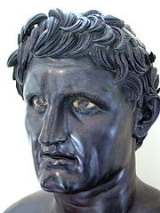
Seleucus I Nicator

Encyclopedia
Seleucus I (ca. 358 BC – 281 BC) was a Macedonian
officer of Alexander the Great and one of the Diadochi
. In the Wars of the Diadochi
that took place after Alexander's death, Seleucus established the Seleucid dynasty and the Seleucid Empire
. His kingdom would be one of the last holdouts of Alexander's former empire to Roman rule. They were only outlived by the Ptolemaic Kingdom
in Egypt
by roughly 34 years.
After the death of Alexander, Seleucus was nominated as the satrap
of Babylon
in 320 BC. Antigonus
forced Seleucus to flee from Babylon, but, supported by Ptolemy
, he was able to return in 312 BC. Seleucus' later conquests include Persia and Media
. He was defeated by the emperor of Bharatvarsha/India
, Chandragupta Maurya
and accepted a matrimony alliance for 500 elephants after ceding the territories considered as part of India
. Seleucus defeated Antigonus in the battle of Ipsus
in 301 BC and Lysimachus
in the battle of Corupedium
in 281 BC. He was assassinated by Ptolemy Ceraunus during the same year. His successor was his son Antiochus I.
Seleucus founded a number of new cities, including Antioch
and Seleucia
.
from Orestis
. Historian Junianus Justinus
claims he was one of Philip II of Macedon
's generals. Antiochus is not, however, mentioned in any other sources and nothing is known of his supposed career under Philip. It is possible that Antiochus was a member of an upper Macedonian noble family. Seleucus' mother was supposedly called Laodice
, but nothing else is known of her. Later, Seleucus named a number of cities after his parents.
As a teenager, Seleucus was chosen to serve as the king's page
(paides). It was customary for all male offspring of noble families to first serve in this position and later as officers in the king's army.
Seleucus' year of birth is unclear. Justin claims he was 77 years old during the battle of Corupedium
, which would place his year of birth at 358 BC. Appianus tells us Seleucus was 73 years old during the battle, which means 354 BC would be the year of birth. Eusebius of Caesarea
, however, mentions the age of 75, and thus the year 356 BC, making Seleucus the same age as Alexander the Great. This is most likely propaganda on Seleucus' part to make him seem comparable to Alexander.
Seleucus was born in Europos, located in the northern part of Macedonia. Just a year before his birth (if the year 358 BC is accepted as the most likely date), the Paeonians invaded the region. Philip defeated the invaders and only a few years later utterly subdued them under Macedonian rule.
A number of legends, similar to those told of Alexander the Great, were told of Seleucus. It was said Antiochus told his son before he left to battle the Persians with Alexander that his real father was actually the god Apollo
. The god had left a ring with a picture of an anchor
as a gift to Laodice. Seleucus had a birthmark shaped like an anchor. It was told that Seleucus' sons and grandsons also had similar birthmarks. The story is similar to the one told about Alexander. Most likely the story is merely propaganda by Seleucus, who presumably invented the story to present himself as the natural successor of Alexander.
John Malalas
tells us Seleucus had a sister called Didymeia
, who had sons called Nicanor and Nicomedes. It is most likely the sons are fictitious. Didymeia might refer to the oracle of Apollo in Didyma
near Miletus
. It has also been suggested that Ptolemy (son of Seleucus)
was actually the uncle of Seleucus.
 In spring 334 BC, as a young man of about twenty-three, Seleucus accompanied Alexander into Asia. By the time of the Indian campaigns beginning in late in 327 BC, he had risen to the command of the élite infantry corps in the Macedonian army, the "Shield-bearers" (Hypaspistai), later known as the "Silvershields". It is said that when Alexander crossed the Hydaspes river on a boat, he was accompanied by Perdiccas
, Ptolemy I Soter
, Lysimachus
and also Seleucus. During the subsequent Battle of the Hydaspes River
, Seleucus led his troops against the elephants of King Porus. It is likely that Seleucus had no role in the actual planning of the battle. He is also not mentioned as holding any major independent position during the battle, unlike, for example, Craterus
, Hephaistion, Peithon
and Leonnatus
– each of whom had sizable detachments under his control. Seleucus' Royal Hypaspistai were constantly under Alexander's eye and at his disposal. They later participated in the Indus valley campaign, in the battles fought against the Malli
and in the crossing of the Gedrosia
n desert.
Seleucus also took his future wife, the Persian princess Apama
(daughter of Spitamenes
), with him into India as his mistress, where she gave birth to his bastard eldest son and successor Antiochus I Soter
(325 BC). At the great marriage ceremony at Susa
in the spring of 324 BC, Seleucus formally married Apama
, and she later bore him at least two legitimate daughters, Laodice
, Apama and a son Achaeus
. At the same event, Alexander married the daughter of Darius III while several other Macedonians married Persian women. After Alexander's death, when the other senior Macedonian officers unloaded their "Susa wives" en masse, Seleucus was one of the very few who kept his, and Apama remained his consort and later Queen for the rest of her life.
Seleucus is mentioned three times in ancient sources before the death of Alexander. He participated in a sailing trip near Babylon
, took part in the dinner party of Medeios the Thessalian with Alexander and visited the temple of Sarapis. In the first of these episodes, Alexander's diadem
was blown off his head and landed on some reeds near the tombs of Assyrian kings. Seleucus swam to fetch the diadem back, placing it on his own head while returning to the boat to keep it dry. The validity of the story is dubious. The story of the dinner party of Medeios may be true, but the plot to poison the King is unlikely. In the final story, Seleucus reportedly slept in the temple of Sarapis in the hope that Alexander's health might improve. The validity of this story is also questionable.

Alexander the Great died without a successor in Babylon on June 10, 323 BC. His general Perdiccas
became the regent of all of Alexander's empire, while Alexander's physically and mentally disabled half-brother Arrhidaeus
was chosen as the next king under the name Philip III of Macedon
. Alexander's unborn child (Alexander IV
) was also named his father's successor. In the "Partition of Babylon
" however, the enormous Macedonian dominion was effectively divided among Alexander's generals. Seleucus was chosen to command the Companion cavalry
(hetaroi) and appointed first or court chiliarch
, which made him the senior officer in the Royal Army after the regent and commander-in-chief Perdiccas. Several other powerful men supported Perdiccas, including Ptolemy
, Lysimachus
, Peithon
and Eumenes
. Perdiccas' power depended on his ability to hold Alexander's enormous empire together, and on whether he could force the satrap
s to obey him.
War soon broke out between Perdiccas and the other Diadochi
. To cement his position, Perdiccas tried to marry Alexander's sister Cleopatra. The First War of the Diadochi began when Perdiccas sent Alexander's corpse to Macedonia to be buried. Ptolemy however captured the body and took it to Alexandria
. Perdiccas and his troops followed him to Egypt, whereupon Ptolemy conspired with the satrap of Media, Peithon
, and the commander of the Argyraspides
, Antigenes, both serving as officers under Perdiccas, and assassinated him. Cornelius Nepos
mentions that Seleucus also took part in this conspiracy, but this is not certain.
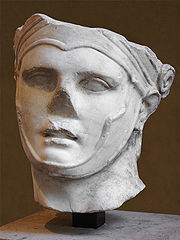 The most powerful man in the empire after the death of Perdiccas was Antipater
. Perdiccas' opponents gathered in Triparadisos, where the empire of Alexander was partitioned again (the Treaty of Triparadisus 321 BC).
At Triparadisos the soldiers had become mutinous and were planning to murder their master Antipater. Seleucus and Antigonus
, however, managed to prevent this. For betraying Perdiccas, Seleucus was awarded the rich province of Babylon. This decision may have been Antigonus' idea. Seleucus' Babylon was surrounded by Peucestas
, the satrap of Persis; Antigenes, the new satrap of Susiana and Peithon of Media. Babylon was one of the wealthiest provinces of the empire, but its military power was insignificant. It is possible that Antipater divided the eastern provinces so that no single satrap could rise above the others in power.
After the death of Alexander, Archon of Pella
was chosen satrap of Babylon. Perdiccas, however, had had plans to supersede Archon and nominate Docimus
as his successor. During his invasion of Egypt, Perdiccas sent Docimus along with his detachments to Babylon. Archon waged war against him, but fell in battle. Thus, Docimus was not intending to give Babylon to Seleucus without a fight. It is not certain how Seleucus took Babylon from Docimus, but according to one Babylonian chronicle an important building was destroyed in the city during the summer or winter of 320 BC. Other Babylonian sources state that Seleucus arrived in Babylon in October or November 320 BC. Despite the presumed battle, Docimus was able to escape.
Meanwhile, the empire was once again in turmoil. Peithon, the satrap of Media, assassinated Philip, the satrap of Parthia
, and replaced him with his brother Eudemus
as the new satrap. In the west Antigonus
and Eumenes
waged war against each other. Just like Peithon and Seleucus, Eumenes was one of the former supporters of Perdiccas. Seleucus' biggest problem was, however, Babylon itself. The locals had rebelled against Archon and supported Docimus. The Babylonian priesthood had great influence over the region. Babylon also had a sizable population of Macedonian and Greek veterans of Alexander's army. Seleucus managed to win over the priests with monetary gifts and bribes.
, but had to retreat when Antigonus reached the city. The situation was difficult for Seleucus. Eumenes and his army were north of Babylon; Antigonus was following him with an even larger army; Peithon was in Media and his opponents in Susiana. Antigenes, satrap of Susiana and commander of the Argyraspides, was allied with Eumenes. Antigenes was in Cilicia when the war between him and Peithon began.
Peithon arrived at Babylon in the autumn or winter of 317 BC. Peithon had lost a large number of troops, but Seleucus had even fewer soldiers. Eumenes decided to march to Susa in the spring of 316 BC. The satraps in Susa had apparently accepted Eumenes' claims of his fighting on behalf of the lawful ruling family against the usurper Antigonus. Eumenes marched his army 300 stadions away from Babylon and tried to cross the Tigris
. Seleucus had to act. He sent two trireme
s and some smaller ships to stop the crossing. He also tried to get the former hypasiti of the Argyraspides to join him, but this did not happen. Seleucus also sent messages to Antigonus. Because of his lack of troops, Seleucus apparently had no plans to actually stop Eumenes. He opened the flood barriers of the river, but the resulting flood did not stop Eumenes.
In the spring of 316 BC, Seleucus and Peithon joined Antigonus, who was following Eumenes to Susa. From Susa Antigonus went to Media, from where he could threaten the eastern provinces. He left Seleucus with a small number of troops to prevent Eumenes from reaching the Mediterranean. Sibyrtius
, satrap of Arachosia
, saw the situation as hopeless and returned to his own province. The armies of Eumenes and his allies were at breaking point. Antigonus and Eumenes had two encounters during 316 BC, in the battles of Paraitacene
and Gabiene
. Eumenes was defeated and executed. The events of the Second War of the Diadochi revealed Seleucus' ability to wait for the right moment. Blazing into battle was not his style.
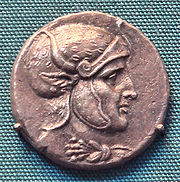 Antigonus spent the winter of 316 BC in Media, whose ruler was once again Peithon. Peithon's lust for power had grown, and he tried to get a portion of Antigonus troops to revolt to his side. Antigonus, however, discovered the plot and executed Peithon. He then superseded Peucestas as satrap of Persia. In the summer of 315 BC Antigonus arrived in Babylon and was warmly welcomed by Seleucus. The relationship between the two soon turned cold, however. Seleucus punished one of Antigonus' officers without asking permission from Antigonus. Antigonus became angry and demanded that Seleucus give him the income from the province, which Seleucus refused to do. He was, however, afraid of Antigonus and fled to Egypt with 50 horsemen. It is told that Chaldea
n astrologers prophesied to Antigonus that Seleucus would become master of Asia and would kill Antigonus. After hearing this, Antigonus sent soldiers after Seleucus, who had however first escaped to Mesopotamia
and then to Syria. Antigonus executed Blitor, the new satrap of Mesopotamia, for helping Seleucus. Modern scholars are skeptical of the prophecy story. It seems certain, however, that the Babylon priesthood was against Seleucus.
During Seleucus' escape to Egypt, Macedonia was undergoing great turmoil. Cassander
murdered king Philip III, his wife Eurydice
and Alexander the Great's mother Olympias
. Alexander IV
, still a young child, became the new king and was under the control of Cassander.
, about Antigonus. Antigonus was now the most powerful of the Diadochi, and the others would soon ally against him. The allies sent a proposition to Antigonus in which they demanded that Seleucus be allowed to return to Babylon. Antigonus refused and went to Syria, where he planned to attack Ptolemy in the spring of 314 BC. Seleucus was an admiral under Ptolemy. At the same time he started the siege of Tyros, Antigonus allied with Rhodes
. The island had a strategic location and its navy was capable of preventing the allies from combining their forces. Because of the threat of Rhodes, Ptolemy gave Seleucus a hundred ships and sent him to the Aegean Sea. The fleet was too small to defeat Rhodes, but it was big enough to force Asander
, the satrap of Caria
, to ally with Ptolemy. To demonstrate his power, Seleucus also invaded the city of Erythrai. Ptolemy, nephew of Antigonus, attacked Asander. Seleucus returned to Cyprus, where Ptolemy I had sent his brother Menelaos
along with 10,000 mercenaries and 100 ships. Seleucus and Menelaos began to besiege Kition. Antigonus sent most of his fleet to the Aegean Sea and his army to Asia Minor. Ptolemy now had an opportunity to invade Syria, where he defeated Demetrius
, the son Antigonus, in the battle of Gaza
in 312 BC. It is probable that Seleucus took part in the battle. Peithon, son of Agenor
, whom Antigonus had nominated as the new satrap of Babylon, fell in the battle. The death of Peithon gave Seleucus an opportunity to return to Babylon.
Seleucus had prepared his return to Babylon well. After the battle of Gaza Demetrius retreated to Tripoli
while Ptolemy advanced all the way to Sidon
. Ptolemy gave Seleucus 800 infantry and 200 cavalry. He also had his friends accompanying him, perhaps the same 50 who escaped with him from Babylon. On the way to Babylon Seleucus recruited more soldiers from the colonies along the route. He finally had about 3,000 soldiers. In Babylon, Pethon's commander, Diphilus, barricaded himself in the city's fortress. Seleucus conquered Babylon with great speed and the fortress was also quickly captured. Seleucus' friends who had stayed in Babylon were released from captivity. His return to Babylon was afterwards officially regarded as the beginning of the Seleucid Empire
and that year as the first of the Seleucid era
.
 Soon after Seleucus' return, the supporters of Antigonus tried get Babylon back. Nicanor
was the new satrap of Media and the strategos of the eastern provinces. His army had about 17,000 soldiers. Evagoras, the satrap of Aria, was allied with him. It was obvious that Seleucus' small force could not defeat the two in battle. Seleucus' hid his armies in the marshes that surrounded the area where Nicanor was planning to cross the Tigris and made a surprise attack during the night. Evagoras fell in the beginning of the battle and Nicanor was cut off from his forces. The news about the death of Evagoras spread among the soldiers, who started to surrender en masse. Almost all of them agreed to fight under Seleucus. Nicanor managed to escape with only a few men.
Even though Seleucus now had about 20,000 soldiers, they were not enough to withstand the forces of Antigonus. He also did not know when Antigonus would begin his counterattack. On the other hand, he knew that at least two eastern provinces did not have a satrap. A great majority of his own troops were from these provinces. Some of Evagoras' troops were Persian. Perhaps a portion of the troops were Eumenes' soldiers, who had a reason to hate Antigonus. Seleucus decided to take advantage of this situation.
Seleucus spread different stories among the provinces and the soldiers. According to one of them, he had in a dream seen Alexander standing beside him. Eumenes had tried to use a similar propaganda trick. Antigonus, who had been in Asia Minor while Seleucus had been in the east with Alexander, could not use Alexander in his own propaganda. Seleucus, being Macedonian, had the ability to gain the trust of the Macedonians among his troops, which was not the case with Eumenes.
After becoming once again satrap of Babylon, Seleucus became much more aggressive in his politics. In a short time he conquered Media and Susiana. Diodorus Siculus
reports that Seleucus also conquered other nearby areas, which might refer to Persis, Aria
or Parthia
. Seleucus did not reach Bactria
and Sogdiana
. The satrap of the former was Stasanor
, who had managed to remain neutral during the conflicts. After the defeat of Nikanor's army, there was no force in the east that could have opposed Seleucus. It is uncertain how Seleucus arranged the administration of the provinces he had conquered. Most satraps had died. In theory, Polyperchon
was still the lawful predecessor of Antipater and the official regent of the Macedonian kingdom. It was his duty to select the satraps. However, Polyperchon was still allied with Antipater and thus an enemy of Seleucus.
When Demetrius arrived in Babylon, Seleucus was somewhere in the east. He had left Patrocles
to defend the city. Babylon was defended in an unusual way. It had two strong fortresses, in which Seleucus had left his garrisons. The inhabitants of the city were transferred out and settled in the neighboring areas, some as far as Susa. The surroundings of Babylon were excellent for defense, with cities, swamps, canals and rivers. Demetrius' troops started to besiege the fortresses of Babylon and managed to conquer one of them. The second fortress proved more difficult for Demetrius. He left his friend Archelaus to continue the siege, and himself returned west leaving 5,000 infantry and 1,000 cavalry in Babylon. Ancient sources do not mention what happened to these troops. Perhaps Seleucus had to reconquer Babylon from Archelaus.
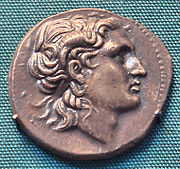 Over the course of nine years (311–302 BC), while Antigonus was occupied in the west, Seleucus brought the whole eastern part of Alexander's empire as far as the Jaxartes and Indus River
s under his authority.
In 311 BC Antigonus made peace with Cassander, Lysimachus and Ptolemy, which gave him an opportunity to deal with Seleucus. Antigonus' army had at least 80,000 soldiers. Even if he left half of his troops in the west, he would still have a numerical advantage over Seleucus. Seleucus may have received help from Cossaians, whose ancestors were the ancient Kassites
. Antigonus had devastated their lands while fighting Eumenes. Seleucus perhaps recruited a portion of Archelaus' troops. When Antigonus finally invaded Babylon, Seleucus' army was much bigger than before. Many of his soldiers certainly hated Antigonus. The population of Babylon was also hostile. Seleucus, thus, did not need to garrison the area to keep the locals from revolting.
Little information is available about the conflict between Antigonus and Seleucus; only a very rudimentary Babylonian chronicle detailing the events of the war remains. The description of the year 310 BC has completely disappeared. It seems that Antigonus managed to conquer Babylon. His plans were disturbed, however, by Ptolemy, who made a surprise attack in Cilicia.
We do know that Seleucus managed to defeat Antigonus in at least one decisive battle. This battle is only mentioned in Stratagems in War by Polyaenus
. Polyaenus reports that the troops of Seleucus and Antigonus fought for a whole day, but when night came the battle was still undecided. The two forces agreed to rest for the night and continue in the morning. Antigonus' troops slept without their equipment. Seleucus ordered his forces to sleep and eat breakfast in battle formation. Shortly before dawn, Seleucus' troops attacked the forces of Antigonus, who were still without their weapons and in disarray and thus easily defeated. The historical accuracy of the story is questionable.
The Babylonian war finally ended in Seleucus' victory. Antigonus was forced to retreat west. Both sides fortified their borders. Antigonus built a series of fortresses along the Balikh River while Seleucus built a few cities, including Dura-Europos
and Nisibis
.
. The city was built on the shore of the Tigris probably in 307 or 305 BC. Seleucus made Seleucia his new capital, thus imitating Lysimachus, Cassander and Antigonus, all of whom had named cities after themselves. Seleucus also transferred the mint of Babylon to his new city. Babylon was soon left in the shadow of Seleucia, and the story goes that Antiochus
, the son of Seleucus, moved the whole population of Babylon to his father's namesake capital in 275 BC. The city flourished until AD 165, when the Romans destroyed it.
A story of the founding of the city goes as follows: Seleucus asked the Babylonian priests which day would be best to found the city. The priest calculated the day, but, wanting the founding to fail, told Seleucus a different date. Their plot failed however, because when the correct day came, Seleucus' soldiers spontaneously started to build the city. When questioned, the priests admitted their deed.
.jpg) The struggle between the Diadochi reached its climax when Antigonus, after the extinction of the old royal line of Macedonia, proclaimed himself king in 306 BC. Ptolemy, Lysimachus, Cassander and Seleucus soon followed. Also, Agathocles
The struggle between the Diadochi reached its climax when Antigonus, after the extinction of the old royal line of Macedonia, proclaimed himself king in 306 BC. Ptolemy, Lysimachus, Cassander and Seleucus soon followed. Also, Agathocles
of Sicily declared himself king around the same time. Seleucus, like the other four principal Macedonian chiefs, assumed the title and style of basileus
(king).
Emperor Chandragupta Maurya
:
Only a few sources mention his activities in India. Chandragupta Maurya
(known in Greek sources as Sandrökottos), founder of the Mauryan empire, had conquered the Indus valley and several other parts of the easternmost regions of Alexander's empire. Seleucus began a campaign against Chandragupta and crossed the Indus. Seleucus' Indian campaign was, however, a failure. It is unknown what exactly happened. Perhaps Chandragupta defeated Seleucus in battle. No sources mention this, however. But as most historians note, Seleucus appears to have fared poorly as he did not achieve his aims. The two leaders ultimately reached an agreement, and through a treaty sealed in 305 BC, Seleucus ceded a considerable amount of territory to Chandragupta
in exchange for 500 war elephants, which were to play a key role in the battles that were to come. After 20 years only one of the animals was still alive. This is probably because Chandragupta gave Seleucus his oldest elephants as a present. According to Strabo, the ceded territories bordered the Indus:
Seleucus surrendered the easternmost provinces of Arachosia
, Paropamisadae
and perhaps Aria
. On the other hand, he was accepted by other satraps of the eastern provinces. His Persian wife might have increased his popularity. The satraps of Bactria and Parthia needed Seleucus' support against Chandragupta.
Modern scholarship often considers that Seleucus actually gave away more territory in what is now southern Afghanistan
, and parts of Persia
west of the Indus
. This would tend to be corroborated archaeologically, as concrete indications of Mauryan influence, such as the inscriptions of the Edicts of Ashoka
, are known as far as Kandhahar in today's southern Afghanistan.
Some authors claim this to be an exaggeration originating in a statement by Pliny the Elder referring not specifically to the lands received by Chandragupta, but rather to the various opinions of geographers regarding the definition of the word "India":
Also the passage of Arrian
explaining that Megasthenes
lived in Arachosia
with the satrap Sibyrtius
, from where he traveled to India to visit Chandragupta, goes against the notion that Arachosia was under Maurya rule:
Nevertheless, it is usually considered today that Arachosia and the other three regions did become dominions of the Mauryan Empire.
The alliance between Chandragupta and Seleucus was probably affirmed with a marriage (Epigamia
). Chandragupta or his son married the daughter of Seleucus, Cornelia, or perhaps there was diplomatic recognition of intermarriage between Indians and Greeks.
In addition to this matrimonial recognition or alliance, Seleucus dispatched an ambassador, Megasthenes
, to the Mauryan court at Pataliputra (Modern Patna
in Bihar state). Only short extracts remain of Megasthenes' description of the journey.
The two rulers seem to have been on very good terms, as classical sources have recorded that following their treaty, Chandragupta sent various presents such as aphrodisiac
s to Seleucus.
Seleucus obtained knowledge of most of northern India, as explained by Pliny the Elder
through his numerous embassies to the Mauryan Empire:
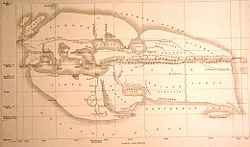
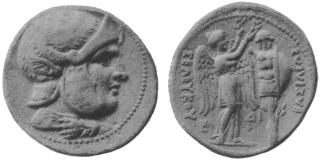
Seleucus apparently minted coins during his stay in India, as several coins in his name are in the Indian standard and have been excavated in India. These coins describe him as "Basileus" ("King"), which implies a date later than 306 BC. Some of them also mention Seleucus in association with his son Antiochus as king, which would also imply a date as late as 293 BC. No Seleucid coins were struck in India thereafter and confirm the reversal of territory west of the Indus to Chandragupta.
Seleucus may have founded a navy in the Persian Gulf
and in the Indian Ocean.
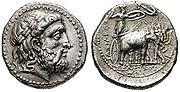 The war elephants Seleucus received from Chandragupta proved to be useful when the Diadochi finally decided to deal with Antigonus. Cassander, Seleucus and Lysimachus defeated Antigonus and Demetrius in the battle of Ipsus
. Antigonus fell in battle, but Demetrius managed to escape. After the battle, Syria was placed under Seleucus' rule. He understood Syria to encompass the region from the Taurus mountains
to Sinai, but Ptolemy had already conquered Palestine
and Phonicia. In 299 BC Seleucus allied with Demetrius and married his daughter Stratonice
. Stratonice was also the daughter of Antipater's daughter Phila. Seleucus had a daughter by Stratonice, who was also called Phila
.
The fleet of Demetrius managed to destroy Ptolemy's fleet and thus Seleucus did not need to fight him.
Seleucus, however, did not manage to enlarge his kingdom to the west. The main reason was that he did not have enough Greek and Macedonian troops. During the battle of Ipsus, he had less infantry than Lysimachus. His strength was in his war elephants and in traditional Persian cavalry. In order to enlarge his army, Seleucus tried to attract colonists from mainland Greece by founding four new cities—Seleucia Pieria and Laodicea in Syria on the coast and Antioch on the Orontes and Apameia
in the Orontes River
valley. Antioch
became his chief seat of government. The new Seleuceia was supposed to become his new naval base and a gateway to the Mediterranean. Seleucus also founded six smaller cities.
It is said of Seleucus that "few princes have ever lived with so great a passion for the building of cities. He is reputed to have built in all nine Seleucias, sixteen Antiochs, and six Laodiceas".
.jpg) Seleucus nominated his son Antiochus I as his co-ruler and viceroy of the eastern provinces in 292 BC, the vast extent of the empire seeming to require a double government. In 294 BC Stratonice married her stepson Antiochus
Seleucus nominated his son Antiochus I as his co-ruler and viceroy of the eastern provinces in 292 BC, the vast extent of the empire seeming to require a double government. In 294 BC Stratonice married her stepson Antiochus
. Seleucus reportedly instigated the marriage after discovering that his son was in danger of dying of lovesickness. Seleucus was thus able to remove Stratonice out of the way, as her father Demetrius had now become king of Macedonia.
The alliance between Seleucus and Demetrius ended in 294 BC when Seleucus conquered Cilicia
. Demetrius invaded and easily conquered Cilicia in 286 BC, which meant that Demetrius was now threatening the most important regions of Seleucus' empire in Syria. Demetrius' troops, however, were tired and had not received their payment. Seleucus, on the other hand, was known as a cunning and rich leader who had earned the adoration of his soldiers. Seleucus blocked the roads leading south from Cilicia and urged Demetrius' troops to join his side. Simultaneously he tried to evade battle with Demetrius. Finally, Seleucus addressed Demetrius personally. He showed himself in front of the soldiers and removed his helmet, revealing his identity. Demetrius' troops now started to abandon their leader en massse. Demetrius was finally imprisoned in Apameia and died a few years later in captivity.
Lysimachus and Ptolemy had supported Seleucus against Demetrius, but after the latter's defeat the alliance started to break apart. Lysimachus ruled Macedonia, Thracia
and Asia Minor
. He also had problems with his family. Lysimachus executed his son Agathocles
, whose wife Lysandra
escaped to Babylon to Seleucus.
The unpopularity of Lysimachus after the murder of Agathocles
gave Seleucus an opportunity to remove his last rival. His intervention in the west was solicited by Ptolemy Keraunos
, who, on the accession to the Egyptian throne of his brother Ptolemy II (285 BC), had at first taken refuge with Lysimachus and then with Seleucus. Seleucus then invaded Asia Minor and defeated his rival in the Battle of Corupedium
in Lydia
, 281 BC. Lysimachus fell in battle. In addition, Ptolemy had died a few years earlier. Seleucus was thus now the only living contemporary of Alexander.
 Before his death, Seleucus tried to deal with the administration of Asia Minor. The region was ethnically diverse, consisting of Greek cities, a Persian aristocracy and indigenous peoples. Seleucus perhaps tried to defeat Cappadocia
, but failed. Lysimachus' old officer Philetairos ruled Pergamon
independently. On the other hand, based on their names, Seleucus apparently founded a number of new cities in Asia Minor.
Few of the letters Seleucus sent to different cities and temples still exist. All cities in Asia Minor sent embassies to their new ruler. It is reported that Seleucus complained about the number of letters he received and was forced to read. He was apparently a popular ruler. In Lemnos
he was celebrated as a liberator and a temple was built to honour him. According to a local custom, Seleucus was always offered an extra cup of wine during dinner time. His title during this period was Seleucus Soter ("liberator"). When Seleucus left for Europe, the organizational rearrangement of Asia Minor had not been completed.
near Lysimachia
September (281 BC).
It seems certain that after taking Macedonia and Thracia, Seleucus would have tried to conquer Greece. He had already prepared this campaign using the numerous gifts presented to him. He was also nominated an honorary citizen of Athens
.
Antiochus founded the cult of his father. A cult of personality formed around the later members of the Seleucid dynasty and Seleucus was later worshipped as a son of god. One inscription found in Ilion advises priests to sacrifice to Apollo
, the ancestor of Antiochus' family. Several anecdotes of Selecus' life became popular in the classical world.
Ancient Macedonians
The Macedonians originated from inhabitants of the northeastern part of the Greek peninsula, in the alluvial plain around the rivers Haliacmon and lower Axios...
officer of Alexander the Great and one of the Diadochi
Diadochi
The Diadochi were the rival generals, family and friends of Alexander the Great who fought for the control of Alexander's empire after his death in 323 BC...
. In the Wars of the Diadochi
Wars of the Diadochi
The Wars of the Diadochi were a series of conflicts fought between Alexander the Great's generals over the rule of his empire between 322 and 275 BC.-Background:...
that took place after Alexander's death, Seleucus established the Seleucid dynasty and the Seleucid Empire
Seleucid Empire
The Seleucid Empire was a Greek-Macedonian state that was created out of the eastern conquests of Alexander the Great. At the height of its power, it included central Anatolia, the Levant, Mesopotamia, Persia, today's Turkmenistan, Pamir and parts of Pakistan.The Seleucid Empire was a major centre...
. His kingdom would be one of the last holdouts of Alexander's former empire to Roman rule. They were only outlived by the Ptolemaic Kingdom
Ptolemaic Kingdom
The Ptolemaic Kingdom in and around Egypt began following Alexander the Great's conquest in 332 BC and ended with the death of Cleopatra VII and the Roman conquest in 30 BC. It was founded when Ptolemy I Soter declared himself Pharaoh of Egypt, creating a powerful Hellenistic state stretching from...
in Egypt
Egypt
Egypt , officially the Arab Republic of Egypt, Arabic: , is a country mainly in North Africa, with the Sinai Peninsula forming a land bridge in Southwest Asia. Egypt is thus a transcontinental country, and a major power in Africa, the Mediterranean Basin, the Middle East and the Muslim world...
by roughly 34 years.
After the death of Alexander, Seleucus was nominated as the satrap
Satrap
Satrap was the name given to the governors of the provinces of the ancient Median and Achaemenid Empires and in several of their successors, such as the Sassanid Empire and the Hellenistic empires....
of Babylon
Babylon
Babylon was an Akkadian city-state of ancient Mesopotamia, the remains of which are found in present-day Al Hillah, Babil Province, Iraq, about 85 kilometers south of Baghdad...
in 320 BC. Antigonus
Antigonus I Monophthalmus
Antigonus I Monophthalmus , son of Philip from Elimeia, was a Macedonian nobleman, general, and satrap under Alexander the Great. During his early life he served under Philip II, and he was a major figure in the Wars of the Diadochi after Alexander's death, declaring himself king in 306 BC and...
forced Seleucus to flee from Babylon, but, supported by Ptolemy
Ptolemy I Soter
Ptolemy I Soter I , also known as Ptolemy Lagides, c. 367 BC – c. 283 BC, was a Macedonian general under Alexander the Great, who became ruler of Egypt and founder of both the Ptolemaic Kingdom and the Ptolemaic Dynasty...
, he was able to return in 312 BC. Seleucus' later conquests include Persia and Media
Medes
The MedesThe Medes...
. He was defeated by the emperor of Bharatvarsha/India
India
India , officially the Republic of India , is a country in South Asia. It is the seventh-largest country by geographical area, the second-most populous country with over 1.2 billion people, and the most populous democracy in the world...
, Chandragupta Maurya
Chandragupta Maurya
Chandragupta Maurya , was the founder of the Maurya Empire. Chandragupta succeeded in conquering most of the Indian subcontinent. Chandragupta is considered the first unifier of India and its first genuine emperor...
and accepted a matrimony alliance for 500 elephants after ceding the territories considered as part of India
India
India , officially the Republic of India , is a country in South Asia. It is the seventh-largest country by geographical area, the second-most populous country with over 1.2 billion people, and the most populous democracy in the world...
. Seleucus defeated Antigonus in the battle of Ipsus
Battle of Ipsus
The Battle of Ipsus was fought between some of the Diadochi in 301 BC near the village of that name in Phrygia...
in 301 BC and Lysimachus
Lysimachus
Lysimachus was a Macedonian officer and diadochus of Alexander the Great, who became a basileus in 306 BC, ruling Thrace, Asia Minor and Macedon.-Early Life & Career:...
in the battle of Corupedium
Battle of Corupedium
The Battle of Corupedium, also called Corupedion or Curupedion is the name of the last battle of the Diadochi, the rival successors to Alexander the Great. It was fought in 281 BC between the armies of Lysimachus and Seleucus I Nicator. Lysimachus had ruled Thrace for decades and parts of modern...
in 281 BC. He was assassinated by Ptolemy Ceraunus during the same year. His successor was his son Antiochus I.
Seleucus founded a number of new cities, including Antioch
Antioch
Antioch on the Orontes was an ancient city on the eastern side of the Orontes River. It is near the modern city of Antakya, Turkey.Founded near the end of the 4th century BC by Seleucus I Nicator, one of Alexander the Great's generals, Antioch eventually rivaled Alexandria as the chief city of the...
and Seleucia
Seleucia
Seleucia was the first capital of the Seleucid Empire, and one of the great cities of antiquity standing in Mesopotamia, on the Tigris River.Seleucia may refer to:...
.
Youth and family
Seleucus was the son of AntiochusAntiochus (father of Seleucus I Nicator)
Antiochus was a Macedonian man that lived during the time of Philip II of Macedon, who ruled from 359 BC-336 BC. He originally came from Orestis, Macedonia....
from Orestis
Orestis (region)
For the modern municipality, see OrestidaOrestis was a region of Upper Macedonia, corresponding roughly to the modern Kastoria Prefecture, West Macedonia, Greece. Its inhabitants were the Greek tribe Orestae...
. Historian Junianus Justinus
Junianus Justinus
Justin was a Latin historian who lived under the Roman Empire. His name is mentioned only in the title of his own history, and there it is in the genitive, which would be M. Juniani Justini no matter which nomen he bore.Of his personal history nothing is known...
claims he was one of Philip II of Macedon
Philip II of Macedon
Philip II of Macedon "friend" + ἵππος "horse" — transliterated ; 382 – 336 BC), was a king of Macedon from 359 BC until his assassination in 336 BC. He was the father of Alexander the Great and Philip III.-Biography:...
's generals. Antiochus is not, however, mentioned in any other sources and nothing is known of his supposed career under Philip. It is possible that Antiochus was a member of an upper Macedonian noble family. Seleucus' mother was supposedly called Laodice
Laodice of Macedonia
Laodice was a Greek noblewoman and wife of Antiochus , a general of distinction in the service of Philip II of Macedon. She was the mother of Seleucus, the founder of the Seleucid Empire and Seleucus' sister Didymeia. It was pretended, in consequence of a dream which she had, that Apollo was the...
, but nothing else is known of her. Later, Seleucus named a number of cities after his parents.
As a teenager, Seleucus was chosen to serve as the king's page
Page (servant)
A page or page boy is a traditionally young male servant, a messenger at the service of a nobleman or royal.-The medieval page:In medieval times, a page was an attendant to a knight; an apprentice squire...
(paides). It was customary for all male offspring of noble families to first serve in this position and later as officers in the king's army.
Seleucus' year of birth is unclear. Justin claims he was 77 years old during the battle of Corupedium
Battle of Corupedium
The Battle of Corupedium, also called Corupedion or Curupedion is the name of the last battle of the Diadochi, the rival successors to Alexander the Great. It was fought in 281 BC between the armies of Lysimachus and Seleucus I Nicator. Lysimachus had ruled Thrace for decades and parts of modern...
, which would place his year of birth at 358 BC. Appianus tells us Seleucus was 73 years old during the battle, which means 354 BC would be the year of birth. Eusebius of Caesarea
Eusebius of Caesarea
Eusebius of Caesarea also called Eusebius Pamphili, was a Roman historian, exegete and Christian polemicist. He became the Bishop of Caesarea in Palestine about the year 314. Together with Pamphilus, he was a scholar of the Biblical canon...
, however, mentions the age of 75, and thus the year 356 BC, making Seleucus the same age as Alexander the Great. This is most likely propaganda on Seleucus' part to make him seem comparable to Alexander.
Seleucus was born in Europos, located in the northern part of Macedonia. Just a year before his birth (if the year 358 BC is accepted as the most likely date), the Paeonians invaded the region. Philip defeated the invaders and only a few years later utterly subdued them under Macedonian rule.
A number of legends, similar to those told of Alexander the Great, were told of Seleucus. It was said Antiochus told his son before he left to battle the Persians with Alexander that his real father was actually the god Apollo
Apollo
Apollo is one of the most important and complex of the Olympian deities in Greek and Roman mythology...
. The god had left a ring with a picture of an anchor
Anchor
An anchor is a device, normally made of metal, that is used to connect a vessel to the bed of a body of water to prevent the vessel from drifting due to wind or current. The word derives from Latin ancora, which itself comes from the Greek ἄγκυρα .Anchors can either be temporary or permanent...
as a gift to Laodice. Seleucus had a birthmark shaped like an anchor. It was told that Seleucus' sons and grandsons also had similar birthmarks. The story is similar to the one told about Alexander. Most likely the story is merely propaganda by Seleucus, who presumably invented the story to present himself as the natural successor of Alexander.
John Malalas
John Malalas
John Malalas or Ioannes Malalas was a Greek chronicler from Antioch. Malalas is probably a Syriac word for "rhetor", "orator"; it is first applied to him by John of Damascus .-Life:Malalas was educated in Antioch, and probably was a jurist there, but moved to...
tells us Seleucus had a sister called Didymeia
Didymeia (sister of Seleucus I Nicator)
Didymeia was a Greek Macedonian noblewoman. She originally came from an upper Macedonian noble family. Didymeia was the daughter of...
, who had sons called Nicanor and Nicomedes. It is most likely the sons are fictitious. Didymeia might refer to the oracle of Apollo in Didyma
Didyma
Didyma was an ancient Ionian sanctuary, the modern Didim, Turkey, containing a temple and oracle of Apollo, the Didymaion. In Greek didyma means "twin", but the Greeks who sought a "twin" at Didyma ignored the Carian origin of the name...
near Miletus
Miletus
Miletus was an ancient Greek city on the western coast of Anatolia , near the mouth of the Maeander River in ancient Caria...
. It has also been suggested that Ptolemy (son of Seleucus)
Ptolemy (son of Seleucus)
Ptolemy ; died 333 BC) son of Seleucus from Orestis or Tymphaia, was one of the select officers called Somatophylaces, or guards of the king's person; he combined with that distinguished post the command of one of the divisions of the phalanx. Ptolemy was from an upper noble family...
was actually the uncle of Seleucus.
Early career under Alexander the Great
Perdiccas
Perdiccas was one of Alexander the Great's generals. After Alexander's death in 323 BC he became regent of all Alexander's empire.Arrian tells us he was son of Orontes, a descendant of the independent princes of the Macedonian province of Orestis...
, Ptolemy I Soter
Ptolemy I Soter
Ptolemy I Soter I , also known as Ptolemy Lagides, c. 367 BC – c. 283 BC, was a Macedonian general under Alexander the Great, who became ruler of Egypt and founder of both the Ptolemaic Kingdom and the Ptolemaic Dynasty...
, Lysimachus
Lysimachus
Lysimachus was a Macedonian officer and diadochus of Alexander the Great, who became a basileus in 306 BC, ruling Thrace, Asia Minor and Macedon.-Early Life & Career:...
and also Seleucus. During the subsequent Battle of the Hydaspes River
Battle of the Hydaspes River
The Battle of the Hydaspes River was fought by Alexander the Great in 326 BC against King Porus of the Hindu Paurava kingdom on the banks of the Hydaspes River in the Punjab near Bhera in what is now modern-day Pakistan...
, Seleucus led his troops against the elephants of King Porus. It is likely that Seleucus had no role in the actual planning of the battle. He is also not mentioned as holding any major independent position during the battle, unlike, for example, Craterus
Craterus
Craterus was a Macedonian general under Alexander the Great and one of the Diadochi.He was the son of a Macedonian nobleman named Alexander from Orestis and brother of admiral Amphoterus. Craterus commanded the phalanx and all infantry on the left wing in Battle of Issus...
, Hephaistion, Peithon
Peithon
Peithon or Pithon was the son of Crateuas, a nobleman from Eordaia in western Macedonia. One of the bodyguards of Alexander the Great, later satrap of Media and one of the diadochi....
and Leonnatus
Leonnatus
Leonnatus was a Macedonian officer of Alexander the Great and one of the diadochi.He was a member of the royal house of Lyncestis, a small kingdom that had been included in Macedonia by King Philip II of Macedon. Leonnatus was the same age as Alexander and was very close to him. Later, he was one...
– each of whom had sizable detachments under his control. Seleucus' Royal Hypaspistai were constantly under Alexander's eye and at his disposal. They later participated in the Indus valley campaign, in the battles fought against the Malli
Malli
Mallı is a village in the Goychay Rayon of Azerbaijan. The villages forms part of the municipality of Mallı-Şıxlı....
and in the crossing of the Gedrosia
Gedrosia
Gedrosia from Pashto Gwadar-khua is the hellenized name of an area that corresponds to today's Balochistan. Eastern Balochistan is southwestern province of Pakistan and parts of southwestern and south-central Afghanistan and western Balochistan is divided between Iranian provinces of Hormozgan and...
n desert.
Seleucus also took his future wife, the Persian princess Apama
Apama
Apama , sometimes known as Apama I or Apame I was the wife of the first ruler of the Seleucid Empire, Seleucus I Nicator. They married at Susa in 324 BC...
(daughter of Spitamenes
Spitamenes
Spitamenes Sogdian warlord, leader of the uprising in Sogdiana and Bactria against Alexander of Macedon 329 BC....
), with him into India as his mistress, where she gave birth to his bastard eldest son and successor Antiochus I Soter
Antiochus I Soter
Antiochus I Soter , was a king of the Hellenistic Seleucid Empire. He reigned from 281 BC - 261 BC....
(325 BC). At the great marriage ceremony at Susa
Susa
Susa was an ancient city of the Elamite, Persian and Parthian empires of Iran. It is located in the lower Zagros Mountains about east of the Tigris River, between the Karkheh and Dez Rivers....
in the spring of 324 BC, Seleucus formally married Apama
Apama
Apama , sometimes known as Apama I or Apame I was the wife of the first ruler of the Seleucid Empire, Seleucus I Nicator. They married at Susa in 324 BC...
, and she later bore him at least two legitimate daughters, Laodice
Laodice
-Greek mythology:* Laodice , daughter of Priam, king of Troy* Laodice, daughter of Agamemnon, a.k.a. Electra* Laodice, one of the Hyperborean maidens* Laodice, consort of Phoroneus...
, Apama and a son Achaeus
Achaeus (son of Seleucus I Nicator)
Achaeus was a Greek Macedonian nobleman and was the second son born to King and founder of the Seleucid Empire Seleucus I Nicator and Persian noblewoman Apama I. Achaeus was of Greek and Persian descent. He had three siblings: one brother the Seleucid King Antiochus I Soter and two sisters: Apama...
. At the same event, Alexander married the daughter of Darius III while several other Macedonians married Persian women. After Alexander's death, when the other senior Macedonian officers unloaded their "Susa wives" en masse, Seleucus was one of the very few who kept his, and Apama remained his consort and later Queen for the rest of her life.
Seleucus is mentioned three times in ancient sources before the death of Alexander. He participated in a sailing trip near Babylon
Babylon
Babylon was an Akkadian city-state of ancient Mesopotamia, the remains of which are found in present-day Al Hillah, Babil Province, Iraq, about 85 kilometers south of Baghdad...
, took part in the dinner party of Medeios the Thessalian with Alexander and visited the temple of Sarapis. In the first of these episodes, Alexander's diadem
Diadem
Diadem may refer to:*Diadem, a type of crown-Military:*HMS Diadem was a 64-gun third rate ship of the line in the Royal Navy launched in 1782 at Chatham and participated in the Battle of Cape St Vincent in 1787...
was blown off his head and landed on some reeds near the tombs of Assyrian kings. Seleucus swam to fetch the diadem back, placing it on his own head while returning to the boat to keep it dry. The validity of the story is dubious. The story of the dinner party of Medeios may be true, but the plot to poison the King is unlikely. In the final story, Seleucus reportedly slept in the temple of Sarapis in the hope that Alexander's health might improve. The validity of this story is also questionable.
Senior officer under Perdiccas
Alexander the Great died without a successor in Babylon on June 10, 323 BC. His general Perdiccas
Perdiccas
Perdiccas was one of Alexander the Great's generals. After Alexander's death in 323 BC he became regent of all Alexander's empire.Arrian tells us he was son of Orontes, a descendant of the independent princes of the Macedonian province of Orestis...
became the regent of all of Alexander's empire, while Alexander's physically and mentally disabled half-brother Arrhidaeus
Arrhidaeus
Arrhidaeus , one of Alexander the Great's generals, was entrusted with the conduct of Alexander's funeral to Egypt in 323 BC...
was chosen as the next king under the name Philip III of Macedon
Philip III of Macedon
Philip III Arrhidaeus was the king of Macedonia from after June 11, 323 BC until his death. He was a son of King Philip II of Macedonia by Philinna of Larissa, allegedly a Thessalian dancer, and a half-brother of Alexander the Great...
. Alexander's unborn child (Alexander IV
Alexander IV of Macedon
Alexander IV Aegus was the son of Alexander the Great and Princess Roxana of Bactria.-Birth:...
) was also named his father's successor. In the "Partition of Babylon
Partition of Babylon
The Partition of Babylon designates the attribution of the territories of Alexander the Great between his generals after his death in 323 BC.-Background:...
" however, the enormous Macedonian dominion was effectively divided among Alexander's generals. Seleucus was chosen to command the Companion cavalry
Companion cavalry
The Companions were the elite cavalry of the Macedonian army from the time of king Philip II of Macedon and reached the most prestige under Alexander the Great, and have been regarded as the best cavalry in the ancient world and the first shock cavalry...
(hetaroi) and appointed first or court chiliarch
Chiliarch
Chiliarch , in the Greek army of the Hellenistic period, was a commander of a 1,000 men unit, roughly equivalent to a modern battalion. The office was an adaptation by Alexander the Great of the Persian Achaemenid empire's hazarapatish. A chiliarch held duties both martial and civil...
, which made him the senior officer in the Royal Army after the regent and commander-in-chief Perdiccas. Several other powerful men supported Perdiccas, including Ptolemy
Ptolemy I Soter
Ptolemy I Soter I , also known as Ptolemy Lagides, c. 367 BC – c. 283 BC, was a Macedonian general under Alexander the Great, who became ruler of Egypt and founder of both the Ptolemaic Kingdom and the Ptolemaic Dynasty...
, Lysimachus
Lysimachus
Lysimachus was a Macedonian officer and diadochus of Alexander the Great, who became a basileus in 306 BC, ruling Thrace, Asia Minor and Macedon.-Early Life & Career:...
, Peithon
Peithon
Peithon or Pithon was the son of Crateuas, a nobleman from Eordaia in western Macedonia. One of the bodyguards of Alexander the Great, later satrap of Media and one of the diadochi....
and Eumenes
Eumenes
Eumenes of Cardia was a Thracian general and scholar. He participated in the wars of the Diadochi as a supporter of the Macedonian Argead royal house.-Career:...
. Perdiccas' power depended on his ability to hold Alexander's enormous empire together, and on whether he could force the satrap
Satrap
Satrap was the name given to the governors of the provinces of the ancient Median and Achaemenid Empires and in several of their successors, such as the Sassanid Empire and the Hellenistic empires....
s to obey him.
War soon broke out between Perdiccas and the other Diadochi
Diadochi
The Diadochi were the rival generals, family and friends of Alexander the Great who fought for the control of Alexander's empire after his death in 323 BC...
. To cement his position, Perdiccas tried to marry Alexander's sister Cleopatra. The First War of the Diadochi began when Perdiccas sent Alexander's corpse to Macedonia to be buried. Ptolemy however captured the body and took it to Alexandria
Alexandria
Alexandria is the second-largest city of Egypt, with a population of 4.1 million, extending about along the coast of the Mediterranean Sea in the north central part of the country; it is also the largest city lying directly on the Mediterranean coast. It is Egypt's largest seaport, serving...
. Perdiccas and his troops followed him to Egypt, whereupon Ptolemy conspired with the satrap of Media, Peithon
Peithon
Peithon or Pithon was the son of Crateuas, a nobleman from Eordaia in western Macedonia. One of the bodyguards of Alexander the Great, later satrap of Media and one of the diadochi....
, and the commander of the Argyraspides
Argyraspides
The Argyraspides , were a division of the Macedonian army of Alexander the Great, who were so called because they carried silver-plated shields. They were picked men, were commanded by Nicanor, the son of Parmenion, and were held in high honour by Alexander. They were hypaspists, having changed...
, Antigenes, both serving as officers under Perdiccas, and assassinated him. Cornelius Nepos
Cornelius Nepos
Cornelius Nepos was a Roman biographer. He was born at Hostilia, a village in Cisalpine Gaul not far from Verona. His Gallic origin is attested by Ausonius, and Pliny the Elder calls him Padi accola...
mentions that Seleucus also took part in this conspiracy, but this is not certain.
Satrap of Babylon
Antipater
Antipater was a Macedonian general and a supporter of kings Philip II of Macedon and Alexander the Great. In 320 BC, he became Regent of all of Alexander's Empire. Antipater was one of the sons of a Macedonian nobleman called Iollas or Iolaus and his family were distant collateral relatives to the...
. Perdiccas' opponents gathered in Triparadisos, where the empire of Alexander was partitioned again (the Treaty of Triparadisus 321 BC).
At Triparadisos the soldiers had become mutinous and were planning to murder their master Antipater. Seleucus and Antigonus
Antigonus I Monophthalmus
Antigonus I Monophthalmus , son of Philip from Elimeia, was a Macedonian nobleman, general, and satrap under Alexander the Great. During his early life he served under Philip II, and he was a major figure in the Wars of the Diadochi after Alexander's death, declaring himself king in 306 BC and...
, however, managed to prevent this. For betraying Perdiccas, Seleucus was awarded the rich province of Babylon. This decision may have been Antigonus' idea. Seleucus' Babylon was surrounded by Peucestas
Peucestas
Peucestas was a native of the town of Mieza, in Macedonia, and a distinguished officer in the service of Alexander the Great. His name is first mentioned as one of those appointed to command a trireme on the Hydaspes...
, the satrap of Persis; Antigenes, the new satrap of Susiana and Peithon of Media. Babylon was one of the wealthiest provinces of the empire, but its military power was insignificant. It is possible that Antipater divided the eastern provinces so that no single satrap could rise above the others in power.
After the death of Alexander, Archon of Pella
Archon of Pella
Archon was a Pellaean, appointed satrap of Babylonia after the death of Alexander the Great , is probably the same as the son of Cleinias mentioned in the Indian expedition of Alexander. He perished in 321 BC in a fight against Docimus. As it is proved from an inscription in Delphi, Archon had...
was chosen satrap of Babylon. Perdiccas, however, had had plans to supersede Archon and nominate Docimus
Docimus
Antigonos Dokimos, commonly shortened and Latinized as Docimus , was one of the officers in the Macedonian army.After the death of Alexander the Great he supported the party of Perdiccas....
as his successor. During his invasion of Egypt, Perdiccas sent Docimus along with his detachments to Babylon. Archon waged war against him, but fell in battle. Thus, Docimus was not intending to give Babylon to Seleucus without a fight. It is not certain how Seleucus took Babylon from Docimus, but according to one Babylonian chronicle an important building was destroyed in the city during the summer or winter of 320 BC. Other Babylonian sources state that Seleucus arrived in Babylon in October or November 320 BC. Despite the presumed battle, Docimus was able to escape.
Meanwhile, the empire was once again in turmoil. Peithon, the satrap of Media, assassinated Philip, the satrap of Parthia
Parthia
Parthia is a region of north-eastern Iran, best known for having been the political and cultural base of the Arsacid dynasty, rulers of the Parthian Empire....
, and replaced him with his brother Eudemus
Eudemus (general)
Eudemus was one of Alexander the Great's generals, who was appointed by him to the command of the troops left in India, after the murder of the Alexander-appointed satrap Philip by his own mercenary troops in 326 BCE:After Alexander's death he made himself master of the territories of the Indian...
as the new satrap. In the west Antigonus
Antigonus I Monophthalmus
Antigonus I Monophthalmus , son of Philip from Elimeia, was a Macedonian nobleman, general, and satrap under Alexander the Great. During his early life he served under Philip II, and he was a major figure in the Wars of the Diadochi after Alexander's death, declaring himself king in 306 BC and...
and Eumenes
Eumenes
Eumenes of Cardia was a Thracian general and scholar. He participated in the wars of the Diadochi as a supporter of the Macedonian Argead royal house.-Career:...
waged war against each other. Just like Peithon and Seleucus, Eumenes was one of the former supporters of Perdiccas. Seleucus' biggest problem was, however, Babylon itself. The locals had rebelled against Archon and supported Docimus. The Babylonian priesthood had great influence over the region. Babylon also had a sizable population of Macedonian and Greek veterans of Alexander's army. Seleucus managed to win over the priests with monetary gifts and bribes.
Second War of the Diadochi
After the death of Antipater in 319 BC, the satrap of Media began to expand his power. Peithon assembled a large army of perhaps over 20,000 soldiers. Under the leadership of Peucestas the other satraps of the region brought together an opposing army of their own. Peithon was finally defeated in a battle waged in Parthia. He escaped to Media, but his opponents did not follow him and rather returned to Susiana. Meanwhile Eumenes and his army had arrived at CiliciaCilicia
In antiquity, Cilicia was the south coastal region of Asia Minor, south of the central Anatolian plateau. It existed as a political entity from Hittite times into the Byzantine empire...
, but had to retreat when Antigonus reached the city. The situation was difficult for Seleucus. Eumenes and his army were north of Babylon; Antigonus was following him with an even larger army; Peithon was in Media and his opponents in Susiana. Antigenes, satrap of Susiana and commander of the Argyraspides, was allied with Eumenes. Antigenes was in Cilicia when the war between him and Peithon began.
Peithon arrived at Babylon in the autumn or winter of 317 BC. Peithon had lost a large number of troops, but Seleucus had even fewer soldiers. Eumenes decided to march to Susa in the spring of 316 BC. The satraps in Susa had apparently accepted Eumenes' claims of his fighting on behalf of the lawful ruling family against the usurper Antigonus. Eumenes marched his army 300 stadions away from Babylon and tried to cross the Tigris
Tigris
The Tigris River is the eastern member of the two great rivers that define Mesopotamia, the other being the Euphrates. The river flows south from the mountains of southeastern Turkey through Iraq.-Geography:...
. Seleucus had to act. He sent two trireme
Trireme
A trireme was a type of galley, a Hellenistic-era warship that was used by the ancient maritime civilizations of the Mediterranean, especially the Phoenicians, ancient Greeks and Romans.The trireme derives its name from its three rows of oars on each side, manned with one man per oar...
s and some smaller ships to stop the crossing. He also tried to get the former hypasiti of the Argyraspides to join him, but this did not happen. Seleucus also sent messages to Antigonus. Because of his lack of troops, Seleucus apparently had no plans to actually stop Eumenes. He opened the flood barriers of the river, but the resulting flood did not stop Eumenes.
In the spring of 316 BC, Seleucus and Peithon joined Antigonus, who was following Eumenes to Susa. From Susa Antigonus went to Media, from where he could threaten the eastern provinces. He left Seleucus with a small number of troops to prevent Eumenes from reaching the Mediterranean. Sibyrtius
Sibyrtius
Sibyrtius was a Greek officer from Crete in the service of Alexander the Great, who was appointed by him, on his return from India , governor of the province of Carmania. This post he shortly after exchanged for the more important satrapy of Arachosia and Gedrosia, to which he succeeded on the...
, satrap of Arachosia
Arachosia
Arachosia is the Latinized form of the Greek name of an Achaemenid and Seleucid governorate in the eastern part of their respective empires, around modern-day southern Afghanistan. The Greek term "Arachosia" corresponds to the Iranian land of Harauti which was between Kandahar in Afghanistan and...
, saw the situation as hopeless and returned to his own province. The armies of Eumenes and his allies were at breaking point. Antigonus and Eumenes had two encounters during 316 BC, in the battles of Paraitacene
Battle of Paraitacene
The Battle of Paraitacene was a battle in the wars of the successors of Alexander the Great between Antigonus I Monophthalmus and Eumenes. It was fought in 317 BC.-Background:...
and Gabiene
Battle of Gabiene
Battle of Gabiene was a second great battle between two of Alexander the Great's successors: Antigonus and Eumenes in the wars of the Diadochi.-Background:...
. Eumenes was defeated and executed. The events of the Second War of the Diadochi revealed Seleucus' ability to wait for the right moment. Blazing into battle was not his style.
Escape to Egypt
Chaldea
Chaldea or Chaldaea , from Greek , Chaldaia; Akkadian ; Hebrew כשדים, Kaśdim; Aramaic: ܟܐܠܕܘ, Kaldo) was a marshy land located in modern-day southern Iraq which came to briefly rule Babylon...
n astrologers prophesied to Antigonus that Seleucus would become master of Asia and would kill Antigonus. After hearing this, Antigonus sent soldiers after Seleucus, who had however first escaped to Mesopotamia
Mesopotamia
Mesopotamia is a toponym for the area of the Tigris–Euphrates river system, largely corresponding to modern-day Iraq, northeastern Syria, southeastern Turkey and southwestern Iran.Widely considered to be the cradle of civilization, Bronze Age Mesopotamia included Sumer and the...
and then to Syria. Antigonus executed Blitor, the new satrap of Mesopotamia, for helping Seleucus. Modern scholars are skeptical of the prophecy story. It seems certain, however, that the Babylon priesthood was against Seleucus.
During Seleucus' escape to Egypt, Macedonia was undergoing great turmoil. Cassander
Cassander
Cassander , King of Macedonia , was a son of Antipater, and founder of the Antipatrid dynasty...
murdered king Philip III, his wife Eurydice
Eurydice
Eurydice in Greek mythology, was an oak nymph or one of the daughters of Apollo . She was the wife of Orpheus, who loved her dearly; on their wedding day, he played joyful songs as his bride danced through the meadow. One day, a satyr saw and pursued Eurydice, who stepped on a venomous snake,...
and Alexander the Great's mother Olympias
Olympias
Olympias was a Greek princess of Epirus, daughter of king Neoptolemus I of Epirus, the fourth wife of the king of Macedonia, Philip II, and mother of Alexander the Great...
. Alexander IV
Alexander IV of Macedon
Alexander IV Aegus was the son of Alexander the Great and Princess Roxana of Bactria.-Birth:...
, still a young child, became the new king and was under the control of Cassander.
Admiral under Ptolemy
After arriving in Egypt, Seleucus sent his friends to Greece to inform Cassander and Lysimachus, the ruler of ThraciaThracia
Thracia is a Web-Based computer game created and developed by an exclusively Romanian team, part of Infotrend Consulting, and launched in 2009. At the time, it was the first endeavor of its kind. All browser games were text based, made up mostly of static content...
, about Antigonus. Antigonus was now the most powerful of the Diadochi, and the others would soon ally against him. The allies sent a proposition to Antigonus in which they demanded that Seleucus be allowed to return to Babylon. Antigonus refused and went to Syria, where he planned to attack Ptolemy in the spring of 314 BC. Seleucus was an admiral under Ptolemy. At the same time he started the siege of Tyros, Antigonus allied with Rhodes
Rhodes
Rhodes is an island in Greece, located in the eastern Aegean Sea. It is the largest of the Dodecanese islands in terms of both land area and population, with a population of 117,007, and also the island group's historical capital. Administratively the island forms a separate municipality within...
. The island had a strategic location and its navy was capable of preventing the allies from combining their forces. Because of the threat of Rhodes, Ptolemy gave Seleucus a hundred ships and sent him to the Aegean Sea. The fleet was too small to defeat Rhodes, but it was big enough to force Asander
Asander
Asander was the son of Philotas and brother of Parmenion. Alexander the Great appointed him in 334 BC governor of Lydia and the other parts of the satrapy of Spithridates, and also placed under his command an army strong enough to maintain the Macedonian authority...
, the satrap of Caria
Caria
Caria was a region of western Anatolia extending along the coast from mid-Ionia south to Lycia and east to Phrygia. The Ionian and Dorian Greeks colonized the west of it and joined the Carian population in forming Greek-dominated states there...
, to ally with Ptolemy. To demonstrate his power, Seleucus also invaded the city of Erythrai. Ptolemy, nephew of Antigonus, attacked Asander. Seleucus returned to Cyprus, where Ptolemy I had sent his brother Menelaos
Menelaus (son of Lagus)
Menelaus , son of Lagus and brother of Ptolemy I Soter , served as priest of the eponymous state cult, which may well have been dedicated to Alexander the Great, and was for a time king in Cyprus, under his brother....
along with 10,000 mercenaries and 100 ships. Seleucus and Menelaos began to besiege Kition. Antigonus sent most of his fleet to the Aegean Sea and his army to Asia Minor. Ptolemy now had an opportunity to invade Syria, where he defeated Demetrius
Demetrius I of Macedon
Demetrius I , called Poliorcetes , son of Antigonus I Monophthalmus and Stratonice, was a king of Macedon...
, the son Antigonus, in the battle of Gaza
Battle of Gaza (312 BC)
The Battle of Gaza was a battle of the Third war of the Diadochi between Ptolemy and Demetrius .Ptolemy launched an invasion of Syria...
in 312 BC. It is probable that Seleucus took part in the battle. Peithon, son of Agenor
Peithon, son of Agenor
Peithon, son of Agenor was an officer in the expedition of Alexander the Great to India, who became satrap of the Indus from 325 to 316 BCE, and then satrap of Babylon, from 316 to 312 BCE, until he died at the Battle of Gaza in 312 BCE....
, whom Antigonus had nominated as the new satrap of Babylon, fell in the battle. The death of Peithon gave Seleucus an opportunity to return to Babylon.
Seleucus had prepared his return to Babylon well. After the battle of Gaza Demetrius retreated to Tripoli
Tripoli, Lebanon
Tripoli is the largest city in northern Lebanon and the second-largest city in Lebanon. Situated 85 km north of the capital Beirut, Tripoli is the capital of the North Governorate and the Tripoli District. Geographically located on the east of the Mediterranean, the city's history dates back...
while Ptolemy advanced all the way to Sidon
Sidon
Sidon or Saïda is the third-largest city in Lebanon. It is located in the South Governorate of Lebanon, on the Mediterranean coast, about 40 km north of Tyre and 40 km south of the capital Beirut. In Genesis, Sidon is the son of Canaan the grandson of Noah...
. Ptolemy gave Seleucus 800 infantry and 200 cavalry. He also had his friends accompanying him, perhaps the same 50 who escaped with him from Babylon. On the way to Babylon Seleucus recruited more soldiers from the colonies along the route. He finally had about 3,000 soldiers. In Babylon, Pethon's commander, Diphilus, barricaded himself in the city's fortress. Seleucus conquered Babylon with great speed and the fortress was also quickly captured. Seleucus' friends who had stayed in Babylon were released from captivity. His return to Babylon was afterwards officially regarded as the beginning of the Seleucid Empire
Seleucid Empire
The Seleucid Empire was a Greek-Macedonian state that was created out of the eastern conquests of Alexander the Great. At the height of its power, it included central Anatolia, the Levant, Mesopotamia, Persia, today's Turkmenistan, Pamir and parts of Pakistan.The Seleucid Empire was a major centre...
and that year as the first of the Seleucid era
Seleucid era
The Seleucid era was a system of numbering years in use by the Seleucid Empire and other countries among the ancient Hellenistic civilizations. The era dates from the return of Seleucus I Nicator to Babylon in 311 BC after his exile in Ptolemaic Egypt, considered by Seleucus and his court to mark...
.
Conquest of the eastern provinces
Nicanor (satrap)
Nicanor or Nikanor was a Macedonian officer of distinction who served as satrap of Media under Antigonus....
was the new satrap of Media and the strategos of the eastern provinces. His army had about 17,000 soldiers. Evagoras, the satrap of Aria, was allied with him. It was obvious that Seleucus' small force could not defeat the two in battle. Seleucus' hid his armies in the marshes that surrounded the area where Nicanor was planning to cross the Tigris and made a surprise attack during the night. Evagoras fell in the beginning of the battle and Nicanor was cut off from his forces. The news about the death of Evagoras spread among the soldiers, who started to surrender en masse. Almost all of them agreed to fight under Seleucus. Nicanor managed to escape with only a few men.
Even though Seleucus now had about 20,000 soldiers, they were not enough to withstand the forces of Antigonus. He also did not know when Antigonus would begin his counterattack. On the other hand, he knew that at least two eastern provinces did not have a satrap. A great majority of his own troops were from these provinces. Some of Evagoras' troops were Persian. Perhaps a portion of the troops were Eumenes' soldiers, who had a reason to hate Antigonus. Seleucus decided to take advantage of this situation.
Seleucus spread different stories among the provinces and the soldiers. According to one of them, he had in a dream seen Alexander standing beside him. Eumenes had tried to use a similar propaganda trick. Antigonus, who had been in Asia Minor while Seleucus had been in the east with Alexander, could not use Alexander in his own propaganda. Seleucus, being Macedonian, had the ability to gain the trust of the Macedonians among his troops, which was not the case with Eumenes.
After becoming once again satrap of Babylon, Seleucus became much more aggressive in his politics. In a short time he conquered Media and Susiana. Diodorus Siculus
Diodorus Siculus
Diodorus Siculus was a Greek historian who flourished between 60 and 30 BC. According to Diodorus' own work, he was born at Agyrium in Sicily . With one exception, antiquity affords no further information about Diodorus' life and doings beyond what is to be found in his own work, Bibliotheca...
reports that Seleucus also conquered other nearby areas, which might refer to Persis, Aria
Aria
An aria in music was originally any expressive melody, usually, but not always, performed by a singer. The term is now used almost exclusively to describe a self-contained piece for one voice usually with orchestral accompaniment...
or Parthia
Parthia
Parthia is a region of north-eastern Iran, best known for having been the political and cultural base of the Arsacid dynasty, rulers of the Parthian Empire....
. Seleucus did not reach Bactria
Bactria
Bactria and also appears in the Zend Avesta as Bukhdi. It is the ancient name of a historical region located between south of the Amu Darya and west of the Indus River...
and Sogdiana
Sogdiana
Sogdiana or Sogdia was the ancient civilization of an Iranian people and a province of the Achaemenid Empire, eighteenth in the list on the Behistun Inscription of Darius the Great . Sogdiana is "listed" as the second of the "good lands and countries" that Ahura Mazda created...
. The satrap of the former was Stasanor
Stasanor
Stasanor was a native of Soli in Cyprus who held a distinguished position among the officers of Alexander the Great.-Stasanor, officer of Alexander:...
, who had managed to remain neutral during the conflicts. After the defeat of Nikanor's army, there was no force in the east that could have opposed Seleucus. It is uncertain how Seleucus arranged the administration of the provinces he had conquered. Most satraps had died. In theory, Polyperchon
Polyperchon
Polyperchon , son of Simmias from Tymphaia in Epirus, was a Macedonian general who served under Philip II and Alexander the Great, accompanying Alexander throughout his long journeys. After the return to Babylon, Polyperchon was sent back to Macedon with Craterus, but had only reached Cilicia by...
was still the lawful predecessor of Antipater and the official regent of the Macedonian kingdom. It was his duty to select the satraps. However, Polyperchon was still allied with Antipater and thus an enemy of Seleucus.
Response
Antigonus sent his son Demetrius along with 15,000 infantry and 4,000 cavalry to reconquer Babylon. Apparently, he gave Demetrius a time limit, after which he had to return to Syria. Antigonus believed Seleucus was still ruling only Babylon. Perhaps Nicanor had not told him that Selucus now had at least 20,000 soldiers. It seems that the scale of Nicanor's defeat was not clear to all parties. Antigonus did not know Seleucus had conquered the majority of the eastern provinces and perhaps cared little about the eastern parts of the empire.When Demetrius arrived in Babylon, Seleucus was somewhere in the east. He had left Patrocles
Patrocles (geographer)
For other uses ,see PatroclesPatrocles was a Macedonian general and writer on geographical subjects. He served Seleucus and Antiochus for several decades. After exploring the Caspian Sea, Patrocles concluded that the Caspian was a gulf or inlet that could be entered from the Indian Ocean...
to defend the city. Babylon was defended in an unusual way. It had two strong fortresses, in which Seleucus had left his garrisons. The inhabitants of the city were transferred out and settled in the neighboring areas, some as far as Susa. The surroundings of Babylon were excellent for defense, with cities, swamps, canals and rivers. Demetrius' troops started to besiege the fortresses of Babylon and managed to conquer one of them. The second fortress proved more difficult for Demetrius. He left his friend Archelaus to continue the siege, and himself returned west leaving 5,000 infantry and 1,000 cavalry in Babylon. Ancient sources do not mention what happened to these troops. Perhaps Seleucus had to reconquer Babylon from Archelaus.
Babylonian War
Indus River
The Indus River is a major river which flows through Pakistan. It also has courses through China and India.Originating in the Tibetan plateau of western China in the vicinity of Lake Mansarovar in Tibet Autonomous Region, the river runs a course through the Ladakh district of Jammu and Kashmir and...
s under his authority.
In 311 BC Antigonus made peace with Cassander, Lysimachus and Ptolemy, which gave him an opportunity to deal with Seleucus. Antigonus' army had at least 80,000 soldiers. Even if he left half of his troops in the west, he would still have a numerical advantage over Seleucus. Seleucus may have received help from Cossaians, whose ancestors were the ancient Kassites
Kassites
The Kassites were an ancient Near Eastern people who gained control of Babylonia after the fall of the Old Babylonian Empire after ca. 1531 BC to ca. 1155 BC...
. Antigonus had devastated their lands while fighting Eumenes. Seleucus perhaps recruited a portion of Archelaus' troops. When Antigonus finally invaded Babylon, Seleucus' army was much bigger than before. Many of his soldiers certainly hated Antigonus. The population of Babylon was also hostile. Seleucus, thus, did not need to garrison the area to keep the locals from revolting.
Little information is available about the conflict between Antigonus and Seleucus; only a very rudimentary Babylonian chronicle detailing the events of the war remains. The description of the year 310 BC has completely disappeared. It seems that Antigonus managed to conquer Babylon. His plans were disturbed, however, by Ptolemy, who made a surprise attack in Cilicia.
We do know that Seleucus managed to defeat Antigonus in at least one decisive battle. This battle is only mentioned in Stratagems in War by Polyaenus
Polyaenus
Polyaenus or Polyenus vs. e]]; , "many proverbs") was a 2nd century Macedonian author, known best for his Stratagems in War , which has been preserved. The Suda calls him a rhetorician, and Polyaenus himself writes that he was accustomed to plead causes before the emperor...
. Polyaenus reports that the troops of Seleucus and Antigonus fought for a whole day, but when night came the battle was still undecided. The two forces agreed to rest for the night and continue in the morning. Antigonus' troops slept without their equipment. Seleucus ordered his forces to sleep and eat breakfast in battle formation. Shortly before dawn, Seleucus' troops attacked the forces of Antigonus, who were still without their weapons and in disarray and thus easily defeated. The historical accuracy of the story is questionable.
The Babylonian war finally ended in Seleucus' victory. Antigonus was forced to retreat west. Both sides fortified their borders. Antigonus built a series of fortresses along the Balikh River while Seleucus built a few cities, including Dura-Europos
Dura-Europos
Dura-Europos , also spelled Dura-Europus, was a Hellenistic, Parthian and Roman border city built on an escarpment 90 m above the right bank of the Euphrates river. It is located near the village of Salhiyé, in today's Syria....
and Nisibis
Nisibis
Nusaybin Nisêbîn) is a city in Mardin Province, Turkey, populated mainly by Kurds. Earlier Arameans, Arabs, and Armenians lived in the city. The population of the city is 83,832 as of 2009.-Ancient Period:...
.
Seleucia
The next event connected to Seleucus was the founding of the city of SeleuciaSeleucia
Seleucia was the first capital of the Seleucid Empire, and one of the great cities of antiquity standing in Mesopotamia, on the Tigris River.Seleucia may refer to:...
. The city was built on the shore of the Tigris probably in 307 or 305 BC. Seleucus made Seleucia his new capital, thus imitating Lysimachus, Cassander and Antigonus, all of whom had named cities after themselves. Seleucus also transferred the mint of Babylon to his new city. Babylon was soon left in the shadow of Seleucia, and the story goes that Antiochus
Antiochus I Soter
Antiochus I Soter , was a king of the Hellenistic Seleucid Empire. He reigned from 281 BC - 261 BC....
, the son of Seleucus, moved the whole population of Babylon to his father's namesake capital in 275 BC. The city flourished until AD 165, when the Romans destroyed it.
A story of the founding of the city goes as follows: Seleucus asked the Babylonian priests which day would be best to found the city. The priest calculated the day, but, wanting the founding to fail, told Seleucus a different date. Their plot failed however, because when the correct day came, Seleucus' soldiers spontaneously started to build the city. When questioned, the priests admitted their deed.
Seleucus the king
Agathocles
Agathocles , , was tyrant of Syracuse and king of Sicily .-Biography:...
of Sicily declared himself king around the same time. Seleucus, like the other four principal Macedonian chiefs, assumed the title and style of basileus
Basileus
Basileus is a Greek term and title that has signified various types of monarchs in history. It is perhaps best known in English as a title used by the Byzantine Emperors, but also has a longer history of use for persons of authority and sovereigns in ancient Greece, as well as for the kings of...
(king).
Chandragupta and the eastern provinces
Seleucus soon turned his attention once again eastward. In the year 305 BC, Seleucus I Nicator went to India and apparently occupied territory as far as the Indus, and eventually waged war with the MauryaMaurya Empire
The Maurya Empire was a geographically extensive Iron Age historical power in ancient India, ruled by the Mauryan dynasty from 321 to 185 BC...
Emperor Chandragupta Maurya
Chandragupta Maurya
Chandragupta Maurya , was the founder of the Maurya Empire. Chandragupta succeeded in conquering most of the Indian subcontinent. Chandragupta is considered the first unifier of India and its first genuine emperor...
:
Always lying in wait for the neighboring nations, strong in arms and persuasive in council, he [Seleucus] acquired Mesopotamia, Armenia, 'Seleucid' Cappadocia, Persis, Parthia, Bactria, Arabia, Tapouria, Sogdia, Arachosia, Hyrcania, and other adjacent peoples that had been subdued by Alexander, as far as the river Indus, so that the boundaries of his empire were the most extensive in Asia after that of Alexander. The whole region from Phrygia to the Indus was subject to Seleucus. He crossed the Indus and waged war with SandrocottusChandragupta MauryaChandragupta Maurya , was the founder of the Maurya Empire. Chandragupta succeeded in conquering most of the Indian subcontinent. Chandragupta is considered the first unifier of India and its first genuine emperor...
, king of the Indians, who dwelt on the banks of that stream, until they came to an understanding with each other and contracted a marriage relationship. – AppianAppianAppian of Alexandria was a Roman historian of Greek ethnicity who flourished during the reigns of Trajan, Hadrian, and Antoninus Pius.He was born ca. 95 in Alexandria. He tells us that, after having filled the chief offices in the province of Egypt, he went to Rome ca. 120, where he practised as...
, History of Rome, The Syrian Wars 55
Only a few sources mention his activities in India. Chandragupta Maurya
Chandragupta Maurya
Chandragupta Maurya , was the founder of the Maurya Empire. Chandragupta succeeded in conquering most of the Indian subcontinent. Chandragupta is considered the first unifier of India and its first genuine emperor...
(known in Greek sources as Sandrökottos), founder of the Mauryan empire, had conquered the Indus valley and several other parts of the easternmost regions of Alexander's empire. Seleucus began a campaign against Chandragupta and crossed the Indus. Seleucus' Indian campaign was, however, a failure. It is unknown what exactly happened. Perhaps Chandragupta defeated Seleucus in battle. No sources mention this, however. But as most historians note, Seleucus appears to have fared poorly as he did not achieve his aims. The two leaders ultimately reached an agreement, and through a treaty sealed in 305 BC, Seleucus ceded a considerable amount of territory to Chandragupta
Chandragupta Maurya
Chandragupta Maurya , was the founder of the Maurya Empire. Chandragupta succeeded in conquering most of the Indian subcontinent. Chandragupta is considered the first unifier of India and its first genuine emperor...
in exchange for 500 war elephants, which were to play a key role in the battles that were to come. After 20 years only one of the animals was still alive. This is probably because Chandragupta gave Seleucus his oldest elephants as a present. According to Strabo, the ceded territories bordered the Indus:
The Indians occupy [in part] some of the countries situated along the Indus, which formerly belonged to the Persians: Alexander deprived the Ariani of them, and established there settlements of his own. But Seleucus Nicator gave them to Sandrocottus in consequence of a marriage contract - Seleucus gave his daughter in marriage to Chandragupta, and received in return five hundred elephants. — Strabo 15.2.1(9)
Seleucus surrendered the easternmost provinces of Arachosia
Arachosia
Arachosia is the Latinized form of the Greek name of an Achaemenid and Seleucid governorate in the eastern part of their respective empires, around modern-day southern Afghanistan. The Greek term "Arachosia" corresponds to the Iranian land of Harauti which was between Kandahar in Afghanistan and...
, Paropamisadae
Paropamisadae
Paropamisadae or Paropamisus was the ancient Greek name for a region of the Hindu-Kush in eastern Afghanistan, centered on the cities of Kabul and Kapisa .-History of Paropamisadae:...
and perhaps Aria
Aria
An aria in music was originally any expressive melody, usually, but not always, performed by a singer. The term is now used almost exclusively to describe a self-contained piece for one voice usually with orchestral accompaniment...
. On the other hand, he was accepted by other satraps of the eastern provinces. His Persian wife might have increased his popularity. The satraps of Bactria and Parthia needed Seleucus' support against Chandragupta.
Modern scholarship often considers that Seleucus actually gave away more territory in what is now southern Afghanistan
Afghanistan
Afghanistan , officially the Islamic Republic of Afghanistan, is a landlocked country located in the centre of Asia, forming South Asia, Central Asia and the Middle East. With a population of about 29 million, it has an area of , making it the 42nd most populous and 41st largest nation in the world...
, and parts of Persia
Iran
Iran , officially the Islamic Republic of Iran , is a country in Southern and Western Asia. The name "Iran" has been in use natively since the Sassanian era and came into use internationally in 1935, before which the country was known to the Western world as Persia...
west of the Indus
Indus River
The Indus River is a major river which flows through Pakistan. It also has courses through China and India.Originating in the Tibetan plateau of western China in the vicinity of Lake Mansarovar in Tibet Autonomous Region, the river runs a course through the Ladakh district of Jammu and Kashmir and...
. This would tend to be corroborated archaeologically, as concrete indications of Mauryan influence, such as the inscriptions of the Edicts of Ashoka
Edicts of Ashoka
The Edicts of Ashoka are a collection of 33 inscriptions on the Pillars of Ashoka, as well as boulders and cave walls, made by the Emperor Ashoka of the Mauryan dynasty during his reign from 269 BCE to 231 BCE. These inscriptions are dispersed throughout the areas of modern-day Bangladesh, India,...
, are known as far as Kandhahar in today's southern Afghanistan.
Some authors claim this to be an exaggeration originating in a statement by Pliny the Elder referring not specifically to the lands received by Chandragupta, but rather to the various opinions of geographers regarding the definition of the word "India":
Most geographers, in fact, do not look upon India as bounded by the river Indus, but add to it the four satrapies of the GedroseGedrosiaGedrosia from Pashto Gwadar-khua is the hellenized name of an area that corresponds to today's Balochistan. Eastern Balochistan is southwestern province of Pakistan and parts of southwestern and south-central Afghanistan and western Balochistan is divided between Iranian provinces of Hormozgan and...
, the ArachotëArachosiaArachosia is the Latinized form of the Greek name of an Achaemenid and Seleucid governorate in the eastern part of their respective empires, around modern-day southern Afghanistan. The Greek term "Arachosia" corresponds to the Iranian land of Harauti which was between Kandahar in Afghanistan and...
, the AriaHeratHerāt is the capital of Herat province in Afghanistan. It is the third largest city of Afghanistan, with a population of about 397,456 as of 2006. It is situated in the valley of the Hari River, which flows from the mountains of central Afghanistan to the Karakum Desert in Turkmenistan...
, and the Paropamisadë, the River CophesKabul RiverKabul River , the classical Cophes , is a 700 km long river that starts in the Sanglakh Range of the Hindu Kush Mountains in Afghanistan and ends in the Indus River near Attock, Pakistan. It is the main river in eastern Afghanistan and is separated from the watershed of the Helmand by the Unai Pass...
thus forming the extreme boundary of India. According to other writers, however, all these territories, are reckoned as belonging to the country of the Aria. — Pliny, Natural History VI, 23
Also the passage of Arrian
Arrian
Lucius Flavius Arrianus 'Xenophon , known in English as Arrian , and Arrian of Nicomedia, was a Roman historian, public servant, a military commander and a philosopher of the 2nd-century Roman period...
explaining that Megasthenes
Megasthenes
Megasthenes was a Greek ethnographer in the Hellenistic period, author of the work Indica.He was born in Asia Minor and became an ambassador of Seleucus I of Syria possibly to Chandragupta Maurya in Pataliputra, India. However the exact date of his embassy is uncertain...
lived in Arachosia
Arachosia
Arachosia is the Latinized form of the Greek name of an Achaemenid and Seleucid governorate in the eastern part of their respective empires, around modern-day southern Afghanistan. The Greek term "Arachosia" corresponds to the Iranian land of Harauti which was between Kandahar in Afghanistan and...
with the satrap Sibyrtius
Sibyrtius
Sibyrtius was a Greek officer from Crete in the service of Alexander the Great, who was appointed by him, on his return from India , governor of the province of Carmania. This post he shortly after exchanged for the more important satrapy of Arachosia and Gedrosia, to which he succeeded on the...
, from where he traveled to India to visit Chandragupta, goes against the notion that Arachosia was under Maurya rule:
Megasthenes lived with Sibyrtius, satrap of Arachosia, and often speaks of his visiting Sandracottus, the king of the Indians. — ArrianArrianLucius Flavius Arrianus 'Xenophon , known in English as Arrian , and Arrian of Nicomedia, was a Roman historian, public servant, a military commander and a philosopher of the 2nd-century Roman period...
, Anabasis AlexandriAnabasis AlexandriAnabasis Alexandri , the Campaigns of Alexander by Arrian, is the most important source on Alexander the Great.The Greek term anabasis referred to an expedition from a coastline into the interior of a country. The term katabasis referred to a trip from the interior to the coast...
v,6
Nevertheless, it is usually considered today that Arachosia and the other three regions did become dominions of the Mauryan Empire.
The alliance between Chandragupta and Seleucus was probably affirmed with a marriage (Epigamia
Epigamia
In ancient Greece Epigamia , designated the legal right to contract a marriage. In particular it strongly regulated the right of intermarrying between different states...
). Chandragupta or his son married the daughter of Seleucus, Cornelia, or perhaps there was diplomatic recognition of intermarriage between Indians and Greeks.
In addition to this matrimonial recognition or alliance, Seleucus dispatched an ambassador, Megasthenes
Megasthenes
Megasthenes was a Greek ethnographer in the Hellenistic period, author of the work Indica.He was born in Asia Minor and became an ambassador of Seleucus I of Syria possibly to Chandragupta Maurya in Pataliputra, India. However the exact date of his embassy is uncertain...
, to the Mauryan court at Pataliputra (Modern Patna
Patna
Paṭnā , is the capital of the Indian state of Bihar and the second largest city in Eastern India . Patna is one of the oldest continuously inhabited places in the world...
in Bihar state). Only short extracts remain of Megasthenes' description of the journey.
The two rulers seem to have been on very good terms, as classical sources have recorded that following their treaty, Chandragupta sent various presents such as aphrodisiac
Aphrodisiac
An aphrodisiac is a substance that increases sexual desire. The name comes from Aphrodite, the Greek goddess of sexuality and love. Throughout history, many foods, drinks, and behaviors have had a reputation for making sex more attainable and/or pleasurable...
s to Seleucus.
Seleucus obtained knowledge of most of northern India, as explained by Pliny the Elder
Pliny the Elder
Gaius Plinius Secundus , better known as Pliny the Elder, was a Roman author, naturalist, and natural philosopher, as well as naval and army commander of the early Roman Empire, and personal friend of the emperor Vespasian...
through his numerous embassies to the Mauryan Empire:
The other parts of the country [beyond the Hydaspes, the farthest extent of Alexander's conquests] were discovered and surveyed by Seleucus Nicator: namely
- from thence (the Hydaspes) to the Hesudrus 168 miles
- to the river Ioames (Yamuna
YamunaThe Yamuna is the largest tributary river of the Ganges in northern India...
) as much: and some copies add 5 miles more therto- from thence to Ganges 112 miles
- to Rhodapha 119, and some say, that between them two it is no less than 325 miles.
- From it to Calinipaxa
CalinipaxaCalinipaxa is a city in northern India described in ancient sources, and thought to be the modern Kanouge , on the Ganges. It was first made known to the West through the expeditions of Seleucus Nicator to India in 303 BCE....
, a great town 167 miles-and-a-half, others say 265.- And to the confluent of the rivers Iomanes and Ganges, where both meet together, 225 miles, and many put thereto 13 miles more
- from thence to the town Palibotta 425 miles
- and so to the mouth of the Ganges where he falleth into the sea 638 miles. — Pliny the Elder, Natural history, Book 6, Chap 21
Seleucus apparently minted coins during his stay in India, as several coins in his name are in the Indian standard and have been excavated in India. These coins describe him as "Basileus" ("King"), which implies a date later than 306 BC. Some of them also mention Seleucus in association with his son Antiochus as king, which would also imply a date as late as 293 BC. No Seleucid coins were struck in India thereafter and confirm the reversal of territory west of the Indus to Chandragupta.
Seleucus may have founded a navy in the Persian Gulf
Persian Gulf
The Persian Gulf, in Southwest Asia, is an extension of the Indian Ocean located between Iran and the Arabian Peninsula.The Persian Gulf was the focus of the 1980–1988 Iran-Iraq War, in which each side attacked the other's oil tankers...
and in the Indian Ocean.
Battle of Ipsus
Battle of Ipsus
The Battle of Ipsus was fought between some of the Diadochi in 301 BC near the village of that name in Phrygia...
. Antigonus fell in battle, but Demetrius managed to escape. After the battle, Syria was placed under Seleucus' rule. He understood Syria to encompass the region from the Taurus mountains
Taurus Mountains
Taurus Mountains are a mountain complex in southern Turkey, dividing the Mediterranean coastal region of southern Turkey from the central Anatolian Plateau. The system extends along a curve from Lake Eğirdir in the west to the upper reaches of the Euphrates and Tigris rivers in the east...
to Sinai, but Ptolemy had already conquered Palestine
Palestine
Palestine is a conventional name, among others, used to describe the geographic region between the Mediterranean Sea and the Jordan River, and various adjoining lands....
and Phonicia. In 299 BC Seleucus allied with Demetrius and married his daughter Stratonice
Stratonice of Syria
For other persons with the same name, see StratoniceStratonice of Syria was the daughter of king Demetrius Poliorcetes and Phila, the daughter of Antipater...
. Stratonice was also the daughter of Antipater's daughter Phila. Seleucus had a daughter by Stratonice, who was also called Phila
Phila (daughter of Seleucus)
For other persons named Phila, see Phila.Phila a daughter of Seleucus I Nicator and Stratonice. She became the wife of Antigonus II Gonatas and was mother of Demetrius II Aetolicus.-References:...
.
The fleet of Demetrius managed to destroy Ptolemy's fleet and thus Seleucus did not need to fight him.
Seleucus, however, did not manage to enlarge his kingdom to the west. The main reason was that he did not have enough Greek and Macedonian troops. During the battle of Ipsus, he had less infantry than Lysimachus. His strength was in his war elephants and in traditional Persian cavalry. In order to enlarge his army, Seleucus tried to attract colonists from mainland Greece by founding four new cities—Seleucia Pieria and Laodicea in Syria on the coast and Antioch on the Orontes and Apameia
Apamea (Syria)
Apamea was a treasure city and stud-depot of the Seleucid kings, was capital of Apamene, on the right bank of the Orontes River. . Its site is found about to the northwest of Hama, Syria, overlooking the Ghab valley...
in the Orontes River
Orontes River
The Orontes or ‘Āṣī is a river of Lebanon, Syria and Turkey.It was anciently the chief river of the Levant, also called Draco, Typhon and Axius...
valley. Antioch
Antioch
Antioch on the Orontes was an ancient city on the eastern side of the Orontes River. It is near the modern city of Antakya, Turkey.Founded near the end of the 4th century BC by Seleucus I Nicator, one of Alexander the Great's generals, Antioch eventually rivaled Alexandria as the chief city of the...
became his chief seat of government. The new Seleuceia was supposed to become his new naval base and a gateway to the Mediterranean. Seleucus also founded six smaller cities.
It is said of Seleucus that "few princes have ever lived with so great a passion for the building of cities. He is reputed to have built in all nine Seleucias, sixteen Antiochs, and six Laodiceas".
Defeat of Demetrius and Lysimachus
Antiochus I Soter
Antiochus I Soter , was a king of the Hellenistic Seleucid Empire. He reigned from 281 BC - 261 BC....
. Seleucus reportedly instigated the marriage after discovering that his son was in danger of dying of lovesickness. Seleucus was thus able to remove Stratonice out of the way, as her father Demetrius had now become king of Macedonia.
The alliance between Seleucus and Demetrius ended in 294 BC when Seleucus conquered Cilicia
Cilicia
In antiquity, Cilicia was the south coastal region of Asia Minor, south of the central Anatolian plateau. It existed as a political entity from Hittite times into the Byzantine empire...
. Demetrius invaded and easily conquered Cilicia in 286 BC, which meant that Demetrius was now threatening the most important regions of Seleucus' empire in Syria. Demetrius' troops, however, were tired and had not received their payment. Seleucus, on the other hand, was known as a cunning and rich leader who had earned the adoration of his soldiers. Seleucus blocked the roads leading south from Cilicia and urged Demetrius' troops to join his side. Simultaneously he tried to evade battle with Demetrius. Finally, Seleucus addressed Demetrius personally. He showed himself in front of the soldiers and removed his helmet, revealing his identity. Demetrius' troops now started to abandon their leader en massse. Demetrius was finally imprisoned in Apameia and died a few years later in captivity.
Lysimachus and Ptolemy had supported Seleucus against Demetrius, but after the latter's defeat the alliance started to break apart. Lysimachus ruled Macedonia, Thracia
Thracia
Thracia is a Web-Based computer game created and developed by an exclusively Romanian team, part of Infotrend Consulting, and launched in 2009. At the time, it was the first endeavor of its kind. All browser games were text based, made up mostly of static content...
and Asia Minor
Asia Minor
Asia Minor is a geographical location at the westernmost protrusion of Asia, also called Anatolia, and corresponds to the western two thirds of the Asian part of Turkey...
. He also had problems with his family. Lysimachus executed his son Agathocles
Agathocles
Agathocles , , was tyrant of Syracuse and king of Sicily .-Biography:...
, whose wife Lysandra
Lysandra
Lysandra was a daughter of Ptolemy I Soter and Eurydice, a daughter of Antipater....
escaped to Babylon to Seleucus.
The unpopularity of Lysimachus after the murder of Agathocles
Agathocles (son of Lysimachus)
Agathocles was a Greek Prince who was of Macedonian and Thessalian descent. He was the son born to the diadochus Lysimachus from his first wife the Queen consort, Nicaea a daughter of the powerful regent Antipater...
gave Seleucus an opportunity to remove his last rival. His intervention in the west was solicited by Ptolemy Keraunos
Ptolemy Keraunos
Ptolemy Keraunos was the King of Macedon from 281 BC to 279 BC. His epithet Keraunos is Greek for "Thunder" or "Thunderbolt".He was the eldest son of Ptolemy I Soter, ruler of Egypt, and his third wife Eurydice, daughter of the regent Antipater. His younger half-brother, also called Ptolemy,...
, who, on the accession to the Egyptian throne of his brother Ptolemy II (285 BC), had at first taken refuge with Lysimachus and then with Seleucus. Seleucus then invaded Asia Minor and defeated his rival in the Battle of Corupedium
Battle of Corupedium
The Battle of Corupedium, also called Corupedion or Curupedion is the name of the last battle of the Diadochi, the rival successors to Alexander the Great. It was fought in 281 BC between the armies of Lysimachus and Seleucus I Nicator. Lysimachus had ruled Thrace for decades and parts of modern...
in Lydia
Lydia
Lydia was an Iron Age kingdom of western Asia Minor located generally east of ancient Ionia in the modern Turkish provinces of Manisa and inland İzmir. Its population spoke an Anatolian language known as Lydian....
, 281 BC. Lysimachus fell in battle. In addition, Ptolemy had died a few years earlier. Seleucus was thus now the only living contemporary of Alexander.
Administration of Asia Minor
Cappadocia
Cappadocia is a historical region in Central Anatolia, largely in Nevşehir Province.In the time of Herodotus, the Cappadocians were reported as occupying the whole region from Mount Taurus to the vicinity of the Euxine...
, but failed. Lysimachus' old officer Philetairos ruled Pergamon
Pergamon
Pergamon , or Pergamum, was an ancient Greek city in modern-day Turkey, in Mysia, today located from the Aegean Sea on a promontory on the north side of the river Caicus , that became the capital of the Kingdom of Pergamon during the Hellenistic period, under the Attalid dynasty, 281–133 BC...
independently. On the other hand, based on their names, Seleucus apparently founded a number of new cities in Asia Minor.
Few of the letters Seleucus sent to different cities and temples still exist. All cities in Asia Minor sent embassies to their new ruler. It is reported that Seleucus complained about the number of letters he received and was forced to read. He was apparently a popular ruler. In Lemnos
Lemnos
Lemnos is an island of Greece in the northern part of the Aegean Sea. Administratively the island forms a separate municipality within the Lemnos peripheral unit, which is part of the North Aegean Periphery. The principal town of the island and seat of the municipality is Myrina...
he was celebrated as a liberator and a temple was built to honour him. According to a local custom, Seleucus was always offered an extra cup of wine during dinner time. His title during this period was Seleucus Soter ("liberator"). When Seleucus left for Europe, the organizational rearrangement of Asia Minor had not been completed.
Death and legacy
Seleucus now held the whole of Alexander's conquests excepting Egypt and moved to take possession of Macedonia and Thrace. He intended to leave Asia to Antiochus and content himself for the remainder of his days with the Macedonian kingdom in its old limits. He had, however, hardly crossed into the Chersonese when he was assassinated by Ptolemy KeraunosPtolemy Keraunos
Ptolemy Keraunos was the King of Macedon from 281 BC to 279 BC. His epithet Keraunos is Greek for "Thunder" or "Thunderbolt".He was the eldest son of Ptolemy I Soter, ruler of Egypt, and his third wife Eurydice, daughter of the regent Antipater. His younger half-brother, also called Ptolemy,...
near Lysimachia
Lysimachia (Thrace)
Lysimachia was an important Hellenistic Greek town on the north-western extremity of the Thracian Chersonese in what is now the European part of Turkey, not far from the bay of Melas .- History :...
September (281 BC).
It seems certain that after taking Macedonia and Thracia, Seleucus would have tried to conquer Greece. He had already prepared this campaign using the numerous gifts presented to him. He was also nominated an honorary citizen of Athens
Athens
Athens , is the capital and largest city of Greece. Athens dominates the Attica region and is one of the world's oldest cities, as its recorded history spans around 3,400 years. Classical Athens was a powerful city-state...
.
Antiochus founded the cult of his father. A cult of personality formed around the later members of the Seleucid dynasty and Seleucus was later worshipped as a son of god. One inscription found in Ilion advises priests to sacrifice to Apollo
Apollo
Apollo is one of the most important and complex of the Olympian deities in Greek and Roman mythology...
, the ancestor of Antiochus' family. Several anecdotes of Selecus' life became popular in the classical world.
External links
- Seleucus I Nicator entry in historical sourcebook by Mahlon H. Smith