
See Also

Tyrian purple

Tyrian purple , also known as royal purple or imperial purple, is a purple-red dye Dye

A dye can generally be described as a color [i]ed substance that has an affinity [i] t ... 

 made by the ancient Canaanites/Phoenicia Phoenicia

Phoenicia was an ancient civilization [i] centred in the north of ancient Canaan [i], with its heartland ... 

ns in the city of Tyre Tyre

Tyre is a city in the South Governorate [i] of Lebanon [i]. ... 

, from a mucus-secretion of the hypobranchial gland of a marine snail Snail

The name snail applies to most members of the mollusca [i]n class Gastropoda [i] that have coiled shell [i] ... 

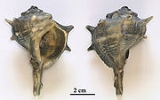
 known as the Murex brandaris or the spiny dye-murex. The Phoenicians also made a purple-blue indigo dye Indigo dye

Indigo dye is an important dye [i]stuff with a distinctive blue color . ... 

, called royal blue or hyacinth purple, which was made from a related species of marine snail, called the Murex trunculus Hexaplex trunculus

Hexaplex trunculus is a marine snail [i], whose hypobranchial gland secrets a mucus that the ancient ... 

or the banded dye-murex. Tyrian purple was expensive: the fourth-century BCE historian Theopompus reported, "Purple for dyes fetched its weight in silver at Colophon" in Asia Minor.

Discussions

  Discussion Features

   Ask a question about 'Tyrian purple'

   Start a new discussion about 'Tyrian purple'

   Answer questions about 'Tyrian purple'

   'Tyrian purple' discussion forum


Encyclopedia


Tyrian purple , also known as royal purple or imperial purple, is a purple-red dye Dye

A dye can generally be described as a color [i]ed substance that has an affinity [i] t ... 

 made by the ancient Canaanites/Phoenicia Phoenicia

Phoenicia was an ancient civilization [i] centred in the north of ancient Canaan [i], with its heartland ... 

ns in the city of Tyre Tyre

Tyre is a city in the South Governorate [i] of Lebanon [i]. ... 

, from a mucus-secretion of the hypobranchial gland of a marine snail Snail

The name snail applies to most members of the mollusca [i]n class Gastropoda [i] that have coiled shell [i]... 

 known as the Murex brandaris or the spiny dye-murex.

The Phoenicians also made a purple-blue indigo dye Indigo dye

Indigo dye is an important dye [i]stuff with a distinctive blue color . ... 

, called royal blue or hyacinth purple, which was made from a related species of marine snail, called the Murex trunculus Hexaplex trunculus

Hexaplex trunculus is a marine snail [i], whose hypobranchial gland secrets a mucus that the ancient ... 

or the banded dye-murex.

Tyrian purple was expensive: the fourth-century BCE historian Theopompus reported, "Purple for dyes fetched its weight in silver at Colophon" in Asia Minor.

The fast, non-fading dye was an item of luxury trade, prized by Romans Ancient Rome

Ancient Rome was a civilization [i] that grew out of the city-state [i] of Rome [i], founded in the Italian Peninsula [i] ... 

, who used it to colour ceremonial robes. Pliny the Elder Pliny the Elder

Gaius Plinius Secundus, better known as Pliny the Elder, was an ancient author [i] and natural philosopher [i] ... 

 described the dyeing process of two purples in his Natural History Naturalis Historia

Naturalis Historia or "Natural History" is an encyclopedia [i] written by Pliny the Elder [i]. ... 

:

The ancient method for mass-producing the two murex dyes has not yet been successfully reconstructed, but this special "blackish clotted blood" color, which was prized above all others, is believed to be achieved by double-dipping the cloth, once in the indigo dye of H. trunculus and once in the purple-red dye of M. brandaris.

The Roman mythographer Julius Pollux, writing in the second century BC, asserted that the purple dye was first discovered by Heracles Heracles

In Greek mythology [i], Heracles or Herakles was a divine hero [i], the son of Zeus [i] and ... 

, or rather, by his dog, whose mouth was stained purple from chewing on snails along the coast of the Levant Levant

Levant or in Arabic [i] ?????, Ash-Sham is an imprecise geographical term [i] ... 

. Recently, the archaeological discovery of substantial numbers of Murex shells on Crete Crete

Crete is the largest of the Greek [i] islands and the fifth largest in the Mediterranean Sea [i] ... 

 suggests that the Minoans Minoan civilization

The Minoans were a pre-Hellenic [i] Bronze Age [i] civilization in Crete [i] in the Aegean Sea [i] ... 

 may have pioneered the extraction of Royal purple centuries before the Tyrians. Dating from colocated pottery, suggests the dye may have been produced during the Middle Minoan period in the 20th–18th century BC.

The main chemical constituent of the Tyrian dye was discovered by Paul Friedländer in 1909 to be 6,6'-dibromoindigo, a substance that had previously been synthesized in 1903. However, it has never been synthesized commercially.

Web colour

The true colour of Tyrian purple, like most high chroma pigments Pigment

A pigment is a material that changes the color of light [i] it reflects as the result of selective color ... 

, cannot be accurately displayed on a computer display, but this swatch – – is an approximation. This is the sRGB SRGB color space

sRGB color space, or standard RGB, is an RGB color space [i] created cooperatively by Hewlett-Packard [i] ... 

 colour #990024, intended for viewing on an output device with a gamma Gamma correction

Gamma correction, gamma nonlinearity, gamma encoding, or often simply gamma, is the na... 

 of 2.2. It is a representation of RHS Royal Horticultural Society

The Royal Horticultural Society or RHS was founded in 1804 [i] in London [i], England [i] as the Hort ... 

 colour code 66A , which has been equated to "Tyrian red" , a term which is often used as a synonym for Tyrian purple.

References


See also

  • Indigo dye Indigo dye

    Indigo dye is an important dye [i]stuff with a distinctive blue color . ... 


External link