


Tigranes the Great

Encyclopedia
Tigranes the Great (140 – 55 BCE; also called Tigranes II and sometimes Tigranes I) was emperor of Armenia under whom the country became, for a short time, the strongest state east of the Roman Republic. He was a member of the Artaxiad Royal House
. Under his reign, the Armenian kingdom expanded beyond its traditional boundaries, allowing Tigranes to claim the title Great King
, and involving Armenia in many battles against opponents such as the Parthian
and Seleucid
empires, and the Roman Republic
.
of Parthia
who defeated the Armenians in 105 BCE. Other sources give the date as much earlier, at around 112–111 BCE. After the death of King Tigranes I
in 95 BCE, Tigranes bought his freedom, according to Strabo
, by handing over "seventy valleys" in Atropatene
to the Parthians.
When he came to power, the foundation upon which Tigranes was to build his Empire was already in place, a legacy of the founder of the Artaxiad Dynasty, Artaxias I
, and subsequent kings. The mountains of Armenia, however, formed natural borders between the different regions of the country and as a result, the feudalistic nakharar
s had significant influence over the regions or provinces in which they were based. This did not suit Tigranes, who wanted to create a centralist empire. He thus proceeded by consolidating his power within Armenia before embarking on his campaign.
He deposed Artanes, the last king of Armenian Sophene
and a descendant of Zariadres
.
(90–85 BCE), Tigranes supported Mithridates VI
of Pontus
but was careful not to become directly involved in the war.
He rapidly built up his power, allying with Mithridates VI of Pontus and marrying his daughter Cleopatra
. Tigranes had agreed that he was to extend his influence in the East, while Mithridates was to conquer Roman land in Anatolia and in Europe. By creating a stronger Hellenistic state, Mithridates was to contend with the well-established Roman foothold in Europe. Mithridates then put into effect a planned a general attack on Roman and Italians in Anatolia, tapping into local discontent with the Romans and their taxes and urging the peoples of Anatolia against all foreign influence. 80,000 people were slaughtered in the province of Asia Minor, known as the Asiatic Vespers
. The two kings' attempts to control Cappadocia
and then the massacres resulted in guaranteed Roman
intervention. The senate decided on Lucius Cornelius Sulla
, who was then one of the current consuls, to be commander of the army against Mithridates.
in 88 BCE, Tigranes took advantage of the fact that the Parthian Empire had been weakened by Scythian invasions and internal squabbling:
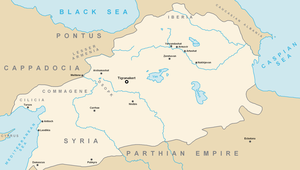 In 83 BC, after a bloody strife for the throne of Syria, governed by the Seleucids, the Syrians decided to choose Tigranes as the protector of their kingdom and offered him the crown of Syria
. Magadates was appointed as his governor in Antioch. He then conquered Phoenicia
and Cilicia
, effectively putting an end to the last remnants of the Seleucid Empire
, though a few holdout cities appear to have recognized the shadowy boy-king Seleucus VII Philometor
as the legitimate king during his reign. The southern border of his domain reached as far as Ptolemais
(modern Akko). Many of the inhabitants of conquered cities were sent to his new metropolis
of Tigranakert (Latin name, Tigranocerta)
.
At its height, his empire extended from the Pontic Alps (in modern north-eastern Turkey) to Mesopotamia
, and from the Caspian Sea
to the Mediterranean. Tigranes apparently invaded territories as far away as Ecbatana
and took the title king of kings
which, at the time, according to their coins, even the Parthian kings did not assume. He was called "Tigranes the Great" by many Western historians and writers, such as Plutarch
. The "King of Kings" never appeared in public without having four kings attending him. Cicero
, referring to his success in the east, said that he "made the Republic of Rome tremble before the prowess of his arms."
Tigranes' coin consist of tetradrachm
s and copper coins having on the obverse his portrait wearing a decorated Armenian tiara with ear-flaps. The reverse has a completely original design. There are the seated Tyche of Antioch and the river god Orontes at her feet.
, demanded the expulsion of Mithridates from Armenia – to comply with such a demand would be, in effect, to accept the status of vassal to Rome and this Tigranes refused. Charles Rollins, in his Ancient History, says:
Lucullus' reaction was an attack that was so precipitate that he took Tigranes by surprise. According to Roman historians, the messenger who first brought news of the unexpected Roman attack was executed. Eventually Mithrobazanes, one of Tigranes generals, told Tigranes of the Roman approach. Tigranes was, according to Keaveney, so impressed by Mithrobazanes' courage that he appointed Mithrobazanes to command an army against Lucullus – Mithrobazanes was however defeated and killed. After this defeat Tigranes withdrew north to Armenia to regroup which left Lucullus free to put Tigranocerta under siege.
When Tigranes had gathered a large army he returned to confront Lucullus. On October 6, 69 BCE, Tigranes' much larger force was decisively defeated by the Roman army
under Lucullus in the Battle of Tigranocerta
. Tigranes' treatment of the inhabitants (the majority of the population had been forced to move to the city) led disgruntled city guards to open the gates of the city to the Romans. Learning of this, Tigranes hurriedly sent 6000 cavalrymen to the city in order to rescue his wives and some of his assets. Tigranes escaped capture with a small escort.
On the 6 October 68 BCE, the Romans approached the old capital of Artaxata
. Tigranes' and Mithridates' combined Armeno-Pontian army of 70,000 men formed up to face them but were resoundingly defeated. Once again, both Mithridates and Tigranes evaded capture by the victorious Romans.
The long campaigning and hardships that Lucullus' troops had endured for years, combined with a perceived lack of reward in the form of plunder, led to successive mutinies among the legions in 68–67. Frustrated by the rough terrain of Northern Armenia and seeing the worsening moral of his troops, Lucullus moved back south and put Nisibis under siege. Tigranes concluded (wrongly) that Nisibis would hold out and sought to regain those parts of Armenia that the Romans had captured. Despite his continuous success in battle, Lucullus could still not capture either one of the monarchs. With Lucullus' troops now refusing to obey his commands, but agreeing to defend positions from attack, the senate
sent Gnaeus Pompey
to recall Lucullus to Rome and take over his command.
was given the task of defeating Mithradates and Tigranes. Pompey first concentrated on attacking Mithradates while distracting Tigranes by engineering a Parthian attack on Gordyeyne. Phraates III
, the Parthian king was soon persuaded to take things a little further than an anexation of Gordyeyne when a son of Tigranes (also named Tigranes) went to join the Parthians and persuaded Phraates to invade Armenia in an attempt to replace the elder Tigranes with the younger. Tigranes decided not to meet the invasion in the field but instead ensured that his capital, Artaxata, was well defended and withdrew to the hill country. Phraates soon realized that Artaxata would not fall without a protracted siege, the time for which he could not spare due his fear of plots at home. Once Phraates left Tigranes came back down from the hills and drove his son from Armenia. The son then fled to Pompey.
In 66 BCE, Pompey advanced into Armenia
with the younger Tigranes, and Tigranes the Great, now almost 75 years old, surrendered. Pompey
treated him generously and allowed him to retain his kingdom shorn of his conquests in return for 6,000 talents of silver. His unfaithful son was sent back to Rome as a prisoner.
Tigranes continued to rule Armenia as an ally of Rome until his death in 55/54.
Artaxiad Dynasty
The Artaxiad Dynasty or Ardaxiad Dynasty ruled the Kingdom of Armenia from 189 BC until their overthrow by the Romans in AD 12. Their realm included Greater Armenia, Sophene and intermittently Lesser Armenia and parts of Mesopotamia...
. Under his reign, the Armenian kingdom expanded beyond its traditional boundaries, allowing Tigranes to claim the title Great King
Great King
Great King and the equivalent in many languages is a semantic title for historical titles of Monarchs, suggesting an elevated status among the host of Kings and Princes...
, and involving Armenia in many battles against opponents such as the Parthian
Parthian Empire
The Parthian Empire , also known as the Arsacid Empire , was a major Iranian political and cultural power in ancient Persia...
and Seleucid
Seleucid Empire
The Seleucid Empire was a Greek-Macedonian state that was created out of the eastern conquests of Alexander the Great. At the height of its power, it included central Anatolia, the Levant, Mesopotamia, Persia, today's Turkmenistan, Pamir and parts of Pakistan.The Seleucid Empire was a major centre...
empires, and the Roman Republic
Roman Republic
The Roman Republic was the period of the ancient Roman civilization where the government operated as a republic. It began with the overthrow of the Roman monarchy, traditionally dated around 508 BC, and its replacement by a government headed by two consuls, elected annually by the citizens and...
.
Early years
Tigranes had been a hostage until the age of 40 at the court of King Mithradates IIMithridates II of Parthia
Mithridates II the Great was king of Parthian Empire from 123 to 88 BC. His name invokes the protection of Mithra. He adopted the title Epiphanes, "god manifest" and introduced new designs on his extensive coinage....
of Parthia
Parthian Empire
The Parthian Empire , also known as the Arsacid Empire , was a major Iranian political and cultural power in ancient Persia...
who defeated the Armenians in 105 BCE. Other sources give the date as much earlier, at around 112–111 BCE. After the death of King Tigranes I
Tigranes I
Tigranes I of Armenia reigned as King of Armenia from 115 BC to 95 BC. Artavasdes I did not leave any heir; his brother, Tigranes ascended to the throne of the Artaxiads. Some historians claim that Tigranes II the Great was the son of Tigranes I and not Artavasdes I....
in 95 BCE, Tigranes bought his freedom, according to Strabo
Strabo
Strabo, also written Strabon was a Greek historian, geographer and philosopher.-Life:Strabo was born to an affluent family from Amaseia in Pontus , a city which he said was situated the approximate equivalent of 75 km from the Black Sea...
, by handing over "seventy valleys" in Atropatene
Atropatene
Atropatene was an ancient kingdom established and ruled under local ethnic Iranian dynasts first with "Darius" of Persia and later "Alexander" of Macedonia, starting in the 4th century BC and includes the territory of modern-day Iranian Azarbaijan and Iranian Kurdistan. Its capital was Gazaca...
to the Parthians.
When he came to power, the foundation upon which Tigranes was to build his Empire was already in place, a legacy of the founder of the Artaxiad Dynasty, Artaxias I
Artaxias I
Artaxias I was the founder of the Artaxiad Dynasty whose members ruled the Kingdom of Armenia for nearly two centuries....
, and subsequent kings. The mountains of Armenia, however, formed natural borders between the different regions of the country and as a result, the feudalistic nakharar
Nakharar
Nakharar was a hereditary title of the highest order given to houses of the ancient and medieval Armenian nobility.-Nakharar system:Medieval Armenia was divided into large estates, which were the property of an enlarged noble family and were ruled by a member of it, to whom the title of Nahapet...
s had significant influence over the regions or provinces in which they were based. This did not suit Tigranes, who wanted to create a centralist empire. He thus proceeded by consolidating his power within Armenia before embarking on his campaign.
He deposed Artanes, the last king of Armenian Sophene
Sophene
Sophene , or ) was a province of the Armenian Kingdom and of the Roman Empire, located in the south-west of the kingdom. It currently lies in modern-day southeastern Turkey....
and a descendant of Zariadres
Zariadres
Zariadres was a King of Sophene.Strabo cites Sophene being taken over by a "general" of king Antiochus III by 200 BC, called Zariadres.Following the defeat of Antiochus III by the Romans at the Battle of Magnesia in 190 BC, Zariadres and Artaxias* revolted and with Roman consent began to reign...
.
Alliance with Pontus
During the First Mithridatic WarFirst Mithridatic War
The First Mithridatic War was a war challenging Rome's expanding Empire and rule over the Greek world. In this conflict, the Kingdom of Pontus and many Greek cities rebelling against Rome were led by Mithridates VI of Pontus against the Roman Republic and the Kingdom of Bithynia...
(90–85 BCE), Tigranes supported Mithridates VI
Mithridates VI of Pontus
Mithridates VI or Mithradates VI Mithradates , from Old Persian Mithradatha, "gift of Mithra"; 134 BC – 63 BC, also known as Mithradates the Great and Eupator Dionysius, was king of Pontus and Armenia Minor in northern Anatolia from about 120 BC to 63 BC...
of Pontus
Pontus
Pontus or Pontos is a historical Greek designation for a region on the southern coast of the Black Sea, located in modern-day northeastern Turkey. The name was applied to the coastal region in antiquity by the Greeks who colonized the area, and derived from the Greek name of the Black Sea: Πόντος...
but was careful not to become directly involved in the war.
He rapidly built up his power, allying with Mithridates VI of Pontus and marrying his daughter Cleopatra
Cleopatra of Pontus
Cleopatra of Pontus was a Pontian Princess, who was one of the daughters of King Mithridates VI of Pontus and Queen Laodice. Cleopatra is sometimes known as Cleopatra the Elder, to distinguish her from her sister of the same name and was born and raised in the Kingdom of Pontus...
. Tigranes had agreed that he was to extend his influence in the East, while Mithridates was to conquer Roman land in Anatolia and in Europe. By creating a stronger Hellenistic state, Mithridates was to contend with the well-established Roman foothold in Europe. Mithridates then put into effect a planned a general attack on Roman and Italians in Anatolia, tapping into local discontent with the Romans and their taxes and urging the peoples of Anatolia against all foreign influence. 80,000 people were slaughtered in the province of Asia Minor, known as the Asiatic Vespers
Asiatic Vespers
The Asiatic Vespers refers to an infamous episode during the First Mithridatic War. In response to increasing Roman power in Anatolia, the king of Pontus, Mithridates the Great, tapped into local discontent with the Romans and their taxes to orchestrate the execution of 80,000 Roman and Italian...
. The two kings' attempts to control Cappadocia
Cappadocia
Cappadocia is a historical region in Central Anatolia, largely in Nevşehir Province.In the time of Herodotus, the Cappadocians were reported as occupying the whole region from Mount Taurus to the vicinity of the Euxine...
and then the massacres resulted in guaranteed Roman
Ancient Rome
Ancient Rome was a thriving civilization that grew on the Italian Peninsula as early as the 8th century BC. Located along the Mediterranean Sea and centered on the city of Rome, it expanded to one of the largest empires in the ancient world....
intervention. The senate decided on Lucius Cornelius Sulla
Lucius Cornelius Sulla
Lucius Cornelius Sulla Felix , known commonly as Sulla, was a Roman general and statesman. He had the rare distinction of holding the office of consul twice, as well as that of dictator...
, who was then one of the current consuls, to be commander of the army against Mithridates.
Wars against the Parthians and Seleucids
After the death of Mithridates II of ParthiaMithridates II of Parthia
Mithridates II the Great was king of Parthian Empire from 123 to 88 BC. His name invokes the protection of Mithra. He adopted the title Epiphanes, "god manifest" and introduced new designs on his extensive coinage....
in 88 BCE, Tigranes took advantage of the fact that the Parthian Empire had been weakened by Scythian invasions and internal squabbling:
Syria
Syria , officially the Syrian Arab Republic , is a country in Western Asia, bordering Lebanon and the Mediterranean Sea to the West, Turkey to the north, Iraq to the east, Jordan to the south, and Israel to the southwest....
. Magadates was appointed as his governor in Antioch. He then conquered Phoenicia
Phoenicia
Phoenicia , was an ancient civilization in Canaan which covered most of the western, coastal part of the Fertile Crescent. Several major Phoenician cities were built on the coastline of the Mediterranean. It was an enterprising maritime trading culture that spread across the Mediterranean from 1550...
and Cilicia
Cilicia
In antiquity, Cilicia was the south coastal region of Asia Minor, south of the central Anatolian plateau. It existed as a political entity from Hittite times into the Byzantine empire...
, effectively putting an end to the last remnants of the Seleucid Empire
Seleucid Empire
The Seleucid Empire was a Greek-Macedonian state that was created out of the eastern conquests of Alexander the Great. At the height of its power, it included central Anatolia, the Levant, Mesopotamia, Persia, today's Turkmenistan, Pamir and parts of Pakistan.The Seleucid Empire was a major centre...
, though a few holdout cities appear to have recognized the shadowy boy-king Seleucus VII Philometor
Seleucus VII Kybiosaktes
Seleucus VII Philometor, was a ruler of the Greek Seleucid kingdom. The last members of the once mighty Seleucid dynasty are shadowy figures; local dynasts with complicated family ties whose identities are hard to ascertain: many of them also bore the same names...
as the legitimate king during his reign. The southern border of his domain reached as far as Ptolemais
Ptolemais
Ptolemais, an Ancient Greek place name and feminine personal name, may refer to:Places*Acre, Israel, once named Antiochia Ptolemais after Ptolemy I Soter*Crocodilopolis, an Egyptian city renamed Ptolemais Euergetis by Ptolemy III Euergetes...
(modern Akko). Many of the inhabitants of conquered cities were sent to his new metropolis
Metropolitan area
The term metropolitan area refers to a region consisting of a densely populated urban core and its less-populated surrounding territories, sharing industry, infrastructure, and housing. A metropolitan area usually encompasses multiple jurisdictions and municipalities: neighborhoods, townships,...
of Tigranakert (Latin name, Tigranocerta)
Tigranakert
Tigranakert was a city possibly located near present-day Silvan, Turkey, east of Diyarbakır. It was founded by the Armenian Emperor Tigranes the Great in the 1st century BC. Tigranakert was founded as the new capital of the Armenian Empire in order to be in a more central position within the...
.
At its height, his empire extended from the Pontic Alps (in modern north-eastern Turkey) to Mesopotamia
Mesopotamia
Mesopotamia is a toponym for the area of the Tigris–Euphrates river system, largely corresponding to modern-day Iraq, northeastern Syria, southeastern Turkey and southwestern Iran.Widely considered to be the cradle of civilization, Bronze Age Mesopotamia included Sumer and the...
, and from the Caspian Sea
Caspian Sea
The Caspian Sea is the largest enclosed body of water on Earth by area, variously classed as the world's largest lake or a full-fledged sea. The sea has a surface area of and a volume of...
to the Mediterranean. Tigranes apparently invaded territories as far away as Ecbatana
Ecbatana
Ecbatana is supposed to be the capital of Astyages , which was taken by the Persian emperor Cyrus the Great in the sixth year of Nabonidus...
and took the title king of kings
King of Kings
King of Kings is a title that has been used by several monarchies and empires throughout history. The title originates in the Ancient Near East. It is broadly the equivalent of the later title Emperor....
which, at the time, according to their coins, even the Parthian kings did not assume. He was called "Tigranes the Great" by many Western historians and writers, such as Plutarch
Plutarch
Plutarch then named, on his becoming a Roman citizen, Lucius Mestrius Plutarchus , c. 46 – 120 AD, was a Greek historian, biographer, essayist, and Middle Platonist known primarily for his Parallel Lives and Moralia...
. The "King of Kings" never appeared in public without having four kings attending him. Cicero
Cicero
Marcus Tullius Cicero , was a Roman philosopher, statesman, lawyer, political theorist, and Roman constitutionalist. He came from a wealthy municipal family of the equestrian order, and is widely considered one of Rome's greatest orators and prose stylists.He introduced the Romans to the chief...
, referring to his success in the east, said that he "made the Republic of Rome tremble before the prowess of his arms."
Tigranes' coin consist of tetradrachm
Tetradrachm
The tetradrachm was an Ancient Greek silver coin equivalent to four drachmae. It was in wide circulation from 510 to 38 BC.-History:Many surviving tetradrachms were minted by the polis of Athens from around the middle of the 5th century BC onwards; the popular coin was widely used in transactions...
s and copper coins having on the obverse his portrait wearing a decorated Armenian tiara with ear-flaps. The reverse has a completely original design. There are the seated Tyche of Antioch and the river god Orontes at her feet.
Wars against Rome
Mithridates had found refuge in Armenian land after confronting Rome, considering the fact that Tigranes was his ally and relative. The "King of Kings" eventually came into direct contact with Rome. The Roman commander, LucullusLucullus
Lucius Licinius Lucullus , was an optimate politician of the late Roman Republic, closely connected with Sulla Felix...
, demanded the expulsion of Mithridates from Armenia – to comply with such a demand would be, in effect, to accept the status of vassal to Rome and this Tigranes refused. Charles Rollins, in his Ancient History, says:
Lucullus' reaction was an attack that was so precipitate that he took Tigranes by surprise. According to Roman historians, the messenger who first brought news of the unexpected Roman attack was executed. Eventually Mithrobazanes, one of Tigranes generals, told Tigranes of the Roman approach. Tigranes was, according to Keaveney, so impressed by Mithrobazanes' courage that he appointed Mithrobazanes to command an army against Lucullus – Mithrobazanes was however defeated and killed. After this defeat Tigranes withdrew north to Armenia to regroup which left Lucullus free to put Tigranocerta under siege.
When Tigranes had gathered a large army he returned to confront Lucullus. On October 6, 69 BCE, Tigranes' much larger force was decisively defeated by the Roman army
Roman army
The Roman army is the generic term for the terrestrial armed forces deployed by the kingdom of Rome , the Roman Republic , the Roman Empire and its successor, the Byzantine empire...
under Lucullus in the Battle of Tigranocerta
Battle of Tigranocerta
The Battle of Tigranocerta was fought on October 6, 69 BC between the forces of the Roman Republic and the army of the Kingdom of Armenia led by King Tigranes the Great. The Roman force was led by Consul Lucius Licinius Lucullus, and Tigranes was defeated...
. Tigranes' treatment of the inhabitants (the majority of the population had been forced to move to the city) led disgruntled city guards to open the gates of the city to the Romans. Learning of this, Tigranes hurriedly sent 6000 cavalrymen to the city in order to rescue his wives and some of his assets. Tigranes escaped capture with a small escort.
On the 6 October 68 BCE, the Romans approached the old capital of Artaxata
Battle of Artaxata
The Battle of Artaxata was fought in 68 BC between the Roman Republic and the Kingdom of Armenia. The Romans were led by Consul Lucius Licinius Lucullus, while the Armenians were led by King Tigranes II, who was sheltering King Mithridates VI of Pontus...
. Tigranes' and Mithridates' combined Armeno-Pontian army of 70,000 men formed up to face them but were resoundingly defeated. Once again, both Mithridates and Tigranes evaded capture by the victorious Romans.
The long campaigning and hardships that Lucullus' troops had endured for years, combined with a perceived lack of reward in the form of plunder, led to successive mutinies among the legions in 68–67. Frustrated by the rough terrain of Northern Armenia and seeing the worsening moral of his troops, Lucullus moved back south and put Nisibis under siege. Tigranes concluded (wrongly) that Nisibis would hold out and sought to regain those parts of Armenia that the Romans had captured. Despite his continuous success in battle, Lucullus could still not capture either one of the monarchs. With Lucullus' troops now refusing to obey his commands, but agreeing to defend positions from attack, the senate
Roman Senate
The Senate of the Roman Republic was a political institution in the ancient Roman Republic, however, it was not an elected body, but one whose members were appointed by the consuls, and later by the censors. After a magistrate served his term in office, it usually was followed with automatic...
sent Gnaeus Pompey
Pompey
Gnaeus Pompeius Magnus, also known as Pompey or Pompey the Great , was a military and political leader of the late Roman Republic...
to recall Lucullus to Rome and take over his command.
Pompey and the reconciliation with Rome
In 67 BCE PompeyPompey
Gnaeus Pompeius Magnus, also known as Pompey or Pompey the Great , was a military and political leader of the late Roman Republic...
was given the task of defeating Mithradates and Tigranes. Pompey first concentrated on attacking Mithradates while distracting Tigranes by engineering a Parthian attack on Gordyeyne. Phraates III
Phraates III of Parthia
King Phraates III of Parthia succeeded his father Sanatruces and ruled the Parthian Empire from 70 to 57 BC. He was called "the God" because of his coins, that were ideal for sailors because they were polished with gold dust, so that people from other countries considered their value higher than...
, the Parthian king was soon persuaded to take things a little further than an anexation of Gordyeyne when a son of Tigranes (also named Tigranes) went to join the Parthians and persuaded Phraates to invade Armenia in an attempt to replace the elder Tigranes with the younger. Tigranes decided not to meet the invasion in the field but instead ensured that his capital, Artaxata, was well defended and withdrew to the hill country. Phraates soon realized that Artaxata would not fall without a protracted siege, the time for which he could not spare due his fear of plots at home. Once Phraates left Tigranes came back down from the hills and drove his son from Armenia. The son then fled to Pompey.
In 66 BCE, Pompey advanced into Armenia
Armenia
Armenia , officially the Republic of Armenia , is a landlocked mountainous country in the Caucasus region of Eurasia...
with the younger Tigranes, and Tigranes the Great, now almost 75 years old, surrendered. Pompey
Pompey
Gnaeus Pompeius Magnus, also known as Pompey or Pompey the Great , was a military and political leader of the late Roman Republic...
treated him generously and allowed him to retain his kingdom shorn of his conquests in return for 6,000 talents of silver. His unfaithful son was sent back to Rome as a prisoner.
Tigranes continued to rule Armenia as an ally of Rome until his death in 55/54.
Halley's comet
A recent ABC News article on May 19, 2004 noted that according to the Armenian and Italian researchers the "symbol on his crown that features a star with a curved tail may represent the passage of Halley's Comet in 87 BCE." Tigranes could have seen Halley's comet when it passed closest to the Sun on August 6 in 87, according to the researchers, who said the comet would have been a 'most recordable event'– heralding the New Era of the King of Kings.Further reading
- Manandyan, Hakob. Tigranes II and Rome: A New Interpretation Based on Primary Sources. Trans. George BournoutianGeorge BournoutianGeorge A. Bournoutian is a Senior Professor of History at Iona College. He is the author of numerous books on Armenian history and has taught Armenian history at Columbia University, Tufts University, New York University, Rutgers University, the University of Connecticut, Ramapo College, and...
. Costa Mesa, CA: Mazda Publishers, 2007. Manaseryan, Ruben. Տիգրան Մեծ՝ Հայկական Պայքարը Հռոմի և Պարթևաստանի Դեմ, մ.թ.ա. 94–64 թթ. (Tigran the Great: The Armenian Struggle Against Rome and Parthia, 94–64 B.C.). Yerevan: Lusakan Publishing, 2007. - http://www.livius.org/ti-tn/tigranes/tigranes_ii.html