

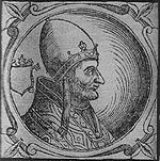
Pope Adrian IV

Encyclopedia
Pope Adrian IV born Nicholas Breakspear or Breakspeare, was Pope
from 1154 to 1159.
Adrian IV is the only Englishman who has occupied the papal chair. It is generally believed that Nicholas Breakspear was born at Breakspear Farm in the parish of Abbots Langley
in Hertfordshire and received his early education at the Abbey School, St Albans
(St Albans School
).
at St Albans. Nicholas himself, however, was refused admission to the monastery
, being told by the abbot
to 'wait to go on with his schooling so that he might be considered more suitable' (Abbey chronicles). In the event, he did not wait and went instead to Paris and finally became a canon regular of the cloister of St. Rufus monastery near Arles
. He rose to be prior
and soon thereafter was unanimously elected abbot. This election has been traditionally dated to 1137, but evidence from the abbey's chronicles suggests it occurred about 1145.
His reforming zeal as abbot led to the lodging of complaints against him at Rome; but these merely attracted to him the favourable attention of Pope Eugene III
(1145–1153), who created him Cardinal Bishop of Albano
in December 1149.
From 1152 to 1154 Nicholas was in Scandinavia
as papal legate
, organising the affairs of the new Norwegian Archbishopric of Nidaros (now Trondheim
). This led him to create the Diocese
at Hamar
, and, according to tradition, to form Cathedral schools in Norway
's bishopric cities. These schools were to have a lasting effect on Norwegian Catholic spirituality
and history, even after King Christian III of Denmark
ordered the Reformation in his kingdom. A late example is Scandinavia's most creative and forceful Counter-Reformation
figure, the Jesuit Laurentius Nicolai Norvegicus, born as Laurids Nielsen after the Reformation, who attended Oslo Cathedral School in his youth. (Today, despite the prestigious prefix Cathedral, these schools have no formal Church ties.) Nicholas made arrangements which resulted in the recognition of Gamla Uppsala
(later moved to Uppsala
) as seat of the Swedish metropolitan in 1164. As a compensation for territory thus withdrawn, the Danish archbishop of Lund
was made legate and perpetual vicar
and given the title of primate
of Denmark
and Sweden
.
(1153–1154). On the death of Anastasius, Nicholas was elected pope on 3 December 1154, taking the name Adrian IV. He at once endeavoured to bring down Arnold of Brescia
, the leader of the anti-papal faction in Rome. Disorder within the city led to the murder of a cardinal, causing Adrian, shortly before Palm Sunday
1155, to take the previously unheard-of step of putting Rome under interdict
. The Senate
(City Council of Rome) thereupon exiled Arnold.
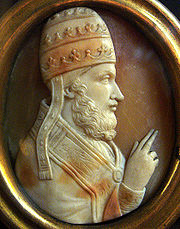 In 1155, Byzantine Emperor Manuel Comnenus
invaded the Italian peninsula from the south, landing his forces in the region of Apulia
. Making contact with local rebels who were hostile to the Sicilian
crown, Greek
forces quickly overran the coastlands and began striking inland. Pope Adrian IV watched these developments with some satisfaction. The Papacy was never on good terms with the Normans
of Sicily
, except when under duress by the threat of direct military action. Having the Eastern Roman Empire
on its southern border was preferable to Adrian than having to constantly deal with the troublesome Normans. Therefore, negotiations were hurriedly carried out, and an alliance was formed between Adrian and Manuel. Adrian undertook to raise a body of mercenary troops from Campania
. Meanwhile, Manuel dreamed of restoration of the Roman Empire
; this was, however, at the cost of a potential union between the Orthodox
and the Catholic Church. Negotiations for union of the eastern and western churches, which had been in a state of schism
since 1054, soon got underway. The combined Papal-Byzantine forces joined with the rebels against the Normans
in Southern Italy, achieving a string of rapid successes as a number of cities yielded either to the threat of force or the lure of gold. The future looked bleak for the Sicilian
s.
It was at this point, just as the war seemed decided in the allies' favour, that things started to go wrong. The Greek commander Michael Palaeologus alienated some of his allies by his arrogance, and this stalled the campaign as rebel Count Robert of Loritello refused to speak to him. Although the two were reconciled, the campaign lost some of its momentum. Yet worse was to come: Michael was soon recalled to Constantinople
. Although his arrogance had slowed the campaign, he was a brilliant general in the field, and his loss was a major blow to the allied campaign. The turning point was the Battle for Brindisi
, where the Sicilians launched a major counter attack by both land and sea. At the approach of the enemy, the mercenaries who were serving in the allied armies demanded impossible increases in their pay; when this was refused, they deserted. Even the local barons started to melt away, and soon Adrian's Byzantine allies were left hopelessly outnumbered. The naval battle was decided in the Sicilians' favour, and the Byzantine commander was captured. The defeat at Brindisi put an end to the restored Byzantine reign in Italy, and by 1158 the Byzantine Army
had left Italy.
Hopes for a lasting alliance with the Byzantine Empire
had also come up against insuperable problems. Pope Adrian IV's conditions for a union between the eastern and western church included recognition of his religious authority over Christians everywhere, and the Emperor's recognition of his secular authority; neither East nor West could accept such conditions. Adrian's secular powers were too valuable to be rendered and Manuel's subjects could never have accepted the authority of the distant Bishop of Rome. In spite of his friendliness towards the Roman Church, Adrian never felt able to honour Manuel with the title of "Augustus". Ultimately, a deal proved elusive, and the two churches remained divided.
', which was addressed to the Angevin
King Henry II of England. He urged Henry to invade Ireland to bring its Celtic Christian Church under the Roman system and to conduct a general reform of governance and society throughout the island. The authenticity of this grant, the historian Edmund Curtis says, is one of "the great questions of history." He states that the matter was discussed at a Royal Council at Winchester
, but that Henry's mother, the Empress Matilda
, had protested. In Ireland however, nothing seems to have been known of it, and no provision appears to have been made to defend against the prospect of Angevin Norman aggression, despite their westward expansion throughout England and Wales
. Ernest F. Henderson states that the existence of this Bull is doubted by many while, in noting that its authenticity has been questioned without success, P. S. O'Hegarty suggests that the question is now purely an academic one. It is notable that decisions of Pope Alexander III
, his successor, Pope Lucius III
, and King Henry VIII in proclaiming the Crown of Ireland Act 1542
was predicated on this document.
The Normans did in fact invade Ireland
, beginning with a small landing of Norman knights in 1169, followed by Henry's landing with a much larger force in 1171.
a letter from Adrian IV which alluded to the beneficia or "benefits" conferred upon the Emperor, and the German chancellor translated this beneficia in the feudal sense of the presentation of property from a lord to a vassal (benefice
). Frederick was infuriated by the suggestion that he was dependent on the Pope, and in the storm which ensued the legates were glad to escape with their lives, and the incident at length closed with a letter from the Pope, declaring that by beneficium he meant merely bonum factum or "a good deed," i.e. the coronation. The breach subsequently became wider, and the Emperor was about to be excommunicate
d when Adrian died at Anagni
on 1 September 1159, reputedly choking on a fly in his wine, but probably of quinsy
.
His biography was first written by Cardinal Boso
in his extension to the Liber Pontificalis
.
Pope
The Pope is the Bishop of Rome, a position that makes him the leader of the worldwide Catholic Church . In the Catholic Church, the Pope is regarded as the successor of Saint Peter, the Apostle...
from 1154 to 1159.
Adrian IV is the only Englishman who has occupied the papal chair. It is generally believed that Nicholas Breakspear was born at Breakspear Farm in the parish of Abbots Langley
Abbots Langley
Abbots Langley is a large village and civil parish in the English county of Hertfordshire. It is an old settlement and is mentioned in the Domesday Book. Economically the village is closely linked to Watford and was formerly part of the Watford Rural District...
in Hertfordshire and received his early education at the Abbey School, St Albans
St Albans
St Albans is a city in southern Hertfordshire, England, around north of central London, which forms the main urban area of the City and District of St Albans. It is a historic market town, and is now a sought-after dormitory town within the London commuter belt...
(St Albans School
St Albans School (Hertfordshire)
St Albans School is an independent school in the city of St Albans in Hertfordshire, in the East of England. Entry before Sixth Form is for boys only, and co-educational thereafter. Founded in 948 by Wulsin , St Albans School is not only the oldest school in Hertfordshire but also one of the oldest...
).
Early life
His father was Robert, who later became a monkMonk
A monk is a person who practices religious asceticism, living either alone or with any number of monks, while always maintaining some degree of physical separation from those not sharing the same purpose...
at St Albans. Nicholas himself, however, was refused admission to the monastery
Monastery
Monastery denotes the building, or complex of buildings, that houses a room reserved for prayer as well as the domestic quarters and workplace of monastics, whether monks or nuns, and whether living in community or alone .Monasteries may vary greatly in size – a small dwelling accommodating only...
, being told by the abbot
Abbot
The word abbot, meaning father, is a title given to the head of a monastery in various traditions, including Christianity. The office may also be given as an honorary title to a clergyman who is not actually the head of a monastery...
to 'wait to go on with his schooling so that he might be considered more suitable' (Abbey chronicles). In the event, he did not wait and went instead to Paris and finally became a canon regular of the cloister of St. Rufus monastery near Arles
Arles
Arles is a city and commune in the south of France, in the Bouches-du-Rhône department, of which it is a subprefecture, in the former province of Provence....
. He rose to be prior
Prior
Prior is an ecclesiastical title, derived from the Latin adjective for 'earlier, first', with several notable uses.-Monastic superiors:A Prior is a monastic superior, usually lower in rank than an Abbot. In the Rule of St...
and soon thereafter was unanimously elected abbot. This election has been traditionally dated to 1137, but evidence from the abbey's chronicles suggests it occurred about 1145.
His reforming zeal as abbot led to the lodging of complaints against him at Rome; but these merely attracted to him the favourable attention of Pope Eugene III
Pope Eugene III
Pope Blessed Eugene III , born Bernardo da Pisa, was Pope from 1145 to 1153. He was the first Cistercian to become Pope.-Early life:...
(1145–1153), who created him Cardinal Bishop of Albano
Roman Catholic Suburbicarian Diocese of Albano
The Diocese of Albano is a suburbicarian see of the Roman Catholic Church in a diocese in Italy, comprising seven towns in the Province of Rome...
in December 1149.
From 1152 to 1154 Nicholas was in Scandinavia
Scandinavia
Scandinavia is a cultural, historical and ethno-linguistic region in northern Europe that includes the three kingdoms of Denmark, Norway and Sweden, characterized by their common ethno-cultural heritage and language. Modern Norway and Sweden proper are situated on the Scandinavian Peninsula,...
as papal legate
Papal legate
A papal legate – from the Latin, authentic Roman title Legatus – is a personal representative of the pope to foreign nations, or to some part of the Catholic Church. He is empowered on matters of Catholic Faith and for the settlement of ecclesiastical matters....
, organising the affairs of the new Norwegian Archbishopric of Nidaros (now Trondheim
Trondheim
Trondheim , historically, Nidaros and Trondhjem, is a city and municipality in Sør-Trøndelag county, Norway. With a population of 173,486, it is the third most populous municipality and city in the country, although the fourth largest metropolitan area. It is the administrative centre of...
). This led him to create the Diocese
Diocese
A diocese is the district or see under the supervision of a bishop. It is divided into parishes.An archdiocese is more significant than a diocese. An archdiocese is presided over by an archbishop whose see may have or had importance due to size or historical significance...
at Hamar
Hamar
is a town and municipality in Hedmark county, Norway. It is part of the traditional region of Hedmarken. The administrative centre of the municipality is the town of Hamar. The municipality of Hamar was separated from Vang as a town and municipality of its own in 1849...
, and, according to tradition, to form Cathedral schools in Norway
Norway
Norway , officially the Kingdom of Norway, is a Nordic unitary constitutional monarchy whose territory comprises the western portion of the Scandinavian Peninsula, Jan Mayen, and the Arctic archipelago of Svalbard and Bouvet Island. Norway has a total area of and a population of about 4.9 million...
's bishopric cities. These schools were to have a lasting effect on Norwegian Catholic spirituality
Catholic spirituality
Catholic spirituality is the spiritual practice of living out a personal act of faith following the acceptance of faith . Although all Catholics are expected to pray together at Mass, there are many different forms of spirituality and private prayer which have developed over the centuries...
and history, even after King Christian III of Denmark
Christian III of Denmark
Christian III reigned as king of Denmark and Norway. He was the eldest son of King Frederick I and Anna of Brandenburg.-Childhood:...
ordered the Reformation in his kingdom. A late example is Scandinavia's most creative and forceful Counter-Reformation
Counter-Reformation
The Counter-Reformation was the period of Catholic revival beginning with the Council of Trent and ending at the close of the Thirty Years' War, 1648 as a response to the Protestant Reformation.The Counter-Reformation was a comprehensive effort, composed of four major elements:#Ecclesiastical or...
figure, the Jesuit Laurentius Nicolai Norvegicus, born as Laurids Nielsen after the Reformation, who attended Oslo Cathedral School in his youth. (Today, despite the prestigious prefix Cathedral, these schools have no formal Church ties.) Nicholas made arrangements which resulted in the recognition of Gamla Uppsala
Gamla Uppsala
Gamla Uppsala is a parish and a village outside Uppsala in Sweden. It had 16,231 inhabitants in 1991.As early as the 3rd century AD and the 4th century AD and onwards, it was an important religious, economic and political centre...
(later moved to Uppsala
Uppsala
- Economy :Today Uppsala is well established in medical research and recognized for its leading position in biotechnology.*Abbott Medical Optics *GE Healthcare*Pfizer *Phadia, an offshoot of Pharmacia*Fresenius*Q-Med...
) as seat of the Swedish metropolitan in 1164. As a compensation for territory thus withdrawn, the Danish archbishop of Lund
Lund
-Main sights:During the 12th and 13th centuries, when the town was the seat of the archbishop, many churches and monasteries were built. At its peak, Lund had 27 churches, but most of them were demolished as result of the Reformation in 1536. Several medieval buildings remain, including Lund...
was made legate and perpetual vicar
Vicar
In the broadest sense, a vicar is a representative, deputy or substitute; anyone acting "in the person of" or agent for a superior . In this sense, the title is comparable to lieutenant...
and given the title of primate
Primate (religion)
Primate is a title or rank bestowed on some bishops in certain Christian churches. Depending on the particular tradition, it can denote either jurisdictional authority or ceremonial precedence ....
of Denmark
Denmark
Denmark is a Scandinavian country in Northern Europe. The countries of Denmark and Greenland, as well as the Faroe Islands, constitute the Kingdom of Denmark . It is the southernmost of the Nordic countries, southwest of Sweden and south of Norway, and bordered to the south by Germany. Denmark...
and Sweden
Sweden
Sweden , officially the Kingdom of Sweden , is a Nordic country on the Scandinavian Peninsula in Northern Europe. Sweden borders with Norway and Finland and is connected to Denmark by a bridge-tunnel across the Öresund....
.
Accession as Pope
On his return Nicholas was received with great honour by Pope Anastasius IVPope Anastasius IV
Pope Anastasius IV , born Corrado Demetri della Suburra, was Pope from 1153 to 1154.-Early life:He was a Roman, son of Benedictus de Suburra, probably of the family of Demetri, and became a secular clerk. He was created cardinal-priest of S. Pudenziana by Pope Paschal II no later than in 1114...
(1153–1154). On the death of Anastasius, Nicholas was elected pope on 3 December 1154, taking the name Adrian IV. He at once endeavoured to bring down Arnold of Brescia
Arnold of Brescia
Arnold of Brescia , also known as Arnaldus , was an Italian monk from Lombardy who called on the Church to renounce ownership of property and participated in the failed Commune of Rome. Eventually arrested, he was hanged by the Church, burned posthumously, and then had his ashes thrown into the...
, the leader of the anti-papal faction in Rome. Disorder within the city led to the murder of a cardinal, causing Adrian, shortly before Palm Sunday
Palm Sunday
Palm Sunday is a Christian moveable feast that falls on the Sunday before Easter. The feast commemorates Jesus' triumphal entry into Jerusalem, an event mentioned in all four Canonical Gospels. ....
1155, to take the previously unheard-of step of putting Rome under interdict
Interdict (Roman Catholic Church)
In Roman Catholic canon law, an interdict is an ecclesiastical censure that excludes from certain rites of the Church individuals or groups, who nonetheless do not cease to be members of the Church.-Distinctions in canon law:...
. The Senate
Roman Senate
The Senate of the Roman Republic was a political institution in the ancient Roman Republic, however, it was not an elected body, but one whose members were appointed by the consuls, and later by the censors. After a magistrate served his term in office, it usually was followed with automatic...
(City Council of Rome) thereupon exiled Arnold.
The Byzantine Alliance
Manuel I Komnenos
Manuel I Komnenos was a Byzantine Emperor of the 12th century who reigned over a crucial turning point in the history of Byzantium and the Mediterranean....
invaded the Italian peninsula from the south, landing his forces in the region of Apulia
Apulia
Apulia is a region in Southern Italy bordering the Adriatic Sea in the east, the Ionian Sea to the southeast, and the Strait of Òtranto and Gulf of Taranto in the south. Its most southern portion, known as Salento peninsula, forms a high heel on the "boot" of Italy. The region comprises , and...
. Making contact with local rebels who were hostile to the Sicilian
Sicily
Sicily is a region of Italy, and is the largest island in the Mediterranean Sea. Along with the surrounding minor islands, it constitutes an autonomous region of Italy, the Regione Autonoma Siciliana Sicily has a rich and unique culture, especially with regard to the arts, music, literature,...
crown, Greek
Byzantine Empire
The Byzantine Empire was the Eastern Roman Empire during the periods of Late Antiquity and the Middle Ages, centred on the capital of Constantinople. Known simply as the Roman Empire or Romania to its inhabitants and neighbours, the Empire was the direct continuation of the Ancient Roman State...
forces quickly overran the coastlands and began striking inland. Pope Adrian IV watched these developments with some satisfaction. The Papacy was never on good terms with the Normans
Normans
The Normans were the people who gave their name to Normandy, a region in northern France. They were descended from Norse Viking conquerors of the territory and the native population of Frankish and Gallo-Roman stock...
of Sicily
Sicily
Sicily is a region of Italy, and is the largest island in the Mediterranean Sea. Along with the surrounding minor islands, it constitutes an autonomous region of Italy, the Regione Autonoma Siciliana Sicily has a rich and unique culture, especially with regard to the arts, music, literature,...
, except when under duress by the threat of direct military action. Having the Eastern Roman Empire
Byzantine Empire
The Byzantine Empire was the Eastern Roman Empire during the periods of Late Antiquity and the Middle Ages, centred on the capital of Constantinople. Known simply as the Roman Empire or Romania to its inhabitants and neighbours, the Empire was the direct continuation of the Ancient Roman State...
on its southern border was preferable to Adrian than having to constantly deal with the troublesome Normans. Therefore, negotiations were hurriedly carried out, and an alliance was formed between Adrian and Manuel. Adrian undertook to raise a body of mercenary troops from Campania
Campania
Campania is a region in southern Italy. The region has a population of around 5.8 million people, making it the second-most-populous region of Italy; its total area of 13,590 km² makes it the most densely populated region in the country...
. Meanwhile, Manuel dreamed of restoration of the Roman Empire
Roman Empire
The Roman Empire was the post-Republican period of the ancient Roman civilization, characterised by an autocratic form of government and large territorial holdings in Europe and around the Mediterranean....
; this was, however, at the cost of a potential union between the Orthodox
Eastern Orthodox Church
The Orthodox Church, officially called the Orthodox Catholic Church and commonly referred to as the Eastern Orthodox Church, is the second largest Christian denomination in the world, with an estimated 300 million adherents mainly in the countries of Belarus, Bulgaria, Cyprus, Georgia, Greece,...
and the Catholic Church. Negotiations for union of the eastern and western churches, which had been in a state of schism
Schism (religion)
A schism , from Greek σχίσμα, skhísma , is a division between people, usually belonging to an organization or movement religious denomination. The word is most frequently applied to a break of communion between two sections of Christianity that were previously a single body, or to a division within...
since 1054, soon got underway. The combined Papal-Byzantine forces joined with the rebels against the Normans
Normans
The Normans were the people who gave their name to Normandy, a region in northern France. They were descended from Norse Viking conquerors of the territory and the native population of Frankish and Gallo-Roman stock...
in Southern Italy, achieving a string of rapid successes as a number of cities yielded either to the threat of force or the lure of gold. The future looked bleak for the Sicilian
Sicily
Sicily is a region of Italy, and is the largest island in the Mediterranean Sea. Along with the surrounding minor islands, it constitutes an autonomous region of Italy, the Regione Autonoma Siciliana Sicily has a rich and unique culture, especially with regard to the arts, music, literature,...
s.
It was at this point, just as the war seemed decided in the allies' favour, that things started to go wrong. The Greek commander Michael Palaeologus alienated some of his allies by his arrogance, and this stalled the campaign as rebel Count Robert of Loritello refused to speak to him. Although the two were reconciled, the campaign lost some of its momentum. Yet worse was to come: Michael was soon recalled to Constantinople
Constantinople
Constantinople was the capital of the Roman, Eastern Roman, Byzantine, Latin, and Ottoman Empires. Throughout most of the Middle Ages, Constantinople was Europe's largest and wealthiest city.-Names:...
. Although his arrogance had slowed the campaign, he was a brilliant general in the field, and his loss was a major blow to the allied campaign. The turning point was the Battle for Brindisi
Brindisi
Brindisi is a city in the Apulia region of Italy, the capital of the province of Brindisi, off the coast of the Adriatic Sea.Historically, the city has played an important role in commerce and culture, due to its position on the Italian Peninsula and its natural port on the Adriatic Sea. The city...
, where the Sicilians launched a major counter attack by both land and sea. At the approach of the enemy, the mercenaries who were serving in the allied armies demanded impossible increases in their pay; when this was refused, they deserted. Even the local barons started to melt away, and soon Adrian's Byzantine allies were left hopelessly outnumbered. The naval battle was decided in the Sicilians' favour, and the Byzantine commander was captured. The defeat at Brindisi put an end to the restored Byzantine reign in Italy, and by 1158 the Byzantine Army
Byzantine army
The Byzantine army was the primary military body of the Byzantine armed forces, serving alongside the Byzantine navy. A direct descendant of the Roman army, the Byzantine army maintained a similar level of discipline, strategic prowess and organization...
had left Italy.
Hopes for a lasting alliance with the Byzantine Empire
Byzantine Empire
The Byzantine Empire was the Eastern Roman Empire during the periods of Late Antiquity and the Middle Ages, centred on the capital of Constantinople. Known simply as the Roman Empire or Romania to its inhabitants and neighbours, the Empire was the direct continuation of the Ancient Roman State...
had also come up against insuperable problems. Pope Adrian IV's conditions for a union between the eastern and western church included recognition of his religious authority over Christians everywhere, and the Emperor's recognition of his secular authority; neither East nor West could accept such conditions. Adrian's secular powers were too valuable to be rendered and Manuel's subjects could never have accepted the authority of the distant Bishop of Rome. In spite of his friendliness towards the Roman Church, Adrian never felt able to honour Manuel with the title of "Augustus". Ultimately, a deal proved elusive, and the two churches remained divided.
Adrian IV and the Norman invasion of Ireland
In 1155, three years after the Synod of Kells, Adrian IV published the Papal Bull 'LaudabiliterLaudabiliter
Laudabiliter was a papal bull issued in 1155 by Adrian IV, the only Englishman to serve as Pope, giving the Angevin King Henry II of England the right to assume control over Ireland and apply the Gregorian Reforms in the Irish church...
', which was addressed to the Angevin
House of Plantagenet
The House of Plantagenet , a branch of the Angevins, was a royal house founded by Geoffrey V of Anjou, father of Henry II of England. Plantagenet kings first ruled the Kingdom of England in the 12th century. Their paternal ancestors originated in the French province of Gâtinais and gained the...
King Henry II of England. He urged Henry to invade Ireland to bring its Celtic Christian Church under the Roman system and to conduct a general reform of governance and society throughout the island. The authenticity of this grant, the historian Edmund Curtis says, is one of "the great questions of history." He states that the matter was discussed at a Royal Council at Winchester
Winchester
Winchester is a historic cathedral city and former capital city of England. It is the county town of Hampshire, in South East England. The city lies at the heart of the wider City of Winchester, a local government district, and is located at the western end of the South Downs, along the course of...
, but that Henry's mother, the Empress Matilda
Empress Matilda
Empress Matilda , also known as Matilda of England or Maude, was the daughter and heir of King Henry I of England. Matilda and her younger brother, William Adelin, were the only legitimate children of King Henry to survive to adulthood...
, had protested. In Ireland however, nothing seems to have been known of it, and no provision appears to have been made to defend against the prospect of Angevin Norman aggression, despite their westward expansion throughout England and Wales
Wales
Wales is a country that is part of the United Kingdom and the island of Great Britain, bordered by England to its east and the Atlantic Ocean and Irish Sea to its west. It has a population of three million, and a total area of 20,779 km²...
. Ernest F. Henderson states that the existence of this Bull is doubted by many while, in noting that its authenticity has been questioned without success, P. S. O'Hegarty suggests that the question is now purely an academic one. It is notable that decisions of Pope Alexander III
Pope Alexander III
Pope Alexander III , born Rolando of Siena, was Pope from 1159 to 1181. He is noted in history for laying the foundation stone for the Notre Dame de Paris.-Church career:...
, his successor, Pope Lucius III
Pope Lucius III
Pope Lucius III , born Ubaldo, was pope from 1 September 1181 to his death.A native of the independent republic of Lucca, he was born ca. 1100 as Ubaldo, son of Orlando. He is commonly referred to as a member of the aristocratic family of Allucingoli, but this is not proven...
, and King Henry VIII in proclaiming the Crown of Ireland Act 1542
Crown of Ireland Act 1542
The Crown of Ireland Act 1542 is an Act of the Parliament of Ireland , declaring that King Henry VIII of England and his successors would also be Kings of Ireland. Since 1171 the monarch of England had held the title Lord of Ireland...
was predicated on this document.
The Normans did in fact invade Ireland
Norman Invasion of Ireland
The Norman invasion of Ireland was a two-stage process, which began on 1 May 1169 when a force of loosely associated Norman knights landed near Bannow, County Wexford...
, beginning with a small landing of Norman knights in 1169, followed by Henry's landing with a much larger force in 1171.
Barbarossa and the death of Adrian IV
At the diet of Besançon in October 1157, the legates presented to Frederick I, Holy Roman EmperorFrederick I, Holy Roman Emperor
Frederick I Barbarossa was a German Holy Roman Emperor. He was elected King of Germany at Frankfurt on 4 March 1152 and crowned in Aachen on 9 March, crowned King of Italy in Pavia in 1155, and finally crowned Roman Emperor by Pope Adrian IV, on 18 June 1155, and two years later in 1157 the term...
a letter from Adrian IV which alluded to the beneficia or "benefits" conferred upon the Emperor, and the German chancellor translated this beneficia in the feudal sense of the presentation of property from a lord to a vassal (benefice
Benefice
A benefice is a reward received in exchange for services rendered and as a retainer for future services. The term is now almost obsolete.-Church of England:...
). Frederick was infuriated by the suggestion that he was dependent on the Pope, and in the storm which ensued the legates were glad to escape with their lives, and the incident at length closed with a letter from the Pope, declaring that by beneficium he meant merely bonum factum or "a good deed," i.e. the coronation. The breach subsequently became wider, and the Emperor was about to be excommunicate
Excommunication
Excommunication is a religious censure used to deprive, suspend or limit membership in a religious community. The word means putting [someone] out of communion. In some religions, excommunication includes spiritual condemnation of the member or group...
d when Adrian died at Anagni
Anagni
Anagni is an ancient town and comune in Latium, central Italy, in the hills east-southeast of Rome. It is a historical center in Ciociaria.-Geography:...
on 1 September 1159, reputedly choking on a fly in his wine, but probably of quinsy
Peritonsillar abscess
Peritonsillar abscess , also called a quinsy or abbreviated as PTA is a recognised complication of tonsillitis and consists of a collection of pus beside the tonsil .-Symptoms and signs:...
.
His biography was first written by Cardinal Boso
Boso Breakspeare
-Origins:According to the older historiography Boso was an Englishman from St Albans and nephew of Nicholas Breakspear, future Pope Adrian IV, on his mother's side. He ostensibly joined the Order of Benedictines at St Albans Abbey in the young age, and then entered the Roman Curia when his uncle...
in his extension to the Liber Pontificalis
Liber Pontificalis
The Liber Pontificalis is a book of biographies of popes from Saint Peter until the 15th century. The original publication of the Liber Pontificalis stopped with Pope Adrian II or Pope Stephen V , but it was later supplemented in a different style until Pope Eugene IV and then Pope Pius II...
.