


History of the Mediterranean region

Encyclopedia
The history of the Mediterranean region is the history
of the interaction of the cultures and people of the lands surrounding the Mediterranean Sea
—the central superhighway of transport, trade and cultural exchange between diverse peoples. Its history is important to understanding the origin and development of the Israel and Judah
, Mesopotamia
n, Egyptian
, Canaanites, Greek
, Roman
, Carthaginian
, Byzantine
, Ottoman
, Christian
, and Islamic cultures.
of 5.33 million years ago, described in more detail under Mediterranean basin
.
Two of the first commonly noted human civilizations began near the eastern Mediterranean sea. Common rhetoric suggests that Civilization first developed in Mesopotamia
beginning with Sumer
in the 4th millennium BC
. Soon after, the Nile River valley of ancient Egypt
was unified under the Pharaoh
s in the 4th millennium BC, and civilization quickly spread through the Fertile Crescent
to the east coast of the sea and throughout the Levant
, which happens to make the Mediterranean countries of Egypt
, Syria
, Lebanon
, Palestine
and Israel
part of the cradle of civilization
. These areas shared similar climates and geographies, but it was more difficult to spread technologies and crops, such as flax, lentil, peas, barley, and cotton to other portions of the Mediterranean basin.
In time, large empire
s developed in Asia Minor
, such as the Hittites
. The main expansion was delayed until ships sturdy enough to cross the sea were developed. Cyprus
and the other islands developed, and the Minoan civilization
flourished on the island of Crete
. While the river valley civilizations always had larger populations, the trading societies on the coast of the sea soon became the most prosperous, and rose to power.
were the Greek
city states and the Phoenicia
ns. The Greeks expanded throughout the Black Sea
and south through the Red Sea
. The Phoenicians spread through the western Mediterranean reaching North Africa
and the Iberian Peninsula
. They often provided the naval forces of the Achaemenid
Persian Empire and their heartland in the Levant was still dominated by powers rooted east in Mesopotamia or Persia
.
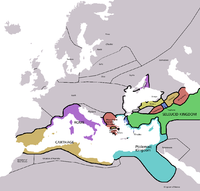 In the northern-most part of ancient Greece, in the ancient kingdom of Macedonia, technological and organizational skills were forged with a long history of cavalry warfare. The hetairoi (Companion cavalry
) was considered the strongest of their time. Under Alexander the Great, this force turned east, and in a series of three decisive battles, routed the Persian forces and took their empire, which included Egypt and the Phoenician lands. The major centres of the Mediterranean at the time became part of Alexander's empire as a result. His empire quickly disintegrated, and the Middle East, Egypt, and Greece were soon again independent. Alexander's conquests spread Greek knowledge and ideas throughout the region.
rose to dominate its surroundings with an empire that contained many of the former Phoenician holdings. However, it was a city on the Italian Peninsula
, Rome
, that would eventually dominate the entire Mediterranean basin. Spreading first through Italy, Rome defeated Carthage in the Punic Wars
, despite Hannibal's famous efforts against Rome in the Second Punic War
. After the Third Punic War
, Rome then became the leading force in the Mediterranean region. The Romans soon spread east taking Greece, and the Greek heritage played an important role in the Roman Empire. By this point the coastal trading cultures were thoroughly dominant over the inland river valleys that had once been the heart of the great powers. Egyptian power moved from the Nile cities to the coastal ones, especially Alexandria
. Mesopotamia became a fringe border region between the Roman Empire and the Persians.
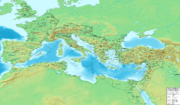 When Augustus
founded the Roman Empire
, the Mediterranean sea began to be called Mare Nostrum
(Latin: "Our Sea") by the Romans. Their empire was centered on this sea and all the area was full of commerce and naval development. For the first time in history an entire sea (the Mediterranean) was free of piracy. For several centuries the Mediterranean was a "Roman Lake", surrounded on all sides by the empire.
The empire began to crumble, however, in the fifth century and Rome
collapsed after 476 AD. Temporarily the east was again dominant as the Byzantine Empire
formed from the eastern half of the Roman one. The western part of the empire, Gaul
, Iberia
, and the Maghreb
were invaded by nomadic horse peoples from the Eurasian
steppe. These conquerors soon became settled, and adopted many of the local customs, forming many small and warring kingdoms.
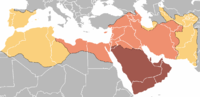 Another power was rising in the east, that of Islam
, whilst the Byzantine
Roman and Sassanid
Persian empires were both weakened by centuries of stalemate warfare during the Roman-Persian Wars
. In a series of rapid Muslim conquests
, the Arab armies
, motivated by Islam and led by the Caliph
s and skilled military commanders such as Khalid ibn al-Walid
, swept through most of the Middle East; reducing Byzantine lands
by more than half and completely engulfing the Persian lands
. In Anatolia
, their expansion was blocked
by the still capable Byzantines with the help of the Bulgarians
. The Byzantine provinces of Roman Syria
, North Africa
, and Sicily, however, could not mount such a resistance, and the Muslim conquerors swept through those regions. At the far west, they crossed the sea taking Visigothic Hispania
before being halted in southern France
by the Franks
. At its greatest extent, the Arab Empire
controlled 3/4 of the Mediterranean region, the only other empire besides the Roman Empire to control most of the Mediterranean Sea.
Much of North Africa became a peripheral area to the main Muslim centres in the Middle East, but Iberia (Al Andalus) and Morocco soon broke from this distant control and founded one of the world's most advanced societies at the time, along with Baghdad
near the eastern Mediterranean.
Between 831 and 1071, the Emirate of Sicily
was one of the major centres of Islamic culture in the Mediterranean. After its conquest by the Normans
the island developed its own distinct culture with the fusion of Arab, Western and Byzantine influences. Palermo remained a leading artistic and commercial centre of the Mediterranean well into the Middle Ages.
Europe was reviving, however, as more organized and centralized states began to form in the later Middle Ages
after the Renaissance of the 12th century
. Motivated by religion and dreams of conquest, the kings of Europe launched a number of Crusades to try to roll back Muslim power and retake the holy land
. The Crusades were unsuccessful in this goal, but they were far more effective in weakening the already tottering Byzantine Empire that began to lose increasing amounts of territory to the Seljuk Turks and later to the Ottoman Turks
. They also rearranged the balance of power in the Muslim world as Egypt once again emerged as a major power in the eastern Mediterranean.
began in Italy
. The Italian "Repubbliche Marinare" (Maritime Republics) of Venice
, Genoa
, Amalfi
and Pisa
developed their own "empires" in the Mediterranean shores. The Islamic states had never been major naval powers, and trade from the east to Europe was soon in the hands of Italian traders, especially the Venetians, who profited immensely from it. Republic of Ragusa
used diplomacy to further trade and maintained a libertarian approach in civil matters to further sentiment in its inhabitants. The Western Mediterranean sea was dominated by the Crown of Aragon
: thanks to their possessions of Sicily
, the Kingdom of Naples
, Sardinia
, the Balearic Islands
, the Duchy of Athens
the Duchy of Neopatria
, and several northern African cities, by the 1420s they kept tight control over the trade routes of that linked the Western and Eastern Mediterranean. Their army was the biggest in the Mediterranean sea, and during the 15th century its power remained unchallenged.
Ottoman power continued to grow, and in 1453, the Byzantine Empire was extinguished with the fall of Constantinople
. The Ottomans already controlled Greece, Bulgaria
and much of the Balkans (except Albania
, due to its resistance), and soon also began to spread through North Africa. North Africa had grown wealthy from the trade across the Sahara Desert, but the Portuguese
, who, along with other Christian powers, had been engaged in a long campaign to evict the Muslims from Iberia, had found a method to circumvent this trade by trading directly with West Africa
. This was enabled by a new type of ships, the caravel
, that made trade in the rough Atlantic waters profitable for the first time. The reduction in the Saharan trade weakened North Africa, and made them an easy target for the Ottomans.
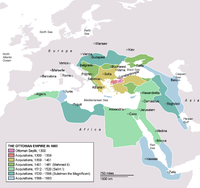
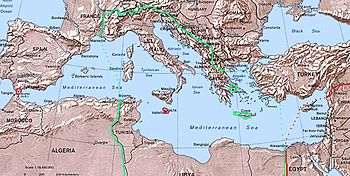 The growing naval prowess of the European powers confronted further rapid Ottoman expansion in the region when the Battle of Lepanto
checked the power of the Ottoman navy. However, as Braudel argued forcefully, this only slowed the Ottoman expansion instead of ending it. The prized island of Cyprus
became Ottoman in 1571. The last resistance in Tunisia
ended in 1574 and almost a generation long siege in Crete
pushed Venetians out of this strategic island in 1669. A balance of power was then established between Spain
and Ottoman Empire
until 18th century, each dominating their respective half of Mediterranean, reducing Italian navies as naval powers increasingly more irrelevant. Furthermore, the Ottoman Empire had succeeded in their objective of extending Muslim rule across the North African coast.
The development of oceanic shipping began to affect the entire Mediterranean, however. While once all trade from the east had passed through the region, the circumnavigation of Africa allowed gold, spices, and dyes to be imported directly to the Atlantic ports of western Europe. The Americas were also a source of extreme wealth to the western powers, from which some of the Mediterranean states were largely cut off. The base of European power thus shifted northward and the once wealthy Italy
became a peripheral area dominated by foreigners. The Ottoman Empire also began a slow decline that saw its North African possessions gain de facto independence and its European holdings gradually reduced by the increasing power of Austria and Russia.
By the nineteenth century the European States were vastly more powerful, and began to colonize North Africa. France spread its power south by taking Algeria
in 1830 and later Tunisia
. Britain gained control of Egypt
in 1882. Italy
conquered Libya
from the Ottomans in 1911. The Ottoman Empire finally collapsed in the First World War
, and its holdings were carved up among France and Britain, but the Turkish regions quickly regained their independence, becoming the independent state of Turkey
in 1923. During the first half of the twentieth century the Mediterranean was at the center of the expansion of the Kingdom of Italy
, and was one of the main areas of battle during World War II
between the Axis and the Allies
. Post-world war period was marked by increasing activity in the Eastern Mediterranean, where naval actions formed part of ongoing Arab-Israeli conflict and Turkey had occupied the northern part of Cyprus. American naval power made the Mediterranean its permanent base during the Cold war. Today, the Mediterranean Sea is the southern border of the European Union
.
Musical Anthropology of the Mediterranean: Interpretation, Performance, Identity, Bologna, Edizioni Clueb – Cooperativa Libraria Universitaria Editrice, 2009.
History
History is the discovery, collection, organization, and presentation of information about past events. History can also mean the period of time after writing was invented. Scholars who write about history are called historians...
of the interaction of the cultures and people of the lands surrounding the Mediterranean Sea
Mediterranean Sea
The Mediterranean Sea is a sea connected to the Atlantic Ocean surrounded by the Mediterranean region and almost completely enclosed by land: on the north by Anatolia and Europe, on the south by North Africa, and on the east by the Levant...
—the central superhighway of transport, trade and cultural exchange between diverse peoples. Its history is important to understanding the origin and development of the Israel and Judah
History of ancient Israel and Judah
Israel and Judah were related Iron Age kingdoms of ancient Palestine. The earliest known reference to the name Israel in archaeological records is in the Merneptah stele, an Egyptian record of c. 1209 BCE. By the 9th century BCE the Kingdom of Israel had emerged as an important local power before...
, Mesopotamia
Mesopotamia
Mesopotamia is a toponym for the area of the Tigris–Euphrates river system, largely corresponding to modern-day Iraq, northeastern Syria, southeastern Turkey and southwestern Iran.Widely considered to be the cradle of civilization, Bronze Age Mesopotamia included Sumer and the...
n, Egyptian
Ancient Egypt
Ancient Egypt was an ancient civilization of Northeastern Africa, concentrated along the lower reaches of the Nile River in what is now the modern country of Egypt. Egyptian civilization coalesced around 3150 BC with the political unification of Upper and Lower Egypt under the first pharaoh...
, Canaanites, Greek
Ancient Greece
Ancient Greece is a civilization belonging to a period of Greek history that lasted from the Archaic period of the 8th to 6th centuries BC to the end of antiquity. Immediately following this period was the beginning of the Early Middle Ages and the Byzantine era. Included in Ancient Greece is the...
, Roman
Ancient Rome
Ancient Rome was a thriving civilization that grew on the Italian Peninsula as early as the 8th century BC. Located along the Mediterranean Sea and centered on the city of Rome, it expanded to one of the largest empires in the ancient world....
, Carthaginian
Carthage
Carthage , implying it was a 'new Tyre') is a major urban centre that has existed for nearly 3,000 years on the Gulf of Tunis, developing from a Phoenician colony of the 1st millennium BC...
, Byzantine
Byzantine Empire
The Byzantine Empire was the Eastern Roman Empire during the periods of Late Antiquity and the Middle Ages, centred on the capital of Constantinople. Known simply as the Roman Empire or Romania to its inhabitants and neighbours, the Empire was the direct continuation of the Ancient Roman State...
, Ottoman
Ottoman Empire
The Ottoman EmpireIt was usually referred to as the "Ottoman Empire", the "Turkish Empire", the "Ottoman Caliphate" or more commonly "Turkey" by its contemporaries...
, Christian
Christianity
Christianity is a monotheistic religion based on the life and teachings of Jesus as presented in canonical gospels and other New Testament writings...
, and Islamic cultures.
Dawn of civilization
Its origins can be thought to have been with the Zanclean floodZanclean flood
The Zanclean flood is a flood theorized to have refilled the Mediterranean Sea 5.33 million years ago, at the beginning of the Zanclean age, between the Miocene and Pliocene, which ended the Messinian salinity crisis...
of 5.33 million years ago, described in more detail under Mediterranean basin
Mediterranean Basin
In biogeography, the Mediterranean Basin refers to the lands around the Mediterranean Sea that have a Mediterranean climate, with mild, rainy winters and hot, dry summers, which supports characteristic Mediterranean forests, woodlands, and scrub vegetation...
.
Two of the first commonly noted human civilizations began near the eastern Mediterranean sea. Common rhetoric suggests that Civilization first developed in Mesopotamia
Mesopotamia
Mesopotamia is a toponym for the area of the Tigris–Euphrates river system, largely corresponding to modern-day Iraq, northeastern Syria, southeastern Turkey and southwestern Iran.Widely considered to be the cradle of civilization, Bronze Age Mesopotamia included Sumer and the...
beginning with Sumer
Sumer
Sumer was a civilization and historical region in southern Mesopotamia, modern Iraq during the Chalcolithic and Early Bronze Age....
in the 4th millennium BC
4th millennium BC
The 4th millennium BC saw major changes in human culture. It marked the beginning of the Bronze Age and of writing.The city states of Sumer and the kingdom of Egypt were established and grew to prominence. Agriculture spread widely across Eurasia...
. Soon after, the Nile River valley of ancient Egypt
Ancient Egypt
Ancient Egypt was an ancient civilization of Northeastern Africa, concentrated along the lower reaches of the Nile River in what is now the modern country of Egypt. Egyptian civilization coalesced around 3150 BC with the political unification of Upper and Lower Egypt under the first pharaoh...
was unified under the Pharaoh
Pharaoh
Pharaoh is a title used in many modern discussions of the ancient Egyptian rulers of all periods. The title originates in the term "pr-aa" which means "great house" and describes the royal palace...
s in the 4th millennium BC, and civilization quickly spread through the Fertile Crescent
Fertile Crescent
The Fertile Crescent, nicknamed "The Cradle of Civilization" for the fact the first civilizations started there, is a crescent-shaped region containing the comparatively moist and fertile land of otherwise arid and semi-arid Western Asia. The term was first used by University of Chicago...
to the east coast of the sea and throughout the Levant
Levant
The Levant or ) is the geographic region and culture zone of the "eastern Mediterranean littoral between Anatolia and Egypt" . The Levant includes most of modern Lebanon, Syria, Jordan, Israel, the Palestinian territories, and sometimes parts of Turkey and Iraq, and corresponds roughly to the...
, which happens to make the Mediterranean countries of Egypt
Ancient Egypt
Ancient Egypt was an ancient civilization of Northeastern Africa, concentrated along the lower reaches of the Nile River in what is now the modern country of Egypt. Egyptian civilization coalesced around 3150 BC with the political unification of Upper and Lower Egypt under the first pharaoh...
, Syria
Syria
Syria , officially the Syrian Arab Republic , is a country in Western Asia, bordering Lebanon and the Mediterranean Sea to the West, Turkey to the north, Iraq to the east, Jordan to the south, and Israel to the southwest....
, Lebanon
Lebanon
Lebanon , officially the Republic of LebanonRepublic of Lebanon is the most common term used by Lebanese government agencies. The term Lebanese Republic, a literal translation of the official Arabic and French names that is not used in today's world. Arabic is the most common language spoken among...
, Palestine
Palestine
Palestine is a conventional name, among others, used to describe the geographic region between the Mediterranean Sea and the Jordan River, and various adjoining lands....
and Israel
Israel
The State of Israel is a parliamentary republic located in the Middle East, along the eastern shore of the Mediterranean Sea...
part of the cradle of civilization
Cradle of Civilization
The cradle of civilization is a term referring to any of the possible locations for the emergence of civilization.It is usually applied to the Ancient Near Eastern Chalcolithic , especially in the Fertile Crescent , but also extended to sites in Armenia, and the Persian Plateau, besides other Asian...
. These areas shared similar climates and geographies, but it was more difficult to spread technologies and crops, such as flax, lentil, peas, barley, and cotton to other portions of the Mediterranean basin.
In time, large empire
Empire
The term empire derives from the Latin imperium . Politically, an empire is a geographically extensive group of states and peoples united and ruled either by a monarch or an oligarchy....
s developed in Asia Minor
Anatolia
Anatolia is a geographic and historical term denoting the westernmost protrusion of Asia, comprising the majority of the Republic of Turkey...
, such as the Hittites
Hittites
The Hittites were a Bronze Age people of Anatolia.They established a kingdom centered at Hattusa in north-central Anatolia c. the 18th century BC. The Hittite empire reached its height c...
. The main expansion was delayed until ships sturdy enough to cross the sea were developed. Cyprus
Cyprus
Cyprus , officially the Republic of Cyprus , is a Eurasian island country, member of the European Union, in the Eastern Mediterranean, east of Greece, south of Turkey, west of Syria and north of Egypt. It is the third largest island in the Mediterranean Sea.The earliest known human activity on the...
and the other islands developed, and the Minoan civilization
Minoan civilization
The Minoan civilization was a Bronze Age civilization that arose on the island of Crete and flourished from approximately the 27th century BC to the 15th century BC. It was rediscovered at the beginning of the 20th century through the work of the British archaeologist Arthur Evans...
flourished on the island of Crete
Crete
Crete is the largest and most populous of the Greek islands, the fifth largest island in the Mediterranean Sea, and one of the thirteen administrative regions of Greece. It forms a significant part of the economy and cultural heritage of Greece while retaining its own local cultural traits...
. While the river valley civilizations always had larger populations, the trading societies on the coast of the sea soon became the most prosperous, and rose to power.
Classical antiquity
Two of the most notable Mediterranean civilizations in classical antiquityClassical antiquity
Classical antiquity is a broad term for a long period of cultural history centered on the Mediterranean Sea, comprising the interlocking civilizations of ancient Greece and ancient Rome, collectively known as the Greco-Roman world...
were the Greek
Ancient Greece
Ancient Greece is a civilization belonging to a period of Greek history that lasted from the Archaic period of the 8th to 6th centuries BC to the end of antiquity. Immediately following this period was the beginning of the Early Middle Ages and the Byzantine era. Included in Ancient Greece is the...
city states and the Phoenicia
Phoenicia
Phoenicia , was an ancient civilization in Canaan which covered most of the western, coastal part of the Fertile Crescent. Several major Phoenician cities were built on the coastline of the Mediterranean. It was an enterprising maritime trading culture that spread across the Mediterranean from 1550...
ns. The Greeks expanded throughout the Black Sea
Black Sea
The Black Sea is bounded by Europe, Anatolia and the Caucasus and is ultimately connected to the Atlantic Ocean via the Mediterranean and the Aegean seas and various straits. The Bosphorus strait connects it to the Sea of Marmara, and the strait of the Dardanelles connects that sea to the Aegean...
and south through the Red Sea
Red Sea
The Red Sea is a seawater inlet of the Indian Ocean, lying between Africa and Asia. The connection to the ocean is in the south through the Bab el Mandeb strait and the Gulf of Aden. In the north, there is the Sinai Peninsula, the Gulf of Aqaba, and the Gulf of Suez...
. The Phoenicians spread through the western Mediterranean reaching North Africa
North Africa
North Africa or Northern Africa is the northernmost region of the African continent, linked by the Sahara to Sub-Saharan Africa. Geopolitically, the United Nations definition of Northern Africa includes eight countries or territories; Algeria, Egypt, Libya, Morocco, South Sudan, Sudan, Tunisia, and...
and the Iberian Peninsula
Iberian Peninsula
The Iberian Peninsula , sometimes called Iberia, is located in the extreme southwest of Europe and includes the modern-day sovereign states of Spain, Portugal and Andorra, as well as the British Overseas Territory of Gibraltar...
. They often provided the naval forces of the Achaemenid
Achaemenid Empire
The Achaemenid Empire , sometimes known as First Persian Empire and/or Persian Empire, was founded in the 6th century BCE by Cyrus the Great who overthrew the Median confederation...
Persian Empire and their heartland in the Levant was still dominated by powers rooted east in Mesopotamia or Persia
Iran
Iran , officially the Islamic Republic of Iran , is a country in Southern and Western Asia. The name "Iran" has been in use natively since the Sassanian era and came into use internationally in 1935, before which the country was known to the Western world as Persia...
.
Hellenistic period
Companion cavalry
The Companions were the elite cavalry of the Macedonian army from the time of king Philip II of Macedon and reached the most prestige under Alexander the Great, and have been regarded as the best cavalry in the ancient world and the first shock cavalry...
) was considered the strongest of their time. Under Alexander the Great, this force turned east, and in a series of three decisive battles, routed the Persian forces and took their empire, which included Egypt and the Phoenician lands. The major centres of the Mediterranean at the time became part of Alexander's empire as a result. His empire quickly disintegrated, and the Middle East, Egypt, and Greece were soon again independent. Alexander's conquests spread Greek knowledge and ideas throughout the region.
Roman-Carthaginian rivalry
These eastern powers soon began to be overshadowed by those further west. In North Africa the former Phoenician colony of CarthageCarthage
Carthage , implying it was a 'new Tyre') is a major urban centre that has existed for nearly 3,000 years on the Gulf of Tunis, developing from a Phoenician colony of the 1st millennium BC...
rose to dominate its surroundings with an empire that contained many of the former Phoenician holdings. However, it was a city on the Italian Peninsula
Italian Peninsula
The Italian Peninsula or Apennine Peninsula is one of the three large peninsulas of Southern Europe , spanning from the Po Valley in the north to the central Mediterranean Sea in the south. The peninsula's shape gives it the nickname Lo Stivale...
, Rome
Rome
Rome is the capital of Italy and the country's largest and most populated city and comune, with over 2.7 million residents in . The city is located in the central-western portion of the Italian Peninsula, on the Tiber River within the Lazio region of Italy.Rome's history spans two and a half...
, that would eventually dominate the entire Mediterranean basin. Spreading first through Italy, Rome defeated Carthage in the Punic Wars
Punic Wars
The Punic Wars were a series of three wars fought between Rome and Carthage from 264 B.C.E. to 146 B.C.E. At the time, they were probably the largest wars that had ever taken place...
, despite Hannibal's famous efforts against Rome in the Second Punic War
Second Punic War
The Second Punic War, also referred to as The Hannibalic War and The War Against Hannibal, lasted from 218 to 201 BC and involved combatants in the western and eastern Mediterranean. This was the second major war between Carthage and the Roman Republic, with the participation of the Berbers on...
. After the Third Punic War
Third Punic War
The Third Punic War was the third and last of the Punic Wars fought between the former Phoenician colony of Carthage, and the Roman Republic...
, Rome then became the leading force in the Mediterranean region. The Romans soon spread east taking Greece, and the Greek heritage played an important role in the Roman Empire. By this point the coastal trading cultures were thoroughly dominant over the inland river valleys that had once been the heart of the great powers. Egyptian power moved from the Nile cities to the coastal ones, especially Alexandria
Alexandria
Alexandria is the second-largest city of Egypt, with a population of 4.1 million, extending about along the coast of the Mediterranean Sea in the north central part of the country; it is also the largest city lying directly on the Mediterranean coast. It is Egypt's largest seaport, serving...
. Mesopotamia became a fringe border region between the Roman Empire and the Persians.
Roman Lake
Augustus
Augustus ;23 September 63 BC – 19 August AD 14) is considered the first emperor of the Roman Empire, which he ruled alone from 27 BC until his death in 14 AD.The dates of his rule are contemporary dates; Augustus lived under two calendars, the Roman Republican until 45 BC, and the Julian...
founded the Roman Empire
Roman Empire
The Roman Empire was the post-Republican period of the ancient Roman civilization, characterised by an autocratic form of government and large territorial holdings in Europe and around the Mediterranean....
, the Mediterranean sea began to be called Mare Nostrum
Mare Nostrum
Mare Nostrum may refer to:*Mare Nostrum, the Roman term for the Mediterranean Sea, adopted by Italian nationalists and fascists.*Mare Nostrum , a Spanish-language novel by Vicente Blasco Ibáñez...
(Latin: "Our Sea") by the Romans. Their empire was centered on this sea and all the area was full of commerce and naval development. For the first time in history an entire sea (the Mediterranean) was free of piracy. For several centuries the Mediterranean was a "Roman Lake", surrounded on all sides by the empire.
The empire began to crumble, however, in the fifth century and Rome
Rome
Rome is the capital of Italy and the country's largest and most populated city and comune, with over 2.7 million residents in . The city is located in the central-western portion of the Italian Peninsula, on the Tiber River within the Lazio region of Italy.Rome's history spans two and a half...
collapsed after 476 AD. Temporarily the east was again dominant as the Byzantine Empire
Byzantine Empire
The Byzantine Empire was the Eastern Roman Empire during the periods of Late Antiquity and the Middle Ages, centred on the capital of Constantinople. Known simply as the Roman Empire or Romania to its inhabitants and neighbours, the Empire was the direct continuation of the Ancient Roman State...
formed from the eastern half of the Roman one. The western part of the empire, Gaul
Gaul
Gaul was a region of Western Europe during the Iron Age and Roman era, encompassing present day France, Luxembourg and Belgium, most of Switzerland, the western part of Northern Italy, as well as the parts of the Netherlands and Germany on the left bank of the Rhine. The Gauls were the speakers of...
, Iberia
Hispania
Another theory holds that the name derives from Ezpanna, the Basque word for "border" or "edge", thus meaning the farthest area or place. Isidore of Sevilla considered Hispania derived from Hispalis....
, and the Maghreb
Maghreb
The Maghreb is the region of Northwest Africa, west of Egypt. It includes five countries: Morocco, Algeria, Tunisia, Libya, and Mauritania and the disputed territory of Western Sahara...
were invaded by nomadic horse peoples from the Eurasian
Eurasian nomads
Eurasian nomads are a large group of peoples of the Eurasian Steppe. This generic title encompasses the ethnic groups inhabiting the steppes of Central Asia, Mongolia, and Eastern Europe. They domesticated the horse, and their economy and culture emphasizes horse breeding, horse riding, and a...
steppe. These conquerors soon became settled, and adopted many of the local customs, forming many small and warring kingdoms.
Islamic Golden Age
Islam
Islam . The most common are and . : Arabic pronunciation varies regionally. The first vowel ranges from ~~. The second vowel ranges from ~~~...
, whilst the Byzantine
Byzantine Empire
The Byzantine Empire was the Eastern Roman Empire during the periods of Late Antiquity and the Middle Ages, centred on the capital of Constantinople. Known simply as the Roman Empire or Romania to its inhabitants and neighbours, the Empire was the direct continuation of the Ancient Roman State...
Roman and Sassanid
Sassanid Empire
The Sassanid Empire , known to its inhabitants as Ērānshahr and Ērān in Middle Persian and resulting in the New Persian terms Iranshahr and Iran , was the last pre-Islamic Persian Empire, ruled by the Sasanian Dynasty from 224 to 651...
Persian empires were both weakened by centuries of stalemate warfare during the Roman-Persian Wars
Roman-Persian Wars
The Roman–Persian Wars were a series of conflicts between states of the Greco-Roman world and two successive Iranic empires: the Parthian and the Sassanid. Contact between the Parthian Empire and the Roman Republic began in 92 BC; wars began under the late Republic, and continued...
. In a series of rapid Muslim conquests
Muslim conquests
Muslim conquests also referred to as the Islamic conquests or Arab conquests, began with the Islamic prophet Muhammad. He established a new unified polity in the Arabian Peninsula which under the subsequent Rashidun and Umayyad Caliphates saw a century of rapid expansion of Muslim power.They...
, the Arab armies
Rashidun army
The Rashidun Caliphate Army or Rashidun army was the primary military body of the Rashidun Caliphate's armed forces during the Muslim conquests of the 7th century, serving alongside the Rashidun Navy...
, motivated by Islam and led by the Caliph
Caliph
The Caliph is the head of state in a Caliphate, and the title for the ruler of the Islamic Ummah, an Islamic community ruled by the Shari'ah. It is a transcribed version of the Arabic word which means "successor" or "representative"...
s and skilled military commanders such as Khalid ibn al-Walid
Khalid ibn al-Walid
Khālid ibn al-Walīd also known as Sayf Allāh al-Maslūl , was a companion of the Islamic prophet Muhammad. He is noted for his military tactics and prowess, commanding the forces of Medina and those of his immediate successors of the Rashidun Caliphate; Abu Bakr and Umar...
, swept through most of the Middle East; reducing Byzantine lands
Byzantine-Arab Wars
The Byzantine–Arab Wars were a series of wars between the Arab Caliphates and the East Roman or Byzantine Empire between the 7th and 12th centuries AD. These started during the initial Muslim conquests under the expansionist Rashidun and Umayyad caliphs and continued in the form of an enduring...
by more than half and completely engulfing the Persian lands
Islamic conquest of Persia
The Muslim conquest of Persia led to the end of the Sassanid Empire in 644, the fall of Sassanid dynasty in 651 and the eventual decline of the Zoroastrian religion in Persia...
. In Anatolia
Anatolia
Anatolia is a geographic and historical term denoting the westernmost protrusion of Asia, comprising the majority of the Republic of Turkey...
, their expansion was blocked
Siege of Constantinople (718)
The Second Arab Siege of Constantinople was a combined land and sea effort by the Arabs to take the capital city of the Byzantine Empire, Constantinople. The Arab ground forces, led by Maslamah ibn Abd al-Malik, were held off by the massive city walls, decimated by an outbreak of plague and...
by the still capable Byzantines with the help of the Bulgarians
First Bulgarian Empire
The First Bulgarian Empire was a medieval Bulgarian state founded in the north-eastern Balkans in c. 680 by the Bulgars, uniting with seven South Slavic tribes...
. The Byzantine provinces of Roman Syria
Muslim conquest of Syria
The Muslim conquest of Syria occurred in the first half of the 7th century, and refers to the region known as the Bilad al-Sham, the Levant, or Greater Syria...
, North Africa
Umayyad conquest of North Africa
The Umayyad conquest of North Africa continued the century of rapid Arab Muslim expansion following the death of Muhammad in 632 CE. By 640 the Arabs controlled Mesopotamia, had invaded Armenia, and were concluding their conquest of Byzantine Syria. Damascus was the seat of the Umayyad caliphate....
, and Sicily, however, could not mount such a resistance, and the Muslim conquerors swept through those regions. At the far west, they crossed the sea taking Visigothic Hispania
Umayyad conquest of Hispania
The Umayyad conquest of Hispania is the initial Islamic Ummayad Caliphate's conquest, between 711 and 718, of the Christian Visigothic Kingdom of Hispania, centered in the Iberian Peninsula, which was known to them under the Arabic name al-Andalus....
before being halted in southern France
Battle of Tours
The Battle of Tours , also called the Battle of Poitiers and in Battle of the Court of the Martyrs, was fought in an area between the cities of Poitiers and Tours, located in north-central France, near the village of Moussais-la-Bataille, about northeast of Poitiers...
by the Franks
Franks
The Franks were a confederation of Germanic tribes first attested in the third century AD as living north and east of the Lower Rhine River. From the third to fifth centuries some Franks raided Roman territory while other Franks joined the Roman troops in Gaul. Only the Salian Franks formed a...
. At its greatest extent, the Arab Empire
Caliphate
The term caliphate, "dominion of a caliph " , refers to the first system of government established in Islam and represented the political unity of the Muslim Ummah...
controlled 3/4 of the Mediterranean region, the only other empire besides the Roman Empire to control most of the Mediterranean Sea.
Much of North Africa became a peripheral area to the main Muslim centres in the Middle East, but Iberia (Al Andalus) and Morocco soon broke from this distant control and founded one of the world's most advanced societies at the time, along with Baghdad
Baghdad
Baghdad is the capital of Iraq, as well as the coterminous Baghdad Governorate. The population of Baghdad in 2011 is approximately 7,216,040...
near the eastern Mediterranean.
Between 831 and 1071, the Emirate of Sicily
Emirate of Sicily
The Emirate of Sicily was an Islamic state on the island of Sicily , which existed from 965 to 1072.-First Arab invasions of Sicily:...
was one of the major centres of Islamic culture in the Mediterranean. After its conquest by the Normans
Normans
The Normans were the people who gave their name to Normandy, a region in northern France. They were descended from Norse Viking conquerors of the territory and the native population of Frankish and Gallo-Roman stock...
the island developed its own distinct culture with the fusion of Arab, Western and Byzantine influences. Palermo remained a leading artistic and commercial centre of the Mediterranean well into the Middle Ages.
Europe was reviving, however, as more organized and centralized states began to form in the later Middle Ages
Middle Ages
The Middle Ages is a periodization of European history from the 5th century to the 15th century. The Middle Ages follows the fall of the Western Roman Empire in 476 and precedes the Early Modern Era. It is the middle period of a three-period division of Western history: Classic, Medieval and Modern...
after the Renaissance of the 12th century
Renaissance of the 12th century
The Renaissance of the 12th century was a period of many changes at the outset of the High Middle Ages. It included social, political and economic transformations, and an intellectual revitalization of Western Europe with strong philosophical and scientific roots...
. Motivated by religion and dreams of conquest, the kings of Europe launched a number of Crusades to try to roll back Muslim power and retake the holy land
Holy Land
The Holy Land is a term which in Judaism refers to the Kingdom of Israel as defined in the Tanakh. For Jews, the Land's identifiction of being Holy is defined in Judaism by its differentiation from other lands by virtue of the practice of Judaism often possible only in the Land of Israel...
. The Crusades were unsuccessful in this goal, but they were far more effective in weakening the already tottering Byzantine Empire that began to lose increasing amounts of territory to the Seljuk Turks and later to the Ottoman Turks
Ottoman Turks
The Ottoman Turks were the Turkish-speaking population of the Ottoman Empire who formed the base of the state's military and ruling classes. Reliable information about the early history of Ottoman Turks is scarce, but they take their Turkish name, Osmanlı , from the house of Osman I The Ottoman...
. They also rearranged the balance of power in the Muslim world as Egypt once again emerged as a major power in the eastern Mediterranean.
Late Middle Ages
Europe continued to increase in power as the RenaissanceRenaissance
The Renaissance was a cultural movement that spanned roughly the 14th to the 17th century, beginning in Italy in the Late Middle Ages and later spreading to the rest of Europe. The term is also used more loosely to refer to the historical era, but since the changes of the Renaissance were not...
began in Italy
Italy
Italy , officially the Italian Republic languages]] under the European Charter for Regional or Minority Languages. In each of these, Italy's official name is as follows:;;;;;;;;), is a unitary parliamentary republic in South-Central Europe. To the north it borders France, Switzerland, Austria and...
. The Italian "Repubbliche Marinare" (Maritime Republics) of Venice
Venice
Venice is a city in northern Italy which is renowned for the beauty of its setting, its architecture and its artworks. It is the capital of the Veneto region...
, Genoa
Genoa
Genoa |Ligurian]] Zena ; Latin and, archaically, English Genua) is a city and an important seaport in northern Italy, the capital of the Province of Genoa and of the region of Liguria....
, Amalfi
Amalfi
Amalfi is a town and comune in the province of Salerno, in the region of Campania, Italy, on the Gulf of Salerno, c. 35 km southeast of Naples. It lies at the mouth of a deep ravine, at the foot of Monte Cerreto , surrounded by dramatic cliffs and coastal scenery...
and Pisa
Pisa
Pisa is a city in Tuscany, Central Italy, on the right bank of the mouth of the River Arno on the Tyrrhenian Sea. It is the capital city of the Province of Pisa...
developed their own "empires" in the Mediterranean shores. The Islamic states had never been major naval powers, and trade from the east to Europe was soon in the hands of Italian traders, especially the Venetians, who profited immensely from it. Republic of Ragusa
Republic of Ragusa
The Republic of Ragusa or Republic of Dubrovnik was a maritime republic centered on the city of Dubrovnik in Dalmatia , that existed from 1358 to 1808...
used diplomacy to further trade and maintained a libertarian approach in civil matters to further sentiment in its inhabitants. The Western Mediterranean sea was dominated by the Crown of Aragon
Crown of Aragon
The Crown of Aragon Corona d'Aragón Corona d'Aragó Corona Aragonum controlling a large portion of the present-day eastern Spain and southeastern France, as well as some of the major islands and mainland possessions stretching across the Mediterranean as far as Greece...
: thanks to their possessions of Sicily
Sicily
Sicily is a region of Italy, and is the largest island in the Mediterranean Sea. Along with the surrounding minor islands, it constitutes an autonomous region of Italy, the Regione Autonoma Siciliana Sicily has a rich and unique culture, especially with regard to the arts, music, literature,...
, the Kingdom of Naples
Kingdom of Naples
The Kingdom of Naples, comprising the southern part of the Italian peninsula, was the remainder of the old Kingdom of Sicily after secession of the island of Sicily as a result of the Sicilian Vespers rebellion of 1282. Known to contemporaries as the Kingdom of Sicily, it is dubbed Kingdom of...
, Sardinia
Sardinia
Sardinia is the second-largest island in the Mediterranean Sea . It is an autonomous region of Italy, and the nearest land masses are the French island of Corsica, the Italian Peninsula, Sicily, Tunisia and the Spanish Balearic Islands.The name Sardinia is from the pre-Roman noun *sard[],...
, the Balearic Islands
Balearic Islands
The Balearic Islands are an archipelago of Spain in the western Mediterranean Sea, near the eastern coast of the Iberian Peninsula.The four largest islands are: Majorca, Minorca, Ibiza and Formentera. The archipelago forms an autonomous community and a province of Spain with Palma as the capital...
, the Duchy of Athens
Duchy of Athens
The Duchy of Athens was one of the Crusader States set up in Greece after the conquest of the Byzantine Empire during the Fourth Crusade, encompassing the regions of Attica and Boeotia, and surviving until its conquest by the Ottoman Empire in the 15th century....
the Duchy of Neopatria
Duchy of Neopatria
The Duchy of Neopatria or Neopatras was one of the Crusader States set up in Greece after the conquest of the Byzantine Empire during the Fourth Crusade...
, and several northern African cities, by the 1420s they kept tight control over the trade routes of that linked the Western and Eastern Mediterranean. Their army was the biggest in the Mediterranean sea, and during the 15th century its power remained unchallenged.
Ottoman power continued to grow, and in 1453, the Byzantine Empire was extinguished with the fall of Constantinople
Constantinople
Constantinople was the capital of the Roman, Eastern Roman, Byzantine, Latin, and Ottoman Empires. Throughout most of the Middle Ages, Constantinople was Europe's largest and wealthiest city.-Names:...
. The Ottomans already controlled Greece, Bulgaria
Bulgaria
Bulgaria , officially the Republic of Bulgaria , is a parliamentary democracy within a unitary constitutional republic in Southeast Europe. The country borders Romania to the north, Serbia and Macedonia to the west, Greece and Turkey to the south, as well as the Black Sea to the east...
and much of the Balkans (except Albania
League of Lezhë
The League of Lezhë was an alliance of Albanian Principalities forged in Lezhë on the 2nd of March 1444. It was initiated and organised by Skanderbeg with the aim of uniting the Albanian principalities that had been founded in the 12th - 14th centuries, to fight the Ottoman Armies...
, due to its resistance), and soon also began to spread through North Africa. North Africa had grown wealthy from the trade across the Sahara Desert, but the Portuguese
Portugal
Portugal , officially the Portuguese Republic is a country situated in southwestern Europe on the Iberian Peninsula. Portugal is the westernmost country of Europe, and is bordered by the Atlantic Ocean to the West and South and by Spain to the North and East. The Atlantic archipelagos of the...
, who, along with other Christian powers, had been engaged in a long campaign to evict the Muslims from Iberia, had found a method to circumvent this trade by trading directly with West Africa
West Africa
West Africa or Western Africa is the westernmost region of the African continent. Geopolitically, the UN definition of Western Africa includes the following 16 countries and an area of approximately 5 million square km:-Flags of West Africa:...
. This was enabled by a new type of ships, the caravel
Caravel
A caravel is a small, highly maneuverable sailing ship developed in the 15th century by the Portuguese to explore along the West African coast and into the Atlantic Ocean. The lateen sails gave her speed and the capacity for sailing to windward...
, that made trade in the rough Atlantic waters profitable for the first time. The reduction in the Saharan trade weakened North Africa, and made them an easy target for the Ottomans.
Modern era
Battle of Lepanto (1571)
The Battle of Lepanto took place on 7 October 1571 when a fleet of the Holy League, a coalition of Catholic maritime states, decisively defeated the main fleet of the Ottoman Empire in five hours of fighting on the northern edge of the Gulf of Patras, off western Greece...
checked the power of the Ottoman navy. However, as Braudel argued forcefully, this only slowed the Ottoman expansion instead of ending it. The prized island of Cyprus
Cyprus
Cyprus , officially the Republic of Cyprus , is a Eurasian island country, member of the European Union, in the Eastern Mediterranean, east of Greece, south of Turkey, west of Syria and north of Egypt. It is the third largest island in the Mediterranean Sea.The earliest known human activity on the...
became Ottoman in 1571. The last resistance in Tunisia
Tunisia
Tunisia , officially the Tunisian RepublicThe long name of Tunisia in other languages used in the country is: , is the northernmost country in Africa. It is a Maghreb country and is bordered by Algeria to the west, Libya to the southeast, and the Mediterranean Sea to the north and east. Its area...
ended in 1574 and almost a generation long siege in Crete
Crete
Crete is the largest and most populous of the Greek islands, the fifth largest island in the Mediterranean Sea, and one of the thirteen administrative regions of Greece. It forms a significant part of the economy and cultural heritage of Greece while retaining its own local cultural traits...
pushed Venetians out of this strategic island in 1669. A balance of power was then established between Spain
Spain
Spain , officially the Kingdom of Spain languages]] under the European Charter for Regional or Minority Languages. In each of these, Spain's official name is as follows:;;;;;;), is a country and member state of the European Union located in southwestern Europe on the Iberian Peninsula...
and Ottoman Empire
Ottoman Empire
The Ottoman EmpireIt was usually referred to as the "Ottoman Empire", the "Turkish Empire", the "Ottoman Caliphate" or more commonly "Turkey" by its contemporaries...
until 18th century, each dominating their respective half of Mediterranean, reducing Italian navies as naval powers increasingly more irrelevant. Furthermore, the Ottoman Empire had succeeded in their objective of extending Muslim rule across the North African coast.
The development of oceanic shipping began to affect the entire Mediterranean, however. While once all trade from the east had passed through the region, the circumnavigation of Africa allowed gold, spices, and dyes to be imported directly to the Atlantic ports of western Europe. The Americas were also a source of extreme wealth to the western powers, from which some of the Mediterranean states were largely cut off. The base of European power thus shifted northward and the once wealthy Italy
Italy
Italy , officially the Italian Republic languages]] under the European Charter for Regional or Minority Languages. In each of these, Italy's official name is as follows:;;;;;;;;), is a unitary parliamentary republic in South-Central Europe. To the north it borders France, Switzerland, Austria and...
became a peripheral area dominated by foreigners. The Ottoman Empire also began a slow decline that saw its North African possessions gain de facto independence and its European holdings gradually reduced by the increasing power of Austria and Russia.
By the nineteenth century the European States were vastly more powerful, and began to colonize North Africa. France spread its power south by taking Algeria
Algeria
Algeria , officially the People's Democratic Republic of Algeria , also formally referred to as the Democratic and Popular Republic of Algeria, is a country in the Maghreb region of Northwest Africa with Algiers as its capital.In terms of land area, it is the largest country in Africa and the Arab...
in 1830 and later Tunisia
Tunisia
Tunisia , officially the Tunisian RepublicThe long name of Tunisia in other languages used in the country is: , is the northernmost country in Africa. It is a Maghreb country and is bordered by Algeria to the west, Libya to the southeast, and the Mediterranean Sea to the north and east. Its area...
. Britain gained control of Egypt
Egypt
Egypt , officially the Arab Republic of Egypt, Arabic: , is a country mainly in North Africa, with the Sinai Peninsula forming a land bridge in Southwest Asia. Egypt is thus a transcontinental country, and a major power in Africa, the Mediterranean Basin, the Middle East and the Muslim world...
in 1882. Italy
Kingdom of Italy (1861–1946)
The Kingdom of Italy was a state forged in 1861 by the unification of Italy under the influence of the Kingdom of Sardinia, which was its legal predecessor state...
conquered Libya
Libya
Libya is an African country in the Maghreb region of North Africa bordered by the Mediterranean Sea to the north, Egypt to the east, Sudan to the southeast, Chad and Niger to the south, and Algeria and Tunisia to the west....
from the Ottomans in 1911. The Ottoman Empire finally collapsed in the First World War
World War I
World War I , which was predominantly called the World War or the Great War from its occurrence until 1939, and the First World War or World War I thereafter, was a major war centred in Europe that began on 28 July 1914 and lasted until 11 November 1918...
, and its holdings were carved up among France and Britain, but the Turkish regions quickly regained their independence, becoming the independent state of Turkey
Turkey
Turkey , known officially as the Republic of Turkey , is a Eurasian country located in Western Asia and in East Thrace in Southeastern Europe...
in 1923. During the first half of the twentieth century the Mediterranean was at the center of the expansion of the Kingdom of Italy
Kingdom of Italy (1861–1946)
The Kingdom of Italy was a state forged in 1861 by the unification of Italy under the influence of the Kingdom of Sardinia, which was its legal predecessor state...
, and was one of the main areas of battle during World War II
World War II
World War II, or the Second World War , was a global conflict lasting from 1939 to 1945, involving most of the world's nations—including all of the great powers—eventually forming two opposing military alliances: the Allies and the Axis...
between the Axis and the Allies
Allies of World War II
The Allies of World War II were the countries that opposed the Axis powers during the Second World War . Former Axis states contributing to the Allied victory are not considered Allied states...
. Post-world war period was marked by increasing activity in the Eastern Mediterranean, where naval actions formed part of ongoing Arab-Israeli conflict and Turkey had occupied the northern part of Cyprus. American naval power made the Mediterranean its permanent base during the Cold war. Today, the Mediterranean Sea is the southern border of the European Union
European Union
The European Union is an economic and political union of 27 independent member states which are located primarily in Europe. The EU traces its origins from the European Coal and Steel Community and the European Economic Community , formed by six countries in 1958...
.
See also
- Mediterranean U-boat Campaign (World War II)
- Babelmed.net, a website about Mediterranean cultures.
- Eastern MediterraneanEastern MediterraneanThe Eastern Mediterranean is a term that denotes the countries geographically to the east of the Mediterranean Sea. This region is also known as Greater Syria or the Levant....
Further reading
- Braudel, FernandFernand BraudelFernand Braudel was a French historian and a leader of the Annales School. His scholarship focused on three main projects, each representing several decades of intense study: The Mediterranean , Civilization and Capitalism , and the unfinished Identity of France...
. The Mediterranean in the Age of Philip II. - Horden, Peregrine and Nicholas Purcell. The Corrupting Sea: A Study of Mediterranean History. Malden, MA: Blackwell, 2000.
- Rogerson, Barnaby. The Last Crusaders: The Hundred-Year Battle for the Center of the World (Overlook Press; 2010) 482 pages. Traces power struggles in the Mediterranean between 1450 and 1590.
- Thiollet, Jean-PierreJean-Pierre ThiolletJean-Pierre Thiollet is a French writer and journalist. He usually lives in Paris and is the author of numerous books.Since 2007, he has been a member of the World Grand Family of Lebanon ....
. Je m'appelle Byblos. - Philip V. Bohlman, Marcello Sorce Keller, and Loris Azzaroni (eds.),
Musical Anthropology of the Mediterranean: Interpretation, Performance, Identity, Bologna, Edizioni Clueb – Cooperativa Libraria Universitaria Editrice, 2009.
- Schlicht, Alfred, "Die Araber und Europa" Stuttgart 2008 (Kohlhammer)