


Ladislaus I of Hungary

Encyclopedia
Saint Ladislaus I was King of Hungary
from 1077 until his death, "who greatly expanded the boundaries of the kingdom and consolidated it internally; no other Hungarian king was so generally beloved by the people". Before his accession to the throne, he was the main advisor of his brother, Géza I of Hungary
, who was fighting against their cousin, King Solomon of Hungary
. When his brother died, his followers proclaimed Ladislaus king according to the Hungarian tradition that gave precedence to the eldest member of the deceased king's sons. Following a long period of civil wars, he strengthened the royal power in his kingdom by introducing severe legislation. He would also extend his rule over Croatia. After his canonisation, Ladislaus became the model of the chivalrous king in Hungary.
. He was born in Poland
, where his father had sought refuge after his father (Ladislaus' grandfather) made an unsuccessful attempt against his cousin, Saint Stephen I, the first king of Hungary. He was named according to the Slavic traditions of his mother's kin and thus he brought the name László
to yet increasing Hungarian use.
In 1048, the family moved to Hungary, where his father received as appanage one third of Hungary ("Tercia pars Regni") from his brother, King Andrew I of Hungary who had acquired the throne from King Peter after a pagan revolt. Following his accession, King Andrew I had to face the attacks of Henry III, Holy Roman Emperor
whose supremacy had been acknowledged by King Peter. King Andrew I and Duke Béla cooperated closely against the German attacks and they would preserve Hungary's independence. However, their cooperation began to loosen from 1053 when the king fathered a son, Salamon
, because from that time King Andrew wanted to ensure his son's inheritance against his brother, who pursuant to the old Hungarian custom, as the oldest member of the royal family, could lay claim to the throne in case of the king's death.
In 1057, King Andrew I had Salamon crowned to ensure his accession, and Ladislaus had to participate in the coronation together with his father and his brothers, Géza
and Lampert
. However, Duke Béla and his sons left the country in 1059 and they returned with Polish troops in the next year. King Andrew I lost two battles against his brother and died. After his death Ladislaus' father was crowned on December 6, 1060. After his father's death on September 11, 1063, Ladislaus and his brothers agreed to accept the rule of their cousin who had come back followed by German troops, if they received their father's former duchy. However, King Salamon refused the offer and the superiority of his troops obliged the three brothers to leave Hungary. They went to Poland, and after the withdrawal of the German army, they came back to Hungary followed by troops King Bolesław II
, their maternal cousin, provided them.
The parties, however, wanted to avoid civil war; therefore they accepted the mediation services of the bishops. They made an agreement on January 20, 1064, in Győr
, under which Ladislaus and his brothers accepted Salamon's rule, and they received their father's former duchy, i.e., the one third of Hungary.
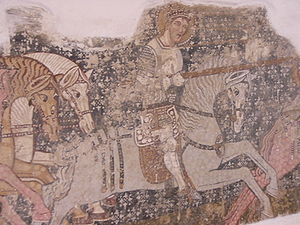
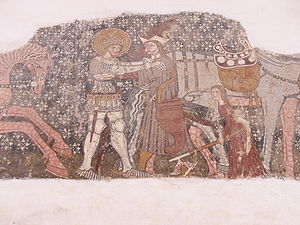
, Ladislaus, his brothers and the king went together against them and won a victory at Kerlés. A popular legend of Ladislaus connected to this battle tells of Ladislaus pursuing and overcoming a Pecheneg warrior, who had tried to abduct a Hungarian girl, thus freeing the girl was.
At that time, Ladislaus married his first wife who was probably a daughter of a German count.
Starting in 1071, when Ladislaus' elder brother, Duke Géza, refused to hand over the king's share of the treasure from the Byzantine Empire
acquired after the occupation of Belgrade
, the relationship between King Salamon and the three brothers deteriorated. Thus, in the next year, when the king lead a new campaign against Belgrade
, only Duke Géza followed him. Ladislaus and Lampert were left behind because the dukes worried that the king's partisans would try to conquer their duchy during their absence.
During 1073, both King Salamon and his cousins prepared for the coming struggle. The king sent his envoys to his brother-in-law, King Henry IV of Germany
, while Ladislaus and his brothers sought the help of their Polish and Czech relatives. Ladislaus went to Moravia and came back with the troops Duke Otto of Moravia, his brother-in-law, had provided him. He came just in time, because before his arrival his brother, Duke Géza had been defeated by King Salamon in the battle at Kemej on February 26, 1074. On March 14, at the Battle of Mogyoród
, the three brothers won a decisive victory over King Salamon's troops, who fled to the western parts of Hungary. Géza was proclaimed king by the dukes' followers. The new king confirmed his brothers, Ladislaus and Lampert, in the possession of their duchy.
During his brother's reign, Ladislaus was his military commander, and in the autumn of 1074, he forced back King Salamon's attack against Nyitra
. However, in 1076, he could not take Pozsony
from King Salamon (although, according to his legends, he would overcome his cousin in single combat).
After the death of his brother on April 25, 1077, Ladislaus was proclaimed king by their partisans. He was probably crowned with the crown sent by the Emperor Michael VII
to his brother, because the ancient crown was still in the possession of King Salamon.
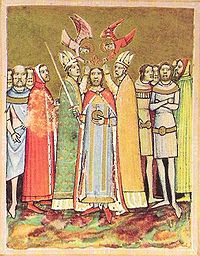 When Ladislaus was crowned, the counties of Moson and Pozsony, were still under the rule of King Salamon, who could count on the assistance of his brother-in-law, King Henry IV of Germany
. Therefore, Ladislaus sought the alliance of the German king's rivals, and in 1078, he married Adelaide, the daughter of Duke Rudolf I of Swabia, who had been proclaimed King of Germany by the emperor's opponents.
In 1079, Ladislaus took the fortress of Moson from King Salamon, but he was not able to occupy Pozsony. Afterwards, he began negotiations with his rival, who finally abdicated in his favour in 1081 in exchange for extensive landholdings. Although, the deposed king tried to plot against his cousin, Ladislaus overcome the conspiracy and had Salamon imprisoned.
Upon Ladislaus' initiative, Pope Gregory VII
ordered the canonization of the first king of Hungary, Stephen I and his son, Emeric
(Imre). On the occasion of the celebrations, on the feast of the Assumption, August 15, 1083, Ladislaus allowed Salamon to go free. Salamon subsequently fled to the Pechenegs. In 1085, the Pechenegs invaded the eastern territory of the kingdom, but Ladislaus defeated them. Following upon his victory, no one disputed Ladislaus' right to rule.
The terms Nobilissimus (most noble) and nobilissima familia (most noble family)
have been used since the 11th century for the King of Hungary and his family, but it were then only a few, among them also Ladislaus I, which were mentioned in official documents as such.
King Ladislaus took an active part in the reorganization of the Roman Catholic Church
in Hungary. The archbishopric of Bacs
was founded by separating it from Kalocsa
, and the See
of Bihar
was transferred to Nagyvárad
, which was not entirely in line with the normative practice of the Church. Similarly, the synod
of Hungarian prelates at Szabolcs
in the year 1092 recognized the legitimacy of the first marriage of the members of the clergy, which was contrary to canon law
.
 The collapse of the German emperor in his struggle with the pope left Ladislaus free to extend his dominions towards the south and east toward the eastern Carpathians. In 1087, he sent his envoys to the court of Herman of Salm, who had been proclaimed King of Germany by the opponents of Henry IV, Holy Roman Emperor
following the death of Ladislaus' father-in-law, but after he received information on Salamon's death, he did not intervene in the internal struggles in Germany.
In 1092, Ladislaus led his armies against Prince Vasilko of Terebovlia, who had allied himself with the Cumans, and won a victory over him. In 1093, Ladislaus supported Duke Zbigniew
's revolt against his father, Duke Władysław I Herman of Poland.
, the new King of Croatia, who had grown old and had never married, Stephen II
, was taken out of his monastery and crowned. With his death in 1091 the Croatian ruling dynasty ended and Ladislaus proclaimed his claim to kingdom as closest living relative of Croatian ruling dynasty. Ladislaus' alternative, but much weaker claim, had been based in Byzantine legal traditions in which it is the right of an emperor's widow to choose his successor and Ilona had declared her support for him. In 1091, Hungarian troops entered Croatia.
However, this action provoked a counter move by the Byzantine Emperor Alexios I
. He enlisted the aid of the Cumans
and persuaded them to invade the eastern parts of Hungary. Upon hearing of the Cuman invasion, Ladislaus withdrew from Croatia and lead his armies against them. In the meantime, he founded a new bishopric in Zagreb
during 1094. He eventually won a decisive victory over them near the river Temes
. Ladislaus followed up his victory by his occupation of Szerém
and Beograd, areas under Byzantine
control. Emperor Alexios I, however, sent fresh nomad troops against Hungary which forced Ladislaus to leave Byzantine territory. It was probably King Ladislaus I who planted in Transylvania the Székely
in order to defend the eastern parts of the Kingdom of Hungary against foreign invasions.
In the autumn of 1091, Pope Urban II
sent a legate to Ladislaus' court and demanded that Ladislaus accept his supremacy over Croatia. Ladislaus refused this claim and he probably accepted the legitimacy of Antipope Clement III
, who had been elected by the followers of the Holy Roman Emperor.
The country was completely subjugated by 1096, and it was incorporated into Hungary.
. As Ladislaus did not have any sons, his two nephews, the sons of King Géza I, could expect to inherit the throne. Ladislaus preferred the younger nephew, Álmos, whom he had named king of Croatia after conquering the country. Coloman did not give up his claims to the throne, and in 1095, he left for Poland.
Ladislaus was preparing a campaign against Duke Břetislav II of Bohemia
in order to help his sister's sons, Dukes Svatopluk
and Otto II of Moravia, when he was informed that Coloman had come back to Hungary in the company of Polish troops. The elderly king, upon hearing the news, died suddenly.
He was buried in the Abbey of Somogyvár which he had founded in 1091.
, daughter of Duke Rudolf I of Swabia and his second wife, Adelaida of Savoy
A number of miracles are attributed to him. On the occasion of some pestilence in the country, he is said to have prayed for the cure before shooting an arrow into the air at random; the arrow then hit the herb which would cure the illness. At another time, he was pursuing a Pecheneg force raiding the realm. According to the story, the king was catching up to the raiders, who decided to scatter the money they had looted before the pursuing Hungarians. The ruse worked as the soldiers stopped to gather the money. The king is then reputed to have turned all the gold to stone through a prayer, allowing him to put his army on the march again, defeat the raiders and free their captives.
C.A. Macartney, in his Hungary: A Short History, eulogizes Ladislaus thus: "Ladislas I, who, like Stephen and his son, Imre, was canonised after his death, was the outstanding personality among them: a true paladin and gentle knight, a protector of his faith and his people, and of the poor and defenceless."
Saint Ladislaus is also the patron saint
of an architecturally significant church in Chicago
's Portage Park
area, St. Ladislaus
.
King of Hungary
The King of Hungary was the head of state of the Kingdom of Hungary from 1000 to 1918.The style of title "Apostolic King" was confirmed by Pope Clement XIII in 1758 and used afterwards by all the Kings of Hungary, so after this date the kings are referred to as "Apostolic King of...
from 1077 until his death, "who greatly expanded the boundaries of the kingdom and consolidated it internally; no other Hungarian king was so generally beloved by the people". Before his accession to the throne, he was the main advisor of his brother, Géza I of Hungary
Géza I of Hungary
Géza I was King of Hungary from 1074 until his death. During King Solomon's rule he governed, as Duke, one third of the Kingdom of Hungary. Afterwards, Géza rebelled against his cousin's reign and his followers proclaimed him king...
, who was fighting against their cousin, King Solomon of Hungary
Solomon of Hungary
Solomon , King of Hungary . He was crowned as a child during his father's lifetime in order to ensure his succession, but his uncle Béla managed to dethrone his father and ascend to the throne...
. When his brother died, his followers proclaimed Ladislaus king according to the Hungarian tradition that gave precedence to the eldest member of the deceased king's sons. Following a long period of civil wars, he strengthened the royal power in his kingdom by introducing severe legislation. He would also extend his rule over Croatia. After his canonisation, Ladislaus became the model of the chivalrous king in Hungary.
Early years
Ladislaus was the second son of the future King Béla I of Hungary and his wife princess RichezaAdelaide/Rixa of Poland
Adelaide/Richeza of Poland, was Queen Consort of Hungary.She was a daughter of King Mieszko II Lambert of Poland, and his wife, Richeza of Lotharingia. She is traditionally called Richeza, but contemporary sources do not confirm this name...
. He was born in Poland
Poland
Poland , officially the Republic of Poland , is a country in Central Europe bordered by Germany to the west; the Czech Republic and Slovakia to the south; Ukraine, Belarus and Lithuania to the east; and the Baltic Sea and Kaliningrad Oblast, a Russian exclave, to the north...
, where his father had sought refuge after his father (Ladislaus' grandfather) made an unsuccessful attempt against his cousin, Saint Stephen I, the first king of Hungary. He was named according to the Slavic traditions of his mother's kin and thus he brought the name László
László
László is a Hungarian male given name and surname after Ladislaus I of Hungary. Other versions are Laszlo, Lazlo or Laszly and it is frequently translated as Leslie.The original Slavic Vladislav name meaning is 'power and glory'....
to yet increasing Hungarian use.
In 1048, the family moved to Hungary, where his father received as appanage one third of Hungary ("Tercia pars Regni") from his brother, King Andrew I of Hungary who had acquired the throne from King Peter after a pagan revolt. Following his accession, King Andrew I had to face the attacks of Henry III, Holy Roman Emperor
Henry III, Holy Roman Emperor
Henry III , called the Black or the Pious, was a member of the Salian Dynasty of Holy Roman Emperors...
whose supremacy had been acknowledged by King Peter. King Andrew I and Duke Béla cooperated closely against the German attacks and they would preserve Hungary's independence. However, their cooperation began to loosen from 1053 when the king fathered a son, Salamon
Solomon of Hungary
Solomon , King of Hungary . He was crowned as a child during his father's lifetime in order to ensure his succession, but his uncle Béla managed to dethrone his father and ascend to the throne...
, because from that time King Andrew wanted to ensure his son's inheritance against his brother, who pursuant to the old Hungarian custom, as the oldest member of the royal family, could lay claim to the throne in case of the king's death.
In 1057, King Andrew I had Salamon crowned to ensure his accession, and Ladislaus had to participate in the coronation together with his father and his brothers, Géza
Géza I of Hungary
Géza I was King of Hungary from 1074 until his death. During King Solomon's rule he governed, as Duke, one third of the Kingdom of Hungary. Afterwards, Géza rebelled against his cousin's reign and his followers proclaimed him king...
and Lampert
Lampert of Hungary
Lampert was a member of the Árpád dynasty; Duke of one-third of the Kingdom of Hungary .Lampert was the third son of the future King Béla I of Hungary and his Polish wife...
. However, Duke Béla and his sons left the country in 1059 and they returned with Polish troops in the next year. King Andrew I lost two battles against his brother and died. After his death Ladislaus' father was crowned on December 6, 1060. After his father's death on September 11, 1063, Ladislaus and his brothers agreed to accept the rule of their cousin who had come back followed by German troops, if they received their father's former duchy. However, King Salamon refused the offer and the superiority of his troops obliged the three brothers to leave Hungary. They went to Poland, and after the withdrawal of the German army, they came back to Hungary followed by troops King Bolesław II
Bolesław II the Generous
Bolesław II the Generous, also known as the Bold and the Cruel , was Duke of Poland and third King of Poland .He was the eldest son of Casimir I the Restorer and Maria Dobroniega, daughter of Grand Duke Vladimir I of Kiev....
, their maternal cousin, provided them.
The parties, however, wanted to avoid civil war; therefore they accepted the mediation services of the bishops. They made an agreement on January 20, 1064, in Győr
Gyor
-Climate:-Main sights:The ancient core of the city is Káptalan Hill at the confluence of three rivers: the Danube, Rába and Rábca. Püspökvár, the residence of Győr’s bishops can be easily recognised by its incomplete tower. Győr’s oldest buildings are the 13th-century dwelling tower and the...
, under which Ladislaus and his brothers accepted Salamon's rule, and they received their father's former duchy, i.e., the one third of Hungary.
Duke of Tercia pars Regni
In the following years, Ladislaus and his brothers collaborated successfully with King Salamon. In 1068, when the Pechenegs (besenyők) had overrun the territories of TransylvaniaTransylvania
Transylvania is a historical region in the central part of Romania. Bounded on the east and south by the Carpathian mountain range, historical Transylvania extended in the west to the Apuseni Mountains; however, the term sometimes encompasses not only Transylvania proper, but also the historical...
, Ladislaus, his brothers and the king went together against them and won a victory at Kerlés. A popular legend of Ladislaus connected to this battle tells of Ladislaus pursuing and overcoming a Pecheneg warrior, who had tried to abduct a Hungarian girl, thus freeing the girl was.
At that time, Ladislaus married his first wife who was probably a daughter of a German count.
Starting in 1071, when Ladislaus' elder brother, Duke Géza, refused to hand over the king's share of the treasure from the Byzantine Empire
Byzantine Empire
The Byzantine Empire was the Eastern Roman Empire during the periods of Late Antiquity and the Middle Ages, centred on the capital of Constantinople. Known simply as the Roman Empire or Romania to its inhabitants and neighbours, the Empire was the direct continuation of the Ancient Roman State...
acquired after the occupation of Belgrade
Belgrade
Belgrade is the capital and largest city of Serbia. It is located at the confluence of the Sava and Danube rivers, where the Pannonian Plain meets the Balkans. According to official results of Census 2011, the city has a population of 1,639,121. It is one of the 15 largest cities in Europe...
, the relationship between King Salamon and the three brothers deteriorated. Thus, in the next year, when the king lead a new campaign against Belgrade
Belgrade
Belgrade is the capital and largest city of Serbia. It is located at the confluence of the Sava and Danube rivers, where the Pannonian Plain meets the Balkans. According to official results of Census 2011, the city has a population of 1,639,121. It is one of the 15 largest cities in Europe...
, only Duke Géza followed him. Ladislaus and Lampert were left behind because the dukes worried that the king's partisans would try to conquer their duchy during their absence.
During 1073, both King Salamon and his cousins prepared for the coming struggle. The king sent his envoys to his brother-in-law, King Henry IV of Germany
Henry IV, Holy Roman Emperor
Henry IV was King of the Romans from 1056 and Holy Roman Emperor from 1084 until his forced abdication in 1105. He was the third emperor of the Salian dynasty and one of the most powerful and important figures of the 11th century...
, while Ladislaus and his brothers sought the help of their Polish and Czech relatives. Ladislaus went to Moravia and came back with the troops Duke Otto of Moravia, his brother-in-law, had provided him. He came just in time, because before his arrival his brother, Duke Géza had been defeated by King Salamon in the battle at Kemej on February 26, 1074. On March 14, at the Battle of Mogyoród
Battle of Mogyoród
The Battle of Mogyoród took place on 14 March 1074. It was an internal conflict between the king of Hungary, Solomon and his cousins duke Géza and Ladislaus, who were claiming rights to the throne....
, the three brothers won a decisive victory over King Salamon's troops, who fled to the western parts of Hungary. Géza was proclaimed king by the dukes' followers. The new king confirmed his brothers, Ladislaus and Lampert, in the possession of their duchy.
During his brother's reign, Ladislaus was his military commander, and in the autumn of 1074, he forced back King Salamon's attack against Nyitra
Nitra
Nitra is a city in western Slovakia, situated at the foot of Zobor Mountain in the valley of the river Nitra. With a population of about 83,572, it is the fifth largest city in Slovakia. Nitra is also one of the oldest cities in Slovakia and the country's earliest political and cultural center...
. However, in 1076, he could not take Pozsony
Bratislava
Bratislava is the capital of Slovakia and, with a population of about 431,000, also the country's largest city. Bratislava is in southwestern Slovakia on both banks of the Danube River. Bordering Austria and Hungary, it is the only national capital that borders two independent countries.Bratislava...
from King Salamon (although, according to his legends, he would overcome his cousin in single combat).
After the death of his brother on April 25, 1077, Ladislaus was proclaimed king by their partisans. He was probably crowned with the crown sent by the Emperor Michael VII
Michael VII
Michael VII Doukas or Ducas , nicknamed Parapinakēs , was Byzantine emperor from 1071 to 1078.- Life :...
to his brother, because the ancient crown was still in the possession of King Salamon.
Struggle for the throne
Henry IV, Holy Roman Emperor
Henry IV was King of the Romans from 1056 and Holy Roman Emperor from 1084 until his forced abdication in 1105. He was the third emperor of the Salian dynasty and one of the most powerful and important figures of the 11th century...
. Therefore, Ladislaus sought the alliance of the German king's rivals, and in 1078, he married Adelaide, the daughter of Duke Rudolf I of Swabia, who had been proclaimed King of Germany by the emperor's opponents.
In 1079, Ladislaus took the fortress of Moson from King Salamon, but he was not able to occupy Pozsony. Afterwards, he began negotiations with his rival, who finally abdicated in his favour in 1081 in exchange for extensive landholdings. Although, the deposed king tried to plot against his cousin, Ladislaus overcome the conspiracy and had Salamon imprisoned.
Upon Ladislaus' initiative, Pope Gregory VII
Pope Gregory VII
Pope St. Gregory VII , born Hildebrand of Sovana , was Pope from April 22, 1073, until his death. One of the great reforming popes, he is perhaps best known for the part he played in the Investiture Controversy, his dispute with Henry IV, Holy Roman Emperor affirming the primacy of the papal...
ordered the canonization of the first king of Hungary, Stephen I and his son, Emeric
Saint Emeric of Hungary
Prince St. Imre, also Henricus, Emeric, Emerick, Emmerich, Emericus or Americus was the son of King St. Stephen I of Hungary and Giselle of Bavaria. He is assumed to be the second son of Stephen, he was named after his uncle, St...
(Imre). On the occasion of the celebrations, on the feast of the Assumption, August 15, 1083, Ladislaus allowed Salamon to go free. Salamon subsequently fled to the Pechenegs. In 1085, the Pechenegs invaded the eastern territory of the kingdom, but Ladislaus defeated them. Following upon his victory, no one disputed Ladislaus' right to rule.
The terms Nobilissimus (most noble) and nobilissima familia (most noble family)
Nobilissima familia (Hungary)
The terms Nobilissimus and nobilissima familia have been used since the 11th century for the King of Hungary and his family...
have been used since the 11th century for the King of Hungary and his family, but it were then only a few, among them also Ladislaus I, which were mentioned in official documents as such.
Internal politics
The continuous struggles for the throne following the death of Saint Stephen I in 1038, had resulted in a confused internal situation by the time Ladislaus ascended the throne. Therefore, Ladislaus issued extremely severe decrees against criminal offenders that made provision for penalties such as mutilation, enslavement or execution for minor crimes against property or the Christian faith.King Ladislaus took an active part in the reorganization of the Roman Catholic Church
Roman Catholic Church
The Catholic Church, also known as the Roman Catholic Church, is the world's largest Christian church, with over a billion members. Led by the Pope, it defines its mission as spreading the gospel of Jesus Christ, administering the sacraments and exercising charity...
in Hungary. The archbishopric of Bacs
BACS
Bacs Payment Schemes Limited is a United Kingdom scheme for the electronic processing of financial transactions. BACS direct debits and BACS direct credits are made using the BACS system...
was founded by separating it from Kalocsa
Kalocsa
Kalocsa is a town in Bács-Kiskun county, Hungary. It lies 88 miles south of Budapest. It is situated in a marshy but highly productive district, near the left bank of the Danube River. Historically it had greater political and economic importance than at present.Kalocsa is the Episcopal see...
, and the See
Episcopal See
An episcopal see is, in the original sense, the official seat of a bishop. This seat, which is also referred to as the bishop's cathedra, is placed in the bishop's principal church, which is therefore called the bishop's cathedral...
of Bihar
Bihor County
Bihor is a county of Romania, in Crişana, with capital city at Oradea. Together with Hajdú-Bihar County in Hungary it constitutes the Biharia Euroregion.-Demographics:...
was transferred to Nagyvárad
Oradea
Oradea is the capital city of Bihor County, in the Crișana region of north-western Romania. The city has a population of 204,477, according to the 2009 estimates. The wider Oradea metropolitan area has a total population of 245,832.-Geography:...
, which was not entirely in line with the normative practice of the Church. Similarly, the synod
Synod
A synod historically is a council of a church, usually convened to decide an issue of doctrine, administration or application. In modern usage, the word often refers to the governing body of a particular church, whether its members are meeting or not...
of Hungarian prelates at Szabolcs
Szabolcs
Szabolcs may refer to:*Szabolcs-Szatmár-Bereg, current administrative unit of Hungary*Szabolcs in Hungary's Szabolcs-Szatmár-Bereg county*Szabolcs , the historical administrative unit of the Kingdom of Hungary...
in the year 1092 recognized the legitimacy of the first marriage of the members of the clergy, which was contrary to canon law
Canon law
Canon law is the body of laws & regulations made or adopted by ecclesiastical authority, for the government of the Christian organization and its members. It is the internal ecclesiastical law governing the Catholic Church , the Eastern and Oriental Orthodox churches, and the Anglican Communion of...
.
Expansion of his rule
Henry IV, Holy Roman Emperor
Henry IV was King of the Romans from 1056 and Holy Roman Emperor from 1084 until his forced abdication in 1105. He was the third emperor of the Salian dynasty and one of the most powerful and important figures of the 11th century...
following the death of Ladislaus' father-in-law, but after he received information on Salamon's death, he did not intervene in the internal struggles in Germany.
In 1092, Ladislaus led his armies against Prince Vasilko of Terebovlia, who had allied himself with the Cumans, and won a victory over him. In 1093, Ladislaus supported Duke Zbigniew
Zbigniew of Poland
Zbigniew , Duke of Poland from 1102 until 1107.-Early years:Zbigniew was the first-born son of Prince Władysław I Herman and Przecława, who apparently belonged to the Prawdzic clan...
's revolt against his father, Duke Władysław I Herman of Poland.
Croatia
Following the death of King Dmitar Zvonimir on April 20, 1089, who had been married to Ladislaus' sister IlonaJelena Lijepa
-Biography:Helen was born a Hungarian princess and was the daughter of Árpád dynasty's King Bela I, sister to King Ladislaus I of Hungary, granddaughter of Polish King Mieszko II Lambert, and a great-granddaughter of Tsar Samuil of Bulgaria....
, the new King of Croatia, who had grown old and had never married, Stephen II
Stjepan II of Croatia
Stephen II was the last member of the Trpimirović dynasty and last native Croatian king to rule the entire medieval Croatian Kingdom...
, was taken out of his monastery and crowned. With his death in 1091 the Croatian ruling dynasty ended and Ladislaus proclaimed his claim to kingdom as closest living relative of Croatian ruling dynasty. Ladislaus' alternative, but much weaker claim, had been based in Byzantine legal traditions in which it is the right of an emperor's widow to choose his successor and Ilona had declared her support for him. In 1091, Hungarian troops entered Croatia.
However, this action provoked a counter move by the Byzantine Emperor Alexios I
Alexios I Komnenos
Alexios I Komnenos, Latinized as Alexius I Comnenus , was Byzantine emperor from 1081 to 1118, and although he was not the founder of the Komnenian dynasty, it was during his reign that the Komnenos family came to full power. The title 'Nobilissimus' was given to senior army commanders,...
. He enlisted the aid of the Cumans
Cumans
The Cumans were Turkic nomadic people comprising the western branch of the Cuman-Kipchak confederation. After Mongol invasion , they decided to seek asylum in Hungary, and subsequently to Bulgaria...
and persuaded them to invade the eastern parts of Hungary. Upon hearing of the Cuman invasion, Ladislaus withdrew from Croatia and lead his armies against them. In the meantime, he founded a new bishopric in Zagreb
Zagreb
Zagreb is the capital and the largest city of the Republic of Croatia. It is in the northwest of the country, along the Sava river, at the southern slopes of the Medvednica mountain. Zagreb lies at an elevation of approximately above sea level. According to the last official census, Zagreb's city...
during 1094. He eventually won a decisive victory over them near the river Temes
Timis River
The Timiş or Tamiš is a 359 km long river originating from Țarcu Mountains , southern Carpathian Mountains, Caraş-Severin County, Romania. It flows through the Banat region and flows into the Danube near Pančevo, in northern Serbia....
. Ladislaus followed up his victory by his occupation of Szerém
Sremska Mitrovica
Sremska Mitrovica is a city and municipality located in the Vojvodina province of Serbia, on the left bank of the Sava river. As of 2002 the town had a total population of 39,041, while Sremska Mitrovica municipality had a population of 85,605...
and Beograd, areas under Byzantine
Byzantine
Byzantine usually refers to the Roman Empire during the Middle Ages.Byzantine may also refer to:* A citizen of the Byzantine Empire, or native Greek during the Middle Ages...
control. Emperor Alexios I, however, sent fresh nomad troops against Hungary which forced Ladislaus to leave Byzantine territory. It was probably King Ladislaus I who planted in Transylvania the Székely
Székely
The Székelys or Székely , sometimes also referred to as Szeklers , are a subgroup of the Hungarian people living mostly in the Székely Land, an ethno-cultural region in eastern Transylvania, Romania...
in order to defend the eastern parts of the Kingdom of Hungary against foreign invasions.
In the autumn of 1091, Pope Urban II
Pope Urban II
Pope Urban II , born Otho de Lagery , was Pope from 12 March 1088 until his death on July 29 1099...
sent a legate to Ladislaus' court and demanded that Ladislaus accept his supremacy over Croatia. Ladislaus refused this claim and he probably accepted the legitimacy of Antipope Clement III
Antipope Clement III
Guibert or Wibert of Ravenna was a cleric made antipope in 1080 due to perceived abuses of Pope Gregory VII during the Investiture Controversy, a title that lasted to his death....
, who had been elected by the followers of the Holy Roman Emperor.
The country was completely subjugated by 1096, and it was incorporated into Hungary.
Last years
The last years of Ladislaus' reign were characterized by the strained relations with his two nephews, Coloman and ÁlmosPrince Álmos
Álmos was a Hungarian prince, the son of King Géza I of Hungary, brother of King Kálmán. He held several governmental posts in the Kingdom of Hungary....
. As Ladislaus did not have any sons, his two nephews, the sons of King Géza I, could expect to inherit the throne. Ladislaus preferred the younger nephew, Álmos, whom he had named king of Croatia after conquering the country. Coloman did not give up his claims to the throne, and in 1095, he left for Poland.
Ladislaus was preparing a campaign against Duke Břetislav II of Bohemia
Bretislaus II of Bohemia
Bretislaus II was the duke of Bohemia from 14 September 1092 until his death. He was the eldest son of King Vratislaus II and Adelaide, daughter of Andrew I of Hungary. He was a major enemy of paganism....
in order to help his sister's sons, Dukes Svatopluk
Svatopluk of Bohemia
Svatopluk the Lion was the duke of Bohemia from 1107 to his assassination. He was a son of Otto I of Olomouc and Euphemia of Hungary and grandson of Bretislaus I of Bohemia....
and Otto II of Moravia, when he was informed that Coloman had come back to Hungary in the company of Polish troops. The elderly king, upon hearing the news, died suddenly.
He was buried in the Abbey of Somogyvár which he had founded in 1091.
Marriages and children
1077: Adelaide of RheinfeldenAdelaide of Rheinfelden
Adelaide of Rheinfelden , was a Queen Consort of Hungary; she was the daughter of Rudolf of Rheinfelden and Adelheid of Savoy; wife of King Ladislaus I of Hungary.-Life:Adelaide was born in the 1060s...
, daughter of Duke Rudolf I of Swabia and his second wife, Adelaida of Savoy
- PriscaPiroska of HungarySaint Irene of Hungary, born Piroska, was a daughter of Ladislaus I of Hungary and Adelaide of Swabia. Her maternal grandparents were Rudolf of Rheinfeld and his second wife Adelheid of Savoy. Adelheid was a daughter of Otto of Savoy and Adelaide of Turin. She was the mother of the future emperor...
(c. 1080 – August 13, 1134), wife of John IIJohn II KomnenosJohn II Komnenos was Byzantine Emperor from 1118 to 1143. Also known as Kaloïōannēs , he was the eldest son of Emperor Alexios I Komnenos and Irene Doukaina...
, emperor of the Byzantine Empire - Unknown daughter (? – ?), wife of Prince Yaroslav of Volhynia.
Ancestors
Legacy
No other Hungarian king was held in such high esteem. The whole nation mourned for him for three years, and regarded him as a saint long before his canonization. A whole cycle of legends is associated with his name. He was canonized on June 27, 1192.A number of miracles are attributed to him. On the occasion of some pestilence in the country, he is said to have prayed for the cure before shooting an arrow into the air at random; the arrow then hit the herb which would cure the illness. At another time, he was pursuing a Pecheneg force raiding the realm. According to the story, the king was catching up to the raiders, who decided to scatter the money they had looted before the pursuing Hungarians. The ruse worked as the soldiers stopped to gather the money. The king is then reputed to have turned all the gold to stone through a prayer, allowing him to put his army on the march again, defeat the raiders and free their captives.
C.A. Macartney, in his Hungary: A Short History, eulogizes Ladislaus thus: "Ladislas I, who, like Stephen and his son, Imre, was canonised after his death, was the outstanding personality among them: a true paladin and gentle knight, a protector of his faith and his people, and of the poor and defenceless."
Saint Ladislaus is also the patron saint
Patron saint
A patron saint is a saint who is regarded as the intercessor and advocate in heaven of a nation, place, craft, activity, class, clan, family, or person...
of an architecturally significant church in Chicago
Chicago
Chicago is the largest city in the US state of Illinois. With nearly 2.7 million residents, it is the most populous city in the Midwestern United States and the third most populous in the US, after New York City and Los Angeles...
's Portage Park
Portage Park, Chicago
Portage Park is located on the northwest side of the City of Chicago, Illinois and is one of 77 officially designated Chicago community areas. Portage Park is bordered by the community areas of Jefferson Park and Forest Glen to the north, Dunning and the suburb of Harwood Heights to the west,...
area, St. Ladislaus
St. Ladislaus in Chicago
St. Ladislaus - historic church of the Roman Catholic Archdiocese of Chicago located in Chicago, Illinois.One of the many Polish churches on Chicago's Northwest Side, it is considered to be one of the more architecturally significant religious edifices in the Portage Park area, as well as one of...
.
See also
- Szent László Infantry DivisionSzent László Infantry DivisionThe Szent László Infantry Division was an elite Hungarian infantry unit formed in the final year of World War II. It was made up of a mix of army and air force personnel. The division saw action at Budapest, in western Hungary, and in southeastern Austria....
- Saint Ladislaus legendSaint Ladislaus legendAn episode from the Legend of Saint Ladislaus provided the subjects for numerous murals painted in medieval churches in Hungary during the 14th to 16th century.-Historical background:Ladislaus I of Hungary was a chivalrous king in Hungary in the 11th century...
- Tercia pars regniTercia pars regniThe Tercia pars regni or Ducatus is the denomination for territories occasionally governed separately by members of the Árpád dynasty within the Kingdom of Hungary in the 11th-12th centuries...
Sources
- Kristó Gyula - Makk Ferenc: Az Árpád-ház uralkodói (IPC Könyvek, 1996)
- Korai Magyar Történeti Lexikon (9-14. század), főszerkesztő: Kristó Gyula, szerkesztők: Engel Pál és Makk Ferenc (Akadémiai Kiadó, Budapest, 1994)
- Magyarország Történeti Kronológiája I. – A kezdetektől 1526-ig, főszerkesztő: Benda Kálmán (Akadémiai Kiadó, Budapest, 1981)
- Kosztolnyik, Z.J. Five Eleventh Century Hungarian Kings, 1981.