

Hohenstaufen

Encyclopedia
The House of Hohenstaufen (or the Staufer) was a dynasty of German kings in the High Middle Ages
, lasting from 1138 to 1254. Three of these kings were also crowned Holy Roman Emperor
. In 1194 the Hohenstaufens also became Kings of Sicily
. Hohenstaufen
or Staufen, the adjective and plural of Staufer, is also the name of their castle in Swabia
, located on an eponymous mountain near Göppingen
, built by the first known member of the dynasty, Duke Frederick I
. The dynasty is sometimes called Swabian dynasty after the family's ducal origin.
king Henry IV of Germany
appointed Count Frederick at Hohenstaufen Castle as Duke of Swabia
. At the same time, Frederick was engaged to the king's approximately seven-year old daughter, Agnes
. Nothing is known about Frederick's life before this event. He proved to be a close ally of Henry IV in his struggle against other Swabian lords, namely Rudolf of Rheinfelden (the previous duke), and the Zähringen
and Welf lords. Frederick's brother Otto became bishop of Strasbourg in 1082.
Frederick I was succeeded by his son Duke Frederick II
in 1105. Frederick II remained a close ally of the Salians, he and his younger brother Conrad
were named the king's representatives in Germany when the king was in Italy. Around 1120, Frederick II married Judith of Bavaria from the rival House of Welf.
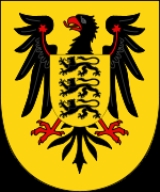
, elected German king in 1198, changed the coat of arms – the lion was replaced by three leopards, probably derived form the arms of his Welf rival Otto IV
.
, had died without heirs in 1125, a controversy arose about the succession. Duke Frederick II and Conrad, the two current male Staufer, by their mother Agnes were grandsons of late Emperor Henry IV and nephews of Henry V. Frederick ran for King of the Romans
, but lost the election
against the Saxon
duke Lothair of Supplinburg
. A civil war between the Staufer and King Lothair ended with Frederick's submission in 1134. After the Lothair's death in 1137, Conrad was elected King of the Romans. Frederick II died in 1147 and was succeeded as Swabian duke by his son Frederick III
. When Conrad died without adult heir in 1152, Frederick III also succeeded him as King Frederick I of Germany.
under his Salian prdecessors. As royal access to the resources of the church in Germany was much reduced, Frederick was forced to go to Italy
to find the finances needed to restore the king's power in Germany. He was soon crowned emperor in Italy, but decades of warfare on the peninsula yielded scant results. The Papacy
and the prosperous city-states of the Lombard League
in northern Italy were traditional enemies, but the fear of Imperial domination caused them to join ranks to fight Frederick. Under the skilled leadership of Pope Alexander III
, the alliance suffered many defeats but ultimately was able to deny the emperor a complete victory in Italy. Frederick returned to Germany. He had vanquished one notable opponent, his Welf cousin, Duke Henry the Lion
of Saxony and Bavaria
in 1180, but his hopes of restoring the power and prestige of the monarchy seemed unlikely to be met by the end of his life.
During Frederick's long stays in Italy, the German princes became stronger and began a successful colonization of Slavic lands. Offers of reduced taxes and manorial duties enticed many Germans to settle in the east in the course of the Ostsiedlung
. In 1163 Frederick waged a successful campaign against the Kingdom of Poland in order to re-install the Silesian
dukes of the Piast
dynasty. With the German colonization, the Empire increased in size and came to include the Duchy of Pomerania
as well as Bohemia
and the March of Moravia
. A quickening economic life in Germany increased the number of towns and Imperial cities
, and gave them greater importance. It was also during this period that castles and courts replaced monasteries as centers of culture. Growing out of this courtly culture, Middle High German
literature reached its peak in lyrical love poetry, the Minnesang
, and in narrative epic poems such as Tristan
, Parzival
, and the Nibelungenlied
.
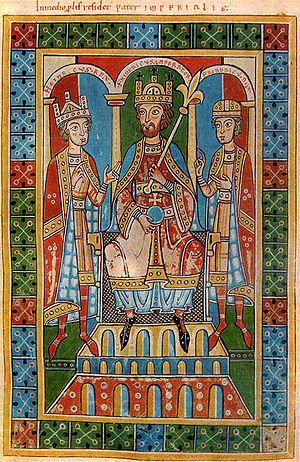
and was succeeded by his son, Henry VI
. Elected king even before his father's death, Henry went to Rome
to be crowned emperor. He married Queen Constance of Sicily, and a death in his wife's family in 1194 gave him possession of the Kingdom of Sicily
, a source of vast wealth. Henry failed to make royal and Imperial succession hereditary, but in 1196 he succeeded in gaining a pledge that his infant son Frederick
would receive the German crown. Faced with difficulties in Italy and confident that he would realize his wishes in Germany at a later date, Henry returned to the south, where it appeared he might unify the peninsula under the Hohenstaufen name. After a series of military victories, however, he fell ill and died of natural causes in Sicily in 1197. His underage son Frederick could only succeed him in Sicily, while in the Empire the struggle between the Hohenstaufen and the House of Welf erupted once again.
Because the election of a three-year-old boy to be German king appeared likely to make orderly rule difficult, the boy's uncle, Duke Philip of Swabia
, brother of late Henry VI, was designated to serve in his place. Other factions however favoured a Welf candidate. In 1198, two rival kings were chosen: the Hohenstaufen Philip of Swabia and the son of the deprived Duke Henry the Lion
, the Welf Otto IV
. A long civil war began; Philip was about to win when he was murdered by the Bavarian count palatine
Otto of Wittelsbach in 1208. Pope Innocent III
initially had supported the Welfs, but when Otto, now sole elected monarch, moved to appropriate Sicily, Innocent changed sides and accepted young Frederick II and his ally, King Philip II of France
, who defeated Otto at the 1214 Battle of Bouvines
. Frederick had returned to Germany in 1212 from Sicily, where he had grown up, and was elected king in 1215. When Otto died in 1218, Fredrick became the undisputed ruler, and in 1220 was crowned Holy Roman Emperor
.
By the 1226 Golden Bull of Rimini
, Frederick had assigned the military order of the Teutonic Knights
to complete the conquest and conversion of the Prussian
lands. A reconciliation with the Welfs took place in 1235, whereby Otto the Child
, grandson of the late Saxon duke Henry the Lion, was named Duke of Brunswick and Lüneburg. The power struggle with the popes continued and resulted in Fredrick's excommunication
in 1227. In 1239, Pope Gregory IX
excommunicated Fredrick again, and in 1245 he was condemned as a heretic by a church council. Although Frederick was one of the most energetic, imaginative, and capable rulers of the time, he was not concerned with drawing the disparate forces in Germany together. His legacy was thus that local rulers had more authority after his reign than before it. The clergy also had become more powerful.
 By the time of Frederick's death in 1250, little centralized power remained in Germany. The Great Interregnum
, a period in which there were several elected rival kings non of whom was able to achieve any position of authority, followed the death of Frederick's son King Conrad IV of Germany
in 1254. The German princes vied for individual advantage and managed to strip many powers away from the diminished monarchy. Rather than establish sovereign states however, many nobles tended to look after their families. Their many male heirs created more and smaller estates, and from a largely free class of officials previously formed, many of these assumed or acquired hereditary rights to administrative and legal offices. These trends compounded political fragmentation within Germany. The period was ended with the election of Rudolph of Habsburg
in 1273.
. By this time, the office of duke of Swabia had been fully subsumed into the office of the king, and without royal authority had become meaningless. In 1261, attempts to elect young Conradin king were unsuccessful. He also had to defend Sicily against an invasion by Charles of Anjou, a brother of the French
king. Conradin's campaign to retake control ended with his defeat in 1268 at the Battle of Tagliacozzo
after which he was handed over to Charles, who had him publicly executed at Naples
. With Conradin, the line of the Dukes of Swabia finally ceased to exist. Most of the later emperors were descended from the Hohenstaufen.
During the political decentralization of the late Hohenstaufen period, the population had grown from an estimated 8 million in 1200 to about 14 million in 1300, and the number of towns increased tenfold. The most heavily urbanized areas of Germany were located in the south and the west. Towns often developed a degree of independence, but many were subordinate to local rulers if not immediate to the emperor. Colonization of the east also continued in the thirteenth century, most notably through the efforts of the Teutonic Knights. German merchants also began trading extensively on the Baltic
.
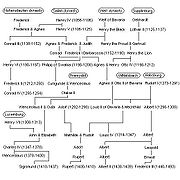
Like the first ruling Hohenstaufen, Conrad III, also the last one, Conrad IV, was never crowned emperor. After a 20 year period (Interregnum
1254-1273) the first Habsburg
was elected king.
High Middle Ages
The High Middle Ages was the period of European history around the 11th, 12th, and 13th centuries . The High Middle Ages were preceded by the Early Middle Ages and followed by the Late Middle Ages, which by convention end around 1500....
, lasting from 1138 to 1254. Three of these kings were also crowned Holy Roman Emperor
Holy Roman Emperor
The Holy Roman Emperor is a term used by historians to denote a medieval ruler who, as German King, had also received the title of "Emperor of the Romans" from the Pope...
. In 1194 the Hohenstaufens also became Kings of Sicily
Kingdom of Sicily
The Kingdom of Sicily was a state that existed in the south of Italy from its founding by Roger II in 1130 until 1816. It was a successor state of the County of Sicily, which had been founded in 1071 during the Norman conquest of southern Italy...
. Hohenstaufen
Hohenstaufen Castle
Hohenstaufen Castle is a ruin, lying above the town of Hohenstaufen, in the district of Göppingen in Baden-Württemberg, Germany. It was the seat of the now-defunct House of Hohenstaufen....
or Staufen, the adjective and plural of Staufer, is also the name of their castle in Swabia
Swabia
Swabia is a cultural, historic and linguistic region in southwestern Germany.-Geography:Like many cultural regions of Europe, Swabia's borders are not clearly defined...
, located on an eponymous mountain near Göppingen
Göppingen
Göppingen is a town in southern Germany, part of the Stuttgart Region of Baden-Württemberg. It is the capital of the district Göppingen. It is situated at the bottom of the Hohenstaufen mountain, in the valley of the river Fils....
, built by the first known member of the dynasty, Duke Frederick I
Frederick I, Duke of Swabia
Frederick I von Staufen was Duke of Swabia from 1079 to his death. He was the first ruler of Swabia from the House of Hohenstaufen, and was the builder of dynasty's ancestral Hohenstaufen Castle near Göppingen.-Parents:...
. The dynasty is sometimes called Swabian dynasty after the family's ducal origin.
Origins as dukes of Swabia
In 1079, the SalianSalian dynasty
The Salian dynasty was a dynasty in the High Middle Ages of four German Kings , also known as the Frankish dynasty after the family's origin and role as dukes of Franconia...
king Henry IV of Germany
Henry IV, Holy Roman Emperor
Henry IV was King of the Romans from 1056 and Holy Roman Emperor from 1084 until his forced abdication in 1105. He was the third emperor of the Salian dynasty and one of the most powerful and important figures of the 11th century...
appointed Count Frederick at Hohenstaufen Castle as Duke of Swabia
Duke of Swabia
The following is a list of Dukes of Swabia in southwest Germany.Swabia was one of the five stem duchies of the medieval German kingdom, and its dukes were thus among the most powerful magnates of Germany. The most notable family to hold Swabia were the Hohenstaufen, who held it, with a brief...
. At the same time, Frederick was engaged to the king's approximately seven-year old daughter, Agnes
Agnes of Germany
Agnes of Germany was the daughter of Henry IV, Holy Roman Emperor and Bertha of Savoy. Her maternal grandparents were Otto, Count of Savoy, Aosta and Moriana and Adelaide, Marchioness of Turin and Susa....
. Nothing is known about Frederick's life before this event. He proved to be a close ally of Henry IV in his struggle against other Swabian lords, namely Rudolf of Rheinfelden (the previous duke), and the Zähringen
Zähringen
Zähringen is the name of an old German family that founded a large number of cities in what are today Switzerland and Baden-Württemberg. While the junior line that first assumed the title Duke of Zähringen, a cadet branch of the House of Baden, became extinct in 1218, the senior line persists and...
and Welf lords. Frederick's brother Otto became bishop of Strasbourg in 1082.
Frederick I was succeeded by his son Duke Frederick II
Frederick II, Duke of Swabia
Frederick II , called the One-Eyed, was the second Hohenstaufen duke of Swabia from 1105. He was the eldest son of Frederick I and Agnes....
in 1105. Frederick II remained a close ally of the Salians, he and his younger brother Conrad
Conrad III of Germany
Conrad III was the first King of Germany of the Hohenstaufen dynasty. He was the son of Frederick I, Duke of Swabia, and Agnes, a daughter of the Salian Emperor Henry IV.-Life and reign:...
were named the king's representatives in Germany when the king was in Italy. Around 1120, Frederick II married Judith of Bavaria from the rival House of Welf.
Coat of arms
When Frederick I became Duke of Swabia in 1079, his coat of arms showed a black lion on a gold shield. Whilst members of the family reigned as German Kings and Emperors of the Holy Roman Empire, the Hohenstaufen coat of arms was used as a breast shield on the empire’s coat of arms. Philip of SwabiaPhilip of Swabia
Philip of Swabia was king of Germany and duke of Swabia, the rival of the emperor Otto IV.-Biography:Philip was the fifth and youngest son of Emperor Frederick I and Beatrice I, Countess of Burgundy, daughter of Renaud III, count of Burgundy, and brother of the emperor Henry VI...
, elected German king in 1198, changed the coat of arms – the lion was replaced by three leopards, probably derived form the arms of his Welf rival Otto IV
Otto IV, Holy Roman Emperor
Otto IV of Brunswick was one of two rival kings of the Holy Roman Empire from 1198 on, sole king from 1208 on, and emperor from 1209 on. The only king of the Welf dynasty, he incurred the wrath of Pope Innocent III and was excommunicated in 1215.-Early life:Otto was the third son of Henry the...
.
Ruling in Germany
When the last male member of the Salian dynasty, Emperor Henry VHenry V, Holy Roman Emperor
Henry V was King of Germany and Holy Roman Emperor , the fourth and last ruler of the Salian dynasty. Henry's reign coincided with the final phase of the great Investiture Controversy, which had pitted pope against emperor...
, had died without heirs in 1125, a controversy arose about the succession. Duke Frederick II and Conrad, the two current male Staufer, by their mother Agnes were grandsons of late Emperor Henry IV and nephews of Henry V. Frederick ran for King of the Romans
King of the Romans
King of the Romans was the title used by the ruler of the Holy Roman Empire following his election to the office by the princes of the Kingdom of Germany...
, but lost the election
Imperial election
The election of a Holy Roman Emperor or King of Germany was, from at least the 13th century, accomplished by a small body of the greatest princes of the Empire, the Prince-electors. Appointment as Emperor was normally for life...
against the Saxon
Duchy of Saxony
The medieval Duchy of Saxony was a late Early Middle Ages "Carolingian stem duchy" covering the greater part of Northern Germany. It covered the area of the modern German states of Bremen, Hamburg, Lower Saxony, North Rhine-Westphalia, and Saxony-Anhalt and most of Schleswig-Holstein...
duke Lothair of Supplinburg
Lothair III, Holy Roman Emperor
Lothair III of Supplinburg , was Duke of Saxony , King of Germany , and Holy Roman Emperor from 1133 to 1137. The son of Count Gebhard of Supplinburg, his reign was troubled by the constant intriguing of Frederick I, Duke of Swabia and Duke Conrad of Franconia...
. A civil war between the Staufer and King Lothair ended with Frederick's submission in 1134. After the Lothair's death in 1137, Conrad was elected King of the Romans. Frederick II died in 1147 and was succeeded as Swabian duke by his son Frederick III
Frederick I, Holy Roman Emperor
Frederick I Barbarossa was a German Holy Roman Emperor. He was elected King of Germany at Frankfurt on 4 March 1152 and crowned in Aachen on 9 March, crowned King of Italy in Pavia in 1155, and finally crowned Roman Emperor by Pope Adrian IV, on 18 June 1155, and two years later in 1157 the term...
. When Conrad died without adult heir in 1152, Frederick III also succeeded him as King Frederick I of Germany.
Frederick Barbarossa
King Frederick I, known as Frederick Barbarossa because of his red beard, struggled throughout his reign to restore the power and prestige of the German monarchy against the dukes, who had grown stronger both during and after the Investiture ControversyInvestiture Controversy
The Investiture Controversy or Investiture Contest was the most significant conflict between Church and state in medieval Europe. In the 11th and 12th centuries, a series of Popes challenged the authority of European monarchies over control of appointments, or investitures, of church officials such...
under his Salian prdecessors. As royal access to the resources of the church in Germany was much reduced, Frederick was forced to go to Italy
Kingdom of Italy (medieval)
The Kingdom of Italy was a political entity under control of Carolingian dynasty of Francia first, after the defeat of the Lombards in 774. It was finally incorporated as a part of the Holy Roman Empire in 962....
to find the finances needed to restore the king's power in Germany. He was soon crowned emperor in Italy, but decades of warfare on the peninsula yielded scant results. The Papacy
Papal States
The Papal State, State of the Church, or Pontifical States were among the major historical states of Italy from roughly the 6th century until the Italian peninsula was unified in 1861 by the Kingdom of Piedmont-Sardinia .The Papal States comprised territories under...
and the prosperous city-states of the Lombard League
Lombard League
The Lombard League was an alliance formed around 1167, which at its apex included most of the cities of northern Italy , including, among others, Crema, Cremona, Mantua, Piacenza, Bergamo, Brescia, Milan, Genoa, Bologna, Padua, Modena, Reggio Emilia, Treviso, Venice, Vercelli, Vicenza, Verona,...
in northern Italy were traditional enemies, but the fear of Imperial domination caused them to join ranks to fight Frederick. Under the skilled leadership of Pope Alexander III
Pope Alexander III
Pope Alexander III , born Rolando of Siena, was Pope from 1159 to 1181. He is noted in history for laying the foundation stone for the Notre Dame de Paris.-Church career:...
, the alliance suffered many defeats but ultimately was able to deny the emperor a complete victory in Italy. Frederick returned to Germany. He had vanquished one notable opponent, his Welf cousin, Duke Henry the Lion
Henry the Lion
Henry the Lion was a member of the Welf dynasty and Duke of Saxony, as Henry III, from 1142, and Duke of Bavaria, as Henry XII, from 1156, which duchies he held until 1180....
of Saxony and Bavaria
Duchy of Bavaria
The Duchy of Bavaria was the only one of the stem duchies from the earliest days of East Francia and the Kingdom of Germany to preserve both its name and most of its territorial extent....
in 1180, but his hopes of restoring the power and prestige of the monarchy seemed unlikely to be met by the end of his life.
During Frederick's long stays in Italy, the German princes became stronger and began a successful colonization of Slavic lands. Offers of reduced taxes and manorial duties enticed many Germans to settle in the east in the course of the Ostsiedlung
Ostsiedlung
Ostsiedlung , also called German eastward expansion, was the medieval eastward migration and settlement of Germans from modern day western and central Germany into less-populated regions and countries of eastern Central Europe and Eastern Europe. The affected area roughly stretched from Slovenia...
. In 1163 Frederick waged a successful campaign against the Kingdom of Poland in order to re-install the Silesian
Duchy of Silesia
The Duchy of Silesia with its capital at Wrocław was a medieval duchy located in the historic Silesian region of Poland. Soon after it was formed under the Piast dynasty in 1138, it fragmented into various Duchies of Silesia. In 1327 the remaining Duchy of Wrocław as well as most other duchies...
dukes of the Piast
Silesian Piasts
The Silesian Piasts were the oldest line of the Piast dynasty beginning with Władysław II the Exile, son of Bolesław III Wrymouth, Duke of Poland...
dynasty. With the German colonization, the Empire increased in size and came to include the Duchy of Pomerania
Duchy of Pomerania
The Duchy of Pomerania was a duchy in Pomerania on the southern coast of the Baltic Sea, ruled by dukes of the House of Pomerania ....
as well as Bohemia
Bohemia
Bohemia is a historical region in central Europe, occupying the western two-thirds of the traditional Czech Lands. It is located in the contemporary Czech Republic with its capital in Prague...
and the March of Moravia
March of Moravia
The March or Margraviate of Moravia, was a marcher state, sometimes de facto independent and varyingly within the power of the Duchy, later Kingdom of Bohemia...
. A quickening economic life in Germany increased the number of towns and Imperial cities
Free Imperial City
In the Holy Roman Empire, a free imperial city was a city formally ruled by the emperor only — as opposed to the majority of cities in the Empire, which were governed by one of the many princes of the Empire, such as dukes or prince-bishops...
, and gave them greater importance. It was also during this period that castles and courts replaced monasteries as centers of culture. Growing out of this courtly culture, Middle High German
Middle High German
Middle High German , abbreviated MHG , is the term used for the period in the history of the German language between 1050 and 1350. It is preceded by Old High German and followed by Early New High German...
literature reached its peak in lyrical love poetry, the Minnesang
Minnesang
Minnesang was the tradition of lyric and song writing in Germany which flourished in the 12th century and continued into the 14th century. People who wrote and performed Minnesang are known as Minnesingers . The name derives from the word minne, Middle High German for love which was their main...
, and in narrative epic poems such as Tristan
Tristan
Tristan is one of the main characters of the Tristan and Iseult story, a Cornish hero and one of the Knights of the Round Table featuring in the Matter of Britain...
, Parzival
Parzival
Parzival is a major medieval German romance by the poet Wolfram von Eschenbach, in the Middle High German language. The poem, commonly dated to the first quarter of the 13th century, is itself largely based on Chrétien de Troyes’s Perceval, the Story of the Grail and mainly centers on the Arthurian...
, and the Nibelungenlied
Nibelungenlied
The Nibelungenlied, translated as The Song of the Nibelungs, is an epic poem in Middle High German. The story tells of dragon-slayer Siegfried at the court of the Burgundians, how he was murdered, and of his wife Kriemhild's revenge....
.
Henry VI
Frederick died in 1190 while on the Third CrusadeThird Crusade
The Third Crusade , also known as the Kings' Crusade, was an attempt by European leaders to reconquer the Holy Land from Saladin...
and was succeeded by his son, Henry VI
Henry VI, Holy Roman Emperor
Henry VI was King of Germany from 1190 to 1197, Holy Roman Emperor from 1191 to 1197 and King of Sicily from 1194 to 1197.-Early years:Born in Nijmegen,...
. Elected king even before his father's death, Henry went to Rome
Rome
Rome is the capital of Italy and the country's largest and most populated city and comune, with over 2.7 million residents in . The city is located in the central-western portion of the Italian Peninsula, on the Tiber River within the Lazio region of Italy.Rome's history spans two and a half...
to be crowned emperor. He married Queen Constance of Sicily, and a death in his wife's family in 1194 gave him possession of the Kingdom of Sicily
Kingdom of Sicily
The Kingdom of Sicily was a state that existed in the south of Italy from its founding by Roger II in 1130 until 1816. It was a successor state of the County of Sicily, which had been founded in 1071 during the Norman conquest of southern Italy...
, a source of vast wealth. Henry failed to make royal and Imperial succession hereditary, but in 1196 he succeeded in gaining a pledge that his infant son Frederick
Frederick II, Holy Roman Emperor
Frederick II , was one of the most powerful Holy Roman Emperors of the Middle Ages and head of the House of Hohenstaufen. His political and cultural ambitions, based in Sicily and stretching through Italy to Germany, and even to Jerusalem, were enormous...
would receive the German crown. Faced with difficulties in Italy and confident that he would realize his wishes in Germany at a later date, Henry returned to the south, where it appeared he might unify the peninsula under the Hohenstaufen name. After a series of military victories, however, he fell ill and died of natural causes in Sicily in 1197. His underage son Frederick could only succeed him in Sicily, while in the Empire the struggle between the Hohenstaufen and the House of Welf erupted once again.
Because the election of a three-year-old boy to be German king appeared likely to make orderly rule difficult, the boy's uncle, Duke Philip of Swabia
Philip of Swabia
Philip of Swabia was king of Germany and duke of Swabia, the rival of the emperor Otto IV.-Biography:Philip was the fifth and youngest son of Emperor Frederick I and Beatrice I, Countess of Burgundy, daughter of Renaud III, count of Burgundy, and brother of the emperor Henry VI...
, brother of late Henry VI, was designated to serve in his place. Other factions however favoured a Welf candidate. In 1198, two rival kings were chosen: the Hohenstaufen Philip of Swabia and the son of the deprived Duke Henry the Lion
Henry the Lion
Henry the Lion was a member of the Welf dynasty and Duke of Saxony, as Henry III, from 1142, and Duke of Bavaria, as Henry XII, from 1156, which duchies he held until 1180....
, the Welf Otto IV
Otto IV, Holy Roman Emperor
Otto IV of Brunswick was one of two rival kings of the Holy Roman Empire from 1198 on, sole king from 1208 on, and emperor from 1209 on. The only king of the Welf dynasty, he incurred the wrath of Pope Innocent III and was excommunicated in 1215.-Early life:Otto was the third son of Henry the...
. A long civil war began; Philip was about to win when he was murdered by the Bavarian count palatine
Count palatine
Count palatine is a high noble title, used to render several comital styles, in some cases also shortened to Palatine, which can have other meanings as well.-Comes palatinus:...
Otto of Wittelsbach in 1208. Pope Innocent III
Pope Innocent III
Pope Innocent III was Pope from 8 January 1198 until his death. His birth name was Lotario dei Conti di Segni, sometimes anglicised to Lothar of Segni....
initially had supported the Welfs, but when Otto, now sole elected monarch, moved to appropriate Sicily, Innocent changed sides and accepted young Frederick II and his ally, King Philip II of France
Philip II of France
Philip II Augustus was the King of France from 1180 until his death. A member of the House of Capet, Philip Augustus was born at Gonesse in the Val-d'Oise, the son of Louis VII and his third wife, Adela of Champagne...
, who defeated Otto at the 1214 Battle of Bouvines
Battle of Bouvines
The Battle of Bouvines, 27 July 1214, was a conclusive medieval battle ending the twelve year old Angevin-Flanders War that was important to the early development of both the French state by confirming the French crown's sovereignty over the Angevin lands of Brittany and Normandy.Philip Augustus of...
. Frederick had returned to Germany in 1212 from Sicily, where he had grown up, and was elected king in 1215. When Otto died in 1218, Fredrick became the undisputed ruler, and in 1220 was crowned Holy Roman Emperor
Holy Roman Emperor
The Holy Roman Emperor is a term used by historians to denote a medieval ruler who, as German King, had also received the title of "Emperor of the Romans" from the Pope...
.
Decline
The conflict between the Hohenstaufen and the Welf had irrevocably weakened the Imperial authority and the Norman kingdom of Sicily became the base for Hohenstaufen rule.Frederick II
Emperor Frederick II spent little time in Germany as his main concerns lay in Southern Italy. He founded the University of Naples in 1224 to train future state officials and reigned over Germany primarily through the allocation of royal prerogatives, leaving the sovereign authority and imperial estates to the ecclesiastical and secular princes. He made significant concessions to the German nobles, such as those put forth in an imperial statute of 1232, which made princes virtually independent rulers within their territories. These measures favoured the further fragmentation of the Empire.By the 1226 Golden Bull of Rimini
Golden Bull of Rimini
The Golden Bull of Rimini was a Golden Bull issued by Emperor Frederick II, at his court in Rimini in March 1226 to confirm the Teutonic Knights' possessions in Prussia...
, Frederick had assigned the military order of the Teutonic Knights
Teutonic Knights
The Order of Brothers of the German House of Saint Mary in Jerusalem , commonly the Teutonic Order , is a German medieval military order, in modern times a purely religious Catholic order...
to complete the conquest and conversion of the Prussian
Prussia (region)
Prussia is a historical region in Central Europe extending from the south-eastern coast of the Baltic Sea to the Masurian Lake District. It is now divided between Poland, Russia, and Lithuania...
lands. A reconciliation with the Welfs took place in 1235, whereby Otto the Child
Otto I, Duke of Brunswick-Lüneburg
Otto I of Brunswick-Lüneburg was the first duke of Brunswick-Lüneburg from 1235 until his death. He is called Otto the Child to distinguish him from his uncle, Otto IV, Holy Roman Emperor.-Early years:...
, grandson of the late Saxon duke Henry the Lion, was named Duke of Brunswick and Lüneburg. The power struggle with the popes continued and resulted in Fredrick's excommunication
Excommunication
Excommunication is a religious censure used to deprive, suspend or limit membership in a religious community. The word means putting [someone] out of communion. In some religions, excommunication includes spiritual condemnation of the member or group...
in 1227. In 1239, Pope Gregory IX
Pope Gregory IX
Pope Gregory IX, born Ugolino di Conti, was pope from March 19, 1227 to August 22, 1241.The successor of Pope Honorius III , he fully inherited the traditions of Pope Gregory VII and of his uncle Pope Innocent III , and zealously continued their policy of Papal supremacy.-Early life:Ugolino was...
excommunicated Fredrick again, and in 1245 he was condemned as a heretic by a church council. Although Frederick was one of the most energetic, imaginative, and capable rulers of the time, he was not concerned with drawing the disparate forces in Germany together. His legacy was thus that local rulers had more authority after his reign than before it. The clergy also had become more powerful.
Interregnum
An interregnum is a period of discontinuity or "gap" in a government, organization, or social order...
, a period in which there were several elected rival kings non of whom was able to achieve any position of authority, followed the death of Frederick's son King Conrad IV of Germany
Conrad IV of Germany
Conrad IV was king of Jerusalem , of Germany , and of Sicily .-Biography:...
in 1254. The German princes vied for individual advantage and managed to strip many powers away from the diminished monarchy. Rather than establish sovereign states however, many nobles tended to look after their families. Their many male heirs created more and smaller estates, and from a largely free class of officials previously formed, many of these assumed or acquired hereditary rights to administrative and legal offices. These trends compounded political fragmentation within Germany. The period was ended with the election of Rudolph of Habsburg
Rudolph I of Germany
Rudolph I was King of the Romans from 1273 until his death. He played a vital role in raising the Habsburg dynasty to a leading position among the Imperial feudal dynasties...
in 1273.
End of the Hohenstaufen
Conrad IV was succeeded as duke of Swabia by his only son, two-year old ConradinConradin
Conrad , called the Younger or the Boy, but usually known by the diminutive Conradin , was the Duke of Swabia , King of Jerusalem , and King of Sicily .-Early childhood:Conradin was born in Wolfstein, Bavaria, to Conrad...
. By this time, the office of duke of Swabia had been fully subsumed into the office of the king, and without royal authority had become meaningless. In 1261, attempts to elect young Conradin king were unsuccessful. He also had to defend Sicily against an invasion by Charles of Anjou, a brother of the French
Kingdom of France
The Kingdom of France was one of the most powerful states to exist in Europe during the second millennium.It originated from the Western portion of the Frankish empire, and consolidated significant power and influence over the next thousand years. Louis XIV, also known as the Sun King, developed a...
king. Conradin's campaign to retake control ended with his defeat in 1268 at the Battle of Tagliacozzo
Battle of Tagliacozzo
The Battle of Tagliacozzo was fought on 23 August 1268 between the French, Provençal, and Italian forces of Charles of Anjou and the Italian, Spanish, Roman, Arab and German troops of the Hohenstaufen army, led by Conradin , the sixteen year old Duke of Swabia and claimant to the throne of Sicily...
after which he was handed over to Charles, who had him publicly executed at Naples
Naples
Naples is a city in Southern Italy, situated on the country's west coast by the Gulf of Naples. Lying between two notable volcanic regions, Mount Vesuvius and the Phlegraean Fields, it is the capital of the region of Campania and of the province of Naples...
. With Conradin, the line of the Dukes of Swabia finally ceased to exist. Most of the later emperors were descended from the Hohenstaufen.
During the political decentralization of the late Hohenstaufen period, the population had grown from an estimated 8 million in 1200 to about 14 million in 1300, and the number of towns increased tenfold. The most heavily urbanized areas of Germany were located in the south and the west. Towns often developed a degree of independence, but many were subordinate to local rulers if not immediate to the emperor. Colonization of the east also continued in the thirteenth century, most notably through the efforts of the Teutonic Knights. German merchants also began trading extensively on the Baltic
Baltic region
The terms Baltic region, Baltic Rim countries, and Baltic Rim refer to slightly different combinations of countries in the general area surrounding the Baltic Sea.- Etymology :...
.
Members of the Hohenstaufen family
Holy Roman Emperors and Kings of Germany
- Conrad IIIConrad III of GermanyConrad III was the first King of Germany of the Hohenstaufen dynasty. He was the son of Frederick I, Duke of Swabia, and Agnes, a daughter of the Salian Emperor Henry IV.-Life and reign:...
, king 1138-1152 - Frederick I Barbarossa, king 1152-1190, Emperor after 1155
- Henry VI, king 1190-1197, Emperor after 1191
- Philip of SwabiaPhilip of SwabiaPhilip of Swabia was king of Germany and duke of Swabia, the rival of the emperor Otto IV.-Biography:Philip was the fifth and youngest son of Emperor Frederick I and Beatrice I, Countess of Burgundy, daughter of Renaud III, count of Burgundy, and brother of the emperor Henry VI...
, king 1198-1208 - Frederick IIFrederick II, Holy Roman EmperorFrederick II , was one of the most powerful Holy Roman Emperors of the Middle Ages and head of the House of Hohenstaufen. His political and cultural ambitions, based in Sicily and stretching through Italy to Germany, and even to Jerusalem, were enormous...
, king 1208-1250, Emperor after 1220 - Henry (VII)Henry (VII) of GermanyHenry was King of Sicily from 1212, Duke of Swabia from 1216, and King of Germany from 1220. He was the son and co-king of Emperor Frederick II and elder brother of Conrad IV of Germany...
, king 1220 - 1235 (under his father Frederick II) - Conrad IV, king 1237-1254 (until 1250 under his father Frederick II)
Like the first ruling Hohenstaufen, Conrad III, also the last one, Conrad IV, was never crowned emperor. After a 20 year period (Interregnum
Interregnum
An interregnum is a period of discontinuity or "gap" in a government, organization, or social order...
1254-1273) the first Habsburg
Habsburg
The House of Habsburg , also found as Hapsburg, and also known as House of Austria is one of the most important royal houses of Europe and is best known for being an origin of all of the formally elected Holy Roman Emperors between 1438 and 1740, as well as rulers of the Austrian Empire and...
was elected king.
Kings of Sicily
Note: Some of the following kings are already listed above as German Kings- Henry VIHenry VI, Holy Roman EmperorHenry VI was King of Germany from 1190 to 1197, Holy Roman Emperor from 1191 to 1197 and King of Sicily from 1194 to 1197.-Early years:Born in Nijmegen,...
1194-1197 - FrederickFrederick II, Holy Roman EmperorFrederick II , was one of the most powerful Holy Roman Emperors of the Middle Ages and head of the House of Hohenstaufen. His political and cultural ambitions, based in Sicily and stretching through Italy to Germany, and even to Jerusalem, were enormous...
1198-1250- Henry (VII)Henry (VII) of GermanyHenry was King of Sicily from 1212, Duke of Swabia from 1216, and King of Germany from 1220. He was the son and co-king of Emperor Frederick II and elder brother of Conrad IV of Germany...
1212–1217 (nominal king under his father)
- Henry (VII)
- ConradConrad IV of GermanyConrad IV was king of Jerusalem , of Germany , and of Sicily .-Biography:...
1250-1254 - (ConradinConradinConrad , called the Younger or the Boy, but usually known by the diminutive Conradin , was the Duke of Swabia , King of Jerusalem , and King of Sicily .-Early childhood:Conradin was born in Wolfstein, Bavaria, to Conrad...
1254-1258/1268) - ManfredManfred of SicilyManfred was the King of Sicily from 1258 to 1266. He was a natural son of the emperor Frederick II of Hohenstaufen but his mother, Bianca Lancia , is reported by Matthew of Paris to have been married to the emperor while on her deathbed.-Background:Manfred was born in Venosa...
1258-1266
Dukes of Swabia
Note: Some of the following dukes are already listed above as German Kings- Frederick I, Duke of SwabiaFrederick I, Duke of SwabiaFrederick I von Staufen was Duke of Swabia from 1079 to his death. He was the first ruler of Swabia from the House of Hohenstaufen, and was the builder of dynasty's ancestral Hohenstaufen Castle near Göppingen.-Parents:...
(Friedrich) (r. 1079 - 1105) - Frederick II, Duke of SwabiaFrederick II, Duke of SwabiaFrederick II , called the One-Eyed, was the second Hohenstaufen duke of Swabia from 1105. He was the eldest son of Frederick I and Agnes....
(r. 1105 - 1147) - Frederick I, Holy Roman Emperor (Frederick III of Swabia)(r. 1147 - 1152) King in 1152 and Holy Roman EmperorHoly Roman EmperorThe Holy Roman Emperor is a term used by historians to denote a medieval ruler who, as German King, had also received the title of "Emperor of the Romans" from the Pope...
in 1155 - Frederick IV, Duke of SwabiaFrederick IV, Duke of SwabiaFrederick IV of Hohenstaufen was duke of Swabia, succeeding his cousin, Frederick Barbarossa, Holy Roman Emperor, in 1152.He was the son of Conrad III of Germany and his second wife Gertrude von Sulzbach and thus the direct heir of the crown, had there been true heredity...
(r. 1152 - 1167) - Frederick V, Duke of SwabiaFrederick V, Duke of SwabiaFrederick V of Hohenstaufen was duke of Swabia from 1167 to his death. He was the eldest son of Frederick III Barbarossa and Beatrice I, Countess of Burgundy.-Ancestry:-See also:*Dukes of Swabia family tree...
(r. 1167 - 1170) - Frederick VI, Duke of SwabiaFrederick VI, Duke of SwabiaFrederick VI of Hohenstaufen was duke of Swabia from 1170 to his death at the siege of Acre. He was the third son of Frederick I Barbarossa and Beatrice I, Countess of Burgundy and brother of Henry VI, Holy Roman Emperor...
(r. 1170 - 1191) - Conrad II, Duke of SwabiaConrad II, Duke of SwabiaConrad II was duke of Swabia from 1191 to his death and Duke of Rothenburg . He was the fourth son of Frederick III Barbarossa and Beatrice I, Countess of Burgundy, and brother of Henry VI, Holy Roman Emperor...
(r. 1191 - 1196) - Philip of SwabiaPhilip of SwabiaPhilip of Swabia was king of Germany and duke of Swabia, the rival of the emperor Otto IV.-Biography:Philip was the fifth and youngest son of Emperor Frederick I and Beatrice I, Countess of Burgundy, daughter of Renaud III, count of Burgundy, and brother of the emperor Henry VI...
(r. 1196 - 1208) King in 1198 - Frederick II, Holy Roman EmperorFrederick II, Holy Roman EmperorFrederick II , was one of the most powerful Holy Roman Emperors of the Middle Ages and head of the House of Hohenstaufen. His political and cultural ambitions, based in Sicily and stretching through Italy to Germany, and even to Jerusalem, were enormous...
(r. 1212 - 1216) King in 1212 and Holy Roman EmperorHoly Roman EmperorThe Holy Roman Emperor is a term used by historians to denote a medieval ruler who, as German King, had also received the title of "Emperor of the Romans" from the Pope...
in 1220 - Henry (VII) of GermanyHenry (VII) of GermanyHenry was King of Sicily from 1212, Duke of Swabia from 1216, and King of Germany from 1220. He was the son and co-king of Emperor Frederick II and elder brother of Conrad IV of Germany...
(r. 1216 - 1235), King 1220 - 1235 - Conrad IV (r. 1235 - 1254) King in 1237
- Conrad V (Conradin)ConradinConrad , called the Younger or the Boy, but usually known by the diminutive Conradin , was the Duke of Swabia , King of Jerusalem , and King of Sicily .-Early childhood:Conradin was born in Wolfstein, Bavaria, to Conrad...
(r. 1254 - 1268)
See also
- Kings of Germany family tree. The Hohenstaufen were the 6th dynasty to rule Germany and were related by marriage to all the earlier dynasties.
- Dukes of Swabia family treeDukes of Swabia family treeThis is a Family tree of the Dukes of Swabia, from 1012 to the end of the Hohenstaufen dominion over the duchy in 1268. Dukes previous to 1012 are not represented.-See also:*Holy Roman Emperor*Swabia*Other family trees...
- List of monarchs of Sicily. Hohenstaufen kings ruled in SicilyKingdom of SicilyThe Kingdom of Sicily was a state that existed in the south of Italy from its founding by Roger II in 1130 until 1816. It was a successor state of the County of Sicily, which had been founded in 1071 during the Norman conquest of southern Italy...
from 1194 till Manfred of SicilyManfred of SicilyManfred was the King of Sicily from 1258 to 1266. He was a natural son of the emperor Frederick II of Hohenstaufen but his mother, Bianca Lancia , is reported by Matthew of Paris to have been married to the emperor while on her deathbed.-Background:Manfred was born in Venosa...
was killed in the Battle of BeneventoBattle of BeneventoThe Battle of Benevento was fought near Benevento, in present-day Southern Italy, on February 26, 1266, between the troops of Charles of Anjou and Manfred of Sicily. Manfred's defeat and death resulted in the capture of the Kingdom of Sicily by Charles....
in 1266. - During the Third Reich, the Waffen-SSWaffen-SSThe Waffen-SS was a multi-ethnic and multi-national military force of the Third Reich. It constituted the armed wing of the Schutzstaffel or SS, an organ of the Nazi Party. The Waffen-SS saw action throughout World War II and grew from three regiments to over 38 divisions, and served alongside...
named an SS Panzer division9th SS Panzer Division HohenstaufenThe 9th SS Panzer Division "Hohenstaufen", also known as SS-Panzergrenadier-Division 9, SS-Panzergrenadier-Division 9 Hohenstaufen or 9. SS-Panzer-Division Hohenstaufen, was a German Waffen-SS Armoured division which saw action on both the Eastern and Western Fronts during World War II. The...
"Hohenstaufen". - Coat of arms of Baden-WürttembergCoat of arms of Baden-WürttembergThe coat of arms of the German state of Baden-Württemberg features a greater and a lesser version.-History:The coat of arms of Baden-Württemberg was determined after the merging of the former German states Baden, Württemberg-Baden and Württemberg-Hohenzollern, that were divided due to different...