
All Topics  
Jousting


Jousting


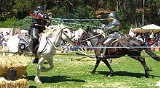
Jousting is a sport and an entertainment for the rich and noble. It consists of competition between two mounted knightKnight

Knight is the English term for a social position originating in the Middle Ages....
s using a variety of weapons, usually in sets of three per weapon (such as tilting with a lanceLance

The term lance has become a catchall for a variety of different pole weapons based on the spear....
, blows with the battle axeAxe

The axe is an ancient and ubiquitous tool that has been used for millennia to shape, split and cut wood, harvest timber, as ...
, strokes with the daggerDagger

A dagger is a double-edged knife used for stabbing, thrusting or as a secondary defense weapon in close combat....
, or strokes with a swordSword

Sword is a term for a long edged weapon, used by various civilizations throughout Eurasia and North Africa....
), often as part of a tournamentTournament

A tournament is a competition involving a relatively large number of competitors, all participating in a single sport or gam...
.

Jousting was just one of a number of popular martial gamesCombat sport

A combat sport is a competitive contact sport where two combatants fight against each other using certain rules of engagemen...
 in the Middle AgesMiddle Ages

The Middle Ages formed the middle period in a traditional schematic division of European history into three "ages": the clas...
 referred to generically as hastiludeHastilude

Hastilude is a generic term used in the Middle Ages to refer to many kinds of martial games....
s.

Though the first recorded tournament was staged in 1066, jousting did not gain in widespread popularity until the 13th century. It maintained its status as a popular European sport until the early 17th century.

Jousting was added to tournamentsTournament (medieval) Overview

Tournament, or tourney, the name popularly given in the Middle Ages to a species of mock fight, so called owing to the...
 several centuries after their inauguration. The joust permitted a better display of individual skill and, although dangerous, offered large sums of prize money. Many knights made their fortune in these events, whilst many lost their fortune or even life. For example, Henry II of FranceHenry II of France

Henry II, a member of the Valois Dynasty, was King of France from March 31, 1547, until his death....
 died when a shard of his opponent's broken lance went through his visor and into his eye.


Medieval jousting

The skills and techniques used in jousting were also used in combatCombat

Combat, or fighting, is purposeful violent conflict between one or more persons or organizations, often intended to es...
. In combat, mounted knights would charge at their enemies with weapons to try to kill or disable them. The primary use of the jousting lanceLance

The term lance has become a catchall for a variety of different pole weapons based on the spear....
 was to unhorse the other by striking them with the end of the lance while riding towards them at high speed. This is known as "tilting". Other weapons were also used for jousting.

War put on hold for a joust

The 1300s document (translated from French) called The Chronicles of FroissartFroissart's Chronicles

Froissart's Chronicle was written in French by Jean Froissart....
contains many details concerning jousting in medieval times. For example, much can be gleaned from its account of a war put on hold for a joust as it illustrates and documents:

  • the connection between romance and jousting
  • the importance associated with jousting
  • the nonlethal expectations
  • the use of attendants
  • the rounds consisting of three encounters with various weapons
  • jousting being stopped when the risk of death seemed too great
  • the financial rewards of acquitting yourself well
  • tournaments contained jousts but jousts were also done outside of tournaments
  • jousts contained tilts but tilts were but one type of armed encounter during a joust
  • jousting as sport and not war was done between enemies during a war between warring sides, at least this once
  • the completion of a joust could be delayed days and finished later
  • standards of conduct considered honorable


The Chronicles of FroissartFroissart's Chronicles

Froissart's Chronicle was written in French by Jean Froissart....
records that, during a campaign in the Gatinois and the Beauce in France during the Hundred Years War between the English and French, a squire from Beauce named Gauvain Micaille yelled out to the English, "Is there among you any gentleman who for the love of his lady is willing to try with me some feat of arms? If there should be any such, here I am, quite ready to sally forth completely armed and mounted, to tilt three courses with the lance, to give three blows with the battle axe, and three strokes with the dagger. Now look, you English, if there be none among you in love." This is what Froissart says happened next:

Equipment


The lists

The lists, or list field, is the arena in which a jousting event or similar tournament is held. More precisely, it is the roped-off enclosure where tournament fighting takes place. It is mentioned frequently in the novel IvanhoeIvanhoe Summary

Ivanhoe is a novel by Sir Walter Scott....
 by Sir Walter Scott. In the late medieval period, castles and palaces were augmented by purpose-built tiltyardTiltyard

A tiltyard was an enclosed courtyard for jousting ....
s
as a venue for "jousting tournaments".

The horse


The two most common kinds of horse used for jousting were warmbloodWarmblood

Warmbloods are a group of sport horse breeds and the term simply distinguishes this type of horse from the "cold bloods" and...
 chargerWar horse

War Horses are horses specially trained for use in battle or individual combat....
s
and coldblood destrierDestrier

A destrier is an historical term for a knight's war horse....
s
. Chargers were medium-weight horses bred and trained for agility and stamina, while destriers were heavy war horseWar horse

War Horses are horses specially trained for use in battle or individual combat....
s. These were larger and slower, but helpful to give devastating force to the rider's lance through its weight being about twice as great as that of a traditional riding horse. The horses were trained for amblingFacts About Ambling

Ambling, in horsemanship, is a peculiar kind of pace, wherein a horse's two legs of the same side move at the same time....
, a kind of pacePace

Pace may refer to:*Pace, the speed at which movement occurs...
 that provided the rider with stability in order to be able to focus and aim better with the lance.

During a jousting tournament, the horses were cared for by their groomGroom (horses)

A groom is an employee who is responsible for some or all aspects of the welfare of a stable owner's horses and/or the care ...
s in their respective tents. They wore caparisonCaparison

A caparison is a covering, or cloth laid over a horse or other animal, especially a pack animal, or horse of state....
s, a type of ornamental cloth featuring the owner's heraldic signsHeraldry

Heraldry is the practice of designing, displaying, describing and recording coats of arms and badges, as well as the formal ...
. Competing horses had their heads protected by a chanfron, an iron shield for protection from otherwise lethal lance hits.

Other forms of equipment on the horse included long-necked spurSpur

...
s which enabled the rider to control the horse with extended legs, a saddle with a high back to provide leverage during the charge or when hit, as well as stirrupFacts About Stirrup

The stirrup is a ring with a flat bottom fixed on a leather strap, usually hung from each side of a saddle to create a footr...
s for the necessary leverage to deliver blows with the lance.

The armor


Jousting was popular from the Middle AgesMiddle Ages

The Middle Ages formed the middle period in a traditional schematic division of European history into three "ages": the clas...
 until the early 1600s. During that time armour evolved from being chain mailChain Mail

"Chain Mail" is a single by Mancunian band James, released in March 1986 by Sire Records, the first after the band defected ...
 (called simply mail at the time), with a solid, heavy helmet, called a "great helmFacts About Great helm

The great helm of the High Middle Ages arose in the late 12th century in the context of the crusades and remained in use unt...
", and shield. By 1400 knights wore full suits of plate armourPlate armour

Plate armour is personal armour made from large metal plates, worn on the chest and sometimes the entire body....
, called a "harness". A full harness frequently included extra pieces specifically for use in jousting, so that a light military combat suit could be reinforced with heavier, "bolt-on" protective plates on the cuirassCuirass

This article is devoted to the type of armour known as a cuirass....
 (breastplate) and helmet, and also with jousting-specific arm and shoulder pieces, which traded mobility for extra protection. These extra pieces were usually much stronger on the side expected to take the impact of the lance. Special jousting helmets were sometimes used, made so that the wearer could only see out by leaning forwards. If the wearer straightened up just before the impact of the lance, the eyes would be completely protected. Some later suits had a small shield built-in the left side of the armor. In some cases this was spring loaded to fly into pieces if struck properly by the opponent's lance.

The lance

In modern times, jousting is often done for show or demonstration purposes, and the lances used are usually made of light wood and prepared so that they break easily. Lances were often decorated with stripes or the colors of a knight's coat of arms. In a real joust, the lances were of solid oak and a significant strike was needed to shatter them. However, the (blunt) lances would not usually penetrate the steel. The harnesses worn by the knights were lined on the inside with plenty of cloth to soften the blow from the lance.


Modern-day jousting


Modern day jousting or tilting has been kept alive by the International Jousting Association, , which has strict guidelines for the quality and authenticity of jousters' armour & equipment, and has developed the use of breakable lance tips for safety.

Jousting under the IJA rules follows a points system where points are given for breaking the lance tip on the opposing knight's shield, note there are no points given for unhorsing an opponent. IJA sanctioned tournaments also include skill at arms where the riders display their horsemanship and weapons handling skills with swords on the Moors Head, they use spears for the rings and spear throw, and use the lance against a spinning quintain. Many IJA tournaments also include a mounted melee with fully armoured riders using padded batons in place of swords for safety. None of the IJA events are theatrically based and they offer the public a chance to observe living history as opposed the Renaissance Fair type entertainment type jousting.

Today, tent peggingTent pegging

Tent pegging is a cavalry sport of ancient origin, and is one of only ten equestrian disciplines officially recognised by th...
 is the only form of jousting officially recognized by the International Federation for Equestrian SportsInternational Federation for Equestrian Sports

The Fdration questre internationale is the international governing body of equestrian sports....
. The sport involves using a lance or sword to strike and carry away a small wooden ground target. The name "tent pegging" is derived from the cavalry tactic of causing confusion in enemy camps by galloping though the camps and collapsing the tents by pulling up the tent peg anchors with well-placed lance tip strikes. The actual sport of tent pegging, however, originates in medieval IndiaIndia

India , officially the Republic of India, is a country in South Asia....
, when horse cavalrymen would try to incapacitate elephant cavalry by striking the elephants with lances on their extremely sensitive toenails.

Ring jousting is the official state sport of MarylandMaryland

Maryland , is a Mid-Atlantic state located on the East Coast of the United States and is classified by the U.S....
, and was the first official sport of any American state.

The Italian town of FolignoFoligno

Foligno, is an ancient town of Italy in the province of Perugia in east central Umbria, on the Topino river where it leaves ...
 also holds an annual jousting tournament, the Giostra della QuintanaGiostra della Quintana

The Giostra della Quintana is a knight ring jousting tournament based on a historical event....
, that dates back to the 1613. The Knights have to spear rings from the statue of the Quintana.

The Italian town of ArezzoArezzo

Arezzo is an old city in central Italy, capital of the province of the same name, located in Tuscany....
 continues to hold an annual jousting tournament, which dates to the CrusadesCrusades

The Crusades were a series of military campaigns waged in the name of Christendom This term refers to a particular political...
. Jousters aim for a square target attached to a wooden effigy of a SaracenSaracen

In older Western historical literature, the Saracens were the people of the Saracen Empire, another name for the Arab ...
 king, whose opposite arm holds a cat-o-three-tails — three leather laces with a heavy wooden ball at the end of each lace. The riders strike the target with chalk-tipped lances and score points for accuracy, but must also dodge the cat-o-three-tails after they have struck the target.

Modern theatrical joustingTheatrical jousting

Coined in the late 20th century by American stunt performer Kent Shelton, the term "theatrical jousting" refers to a form of live ...
 competitions are popular at American Renaissance fairFacts About Renaissance Fair

A Renaissance Fair or Renaissance Festival is an outdoor weekend gathering ostensibly focused on recreating life as it...
s and similar festivals, and feature riders on horseback attempting various feats of skill with the lance, which may not always have a basis in history.

Several international organisations, such as the Society for Creative AnachronismSociety for Creative Anachronism

The Society for Creative Anachronism is a not-for-profit organization....
 and the International Jousting Association, promote rules to govern their jousting events.


In Port Republic, MarylandFacts About Port Republic, Maryland

Port Republic is a small, rural community located in...
 the annual Calvert County Jousting Tournament is held every August on the grounds of historic Christ EpiscopalEpiscopal Church in the United States of America

The Protestant Episcopal Church in the United States of America, or as it is also known, The Episcopal Church, is the ...
 Church. In 2005, the tournament was featured in an edition of ESPNESPN

ESPN is an American cable television network dedicated to broadcasting sports-related programming 24 hours a day....
's SportsCenterSportsCenter

SportsCenter is a sports news television show shown every day on ESPN since the network was founded on September 7, 1979...
.

See also

  • Accession Day tiltFacts About Accession Day tilt

    The Accession Day tilts were a series of elaborate festivities held annually at the court of Elizabeth I of England to celeb...
  • Kipper (medieval tournament)Kipper (medieval tournament)

    In medieval tournaments a kipper is a person employed by a knight, usually a vassal of the knight such as a slave, serf or p...
  • Tournament (medieval)Tournament (medieval)

    Tournament, or tourney, the name popularly given in the Middle Ages to a species of mock fight, so called owing to the...
  • Bem cavalgarBem cavalgar

    Bem Cavalgar is a book written by Edward of Portugal, left incomplete as Edward died of a plague in 1438....
  • Tent peggingTent pegging

    Tent pegging is a cavalry sport of ancient origin, and is one of only ten equestrian disciplines officially recognised by th...
  • Renaissance FairRenaissance Fair Overview

    A Renaissance Fair or Renaissance Festival is an outdoor weekend gathering ostensibly focused on recreating life as it...


Further reading

  • excerpts from 1849 edition of the Thomas Johnes translation (1805).
  • (myArmoury.com article)