

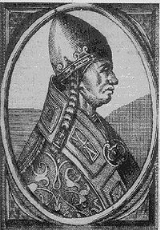
Pope Alexander III

Encyclopedia
Pope Alexander III born Rolando (or Orlando) of Siena, was Pope
from 1159 to 1181. He is noted in history for laying the foundation stone for the Notre Dame de Paris
.
. From 14th century he is referred to as a member of the aristocratic family of Bandinelli but this is not proven. For a long time, scholars believed him to be identical with the twelfth-century canon lawyer and theologian, Master Roland of Bologna, who composed the "Stroma" or "Summa Rolandi" – one of the earliest commentaries on the Decretum
of Gratian
– and the "Sententiae Rolandi", a sentence collection displaying the influence of Pierre Abélard.
In October 1150, Pope Eugene III
(1145–1153) created him cardinal deacon of the Title of Santi Cosma e Damiano
; later he became cardinal priest of the Title of St Mark. In 1153, he became papal chancellor
, and was the leader of the cardinals opposed to Frederick I Barbarossa (1152–1190). He negotiated the Treaty of Benevento
, restoring peaceful relations between Rome and the Kingdom of Sicily
.
On September 7, 1159, he was chosen the successor of Pope Adrian IV
(1154–1159), a minority of the cardinals, however, elected the cardinal priest Octavian, who assumed the name of Victor IV
(1159–1164) and became the German emperor's antipope. The situation was critical for Alexander III, because as many chronicles of the time (maybe exaggerations) Barbarossa's antipope counted with the approval of most kingdoms of Europe, except the Kingdom of Portugal, Sicily and Spain. However, in 1161 the King Géza II of Hungary
signed an agreement and recognised Alexander III as the rightful pope and declared that the supreme spiritual leader was the only one who could excersice the Rights of Investiture
. This meant that Alexander's legitimation was gaining strength, as soon it proved the fact that other monarchs as the King of France and the king Henry II of England
recognized his authority.
However, this antipope
dispute between Alexander III and Victor IV, and the successors of the second: antipope Paschal III
(1164–68) and antipope Calixtus III (1168–1178), (who had the imperial support) continued until the defeat of Legnano
(1176), when Barbarossa finally (in the Peace of Venice 1177) recognized Alexander III as pope. On March 12, 1178, Alexander III returned to Rome, which he had been compelled to leave twice: the first time from 1162, when he was sent into a Campania
n exile by Oddone Frangipane
following his brief arrest and detainment, until November 23, 1165; and again in 1167. The first period he spent in France, the latter chiefly in Gaeta
, Benevento
, Anagni
, and Venice
.
 Alexander III was the first pope known to have paid direct attention to missionary activities east of the Baltic Sea. In 1165, his close friend, Eskil
, the Archbishop of Lund, appointed a Benedictine monk Fulco as a bishop in Estonia
. In 1171, he became the first pope to address the situation of the Church in Finland
, with Finns allegedly harassing the priests and relying only on God in time of war.
In March 1179, Alexander III held the Third Council of the Lateran
, one of the most important mediaeval church councils, reckoned by the Roman Church as the eleventh ecumenical council
; its acts embodied several of the Pope's proposals for the betterment of the condition of the Church, among them the law requiring that no one could be elected pope without the votes of two-thirds of the cardinals. The rule was altered slightly in 1996 but, in 2007, returned to the 1179 rule. This synod marked the summit of Alexander III's power.
Besides checkmating Barbarossa, he had humbled Henry II of England
for the murder of Thomas Becket
in 1170, to whom he was unusually close. In 1172 he confirmed the position of Henry as Lord of Ireland
. He had confirmed the right of Afonso I of Portugal
to the crown, and even as a fugitive had enjoyed the favour and protection of Louis VII of France
. Nevertheless, soon after the close of the synod the Roman republic forced Alexander III to leave the city, which he never re-entered; and on September 29, 1179, some nobles set up the antipope Innocent III
(1179–1180). By the judicious use of money, however, Alexander III got him into his power, so that he was deposed in January, 1180. In 1181, Alexander III excommunicated
William I of Scotland
and put the kingdom under an interdict
.
He died at Civita Castellana
on August 30, 1181.
's play Becket
. In the 1964 film adaptation he was portrayed by Italian actor Paolo Stoppa
.
Alexander III is mentioned in Umberto Eco's book Baudolino
.
Pope
The Pope is the Bishop of Rome, a position that makes him the leader of the worldwide Catholic Church . In the Catholic Church, the Pope is regarded as the successor of Saint Peter, the Apostle...
from 1159 to 1181. He is noted in history for laying the foundation stone for the Notre Dame de Paris
Notre Dame de Paris
Notre Dame de Paris , also known as Notre Dame Cathedral, is a Gothic, Roman Catholic cathedral on the eastern half of the Île de la Cité in the fourth arrondissement of Paris, France. It is the cathedral of the Catholic Archdiocese of Paris: that is, it is the church that contains the cathedra of...
.
Church career
He was born in SienaSiena
Siena is a city in Tuscany, Italy. It is the capital of the province of Siena.The historic centre of Siena has been declared by UNESCO a World Heritage Site. It is one of the nation's most visited tourist attractions, with over 163,000 international arrivals in 2008...
. From 14th century he is referred to as a member of the aristocratic family of Bandinelli but this is not proven. For a long time, scholars believed him to be identical with the twelfth-century canon lawyer and theologian, Master Roland of Bologna, who composed the "Stroma" or "Summa Rolandi" – one of the earliest commentaries on the Decretum
Decretum Gratiani
The Decretum Gratiani or Concordia discordantium canonum is a collection of Canon law compiled and written in the 12th century as a legal textbook by the jurist known as Gratian. It forms the first part of the collection of six legal texts, which together became known as the Corpus Juris Canonici...
of Gratian
Gratian (jurist)
Gratian, was a 12th century canon lawyer from Bologna. He is sometimes incorrectly referred to as Franciscus Gratianus, Johannes Gratianus, or Giovanni Graziano. The dates of his birth and death are unknown....
– and the "Sententiae Rolandi", a sentence collection displaying the influence of Pierre Abélard.
In October 1150, Pope Eugene III
Pope Eugene III
Pope Blessed Eugene III , born Bernardo da Pisa, was Pope from 1145 to 1153. He was the first Cistercian to become Pope.-Early life:...
(1145–1153) created him cardinal deacon of the Title of Santi Cosma e Damiano
Santi Cosma e Damiano
The basilica of Santi Cosma e Damiano is a church in Rome, Italy, located in the Roman Forum. It is one of the ancient churches called tituli, of which cardinals are patrons as deacons: the Cardinal Deacon of the Titulus Ss. Cosmae et Damiani is Giovanni Cheli...
; later he became cardinal priest of the Title of St Mark. In 1153, he became papal chancellor
Chancellor
Chancellor is the title of various official positions in the governments of many nations. The original chancellors were the Cancellarii of Roman courts of justice—ushers who sat at the cancelli or lattice work screens of a basilica or law court, which separated the judge and counsel from the...
, and was the leader of the cardinals opposed to Frederick I Barbarossa (1152–1190). He negotiated the Treaty of Benevento
Treaty of Benevento
The Treaty of Benevento was an important treaty between the papacy of Adrian IV and the Norman Kingdom of Sicily. After years of turbulent relations, the popes finally settled down to a peace with the Hauteville kings....
, restoring peaceful relations between Rome and the Kingdom of Sicily
Kingdom of Sicily
The Kingdom of Sicily was a state that existed in the south of Italy from its founding by Roger II in 1130 until 1816. It was a successor state of the County of Sicily, which had been founded in 1071 during the Norman conquest of southern Italy...
.
On September 7, 1159, he was chosen the successor of Pope Adrian IV
Pope Adrian IV
Pope Adrian IV , born Nicholas Breakspear or Breakspeare, was Pope from 1154 to 1159.Adrian IV is the only Englishman who has occupied the papal chair...
(1154–1159), a minority of the cardinals, however, elected the cardinal priest Octavian, who assumed the name of Victor IV
Antipope Victor IV (1159-1164)
Victor IV , born Octavian or Octavianus: Ottaviano dei Crescenzi Ottaviani di Monticelli, was the cardinal priest of Santa Cecilia before he was elected as a Ghibelline antipope in 1159, following the death of Pope Adrian IV and the election of Alexander III...
(1159–1164) and became the German emperor's antipope. The situation was critical for Alexander III, because as many chronicles of the time (maybe exaggerations) Barbarossa's antipope counted with the approval of most kingdoms of Europe, except the Kingdom of Portugal, Sicily and Spain. However, in 1161 the King Géza II of Hungary
Géza II of Hungary
Géza II , , King of Hungary, King of Croatia, Dalmatia and Rama . He ascended the throne as a child and during his minority the kingdom was governed by his mother and uncle...
signed an agreement and recognised Alexander III as the rightful pope and declared that the supreme spiritual leader was the only one who could excersice the Rights of Investiture
Investiture
Investiture, from the Latin is a rather general term for the formal installation of an incumbent...
. This meant that Alexander's legitimation was gaining strength, as soon it proved the fact that other monarchs as the King of France and the king Henry II of England
Henry II of England
Henry II ruled as King of England , Count of Anjou, Count of Maine, Duke of Normandy, Duke of Aquitaine, Duke of Gascony, Count of Nantes, Lord of Ireland and, at various times, controlled parts of Wales, Scotland and western France. Henry, the great-grandson of William the Conqueror, was the...
recognized his authority.
However, this antipope
Antipope
An antipope is a person who opposes a legitimately elected or sitting Pope and makes a significantly accepted competing claim to be the Pope, the Bishop of Rome and leader of the Roman Catholic Church. At times between the 3rd and mid-15th century, antipopes were typically those supported by a...
dispute between Alexander III and Victor IV, and the successors of the second: antipope Paschal III
Antipope Paschal III
Antipope Paschal III was Antipope from 1164 to 20 September 1168.His real name was Guido of Crema. Paschal III was the second of the antipopes to challenge the reign of Pope Alexander III. In 1164, a small number of cardinals who had elected Victor IV met again to vote Paschal III as his successor...
(1164–68) and antipope Calixtus III (1168–1178), (who had the imperial support) continued until the defeat of Legnano
Battle of Legnano
The Battle of Legnano was fought on May 29, 1176, between the forces of the Holy Roman Empire, led by Emperor Frederick Barbarossa, and the Lombard League.-The Lombard League:...
(1176), when Barbarossa finally (in the Peace of Venice 1177) recognized Alexander III as pope. On March 12, 1178, Alexander III returned to Rome, which he had been compelled to leave twice: the first time from 1162, when he was sent into a Campania
Campania
Campania is a region in southern Italy. The region has a population of around 5.8 million people, making it the second-most-populous region of Italy; its total area of 13,590 km² makes it the most densely populated region in the country...
n exile by Oddone Frangipane
Oddone Frangipane
Oddone Frangipane was the son of Leo and grandson of Cencio II of the Frangipani family. He had another brother named Cencio. During the middle of the twelfth century, he was the most influential aristocrat in Rome. His career began sometime around 1130...
following his brief arrest and detainment, until November 23, 1165; and again in 1167. The first period he spent in France, the latter chiefly in Gaeta
Gaeta
Gaeta is a city and comune in the province of Latina, in Lazio, central Italy. Set on a promontory stretching towards the Gulf of Gaeta, it is 120 km from Rome and 80 km from Naples....
, Benevento
Benevento
Benevento is a town and comune of Campania, Italy, capital of the province of Benevento, 50 km northeast of Naples. It is situated on a hill 130 m above sea-level at the confluence of the Calore Irpino and Sabato...
, Anagni
Anagni
Anagni is an ancient town and comune in Latium, central Italy, in the hills east-southeast of Rome. It is a historical center in Ciociaria.-Geography:...
, and Venice
Venice
Venice is a city in northern Italy which is renowned for the beauty of its setting, its architecture and its artworks. It is the capital of the Veneto region...
.
Political aspects
Eskil of Lund
Eskil was a 12th century Archbishop of Lund, in Skåne, Denmark .He was one of the most capable and prominent princes of the Church in Scandinavia...
, the Archbishop of Lund, appointed a Benedictine monk Fulco as a bishop in Estonia
Estonia
Estonia , officially the Republic of Estonia , is a state in the Baltic region of Northern Europe. It is bordered to the north by the Gulf of Finland, to the west by the Baltic Sea, to the south by Latvia , and to the east by Lake Peipsi and the Russian Federation . Across the Baltic Sea lies...
. In 1171, he became the first pope to address the situation of the Church in Finland
Finland
Finland , officially the Republic of Finland, is a Nordic country situated in the Fennoscandian region of Northern Europe. It is bordered by Sweden in the west, Norway in the north and Russia in the east, while Estonia lies to its south across the Gulf of Finland.Around 5.4 million people reside...
, with Finns allegedly harassing the priests and relying only on God in time of war.
In March 1179, Alexander III held the Third Council of the Lateran
Third Council of the Lateran
The Third Council of the Lateran met in March 1179 as the eleventh ecumenical council. Pope Alexander III presided and 302 bishops attended.By agreement reached at the Peace of Venice in 1177 the bitter conflict between Alexander III and Emperor Frederick I was brought to an end...
, one of the most important mediaeval church councils, reckoned by the Roman Church as the eleventh ecumenical council
Ecumenical council
An ecumenical council is a conference of ecclesiastical dignitaries and theological experts convened to discuss and settle matters of Church doctrine and practice....
; its acts embodied several of the Pope's proposals for the betterment of the condition of the Church, among them the law requiring that no one could be elected pope without the votes of two-thirds of the cardinals. The rule was altered slightly in 1996 but, in 2007, returned to the 1179 rule. This synod marked the summit of Alexander III's power.
Besides checkmating Barbarossa, he had humbled Henry II of England
Henry II of England
Henry II ruled as King of England , Count of Anjou, Count of Maine, Duke of Normandy, Duke of Aquitaine, Duke of Gascony, Count of Nantes, Lord of Ireland and, at various times, controlled parts of Wales, Scotland and western France. Henry, the great-grandson of William the Conqueror, was the...
for the murder of Thomas Becket
Thomas Becket
Thomas Becket was Archbishop of Canterbury from 1162 until his murder in 1170. He is venerated as a saint and martyr by both the Roman Catholic Church and the Anglican Communion...
in 1170, to whom he was unusually close. In 1172 he confirmed the position of Henry as Lord of Ireland
Lordship of Ireland
The Lordship of Ireland refers to that part of Ireland that was under the rule of the king of England, styled Lord of Ireland, between 1177 and 1541. It was created in the wake of the Norman invasion of Ireland in 1169–71 and was succeeded by the Kingdom of Ireland...
. He had confirmed the right of Afonso I of Portugal
Afonso I of Portugal
Afonso I or Dom Afonso Henriques , more commonly known as Afonso Henriques , nicknamed "the Conqueror" , "the Founder" or "the Great" by the Portuguese, and El-Bortukali and Ibn-Arrik by the Moors whom he fought, was the first King of Portugal...
to the crown, and even as a fugitive had enjoyed the favour and protection of Louis VII of France
Louis VII of France
Louis VII was King of France, the son and successor of Louis VI . He ruled from 1137 until his death. He was a member of the House of Capet. His reign was dominated by feudal struggles , and saw the beginning of the long rivalry between France and England...
. Nevertheless, soon after the close of the synod the Roman republic forced Alexander III to leave the city, which he never re-entered; and on September 29, 1179, some nobles set up the antipope Innocent III
Antipope Innocent III
Innocent III was an antipope during 1179 to 1180.Innocent III sprang from a noble Lombard family. Opponents of Pope Alexander III tried to make him Pope in September 1179. Alexander, however, bribed his partisans to give him up, and imprisoned him in the cloister of La Cava in January...
(1179–1180). By the judicious use of money, however, Alexander III got him into his power, so that he was deposed in January, 1180. In 1181, Alexander III excommunicated
Excommunication
Excommunication is a religious censure used to deprive, suspend or limit membership in a religious community. The word means putting [someone] out of communion. In some religions, excommunication includes spiritual condemnation of the member or group...
William I of Scotland
William I of Scotland
William the Lion , sometimes styled William I, also known by the nickname Garbh, "the Rough", reigned as King of the Scots from 1165 to 1214...
and put the kingdom under an interdict
Interdict (Roman Catholic Church)
In Roman Catholic canon law, an interdict is an ecclesiastical censure that excludes from certain rites of the Church individuals or groups, who nonetheless do not cease to be members of the Church.-Distinctions in canon law:...
.
He died at Civita Castellana
Civita Castellana
Civita Castellana is a town and comune in the province of Viterbo, 65 km north of Rome.Mount Soracte lies about 10 km to the south-east.-History:...
on August 30, 1181.
In popular culture
Alexander is a character in Jean AnouilhJean Anouilh
Jean Marie Lucien Pierre Anouilh was a French dramatist whose career spanned five decades. Though his work ranged from high drama to absurdist farce, Anouilh is best known for his 1943 play Antigone, an adaptation of Sophocles' Classical drama, that was seen as an attack on Marshal Pétain's...
's play Becket
Becket
Becket or The Honor of God is a play written in French by Jean Anouilh. It is a depiction of the conflict between Thomas Becket and King Henry II of England leading to Becket's murder in 1170. It contains many historical inaccuracies, which the author acknowledged.-Background:Anouilh's...
. In the 1964 film adaptation he was portrayed by Italian actor Paolo Stoppa
Paolo Stoppa
Paolo Stoppa was an Italian actor and dubber.Born in Rome, he began as a stage actor in 1927 in the theater in Rome and began acting in films in 1932...
.
Alexander III is mentioned in Umberto Eco's book Baudolino
Baudolino
Baudolino is a 2000 novel by Umberto Eco about the adventures of a young man named Baudolino in the known and mythical Christian world of the 12th century.Baudolino was translated into English in 2001 by William Weaver...
.