

List of introduced species

Encyclopedia
A complete list of introduced species for even quite small areas of the world would be dauntingly long. Humans have introduced more different species to new environments than any single document can hope to record. This list is generally for established species with truly wild populations—not kept domestically or on ranches—that have been seen numerous times, and have breeding populations.
Australia
Australia has a huge range of introduced species, so sub-classifications are necessary:
Feral animals that cause the most public concern, and economic and ecological damage include:
other introduced species
British Isles
See also Invasive species in the British Isles
Further information can be found at the GB Non-native Species Secretariat, which has a free toolkit of resources on non-native species, including a photo gallery, ID sheets, risk assessments, projects database, case studies and resources for local action groups.
.
Freshwater
Terrestrial
AustraliaAustraliaAustralia , officially the Commonwealth of Australia, is a country in the Southern Hemisphere comprising the mainland of the Australian continent, the island of Tasmania, and numerous smaller islands in the Indian and Pacific Oceans. It is the world's sixth-largest country by total area...
Australia has a huge range of introduced species, so sub-classifications are necessary:
- InvasiveInvasive species"Invasive species", or invasive exotics, is a nomenclature term and categorization phrase used for flora and fauna, and for specific restoration-preservation processes in native habitats, with several definitions....
- species has a tendency to spread their range into new areas - FeralFeralA feral organism is one that has changed from being domesticated to being wild or untamed. In the case of plants it is a movement from cultivated to uncultivated or controlled to volunteer. The introduction of feral animals or plants to their non-native regions, like any introduced species, may...
s - defined as animals for domestic purposes (i.e., petPetA pet is a household animal kept for companionship and a person's enjoyment, as opposed to wild animals or to livestock, laboratory animals, working animals or sport animals, which are kept for economic or productive reasons. The most popular pets are noted for their loyal or playful...
s or beasts of burdenWorking animalA working animal is an animal, usually domesticated, that is kept by humans and trained to perform tasks. They may be close members of the family, such as guide or service dogs, or they may be animals trained strictly to perform a job, such as logging elephants. They may also be used for milk, a...
) that have gone wild - Pests - animals that have a direct effect on human standards of living or the environment/ecosystems, have a high rate of reproduction, and are difficult to control
Feral animals that cause the most public concern, and economic and ecological damage include:
| Image | Name | Species | Overview | Introduced | Reason | Introduced from | Distribution | Feral | Pest | Threat level | Est. pop. | Main control measures | Notes / ref |
|---|---|---|---|---|---|---|---|---|---|---|---|---|---|
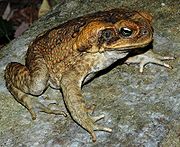 |
Cane toad Cane toads in Australia The cane toad is an invasive species in Australia. The cane toad is the largest species in the family Bufonidae. Adult cane toads are usually heavy-built and weigh an average of up to 1.8kg. . Their size may vary from 15-23 cm. and their skin is warty... |
Bufo marinus Cane Toad The Cane Toad , also known as the Giant Neotropical Toad or Marine Toad, is a large, terrestrial true toad which is native to Central and South America, but has been introduced to various islands throughout Oceania and the Caribbean... |
Cane toads in Australia Cane toads in Australia The cane toad is an invasive species in Australia. The cane toad is the largest species in the family Bufonidae. Adult cane toads are usually heavy-built and weigh an average of up to 1.8kg. . Their size may vary from 15-23 cm. and their skin is warty... |
1935 | Biological control (cane beetle Cane beetle The cane beetle, Dermolepida albohirtum, is a native Australian beetle and a pest of the sugar cane. Adult beetles eat the leaves of sugar cane but greater damage is the done by their larvae hatching underground and eating the roots, which either kills or stunts the growth of the plant.Larvae,... ) |
South America via Hawaii | Queensland Queensland Queensland is a state of Australia, occupying the north-eastern section of the mainland continent. It is bordered by the Northern Territory, South Australia and New South Wales to the west, south-west and south respectively. To the east, Queensland is bordered by the Coral Sea and Pacific Ocean... (extensive), northern New South Wales New South Wales New South Wales is a state of :Australia, located in the east of the country. It is bordered by Queensland, Victoria and South Australia to the north, south and west respectively. To the east, the state is bordered by the Tasman Sea, which forms part of the Pacific Ocean. New South Wales... , Top End Top End The Top End of northern Australia is the second northernmost point on the continent. It covers a rather vaguely-defined area of perhaps 400,000 square kilometres behind the northern coast from the Northern Territory capital of Darwin across to Arnhem Land with the Indian Ocean on the west, the... , Kimberley |
No | Yes | Extreme | 200 million + | Culling; trapping; genetic (under research) | prolific breeders and bufotoxin Bufotoxin Bufotoxins are a family of toxic substances found in the parotoid glands, skin and venom of many toads ; other amphibians; and some plants and mushrooms. The exact composition varies greatly with the specific source of the toxin. It can contain: 5-MeO-DMT, bufagins, bufotalin, bufotenine,... kills native animals |
 |
Red Fox Red Fox The red fox is the largest of the true foxes, as well as being the most geographically spread member of the Carnivora, being distributed across the entire northern hemisphere from the Arctic Circle to North Africa, Central America, and the steppes of Asia... |
Vulpes vulpes | Feral foxes in Australia Feral foxes in Australia Feral foxes pose a serious conservation problem in Australia.The red fox was introduced to Australia in the 19th century for hunting in 1843 near Melbourne, but has since become widespread, and is considered responsible for the decline in a number of species of native animals in the "critical... |
1855 | Recreational hunting | Europe | most of mainland Australia; small numbers in Tasmania | No | Yes | Extreme | 7.2 million + | 1080 baiting; hunting | Elusive prolific predator of native animals and livestock. |
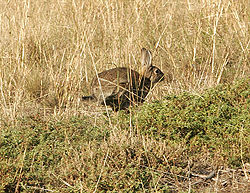 |
European Rabbit European Rabbit The European Rabbit or Common Rabbit is a species of rabbit native to south west Europe and north west Africa . It has been widely introduced elsewhere often with devastating effects on local biodiversity... |
Oryctolagus cuniculus | Rabbits in Australia Rabbits in Australia In Australia, rabbits are a serious mammalian pest and are an invasive species. Annually, European rabbits cause millions of dollars of damage to crops.-Effects on Australia's ecology:... |
1859 | Recreational hunting | Europe | Throughout Australia (extensive) | No | Yes | High | 200 million + | rabbit-proof fence Rabbit-proof fence The State Barrier Fence of Western Australia, formerly known as the No. 1 Rabbit-proof Fence, the State Vermin Fence and the Emu Fence, is a pest-exclusion fence constructed between 1901 and 1907 to keep rabbits and other agricultural pests, from the east, out of Western Australian pastoral... ; Myxomatosis Myxomatosis Myxomatosis is a disease that affects rabbits and is caused by the Myxoma virus. It was first observed in Uruguay in laboratory rabbits in the late 19th century. It was introduced into Australia in 1950 in an attempt to control the rabbit population... ; Calicivirus (RHD) |
Prolific breeders that destroy land. |
 |
Dromedary Camel | Camelus dromedarius Dromedary The dromedary or Arabian camel is a large, even-toed ungulate with one hump on its back. Its native range is unclear, but it was probably the Arabian Peninsula. The domesticated form occurs widely in North Africa and the Middle East... |
Australian feral camel Australian feral camel Thousands of the two main species of Australian feral camels, mostly dromedaries but also some bactrian camels, were imported into Australia during the 19th century for transport and construction as part of the colonisation of the central and western parts of Australia. Motorised transport replaced... |
1840 | Beast of burden | India | Central Australia (extensive) | Yes | Yes | Medium to high | 1.1 million | Helicopter culling | Grazer, though arid Australian conditions suit the camel perfectly. |
 |
Feral goat Feral goat The feral goat is the domestic goat when it has become established in the wild. Feral goats occur in Australia, New Zealand, Ireland, Great Britain, Hawaii, the Galapagos and in many other parts of the world... |
Capra hircus Goat The domestic goat is a subspecies of goat domesticated from the wild goat of southwest Asia and Eastern Europe. The goat is a member of the Bovidae family and is closely related to the sheep as both are in the goat-antelope subfamily Caprinae. There are over three hundred distinct breeds of... |
Feral goats in Australia Feral goats in Australia Feral goats are an invasive animal species in Australia.-History:Goats originally came to Australia with the First Fleet in 1788. These goats were the ancestors of the feral goat populations present in Australia today. During the 19th Century, the goats were set free by mariners as a measure to... |
?? | Domestic Domestication Domestication or taming is the process whereby a population of animals or plants, through a process of selection, becomes accustomed to human provision and control. In the Convention on Biological Diversity a domesticated species is defined as a 'species in which the evolutionary process has been... livestock Livestock Livestock refers to one or more domesticated animals raised in an agricultural setting to produce commodities such as food, fiber and labor. The term "livestock" as used in this article does not include poultry or farmed fish; however the inclusion of these, especially poultry, within the meaning... |
?? | Throughout Australia (extensive) | Yes | Yes | High | + | Helicopter culling | |
| Feral cat Feral cat A feral cat is a descendant of a domesticated cat that has returned to the wild. It is distinguished from a stray cat, which is a pet cat that has been lost or abandoned, while feral cats are born in the wild; the offspring of a stray cat can be considered feral if born in the wild.In many parts of... |
Felis catus Cat The cat , also known as the domestic cat or housecat to distinguish it from other felids and felines, is a small, usually furry, domesticated, carnivorous mammal that is valued by humans for its companionship and for its ability to hunt vermin and household pests... |
Feral cat | c. 1700s | Pets | Europe | Throughout Australia, except in tropical rainforests (extensive) | Yes | Yes | High to extreme | ?? | Barrier fencing, shooting, trapping. Control measures effective on small islands; less so on the mainland. | The most widely spread and invasive of all introduced species. It is possibly responsible for the extinction of some species of small mammals. | |
| Brumby Brumby A Brumby is a free-roaming feral horse in Australia. Although found in many areas around the country, the best-known brumbies are found in the Australian Alps region in south-eastern Australia. Today, most of them are found in the Northern Territory, with the second largest population in Queensland... |
Equus ferus caballus Horse The horse is one of two extant subspecies of Equus ferus, or the wild horse. It is a single-hooved mammal belonging to the taxonomic family Equidae. The horse has evolved over the past 45 to 55 million years from a small multi-toed creature into the large, single-toed animal of today... |
Brumby Brumby A Brumby is a free-roaming feral horse in Australia. Although found in many areas around the country, the best-known brumbies are found in the Australian Alps region in south-eastern Australia. Today, most of them are found in the Northern Territory, with the second largest population in Queensland... |
1788 First Fleet The First Fleet is the name given to the eleven ships which sailed from Great Britain on 13 May 1787 with about 1,487 people, including 778 convicts , to establish the first European colony in Australia, in the region which Captain Cook had named New South Wales. The fleet was led by Captain ... |
Farm and utility work | Europe; some later imports from South Africa South Africa The Republic of South Africa is a country in southern Africa. Located at the southern tip of Africa, it is divided into nine provinces, with of coastline on the Atlantic and Indian oceans... and Indonesia Indonesia Indonesia , officially the Republic of Indonesia , is a country in Southeast Asia and Oceania. Indonesia is an archipelago comprising approximately 13,000 islands. It has 33 provinces with over 238 million people, and is the world's fourth most populous country. Indonesia is a republic, with an... |
Throughout Australia (extensive) | Yes | Yes | Medium to high | 300,000+ | Musters, ground and helicopter culling, fertility control | Grazers that damage sensitive lands | |
| Feral pig | Sus scrofa | Feral pig | 1788 First Fleet The First Fleet is the name given to the eleven ships which sailed from Great Britain on 13 May 1787 with about 1,487 people, including 778 convicts , to establish the first European colony in Australia, in the region which Captain Cook had named New South Wales. The fleet was led by Captain ... |
Domestic Domestication Domestication or taming is the process whereby a population of animals or plants, through a process of selection, becomes accustomed to human provision and control. In the Convention on Biological Diversity a domesticated species is defined as a 'species in which the evolutionary process has been... livestock Livestock Livestock refers to one or more domesticated animals raised in an agricultural setting to produce commodities such as food, fiber and labor. The term "livestock" as used in this article does not include poultry or farmed fish; however the inclusion of these, especially poultry, within the meaning... |
Europe | Throughout Australia, except in deserts (extensive) | Yes | Yes | High | 13 million to 23 million | Musters, ground and helicopter culling, trapping, poisoning, fencing | Prolific breeders that destroy land and have the potential to spread disease |
- Brown hareEuropean HareThe European hare , also known as the brown hare, Eastern Jackrabbit and Eastern prairie hare, is a species of hare native to northern, central, and western Europe and western Asia. It is a mammal adapted to temperate open country. It is related to the similarly appearing rabbit, which is in the...
- Common starling
- MallardMallardThe Mallard , or Wild Duck , is a dabbling duck which breeds throughout the temperate and subtropical Americas, Europe, Asia, and North Africa, and has been introduced to New Zealand and Australia....
- Feral PigeonFeral PigeonFeral pigeons , also called city doves, flying rats, city pigeons or street pigeons, are derived from domestic pigeons that have returned to the wild. The domestic pigeon was originally bred from the wild Rock Pigeon, which naturally inhabits sea-cliffs and mountains. All three types readily...
- Nutmeg mannikin
- Brown troutBrown troutThe brown trout and the sea trout are fish of the same species....
- Mosquitofish
- Western honeybee
- AllamandaAllamandaAllamanda, also known as Yellow Bell, Golden Trumpet or Buttercup Flower, is a genus of tropical shrubs or vines belonging to the dogbane family .The genus Alamanda is native to South and Central America...
- Allamanda cathartica from South America - DromedaryDromedaryThe dromedary or Arabian camel is a large, even-toed ungulate with one hump on its back. Its native range is unclear, but it was probably the Arabian Peninsula. The domesticated form occurs widely in North Africa and the Middle East...
- Red imported fire antRed imported fire antSee main article Fire ant.The red imported fire ant , or simply RIFA, is one of over 280 species in the widespread genus Solenopsis...
from South America via North America - Patterson's CursePatterson's CurseEchium plantagineum, commonly known as Purple Viper's Bugloss, is a species of Echium, native to western and southern Europe , northern Africa, and southwestern Asia . It has also been introduced to Australia, South Africa and United States and is an invasive plant...
- DeerDeerDeer are the ruminant mammals forming the family Cervidae. Species in the Cervidae family include white-tailed deer, elk, moose, red deer, reindeer, fallow deer, roe deer and chital. Male deer of all species and female reindeer grow and shed new antlers each year...
from EuropeEuropeEurope is, by convention, one of the world's seven continents. Comprising the westernmost peninsula of Eurasia, Europe is generally 'divided' from Asia to its east by the watershed divides of the Ural and Caucasus Mountains, the Ural River, the Caspian and Black Seas, and the waterways connecting... - Domestic Asian Water buffalo
- Feral CatFeral catA feral cat is a descendant of a domesticated cat that has returned to the wild. It is distinguished from a stray cat, which is a pet cat that has been lost or abandoned, while feral cats are born in the wild; the offspring of a stray cat can be considered feral if born in the wild.In many parts of...
- DogDogThe domestic dog is a domesticated form of the gray wolf, a member of the Canidae family of the order Carnivora. The term is used for both feral and pet varieties. The dog may have been the first animal to be domesticated, and has been the most widely kept working, hunting, and companion animal in...
- DingoDingoThe Australian Dingo or Warrigal is a free-roaming wild dog unique to the continent of Australia, mainly found in the outback. Its original ancestors are thought to have arrived with humans from southeast Asia thousands of years ago, when dogs were still relatively undomesticated and closer to...
can also be considered native - Black ratBlack RatThe black rat is a common long-tailed rodent of the genus Rattus in the subfamily Murinae . The species originated in tropical Asia and spread through the Near East in Roman times before reaching Europe by the 1st century and spreading with Europeans across the world.-Taxonomy:The black rat was...
- Brown ratBrown RatThe brown rat, common rat, sewer rat, Hanover rat, Norway rat, Brown Norway rat, Norwegian rat, or wharf rat is one of the best known and most common rats....
- Polynesian ratPolynesian RatThe Polynesian Rat, or Pacific Rat , known to the Māori as kiore, is the third most widespread species of rat in the world behind the Brown Rat and Black Rat. The Polynesian Rat originates in Southeast Asia but, like its cousins, has become well travelled – infiltrating Fiji and most Polynesian...
- European GoldfinchEuropean GoldfinchThe European Goldfinch or Goldfinch is a small passerine bird in the finch family.-Habitat and range:The goldfinch breeds across Europe, North Africa, and western and central Asia, in open, partially wooded lowlands. It is resident in the milder west of its range, but migrates from colder regions...
other introduced species
British IslesBritish IslesThe British Isles are a group of islands off the northwest coast of continental Europe that include the islands of Great Britain and Ireland and over six thousand smaller isles. There are two sovereign states located on the islands: the United Kingdom of Great Britain and Northern Ireland and...
See also Invasive species in the British IslesInvasive species in the British Isles
As with other islands globally, the British Isles are particularly vulnerable to invasive species. Usually, an island will have several distinct species, which are not present on the nearest mainland, and vice-versa...
Further information can be found at the GB Non-native Species Secretariat, which has a free toolkit of resources on non-native species, including a photo gallery, ID sheets, risk assessments, projects database, case studies and resources for local action groups.
Mammals
- Red-necked WallabyRed-necked WallabyThe Red-necked Wallaby is a medium-sized marsupial macropod, common in the more temperate and fertile parts of eastern Australia, including Tasmania.- Description :...
from AustraliaAustraliaAustralia , officially the Commonwealth of Australia, is a country in the Southern Hemisphere comprising the mainland of the Australian continent, the island of Tasmania, and numerous smaller islands in the Indian and Pacific Oceans. It is the world's sixth-largest country by total area... - Grey SquirrelEastern Gray SquirrelThe eastern gray squirrel is a tree squirrel in the genus Sciurus native to the eastern and midwestern United States, and to the southerly portions of the eastern provinces of Canada...
from North AmericaNorth AmericaNorth America is a continent wholly within the Northern Hemisphere and almost wholly within the Western Hemisphere. It is also considered a northern subcontinent of the Americas... - Brown RatBrown RatThe brown rat, common rat, sewer rat, Hanover rat, Norway rat, Brown Norway rat, Norwegian rat, or wharf rat is one of the best known and most common rats....
- Black RatBlack RatThe black rat is a common long-tailed rodent of the genus Rattus in the subfamily Murinae . The species originated in tropical Asia and spread through the Near East in Roman times before reaching Europe by the 1st century and spreading with Europeans across the world.-Taxonomy:The black rat was...
- House MouseHouse mouseThe house mouse is a small rodent, a mouse, one of the most numerous species of the genus Mus.As a wild animal the house mouse mainly lives associated with humans, causing damage to crops and stored food....
- Edible DormouseEdible dormouseThe edible dormouse or fat dormouse is a large dormouse and the only living species in the genus Glis.-Description:...
from Europe - CoypuCoypuThe coypu , , also known as the river rat, and nutria, is a large, herbivorous, semiaquatic rodent and the only member of the family Myocastoridae. Originally native to subtropical and temperate South America, it has since been introduced to North America, Europe, Asia, and Africa, primarily by...
from South AmericaSouth AmericaSouth America is a continent situated in the Western Hemisphere, mostly in the Southern Hemisphere, with a relatively small portion in the Northern Hemisphere. The continent is also considered a subcontinent of the Americas. It is bordered on the west by the Pacific Ocean and on the north and east...
(subsequently eradicated) - European RabbitEuropean RabbitThe European Rabbit or Common Rabbit is a species of rabbit native to south west Europe and north west Africa . It has been widely introduced elsewhere often with devastating effects on local biodiversity...
from continental EuropeEuropeEurope is, by convention, one of the world's seven continents. Comprising the westernmost peninsula of Eurasia, Europe is generally 'divided' from Asia to its east by the watershed divides of the Ural and Caucasus Mountains, the Ural River, the Caspian and Black Seas, and the waterways connecting... - American MinkAmerican MinkThe American mink is a semi-aquatic species of Mustelid native to North America, though human intervention has expanded its range to many parts of Europe and South America. Because of this, it is classed as Least Concern by the IUCN. Since the extinction of the sea mink, the American mink is the...
- Reeves's MuntjacReeves's MuntjacThe Reeves' Muntjac is a muntjac species found widely in southeastern China and in Taiwan. They have also been introduced in the Netherlands, the United Kingdom and Ireland by 2008. It feeds on herbs, blossoms, succulent shoots, grasses and nuts, and was also reported to eat trees...
from ChinaChinaChinese civilization may refer to:* China for more general discussion of the country.* Chinese culture* Greater China, the transnational community of ethnic Chinese.* History of China* Sinosphere, the area historically affected by Chinese culture... - Fallow DeerFallow DeerThe Fallow Deer is a ruminant mammal belonging to the family Cervidae. This common species is native to western Eurasia, but has been introduced widely elsewhere. It often includes the rarer Persian Fallow Deer as a subspecies , while others treat it as an entirely different species The Fallow...
from continental Europe - Sika DeerSika DeerThe Sika Deer, Cervus nippon, also known as the Spotted Deer or the Japanese Deer, is a species of deer native to much of East Asia and introduced to various other parts of the world...
from AsiaAsiaAsia is the world's largest and most populous continent, located primarily in the eastern and northern hemispheres. It covers 8.7% of the Earth's total surface area and with approximately 3.879 billion people, it hosts 60% of the world's current human population... - Chinese Water Deer from China
Birds
- Little OwlLittle OwlThe Little Owl is a bird which is resident in much of the temperate and warmer parts of Europe, Asia east to Korea, and north Africa. It is not native to Great Britain, but was first introduced in 1842, and is now naturalised there...
from mainland Europe - Rose-ringed ParakeetRose-ringed ParakeetThe Rose-ringed Parakeet , also known as the Ringnecked Parakeet, is a gregarious tropical parakeet species that has an extremely large range. Since the trend of the population appears to be increasing, the species has been evaluated as Least Concern by IUCN in 2009.Rose-ringed parakeets are...
from AsiaAsiaAsia is the world's largest and most populous continent, located primarily in the eastern and northern hemispheres. It covers 8.7% of the Earth's total surface area and with approximately 3.879 billion people, it hosts 60% of the world's current human population... - Red-legged PartridgeRed-legged PartridgeThe Red-legged Partridge is a gamebird in the pheasant family Phasianidae of the order Galliformes, gallinaceous birds. It is sometimes known as French Partridge, to distinguish it from the Grey or English Partridge....
- Golden PheasantGolden PheasantThe Golden Pheasant or "Chinese Pheasant", is a gamebird of the order Galliformes and the family Phasianidae...
from Asia - Lady Amherst Pheasant
- Common PheasantCommon PheasantThe Common Pheasant , is a bird in the pheasant family . It is native to Georgia and has been widely introduced elsewhere as a game bird. In parts of its range, namely in places where none of its relatives occur such as in Europe , it is simply known as the "pheasant"...
- Canada GooseCanada GooseThe Canada Goose is a wild goose belonging to the genus Branta, which is native to arctic and temperate regions of North America, having a black head and neck, white patches on the face, and a brownish-gray body....
Fish
- ZanderZanderZander is a species of fish. The scientific name is Sander lucioperca , and it is closely allied to perch. Zander are often called pike-perch as they resemble the pike with their elongated body and head, and the perch with their spiny dorsal fin. Zander are not, as is commonly believed, a pike and...
- WelsWels catfishThe wels catfish , also called sheatfish, is a large catfish found in wide areas of central, southern, and eastern Europe, and near the Baltic and Caspian Seas. It is a scaleless fresh and brackish water fish recognizable by its broad, flat head and wide mouth...
- Rainbow TroutRainbow troutThe rainbow trout is a species of salmonid native to tributaries of the Pacific Ocean in Asia and North America. The steelhead is a sea run rainbow trout usually returning to freshwater to spawn after 2 to 3 years at sea. In other words, rainbow trout and steelhead trout are the same species....
- WalleyeWalleyeWalleye is a freshwater perciform fish native to most of Canada and to the northern United States. It is a North American close relative of the European pikeperch...
- BitterlingBitterlingThe Amur Bitterling, Rhodeus sericeus, is a small fish of the carp family. It is sometimes just called "bitterling", but this is wrong: for one thing, it dates back to the time when the European Bitterling was still considered conspecific with R. sericeus, for another, "bitterling" properly refers...
- Brook TroutBrook troutThe brook trout, Salvelinus fontinalis, is a species of fish in the salmon family of order Salmoniformes. In many parts of its range, it is known as the speckled trout or squaretail. A potamodromous population in Lake Superior are known as coaster trout or, simply, as coasters...
- Common CarpCommon carpThe Common carp is a widespread freshwater fish of eutrophic waters in lakes and large rivers in Europe and Asia. The wild populations are considered vulnerable to extinction, but the species has also been domesticated and introduced into environments worldwide, and is often considered an invasive...
- Black BullheadBlack bullheadThe black bullhead, Ameiurus melas, is a species of bullhead catfish. Like other bullhead catfish, it has the ability to thrive in waters that are low in oxygen, brackish, turbid and/or very warm. It also has barbels located near its mouth, a broad head, spiny fins and no scales...
- GoldfishGoldfishThe goldfish is a freshwater fish in the family Cyprinidae of order Cypriniformes. It was one of the earliest fish to be domesticated, and is one of the most commonly kept aquarium fish....
- Grass CarpGrass carpThe grass carp is a herbivorous, freshwater fish species of family Cyprinidae, and the only species of the genus Ctenopharyngodon. It is cultivated in China for food, but was introduced in Europe and the United States for aquatic weed control...
- Orfe
- PumpkinseedPumpkinseedThe pumpkinseed sunfish is a freshwater fish of the sunfish family of order Perciformes. It is also referred to as "pond perch", "common sunfish", "punkys", and "sunny".-Range and distribution:...
- Topmouth GudgeonPseudorasbora parvaStone moroko , Pseudorasbora parva, is a fish belonging to the Cyprinid family, native to Asia, but introduced and now considered an invasive species in Europe...
- Sunbleak
- Fathead MinnowFathead minnowThe fathead minnow , is a species of temperate freshwater fish belonging to the Pimephales genus of the cyprinid family. The natural geographic range extends throughout much of North America, from central Canada south along the Rockies to Texas, and east to Virginia and the Northeastern United...
- Pacific Humped Back SalmonPink salmonPink salmon or humpback salmon, Oncorhynchus gorbuscha, is a species of anadromous fish in the salmon family. It is the smallest and most abundant of the Pacific salmon.- Appearance :...
Amphibians
- Alpine NewtAlpine NewtThe Alpine Newt is a newt of the Salamander order Caudata in the class of Amphibians.-Description:...
- Midwife ToadMidwife toadMidwife toads are a genus of frogs in the Discoglossidae family, and are found in most of Europe and northwestern Africa. Characteristic of these toad-like frogs is their parental care: the males carry a string of fertilised eggs on their back, hence the name "midwife". The female expels a strand...
- Yellow-bellied ToadYellow-bellied toadThe Yellow-Bellied Toad belongs to the order of Anura, the archaeobatrachial family of Bombinatoridae, and to the genus of fire-bellied toads.- Anatomy :...
- Marsh FrogMarsh FrogThe Marsh Frog is the largest frog native to Europe and belongs to the family of true frogs. It is very similar in appearance to the closely related Edible Frog and Pool Frog...
- American bullfrogBullfrogThe American bullfrog , often simply known as the bullfrog in Canada and the United States, is an aquatic frog, a member of the family Ranidae, or “true frogs”, native to much of North America. This is a frog of larger, permanent water bodies, swamps, ponds, and lakes, where it is usually found...
(not established) - African Clawed FrogAfrican clawed frogThe African clawed frog is a species of South African aquatic frog of the genus Xenopus. Its name is derived from the three short claws on each hind foot, which it uses to tear apart its food...
(not established)
Crustaceans
- Signal crayfishSignal crayfishThe signal crayfish, Pacifastacus leniusculus, is a North American species of crayfish. It was introduced to Europe in the 1960s to supplement the Scandinavian Astacus astacus fisheries, which were being damaged by crayfish plague, but the imports turned out to be a carrier of that disease...
- Chinese mitten crabChinese mitten crabThe Chinese mitten crab, Eriocheir sinensis is a medium-sized burrowing crab, named for its furry claws that look like mittens, that is native in the coastal estuaries of eastern Asia from Korea in the north to the Fujian province of China in the south...
- Killer ShrimpDikerogammarus villosusDikerogammarus villosus, also known as the killer shrimp, is a species of amphipod crustacean native to the Ponto-Caspian region of eastern Europe, but which has become invasive across the western part of the continent. In the areas it has invaded, it lives in a wide range of habitats and will kill...
Butterflies and moths
- Large Chequered SkipperLarge Chequered SkipperThe Large Chequered Skipper is a butterfly of the Hesperiidae family. The species can be found in isolated populations in Europe. It is endanged in The Netherlands....
butterfly from continental Europe to Channel IslandsChannel IslandsThe Channel Islands are an archipelago of British Crown Dependencies in the English Channel, off the French coast of Normandy. They include two separate bailiwicks: the Bailiwick of Guernsey and the Bailiwick of Jersey...
(subsequently lost) - Large CopperLarge CopperThe Large Copper is a butterfly of the family Lycaenidae.The insect has a wide range occurring throughout the Northern Palearctic ecozone north to the middle taiga zone .-Subspecies:...
butterfly Lycaena dispar rutilus from Continental Europe (subsequently lost) - Large CopperLarge CopperThe Large Copper is a butterfly of the family Lycaenidae.The insect has a wide range occurring throughout the Northern Palearctic ecozone north to the middle taiga zone .-Subspecies:...
butterfly Lycaena dispar batavus from the NetherlandsNetherlandsThe Netherlands is a constituent country of the Kingdom of the Netherlands, located mainly in North-West Europe and with several islands in the Caribbean. Mainland Netherlands borders the North Sea to the north and west, Belgium to the south, and Germany to the east, and shares maritime borders...
(subsequently lost) - Large Blue butterfly from SwedenSwedenSweden , officially the Kingdom of Sweden , is a Nordic country on the Scandinavian Peninsula in Northern Europe. Sweden borders with Norway and Finland and is connected to Denmark by a bridge-tunnel across the Öresund....
- Geranium BronzeGeranium BronzeThe Geranium Bronze or Brun des pélargoniums in French is a butterfly in the family Lycaenidae.The wingspan is 15–23 mm for males and 18–27 mm for females. Adults are on wing year round in warmer areas, but usually from August to May in South Africa...
butterfly from South AfricaSouth AfricaThe Republic of South Africa is a country in southern Africa. Located at the southern tip of Africa, it is divided into nine provinces, with of coastline on the Atlantic and Indian oceans...
via Southern Europe on geranium (not established) - MapMap (butterfly)The Map is a butterfly of the Nymphalidae family. It is common throughout the lowlands of central and eastern Europe, and is expanding its range in western Europe....
butterfly (subsequently eradicated) - Psychoides filicivora moth from the Far EastFar EastThe Far East is an English term mostly describing East Asia and Southeast Asia, with South Asia sometimes also included for economic and cultural reasons.The term came into use in European geopolitical discourse in the 19th century,...
- Azalea Leaf MinerCaloptilia azaleellaThe Azalea leaf miner is a moth of the Gracillariidae family. It is endemic to Japan, but has been introduced worldwide.The wingspan is 10-11 mm. The moth flies from May to October depending on the location....
moth from East AsiaAsiaAsia is the world's largest and most populous continent, located primarily in the eastern and northern hemispheres. It covers 8.7% of the Earth's total surface area and with approximately 3.879 billion people, it hosts 60% of the world's current human population... - Argyresthia cupressellaArgyresthia cupressellaThe Cypress Tip Moth is a moth of the Yponomeutidae family. It is endemic to the western coast of the United States and Canada, but has been introduced in Europe.The wingspan is 8–9 mm...
moth from United StatesUnited StatesThe United States of America is a federal constitutional republic comprising fifty states and a federal district... - Brown House Moth from Asia
- Tachystola acroxanthaTachystola acroxanthaTachystola acroxantha is a moth of the Oecophoridae family. It is native to Australia, but is an invasive species in Europe. It was probably imported with Australian plants....
moth from AustraliaAustraliaAustralia , officially the Commonwealth of Australia, is a country in the Southern Hemisphere comprising the mainland of the Australian continent, the island of Tasmania, and numerous smaller islands in the Indian and Pacific Oceans. It is the world's sixth-largest country by total area... - Coleotechnites piceaellaColeotechnites piceaellaThe Orange Spruce Needleminer is a moth of the Gelechiidae family. It is found in north-eastern United States and Canada...
moth from United States - Cotoneaster Webworm moth from United States
- Blastobasis adustellaBlastobasis adustellaBlastobasis adustella is a species of moth of the Blastobasidae family. It is endemic to Australian region, but was introduced in western Europe and is now reported from The Netherlands, Great Britain, Ireland, Madeira and the Azores...
moth - Blastobasis lacticlella moth
- Adoxophyles oporana moth
- Carnation Tortrix
- Light Brown Apple MothLight brown apple mothThe light brown apple moth is a leafroller moth belonging to the lepidopteran family Tortricidae.-Adult moths:...
Epiphyas postvittana from Australia - Codling MothCodling mothThe codling moth is a member of the Lepidopteran family Tortricidae. They are known as an agricultural pest, their larva being the common apple worm or maggot. It is native to Europe and was introduced to North America, where it has become one of the regular pests of apple orchards. It is found...
Plants
- Japanese knotweedJapanese knotweedJapanese Knotweed is a large, herbaceous perennial plant, native to eastern Asia in Japan, China and Korea...
- Oxford ragwortSenecio squalidusOxford Ragwort , is a member of the Senecio genus in the daisy family Asteraceae. It is a yellow-flowered herbaceous plant, native to mountainous, rocky or volcanic areas, that has managed to find other homes on man-made and natural piles of rocks, war-ruined neighborhoods and even on stone walls...
- Hottentot fig
- Fox and cubs
- Jewelweed
- Giant HogweedGiant HogweedHeracleum mantegazzianum, commonly known as giant hogweed, cartwheel-flower, wild parsnip, wild rhubarb, giant cow parsnip, or giant cow parsley, is a plant in the family Apiaceae. It typically grows to heights of , sometimes reaching...
- American Willow herbEpilobium ciliatumEpilobium ciliatum is a species of willowherb known by the common names Fringed Willowherb and American Willowherb. This plant is found in many parts of the world. It is native to much of North America and eastern Asia, and it is an introduced species in much of Eurasia and Australia...
- Evening primroseOenotheraOenothera is a Genus of about 125 species of annual, biennial and perennial herbaceous flowering plants, native to North and South America. It is the type genus of the family Onagraceae, the Evening Primrose Family. Common names include evening-primrose, suncups, and sundrops.The species vary in...
- Water fernAzolla filiculoidesAzolla filiculoides is a species of Azolla, native to warm temperate and tropical regions of the Americas as well as most of the old world including Asia and Australia....
- Autumnal crocus
- Pigmy weedCrassula helmsii-Origins:Originally found in Australia and New Zealand, it has been introduced around the world. In the UK it is considered an invasive species.-Description:...
- Least duckweed
- Canadian Pond Weed
- Bermuda buttercupOxalis pes-capraeOxalis pes-caprae is a species of tristylous flowering plant in the wood sorrel family Oxalidaceae...
- Guernsey fleabaneConyza sumatrensisConyza sumatrensis is an annual herb native to North America but naturalised worldwide.In certain countries the plant has started to exhibit resistance to herbicides....
- RhododendronRhododendron ponticumRhododendron ponticum, called Common Rhododendron or Pontic Rhododendron, is a species of Rhododendron native to southern Europe and southwest Asia.-Description:...
- floating pennywortHydrocotyle ranunculoidesHydrocotyle ranunculoides, known commonly as water pennywort or floating pennywort is an aquatic plant in the Apiaceae. It is native to North and South America and parts of Africa. In the UK it is an invasive alien species which is currently spreading in waterways in the UK. It is also a weed in...
- Purple dewplant
- Himalayan BalsamHimalayan BalsamImpatiens glandulifera is a large annual plant native to the Himalayas. Via human introduction it is now extant across much of the Northern Hemisphere.-Etymology:...
- Common Field speedwellVeronica persicaVeronica persica is a flowering plant native of Eurasia. First recorded in Britain in 1825 and now widespread in the United States, and east Asia .-General description:The seed leaves are broadly triangular cotyledons, with truncated base...
- Purple pitcherSarracenia purpureaSarracenia purpurea, commonly known as the purple pitcher plant, northern pitcher plant, or side-saddle flower, is a carnivorous plant in the family Sarraceniaceae...
Mammals
- Common Brushtail PossumCommon Brushtail PossumThe Common Brushtail Possum is a nocturnal, semi-arboreal marsupial of the family Phalangeridae, it is native to Australia, and the largest of the possums.Like most possums, the Common Brushtail is nocturnal...
from AustraliaAustraliaAustralia , officially the Commonwealth of Australia, is a country in the Southern Hemisphere comprising the mainland of the Australian continent, the island of Tasmania, and numerous smaller islands in the Indian and Pacific Oceans. It is the world's sixth-largest country by total area... - CatCatThe cat , also known as the domestic cat or housecat to distinguish it from other felids and felines, is a small, usually furry, domesticated, carnivorous mammal that is valued by humans for its companionship and for its ability to hunt vermin and household pests...
from Europe - Deer:
- ElkElkThe Elk is the large deer, also called Cervus canadensis or wapiti, of North America and eastern Asia.Elk may also refer to:Other antlered mammals:...
(Wapiti) from USA - Red DeerRed DeerThe red deer is one of the largest deer species. Depending on taxonomy, the red deer inhabits most of Europe, the Caucasus Mountains region, Asia Minor, parts of western Asia, and central Asia. It also inhabits the Atlas Mountains region between Morocco and Tunisia in northwestern Africa, being...
from Europe - Sika deerSika DeerThe Sika Deer, Cervus nippon, also known as the Spotted Deer or the Japanese Deer, is a species of deer native to much of East Asia and introduced to various other parts of the world...
from AsiaAsiaAsia is the world's largest and most populous continent, located primarily in the eastern and northern hemispheres. It covers 8.7% of the Earth's total surface area and with approximately 3.879 billion people, it hosts 60% of the world's current human population...
- Elk
- Donkeys: the Ponui donkeyPonui donkeyPonui donkey has two related meanings:* a feral herd of donkeys established on Ponui Island, New Zealand. The herd is descended from three individuals released in the 1880s.* a breed of donkey derived from this herd, also known as New Zealand donkeys....
from Europe - CattleCattleCattle are the most common type of large domesticated ungulates. They are a prominent modern member of the subfamily Bovinae, are the most widespread species of the genus Bos, and are most commonly classified collectively as Bos primigenius...
from Europe
- FerretFerretThe ferret is a domesticated mammal of the type Mustela putorius furo. Ferrets are sexually dimorphic predators with males being substantially larger than females. They typically have brown, black, white, or mixed fur...
from Europe - GoatGoatThe domestic goat is a subspecies of goat domesticated from the wild goat of southwest Asia and Eastern Europe. The goat is a member of the Bovidae family and is closely related to the sheep as both are in the goat-antelope subfamily Caprinae. There are over three hundred distinct breeds of...
from Europe - HareHareHares and jackrabbits are leporids belonging to the genus Lepus. Hares less than one year old are called leverets. Four species commonly known as types of hare are classified outside of Lepus: the hispid hare , and three species known as red rock hares .Hares are very fast-moving...
from Europe - HorseHorseThe horse is one of two extant subspecies of Equus ferus, or the wild horse. It is a single-hooved mammal belonging to the taxonomic family Equidae. The horse has evolved over the past 45 to 55 million years from a small multi-toed creature into the large, single-toed animal of today...
from Europe - HedgehogHedgehogA hedgehog is any of the spiny mammals of the subfamily Erinaceinae and the order Erinaceomorpha. There are 17 species of hedgehog in five genera, found through parts of Europe, Asia, Africa, and New Zealand . There are no hedgehogs native to Australia, and no living species native to the Americas...
from Europe - Himalayan tahrHimalayan TahrThe Himalayan Tahr or Common Thar is a large ungulate related to the wild goat.-Habitat:...
from Himalaya - ChamoisChamoisThe chamois, Rupicapra rupicapra, is a goat-antelope species native to mountains in Europe, including the Carpathian Mountains of Romania, the European Alps, the Tatra Mountains, the Balkans, parts of Turkey, and the Caucasus. The chamois has also been introduced to the South Island of New Zealand...
from Europe - PigPigA pig is any of the animals in the genus Sus, within the Suidae family of even-toed ungulates. Pigs include the domestic pig, its ancestor the wild boar, and several other wild relatives...
- RabbitRabbitRabbits are small mammals in the family Leporidae of the order Lagomorpha, found in several parts of the world...
from Europe - Rats:
- Brown ratBrown RatThe brown rat, common rat, sewer rat, Hanover rat, Norway rat, Brown Norway rat, Norwegian rat, or wharf rat is one of the best known and most common rats....
and Black ratBlack RatThe black rat is a common long-tailed rodent of the genus Rattus in the subfamily Murinae . The species originated in tropical Asia and spread through the Near East in Roman times before reaching Europe by the 1st century and spreading with Europeans across the world.-Taxonomy:The black rat was...
from Europe - Pacific rat (kiore) from Pacific islands
- Brown rat
- StoatStoatThe stoat , also known as the ermine or short-tailed weasel, is a species of Mustelid native to Eurasia and North America, distinguished from the least weasel by its larger size and longer tail with a prominent black tip...
from Europe - WallabiesWallabyA wallaby is any of about thirty species of macropod . It is an informal designation generally used for any macropod that is smaller than a kangaroo or wallaroo that has not been given some other name.-Overview:...
: Brush-tailed Rock Wallaby and others from Australia - WeaselWeaselWeasels are mammals forming the genus Mustela of the Mustelidae family. They are small, active predators, long and slender with short legs....
from Europe
Birds
- Common Blackbird from Europe
- DunnockDunnockThe Dunnock, Prunella modularis, is a small passerine bird found throughout temperate Europe and into Asia. It is by far the most widespread member of the accentor family, which otherwise consists of mountain species...
(Hedge sparrow or hedge accentor) from Europe - MagpieAustralian MagpieThe Australian Magpie is a medium-sized black and white passerine bird native to Australia and southern New Guinea. A member of the Artamidae, it is closely related to the butcherbirds...
from Australia - MallardMallardThe Mallard , or Wild Duck , is a dabbling duck which breeds throughout the temperate and subtropical Americas, Europe, Asia, and North Africa, and has been introduced to New Zealand and Australia....
- Common mynaMynaThe myna is a bird of the starling family . This is a group of passerine birds which occur naturally only in southern and eastern Asia...
from India - StarlingStarlingStarlings are small to medium-sized passerine birds in the family Sturnidae. The name "Sturnidae" comes from the Latin word for starling, sturnus. Many Asian species, particularly the larger ones, are called mynas, and many African species are known as glossy starlings because of their iridescent...
from Europe - Common pheasantCommon PheasantThe Common Pheasant , is a bird in the pheasant family . It is native to Georgia and has been widely introduced elsewhere as a game bird. In parts of its range, namely in places where none of its relatives occur such as in Europe , it is simply known as the "pheasant"...
from Asia - QuailQuailQuail is a collective name for several genera of mid-sized birds generally considered in the order Galliformes. Old World quail are found in the family Phasianidae, while New World quail are found in the family Odontophoridae...
Insects
- Monarch butterflyMonarch butterflyThe Monarch butterfly is a milkweed butterfly , in the family Nymphalidae. It is perhaps the best known of all North American butterflies. Since the 19th century, it has been found in New Zealand, and in Australia since 1871 where it is called the Wanderer...
from USA - Common houseflyHouseflyThe housefly , Musca domestica, is a fly of the suborder Cyclorrhapha...
from Europe - Honey beeBeeBees are flying insects closely related to wasps and ants, and are known for their role in pollination and for producing honey and beeswax. Bees are a monophyletic lineage within the superfamily Apoidea, presently classified by the unranked taxon name Anthophila...
from Europe
Plants
Up to 26,000 plants have been introduced into New Zealand. This list is a few of the more common and more invasive speciesInvasive species
"Invasive species", or invasive exotics, is a nomenclature term and categorization phrase used for flora and fauna, and for specific restoration-preservation processes in native habitats, with several definitions....
.
- GorseGorseGorse, furze, furse or whin is a genus of about 20 plant species of thorny evergreen shrubs in the subfamily Faboideae of the pea family Fabaceae, native to western Europe and northwest Africa, with the majority of species in Iberia.Gorse is closely related to the brooms, and like them, has green...
from ScotlandScotlandScotland is a country that is part of the United Kingdom. Occupying the northern third of the island of Great Britain, it shares a border with England to the south and is bounded by the North Sea to the east, the Atlantic Ocean to the north and west, and the North Channel and Irish Sea to the... - (Common) Broom (Cytisus scopariusCytisus scopariusCytisus scoparius, the Common Broom and Scotch Broom, syn. Sarothamnus scoparius, is a perennial leguminous shrub native to western and central Europe,....
) - BlackberryBlackberryThe blackberry is an edible fruit produced by any of several species in the Rubus genus of the Rosaceae family. The fruit is not a true berry; botanically it is termed an aggregate fruit, composed of small drupelets. The plants typically have biennial canes and perennial roots. Blackberries and...
- LupinLupinLupinus, commonly known as Lupins or lupines , is a genus in the legume family . The genus comprises about 280 species , with major centers of diversity in South and western North America , and the Andes and secondary centers in the Mediterranean region and Africa Lupinus, commonly known as Lupins...
- RagwortSenecioSenecio is a genus of the daisy family that includes ragworts and groundsels. The flower heads are normally rayed, completely yellow, and the heads are borne in branched clusters...
- Scotch thistle
- Californian thistle (Cirsium arvenseCirsium arvenseCirsium arvense is a species of Cirsium, native throughout Europe and northern Asia, and widely introduced elsewhere. The standard English name in its native area is Creeping Thistle.-Alternate names:...
) - Mistflower
- Kahili ginger (Hedychium gardnerianumHedychium gardnerianumHedychium gardnerianum is a plant native to the Himalayas in India, Nepal, and Bhutan. It grows to 8 ft tall with long, bright green leaves clasping the tall stems. The very fragrant pale yellow and red flowers are held in dense spikes above the foliage...
) - Japanese honeysuckleJapanese HoneysuckleThe Japanese Honeysuckle is a species of honeysuckle native to eastern Asia including China , Japan, and Korea. It is a twining vine able to climb up to high or more in trees, with opposite, simple oval leaves long and broad...
- Old man's beardOld man's beardOld man's beard may refer to the following species:* Usnea, a type of lichen.* Clematis aristata, an Australian climbing plant.* Clematis vitalba, a climbing plant....
Mammals
- Feral HorseFeral horseA feral horse is a free-roaming horse of domesticated ancestry. As such, a feral horse is not a wild animal in the sense of an animal without domesticated ancestors. However, some populations of feral horses are managed as wildlife, and these horses often are popularly called "wild" horses...
from Europe (known as MustangsMustang (horse)A Mustang is a free-roaming horse of the North American west that first descended from horses brought to the Americas by the Spanish. Mustangs are often referred to as wild horses, but there is intense debate over terminology...
)reintroduced - Rhesus MacaqueRhesus MacaqueThe Rhesus macaque , also called the Rhesus monkey, is one of the best-known species of Old World monkeys. It is listed as Least Concern in the IUCN Red List of Threatened Species in view of its wide distribution, presumed large population, and its tolerance of a broad range of habitats...
from Asia (in FloridaFloridaFlorida is a state in the southeastern United States, located on the nation's Atlantic and Gulf coasts. It is bordered to the west by the Gulf of Mexico, to the north by Alabama and Georgia and to the east by the Atlantic Ocean. With a population of 18,801,310 as measured by the 2010 census, it...
) - Wild Boar from Europe(The Common species)
- Sika DeerSika DeerThe Sika Deer, Cervus nippon, also known as the Spotted Deer or the Japanese Deer, is a species of deer native to much of East Asia and introduced to various other parts of the world...
from Asia - Barbary SheepBarbary sheepThe Barbary Sheep is a species of caprid native to rocky mountains in North Africa. Six subspecies have been described. Although it is rare in its native North Africa, it has been introduced to North America, southern Europe and elsewhere...
from Africa - House MouseHouse mouseThe house mouse is a small rodent, a mouse, one of the most numerous species of the genus Mus.As a wild animal the house mouse mainly lives associated with humans, causing damage to crops and stored food....
from Europe - Red DeerRed DeerThe red deer is one of the largest deer species. Depending on taxonomy, the red deer inhabits most of Europe, the Caucasus Mountains region, Asia Minor, parts of western Asia, and central Asia. It also inhabits the Atlas Mountains region between Morocco and Tunisia in northwestern Africa, being...
from Europe and New Zealand - Black RatBlack RatThe black rat is a common long-tailed rodent of the genus Rattus in the subfamily Murinae . The species originated in tropical Asia and spread through the Near East in Roman times before reaching Europe by the 1st century and spreading with Europeans across the world.-Taxonomy:The black rat was...
from Europe - Common rat from Europe
- Nutria from South AmericaSouth AmericaSouth America is a continent situated in the Western Hemisphere, mostly in the Southern Hemisphere, with a relatively small portion in the Northern Hemisphere. The continent is also considered a subcontinent of the Americas. It is bordered on the west by the Pacific Ocean and on the north and east...
- Fallow DeerFallow DeerThe Fallow Deer is a ruminant mammal belonging to the family Cervidae. This common species is native to western Eurasia, but has been introduced widely elsewhere. It often includes the rarer Persian Fallow Deer as a subspecies , while others treat it as an entirely different species The Fallow...
From Europe and New Zealand - Feral catFeral catA feral cat is a descendant of a domesticated cat that has returned to the wild. It is distinguished from a stray cat, which is a pet cat that has been lost or abandoned, while feral cats are born in the wild; the offspring of a stray cat can be considered feral if born in the wild.In many parts of...
From Europe or Africa - Brown hare From Europe
- Wild GoatWild GoatThe wild goat is a widespread species of goat, with a distribution ranging from Europe and Asia Minor to central Asia and the Middle East. It is the ancestor of the domestic goat.-Social structure:...
from Asia (Capra aegagrus aegagrus)
Birds
- ChukarChukarThe Chukar Partridge or Chukar is a Eurasian upland gamebird in the pheasant family Phasianidae. It has been considered to form a superspecies complex along with the Rock Partridge, Philby's Partridge and Przevalski's Partridge and treated in the past as conspecific particularly with the first...
from Asia - Eurasian Collared-DoveEurasian Collared DoveThe Eurasian Collared Dove most often simply called the Collared Dove, also sometimes hyphenated as Eurasian Collared-dove is a species of dove native to Asia and Europe, and also recently introduced in North America....
from Europe - Eurasian Tree SparrowTree SparrowThe Eurasian Tree Sparrow is a passerine bird in the sparrow family with a rich chestnut crown and nape, and a black patch on each pure white cheek. The sexes are similarly plumaged, and young birds are a duller version of the adult...
from Europe - European StarlingEuropean StarlingThe Common Starling , also known as the European Starling or just Starling, is a passerine bird in the family Sturnidae.This species of starling is native to most of temperate Europe and western Asia...
from Europe - Gray PartridgeGrey PartridgeThe Grey Partridge, Perdix perdix, also known as the English Partridge, Hungarian Partridge, or Hun, is a gamebird in the pheasant family Phasianidae of the order Galliformes, gallinaceous birds...
from Europe - Himalayan SnowcockHimalayan SnowcockThe Himalayan Snowcock is a snowcock in the pheasant family Phasianidae found across the Himalayan ranges and parts of the adjoining Pamir range of Asia. It is found on alpine pastures and on steep rocky cliffs where they will dive down the hill slopes to escape. It overlaps with the slightly...
from Asia - House SparrowHouse SparrowThe House Sparrow is a bird of the sparrow family Passeridae, found in most parts of the world. One of about 25 species in the genus Passer, the House Sparrow occurs naturally in most of Europe, the Mediterranean region, and much of Asia...
from Europe - Monk ParakeetMonk ParakeetThe Monk Parakeet, also known as the Quaker Parrot, is a species of parrot, in most treatments the only member of the genus Myiopsitta. It originates from the temperate to subtropical areas of Argentina and the surrounding countries in South America...
from South America - Muscovy DuckMuscovy DuckThe Muscovy Duck is a large duck which is native to Mexico and Central and South America. A small wild population reaches into the United States in the lower Rio Grande Valley of Texas...
from Central America and South America - Mute SwanMute SwanThe Mute Swan is a species of swan, and thus a member of the duck, goose and swan family Anatidae. It is native to much of Europe and Asia, and the far north of Africa. It is also an introduced species in North America, Australasia and southern Africa. The name 'mute' derives from it being less...
from Europe - Ring-necked Pheasant from Asia and Europe
- Rock PigeonRock PigeonThe Rock Dove or Rock Pigeon, is a member of the bird family Columbidae . In common usage, this bird is often simply referred to as the "pigeon"....
from Europe
Reptiles & Amphibians
- Spectacled CaimanSpectacled CaimanThe spectacled caiman , also known as the white caiman or common caiman, is a crocodilian reptile found in much of Central and South America. It lives in a range of lowland wetland and riverine habitat types and can tolerate salt water as well as fresh; due in part to this adaptability it is the...
- (established in CaribbeanCaribbeanThe Caribbean is a crescent-shaped group of islands more than 2,000 miles long separating the Gulf of Mexico and the Caribbean Sea, to the west and south, from the Atlantic Ocean, to the east and north...
) - Brown AnoleBrown AnoleThe Brown Anole is a lizard native to Cuba and the Bahamas. It has been widely introduced elsewhere, and is now found in Florida and as far north as southern Georgia, Texas, Taiwan, Hawaii, Southern California, and other Caribbean islands.This species is highly invasive...
- Hispaniolan Green AnoleHispaniolan Green AnoleThe Hispaniolan green anole is a species of anole native to the island of Hispaniola. It is very similar to the North American species, the green anole , but males have a light blue throat flap, instead of red...
- Puerto Rican Crested AnolePuerto Rican Crested AnoleThe Puerto Rican crested anole is the nominate subspecies of a species of anole belonging to the Polychrotidae family of reptiles.-Geographic range:...
- Largehead Anole
- Bark Anole
- Knight AnoleKnight AnoleThe knight anole is a species of lizard in the Polychrotidae family, and the largest species of anole. Other common names include Cuban knight anole.-Geographic range:...
- Cuban Green AnoleCuban green anoleThe Cuban green anole is a species of anole found exclusively in Cuba, though it was introduced to parts of Florida....
- Jamaican Giant AnoleJamaican giant anoleThe Jamaican giant anole , also known as the Jamaican crested anole is a species of anole found in Jamaica and surrounding islands. It has also been introduced into Florida....
- Green IguanaGreen IguanaThe Green Iguana or Common Iguana is a large, arboreal herbivorous species of lizard of the genus Iguana native to Central and South America...
- Common BasiliskCommon BasiliskThe Common Basilisk is a lizard found in Central and South American rainforests near rivers and streams.The basilisk is part of the corytophanid family...
- Brown BasiliskBrown basiliskThe Brown Basilisk or Striped Basilisk is one species of basilisk lizard. They are native to Panama, Belize, northwestern Colombia and Costa Rica, but have been introduced into the U.S...
- Mexican Spiny-tailed Iguana
- Black Spiny-tailed Iguana
- Common Agama
- Oriental Garden Lizard
- Butterfly Lizard
- Ashy GeckoAshy geckoThe Ashy Gecko is a species of gecko native to Cuba and Hispaniola. It is a small species, dark in color with many white spots. It is also a good climber. Ashy geckos have been introduced in southern Florida, and have well established populations....
- Ocellated GeckoOcellated GeckoSphaerodactylus argus, the ocellated gecko, is a species of gecko.-Geographic range:The type locality is Jamaica. It is also native to Cuba and Hispaniola...
- House GeckoHouse GeckoThe Common House Gecko, scientific name Hemidactylus frenatus, is a native of southeastern Asia. It is also known as the Pacific house gecko, the Asian house gecko, or simply, the house lizard. They can be seen climbing walls of houses and other buildings in search of insects attracted to porch...
- Tokay GeckoTokay geckoThe Tokay Gecko is a nocturnal arboreal gecko, ranging from northeast India and Bangladesh, throughout Southeast Asia, Philippines to Indonesia and western New Guinea. Its native habitat is rainforest trees and cliffs, and it also frequently adapts to rural human habitations, roaming walls and...
- Mediterranean Gecko
- Tropical House GeckoTropical house geckoThe Tropical house gecko, Afro-American house gecko or Cosmopolitan house gecko is a species of house gecko native to sub-Saharan Africa...
- Flat-tailed House Gecko
- Indo-Pacific Gecko
- Madagascan Giant Day Gecko
- Giant Ameiva (Ameiva ameiva)
- Rainbow WhiptailRainbow WhiptailThe Rainbow Whiptail is a species of lizard found in South America. It has also been introduced in Florida and has established populations there....
- Wall LizardWall lizardThe common wall lizard is a species of lizard with a large distribution in Europe and well-established introduced populations in North America, where it is also called the European wall lizard. It can grow to about in total length.-Identification:The common wall lizard is a small, thin lizard...
- (northeast United States) - Northern Curlytail Lizard
- Hispaniolan Curlytail LizardHispaniolan Curlytail LizardThe red-sided curly-tailed lizard , also known as the Hispaniolan curlytail lizard, is a common lizard species native to the Caribbean, though an established introduced population can be found in southern Florida. This lizard is active during the day and feeds mainly on insects....
- Nile MonitorNile monitorThe Nile Monitor, Water Leguaan, or River Leguaan is a large member of the monitor lizard family ....
- Brahminy Blind Snake
- Burmese PythonBurmese PythonThe Burmese Python is the largest subspecies of the Indian Python and one of the 6 largest snakes in the world, native to a large variation of tropic and subtropic areas of Southern- and Southeast Asia. They are often found near water and are sometimes semi-aquatic, but can also be found in trees...
- Green and Black Poison Dart FrogGreen and Black Poison Dart FrogDendrobates auratus, also known as the green and black poison dart frog or the green and black poison arrow frog, and sometimes mint poison frog , is a brightly-colored member of the order Anura native to Central America and north-western parts of South America...
(HawaiiHawaiiHawaii is the newest of the 50 U.S. states , and is the only U.S. state made up entirely of islands. It is the northernmost island group in Polynesia, occupying most of an archipelago in the central Pacific Ocean, southwest of the continental United States, southeast of Japan, and northeast of...
) - African Clawed FrogAfrican clawed frogThe African clawed frog is a species of South African aquatic frog of the genus Xenopus. Its name is derived from the three short claws on each hind foot, which it uses to tear apart its food...
- (CaliforniaCaliforniaCalifornia is a state located on the West Coast of the United States. It is by far the most populous U.S. state, and the third-largest by land area...
and ArizonaArizonaArizona ; is a state located in the southwestern region of the United States. It is also part of the western United States and the mountain west. The capital and largest city is Phoenix...
only)
Fish
- Round GobyRound GobyThe round goby, Neogobius melanostomus, is an euryhaline bottom-dwelling goby of the family Gobiidae, native to central Eurasia including the Black Sea and the Caspian Sea.-Characteristics:...
from EurasiaEurasiaEurasia is a continent or supercontinent comprising the traditional continents of Europe and Asia ; covering about 52,990,000 km2 or about 10.6% of the Earth's surface located primarily in the eastern and northern hemispheres... - Eurasian Ruffe from Eurasia
- Common CarpCarpCarp are various species of oily freshwater fish of the family Cyprinidae, a very large group of fish native to Europe and Asia. The cypriniformes are traditionally grouped with the Characiformes, Siluriformes and Gymnotiformes to create the superorder Ostariophysi, since these groups have certain...
from Europe - Cherry BarbCherry barbThe cherry barb, Puntius titteya is a tropical fish belonging to the spotted barb genus of the Cyprinidae family. It is native to Sri Lanka, and introduced populations have become established in Mexico and Colombia. The cherry barb was named Puntius titteya by Paul E. P. Deraniyagala in 1929...
from Sri LankaSri LankaSri Lanka, officially the Democratic Socialist Republic of Sri Lanka is a country off the southern coast of the Indian subcontinent. Known until 1972 as Ceylon , Sri Lanka is an island surrounded by the Indian Ocean, the Gulf of Mannar and the Palk Strait, and lies in the vicinity of India and the... - Bighead CarpBighead carpThe bighead carp is a freshwater fish, one of several Asian carps. It has a large, scaleless head, a large mouth, and eyes located very low on the head. Adults usually have a mottled silver-gray coloration. Adults can be quite large...
from China - Silver CarpSilver carpThe silver carp is a species of freshwater cyprinid fish, a variety of Asian carp native to north and northeast Asia. It is cultivated in China....
from Asia - Sea LampreySea lampreyThe sea lamprey is a parasitic lamprey found on the Atlantic coasts of Europe and North America, in the western Mediterranean Sea, and in the Great Lakes. It is brown, gray, or black on its back and white or gray on the underside and can grow up to 90 cm long. Sea lampreys prey on a wide...
, introduced into the Great LakesGreat LakesThe Great Lakes are a collection of freshwater lakes located in northeastern North America, on the Canada – United States border. Consisting of Lakes Superior, Michigan, Huron, Erie, and Ontario, they form the largest group of freshwater lakes on Earth by total surface, coming in second by volume...
through the Welland canalWelland CanalThe Welland Canal is a ship canal in Canada that extends from Port Weller, Ontario, on Lake Ontario, to Port Colborne, Ontario, on Lake Erie. As a part of the St...
c.1921 - Snakehead from ChinaChinaChinese civilization may refer to:* China for more general discussion of the country.* Chinese culture* Greater China, the transnational community of ethnic Chinese.* History of China* Sinosphere, the area historically affected by Chinese culture...
- Western tubenose gobyWestern tubenose gobyThe western tubenose goby, or freshwater tubenose goby, is a limnetic fish species in the Gobiidae family. During the long period this fish was considered as a junior synonym of the tubenose goby, P. marmoratus...
from Europe
Crustaceans
- European green crabCarcinus maenasCarcinus maenas is a common littoral crab, and an important invasive species, listed among the 100 "world's worst alien invasive species". It is native to the north-east Atlantic Ocean and Baltic Sea, but has colonised similar habitats in Australia, South Africa, South America and both Atlantic and...
from AtlanticAtlantic OceanThe Atlantic Ocean is the second-largest of the world's oceanic divisions. With a total area of about , it covers approximately 20% of the Earth's surface and about 26% of its water surface area...
coasts of EuropeEuropeEurope is, by convention, one of the world's seven continents. Comprising the westernmost peninsula of Eurasia, Europe is generally 'divided' from Asia to its east by the watershed divides of the Ural and Caucasus Mountains, the Ural River, the Caspian and Black Seas, and the waterways connecting...
and Northern Africa - Chinese mitten crabChinese mitten crabThe Chinese mitten crab, Eriocheir sinensis is a medium-sized burrowing crab, named for its furry claws that look like mittens, that is native in the coastal estuaries of eastern Asia from Korea in the north to the Fujian province of China in the south...
from the coastal rivers and estuaries of the Yellow SeaYellow SeaThe Yellow Sea is the name given to the northern part of the East China Sea, which is a marginal sea of the Pacific Ocean. It is located between mainland China and the Korean Peninsula. Its name comes from the sand particles from Gobi Desert sand storms that turn the surface of the water golden... - Japanese shore crabJapanese shore crabThe Japanese shore crab, Hemigrapsus sanguineus, has a square-like carapace with three marginal teeth toward the front of each side of the carapace and alternating light and dark bands on the legs. It reaches in width. Its native range is from southern Russia to Hong Kong...
from JapanJapanJapan is an island nation in East Asia. Located in the Pacific Ocean, it lies to the east of the Sea of Japan, China, North Korea, South Korea and Russia, stretching from the Sea of Okhotsk in the north to the East China Sea and Taiwan in the south... - Spiny waterflea from northern EuropeEuropeEurope is, by convention, one of the world's seven continents. Comprising the westernmost peninsula of Eurasia, Europe is generally 'divided' from Asia to its east by the watershed divides of the Ural and Caucasus Mountains, the Ural River, the Caspian and Black Seas, and the waterways connecting...
and western RussiaRussiaRussia or , officially known as both Russia and the Russian Federation , is a country in northern Eurasia. It is a federal semi-presidential republic, comprising 83 federal subjects... - Fishhook waterfleaFishhook waterfleaCercopagis pengoi, or the fishhook waterflea, is a species of planktonic cladoceran crustacean that is native in the brackish fringes of the Black Sea and the Caspian Sea. In recent decades it has spread as an invasive species to some freshwater waterways and reservoirs of Eastern Europe and to the...
from the Ponto-CaspianCaspian SeaThe Caspian Sea is the largest enclosed body of water on Earth by area, variously classed as the world's largest lake or a full-fledged sea. The sea has a surface area of and a volume of...
region - Mud shrimpMud shrimpThe term mud shrimp is used for a number of different mud-dwelling crustaceans:*Infraorder Thalassinidea, including genera such as Callianassa, Pestarella and Upogebia*Corophium volutator, an amphipod of the North Atlantic...
from Europe
Mollusks
Marine- Common periwinkleCommon PeriwinkleThe common periwinkle or winkle, scientific name Littorina littorea, is a species of small edible sea snail, a marine gastropod mollusk which has gills and an operculum, and is classified within the family Littorinidae, the periwinkles....
from Europe - Veined rapa whelkVeined rapa whelkRapana venosa, common name the veined rapa whelk or Asian rapa whelk, is a species of large predatory sea snail, a marine gastropod mollusk or whelk, in the family Muricidae, the rock shells....
from the Sea of JapanSea of JapanThe Sea of Japan is a marginal sea of the western Pacific Ocean, between the Asian mainland, the Japanese archipelago and Sakhalin. It is bordered by Japan, North Korea, Russia and South Korea. Like the Mediterranean Sea, it has almost no tides due to its nearly complete enclosure from the Pacific...
Freshwater
- Chinese mystery snailChinese mystery snailThe Chinese mystery snail, Japanese mystery snail, black snail, or trapdoor snail, scientific name Bellamya chinensis, synonym Cipangopaludina chinensis, is a large freshwater snail with gills and an operculum, an aquatic gastropod mollusk in the family Viviparidae...
from Asia - Zebra musselZebra musselThe zebra mussel, Dreissena polymorpha, is a small freshwater mussel. This species was originally native to the lakes of southeast Russia being first described in 1769 by a German zoologist Peter Simon Pallas in the Ural, Volga and Dnieper rivers. They are still found nearby, as Pontic and Caspian...
from the Caspian and Black SeaBlack SeaThe Black Sea is bounded by Europe, Anatolia and the Caucasus and is ultimately connected to the Atlantic Ocean via the Mediterranean and the Aegean seas and various straits. The Bosphorus strait connects it to the Sea of Marmara, and the strait of the Dardanelles connects that sea to the Aegean...
s
Terrestrial
- Grove snailGrove snailThe grove snail or brown-lipped snail is a species of air-breathing land snail, a terrestrial pulmonate gastropod mollusc...
from Europe - White-lipped snailWhite-lipped snailThe white-lipped snail is a medium-sized species of air-breathing land snail, a terrestrial pulmonate gastropod mollusc...
from Europe - Helix aspera from Europe
- Theba pisanaTheba pisanaTheba pisana, common names the white garden snail, the sand hill snail, white Italian snail, the Mediterranean coastal snail, or simply the Mediterranean snail, is an edible species of medium-sized air-breathing land snail, a pulmonate gastropod mollusk in the family Helicidae...
from Europe
Insects
- Asian gypsy moth from SiberiaSiberiaSiberia is an extensive region constituting almost all of Northern Asia. Comprising the central and eastern portion of the Russian Federation, it was part of the Soviet Union from its beginning, as its predecessor states, the Tsardom of Russia and the Russian Empire, conquered it during the 16th...
- Asian long-horned beetleAsian long-horned beetleThe Asian long-horned beetle known as the starry sky or sky beetle is native to eastern China, Japan, and Korea. This species has now been accidentally introduced to the United States, where it was first discovered in 1996, as well as Canada and several countries in Europe, including Austria,...
- Asian Tiger MosquitoAsian tiger mosquitoThe Asian tiger mosquito or forest day mosquito, Aedes albopictus , from the mosquito family, is characterized by its black and white striped legs, and small black and white striped body...
- Balsam woolly adelgidBalsam woolly adelgidBalsam woolly adelgids are small wingless insects that infest and kill firs, especially Balsam Fir and Fraser Fir. They are an invasive species from Europe introduced to the United States around 1900....
- Beech scale
- Birch leafminerBirch leafminerBirch leafminers are sawflies, which are closely related to bees and wasps. They are among the most common insect pests affecting Birch trees in North America. Areas inside the leaves are consumed by the larvae affecting the leaves' ability to produce food...
- Brown spruce longhorn beetle from Europe
- Cabbage White (=Small White) butterfly from Europe
- Emerald Ash BorerEmerald ash borerThe emerald ash borer is a green beetle native to Asia.In North America the borer is an invasive species, highly destructive to ash trees in its introduced range. The potential damage of this insect rivals that of Chestnut blight and Dutch Elm Disease...
from Asia - European elm bark beetle
- European pine sawfly
- European pine shoot moth
- European Skipper (=Essex SkipperEssex SkipperThe Essex Skipper is a butterfly of the Hesperiidae family. In North America, it is known as the European Skipper....
) butterfly from Europe - European spruce sawfly
- Formosan subterranean termiteFormosan subterranean termiteThe Formosan subterranean termite is an invasive species of termite. It has been transported worldwide from its native range in southern China to Formosa and Japan...
- Gypsy mothGypsy mothThe gypsy moth, Lymantria dispar, is a moth in the family Lymantriidae of Eurasian origin. Originally ranging from Europe to Asia, it was introduced to North America in the late 1860s and has been expanding its range ever since...
from Europe - Harmonia axyridis (Harlequin Ladybug)
- Hemlock woolly adelgidHemlock Woolly AdelgidHemlock woolly adelgid , commonly abbreviated as HWA, is a true bug native to East Asia that feeds by sucking sap from hemlock trees . In eastern North America, it is a destructive pest that poses a major threat to the eastern hemlock and the Carolina hemlock...
from Japan - Larch Casebearer
- Larch sawflyLarch sawflyThe larch sawfly is a species of sawfly. The adult sawfly resembles a black wasp, is about ½ inch in length with a thick waist and has brown to orangish markings on the abdomen. Larvae have black heads, gray-green bodies with white undersides, and are about 15–18 mm long when full grown...
- Pear thrip from Europe
- Phroid Fly from South America
- Red imported fire antRed imported fire antSee main article Fire ant.The red imported fire ant , or simply RIFA, is one of over 280 species in the widespread genus Solenopsis...
from South America - Varroa mite from Asia
- Western honeybee from Europe
- Winter mothWinter MothThe Winter Moth is a moth of the family Geometridae. It is an abundant species of Europe and the Near East and one of very few Lepidoptera of temperate regions in which the adults are active in the depth of winter....
- silverleaf whiteflySilverleaf whiteflyThe silverleaf whitefly is one of several whiteflies that are currently important agricultural pests. The Silverleaf Whitefly is classified in the family Aleyrodidae, and is included in the large sub-order of insects, Heteroptera...
Plants
- Acer platanoides--Norway Maple from Europe
- Taraxacum officinale -- Dandelion from Europe
- Eurasian watermilfoil from Europe, Asia and northern AfricaAfricaAfrica is the world's second largest and second most populous continent, after Asia. At about 30.2 million km² including adjacent islands, it covers 6% of the Earth's total surface area and 20.4% of the total land area...
- Ice plantIce plant- Plant common names :* Aizoaceae, the ice plant family* Carpobrotus chilensis* Carpobrotus edulis* Conicosia, narrow-leafed ice plants* Delosperma cooperi, Cooper's ice plant* Delosperma bosseranum...
from South AfricaSouth AfricaThe Republic of South Africa is a country in southern Africa. Located at the southern tip of Africa, it is divided into nine provinces, with of coastline on the Atlantic and Indian oceans... - EucalyptEucalyptEucalypts are woody plants belonging to three closely related genera:Eucalyptus, Corymbia and Angophora.In 1995 new evidence, largely genetic, indicated that some prominent Eucalyptus species were actually more closely related to Angophora than to the other eucalypts; they were split off into the...
s from Australia - KudzuKudzuKudzu is a plant in the genus Pueraria in the pea family Fabaceae, subfamily Faboideae. It is a climbing, coiling, and trailing vine native to southern Japan and southeast China. Its name comes from the Japanese name for the plant, . It is a weed that climbs over trees or shrubs and grows so...
from Japan - Hesperis matronalis -- Dame's rocketDame's RocketHesperis matronalis is a herbaceous plant species in the mustard family, Brassicaceae. It has numerous common names including: Dame’s Rocket, Damask Violet, Dame’s Violet, Dames-wort, Dame’s Gilliflower, Night Scented Gilliflower, Queen’s Gilliflower, Rogue’s Gilliflower, Summer Lilac, Sweet Rocket,...
from Eurasia - Vicia cracca -- Cow vetch from Eurasia
- Vicia villosa -- Hairy vetchHairy vetchVicia villosa, known as the hairy vetch, fodder vetch or winter vetch, is a plant native to Europe and western Asia. It is a legume, grown as a forage crop....
from Eurasia - Lonicera japonica -- Japanese honeysuckleJapanese HoneysuckleThe Japanese Honeysuckle is a species of honeysuckle native to eastern Asia including China , Japan, and Korea. It is a twining vine able to climb up to high or more in trees, with opposite, simple oval leaves long and broad...
- Lonicera maackii -- Amur honeysuckle
- Rosa multiflora -- Multiflora roseMultiflora RoseRosa multiflora is a species of rose native to eastern Asia, in China, Japan and Korea....
- Lythrum salicaria -- Purple loosestrifePurple loosestrifeLythrum salicaria is a flowering plant belonging to the family Lythraceae, native to Europe, Asia, northwest Africa, and southeastern Australia. It should not be confused with other plants sharing the name loosestrife that are members of the family Primulaceae...
- Pueraria montana -- KudzuKudzuKudzu is a plant in the genus Pueraria in the pea family Fabaceae, subfamily Faboideae. It is a climbing, coiling, and trailing vine native to southern Japan and southeast China. Its name comes from the Japanese name for the plant, . It is a weed that climbs over trees or shrubs and grows so...
(aka Pueraria lobata) - Celastrus orbiculatus -- Oriental bittersweet
- Elaeagnus umbellata -- Autumn olive
- Alliaria petiolata -- Garlic mustardGarlic MustardGarlic mustard is a biennial flowering plant in the Mustard family, Brassicaceae. It is native to Europe, western and central Asia, and northwestern Africa, from Morocco, Iberia and the British Isles, north to northern Scandinavia, and east to northern India and western China...
- Hydrilla verticillata -- HydrillaHydrillaHydrilla is an aquatic plant genus, usually treated as containing just one species, Hydrilla verticillata, though some botanists divide it into several species. Synonyms include H. asiatica, H. japonica, H. lithuanica, and H. ovalifolica...
from IndiaIndiaIndia , officially the Republic of India , is a country in South Asia. It is the seventh-largest country by geographical area, the second-most populous country with over 1.2 billion people, and the most populous democracy in the world...
and Sri LankaSri LankaSri Lanka, officially the Democratic Socialist Republic of Sri Lanka is a country off the southern coast of the Indian subcontinent. Known until 1972 as Ceylon , Sri Lanka is an island surrounded by the Indian Ocean, the Gulf of Mannar and the Palk Strait, and lies in the vicinity of India and the... - Trapa natans -- Water caltropWater caltropThe water caltrop, water chestnut, buffalo nut, bat nut, devil pod or Singhara or Pani-fol is either of two species of the genus Trapa: Trapa natans and Trapa bicornis...
from Eurasia - Eichhornia crassipes -- Water hyacinthWater hyacinthThe seven species of water hyacinth comprise the genus Eichhornia. Water hyacinth are a free-floating perennial aquatic plant native to tropical and sub-tropical South America. With broad, thick, glossy, ovate leaves, water hyacinth may rise above the surface of the water as much as 1 meter in...
from South America - Pistia stratiotes -- Water lettuce from South America
- Ipomoea aquaticaIpomoea aquaticaIpomoea aquatica is a semi-aquatic tropical plant grown as a leaf vegetable. It is known in English as Water Spinach, Water Morning Glory, Water Convolvulus, or by the more ambiguous names "Chinese spinach" and "swamp cabbage". It has many other names in other languages, such as "Phak bung" in Thai...
-- Water spinach from India and southeast Asia - Arundo donax -- Giant reed from the Mediterranean
- Conium maculatum -- Poison hemlock from Europe
- Salvinia molesta -- Giant salviniaGiant salviniaSalvinia molesta, commonly known as giant salvinia or kariba weed after it infested a large portion of the reservoir of the same name, is an aquatic fern, native to south-eastern Brazil. It is a free floating plant that does not attach to the soil, but instead remains buoyant on the surface of a...
from BrazilBrazilBrazil , officially the Federative Republic of Brazil , is the largest country in South America. It is the world's fifth largest country, both by geographical area and by population with over 192 million people... - Hedera helix -- English ivy from Europe
- Fucus serratus -- Rockweed from Europe
- Codium fragile subsp. tomentosoides -- Green sea fingers
- Centaurea diffusa -- Diffuse knapweedDiffuse knapweedDiffuse Knapweed , also known as White Knapweed or Tumble Knapweed, is a member of the genus Centaurea in the family Asteraceae. It is native to Asia Minor , the Balkans, , Ukraine, and southern Russia. Diffuse knapweed is an annual or biennial plant, generally growing to between 10 and 60 cm...
- Cytisus scoparius -- Scotch broom from Europe
- Sorghum halepense -- Johnson GrassJohnson grassSorghum halepense, commonly called Johnsongrass, is a plant in the grass family, Poaceae, native to the Mediterranean region, but growing throughout Europe and the Middle East. The plant has been introduced to all continents except Antarctica and most larger islands and archipelagos...
from Europe
Mammals
- Desert HedgehogDesert HedgehogThe desert hedgehog is a species of mammal in the Erinaceidae family.-Description:The desert hedgehog is one of the smallest of hedgehogs. It is 5.5 to 11 inches long and weighs about 10-18 ounces. The spines on its back can be banded with coloring similar to the four-toed hedgehog...
- SpainSpainSpain , officially the Kingdom of Spain languages]] under the European Charter for Regional or Minority Languages. In each of these, Spain's official name is as follows:;;;;;;), is a country and member state of the European Union located in southwestern Europe on the Iberian Peninsula...
, FranceFranceThe French Republic , The French Republic , The French Republic , (commonly known as France , is a unitary semi-presidential republic in Western Europe with several overseas territories and islands located on other continents and in the Indian, Pacific, and Atlantic oceans. Metropolitan France...
(from North AfricaNorth AfricaNorth Africa or Northern Africa is the northernmost region of the African continent, linked by the Sahara to Sub-Saharan Africa. Geopolitically, the United Nations definition of Northern Africa includes eight countries or territories; Algeria, Egypt, Libya, Morocco, South Sudan, Sudan, Tunisia, and...
) - Barbary MacaqueBarbary MacaqueThe Barbary Macaque , or Common macaque, is a macaque with no tail. Found in the Atlas Mountains of Algeria and Morocco with a small population, of unknown origin, in Gibraltar, the Barbary Macaque is one of the best-known Old World monkey species. Besides humans, they are the only primates that...
- GibraltarGibraltarGibraltar is a British overseas territory located on the southern end of the Iberian Peninsula at the entrance of the Mediterranean. A peninsula with an area of , it has a northern border with Andalusia, Spain. The Rock of Gibraltar is the major landmark of the region...
(from North Africa) - Raccoon DogRaccoon DogThe raccoon dog , also known as the magnut or tanuki, is a canid indigenous to east Asia. It is the only extant species in the genus Nyctereutes...
- throughout Central and Eastern Europe into E ScandinaviaScandinaviaScandinavia is a cultural, historical and ethno-linguistic region in northern Europe that includes the three kingdoms of Denmark, Norway and Sweden, characterized by their common ethno-cultural heritage and language. Modern Norway and Sweden proper are situated on the Scandinavian Peninsula,...
(from AsiaAsiaAsia is the world's largest and most populous continent, located primarily in the eastern and northern hemispheres. It covers 8.7% of the Earth's total surface area and with approximately 3.879 billion people, it hosts 60% of the world's current human population...
) - American MinkAmerican MinkThe American mink is a semi-aquatic species of Mustelid native to North America, though human intervention has expanded its range to many parts of Europe and South America. Because of this, it is classed as Least Concern by the IUCN. Since the extinction of the sea mink, the American mink is the...
- Spain, N. France, BelgiumBelgiumBelgium , officially the Kingdom of Belgium, is a federal state in Western Europe. It is a founding member of the European Union and hosts the EU's headquarters, and those of several other major international organisations such as NATO.Belgium is also a member of, or affiliated to, many...
, The NetherlandsNetherlandsThe Netherlands is a constituent country of the Kingdom of the Netherlands, located mainly in North-West Europe and with several islands in the Caribbean. Mainland Netherlands borders the North Sea to the north and west, Belgium to the south, and Germany to the east, and shares maritime borders...
, Scandinavia, LithuaniaLithuaniaLithuania , officially the Republic of Lithuania is a country in Northern Europe, the biggest of the three Baltic states. It is situated along the southeastern shore of the Baltic Sea, whereby to the west lie Sweden and Denmark...
, BelarusBelarusBelarus , officially the Republic of Belarus, is a landlocked country in Eastern Europe, bordered clockwise by Russia to the northeast, Ukraine to the south, Poland to the west, and Lithuania and Latvia to the northwest. Its capital is Minsk; other major cities include Brest, Grodno , Gomel ,...
, etc. (from North America) - Egyptian MongooseEgyptian mongooseThe Egyptian Mongoose , also known as the Ichneumon, is a species of mongoose. It may be a reservoir host for Visceral leishmaniasis in Sudan.-Range and habitat:...
- PortugalPortugalPortugal , officially the Portuguese Republic is a country situated in southwestern Europe on the Iberian Peninsula. Portugal is the westernmost country of Europe, and is bordered by the Atlantic Ocean to the West and South and by Spain to the North and East. The Atlantic archipelagos of the...
, southern Spain, island of MljetMljetMljet is the most southerly and easterly of the larger Adriatic islands of the Dalmatia region of Croatia. The National Park includes the western part of the island, Veliko jezero, Malo jezero, Soline Bay and a sea belt 500 m wide from the most prominent cape of Mljet covering an area of...
(from North Africa) - Indian Grey Mongoose - CroatiaCroatiaCroatia , officially the Republic of Croatia , is a unitary democratic parliamentary republic in Europe at the crossroads of the Mitteleuropa, the Balkans, and the Mediterranean. Its capital and largest city is Zagreb. The country is divided into 20 counties and the city of Zagreb. Croatia covers ...
, Bosnia and HerzegovinaBosnia and HerzegovinaBosnia and Herzegovina , sometimes called Bosnia-Herzegovina or simply Bosnia, is a country in Southern Europe, on the Balkan Peninsula. Bordered by Croatia to the north, west and south, Serbia to the east, and Montenegro to the southeast, Bosnia and Herzegovina is almost landlocked, except for the...
, SerbiaSerbiaSerbia , officially the Republic of Serbia , is a landlocked country located at the crossroads of Central and Southeast Europe, covering the southern part of the Carpathian basin and the central part of the Balkans...
, MontenegroMontenegroMontenegro Montenegrin: Crna Gora Црна Гора , meaning "Black Mountain") is a country located in Southeastern Europe. It has a coast on the Adriatic Sea to the south-west and is bordered by Croatia to the west, Bosnia and Herzegovina to the northwest, Serbia to the northeast and Albania to the...
, Adriatic islands - Sika DeerSika DeerThe Sika Deer, Cervus nippon, also known as the Spotted Deer or the Japanese Deer, is a species of deer native to much of East Asia and introduced to various other parts of the world...
- France, Germany, DenmarkDenmarkDenmark is a Scandinavian country in Northern Europe. The countries of Denmark and Greenland, as well as the Faroe Islands, constitute the Kingdom of Denmark . It is the southernmost of the Nordic countries, southwest of Sweden and south of Norway, and bordered to the south by Germany. Denmark...
, PolandPolandPoland , officially the Republic of Poland , is a country in Central Europe bordered by Germany to the west; the Czech Republic and Slovakia to the south; Ukraine, Belarus and Lithuania to the east; and the Baltic Sea and Kaliningrad Oblast, a Russian exclave, to the north...
, AustriaAustriaAustria , officially the Republic of Austria , is a landlocked country of roughly 8.4 million people in Central Europe. It is bordered by the Czech Republic and Germany to the north, Slovakia and Hungary to the east, Slovenia and Italy to the south, and Switzerland and Liechtenstein to the...
(from Asia) - Axis DeerChitalThe chital or cheetal , also known as chital deer, spotted deer or axis deer is a deer which commonly inhabits wooded regions of Sri Lanka, Nepal, Bangladesh, Bhutan, India, and in small numbers in Pakistan...
- ItalyItalyItaly , officially the Italian Republic languages]] under the European Charter for Regional or Minority Languages. In each of these, Italy's official name is as follows:;;;;;;;;), is a unitary parliamentary republic in South-Central Europe. To the north it borders France, Switzerland, Austria and...
, SloveniaSloveniaSlovenia , officially the Republic of Slovenia , is a country in Central and Southeastern Europe touching the Alps and bordering the Mediterranean. Slovenia borders Italy to the west, Croatia to the south and east, Hungary to the northeast, and Austria to the north, and also has a small portion of...
, Poland, UkraineUkraineUkraine is a country in Eastern Europe. It has an area of 603,628 km², making it the second largest contiguous country on the European continent, after Russia...
, GeorgiaGeorgia (country)Georgia is a sovereign state in the Caucasus region of Eurasia. Located at the crossroads of Western Asia and Eastern Europe, it is bounded to the west by the Black Sea, to the north by Russia, to the southwest by Turkey, to the south by Armenia, and to the southeast by Azerbaijan. The capital of...
, Russia east of Black Sea (from South AsiaSouth AsiaSouth Asia, also known as Southern Asia, is the southern region of the Asian continent, which comprises the sub-Himalayan countries and, for some authorities , also includes the adjoining countries to the west and the east...
) - White-tailed DeerWhite-tailed DeerThe white-tailed deer , also known as the Virginia deer or simply as the whitetail, is a medium-sized deer native to the United States , Canada, Mexico, Central America, and South America as far south as Peru...
- S FinlandFinlandFinland , officially the Republic of Finland, is a Nordic country situated in the Fennoscandian region of Northern Europe. It is bordered by Sweden in the west, Norway in the north and Russia in the east, while Estonia lies to its south across the Gulf of Finland.Around 5.4 million people reside...
(from North America) - Barbary SheepBarbary sheepThe Barbary Sheep is a species of caprid native to rocky mountains in North Africa. Six subspecies have been described. Although it is rare in its native North Africa, it has been introduced to North America, southern Europe and elsewhere...
- Spain (from Africa) - Greenland Musk OxMusk OxThe muskox is an Arctic mammal of the family Bovidae, noted for its thick coat and for the strong odor emitted by males, from which its name derives. This musky odor is used to attract females during mating season...
- NorwayNorwayNorway , officially the Kingdom of Norway, is a Nordic unitary constitutional monarchy whose territory comprises the western portion of the Scandinavian Peninsula, Jan Mayen, and the Arctic archipelago of Svalbard and Bouvet Island. Norway has a total area of and a population of about 4.9 million...
, SwedenSwedenSweden , officially the Kingdom of Sweden , is a Nordic country on the Scandinavian Peninsula in Northern Europe. Sweden borders with Norway and Finland and is connected to Denmark by a bridge-tunnel across the Öresund....
(from GreenlandGreenlandGreenland is an autonomous country within the Kingdom of Denmark, located between the Arctic and Atlantic Oceans, east of the Canadian Arctic Archipelago. Though physiographically a part of the continent of North America, Greenland has been politically and culturally associated with Europe for...
) - Grey SquirrelEastern Gray SquirrelThe eastern gray squirrel is a tree squirrel in the genus Sciurus native to the eastern and midwestern United States, and to the southerly portions of the eastern provinces of Canada...
- Italy ,Scotland ,England ,Ireland (from North America) - Siberian ChipmunkSiberian ChipmunkThe Siberian chipmunk or Common Chipmunk is a chipmunk which occurs across northern Asia from central Russia to China, Korea, and Hokkaidō in northern Japan. The only chipmunk found outside North America, it is classed either as the only living member of the genus Eutamias, or a member of a genus...
- France, Germany, Austria, Netherlands, Finland (from further east in Eurasia) - MuskratMuskratThe muskrat , the only species in genus Ondatra, is a medium-sized semi-aquatic rodent native to North America, and introduced in parts of Europe, Asia, and South America. The muskrat is found in wetlands and is a very successful animal over a wide range of climates and habitats...
- E Scandinavia, W France, north to Denmark, east to Ukraine, south to N GreeceGreeceGreece , officially the Hellenic Republic , and historically Hellas or the Republic of Greece in English, is a country in southeastern Europe.... - Brown RatBrown RatThe brown rat, common rat, sewer rat, Hanover rat, Norway rat, Brown Norway rat, Norwegian rat, or wharf rat is one of the best known and most common rats....
- throughout (from Asia) - Black RatBlack RatThe black rat is a common long-tailed rodent of the genus Rattus in the subfamily Murinae . The species originated in tropical Asia and spread through the Near East in Roman times before reaching Europe by the 1st century and spreading with Europeans across the world.-Taxonomy:The black rat was...
- throughout (from South-East Asia or ChinaChinaChinese civilization may refer to:* China for more general discussion of the country.* Chinese culture* Greater China, the transnational community of ethnic Chinese.* History of China* Sinosphere, the area historically affected by Chinese culture...
, via IndiaIndiaIndia , officially the Republic of India , is a country in South Asia. It is the seventh-largest country by geographical area, the second-most populous country with over 1.2 billion people, and the most populous democracy in the world...
and Middle EastMiddle EastThe Middle East is a region that encompasses Western Asia and Northern Africa. It is often used as a synonym for Near East, in opposition to Far East...
) - House MouseHouse mouseThe house mouse is a small rodent, a mouse, one of the most numerous species of the genus Mus.As a wild animal the house mouse mainly lives associated with humans, causing damage to crops and stored food....
- throughout (from N IranIranIran , officially the Islamic Republic of Iran , is a country in Southern and Western Asia. The name "Iran" has been in use natively since the Sassanian era and came into use internationally in 1935, before which the country was known to the Western world as Persia...
border) - Crested PorcupineCrested PorcupineThe crested porcupine is a species of rodent in the Hystricidae family.It is extant in mainland Italy, Sicily, North Africa and sub-Saharan Africa.-Physical Attributes:...
- Italy (from North Africa) - CoypuCoypuThe coypu , , also known as the river rat, and nutria, is a large, herbivorous, semiaquatic rodent and the only member of the family Myocastoridae. Originally native to subtropical and temperate South America, it has since been introduced to North America, Europe, Asia, and Africa, primarily by...
- pockets in France, Germany, Poland, Denmark, Italy, BulgariaBulgariaBulgaria , officially the Republic of Bulgaria , is a parliamentary democracy within a unitary constitutional republic in Southeast Europe. The country borders Romania to the north, Serbia and Macedonia to the west, Greece and Turkey to the south, as well as the Black Sea to the east...
, GeorgiaGeorgia (country)Georgia is a sovereign state in the Caucasus region of Eurasia. Located at the crossroads of Western Asia and Eastern Europe, it is bounded to the west by the Black Sea, to the north by Russia, to the southwest by Turkey, to the south by Armenia, and to the southeast by Azerbaijan. The capital of...
, etc. (from South AmericaSouth AmericaSouth America is a continent situated in the Western Hemisphere, mostly in the Southern Hemisphere, with a relatively small portion in the Northern Hemisphere. The continent is also considered a subcontinent of the Americas. It is bordered on the west by the Pacific Ocean and on the north and east...
) - Cottontail RabbitEastern CottontailThe eastern cottontail is a New World cottontail rabbit, a member of the family Leporidae. It is one of the most common rabbit species in North America.-Distribution:...
- Spain, France, Italy (from North America)
Birds
- Sacred IbisSacred IbisThe African Sacred Ibis is a species of ibis.-Description:An adult individual is 68 cm long with all-white body plumage apart from dark plumes on the rump. The bald head and neck, thick curved bill and legs are black. The white wings show a black rear border in flight...
- France (from Africa) - Black SwanBlack SwanThe Black Swan is a large waterbird, a species of swan, which breeds mainly in the southeast and southwest regions of Australia. The species was hunted to extinction in New Zealand, but later reintroduced. Within Australia they are nomadic, with erratic migration patterns dependent upon climatic...
- Poland, Netherlands (from AustraliaAustraliaAustralia , officially the Commonwealth of Australia, is a country in the Southern Hemisphere comprising the mainland of the Australian continent, the island of Tasmania, and numerous smaller islands in the Indian and Pacific Oceans. It is the world's sixth-largest country by total area...
) - Canada GooseCanada GooseThe Canada Goose is a wild goose belonging to the genus Branta, which is native to arctic and temperate regions of North America, having a black head and neck, white patches on the face, and a brownish-gray body....
- N Europe (France to Scandinavia) (from North America) - Swan GooseSwan GooseThe Swan Goose is a rare large goose with a natural breeding range in inland Mongolia, northernmost China, and southeastern Russia. It is migratory and winters mainly in central and eastern China...
- Bar-headed GooseBar-headed GooseThe Bar-headed Goose is a goose which breeds in Central Asia in colonies of thousands near mountain lakes and winters in South Asia, as far south as peninsular India. It lays three to eight eggs at a time in a ground nest....
- UK, Netherlands - Egyptian GooseEgyptian GooseThe Egyptian Goose is a member of the duck, goose and swan family Anatidae. It is in the shelduck subfamily Tadorninae, and is the only extant member of the genus Alopochen...
- UK, Netherlands (from Africa) - Ruddy DuckRuddy DuckThe Ruddy Duck is a small stiff-tailed duck.Their breeding habitat is marshy lakes and ponds throughout much of North America, and in South America in the Andes. They nest in dense marsh vegetation near water. The female builds her nest out of grass, locating it in tall vegetation to hide it from...
- spreading from UK (from North America) - Common PheasantCommon PheasantThe Common Pheasant , is a bird in the pheasant family . It is native to Georgia and has been widely introduced elsewhere as a game bird. In parts of its range, namely in places where none of its relatives occur such as in Europe , it is simply known as the "pheasant"...
- throughout (from Asia) - California QuailCalifornia QuailThe California Quail, Callipepla californica, also known as the California Valley Quail or Valley Quail, is a small ground-dwelling bird in the New World quail family...
- Denmark, Germany, Italy (from North America) - Northern Bobwhite - C France (from North America)
- Daurian PartridgeDaurian PartridgeThe Daurian Partridge Perdix daurica is a gamebird in the pheasant family Phasianidae of the order Galliformes, gallinaceous birds. The name derives from the "Dauria" region....
- Italy, Russia, Ukraine (from S Siberia & C Asia) - Reeves's PheasantReeves's PheasantThe Reeves's Pheasant, Syrmaticus reevesii, is a large pheasant within the genus Syrmaticus. It is endemic to China....
- France, Czech Republic (from China) - Wild TurkeyWild TurkeyThe Wild Turkey is native to North America and is the heaviest member of the Galliformes. It is the same species as the domestic turkey, which derives from the South Mexican subspecies of wild turkey .Adult wild turkeys have long reddish-yellow to grayish-green...
- Germany (from North America) - Rose-ringed ParakeetRose-ringed ParakeetThe Rose-ringed Parakeet , also known as the Ringnecked Parakeet, is a gregarious tropical parakeet species that has an extremely large range. Since the trend of the population appears to be increasing, the species has been evaluated as Least Concern by IUCN in 2009.Rose-ringed parakeets are...
- Spain, Netherlands, Belgium, W Germany - Monk ParakeetMonk ParakeetThe Monk Parakeet, also known as the Quaker Parrot, is a species of parrot, in most treatments the only member of the genus Myiopsitta. It originates from the temperate to subtropical areas of Argentina and the surrounding countries in South America...
- Italy, SlovakiaSlovakiaThe Slovak Republic is a landlocked state in Central Europe. It has a population of over five million and an area of about . Slovakia is bordered by the Czech Republic and Austria to the west, Poland to the north, Ukraine to the east and Hungary to the south...
(from South America) - Common Mynah - Russia (from India)
- Common WaxbillCommon WaxbillThe Common Waxbill , also known as the St Helena Waxbill, is a small passerine bird belonging to the estrildid finch family. It is native to sub-Saharan Africa but has been introduced to many other regions of the world and now has an estimated global extent of occurrence of 10,000,000 km²...
- Portugal (from Africa) - Red Avadavat - Spain, Po Delta (from India)
- Greater Rhea - Germany (from South America)
Reptiles & Amphibians
- Pond Slider - (from North America)
- Common Garter SnakeCommon Garter SnakeThe Common Garter Snake is a snake indigenous to North America. Most garter snakes have a pattern of yellow stripes on a brown or green background and their average length is about , maximum about .-Subspecies:...
- Sweden (from North America) - BullfrogBullfrogThe American bullfrog , often simply known as the bullfrog in Canada and the United States, is an aquatic frog, a member of the family Ranidae, or “true frogs”, native to much of North America. This is a frog of larger, permanent water bodies, swamps, ponds, and lakes, where it is usually found...
- southern Europe (from North America) - African Clawed FrogAfrican clawed frogThe African clawed frog is a species of South African aquatic frog of the genus Xenopus. Its name is derived from the three short claws on each hind foot, which it uses to tear apart its food...
- (from Africa)
See also
- List of adventive wild plants in Israel
- Norwegian Black List