
All Topics  
Common Garter Snake

 
Common Garter Snake

   Email Print
   Bookmark   Link


Common Garter Snake


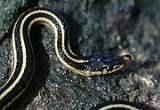
The common garter snake (Thamnophis sirtalis) is a snake
Snake

Snakes are elongate legless carnivore reptiles of the suborder Serpentes that can be distinguished from legless lizards by their lack of eyelids and external ears....
 indigenous to North America
North America

North America is the northern continent of the Americas, situated in the Earth's northern hemisphere and almost totally in the western hemisphere....
. Most garter snakes have a pattern of yellow stripes on a brown background and their average length is about to .

common garter snake is a diurnal
Diurnal animal

Scientific term refered to as an animal behavior, diurnality indicates an animal that is active during the daytime and rests during the night. Animals that are not diurnal might be Nocturnality or crepuscular .  Many animal species are diurnal, including many mammals, insects and birds....
 snake. In summer, it is most active in the morning and late afternoon; in cooler seasons or climates, it restricts its activity to the warm afternoons.

In warmer southern areas, the snake is active year-round; otherwise, it hibernates
Hibernation

Hibernation is a state of inactivity and Metabolism depression in animals, characterized by lower body temperature, slower breathing, and lower metabolic rate....
 in common dens, sometimes in great numbers.


Discussion
Ask a question about 'Common Garter Snake'
Start a new discussion about 'Common Garter Snake'
Answer questions from other users
Full Discussion Forum


Encyclopedia


The common garter snake (Thamnophis sirtalis) is a snake
Snake

Snakes are elongate legless carnivore reptiles of the suborder Serpentes that can be distinguished from legless lizards by their lack of eyelids and external ears....
 indigenous to North America
North America

North America is the northern continent of the Americas, situated in the Earth's northern hemisphere and almost totally in the western hemisphere....
. Most garter snakes have a pattern of yellow stripes on a brown background and their average length is about to .

Description


Life history

The common garter snake is a diurnal
Diurnal animal

Scientific term refered to as an animal behavior, diurnality indicates an animal that is active during the daytime and rests during the night. Animals that are not diurnal might be Nocturnality or crepuscular .  Many animal species are diurnal, including many mammals, insects and birds....
 snake. In summer, it is most active in the morning and late afternoon; in cooler seasons or climates, it restricts its activity to the warm afternoons.

In warmer southern areas, the snake is active year-round; otherwise, it hibernates
Hibernation

Hibernation is a state of inactivity and Metabolism depression in animals, characterized by lower body temperature, slower breathing, and lower metabolic rate....
 in common dens, sometimes in great numbers. On warm winter afternoons, some snakes have been observed emerging from their hibernacula to bask in the sun.

Garter snakes generally mate in March or April, after hibernation. The species is oviparous; females give birth to a litter of 12-40 live young anytime from February through december.

Toxicity

The saliva
Saliva

Saliva is the watery and usually frothy substance produced in the mouths of humans and most other animals. Saliva is produced in and secreted from the salivary glands....
 of a garter snake may be toxic to amphibians and other small animals. For humans, a bite is not dangerous. Most garter snakes also secrete a foul-smelling fluid from postanal gland
Gland

A gland is an Organ in an animal's body that synthesizes a substance for release such as hormones or breast milk, often into the bloodstream or into cavities inside the body or its outer surface ....
s when handled or harmed.

Reproduction

Unlike most snakes, Garter snakes do not lay eggs—they give live birth
Live birth

A live birth occurs when a fetus, whatever its gestational age, exits the maternal body and subsequently shows any sign of life, such as voluntary muscle, heartbeat, or pulsation of the umbilical cord, for however brief a time and regardless of whether the umbilical cord or placenta are intact....
 like mammals. In the early part of spring, when garter snakes are coming out of hibernation, the males generally emerge first, in order to be first in line when the females wake up. Some males will assume the role of a female and lead many of the waiting males away from the burrow, luring them with a fake female pheromone. After such a male has led them away, he "turns" back into a male and races back to the den, just as the females emerge. He is then the first to mate with all the females he can catch. There are generally far more males than females and that is why, during mating season, they form "mating balls," where one or two females will be completely swarmed by 10 or more males. Sometimes a male snake will mate with a female before hibernation and the female will store the sperm in herself until spring, when she will allow her eggs to be fertilized. However, if she mates again in the spring, she will simply absorb the fall of sperm and use the new sperm for her eggs.

Habitat

The habitat
Habitat (ecology)

A habitat is an ecological or Natural_environment area that is inhabited by a particular animal or plant species. It is the natural environment in which an organism lives, or the physical environment that surrounds a species population....
 of the garter snake ranges from forests, fields and prairies to streams, wetlands, meadows, marshes and ponds, and they are often found near water. They are semi-aquatic animal
Aquatic animal

An aquatic animal is an animal, either vertebrate or invertebrate, which lives in water for most or all of its life.Natural environments and the animals that live in them can be categorized as aquatic or terrestrial ecoregion ....
s like most snakes. Habitats range from sea level to mountain locations. Their diet consists mainly of amphibians and earthworm
Earthworm

Earthworm is the common name for the largest members of Oligochaeta in the phylum Annelida. The earthworm is the most known worm in America, and other countries....
s, but also fish
Fish

A fish is any marine biology vertebrate animal that is typically ectothermic , covered with scale , and equipped with two sets of paired fins and several unpaired fins....
, small bird
Bird

Birds are wing, Bipedalismal, endothermic , vertebrate animals that lay egg . There are around 10,000 living species, making them the most numerous tetrapod vertebrates....
s, and rodent
Rodent

Rodentia is an Order of mammals also known as rodents, characterised by two continuously growing Incisors#The_Rodent_incisor in the upper and lower jaws which must be kept short by gnawing....
s. Due to the more aquatic species, garter snakes are effective at catching fish and small to medium tadpoles. The animals that eat the common garter snake are large fish, bull frogs, snapping turtles, milk snake
Milk Snake

The Milk Snake is a species of kingsnake. There are 25 subspecies among the milk snakes, including the commonly named scarlet kingsnake . The subspecies have strikingly different appearance, and many of them have their own common names....
s, hawk
Hawk

The term hawk can be used in several ways:* In strict usage in Europe and Asia, to mean any of the species in the subfamily Accipitrinae, which comprises the genus Accipiter, Micronisus, Melierax, Urotriorchis and Megatriorchis....
s, skunks, fox
Fox

A fox is an animal belonging to any one of about 27 species of small to medium-sized Canidae, characterized by possessing a long, narrow snout, and a bushy tail, or brush....
es as well as domestic cats. The garter snake is also able to adapt in many places, hot and cold. They are able to live in places like the alpine tundra.

Captive care

Garter snakes can make excellent pets because they are small, easily kept in terrariums and feed readily on goldfish and other commercially available live foods. It is advisable not to give a steady diet of earthworms or nightcrawlers since these lack sufficient vitamins for the snake's health. Although they are usually found near water, the pet habitat must be dry with only a water bowl to avoid serious skin diseases. This is true of all snake species, including water snakes.

If a common garter snake is owned as a pet, a 15–25 gallon tank should be enough for one adult snake, baby snakes can live in a 5-gallon tank, and young ones (1-1.5 years) can live in a 10 gallon tank. As the snake ages and becomes more active a 10 gallon tank will be insufficient as they need more room to roam around than a 10-gallon tank provides. Garter snakes will become weak and depressed if they don't have enough room to roam. Always be sure the lid is very secure and has a small enough mesh so the snake cannot escape.

Bedding should be one of the following things: newspaper, paper towels, aspen shavings, "AstroTurf", reptile carpet or other commercially available reptile bedding. Do not use only sand, as these snakes are not a desert species and do not do well on sand; getting sand in its eyes and mouth can kill them. Also DON'T use pine or Cedar; pine is treated with chemicals harmful for reptiles, and cedar produces dust which if inhaled by the snake, can cause serious lung damage. Chlorophyll hampster bedding also is acceptable and allows the snake to burrow. Adding a shallow bowl of clean, dechlorinated water to this tank allows the snake to drink and swim. This water should be changed every day because a garter snake will defecate and urinate in the water and then will drink from it, which causes many illnesses.

Decorations should include many things for the snake to hide in or under, plus a few rocks or ledges for basking in the light. Live plants are not necessary and often their care is inconsistent with a snake's needs (humidity, fertilizing, light and heat needs, etc.), but fake ones will make the snake feel more natural.

Heating can and should be done two ways: a heat mat, sold for reptiles, and a heat lamp or ceramic heat emitter. The mat it is placed under the tank on one end (never the middle) and the heat lamp is placed above the tank. The emitter is sometimes better than a light because Garter snakes are sometimes shy and dislike bright lights, but a lot of garters will learn to love the lights, so experiment until you find what the snake likes best. Place the heat lamp directly over the tank; you will have to adjust the height until there is a temperature range of about 70° F on the cool end (away from the heat mat) and maybe 75 to 80° F on the hot end (with the heat mat).

Use two thermometers, one on each end, to monitor the temperature. During the night time, it would be best to turn off the emitter or light, unless you do not have a mat, because Garters like a little fluctuation in temperatures, but be sure that the hot end never gets below 70 F at night, because this may put the snake in danger of death or at the very least cause him to start hibernating, which is dangerous in itself because he will not eat when he is hibernating, even if he does "wake up". Be sure to put some shade on the cool end so your snake can get cool off if it wants, but allow room on the warm and cool ends for your snake to get comfortable. Remember, its his world you are setting up, so make it a nice place to live. Feeding is something that is widely debated, but the generally accepted foods include pinkie mice
MICE

MICE is an acronym for:*International Muon Ionization Cooling Experiment*"Money, Ideology, Compromise, Ego", four factors by which spies may be recruited....
, known outside the reptile hobby as newborn baby mice, alive will entice feeding, but prekilled is just fine if the snake will eat them, also good are earthworm
Earthworm

Earthworm is the common name for the largest members of Oligochaeta in the phylum Annelida. The earthworm is the most known worm in America, and other countries....
s which are best to be obtained from a bait store, you must be very careful with these as they are sometimes raised in unclean conditions and may transmit bacteria to your snake. Also feedable are guppy
Guppy

The guppy , also known as the millionfish, is one of the most popular List of freshwater aquarium fish species in the world. It is a small member of the Poecilidae family and like all other members of the family, is live-bearing aquarium fish....
 fish, however, feeder goldfish
Goldfish

The goldfish is a domesticated version of the Prussian carp , a dark-gray/brown carp native to Asia. It was first bred for color in China over 1,000 years ago....
 are often raised in extremely dirty conditions, as they are hardier and "easier to abuse" than guppies, so you should not feed goldfish unless you can arrange to check the animals over a period of time for illness. There is also a debate over thiaminase, with goldfish contain, and wither it will make a garter snake ill and die if the snake is fed solely goldfish, as thiaminase depletes vitamin B. Any fish should be fed in a shallow bowl with water, but not the swimming water that you have permanently in the tank, take the food bowl out after the snake has eaten. Foods generally not acceptable are cricket
Cricket

Cricket is a Bat-and-ball games team sport that originated in southern England. The earliest definite reference is dated 1598, and it is now played in more than 100 countries....
s, dusted or otherwise, as Garter snakes in the wild would never eat them and the sharp exoskeletons are hard on Garter snakes, if they even accept them in the first place, so feed these with caution. Young garter snakes often benefit from eating wax worms and mealworms for extra fat boosts, but in general they should only be given as a treat to adult snakes, as it causes obesity. Feeding is generally done twice a week, but if you have a younger snake, feeding should happen more often, up to every other day. Handling is possible, but should be done carefully, because Garter snakes are very delicate and skittish at first, especially a wild caught one. They will sometimes secrete a foul smelling musk from their cloaca (the breeding/defecating/urinating area near the tail end of the snake) This is to make you let him go because he is scared you will eat him. Do not let him go unless you are absolutely too repulsed by the musk, as this will send a message to the snake that it worked and he will keep doing it. In general continue to gently restrain the snake until it is calm and then re-place it into the tank and leave it alone for a couple of days. After a while it will stop musking you and calm down because he will learn that you will not let him go unless he is calm. Some will even enjoy the warmth or your hands and will enjoy being handled. Garter snakes should never be allowed to roam around the house because they can find any number of small spaces to crawl into and escape or be suffocated/crushed/starved to death when you can't find it again. Children should not be allowed to handle a garter snake unless you supervise, as children can squeeze a snake to death or break its back, or any number of horrible things, plus salmonella is an issue if the child kisses the snake. Always use hand sanitizer after handling the snake. Do not worry about being bit. Again, Garter snakes aren't venomous and their bite has no feel.

Taxonomy

Current scientific classification recognizes thirteen subspecies
Subspecies

In biology, subspecies is the taxonomic rank immediately subordinate to a species. A subspecies is a taxonomic group which is less distinct than the Common descent or species from which it originates....
:
  • T.s. sirtalis Linnaeus 1758: Common Garter Snake
  • T.s. parietalis Say
    Thomas Say

    Thomas Say was an United States natural history, entomologist, malacologist and carcinologist. He was a taxonomist and is often considered to be the father of descriptive entomology in the United States and one of the founding fathers of the Entomological Society of America ....
     1823: Red-sided Garter Snake. Has also been introduced to northern Halland
    Halland

    is one of the traditional provinces of Sweden , on the western coast of Sweden. It borders V?sterg?tland, Sm?land, Sk?ne and the sea of Kattegat....
     in Sweden
    Sweden

    Sweden , officially the Kingdom of Sweden , is a Nordic countries on the Scandinavian Peninsula in Northern Europe. Sweden has land borders with Norway to the west and Finland to the northeast, and it is connected to Denmark by the ?resund Bridge in the south....
    , where it thrives.
  • T.s. infernalis Blainville
    Henri Marie Ducrotay de Blainville

    Henri Marie Ducrotay de Blainville was a France zoologist and anatomist.Blainville was born at Arques-la-Bataille, near Dieppe, Seine-Maritime....
     1835: California Red-sided Garter Snake
  • T.s. concinnus Hallowell
    Edward Hallowell

    Edward Hallowell was an United States herpetologist and physician.He studied and practiced medicine in Philadelphia. He also was a renowned herpetologist who described 55 new species of reptiles....
     1852:Red-spotted Garter Snake
  • T.s. dorsalis Baird
    Spencer Fullerton Baird

    Spencer Fullerton Baird was an United States ornithology and ichthyologist....
     and Girard
    Charles Frédéric Girard

    Charles Fr?d?ric Girard was a France biologist specializing on ichthyology and herpetology.Born in Mulhouse, France, he studied at the College of Neuch?tel, Switzerland as a student of Louis Agassiz....
     1853: New Mexico Garter Snake
  • T.s. pickeringii Baird
    Spencer Fullerton Baird

    Spencer Fullerton Baird was an United States ornithology and ichthyologist....
     and Girard
    Charles Frédéric Girard

    Charles Fr?d?ric Girard was a France biologist specializing on ichthyology and herpetology.Born in Mulhouse, France, he studied at the College of Neuch?tel, Switzerland as a student of Louis Agassiz....
     1853: Puget Sound Garter Snake
  • T.s. tetrataenia Cope
    Edward Drinker Cope

    Edward Drinker Cope was an United States paleontology and comparative anatomy, as well as a noted herpetology and ichthyology.Born to a wealthy Society of Friends family, Cope quickly distinguished himself as a child prodigy interested in science; he published his first scientific paper in 1859....
     1875: San Francisco Garter Snake
    San Francisco garter snake

    The San Francisco Garter Snake is a slender multi-colored colubrid snake. Designated as an endangered species since the year 1967, it resides only in San Mateo County, California, and the extreme northern part of coastal Santa Cruz County, California....
    ; endangered
    Endangered species

    An endangered species is a population of an organism which is at risk of becoming extinct because it is either few in numbers, or threatened by changing environmental or predation parameters....
  • T.s. semifasciatus Cope
    Edward Drinker Cope

    Edward Drinker Cope was an United States paleontology and comparative anatomy, as well as a noted herpetology and ichthyology.Born to a wealthy Society of Friends family, Cope quickly distinguished himself as a child prodigy interested in science; he published his first scientific paper in 1859....
     1892: Chicago Garter Snake
  • T.s. pallidulus Allen
    Glover Morrill Allen

    Glover Morrill Allen was a U.S. zoology.He was born at Walpole, New Hampshire, the son of Reverend Nathaniel Glover Allen and Harriet Ann Allen, and studied at Harvard University, Massachusetts....
     1899: Maritime Garter Snake
  • T.s. annectens Brown 1950: Texas Garter Snake
    Texas Garter Snake

    The Texas Garter Snake is a subspecies of the common garter snake from the United States. It is found predominantly in eastern and central Texas, with a disjunct population in Kansas....
  • T.s. fitchi Fox
    Wade Fox

    Wade Fox was a United States zoologist and herpetologist from the University of California, Berkeley. He specialized in the anatomy of snakes and the systematics of the western Garter snakes....
     1951: Valley Garter Snake
  • T.s. similis Rossman
    Douglas A. Rossman

    Douglas A. Rossman is a United States herpetologist specializing in Garter snakes. He studied at the University of Florida, where he was awarded a Doctor of Philosophy in 1961....
     1965: Blue-striped Garter Snake
  • T.s. butleri Cope
    Edward Drinker Cope

    Edward Drinker Cope was an United States paleontology and comparative anatomy, as well as a noted herpetology and ichthyology.Born to a wealthy Society of Friends family, Cope quickly distinguished himself as a child prodigy interested in science; he published his first scientific paper in 1859....
     1889: Butler's Garter Snake


Conservation

Water contamination, urban expansion, and residential and industrial development are all threats to the garter snake. The San Francisco Garter Snake
San Francisco garter snake

The San Francisco Garter Snake is a slender multi-colored colubrid snake. Designated as an endangered species since the year 1967, it resides only in San Mateo County, California, and the extreme northern part of coastal Santa Cruz County, California....
 (T.s. tetrataenia), which is extremely scarce and occurs only in the vicinity of ponds and reservoirs in San Mateo County, California
San Mateo County, California

San Mateo County is a county located in the San Francisco Bay Area of the U.S. state of California. It covers most of the San Francisco Peninsula just south of San Francisco, California, and north of Santa Clara County, California....
, has been listed as an endangered species
Endangered species

An endangered species is a population of an organism which is at risk of becoming extinct because it is either few in numbers, or threatened by changing environmental or predation parameters....
 by the U.S. Fish and Wildlife Service since 1967.

External links