

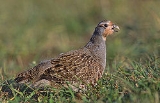
Grey Partridge

Encyclopedia
The Grey Partridge, Perdix perdix, also known as the English Partridge, Hungarian Partridge, or Hun, is a gamebird in the pheasant family Phasianidae
of the order Galliformes
, gallinaceous birds. The species has been successfully introduced to many parts of the world for shooting, including vast areas of North America, where it is most commonly known as Hungarian partridge, or just "Hun". Widespread and common throughout its large range, the Grey Partridge is evaluated as Least Concern on the IUCN Red List
of Threatened Species. This partridge
breeds on farmland across most of Europe
into western Asia
, and has been introduced widely into North America
. They are quite common in some areas of southern Canada
and the northern United States
.
The Grey Partridge is a rotund bird, 28–32 cm long, brown-backed, with grey flanks and chest. The belly is white, usually marked with a large chestnut-brown horse-shoe mark in males, and also in many females. Hens lay up to twenty eggs in a ground nest. The nest is usually in the margin of a cereal field, most commonly Winter wheat
. The only major and constant difference between the sexes is the so-called cross of Lorraine on the tertiary coverts of females – these being marked with two transverse bars, as opposed to the one in males. These are present after around 16 weeks of age when the birds have moulted into adult plumage. Young Grey Partridges are mostly yellow-brown and lack the distinctive face and underpart markings. The song is a harsh kieerr-ik, and when disturbed, like most of the gamebirds, it flies a short distance on rounded wings, often calling rick rick rick as it rises. They are a seed-eating species, but the young in particular take insect
s as an essential protein
supply. During the first 10 days of life, the young can only digest insects. The parents lead their chicks to the edges of cereal
fields, where they can forage for insects. They are also a non-migratory
terrestrial species, and form flocks outside the breeding season.
Though common and not threatened, it appears to be declining in numbers in some areas of intensive cultivation such as Great Britain
, probably due to a loss of breeding habitat and possibly food supplies. Their numbers have fallen in these areas by as much as 85% in the last 25 years. Efforts are being made in Great Britain
by organizations such as the Game & Wildlife Conservation Trust
to halt this decline by creating Conservation headland
s. In 1995 it was nominated a Biodiversity Action plan species. In Ireland
it is now virtually confined to the Lough Boora reserve in County Offaly
where a recent conservation project has succeeded in boosting its numbers to 900. (see UK BAP).
:
Phasianidae
The Phasianidae is a family of birds which consists of the pheasants and partridges, including the junglefowl , Old World Quail, francolins, monals and peafowl. The family is a large one, and is occasionally broken up into two subfamilies, the Phasianinae, and the Perdicinae...
of the order Galliformes
Galliformes
Galliformes are an order of heavy-bodied ground-feeding domestic or game bird, containing turkey, grouse, chicken, New and Old World Quail, ptarmigan, partridge, pheasant, and the Cracidae. Common names are gamefowl or gamebirds, landfowl, gallinaceous birds or galliforms...
, gallinaceous birds. The species has been successfully introduced to many parts of the world for shooting, including vast areas of North America, where it is most commonly known as Hungarian partridge, or just "Hun". Widespread and common throughout its large range, the Grey Partridge is evaluated as Least Concern on the IUCN Red List
IUCN Red List
The IUCN Red List of Threatened Species , founded in 1963, is the world's most comprehensive inventory of the global conservation status of biological species. The International Union for Conservation of Nature is the world's main authority on the conservation status of species...
of Threatened Species. This partridge
Partridge
Partridges are birds in the pheasant family, Phasianidae. They are a non-migratory Old World group.These are medium-sized birds, intermediate between the larger pheasants and the smaller quails. Partridges are native to Europe, Asia, Africa, and the Middle East...
breeds on farmland across most of Europe
Europe
Europe is, by convention, one of the world's seven continents. Comprising the westernmost peninsula of Eurasia, Europe is generally 'divided' from Asia to its east by the watershed divides of the Ural and Caucasus Mountains, the Ural River, the Caspian and Black Seas, and the waterways connecting...
into western Asia
Asia
Asia is the world's largest and most populous continent, located primarily in the eastern and northern hemispheres. It covers 8.7% of the Earth's total surface area and with approximately 3.879 billion people, it hosts 60% of the world's current human population...
, and has been introduced widely into North America
North America
North America is a continent wholly within the Northern Hemisphere and almost wholly within the Western Hemisphere. It is also considered a northern subcontinent of the Americas...
. They are quite common in some areas of southern Canada
Canada
Canada is a North American country consisting of ten provinces and three territories. Located in the northern part of the continent, it extends from the Atlantic Ocean in the east to the Pacific Ocean in the west, and northward into the Arctic Ocean...
and the northern United States
United States
The United States of America is a federal constitutional republic comprising fifty states and a federal district...
.
The Grey Partridge is a rotund bird, 28–32 cm long, brown-backed, with grey flanks and chest. The belly is white, usually marked with a large chestnut-brown horse-shoe mark in males, and also in many females. Hens lay up to twenty eggs in a ground nest. The nest is usually in the margin of a cereal field, most commonly Winter wheat
Winter wheat
Winter wheat is a type of wheat that is planted from September to December in the Northern Hemisphere. Winter wheat sprouts before freezing occurs, then becomes dormant until the soil warms in the spring. Winter wheat needs a few weeks of cold before being able to flower, however persistent snow...
. The only major and constant difference between the sexes is the so-called cross of Lorraine on the tertiary coverts of females – these being marked with two transverse bars, as opposed to the one in males. These are present after around 16 weeks of age when the birds have moulted into adult plumage. Young Grey Partridges are mostly yellow-brown and lack the distinctive face and underpart markings. The song is a harsh kieerr-ik, and when disturbed, like most of the gamebirds, it flies a short distance on rounded wings, often calling rick rick rick as it rises. They are a seed-eating species, but the young in particular take insect
Insect
Insects are a class of living creatures within the arthropods that have a chitinous exoskeleton, a three-part body , three pairs of jointed legs, compound eyes, and two antennae...
s as an essential protein
Protein
Proteins are biochemical compounds consisting of one or more polypeptides typically folded into a globular or fibrous form, facilitating a biological function. A polypeptide is a single linear polymer chain of amino acids bonded together by peptide bonds between the carboxyl and amino groups of...
supply. During the first 10 days of life, the young can only digest insects. The parents lead their chicks to the edges of cereal
Cereal
Cereals are grasses cultivated for the edible components of their grain , composed of the endosperm, germ, and bran...
fields, where they can forage for insects. They are also a non-migratory
Bird migration
Bird migration is the regular seasonal journey undertaken by many species of birds. Bird movements include those made in response to changes in food availability, habitat or weather. Sometimes, journeys are not termed "true migration" because they are irregular or in only one direction...
terrestrial species, and form flocks outside the breeding season.
Though common and not threatened, it appears to be declining in numbers in some areas of intensive cultivation such as Great Britain
Great Britain
Great Britain or Britain is an island situated to the northwest of Continental Europe. It is the ninth largest island in the world, and the largest European island, as well as the largest of the British Isles...
, probably due to a loss of breeding habitat and possibly food supplies. Their numbers have fallen in these areas by as much as 85% in the last 25 years. Efforts are being made in Great Britain
Great Britain
Great Britain or Britain is an island situated to the northwest of Continental Europe. It is the ninth largest island in the world, and the largest European island, as well as the largest of the British Isles...
by organizations such as the Game & Wildlife Conservation Trust
Game & Wildlife Conservation Trust
The Game & Wildlife Conservation Trust is a British charitable organisation, principally associated with the shooting industry, promoting game and wildlife management as an essential part of nature conservation...
to halt this decline by creating Conservation headland
Conservation headland
A Conservation Headland is a strip along the edge of an agricultural field, where pesticides is sprayed only in a selective manner. This increases the number and type of weed and insect species present, and benefits the bird species that depend on them...
s. In 1995 it was nominated a Biodiversity Action plan species. In Ireland
Ireland
Ireland is an island to the northwest of continental Europe. It is the third-largest island in Europe and the twentieth-largest island on Earth...
it is now virtually confined to the Lough Boora reserve in County Offaly
County Offaly
County Offaly is a county in Ireland. It is part of the Midlands Region and is also located in the province of Leinster. It is named after the ancient Kingdom of Uí Failghe and was formerly known as King's County until the establishment of the Irish Free State in 1922. Offaly County Council is...
where a recent conservation project has succeeded in boosting its numbers to 900. (see UK BAP).
Subspecies
There are eight recognized subspeciesSubspecies
Subspecies in biological classification, is either a taxonomic rank subordinate to species, ora taxonomic unit in that rank . A subspecies cannot be recognized in isolation: a species will either be recognized as having no subspecies at all or two or more, never just one...
:
- P. p. amoricana (HartertErnst HartertErnst Johann Otto Hartert was a German ornithologist. Hartert was born in Hamburg. He was employed by Lionel Walter Rothschild as ornithological curator of his private museum at Tring from 1892 to 1929....
, 1917) - locally in FranceFranceThe French Republic , The French Republic , The French Republic , (commonly known as France , is a unitary semi-presidential republic in Western Europe with several overseas territories and islands located on other continents and in the Indian, Pacific, and Atlantic oceans. Metropolitan France... - P. p. canescens (BurturlinSergei Aleksandrovich ButurlinSergei Aleksandrovich Buturlin was a Russian ornithologist.A scion of one of the oldest families of Russian nobility, Buturlin spent most his life in Russia. He went to school in Simbirsk and studied jurisprudence in St...
, 1906) - Southern Grey Partridge - TurkeyTurkeyTurkey , known officially as the Republic of Turkey , is a Eurasian country located in Western Asia and in East Thrace in Southeastern Europe...
east to the South CaucasusSouth CaucasusThe South Caucasus is a geopolitical region located on the border of Eastern Europe and Southwest Asia also referred to as Transcaucasia, or The Trans-Caucasus...
and northwest IranIranIran , officially the Islamic Republic of Iran , is a country in Southern and Western Asia. The name "Iran" has been in use natively since the Sassanian era and came into use internationally in 1935, before which the country was known to the Western world as Persia... - P. p. hispaniensis (ReichenowAnton ReichenowAnton Reichenow was a German ornithologist.Reichenow was the son-in-law of Jean Cabanis, and worked at the Humboldt Museum from 1874 to 1921. He was an expert on African birds, making a collecting expedition to West Africa in 1872 and 1873, and writing Die Vögel Afrikas...
, 1892) - Iberian Partridge - central PyreneesPyreneesThe Pyrenees is a range of mountains in southwest Europe that forms a natural border between France and Spain...
to northeast PortugalPortugalPortugal , officially the Portuguese Republic is a country situated in southwestern Europe on the Iberian Peninsula. Portugal is the westernmost country of Europe, and is bordered by the Atlantic Ocean to the West and South and by Spain to the North and East. The Atlantic archipelagos of the... - P. p. italica (Hartert, 1917) - Italian Grey Partridge
- P. p. lucida (AltumBernard AltumBernard Altum full name Johann Bernard Theodor Altum was a German catholic priest, zoologist, and forest scientist.He wrote...
, 1894) - Eastern Grey Partridge - FinlandFinlandFinland , officially the Republic of Finland, is a Nordic country situated in the Fennoscandian region of Northern Europe. It is bordered by Sweden in the west, Norway in the north and Russia in the east, while Estonia lies to its south across the Gulf of Finland.Around 5.4 million people reside...
east to Ural MountainsUral MountainsThe Ural Mountains , or simply the Urals, are a mountain range that runs approximately from north to south through western Russia, from the coast of the Arctic Ocean to the Ural River and northwestern Kazakhstan. Their eastern side is usually considered the natural boundary between Europe and Asia...
and south to Black SeaBlack SeaThe Black Sea is bounded by Europe, Anatolia and the Caucasus and is ultimately connected to the Atlantic Ocean via the Mediterranean and the Aegean seas and various straits. The Bosphorus strait connects it to the Sea of Marmara, and the strait of the Dardanelles connects that sea to the Aegean...
and northern CaucasusCaucasusThe Caucasus, also Caucas or Caucasia , is a geopolitical region at the border of Europe and Asia, and situated between the Black and the Caspian sea... - P. p. perdix (Linnaeus, 1758) - nominate - British IslesBritish IslesThe British Isles are a group of islands off the northwest coast of continental Europe that include the islands of Great Britain and Ireland and over six thousand smaller isles. There are two sovereign states located on the islands: the United Kingdom of Great Britain and Northern Ireland and...
and southern ScandinaviaScandinaviaScandinavia is a cultural, historical and ethno-linguistic region in northern Europe that includes the three kingdoms of Denmark, Norway and Sweden, characterized by their common ethno-cultural heritage and language. Modern Norway and Sweden proper are situated on the Scandinavian Peninsula,...
to ItalyItalyItaly , officially the Italian Republic languages]] under the European Charter for Regional or Minority Languages. In each of these, Italy's official name is as follows:;;;;;;;;), is a unitary parliamentary republic in South-Central Europe. To the north it borders France, Switzerland, Austria and...
and the BalkansBalkansThe Balkans is a geopolitical and cultural region of southeastern Europe... - P. p. robusta (HomeyerEugen Ferdinand von HomeyerEugen Ferdinand von Homeyer was a German ornithologist. He made early studies of the birds of Pomerania....
and Tancré, 1883) - Southeastern Grey Partridge - Ural MountainsUral MountainsThe Ural Mountains , or simply the Urals, are a mountain range that runs approximately from north to south through western Russia, from the coast of the Arctic Ocean to the Ural River and northwestern Kazakhstan. Their eastern side is usually considered the natural boundary between Europe and Asia...
to southwestern SiberiaSiberiaSiberia is an extensive region constituting almost all of Northern Asia. Comprising the central and eastern portion of the Russian Federation, it was part of the Soviet Union from its beginning, as its predecessor states, the Tsardom of Russia and the Russian Empire, conquered it during the 16th...
and northwestern ChinaChinaChinese civilization may refer to:* China for more general discussion of the country.* Chinese culture* Greater China, the transnational community of ethnic Chinese.* History of China* Sinosphere, the area historically affected by Chinese culture... - P. p. sphagnetorum (Altum, 1894) - moors of northern Holland and northwest GermanyGermanyGermany , officially the Federal Republic of Germany , is a federal parliamentary republic in Europe. The country consists of 16 states while the capital and largest city is Berlin. Germany covers an area of 357,021 km2 and has a largely temperate seasonal climate...
External links
- BirdLife Species Factsheet
- IUCN Red List
- Game & Wildlife Conservation Trust
- Game & Wildlife Conservation Trust - Grey Partridge
- Grey Partridge videos, photos & sounds on the Internet Bird Collection
- Cornell Lab of Ornithology - Grey Partridge
- South Dakota Birds - Grey Partridge
- Ageing and sexing (PDF) by Javier Blasco-Zumeta