

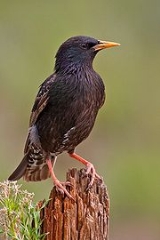
European Starling

Encyclopedia
The Common Starling , also known as the European Starling or just Starling, is a passerine
bird
in the family Sturnidae.
This species of starling
is native to most of temperate Europe
and western Asia
. It is resident in southern and western Europe and southwestern Asia, while northeastern populations migrate
south and west in winter to these regions, and also further south to areas where it does not breed in Iberia
and north Africa
. It has also been introduced to Australia
, New Zealand
, North America
, and South Africa
.
Sturnus
, the Common Starling is the type species
, the one with all the typical characteristics of its genus. It is in this genus that the terrestrial feeding technique of open-bill probing is most advanced; the technique involves prying into the ground by inserting and opening the bill as a way of searching for hidden food items. Common Starlings have the physical traits that enable them to use this feeding technique, which has undoubtedly helped the species spread far and wide.
Along with Sturnus vulgaris, the Sturnus genus includes a number of species which are apparently more-or-less distantly related, but some contend that if the taxonomy is to be based on natural evolutionary grouping, then only the European and Spotless Starling
ought to be grouped together.
of the European Starling, which vary in the iridescence of adult plumage. With gradual variation over geographic range and extensive intergradation
, the subspecies are said to be clinal. Acceptance of different subspecies varies between different authorities.
Several other forms have been named, but are generally no longer considered valid. Most are intergrades from where the ranges of various subspecies meet.
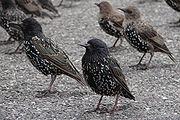 It is among the most familiar of birds in temperate regions. It is 19 – long, with a wingspan of 31 – and a weight of 60 –. The plumage
is shiny black, glossed purple or green, and spangled with white, particularly strongly so in winter. Adult male European Starlings are less spotted below than adult females. The throat feathers are long and loose, and used as a signal in display. Juveniles are grey-brown, and by their first winter resemble adults though often retain some brown juvenile feathering especially on the head in the early part of the winter. The legs are stout, pinkish-red. The bill is narrow conical with a sharp tip; in summer, it is yellow in females, and yellow with a blue-grey base in males, while in winter, and in juveniles, it is black in both sexes. Moult
ing occurs once a year, in late summer after the breeding season is finished; the fresh feathers are prominently tipped white (breast feathers) or buff (wing and back feathers). The reduction in the spotting in the breeding season is achieved by the white feather tips largely wearing off. Starlings walk rather than hop. Their flight is quite strong and direct; they look triangular-winged and short-tailed in flight.
Confusion with other species is only likely in Iberia, the western Mediterranean and northwest Africa in winter, when it has to be distinguished from the closely related Spotless Starling
, which, as its name implies, has less spotting on its plumage. The Spotless Starling can also be diagnostically distinguished at close range by its longer throat feathers. At a more basic level, adult male European Blackbirds can easily be distinguished by more slender body shape, longer tail, and behaviour; they hop instead of walking and do not probe for food with open bills. In flight, only the much paler waxwing
s share a similar flight profile.
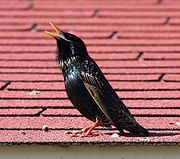
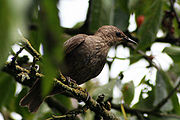 The Common Starling is a noisy bird uttering a wide variety of both melodic and mechanical-sounding sounds, including a distinctive "wolf-whistle
". Starlings are mimics, like many of its family. In captivity, Starlings will learn to imitate all types of sounds and speech earning them the nickname "poor-man's Myna
".
Songs are more commonly sung by males, although females also sing. Songs consist of a mixture of mimicry, clicks, wheezes, chattering, whistles, rattles, and piping notes. Besides song, 11 other calls have been described, including a Flock Call, Threat Call, Attack Call, Snarl Call, and Copulation Call. Birds chatter while roosting and bathing—making a great deal of noise that can frustrate local human inhabitants. Even when a flock of starlings is completely silent, the synchronized movements of the flock make a distinctive whooshing sound that can be heard hundreds of metres away.
or suburban areas where artificial structures and trees provide adequate nesting and roosting sites. They also commonly reside in grassy areas where foraging is easy—such as farmland, grazing pastures, playing fields, golf courses, and airfields. They occasionally inhabit open forests and woodlands and more rarely in shrublands such as the Australian heathland. European Starlings rarely inhabit dense, wet forests (i.e. rainforests or wet sclerophyll
forests). Common starlings have also adapted to coastal areas, where they nest and roost on cliffs and forage amongst seaweed. Their ability to adapt to a large variety of habitats has allowed for their dispersal and establishment throughout the world—resulting in a habitat range from coastal wetlands to alpine
forests, from sea level to 1900 metres above sea level.
Widespread throughout the northern hemisphere, the European Starling is native to Eurasia
and is found throughout Europe
, northern Africa
(from Morocco
to Egypt), northern India
, Nepal
, the Middle East
(including Syria
, Iraq
, and Iraq
), and north-western China
. Furthermore, it has been introduced to and successfully established itself in New Zealand
, Australia
, South Africa
, North America
, Fiji
, and several Caribbean
islands. As a result, it has also been able to migrate to Thailand
, Southeast Asia
, and New Guinea
. In Australia
, Common Starlings are present throughout the southeast, although some isolated populations have been observed in northern and Western Australia
. They are prevalent throughout New South Wales
, Victoria
, Queensland
, Tasmania
, and scattered sites in the southeastern part of Western Australia.
is highly variable, with huge flocks providing a spectacular sight and sound usually occurring near roosts. These huge flocks often attract birds of prey
such as Merlin
s or Sparrowhawks. Flocks form a tight sphere
-like formation in flight, frequently expanding and contracting and changing shape, seemingly without any sort of leader. Very large roosts, exceptionally up to 1.5 million birds, can form in city centres, woodlands, or reedbeds, causing problems with their droppings. These may accumulate up to 30 cm deep, killing trees by their chemical concentration; in smaller amounts, the droppings are, however, beneficial as a fertiliser, and therefore woodland managers may try to move roosts from one area of a wood to another to spread the benefit and avoid large toxic deposits.
Huge flocks of more than a million Starlings are observed just before sunset in spring in southwestern Jutland
, Denmark
. There they gather in March until northern Scandinavia
n birds leave for their breeding ranges by mid-April. Their flocking creates complex shapes against the sky, a phenomenon known locally as sort sol
("Black Sun"). To witness this spectacle, the best places are the seaward marshlands (marsken in Danish) of Tønder
and Esbjerg
municipalities between Tønder and Ribe
.
Flocks of anything from five to fifty thousand Starlings form in areas of the UK just before sundown during mid winter. These flocks are commonly called a Starling "Moot".
Starlings are hunted by birds of prey, including the Peregrine Falcon
and Brown Falcon
. However, in the 1970s the consumption of chemically treated (DDT
) crops by the starlings which were subsequently eaten by Peregrine Falcons caused a dangerous build-up of the toxin in the falcon. As a result, lower reproductive success was observed as a result of thinner eggshells and a build-up of organochlorine residues in eggs.
European Starling nests are especially vulnerable to predators such as stoats, foxes, and humans. Common Myna
s are also a threat, as they often evict eggs, nestlings, and adult starlings from their nests.
, and cicadas, as well as spiders. While the consumption of invertebrates is necessary for successful breeding, starlings are omnivorous and can also eat grains
, seeds
, fruits, nectars, and garbage, if the opportunity arises. There are several methods by which they forage for their food; but for the most part, they forage from or near the ground, taking insects from or beneath the surface of the soil. Generally, starlings prefer foraging amongst short-cropped grasses and are often found between and on top of grazing animals out to pasture. Large flocks forage together, in a practice called “roller-feeding”: where the birds at the back of the flock continually fly to the front of the flock as they forage so that every bird has a turn to lead (1957). The larger the flock, the nearer individuals are to one another while foraging. Flocks often forage in one place for some time, and return to previous successfully foraged sites.
There are four types of foraging observed in the European Starling:
Among European Starling, sallying and probing are the most common foraging behaviors.
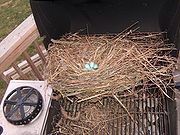 Unpaired males begin to build nests in order to attract single females. Males often decorate the nest with ornaments (such as flowers) and fresh green material which the female later disassembles upon accepting him as a mate . The males sing throughout much of the construction and even more so when a female approaches his nest. Following copulation, the male and female continue to build the nest. Common nesting locations include inside hollowed trees, buildings, tree stumps, and man-made nest-boxes. Nests are typically made out of straw, dry grass, twigs and inner lining made up of feathers, wool, and soft leaves. Construction typically takes 4 to 5 days and may continue through incubation. Fresh herbs are added to nests and work as insect repellent.
Starlings are both monogamous and polygamous; although broods are generally brought up by one male and one female, occasionally the pair may have an extra helper. Pairs may be part of a larger colony, in which case several other nests may occupy the same or nearby trees.
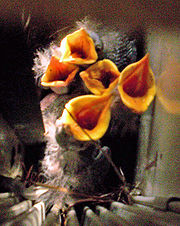 The breeding season begins in early spring and summer. In Australia, eggs are typically laid from late September to late November but the range extends from late July to December. Following copulation, female European Starlings will lay an egg on a daily basis over a period of several days. If an egg is lost during this time period, she will lay another egg to replace it. The eggs (4-5) are small elliptical blue (and occasionally white) eggs that commonly have a glossy appearance to them. Incubation
lasts 13 days, although the last egg laid may take 24 hours longer than the first to hatch. Both parents share the responsibility of sitting on top of the eggs. However, the female spends more time incubating the eggs than the male, and is the only parent to do so at night (while the male returns to the communal roost). The young are born blind and naked. They develop light fluffy down within 7 days of hatching and sight within 9 days. Nestlings remain in the nest for 3 weeks, where they are fed continuously by both their parents. Fledglings continue to be fed by their parents for 1–2 weeks. Pairs can raise up to three broods per breeding season, frequently reusing and relining the same nest. Within two months, most juveniles have molted and gained their first basic plumage. Juveniles acquire their adult plumage the following year.
Intraspecific brood parasites are common in European Starling nests. Female "floaters" (unpaired females during the breeding season) present in colonies often lay eggs in another pair's nest. Additionally, fledglings have been reported to invade their previous nests or neighboring nests and evicting the new brood.
due to declines of more than 50%. In the United Kingdom
, it declined by more than 80% between 1966 and 2004; although populations in some areas—such as Northern Ireland
—are stable or even increasing, those in other areas—mainly in England—declined even more sharply. The overall decline has been attributed to a loss of food-rich permanent pasture, leading to the low survival rates of young birds. Major declines have also been observed from 1980 onward in Sweden
, Finland
, northern Russia
(Karelia
), and the Baltic States
, and smaller declines in much of the rest of northern and central Europe. In contrast, there have been increases in southern Europe, particularly in Italy
, southern France, and northeastern Spain where the species first began breeding in the 1960s.
Earlier, the European Starling had shown marked increases throughout Europe in the period 1800-1900. Before 1800, it had a disjunct range in the British Isles
, absent from central and southern Scotland
, with S. vulgaris zetlandicus in the far north and northwest (Shetland, Orkney, Caithness, Outer Hebrides), and S. vulgaris vulgaris south of the Scottish-English border; it was also rare or regionally absent in Ireland
, western Wales
and western and northernmost England. Between 1800 and 1900, S. vulgaris vulgaris colonised north and westward from England to Ireland and all of Scotland except for Shetland (where zetlandicus remains present); since 1935, this subspecies has also spread to Iceland
, where it now breeds in the southeast and southwest. S. vulgaris vulgaris is also occasionally seen in the Faroes.
is now widely dependent on artificial nest houses put up by humans, which must be protected from colonization by European Starlings.
, an important crop. Nest-boxes for the newly released species were placed on farms and near crops. The Common Starling was introduced to Melbourne
in 1857 then Sydney
in 1880. By the 1880s, established populations were present in the southeast, thanks to the work of acclimatization committees. By the 1920s, starlings were widespread through Victoria
, Queensland
, and New South Wales
, but they were now recognized as pests and Western Australia
banned their import in 1895.
The Common Starling threatens both Australian economy
and biodiversity
. They commonly eat and damage fruit from orchards, such as grape
s, peach
es, olive
s, currant
s, and tomato
es. In addition, starlings dig up newly sown grain and diminish already growing crops—an easy task for a flock of 500 – 150,000 birds. The Common Starling will also eat and foul food meant for livestock, putting the health of livestock at stake. The accumulation of waste left behind by large flocks may ruin human water supplies and cities, as well as natural habitats for Australian fauna.
Australia is home to numerous endemic plants and animals — species that live nowhere else on earth. The Common Starling is an aggressive bird that displaces other hollow nesting, endemic Australian birds. With so many of these native species already endangered, the starling poses a significant threat. They also pose a risk to the native and endemic Australian flora. Seeds will often germinate more successfully after ingestion, and, as they are capable of eating almost any kind of seed and flying great distances, Common Starlings are excellent weed dispersers. They are responsible for spreading invasive plant species such as the Bridal Creeper.
As a result, the government of Western Australia
has gone to great lengths to keep the Common Starling on the other side of their borders. In the state's 2007-2008 budget, an additional A$4.9 million (2007) was allocated to the control and eradication program. New flocks are routinely shot down, while the less cautious juveniles are trapped and netted. New methods are currently being developed, the first of which tags one bird and follows it back to the rest of the flock, exposing a new population for termination. The second analyzes the DNA of Australian Common Starling populations to track where the migration from eastern to Western Australia is occurring so that better preventative strategies can be used.
descended from 60 to 100 birds http://www.birds.cornell.edu/AllAboutBirds/BirdGuide/European_Starling.html released in Central Park
, New York
by Eugene Schieffelin
. He was president of the infamous American Acclimatization Society
which tried to introduce every bird species mentioned in the works of William Shakespeare
to North America in 1890, and this turned into a terrible environmental disaster.
Being an introduced species
European starlings are exempt from the Migratory Bird Treaty Act. Starlings are among the worst nuisance species in North America. The birds travel in enormous flocks; pose danger to air travel; disrupt farms; displace native birds; and roost on city blocks. Corrosive droppings on structures cause hundreds of millions of dollars of yearly damage. In 2008 the U.S. government poisoned, shot or trapped 1.7 million, the most of any nuisance species.
region, and less common north to the Johannesburg
area. It is not as damaging to agriculture in South Africa as it is in the USA.
Passerine
A passerine is a bird of the order Passeriformes, which includes more than half of all bird species. Sometimes known as perching birds or, less accurately, as songbirds, the passerines form one of the most diverse terrestrial vertebrate orders: with over 5,000 identified species, it has roughly...
bird
Bird
Birds are feathered, winged, bipedal, endothermic , egg-laying, vertebrate animals. Around 10,000 living species and 188 families makes them the most speciose class of tetrapod vertebrates. They inhabit ecosystems across the globe, from the Arctic to the Antarctic. Extant birds range in size from...
in the family Sturnidae.
This species of starling
Starling
Starlings are small to medium-sized passerine birds in the family Sturnidae. The name "Sturnidae" comes from the Latin word for starling, sturnus. Many Asian species, particularly the larger ones, are called mynas, and many African species are known as glossy starlings because of their iridescent...
is native to most of temperate Europe
Europe
Europe is, by convention, one of the world's seven continents. Comprising the westernmost peninsula of Eurasia, Europe is generally 'divided' from Asia to its east by the watershed divides of the Ural and Caucasus Mountains, the Ural River, the Caspian and Black Seas, and the waterways connecting...
and western Asia
Asia
Asia is the world's largest and most populous continent, located primarily in the eastern and northern hemispheres. It covers 8.7% of the Earth's total surface area and with approximately 3.879 billion people, it hosts 60% of the world's current human population...
. It is resident in southern and western Europe and southwestern Asia, while northeastern populations migrate
Bird migration
Bird migration is the regular seasonal journey undertaken by many species of birds. Bird movements include those made in response to changes in food availability, habitat or weather. Sometimes, journeys are not termed "true migration" because they are irregular or in only one direction...
south and west in winter to these regions, and also further south to areas where it does not breed in Iberia
Iberian Peninsula
The Iberian Peninsula , sometimes called Iberia, is located in the extreme southwest of Europe and includes the modern-day sovereign states of Spain, Portugal and Andorra, as well as the British Overseas Territory of Gibraltar...
and north Africa
Africa
Africa is the world's second largest and second most populous continent, after Asia. At about 30.2 million km² including adjacent islands, it covers 6% of the Earth's total surface area and 20.4% of the total land area...
. It has also been introduced to Australia
Australia
Australia , officially the Commonwealth of Australia, is a country in the Southern Hemisphere comprising the mainland of the Australian continent, the island of Tasmania, and numerous smaller islands in the Indian and Pacific Oceans. It is the world's sixth-largest country by total area...
, New Zealand
New Zealand
New Zealand is an island country in the south-western Pacific Ocean comprising two main landmasses and numerous smaller islands. The country is situated some east of Australia across the Tasman Sea, and roughly south of the Pacific island nations of New Caledonia, Fiji, and Tonga...
, North America
North America
North America is a continent wholly within the Northern Hemisphere and almost wholly within the Western Hemisphere. It is also considered a northern subcontinent of the Americas...
, and South Africa
South Africa
The Republic of South Africa is a country in southern Africa. Located at the southern tip of Africa, it is divided into nine provinces, with of coastline on the Atlantic and Indian oceans...
.
Taxonomy
In the genusGenus
In biology, a genus is a low-level taxonomic rank used in the biological classification of living and fossil organisms, which is an example of definition by genus and differentia...
Sturnus
Sturnus
Sturnus is a genus of starlings. As discussed below, the taxonomy of this group is complex, and other authorities differ considerably in which species they place in this genus, and in the species boundaries within Sturnus....
, the Common Starling is the type species
Type species
In biological nomenclature, a type species is both a concept and a practical system which is used in the classification and nomenclature of animals and plants. The value of a "type species" lies in the fact that it makes clear what is meant by a particular genus name. A type species is the species...
, the one with all the typical characteristics of its genus. It is in this genus that the terrestrial feeding technique of open-bill probing is most advanced; the technique involves prying into the ground by inserting and opening the bill as a way of searching for hidden food items. Common Starlings have the physical traits that enable them to use this feeding technique, which has undoubtedly helped the species spread far and wide.
Along with Sturnus vulgaris, the Sturnus genus includes a number of species which are apparently more-or-less distantly related, but some contend that if the taxonomy is to be based on natural evolutionary grouping, then only the European and Spotless Starling
Spotless Starling
The Spotless Starling Sturnus unicolor is a passerine bird in the starling family Sturnidae. It is closely related to the Common Starling S. vulgaris, but has a much more restricted range, confined to the Iberian Peninsula, northwest Africa, southernmost France, and on the islands of Sicily,...
ought to be grouped together.
Subspecies
There are several subspeciesSubspecies
Subspecies in biological classification, is either a taxonomic rank subordinate to species, ora taxonomic unit in that rank . A subspecies cannot be recognized in isolation: a species will either be recognized as having no subspecies at all or two or more, never just one...
of the European Starling, which vary in the iridescence of adult plumage. With gradual variation over geographic range and extensive intergradation
Intergradation
In zoology, intergradation is the way in which two distinct subspecies are connected via areas where populations are found that have the characteristics of both...
, the subspecies are said to be clinal. Acceptance of different subspecies varies between different authorities.
- Sturnus vulgaris vulgaris Linnaeus, 1758. Common Starling. Most of Europe, except the far northwest and far southeast; also IcelandIcelandIceland , described as the Republic of Iceland, is a Nordic and European island country in the North Atlantic Ocean, on the Mid-Atlantic Ridge. Iceland also refers to the main island of the country, which contains almost all the population and almost all the land area. The country has a population...
and the Canary IslandsCanary IslandsThe Canary Islands , also known as the Canaries , is a Spanish archipelago located just off the northwest coast of mainland Africa, 100 km west of the border between Morocco and the Western Sahara. The Canaries are a Spanish autonomous community and an outermost region of the European Union...
, where it is a recent colonist. Introduced populations worldwide also belong to this subspecies.
- Nominate subspecies. The gloss is green on the head, belly and lower back, bronzy purple on the neck to upper chest and back, and purplish on the flanks and upper wing-coverts. Inconspicuous light buff fringes are present on the under wing-coverts. In eastern parts of range, more purplish and less bronzy gloss.
- Sturnus vulgaris faroensis FeildenHenry Wemyss FeildenColonel Henry Wemyss Feilden was a British Army officer, Arctic explorer and naturalist.Feilden was the second son of Sir William Henry Feilden , 2nd Baronet of Feniscowles). After joining the Black Watch, at the age of nineteen, he fought in the suppression of the Indian Mutiny...
, 1872. Faroese Starling; sometimes misspelt faeroensis or faroeensis. Faroe IslandsFaroe IslandsThe Faroe Islands are an island group situated between the Norwegian Sea and the North Atlantic Ocean, approximately halfway between Scotland and Iceland. The Faroe Islands are a self-governing territory within the Kingdom of Denmark, along with Denmark proper and Greenland...
.
- Sturnus vulgaris faroensis Feilden
- Slightly larger than nominate, especially bill and feet. Adult with darker and duller green gloss and far less spotting even in fresh plumage. Juvenile sooty black with whitish chin and areas on belly; throat spotted black.
- Sturnus vulgaris zetlandicus HartertErnst HartertErnst Johann Otto Hartert was a German ornithologist. Hartert was born in Hamburg. He was employed by Lionel Walter Rothschild as ornithological curator of his private museum at Tring from 1892 to 1929....
, 1918. Shetland Starling. Shetland IslandsShetland IslandsShetland is a subarctic archipelago of Scotland that lies north and east of mainland Great Britain. The islands lie some to the northeast of Orkney and southeast of the Faroe Islands and form part of the division between the Atlantic Ocean to the west and the North Sea to the east. The total...
.
- Sturnus vulgaris zetlandicus Hartert
- Like faroensis but intermediate in size between that and vulgaris. Birds from Fair IsleFair IsleFair Isle is an island in northern Scotland, lying around halfway between mainland Shetland and the Orkney islands. It is famous for its bird observatory and a traditional style of knitting.-Geography:...
, St KildaSt Kilda, ScotlandSt Kilda is an isolated archipelago west-northwest of North Uist in the North Atlantic Ocean. It contains the westernmost islands of the Outer Hebrides of Scotland. The largest island is Hirta, whose sea cliffs are the highest in the United Kingdom and three other islands , were also used for...
and the Outer HebridesOuter HebridesThe Outer Hebrides also known as the Western Isles and the Long Island, is an island chain off the west coast of Scotland. The islands are geographically contiguous with Comhairle nan Eilean Siar, one of the 32 unitary council areas of Scotland...
are intermediate between this subspecies and the nominate and placement with vulgarisor zetlandicus varies according to authority. Dark juveniles are occasionally found in Scotland and southwards, indicating some gene flowGene flowIn population genetics, gene flow is the transfer of alleles of genes from one population to another.Migration into or out of a population may be responsible for a marked change in allele frequencies...
from faroensis or an original polymorphismPolymorphism (biology)Polymorphism in biology occurs when two or more clearly different phenotypes exist in the same population of a species — in other words, the occurrence of more than one form or morph...
that became dominant in faroensis.- Sturnus vulgaris granti Hartert, 1903. Azores Starling. AzoresAzoresThe Archipelago of the Azores is composed of nine volcanic islands situated in the middle of the North Atlantic Ocean, and is located about west from Lisbon and about east from the east coast of North America. The islands, and their economic exclusion zone, form the Autonomous Region of the...
.
- Sturnus vulgaris granti Hartert, 1903. Azores Starling. Azores
- Like nominate, but smaller, especially feet. Often strong purple gloss on upperparts.
- Sturnus vulgaris poltaratskyi (FinschOtto FinschFriedrich Hermann Otto Finsch was a German ethnographer, naturalist and colonial explorer.-Biography:...
, 1878). Eastern BashkortostanBashkortostanThe Republic of Bashkortostan , also known as Bashkiria is a federal subject of Russia . It is located between the Volga River and the Ural Mountains. Its capital is the city of Ufa...
eastwards through Urals and central SiberiaSiberiaSiberia is an extensive region constituting almost all of Northern Asia. Comprising the central and eastern portion of the Russian Federation, it was part of the Soviet Union from its beginning, as its predecessor states, the Tsardom of Russia and the Russian Empire, conquered it during the 16th...
, to Lake Baykal and western MongoliaMongoliaMongolia is a landlocked country in East and Central Asia. It is bordered by Russia to the north and China to the south, east and west. Although Mongolia does not share a border with Kazakhstan, its western-most point is only from Kazakhstan's eastern tip. Ulan Bator, the capital and largest...
.
- Sturnus vulgaris poltaratskyi (Finsch
- Like nominate, but gloss on head predominantly purple, on back green, on flanks usually purplish-blue, on upper wing-coverts bluish-green. In flight, conspicuous light cinnamon-buff fringes to under wing-coverts and axillaries; these areas may appear very pale in fresh plumage.
- Sturnus vulgaris tauricus ButurlinSergei Aleksandrovich ButurlinSergei Aleksandrovich Buturlin was a Russian ornithologist.A scion of one of the oldest families of Russian nobility, Buturlin spent most his life in Russia. He went to school in Simbirsk and studied jurisprudence in St...
, 1904. From CrimeaCrimeaCrimea , or the Autonomous Republic of Crimea , is a sub-national unit, an autonomous republic, of Ukraine. It is located on the northern coast of the Black Sea, occupying a peninsula of the same name...
and E of Dnieper RiverDnieper RiverThe Dnieper River is one of the major rivers of Europe that flows from Russia, through Belarus and Ukraine, to the Black Sea.The total length is and has a drainage basin of .The river is noted for its dams and hydroelectric stations...
eastwards around coast of Black SeaBlack SeaThe Black Sea is bounded by Europe, Anatolia and the Caucasus and is ultimately connected to the Atlantic Ocean via the Mediterranean and the Aegean seas and various straits. The Bosphorus strait connects it to the Sea of Marmara, and the strait of the Dardanelles connects that sea to the Aegean...
to W Asia MinorAsia MinorAsia Minor is a geographical location at the westernmost protrusion of Asia, also called Anatolia, and corresponds to the western two thirds of the Asian part of Turkey...
, though not in uplands where replaced by purpurascens.
- Sturnus vulgaris tauricus Buturlin
- Like nominate, but decidedly long-winged. Gloss of head green, of body bronze-purple, of flanks and upper wing-coverts greenish bronze. Underwing blackish with pale fringes of coverts. Nearly spotless in breeding plumage.
- Sturnus vulgaris purpurascens GouldJohn GouldJohn Gould was an English ornithologist and bird artist. The Gould League in Australia was named after him. His identification of the birds now nicknamed "Darwin's finches" played a role in the inception of Darwin's theory of evolution by natural selection...
, 1868. E Turkey to TbilisiTbilisiTbilisi is the capital and the largest city of Georgia, lying on the banks of the Mt'k'vari River. The name is derived from an early Georgian form T'pilisi and it was officially known as Tiflis until 1936...
and Lake SevanLake SevanLake Sevan is the largest lake in Armenia and the Caucasus region. It is one of the largest high-altitude lakes in the world.Lake Sevan is situated in the central part of the Republic of Armenia, inside the Gegharkunik Province, at the altitude of 1,900m above sea level...
, in uplands on E shore of Black sea replacing tauricus.
- Sturnus vulgaris purpurascens Gould
- Like nominate, but wing longer and green gloss restricted to ear-coverts, neck and upper chest. Purple gloss elsewehere except on flanks and upper wing-coverts where more bronzy. Dark underwing with slim white fringes to coverts.
- Sturnus vulgaris caucasicus LorenzTheodore K LorenzTheodore K Lorenz was a German ornithologist.Lorenz lived in Russia where he worked as a taxidermist in the Zoological Garden of the Imperial Universityin Moscow.He explored the Caucasus and Kirghizistan....
, 1887. Volga DeltaVolga DeltaThe Volga Delta is the largest river delta in Europe, and occurs where Europe's largest river system, the Volga River, drains into the Caspian Sea in Russia's Astrakhan Oblast, north-east of the republic of Kalmykia. The delta is located in the Caspian Depression—the far eastern part of the delta...
through eastern CaucasusCaucasusThe Caucasus, also Caucas or Caucasia , is a geopolitical region at the border of Europe and Asia, and situated between the Black and the Caspian sea...
and adjacent areas.
- Sturnus vulgaris caucasicus Lorenz
- Green gloss on head and back, purple gloss on neck and belly, more bluish on upper wing-coverts. Underwing like purpurascens.
- Sturnus vulgaris porphyronotus (SharpeRichard Bowdler SharpeRichard Bowdler Sharpe was an English zoologist.-Biography:Sharpe was born in London and studied at Brighton College, The King's School, Peterborough and Loughborough Grammar School. At the age of sixteen he went to work for Smith & Sons in London...
, 1888). Western Central AsiaCentral AsiaCentral Asia is a core region of the Asian continent from the Caspian Sea in the west, China in the east, Afghanistan in the south, and Russia in the north...
, grading into poltaratskyi between Dzungarian AlatauDzungarian AlatauThe Dzungarian Alatau is a mountain range that lies on the boundary of Xinjiang region of China and Kazakhstan. The range is named after Dzungaria. Length: cca...
and Altai.
- Sturnus vulgaris porphyronotus (Sharpe
- Very similar to tauricus but smaller and completely allopatric, being separated by purpurascens, caucasicus and nobilior.
- Sturnus vulgaris nobilior (HumeAllan Octavian HumeAllan Octavian Hume was a civil servant, political reformer and amateur ornithologist in British India. He was one of the founders of the Indian National Congress, a political party that was later to lead the Indian independence movement...
, 1879). AfghanistanAfghanistanAfghanistan , officially the Islamic Republic of Afghanistan, is a landlocked country located in the centre of Asia, forming South Asia, Central Asia and the Middle East. With a population of about 29 million, it has an area of , making it the 42nd most populous and 41st largest nation in the world...
, SE TurkmenistanTurkmenistanTurkmenistan , formerly also known as Turkmenia is one of the Turkic states in Central Asia. Until 1991, it was a constituent republic of the Soviet Union, the Turkmen Soviet Socialist Republic . Turkmenistan is one of the six independent Turkic states...
and adjacent UzbekistanUzbekistanUzbekistan , officially the Republic of Uzbekistan is a doubly landlocked country in Central Asia and one of the six independent Turkic states. It shares borders with Kazakhstan to the west and to the north, Kyrgyzstan and Tajikistan to the east, and Afghanistan and Turkmenistan to the south....
to E IranIranIran , officially the Islamic Republic of Iran , is a country in Southern and Western Asia. The name "Iran" has been in use natively since the Sassanian era and came into use internationally in 1935, before which the country was known to the Western world as Persia...
.
- Sturnus vulgaris nobilior (Hume
- Like purpurascens but smaller and wing shorter; ear-coverts glossed purple, and underside and upperwing gloss quite reddish.
- Sturnus vulgaris humii (BrooksWilliam Edwin BrooksWilliam Edwin Brooks was a civil engineer in India and an ornithologist. He went to India in 1856 as a Civil engineer with the Railways and stayed on until 1881....
, 1876). KashmirKashmirKashmir is the northwestern region of the Indian subcontinent. Until the mid-19th century, the term Kashmir geographically denoted only the valley between the Great Himalayas and the Pir Panjal mountain range...
to NepalNepalNepal , officially the Federal Democratic Republic of Nepal, is a landlocked sovereign state located in South Asia. It is located in the Himalayas and bordered to the north by the People's Republic of China, and to the south, east, and west by the Republic of India...
.
- Sturnus vulgaris humii (Brooks
- Small; purple gloss restricted to neck area and sometimes flanks to tail-coverts, otherwise glossed green.
- Sturnus vulgaris minor (Hume, 1873). Sind Starling. PakistanPakistanPakistan , officially the Islamic Republic of Pakistan is a sovereign state in South Asia. It has a coastline along the Arabian Sea and the Gulf of Oman in the south and is bordered by Afghanistan and Iran in the west, India in the east and China in the far northeast. In the north, Tajikistan...
.
- Sturnus vulgaris minor (Hume, 1873). Sind Starling. Pakistan
- Small; green gloss restricted to head and lower belly and back, otherwise glossed purple.
Several other forms have been named, but are generally no longer considered valid. Most are intergrades from where the ranges of various subspecies meet.
- S. v. ruthenus MenzbierMikhail Aleksandrovich MenzbierMikhail Aleksandrovich Menzbier was a Russian ornithologist. Based in Moscow, he was a founding member of Russia’s first ornithological body, the Kessler Ornithological Society. One of his major areas of work was on the taxonomy of birds of prey...
, 1891 and S. v. jitkowi Buturlin, 1904 are intergrades between vulgaris and poltaratskyi from western RussiaRussiaRussia or , officially known as both Russia and the Russian Federation , is a country in northern Eurasia. It is a federal semi-presidential republic, comprising 83 federal subjects...
. - S. v. graecus TschusiViktor von Tschusi zu SchmidhoffenViktor von Tschusi zu Schmidhoffen was an Austrian ornithologist.Tschusi was born on 28 December 1847 in the Smíchov district of Prague. His father was a former officer in the Austro-Hungarian Army from a noble family of Tyrol, and Tschusi held the title of Reichsritter. Tschusi's father, and his...
, 1905 and S. v. balcanicus Buturlin and Harms, 1909 are intergrades between vulgaris and tauricus from the southern BalkansBalkansThe Balkans is a geopolitical and cultural region of southeastern Europe...
to central UkraineUkraineUkraine is a country in Eastern Europe. It has an area of 603,628 km², making it the second largest contiguous country on the European continent, after Russia...
(where there is some intergradation with poltaratskyi too) and throughout GreeceGreeceGreece , officially the Hellenic Republic , and historically Hellas or the Republic of Greece in English, is a country in southeastern Europe....
to the BosporusBosporusThe Bosphorus or Bosporus , also known as the Istanbul Strait , is a strait that forms part of the boundary between Europe and Asia. It is one of the Turkish Straits, along with the Dardanelles...
. - S. v. heinrichi StresemannErwin StresemannErwin Stresemann was a German naturalist and ornithologist.Stresemann was one of the outstanding ornithologists of the 20th century...
, 1928 is an intergrade between caucasicus and nobilior in northern Iran. - S. v. persepolis TicehurstClaud Buchanan TicehurstClaud Buchanan Ticehurst was a British ornithologist.Born at St Leonards-on-Sea, Sussex, Ticehurst was educated first at Tonbridge School and subsequently attended St John's College, Cambridge...
, 1928 from southern Iran (Fars Province) is very similar to vulgaris; it is not clear whether it is a distinct resident population of simply migrants from southeastern Europe.
Description
Plumage
Plumage refers both to the layer of feathers that cover a bird and the pattern, colour, and arrangement of those feathers. The pattern and colours of plumage vary between species and subspecies and can also vary between different age classes, sexes, and season. Within species there can also be a...
is shiny black, glossed purple or green, and spangled with white, particularly strongly so in winter. Adult male European Starlings are less spotted below than adult females. The throat feathers are long and loose, and used as a signal in display. Juveniles are grey-brown, and by their first winter resemble adults though often retain some brown juvenile feathering especially on the head in the early part of the winter. The legs are stout, pinkish-red. The bill is narrow conical with a sharp tip; in summer, it is yellow in females, and yellow with a blue-grey base in males, while in winter, and in juveniles, it is black in both sexes. Moult
Moult
In biology, moulting or molting , also known as sloughing, shedding, or for some species, ecdysis, is the manner in which an animal routinely casts off a part of its body , either at specific times of year, or at specific points in its life cycle.Moulting can involve the epidermis , pelage...
ing occurs once a year, in late summer after the breeding season is finished; the fresh feathers are prominently tipped white (breast feathers) or buff (wing and back feathers). The reduction in the spotting in the breeding season is achieved by the white feather tips largely wearing off. Starlings walk rather than hop. Their flight is quite strong and direct; they look triangular-winged and short-tailed in flight.
Confusion with other species is only likely in Iberia, the western Mediterranean and northwest Africa in winter, when it has to be distinguished from the closely related Spotless Starling
Spotless Starling
The Spotless Starling Sturnus unicolor is a passerine bird in the starling family Sturnidae. It is closely related to the Common Starling S. vulgaris, but has a much more restricted range, confined to the Iberian Peninsula, northwest Africa, southernmost France, and on the islands of Sicily,...
, which, as its name implies, has less spotting on its plumage. The Spotless Starling can also be diagnostically distinguished at close range by its longer throat feathers. At a more basic level, adult male European Blackbirds can easily be distinguished by more slender body shape, longer tail, and behaviour; they hop instead of walking and do not probe for food with open bills. In flight, only the much paler waxwing
Waxwing
The waxwings form the genus Bombycilla of passerine birds. According to most authorities, this is the only genus placed in the family Bombycillidae.-Description:Waxwings are characterised by soft silky plumage...
s share a similar flight profile.
Voice
Wolf-whistling
Wolf-whistling or finger whistling is a type of whistling in which fingers are inserted in the mouth to produce a louder and more penetrating tone....
". Starlings are mimics, like many of its family. In captivity, Starlings will learn to imitate all types of sounds and speech earning them the nickname "poor-man's Myna
Myna
The myna is a bird of the starling family . This is a group of passerine birds which occur naturally only in southern and eastern Asia...
".
Songs are more commonly sung by males, although females also sing. Songs consist of a mixture of mimicry, clicks, wheezes, chattering, whistles, rattles, and piping notes. Besides song, 11 other calls have been described, including a Flock Call, Threat Call, Attack Call, Snarl Call, and Copulation Call. Birds chatter while roosting and bathing—making a great deal of noise that can frustrate local human inhabitants. Even when a flock of starlings is completely silent, the synchronized movements of the flock make a distinctive whooshing sound that can be heard hundreds of metres away.
Distribution and habitat
Common Starlings prefer urbanUrban area
An urban area is characterized by higher population density and vast human features in comparison to areas surrounding it. Urban areas may be cities, towns or conurbations, but the term is not commonly extended to rural settlements such as villages and hamlets.Urban areas are created and further...
or suburban areas where artificial structures and trees provide adequate nesting and roosting sites. They also commonly reside in grassy areas where foraging is easy—such as farmland, grazing pastures, playing fields, golf courses, and airfields. They occasionally inhabit open forests and woodlands and more rarely in shrublands such as the Australian heathland. European Starlings rarely inhabit dense, wet forests (i.e. rainforests or wet sclerophyll
Sclerophyll
Sclerophyll is the term for a type of vegetation that has hard leaves and short internodes . The word comes from the Greek sclero and phyllon ....
forests). Common starlings have also adapted to coastal areas, where they nest and roost on cliffs and forage amongst seaweed. Their ability to adapt to a large variety of habitats has allowed for their dispersal and establishment throughout the world—resulting in a habitat range from coastal wetlands to alpine
Alpine climate
Alpine climate is the average weather for a region above the tree line. This climate is also referred to as mountain climate or highland climate....
forests, from sea level to 1900 metres above sea level.
Widespread throughout the northern hemisphere, the European Starling is native to Eurasia
Eurasia
Eurasia is a continent or supercontinent comprising the traditional continents of Europe and Asia ; covering about 52,990,000 km2 or about 10.6% of the Earth's surface located primarily in the eastern and northern hemispheres...
and is found throughout Europe
Europe
Europe is, by convention, one of the world's seven continents. Comprising the westernmost peninsula of Eurasia, Europe is generally 'divided' from Asia to its east by the watershed divides of the Ural and Caucasus Mountains, the Ural River, the Caspian and Black Seas, and the waterways connecting...
, northern Africa
Africa
Africa is the world's second largest and second most populous continent, after Asia. At about 30.2 million km² including adjacent islands, it covers 6% of the Earth's total surface area and 20.4% of the total land area...
(from Morocco
Morocco
Morocco , officially the Kingdom of Morocco , is a country located in North Africa. It has a population of more than 32 million and an area of 710,850 km², and also primarily administers the disputed region of the Western Sahara...
to Egypt), northern India
India
India , officially the Republic of India , is a country in South Asia. It is the seventh-largest country by geographical area, the second-most populous country with over 1.2 billion people, and the most populous democracy in the world...
, Nepal
Nepal
Nepal , officially the Federal Democratic Republic of Nepal, is a landlocked sovereign state located in South Asia. It is located in the Himalayas and bordered to the north by the People's Republic of China, and to the south, east, and west by the Republic of India...
, the Middle East
Middle East
The Middle East is a region that encompasses Western Asia and Northern Africa. It is often used as a synonym for Near East, in opposition to Far East...
(including Syria
Syria
Syria , officially the Syrian Arab Republic , is a country in Western Asia, bordering Lebanon and the Mediterranean Sea to the West, Turkey to the north, Iraq to the east, Jordan to the south, and Israel to the southwest....
, Iraq
Iraq
Iraq ; officially the Republic of Iraq is a country in Western Asia spanning most of the northwestern end of the Zagros mountain range, the eastern part of the Syrian Desert and the northern part of the Arabian Desert....
, and Iraq
Iraq
Iraq ; officially the Republic of Iraq is a country in Western Asia spanning most of the northwestern end of the Zagros mountain range, the eastern part of the Syrian Desert and the northern part of the Arabian Desert....
), and north-western China
China
Chinese civilization may refer to:* China for more general discussion of the country.* Chinese culture* Greater China, the transnational community of ethnic Chinese.* History of China* Sinosphere, the area historically affected by Chinese culture...
. Furthermore, it has been introduced to and successfully established itself in New Zealand
New Zealand
New Zealand is an island country in the south-western Pacific Ocean comprising two main landmasses and numerous smaller islands. The country is situated some east of Australia across the Tasman Sea, and roughly south of the Pacific island nations of New Caledonia, Fiji, and Tonga...
, Australia
Australia
Australia , officially the Commonwealth of Australia, is a country in the Southern Hemisphere comprising the mainland of the Australian continent, the island of Tasmania, and numerous smaller islands in the Indian and Pacific Oceans. It is the world's sixth-largest country by total area...
, South Africa
South Africa
The Republic of South Africa is a country in southern Africa. Located at the southern tip of Africa, it is divided into nine provinces, with of coastline on the Atlantic and Indian oceans...
, North America
North America
North America is a continent wholly within the Northern Hemisphere and almost wholly within the Western Hemisphere. It is also considered a northern subcontinent of the Americas...
, Fiji
Fiji
Fiji , officially the Republic of Fiji , is an island nation in Melanesia in the South Pacific Ocean about northeast of New Zealand's North Island...
, and several Caribbean
Caribbean
The Caribbean is a crescent-shaped group of islands more than 2,000 miles long separating the Gulf of Mexico and the Caribbean Sea, to the west and south, from the Atlantic Ocean, to the east and north...
islands. As a result, it has also been able to migrate to Thailand
Thailand
Thailand , officially the Kingdom of Thailand , formerly known as Siam , is a country located at the centre of the Indochina peninsula and Southeast Asia. It is bordered to the north by Burma and Laos, to the east by Laos and Cambodia, to the south by the Gulf of Thailand and Malaysia, and to the...
, Southeast Asia
Southeast Asia
Southeast Asia, South-East Asia, South East Asia or Southeastern Asia is a subregion of Asia, consisting of the countries that are geographically south of China, east of India, west of New Guinea and north of Australia. The region lies on the intersection of geological plates, with heavy seismic...
, and New Guinea
New Guinea
New Guinea is the world's second largest island, after Greenland, covering a land area of 786,000 km2. Located in the southwest Pacific Ocean, it lies geographically to the east of the Malay Archipelago, with which it is sometimes included as part of a greater Indo-Australian Archipelago...
. In Australia
Australia
Australia , officially the Commonwealth of Australia, is a country in the Southern Hemisphere comprising the mainland of the Australian continent, the island of Tasmania, and numerous smaller islands in the Indian and Pacific Oceans. It is the world's sixth-largest country by total area...
, Common Starlings are present throughout the southeast, although some isolated populations have been observed in northern and Western Australia
Western Australia
Western Australia is a state of Australia, occupying the entire western third of the Australian continent. It is bounded by the Indian Ocean to the north and west, the Great Australian Bight and Indian Ocean to the south, the Northern Territory to the north-east and South Australia to the south-east...
. They are prevalent throughout New South Wales
New South Wales
New South Wales is a state of :Australia, located in the east of the country. It is bordered by Queensland, Victoria and South Australia to the north, south and west respectively. To the east, the state is bordered by the Tasman Sea, which forms part of the Pacific Ocean. New South Wales...
, Victoria
Victoria (Australia)
Victoria is the second most populous state in Australia. Geographically the smallest mainland state, Victoria is bordered by New South Wales, South Australia, and Tasmania on Boundary Islet to the north, west and south respectively....
, Queensland
Queensland
Queensland is a state of Australia, occupying the north-eastern section of the mainland continent. It is bordered by the Northern Territory, South Australia and New South Wales to the west, south-west and south respectively. To the east, Queensland is bordered by the Coral Sea and Pacific Ocean...
, Tasmania
Tasmania
Tasmania is an Australian island and state. It is south of the continent, separated by Bass Strait. The state includes the island of Tasmania—the 26th largest island in the world—and the surrounding islands. The state has a population of 507,626 , of whom almost half reside in the greater Hobart...
, and scattered sites in the southeastern part of Western Australia.
Behaviour
It is a highly gregarious species in autumn and winter. Flock sizeGroup size measures
Many animals, including humans, tend to live in groups, herds, flocks, bands, packs, shoals, or colonies of conspecific individuals. The size of these groups, as expressed by the number of participant individuals, is an important aspect of their social environment...
is highly variable, with huge flocks providing a spectacular sight and sound usually occurring near roosts. These huge flocks often attract birds of prey
Bird of prey
Birds of prey are birds that hunt for food primarily on the wing, using their keen senses, especially vision. They are defined as birds that primarily hunt vertebrates, including other birds. Their talons and beaks tend to be relatively large, powerful and adapted for tearing and/or piercing flesh....
such as Merlin
Merlin (bird)
The Merlin is a small species of falcon from the Northern Hemisphere. A bird of prey once known colloquially as a pigeon hawk in North America, the Merlin breeds in the northern Holarctic; some migrate to subtropical and northern tropical regions in winter.-European and North American...
s or Sparrowhawks. Flocks form a tight sphere
Sphere
A sphere is a perfectly round geometrical object in three-dimensional space, such as the shape of a round ball. Like a circle in two dimensions, a perfect sphere is completely symmetrical around its center, with all points on the surface lying the same distance r from the center point...
-like formation in flight, frequently expanding and contracting and changing shape, seemingly without any sort of leader. Very large roosts, exceptionally up to 1.5 million birds, can form in city centres, woodlands, or reedbeds, causing problems with their droppings. These may accumulate up to 30 cm deep, killing trees by their chemical concentration; in smaller amounts, the droppings are, however, beneficial as a fertiliser, and therefore woodland managers may try to move roosts from one area of a wood to another to spread the benefit and avoid large toxic deposits.
Huge flocks of more than a million Starlings are observed just before sunset in spring in southwestern Jutland
Jutland
Jutland , historically also called Cimbria, is the name of the peninsula that juts out in Northern Europe toward the rest of Scandinavia, forming the mainland part of Denmark. It has the North Sea to its west, Kattegat and Skagerrak to its north, the Baltic Sea to its east, and the Danish–German...
, Denmark
Denmark
Denmark is a Scandinavian country in Northern Europe. The countries of Denmark and Greenland, as well as the Faroe Islands, constitute the Kingdom of Denmark . It is the southernmost of the Nordic countries, southwest of Sweden and south of Norway, and bordered to the south by Germany. Denmark...
. There they gather in March until northern Scandinavia
Scandinavia
Scandinavia is a cultural, historical and ethno-linguistic region in northern Europe that includes the three kingdoms of Denmark, Norway and Sweden, characterized by their common ethno-cultural heritage and language. Modern Norway and Sweden proper are situated on the Scandinavian Peninsula,...
n birds leave for their breeding ranges by mid-April. Their flocking creates complex shapes against the sky, a phenomenon known locally as sort sol
Sort sol (bird flock)
thumb|300px|right|A formation of [[starling]]s in the marshlands near [[Tønder]], [[Denmark]].Sort sol is a nature phenomenon in the marshlands in southwestern Jutland, Denmark, in particular the marsh near Tønder and Ribe...
("Black Sun"). To witness this spectacle, the best places are the seaward marshlands (marsken in Danish) of Tønder
Tønder
Tønder is a municipality in Region of Southern Denmark on the Jutland peninsula in south Denmark. The municipality covers an area of 1,278 km², and has a total population of 40,367...
and Esbjerg
Esbjerg
Esbjerg Municipality is a municipality in Region of Southern Denmark on the west coast of the Jutland peninsula in southwest Denmark. Its mayor is Johnny Søtrup, from the Venstre political party...
municipalities between Tønder and Ribe
Ribe
Ribe , the oldest extant Danish town, is in southwest Jutland and has a population of 8,192 . Until 1 January 2007, it was the seat of both the surrounding municipality, and county...
.
Flocks of anything from five to fifty thousand Starlings form in areas of the UK just before sundown during mid winter. These flocks are commonly called a Starling "Moot".
Starlings are hunted by birds of prey, including the Peregrine Falcon
Peregrine Falcon
The Peregrine Falcon , also known as the Peregrine, and historically as the Duck Hawk in North America, is a widespread bird of prey in the family Falconidae. A large, crow-sized falcon, it has a blue-gray back, barred white underparts, and a black head and "moustache"...
and Brown Falcon
Brown Falcon
The Brown Falcon , also known as the Brown Hawk, is a member of the falcon genus found in the drier regions of Australia. Its specific name berigora is derived from an aboriginal name for the bird....
. However, in the 1970s the consumption of chemically treated (DDT
DDT
DDT is one of the most well-known synthetic insecticides. It is a chemical with a long, unique, and controversial history....
) crops by the starlings which were subsequently eaten by Peregrine Falcons caused a dangerous build-up of the toxin in the falcon. As a result, lower reproductive success was observed as a result of thinner eggshells and a build-up of organochlorine residues in eggs.
European Starling nests are especially vulnerable to predators such as stoats, foxes, and humans. Common Myna
Common Myna
The Common Myna or Indian Myna also sometimes spelled Mynah, is a member of family Sturnidae native to Asia. An omnivorous open woodland bird with a strong territorial instinct, the Myna has adapted extremely well to urban environments...
s are also a threat, as they often evict eggs, nestlings, and adult starlings from their nests.
Feeding
The European Starling is insectivorous, and typically consumes insects including caterpillars, mothsMoths
Moths may refer to:* Gustav Moths , German rower* The Moths!, an English indie rock band* MOTHS, members of the Memorable Order of Tin Hats...
, and cicadas, as well as spiders. While the consumption of invertebrates is necessary for successful breeding, starlings are omnivorous and can also eat grains
Cereal
Cereals are grasses cultivated for the edible components of their grain , composed of the endosperm, germ, and bran...
, seeds
SEEDS
SEEDS is a voluntary organisation registered under the Societies Act of India....
, fruits, nectars, and garbage, if the opportunity arises. There are several methods by which they forage for their food; but for the most part, they forage from or near the ground, taking insects from or beneath the surface of the soil. Generally, starlings prefer foraging amongst short-cropped grasses and are often found between and on top of grazing animals out to pasture. Large flocks forage together, in a practice called “roller-feeding”: where the birds at the back of the flock continually fly to the front of the flock as they forage so that every bird has a turn to lead (1957). The larger the flock, the nearer individuals are to one another while foraging. Flocks often forage in one place for some time, and return to previous successfully foraged sites.
There are four types of foraging observed in the European Starling:
- Probing: The bird plunges its beak into the ground randomly and repetitively until an insect has been found. Probing is often accompanied by bill gaping (‘zirkelning’) where the bird opens its beak while probing to enlarge a dirt hole or to separate a lump of grass. This instinctual behavior has been observed in starlings eating garbage from plastic garbage bags—the bill gaping results in the opening of holes in the garbage bags that allow for extrication of consumables.
- SallyingHawking (birds)Hawking is a feeding strategy in birds involving catching flying insects in the air. The term usually refers to a technique of sallying out from a perch to snatch an insect and then returning to the same or a different perch...
: When the starling grabs an invertebrate directly from the air, a particularly successful behavior among this species. - Lunging: A less common technique where the starling lunges forward to catch a moving target or invertebrate on the surface floor.
- GleaningGleaning (birds)Gleaning is a term for a feeding strategy by birds in which they catch invertebrate prey, mainly arthropods, by plucking them from foliage or the ground, from crevices such as rock faces and under the eaves of houses, or even, as in the case of ticks and lice, from living animals. This behavior is...
: When the bird pulls backwards to extricate an earthworm from the soil.
Among European Starling, sallying and probing are the most common foraging behaviors.
Courtship
Starlings are both monogamous and polygamous; although broods are generally brought up by one male and one female, occasionally the pair may have an extra helper. Pairs may be part of a larger colony, in which case several other nests may occupy the same or nearby trees.
Breeding
Avian incubation
Incubation refers to the process by which certain oviparous animals hatch their eggs, and to the development of the embryo within the egg. The most vital factor of incubation is the constant temperature required for its development over a specific period. Especially in domestic fowl, the act of...
lasts 13 days, although the last egg laid may take 24 hours longer than the first to hatch. Both parents share the responsibility of sitting on top of the eggs. However, the female spends more time incubating the eggs than the male, and is the only parent to do so at night (while the male returns to the communal roost). The young are born blind and naked. They develop light fluffy down within 7 days of hatching and sight within 9 days. Nestlings remain in the nest for 3 weeks, where they are fed continuously by both their parents. Fledglings continue to be fed by their parents for 1–2 weeks. Pairs can raise up to three broods per breeding season, frequently reusing and relining the same nest. Within two months, most juveniles have molted and gained their first basic plumage. Juveniles acquire their adult plumage the following year.
Intraspecific brood parasites are common in European Starling nests. Female "floaters" (unpaired females during the breeding season) present in colonies often lay eggs in another pair's nest. Additionally, fledglings have been reported to invade their previous nests or neighboring nests and evicting the new brood.
Status and conservation
Overall, the European Starling is listed by the IUCN as being a species of least concern. However, it has been adversely affected in northern Europe by intensive agriculture, and in several countries, it has been red-listedRed-listed
Red-listed species includes any indigenous species or subspecies considered to be extirpated, endangered, or threatened in their locale. Extirpated taxa no longer exist in the wild in the locale in which they are listed , but do occur elsewhere. Endangered taxa are facing imminent extirpation or...
due to declines of more than 50%. In the United Kingdom
United Kingdom
The United Kingdom of Great Britain and Northern IrelandIn the United Kingdom and Dependencies, other languages have been officially recognised as legitimate autochthonous languages under the European Charter for Regional or Minority Languages...
, it declined by more than 80% between 1966 and 2004; although populations in some areas—such as Northern Ireland
Northern Ireland
Northern Ireland is one of the four countries of the United Kingdom. Situated in the north-east of the island of Ireland, it shares a border with the Republic of Ireland to the south and west...
—are stable or even increasing, those in other areas—mainly in England—declined even more sharply. The overall decline has been attributed to a loss of food-rich permanent pasture, leading to the low survival rates of young birds. Major declines have also been observed from 1980 onward in Sweden
Sweden
Sweden , officially the Kingdom of Sweden , is a Nordic country on the Scandinavian Peninsula in Northern Europe. Sweden borders with Norway and Finland and is connected to Denmark by a bridge-tunnel across the Öresund....
, Finland
Finland
Finland , officially the Republic of Finland, is a Nordic country situated in the Fennoscandian region of Northern Europe. It is bordered by Sweden in the west, Norway in the north and Russia in the east, while Estonia lies to its south across the Gulf of Finland.Around 5.4 million people reside...
, northern Russia
Russia
Russia or , officially known as both Russia and the Russian Federation , is a country in northern Eurasia. It is a federal semi-presidential republic, comprising 83 federal subjects...
(Karelia
Karelia
Karelia , the land of the Karelian peoples, is an area in Northern Europe of historical significance for Finland, Russia, and Sweden...
), and the Baltic States
Baltic states
The term Baltic states refers to the Baltic territories which gained independence from the Russian Empire in the wake of World War I: primarily the contiguous trio of Estonia, Latvia, Lithuania ; Finland also fell within the scope of the term after initially gaining independence in the 1920s.The...
, and smaller declines in much of the rest of northern and central Europe. In contrast, there have been increases in southern Europe, particularly in Italy
Italy
Italy , officially the Italian Republic languages]] under the European Charter for Regional or Minority Languages. In each of these, Italy's official name is as follows:;;;;;;;;), is a unitary parliamentary republic in South-Central Europe. To the north it borders France, Switzerland, Austria and...
, southern France, and northeastern Spain where the species first began breeding in the 1960s.
Earlier, the European Starling had shown marked increases throughout Europe in the period 1800-1900. Before 1800, it had a disjunct range in the British Isles
British Isles
The British Isles are a group of islands off the northwest coast of continental Europe that include the islands of Great Britain and Ireland and over six thousand smaller isles. There are two sovereign states located on the islands: the United Kingdom of Great Britain and Northern Ireland and...
, absent from central and southern Scotland
Scotland
Scotland is a country that is part of the United Kingdom. Occupying the northern third of the island of Great Britain, it shares a border with England to the south and is bounded by the North Sea to the east, the Atlantic Ocean to the north and west, and the North Channel and Irish Sea to the...
, with S. vulgaris zetlandicus in the far north and northwest (Shetland, Orkney, Caithness, Outer Hebrides), and S. vulgaris vulgaris south of the Scottish-English border; it was also rare or regionally absent in Ireland
Ireland
Ireland is an island to the northwest of continental Europe. It is the third-largest island in Europe and the twentieth-largest island on Earth...
, western Wales
Wales
Wales is a country that is part of the United Kingdom and the island of Great Britain, bordered by England to its east and the Atlantic Ocean and Irish Sea to its west. It has a population of three million, and a total area of 20,779 km²...
and western and northernmost England. Between 1800 and 1900, S. vulgaris vulgaris colonised north and westward from England to Ireland and all of Scotland except for Shetland (where zetlandicus remains present); since 1935, this subspecies has also spread to Iceland
Iceland
Iceland , described as the Republic of Iceland, is a Nordic and European island country in the North Atlantic Ocean, on the Mid-Atlantic Ridge. Iceland also refers to the main island of the country, which contains almost all the population and almost all the land area. The country has a population...
, where it now breeds in the southeast and southwest. S. vulgaris vulgaris is also occasionally seen in the Faroes.
Introduced populations
This adaptable species is considered to be a pest in several of the countries to which it has been introduced. The European Starling is a hole-nesting species and will nest in just about any cavity it finds. It has affected native species where it has been introduced because of competition for nest sites. For example, in North America, the Purple MartinPurple Martin
The Purple Martin is the largest North American swallow. These aerial acrobats have speed and agility in flight, and when approaching their housing, will dive from the sky at great speeds with their wings tucked.-Description and taxonomy:...
is now widely dependent on artificial nest houses put up by humans, which must be protected from colonization by European Starlings.
Australia
The Common Starling was originally introduced to Australia in order to decrease the population of crop pests—insects which the starlings were known to eat. Early settlers looked forward to the bird’s arrival, believing that starlings were also important to the pollination of flaxFlax
Flax is a member of the genus Linum in the family Linaceae. It is native to the region extending from the eastern Mediterranean to India and was probably first domesticated in the Fertile Crescent...
, an important crop. Nest-boxes for the newly released species were placed on farms and near crops. The Common Starling was introduced to Melbourne
Melbourne
Melbourne is the capital and most populous city in the state of Victoria, and the second most populous city in Australia. The Melbourne City Centre is the hub of the greater metropolitan area and the Census statistical division—of which "Melbourne" is the common name. As of June 2009, the greater...
in 1857 then Sydney
Sydney
Sydney is the most populous city in Australia and the state capital of New South Wales. Sydney is located on Australia's south-east coast of the Tasman Sea. As of June 2010, the greater metropolitan area had an approximate population of 4.6 million people...
in 1880. By the 1880s, established populations were present in the southeast, thanks to the work of acclimatization committees. By the 1920s, starlings were widespread through Victoria
Victoria (Australia)
Victoria is the second most populous state in Australia. Geographically the smallest mainland state, Victoria is bordered by New South Wales, South Australia, and Tasmania on Boundary Islet to the north, west and south respectively....
, Queensland
Queensland
Queensland is a state of Australia, occupying the north-eastern section of the mainland continent. It is bordered by the Northern Territory, South Australia and New South Wales to the west, south-west and south respectively. To the east, Queensland is bordered by the Coral Sea and Pacific Ocean...
, and New South Wales
New South Wales
New South Wales is a state of :Australia, located in the east of the country. It is bordered by Queensland, Victoria and South Australia to the north, south and west respectively. To the east, the state is bordered by the Tasman Sea, which forms part of the Pacific Ocean. New South Wales...
, but they were now recognized as pests and Western Australia
Western Australia
Western Australia is a state of Australia, occupying the entire western third of the Australian continent. It is bounded by the Indian Ocean to the north and west, the Great Australian Bight and Indian Ocean to the south, the Northern Territory to the north-east and South Australia to the south-east...
banned their import in 1895.
The Common Starling threatens both Australian economy
Economy
An economy consists of the economic system of a country or other area; the labor, capital and land resources; and the manufacturing, trade, distribution, and consumption of goods and services of that area...
and biodiversity
Biodiversity
Biodiversity is the degree of variation of life forms within a given ecosystem, biome, or an entire planet. Biodiversity is a measure of the health of ecosystems. Biodiversity is in part a function of climate. In terrestrial habitats, tropical regions are typically rich whereas polar regions...
. They commonly eat and damage fruit from orchards, such as grape
Grape
A grape is a non-climacteric fruit, specifically a berry, that grows on the perennial and deciduous woody vines of the genus Vitis. Grapes can be eaten raw or they can be used for making jam, juice, jelly, vinegar, wine, grape seed extracts, raisins, molasses and grape seed oil. Grapes are also...
s, peach
Peach
The peach tree is a deciduous tree growing to tall and 6 in. in diameter, belonging to the subfamily Prunoideae of the family Rosaceae. It bears an edible juicy fruit called a peach...
es, olive
Olive
The olive , Olea europaea), is a species of a small tree in the family Oleaceae, native to the coastal areas of the eastern Mediterranean Basin as well as northern Iran at the south end of the Caspian Sea.Its fruit, also called the olive, is of major agricultural importance in the...
s, currant
Ribes
Ribes is a genus of about 150 species of flowering plants native throughout the temperate regions of the Northern Hemisphere. It is usually treated as the only genus in the family Grossulariaceae. Seven subgenera are recognized....
s, and tomato
Tomato
The word "tomato" may refer to the plant or the edible, typically red, fruit which it bears. Originating in South America, the tomato was spread around the world following the Spanish colonization of the Americas, and its many varieties are now widely grown, often in greenhouses in cooler...
es. In addition, starlings dig up newly sown grain and diminish already growing crops—an easy task for a flock of 500 – 150,000 birds. The Common Starling will also eat and foul food meant for livestock, putting the health of livestock at stake. The accumulation of waste left behind by large flocks may ruin human water supplies and cities, as well as natural habitats for Australian fauna.
Australia is home to numerous endemic plants and animals — species that live nowhere else on earth. The Common Starling is an aggressive bird that displaces other hollow nesting, endemic Australian birds. With so many of these native species already endangered, the starling poses a significant threat. They also pose a risk to the native and endemic Australian flora. Seeds will often germinate more successfully after ingestion, and, as they are capable of eating almost any kind of seed and flying great distances, Common Starlings are excellent weed dispersers. They are responsible for spreading invasive plant species such as the Bridal Creeper.
As a result, the government of Western Australia
Western Australia
Western Australia is a state of Australia, occupying the entire western third of the Australian continent. It is bounded by the Indian Ocean to the north and west, the Great Australian Bight and Indian Ocean to the south, the Northern Territory to the north-east and South Australia to the south-east...
has gone to great lengths to keep the Common Starling on the other side of their borders. In the state's 2007-2008 budget, an additional A$4.9 million (2007) was allocated to the control and eradication program. New flocks are routinely shot down, while the less cautious juveniles are trapped and netted. New methods are currently being developed, the first of which tags one bird and follows it back to the rest of the flock, exposing a new population for termination. The second analyzes the DNA of Australian Common Starling populations to track where the migration from eastern to Western Australia is occurring so that better preventative strategies can be used.
New Zealand
In New Zealand, the Starling was introduced in 1862, and now occurs in most of the country.North America
There are 200 million in North AmericaNorth America
North America is a continent wholly within the Northern Hemisphere and almost wholly within the Western Hemisphere. It is also considered a northern subcontinent of the Americas...
descended from 60 to 100 birds http://www.birds.cornell.edu/AllAboutBirds/BirdGuide/European_Starling.html released in Central Park
Central Park
Central Park is a public park in the center of Manhattan in New York City, United States. The park initially opened in 1857, on of city-owned land. In 1858, Frederick Law Olmsted and Calvert Vaux won a design competition to improve and expand the park with a plan they entitled the Greensward Plan...
, New York
New York
New York is a state in the Northeastern region of the United States. It is the nation's third most populous state. New York is bordered by New Jersey and Pennsylvania to the south, and by Connecticut, Massachusetts and Vermont to the east...
by Eugene Schieffelin
Eugene Schieffelin
Eugene Schieffelin belonged to the and the New York Zoological Society. He was responsible for introducing the starling to North America.-Starling release:...
. He was president of the infamous American Acclimatization Society
American Acclimatization Society
The American Acclimatization Society was a group founded in New York City in 1871 dedicated to introducing European flora and fauna into North America for both economic and cultural reasons...
which tried to introduce every bird species mentioned in the works of William Shakespeare
William Shakespeare
William Shakespeare was an English poet and playwright, widely regarded as the greatest writer in the English language and the world's pre-eminent dramatist. He is often called England's national poet and the "Bard of Avon"...
to North America in 1890, and this turned into a terrible environmental disaster.
Being an introduced species
Introduced species
An introduced species — or neozoon, alien, exotic, non-indigenous, or non-native species, or simply an introduction, is a species living outside its indigenous or native distributional range, and has arrived in an ecosystem or plant community by human activity, either deliberate or accidental...
European starlings are exempt from the Migratory Bird Treaty Act. Starlings are among the worst nuisance species in North America. The birds travel in enormous flocks; pose danger to air travel; disrupt farms; displace native birds; and roost on city blocks. Corrosive droppings on structures cause hundreds of millions of dollars of yearly damage. In 2008 the U.S. government poisoned, shot or trapped 1.7 million, the most of any nuisance species.
South Africa
In South Africa, the Starling was introduced in 1890, and is now common in the southern CapeCape Province
The Province of the Cape of Good Hope was a province in the Union of South Africa and subsequently the Republic of South Africa...
region, and less common north to the Johannesburg
Johannesburg
Johannesburg also known as Jozi, Jo'burg or Egoli, is the largest city in South Africa, by population. Johannesburg is the provincial capital of Gauteng, the wealthiest province in South Africa, having the largest economy of any metropolitan region in Sub-Saharan Africa...
area. It is not as damaging to agriculture in South Africa as it is in the USA.
Cultural references
- In Welsh Mythology BranwenBranwenBranwen, Daughter of Llŷr is a major character in the Second Branch of the Mabinogi, which is sometimes called the Mabinogi of Branwen after her. Branwen is a daughter of Llŷr and Penarddun...
tamed a starling and sent it across the Irish Sea with a message to her brother BranBranBran is the hard outer layer of grain and consists of combined aleurone and pericarp. Along with germ, it is an integral part of whole grains, and is often produced as a by-product of milling in the production of refined grains. When bran is removed from grains, the grains lose a portion of their...
, who sailed from Wales to Ireland to rescue her with his brother, ManawydanManawydanManawydan fab Llŷr is a figure of Welsh mythology, the son of Llŷr and the brother of Brân the Blessed and Brânwen. The first element in his name is cognate with the stem of the name of the Irish sea god Manannán mac Lir, and likely originated from the same Celtic deity as Manannán...
. - The starling's ability to mimic human speech earned the bird this cameo in William ShakespeareWilliam ShakespeareWilliam Shakespeare was an English poet and playwright, widely regarded as the greatest writer in the English language and the world's pre-eminent dramatist. He is often called England's national poet and the "Bard of Avon"...
's Henry IVHenry IV, Part 1Henry IV, Part 1 is a history play by William Shakespeare, believed to have been written no later than 1597. It is the second play in Shakespeare's tetralogy dealing with the successive reigns of Richard II, Henry IV , and Henry V...
:
- The king forbade my tongue to speak of Mortimer. But I will find him when he is asleep, and in his ear I'll holler 'Mortimer!' Nay I'll have a starling shall be taught to speak nothing but Mortimer, and give it to him to keep his anger still in motion.
- William Butler YeatsWilliam Butler YeatsWilliam Butler Yeats was an Irish poet and playwright, and one of the foremost figures of 20th century literature. A pillar of both the Irish and British literary establishments, in his later years he served as an Irish Senator for two terms...
poem "The Stare's Nest by My Window" is about a starling's nest. "Stare" is a local, informal variation of "starling." - On their 1999 album "Brighten the CornersBrighten the CornersBrighten the Corners is the fourth studio album released by Pavement. All songs were written by lead singer Stephen Malkmus, apart from "Date with Ikea" and "Passat Dream". The title is likely a reference to Ella Fitzgerald's Brighten the Corner, or its title track "Brighten the Corner Where You...
, the '90's indie rock band PavementPavement (band)Pavement is an American alternative rock band that formed in Stockton, California in 1989. In their career, they achieved a significant cult following, and they were called the best band of the 1990s by prominent music critics Robert Christgau and Stephen Thomas Erlewine...
released the song Starlings of the Slipstream.http://www.last.fm/music/Pavement/_/Starlings+of+the+Slipstream The band was from California (specifically, the northern-most part of the San Joaquin ValleySan Joaquin ValleyThe San Joaquin Valley is the area of the Central Valley of California that lies south of the Sacramento – San Joaquin River Delta in Stockton...
region), where European Starlings are ubiquitous http://www.extension.org/pages/Starlings. - One of the main characters of the novel and film The Silence of the Lambs is named Clarice Starling. At one point, another character makes a pun based on her name and tells her to "Fly away, little Starling... Fly, fly, fly..."
- In the Nintendo DS video games, Pokémon Diamond, Pearl and Platinum the Pokémon species Starly and its "Evolutions" are based upon the common starling.
- William Butler Yeats
External links
- Florida's Introduced Birds: European Starling ("Sturnus vulgaris") - University of Florida fact sheet
- ARKive - images and movies of the European starling (Sturnus vulgaris)
- RSPB
- BBC
- Cornell University
- BBC dawn chorus Sample of the starling's song
- European Starling videos, photos & sounds on the Internet Bird Collection
- Ageing and sexing (PDF) by Javier Blasco-Zumeta
- Species Profile- European Starling (Sturnus vulgaris), National Invasive Species Information Center, United States National Agricultural LibraryUnited States National Agricultural LibraryThe United States National Agricultural Library is one of the world's largest agricultural research libraries, and serves as a National Library of the United States and as the library of the United States Department of Agriculture...
. Lists general information and resources for European Starling.