
All Topics  
Black Swan


   Email Print
   Bookmark   Link


Black Swan


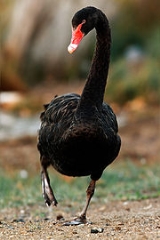
The Black Swan (Cygnus atratus) is a large waterbird which breeds mainly in the southeast and southwest regions of Australia
Australia

Australia, officially the Commonwealth of Australia, is a country in the southern hemisphere comprising the Australia of the world's smallest continent, the major island of Tasmania, and numerous list of islands of Australia in the Indian Ocean and Pacific Oceans....
.

black swan was first described by English naturalist John Latham
John Latham (ornithologist)

John Latham was an England physician, natural history and author.Latham has been called the "grandfather" of Australian ornithology. He was able to examine specimens of Australian birds which reached England in the last twenty years of the 18th century, and was responsible for naming many of them....
 in 1790. It was formerly placed into a monotypic
Monotypic

In biology, a monotype is a alpha taxonomy group with only one biological type:In botany, a monotype is a taxon that has only one species: Ginkgo is a monotypic genus, while Ginkgoaceae is a monotypic family ....
 genus, Chenopis.

Swan
Swan

Swans are birds of the family Anatidae, which also includes goose and ducks. Swans are grouped with the closely related geese in the subfamily Anserinae where they form the tribe Cygnini....
’ is the common gender term, but ‘cob’ for a male and ‘pen’ for a female are also used, as is ‘cygnet’ for the young.


Discussion
Ask a question about 'Black Swan'
Start a new discussion about 'Black Swan'
Answer questions from other users
Full Discussion Forum


Recent Posts


Encyclopedia


The Black Swan (Cygnus atratus) is a large waterbird which breeds mainly in the southeast and southwest regions of Australia
Australia

Australia, officially the Commonwealth of Australia, is a country in the southern hemisphere comprising the Australia of the world's smallest continent, the major island of Tasmania, and numerous list of islands of Australia in the Indian Ocean and Pacific Oceans....
.

Taxonomy

The black swan was first described by English naturalist John Latham
John Latham (ornithologist)

John Latham was an England physician, natural history and author.Latham has been called the "grandfather" of Australian ornithology. He was able to examine specimens of Australian birds which reached England in the last twenty years of the 18th century, and was responsible for naming many of them....
 in 1790. It was formerly placed into a monotypic
Monotypic

In biology, a monotype is a alpha taxonomy group with only one biological type:In botany, a monotype is a taxon that has only one species: Ginkgo is a monotypic genus, while Ginkgoaceae is a monotypic family ....
 genus, Chenopis.

Swan
Swan

Swans are birds of the family Anatidae, which also includes goose and ducks. Swans are grouped with the closely related geese in the subfamily Anserinae where they form the tribe Cygnini....
’ is the common gender term, but ‘cob’ for a male and ‘pen’ for a female are also used, as is ‘cygnet’ for the young. Collective nouns include a ‘bank’ (on the ground) and a ‘wedge’ (in flight). Black Swans can be found singly, or in loose companies numbering into the hundreds or even thousands.

Description

Black Swans are mostly black feather
Feather

Feathers are one of the epidermal growths that form the distinctive outer covering, or plumage, on birds. They are considered the most complex integumentary structures found in vertebrates....
ed birds, with white flight feathers. The bill
Beak

The beak, bill or rostrum is an external anatomical structure of birds which, in addition to eating, is used for Personal grooming#In animals, manipulating objects, killing prey, probing for food, Courtship#Courtship in the animal kingdom and feeding their young....
 is bright red, with a pale bar and tip; and legs and feet are greyish-black. Cobs (males) are slightly larger than pens (females), with a longer and straighter bill. Cygnets (immature birds) are a greyish-brown with pale-edged feathers.

A mature Black Swan measures between 110 and 142 cm (43-56 in) in length and weighs 3.7-9 kg (8.1-20 lbs). Its wing span is between 1.6 and 2 metres (5.3-6.5 ft). The neck is long (relatively the longest neck among the swans) and curved in an "S".

The Black Swan utters a musical and far reaching bugle-like sound, called either on the water or in flight, as well as a range of softer crooning notes. It can also whistle, especially when disturbed while breeding and nesting.

The Black Swan is unlike any other Australian bird, although in poor light and at long range it may be confused with a magpie-goose
Magpie-goose

The Magpie-goose, Anseranas semipalmata, is a waterbird species found in coastal northern Australia and savannah in southern New Guinea. It is a unique member of the order Anseriformes, and arranged in a Family and genus distinct from all other living waterfowl....
 in flight. However, the black swan can be distinguished by its much longer neck and slower wing beat.

Distribution

The species has a large range, with figures between one to ten million km² given as the extent of occurrence. The current global population is estimated to be up to 500,000 individuals. No threat of extinction, or significant decline in population has been identified with this numerous and widespread bird.

Australia


The Black Swan is common in the wetlands of south western and eastern Australia and adjacent coastal islands. In the south west the range ecompasses an area between North West Cape
North West Cape

North West Cape is a large peninsula of land in the north west coast of Western Australia. Cape Range National Park runs down the spine of the peninsula and Ningaloo Reef runs along the western edge....
, Cape Leeuwin
Cape Leeuwin

Cape Leeuwin is the most south-westerly mainland point of the Australia , in the state of Western Australia.A few small islands and rocks, the Saint Alouarn Islands, extend further to the south....
 and Eucla
Eucla, Western Australia

Eucla is the easternmost locality in Western Australia, located in the Goldfields-Esperance region of Western Australia along the Eyre Highway, approximately west of the South Australian border....
; while in the east it covers are large region bounded by the Atherton Tableland
Atherton Tableland

The Atherton Tableland is a fertile plateau which is part of the Great Dividing Range in Queensland, Australia. It is located west to south-south-west inland from Cairns, Queensland, well into the tropics, but its elevated position provides a climate suitable for dairy farming....
, the Eyre Peninsula
Eyre Peninsula

Eyre Peninsula is a triangular peninsula in South Australia. It is bounded on the east by Spencer Gulf, the west by the Great Australian Bight, and the north by the Gawler Ranges....
 and Tasmania
Tasmania

Tasmania is an Australian island and States and territories of Australia of the same name. It is located south of the eastern side of the continent, being separated from it by Bass Strait....
, with the Murray Darling Basin supporting very large populations of black swans. It is uncommon in central and northern Australia.

The Black Swan’s preferred habitat extends across fresh, brackish and salt water lakes, swamps and rivers with underwater and emergent vegetation for food and nesting materials. Permanent wetland
Wetland

File:Mangrove trees in Everglades.JPGA wetland is an area of land whose soil is saturated with moisture either permanently or seasonally. Such areas may also be covered partially or completely by shallow pools of water....
s are preferred, including ornamental lakes, but black swans can also be found in flooded pastures and tidal mudflats, and occasionally on the open sea near islands or the shore.

Black Swans were once thought to be sedentary, but the species is now known to be highly nomadic. There is no set migratory pattern, but rather opportunistic responses to either rainfall or drought. In high rainfall years, emigration occurs from the south west and south east into the interior, with a reverse immigration to these heartlands in drier years. When rain does fall in the arid central regions, black swans will migrate to these areas to nest and raise their young. However, should dry conditions return before the young have been raised, the adult birds will abandon the nests and their eggs or cygnets and return to wetter areas.

Black Swans, like many other water fowl, lose all their flight feathers at once when they moult after breeding, and they are unable to fly for about a month. During this time they will usually settle on large, open waters for safety.

Introduced populations

Before the arrival of the Maori
Maori

The Maori are the indigenous people Polynesian people of Aotearoa . The group probably arrived in south-western Polynesia in several waves at some time before 1300....
 in New Zealand
New Zealand

New Zealand is an island country in the south-western Pacific Ocean comprising two main landmasses , and numerous Islands of New Zealand, most notably Stewart Island/Rakiura and the Chatham Islands....
, a sub-species of the Black Swan known as the New Zealand Swan
New Zealand Swan

The New Zealand Swan is an extinct swan from the Chatham Islands and the South Island of New Zealand. It was originally described as a separate species from the Black Swan based on the slightly larger size of the fossil bones found and the apparent absence of the Black Swan from New Zealand prior to 1864....
 had developed in the islands, but was apparently hunted to extinction
Extinction

In biology and ecology, extinction is the death of every member of a species or group of taxon. The moment of extinction is generally considered to be the death of the last individual of that species ....
. In 1864, the Australian Black Swan was introduced to New Zealand as an ornamental waterfowl, and populations are now common on larger coastal or inland lakes, especially Rotorua Lakes
Lake Rotorua

Lake Rotorua is the second largest lake in the North Island of New Zealand by surface area, and covers 79.8km2. With a mean depth of only 10 metres it is considerably smaller than nearby Lake Tarawera in terms of volume of water....
, Lake Wairarapa
Lake Wairarapa

Lake Wairarapa is a lake at the southern end of the North Island of New Zealand, 50 kilometers east of Wellington, New Zealand. The lake covers an area of 1 E8 m2, and is the List of lakes in New Zealand#Largest lakes in the North Island, fractionally smaller than Lake Rotorua....
 and Lake Ellesmere
Lake Ellesmere

Lake Ellesmere is located in the Canterbury, New Zealand region of the South Island of New Zealand. It is a broad, shallow lake located directly to the west of Banks Peninsula, separated from the Pacific Ocean by a long narrow strip of land called Kaitorete Spit....
, and the Chatham Islands
Chatham Islands

The archipelago of the Chatham Islands is a territory of New Zealand of about ten islands within a radius. The remote islands, over east of southern New Zealand, have officially belonged to the country since 1842....
. Black Swans have also naturally flown to New Zealand, leading some people to consider them a native rather than exotic species, although the present population appears to be largely descended from deliberate introductions.

The Black Swan is also very popular as an ornamental waterbird in Western Europe
Europe

Europe is, conventionally, one of the world's seven continents. Comprising the westernmost peninsula of Eurasia, Europe is generally divided from Asia to its east by the water divide of the Ural Mountains, the Ural , the Caspian Sea, and by the Caucasus Mountains to the southeast....
, especially Britain
Great Britain

Great Britain is an island lying to the northwest of Continental Europe. It is the List of islands by area, and the largest in Europe. With a population of 58.9 million people it is List of islands by population....
, and escapes are commonly reported. As yet the population in Britain is not considered to be self-sustaining and so the species is not afforded admission to the official British List, but the Wildfowl and Wetlands Trust
Wildfowl and Wetlands Trust

The Wildfowl and Wetlands Trust is a wildfowl and wetland Conservation movement charitable organization in the United Kingdom. Its patron is Queen Elizabeth II of the United Kingdom....
 have recorded a maximum of nine breeding pairs in the UK in 2001, with an estimate of 43 feral birds in 2003/04 (though that is undoubtedly an under-estimate given the level of monitoring undertaken).

There are at least four Black Swans in residence at The University of York
University of York

The University of York is a campus university located in the city of York, England. Established in 1963, York has expanded to more than 30 departments and centres, covering a wide range of subjects....
. The university has a large artificial lake on campus with many species of wildfowl. They are known as "The Devil Swans" or "Demon Swans" due to their unusual colouration and, sometimes, agressive behaviour towards students.

A colony of Black Swans in Dawlish
Dawlish

Dawlish is a town on the south coast of Devon, England, 12 miles from the County town of Exeter, with a population of around 13,000 people. During the eighteenth century, it grew from a small fishing port to become a well-known seaside resort....
, Devon
Devon

Devon is a large Counties of England in South West England. The county is also referred to as Devonshire, but that is an entirely unofficial name, rarely used inside of the county but often indicating a shire....
 has become so well associated with the town that the bird has been the town's emblem for forty years.

Behaviour


Bearing

When swimming, black swans hold their necks arched or erect, and often carry their feathers or wings raised in an aggressive display. In flight, a wedge of black swans will form as a line or a V, with the individual birds flying strongly with undulating long necks, making whistling sounds with their wings and baying, bugling or trumpeting calls.


Nesting

Generally, black swans nest in the wetter winter months (February to September), occasionally in large colonies. A typical clutch contains 4 to 8 greenish-white eggs that are incubated for about 35-40 days. After hatching, the cygnets are tended by the parents for about 6 months until fledging, and may ride on their parent's back for longer trips into deeper water.

A Black Swan nest is essentially a large heap or mound of reeds, grasses and weeds between 1 and 1.5 metres (3-4½ feet) in diameter and up to 1 metre high, in shallow water or on islands. A nest is reused every year, restored or rebuilt as needed. Both parents share the care of the nest. Like other swans, the black swan is largely monogamous, pairing for life (about 6% divorce rate). Recent studies have shown that around a third of all broods exhibit extra-pair paternity.

Homosexuality

A recent (2007) exhibition at the University of Oslo
University of Oslo

The University of Oslo is the List of oldest universities in continuous operation#Oldest Universities by Region .28post 1500.29, largest and most prestigious university in Norway, situated in the Norwegian capital of Oslo....
 Natural History Museum in Norway called Against Nature?
Against Nature?

Against Nature? was an exhibition on homosexuality in animals made by The Natural History Museum, University of Oslo, Norway. The exhibition focuses on occurrence and function of homosexuality in animals, and is the first of its kind....
 explored homosexual behaviours in a number of species, including black swans. Several swan species exhibit lifelong homosocial
Homosocial

In sociology, homosociality describes same-sex relationships that are not of a sexual nature. For example, a heterosexual male who prefers to socialize with men may be considered a homosocial heterosexual....
 behaviours, and the same phenomenon can also be found in a number of other water-birds, notably geese
Goose

Goose is the English-language name for a considerable number of birds, belonging to the family Anatidae. This family also includes swans, most of which are larger than geese, and ducks, which are smaller....
 and flamingo
Flamingo

Flamingos or flamingoes are wikt:gregarious wading birds in the genus Phoenicopterus and family Phoenicopteridae. They are found in both the Western Hemisphere and in the Eastern Hemisphere, but are more numerous in the latter....
s, where it serves as a flexible life strategy.

In swans, the pair is the central social unit
Social unit

Social unit is a term used in sociology, anthropology, ethnology, and also in ethology, zoology and biology to describe a social entity which is part of and participates in a larger Groups of people or society....
. The birds reinforce the unit with frequent preening and sex. Should one die, the other will usually live out the remainder of its life alone. The pair builds nests, raise cygnets and defends a territory. Two cobs, being bigger and stronger than a cob and a pen, can hold down a larger territory, and provide their cygnets with more to eat.

Such same-sex pairs represent a major fitness
Fitness (biology)

Fitness is a central concept in evolution. It describes the capability of an individual of certain genotype to reproduce, and usually is equal to the proportion of the individual's genes in all the genes of the next generation....
 bonus to a pen, and pens without partners will seek out these couples, have sex with one or other of the cobs and lay eggs in their nest. She is then chased off, not being a part of the pair, and the cobs raise the cygnets themselves. Having access to more food the brood have up to ten times the survival rate of a brood with a heterosexual swan couple. From an evolutionary point of view, this is a very rewarding strategy for the cobs as well.

This situation only holds true as long as a nest and a territory is in short supply. The two males will have a fitness loss in that they (1) have no guarantee they are the actual fathers of the cygnets (not being bonded with the female) and (2) will anyway have to split reproduction between them.

A same-sex lifestyle will be advantageous in some situations, but not in others. However, having a partner is a requisite for building a nest and keeping a territory, and an opposite-sex partner may not always be available when forming pairs. Thus, the ability to form a male pair is a normal part of the black swan’s social behaviour and an example of a flexible life strategy in the species.

Conservation

The Black Swan is protected under the Australian National Parks and Wildlife Act, 1974. It is evaluated as Least Concern on the IUCN Red List
IUCN Red List

The IUCN Red List of Threatened Species , created in 1963, is the world's most comprehensive inventory of the global Conservation movement status of plant and animal species....
 of Threatened Species.

Australian culture

The Black Swan was a literary or artistic image, even before the discovery of Cygnus atratus. Cultural reference has been based on symbolic contrast and as a distinctive motif.

The Black Swan's role in Australian heraldry and culture extends to the first founding of the colonies in the eighteenth century. It has often been equated with antipodean identity, the contrast to the white swan of the northern hemisphere indicating 'Australianess'. The Black Swan is featured on the flag, and is both the state and bird emblem, of Western Australia
Western Australia

Western Australia is a States and territories of Australia occupying the entire western third of the Australia . The nation's largest state and the second largest subnational entity in the world, it has 2.1 million inhabitants , 85% of whom live in the south-west corner of the state....
; it also appears in the Coat of Arms
Coat of arms

A coat of arms, more properly called an armorial achievement, armorial bearings or often just arms for short, in European tradition, is a design belonging to a particular person and used by them in a wide variety of ways....
 and other iconography of the state's institutions.

Gallery


External links

  • on the Internet Bird Collection
  • How To Raise Swans