
All Topics  
Sika Deer


   Email Print
   Bookmark   Link


Sika Deer


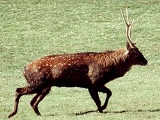
The Sika Deer (Cervus nippon) is a member of the deer family Cervidae that inhabits much of East AsiaEast Asia

East Asia is a subregion of Asia that can be defined in either geographical or cultural terms....
. It is found in mixed deciduous forests to the north, and mixed subtropical deciduous and evergreen forests to the south. The Sika Deer are closely related to Red DeerRed Deer

Red Deer, known as elk or wapiti in North America, are the second largest species of deer in the world, after ...
, Central Asian Red DeerCentral Asian Red Deer

The Central Asian Red Deer is a primordial group of Red deer subspecies, which live primarily in Asia east of the Caspian Se...
 and elkElk

Elk may refer to a number of species of large deer:...
.

Distribution and races

Sika deer are found from the Ussuri region of SiberiaSiberia

Siberia is a vast region of Russia constituting almost all of Northern Asia....
 south to KoreaKorea

KoreaOne of the world's oldest civilizations, Korea began with the founding of Gojoseon in 2333 BC, according to the Dangun...
, ManchuriaManchuria

Manchuria is a vast territorial region in northeast Asia....
 and Northern and Southern China, with a possibly isolated population in VietnamVietnam

Vietnam, officially the Socialist Republic of Vietnam, is a country in Southeast Asia....
. It is also native to TaiwanTaiwan

Taiwan is an island in East Asia, but the term "Taiwan" is also commonly used to collectively refer to the territories gove...
 and JapanJapan

is an island country in East Asia. Located in the Pacific Ocean, it lies to the east of China, Korea, and Russia, stretching from...
 and were possibly introduced to some smaller western Pacific islands. The largest race of Sika deer (found in the colder north) are Dybowski's Sika Deer (C. n. dybowskii) of Manchuria and Ussuri Region, and the Hokkaido Sika Deer (C. n. yesoensis) of Hokkaido Island in Japan. The Kerama Sika Deer (C. n. keramae) of the Ryukyu IslandsRyukyu Islands

The Ryukyu Islands or more recently the , are an island chain in the western Pacific Ocean at the eastern limit of the East ...
 is one of the smallest, and unlike other subspecies, has the whole body (including the rump patch) dark brown. The Formosan Sika Deer (C. n. taioanus) is rather large for an island form being larger than the Kerama Sika Deer and similar in size to deer from Southern China. There are several geographically separated subspecies, but due to the long history of the velvet antler trade (for medicinal values) and farming of Sika deer for antler production in much of Turkestan, China, Mongolia, Manchuria, and the Ussuri Region, the integrity of these subspecies is questionable as many populations have already mixed gene pools. Other deer raised for antler trade were Thorold's DeerThorold's Deer

Thorold's deer has the scientific name Cervus Albirostris Przewalski....
 (Cervus albirostris), various Central Asian Red DeerCentral Asian Red Deer

The Central Asian Red Deer is a primordial group of Red deer subspecies, which live primarily in Asia east of the Caspian Se...
 (Cervus affinis) subspecies, and WapitiElk Summary

Elk may refer to a number of species of large deer:...
 (Cervus canadensis) subspecies. Sika deer are known to escape deer farms and many of the so-called wild sika deer populations in Central and Southern China are descendants of those that have escaped and have re-established themselves in the wild. In Taiwan, both Formosan Sika Deer and Formosan Sambar DeerSambar Deer

Sambar, common name for several large dark brown and maned Asian deer, particularly for the Indian species, which attains a ...
 (Cervus unicolor swinhoei) have been farmed for velvet antlers. The only exceptions that may have integrity as a subspecies are possibly the Dybowski's Sika deer of Manchuria and Ussuri region, and the sika deer subspecies that survive in Japan, Ryukyu Islands, and Taiwan. Japan is the only country in Eastern Asia where sika deer were not farmed for velvet antler.

Sika Deer are widespread in Japan, and readily become tame; at one time they were regarded as sacred. The largest wild populations are in the northern island of HokkaidoHokkaido

Hokkaido listen , formerly known as Ezo, is the second largest island and largest prefecture of Japan....
. Following Japanese settlement of Hokkaido in the latter half of the 19th century, the deer there were hunted almost to the point of extinction, and were reduced to a few small populations. Legal protection put in place in the mid 20th century was followed by rapid population recovery from the 1950s to the 1980s. In the absence of the natural predators, some huntingHunting

Hunting is the practice of pursuing animals to capture or kill them for food, recreation, or trade in their products....
 is now encouraged in order to stabilize the population and limit the agricultural damage done by the deer. The present Hokkaido deer population is still concentrated in the eastern half of the island, and many deer that frequent other parts of the island migrate back to this area during the winter months.

Deer are also present in the more populated islands of Japan: for example, in the ancient capital city of NaraNara, Nara

is the capital city of Nara Prefecture in the Kansai region of Japan, near Kyoto....
, as well as the sacred island of MiyajimaMiyajima

may refer to* Miyajima, another name for the Japanese island Itsukushima...
, they wander at will among the templeTemple

A temple is a structure reserved for religious or spiritual activities, such as prayer and sacrifice, or analogous rites ....
s, and are much photographed (and fed) by touristsTourism

Tourism is the act of travel for predominantly recreational or leisure purposes, and also refers to the provision of service...
. In other parts of Asia, the deer have also been extensively hunted, and legal protection has been less effective, so that several populations and subspecies are now endangered.

Sika Deer have been introduced into a number of other countries including AustraliaAustralia Overview

Australia, officially the Commonwealth of Australia, is a country in the Southern Hemisphere comprising the mainland o...
, AustriaAustria

Austria is a landlocked country in central Europe....
, DenmarkDenmark

The Kingdom of Denmark is the smallest and southernmost of the Nordic countries....
, GermanyGermany

Germany , officially the Federal Republic of Germany , is a country in central Europe....
, Britain, FranceFrance

France, officially the French Republic, is a country whose metropolitan territory is located in Western Europe and whi...
, IrelandIreland

Ireland is the third largest island in Europe....
, Jolo IslandFacts About Jolo

Jolo may refer to:* Jolo Island* Jolo, Sulu...
 (south of the PhilippinesPhilippines

The Philippines , officially the Republic of the Philippines , is an island nation located in the Malay archipelago in...
), New ZealandNew Zealand

New Zealand is a country in the south-western Pacific Ocean consisting of two large islands and many much smaller islands, m...
, PolandPoland

Poland , officially the Republic of Poland , is a country located in Central Europe....
, MoroccoMorocco

The Kingdom of Morocco is a country in North Africa....
 and the United StatesUnited States

The United States of America, also known as the United States, the U.S., the U.S.A., and America, is...
 (Maryland and Texas). In many cases they were originally introduced as ornamental animals in parkland, but have established themselves in the wild.

In Britain and IrelandIreland

Ireland is the third largest island in Europe....
 several distinct wild and feral populations now exist. Some of these are in isolated areas, for example on the island of LundyLundy

Lundy is an island in the Bristol Channel of Great Britain, administered as part of Torridge district of the English county ...
, but others are contiguous with populations of the native Red DeerRed Deer

Red Deer, known as elk or wapiti in North America, are the second largest species of deer in the world, after ...
. Since the two species hybridise, this is a serious conservation concern, and in mainland Scotland biologists have contended that there are now no pure sika or Red deer left there, and that the two species have thoroughly and irretrievably hybridised. The same is thought to be true of sika and the remnant wild Red deer population in Ireland.

Across its original range, and more intensively in many countries to which it has been introduced, the sika is regarded as a particularly prized and elusive sportsman's quarry. In Britain, Ireland and mainland Europe it has been noted that sika display very different survival strategies and escape tactics from the indigenous deer. They have a marked tendency to use camouflageCamouflage

Camouflage is the method which allows an otherwise visible organism or object to remain indiscernible from the surrounding e...
 and concealment in circumstances when Red deer, for example, would flee; and have been seen to squat and lie belly-flat when danger threatens in the form of human intrusion. Hunters and control cullers have estimated that the sika's wariness and "cleverness" makes it three or four times more difficult to bring to bag than a Red or Fallow deer. It has also been widely remarked that sika are much more tenacious of life, and harder to kill with a rifle bullet, than the native deer of Europe and North America. In the British Isles sika are widely regarded as a very serious threat to new and established woodlands, and public and private forestry bodies adopt policies of rigorous year-round culling, generally with little effect.

Among aficionados of venisonVenison

Venison is the term for the meat of deer, moose, elk, caribou, and antelope....
, sika flesh is regarded as one of the very finest and most flavoursome of all gameGame

A game is a structured or semi-structured, contrived , usually undertaken for enjoyment, though sports or training simulati...
 meats at the dinner table.

Sika (?? or ?)
Dybowski's sika deer (
Cervus nippon dybowskii) and Formosan sika deer (Cervus nippon taioanus) are highly endangered and possibly already extinct in the wild. They can be found in several zoos and are being kept alive by a captive-management program.

The Sitka DeerSitka Deer Overview

The Sitka Deer or Sitka Black-tailed Deer, is a subspecies of Black-tailed Deer that inhabits northern British Columbi...
 is a subspecies of Black-Tailed DeerBlack-tailed Deer

The Black-tailed deer is a species of deer found in western North America....
 and Mule DeerMule Deer

The Mule Deer is a deer whose habitat is in the western half of North America....
 and therefore, a different species.

See also

  • Red DeerRed Deer

    Red Deer, known as elk or wapiti in North America, are the second largest species of deer in the world, after ...
     - European Red Deer
  • Central Asian Red DeerCentral Asian Red Deer Summary

    The Central Asian Red Deer is a primordial group of Red deer subspecies, which live primarily in Asia east of the Caspian Se...
     - Asian/Himalayan/Tibetan Red Deer
  • ElkElk Overview

    Elk may refer to a number of species of large deer:...
     - East Asian/North American Red Deer (Wapiti)
  • Thorold's DeerThorold's Deer

    Thorold's deer has the scientific name Cervus Albirostris Przewalski....


External links