

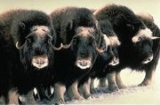
Musk Ox

Encyclopedia
The muskox is an Arctic
mammal
of the family Bovid
ae, noted for its thick coat and for the strong odor emitted by males, from which its name derives. This musky odor
is used to attract females during mating season. Muskoxen primarily live in Arctic
North America
and Greenland
, with small introduced populations in Sweden
, Siberia
and Norway
.
between 200,000 and 90,000 years ago, during the Pleistocene
period, when it was a contemporary of the woolly mammoth
. It is thought that the muskox was able to survive the last ice age
(Wisconsin glaciation) by finding ice-free areas away from prehistoric peoples. The muskox gradually moved across North America and arrived in Greenland
during the late Holocene
.
and goat
s than to ox
en, but are in their own genus, Ovibos (Latin
: "sheep-ox"). Both sexes have long curved horn
s. Muskoxen stand 1.2 m (3.9 ft) high at the shoulder on average, with females measuring 135 to 200 cm (4.4 to 6.6 ft) in length, and males 200 to 250 cm (6.6 to 8.2 ft). Adults, on average, weigh 285 kg (628.3 lb) and range from 180 to 400 kg (396.8 to 881.8 lb). Their life expectancy is 12–20 years. The thick coat and large head often suggests a larger animal than the muskox truly is, but heavy zoo-kept specimens have weighed up to 650 kilograms (1,433 lb). Their coat, a mix of black, gray, and brown, includes long guard hair
s that almost reach the ground. Rare "white muskoxen" have been spotted in the Queen Maud Gulf Bird Sanctuary
. Muskoxen are occasionally domesticated for wool, meat and milk. The wool
, qiviut
, is highly prized for its softness, length, and insulation value. Prices for yarn range between $40 and $80 per ounce (28 g).
, Greenland, and the United States
. The Alaska
population was wiped out in the late 19th or early 20th century. Their depletion has been attributed to over hunting, but it may alternatively be because the climate had become unsuitable. However, muskoxen have since been reintroduced
to Alaska. The United States Fish and Wildlife Service
introduced muskox onto the Nunivak Island
in 1935 as a means for subsistence
living. The species has also been introduced from Banks Island
to northern Europe
, including Sweden
, the Dovre mountain range
of Norway
, and Russia
and from Ellesmere Island
to Eastern Canada
. In the province of Quebec
, muskoxen were close to extinction at one point, but have recovered after being protected from hunting. The world population is estimated at between 80,000 and 125,000, with an estimated 68,788 living on Banks Island
. The last known muskox population outside North America lived on the Taymyr Peninsula
of Siberia
, and died out about 2,000 years ago. The muskox was successfully reintroduced to the Taymyr Peninsula in 1975.
During the summer, muskoxen live in wet areas, such as river valleys, moving to higher elevations in the winter to avoid deep snow. Muskoxen will eat grasses, arctic willow
s, woody plants, lichens and mosses. When food is abundant, they prefer succulent and nutritious grasses in an area. Willows are the most commonly eaten plants in the winter. Muskoxen have a high threshold of fat reserves before conceiving which reflects their conservative breeding strategies. Winter ranges typically have shallow snow to reduce the energetic costs of digging through snow to reach forage. Predators of muskoxen include Arctic wolves
, grizzly bear
s and polar bear
s.
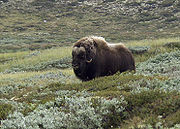 The mating (or "rutting") season of the muskoxen begins in late June or early July. During this time, dominant bulls will fight others out of the herds and establish harems of usually 6–7 cows and their offspring. Fighting bulls will first rub their pre-orbital glands against their legs while bellowing loudly and then display their horns. The bulls then back up twenty meters, lower their heads and charge into each other and will keep doing that until one bull gives up. But subordinate and elderly bulls will leave the herds to form bachelor groups or become solitary. However when there’s danger, the outside bulls can return to the herd for protection. Dominant bulls will prevent cows from leaving their harems. During mating, a bull will casually kick an estrous cow with his foreleg to calm her down and make her more receptive to his advances. The herds reassemble when summer ends.
While the bulls are more aggressive during the rutting season and make the decisions in the groups, the females take charge during gestation. Pregnant females are aggressive and decide what distance the herd travels in a day and where they will bed for the night. The herds move more frequently when cows are lactating to get enough food to nurse their offspring. Cows have an 8–9 month gestation period with calving occurring from April to June. Cows do not calve every year. When winters are severe, cows will not go into estrous and thus not calve the next year. When calving, cows stay in the herd for protection. After birth calves are able to keep up with the herd in just a few hours after birth. The calves are welcomed into the herd and nurse for the first two months. After that, a calf then begins eating vegetation and nurses only occasionally. Cows communicate with their calves through braying. The calf’s bond with its mother weakens after two years.
Muskoxen have a distinctive defensive behavior: when the herd is threatened, the bulls and cows will face outward to form a stationary ring or semicircle around the calves. The bulls are usually the front line for defense against predators with the cows and juveniles gathering close to them. Bulls determine the defensive formation during rutting while the cows decide the rest of the year.
, and three introduced populations in Arnangarnup Qoorua Nature Reserve, and Kangerlussuaq
and Maniitsoq Caribou Reserves. Within these protected areas, muskox receives full protection.
Arctic
The Arctic is a region located at the northern-most part of the Earth. The Arctic consists of the Arctic Ocean and parts of Canada, Russia, Greenland, the United States, Norway, Sweden, Finland, and Iceland. The Arctic region consists of a vast, ice-covered ocean, surrounded by treeless permafrost...
mammal
Mammal
Mammals are members of a class of air-breathing vertebrate animals characterised by the possession of endothermy, hair, three middle ear bones, and mammary glands functional in mothers with young...
of the family Bovid
Bovid
A bovid is any of almost 140 species of cloven-hoofed ruminant mammal at least the males of which bear characteristic unbranching horns covered in a permanent sheath of keratin....
ae, noted for its thick coat and for the strong odor emitted by males, from which its name derives. This musky odor
Musk
Musk is a class of aromatic substances commonly used as base notes in perfumery. They include glandular secretions from animals such as the musk deer, numerous plants emitting similar fragrances, and artificial substances with similar odors. Musk was a name originally given to a substance with a...
is used to attract females during mating season. Muskoxen primarily live in Arctic
Arctic
The Arctic is a region located at the northern-most part of the Earth. The Arctic consists of the Arctic Ocean and parts of Canada, Russia, Greenland, the United States, Norway, Sweden, Finland, and Iceland. The Arctic region consists of a vast, ice-covered ocean, surrounded by treeless permafrost...
North America
North America
North America is a continent wholly within the Northern Hemisphere and almost wholly within the Western Hemisphere. It is also considered a northern subcontinent of the Americas...
and Greenland
Greenland
Greenland is an autonomous country within the Kingdom of Denmark, located between the Arctic and Atlantic Oceans, east of the Canadian Arctic Archipelago. Though physiographically a part of the continent of North America, Greenland has been politically and culturally associated with Europe for...
, with small introduced populations in Sweden
Sweden
Sweden , officially the Kingdom of Sweden , is a Nordic country on the Scandinavian Peninsula in Northern Europe. Sweden borders with Norway and Finland and is connected to Denmark by a bridge-tunnel across the Öresund....
, Siberia
Siberia
Siberia is an extensive region constituting almost all of Northern Asia. Comprising the central and eastern portion of the Russian Federation, it was part of the Soviet Union from its beginning, as its predecessor states, the Tsardom of Russia and the Russian Empire, conquered it during the 16th...
and Norway
Norway
Norway , officially the Kingdom of Norway, is a Nordic unitary constitutional monarchy whose territory comprises the western portion of the Scandinavian Peninsula, Jan Mayen, and the Arctic archipelago of Svalbard and Bouvet Island. Norway has a total area of and a population of about 4.9 million...
.
Evolution
The muskox, or its ancestor, is believed to have migrated to North AmericaNorth America
North America is a continent wholly within the Northern Hemisphere and almost wholly within the Western Hemisphere. It is also considered a northern subcontinent of the Americas...
between 200,000 and 90,000 years ago, during the Pleistocene
Pleistocene
The Pleistocene is the epoch from 2,588,000 to 11,700 years BP that spans the world's recent period of repeated glaciations. The name pleistocene is derived from the Greek and ....
period, when it was a contemporary of the woolly mammoth
Woolly mammoth
The woolly mammoth , also called the tundra mammoth, is a species of mammoth. This animal is known from bones and frozen carcasses from northern North America and northern Eurasia with the best preserved carcasses in Siberia...
. It is thought that the muskox was able to survive the last ice age
Ice age
An ice age or, more precisely, glacial age, is a generic geological period of long-term reduction in the temperature of the Earth's surface and atmosphere, resulting in the presence or expansion of continental ice sheets, polar ice sheets and alpine glaciers...
(Wisconsin glaciation) by finding ice-free areas away from prehistoric peoples. The muskox gradually moved across North America and arrived in Greenland
Greenland
Greenland is an autonomous country within the Kingdom of Denmark, located between the Arctic and Atlantic Oceans, east of the Canadian Arctic Archipelago. Though physiographically a part of the continent of North America, Greenland has been politically and culturally associated with Europe for...
during the late Holocene
Holocene
The Holocene is a geological epoch which began at the end of the Pleistocene and continues to the present. The Holocene is part of the Quaternary period. Its name comes from the Greek words and , meaning "entirely recent"...
.
Physical characteristics
As members of the subfamily Caprinae of the family Bovidae, muskoxen are more closely related to sheepDomestic sheep
Sheep are quadrupedal, ruminant mammals typically kept as livestock. Like all ruminants, sheep are members of the order Artiodactyla, the even-toed ungulates. Although the name "sheep" applies to many species in the genus Ovis, in everyday usage it almost always refers to Ovis aries...
and goat
Goat
The domestic goat is a subspecies of goat domesticated from the wild goat of southwest Asia and Eastern Europe. The goat is a member of the Bovidae family and is closely related to the sheep as both are in the goat-antelope subfamily Caprinae. There are over three hundred distinct breeds of...
s than to ox
Ox
An ox , also known as a bullock in Australia, New Zealand and India, is a bovine trained as a draft animal. Oxen are commonly castrated adult male cattle; castration makes the animals more tractable...
en, but are in their own genus, Ovibos (Latin
Latin
Latin is an Italic language originally spoken in Latium and Ancient Rome. It, along with most European languages, is a descendant of the ancient Proto-Indo-European language. Although it is considered a dead language, a number of scholars and members of the Christian clergy speak it fluently, and...
: "sheep-ox"). Both sexes have long curved horn
Horn (anatomy)
A horn is a pointed projection of the skin on the head of various animals, consisting of a covering of horn surrounding a core of living bone. True horns are found mainly among the ruminant artiodactyls, in the families Antilocapridae and Bovidae...
s. Muskoxen stand 1.2 m (3.9 ft) high at the shoulder on average, with females measuring 135 to 200 cm (4.4 to 6.6 ft) in length, and males 200 to 250 cm (6.6 to 8.2 ft). Adults, on average, weigh 285 kg (628.3 lb) and range from 180 to 400 kg (396.8 to 881.8 lb). Their life expectancy is 12–20 years. The thick coat and large head often suggests a larger animal than the muskox truly is, but heavy zoo-kept specimens have weighed up to 650 kilograms (1,433 lb). Their coat, a mix of black, gray, and brown, includes long guard hair
Guard hair
Guard hairs are the longest, coarsest hairs in a mammal's coat, forming the topcoat . They taper to a point and protect the undercoat from the elements. They are often water repellent and stick out above the rest of the coat...
s that almost reach the ground. Rare "white muskoxen" have been spotted in the Queen Maud Gulf Bird Sanctuary
Queen Maud Gulf Bird Sanctuary
The Queen Maud Gulf Migratory Bird Sanctuary is Canada's largest federally owned protected area, encompassing some of the Arctic Circle coastline. are marine, and are terrestrial....
. Muskoxen are occasionally domesticated for wool, meat and milk. The wool
Wool
Wool is the textile fiber obtained from sheep and certain other animals, including cashmere from goats, mohair from goats, qiviut from muskoxen, vicuña, alpaca, camel from animals in the camel family, and angora from rabbits....
, qiviut
Qiviut
Qiviut is an Inuit word commonly used to indicate the wool of the muskox. The word was originally used to refer to the down feathers of birds as well as the inner wool of the muskox. It is valued for its use as a fiber as, unlike sheep's wool, it does not shrink in water at any temperature...
, is highly prized for its softness, length, and insulation value. Prices for yarn range between $40 and $80 per ounce (28 g).
Range and ecology
Muskoxen are native to the Arctic areas of CanadaCanada
Canada is a North American country consisting of ten provinces and three territories. Located in the northern part of the continent, it extends from the Atlantic Ocean in the east to the Pacific Ocean in the west, and northward into the Arctic Ocean...
, Greenland, and the United States
United States
The United States of America is a federal constitutional republic comprising fifty states and a federal district...
. The Alaska
Alaska
Alaska is the largest state in the United States by area. It is situated in the northwest extremity of the North American continent, with Canada to the east, the Arctic Ocean to the north, and the Pacific Ocean to the west and south, with Russia further west across the Bering Strait...
population was wiped out in the late 19th or early 20th century. Their depletion has been attributed to over hunting, but it may alternatively be because the climate had become unsuitable. However, muskoxen have since been reintroduced
Reintroduction
Reintroduction is the deliberate release of a species into the wild in zones formerly inhabited by said species but where it has disappeared from for a number of reasons, from captivity or relocated from other areas where the species still survives in...
to Alaska. The United States Fish and Wildlife Service
United States Fish and Wildlife Service
The United States Fish and Wildlife Service is a federal government agency within the United States Department of the Interior dedicated to the management of fish, wildlife, and natural habitats...
introduced muskox onto the Nunivak Island
Nunivak Island
Nunivak Island , the second largest island in the Bering Sea, is a permafrost-covered volcanic island lying about 30 miles offshore from the delta of the Yukon and Kuskokwim rivers in the state of Alaska, at about 60° North latitude...
in 1935 as a means for subsistence
Hunter-gatherer
A hunter-gatherer or forage society is one in which most or all food is obtained from wild plants and animals, in contrast to agricultural societies which rely mainly on domesticated species. Hunting and gathering was the ancestral subsistence mode of Homo, and all modern humans were...
living. The species has also been introduced from Banks Island
Banks Island
One of the larger members of the Canadian Arctic Archipelago, Banks Island is situated in the Inuvik Region of the Northwest Territories, Canada. It is separated from Victoria Island to its east by the Prince of Wales Strait and from the mainland by Amundsen Gulf to its south. The Beaufort Sea lies...
to northern Europe
Northern Europe
Northern Europe is the northern part or region of Europe. Northern Europe typically refers to the seven countries in the northern part of the European subcontinent which includes Denmark, Estonia, Latvia, Lithuania, Norway, Finland and Sweden...
, including Sweden
Sweden
Sweden , officially the Kingdom of Sweden , is a Nordic country on the Scandinavian Peninsula in Northern Europe. Sweden borders with Norway and Finland and is connected to Denmark by a bridge-tunnel across the Öresund....
, the Dovre mountain range
Dovrefjell
Dovrefjell is a mountain range in central Norway that forms a natural barrier between Eastern Norway and Trøndelag, the area around Trondheim. As a result, it has been heavily trafficked during and probably preceding historical times...
of Norway
Norway
Norway , officially the Kingdom of Norway, is a Nordic unitary constitutional monarchy whose territory comprises the western portion of the Scandinavian Peninsula, Jan Mayen, and the Arctic archipelago of Svalbard and Bouvet Island. Norway has a total area of and a population of about 4.9 million...
, and Russia
Russia
Russia or , officially known as both Russia and the Russian Federation , is a country in northern Eurasia. It is a federal semi-presidential republic, comprising 83 federal subjects...
and from Ellesmere Island
Ellesmere Island
Ellesmere Island is part of the Qikiqtaaluk Region of the Canadian territory of Nunavut. Lying within the Canadian Arctic Archipelago, it is considered part of the Queen Elizabeth Islands, with Cape Columbia being the most northerly point of land in Canada...
to Eastern Canada
Eastern Canada
Eastern Canada is generally considered to be the region of Canada east of Manitoba, consisting of the following provinces:* New Brunswick* Newfoundland and Labrador* Nova Scotia* Ontario* Prince Edward Island* Quebec...
. In the province of Quebec
Quebec
Quebec or is a province in east-central Canada. It is the only Canadian province with a predominantly French-speaking population and the only one whose sole official language is French at the provincial level....
, muskoxen were close to extinction at one point, but have recovered after being protected from hunting. The world population is estimated at between 80,000 and 125,000, with an estimated 68,788 living on Banks Island
Banks Island
One of the larger members of the Canadian Arctic Archipelago, Banks Island is situated in the Inuvik Region of the Northwest Territories, Canada. It is separated from Victoria Island to its east by the Prince of Wales Strait and from the mainland by Amundsen Gulf to its south. The Beaufort Sea lies...
. The last known muskox population outside North America lived on the Taymyr Peninsula
Taymyr Peninsula
The Taymyr Peninsula is a peninsula in the Far North of Russia, in the Siberian Federal District, that forms the northernmost part of mainland Eurasia and Asia...
of Siberia
Siberia
Siberia is an extensive region constituting almost all of Northern Asia. Comprising the central and eastern portion of the Russian Federation, it was part of the Soviet Union from its beginning, as its predecessor states, the Tsardom of Russia and the Russian Empire, conquered it during the 16th...
, and died out about 2,000 years ago. The muskox was successfully reintroduced to the Taymyr Peninsula in 1975.
During the summer, muskoxen live in wet areas, such as river valleys, moving to higher elevations in the winter to avoid deep snow. Muskoxen will eat grasses, arctic willow
Arctic Willow
Salix arctica is a tiny creeping willow . It is adapted to survive in harsh Arctic and subarctic environments, and has a circumpolar distribution round the Arctic Ocean.-Distribution:...
s, woody plants, lichens and mosses. When food is abundant, they prefer succulent and nutritious grasses in an area. Willows are the most commonly eaten plants in the winter. Muskoxen have a high threshold of fat reserves before conceiving which reflects their conservative breeding strategies. Winter ranges typically have shallow snow to reduce the energetic costs of digging through snow to reach forage. Predators of muskoxen include Arctic wolves
Arctic Wolf
The Arctic Wolf , also called Polar Wolf or White Wolf, is a subspecies of the Gray Wolf, a mammal of the family Canidae. Arctic Wolves inhabit the Canadian Arctic, Alaska and the northern parts of Greenland....
, grizzly bear
Grizzly Bear
The grizzly bear , also known as the silvertip bear, the grizzly, or the North American brown bear, is a subspecies of brown bear that generally lives in the uplands of western North America...
s and polar bear
Polar Bear
The polar bear is a bear native largely within the Arctic Circle encompassing the Arctic Ocean, its surrounding seas and surrounding land masses. It is the world's largest land carnivore and also the largest bear, together with the omnivorous Kodiak Bear, which is approximately the same size...
s.
Social behavior and reproduction
Muskoxen live in herds which number from 12–24 in the winter and 8–20 in the summer. They do not hold territories but they do mark their trails with pre-orbital glands. Male and female muskoxen both have separate age based hierarchies with mature oxen being dominant over juveniles. Dominant oxen tend to get access to the best resources and will displace subordinates from patches of grass during the winter. Muskoxen bulls assert their dominance many different ways. One is a "rush and butt" in which a dominant bull rushes a subordinate from the side with its horns and will warn the subordinate so it can have a chance to get away. Bulls will also roar, swing their heads and paw the ground. Dominant bulls sometimes treat subordinate bulls like cows. A dominant bull will casually kick a subordinate with its foreleg, something they do to cows during mating. Dominant bulls will also mock copulate subordinates and sniff their genitals. A subordinate bull can change his status by charging a dominant bull.While the bulls are more aggressive during the rutting season and make the decisions in the groups, the females take charge during gestation. Pregnant females are aggressive and decide what distance the herd travels in a day and where they will bed for the night. The herds move more frequently when cows are lactating to get enough food to nurse their offspring. Cows have an 8–9 month gestation period with calving occurring from April to June. Cows do not calve every year. When winters are severe, cows will not go into estrous and thus not calve the next year. When calving, cows stay in the herd for protection. After birth calves are able to keep up with the herd in just a few hours after birth. The calves are welcomed into the herd and nurse for the first two months. After that, a calf then begins eating vegetation and nurses only occasionally. Cows communicate with their calves through braying. The calf’s bond with its mother weakens after two years.
Muskoxen have a distinctive defensive behavior: when the herd is threatened, the bulls and cows will face outward to form a stationary ring or semicircle around the calves. The bulls are usually the front line for defense against predators with the cows and juveniles gathering close to them. Bulls determine the defensive formation during rutting while the cows decide the rest of the year.
Status
Historically this species declined because of over-hunting, but population recovery has taken place following enforcement of hunting regulations. Management in the late 1900s was mostly conservative hunting quotas to foster recovery and recolonization from the historic declines. In Greenland, there are no major threats, although the fact that populations are often small in size and scattered, make them vulnerable to local or regional fluctuations in climate. Most populations are within the National Park, where they are protected from hunting. In Greenland, muskoxen occur in four protected areas, with indigenous populations in the Northeast Greenland National ParkNortheast Greenland National Park
Northeast Greenland National Park is the largest national park in the world, with an area of , making the park larger than 163 countries. It is the only national park in Greenland, and the most northerly national park in the world, its most northerly point reaching slightly further than the most...
, and three introduced populations in Arnangarnup Qoorua Nature Reserve, and Kangerlussuaq
Kangerlussuaq
Kangerlussuaq is a settlement in western Greenland in the Qeqqata municipality, located at the head of a fjord of the same name. It is Greenland's main air transport hub, being the site of Greenland's largest commercial airport....
and Maniitsoq Caribou Reserves. Within these protected areas, muskox receives full protection.
External links
- Robert G. White Large Animal Research Station at the University of Alaska FairbanksUniversity of Alaska FairbanksThe University of Alaska Fairbanks, located in Fairbanks, Alaska, USA, is the flagship campus of the University of Alaska System, and is abbreviated as Alaska or UAF....
- Alex Trebek and John Teal's Reintroduction of Muskox to Alaska
- Jork Meyer, "Sex ratio in muskox skulls (Ovibos moschatus) found at East Greenland" (Geschlechterverhältnis bei Schädeln des Moschusochsen (Ovibos moschatus) in Ostgrönland) Beiträge zur Jagd- und Wildtierforschung 29 (2004): 187–192.
- The New Student's Reference Work/Musk-Ox