

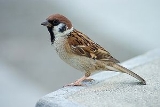
Tree Sparrow

Encyclopedia
The Eurasian Tree Sparrow (Passer montanus) is a passerine
bird in the sparrow
family with a rich chestnut crown
and nape
, and a black patch on each pure white cheek. The sexes are similarly plumage
d, and young birds are a duller version of the adult. This sparrow breeds over most of temperate Eurasia
and Southeast Asia
, where it is known as the Tree Sparrow, and it has been introduced elsewhere including the United States, where it is known as the Eurasian Tree Sparrow or German Sparrow to differentiate it from the native unrelated American Tree Sparrow
. Although several subspecies are recognised, the appearance of this bird varies little across its extensive range.
The Eurasian Tree Sparrow's untidy nest is built in a natural cavity, a hole in a building or the large nest of a European Magpie
or White Stork
. The typical clutch
is five or six eggs which hatch in under two weeks. This sparrow feeds mainly on seeds, but invertebrates are also consumed, particularly during the breeding season. As with other small birds, infection by parasites and diseases, and predation by birds of prey
take their toll, and the typical life span is about two years.
The Eurasian Tree Sparrow is widespread in the towns and cities of eastern Asia, but in Europe it is a bird of lightly wooded open countryside, with the House Sparrow
breeding in the more urban areas. The Eurasian Tree Sparrow's extensive range and large population ensure that it is not endangered globally, but there have been large declines in western European populations, in part due to changes in farming practices involving increased use of herbicides and loss of winter stubble fields. In eastern Asia and western Australia, this species is sometimes viewed as a pest, although it is also widely celebrated in oriental art.
of about 21 cm (8.25 in) and a weight of 24 g (0.86 oz), making it roughly 10% smaller than the House Sparrow. The adult's crown and nape are rich chestnut
, and there is a kidney-shaped black ear patch on each pure white cheek; the chin, throat, and the area between the bill and throat are black. The upperparts are light brown, streaked with black, and the brown wings have two distinct narrow white bars. The legs are pale brown, and the bill is lead-blue in summer, becoming almost black in winter.
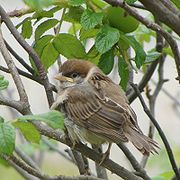
This sparrow is distinctive even within its genus in that it has no plumage differences between the sexes; the juvenile also resembles the adult, although the colours tend to be duller. Its contrasting face pattern makes this species easily identifiable in all plumages; the smaller size and brown, not grey, crown are additional differences from the male House Sparrow. Adult and juvenile Eurasian Tree Sparrows undergo a slow complete moult
in the autumn, and show an increase in body mass despite a reduction in stored fat. The change in mass is due to an increase in blood volume to support active feather growth, and a generally higher water content in the body.
The Eurasian Tree Sparrow has no true song, but its vocalisations include an excited series of tschip calls given by unpaired or courting males. Other monosyllabic chirps are used in social contacts, and the flight call is a harsh teck. A study comparing the vocalisations of the introduced Missouri population with those of birds from Germany showed that the US birds had fewer shared syllable types (meme
s) and more structure within the population than the European sparrows. This may have resulted from the small size of the founding North American population and a consequent loss of genetic diversity
.
 The Old World sparrow
genus Passer
is a group of small passerine
birds that is believed to have originated in Africa, and which contains 15–25 species depending on the authority. Its members are typically found in open, lightly wooded, habitats, although several species, notably the House Sparrow
(P. domesticus) have adapted to human habitations. Most species in the genus are typically 10–20 cm (4–8 in) long, predominantly brown or greyish birds with short square tails and stubby conical beaks. They are primarily ground-feeding seed-eaters, although they also consume invertebrates, especially when breeding. Genetic studies show that the Eurasian Tree Sparrow diverged from the other Eurasian members of its genus relatively early, before the speciation
of the House, Pegu
and Spanish Sparrow
s. The Eurasian species is not closely related to the American Tree Sparrow
(Spizella arborea), which is an American sparrow
.
The Eurasian Tree Sparrow's binomial name is derived from two Latin
words: passer, "sparrow", and montanus, "of the mountains" (from mons "mountain"). The Eurasian Tree Sparrow was first described by Carl Linnaeus in his 1758 Systema Naturae
as Fringilla montana, but, along with the House Sparrow, it was soon moved from the finch
es (family Fringillidae) into the new genus Passer created by French zoologist Mathurin Jacques Brisson
in 1760. The Eurasian Tree Sparrow's common name is given because of its preference of tree holes for nesting. This name, and the scientific name montanus do not appropriately describe this species's habitat preferences: the German
name Feldsperling ("field sparrow") comes closer to doing so.
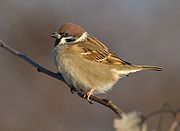 This species varies little in appearance across its large range, and the differences between the eight extant subspecies
recognised by Clement are slight. At least 15 other subspecies have been proposed, but are considered to be intermediates of the listed races
.
(north of this the summers are too cold, with July average temperatures below 12°C) and through Southeast Asia to Java
and Bali
. It formerly bred in the Faroes
, Malta
and Gozo
. In South Asia it is found mainly in the temperate zone. It is sedentary over most of its extensive range, but northernmost breeding populations migrate
south for the winter, and small numbers leave southern Europe for North Africa and the Middle East. The eastern subspecies P. m. dilutus reaches coastal Pakistan in winter and thousands of birds of this race move through eastern China in autumn.
The Eurasian Tree Sparrow has been introduced
outside its native range, but has not always become established, possibly due to competition with the House Sparrow. It was introduced successfully to Sardinia
, eastern Indonesia, the Philippines
and Micronesia
, but introductions to New Zealand
and Bermuda
did not take root. Ship-carried birds colonised Borneo
. This sparrow has occurred as a natural vagrant
to Gibraltar
, Tunisia
, Algeria
, Egypt
Israel
and Dubai
.
In North America, a population of about 15,000 birds has become established around St. Louis
and neighbouring parts of Illinois and southeastern Iowa. These sparrows are descended from 12 birds imported from Germany and released in late April 1870 as part of a project to enhance the native North American avifauna. Within its limited US range, the Eurasian Tree Sparrow has to compete with the House Sparrow in urban centres, and is therefore mainly found in parks, farms and rural woods. The American population is sometimes referred to as the "German Sparrow", to distinguish it from both the native American Tree Sparrow species and the much more widespread "English" House Sparrow.
 In Australia, the Eurasian Tree Sparrow is present in Melbourne
, towns in central and northern Victoria
and some centres in the Riverina
region of New South Wales
. It is a prohibited species in Western Australia
, where it often arrives on ships from Southeast Asia.
Despite its scientific name, Passer montanus, this is not typically a mountain species, and reaches only 700 m (2,300 ft) in Switzerland
, although it has bred at 1,700 m (5,600 ft) in the northern Caucasus and as high as 4,270 m (14,000 ft) in Nepal. In Europe, it is frequently found on coasts with cliffs, in empty buildings, in pollarded
willows along slow water courses, or in open countryside with small isolated patches of woodland. The Eurasian Tree Sparrow shows a strong preference for nest-sites near wetland
habitats, and avoids breeding on intensively managed mixed farmland.
When the Eurasian Tree Sparrow and the larger House Sparrow occur in the same area, the House Sparrow generally breeds in urban areas while the smaller Eurasian Tree Sparrow nests in the countryside. Where trees are in short supply, as in Mongolia, both species may utilise man-made structures as nest sites. The Eurasian Tree Sparrow is rural in Europe, but is an urban bird in eastern Asia; in southern and central Asia, both Passer species may be found around towns and villages. In parts of the Mediterranean, such as Italy, both the Tree and the Italian or Spanish sparrows may be found in settlements. In Australia, the Eurasian Tree Sparrow is largely an urban bird, and it is the House Sparrow which utilises more natural habitats.
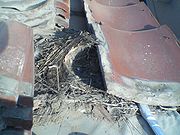
 The Eurasian Tree Sparrow reaches breeding maturity within a year from hatching, and typically builds its nest in a cavity in an old tree or rock face. Some nests are not in holes as such, but are built among roots of overhanging gorse
or similar bush. Roof cavities in houses may be used, and in the tropics, the crown of a palm tree or the ceiling of a verandah can serve as a nest site. This species will breed in the disused domed nest of a European Magpie
, or an active or unused stick nest of a large bird such as the White Stork
, White-tailed Eagle
, Osprey
, Black Kite
or Grey Heron
. It will sometimes attempt to take over the nest of other birds that breed in holes or enclosed spaces, such as the Barn Swallow
, House Martin
, Sand Martin
or European Bee-eater
.
Pairs may breed in isolation or in loose colonies, and will readily use nest box
es. In a Spanish study, boxes made from a mixture of wood and concrete (woodcrete) had a much higher occupancy rate than wooden boxes (76.5% versus 33.5%), and birds nesting in woodcrete sites had earlier clutches, a shorter incubation period and more breeding attempts per season. Clutch size and chick condition did not differ between nest box types, but reproductive success was higher in woodcrete, perhaps because the synthetic nests were 1.5 °C warmer than their wooden counterparts.
The male calls from near the nest site in spring to proclaim ownership and attract a mate. He may also carry nest material into the nest hole. The display and nest building is repeated in autumn. The preferred locations for the autumn display are old Eurasian Tree Sparrow nests, particularly those where nestlings had hatched. Empty nest boxes, and sites used by House Sparrows or other hole nesting birds, such as tits, Pied Flycatchers
or Common Redstart
s, are rarely used for the autumn display.
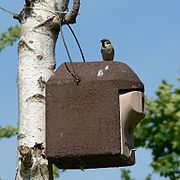 The untidy nest is composed of hay, grass, wool
or other material and lined with feather
s, which improve the thermal insulation. A complete nest consists of three layers; base, lining and dome. The typical clutch is five or six eggs
(rarely more than four in Malaysia), white to pale grey and heavily marked with spots, small blotches, or speckling; they are 20 x 14 mm (0.8 x 0.6 in) in size and weigh 2.1 g (0.08 oz), of which 7% is shell. The eggs are incubated by both parents for 12–13 days before the altricial
, naked chicks hatch, and a further 15–18 days elapse before they fledge
. Two or three broods may be raised each year; birds breeding in colonies produce more eggs and fledglings from their first broods than solitary pairs, but the reverse is true for second and third clutches. Females which copulate frequently tend to lay more eggs and have a shorter incubation time, so within-pair mating may be an indicator of the pairs' reproductive ability. There is a significant level of promiscuity; in a Hungarian study, more than 9% of chicks were sired by extra-pair males, and 20% of the broods contained at least one extra-pair young.
Hybridisation between the Eurasian Tree Sparrow and the House Sparrow has been recorded in many parts of the world with male hybrids tending to resemble the Eurasian Tree Sparrow while females have more similarities with the House Sparrow. A breeding population in the Eastern Ghats
of India, said to be introduced, may also hybridise with House Sparrows. On at least one occasion a mixed pair has resulted in fertile young. A wild hybridisation with the resident sparrows of Malta, which are intermediate between the Spanish Sparrow
(P. hispaniolensis) and Italian Sparrow
s (P. italiae), was recorded in Malta in 1975.
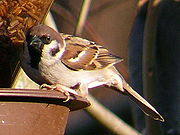 The Tree Sparrow is a predominantly seed and grain eating bird which feeds on the ground in flocks, often with House Sparrows, finches, or buntings. It eats weed seeds, such as chickweeds
and goosefoot
, spilled grain, and it may also visit feeding stations
, especially for peanut
s. It will also feed on invertebrate
s, especially during the breeding season when the young are fed mainly on animal food; it takes insects, woodlice
, millipede
s, centipede
s, spider
s and harvestmen
.
Adults use a variety of wetlands when foraging for invertebrate prey to feed nestlings, and aquatic sites play a key role in providing adequate diversity and availability of suitable invertebrate prey to allow successful chick rearing throughout the long breeding season of this multi-brooded species. Large areas of formerly occupied farmland no longer provide these invertebrate resources due to the effects of intensive farming
, and the availability of supplementary seed food within 1 kilometre (0.621372736649807 mi) of the nest-site does not influence nest-site choice, or affect the number of young raised.
In winter, seed resources are most likely to be a key limiting factor. At this time of year, individuals in a flock form linear dominance hierarchies
, but there is no strong relation between the size of the throat patch and position in that hierarchy. This is in contrast to the House Sparrow; in that species, fights to establish dominance are reduced by the display of the throat patch, the size of which acts as a signalling
"badge" of fitness
.
The risk of predation affects feeding strategies. A study showed increased distance between shelter and a food supply meant that birds visited a feeder in smaller flocks, spent less time on it and were more vigilant when far from shelter. Sparrows can feed as "producers", searching for food directly, or "scroungers", just joining other flock members who have already discovered food. Scrounging was 30% more likely at exposed feeding sites, although this is not due to increased anti-predator vigilance. A possible explanation is that riskier places are used by individuals with lower fat reserves.
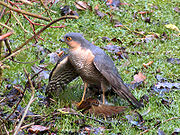 Predators of the Tree Sparrow include a variety of accipiter
s, falcon
s and owl
s, such as the Eurasian Sparrowhawk, Common Kestrel
, Little Owl
, and sometimes Long-eared Owl
and White Stork. It does not appear to be at an increased risk of predation during its autumn moult, despite having fewer flight feathers at that time. Nests may be raided by Eurasian Magpies, Jays
, Least Weasel
s, rats, cats and constricting snakes such as the Horseshoe Whip Snake
.
Many species of birdlice
are present on the birds and in their nests, and mites of the genus Knemidocoptes have been known to infest populations, resulting in lesions on the legs and toes. Parasitisation of nestlings by Protocalliphora
blow-fly
larvae is a significant factor in nestling mortality. Egg size does not influence nestling mortality, but chicks from large eggs grow faster.
Tree Sparrows are also subject to bacterial and viral infections. Bacteria have been shown to be an important factor in the failure of eggs to hatch and in nestling mortality, and mass deaths due to Salmonella
infection have been noted in Japan. Avian malaria
parasites have been found in the blood of many populations, and birds in China were found to harbour a strain of H5N1 that was highly virulent to chickens.
The immune response of Tree Sparrows is less robust than that of the House Sparrow and has been proposed as a factor in the greater invasive potential of the latter. The House Sparrows and Tree Sparrow are the most frequent victims of roadkill
on the roads of Central, Eastern and Southern Europe. The maximum recorded age is 13.1 years, but three years is a typical lifespan.
 The Tree Sparrow has a large, currently unquantified range; its world population is also unknown, but includes an estimated 52–96 million individuals in Europe. Although population trends have not been evaluated, the species is not believed to approach the thresholds for the population decline criterion of the IUCN Red List
(that is, declining more than 30% in ten years or three generations). For these reasons, the species' conservation status
is evaluated at the global level as "Least Concern
".
Although the Tree Sparrow has been expanding its range in Fennoscandia
and eastern Europe, populations have been declining in much of western Europe, a trend reflected in other farmland birds such as the Skylark
, Corn Bunting
and Northern Lapwing
. From 1980 to 2003, common farmland bird numbers fell by 28%. The collapse in populations seems to have been particularly severe in Great Britain, where there was a 95% decline between 1970 and 1998, and Ireland, which retains only 1,000–1,500 pairs. In the British Isles, such declines may be due to natural fluctuations, to which Tree Sparrows are known to be prone. Breeding performance has improved substantially as population sizes have decreased, suggesting that decreases in productivity were not responsible for the decline and that survival was the critical factor. The large decline in Tree Sparrow numbers is probably the result of agricultural intensification and specialisation, particularly the increased use of herbicides and a trend towards autumn-sown crops (at the expense of spring-sown crops that produce stubble fields in winter). The change from mixed to specialised farming and the increased use of insecticides has reduced the amount of insect food available for nestlings.
 The Tree Sparrow is seen as a pest in some areas. In Australia, it damages many cereal and fruit crops and spoils cereal crops, animal feed and stored grain with its droppings. Quarantine
rules prohibit the transport of this species into Western Australia.
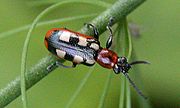
Chairman Mao Zedong
of China attempted in April 1958 to reduce crop damage by Tree Sparrows, estimated at 4.5 kg (9.9 lb) of grain per bird each year, by mobilising three million people and many scarecrows to drive the birds to death by exhaustion. Although initially successful, the "great sparrow campaign
" had overlooked the numbers of locusts and other insect pests consumed by the birds, and crop yields fell, exacerbating a famine which led to the deaths of 30 million people between 1959 and 1961. The Tree Sparrow's consumption of insects has led to its use in agriculture to control fruit tree pests and the common asparagus beetle
, Crioceris aspergi.
 The Tree Sparrow has long been depicted in Chinese and Japanese art, often on a plant spray or in a flying flock, and representations by oriental artists including Hiroshige
have featured on the postage stamps of Antigua and Barbuda
, Central African Republic
, China and The Gambia
. More straightforward illustrations were used on the stamps of Belarus
, Belgium
, Cambodia
, Estonia
and Taiwan
. The fluttering of the bird gave rise to a traditional Japanese dance, the Suzume Odori, which was depicted by artists such as Hokusai
.
In the Philippines
, where it is known as maya, the Tree Sparrow is the most common bird in the cities, and many urban Filipinos consider that it is the national bird. The former national bird of the Philippines (it has been the Philippine Eagle
since 1995) is the Black-headed Munia
, another species also known as maya.
Passerine
A passerine is a bird of the order Passeriformes, which includes more than half of all bird species. Sometimes known as perching birds or, less accurately, as songbirds, the passerines form one of the most diverse terrestrial vertebrate orders: with over 5,000 identified species, it has roughly...
bird in the sparrow
Sparrow
The sparrows are a family of small passerine birds, Passeridae. They are also known as true sparrows, or Old World sparrows, names also used for a genus of the family, Passer...
family with a rich chestnut crown
Crown (anatomy)
A crown is the top of the head.The following birds and other animals are said to have a crown on their head:* Cranes** Grey-crowned Crane** Red-crowned Crane** Black-crowned Crane* Crowned eagle* Gray-crowned Rosy Finch* Yellow-crowned Gonolek...
and nape
Nape
The nape is the back of the neck. In technical anatomical/medical terminology, the nape is referred to by the word nucha, which also gives the adjective corresponding to "nape" in English, "nuchal"....
, and a black patch on each pure white cheek. The sexes are similarly plumage
Plumage
Plumage refers both to the layer of feathers that cover a bird and the pattern, colour, and arrangement of those feathers. The pattern and colours of plumage vary between species and subspecies and can also vary between different age classes, sexes, and season. Within species there can also be a...
d, and young birds are a duller version of the adult. This sparrow breeds over most of temperate Eurasia
Eurasia
Eurasia is a continent or supercontinent comprising the traditional continents of Europe and Asia ; covering about 52,990,000 km2 or about 10.6% of the Earth's surface located primarily in the eastern and northern hemispheres...
and Southeast Asia
Southeast Asia
Southeast Asia, South-East Asia, South East Asia or Southeastern Asia is a subregion of Asia, consisting of the countries that are geographically south of China, east of India, west of New Guinea and north of Australia. The region lies on the intersection of geological plates, with heavy seismic...
, where it is known as the Tree Sparrow, and it has been introduced elsewhere including the United States, where it is known as the Eurasian Tree Sparrow or German Sparrow to differentiate it from the native unrelated American Tree Sparrow
American Tree Sparrow
The American Tree Sparrow , formerly known as the Winter Sparrow, is a medium-sized sparrow.Adults have a rusty cap and grey underparts with a small dark spot on the breast. They have a rusty back with lighter stripes, brown wings with white bars and a slim tail. Their face is grey with a rusty...
. Although several subspecies are recognised, the appearance of this bird varies little across its extensive range.
The Eurasian Tree Sparrow's untidy nest is built in a natural cavity, a hole in a building or the large nest of a European Magpie
European Magpie
The European Magpie, Eurasian Magpie, or Common Magpie, , is a resident breeding bird throughout Europe, much of Asia and northwest Africa. It is one of several birds in the crow family named as magpies, and belongs to the Holarctic radiation of "monochrome" magpies...
or White Stork
White Stork
The White Stork is a large bird in the stork family Ciconiidae. Its plumage is mainly white, with black on its wings. Adults have long red legs and long pointed red beaks, and measure on average from beak tip to end of tail, with a wingspan...
. The typical clutch
Clutch (eggs)
A clutch of eggs refers to all the eggs produced by birds or reptiles, often at a single time, particularly those laid in a nest.In birds, destruction of a clutch by predators, , results in double-clutching...
is five or six eggs which hatch in under two weeks. This sparrow feeds mainly on seeds, but invertebrates are also consumed, particularly during the breeding season. As with other small birds, infection by parasites and diseases, and predation by birds of prey
Bird of prey
Birds of prey are birds that hunt for food primarily on the wing, using their keen senses, especially vision. They are defined as birds that primarily hunt vertebrates, including other birds. Their talons and beaks tend to be relatively large, powerful and adapted for tearing and/or piercing flesh....
take their toll, and the typical life span is about two years.
The Eurasian Tree Sparrow is widespread in the towns and cities of eastern Asia, but in Europe it is a bird of lightly wooded open countryside, with the House Sparrow
House Sparrow
The House Sparrow is a bird of the sparrow family Passeridae, found in most parts of the world. One of about 25 species in the genus Passer, the House Sparrow occurs naturally in most of Europe, the Mediterranean region, and much of Asia...
breeding in the more urban areas. The Eurasian Tree Sparrow's extensive range and large population ensure that it is not endangered globally, but there have been large declines in western European populations, in part due to changes in farming practices involving increased use of herbicides and loss of winter stubble fields. In eastern Asia and western Australia, this species is sometimes viewed as a pest, although it is also widely celebrated in oriental art.
Description
The Eurasian Tree Sparrow is 12.5–14 cm (5–5½ in) long, with a wingspanWingspan
The wingspan of an airplane or a bird, is the distance from one wingtip to the other wingtip. For example, the Boeing 777 has a wingspan of about ; and a Wandering Albatross caught in 1965 had a wingspan of , the official record for a living bird.The term wingspan, more technically extent, is...
of about 21 cm (8.25 in) and a weight of 24 g (0.86 oz), making it roughly 10% smaller than the House Sparrow. The adult's crown and nape are rich chestnut
Chestnut (color)
Chestnut, also known as Indian red, is a color, a medium brownish shade of red, and is named after the nut of the chestnut tree.As Indian red, it is named after the red laterite soil found in India. It is thus an earth tone as well as a red. It is composed of naturally occurring iron oxides. Other...
, and there is a kidney-shaped black ear patch on each pure white cheek; the chin, throat, and the area between the bill and throat are black. The upperparts are light brown, streaked with black, and the brown wings have two distinct narrow white bars. The legs are pale brown, and the bill is lead-blue in summer, becoming almost black in winter.
This sparrow is distinctive even within its genus in that it has no plumage differences between the sexes; the juvenile also resembles the adult, although the colours tend to be duller. Its contrasting face pattern makes this species easily identifiable in all plumages; the smaller size and brown, not grey, crown are additional differences from the male House Sparrow. Adult and juvenile Eurasian Tree Sparrows undergo a slow complete moult
Moult
In biology, moulting or molting , also known as sloughing, shedding, or for some species, ecdysis, is the manner in which an animal routinely casts off a part of its body , either at specific times of year, or at specific points in its life cycle.Moulting can involve the epidermis , pelage...
in the autumn, and show an increase in body mass despite a reduction in stored fat. The change in mass is due to an increase in blood volume to support active feather growth, and a generally higher water content in the body.
The Eurasian Tree Sparrow has no true song, but its vocalisations include an excited series of tschip calls given by unpaired or courting males. Other monosyllabic chirps are used in social contacts, and the flight call is a harsh teck. A study comparing the vocalisations of the introduced Missouri population with those of birds from Germany showed that the US birds had fewer shared syllable types (meme
Meme
A meme is "an idea, behaviour or style that spreads from person to person within a culture."A meme acts as a unit for carrying cultural ideas, symbols or practices, which can be transmitted from one mind to another through writing, speech, gestures, rituals or other imitable phenomena...
s) and more structure within the population than the European sparrows. This may have resulted from the small size of the founding North American population and a consequent loss of genetic diversity
Genetic diversity
Genetic diversity, the level of biodiversity, refers to the total number of genetic characteristics in the genetic makeup of a species. It is distinguished from genetic variability, which describes the tendency of genetic characteristics to vary....
.
Taxonomy
Sparrow
The sparrows are a family of small passerine birds, Passeridae. They are also known as true sparrows, or Old World sparrows, names also used for a genus of the family, Passer...
genus Passer
Passer
Passer is a genus of Old World sparrows. These sparrows are plump little brown or greyish birds often with black, yellow or white markings. Typically 10–20 cm long, they have short tails and stubby conical beaks...
is a group of small passerine
Passerine
A passerine is a bird of the order Passeriformes, which includes more than half of all bird species. Sometimes known as perching birds or, less accurately, as songbirds, the passerines form one of the most diverse terrestrial vertebrate orders: with over 5,000 identified species, it has roughly...
birds that is believed to have originated in Africa, and which contains 15–25 species depending on the authority. Its members are typically found in open, lightly wooded, habitats, although several species, notably the House Sparrow
House Sparrow
The House Sparrow is a bird of the sparrow family Passeridae, found in most parts of the world. One of about 25 species in the genus Passer, the House Sparrow occurs naturally in most of Europe, the Mediterranean region, and much of Asia...
(P. domesticus) have adapted to human habitations. Most species in the genus are typically 10–20 cm (4–8 in) long, predominantly brown or greyish birds with short square tails and stubby conical beaks. They are primarily ground-feeding seed-eaters, although they also consume invertebrates, especially when breeding. Genetic studies show that the Eurasian Tree Sparrow diverged from the other Eurasian members of its genus relatively early, before the speciation
Speciation
Speciation is the evolutionary process by which new biological species arise. The biologist Orator F. Cook seems to have been the first to coin the term 'speciation' for the splitting of lineages or 'cladogenesis,' as opposed to 'anagenesis' or 'phyletic evolution' occurring within lineages...
of the House, Pegu
Pegu Sparrow
The Plain-backed Sparrow , also called the Pegu Sparrow or Olive-backed Sparrow, is a sparrow found in the Asian countries of Burma, Thailand, Cambodia, Laos, Vietnam and Malaysia....
and Spanish Sparrow
Spanish Sparrow
The Spanish Sparrow or Willow Sparrow is a passerine bird of the sparrow family Passeridae. It is found in the Mediterranean region and southwest and central Asia...
s. The Eurasian species is not closely related to the American Tree Sparrow
American Tree Sparrow
The American Tree Sparrow , formerly known as the Winter Sparrow, is a medium-sized sparrow.Adults have a rusty cap and grey underparts with a small dark spot on the breast. They have a rusty back with lighter stripes, brown wings with white bars and a slim tail. Their face is grey with a rusty...
(Spizella arborea), which is an American sparrow
American sparrow
American sparrows are a group of mainly New World passerine birds, forming part of the family Emberizidae. American sparrows are seed-eating birds with conical bills, brown or gray in color, and many species have distinctive head patterns....
.
The Eurasian Tree Sparrow's binomial name is derived from two Latin
Latin
Latin is an Italic language originally spoken in Latium and Ancient Rome. It, along with most European languages, is a descendant of the ancient Proto-Indo-European language. Although it is considered a dead language, a number of scholars and members of the Christian clergy speak it fluently, and...
words: passer, "sparrow", and montanus, "of the mountains" (from mons "mountain"). The Eurasian Tree Sparrow was first described by Carl Linnaeus in his 1758 Systema Naturae
Systema Naturae
The book was one of the major works of the Swedish botanist, zoologist and physician Carolus Linnaeus. The first edition was published in 1735...
as Fringilla montana, but, along with the House Sparrow, it was soon moved from the finch
Finch
The true finches are passerine birds in the family Fringillidae. They are predominantly seed-eating songbirds. Most are native to the Northern Hemisphere, but one subfamily is endemic to the Neotropics, one to the Hawaiian Islands, and one subfamily – monotypic at genus level – is found...
es (family Fringillidae) into the new genus Passer created by French zoologist Mathurin Jacques Brisson
Mathurin Jacques Brisson
Mathurin Jacques Brisson was a French zoologist and natural philosopher.Brisson was born at Fontenay-le-Comte. The earlier part of his life was spent in the pursuit of natural history, his published works in this department including Le Règne animal and Ornithologie...
in 1760. The Eurasian Tree Sparrow's common name is given because of its preference of tree holes for nesting. This name, and the scientific name montanus do not appropriately describe this species's habitat preferences: the German
German language
German is a West Germanic language, related to and classified alongside English and Dutch. With an estimated 90 – 98 million native speakers, German is one of the world's major languages and is the most widely-spoken first language in the European Union....
name Feldsperling ("field sparrow") comes closer to doing so.
Subspecies
Subspecies
Subspecies in biological classification, is either a taxonomic rank subordinate to species, ora taxonomic unit in that rank . A subspecies cannot be recognized in isolation: a species will either be recognized as having no subspecies at all or two or more, never just one...
recognised by Clement are slight. At least 15 other subspecies have been proposed, but are considered to be intermediates of the listed races
Race (biology)
In biology, races are distinct genetically divergent populations within the same species with relatively small morphological and genetic differences. The populations can be described as ecological races if they arise from adaptation to different local habitats or geographic races when they are...
.
- P. m. montanus, the nominate subspecies, ranges across Europe except southwestern IberiaIberian PeninsulaThe Iberian Peninsula , sometimes called Iberia, is located in the extreme southwest of Europe and includes the modern-day sovereign states of Spain, Portugal and Andorra, as well as the British Overseas Territory of Gibraltar...
, southern GreeceGreeceGreece , officially the Hellenic Republic , and historically Hellas or the Republic of Greece in English, is a country in southeastern Europe....
, and the former YugoslaviaYugoslaviaYugoslavia refers to three political entities that existed successively on the western part of the Balkans during most of the 20th century....
. It also breeds in Asia east to the Lena RiverLena RiverThe Lena is the easternmost of the three great Siberian rivers that flow into the Arctic Ocean . It is the 11th longest river in the world and has the 9th largest watershed...
and south to the northern regions of TurkeyTurkeyTurkey , known officially as the Republic of Turkey , is a Eurasian country located in Western Asia and in East Thrace in Southeastern Europe...
, the CaucasusCaucasusThe Caucasus, also Caucas or Caucasia , is a geopolitical region at the border of Europe and Asia, and situated between the Black and the Caspian sea...
, KazakhstanKazakhstanKazakhstan , officially the Republic of Kazakhstan, is a transcontinental country in Central Asia and Eastern Europe. Ranked as the ninth largest country in the world, it is also the world's largest landlocked country; its territory of is greater than Western Europe...
, MongoliaMongoliaMongolia is a landlocked country in East and Central Asia. It is bordered by Russia to the north and China to the south, east and west. Although Mongolia does not share a border with Kazakhstan, its western-most point is only from Kazakhstan's eastern tip. Ulan Bator, the capital and largest...
and KoreaKoreaKorea ) is an East Asian geographic region that is currently divided into two separate sovereign states — North Korea and South Korea. Located on the Korean Peninsula, Korea is bordered by the People's Republic of China to the northwest, Russia to the northeast, and is separated from Japan to the...
. - P. m. transcaucasicus, described by Sergei Aleksandrovich ButurlinSergei Aleksandrovich ButurlinSergei Aleksandrovich Buturlin was a Russian ornithologist.A scion of one of the oldest families of Russian nobility, Buturlin spent most his life in Russia. He went to school in Simbirsk and studied jurisprudence in St...
in 1906, breeds from the southern Caucasus east to northern IranIranIran , officially the Islamic Republic of Iran , is a country in Southern and Western Asia. The name "Iran" has been in use natively since the Sassanian era and came into use internationally in 1935, before which the country was known to the Western world as Persia...
. It is duller and greyer than the nominate race. - P. m. dilutus, described by Charles Wallace RichmondCharles Wallace RichmondCharles Wallace Richmond was an American ornithologist. He is best remembered for a compilation of the Latin names of birds that is called the Richmond Index.-Life and work:...
in 1856, is resident in the extreme northeast of Iran, northern PakistanPakistanPakistan , officially the Islamic Republic of Pakistan is a sovereign state in South Asia. It has a coastline along the Arabian Sea and the Gulf of Oman in the south and is bordered by Afghanistan and Iran in the west, India in the east and China in the far northeast. In the north, Tajikistan...
and northwest IndiaIndiaIndia , officially the Republic of India , is a country in South Asia. It is the seventh-largest country by geographical area, the second-most populous country with over 1.2 billion people, and the most populous democracy in the world...
. It also occurs further north, from UzbekistanUzbekistanUzbekistan , officially the Republic of Uzbekistan is a doubly landlocked country in Central Asia and one of the six independent Turkic states. It shares borders with Kazakhstan to the west and to the north, Kyrgyzstan and Tajikistan to the east, and Afghanistan and Turkmenistan to the south....
and TajikistanTajikistanTajikistan , officially the Republic of Tajikistan , is a mountainous landlocked country in Central Asia. Afghanistan borders it to the south, Uzbekistan to the west, Kyrgyzstan to the north, and China to the east....
east to ChinaChinaChinese civilization may refer to:* China for more general discussion of the country.* Chinese culture* Greater China, the transnational community of ethnic Chinese.* History of China* Sinosphere, the area historically affected by Chinese culture...
. Compared to P. m. montanus, it is paler, with sandy-brown upperparts. - P. m. tibetanus, the largest race by size, was described by Stuart BakerE. C. Stuart BakerEdward Charles Stuart Baker CIE OBE FZS FLS was a British ornithologist and police officer.-Life and career:Baker was educated at Trinity College, Stratford-upon-Avon and in 1883 followed his father into the Indian Police Service. He spent most of his career in India in the Assam Police, rising to...
in 1925. It is found in the northern HimalayasHimalayasThe Himalaya Range or Himalaya Mountains Sanskrit: Devanagari: हिमालय, literally "abode of snow"), usually called the Himalayas or Himalaya for short, is a mountain range in Asia, separating the Indian subcontinent from the Tibetan Plateau...
, from NepalNepalNepal , officially the Federal Democratic Republic of Nepal, is a landlocked sovereign state located in South Asia. It is located in the Himalayas and bordered to the north by the People's Republic of China, and to the south, east, and west by the Republic of India...
east through TibetTibetTibet is a plateau region in Asia, north-east of the Himalayas. It is the traditional homeland of the Tibetan people as well as some other ethnic groups such as Monpas, Qiang, and Lhobas, and is now also inhabited by considerable numbers of Han and Hui people...
to northwest China. It resembles P. m. dilutus, but is darker. - P. m. saturatus, described by Leonhard Hess StejnegerLeonhard Hess StejnegerLeonhard Hess Stejneger was a Norwegian-born American ornithologist, herpetologist and zoologist. Stejneger specialized in vertebrate natural history studies. He gained his greatest reputation with reptiles and amphibians....
in 1885, breeds in SakhalinSakhalinSakhalin or Saghalien, is a large island in the North Pacific, lying between 45°50' and 54°24' N.It is part of Russia, and is Russia's largest island, and is administered as part of Sakhalin Oblast...
, the Kuril IslandsKuril IslandsThe Kuril Islands , in Russia's Sakhalin Oblast region, form a volcanic archipelago that stretches approximately northeast from Hokkaidō, Japan, to Kamchatka, Russia, separating the Sea of Okhotsk from the North Pacific Ocean. There are 56 islands and many more minor rocks. It consists of Greater...
, JapanJapanJapan is an island nation in East Asia. Located in the Pacific Ocean, it lies to the east of the Sea of Japan, China, North Korea, South Korea and Russia, stretching from the Sea of Okhotsk in the north to the East China Sea and Taiwan in the south...
, TaiwanTaiwanTaiwan , also known, especially in the past, as Formosa , is the largest island of the same-named island group of East Asia in the western Pacific Ocean and located off the southeastern coast of mainland China. The island forms over 99% of the current territory of the Republic of China following...
and South KoreaSouth KoreaThe Republic of Korea , , is a sovereign state in East Asia, located on the southern portion of the Korean Peninsula. It is neighbored by the People's Republic of China to the west, Japan to the east, North Korea to the north, and the East China Sea and Republic of China to the south...
. It is deeper brown than the nominate subspecies and has a larger bill. - P. m. malaccensis, described by Alphonse DuboisAlphonse Joseph Charles DuboisAlphonse Joseph Charles Dubois was a Belgium naturalist, born in 1839 at Aix-la-Chapelle and died in 1920 at Coxyde-sur-Mer. He took a doctorate in medicine, and in 1869 became curator of the department of vertebrates at the Royal Museum of Natural History in Brussels.He worked with his father,...
in 1885, is found from the southern Himalayas east to HainanHainanHainan is the smallest province of the People's Republic of China . Although the province comprises some two hundred islands scattered among three archipelagos off the southern coast, of its land mass is Hainan Island , from which the province takes its name...
and IndonesiaIndonesiaIndonesia , officially the Republic of Indonesia , is a country in Southeast Asia and Oceania. Indonesia is an archipelago comprising approximately 13,000 islands. It has 33 provinces with over 238 million people, and is the world's fourth most populous country. Indonesia is a republic, with an...
. It is a dark race, like P. m. saturatus, but is smaller and more heavily streaked on its upperparts. - P. m. hepaticus, described by Sidney Dillon RipleySidney Dillon RipleySidney Dillon Ripley was an American ornithologist and wildlife conservationist. He served as Secretary of the Smithsonian Institution from 1964-1984.-Biography:...
in 1948, breeds from northeast AssamAssamAssam , also, rarely, Assam Valley and formerly the Assam Province , is a northeastern state of India and is one of the most culturally and geographically distinct regions of the country...
to northwest Burma. It is similar to P. m. saturatus, but redder on its head and upperparts.
Distribution and habitat
The Eurasian Tree Sparrow's natural breeding range comprises most of temperate Europe and Asia south of about latitude 68°N68th parallel north
The 68th parallel north is a circle of latitude that is 68 degrees north of the Earth's equatorial plane, in the Arctic. It crosses the Atlantic Ocean, Europe, Asia and North America....
(north of this the summers are too cold, with July average temperatures below 12°C) and through Southeast Asia to Java
Java
Java is an island of Indonesia. With a population of 135 million , it is the world's most populous island, and one of the most densely populated regions in the world. It is home to 60% of Indonesia's population. The Indonesian capital city, Jakarta, is in west Java...
and Bali
Bali
Bali is an Indonesian island located in the westernmost end of the Lesser Sunda Islands, lying between Java to the west and Lombok to the east...
. It formerly bred in the Faroes
Faroe Islands
The Faroe Islands are an island group situated between the Norwegian Sea and the North Atlantic Ocean, approximately halfway between Scotland and Iceland. The Faroe Islands are a self-governing territory within the Kingdom of Denmark, along with Denmark proper and Greenland...
, Malta
Malta
Malta , officially known as the Republic of Malta , is a Southern European country consisting of an archipelago situated in the centre of the Mediterranean, south of Sicily, east of Tunisia and north of Libya, with Gibraltar to the west and Alexandria to the east.Malta covers just over in...
and Gozo
Gozo
Gozo is a small island of the Maltese archipelago in the Mediterranean Sea. The island is part of the Southern European country of Malta; after the island of Malta itself, it is the second-largest island in the archipelago...
. In South Asia it is found mainly in the temperate zone. It is sedentary over most of its extensive range, but northernmost breeding populations migrate
Bird migration
Bird migration is the regular seasonal journey undertaken by many species of birds. Bird movements include those made in response to changes in food availability, habitat or weather. Sometimes, journeys are not termed "true migration" because they are irregular or in only one direction...
south for the winter, and small numbers leave southern Europe for North Africa and the Middle East. The eastern subspecies P. m. dilutus reaches coastal Pakistan in winter and thousands of birds of this race move through eastern China in autumn.
The Eurasian Tree Sparrow has been introduced
Introduced species
An introduced species — or neozoon, alien, exotic, non-indigenous, or non-native species, or simply an introduction, is a species living outside its indigenous or native distributional range, and has arrived in an ecosystem or plant community by human activity, either deliberate or accidental...
outside its native range, but has not always become established, possibly due to competition with the House Sparrow. It was introduced successfully to Sardinia
Sardinia
Sardinia is the second-largest island in the Mediterranean Sea . It is an autonomous region of Italy, and the nearest land masses are the French island of Corsica, the Italian Peninsula, Sicily, Tunisia and the Spanish Balearic Islands.The name Sardinia is from the pre-Roman noun *sard[],...
, eastern Indonesia, the Philippines
Philippines
The Philippines , officially known as the Republic of the Philippines , is a country in Southeast Asia in the western Pacific Ocean. To its north across the Luzon Strait lies Taiwan. West across the South China Sea sits Vietnam...
and Micronesia
Micronesia
Micronesia is a subregion of Oceania, comprising thousands of small islands in the western Pacific Ocean. It is distinct from Melanesia to the south, and Polynesia to the east. The Philippines lie to the west, and Indonesia to the southwest....
, but introductions to New Zealand
New Zealand
New Zealand is an island country in the south-western Pacific Ocean comprising two main landmasses and numerous smaller islands. The country is situated some east of Australia across the Tasman Sea, and roughly south of the Pacific island nations of New Caledonia, Fiji, and Tonga...
and Bermuda
Bermuda
Bermuda is a British overseas territory in the North Atlantic Ocean. Located off the east coast of the United States, its nearest landmass is Cape Hatteras, North Carolina, about to the west-northwest. It is about south of Halifax, Nova Scotia, Canada, and northeast of Miami, Florida...
did not take root. Ship-carried birds colonised Borneo
Borneo
Borneo is the third largest island in the world and is located north of Java Island, Indonesia, at the geographic centre of Maritime Southeast Asia....
. This sparrow has occurred as a natural vagrant
Vagrancy (biology)
Vagrancy is a phenomenon in biology whereby individual animals appear well outside their normal range; individual animals which exhibit vagrancy are known as vagrants. The term accidental is sometimes also used...
to Gibraltar
Gibraltar
Gibraltar is a British overseas territory located on the southern end of the Iberian Peninsula at the entrance of the Mediterranean. A peninsula with an area of , it has a northern border with Andalusia, Spain. The Rock of Gibraltar is the major landmark of the region...
, Tunisia
Tunisia
Tunisia , officially the Tunisian RepublicThe long name of Tunisia in other languages used in the country is: , is the northernmost country in Africa. It is a Maghreb country and is bordered by Algeria to the west, Libya to the southeast, and the Mediterranean Sea to the north and east. Its area...
, Algeria
Algeria
Algeria , officially the People's Democratic Republic of Algeria , also formally referred to as the Democratic and Popular Republic of Algeria, is a country in the Maghreb region of Northwest Africa with Algiers as its capital.In terms of land area, it is the largest country in Africa and the Arab...
, Egypt
Egypt
Egypt , officially the Arab Republic of Egypt, Arabic: , is a country mainly in North Africa, with the Sinai Peninsula forming a land bridge in Southwest Asia. Egypt is thus a transcontinental country, and a major power in Africa, the Mediterranean Basin, the Middle East and the Muslim world...
Israel
Israel
The State of Israel is a parliamentary republic located in the Middle East, along the eastern shore of the Mediterranean Sea...
and Dubai
Dubai
Dubai is a city and emirate in the United Arab Emirates . The emirate is located south of the Persian Gulf on the Arabian Peninsula and has the largest population with the second-largest land territory by area of all the emirates, after Abu Dhabi...
.
In North America, a population of about 15,000 birds has become established around St. Louis
St. Louis, Missouri
St. Louis is an independent city on the eastern border of Missouri, United States. With a population of 319,294, it was the 58th-largest U.S. city at the 2010 U.S. Census. The Greater St...
and neighbouring parts of Illinois and southeastern Iowa. These sparrows are descended from 12 birds imported from Germany and released in late April 1870 as part of a project to enhance the native North American avifauna. Within its limited US range, the Eurasian Tree Sparrow has to compete with the House Sparrow in urban centres, and is therefore mainly found in parks, farms and rural woods. The American population is sometimes referred to as the "German Sparrow", to distinguish it from both the native American Tree Sparrow species and the much more widespread "English" House Sparrow.
Melbourne
Melbourne is the capital and most populous city in the state of Victoria, and the second most populous city in Australia. The Melbourne City Centre is the hub of the greater metropolitan area and the Census statistical division—of which "Melbourne" is the common name. As of June 2009, the greater...
, towns in central and northern Victoria
Victoria (Australia)
Victoria is the second most populous state in Australia. Geographically the smallest mainland state, Victoria is bordered by New South Wales, South Australia, and Tasmania on Boundary Islet to the north, west and south respectively....
and some centres in the Riverina
Riverina
The Riverina is an agricultural region of south-western New South Wales , Australia. The Riverina is distinguished from other Australian regions by the combination of flat plains, warm to hot climate and an ample supply of water for irrigation. This combination has allowed the Riverina to develop...
region of New South Wales
New South Wales
New South Wales is a state of :Australia, located in the east of the country. It is bordered by Queensland, Victoria and South Australia to the north, south and west respectively. To the east, the state is bordered by the Tasman Sea, which forms part of the Pacific Ocean. New South Wales...
. It is a prohibited species in Western Australia
Western Australia
Western Australia is a state of Australia, occupying the entire western third of the Australian continent. It is bounded by the Indian Ocean to the north and west, the Great Australian Bight and Indian Ocean to the south, the Northern Territory to the north-east and South Australia to the south-east...
, where it often arrives on ships from Southeast Asia.
Despite its scientific name, Passer montanus, this is not typically a mountain species, and reaches only 700 m (2,300 ft) in Switzerland
Switzerland
Switzerland name of one of the Swiss cantons. ; ; ; or ), in its full name the Swiss Confederation , is a federal republic consisting of 26 cantons, with Bern as the seat of the federal authorities. The country is situated in Western Europe,Or Central Europe depending on the definition....
, although it has bred at 1,700 m (5,600 ft) in the northern Caucasus and as high as 4,270 m (14,000 ft) in Nepal. In Europe, it is frequently found on coasts with cliffs, in empty buildings, in pollarded
Pollarding
Pollarding is a pruning system in which the upper branches of a tree are removed, promoting a dense head of foliage and branches. It has been common in Great Britain and Europe since medieval times and is practiced today in urban areas worldwide, primarily to maintain trees at a predetermined...
willows along slow water courses, or in open countryside with small isolated patches of woodland. The Eurasian Tree Sparrow shows a strong preference for nest-sites near wetland
Wetland
A wetland is an area of land whose soil is saturated with water either permanently or seasonally. Wetlands are categorised by their characteristic vegetation, which is adapted to these unique soil conditions....
habitats, and avoids breeding on intensively managed mixed farmland.
When the Eurasian Tree Sparrow and the larger House Sparrow occur in the same area, the House Sparrow generally breeds in urban areas while the smaller Eurasian Tree Sparrow nests in the countryside. Where trees are in short supply, as in Mongolia, both species may utilise man-made structures as nest sites. The Eurasian Tree Sparrow is rural in Europe, but is an urban bird in eastern Asia; in southern and central Asia, both Passer species may be found around towns and villages. In parts of the Mediterranean, such as Italy, both the Tree and the Italian or Spanish sparrows may be found in settlements. In Australia, the Eurasian Tree Sparrow is largely an urban bird, and it is the House Sparrow which utilises more natural habitats.
Breeding
Gorse
Gorse, furze, furse or whin is a genus of about 20 plant species of thorny evergreen shrubs in the subfamily Faboideae of the pea family Fabaceae, native to western Europe and northwest Africa, with the majority of species in Iberia.Gorse is closely related to the brooms, and like them, has green...
or similar bush. Roof cavities in houses may be used, and in the tropics, the crown of a palm tree or the ceiling of a verandah can serve as a nest site. This species will breed in the disused domed nest of a European Magpie
European Magpie
The European Magpie, Eurasian Magpie, or Common Magpie, , is a resident breeding bird throughout Europe, much of Asia and northwest Africa. It is one of several birds in the crow family named as magpies, and belongs to the Holarctic radiation of "monochrome" magpies...
, or an active or unused stick nest of a large bird such as the White Stork
White Stork
The White Stork is a large bird in the stork family Ciconiidae. Its plumage is mainly white, with black on its wings. Adults have long red legs and long pointed red beaks, and measure on average from beak tip to end of tail, with a wingspan...
, White-tailed Eagle
White-tailed Eagle
The White-tailed Eagle , also known as the Sea Eagle, Erne , or White-tailed Sea-eagle, is a large bird of prey in the family Accipitridae which includes other raptors such as hawks, kites, and harriers...
, Osprey
Osprey
The Osprey , sometimes known as the sea hawk or fish eagle, is a diurnal, fish-eating bird of prey. It is a large raptor, reaching more than in length and across the wings...
, Black Kite
Black Kite
The Black Kite is a medium-sized bird of prey in the family Accipitridae, which also includes many other diurnal raptors. Unlike others of the group, they are opportunistic hunters and are more likely to scavenge. They spend a lot of time soaring and gliding in thermals in search of food. Their...
or Grey Heron
Grey Heron
The Grey Heron , is a wading bird of the heron family Ardeidae, native throughout temperate Europe and Asia and also parts of Africa. It is resident in the milder south and west, but many birds retreat in winter from the ice in colder regions...
. It will sometimes attempt to take over the nest of other birds that breed in holes or enclosed spaces, such as the Barn Swallow
Barn Swallow
The Barn Swallow is the most widespread species of swallow in the world. It is a distinctive passerine bird with blue upperparts, a long, deeply forked tail and curved, pointed wings. It is found in Europe, Asia, Africa and the Americas...
, House Martin
House Martin
The Common House Martin , sometimes called the Northern House Martin or, particularly in Europe, just House Martin, is a migratory passerine bird of the swallow family which breeds in Europe, north Africa and temperate Asia; and winters in sub-Saharan Africa and tropical Asia...
, Sand Martin
Sand Martin
The Sand Martin is a migratory passerine bird in the swallow family. It has a wide range in summer, embracing practically the whole of Europe and the Mediterranean countries, part of northern Asia and also North America. It winters in eastern and southern Africa, South America and South Asia...
or European Bee-eater
European Bee-eater
The European Bee-eater, Merops apiaster, is a near passerine bird in the bee-eater family Meropidae. It breeds in southern Europe and in parts of north Africa and western Asia. It is strongly migratory, wintering in tropical Africa, India and Sri Lanka...
.
Pairs may breed in isolation or in loose colonies, and will readily use nest box
Nest box
A nest box, also spelled nestbox is a man-made box provided for animals to nest in. Nest boxes are most frequently utilized for wild and domesticated birds, in which case they are also called birdhouses, but some mammalian species may also use them. Birdhouses are the most common types of nest...
es. In a Spanish study, boxes made from a mixture of wood and concrete (woodcrete) had a much higher occupancy rate than wooden boxes (76.5% versus 33.5%), and birds nesting in woodcrete sites had earlier clutches, a shorter incubation period and more breeding attempts per season. Clutch size and chick condition did not differ between nest box types, but reproductive success was higher in woodcrete, perhaps because the synthetic nests were 1.5 °C warmer than their wooden counterparts.
The male calls from near the nest site in spring to proclaim ownership and attract a mate. He may also carry nest material into the nest hole. The display and nest building is repeated in autumn. The preferred locations for the autumn display are old Eurasian Tree Sparrow nests, particularly those where nestlings had hatched. Empty nest boxes, and sites used by House Sparrows or other hole nesting birds, such as tits, Pied Flycatchers
European Pied Flycatcher
The Pied Flycatcher, Ficedula hypoleuca, is a small passerine bird in the Old World flycatcher family, one of the four species of Western Palearctic black-and-white flycatchers. It breeds in most of Europe and western Asia. It is migratory, wintering mainly in western Africa. It hybridizes with...
or Common Redstart
Common Redstart
The Common Redstart , or often simply Redstart, is a small passerine bird in the redstart genus Phoenicurus...
s, are rarely used for the autumn display.
Wool
Wool is the textile fiber obtained from sheep and certain other animals, including cashmere from goats, mohair from goats, qiviut from muskoxen, vicuña, alpaca, camel from animals in the camel family, and angora from rabbits....
or other material and lined with feather
Feather
Feathers are one of the epidermal growths that form the distinctive outer covering, or plumage, on birds and some non-avian theropod dinosaurs. They are considered the most complex integumentary structures found in vertebrates, and indeed a premier example of a complex evolutionary novelty. They...
s, which improve the thermal insulation. A complete nest consists of three layers; base, lining and dome. The typical clutch is five or six eggs
Egg (biology)
An egg is an organic vessel in which an embryo first begins to develop. In most birds, reptiles, insects, molluscs, fish, and monotremes, an egg is the zygote, resulting from fertilization of the ovum, which is expelled from the body and permitted to develop outside the body until the developing...
(rarely more than four in Malaysia), white to pale grey and heavily marked with spots, small blotches, or speckling; they are 20 x 14 mm (0.8 x 0.6 in) in size and weigh 2.1 g (0.08 oz), of which 7% is shell. The eggs are incubated by both parents for 12–13 days before the altricial
Altricial
Altricial, meaning "requiring nourishment", refers to a pattern of growth and development in organisms which are incapable of moving around on their own soon after hatching or being born...
, naked chicks hatch, and a further 15–18 days elapse before they fledge
Fledge
Fledge is the stage in a young bird's life when the feathers and wing muscles are sufficiently developed for flight. It also describes the act of a chick's parents raising it to a fully grown state...
. Two or three broods may be raised each year; birds breeding in colonies produce more eggs and fledglings from their first broods than solitary pairs, but the reverse is true for second and third clutches. Females which copulate frequently tend to lay more eggs and have a shorter incubation time, so within-pair mating may be an indicator of the pairs' reproductive ability. There is a significant level of promiscuity; in a Hungarian study, more than 9% of chicks were sired by extra-pair males, and 20% of the broods contained at least one extra-pair young.
Hybridisation between the Eurasian Tree Sparrow and the House Sparrow has been recorded in many parts of the world with male hybrids tending to resemble the Eurasian Tree Sparrow while females have more similarities with the House Sparrow. A breeding population in the Eastern Ghats
Eastern Ghats
The Eastern Ghats or Eastern Ghauts are a discontinuous range of mountains along India's eastern coast. The Eastern Ghats run from West Bengal state in the north, through Orissa and Andhra Pradesh to Tamil Nadu in the south passing some parts of Karnataka. They are eroded and cut through by the...
of India, said to be introduced, may also hybridise with House Sparrows. On at least one occasion a mixed pair has resulted in fertile young. A wild hybridisation with the resident sparrows of Malta, which are intermediate between the Spanish Sparrow
Spanish Sparrow
The Spanish Sparrow or Willow Sparrow is a passerine bird of the sparrow family Passeridae. It is found in the Mediterranean region and southwest and central Asia...
(P. hispaniolensis) and Italian Sparrow
Italian Sparrow
The Italian Sparrow is a passerine bird of the sparrow family Passeridae, found in Italy and other parts of the Mediterranean region. In appearance, it is intermediate between the House Sparrow, and the Spanish Sparrow, a species of the Mediterranean and Central Asia closely related to the House...
s (P. italiae), was recorded in Malta in 1975.
Feeding
Caryophyllaceae
The Caryophyllaceae, commonly called the pink family or carnation family, is a family of flowering plants. It is included in the dicotyledon order Caryophyllales in the APG III system, alongside 33 other families, including Amaranthaceae, Cactaceae and Polygonaceae...
and goosefoot
Chenopodium
Chenopodium is a genus of about 150 species of perennial or annual herbaceous flowering plants known as the goosefoots, which occur almost anywhere in the world. It is placed in the family Amaranthaceae in the APG II system; older classifications separate it and its relatives as Chenopodiaceae, but...
, spilled grain, and it may also visit feeding stations
Bird feeder
A birdfeeder, bird feeder, bird table, or tray feeder are devices placed outdoors to supply bird food to birds...
, especially for peanut
Peanut
The peanut, or groundnut , is a species in the legume or "bean" family , so it is not a nut. The peanut was probably first cultivated in the valleys of Peru. It is an annual herbaceous plant growing tall...
s. It will also feed on invertebrate
Invertebrate
An invertebrate is an animal without a backbone. The group includes 97% of all animal species – all animals except those in the chordate subphylum Vertebrata .Invertebrates form a paraphyletic group...
s, especially during the breeding season when the young are fed mainly on animal food; it takes insects, woodlice
Woodlouse
A woodlouse is a crustacean with a rigid, segmented, long exoskeleton and fourteen jointed limbs...
, millipede
Millipede
Millipedes are arthropods that have two pairs of legs per segment . Each segment that has two pairs of legs is a result of two single segments fused together as one...
s, centipede
Centipede
Centipedes are arthropods belonging to the class Chilopoda of the subphylum Myriapoda. They are elongated metameric animals with one pair of legs per body segment. Despite the name, centipedes can have a varying number of legs from under 20 to over 300. Centipedes have an odd number of pairs of...
s, spider
Spider
Spiders are air-breathing arthropods that have eight legs, and chelicerae with fangs that inject venom. They are the largest order of arachnids and rank seventh in total species diversity among all other groups of organisms...
s and harvestmen
Opiliones
Opiliones are an order of arachnids commonly known as harvestmen. , over 6,400 species of harvestmen have been discovered worldwide, although the real number of extant species may exceed 10,000. The order Opiliones can be divided into four suborders: Cyphophthalmi, Eupnoi, Dyspnoi and Laniatores...
.
Adults use a variety of wetlands when foraging for invertebrate prey to feed nestlings, and aquatic sites play a key role in providing adequate diversity and availability of suitable invertebrate prey to allow successful chick rearing throughout the long breeding season of this multi-brooded species. Large areas of formerly occupied farmland no longer provide these invertebrate resources due to the effects of intensive farming
Intensive farming
Intensive farming or intensive agriculture is an agricultural production system characterized by the high inputs of capital, labour, or heavy usage of technologies such as pesticides and chemical fertilizers relative to land area....
, and the availability of supplementary seed food within 1 kilometre (0.621372736649807 mi) of the nest-site does not influence nest-site choice, or affect the number of young raised.
In winter, seed resources are most likely to be a key limiting factor. At this time of year, individuals in a flock form linear dominance hierarchies
Dominance hierarchy
A dominance hierarchy is the organization of individuals in a group that occurs when competition for resources leads to aggression...
, but there is no strong relation between the size of the throat patch and position in that hierarchy. This is in contrast to the House Sparrow; in that species, fights to establish dominance are reduced by the display of the throat patch, the size of which acts as a signalling
Signalling theory
Within evolutionary biology, signalling theory is a body of theoretical work examining communication between individuals. The central question is when organisms with conflicting interests should be expected to communicate "honestly"...
"badge" of fitness
Fitness (biology)
Fitness is a central idea in evolutionary theory. It can be defined either with respect to a genotype or to a phenotype in a given environment...
.
The risk of predation affects feeding strategies. A study showed increased distance between shelter and a food supply meant that birds visited a feeder in smaller flocks, spent less time on it and were more vigilant when far from shelter. Sparrows can feed as "producers", searching for food directly, or "scroungers", just joining other flock members who have already discovered food. Scrounging was 30% more likely at exposed feeding sites, although this is not due to increased anti-predator vigilance. A possible explanation is that riskier places are used by individuals with lower fat reserves.
Survival
Accipiter
The genus Accipiter is a group of birds of prey in the family Accipitridae, many of which are named as goshawks and sparrowhawks. They can be anatomically distinguished from their relatives by the lack of a procoracoid foramen. Two small and aberrant species usually placed here do possess a large...
s, falcon
Falcon
A falcon is any species of raptor in the genus Falco. The genus contains 37 species, widely distributed throughout Europe, Asia, and North America....
s and owl
Owl
Owls are a group of birds that belong to the order Strigiformes, constituting 200 bird of prey species. Most are solitary and nocturnal, with some exceptions . Owls hunt mostly small mammals, insects, and other birds, although a few species specialize in hunting fish...
s, such as the Eurasian Sparrowhawk, Common Kestrel
Common Kestrel
The Common Kestrel is a bird of prey species belonging to the kestrel group of the falcon family Falconidae. It is also known as the European Kestrel, Eurasian Kestrel, or Old World Kestrel. In Britain, where no other brown falcon occurs, it is generally just called "the kestrel".This species...
, Little Owl
Little Owl
The Little Owl is a bird which is resident in much of the temperate and warmer parts of Europe, Asia east to Korea, and north Africa. It is not native to Great Britain, but was first introduced in 1842, and is now naturalised there...
, and sometimes Long-eared Owl
Long-eared Owl
The Long-eared Owl - Asio otus is a species of owl which breeds in Europe, Asia, and North America. This species is a part of the larger grouping of owls known as typical owls, family Strigidae, which contains most species of owl...
and White Stork. It does not appear to be at an increased risk of predation during its autumn moult, despite having fewer flight feathers at that time. Nests may be raided by Eurasian Magpies, Jays
Eurasian Jay
The Eurasian Jay is a species of bird occurring over a vast region from Western Europe and north-west Africa to the Indian Subcontinent and further to the eastern seaboard of Asia and down into south-east Asia...
, Least Weasel
Least Weasel
The least weasel is the smallest member of the Mustelidae , native to Eurasia, North America and North Africa, though it has been introduced elsewhere. It is classed as Least Concern by the IUCN, due to its wide distribution and presumably large population...
s, rats, cats and constricting snakes such as the Horseshoe Whip Snake
Horseshoe Whip Snake
The horseshoe whip snake is a species of snake in the Colubridae family.-Geographic range:It is found in Algeria, Italy, Morocco, Portugal, Spain, Gibraltar and Tunisia.-Description:...
.
Many species of birdlice
Bird louse
Bird louse refers to any chewing louse of order Phthiraptera which parasitizes warm-blooded animals, especially birds. Bird lice may feed on feathers, skin, or blood. They have no wings, and ther biting mouth parts distinguish them from true lice, which suck blood.Almost all domestic birds are...
are present on the birds and in their nests, and mites of the genus Knemidocoptes have been known to infest populations, resulting in lesions on the legs and toes. Parasitisation of nestlings by Protocalliphora
Protocalliphora
Protocalliphora or bird blowflies are a blow fly genus containing many species which are obligate parasites of birds. The larvae suck the blood of nestlings and are found in the nests of birds...
blow-fly
Blow-fly
Calliphoridae are insects in the Order Diptera, family Calliphoridae...
larvae is a significant factor in nestling mortality. Egg size does not influence nestling mortality, but chicks from large eggs grow faster.
Tree Sparrows are also subject to bacterial and viral infections. Bacteria have been shown to be an important factor in the failure of eggs to hatch and in nestling mortality, and mass deaths due to Salmonella
Salmonella
Salmonella is a genus of rod-shaped, Gram-negative, non-spore-forming, predominantly motile enterobacteria with diameters around 0.7 to 1.5 µm, lengths from 2 to 5 µm, and flagella which grade in all directions . They are chemoorganotrophs, obtaining their energy from oxidation and reduction...
infection have been noted in Japan. Avian malaria
Avian malaria
Avian malaria is a parasitic disease of birds.-Etiology:Avian malaria is most notably caused by Plasmodium relictum, a protist that infects birds in tropical regions...
parasites have been found in the blood of many populations, and birds in China were found to harbour a strain of H5N1 that was highly virulent to chickens.
The immune response of Tree Sparrows is less robust than that of the House Sparrow and has been proposed as a factor in the greater invasive potential of the latter. The House Sparrows and Tree Sparrow are the most frequent victims of roadkill
Roadkill
Roadkill is an animal or animals that have been struck and killed by motor vehicles. In the United States of America, removal and disposal of animals struck by motor vehicles is usually the responsibility of the state's state trooper association or department of transportation.-History:During the...
on the roads of Central, Eastern and Southern Europe. The maximum recorded age is 13.1 years, but three years is a typical lifespan.
Status
IUCN Red List
The IUCN Red List of Threatened Species , founded in 1963, is the world's most comprehensive inventory of the global conservation status of biological species. The International Union for Conservation of Nature is the world's main authority on the conservation status of species...
(that is, declining more than 30% in ten years or three generations). For these reasons, the species' conservation status
Conservation status
The conservation status of a group of organisms indicates whether the group is still extant and how likely the group is to become extinct in the near future...
is evaluated at the global level as "Least Concern
Least Concern
Least Concern is an IUCN category assigned to extant taxon or lower taxa which have been evaluated but do not qualify for any other category. As such they do not qualify as threatened, Near Threatened, or Conservation Dependent...
".
Although the Tree Sparrow has been expanding its range in Fennoscandia
Fennoscandia
Fennoscandia and Fenno-Scandinavia are geographic and geological terms used to describe the Scandinavian Peninsula, the Kola Peninsula, Karelia and Finland...
and eastern Europe, populations have been declining in much of western Europe, a trend reflected in other farmland birds such as the Skylark
Skylark
The Skylark is a small passerine bird species. This lark breeds across most of Europe and Asia and in the mountains of north Africa. It is mainly resident in the west of its range, but eastern populations are more migratory, moving further south in winter. Even in the milder west of its range,...
, Corn Bunting
Corn Bunting
The Corn Bunting, Miliaria calandra, is a passerine bird in the bunting family Emberizidae, a group now separated by most modern authors from the finches, Fringillidae...
and Northern Lapwing
Northern Lapwing
The Northern Lapwing , also known as the Peewit, Green Plover or just Lapwing, is a bird in the plover family. It is common through temperate Eurasia....
. From 1980 to 2003, common farmland bird numbers fell by 28%. The collapse in populations seems to have been particularly severe in Great Britain, where there was a 95% decline between 1970 and 1998, and Ireland, which retains only 1,000–1,500 pairs. In the British Isles, such declines may be due to natural fluctuations, to which Tree Sparrows are known to be prone. Breeding performance has improved substantially as population sizes have decreased, suggesting that decreases in productivity were not responsible for the decline and that survival was the critical factor. The large decline in Tree Sparrow numbers is probably the result of agricultural intensification and specialisation, particularly the increased use of herbicides and a trend towards autumn-sown crops (at the expense of spring-sown crops that produce stubble fields in winter). The change from mixed to specialised farming and the increased use of insecticides has reduced the amount of insect food available for nestlings.
Relationships with humans
Quarantine
Quarantine is compulsory isolation, typically to contain the spread of something considered dangerous, often but not always disease. The word comes from the Italian quarantena, meaning forty-day period....
rules prohibit the transport of this species into Western Australia.
Chairman Mao Zedong
Mao Zedong
Mao Zedong, also transliterated as Mao Tse-tung , and commonly referred to as Chairman Mao , was a Chinese Communist revolutionary, guerrilla warfare strategist, Marxist political philosopher, and leader of the Chinese Revolution...
of China attempted in April 1958 to reduce crop damage by Tree Sparrows, estimated at 4.5 kg (9.9 lb) of grain per bird each year, by mobilising three million people and many scarecrows to drive the birds to death by exhaustion. Although initially successful, the "great sparrow campaign
Great sparrow campaign
thumb|right|250px|At the direction of [[Mao Zedong|Chairman Mao]], sparrows were killed by the peasants, causing a major [[ecological]] imbalance in the environment...
" had overlooked the numbers of locusts and other insect pests consumed by the birds, and crop yields fell, exacerbating a famine which led to the deaths of 30 million people between 1959 and 1961. The Tree Sparrow's consumption of insects has led to its use in agriculture to control fruit tree pests and the common asparagus beetle
Common asparagus beetle
The common asparagus beetle is an important pest of asparagus crops both in Europe and in North America. Asparagus is its only food plant. The beetle is about half a centimeter long, metallic blue-black in color with cream or yellow spots on its red-bordered elytra...
, Crioceris aspergi.
Hiroshige
was a Japanese ukiyo-e artist, and one of the last great artists in that tradition. He was also referred to as Andō Hiroshige and by the art name of Ichiyūsai Hiroshige ....
have featured on the postage stamps of Antigua and Barbuda
Antigua and Barbuda
Antigua and Barbuda is a twin-island nation lying between the Caribbean Sea and the Atlantic Ocean. It consists of two major inhabited islands, Antigua and Barbuda, and a number of smaller islands...
, Central African Republic
Central African Republic
The Central African Republic , is a landlocked country in Central Africa. It borders Chad in the north, Sudan in the north east, South Sudan in the east, the Democratic Republic of the Congo and the Republic of the Congo in the south, and Cameroon in the west. The CAR covers a land area of about ,...
, China and The Gambia
The Gambia
The Republic of The Gambia, commonly referred to as The Gambia, or Gambia , is a country in West Africa. Gambia is the smallest country on mainland Africa, surrounded by Senegal except for a short coastline on the Atlantic Ocean in the west....
. More straightforward illustrations were used on the stamps of Belarus
Belarus
Belarus , officially the Republic of Belarus, is a landlocked country in Eastern Europe, bordered clockwise by Russia to the northeast, Ukraine to the south, Poland to the west, and Lithuania and Latvia to the northwest. Its capital is Minsk; other major cities include Brest, Grodno , Gomel ,...
, Belgium
Belgium
Belgium , officially the Kingdom of Belgium, is a federal state in Western Europe. It is a founding member of the European Union and hosts the EU's headquarters, and those of several other major international organisations such as NATO.Belgium is also a member of, or affiliated to, many...
, Cambodia
Cambodia
Cambodia , officially known as the Kingdom of Cambodia, is a country located in the southern portion of the Indochina Peninsula in Southeast Asia...
, Estonia
Estonia
Estonia , officially the Republic of Estonia , is a state in the Baltic region of Northern Europe. It is bordered to the north by the Gulf of Finland, to the west by the Baltic Sea, to the south by Latvia , and to the east by Lake Peipsi and the Russian Federation . Across the Baltic Sea lies...
and Taiwan
Taiwan
Taiwan , also known, especially in the past, as Formosa , is the largest island of the same-named island group of East Asia in the western Pacific Ocean and located off the southeastern coast of mainland China. The island forms over 99% of the current territory of the Republic of China following...
. The fluttering of the bird gave rise to a traditional Japanese dance, the Suzume Odori, which was depicted by artists such as Hokusai
Hokusai
was a Japanese artist, ukiyo-e painter and printmaker of the Edo period. He was influenced by such painters as Sesshu, and other styles of Chinese painting...
.
In the Philippines
Philippines
The Philippines , officially known as the Republic of the Philippines , is a country in Southeast Asia in the western Pacific Ocean. To its north across the Luzon Strait lies Taiwan. West across the South China Sea sits Vietnam...
, where it is known as maya, the Tree Sparrow is the most common bird in the cities, and many urban Filipinos consider that it is the national bird. The former national bird of the Philippines (it has been the Philippine Eagle
Philippine Eagle
The Philippine Eagle , also known as the Monkey-eating Eagle, is an eagle of the family Accipitridae that is endemic to forests in the Philippines. It has brown and white-coloured plumage, and a shaggy crest, and generally measures in length and weighs...
since 1995) is the Black-headed Munia
Black-headed Munia
The Black-headed Munia, Lonchura atricapilla also known as Chestnut Munia, is a small passerine bird...
, another species also known as maya.
External links
- ARkive Photographs, video.
- Skull image
- Ageing and sexing (PDF) by Javier Blasco-Zumeta
- Tree Sparrow videos, photos & sounds on the Internet Bird Collection