
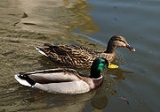
The
Mallard or
Wild Duck (
Anas platyrhynchos), is a dabbling duck which breeds throughout the
temperateIn geography, temperate or tepid latitudes of the globe lie between the tropics and the polar circles. The changes in these regions between summer and winter are generally relatively moderate, rather than extreme hot or cold...
and subtropical Americas, Europe, Asia, and North Africa, and has been
introducedAn introduced species — or neozoon, alien, exotic, non-indigenous, or non-native species, or simply an introduction, is a species living outside its indigenous or native distributional range, and has arrived in an ecosystem or plant community by human activity, either deliberate or accidental...
to New Zealand and Australia.
The male birds have a bright green or blue head, while the female's is light brown. The Mallard lives in wetlands, eats water plants, and is gregarious. The Mallard is the ancestor of most domestic ducks, and can interbreed with other species of genus
AnasAnas is a genus of dabbling ducks. It includes mallards, wigeons, teals, pintails and shovelers in a number of subgenera. Some authorities prefer to elevate the subgenera to genus rank...
. Among close relatives of the Mallard this hybridisation can cause genetic dilution, which is contributing the decline of rarer species of ducks.
Taxonomy and evolution
The Mallard was one of the many
bird species originally describedIn the 10th edition of Systema Naturae, Carl Linnaeus listed the 564 species of bird from around the world which were known to him at the time. There are now believed to be around 10,000 extant species...
by
LinnaeusCarl Linnaeus , also known after his ennoblement as , was a Swedish botanist, physician, and zoologist, who laid the foundations for the modern scheme of binomial nomenclature. He is known as the father of modern taxonomy, and is also considered one of the fathers of modern ecology...
in his 18th century work,
Systema NaturaeThe book was one of the major works of the Swedish botanist, zoologist and physician Carolus Linnaeus. The first edition was published in 1735...
, and still bears the first
binomial nameBinomial nomenclature is a formal system of naming species of living things by giving each a name composed of two parts, both of which use Latin grammatical forms, although they can be based on words from other languages...
it was given.
The Mallard is the ancestor of almost all of the varieties of domestic ducks, others being descended from the
Muscovy DuckThe Muscovy Duck is a large duck which is native to Mexico and Central and South America. A small wild population reaches into the United States in the lower Rio Grande Valley of Texas...
and
American Black DuckThe American Black Duck is a large dabbling duck. American Black Ducks are similar to Mallards in size, and resemble the female Mallard in coloration, although the Black Duck's plumage is darker...
. Ducks belong to the subfamily
AnatinaeThe Anatinae is a subfamily of the family Anatidae . Its surviving members are the dabbling ducks, which feed mainly at the surface rather than by diving...
of the waterfowl family Anatidae.
The name is derived from the
Old FrenchOld French was the Romance dialect continuum spoken in territories that span roughly the northern half of modern France and parts of modern Belgium and Switzerland from the 9th century to the 14th century...
malart or
mallart "wild drake", although its ultimate derivation is unclear. It may be related to an
Old High GermanThe term Old High German refers to the earliest stage of the German language and it conventionally covers the period from around 500 to 1050. Coherent written texts do not appear until the second half of the 8th century, and some treat the period before 750 as 'prehistoric' and date the start of...
masculine proper name
Madelhart, clues lying in the alternate English forms "maudelard" or "mawdelard".
Mallards frequently interbreed with their closest relatives in the
genusIn biology, a genus is a low-level taxonomic rank used in the biological classification of living and fossil organisms, which is an example of definition by genus and differentia...
AnasAnas is a genus of dabbling ducks. It includes mallards, wigeons, teals, pintails and shovelers in a number of subgenera. Some authorities prefer to elevate the subgenera to genus rank...
, such as the
American Black DuckThe American Black Duck is a large dabbling duck. American Black Ducks are similar to Mallards in size, and resemble the female Mallard in coloration, although the Black Duck's plumage is darker...
, and also with species more distantly related, for example the
Northern PintailThe Pintail or Northern Pintail is a widely occurring duck which breeds in the northern areas of Europe, Asia and North America. It is strongly migratory and winters south of its breeding range to the equator...
, leading to various hybrids that may be fully fertile. This is quite unusual among different species, and apparently is because the Mallard
evolvedEvolution is any change across successive generations in the heritable characteristics of biological populations. Evolutionary processes give rise to diversity at every level of biological organisation, including species, individual organisms and molecules such as DNA and proteins.Life on Earth...
very rapidly and not too long ago, during the
Late PleistoceneThe Late Pleistocene is a stage of the Pleistocene Epoch. The beginning of the stage is defined by the base of the Eemian interglacial phase before the final glacial episode of the Pleistocene 126,000 ± 5,000 years ago. The end of the stage is defined exactly at 10,000 Carbon-14 years BP...
only. The distinct lineages of this radiation are usually kept separate due to non-overlapping ranges and behavioural cues, but are still not fully genetically incompatible. Mallards and their domesticated conspecifics are, of course, also fully interfertile.
Mallards appear to be closer to their
Indo-PacificThe Indo-Pacific is a biogeographic region of the Earth's seas, comprising the tropical waters of the Indian Ocean, the western and central Pacific Ocean, and the seas connecting the two in the general area of Indonesia...
relatives than to their American ones judging from
biogeographyBiogeography is the study of the distribution of species , organisms, and ecosystems in space and through geological time. Organisms and biological communities vary in a highly regular fashion along geographic gradients of latitude, elevation, isolation and habitat area...
. Considering mtDNA
D-loopD-loop replication is a process by which chloroplasts and mitochondria replicate their genetic material. An important component of understanding D-loop replication is that many chloroplasts and mitochondria have a single circular chromosome like bacteria instead of the linear chromosomes found in...
sequenceThe sequence or primary structure of a nucleic acid is the composition of atoms that make up the nucleic acid and the chemical bonds that bond those atoms. Because nucleic acids, such as DNA and RNA, are unbranched polymers, this specification is equivalent to specifying the sequence of...
data, they may have evolved more probably than not in the general area of
SiberiaSiberia is an extensive region constituting almost all of Northern Asia. Comprising the central and eastern portion of the Russian Federation, it was part of the Soviet Union from its beginning, as its predecessor states, the Tsardom of Russia and the Russian Empire, conquered it during the 16th...
; Mallard bones rather abruptly appear in food remains of ancient humans and other deposits of
fossilFossils are the preserved remains or traces of animals , plants, and other organisms from the remote past...
bones in Europe, without a good candidate for a local predecessor species. The large
ice ageAn ice age or, more precisely, glacial age, is a generic geological period of long-term reduction in the temperature of the Earth's surface and atmosphere, resulting in the presence or expansion of continental ice sheets, polar ice sheets and alpine glaciers...
paleosubspecies which made up at least the European and west Asian populations during the
PleistoceneThe Pleistocene is the epoch from 2,588,000 to 11,700 years BP that spans the world's recent period of repeated glaciations. The name pleistocene is derived from the Greek and ....
has been named
Anas platyrhynchos palaeoboschas.
Haplotypes typical of American Mallard relatives and Spotbills can be found in Mallards around the
Bering SeaThe Bering Sea is a marginal sea of the Pacific Ocean. It comprises a deep water basin, which then rises through a narrow slope into the shallower water above the continental shelves....
. The
Aleutian Islands turned out to hold a population of Mallards that appear to be evolving towards a subspecies, as
gene flowIn population genetics, gene flow is the transfer of alleles of genes from one population to another.Migration into or out of a population may be responsible for a marked change in allele frequencies...
with other populations is very limited.
The size of the Mallard varies clinally, and birds from
GreenlandGreenland is an autonomous country within the Kingdom of Denmark, located between the Arctic and Atlantic Oceans, east of the Canadian Arctic Archipelago. Though physiographically a part of the continent of North America, Greenland has been politically and culturally associated with Europe for...
, although larger than birds further south, have smaller bills and are stockier. It is sometimes separated as
subspeciesSubspecies in biological classification, is either a taxonomic rank subordinate to species, ora taxonomic unit in that rank . A subspecies cannot be recognized in isolation: a species will either be recognized as having no subspecies at all or two or more, never just one...
, the Greenland Mallard (
A. p. conboschas).
Description
The Mallard is 50 – long (of which the body makes up around two-thirds), has a wingspan of 81 –, and weighs 0.72 –. The breeding male is unmistakable, with a bright bottle-green head, black rear end and a yellowish orange (can also contain some red) bill tipped with black (as opposed to the black/orange bill in females). It has a white collar which demarcates the head from the purple-tinged brown breast, grey brown wings, and a pale grey belly. The dark tail has white borders. The female Mallard is a mottled light brown, like most female dabbling ducks, and has buff cheeks, eyebrow, throat and neck with a darker crown and eye-stripe. However, both the female and male Mallards have distinct purple
speculumThe speculum is a patch, often distinctly coloured, on the inner remiges of some birds.Examples of the colour of the speculum in a number of ducks are:* Common Teal and Green-winged Teal: Iridescent green edged with buff....
edged with white, prominent in flight or at rest (though temporarily shed during the annual summer moult). Upon hatching, the plumage colouring of the duckling is yellow on the underside and face (with streaks by the eyes) and black on the backside (with some yellow spots) all the way to the top and back of the head. Its legs and bill are also black. As it nears a month in age, the duckling's plumage will start becoming drab, looking more like the female (though its plumage is more streaked) and its legs will lose their dark grey colouring. Two months after hatching, the fledgling period has ended and the duckling is now a juvenile. Between three to four months of age, the juvenile can finally begin flying as its wings are fully developed for flight (which can be confirmed by the sight of purple speculum feathers). Its bill will soon lose its dark grey colouring and its sex can finally be distinguished by three factors. The bill colouring is yellow in males, black and orange for females. The breast feathers are reddish-brown for males, brown for females. The centre tail feather is curled for males (called a drake feather), straight for females
During the final period of maturity leading up to adulthood (6–10 months of age), the plumage of female juveniles remains the same while the plumage of male juveniles slowly changes to its recognizable colours. This plumage change also applies to adult Mallard males when they transition in and out of their non-breeding (eclipse) plumage at the beginning and the end of the summer moulting period. The adulthood age for Mallards is 14 months and the average life expectancy is 20 years.
Several species of duck have brown-plumaged females which can be confused with the female Mallard. The female
GadwallThe Gadwall is a common and widespread duck of the family Anatidae.- Description :The Gadwall is 46–56 cm long with a 78–90 cm wingspan. The male is slightly larger than the female, weighing on average 990 g against her 850 g...
(
A. strepera) has an orange-lined bill, white belly, black and white speculum which is seen as a white square on the wings in flight, and is a smaller bird.
In captivity, domestic ducks come in wild-type plumages, white, and other colours. Most of these colour variants are also known in domestic Mallards not bred as livestock, but kept as pets,
aviaryAn aviary is a large enclosure for confining birds. Unlike cages, aviaries allow birds a larger living space where they can fly; hence, aviaries are also sometimes known as flight cages...
birds, etc., where they are rare but increasing in availability.
A noisy species, the male has a nasal call, and a high-pitched whistle, while the female has a deeper
quack stereotypically associated with ducks.
The Mallard is a rare example of both
Allen's RuleAllen's rule is a biological rule posited by Joel Asaph Allen in 1877. It states that endotherms from colder climates usually have shorter limbs than the equivalent animals from warmer climates.- Theory :...
and
Bergmann's RuleBergmann's rule is an ecogeographic principle that states that within a broadly distributed genus, species of larger size are found in colder environments, and species of smaller size are found in warmer regions. Although originally formulated in terms of species within a genus, it has often been...
in birds. Bergmann's Rule, which states that polar forms tend to be larger than related ones from warmer climates, has numerous examples in birds. Allen's Rule says that appendages like ears tend to be smaller in polar forms to minimize heat loss, and larger in tropical and desert equivalents to facilitate heat diffusion, and that the polar taxa are stockier overall. Examples of this rule in birds are rare, as they lack external ears. However, the bill of ducks is very well supplied with blood vessels and is vulnerable to cold.
Due to the malleability of the Mallard's genetic code, which gives it its vast interbreeding capability, mutations in the genes that decide plumage colour are very common and have resulted in a wide variety of hybrids such as Brewer's Duck (Mallard x
GadwallThe Gadwall is a common and widespread duck of the family Anatidae.- Description :The Gadwall is 46–56 cm long with a 78–90 cm wingspan. The male is slightly larger than the female, weighing on average 990 g against her 850 g...
,
Anas strepera).
Distribution and habitat
The Mallard is widely distributed across the Northern Hemisphere, North America from southern and central Alaska to Mexico, the Hawaiian Islands, and across Eurasia, from Iceland and southern Greenland and parts of Morocco (North Africa) in the west, Scandinavia to the north, and to Siberia, Japan, and China in the east. It is strongly
migratoryBird migration is the regular seasonal journey undertaken by many species of birds. Bird movements include those made in response to changes in food availability, habitat or weather. Sometimes, journeys are not termed "true migration" because they are irregular or in only one direction...
in the northern parts of its breeding range, and winters farther south. For example, in North America it winters south to Mexico, but also regularly strays into Central America and the
CaribbeanThe Caribbean is a crescent-shaped group of islands more than 2,000 miles long separating the Gulf of Mexico and the Caribbean Sea, to the west and south, from the Atlantic Ocean, to the east and north...
between September and May.
The Mallard inhabits a wide range of habitat and climates, from Arctic Tundra to subtropical regions. It is found in both fresh- and salt water
wetlandA wetland is an area of land whose soil is saturated with water either permanently or seasonally. Wetlands are categorised by their characteristic vegetation, which is adapted to these unique soil conditions....
s, including parks, small ponds, rivers, lakes and
estuariesAn estuary is a partly enclosed coastal body of water with one or more rivers or streams flowing into it, and with a free connection to the open sea....
, as well as shallow inlets and open sea within sight of the coastline. Water depths of less than 1 metres (3.3 ft) are preferred, birds avoiding areas more than a few metres deep. They are attracted to bodies of water with aquatic vegetation.
Feeding
The Mallard is omnivorous and very flexible in its food choice. Its diet may vary based on several factors, including the stage of the breeding cycle, short term variations in available food,
nutrientA nutrient is a chemical that an organism needs to live and grow or a substance used in an organism's metabolism which must be taken in from its environment. They are used to build and repair tissues, regulate body processes and are converted to and used as energy...
availability, and
interInterspecific competition, in ecology, is a form of competition in which individuals of different species compete for the same resource in an ecosystem...
- and
intraspecific competitionIntraspecific competition is a particular form of competition in which members of the same species vie for the same resource in an ecosystem...
. The majority of the Mallard's diet seems to be made up of gastropods, invertebrates (including beetles,
fliesFließ is a municipality in the Landeck district and is located5 km south of Landeck on the upper course of the Inn River. It has 9 hamlets and was already populated at the roman age; the village itself was founded around the 6th century. After a conflagration in 1933 Fließ was restored more...
, lepidopterans,
dragonfliesOdonata is an order of insects, encompassing dragonflies and damselflies . The word dragonfly is also sometimes used to refer to all Odonata, but the back-formation odonate is a more correct English name for the group as a whole...
, and caddisflies), crustaceans,
wormsOligochaeta is a subclass of animals in the biological phylum Annelida, which is made up of many types of aquatic and terrestrial worms, and this includes all of the various earthworms...
, many varieties of seeds and plant matter, and roots and tubers. During the breeding season, male birds were recorded to have eaten 37.6% animal matter and 62.4% plant matter, most notably
Echinochloa crus-galliEchinochloa crus-galli is a type of wild grass originating from tropical Asia that was formerly classified as a type of panicum grass. It is commonly known as Cockspur , Common Barnyard Grass, or simply "barnyard grass"...
, and nonlaying females ate 37.0% animal matter and 63.0% plant matter, while laying females ate 71.9% animal matter and only 28.1% plant matter. Plants generally make up a larger part of the bird's diet, especially during fall migration and in the winter.
It usually feeds by dabbling for plant food or grazing; there are reports of it eating
frogFrogs are amphibians in the order Anura , formerly referred to as Salientia . Most frogs are characterized by a short body, webbed digits , protruding eyes and the absence of a tail...
s. It usually nests on a river bank, but not always near water. It is highly gregarious outside of the breeding season and will form large
flocksA flock is a group of birds conducting flocking behavior in flight, or while foraging. The term is akin to the herd amongst mammals. The benefits of aggregating in flocks are varied and flocks will form explicitly for specific purposes...
, which are known as a
sord.
Breeding
Mallards usually form pairs (in October and November) only until the female lays eggs at the start of nesting season which is around the beginning of spring (early March to late May), at which time she is left by the male who will join up with other males to await the moulting period which begins in June. During the brief time before this, however, the males are still sexually potent and some of them will either remain on standby to sire replacement clutches (for female Mallards that have lost or abandoned their previous clutch) or forcibly mate with females of a different species that appear to be isolated or unattached.
The nesting period can be very stressful for the female; since she lays more than half her body weight in eggs and requires a lot of rest and a feeding/loafing area that is safe from predators. When seeking out a suitable nesting site, the female's preferences are areas that are well concealed, inaccessible to ground predators, or have few predators nearby. This can include urban areas that have roof gardens, enclosed courtyards, and flower boxes on window ledges more than one story up which prevents the ducklings from leaving safely without human intervention. The clutch is 8–13 eggs, which are incubated for 27–28 days to hatching with 50–60 days to fledgling. The ducklings are
precocialIn biology, the term precocial refers to species in which the young are relatively mature and mobile from the moment of birth or hatching. The opposite developmental strategy is called "altricial," where the young are born or hatched helpless. Extremely precocial species may be called...
and fully capable of swimming as soon as they hatch. However,
Filial imprintingImprinting is the term used in psychology and ethology to describe any kind of phase-sensitive learning that is rapid and apparently independent of the consequences of behavior...
will compel them to instinctively stay near the mother not only for warmth and protection but also to learn about and remember their habitat as well as how and where to forage for food. When ducklings mature into flight-capable juveniles, they will learn about and remember their traditional migratory routes (unless they are born and raised in captivity). After this, the juveniles and the mother may either part or continue staying together until the breeding season arrives.
When they pair off with mating partners, often one or several drakes will end up "left out". This group will sometimes target an isolated female duck, even when she's of a different species, and proceed to chase and peck at her until she weakens, at which point each male will take turns copulating with the female. Lebret (1961) calls this behaviour "Attempted Rape Flight" and Cramp & Simmons (1977) speak of "rape-intent flights". Male Mallards will also occasionally chase other male ducks of a different species, and even each other, in the same way. In one documented case of "homosexual necrophilia", a male Mallard copulated with another male he was chasing after the chased male died upon flying into a glass window.
Mallards are opportunistically targeted by
brood parasiteBrood parasites are organisms that use the strategy of brood parasitism, a kind of kleptoparasitism found among birds, fish or insects, involving the manipulation and use of host individuals either of the same or different species to raise the young of the brood-parasite...
s, occasionally having eggs laid in their nests by
RedheadsThe Redhead is a medium-sized diving duck, 37 cm long with an 84 cm wingspan.The adult male has a blue bill, a red head and neck, a black breast, yellow eyes and a grey back. The adult female has a brown head and body and a darker bluish bill with a black tip.The breeding habitat is...
,
Ruddy DuckThe Ruddy Duck is a small stiff-tailed duck.Their breeding habitat is marshy lakes and ponds throughout much of North America, and in South America in the Andes. They nest in dense marsh vegetation near water. The female builds her nest out of grass, locating it in tall vegetation to hide it from...
s,
Lesser ScaupThe Lesser Scaup is a small North American diving duck that migrates south as far as Central America in winter. It is colloquially known as the Little Bluebill or Broadbill because of its distinctive blue bill...
, Gadwalls,
Northern ShovelerThe Northern Shoveler , Northern Shoveller in British English, sometimes known simply as the Shoveler, is a common and widespread duck. It breeds in northern areas of Europe and Asia and across most of North America, and is a rare vagrant to Australia...
s,
Northern PintailThe Pintail or Northern Pintail is a widely occurring duck which breeds in the northern areas of Europe, Asia and North America. It is strongly migratory and winters south of its breeding range to the equator...
s,
Cinnamon TealThe Cinnamon Teal is a small, reddish dabbling duck found in marshes and ponds of western North and South America.thumb|left|Female Anas cyanoptera septentrionalium...
,
Common GoldeneyeThe Common Goldeneye is a medium-sized sea duck of the genus Bucephala, the goldeneyes. Their closest relative is the similar Barrow's Goldeneye....
s, and other Mallards. These eggs are generally accepted when they resemble the eggs of the host Mallard, although the hen may attempt to eject them or even abandon the nest if parasitism occurs during egg laying. Mallards of all ages (but especially young ones) and in all locations must contend with a wide diversity of predators including
raptor-Biology:* A bird of prey* Informal name for species in the Velociraptor genus of dinosaurs, or members of the family Dromaeosauridae in general* Acronym for the adapter protein regulatory-associated protein of mTOR-The South African military:...
s,
mustelidsMustelidae , commonly referred to as the weasel family, are a family of carnivorous mammals. Mustelids are diverse and the largest family in the order Carnivora, at least partly because in the past it has been a catch-all category for many early or poorly differentiated taxa...
, corvids,
snakeSnakes are elongate, legless, carnivorous reptiles of the suborder Serpentes that can be distinguished from legless lizards by their lack of eyelids and external ears. Like all squamates, snakes are ectothermic, amniote vertebrates covered in overlapping scales...
s,
raccoonProcyon is a genus of nocturnal mammals, comprising three species commonly known as raccoons, in the family Procyonidae. The most familiar species, the common raccoon , is often known simply as "the" raccoon, as the two other raccoon species in the genus are native only to the tropics and are...
s, opossums,
skunkSkunks are mammals best known for their ability to secrete a liquid with a strong, foul odor. General appearance varies from species to species, from black-and-white to brown or cream colored. Skunks belong to the family Mephitidae and to the order Carnivora...
s,
turtleTurtles are reptiles of the order Testudines , characterised by a special bony or cartilaginous shell developed from their ribs that acts as a shield...
s, large
fishFish are a paraphyletic group of organisms that consist of all gill-bearing aquatic vertebrate animals that lack limbs with digits. Included in this definition are the living hagfish, lampreys, and cartilaginous and bony fish, as well as various extinct related groups...
and
felidsFelidae is the biological family of the cats; a member of this family is called a felid. Felids are the strictest carnivores of the thirteen terrestrial families in the order Carnivora, although the three families of marine mammals comprising the superfamily pinnipedia are as carnivorous as the...
and
canidsCanidae is the biological family of carnivorous and omnivorous mammals that includes wolves, foxes, jackals, coyotes, and domestic dogs. A member of this family is called a canid . The Canidae family is divided into two tribes: Canini and Vulpini...
, including domesticated ones. The most prolific natural predators of adult Mallards are
Red foxThe red fox is the largest of the true foxes, as well as being the most geographically spread member of the Carnivora, being distributed across the entire northern hemisphere from the Arctic Circle to North Africa, Central America, and the steppes of Asia...
and
hawkThe term hawk can be used in several ways:* In strict usage in Australia and Africa, to mean any of the species in the subfamily Accipitrinae, which comprises the genera Accipiter, Micronisus, Melierax, Urotriorchis and Megatriorchis. The large and widespread Accipiter genus includes goshawks,...
s, although both kill far fewer than human hunters.
Conservation
The release of
feralA feral organism is one that has changed from being domesticated to being wild or untamed. In the case of plants it is a movement from cultivated to uncultivated or controlled to volunteer. The introduction of feral animals or plants to their non-native regions, like any introduced species, may...
Mallards in areas where they are not native sometimes creates problems through interbreeding with indigenous
waterfowlWaterfowl are certain wildfowl of the order Anseriformes, especially members of the family Anatidae, which includes ducks, geese, and swans....
. These
non-migratoryBird migration is the regular seasonal journey undertaken by many species of birds. Bird movements include those made in response to changes in food availability, habitat or weather. Sometimes, journeys are not termed "true migration" because they are irregular or in only one direction...
Mallards interbreed with indigenous wild ducks from local populations of closely related species through
genetic pollutionGenetic pollution is a controversial term for uncontrolled gene flow into wild populations. This gene flow is undesirable according to some environmentalists and conservationists, including groups such as Greenpeace, TRAFFIC, and GeneWatch UK.-Usage:...
by producing fertile offspring. Complete hybridization of various species of wild ducks gene pools could result in the extinction of many indigenous waterfowl. The wild Mallard itself is the ancestor of most domestic ducks and its naturally evolved wild gene pool gets genetically polluted in turn by the domesticated and feral populations.
The Mallard is considered an
invasive species"Invasive species", or invasive exotics, is a nomenclature term and categorization phrase used for flora and fauna, and for specific restoration-preservation processes in native habitats, with several definitions....
in New Zealand. There, and elsewhere, Mallards are spreading with increasing
urbanizationUrbanization, urbanisation or urban drift is the physical growth of urban areas as a result of global change. The United Nations projected that half of the world's population would live in urban areas at the end of 2008....
and hybridizing with local relatives. Over time, a continuum of hybrids ranging between almost typical examples of either species will develop; the
speciationSpeciation is the evolutionary process by which new biological species arise. The biologist Orator F. Cook seems to have been the first to coin the term 'speciation' for the splitting of lineages or 'cladogenesis,' as opposed to 'anagenesis' or 'phyletic evolution' occurring within lineages...
process beginning to reverse itself. This has created
conservationConservation biology is the scientific study of the nature and status of Earth's biodiversity with the aim of protecting species, their habitats, and ecosystems from excessive rates of extinction...
concerns for relatives of the Mallard, such as the
Hawaiian DuckThe Hawaiian Duck is a species of bird in the family Anatidae. It is endemic to the large islands of Hawaii. Some authorities treat it as an island subspecies of the Mallard, based on their capacity to produce fertile hybrids, but it appears well distinct and capability of hybridization is...
, the
A. s. superciliosa subspecies of the
Pacific Black DuckThe Pacific Black Duck is a dabbling duck found in much of Indonesia, New Guinea, Australia, New Zealand, and many islands in the southwestern Pacific, reaching to the Caroline Islands in the north and French Polynesia in the east. It is usually called the Grey Duck in New Zealand...
, the
American Black DuckThe American Black Duck is a large dabbling duck. American Black Ducks are similar to Mallards in size, and resemble the female Mallard in coloration, although the Black Duck's plumage is darker...
, the
Mottled DuckThe Mottled Duck or Mottled Mallard is a medium-sized dabbling duck. It is intermediate in appearance between the female Mallard and the American Black Duck. It is closely related to those species, and is sometimes considered a subspecies of the former, but this is inappropriate .There are two...
,
Meller's DuckMeller's Duck is a species of the dabbling duck genus Anas. It is endemic to eastern Madagascar. Although a population was established on Mauritius in the mid-18th century, this is on the verge of extinction due to habitat loss and competition by feral domestic ducks...
, the
Yellow-billed DuckThe Yellow-billed Duck, Anas undulata, is a 51–58 cm long dabbling duck which is an abundant resident breeder in southern and eastern Africa.This duck is not migratory, but will wander in the dry season to find suitable waters...
, and the
Mexican DuckThe Mexican Duck is a dabbling duck in the genus Anas which breeds in Mexico and the southern USA. Most of the population is resident, but some northern birds migrate south to Mexico in winter....
, in the latter case even leading to a dispute whether these birds should be considered a species (and thus entitled to more conservation research and funding) or included in the Mallard.
The availability of Mallards, Mallard ducklings, and fertilized Mallard eggs for public sale and private ownership, either as livestock or as pets, is currently legal in the United States except for the state of
FloridaFlorida is a state in the southeastern United States, located on the nation's Atlantic and Gulf coasts. It is bordered to the west by the Gulf of Mexico, to the north by Alabama and Georgia and to the east by the Atlantic Ocean. With a population of 18,801,310 as measured by the 2010 census, it...
which has currently banned domestic ownership of Mallards. This is to prevent hybridisation with the native
Mottled DuckThe Mottled Duck or Mottled Mallard is a medium-sized dabbling duck. It is intermediate in appearance between the female Mallard and the American Black Duck. It is closely related to those species, and is sometimes considered a subspecies of the former, but this is inappropriate .There are two...
.
Mallards are also causing severe "genetic pollution" of South Africa's
biodiversityBiodiversity is the degree of variation of life forms within a given ecosystem, biome, or an entire planet. Biodiversity is a measure of the health of ecosystems. Biodiversity is in part a function of climate. In terrestrial habitats, tropical regions are typically rich whereas polar regions...
by breeding with endemic ducks, although the
Agreement on the Conservation of African-Eurasian Migratory Waterbirds applies to the Mallard. The hybrids of Mallard and the
Yellow-billed DuckThe Yellow-billed Duck, Anas undulata, is a 51–58 cm long dabbling duck which is an abundant resident breeder in southern and eastern Africa.This duck is not migratory, but will wander in the dry season to find suitable waters...
are fertile and can produce more hybrid offspring. If this continues, only hybrids will occur and in the long term this will result in the extinction of various indigenous waterfowl. The Mallard duck can cross breed with 63 other species and is posing a severe threat to the genetic integrity of indigenous waterfowl. Mallards and their hybrids compete with indigenous birds for resources such as food, nest sites and roosting sites.
The Eastern or Chinese Spot-billed Duck is currently introgressing into the Mallard populations of the
Primorsky KraiPrimorsky Krai , informally known as Primorye , is a federal subject of Russia . Primorsky means "maritime" in Russian, hence the region is sometimes referred to as Maritime Province or Maritime Territory. Its administrative center is in the city of Vladivostok...
, possibly due to
habitatA habitat is an ecological or environmental area that is inhabited by a particular species of animal, plant or other type of organism...
changes from
global warmingGlobal warming refers to the rising average temperature of Earth's atmosphere and oceans and its projected continuation. In the last 100 years, Earth's average surface temperature increased by about with about two thirds of the increase occurring over just the last three decades...
. The
Mariana MallardThe Mariana Mallard or Oustalet's Duck is an extinct type of duck of the genus Anas that was endemic to the Mariana Islands...
was a resident allopatric population—in most respects a good species—apparently initially derived from Mallard-
Pacific Black DuckThe Pacific Black Duck is a dabbling duck found in much of Indonesia, New Guinea, Australia, New Zealand, and many islands in the southwestern Pacific, reaching to the Caroline Islands in the north and French Polynesia in the east. It is usually called the Grey Duck in New Zealand...
hybrids; unfortunately, it became extinct in the 1980s. In addition, feral domestic ducks interbreeding with Mallards have led to a size increase—especially in drakes—in most Mallards in urban areas. Rape flights between normal-sized females and such stronger males are liable to end with the female being drowned by the males' combined weight.
The
Laysan DuckThe Laysan Duck , also known as the Laysan Teal because of its small size, is an endangered dabbling duck endemic to the Hawaiian Islands...
is an insular relative of the Mallard with a very small and fluctuating population. Mallards sometimes arrive on its island home during migration, and can be expected to occasionally have remained and hybridized with Laysan Ducks as long as these species exist. But these hybrids are less well adapted to the peculiar ecological conditions of Laysan Island than the local ducks, and thus have lower
fitnessFitness is a central idea in evolutionary theory. It can be defined either with respect to a genotype or to a phenotype in a given environment...
, and furthermore, there were—apart from a brief time in the early 20th century when the Laysan Duck was almost extinct—always much more Laysan Ducks than stray Mallards. Thus, in this case, the hybrid lineages would rapidly fail.
In the cases mentioned above, however, ecological changes and hunting have led to a decline of local species; for example, the New Zealand Grey Duck population declined drastically due to overhunting in the mid-20th century. In the Hawaiian Duck, it seems that hybrid offspring are less well-adapted to native habitat and that utilizing them in reintroduction projects makes these less than successful. In conclusion, the crucial point underlying the problems of Mallards "hybridizing away" relatives is far less a consequence of Mallards spreading, but of local ducks declining;
allopatric speciationAllopatric speciation or geographic speciation is speciation that occurs when biological populations of the same species become isolated due to geographical changes such as mountain building or social changes such as emigration...
and isolating behaviour have produced today's diversity of Mallard-like ducks despite the fact that in most if not all of these populations, hybridization must have occurred to some extent.
Relationship with humans
The Mallard is depicted in a marginal decoration of the 15th century English illuminated manuscript the
Sherborne MissalThe Sherborne Missal is a 15th century English illuminated manuscript missal in the British Library that has survived in excellent condition. It weighs 20 kg and has 347 leaves. It was commissioned by Abbott Robert Bruyning of Sherborne, and was made for use at Sherborne Abbey...
.
Since 1933, the
Peabody HotelThe Peabody Hotel is a luxury hotel in Downtown Memphis, Tennessee. The hotel is well known for the famous "Peabody Ducks" that live on the hotel rooftop, but which make daily treks to the hotel's lobby in a daily "March of Ducks" celebration.- History :...
in
Downtown Memphis, TennesseeDowntown Memphis, Tennessee is the central business district of Memphis, Tennessee and is located along the Mississippi River between Interstate 40 to the north, Interstate 55 to the south and I-240 to the east, where it abuts Midtown Memphis....
has maintained a long tradition of keeping one Mallard drake and four Mallard hens, called
The Peabody Ducks, as a popular hotel attraction and as guests of honor. The Mallards are provided by a local farmer and friend of the Peabody Hotel and are rotated out and returned to the farm for a new team of Mallards every three months. This tradition has also been maintained and observed at the other Peabody Hotels in
Little RockLittle Rock is the capital and the largest city of the U.S. state of Arkansas. The Metropolitan Statistical Area had a population of 699,757 people in the 2010 census...
,
ArkansasArkansas is a state located in the southern region of the United States. Its name is an Algonquian name of the Quapaw Indians. Arkansas shares borders with six states , and its eastern border is largely defined by the Mississippi River...
and
OrlandoOrlando is a city in the central region of the U.S. state of Florida. It is the county seat of Orange County, and the center of the Greater Orlando metropolitan area. According to the 2010 US Census, the city had a population of 238,300, making Orlando the 79th largest city in the United States...
,
FloridaFlorida is a state in the southeastern United States, located on the nation's Atlantic and Gulf coasts. It is bordered to the west by the Gulf of Mexico, to the north by Alabama and Georgia and to the east by the Atlantic Ocean. With a population of 18,801,310 as measured by the 2010 census, it...
.
The children's
picture bookA picture book combines visual and verbal narratives in a book format, most often aimed at young children. The images in picture books use a range of media such as oil paints, acrylics, watercolor and pencil.Two of the earliest books with something like the format picture books still retain now...
Make Way for DucklingsMake Way for Ducklings is a children's picture book written and illustrated by Robert McCloskey. First published in 1941, the book tells the story of a pair of mallard ducks who decide to raise their family on an island in the lagoon in Boston Public Garden, a park in the center of Boston,...
, published in
1941The year 1941 in literature involved some significant events and new books.-Events:*Frank Herbert marries Flora Parkinson.*F. Scott Fitzgerald's unfinished work, The Last Tycoon, is edited and published by Edmund Wilson.-New books:...
and winner of the
1942 Caldecott MedalThe Caldecott Medal is awarded annually by the Association for Library Service to Children , a division of the American Library Association, to the artist of the most distinguished American picture book for children published that year. The award was named in honor of nineteenth-century English...
for its illustrations, is the story of a pair of Mallards who decide to raise their family on an island in the lagoon in
Boston Public GardenThe Public Garden, also known as Boston Public Garden, is a large park located in the heart of Boston, Massachusetts, adjacent to Boston Common.-History:...
in
MassachusettsThe Commonwealth of Massachusetts is a state in the New England region of the northeastern United States of America. It is bordered by Rhode Island and Connecticut to the south, New York to the west, and Vermont and New Hampshire to the north; at its east lies the Atlantic Ocean. As of the 2010...
.
Duck HeadDuck Head is a brand name for clothing and shoes in the United States. First registered as a trademark in the late 19th century, the name has been used by several different manufacturers and retailers of apparel, primarily in the southern United States...
, a U.S. clothing brand, uses the image of a Mallard's head as its
logoA logo is a graphic mark or emblem commonly used by commercial enterprises, organizations and even individuals to aid and promote instant public recognition...
.
See also
- Unihemispheric slow-wave sleep
Unihemispheric slow-wave sleep , also termed asymmetric slow-wave sleep , is characterized by slow-wave activity in one hemisphere of the brain while a low voltage EEG, characteristic of wakefulness, is present in the other. The phenomenon has been observed in a number of terrestrial and aquatic as...
- Rouen Duck
The Rouen Duck is a heavyweight breed of domesticated duck raised primarily for decoration or as general purpose ducks, since they are not prolific egg layers...
: A domestic duck breed that is identical to the Mallard in terms of plumage coloring.
External links