

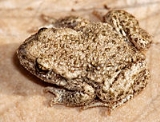
Midwife toad

Encyclopedia
Midwife toads are a genus of frog
s in the Discoglossidae
family, and are found in most of Europe
and northwestern Africa
. Characteristic of these toad-like frogs is their parental care: the males carry a string of fertilised eggs on their back, hence the name "midwife". The female expels a strand of eggs, which the male fertilizes externally. He then wraps them around his legs to protect them from predators in the water. When they are ready to hatch, the male wades into shallow water, where he allows the tadpoles to leap out of their eggs. Five separate species of midwife toad are found across western Europe, northern Africa, and Majorca.
Midwife toads can be found in the snows of the Pyrenees
, living at heights of 5,000–6,500 feet in areas such as the Néouvielle massif
Unlike the thin tongue of many amphibians, the midwife's tongue is round and flattened. Its family name, Discoglossidae, means "round tongue" In parts of France
midwife toads live in sand dunes by the sea. They share this habitat with natterjack toad
s.
, the programmed cell death
, was first observed in the developing of the tadpoles of the midwife toads 1842 by Carl Vogt.
Frog
Frogs are amphibians in the order Anura , formerly referred to as Salientia . Most frogs are characterized by a short body, webbed digits , protruding eyes and the absence of a tail...
s in the Discoglossidae
Discoglossidae
Discoglossidae is a family of primitive frogs, with the common name Disc-Tongued Frogs. Most are endemic to Europe, but there are also three species in North-West Africa, and an extinct species formerly occurred in Israel....
family, and are found in most of Europe
Europe
Europe is, by convention, one of the world's seven continents. Comprising the westernmost peninsula of Eurasia, Europe is generally 'divided' from Asia to its east by the watershed divides of the Ural and Caucasus Mountains, the Ural River, the Caspian and Black Seas, and the waterways connecting...
and northwestern Africa
Africa
Africa is the world's second largest and second most populous continent, after Asia. At about 30.2 million km² including adjacent islands, it covers 6% of the Earth's total surface area and 20.4% of the total land area...
. Characteristic of these toad-like frogs is their parental care: the males carry a string of fertilised eggs on their back, hence the name "midwife". The female expels a strand of eggs, which the male fertilizes externally. He then wraps them around his legs to protect them from predators in the water. When they are ready to hatch, the male wades into shallow water, where he allows the tadpoles to leap out of their eggs. Five separate species of midwife toad are found across western Europe, northern Africa, and Majorca.
Midwife toads can be found in the snows of the Pyrenees
Pyrenees
The Pyrenees is a range of mountains in southwest Europe that forms a natural border between France and Spain...
, living at heights of 5,000–6,500 feet in areas such as the Néouvielle massif
Néouvielle massif
The Néouvielle massif is a group of mountains in the Pyrenees in France notable for its lakes and its microclimate. Much of the massif lies within the Néouvielle National Nature Reserve; this nature reserve was created in 1936 and is the third oldest in France.The name Néouvielle derives from nèu...
Unlike the thin tongue of many amphibians, the midwife's tongue is round and flattened. Its family name, Discoglossidae, means "round tongue" In parts of France
France
The French Republic , The French Republic , The French Republic , (commonly known as France , is a unitary semi-presidential republic in Western Europe with several overseas territories and islands located on other continents and in the Indian, Pacific, and Atlantic oceans. Metropolitan France...
midwife toads live in sand dunes by the sea. They share this habitat with natterjack toad
Natterjack Toad
The Natterjack Toad is a toad native to sandy and heathland areas of Europe. Adults are 60–70 mm in length and are distinguished from Common Toads by a yellow line down the middle of the back...
s.
Description
Five separate species of midwife toad are found across western Europe, northern Africa, and Majorca. Shy, nocturnal animals, they give away their presence by their ringing call. During the day, the midwife toad hides under stones and logs or in underground tunnels. It often hides in dry, sandy soil, which it finds easier to dig into using its forelegs and snout. It emerges at dusk to forage for food, but always returns to the same hiding places before dawn. During the winter, the common midwife toad hibernates in its hole or in a burrow that has been deserted by a small animal.Food and Feeding
The Midwife toad crawls around the area close to its hiding place at night to search for food. The toad uses the end of its long, sticky tongue to pick up prey, which includes beetles, crickets, flies, caterpillars, centipedes, ants and millipedes. Tadpoles feed on vegetable matter. They chew with tiny, hornyteeth. Young toads eat smaller sizes of the same prey that adults feed on. When the egg ready to hatch the male leaves them near the water.Defenses
The back of the midwife toad is covered with small warts. These warts give off a strong smelling poison when the toad is handled or attacked. The poison is so powerful that the toad has few enemies or predators. The poison also helps to keep the egg strings on the male's back safe from attack. The tadpole does not possess the poison, and therefore falls prey to fish and insects.Adaptions
The Majorcan midwife toad has adapted to the harsh, dry conditions of this Spanish Island. it is found only in deep canyons in the northern mountains. Its body has evolved to become more flattened, which enables the toad to squeeze into narrow crevices in the rocks of its habitat. The only moisture available is in small, rain-filled puddles on ledges. Tadpoles are born and develop in these pools. Fossils of these species have also been found in Europe.Species
| Binomial Name and Author | Common Name |
|---|---|
| Alytes cisternasii | Iberian Midwife Toad |
| Alytes dickhilleni | Betic Midwife Toad |
| Alytes maurus | |
| Alytes muletensis | Mallorcan midwife toad |
| Alytes obstetricans | Common Midwife Toad |
In Laboratories
ApoptosisApoptosis
Apoptosis is the process of programmed cell death that may occur in multicellular organisms. Biochemical events lead to characteristic cell changes and death. These changes include blebbing, cell shrinkage, nuclear fragmentation, chromatin condensation, and chromosomal DNA fragmentation...
, the programmed cell death
Programmed cell death
Programmed cell-death is death of a cell in any form, mediated by an intracellular program. PCD is carried out in a regulated process which generally confers advantage during an organism's life-cycle...
, was first observed in the developing of the tadpoles of the midwife toads 1842 by Carl Vogt.