
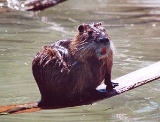
The
coypu (
Myocastor coypus), also known as the
river rat,
and
nutria, is a large,
herbivorousHerbivores are organisms that are anatomically and physiologically adapted to eat plant-based foods. Herbivory is a form of consumption in which an organism principally eats autotrophs such as plants, algae and photosynthesizing bacteria. More generally, organisms that feed on autotrophs in...
, semiaquatic
rodentRodentia is an order of mammals also known as rodents, characterised by two continuously growing incisors in the upper and lower jaws which must be kept short by gnawing....
and the only member of the family
Myocastoridae. Originally native to subtropical and temperate
South AmericaSouth America is a continent situated in the Western Hemisphere, mostly in the Southern Hemisphere, with a relatively small portion in the Northern Hemisphere. The continent is also considered a subcontinent of the Americas. It is bordered on the west by the Pacific Ocean and on the north and east...
, it has since been introduced to
North AmericaNorth America is a continent wholly within the Northern Hemisphere and almost wholly within the Western Hemisphere. It is also considered a northern subcontinent of the Americas...
,
EuropeEurope is, by convention, one of the world's seven continents. Comprising the westernmost peninsula of Eurasia, Europe is generally 'divided' from Asia to its east by the watershed divides of the Ural and Caucasus Mountains, the Ural River, the Caspian and Black Seas, and the waterways connecting...
,
AsiaAsia is the world's largest and most populous continent, located primarily in the eastern and northern hemispheres. It covers 8.7% of the Earth's total surface area and with approximately 3.879 billion people, it hosts 60% of the world's current human population...
, and
AfricaAfrica is the world's second largest and second most populous continent, after Asia. At about 30.2 million km² including adjacent islands, it covers 6% of the Earth's total surface area and 20.4% of the total land area...
, primarily by fur ranchers. Although it is still valued for its fur in some regions, its destructive feeding and burrowing behaviors make this
invasive species"Invasive species", or invasive exotics, is a nomenclature term and categorization phrase used for flora and fauna, and for specific restoration-preservation processes in native habitats, with several definitions....
a pest throughout most of its range.
There are two commonly-used names in the
English languageEnglish is a West Germanic language that arose in the Anglo-Saxon kingdoms of England and spread into what was to become south-east Scotland under the influence of the Anglian medieval kingdom of Northumbria...
for
Myocastor coypus. The name
nutria (or local derivatives such as "
nutria- or
nutra- rat") is generally used in North America and Asia; however, in
SpanishSpanish , also known as Castilian , is a Romance language in the Ibero-Romance group that evolved from several languages and dialects in central-northern Iberia around the 9th century and gradually spread with the expansion of the Kingdom of Castile into central and southern Iberia during the...
-speaking countries, the word
nutria refers to the
otterThe Otters are twelve species of semi-aquatic mammals which feed on fish and shellfish, and also other invertebrates, amphibians, birds and small mammals....
. To avoid this ambiguity, the name
coypu (derived from the Mapudungun language) is used in Latin America and Europe. In France, the coypu is known as a
ragondin. In Dutch it is known as
beverrat (beaver rat). In Italy, instead, the popular name is, as in North America and Asia,
nutria, but it is also called
castorino (
little beaverThe beaver is a primarily nocturnal, large, semi-aquatic rodent. Castor includes two extant species, North American Beaver and Eurasian Beaver . Beavers are known for building dams, canals, and lodges . They are the second-largest rodent in the world...
), by which its fur is known in Italy.
Coypus live in burrows alongside stretches of water. They feed on river plants, and waste close to 90% of the plant material while feeding on the stems.
Taxonomy
The coypu was first described by
Juan Ignacio MolinaFr. Juan Ignacio Molina was a Chilean Jesuit priest, naturalist, historian, botanist, ornithologist and geographer...
in 1782 as
Mus coypus, a member of the
mouseA mouse is a small mammal belonging to the order of rodents. The best known mouse species is the common house mouse . It is also a popular pet. In some places, certain kinds of field mice are also common. This rodent is eaten by large birds such as hawks and eagles...
genus. The genus
Myocastor, assigned in 1792 by
Robert KerrRobert Kerr FRS was a scientific writer and translator from Scotland.Kerr was born in Roxburghshire as the son of a jeweller. He studied medicine at the University of Edinburgh and practised at the Edinburgh Foundling Hospital as a surgeon...
, is derived from the
GreekGreek is an independent branch of the Indo-European family of languages. Native to the southern Balkans, it has the longest documented history of any Indo-European language, spanning 34 centuries of written records. Its writing system has been the Greek alphabet for the majority of its history;...
mys and
kastor, or "mouse-beaver".
GeoffroyÉtienne Geoffroy Saint-Hilaire was a French naturalist who established the principle of "unity of composition". He was a colleague of Jean-Baptiste Lamarck and expanded and defended Lamarck's evolutionary theories...
, independently of Kerr, named the species
Myopotamus coypus, and it is occasionally referred to by this name.
Four subspecies are generally recognized:
- M. c. bonariensis: northern Argentina, Bolivia, Paraguay, Uruguay, southern Brazil
- M. c. coypus: central Chile, Bolivia
- M. c. melanops: Chiloé Island
Chiloé Island , also known as Greater Island of Chiloé , is the largest island of the Chiloé Archipelago off the coast of Chile, in the Pacific Ocean...
- M. c. santacruzae: Patagonia
Patagonia is a region located in Argentina and Chile, integrating the southernmost section of the Andes mountains to the southwest towards the Pacific ocean and from the east of the cordillera to the valleys it follows south through Colorado River towards Carmen de Patagones in the Atlantic Ocean...
M. c. bonariensis, the subspecies present in the northernmost (subtropical) part of the coypu's range, is believed to be the type of coypu most commonly introduced to other continents.
Appearance
The coypu somewhat resembles a very large
ratRats are various medium-sized, long-tailed rodents of the superfamily Muroidea. "True rats" are members of the genus Rattus, the most important of which to humans are the black rat, Rattus rattus, and the brown rat, Rattus norvegicus...
, or a
beaverThe beaver is a primarily nocturnal, large, semi-aquatic rodent. Castor includes two extant species, North American Beaver and Eurasian Beaver . Beavers are known for building dams, canals, and lodges . They are the second-largest rodent in the world...
with a small tail. Adults are typically 5 kilogram in weight, and 40 centimetre in body length, with a 30 centimetre tail. They have a coarse, darkish brown outer fur with a soft under-fur. Two distinguishing marks are the presence of a white patch on the muzzle, and webbed hind feet. They can also be identified by their bright orange-yellow
incisorIncisors are the first kind of tooth in heterodont mammals. They are located in the premaxilla above and mandible below.-Function:...
teeth (unlike
ratRats are various medium-sized, long-tailed rodents of the superfamily Muroidea. "True rats" are members of the genus Rattus, the most important of which to humans are the black rat, Rattus rattus, and the brown rat, Rattus norvegicus...
s, which have brownish yellow incisors). The
nippleIn its most general form, a nipple is a structure from which a fluid emanates. More specifically, it is the projection on the breasts or udder of a mammal by which breast milk is delivered to a mother's young. In this sense, it is often called a teat, especially when referring to non-humans, and...
s of female coypu are high on her flanks. This allows their young to feed while the female is in the water.
Coypu can also be mistaken for another widely dispersed semi-aquatic rodent that occupies the same wetland habitats, the
muskratThe muskrat , the only species in genus Ondatra, is a medium-sized semi-aquatic rodent native to North America, and introduced in parts of Europe, Asia, and South America. The muskrat is found in wetlands and is a very successful animal over a wide range of climates and habitats...
. The muskrat, however, is smaller, more tolerant of cold climates, and has a laterally flattened tail that it uses to assist in swimming, whereas the tail of a coypu is round. It can also be mistaken for a small
beaverThe beaver is a primarily nocturnal, large, semi-aquatic rodent. Castor includes two extant species, North American Beaver and Eurasian Beaver . Beavers are known for building dams, canals, and lodges . They are the second-largest rodent in the world...
, as beavers and coypus have very similar anatomies; beavers' tails are flat and paddle-like, as opposed to the round rat-like tails of coypu.
Commercial and environmental issues
Local extinction in their native range due to overharvest led to the development of coypu fur farms in the late 19th and early 20th centuries. The first farms were in Argentina and then later in Europe, North America, and Asia. These farms have generally not been successful long term investments and farmed coypu often are released or escape as operations become unprofitable.
As demand for coypu fur declined, coypu have since become pests in many areas, destroying aquatic vegetation, marshes,
irrigationIrrigation may be defined as the science of artificial application of water to the land or soil. It is used to assist in the growing of agricultural crops, maintenance of landscapes, and revegetation of disturbed soils in dry areas and during periods of inadequate rainfall...
systems, chewing through human-made items, such as tires and wooden house panelling in
LouisianaLouisiana is a state located in the southern region of the United States of America. Its capital is Baton Rouge and largest city is New Orleans. Louisiana is the only state in the U.S. with political subdivisions termed parishes, which are local governments equivalent to counties...
, eroding river banks, and displacing native animals. Coypu were introduced to the
LouisianaLouisiana is a state located in the southern region of the United States of America. Its capital is Baton Rouge and largest city is New Orleans. Louisiana is the only state in the U.S. with political subdivisions termed parishes, which are local governments equivalent to counties...
ecosystem in the 1930s when they escaped from fur farms that had imported them from South America. Nutria damage in Louisiana became so severe that in 2005, a bounty program was in effect to aid in controlling the animal. In the
Chesapeake BayThe Chesapeake Bay is the largest estuary in the United States. It lies off the Atlantic Ocean, surrounded by Maryland and Virginia. The Chesapeake Bay's drainage basin covers in the District of Columbia and parts of six states: New York, Pennsylvania, Delaware, Maryland, Virginia, and West...
region in
MarylandMaryland is a U.S. state located in the Mid Atlantic region of the United States, bordering Virginia, West Virginia, and the District of Columbia to its south and west; Pennsylvania to its north; and Delaware to its east...
, where they were introduced in the 1940s, coypu are believed to have destroyed 7000 acre of marshland in the
Blackwater National Wildlife RefugeThe Blackwater National Wildlife Refuge was established in 1933 as a waterfowl sanctuary for birds migrating along the critical migration highway called the Atlantic Flyway...
. In response, by 2003, a multi-million dollar eradication program was underway.
Coypu were also introduced to
East AngliaEast Anglia is a traditional name for a region of eastern England, named after an ancient Anglo-Saxon kingdom, the Kingdom of the East Angles. The Angles took their name from their homeland Angeln, in northern Germany. East Anglia initially consisted of Norfolk and Suffolk, but upon the marriage of...
, for fur, in 1929; many escaped and damaged the drainage works, and a concerted programme by
MAFFThe Ministry of Agriculture, Fisheries and Food was a United Kingdom government department created by the Board of Agriculture Act 1889 and at that time called the Board of Agriculture, and then from 1903 the Board of Agriculture and Fisheries, and from 1919 the Ministry of Agriculture and Fisheries...
eradicated them by 1989.
Coypu meat is lean and low in
cholesterolCholesterol is a complex isoprenoid. Specifically, it is a waxy steroid of fat that is produced in the liver or intestines. It is used to produce hormones and cell membranes and is transported in the blood plasma of all mammals. It is an essential structural component of mammalian cell membranes...
. While there have been many attempts to establish markets for coypu meat, all documented cases have generally been unsuccessful. Unscrupulous entrepreneurs have promoted coypu and coypu farms for their value as "meat", "fur", or "aquatic weed control". In recent years they have done so in countries such as the United States, China, Taiwan and Thailand. In every documented case the entrepreneurs sell coypu "breeding stock" at very high prices. Would-be coypu farmers find that the markets for their products disappear after the promoter has dropped out of the picture.
In the former Soviet republics of Central Asia, specifically Kyrgyzstan and Uzbekistan, Nutria (Russian and local languages Нутрия) are farmed on private plots and sold in local markets as a poor man's meat.
In addition to direct environmental damage, coypu are the host for a
nematodeThe nematodes or roundworms are the most diverse phylum of pseudocoelomates, and one of the most diverse of all animals. Nematode species are very difficult to distinguish; over 28,000 have been described, of which over 16,000 are parasitic. It has been estimated that the total number of nematode...
parasite (
Strongyloides myopotami) that can infect the skin of humans causing dermatitis similar to
strongyloidiasisStrongyloidiasis is a human parasitic disease caused by the nematode Strongyloides stercoralis, or sometimes S. fülleborni. It can cause a number of symptoms in people, principally skin symptoms, abdominal pain, diarrhea and weight loss...
. The condition is also called "nutria itch".
Distribution
The distribution of coypu tends to expand and contract with successive cold or mild winters. During cold winters, coypu often suffer
frostbiteFrostbite is the medical condition where localized damage is caused to skin and other tissues due to extreme cold. Frostbite is most likely to happen in body parts farthest from the heart and those with large exposed areas...
on their tails leading to
infectionAn infection is the colonization of a host organism by parasite species. Infecting parasites seek to use the host's resources to reproduce, often resulting in disease...
or death. As a result, populations of coypu often contract and even become locally or regionally extinct as in the
ScandinaviaScandinavia is a cultural, historical and ethno-linguistic region in northern Europe that includes the three kingdoms of Denmark, Norway and Sweden, characterized by their common ethno-cultural heritage and language. Modern Norway and Sweden proper are situated on the Scandinavian Peninsula,...
n countries and such USA states as Idaho, Montana and Nebraska during the 1980s (Carter and Leonard 2002). During mild winters, their ranges tend to expand northward. For example in recent years range expansions have been noted in Washington State and Oregon (Sheffels and Sytsma 2007).
External links