

Garlic Mustard

Encyclopedia
Garlic mustard is a biennial flowering plant
in the Mustard family, Brassicaceae
. It is native to Europe
, western and central Asia
, and northwestern Africa
, from Morocco
, Iberia
and the British Isles
, north to northern Scandinavia
, and east to northern India
and western China
(Xinjiang
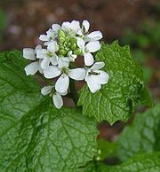
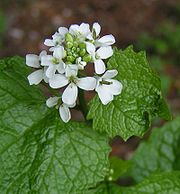
). In the first year of growth, plants form clumps of round shaped, slightly wrinkled leaves, that when crushed smell like garlic. The next year plants flower in spring, producing cross shaped white flowers in dense clusters. As the flowering stems bloom they elongate into a spike-like shape. When blooming is complete, plants produce upright fruits that release seeds in mid summer. Plants are often found growing along the margins of hedgerows, giving rise to the old British
folk name of Jack-by-the-hedge. Other common names include Garlic Root, Hedge Garlic, Sauce-alone, Jack-in-the-bush, Penny Hedge and Poor Man's Mustard. The genus name Alliaria, "resembling Allium
", refers to the garlic
-like odour of the crushed foliage.
Lawrence Newcomb gives the species name Alliaria officinalis for this plant.
biennial plant
(sometimes an annual plant
) growing from a deeply growing, thin, white taproot that is scented like a horse-radish. Second year plants grow from 30–100 cm (rarely to 130 cm) tall. The leaves
are stalked, triangular to heart-shaped, 10–15 cm long (of which about half being the petiole
) and 5–9 cm broad, with a coarsely toothed margin. In biennial specimens, first-year plants appear as a rosette of green leaves close to the ground; these rosettes remain green through the winter and develop into mature flowering plants the following spring. The flower
s are produced in spring and summer in button-like clusters. Each small flower has four white petals 4–8 mm long and 2–3 mm broad, arranged in a cross shape. The fruit
is an erect, slender, four-sided pod 4 to 5.5 cm long, called a silique
, green maturing pale grey-brown, containing two rows of small shiny black seed
s which are released when the pod splits open. Some plants can flower and complete their life-cycle in the first year. A single plant can produce hundreds of seeds, which scatter as much as several meters from the parent plant. Depending upon conditions, garlic mustard flowers either self-fertilize or are cross-pollinated by a variety of insects. Self-fertilized seeds are genetically identical to the parent plant, enhancing its ability to colonize an area where that genotype is suited to thrive. Garlic mustard has been classified as Magnoliopsida.

s and sauce
s such as pesto
, and sometimes the flowers and fruit are included as well. These are best when young, and provide a mild flavour of both garlic and mustard. The seeds are sometimes used to season food directly in France
.
Garlic mustard was once used medicinally as a disinfectant or diuretic
, and was sometimes used to heal wounds.
In Europe as many as 69 species of insect
s and seven species of fungus
utilize Garlic Mustard as a food plant, including the larva
e of some Lepidoptera
species such as the Garden Carpet
moth.
as a culinary herb in the 1860s and is an invasive species
in much of North America. , it is listed as a noxious or restricted plant in the US states of Alabama, Connecticut, Massachusetts, Minnesota, New Hampshire, Oregon, Vermont, West Virginia and Washington. Like most invasive plants, once it has an introduction into a new location, it persists and spreads into undisturbed plant communities. In many areas of its introduction in Eastern North America, it has become the dominant under-story species in woodland and flood plain environments, where eradication is difficult.
The insects and fungi that feed on it in its native habitat are not present in North America, increasing its seed productivity and allowing it to out-compete native plants. It is a possible threat to the West Virginia White Butterfly (Pieris virginiensis) and Mustard White Butterfly (Pieris oleracea); adult butterflies of both species lay their eggs on native Dentaria or Toothwort plants, but they often confuse garlic mustard plants with Dentaria and lay their eggs on garlic mustard, because they have similar flowers. The eggs and young butterflies cannot live on the garlic mustard, because it has chemicals that are toxic to the larvae and eggs.
Garlic Mustard produces allelochemicals
which suppress mycorrhizal fungi that most plants, including native forest trees, require for optimum growth. However, allelochemicals produced by Garlic Mustard do not affect mycorrhizal fungi from Garlic Mustard's native range, indicating that this "novel weapon" in the invaded range explains Garlic Mustard's success in North America. Additionally, because white-tailed deer
rarely feed on Garlic Mustard, large deer populations may help to increase its population densities by consuming competing native plants. Trampling by browsing deer encourages additional seed growth by disturbing the soil. Seeds contained in the soil can germinate up to five years after being produced. The persistence of the seed bank and suppression of mycorrhizal fungi both complicate restoration of invaded areas because long-term removal is required to deplete the seed bank and allow recovery of mycorrhizae.
Garlic mustard produces a variety of secondary compounds including flavonoids, defense proteins, glycoside
s, and glucosinolate
s that reduce its palatability to herbivores.
Research published in 2007 shows that, in northeastern forests, garlic mustard rosettes increased the rate of native leaf litter decomposition, increasing nutrient availability and possibly creating conditions favorable to garlic mustard's own spread.
Flowering plant
The flowering plants , also known as Angiospermae or Magnoliophyta, are the most diverse group of land plants. Angiosperms are seed-producing plants like the gymnosperms and can be distinguished from the gymnosperms by a series of synapomorphies...
in the Mustard family, Brassicaceae
Brassicaceae
Brassicaceae, a medium sized and economically important family of flowering plants , are informally known as the mustards, mustard flowers, the crucifers or the cabbage family....
. It is native to Europe
Europe
Europe is, by convention, one of the world's seven continents. Comprising the westernmost peninsula of Eurasia, Europe is generally 'divided' from Asia to its east by the watershed divides of the Ural and Caucasus Mountains, the Ural River, the Caspian and Black Seas, and the waterways connecting...
, western and central Asia
Asia
Asia is the world's largest and most populous continent, located primarily in the eastern and northern hemispheres. It covers 8.7% of the Earth's total surface area and with approximately 3.879 billion people, it hosts 60% of the world's current human population...
, and northwestern Africa
Africa
Africa is the world's second largest and second most populous continent, after Asia. At about 30.2 million km² including adjacent islands, it covers 6% of the Earth's total surface area and 20.4% of the total land area...
, from Morocco
Morocco
Morocco , officially the Kingdom of Morocco , is a country located in North Africa. It has a population of more than 32 million and an area of 710,850 km², and also primarily administers the disputed region of the Western Sahara...
, Iberia
Iberian Peninsula
The Iberian Peninsula , sometimes called Iberia, is located in the extreme southwest of Europe and includes the modern-day sovereign states of Spain, Portugal and Andorra, as well as the British Overseas Territory of Gibraltar...
and the British Isles
British Isles
The British Isles are a group of islands off the northwest coast of continental Europe that include the islands of Great Britain and Ireland and over six thousand smaller isles. There are two sovereign states located on the islands: the United Kingdom of Great Britain and Northern Ireland and...
, north to northern Scandinavia
Scandinavia
Scandinavia is a cultural, historical and ethno-linguistic region in northern Europe that includes the three kingdoms of Denmark, Norway and Sweden, characterized by their common ethno-cultural heritage and language. Modern Norway and Sweden proper are situated on the Scandinavian Peninsula,...
, and east to northern India
India
India , officially the Republic of India , is a country in South Asia. It is the seventh-largest country by geographical area, the second-most populous country with over 1.2 billion people, and the most populous democracy in the world...
and western China
China
Chinese civilization may refer to:* China for more general discussion of the country.* Chinese culture* Greater China, the transnational community of ethnic Chinese.* History of China* Sinosphere, the area historically affected by Chinese culture...
(Xinjiang
Xinjiang
Xinjiang is an autonomous region of the People's Republic of China. It is the largest Chinese administrative division and spans over 1.6 million km2...
). In the first year of growth, plants form clumps of round shaped, slightly wrinkled leaves, that when crushed smell like garlic. The next year plants flower in spring, producing cross shaped white flowers in dense clusters. As the flowering stems bloom they elongate into a spike-like shape. When blooming is complete, plants produce upright fruits that release seeds in mid summer. Plants are often found growing along the margins of hedgerows, giving rise to the old British
United Kingdom
The United Kingdom of Great Britain and Northern IrelandIn the United Kingdom and Dependencies, other languages have been officially recognised as legitimate autochthonous languages under the European Charter for Regional or Minority Languages...
folk name of Jack-by-the-hedge. Other common names include Garlic Root, Hedge Garlic, Sauce-alone, Jack-in-the-bush, Penny Hedge and Poor Man's Mustard. The genus name Alliaria, "resembling Allium
Allium
Allium is a monocot genus of flowering plants, informally referred to as the onion genus. The generic name Allium is the Latin word for garlic....
", refers to the garlic
Garlic
Allium sativum, commonly known as garlic, is a species in the onion genus, Allium. Its close relatives include the onion, shallot, leek, chive, and rakkyo. Dating back over 6,000 years, garlic is native to central Asia, and has long been a staple in the Mediterranean region, as well as a frequent...
-like odour of the crushed foliage.
Lawrence Newcomb gives the species name Alliaria officinalis for this plant.
Description
It is a herbaceousHerbaceous
A herbaceous plant is a plant that has leaves and stems that die down at the end of the growing season to the soil level. They have no persistent woody stem above ground...
biennial plant
Biennial plant
A biennial plant is a flowering plant that takes two years to complete its biological lifecycle. In the first year the plant grows leaves, stems, and roots , then it enters a period of dormancy over the colder months. Usually the stem remains very short and the leaves are low to the ground, forming...
(sometimes an annual plant
Annual plant
An annual plant is a plant that usually germinates, flowers, and dies in a year or season. True annuals will only live longer than a year if they are prevented from setting seed...
) growing from a deeply growing, thin, white taproot that is scented like a horse-radish. Second year plants grow from 30–100 cm (rarely to 130 cm) tall. The leaves
Leaf
A leaf is an organ of a vascular plant, as defined in botanical terms, and in particular in plant morphology. Foliage is a mass noun that refers to leaves as a feature of plants....
are stalked, triangular to heart-shaped, 10–15 cm long (of which about half being the petiole
Petiole (botany)
In botany, the petiole is the stalk attaching the leaf blade to the stem. The petiole usually has the same internal structure as the stem. Outgrowths appearing on each side of the petiole are called stipules. Leaves lacking a petiole are called sessile, or clasping when they partly surround the...
) and 5–9 cm broad, with a coarsely toothed margin. In biennial specimens, first-year plants appear as a rosette of green leaves close to the ground; these rosettes remain green through the winter and develop into mature flowering plants the following spring. The flower
Flower
A flower, sometimes known as a bloom or blossom, is the reproductive structure found in flowering plants . The biological function of a flower is to effect reproduction, usually by providing a mechanism for the union of sperm with eggs...
s are produced in spring and summer in button-like clusters. Each small flower has four white petals 4–8 mm long and 2–3 mm broad, arranged in a cross shape. The fruit
Fruit
In broad terms, a fruit is a structure of a plant that contains its seeds.The term has different meanings dependent on context. In non-technical usage, such as food preparation, fruit normally means the fleshy seed-associated structures of certain plants that are sweet and edible in the raw state,...
is an erect, slender, four-sided pod 4 to 5.5 cm long, called a silique
Silique
A silique or siliqua is a fruit of 2 fused carpels with the length being more than three times the width. The outer walls of the ovary usually separate when ripe, leaving a persistent partition...
, green maturing pale grey-brown, containing two rows of small shiny black seed
Seed
A seed is a small embryonic plant enclosed in a covering called the seed coat, usually with some stored food. It is the product of the ripened ovule of gymnosperm and angiosperm plants which occurs after fertilization and some growth within the mother plant...
s which are released when the pod splits open. Some plants can flower and complete their life-cycle in the first year. A single plant can produce hundreds of seeds, which scatter as much as several meters from the parent plant. Depending upon conditions, garlic mustard flowers either self-fertilize or are cross-pollinated by a variety of insects. Self-fertilized seeds are genetically identical to the parent plant, enhancing its ability to colonize an area where that genotype is suited to thrive. Garlic mustard has been classified as Magnoliopsida.
Cultivation and uses
The chopped leaves are used for flavoring in saladSalad
Salad is any of a wide variety of dishes, including vegetable salads; salads of pasta, legumes, eggs, or grains; mixed salads incorporating meat, poultry, or seafood; and fruit salads. They may include a mixture of cold and hot, often including raw vegetables or fruits.Green salads include leaf...
s and sauce
Sauce
In cooking, a sauce is liquid, creaming or semi-solid food served on or used in preparing other foods. Sauces are not normally consumed by themselves; they add flavor, moisture, and visual appeal to another dish. Sauce is a French word taken from the Latin salsus, meaning salted...
s such as pesto
Pesto
Pesto is a sauce originating in Genoa in the Liguria region of northern Italy , and traditionally consists of crushed garlic, basil and pine nuts blended with olive oil and Parmigiano Reggiano and Fiore Sardo...
, and sometimes the flowers and fruit are included as well. These are best when young, and provide a mild flavour of both garlic and mustard. The seeds are sometimes used to season food directly in France
France
The French Republic , The French Republic , The French Republic , (commonly known as France , is a unitary semi-presidential republic in Western Europe with several overseas territories and islands located on other continents and in the Indian, Pacific, and Atlantic oceans. Metropolitan France...
.
Garlic mustard was once used medicinally as a disinfectant or diuretic
Diuretic
A diuretic provides a means of forced diuresis which elevates the rate of urination. There are several categories of diuretics. All diuretics increase the excretion of water from bodies, although each class does so in a distinct way.- Medical uses :...
, and was sometimes used to heal wounds.
In Europe as many as 69 species of insect
Insect
Insects are a class of living creatures within the arthropods that have a chitinous exoskeleton, a three-part body , three pairs of jointed legs, compound eyes, and two antennae...
s and seven species of fungus
Fungus
A fungus is a member of a large group of eukaryotic organisms that includes microorganisms such as yeasts and molds , as well as the more familiar mushrooms. These organisms are classified as a kingdom, Fungi, which is separate from plants, animals, and bacteria...
utilize Garlic Mustard as a food plant, including the larva
Larva
A larva is a distinct juvenile form many animals undergo before metamorphosis into adults. Animals with indirect development such as insects, amphibians, or cnidarians typically have a larval phase of their life cycle...
e of some Lepidoptera
Lepidoptera
Lepidoptera is a large order of insects that includes moths and butterflies . It is one of the most widespread and widely recognizable insect orders in the world, encompassing moths and the three superfamilies of butterflies, skipper butterflies, and moth-butterflies...
species such as the Garden Carpet
Garden Carpet
The Garden Carpet is a moth of the family Geometridae. It is an abundant and familiar species across its huge range which covers the whole Palearctic region, the Near East and North Africa....
moth.
As an invasive species
Garlic mustard was introduced in North AmericaNorth America
North America is a continent wholly within the Northern Hemisphere and almost wholly within the Western Hemisphere. It is also considered a northern subcontinent of the Americas...
as a culinary herb in the 1860s and is an invasive species
Invasive species
"Invasive species", or invasive exotics, is a nomenclature term and categorization phrase used for flora and fauna, and for specific restoration-preservation processes in native habitats, with several definitions....
in much of North America. , it is listed as a noxious or restricted plant in the US states of Alabama, Connecticut, Massachusetts, Minnesota, New Hampshire, Oregon, Vermont, West Virginia and Washington. Like most invasive plants, once it has an introduction into a new location, it persists and spreads into undisturbed plant communities. In many areas of its introduction in Eastern North America, it has become the dominant under-story species in woodland and flood plain environments, where eradication is difficult.
The insects and fungi that feed on it in its native habitat are not present in North America, increasing its seed productivity and allowing it to out-compete native plants. It is a possible threat to the West Virginia White Butterfly (Pieris virginiensis) and Mustard White Butterfly (Pieris oleracea); adult butterflies of both species lay their eggs on native Dentaria or Toothwort plants, but they often confuse garlic mustard plants with Dentaria and lay their eggs on garlic mustard, because they have similar flowers. The eggs and young butterflies cannot live on the garlic mustard, because it has chemicals that are toxic to the larvae and eggs.
Garlic Mustard produces allelochemicals
Allelopathy
Allelopathy is a biological phenomenon by which an organism produces one or more biochemicals that influence the growth, survival, and reproduction of other organisms. These biochemicals are known as allelochemicals and can have beneficial or detrimental effects on the target organisms...
which suppress mycorrhizal fungi that most plants, including native forest trees, require for optimum growth. However, allelochemicals produced by Garlic Mustard do not affect mycorrhizal fungi from Garlic Mustard's native range, indicating that this "novel weapon" in the invaded range explains Garlic Mustard's success in North America. Additionally, because white-tailed deer
White-tailed Deer
The white-tailed deer , also known as the Virginia deer or simply as the whitetail, is a medium-sized deer native to the United States , Canada, Mexico, Central America, and South America as far south as Peru...
rarely feed on Garlic Mustard, large deer populations may help to increase its population densities by consuming competing native plants. Trampling by browsing deer encourages additional seed growth by disturbing the soil. Seeds contained in the soil can germinate up to five years after being produced. The persistence of the seed bank and suppression of mycorrhizal fungi both complicate restoration of invaded areas because long-term removal is required to deplete the seed bank and allow recovery of mycorrhizae.
Garlic mustard produces a variety of secondary compounds including flavonoids, defense proteins, glycoside
Glycoside
In chemistry, a glycoside is a molecule in which a sugar is bound to a non-carbohydrate moiety, usually a small organic molecule. Glycosides play numerous important roles in living organisms. Many plants store chemicals in the form of inactive glycosides. These can be activated by enzyme...
s, and glucosinolate
Glucosinolate
The glucosinolates are a class of organic compounds that contain sulfur and nitrogen and are derived from glucose and an amino acid. They occur as secondary metabolites of almost all plants of the order Brassicales , but also in the genus Drypetes .-Chemistry:Glucosinolates are water-soluble...
s that reduce its palatability to herbivores.
Research published in 2007 shows that, in northeastern forests, garlic mustard rosettes increased the rate of native leaf litter decomposition, increasing nutrient availability and possibly creating conditions favorable to garlic mustard's own spread.
External links
- Flora Europaea: Alliaria petiolata
- Flora of China: Alliaria petiolata
- Flora of Pakistan: Alliaria petiolata
- Plants for a Future: Alliaria petiolata
- Garlic mustard recipes
- U.S. NPS guide
- Species Profile- Garlic Mustard (Alliaria petiolata), National Invasive Species Information Center, United States National Agricultural LibraryUnited States National Agricultural LibraryThe United States National Agricultural Library is one of the world's largest agricultural research libraries, and serves as a National Library of the United States and as the library of the United States Department of Agriculture...
. Lists general information and resources for Garlic Mustard. - Most Unwanted - Garlic Mustard (Alliaria petiolata), Ontario Invasive Plant Council. Biological information and resources for Garlic Mustard in Ontario.