


Culture of India

Encyclopedia
India's languages
, religions, dance, music
, architecture, food
and customs differ from place to place within the country, but nevertheless possess a commonality.
The culture of India is an amalgamation of these diverse sub-cultures spread all over the Indian subcontinent and traditions that are several millennia old.
Regarded by many historians as the "oldest living civilization of Earth", the Indian tradition dates back to 8000 BC and has a continuous recorded history since the time of the Vedas, believed variously to be 3,000 to over 5,500 years ago. Several elements of India's diverse culture — such as Indian religions, yoga
and Indian cuisine — have had a profound impact across the world.
and Sikhism
, collectively known as Indian religions. Indian religions, also known as Dharmic religions are a major form of world religions along with Abrahamic ones. Today, Hinduism and Buddhism are the world's third- and fourth-largest religions respectively, with over 2 billion followers altogether, and possibly as many as 2.5 or 2.6 billion followers. India is also the birthplace for the Lingayat and Ahmadiyya
faiths.
India
is one of the most religiously diverse nations in the world, with some of the most deeply religious societies and cultures. Religion still plays a central and definitive role in the life of many of its people.
The religion of 80% of the people is Hinduism. Islam is practiced by around 13% of all Indians. Sikhism, Jainism and especially Buddhism are influential not only in India but across the world. Christianity
, Zoroastrianism
, Judaism
and the Bahá'í Faith
are also influential but their numbers are smaller. Despite the strong role of religion in Indian life, atheism
and agnostics also have visible influence along with a self-ascribed tolerance to other people.
According to industry consultant Eugene M. Makar, traditional Indian culture is defined by a relatively strict social hierarchy. He also mentions that from an early age, children are reminded of their roles and places in society. This is reinforced by the fact that many believe gods and spirits have an integral and functional role in determining their life. Several differences such as religion divide the culture. However, a far more powerful division is the traditional Hindu bifurcation into non-polluting and polluting occupations
. Strict social taboos have governed these groups for thousands of years. In recent years, particularly in cities, some of these lines have blurred and sometimes even disappeared. Important family relations extend as far as gotra
, the mainly patrilinear lineage or clan assigned to a Hindu at birth. In rural areas & sometimes in urban areas as well, it is common that three or four generations of the family live under the same roof. The patriarch
often resolves family issues.
 Family plays a significant role in the Indian culture. For generations, India has had a prevailing tradition of the joint family system. It is a system under which extended members of a family – parents, children, the children’s spouses and their offspring, etc. – live together. Usually, the eldest male member is the head in the joint Indian family system. He makes all important decisions and rules, and other family members abide by them.
s and the astrological compatibility of the couples' horoscopes.Generally this is done to reduce culture shock for the bride and groom as most families are extended families.
In most marriages the bride's family provide a dowry to the bride to safe guard herself and her children in the event of her husband passing prematurely. In most families the inheritance of family estates pass down the male line.
In India, the marriage is thought to be for life, and the divorce rate is extremely low — 1.1% compared with about 50% in the United States
. The arranged marriages generally have a much lower divorce rate, although divorce rates have risen significantly in recent years for love marriage. The divorce rates of marriage is increasing nowadays (3.5%)
, namaskar or Namaskara or Namaskaram (Telugu
), Vanakkam (Tamil
), Nomoshkaar (Bengali
), Nomoskar (Assamese
) ) is a common spoken greeting or salutation in the Indian subcontinent
. Namaskar is considered a slightly more formal version than Namaste but both express deep respect. It is commonly used in India and Nepal
by Hindus, Jains, Buddhists and Sikhs, and many continue to use this outside the Indian subcontinent. In Indian and Nepali culture, the word is spoken at the beginning of written or verbal communication. However, the same hands folded gesture is made usually wordlessly upon departure. Taken literally, it means "I bow to you". The word is derived from Sanskrit
(namah): to bow
, obeisance, reverential salutation
, and respect
, and (te): "to you". As explained by an Indian scholar, in literal terms Namaste refers to 'That which is of God in me bows to that which is of God in you'. In most Indian families, younger men and women are taught to seek the blessing of their elders by reverentially bowing to their elders. This custom is known as Pranāma
Other greetings include "Jai Shri Krishna", "Ram Ram", "Adab
" (associated with the culture of south Asian Muslims
) and Sat Shri Akal
(Punjabi
, used by followers of Sikhism
) and Jai Jinendra
, a common greeting used across the Jain community
.
, the Republic Day
, the Gandhi Jayanti
,and 1st may are celebrated with zeal and enthusiasm across India. In addition, many states and regions have local festivals depending on prevalent religious and linguistic demographics. Popular religious festivals include the Hindu festivals of Navratri, Diwali
, Ganesh Chaturthi
, Durga puja
, Holi
, Rakshabandhan and Dussehra. Several harvest festival
s, such as Sankranthi
, Pongal, Raja sankaranti swinging fesival, and Onam
,"Nuakhai
" are also fairly popular.
Certain festivals in India are celebrated by multiple religions. Notable examples include Diwali, which is celebrated by Hindus, Sikhs and Jains, and Buddh Purnima
, celebrated by Buddhists and Hindus. Islamic festivals, such Eid ul-Fitr
, Eid al-Adha and Ramadhan, are celebrated by Muslims across India.Muslims won't celebrate any other fest except these two. Sikh Festivals, such as Guru Nanak Jayanti, Baisakhi are celebrated with full fanfare by Sikhs and Hindu. Adding colors to the culture of India, the Dree Festival
is one of the tribal festivals of India celebrated by the Apatanis of the Ziro valley of Arunachal Pradesh
, which is the easternmost state of India.
.Such as Tamil ·Assamese · Bengali · Bodo · Chhattisgarhi · Dogri · Garo · Gujarati · Standard Hindi · Kannada · Kashmiri · Khasi · Kokborok · Konkani · Maithili · Malayalam · Manipuri · Marathi · Mizo · Nepali · Oriya · Punjabi · Sanskrit · Santali · Sindhi · Telugu · Tulu · Urdu ·
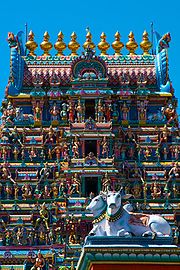 .
.
The varied and rich wildlife of India
has had a profound impact on the region's popular culture. Common name for wilderness in India is Jungle
which was adopted by the British colonialists to the English language. The word has been also made famous in The Jungle Book
by Rudyard Kipling
. India's wildlife has been the subject of numerous other tales and fables such as the Panchatantra
and the Jataka tales.
In Hinduism, the cow is regarded as a symbol of ahimsa
(non-violence), mother goddess
and bringer of good fortune and wealth. For this reason, cows are revered in Hindu culture and feeding a cow is seen as an act of worship.'
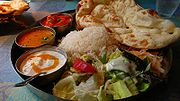
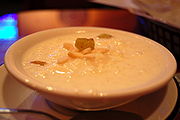 The cuisine in India is classified into three major categories. Sattva
, Rajas
, and Tamas
. Sattva which stand for balance, Rajas stands for passion, and Tamas stands for indulgence. Food is consumed according to the lifestyle of the person. For example: A King has to be aggressive to defend his country, he would be taking food which would give much passion and that aggressiveness which is required. When a person tries to lead his life in want of self realisaiton, he would prefer a Satvic food or known as Sattvic diet
, which would help to keep his mind in balance. Tamasic food or known as Static foods is to be taken only if its required, like consumption of Alcohol. This is the reason why many Indians try to abstain drinking.
The multiple varieties of Indian cuisine are characterized by their sophisticated and subtle use of many Spices and Herbs. Each family of this cuisine is characterized by a wide assortment of dishes and cooking techniques. Though a significant portion of Indian food is vegetarian, many traditional Indian dishes also include: chicken
, goat
, lamb, fish
, and other meats.
India is known for its love for food and spices
, and it plays a role in everyday life as well as in festivals. Indian cuisine varies from region to region, reflecting the varied demographics
of the country. Generally, Indian cuisine can be split into five categories — northern
, southern
, eastern, western and north-eastern.
Despite this diversity, some unifying threads emerge. Varied uses of spices are an integral part of food preparation, and are used to enhance the flavor of a dish and create unique flavors and aromas. Cuisine across India has also been influenced by various cultural groups that entered India throughout history, such as the Persians
, Mughals, and European colonists. Though the tandoor
originated in Central Asia
, Indian tandoori dishes, such as chicken tikka
made with Indian ingredients, enjoy widespread popularity.
Indian cuisine is one of the most popular cuisines across the globe. In most Indian restaurants outside India the menu does not do justice to the enormous variety of Indian cuisine available - the most common cuisine served on the menu would be Punjabi cuisine (chicken tikka masala
is a very popular dish in the United Kingdom). There do exist some restaurants serving cuisines from other regions of India, although these are few and far between. Historically, Indian Spices and Herbs were one of the most sought after trade commodities. The Spice trade
between India and Europe led to the rise and dominance of Arab traders to such an extent that European explorers, such as Vasco da Gama
and Christopher Columbus
, set out to find new trade routes with India leading to the Age of Discovery
. The popularity of curry, which originated in India, across Asia has often led to the dish being labeled as the "pan-Asian" dish.
greatly varies across different parts of the country and is influenced immensely by local culture, geography and climate. Popular styles of dress include draped garments such as sari
for women and dhoti
or lungi
for men; in addition, stitched clothes such as churidar
for women and kurta
-pyjama and European-style trousers and shirts for men, are also popular.
In India, a person's social status is perceived to be symbolized by his or her attire. Indian dress etiquette discourages exposure of skin and wearing transparent or tight clothes. Most Indian clothes are made from cotton
which is ideal for the region's hot weather. Since India's weather is mostly hot and rainy, majority of Indians wear sandals.
Worn by women on their forehead, the bindi
is considered to be a highly auspicious mark in Hindu religion. Traditionally, the red bindi (or sindoor
) was worn only by the married Hindu women, but now it has become a part of women's fashion. Some Indian traditions consider the bindi to be representative of the third eye
.
India's clothing styles have continuously evolved over the course of the country's history. Ancient Vedic texts mention clothes made from barks and leaves (known as phataka). The 11th century BC Rig-veda mentions dyed and embroidered garments (known as paridhan and pesas respectively) and thus highlights the development of sophisticated garment manufacturing techniques during the Vedic age. In 5th century BC, Greek historian Herodotus
describes the richness of the quality of Indian cotton clothes. By 2nd century AD, muslin
s manufactured in southern India were imported by the Roman Empire
and silk cloth was one of the major exports of ancient India along with Indian spices. Stitched clothing in India was developed before 10th century AD and was further popularized in 15th century by Muslim empires in India. Draped clothing styles remained popular with India's Hindu population while the Muslims increasingly adopted tailored garments.
During the British Raj
, India's large clothing and handicrafts industry was left paralyzed so as to make place for British industrial cloth. Consequently, Indian independence movement leader Mahatma Gandhi
successfully advocated for what he termed as khadi
clothing — light colored hand-woven clothes — so as to decrease reliance of the Indian people on British industrial goods. The 1980s was marked by a widespread modification to Indian clothing fashions which was characterized by a large-scale growth of fashion schools in India, increasing involvement of women in the fashion industry and changing Indian attitudes towards multiculturalism. These developments played a pivotal role in the fusion of Indian and Western clothing styles.
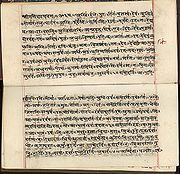 Time is always referred as Kaala Chakra in India. In Ancient India the time was divided in Four yugas. The calendar which most Indians follows goes in accordance to this. There by, measuring the dates of Vedas came in later days.
With its oldest core dating back to as early as 1500 BC, the Rigvedic
Sanskrit
is one of the oldest attestations of any Indo-Iranian language, and one of the earliest attested members of the Indo-European language family, the family which includes English and most European languages. Sanskrit has had a profound impact on the languages and literature of India. Hindi
, India's most spoken language, is a "Sanskritized register" of the Khariboli dialect. In addition, all modern Indo-Aryan languages
, Munda languages
and Dravidian languages
, have borrowed many words either directly from Sanskrit (tatsama
words), or indirectly via middle Indo-Aryan languages (tadbhava
words). Words originating in Sanskrit are estimated to constitute roughly fifty percent of the vocabulary of modern Indo-Aryan languages, and the literary forms of (Dravidian) Telugu
, Malayalam and Kannada
. Part of the Eastern Indo-Aryan languages, the Bengali language
arose from the eastern Middle Indic languages and its roots are traced to the 5th century BC Ardhamagadhi language.
Tamil
, one of India's major classical languages, descends from Proto-Dravidian
languages which was spoken around the third millennium BC in peninsular India. Tamil literature
has existed for over two thousand years and the earliest epigraphic
records found date from around the third century BC
.
Another major Classical Dravidian language, Kannada is attested epigraphically from the mid-1st millennium AD, and literary Old Kannada flourished in the 9th to 10th century Rashtrakuta Dynasty
. As a spoken language, some believe it to be even older than Tamil due to the existence of words which have more primitive forms than in Tamil. Pre-old Kannada (or Purava HazheGannada) was the language of Banavasi
in the early Common Era, the Satavahana
and Kadamba periods and hence has a history of over 2000 years. The Ashoka rock edict found at Brahmagiri
(dated to 230 BC) has been suggested to contain a word in identifiable Kannada.
According to 2001 India census, Hindi
is the most spoken language in India, followed by Bengali
, Telugu
, Marathi
and Tamil
. In contemporary Indian literature, there are two major literary awards; these are the Sahitya Akademi Fellowship
and the Jnanpith Award
. Seven Jnanpith awards have been awarded in Kannada
, six in Hindi
, five in Bengali
, four in Malayalam
, three each in Marathi
, Gujarati
, Urdu
and Oriya
and two each in Telugu
and Tamil
,.
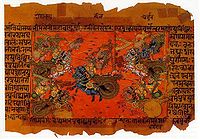 The Rāmāyaṇa
and the Mahābhārata
are the oldest preserved and well-known epics of India. Versions have been adopted as the epics of Southeast Asian countries like Thailand, Malaysia and Indonesia. The Ramayana consists of 24,000 verses in seven books and 500 canto
s , and tells the story of Rama (an incarnation or Avatar
of the Hindu preserver-god Vishnu
), whose wife Sita
is abducted by the demon
king of Lanka
, Ravana
. This epic played a pivotal role in establishing the role of dhárma
as a principal ideal guiding force for Hindu way of life. The earliest parts of the Mahabharata text date to 400 BC and is estimated to have reached its final form by the early Gupta period
(ca. 4th c. AD). Other regional variations of these, as well as unrelated epics include the Tamil Ramavataram, Kannada Pampa Bharata, Hindi Ramacharitamanasa, and Malayalam Adhyathmaramayanam
. In addition to these two great Indian epics, there are five major epics in the classical Tamil language
— Silappatikaram, Manimekalai
, Civaka-cintamani
and Valayapathi
.
 Indian dance too has diverse folk and classical forms. Among the well-known folk dances are the bhangra of the Punjab
, the bihu
of Assam
, the chhau of Jharkhand
, the Odishi of Orissa
, the ghoomar
of Rajasthan
, the dandiya
and garba
of Gujarat, the Yakshagana
of Karnataka and lavani
of Maharashtra
and Dekhnni of Goa. Eight dance forms, many with narrative forms and mythological
elements, have been accorded classical dance status by India's National Academy of Music, Dance, and Drama. These are: bharatanatyam
of the state of Tamil Nadu
, kathak
of Uttar Pradesh
, kathakali
and mohiniattam of Kerala
, kuchipudi
of Andhra Pradesh
, manipuri
of Manipur
, odissi
of the state of Orissa
and the sattriya
of Assam
.
and Meghadoota are some of the older dramas, following those of Bhasa. One of the oldest surviving theatre traditions of the world is the 2,000 year old Kutiyattam of Kerala. It strictly follows the Natya Shastra
. Nātyāchārya Māni Mādhava Chākyār
is credited for reviving the age old drama tradition from extinction. He was known for mastery of Rasa Abhinaya. He started to perform the Kalidasa plays like Abhijñānaśākuntala, Vikramorvaśīya and Mālavikāgnimitra; Bhasa's Swapnavāsavadatta
and Pancharātra
; Harsha
's Nagananda
.
, popular and pop music.
The oldest preserved examples of Indian music are the melodies of the Samaveda
(1000 BC) that are still sung in certain Vedic Śrauta sacrifices; this is the earliest account of Indian musical hymns. It proposed a tonal structure consisting of seven notes, which were named, in descending order, as Krusht, Pratham, Dwitiya, Tritiya, Chaturth, Mandra and Atiswār. These refer to the notes of a flute, which was the only fixed frequency instrument. The Samaveda, and other Hindu
texts, heavily influenced India's classical music
tradition, which is known today in two distinct styles: Carnatic
and Hindustani music. Both the Carnatic music and Hindustani music systems are based on the melodic base (known as Rāga
), sung to a rhythmic cycle (known as Tāla
); these principles were refined in the nātyaśāstra (200 BC) and the dattilam
(300 AD).
Prominent contemporary Indian musical forms included filmi
and Indipop. Filmi refers to the wide range of music written and performed for mainstream Indian cinema, primarily Bollywood
, and accounts for more than 70 percent of all music sales in the country. Indipop is one of the most popular contemporary styles of Indian music which is either a fusion of Indian folk
, classical or Sufi music
with Western musical traditions.
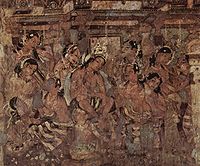 The earliest Indian paintings were the rock paintings of pre-historic times, the petroglyph
st it was common for households to paint their doorways or indoor rooms where guests resided.
Cave paintings from Ajanta
, Bagh
, Ellora and Sittanavasal
and temple paintings testify to a love of naturalism. Most early and medieval art in India is Hindu, Buddhist or Jain. A freshly made coloured flour design (Rangoli
) is still a common sight outside the doorstep of many (mostly South Indian) Indian homes. Raja Ravi Varma
is one the classical painters from medieval India.
Madhubani painting
, Mysore painting
, Rajput painting
, Tanjore painting
, Mughal painting
are some notable Genres of Indian Art; while Nandalal Bose
, M. F. Husain, S. H. Raza, Geeta Vadhera
, Jamini Roy
and B.Venkatappa are some modern painters. Among the present day artists, Atul Dodiya, Bose Krishnamacnahri, Devajyoti Ray
and Shibu Natesan represent a new era of Indian art where global art shows direct amalgamation with Indian classical styles. These recent artists have acquired international recognition. Jehangir Art Gallery
, Mumbai
, Mysore Palace
has on display a few good Indian paintings.
 The first sculpture
s in India date back to the Indus Valley civilization
, where stone and bronze figures have been discovered. Later, as Hinduism, Buddhism, and Jainism developed further, India produced some extremely intricate bronze
s as well as temple carvings. Some huge shrines, such as the one at Ellora
were not constructed by using blocks but carved out of solid rock.
Sculptures produced in in the northwest, in stucco
, schist
, or clay
, display a very strong blend of Indian and Classical Hellenistic or possibly even Greco-Roman influence. The pink sandstone
sculptures of Mathura evolved almost simultaneously. During the Gupta period (4th to 6th century) sculpture reached a very high standard in execution and delicacy in modeling. These styles and others elsewhere in India evolved leading to classical Indian art that contributed to Buddhist and Hindu sculpture throughout Southeast Central and East Asia.
 Indian architecture encompasses a multitude of expressions over space and time, constantly absorbing new ideas. The result is an evolving range of architectural production that nonetheless retains a certain amount of continuity across history. Some of its earliest production are found in the Indus Valley Civilization
(2600–1900 BC) which is characterised by well planned cities and houses. Religion
and kingship do not seem to have played an important role in the planning and layout of these towns.
During the period of the Mauryan and Gupta
empires and their successors, several Buddhist architectural complexes, such as the caves of Ajanta
and Ellora
and the monumental Sanchi
Stupa
were built. Later on, South India produced several Hindu temples like Chennakesava Temple
at Belur
, the Hoysaleswara Temple
at Halebidu
, and the Kesava Temple at Somanathapura
, Brihadeeswara Temple, Thanjavur, the Sun Temple, Konark
, Sri Ranganathaswamy Temple at Srirangam
, and the Buddha
stupa
(Chinna Lanja dibba and Vikramarka kota dibba) at Bhattiprolu
. Angkor Wat
, Borobudur and other Buddhist and Hindu
temples indicate strong Indian influence on South East Asian architecture, as they are built in styles almost identical to traditional Indian religious buildings.
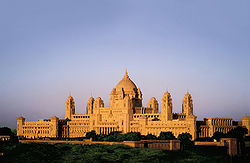 The traditional system of Vaastu Shastra serves as India's version of Feng Shui
, influencing town planning, architecture, and ergonomics. It is unclear which system is older, but they contain certain similarities. Feng Shui is more commonly used throughout the world. Though Vastu is conceptually similar to Feng Shui in that it also tries to harmonize the flow of energy, (also called life-force or Prana
in Sanskrit and Chi
/Ki
in Chinese/Japanese), through the house, it differs in the details, such as the exact directions in which various objects, rooms, materials, etc. are to be placed.
With the advent of Islamic influence from the west, Indian architecture was adapted to allow the traditions of the new religion. Fatehpur Sikri
, Taj Mahal
, Gol Gumbaz
, Qutub Minar
, Red Fort of Delhi are creations of this era, and are often used as the stereotypical symbols of India. The colonial rule of the British Empire saw the development of Indo-Saracenic
style, and mixing of several other styles, such as European Gothic. The Victoria Memorial
or the Chhatrapati Shivaji Terminus
are notable examples.
Indian architecture has influenced eastern and southeastern Asia, due to the spread of Buddhism. A number of Indian architectural features such as the temple mound or stupa
, temple spire or sikhara
, temple tower or pagoda
and temple gate or torana
, have become famous symbols of Asian culture, used extensively in East Asia
and South East Asia. The central spire is also sometimes called a vimanam
. The southern temple gate, or gopuram
is noted for its intricacy and majesty.
Contemporary Indian architecture is more cosmopolitan. Cities are extremely compact and densely populated. Mumbai's Nariman Point
is famous for its Art Deco
buildings. Recent creations such as the Lotus Temple
, and the various modern urban developments of India like Chandigarh
, are notable.
 Field Hockey
is the national Sport in India, and the India national field hockey team
won the 1975 Men's Hockey World Cup
and 8 gold
, 1 silver
and 2 bronze
medals at the Olympic games. Cricket
is the most popular Sport in India. The India national cricket team won the 1983 Cricket World Cup
, the 2011 Cricket World Cup
and the 2007 ICC World Twenty20, and shared the 2002 ICC Champions Trophy
with Sri Lanka
. Domestic competitions include the Ranji Trophy
, the Duleep Trophy
, the Deodhar Trophy
, the Irani Trophy
and the Challenger Series. In addition, BCCI
conducts the Indian Premier League
, a Twenty20
competition.
India is the host of 2010 Commonwealth Games
, played in New Delhi
. It hosted a spectacular display of Indian culture and heritage to the entire world during the opening ceremony of the games.
Chess
is commonly believed to have originated in northwestern India during the Gupta empire
, where its early form in the 6th century was known as chaturanga
. Other games which originated in India and continue to remain popular in wide parts of northern India include Kabaddi
, Gilli-danda
, and Kho kho
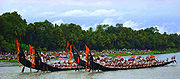
. Traditional southern Indian games include Snake boat race
and Kuttiyum kolum
.
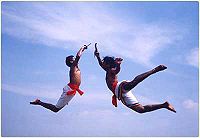 One of the best known forms of ancient Indian martial arts is the Kalarippayattu
from Kerala. This ancient fighting style originated in southern India in 12th century BC and is regarded as one of the oldest surviving martial arts. In this form martial arts, various stages of physical training include ayurvedic
massage with sesame oil to impart suppleness to the body (uzichil); a series of sharp body movements so as to gain control over various parts of the body (miapayattu); and, complex sword fighting techniques (paliyankam). Silambam
, which was developed around 200 AD, traces its roots to the Sangam period in southern India. Silambam is unique among Indian martial arts because it uses complex footwork techniques (kaaladi), including a variety of spinning styles. A bamboo staff is used as the main weapon. The ancient Tamil Sangam literature
mentions that between 400 BC and 600 AD, soldiers from southern India received special martial arts training which revolved primarily around the use of spear
(vel), sword
(val) and shield
(kedaham).
In northern India, the musti yuddha evolved in 1100 AD and focussed on mental, physical and spiritual training. In addition, the Dhanur Veda tradition was an influential fighting arts style which considered the bow and the arrow to be the supreme weapons. The Dhanur Veda was first described in the 5th century BC Viṣṇu Purāṇa
and is also mentioned in both of the major ancient Indian epics, the Rāmāyaṇa and Mahābhārata. A distinctive factor of Indian martial arts is the heavy emphasis laid on meditation (dhyāna
) as a tool to remove fear, doubt and anxiety.
Indian martial arts techniques have had a profound impact on other martial arts styles across Asia. The 3rd century BC Yoga Sutras of Patanjali
taught how to meditate single-mindedly on points located inside one's body, which was later used in martial arts, while various mudra
finger movements were taught in Yogacara
Buddhism. These elements of yoga
, as well as finger movements in the nata dances, were later incorporated into various martial arts. According to some historical accounts, Indian Buddhist monk Bodhidharma
was one of the main founders of the Shaolin Kungfu.
, which was government owned. 1982 saw revolution in TV programming in India, with the New Delhi Asian games, India saw the colour version of TV, that year. The Ramayana
and Mahabharat were some among the popular television series produced. By the late 1980s more and more people started to own television sets. Though there was a single channel, television programming had reached saturation. Hence the government opened up another channel which had part national programming and part regional. This channel was known as DD 2 later DD Metro. Both channels were broadcasted terrestrially.
In 1991, the government liberated its markets, opening them up to cable television
. Since then, there has been a spurt in the number of channels available. Today, Indian silver screen is a huge industry by itself, and has thousands of programmes in all the states of India. The small screen has produced numerous celebrities of their own kind some even attaining national fame for themselves. TV soaps are extremely popular with housewives as well as working women, and even men of all kinds. Some lesser known actors have found success in Bollywood
. Indian TV now has many of the same channels as Western TV, including stations such as Cartoon Network
, Nickelodeon
, HBO, FX, and MTV India
.
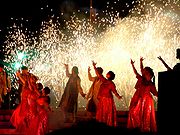 Bollywood
is the informal name given to the popular Mumbai
-based film industry
in India. Bollywood
and the other major cinematic hubs (in Bengali, Kannada, Malayalam, Marathi, Tamil
, Punjabi and Telugu) constitute the broader Indian film industry
, whose output is considered to be the largest in the world in terms of number of films produced and number of tickets sold.
India has produced many critically acclaimed cinema-makers like K. Vishwanath, Bapu, Satyajit Ray
, Ritwik Ghatak, Guru Dutt
, K. Vishwanath, Adoor Gopalakrishnan
, Shaji N. Karun
, Girish Kasaravalli
, Shekhar Kapoor, Hrishikesh Mukherjee
, Shankar Nag
, Girish Karnad
, G. V. Iyer
et al. (see Indian film directors). With the opening up of the economy in the recent years and consequent exposure to world cinema, audience tastes have been changing. In addition, multiplexes have mushroomed in most cities, changing the revenue patterns.
Languages of India
The languages of India belong to several language families, the major ones being the Indo-European languages—Indo-Aryan and the Dravidian languages...
, religions, dance, music
Music of India
The music of India includes multiple varieties of folk, popular, pop, classical music and R&B. India's classical music tradition, including Carnatic and Hindustani music, has a history spanning millennia and developed over several eras. It remains fundamental to the lives of Indians today as...
, architecture, food
Indian cuisine
Indian cuisine consists of thousands of regional cuisines which date back thousands of years. The dishes of India are characterised by the extensive use of various Indian spices, herbs, vegetables and fruit. Indian cuisine is also known for the widespread practice of vegetarianism in Indian society...
and customs differ from place to place within the country, but nevertheless possess a commonality.
The culture of India is an amalgamation of these diverse sub-cultures spread all over the Indian subcontinent and traditions that are several millennia old.
Regarded by many historians as the "oldest living civilization of Earth", the Indian tradition dates back to 8000 BC and has a continuous recorded history since the time of the Vedas, believed variously to be 3,000 to over 5,500 years ago. Several elements of India's diverse culture — such as Indian religions, yoga
Yoga
Yoga is a physical, mental, and spiritual discipline, originating in ancient India. The goal of yoga, or of the person practicing yoga, is the attainment of a state of perfect spiritual insight and tranquility while meditating on Supersoul...
and Indian cuisine — have had a profound impact across the world.
Religions and spirituality
India is the birth place of Hinduism, Buddhism, JainismJainism
Jainism is an Indian religion that prescribes a path of non-violence towards all living beings. Its philosophy and practice emphasize the necessity of self-effort to move the soul towards divine consciousness and liberation. Any soul that has conquered its own inner enemies and achieved the state...
and Sikhism
Sikhism
Sikhism is a monotheistic religion founded during the 15th century in the Punjab region, by Guru Nanak Dev and continued to progress with ten successive Sikh Gurus . It is the fifth-largest organized religion in the world and one of the fastest-growing...
, collectively known as Indian religions. Indian religions, also known as Dharmic religions are a major form of world religions along with Abrahamic ones. Today, Hinduism and Buddhism are the world's third- and fourth-largest religions respectively, with over 2 billion followers altogether, and possibly as many as 2.5 or 2.6 billion followers. India is also the birthplace for the Lingayat and Ahmadiyya
Ahmadiyya
Ahmadiyya is an Islamic religious revivalist movement founded in India near the end of the 19th century, originating with the life and teachings of Mirza Ghulam Ahmad , who claimed to have fulfilled the prophecies about the world reformer of the end times, who was to herald the Eschaton as...
faiths.
India
India
India , officially the Republic of India , is a country in South Asia. It is the seventh-largest country by geographical area, the second-most populous country with over 1.2 billion people, and the most populous democracy in the world...
is one of the most religiously diverse nations in the world, with some of the most deeply religious societies and cultures. Religion still plays a central and definitive role in the life of many of its people.
The religion of 80% of the people is Hinduism. Islam is practiced by around 13% of all Indians. Sikhism, Jainism and especially Buddhism are influential not only in India but across the world. Christianity
Christianity
Christianity is a monotheistic religion based on the life and teachings of Jesus as presented in canonical gospels and other New Testament writings...
, Zoroastrianism
Zoroastrianism
Zoroastrianism is a religion and philosophy based on the teachings of prophet Zoroaster and was formerly among the world's largest religions. It was probably founded some time before the 6th century BCE in Greater Iran.In Zoroastrianism, the Creator Ahura Mazda is all good, and no evil...
, Judaism
Judaism
Judaism ) is the "religion, philosophy, and way of life" of the Jewish people...
and the Bahá'í Faith
Bahá'í Faith
The Bahá'í Faith is a monotheistic religion founded by Bahá'u'lláh in 19th-century Persia, emphasizing the spiritual unity of all humankind. There are an estimated five to six million Bahá'ís around the world in more than 200 countries and territories....
are also influential but their numbers are smaller. Despite the strong role of religion in Indian life, atheism
Atheism
Atheism is, in a broad sense, the rejection of belief in the existence of deities. In a narrower sense, atheism is specifically the position that there are no deities...
and agnostics also have visible influence along with a self-ascribed tolerance to other people.
According to industry consultant Eugene M. Makar, traditional Indian culture is defined by a relatively strict social hierarchy. He also mentions that from an early age, children are reminded of their roles and places in society. This is reinforced by the fact that many believe gods and spirits have an integral and functional role in determining their life. Several differences such as religion divide the culture. However, a far more powerful division is the traditional Hindu bifurcation into non-polluting and polluting occupations
Caste system in India
The Indian caste system is a system of social stratification and social restriction in India in which communities are defined by thousands of endogamous hereditary groups called Jātis....
. Strict social taboos have governed these groups for thousands of years. In recent years, particularly in cities, some of these lines have blurred and sometimes even disappeared. Important family relations extend as far as gotra
Gotra
In the Hindu society, the term Gotra broadly refers to people who are descendants in an unbroken male line from a common male ancestor. Panini defines gotra for grammatical purposes as apatyam pautraprabhrti gotram , which means "the word gotra denotes the progeny beginning with the son's son"...
, the mainly patrilinear lineage or clan assigned to a Hindu at birth. In rural areas & sometimes in urban areas as well, it is common that three or four generations of the family live under the same roof. The patriarch
Patriarch
Originally a patriarch was a man who exercised autocratic authority as a pater familias over an extended family. The system of such rule of families by senior males is called patriarchy. This is a Greek word, a compound of πατριά , "lineage, descent", esp...
often resolves family issues.
Marriage
Arranged Marriage
For centuries, arranged marriages have been the tradition in Indian society though men and women have always had the choice of who they want to marry. Even today, the vast majority of Indians have their marriages planned by their parents and other respected family-members, with the consent of the bride and groom. Arranged matches are made after taking into account factors such as age, height, personal values and tastes, the backgrounds of their families (wealth, social standing), their casteCaste
Caste is an elaborate and complex social system that combines elements of endogamy, occupation, culture, social class, tribal affiliation and political power. It should not be confused with race or social class, e.g. members of different castes in one society may belong to the same race, as in India...
s and the astrological compatibility of the couples' horoscopes.Generally this is done to reduce culture shock for the bride and groom as most families are extended families.
In most marriages the bride's family provide a dowry to the bride to safe guard herself and her children in the event of her husband passing prematurely. In most families the inheritance of family estates pass down the male line.
In India, the marriage is thought to be for life, and the divorce rate is extremely low — 1.1% compared with about 50% in the United States
United States
The United States of America is a federal constitutional republic comprising fifty states and a federal district...
. The arranged marriages generally have a much lower divorce rate, although divorce rates have risen significantly in recent years for love marriage. The divorce rates of marriage is increasing nowadays (3.5%)
- "Opinion is divided over what the phenomenon means: for traditionalists the rising numbers portend the breakdown of society while, for some modernists, they speak of a healthy new empowerment for women."
Greetings
NamasteNamaste
Namaste is a common spoken valediction or salutation originating from the Indian subcontinent. It is a customary greeting when individuals meet, and a valediction upon their parting. A non-contact form of salutation is traditionally preferred in India and Namaste is the most common form of such a...
, namaskar or Namaskara or Namaskaram (Telugu
Telugu language
Telugu is a Central Dravidian language primarily spoken in the state of Andhra Pradesh, India, where it is an official language. It is also spoken in the neighbouring states of Chattisgarh, Karnataka, Maharashtra, Orissa and Tamil Nadu...
), Vanakkam (Tamil
Tamil language
Tamil is a Dravidian language spoken predominantly by Tamil people of the Indian subcontinent. It has official status in the Indian state of Tamil Nadu and in the Indian union territory of Pondicherry. Tamil is also an official language of Sri Lanka and Singapore...
), Nomoshkaar (Bengali
Bengali language
Bengali or Bangla is an eastern Indo-Aryan language. It is native to the region of eastern South Asia known as Bengal, which comprises present day Bangladesh, the Indian state of West Bengal, and parts of the Indian states of Tripura and Assam. It is written with the Bengali script...
), Nomoskar (Assamese
Assamese language
Assamese is the easternmost Indo-Aryan language. It is used mainly in the state of Assam in North-East India. It is also the official language of Assam. It is also spoken in parts of Arunachal Pradesh and other northeast Indian states. Nagamese, an Assamese-based Creole language is widely used in...
) ) is a common spoken greeting or salutation in the Indian subcontinent
Indian subcontinent
The Indian subcontinent, also Indian Subcontinent, Indo-Pak Subcontinent or South Asian Subcontinent is a region of the Asian continent on the Indian tectonic plate from the Hindu Kush or Hindu Koh, Himalayas and including the Kuen Lun and Karakoram ranges, forming a land mass which extends...
. Namaskar is considered a slightly more formal version than Namaste but both express deep respect. It is commonly used in India and Nepal
Nepal
Nepal , officially the Federal Democratic Republic of Nepal, is a landlocked sovereign state located in South Asia. It is located in the Himalayas and bordered to the north by the People's Republic of China, and to the south, east, and west by the Republic of India...
by Hindus, Jains, Buddhists and Sikhs, and many continue to use this outside the Indian subcontinent. In Indian and Nepali culture, the word is spoken at the beginning of written or verbal communication. However, the same hands folded gesture is made usually wordlessly upon departure. Taken literally, it means "I bow to you". The word is derived from Sanskrit
Sanskrit
Sanskrit , is a historical Indo-Aryan language and the primary liturgical language of Hinduism, Jainism and Buddhism.Buddhism: besides Pali, see Buddhist Hybrid Sanskrit Today, it is listed as one of the 22 scheduled languages of India and is an official language of the state of Uttarakhand...
(namah): to bow
Bowing (social)
Bowing is the act of lowering the torso and head as a social gesture in direction to another person or symbol. It is most prominent in Asian cultures but it is also typical of nobility and aristocracy in many countries and distinctively in Europe. Sometimes the gesture may be limited to lowering...
, obeisance, reverential salutation
Salutation (greeting)
A salutation is a greeting used in a letter or other written communication, such as an email. Salutations can be formal or informal. The most common form of salutation in a letter is Dear followed by the recipient's given name or title...
, and respect
Respect
Respect denotes both a positive feeling of esteem for a person or other entity , and also specific actions and conduct representative of that esteem. Respect can be a specific feeling of regard for the actual qualities of the one respected...
, and (te): "to you". As explained by an Indian scholar, in literal terms Namaste refers to 'That which is of God in me bows to that which is of God in you'. In most Indian families, younger men and women are taught to seek the blessing of their elders by reverentially bowing to their elders. This custom is known as Pranāma
Pranāma
Pranāma or ', the touching of the feet in Indian culture, is a show of respect and it is often an integral part of darshan. When greeting, children touch the feet of their family elders while people of all ages will bend to touch the feet of a great guru, murti or icon of a Deva .It is customary...
Other greetings include "Jai Shri Krishna", "Ram Ram", "Adab
Adab (gesture)
Adab is a hand gesture used as a greeting, associated with the culture of south Asian Muslims, especially of Urdu-speaking communities of Uttar Pradesh and Hyderabadi Muslims ....
" (associated with the culture of south Asian Muslims
Islam in India
Islam is the second-most practiced religion in the Republic of India after Hinduism, with more than 13.4% of the country's population ....
) and Sat Shri Akal
Sat Sri Akaal
Sat Sri Akal is a greeting in the Punjabi language used by followers of the Sikh religion....
(Punjabi
Punjabi language
Punjabi is an Indo-Aryan language spoken by inhabitants of the historical Punjab region . For Sikhs, the Punjabi language stands as the official language in which all ceremonies take place. In Pakistan, Punjabi is the most widely spoken language...
, used by followers of Sikhism
Sikhism
Sikhism is a monotheistic religion founded during the 15th century in the Punjab region, by Guru Nanak Dev and continued to progress with ten successive Sikh Gurus . It is the fifth-largest organized religion in the world and one of the fastest-growing...
) and Jai Jinendra
Jai Jinendra
Jai Jinendra! is a common greeting used across the Jain community. Composed of three words, Jaya, Jina and Indra, it means "Hail the ones who have conquered their internal and external enemies"....
, a common greeting used across the Jain community
Jain community
The Jains in India have been the last direct representatives of the Shramana tradition in India. They follow Jainism, as the dharma taught by the 24 Tirthankaras, the last of whom was Mahavira.-Cultural influence:...
.
Festivals
India, being a multi-cultural and multi-religious society, celebrates holidays and festivals of various religions. The four national holidays in India, the Independence DayIndependence Day (India)
The Independence Day of India is celebrated on the fifteenth of August to commemorate its independence from British rule and its birth as a sovereign nation in 1947. The day is a national holiday in India. All over the country, flag-hoisting ceremonies are conducted by the local administration in...
, the Republic Day
Republic Day (India)
The Republic Day of India commemorates the date on which the Constitution of India came into force replacing the Government of India Act 1935 as the governing document of India on 26 January 1950....
, the Gandhi Jayanti
Gandhi Jayanti
Gandhi Jayanti is a National Holiday celebrated in India to mark the occasion of the birthday of Mohandas Gandhi, the "Father of the Nation." He was born on October 2, 1869. Hence Gandhi Jayanti is celebrated every year on the 2nd of October. It is one of the three official declared National...
,and 1st may are celebrated with zeal and enthusiasm across India. In addition, many states and regions have local festivals depending on prevalent religious and linguistic demographics. Popular religious festivals include the Hindu festivals of Navratri, Diwali
Diwali
Diwali or DeepavaliThe name of the festival in various regional languages include:, , , , , , , , , , , , , popularly known as the "festival of lights," is a festival celebrated between mid-October and mid-December for different reasons...
, Ganesh Chaturthi
Ganesh Chaturthi
Ganesh Chaturthi , also known as Vinayaka Chaturthi is the Hindu festival of Ganesha also called Vinayagar in Tamil Nadu, the son of Shiva and Parvati, who is believed to bestow his presence on earth for all his devotees in the duration of this festival...
, Durga puja
Durga Puja
Durga puja ; দুর্গা পূজা,ଦୁର୍ଗା ପୂଜା,‘Worship of Durga’), also referred to as Durgotsava ; , is an annual Hindu festival in South Asia that celebrates worship of the Hindu goddess Durga. It refers to all the six days observed as Mahalaya, Shashthi, Maha Saptami, Maha Ashtami, Maha Navami and...
, Holi
Holi
Holi , is a religious spring festival celebrated by Hindus. Holi is also known as festival of Colours. It is primarily observed in India, Nepal, Pakistan, and countries with large Indic diaspora populations following Hinduism, such as Suriname, Malaysia, Guyana, South Africa, Trinidad, United...
, Rakshabandhan and Dussehra. Several harvest festival
Harvest festival
A Harvest Festival is an annual celebration which occurs around the time of the main harvest of a given region. Given the differences in climate and crops around the world, harvest festivals can be found at various times throughout the world...
s, such as Sankranthi
Sankranthi
Makar Sankranti or Sankranti or Sankranthi marks the transition of the Sun into Makara rashi on its celestial path...
, Pongal, Raja sankaranti swinging fesival, and Onam
Onam
Onam is a Hindu festival celebrated by the people of Kerala, India. The festival commemorates the Vamana avatar of Vishnu and the subsequent homecoming of the legendary Emperor Mahabali. It falls during the month of Chingam and lasts for ten days...
,"Nuakhai
Nuakhai
Nuakhai or Nuankhai is an agricultural festival mainly observed by people of western Orissa in India. Nuakhai is observed to welcome the new rice of the season...
" are also fairly popular.
Certain festivals in India are celebrated by multiple religions. Notable examples include Diwali, which is celebrated by Hindus, Sikhs and Jains, and Buddh Purnima
Vesak
Vesākha is a holiday observed traditionally by Buddhists in Bangladesh, India, Nepal, Sri Lanka, and the South East Asian countries of Singapore, Vietnam, Thailand, Cambodia, Laos, Malaysia, Burma, and Indonesia...
, celebrated by Buddhists and Hindus. Islamic festivals, such Eid ul-Fitr
Eid ul-Fitr
Eid ul-Fitr, Eid al-Fitr, Id-ul-Fitr, or Id al-Fitr , often abbreviated to Eid, is a Muslim holiday that marks the end of Ramadan, the Islamic holy month of fasting . Eid is an Arabic word meaning "festivity," while Fiṭr means "breaking the fast"...
, Eid al-Adha and Ramadhan, are celebrated by Muslims across India.Muslims won't celebrate any other fest except these two. Sikh Festivals, such as Guru Nanak Jayanti, Baisakhi are celebrated with full fanfare by Sikhs and Hindu. Adding colors to the culture of India, the Dree Festival
Dree Festival
The Dree Festival is an Apatani agricultural rite. It involves the sacrifice of fowls, eggs and animals to the Gods - Tamu, Metii and Danyi Pilo. The purpose of the festival is to appease these Gods so that famine could be avoided. This rite is observed by the Apatanis in Arunachal Pradesh, India...
is one of the tribal festivals of India celebrated by the Apatanis of the Ziro valley of Arunachal Pradesh
Arunachal Pradesh
Arunachal Pradesh is a state of India, located in the far northeast. It borders the states of Assam and Nagaland to the south, and shares international borders with Burma in the east, Bhutan in the west, and the People's Republic of China in the north. The majority of the territory is claimed by...
, which is the easternmost state of India.
Names and language
Indian names are based on a variety of systems and naming conventions, which vary from region to region. Names are also influenced by religion and caste and may come from the Indian epics. India's population speaks a wide variety of languagesLanguages of India
The languages of India belong to several language families, the major ones being the Indo-European languages—Indo-Aryan and the Dravidian languages...
.Such as Tamil ·Assamese · Bengali · Bodo · Chhattisgarhi · Dogri · Garo · Gujarati · Standard Hindi · Kannada · Kashmiri · Khasi · Kokborok · Konkani · Maithili · Malayalam · Manipuri · Marathi · Mizo · Nepali · Oriya · Punjabi · Sanskrit · Santali · Sindhi · Telugu · Tulu · Urdu ·
Animals
The varied and rich wildlife of India
Wildlife of India
The wildlife of India is a mix of species of number of different types of organism. The region's rich and diverse wildlife is preserved in 89 national parks, 13 Bio reserves and 400+ wildlife sanctuaries across the country. Since India is home to a number of rare and threatened animal species,...
has had a profound impact on the region's popular culture. Common name for wilderness in India is Jungle
Jungle
A Jungle is an area of land in the tropics overgrown with dense vegetation.The word jungle originates from the Sanskrit word jangala which referred to uncultivated land. Although the Sanskrit word refers to "dry land", it has been suggested that an Anglo-Indian interpretation led to its...
which was adopted by the British colonialists to the English language. The word has been also made famous in The Jungle Book
The Jungle Book
The Jungle Book is a collection of stories by British Nobel laureate Rudyard Kipling. The stories were first published in magazines in 1893–4. The original publications contain illustrations, some by Rudyard's father, John Lockwood Kipling. Kipling was born in India and spent the first six...
by Rudyard Kipling
Rudyard Kipling
Joseph Rudyard Kipling was an English poet, short-story writer, and novelist chiefly remembered for his celebration of British imperialism, tales and poems of British soldiers in India, and his tales for children. Kipling received the 1907 Nobel Prize for Literature...
. India's wildlife has been the subject of numerous other tales and fables such as the Panchatantra
Panchatantra
The Panchatantra is an ancient Indian inter-related collection of animal fables in verse and prose, in a frame story format. The original Sanskrit work, which some scholars believe was composed in the 3rd century BCE, is attributed to Vishnu Sharma...
and the Jataka tales.
In Hinduism, the cow is regarded as a symbol of ahimsa
Ahimsa
Ahimsa is a term meaning to do no harm . The word is derived from the Sanskrit root hims – to strike; himsa is injury or harm, a-himsa is the opposite of this, i.e. non harming or nonviolence. It is an important tenet of the Indian religions...
(non-violence), mother goddess
Mother goddess
Mother goddess is a term used to refer to a goddess who represents motherhood, fertility, creation or embodies the bounty of the Earth. When equated with the Earth or the natural world such goddesses are sometimes referred to as Mother Earth or as the Earth Mother.Many different goddesses have...
and bringer of good fortune and wealth. For this reason, cows are revered in Hindu culture and feeding a cow is seen as an act of worship.'
Cuisine
Sattva
In Hindu philosophy, sattva is the most rarefied of the three gunas in Samkhya, sāttvika "pure", rājasika "dim", and tāmasika "dark". Importantly, no value judgement is entailed as all guna are indivisible and mutually qualifying...
, Rajas
Rajas
Rajas ) is, in the Samkhya school of Hindu philosophy, one of the three gunas. Of these, rajas, is responsible for motion, energy and preservation...
, and Tamas
Tamas
Tamas may refer to:* Tamas , the philosophical concept of darkness and death, the lowest of the three gunas.* Tamas , a highly acclaimed 1987 TV series/movie about the Partition of India directed by Govind Nihalani....
. Sattva which stand for balance, Rajas stands for passion, and Tamas stands for indulgence. Food is consumed according to the lifestyle of the person. For example: A King has to be aggressive to defend his country, he would be taking food which would give much passion and that aggressiveness which is required. When a person tries to lead his life in want of self realisaiton, he would prefer a Satvic food or known as Sattvic diet
Sattvic diet
A sattvic diet, also referred to as a yoga diet or sentient diet, is a diet based on foods which, according to Ayurveda, Yoga, and Jainism, are strong in the sattva guna, and lead to clarity and equanimity of mind while also being beneficial to the body.Such foods include water, cereal grains, mung...
, which would help to keep his mind in balance. Tamasic food or known as Static foods is to be taken only if its required, like consumption of Alcohol. This is the reason why many Indians try to abstain drinking.
The multiple varieties of Indian cuisine are characterized by their sophisticated and subtle use of many Spices and Herbs. Each family of this cuisine is characterized by a wide assortment of dishes and cooking techniques. Though a significant portion of Indian food is vegetarian, many traditional Indian dishes also include: chicken
Chicken
The chicken is a domesticated fowl, a subspecies of the Red Junglefowl. As one of the most common and widespread domestic animals, and with a population of more than 24 billion in 2003, there are more chickens in the world than any other species of bird...
, goat
Goat
The domestic goat is a subspecies of goat domesticated from the wild goat of southwest Asia and Eastern Europe. The goat is a member of the Bovidae family and is closely related to the sheep as both are in the goat-antelope subfamily Caprinae. There are over three hundred distinct breeds of...
, lamb, fish
Fish
Fish are a paraphyletic group of organisms that consist of all gill-bearing aquatic vertebrate animals that lack limbs with digits. Included in this definition are the living hagfish, lampreys, and cartilaginous and bony fish, as well as various extinct related groups...
, and other meats.
India is known for its love for food and spices
Spices Board of India
Spices Board is the Indian government regulatory and promotion agency for Indian spices. The board is headquartered in Kochi. Dr. Jayathilak, IAS is the current Chairman of Spices Board....
, and it plays a role in everyday life as well as in festivals. Indian cuisine varies from region to region, reflecting the varied demographics
Demographics of India
The demographics of India are inclusive of the second most populous country in the world, with over 1.21 billion people , more than a sixth of the world's population. Already containing 17.5% of the world's population, India is projected to be the world's most populous country by 2025, surpassing...
of the country. Generally, Indian cuisine can be split into five categories — northern
North Indian cuisine
North Indian cuisine , part of Indian cuisine, is a term used to refer to the cuisines found in Northern India which includes the Indian states: Jammu and Kashmir, Punjab, Haryana, Himachal Pradesh, Rajasthan, Uttarakhand and West-Central Uttar Pradesh...
, southern
South Indian cuisine
South Indian Cuisine is a term used to refer to the cuisines found in the four southern states of India: Andhra Pradesh, Karnataka, Kerala and Tamil Nadu.-Similarities and differences in "Four states' cuisines":...
, eastern, western and north-eastern.
Despite this diversity, some unifying threads emerge. Varied uses of spices are an integral part of food preparation, and are used to enhance the flavor of a dish and create unique flavors and aromas. Cuisine across India has also been influenced by various cultural groups that entered India throughout history, such as the Persians
Persian people
The Persian people are part of the Iranian peoples who speak the modern Persian language and closely akin Iranian dialects and languages. The origin of the ethnic Iranian/Persian peoples are traced to the Ancient Iranian peoples, who were part of the ancient Indo-Iranians and themselves part of...
, Mughals, and European colonists. Though the tandoor
Tandoor
A tandoor is a cylindrical clay oven used in cooking and baking. The tandoor is used for cooking in Azerbaijan, India, Turkey, Iran, Armenia, Georgia, Pakistan, Uzbekistan, Afghanistan, the Balkans, the Middle East, and Central Asia, as well as Burma and Bangladesh.The heat for a tandoor was...
originated in Central Asia
Central Asia
Central Asia is a core region of the Asian continent from the Caspian Sea in the west, China in the east, Afghanistan in the south, and Russia in the north...
, Indian tandoori dishes, such as chicken tikka
Chicken Tikka
Chicken tikka is a chicken dish served in Indian and Pakistani cuisine. It is popular in countries all over the world. It is traditionally small pieces of boneless chicken baked using skewers, in a clay-based oven called a tandoor, after marinating in spices and yogurt.The word tikka means "bits,...
made with Indian ingredients, enjoy widespread popularity.
Indian cuisine is one of the most popular cuisines across the globe. In most Indian restaurants outside India the menu does not do justice to the enormous variety of Indian cuisine available - the most common cuisine served on the menu would be Punjabi cuisine (chicken tikka masala
Chicken Tikka Masala
Chicken tikka masala is a curry dish of roasted chicken chunks in a spicy sauce. The sauce is usually creamy, spiced and orange-coloured...
is a very popular dish in the United Kingdom). There do exist some restaurants serving cuisines from other regions of India, although these are few and far between. Historically, Indian Spices and Herbs were one of the most sought after trade commodities. The Spice trade
Spice trade
Civilizations of Asia were involved in spice trade from the ancient times, and the Greco-Roman world soon followed by trading along the Incense route and the Roman-India routes...
between India and Europe led to the rise and dominance of Arab traders to such an extent that European explorers, such as Vasco da Gama
Vasco da Gama
Vasco da Gama, 1st Count of Vidigueira was a Portuguese explorer, one of the most successful in the Age of Discovery and the commander of the first ships to sail directly from Europe to India...
and Christopher Columbus
Christopher Columbus
Christopher Columbus was an explorer, colonizer, and navigator, born in the Republic of Genoa, in northwestern Italy. Under the auspices of the Catholic Monarchs of Spain, he completed four voyages across the Atlantic Ocean that led to general European awareness of the American continents in the...
, set out to find new trade routes with India leading to the Age of Discovery
Age of Discovery
The Age of Discovery, also known as the Age of Exploration and the Great Navigations , was a period in history starting in the early 15th century and continuing into the early 17th century during which Europeans engaged in intensive exploration of the world, establishing direct contacts with...
. The popularity of curry, which originated in India, across Asia has often led to the dish being labeled as the "pan-Asian" dish.
Clothing
Traditional clothing in IndiaIndian Dress
The traditional clothing in India varies with region, religion and community. The formal business attire is fairly uniform across the country, and similar to the western clothing.- Women's Clothing :...
greatly varies across different parts of the country and is influenced immensely by local culture, geography and climate. Popular styles of dress include draped garments such as sari
Sari
A sari or sareeThe name of the garment in various regional languages include: , , , , , , , , , , , , , is a strip of unstitched cloth, worn by females, ranging from four to nine metres in length that is draped over the body in various styles. It is popular in India, Bangladesh, Nepal,...
for women and dhoti
Dhoti
The dhoti or pancha is the traditional men's garment in the in India, Bangladesh and Sri Lanka. A similar garment is worn in some rural areas of Punjab province in Pakistan, but the use is fast declining...
or lungi
Lungi
The Lungi , also known as a sarong , is a traditional garment worn around the waist in India, Pakistan, Bangladesh, Sri Lanka, Burma, Brunei, Indonesia, Malaysia, Singapore, the Horn of Africa and the southern Arabian Peninsula...
for men; in addition, stitched clothes such as churidar
Churidar
Churidars , or more properly churidar pyjamas , are tightly fitting trousers worn by both men and women in South Asia and Central Asia. Churidars are a variant of the common salwar pants. Salwars are cut wide at the top and narrow at the ankle. Churidars narrow more quickly, so that contours of the...
for women and kurta
Kurta
A kurta is a traditional item of clothing worn in Afghanistan, Pakistan , Nepal, India, Bangladesh, and Sri Lanka. It is a loose shirt falling either just above or somewhere below the knees of the wearer, and is worn by both men and women...
-pyjama and European-style trousers and shirts for men, are also popular.
In India, a person's social status is perceived to be symbolized by his or her attire. Indian dress etiquette discourages exposure of skin and wearing transparent or tight clothes. Most Indian clothes are made from cotton
Cotton
Cotton is a soft, fluffy staple fiber that grows in a boll, or protective capsule, around the seeds of cotton plants of the genus Gossypium. The fiber is almost pure cellulose. The botanical purpose of cotton fiber is to aid in seed dispersal....
which is ideal for the region's hot weather. Since India's weather is mostly hot and rainy, majority of Indians wear sandals.
Worn by women on their forehead, the bindi
Bindi
-People:* Bindi Irwin, daughter of wildlife conservationist Steve Irwin** Bindi the Jungle Girl , Bindi Irwin's TV show* Rosy Bindi, Italian politician* Giacomo Bindi* Umberto Bindi, Italian singer-songwriter* Emanuele Bindi, Italian bicycle racer...
is considered to be a highly auspicious mark in Hindu religion. Traditionally, the red bindi (or sindoor
Sindoor
Sindoor is a traditional red or orange-red colored cosmetic powder from the Indian subcontinent, usually worn by married women along the parting of their hair. Usage of sindoor denotes that a woman is married in many Hindu communities, and ceasing to wear it usually implies widowhood...
) was worn only by the married Hindu women, but now it has become a part of women's fashion. Some Indian traditions consider the bindi to be representative of the third eye
Third eye
The third eye is a mystical and esoteric concept referring in part to the ajna chakra in certain spiritual traditions. It is also spoken of as the gate that leads within to inner realms and spaces of higher consciousness...
.
India's clothing styles have continuously evolved over the course of the country's history. Ancient Vedic texts mention clothes made from barks and leaves (known as phataka). The 11th century BC Rig-veda mentions dyed and embroidered garments (known as paridhan and pesas respectively) and thus highlights the development of sophisticated garment manufacturing techniques during the Vedic age. In 5th century BC, Greek historian Herodotus
Herodotus
Herodotus was an ancient Greek historian who was born in Halicarnassus, Caria and lived in the 5th century BC . He has been called the "Father of History", and was the first historian known to collect his materials systematically, test their accuracy to a certain extent and arrange them in a...
describes the richness of the quality of Indian cotton clothes. By 2nd century AD, muslin
Muslin
Muslin |sewing patterns]], such as for clothing, curtains, or upholstery. Because air moves easily through muslin, muslin clothing is suitable for hot, dry climates.- Etymology and history :...
s manufactured in southern India were imported by the Roman Empire
Roman Empire
The Roman Empire was the post-Republican period of the ancient Roman civilization, characterised by an autocratic form of government and large territorial holdings in Europe and around the Mediterranean....
and silk cloth was one of the major exports of ancient India along with Indian spices. Stitched clothing in India was developed before 10th century AD and was further popularized in 15th century by Muslim empires in India. Draped clothing styles remained popular with India's Hindu population while the Muslims increasingly adopted tailored garments.
During the British Raj
British Raj
British Raj was the British rule in the Indian subcontinent between 1858 and 1947; The term can also refer to the period of dominion...
, India's large clothing and handicrafts industry was left paralyzed so as to make place for British industrial cloth. Consequently, Indian independence movement leader Mahatma Gandhi
Mahatma Gandhi
Mohandas Karamchand Gandhi , pronounced . 2 October 1869 – 30 January 1948) was the pre-eminent political and ideological leader of India during the Indian independence movement...
successfully advocated for what he termed as khadi
Khadi
The term khādī or khaddar means cotton. khādī is Indian handspun and hand-woven cloth. The raw materials may be cotton, silk, or wool, which are spun into threads on a spinning wheel called a charkha. It is a versatile fabric, cool in the summer and warm in the winter...
clothing — light colored hand-woven clothes — so as to decrease reliance of the Indian people on British industrial goods. The 1980s was marked by a widespread modification to Indian clothing fashions which was characterized by a large-scale growth of fashion schools in India, increasing involvement of women in the fashion industry and changing Indian attitudes towards multiculturalism. These developments played a pivotal role in the fusion of Indian and Western clothing styles.
History
With its oldest core dating back to as early as 1500 BC, the Rigvedic
Rigveda
The Rigveda is an ancient Indian sacred collection of Vedic Sanskrit hymns...
Sanskrit
Sanskrit
Sanskrit , is a historical Indo-Aryan language and the primary liturgical language of Hinduism, Jainism and Buddhism.Buddhism: besides Pali, see Buddhist Hybrid Sanskrit Today, it is listed as one of the 22 scheduled languages of India and is an official language of the state of Uttarakhand...
is one of the oldest attestations of any Indo-Iranian language, and one of the earliest attested members of the Indo-European language family, the family which includes English and most European languages. Sanskrit has had a profound impact on the languages and literature of India. Hindi
Hindi
Standard Hindi, or more precisely Modern Standard Hindi, also known as Manak Hindi , High Hindi, Nagari Hindi, and Literary Hindi, is a standardized and sanskritized register of the Hindustani language derived from the Khariboli dialect of Delhi...
, India's most spoken language, is a "Sanskritized register" of the Khariboli dialect. In addition, all modern Indo-Aryan languages
Indo-Aryan languages
The Indo-Aryan languages constitutes a branch of the Indo-Iranian languages, itself a branch of the Indo-European language family...
, Munda languages
Munda languages
-Anderson :Gregory Anderson's 1999 proposal is as follows. Individual languages are highlighted in italics.*North Munda **Korku**Kherwarian***Santhali***Mundari*South Munda **Kharia–Juang***Juang***Kharia...
and Dravidian languages
Dravidian languages
The Dravidian language family includes approximately 85 genetically related languages, spoken by about 217 million people. They are mainly spoken in southern India and parts of eastern and central India as well as in northeastern Sri Lanka, Pakistan, Nepal, Bangladesh, Afghanistan, Iran, and...
, have borrowed many words either directly from Sanskrit (tatsama
Tatsama
Tatsama are Sanskrit loanwords in modern Indic languages like Bengali, Marathi, Hindi, Gujarati, Sinhala and Central Dravidian language Telugu. They belong to a higher and more erudite register than common words. That register can be compared to the use of words of Greek origin in English Tatsama...
words), or indirectly via middle Indo-Aryan languages (tadbhava
Tadbhava
' is one of three etymological classes defined by native grammarians of middle Indo-Aryan languages. A "tadbhava" is a word which had been borrowed from Sanskrit, but which had changed to fit the phonology of the Prakrit or Apabhramsa in question...
words). Words originating in Sanskrit are estimated to constitute roughly fifty percent of the vocabulary of modern Indo-Aryan languages, and the literary forms of (Dravidian) Telugu
Telugu language
Telugu is a Central Dravidian language primarily spoken in the state of Andhra Pradesh, India, where it is an official language. It is also spoken in the neighbouring states of Chattisgarh, Karnataka, Maharashtra, Orissa and Tamil Nadu...
, Malayalam and Kannada
Kannada language
Kannada or , is a language spoken in India predominantly in the state of Karnataka. Kannada, whose native speakers are called Kannadigas and number roughly 50 million, is one of the 30 most spoken languages in the world...
. Part of the Eastern Indo-Aryan languages, the Bengali language
Bengali language
Bengali or Bangla is an eastern Indo-Aryan language. It is native to the region of eastern South Asia known as Bengal, which comprises present day Bangladesh, the Indian state of West Bengal, and parts of the Indian states of Tripura and Assam. It is written with the Bengali script...
arose from the eastern Middle Indic languages and its roots are traced to the 5th century BC Ardhamagadhi language.
Tamil
Tamil language
Tamil is a Dravidian language spoken predominantly by Tamil people of the Indian subcontinent. It has official status in the Indian state of Tamil Nadu and in the Indian union territory of Pondicherry. Tamil is also an official language of Sri Lanka and Singapore...
, one of India's major classical languages, descends from Proto-Dravidian
Proto-Dravidian
Proto-Dravidian is the proto-language of the Dravidian languages. It is thought to have differentiated into Proto-North Dravidian, Proto-Central Dravidian and Proto-South Dravidian around 500 BC, although some linguists have argued that the degree of differentiation between the sub-families points...
languages which was spoken around the third millennium BC in peninsular India. Tamil literature
Tamil literature
Tamil literature refers to the literature in the Tamil language. Tamil literature has a rich and long literary tradition spanning more than two thousand years. The oldest extant works show signs of maturity indicating an even longer period of evolution...
has existed for over two thousand years and the earliest epigraphic
Epigraphy
Epigraphy Epigraphy Epigraphy (from the , literally "on-writing", is the study of inscriptions or epigraphs as writing; that is, the science of identifying the graphemes and of classifying their use as to cultural context and date, elucidating their meaning and assessing what conclusions can be...
records found date from around the third century BC
Common Era
Common Era ,abbreviated as CE, is an alternative designation for the calendar era originally introduced by Dionysius Exiguus in the 6th century, traditionally identified with Anno Domini .Dates before the year 1 CE are indicated by the usage of BCE, short for Before the Common Era Common Era...
.
Another major Classical Dravidian language, Kannada is attested epigraphically from the mid-1st millennium AD, and literary Old Kannada flourished in the 9th to 10th century Rashtrakuta Dynasty
Rashtrakuta Dynasty
The Rashtrakuta Empire was a royal dynasty ruling large parts of the Indian Subcontinent between the sixth and the 10th centuries. During this period they ruled as several closely related, but individual clans. Rastrakutas in inscriptions represented as descendants of Satyaki, a Yadava well known...
. As a spoken language, some believe it to be even older than Tamil due to the existence of words which have more primitive forms than in Tamil. Pre-old Kannada (or Purava HazheGannada) was the language of Banavasi
Banavasi
Banavasi is an ancient temple town in Uttara Kannada District bordering Shivamogga district in the South Indian state of Karnataka .-History:Banavasi is one of the oldest towns in the Karnataka state...
in the early Common Era, the Satavahana
Satavahana
The Sātavāhana Empire or Andhra Empire, was a royal Indian dynasty based from Dharanikota and Amaravati in Andhra Pradesh as well as Junnar and Prathisthan in Maharashtra. The territory of the empire covered much of India from 230 BCE onward...
and Kadamba periods and hence has a history of over 2000 years. The Ashoka rock edict found at Brahmagiri
Brahmagiri archaeological site
Brahmagiri is an archaeological site located in the Chitradurga district of the state of Karnataka, India. The site was first explored by Benjamin L. Rice in 1891, who discovered rock edicts of Emperor Ashoka here. These rock edicts indicated that the locality was termed as Isila and denoted the...
(dated to 230 BC) has been suggested to contain a word in identifiable Kannada.
According to 2001 India census, Hindi
Hindi
Standard Hindi, or more precisely Modern Standard Hindi, also known as Manak Hindi , High Hindi, Nagari Hindi, and Literary Hindi, is a standardized and sanskritized register of the Hindustani language derived from the Khariboli dialect of Delhi...
is the most spoken language in India, followed by Bengali
Bengali language
Bengali or Bangla is an eastern Indo-Aryan language. It is native to the region of eastern South Asia known as Bengal, which comprises present day Bangladesh, the Indian state of West Bengal, and parts of the Indian states of Tripura and Assam. It is written with the Bengali script...
, Telugu
Telugu language
Telugu is a Central Dravidian language primarily spoken in the state of Andhra Pradesh, India, where it is an official language. It is also spoken in the neighbouring states of Chattisgarh, Karnataka, Maharashtra, Orissa and Tamil Nadu...
, Marathi
Marathi language
Marathi is an Indo-Aryan language spoken by the Marathi people of western and central India. It is the official language of the state of Maharashtra. There are over 68 million fluent speakers worldwide. Marathi has the fourth largest number of native speakers in India and is the fifteenth most...
and Tamil
Tamil language
Tamil is a Dravidian language spoken predominantly by Tamil people of the Indian subcontinent. It has official status in the Indian state of Tamil Nadu and in the Indian union territory of Pondicherry. Tamil is also an official language of Sri Lanka and Singapore...
. In contemporary Indian literature, there are two major literary awards; these are the Sahitya Akademi Fellowship
Sahitya Akademi Fellowship
The Sahitya Akademi Fellowship is a literary honour in India. Awarded by the Sahitya Akademi, India's National Academy of Letters, to the "immortals of literature," and limited to twenty one individuals at any given time, it is the highest literary honour conferred by the Government of India...
and the Jnanpith Award
Jnanpith Award
The Jnanpith Award is a literary award in India. Along with the Sahitya Akademi Fellowship, it is one of the two most prestigious literary honours in the country...
. Seven Jnanpith awards have been awarded in Kannada
Kannada language
Kannada or , is a language spoken in India predominantly in the state of Karnataka. Kannada, whose native speakers are called Kannadigas and number roughly 50 million, is one of the 30 most spoken languages in the world...
, six in Hindi
Hindi
Standard Hindi, or more precisely Modern Standard Hindi, also known as Manak Hindi , High Hindi, Nagari Hindi, and Literary Hindi, is a standardized and sanskritized register of the Hindustani language derived from the Khariboli dialect of Delhi...
, five in Bengali
Bengali language
Bengali or Bangla is an eastern Indo-Aryan language. It is native to the region of eastern South Asia known as Bengal, which comprises present day Bangladesh, the Indian state of West Bengal, and parts of the Indian states of Tripura and Assam. It is written with the Bengali script...
, four in Malayalam
Malayalam language
Malayalam , is one of the four major Dravidian languages of southern India. It is one of the 22 scheduled languages of India with official language status in the state of Kerala and the union territories of Lakshadweep and Pondicherry. It is spoken by 35.9 million people...
, three each in Marathi
Marathi language
Marathi is an Indo-Aryan language spoken by the Marathi people of western and central India. It is the official language of the state of Maharashtra. There are over 68 million fluent speakers worldwide. Marathi has the fourth largest number of native speakers in India and is the fifteenth most...
, Gujarati
Gujarati language
Gujarati is an Indo-Aryan language, and part of the greater Indo-European language family. It is derived from a language called Old Gujarati which is the ancestor language of the modern Gujarati and Rajasthani languages...
, Urdu
Urdu
Urdu is a register of the Hindustani language that is identified with Muslims in South Asia. It belongs to the Indo-European family. Urdu is the national language and lingua franca of Pakistan. It is also widely spoken in some regions of India, where it is one of the 22 scheduled languages and an...
and Oriya
Oriya language
Oriya , officially Odia from November, 2011, is an Indian language, belonging to the Indo-Aryan branch of the Indo-European language family. It is mainly spoken in the Indian states of Orissa and West Bengal...
and two each in Telugu
Telugu language
Telugu is a Central Dravidian language primarily spoken in the state of Andhra Pradesh, India, where it is an official language. It is also spoken in the neighbouring states of Chattisgarh, Karnataka, Maharashtra, Orissa and Tamil Nadu...
and Tamil
Tamil language
Tamil is a Dravidian language spoken predominantly by Tamil people of the Indian subcontinent. It has official status in the Indian state of Tamil Nadu and in the Indian union territory of Pondicherry. Tamil is also an official language of Sri Lanka and Singapore...
,.
Epics
Ramayana
The Ramayana is an ancient Sanskrit epic. It is ascribed to the Hindu sage Valmiki and forms an important part of the Hindu canon , considered to be itihāsa. The Ramayana is one of the two great epics of India and Nepal, the other being the Mahabharata...
and the Mahābhārata
Mahabharata
The Mahabharata is one of the two major Sanskrit epics of ancient India and Nepal, the other being the Ramayana. The epic is part of itihasa....
are the oldest preserved and well-known epics of India. Versions have been adopted as the epics of Southeast Asian countries like Thailand, Malaysia and Indonesia. The Ramayana consists of 24,000 verses in seven books and 500 canto
Canto
The canto is a principal form of division in a long poem, especially the epic. The word comes from Italian, meaning "song" or singing. Famous examples of epic poetry which employ the canto division are Lord Byron's Don Juan, Valmiki's Ramayana , Dante's The Divine Comedy , and Ezra Pound's The...
s , and tells the story of Rama (an incarnation or Avatar
Avatar
In Hinduism, an avatar is a deliberate descent of a deity to earth, or a descent of the Supreme Being and is mostly translated into English as "incarnation," but more accurately as "appearance" or "manifestation"....
of the Hindu preserver-god Vishnu
Vishnu
Vishnu is the Supreme god in the Vaishnavite tradition of Hinduism. Smarta followers of Adi Shankara, among others, venerate Vishnu as one of the five primary forms of God....
), whose wife Sita
SITA
SITA is a multinational information technology company specialising in providing IT and telecommunication services to the air transport industry...
is abducted by the demon
Rakshasa
A Rakshasa or alternatively rakshas, is a race of mythological humanoid beings or unrighteous spirit in Hindu and Buddhist religion...
king of Lanka
Lanka
Sri Lanka is the name given in Hindu mythology to the island fortress capital of the legendary king Ravana in the great Hindu epics, the Ramayana and the Mahabharata...
, Ravana
Ravana
' is the primary antagonist character of the Hindu legend, the Ramayana; who is the great king of Lanka. In the classic text, he is mainly depicted negatively, kidnapping Rama's wife Sita, to claim vengeance on Rama and his brother Lakshmana for having cut off the nose of his sister...
. This epic played a pivotal role in establishing the role of dhárma
Dharma
Dharma means Law or Natural Law and is a concept of central importance in Indian philosophy and religion. In the context of Hinduism, it refers to one's personal obligations, calling and duties, and a Hindu's dharma is affected by the person's age, caste, class, occupation, and gender...
as a principal ideal guiding force for Hindu way of life. The earliest parts of the Mahabharata text date to 400 BC and is estimated to have reached its final form by the early Gupta period
Gupta Empire
The Gupta Empire was an ancient Indian empire which existed approximately from 320 to 550 CE and covered much of the Indian Subcontinent. Founded by Maharaja Sri-Gupta, the dynasty was the model of a classical civilization. The peace and prosperity created under leadership of Guptas enabled the...
(ca. 4th c. AD). Other regional variations of these, as well as unrelated epics include the Tamil Ramavataram, Kannada Pampa Bharata, Hindi Ramacharitamanasa, and Malayalam Adhyathmaramayanam
Thunchaththu Ramanujan Ezhuthachan
Thunjathu Ramanujan Ezhuthachan was an Indian poet from around the 16th century, known as the father of the Malayalam language — the principal language of the Indian state of Kerala, spoken by 36 million people in the world...
. In addition to these two great Indian epics, there are five major epics in the classical Tamil language
Tamil language
Tamil is a Dravidian language spoken predominantly by Tamil people of the Indian subcontinent. It has official status in the Indian state of Tamil Nadu and in the Indian union territory of Pondicherry. Tamil is also an official language of Sri Lanka and Singapore...
— Silappatikaram, Manimekalai
Manimekalai
Manimekalai or Maṇimekalai , written by the Tamil Buddhist poet Seethalai Saathanar is one of the masterpieces of Tamil literature. It is considered to be one of the five great epics of Tamil literature. Manimekalai is a poem in 30 cantos...
, Civaka-cintamani
Civaka Cintamani
Civaka Cintamani is a classical epic poem. It is a Jain religious epic authored by Tirutakkatevar.It belongs to the Sangam tradition of Tamil literature, and is considered one of the five great Tamil epics. In its form, it anticipates the Ramayana of Kambar. Cīvaka Cintāmaṇi was much appreciated...
and Valayapathi
Valayapathi
Valayapathi is a fragmentary Tamil Jain epic. Tamil literary tradition places it among the five great epics, alongside such works as the Manimekalai and Cilappatikaram.-Sources:...
.
Dance
Punjab region
The Punjab , also spelled Panjab |water]]s"), is a geographical region straddling the border between Pakistan and India which includes Punjab province in Pakistan and the states of the Punjab, Haryana, Himachal Pradesh, Chandigarh and some northern parts of the National Capital Territory of Delhi...
, the bihu
Bihu
Bihu denotes a set of three different cultural festivals of Assam and celebrated by the Assamese diaspora around the world. Though they owe their origins to ancient rites and practices they have taken definite urban features and have become popular festivals in urban and commercialized milieus in...
of Assam
Assam
Assam , also, rarely, Assam Valley and formerly the Assam Province , is a northeastern state of India and is one of the most culturally and geographically distinct regions of the country...
, the chhau of Jharkhand
Jharkhand
Jharkhand is a state in eastern India. It was carved out of the southern part of Bihar on 15 November 2000. Jharkhand shares its border with the states of Bihar to the north, Uttar Pradesh and Chhattisgarh to the west, Orissa to the south, and West Bengal to the east...
, the Odishi of Orissa
Orissa
Orissa , officially Odisha since Nov 2011, is a state of India, located on the east coast of India, by the Bay of Bengal. It is the modern name of the ancient nation of Kalinga, which was invaded by the Maurya Emperor Ashoka in 261 BC. The modern state of Orissa was established on 1 April...
, the ghoomar
Ghoomar
Ghoomar is a traditional women's folk dance of Rajasthan, India which was developed by the Bhil tribe and was adopted by other Rajasthani communities...
of Rajasthan
Rajasthan
Rājasthān the land of Rajasthanis, , is the largest state of the Republic of India by area. It is located in the northwest of India. It encompasses most of the area of the large, inhospitable Great Indian Desert , which has an edge paralleling the Sutlej-Indus river valley along its border with...
, the dandiya
Dandiya
Raas or Dandiya Raas is the traditional folk dance form of Vrindavan, India, where it is performed depicting scenes of Holi, and lila of Krishna and Radha. Along with Garba, it is the featured dance of Navratri evenings in Western India.-Etymology:...
and garba
Garba (dance)
Garba is an Indian form of dance that originated in the Gujarat region. The name garba comes from the Sanskrit term Garbha and Deep . Many traditional garbas are performed around a central lit lamp or picture/statues of different avatars of Goddess Shakti...
of Gujarat, the Yakshagana
Yakshagana
Yakshagana is a musical theater popular in the coastal and Malenadu regions of Karnataka, India. Yakshagana is the recent scholastic name for what are known as kēḷike, āṭa, bayalāṭa, bayalāṭa, daśāvatāra . It is believed to have evolved from pre-classical music and theatre during Bhakti movement...
of Karnataka and lavani
Lavani
Lavani is a genre of music popular in Maharashtra and southern Madhya Pradesh, Karnataka and Tamil Nadu. Lavani is a combination of traditional song and dance, which particularly performed to the enchanting beats of Dholak, a percussion instrument. Lavani is noted for its powerful rhythm and...
of Maharashtra
Maharashtra
Maharashtra is a state located in India. It is the second most populous after Uttar Pradesh and third largest state by area in India...
and Dekhnni of Goa. Eight dance forms, many with narrative forms and mythological
Hindu mythology
Hindu religious literature is the large body of traditional narratives related to Hinduism, notably as contained in Sanskrit literature, such as the Sanskrit epics and the Puranas. As such, it is a subset of Nepali and Indian culture...
elements, have been accorded classical dance status by India's National Academy of Music, Dance, and Drama. These are: bharatanatyam
Bharatanatyam
Bharata Natyam or Chadhir Attam, is a classical dance form from the South Indian state of Tamil Nadu, practiced predominantly in modern times by women. The dance is usually accompanied by classical Carnatic music...
of the state of Tamil Nadu
Tamil Nadu
Tamil Nadu is one of the 28 states of India. Its capital and largest city is Chennai. Tamil Nadu lies in the southernmost part of the Indian Peninsula and is bordered by the union territory of Pondicherry, and the states of Kerala, Karnataka, and Andhra Pradesh...
, kathak
Kathak
Kathak is one of the eight forms of Indian classical dances, originated from Uttar Pradesh, India. This dance form traces its origins to the nomadic bards of ancient northern India, known as Kathaks, or storytellers...
of Uttar Pradesh
Uttar Pradesh
Uttar Pradesh abbreviation U.P. , is a state located in the northern part of India. With a population of over 200 million people, it is India's most populous state, as well as the world's most populous sub-national entity...
, kathakali
Kathakali
Kathakali is a highly stylized classical Indian dance-drama noted for the attractive make-up of characters, elaborate costumes, detailed gestures and well-defined body movements presented in tune with the anchor playback music and complementary percussion...
and mohiniattam of Kerala
Kerala
or Keralam is an Indian state located on the Malabar coast of south-west India. It was created on 1 November 1956 by the States Reorganisation Act by combining various Malayalam speaking regions....
, kuchipudi
Kuchipudi
Kuchipudi is a Classical Indian dance form Andhra Pradesh, India. It is also popular all over South India. Kuchipudi is the name of a village in the Divi Taluka of Krishna district that borders the Bay of Bengal and with resident Brahmins practicing this traditional dance form, it acquired the...
of Andhra Pradesh
Andhra Pradesh
Andhra Pradesh , is one of the 28 states of India, situated on the southeastern coast of India. It is India's fourth largest state by area and fifth largest by population. Its capital and largest city by population is Hyderabad.The total GDP of Andhra Pradesh is $100 billion and is ranked third...
, manipuri
Manipuri dance
Manipuri dance is one of the major Indian classical dance forms. It originates from Manipur, a state in north-eastern India on the border with Myanmar . In Manipur, surrounded by mountains and geographically isolated at the meeting point of the orient and mainland India, the form developed its own...
of Manipur
Manipur
Manipur is a state in northeastern India, with the city of Imphal as its capital. Manipur is bounded by the Indian states of Nagaland to the north, Mizoram to the south and Assam to the west; it also borders Burma to the east. It covers an area of...
, odissi
Odissi
Odissi, also spelled Orissi , is one of the eight classical dance forms of India. It originates from the state of Orissa, in eastern India. It is the oldest surviving dance form of India on the basis of archaeological evidences. The classic treatise of Indian dance, Natya Shastra, refers to it as...
of the state of Orissa
Orissa
Orissa , officially Odisha since Nov 2011, is a state of India, located on the east coast of India, by the Bay of Bengal. It is the modern name of the ancient nation of Kalinga, which was invaded by the Maurya Emperor Ashoka in 261 BC. The modern state of Orissa was established on 1 April...
and the sattriya
Sattriya dance
Sattriya, or Sattriya Nritya, is one among eight principal classical Indian dance traditions. Whereas some of the other traditions have been revived in the recent past, Sattriya has remained a living tradition since its creation by the Assamese Vaishnav saint Srimanta Sankardeva, in 15th century...
of Assam
Assam
Assam , also, rarely, Assam Valley and formerly the Assam Province , is a northeastern state of India and is one of the most culturally and geographically distinct regions of the country...
.
Drama and theatre
Indian drama and theatre has a long history alongside its music and dance. Kalidasa's plays like ShakuntalaShakuntala
In Hindu mythology Shakuntala is the wife of Dushyanta and the mother of Emperor Bharata. Her story is told in the Mahabharata and dramatized by Kalidasa in his play Abhijñānaśākuntalam .-Etymology:Rishi Kanva found her in forest as a baby surrounded by Shakunta birds...
and Meghadoota are some of the older dramas, following those of Bhasa. One of the oldest surviving theatre traditions of the world is the 2,000 year old Kutiyattam of Kerala. It strictly follows the Natya Shastra
Natya Shastra
The Natya Shastra is an ancient Indian treatise on the performing arts, encompassing theatre, dance and music. It was written during the period between 200 BC and 200 AD in classical India and is traditionally attributed to the Sage Bharata.The Natya Shastra is incredibly wide in its scope...
. Nātyāchārya Māni Mādhava Chākyār
Mani Madhava Chakyar
Guru Mani Madhava Chakyar was a celebrated master performance artist and Sanskrit scholar from Kerala, South India, considered to be the greatest Chakyar Koothu and Koodiyattam artist and authority of modern times...
is credited for reviving the age old drama tradition from extinction. He was known for mastery of Rasa Abhinaya. He started to perform the Kalidasa plays like Abhijñānaśākuntala, Vikramorvaśīya and Mālavikāgnimitra; Bhasa's Swapnavāsavadatta
Swapnavasavadatta
Svapnavasavadatta is a Sanskrit play in six acts written by the ancient Indian poet Bhasa. It is probably the best known of Bhāsa's works...
and Pancharātra
Pancharatra
Pancharātra is a Sanskrit drama written by Bhasa. The plot is based on the Hindu epic Mahabharata....
; Harsha
Harsha
Harsha or Harsha Vardhana or Harshvardhan was an Indian emperor who ruled northern India from 606 to 647 AD. He was the son of Prabhakara Vardhana and younger brother of Rajya Vardhana, a king of Thanesar, Haryana...
's Nagananda
Nagananda
Nagananda is a Sanskrit play attributed to king Harsha .Nagananda is one of the best Sanskrit dramas in five acts dealing with the popular story of Jimutavahana's self-sacrifice to save the Nagas...
.
Music
The music of India includes multiple varieties of religious, classical, folkFolk music
Folk music is an English term encompassing both traditional folk music and contemporary folk music. The term originated in the 19th century. Traditional folk music has been defined in several ways: as music transmitted by mouth, as music of the lower classes, and as music with unknown composers....
, popular and pop music.
The oldest preserved examples of Indian music are the melodies of the Samaveda
Samaveda
The Sama veda , is second of the four Vedas, the ancient core Hindu scriptures. Its earliest parts are believed to date from 1700 BC and it ranks next in sanctity and liturgical importance to the Rigveda...
(1000 BC) that are still sung in certain Vedic Śrauta sacrifices; this is the earliest account of Indian musical hymns. It proposed a tonal structure consisting of seven notes, which were named, in descending order, as Krusht, Pratham, Dwitiya, Tritiya, Chaturth, Mandra and Atiswār. These refer to the notes of a flute, which was the only fixed frequency instrument. The Samaveda, and other Hindu
Hindu
Hindu refers to an identity associated with the philosophical, religious and cultural systems that are indigenous to the Indian subcontinent. As used in the Constitution of India, the word "Hindu" is also attributed to all persons professing any Indian religion...
texts, heavily influenced India's classical music
Indian classical music
The origins of Indian classical music can be found in the Vedas, which are the oldest scriptures in the Hindu tradition. Indian classical music has also been significantly influenced by, or syncretised with, Indian folk music and Persian music. The Samaveda, one of the four Vedas, describes music...
tradition, which is known today in two distinct styles: Carnatic
Carnatic music
Carnatic music is a system of music commonly associated with the southern part of the Indian subcontinent, with its area roughly confined to four modern states of India: Andhra Pradesh, Karnataka, Kerala, and Tamil Nadu...
and Hindustani music. Both the Carnatic music and Hindustani music systems are based on the melodic base (known as Rāga
Raga
A raga is one of the melodic modes used in Indian classical music.It is a series of five or more musical notes upon which a melody is made...
), sung to a rhythmic cycle (known as Tāla
Tala (music)
Tāla, Taal or Tal is the term used in Indian classical music for the rhythmic pattern of any composition and for the entire subject of rhythm, roughly corresponding to metre in Western music, though closer conceptual equivalents are to be found in other Asian classical systems such as the notion...
); these principles were refined in the nātyaśāstra (200 BC) and the dattilam
Dattilam
Dattilam is an ancient Indian musical text ascribed to the sage Dattila. It is believed to have been composed shortly after the Natya Shastra of Bharata, and is dated between the 1st and 4th c. AD....
(300 AD).
Prominent contemporary Indian musical forms included filmi
Filmi
Filmi is Indian popular music as written and performed for Indian cinema. Music directors make up the main body of composers; the songs are performed by playback singers and it makes up 72% of the music sales in India....
and Indipop. Filmi refers to the wide range of music written and performed for mainstream Indian cinema, primarily Bollywood
Bollywood
Bollywood is the informal term popularly used for the Hindi-language film industry based in Mumbai , Maharashtra, India. The term is often incorrectly used to refer to the whole of Indian cinema; it is only a part of the total Indian film industry, which includes other production centers producing...
, and accounts for more than 70 percent of all music sales in the country. Indipop is one of the most popular contemporary styles of Indian music which is either a fusion of Indian folk
Indian folk music
Indian folk music is diverse because of India's vast cultural diversity. It has many forms including bhangra, lavani, dandiya and Rajasthani. The arrival of movies and pop music weakened folk music's popularity, but cheaply recordable music has made it easier to find and helped revive the traditions...
, classical or Sufi music
Sufi music
Sufi music is the devotional music of the Sufis, inspired by the works of Sufi poets, like Rumi, Hafiz, Bulleh Shah and Khwaja Ghulam Farid.Qawwali is the most well known form of Sufi music, common in India and Pakistan...
with Western musical traditions.
Painting
Petroglyph
Petroglyphs are pictogram and logogram images created by removing part of a rock surface by incising, picking, carving, and abrading. Outside North America, scholars often use terms such as "carving", "engraving", or other descriptions of the technique to refer to such images...
st it was common for households to paint their doorways or indoor rooms where guests resided.
Cave paintings from Ajanta
Ajanta
The Ajanta Caves in Aurangabad district of Maharashtra, India are 29 rock-cut cave monuments which date from the 2nd century BCE. The caves include paintings and sculptures considered to be masterpieces of both Buddhist religious art as well as frescos which are reminiscent of the Sigiriya...
, Bagh
Bagh Caves
The Bagh Caves are a group of nine rock-cut monuments, situated among the southern slopes of the Vindhyas in Kukshi tehsil of Dhar district in Madhya Pradesh state in central India. These monuments are located at a distance of 97 km from Dhar town. These are renowned for mural paintings by...
, Ellora and Sittanavasal
Sittanavasal
Sittanavasal is a 2nd Century Jain cave temple complex in Pudukottai district of Tamil Nadu. It is located at a distance of 58 km from Trichy. The most famous monument is rock-cut monastery of the Jains which contains remnants of exquisite frescoes from 7th century...
and temple paintings testify to a love of naturalism. Most early and medieval art in India is Hindu, Buddhist or Jain. A freshly made coloured flour design (Rangoli
Rangoli
Rangoli is a traditional decorative folk art from India. These are decorative designs made on floors of living rooms and courtyards during Hindu festivals and are meant as sacred welcoming areas for the Hindu deities. The ancient symbols have been passed on through the ages, from each generation to...
) is still a common sight outside the doorstep of many (mostly South Indian) Indian homes. Raja Ravi Varma
Raja Ravi Varma
Raja Ravi Varma was an Indian painter from the princely state of Travancore who achieved recognition for his depiction of scenes from the epics of the Mahabharata and Ramayana...
is one the classical painters from medieval India.
Madhubani painting
Madhubani painting
]]Madhubani painting or Mithila painting is a style of Indian painting, practiced in the Mithila region of Bihar state, India and the adjoining parts of Terai in Nepal. In the present time the main artists include Smt Bharti Dayal ' Ganga devi ' Smt Bua Devi ,late Smt Jagdamba Devi,late Smt Sita...
, Mysore painting
Mysore painting
Mysore painting is an important form of classical South Indian painting that originated in the town of Mysore in Karnataka. Painting in Karnataka has a long and illustrious history, tracing it’s origins back to the Ajanta times Mysore painting is an important form of classical South Indian...
, Rajput painting
Rajput painting
Rajput painting, also known as Rajasthani Painting, is a style of Indian painting, evolved and flourished during the 18th century in the royal courts of Rajputana, India, flowing from the style of Mughal painting, itself derived from the Persian miniature. Each Rajput kingdom evolved a distinct...
, Tanjore painting
Tanjore painting
Tanjore painting is an important form of classical South Indian painting native to the town of Thanjavur in Tamil Nadu, India. The art form dates back to about 1600 AD, a period when the Nayakas of Tanjavur encouraged art—chiefly, classical dance and music—as well as literature, both in Telugu...
, Mughal painting
Mughal painting
Mughal painting is a particular style of South Asian painting, generally confined to miniatures either as book illustrations or as single works to be kept in albums, which emerged from Persian miniature painting, with Indian Hindu, Jain, and Buddhist influences, and developed largely in the court...
are some notable Genres of Indian Art; while Nandalal Bose
Nandalal Bose
Nandalal Bose was a notable Indian painter of Bengal school of art. A pupil of Abanindranath Tagore, Bose was known for "Indian style" of painting. He became the principal of Kala Bhawan, Shanti Niketan in 1922...
, M. F. Husain, S. H. Raza, Geeta Vadhera
Geeta Vadhera
Geeta Vadhera is a contemporary artist from Gurgaon, a suburb of New Delhi, India.-Early years:Geeta was educated at the Delhi School of Arts and started her career with the government owned Cottage Industries, where she worked on commercial assignments....
, Jamini Roy
Jamini Roy
-Early life:Jamini Roy was born in 1887 into a middle-class family of land-owners in a village called Beliatore in the District of Bankura in Bengal .When he was sixteen he was sent to study at the Government School of Art in Calcutta...
and B.Venkatappa are some modern painters. Among the present day artists, Atul Dodiya, Bose Krishnamacnahri, Devajyoti Ray
Devajyoti Ray
Devajyoti Ray is an Indian painter and installation artist whose works attained significance in the post-liberalization phase of Indian economy. His works have been exhibited internationally and have been acquired by many art academies...
and Shibu Natesan represent a new era of Indian art where global art shows direct amalgamation with Indian classical styles. These recent artists have acquired international recognition. Jehangir Art Gallery
Jehangir Art Gallery
The Jehangir Art Gallery is Mumbai ’s most famous art gallery and a tourist attraction. It was founded by Sir Cowasji Jehangir at the urging of K. K. Hebbar and Homi Bhabha. It was built in 1952...
, Mumbai
Mumbai
Mumbai , formerly known as Bombay in English, is the capital of the Indian state of Maharashtra. It is the most populous city in India, and the fourth most populous city in the world, with a total metropolitan area population of approximately 20.5 million...
, Mysore Palace
Mysore Palace
The Palace of Mysore is a palace situated in the city of Mysore in southern India. It is the official residence of the Wodeyars - the erstwhile royal family of Mysore, and also houses two durbar halls ....
has on display a few good Indian paintings.
Sculpture
Sculpture
Sculpture is three-dimensional artwork created by shaping or combining hard materials—typically stone such as marble—or metal, glass, or wood. Softer materials can also be used, such as clay, textiles, plastics, polymers and softer metals...
s in India date back to the Indus Valley civilization
Indus Valley Civilization
The Indus Valley Civilization was a Bronze Age civilization that was located in the northwestern region of the Indian subcontinent, consisting of what is now mainly modern-day Pakistan and northwest India...
, where stone and bronze figures have been discovered. Later, as Hinduism, Buddhism, and Jainism developed further, India produced some extremely intricate bronze
Bronze
Bronze is a metal alloy consisting primarily of copper, usually with tin as the main additive. It is hard and brittle, and it was particularly significant in antiquity, so much so that the Bronze Age was named after the metal...
s as well as temple carvings. Some huge shrines, such as the one at Ellora
Ellora Caves
Ellora is an archaeological site, from the city of Aurangabad in the Indian state of Maharashtra built by the Rashtrakuta dynasty . Well-known for its monumental caves, Ellora is a World Heritage Site. Ellora represents the epitome of Indian rock-cut architecture. The 34 "caves" – actually...
were not constructed by using blocks but carved out of solid rock.
Sculptures produced in in the northwest, in stucco
Stucco
Stucco or render is a material made of an aggregate, a binder, and water. Stucco is applied wet and hardens to a very dense solid. It is used as decorative coating for walls and ceilings and as a sculptural and artistic material in architecture...
, schist
Schist
The schists constitute a group of medium-grade metamorphic rocks, chiefly notable for the preponderance of lamellar minerals such as micas, chlorite, talc, hornblende, graphite, and others. Quartz often occurs in drawn-out grains to such an extent that a particular form called quartz schist is...
, or clay
Clay
Clay is a general term including many combinations of one or more clay minerals with traces of metal oxides and organic matter. Geologic clay deposits are mostly composed of phyllosilicate minerals containing variable amounts of water trapped in the mineral structure.- Formation :Clay minerals...
, display a very strong blend of Indian and Classical Hellenistic or possibly even Greco-Roman influence. The pink sandstone
Sandstone
Sandstone is a sedimentary rock composed mainly of sand-sized minerals or rock grains.Most sandstone is composed of quartz and/or feldspar because these are the most common minerals in the Earth's crust. Like sand, sandstone may be any colour, but the most common colours are tan, brown, yellow,...
sculptures of Mathura evolved almost simultaneously. During the Gupta period (4th to 6th century) sculpture reached a very high standard in execution and delicacy in modeling. These styles and others elsewhere in India evolved leading to classical Indian art that contributed to Buddhist and Hindu sculpture throughout Southeast Central and East Asia.
Architecture
Indus Valley Civilization
The Indus Valley Civilization was a Bronze Age civilization that was located in the northwestern region of the Indian subcontinent, consisting of what is now mainly modern-day Pakistan and northwest India...
(2600–1900 BC) which is characterised by well planned cities and houses. Religion
Religion
Religion is a collection of cultural systems, belief systems, and worldviews that establishes symbols that relate humanity to spirituality and, sometimes, to moral values. Many religions have narratives, symbols, traditions and sacred histories that are intended to give meaning to life or to...
and kingship do not seem to have played an important role in the planning and layout of these towns.
During the period of the Mauryan and Gupta
Gupta Empire
The Gupta Empire was an ancient Indian empire which existed approximately from 320 to 550 CE and covered much of the Indian Subcontinent. Founded by Maharaja Sri-Gupta, the dynasty was the model of a classical civilization. The peace and prosperity created under leadership of Guptas enabled the...
empires and their successors, several Buddhist architectural complexes, such as the caves of Ajanta
Ajanta
The Ajanta Caves in Aurangabad district of Maharashtra, India are 29 rock-cut cave monuments which date from the 2nd century BCE. The caves include paintings and sculptures considered to be masterpieces of both Buddhist religious art as well as frescos which are reminiscent of the Sigiriya...
and Ellora
Ellora Caves
Ellora is an archaeological site, from the city of Aurangabad in the Indian state of Maharashtra built by the Rashtrakuta dynasty . Well-known for its monumental caves, Ellora is a World Heritage Site. Ellora represents the epitome of Indian rock-cut architecture. The 34 "caves" – actually...
and the monumental Sanchi
Sanchi
Sanchi is a small village in Raisen District of the state of Madhya Pradesh, India, it is located 46 km north east of Bhopal, and 10 km from Besnagar and Vidisha in the central part of the state of Madhya Pradesh. It is the location of several Buddhist monuments dating from the 3rd...
Stupa
Stupa
A stupa is a mound-like structure containing Buddhist relics, typically the remains of Buddha, used by Buddhists as a place of worship....
were built. Later on, South India produced several Hindu temples like Chennakesava Temple
Chennakesava Temple
The Chennakesava Temple originally called Vijayanarayana Temple was built on the banks of the Yagachi River in Belur, an early capital of the Hoysala Empire. Belur is 40 km from Hassan city and 220 km from Bangalore, in Hassan district of Karnataka state, India. Chennakesava literally...
at Belur
Belur
Belur may refer to any of the following:* Belur, Karnataka, town in Karnataka, India* Belur, West Bengal, India, a locality on the west bank of the Hooghly River* Belur Math, the religious abbey located in Belur, West Bengal, India...
, the Hoysaleswara Temple
Hoysaleswara temple
Hoysaleswara temple is a temple dedicated to Hindu God Shiva. It was built in Halebidu during the Hoysala Empire rule in the 12th century by King Vishnuvardhana. The construction was completed in 1121 CE. During the early 14th century, Halebidu was sacked and looted by Muslim invaders from...
at Halebidu
Halebidu
Halebidu is located in Hassan District, Karnataka, India. Halebidu was the regal capital of the Hoysala Empire in the 12th century. It is home to one of the best examples of Hoysala architecture in the ornate Hoysaleswara and Kedareswara temples. Halebidu literally means ruined city...
, and the Kesava Temple at Somanathapura
Somanathapura
The Chennakesava Temple located at Somanathapura is one of the finest examples of Hoysala architecture. This temple was built by Soma, a Dandanayaka in 1268 under Hoysala king Narasimha III, when the Hoysala Empire was the major power in South India.-Deity and sculptures:The ceiling of the hall...
, Brihadeeswara Temple, Thanjavur, the Sun Temple, Konark
Konark
Konark is a small town in Puri district in the state of Orissa, India, on the Bay of Bengal, sixty-five kilometers from Bhubaneswar. It is the site of the 13th-century Sun Temple , built in black granite by King Narasimhadeva-I of the Eastern Ganga Dynasty. The temple is a World Heritage Site...
, Sri Ranganathaswamy Temple at Srirangam
Srirangam
Srirangam , Old name is Vellithirumutha gramam and Tamil name is Thiruvarangam , is an island and a part of the city of Tiruchirapalli , in South India....
, and the Buddha
Gautama Buddha
Siddhārtha Gautama was a spiritual teacher from the Indian subcontinent, on whose teachings Buddhism was founded. In most Buddhist traditions, he is regarded as the Supreme Buddha Siddhārtha Gautama (Sanskrit: सिद्धार्थ गौतम; Pali: Siddhattha Gotama) was a spiritual teacher from the Indian...
stupa
Stupa
A stupa is a mound-like structure containing Buddhist relics, typically the remains of Buddha, used by Buddhists as a place of worship....
(Chinna Lanja dibba and Vikramarka kota dibba) at Bhattiprolu
Bhattiprolu
Bhattiprolu is a small village in Guntur District of Andhra Pradesh State in Southern India.-History:The original name of Bhattiprolu was Pratipalapura, a flourishing Buddhist town in the ancient Sala kingdom that predated Andhra Satavahanas. From available inscriptional evidence, King Kuberaka...
. Angkor Wat
Angkor Wat
Angkor Wat is a temple complex at Angkor, Cambodia, built for the king Suryavarman II in the early 12th century as his state temple and capital city. As the best-preserved temple at the site, it is the only one to have remained a significant religious centre since its foundation – first Hindu,...
, Borobudur and other Buddhist and Hindu
Hindu
Hindu refers to an identity associated with the philosophical, religious and cultural systems that are indigenous to the Indian subcontinent. As used in the Constitution of India, the word "Hindu" is also attributed to all persons professing any Indian religion...
temples indicate strong Indian influence on South East Asian architecture, as they are built in styles almost identical to traditional Indian religious buildings.
Feng shui
Feng shui ' is a Chinese system of geomancy believed to use the laws of both Heaven and Earth to help one improve life by receiving positive qi. The original designation for the discipline is Kan Yu ....
, influencing town planning, architecture, and ergonomics. It is unclear which system is older, but they contain certain similarities. Feng Shui is more commonly used throughout the world. Though Vastu is conceptually similar to Feng Shui in that it also tries to harmonize the flow of energy, (also called life-force or Prana
Prana
Prana is the Sanskrit word for "vital life" .It is one of the five organs of vitality or sensation, viz. prana "breath", vac "speech", chakshus "sight", shrotra "hearing", and manas "thought" Prana is the Sanskrit word for "vital life" (from the root "to fill", cognate to Latin plenus...
in Sanskrit and Chi
Qi
In traditional Chinese culture, qì is an active principle forming part of any living thing. Qi is frequently translated as life energy, lifeforce, or energy flow. Qi is the central underlying principle in traditional Chinese medicine and martial arts...
/Ki
Qi
In traditional Chinese culture, qì is an active principle forming part of any living thing. Qi is frequently translated as life energy, lifeforce, or energy flow. Qi is the central underlying principle in traditional Chinese medicine and martial arts...
in Chinese/Japanese), through the house, it differs in the details, such as the exact directions in which various objects, rooms, materials, etc. are to be placed.
With the advent of Islamic influence from the west, Indian architecture was adapted to allow the traditions of the new religion. Fatehpur Sikri
Fatehpur Sikri
Fatehpur Sikri is a city and a municipal board in Agra district in the state of Uttar Pradesh, India. Built near the much older Sikri, the historical city of Fatehabad, as it was first named, was constructed by Mughal emperor Akbar beginning in 1570...
, Taj Mahal
Taj Mahal
The Taj Mahal is a white Marble mausoleum located in Agra, India. It was built by Mughal emperor Shah Jahan in memory of his third wife, Mumtaz Mahal...
, Gol Gumbaz
Gol Gumbaz
Gol Gumbaz is the mausoleum of Mohammed Adil Shah, Sultan of Bijapur. The tomb, located in Bijapur, Karnataka in southern India, was completed in 1656 by the architect Yaqut of Dabul...
, Qutub Minar
Qutub Minar
Qutub Minar also Qutb Minar, is a UNESCO World Heritage Site. Located in Delhi, India. The Qutub Minar is constructed with red sandstone and marble, and is the tallest minaret in India, with a height of 72.5 meters , contains 379 stairs to reach the top, and the diameter of base is 14.3 meters...
, Red Fort of Delhi are creations of this era, and are often used as the stereotypical symbols of India. The colonial rule of the British Empire saw the development of Indo-Saracenic
Indo-Saracenic
The Indo-Saracenic Revival was an architectural style movement by British architects in the late 19th century in British India...
style, and mixing of several other styles, such as European Gothic. The Victoria Memorial
Victoria Memorial (India)
The Victoria Memorial, officially the Victoria Memorial Hall, is a memorial building dedicated to Victoria, Queen of the United Kingdom and Empress of India, which is located in Kolkata, India – the capital of West Bengal and a former capital of British India. It currently serves as a museum and a...
or the Chhatrapati Shivaji Terminus
Chhatrapati Shivaji Terminus
The Chhatrapati Shivaji Terminus , is a UNESCO World Heritage Site and historic railway station in Mumbai which serves as the headquarters of the Central Railways. Situated in the Bori Bunder area of Mumbai, it was built as a new railway station on the location of the Bori Bunder Station in 1887...
are notable examples.
Indian architecture has influenced eastern and southeastern Asia, due to the spread of Buddhism. A number of Indian architectural features such as the temple mound or stupa
Stupa
A stupa is a mound-like structure containing Buddhist relics, typically the remains of Buddha, used by Buddhists as a place of worship....
, temple spire or sikhara
Sikhara
Śikhara, a Sanskrit word translating literally to "mountain peak", refers to the rising tower in the Hindu temple architecture of North India. Sikhara over the sanctum sanctorum where the presiding deity is enshrined is the most prominent and visible part of a Hindu temple of North India.In south...
, temple tower or pagoda
Pagoda
A pagoda is the general term in the English language for a tiered tower with multiple eaves common in Nepal, India, China, Japan, Korea, Vietnam and other parts of Asia. Some pagodas are used as Taoist houses of worship. Most pagodas were built to have a religious function, most commonly Buddhist,...
and temple gate or torana
Torana
For the Australian car, see Holden Torana.A torana is a type of gateway seen in the Hindu and Buddhist architecture of the Indian subcontinent.-Meaning and uses of torana:...
, have become famous symbols of Asian culture, used extensively in East Asia
East Asia
East Asia or Eastern Asia is a subregion of Asia that can be defined in either geographical or cultural terms...
and South East Asia. The central spire is also sometimes called a vimanam
Gopuram
A Gopuram or Gopura, is a monumental tower, usually ornate, at the entrance of any temple, especially in Southern India. This forms a prominent feature of Koils, Hindu temples of the Dravidian style. They are topped by the kalasam, a bulbous stone finial...
. The southern temple gate, or gopuram
Gopuram
A Gopuram or Gopura, is a monumental tower, usually ornate, at the entrance of any temple, especially in Southern India. This forms a prominent feature of Koils, Hindu temples of the Dravidian style. They are topped by the kalasam, a bulbous stone finial...
is noted for its intricacy and majesty.
Contemporary Indian architecture is more cosmopolitan. Cities are extremely compact and densely populated. Mumbai's Nariman Point
Nariman Point
Nariman Point is Mumbai's premier business district and country's first central business district. It was named after Khursheed Framji Nariman, a Parsi visionary. The area is situated on land reclaimed from the sea. It had the distinction of having the highest commercial real estate rental space...
is famous for its Art Deco
Art Deco
Art deco , or deco, is an eclectic artistic and design style that began in Paris in the 1920s and flourished internationally throughout the 1930s, into the World War II era. The style influenced all areas of design, including architecture and interior design, industrial design, fashion and...
buildings. Recent creations such as the Lotus Temple
Lotus Temple
The Bahá'í House of Worship in Delhi, India, popularly known as the Lotus Temple due to its flowerlike shape, is a Bahá'í House of Worship and also a prominent attraction in Delhi. It was completed in 1986 and serves as the Mother Temple of the Indian subcontinent...
, and the various modern urban developments of India like Chandigarh
Chandigarh
Chandigarh is a union territory of India that serves as the capital of two states, Haryana and Punjab. The name Chandigarh translates as "The Fort of Chandi". The name is from an ancient temple called Chandi Mandir, devoted to the Hindu goddess Chandi, in the city...
, are notable.
Sports
Field hockey in India
Hockey is the national sport of India.The Indian men's hockey team is the most successful hockey team in Olympic history with 8 gold, 1 silver, and 2 bronze medals.-New Committee :...
is the national Sport in India, and the India national field hockey team
India national field hockey team
The India national field hockey team is the national men's team representing field hockey in India. It is the first non-European team to be a part of the International Hockey Federation....
won the 1975 Men's Hockey World Cup
Hockey World Cup
The Hockey World Cup is an international field hockey competition organised by the International Hockey Federation . The tournament was started in 1971...
and 8 gold
Gold medal
A gold medal is typically the medal awarded for highest achievement in a non-military field. Its name derives from the use of at least a fraction of gold in form of plating or alloying in its manufacture...
, 1 silver
Silver medal
A silver medal is a medal awarded to the second place finisher of contests such as the Olympic Games, Commonwealth Games, and contests with similar formats....
and 2 bronze
Bronze medal
A bronze medal is a medal awarded to the third place finisher of contests such as the Olympic Games, Commonwealth Games, etc. The practice of awarding bronze third place medals began at the 1904 Olympic Games in St...
medals at the Olympic games. Cricket
Cricket
Cricket is a bat-and-ball game played between two teams of 11 players on an oval-shaped field, at the centre of which is a rectangular 22-yard long pitch. One team bats, trying to score as many runs as possible while the other team bowls and fields, trying to dismiss the batsmen and thus limit the...
is the most popular Sport in India. The India national cricket team won the 1983 Cricket World Cup
1983 Cricket World Cup
The 1983 ICC Cricket World Cup was the third edition of the ICC Cricket World Cup tournament. It was held from 9 June to 25 June 1983 in England and was won by India. Eight countries participated in the event. The preliminary matches were played in two groups of four teams each, and each...
, the 2011 Cricket World Cup
2011 Cricket World Cup
The 2011 ICC Cricket World Cup was the tenth Cricket World Cup. It was played in India, Sri Lanka, and Bangladesh. It was Bangladesh's first time co-hosting a World Cup...
and the 2007 ICC World Twenty20, and shared the 2002 ICC Champions Trophy
2002 ICC Champions Trophy
-Semifinals: -Finals: =*Ricky Ponting *Adam Gilchrist *Michael Bevan*Jason Gillespie*Nathan Hauritz*Matthew Hayden*Brett Lee*Darren Lehmann*Jimmy Maher...
with Sri Lanka
Sri Lanka
Sri Lanka, officially the Democratic Socialist Republic of Sri Lanka is a country off the southern coast of the Indian subcontinent. Known until 1972 as Ceylon , Sri Lanka is an island surrounded by the Indian Ocean, the Gulf of Mannar and the Palk Strait, and lies in the vicinity of India and the...
. Domestic competitions include the Ranji Trophy
Ranji Trophy
The Ranji Trophy is a domestic first-class cricket championship played in India between different city and state sides, equivalent to the County Championship in England and the Sheffield Shield in Australia...
, the Duleep Trophy
Duleep Trophy
The Duleep Trophy is a domestic first-class cricket competition played in India between teams representing geographical zones of India. The competition is named after Kumar Shri Duleepsinhji .-History:...
, the Deodhar Trophy
Deodhar Trophy
The current List A cricket competition in Indian domestic cricket is the Deodhar Trophy. It is named after Prof. D. B. Deodhar and is a 50-over knockout competition played on an annual basis among the 5 zonal teams - North Zone, South Zone, East Zone, West Zone and Central Zone...
, the Irani Trophy
Irani Trophy
The Irani Cup tournament was conceived during the 1959-60 season to mark the completion of 25 years of the Ranji Trophy championship and was named after the late Z.R. Irani, who was associated with the Board of Control for Cricket in India from its inception in 1928, till his death in 1970...
and the Challenger Series. In addition, BCCI
Board of Control for Cricket in India
The Board of Control for Cricket in India , headquartered at Mumbai, is the national governing body for all cricket in India. It's not the apex governing body in India. The board was formed in December 1928 as BCCI replaced Calcutta Cricket Club. BCCI is a society, registered under the Tamil Nadu...
conducts the Indian Premier League
Indian Premier League
The Indian Premier League is a professional league for Twenty20 cricket competition in India. It was initiated by the Board of Control for Cricket in India , headquartered in Mumbai, and is supervised by BCCI Vice President Rajeev Shukla, who serves as the league's Chairman and Commissioner...
, a Twenty20
Twenty20
Twenty20 is a form of cricket, originally introduced in England for professional inter-county competition by the England and Wales Cricket Board , in 2003. A Twenty20 game involves two teams, each has a single innings, batting for a maximum of 20 overs. Twenty20 cricket is also known as T20 cricket...
competition.
India is the host of 2010 Commonwealth Games
2010 Commonwealth Games
The 2010 Commonwealth Games, officially known as the XIX Commonwealth Games, were held in Delhi, India, from 3 to 14 October 2010. A total of 6,081 athletes from 71 Commonwealth nations and dependencies competed in 21 sports and 272 events, making it the largest Commonwealth Games till date...
, played in New Delhi
New Delhi
New Delhi is the capital city of India. It serves as the centre of the Government of India and the Government of the National Capital Territory of Delhi. New Delhi is situated within the metropolis of Delhi. It is one of the nine districts of Delhi Union Territory. The total area of the city is...
. It hosted a spectacular display of Indian culture and heritage to the entire world during the opening ceremony of the games.
Chess
Chess
Chess is a two-player board game played on a chessboard, a square-checkered board with 64 squares arranged in an eight-by-eight grid. It is one of the world's most popular games, played by millions of people worldwide at home, in clubs, online, by correspondence, and in tournaments.Each player...
is commonly believed to have originated in northwestern India during the Gupta empire
Gupta Empire
The Gupta Empire was an ancient Indian empire which existed approximately from 320 to 550 CE and covered much of the Indian Subcontinent. Founded by Maharaja Sri-Gupta, the dynasty was the model of a classical civilization. The peace and prosperity created under leadership of Guptas enabled the...
, where its early form in the 6th century was known as chaturanga
Chaturanga
Chaturanga is an ancient Indian game that is presumed to be the common ancestor of the games of chess, shogi, and makruk, and related to xiangqi and janggi.Chaturanga developed in Gupta India around the 6th century...
. Other games which originated in India and continue to remain popular in wide parts of northern India include Kabaddi
Kabaddi
Kabaddi is a South Asian team sport...
, Gilli-danda
Gilli-danda
Gilli-Danda is an amateur sport played in the rural areas and small towns all over the Indian subcontinent, as well as Cambodia....
, and Kho kho
Kho Kho
Kho Kho is an Indian and Pakistani sport played by teams of twelve players who try to avoid being touched by members of the opposing team, only 9 players of the team enter the field...
. Traditional southern Indian games include Snake boat race
Vallam Kali
Vallam Kali literally means boat race in Malayalam. It is the traditional boat race in Kerala It is mainly conducted during the season of the harvest festival Onam in autumn....
and Kuttiyum kolum
Kuttiyum kolum
Kuttiyum kolum is a traditional game in Kerala, India.-Origin:There are no records of the game's origin in south Asian sub continent or its existence before the arrival of Europeans. However a similar game by name of Lippa has history of being played in Italy and Southern Europe...
.
Indian martial arts
Kalarippayattu
Kalaripayattu is a southern Indian martial art originating in Tamil Nadu but also practiced in contiguous parts of Kerala and Karnataka.Kalari payat includes strikes, kicks, grappling, preset forms, weaponry and healing methods...
from Kerala. This ancient fighting style originated in southern India in 12th century BC and is regarded as one of the oldest surviving martial arts. In this form martial arts, various stages of physical training include ayurvedic
Ayurveda
Ayurveda or ayurvedic medicine is a system of traditional medicine native to India and a form of alternative medicine. In Sanskrit, words , meaning "longevity", and , meaning "knowledge" or "science". The earliest literature on Indian medical practice appeared during the Vedic period in India,...
massage with sesame oil to impart suppleness to the body (uzichil); a series of sharp body movements so as to gain control over various parts of the body (miapayattu); and, complex sword fighting techniques (paliyankam). Silambam
Silambam
Silambam or silambattam is a weapon-based Dravidian martial art from Tamil Nadu in south India but also practised by the Tamil community of Sri Lanka and Malaysia. In Tamil, the word silambam refers to the bamboo staff which is the main weapon used in this style...
, which was developed around 200 AD, traces its roots to the Sangam period in southern India. Silambam is unique among Indian martial arts because it uses complex footwork techniques (kaaladi), including a variety of spinning styles. A bamboo staff is used as the main weapon. The ancient Tamil Sangam literature
Sangam literature
Sangam literature refers to a body of classical Tamil literature created between the years c. 600 BCE to 300 CE. This collection contains 2381 poems composed by 473 poets, some 102 of whom remain anonymous The period during which these poems were composed is commonly referred to as the Sangam...
mentions that between 400 BC and 600 AD, soldiers from southern India received special martial arts training which revolved primarily around the use of spear
Spear
A spear is a pole weapon consisting of a shaft, usually of wood, with a pointed head.The head may be simply the sharpened end of the shaft itself, as is the case with bamboo spears, or it may be made of a more durable material fastened to the shaft, such as flint, obsidian, iron, steel or...
(vel), sword
Sword
A sword is a bladed weapon used primarily for cutting or thrusting. The precise definition of the term varies with the historical epoch or the geographical region under consideration...
(val) and shield
Shield
A shield is a type of personal armor, meant to intercept attacks, either by stopping projectiles such as arrows or redirecting a hit from a sword, mace or battle axe to the side of the shield-bearer....
(kedaham).
In northern India, the musti yuddha evolved in 1100 AD and focussed on mental, physical and spiritual training. In addition, the Dhanur Veda tradition was an influential fighting arts style which considered the bow and the arrow to be the supreme weapons. The Dhanur Veda was first described in the 5th century BC Viṣṇu Purāṇa
Vishnu Purana
The Vishnu Purana is a religious Hindu text and one of the eighteen Mahapuranas. It is considered one of the most important Puranas and has been given the name Puranaratna...
and is also mentioned in both of the major ancient Indian epics, the Rāmāyaṇa and Mahābhārata. A distinctive factor of Indian martial arts is the heavy emphasis laid on meditation (dhyāna
Dhyana
Dhyāna may refer to:* Dhyāna in Buddhism * Dhyāna in Hinduism...
) as a tool to remove fear, doubt and anxiety.
Indian martial arts techniques have had a profound impact on other martial arts styles across Asia. The 3rd century BC Yoga Sutras of Patanjali
Yoga Sutras of Patanjali
The Yoga Sūtras of Patañjali are 194 Indian sūtras that constitute the foundational text of Rāja Yoga. Yoga is one of the six orthodox āstika schools of Hindu philosophy, and Rāja Yoga is the highest practice....
taught how to meditate single-mindedly on points located inside one's body, which was later used in martial arts, while various mudra
Mudra
A mudrā is a symbolic or ritual gesture in Hinduism and Buddhism. While some mudrās involve the entire body, most are performed with the hands and fingers...
finger movements were taught in Yogacara
Yogacara
Yogācāra is an influential school of Buddhist philosophy and psychology emphasizing phenomenology and ontology through the interior lens of meditative and yogic practices. It developed within Indian Mahāyāna Buddhism in about the 4th century CE...
Buddhism. These elements of yoga
Yoga
Yoga is a physical, mental, and spiritual discipline, originating in ancient India. The goal of yoga, or of the person practicing yoga, is the attainment of a state of perfect spiritual insight and tranquility while meditating on Supersoul...
, as well as finger movements in the nata dances, were later incorporated into various martial arts. According to some historical accounts, Indian Buddhist monk Bodhidharma
Bodhidharma
Bodhidharma was a Buddhist monk who lived during the 5th/6th century AD. He is traditionally credited as the transmitter of Ch'an to China, and regarded as the first Chinese patriarch...
was one of the main founders of the Shaolin Kungfu.
Television
Indian television started off in 1959 in New Delhi with tests for educational telecasts. Indian small screen programming started off in the mid 1970s. At that time there was only one national channel DoordarshanDoorDarshan
Doordarshan is an Indian public service broadcaster, a division of Prasar Bharati. It is one of the largest broadcasting organizations in India in terms of the infrastructure of studios and transmitters. Recently, it has also started Digital Terrestrial Transmitters. On September 15, 2009,...
, which was government owned. 1982 saw revolution in TV programming in India, with the New Delhi Asian games, India saw the colour version of TV, that year. The Ramayana
Ramayana
The Ramayana is an ancient Sanskrit epic. It is ascribed to the Hindu sage Valmiki and forms an important part of the Hindu canon , considered to be itihāsa. The Ramayana is one of the two great epics of India and Nepal, the other being the Mahabharata...
and Mahabharat were some among the popular television series produced. By the late 1980s more and more people started to own television sets. Though there was a single channel, television programming had reached saturation. Hence the government opened up another channel which had part national programming and part regional. This channel was known as DD 2 later DD Metro. Both channels were broadcasted terrestrially.
In 1991, the government liberated its markets, opening them up to cable television
Cable television
Cable television is a system of providing television programs to consumers via radio frequency signals transmitted to televisions through coaxial cables or digital light pulses through fixed optical fibers located on the subscriber's property, much like the over-the-air method used in traditional...
. Since then, there has been a spurt in the number of channels available. Today, Indian silver screen is a huge industry by itself, and has thousands of programmes in all the states of India. The small screen has produced numerous celebrities of their own kind some even attaining national fame for themselves. TV soaps are extremely popular with housewives as well as working women, and even men of all kinds. Some lesser known actors have found success in Bollywood
Bollywood
Bollywood is the informal term popularly used for the Hindi-language film industry based in Mumbai , Maharashtra, India. The term is often incorrectly used to refer to the whole of Indian cinema; it is only a part of the total Indian film industry, which includes other production centers producing...
. Indian TV now has many of the same channels as Western TV, including stations such as Cartoon Network
Cartoon Network
Cartoon Network is a name of television channels worldwide created by Turner Broadcasting which used to primarily show animated programming. The channel began broadcasting on October 1, 1992 in the United States....
, Nickelodeon
Nickelodeon (TV channel)
Nickelodeon, often simply called Nick and originally named Pinwheel, is an American children's channel owned by MTV Networks, a subsidiary of Viacom International. The channel is primarily aimed at children ages 7–17, with the exception of their weekday morning program block aimed at preschoolers...
, HBO, FX, and MTV India
MTV India
MTV India is the Indian version of MTV , a channel specialising in music and youth culture programming. It was launched in 1996 and is now part of the Viacom 18 Media Pvt. Ltd based in Mumbai. . "MTV India" is one of the oldest Music Television Networks in Asia...
.
Cinema
Bollywood
Bollywood is the informal term popularly used for the Hindi-language film industry based in Mumbai , Maharashtra, India. The term is often incorrectly used to refer to the whole of Indian cinema; it is only a part of the total Indian film industry, which includes other production centers producing...
is the informal name given to the popular Mumbai
Mumbai
Mumbai , formerly known as Bombay in English, is the capital of the Indian state of Maharashtra. It is the most populous city in India, and the fourth most populous city in the world, with a total metropolitan area population of approximately 20.5 million...
-based film industry
Film
A film, also called a movie or motion picture, is a series of still or moving images. It is produced by recording photographic images with cameras, or by creating images using animation techniques or visual effects...
in India. Bollywood
Bollywood
Bollywood is the informal term popularly used for the Hindi-language film industry based in Mumbai , Maharashtra, India. The term is often incorrectly used to refer to the whole of Indian cinema; it is only a part of the total Indian film industry, which includes other production centers producing...
and the other major cinematic hubs (in Bengali, Kannada, Malayalam, Marathi, Tamil
Tamil language
Tamil is a Dravidian language spoken predominantly by Tamil people of the Indian subcontinent. It has official status in the Indian state of Tamil Nadu and in the Indian union territory of Pondicherry. Tamil is also an official language of Sri Lanka and Singapore...
, Punjabi and Telugu) constitute the broader Indian film industry
Cinema of India
The cinema of India consists of films produced across India, which includes the cinematic culture of Andhra Pradesh, Assam, Gujarat, Haryana, Jammu and Kashmir, Karnataka, Kerala, Maharashtra, Orissa, Punjab, Tamil Nadu, and West Bengal. Indian films came to be followed throughout South Asia and...
, whose output is considered to be the largest in the world in terms of number of films produced and number of tickets sold.
India has produced many critically acclaimed cinema-makers like K. Vishwanath, Bapu, Satyajit Ray
Satyajit Ray
Satyajit Ray was an Indian Bengali filmmaker. He is regarded as one of the greatest auteurs of 20th century cinema. Ray was born in the city of Kolkata into a Bengali family prominent in the world of arts and literature...
, Ritwik Ghatak, Guru Dutt
Guru Dutt
Vasanth Kumar Shivashankar Padukone , popularly known as Guru Dutt, was an Indian film director, producer and actor. He is often credited with ushering in the golden era of Hindi cinema...
, K. Vishwanath, Adoor Gopalakrishnan
Adoor Gopalakrishnan
Moutatthu "Adoor" Gopalakrishnan Unnithan is an Indian film director, script writer, and producer. Adoor Gopalakrishnan had a major role in revolutionizing Malayalam cinema and is regarded as one of the greatest filmmakers of India.. Adoor's first film Swayamvaram pioneered the new wave cinema...
, Shaji N. Karun
Shaji N. Karun
Shaji Neelakantan Karun is a National Award-winning Indian film director and cinematographer. His debut film Piravi won the Caméra d'Or - Mention d'honneur at the 1989 Cannes Film Festival...
, Girish Kasaravalli
Girish Kasaravalli
Girish Kasaravalli is a noted film director, and one of the pioneers of the Parallel Cinema in Kannada cinema, who has won the National Film Award for Best Film four times, Ghatashraddha , Tabarana Kathe , Thaayi Saheba and Dweepa...
, Shekhar Kapoor, Hrishikesh Mukherjee
Hrishikesh Mukherjee
Hrishikesh Mukherjee ) was a famous Indian film director known for a number of films, including Satyakam, Chupke Chupke, Anupama, Anand, Abhimaan, Guddi, Gol Maal, Aashirwad, Bawarchi, and Namak Haraam.Popularly known as Hrishi-da, he directed 42 films during his career spanning over four decades,...
, Shankar Nag
Shankar Nag
Shankar Nagarkatte , 9 November 1954 - 30 September 1990) popularly known as Shankar Nag was a popular actor and director of Kannada cinema. He also directed and acted in the teleserial, Malgudi days, based on celebrated novelist R.K.Narayan's short stories. Besides these, he was actively involved...
, Girish Karnad
Girish Karnad
Girish Raghunath Karnad is a contemporary writer, playwright, screenwriter, actor and movie director in Kannada language...
, G. V. Iyer
G. V. Iyer
Ganapathi Venkatrama Iyer was a well known Indian film director and actor. He was nicknamed "Kannada Bheeshma", and was the only person who made movies in Sanskrit. His films were well-known for their spiritual themes. He was born in 1917 in Nanjanagud in Mysore district of Karnataka state in...
et al. (see Indian film directors). With the opening up of the economy in the recent years and consequent exposure to world cinema, audience tastes have been changing. In addition, multiplexes have mushroomed in most cities, changing the revenue patterns.
See also
- North Indian CultureNorth Indian CultureNorth Indian Culture represents the rich cultural heritage of officially the seven North Indian states of Punjab, Jammu & Kashmir, Chandigarh, Haryana, Himachal Pradesh, Uttarakhand and Rajasthan...
- Ancient Dravidian cultureAncient Dravidian cultureThe culture of the Dravidian peoples has historically influenced the less cultured invading Aryans.The Dravidians arrived from ancient Mesopotamia more than nine thousand years ago.Before the Dravidians arrived there were indigenous people in India.The Dravidians established The Mergargh...
- Culture of the Indian subcontinent
- Etiquette of Indian diningEtiquette of Indian DiningAs in many cultures, proper habits of eating and drinking are very important and widely respected parts of Indian culture, local customs, traditions, and religions. Proper table manners vary from culture to culture, although there are always a few basic rules that are important to follow...
- Indian religions
- Lists of Indians by state
- South Asian ethnic groupsSouth Asian ethnic groupsThe ethno-linguistic composition of the population of South Asia, that is the nations of India, Pakistan, Bangladesh, Nepal, Bhutan, Maldives and Sri Lanka is highly diverse. The majority of the population fall within two large Linguistic groups, Indo-Aryan and Dravidian.These groups are further...
- Atithi Devo BhavAtithi Devo BhavAtithi devo bhavah [Atithi devo bhavaḥ] is a Sanskrit verse, taken from an ancient Hindu scripture which became part of the "code of conduct" for Hindu society. Atithi devo bhav regards a procedure of the Host-Guest relationship...
- Cultural Zones of IndiaCultural Zones of IndiaThe Cultural Zones of India are seven overlapping zones defined by the Ministry of Culture of the Government of India to promote and preserve the cultural heritage of various regions of India. Each of these zones has been provided with a zonal centre...
Further reading
- Auboyer, Jeannine (2002). Daily Life in Ancient India, from 200 BC to 700 AD. (originally published in French in 1961), Phoenix Press, London ISBN 1-84212-591-5
- Basham A.L.(1954). The Wonder that was India. Sidgwick and Jackson, London.
- Bhalla, Prem P. (2006). Hindu Rites, Rituals, Customs & Traditions. Pustak Mahal. ISBN 812230902X.
- Gajrani, S. (2004). History, Religion and Culture of India: In 6 Volumes. Gyan Publishing House, New Delhi, India. ISBN 8182050626.
- Grihault, Nicki. India – Culture Smart!: a quick guide to customs and etiquette. (ISBN 1-85733-305-5)}}
- Naipaul, V.S. India: A Million Mutinies NowIndia: A Million Mutinies NowIndia: A Million Mutinies Now is a nonfiction book by V. S. Naipaul published in 1990. It is a travelogue written during the author's sojourn in his ancestral land — India. It was the third of Naipaul's acclaimed Indian trilogy which includes An Area of Darkness and India: A Wounded...
. (ISBN 0-7493-9920-1) - Tully, MarkMark TullySir William "Mark" Tully, OBE is the former Chief of Bureau, BBC, New Delhi. He worked for BBC for a period of 30 years before resigning in July 1994. He held the position of Chief of Bureau, BBC, Delhi for 20 years. Since 1994 he has been working as a freelance journalist and broadcaster based in...
. No Full Stops in India. (ISBN 0-14-010480-1) - Ukil, Manjari Foreign Influence on Indian Culture (c.600 BC to AD 320), (ISBN 81-88629-60-X)
- Varma, Pavan K. Being Indian: Inside the Real India. (ISBN 0-434-01391-9)
- Vimalananda, Swamini; Krishnakumar, Radhika. In Indian Culture Why do We?.
External links
- Indian Govt. Site devoted to preserving manuscripts and making them available
- Society for Promotion of Indian Art and Culture amongst Youth (SPIC MACAY)
- Treasure House of India's Art and Culture
- IndianCultureOnline.com – Indian Culture Photos+Detail Information
- North India Culture
- Culture Coverage
- An Introduction to Indian Culture
- Culture of India