
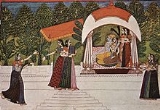
Rajput painting, also known as Rajasthani Painting, is a style of
Indian paintingIndian painting has a very long history, although the seasonally humid Indian climate was difficult for the long-term preservation of paintings and there are far fewer survivals than of other forms of Indian art. The earliest Indian paintings were the rock paintings of pre-historic times, the...
, evolved and flourished during the 18th century in the royal courts of
RajputanaRājputāna was the pre-1949 name of the present-day Indian state of Rājasthān, the largest state of the Republic of India in terms of area. George Thomas was the first in 1800 A.D., to term this region as Rajputana...
,
IndiaIndia , officially the Republic of India , is a country in South Asia. It is the seventh-largest country by geographical area, the second-most populous country with over 1.2 billion people, and the most populous democracy in the world...
, flowing from the style of
Mughal paintingMughal painting is a particular style of South Asian painting, generally confined to miniatures either as book illustrations or as single works to be kept in albums, which emerged from Persian miniature painting, with Indian Hindu, Jain, and Buddhist influences, and developed largely in the court...
, itself derived from the
Persian miniatureA Persian miniature is a small painting on paper, whether a book illustration or a separate work of art intended to be kept in an album of such works called a muraqqa. The techniques are broadly comparable to the Western and Byzantine traditions of miniatures in illuminated manuscripts...
. Each Rajput kingdom evolved a distinct style, but with certain common features. Rajput paintings depict a number of themes, events of epics like the Ramayana and the Mahabharata, Krishna’s life, beautiful landscapes, and humans.
MiniaturesThe word miniature, derived from the Latin minium, red lead, is a picture in an ancient or medieval illuminated manuscript; the simple decoration of the early codices having been miniated or delineated with that pigment...
in manuscripts or single sheets to be kept in albums were the preferred medium of Rajput painting, but many paintings were done on the walls of palaces, inner chambers of the forts, havelis, particularly, the havelis of
ShekhawatiShekhawati is a semi-arid historical region located in the northeast part of Rajasthan, India got its name from Shekhawat Rajputs....
, the forts and palaces built by
ShekhawatShekhawat is a sub-clan of Kachwaha Rajputs found mainly in Rajasthan, India. The Shekhawat clan claims descent from the great rajput warrior Maharao Shekha Ji. The Shekhawats were the most prominent among all sub clans of Kachwahas of Jaipur. Shekhawats were the rulers of Shekhawati.-History:The...
Rajputs.
The colours were extracted from certain minerals, plant sources, conch shells, and were even derived by processing precious stones. Gold and silver were used. The preparation of desired colours was a lengthy process, sometimes taking weeks. Brushes used were very fine.
Schools
In the last decades of the 16th Century Rajput art schools began to develop distinctive styles combining indigenous as well as foreign influences (Persian, Mughal, Chinese, European) into unique styles. Various identifiable styles developed in different Rajput art schools particularly at Amber (near present-day
JaipurJaipur , also popularly known as the Pink City, is the capital and largest city of the Indian state of Rajasthan. Founded on 18 November 1727 by Maharaja Sawai Jai Singh II, the ruler of Amber, the city today has a population of more than 3.1 million....
),
Bikaner,
MarwarMarwar is a region of southwestern Rajasthan state in western India. It lies partly in the Thar Desert. In Rajasthani dialect "wad" means a particular area. The word Marwar is derived from Sanskrit word 'Maruwat'. English translation of the word is 'The region of desert'., The Imperial Gazetteer...
(Jodhpur),
MewarMewar is a region of south-central Rajasthan state in western India. It includes the present-day districts of Pratapgarh, Bhilwara, Chittorgarh, Rajsamand, Udaipur, Dungarpur, Banswara and some of the part of Gujarat and Madhya Pradesh. The region was for centuries a Rajput kingdom that later...
(Udaipur),
KishangarhKishangarh is a city and a municipality in Ajmer district in the Indian state of Rajasthan. It lies 18 miles north-west of Ajmer. It is well connected via Indian Railways and National Highway #8. It is the birth place of the Kishangarh style of painting, which is known for the beautiful depiction...
,
PratapgarhPratapgarh, is a town in Rajasthan, India. It is the district headquarters of Pratapgarh district the newest District of Rajasthan. Famous for its Thewa art, the town is surrounded by tribal villages.- History :...
,
KotaKota , formerly known as Kotah, is a city in the northern Indian state of Rajasthan. It is located south of state capital, Jaipur. Situated on the banks of Chambal River, the city is the trade centre for an area in which millet, wheat, rice, pulses, coriander and oilseeds are grown; industries...
,
BundiBundi is a city and a municipality of approximately 88,000 inhabitants in the Hadoti region of Rajasthan state in northwest India. It is of particular architectural note for its ornate forts, palaces, and stepwell reservoirs known as baoris...
,
NathdwaraNathdwara is a town in Rajasthan state of western India. It is located in the Aravalli hills, on the banks of the Banas River in Rajsamand District, 48 kilometers north-east of Udaipur. This town is famous for its temple of Krishna which houses the idol of Shrinathji, a 14th century, 7-year old...
, Kangra, Kulu, and Guler. Jitendra Sahoo is a famous artist of Rajput painting.
See also
- Mewar painting
- Kangra painting
Kangra painting is the pictorial art of Kangra, named after Kangra, Himachal Pradesh, a former princely state, which patronized the art. It became prevalent with the fading of Basohli school of painting in mid-18th century , and soon produced such a magnitude in paintings both in content as well as...
- Tanjore painting
Tanjore painting is an important form of classical South Indian painting native to the town of Thanjavur in Tamil Nadu, India. The art form dates back to about 1600 AD, a period when the Nayakas of Tanjavur encouraged art—chiefly, classical dance and music—as well as literature, both in Telugu...
- Dalchand
Dalchand was a Mughal-trained painter who worked at the Marwar court in Rajasthan in the first quarter of the 18th century. He painted several portraits and court scenes of his patron, Maharaja Abhai Singh, before moving to Kishangarh. Dalchand's father was the renowned Kishangarh painter...
, an 18th century Rajput artist