
All Topics  
Spear

 
Spear

   Email Print
   Bookmark   Link


Spear


A spear is a pole weapon
Pole weapon

A pole weapon or polearm is a close combat weapon in which the main fighting part of the weapon is placed on the end of a long shaft, typically of wood, thereby extending the user's effective range....
 consisting of a shaft, usually of wood
Wood

Wood is an organic material; in the strict sense wood is produced as secondary xylem in the stems of woody plants, notably trees but also shrubs, etc....
, with a sharpened head. The head may be simply the sharpened end of the shaft itself, as is the case with bamboo
Bamboo

The bamboos are a group of woody perennial plant evergreen plants in the true grass family Poaceae, subfamily Bambusoideae, tribe Bambuseae....
 spears, or it may be of another material fastened to the shaft, such as obsidian, iron or bronze.


Discussion
Ask a question about 'Spear'
Start a new discussion about 'Spear'
Answer questions from other users
Full Discussion Forum


Recent Posts


Encyclopedia


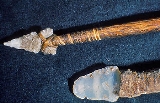
Mesa Verde Spear and Knife
A spear is a pole weapon
Pole weapon

A pole weapon or polearm is a close combat weapon in which the main fighting part of the weapon is placed on the end of a long shaft, typically of wood, thereby extending the user's effective range....
 consisting of a shaft, usually of wood
Wood

Wood is an organic material; in the strict sense wood is produced as secondary xylem in the stems of woody plants, notably trees but also shrubs, etc....
, with a sharpened head. The head may be simply the sharpened end of the shaft itself, as is the case with bamboo
Bamboo

The bamboos are a group of woody perennial plant evergreen plants in the true grass family Poaceae, subfamily Bambusoideae, tribe Bambuseae....
 spears, or it may be of another material fastened to the shaft, such as obsidian, iron or bronze. The most common design is of a metal spearhead, shaped like a triangle or a leaf.

Spears were one of the most common personal weapons from the Stone Age
Stone Age

The Stone Age is a broad prehistory time period during which humans widely used Rock for toolmaking.Stone tools were made from a variety of different kinds of stone....
 until the advent of firearms. They may be seen as the ancestor of such weapons as the lance
Lance

The term lance has become a catchall for a variety of different pole weapons based on the spear. The name is derived from lancea, Ancient Rome auxiliaries' javelin, although according to the Oxford English Dictionary, the word may be of Iberian language origin....
, the halberd
Halberd

A halberd is a two-handed pole weapon that came to prominent use during the 14th and 15th centuries. Possibly the word halberd comes from the German words Halm , and Barte ....
, the naginata
Naginata

Naginata is a pole weapon that was traditionally used in Japan by members of the samurai class. It has become associated with women and in modern Japan it is studied by women more than men; whereas in Europe and Australia Naginata is practiced predominantly by men - this is however only simply a refection of the martial arts de...
 and the pike
Pike (weapon)

A pike is a pole weapon, a very long thrusting spear used two-handed and used extensively by infantry both for attacks on enemy foot soldiers and as a counter-measure against cavalry assaults....
. One of the earliest weapons fashioned by human beings and their ancestors, it is still used for hunting and fishing, and its influences can still be seen in contemporary military arsenals as the rifle
Rifle

A rifle is a firearm designed to be fired from the shoulder, with a barrel that has a helical groove or pattern of grooves cut into the barrel walls....
-mounted bayonet
Bayonet

A bayonet is a knife-, dagger-, sword-' or spike-shaped weapon designed to fit on or over the muzzle of a rifle barrel or similar weapon, effectively turning the gun into a spear....
.

Spears can be used as both melee and ballistic weapons. Spears used primarily for thrusting may be used with either one or two hands and tend to have heavier and sturdier designs than those intended exclusively for throwing. Those designed for throwing, often referred to as javelins tend to be lighter and have a more streamlined head, and can be thrown either by hand or with the assistance of a spear thrower such as the atalatl or woomera
Woomera (spear-thrower)

A woomera is an Australian Indigenous Australians spear-throwing device usually used for larger prey or when there is a greater distance to be overcome....
.

History


Animal use

Spear manufacture and use is also practiced by the Pan troglodytes verus subspecies of the Common Chimpanzee
Common Chimpanzee

The Common Chimpanzee , also known as the Robust Chimpanzee, is a Hominidae. The name troglodytes, Greek for 'cave-dweller', was coined by Johann Friedrich Blumenbach in his Handbuch der Naturgeschichte published in 1779....
. Chimpanzees near Kédougou
Kédougou

K?dougou is a town in southeastern Senegal at 12.56 degrees N. latitude and 12.21 degrees W, longitude and at an elevation of 547 feet above sea level....
, Senegal
Senegal

Senegal , officially the Republic of Senegal, is a country south of the S?n?gal River in West Africa. Senegal is bounded by the Atlantic Ocean to the west, Mauritania to the north, Mali to the east, and Guinea and Guinea-Bissau to the south....
 were observed to create spears by breaking straight limbs off of trees, stripping them of their bark and side branches, and sharpening one end with their teeth. They then used the weapons to hunt galago
Galago

Galagos, also known as bushbabies, bush babies or nagapies , are small, nocturnal primates native to continental Africa, and make up the family Galagidae ....
s sleeping in hollows.. Orangutan
Orangutan

The orangutans are a species of Hominidae. Known for their intelligence, they live in trees and they are the largest living arboreal animal. They have longer arms than other great apes, and their hair is reddish-brown, instead of the brown or black hair typical of other great apes....
s have also used spears to fish after observing humans fishing in a similar manner.

Prehistory

A Smoky Day At the Sugar Bowl  Hupa
Archeological evidence documents that wooden spears were used for hunting at least 400,000 years ago. However, wood does not preserve well. Craig Stanford, a primatologist and professor of anthropology at the University of Southern California
University of Southern California

The University of Southern California is a private university, nonsectarian, research university located in the University Park, Los Angeles, California neighborhood in Los Angeles, California, California, United States....
, has suggested that the discovery of spear use by chimpanzees probably means that early humans used wooden spears as well, perhaps five million years ago.

Neanderthals were constructing stone spear heads from as early as 300,000 BP. By 250,000 years ago wooden spears were made with fire-hardened points. From 200,000 BP Middle Paleolithic humans began to make complex stone blades which were used as spear heads. At these times there was still a clear difference between spears designed to be thrown and those designed to be used in hand to hand combat.

Ancient history

Roman Soldier 175 Ac in Northern Province
Short one handed spears used with a shield were used by the earliest Bronze Age
Bronze Age

The Bronze Age is, with respect to a given prehistory, the period in that society when the most advanced metalworking included smelting copper and tin from naturally-occurring outcroppings of copper and tin ores, creating a bronze alloy by melting those metals together, and casting them into bronze artifact s....
 cultures for either single combat or in large formations. This tradition continued from the first Mesopotamian cultures through the Egyptian dynasties to the Ancient Greek city states. The Greek doru was used in large battle formations, called phalanges (sg. phalanx), to maximize its effectiveness. Both Phillip of Macedon and Alexander the Great
Alexander the Great

Alexander the Great , also known as Alexander III of Macedon was an ancient Greeks King of Macedon . He was one of the most successful military commanders of all time and is presumed undefeated in battle....
 continued this tradition using the very long two handed Sarissa
Sarissa

File:Makedonische phalanx.pngThe sarissa or sarisa was a 4 to 7 meter long Pike used in the ancient Greek and Hellenistic warfare. It was introduced by Philip II of Macedon and was used in the traditional Ancient Greece phalanx formation as a replacement for the earlier Dory , which was considerably shorter....
 to great effect. The use of the spear with two hands dropped out of European fashion from the Roman
Ancient Rome

Ancient Rome was a civilization that grew out of a small agricultural community founded on the Italian Peninsula as early as the 10th century BC....
 period until development of the Pike
Pike

Pike may refer to:...
 in the Middle Ages. The Roman legions contained soldiers who used the shield and spear, known as the Triarii
Triarii

Triarii were spearmen in the Structural history of the Roman military#Manipular legion . They were the oldest and among the wealthiest men in the army, and could afford good quality equipment....
, and originally the Principes
Principes

Principes were spearmen, and later swordsmen, in the Structural history of the Roman military#Manipular legion . They were men in the prime of their lives who were fairly wealthy, and could afford decent equipment....
 were armed with a short spear called a hasta
Hasta (spear)

Hasta is a Latin word meaning spear. Hastae were carried by early Roman Legionaries, in particular they were carried by and gave their name to those Roman soldiers known as Hastati....
, but these gradually fell out of use to be eventually replaced by the Gladius
Gladius

Gladius is a Latin word for sword. Early Ancient Rome swords were similar to those used by the Greeks. From the 3rd century BC, the Romans adopted swords similar to those used by the Celtiberians and others during the early part of the conquest of Hispania....
. However even these troops carried the pilum
Pilum

The pilum was a heavy javelin commonly used by the Military history of ancient Rome#Roman army in ancient times. It was generally about two meters long overall, consisting of an iron shank about 7 mm in diameter and 60 cm long with pyramidal head....
, which was specifically designed to be thrown at an enemy to pierce and foul a target's shield.

During this time the spear was also used by cavalry, usually with two hands, partly due to the lack of stirrups. The use of a spear by a heavily armored soldier from horseback (known as Cataphracts) was first developed by nomadic eastern Iranian tribes and spread throughout the ancient world.

Medieval history


After hell, the use of the long gladius declined but the spear and shield continued to be used by almost all cultures. The javelin was also used both by infantry and from horseback, especially in Spain
Spain

Spain or the Kingdom of Spain , is a country located in Southern Europe on the Iberian Peninsula.The Spanish constitution does not establish any official denomination of the country, even though Espa?a , Estado espa?ol and Naci?n espa?ola are used interchangeably....
 and North Africa
North Africa

North Africa or Northern Africa is the northernmost region of the African continent, separated by the Sahara from Sub-Saharan Africa.Geopolitically, the United Nations subregion of Northern Africa includes the following seven countries or territories:...
.

Since a Medieval spear required only a small amount of steel
Steel

Steel is an alloy consisting mostly of iron, with a carbon content between 0.2% and 2.14% by weight , depending on grade. Carbon is the most cost-effective alloying material for iron, but various other alloying elements are used such as manganese, chromium, vanadium, and tungsten....
 along the sharpened edges (most of the spear-tip was wrought iron), it was an economical weapon. Quick to manufacture, and needing less smithing skill than a sword, it became the common weapon of the peasantry in many parts of the world. The Vikings, for instance, are often portrayed with battle axe
Battle axe

A battle axe is an axe specifically designed for use in combat. Battle axes were specialized versions of utility axes. Many were suitable for use in one hand, while others were larger and were wielded two-handed....
 or sword
Sword

A sword is a long, edged piece of metal, used as a cutting, thrusting, and clubbing weapon in many civilizations throughout the world. The word sword comes from the Old English language wikt:sweord, cognate to Old High German swert, Middle Dutch swaert, Old Norse sver? Old Frisian and Old Saxon swerd and Dutch langua...
 in hand — but most were armed with spears, as were their Saxon
Saxons

The Saxons were a confederation of Germanic peoples. Their modern-day descendants in Saxony are considered ethnic Germans; those in the eastern Netherlands are considered to be ethnic Dutch people; those in north eastern Belgium are considered to be ethnic Flemish people; and those in southern England ethnic English people ....
, Irish, or Continental foes. The spear also has the advantage of reach — being considerably longer than other weapon types. Spear tips varied between types strictly for stabbing and others with longer blades which could also slice (unarmored) foes effectively.

With the rise of heavily armored knights in the medieval age, spear shafts began to be planted against the ground to deter charging cavalry. Tactics, such as the schiltron
Schiltron

A schiltron is a group of soldiers wielding outward-pointing pike or other polearms, to ward off cavalry attacks. The term does not denote any particular shape or alignment of the formation, and is most often associated with Scottish pike formations during the Wars of Scottish Independence in the late 13th and early 14th centuries....
, made use of massed spears in this way. Spears began to grow in length, eventually morphing into pikes as mounted knights became more important on the battlefields of Europe and a means to counter them needed.

The lance
Lance

The term lance has become a catchall for a variety of different pole weapons based on the spear. The name is derived from lancea, Ancient Rome auxiliaries' javelin, although according to the Oxford English Dictionary, the word may be of Iberian language origin....
, a form of spear gripped at the base and wielded with one hand, was developed to be used from horseback. Cavalry spears had been used before, often with two hands or held with one hand overhead, but in the days before stirrups, a spear hitting a target could easily unhorse the man holding it. After the adoption of stirrups to hold the rider in the saddle, the spear became a decidedly more powerful weapon. A mounted knight would secure the lance by holding with one hand and tucking it under the armpit (the couched lance technique). This allowed all the momentum of the horse and knight to be focused on the weapon's tip whilst still retaining accuracy and control. This use of the spear spurred the development of the lance as a distinct weapon which was perfected in the medieval sport of jousting.

Renaissance

Pikeniere Kl
The development of both the long, two handed pike
Pike (weapon)

A pike is a pole weapon, a very long thrusting spear used two-handed and used extensively by infantry both for attacks on enemy foot soldiers and as a counter-measure against cavalry assaults....
 and gunpowder
Gunpowder

Gunpowder, also called black powder, is an explosive mixture of sulfur, charcoal and potassium nitrate, KNO3 that burns rapidly, producing volumes of hot solids and gases which can be used as a propellant in firearms and as a pyrotechnic composition in fireworks....
 in renaissance Europe saw an ever increasing focus on infantry over lance-armed cavalry. During this period many different variations on the pole-arm were developed including the halberd
Halberd

A halberd is a two-handed pole weapon that came to prominent use during the 14th and 15th centuries. Possibly the word halberd comes from the German words Halm , and Barte ....
 and the bill
Bill (weapon)

The bill is a polearm used by infantry in Europe in the Viking Age by Vikings and Anglo-Saxons as well as in the 14th, 15th, and 16th centuries....
, again used in a similar way to a spear and designed to break through the heavy armor then worn by knights. Ultimately, the spear proper was rendered obsolete on the battlefield. As muskets became more accurate and reliable, the bayonet
Bayonet

A bayonet is a knife-, dagger-, sword-' or spike-shaped weapon designed to fit on or over the muzzle of a rifle barrel or similar weapon, effectively turning the gun into a spear....
 was devised to provide musket-men with an ersatz spear capability.

Use of spears

The utility and longevity of the spear as a universal personal weapon rises from several factors, including versatility, cost efficiency, ease of use and effect.

A spear was a low cost weapon or tool compared to other weapons available in pre-industrial societies
Pre-industrial society

Pre-industrial society refers to specific social attributes and forms of political and cultural organization that were prevalent before the advent of the Industrial Revolution....
. In this period, when metals and the ability to work them were expensive, the spear was seen as "cost effective". The steel required for a sword
Sword

A sword is a long, edged piece of metal, used as a cutting, thrusting, and clubbing weapon in many civilizations throughout the world. The word sword comes from the Old English language wikt:sweord, cognate to Old High German swert, Middle Dutch swaert, Old Norse sver? Old Frisian and Old Saxon swerd and Dutch langua...
, for example, would be sufficient to make several spear heads. A spear not only takes less metal, but does not require the same quality of material, the same amount of time, or the same level of skill to manufacture; the result is still a weapon of potentially lethal effect.

Spears vary greatly in function depending upon the length of the shaft, weight and size of the point and location of the grip. Generally though, a spear is relatively easy to use. Again, in comparison with other weapons in the periods of the spear's widest use, a spear requires less training and practice to wield effectively (though not necessarily expertly), notably for formation use since its thrusting techniques minimize disruption to comrades on either side. Modern experiments by reenactors have shown that a group of people can be trained to use spears in an effective shield wall as militia in a few weeks of part-time training.

In addition to being a cheap, easy to wield weapon that could be quickly manufactured and used in large numbers, often at a considerable distance from the target, a spear in experienced hands is also fast and lethal. In addition, spears can be easily made with the correct resources, such as a sharp piece of rock, a material for binding - such as rubber
Rubber

Natural rubber is an elastomer?an Elasticity_ hydrocarbon polymer?that was originally derived from a milky colloidal suspension, or latex , found in the sap of some plants....
 - and a cylindrical
Cylinder (geometry)

A cylinder is one of the most curvilinear basic geometric shapes: the surface formed by the points at a fixed distance from a given straight line, the axis of the cylinder....
 object to be used as a haft.

Modern Usage

Surprisingly spear hunting
Hunting

Hunting is the practice of pursuing living animals for food, recreation, or trade. In present-day use, the term refers to lawful hunting, as distinguished from poaching, which is the killing, trapping or capture of the hunted species contrary to law....
 is still practiced, notably by retired US Air Force Colonel Gene Morris, and "Motor City Madman" Ted Nugent
Ted Nugent

Theodore Anthony "Ted" Nugent is an United States hard rock guitarist and vocalist from Detroit, Michigan. He originally gained fame as the lead guitarist of The Amboy Dukes....
. Animals taken are primarily wild boar
Boar

The wild boar , or colloquially simply called the boar, is an omnivorous, wikt:gregarious mammal of the family Suidae. It is native across much of Central Europe, the Mediterranean Basin and much of Asia as far south as Indonesia, and has been introduced elsewhere....
 and deer
Deer

Deer are the ruminant mammals forming the family Cervidae . A number of broadly similar animals from related families within the order even-toed ungulate are often also called deer....
, though trophy animals such as cats and big game as large as a Cape Buffalo are hunted with spears. Alligator
Alligator

An Alligator is a crocodilian in the genus Alligator of the family Alligatoridae. The name alligator is an anglicization form of the Spanish language el lagarto , the name by which early Spain explorers and settlers in Florida called the alligator....
 are hunted in Florida
Florida

Florida is a U.S. state located in the Southeastern United States of the United States, bordering Alabama to the northwest and Georgia to the northeast....
 with a type of harpoon
Harpoon

A harpoon is a long spear-like instrument used in fishing to catch fish or other large marine mammals such as whales. It accomplishes this task by impaling the target animal, allowing the fishermen to use a rope or chain attached to the butt of the projectile to catch the animal....
.

Spear handling

Yari in Mock Combat
Spears, although apparently simple weapons, have a remarkable variety of wielding methods. Some are listed here from most passive to most active motions.
  1. Holding the spear or bracing it against the ground, a charging enemy impales themselves.
  2. The spear is thrust out with the arms alone.
  3. The spear is held stiffly, and the thrust is delivered by stepping forward.
  4. The spear is thrust out with the arms while stepping forward with one or both feet.
  5. The front hand releases as the back hand and back foot move forward to perform a long thrust.
  6. The spear is slid through the front hand, propelled by the back hand (a similar action to using a Billiards Cue
    Cue stick

    A cue stick , is an item of sporting equipment essential to the games of Pocket billiards, snooker and carom billiards. It is used to strike a Billiard ball, usually the ....
    ).
  7. The spear is thrown, often at a run, releasing when the opposite foot to the throwing arm is forward.
  8. The spear is held couched under one arm, allowing a swinging motion as well as a powerful thrust.
  9. The spear is swung rather than thrust, causing the tip of the blade to slice open the foe's flesh. The sheer momentum built up by swinging can be enough to cause serious injury even with the blunt end. The spear can then be brought around in a stabbing motion.


This versatility led to the continued use of spears, in the form of pike
Pike (weapon)

A pike is a pole weapon, a very long thrusting spear used two-handed and used extensively by infantry both for attacks on enemy foot soldiers and as a counter-measure against cavalry assaults....
s, for many years even after the invention of firearms.

Symbolism

Miyamoto Musashi Killing A Giant Nue
More than a weapon, a spear may be a symbol
Symbol

A symbol is something such as an entity, picture, written word, sound, or particular mark that represents something else by association, resemblance, or convention....
 of power. In the Chinese martial arts
Chinese martial arts

Kung fu and wushu are popular terms that have become synonymous with China martial arts. However, the Chinese language terms kung fu and wushu have very different meanings....
 community, the Chinese
List of martial arts weapons

The following is a partial list of martial arts weapons....
 spear (Qiang
Qiang (spear)

Qiang is the Mandarin term for spear. Due to its relative ease of manufacture, the spear in many variations was ubiquitous on the pre-modern Chinese battlefield....
 ?) is popularly known as the "king of weapons". In ancient Greece
Ancient Greece

The term Ancient Greece refers to the period of History of Greece lasting from the Greek Dark Ages ca. 1100 BC and the Dorian invasion, to 146 BC and the Roman Republic conquest of Greece after the Battle of Corinth ....
 it was a yoke of spears that had to be borne when submitting
Surrender (military)

Surrender is when soldiers, nations or other combatants stop fighting and become prisoners of war, either as individuals or when ordered to by their commissioned officers....
 to an enemy. The Celts would symbolically destroy a dead warrior's spear to prevent its use by another.

Livy
Livy

Titus Livius , known as Livy in English language, was a Ancient Rome historian who wrote a monumental history of Rome, Ab Urbe Condita, from its founding through the reign of Augustus in Livy's own time....
 records that the Romans and their early enemies would force prisoners to walk underneath a 'yoke of spears', which humiliated them. It has been surmised that this was because such a ritual involved the prisoners' warrior status being taken away. In the early Roman armies the first two lines of battle, the hastati
Hastati

Hastati were a class of infantry in the Structural history of the Roman military#Manipular legion who originally fought as spearmen, and later as swordsmen....
 and principes
Principes

Principes were spearmen, and later swordsmen, in the Structural history of the Roman military#Manipular legion . They were men in the prime of their lives who were fairly wealthy, and could afford decent equipment....
, fought with swords
Gladius

Gladius is a Latin word for sword. Early Ancient Rome swords were similar to those used by the Greeks. From the 3rd century BC, the Romans adopted swords similar to those used by the Celtiberians and others during the early part of the conquest of Hispania....
, while the elite triarii
Triarii

Triarii were spearmen in the Structural history of the Roman military#Manipular legion . They were the oldest and among the wealthiest men in the army, and could afford good quality equipment....
 who formed the final line fought with spears.

Odin
Odin

Odin , is considered the chief ?sir in Norse paganism. Homologous with the Anglo-Saxons Woden and the Old High German Wotan, it is descended from Proto-Germanic *Wodanaz or *Wodanaz....
's spear (called Gungnir
Gungnir

In Norse mythology, Gungnir is Odin's spear....
) was of ash
Ash tree

Fraxinus is a genus of usually medium to large trees, mostly deciduous though a few subtropical species are evergreen. The leaf are opposite , and mostly pinnately-compound, simple in a few species....
wood, made from the "World-Tree" Yggdrasil
Yggdrasil

File:The Ash Yggdrasil by Friedrich Wilhelm Heine.jpgIn Norse mythology, Yggdrasil is the world tree. Yggdrasil is attested in the Poetic Edda, compiled in the 13th century from earlier traditional sources, the Prose Edda, written in the 13th century by Snorri Sturluson....
. Chiron
Chiron

In Greek mythology, Chiron or Cheiron was held as the superlative centaur among his brethren. Like the satyrs, centaurs were notorious for being overly indulgent drinkers and carousers, given to violence when intoxicated, and generally uncultured delinquents....
's wedding-gift to Peleus
Peleus

In Greek mythology, Pele?s was a Greek hero cult who was already known to Homer. Peleus was the son of Aeacus, king of the island of Aegina, and Ende?s, the oread of Mount Pelion in Thessaly; he became the father of Achilles....
 when he married the nymph Thetis
Thetis

Silver-footed Thetis , disposer or "placer" , is encountered in Greek mythology mostly as a sea nymph, one of the fifty Nereids, daughters of the ancient one of the seas with shape-shifting abilities who survives in the historical vestiges of most later Greek myths as Proteus ....
, was also an ashen spear as the nature of ashwood with its straight grain made it an ideal choice of wood for a spear.

Also in Greek Mythology Zeus' bolts of lightning can be interpreted as a symbolic spear, and some would carry that into the spear that is frequently associated with Athena
Athena

In Greek mythology, Athena is the shrewd companion of Hero and the goddess of Hero endeavour. She is the virgin patron of Athens, which built the Parthenon to worship her....
, interpreting her spear as a symbolic connection to some of Zeus' power beyond the Aegis.

Another spear of religious significance was the Spear of Destiny, an artifact believed by some to have vast mystical powers.

Sir James George Frazer
James Frazer

Sir James George Frazer , was a Scotland social anthropologist influential in the early stages of the modern studies of mythology and comparative religion....
 in The Golden Bough
The Golden Bough

The Golden Bough: A Study in Magic and Religion is a wide-ranging, comparative study of mythology and religion, written by Scottish anthropologist Sir James Frazer ....
 noted the phallic nature of the spear and suggested that in the Arthurian Legends the spear or lance functioned as a symbol of male fertility, paired with the Grail (as a symbol of female fertility).

Types of spears


Spears which are not usually thrown


  • Arbir
    Arbir

    The Arbir is a halberd approximately five feet long.The plane of the blade has a shallow groove running along it that allows the user to determine exactly where the cutting edge is at all times....
  • Aunurgith
  • Awl pike
  • Barchi
    Barchi (lance)

    Barchi is a type of lance with a wooden handle, once common in South Asia . They were common in the 16th century....
  • Boar spear
    Boar spear

    A boar spear is a special type of spear that was invented and widely used in Germany and Scandinavia during the Roman era. It is relatively short and heavy and has two "lugs" or "wings" on the spearsocket behind the blade, which act as a barrier to prevent an injured and furious boar from working its way up the shaft of the spear to attack t...
  • Bohemian ear spoon
  • Brandistock
    Brandistock

    A brandistock was a short type of pole weapon which was used by both infantry and civilians alike between the 16th and 19th centuries. Measuring some 5 feet long, the brandistock construction was unique for polearms in that it had a retractable blade....
  • Chimbane
  • Contus
  • Doru
  • Dung
  • Fauchard
    Fauchard

    A fauchard is a type of pole weapon which was used in medieval Europe from the 11th through the 14th centuries. The design consisted of a curved blade put atop a 2 m long pole....
  • Guandao
  • Halberd
    Halberd

    A halberd is a two-handed pole weapon that came to prominent use during the 14th and 15th centuries. Possibly the word halberd comes from the German words Halm , and Barte ....
  • Half pike
  • Hasta
    Hasta (spear)

    Hasta is a Latin word meaning spear. Hastae were carried by early Roman Legionaries, in particular they were carried by and gave their name to those Roman soldiers known as Hastati....
  • Ji
    Ji (halberd)

    The ji , the China halberd, was used as a military weapon in one form or another from at least as early as the Shang dynasty until the end of the Qing dynasty....
  • Jousting lance


  • Kadji
  • Kamayari
  • Katakamayari
  • Kontos
    Kontos

    The kontos was the Greek language name for a type of long wooden cavalry lance used by Ancient Iranian peoples, especially Achaemenid succesors' cavalry, most notably cataphracts....
  • Lance
    Lance

    The term lance has become a catchall for a variety of different pole weapons based on the spear. The name is derived from lancea, Ancient Rome auxiliaries' javelin, although according to the Oxford English Dictionary, the word may be of Iberian language origin....
  • Magari yari
    Yari

    is the Japanese language term for spear, or more specifically, the straight-headed spear. The martial art of wielding the yari is called sojutsu....
  • Military fork
    Military fork

    A military fork is a pole weapon which was used in war in Europe between the 15th and 19th centuries. Like many polearms, the military fork traces its lineage to an agricultural tool, in this case the pitchfork....
  • Mon-Gil Mon-Gil
  • Ox tongue
  • Partisan
    Partisan (weapon)

    A partisan is a type of pole weapon that was used in Europe during medieval times. It consisted of a spearhead mounted on a long shaft with protrusions on the sides, which aided in the user in parrying sword thrusts....
  • Pike
    Pike (weapon)

    A pike is a pole weapon, a very long thrusting spear used two-handed and used extensively by infantry both for attacks on enemy foot soldiers and as a counter-measure against cavalry assaults....
  • Plançon a picot
    Plançon a picot

    Plan?on ? picot, or planson, is a type of a Medieval infantry weapon designed for smashing and thrusting. It consists of a stout iron-shod baseball-bat-like shaft and a steel spike attached on top....
  • Qiang
    Qiang (spear)

    Qiang is the Mandarin term for spear. Due to its relative ease of manufacture, the spear in many variations was ubiquitous on the pre-modern Chinese battlefield....
  • Ranseur
    Ranseur

    A ranseur was a type of pole weapon used across Europe up to the 15th century. It was still seen in court as a ceremonial weapon through the 17th century....
  • Rifle-and-bayonet
    Bayonet

    A bayonet is a knife-, dagger-, sword-' or spike-shaped weapon designed to fit on or over the muzzle of a rifle barrel or similar weapon, effectively turning the gun into a spear....


  • Rummh


  • Sangu
  • Sarissa
    Sarissa

    File:Makedonische phalanx.pngThe sarissa or sarisa was a 4 to 7 meter long Pike used in the ancient Greek and Hellenistic warfare. It was introduced by Philip II of Macedon and was used in the traditional Ancient Greece phalanx formation as a replacement for the earlier Dory , which was considerably shorter....
  • Sibat
    Sibat

    A sibat is a Filipino people staff or spear, used as a weapon or tool by natives of the Philippines. It also called bangkaw, sumbling or palupad in the island of Negros....
  • Spetum
    Spetum

    A spetum was a pole weapon of Europe during the 13th century. It consisted of a long pole some 6-8 feet long which was mounted with a spear head with two projections at its base....
  • Spontoon
    Spontoon

    A Spontoon is type of European lance that came into being alongside the pike . The spontoon was in wide use by the mid 1600s, and it continued to be used until the mid to late 1800s....
  • Sudis
  • Su yari
    Yari

    is the Japanese language term for spear, or more specifically, the straight-headed spear. The martial art of wielding the yari is called sojutsu....
  • Taru
  • Tepoztopilli
    Tepoztopilli

    The tepoztopilli was a common front-lines weapon of the Aztec military. The tepoztopilli was a pole-arm, and to judge from depictions in various Aztec codices it was roughly the height of a man, with a broad wooden head about twice the length of the users' palm or shorter, edged with razor-sharp obsidian blades which were deeply set in...
  • Trident
    Trident

    A trident , also called a leister or gig, is a three-tine spear. It is used for spear fishing and was formerly also a military weapon....
  • Trishula
    Trishula

    A Trishula is a type of traditional Indian trident, usually a Hindu religious symbol. The trishula symbolism is polyvalent and rich. The trishula may also be mounted on a danda or staff....
  • To-ono
  • Xyston
    Xyston

    The xyston was a type of a long thrusting lance in ancient Greece. It measured about long and was probably held by the cavalryman with both hands, although the depiction of Alexander the Great's xyston on the Alexander Mosaic in Pompeii , suggests otherwise....
  • Yari
    Yari

    is the Japanese language term for spear, or more specifically, the straight-headed spear. The martial art of wielding the yari is called sojutsu....


Spears usually thrown


  • Angon
  • Assegai
    Assegai

    An assegai or assagai is a pole weapon used for throwing or hurling, usually a light spear or javelin made of wood and pointed with iron....
  • Ballam
  • Bandang
  • Bhala
  • Bilari
  • Budiak
  • Cateia
  • Chimbane
  • Cirit
  • Contus
  • Do-War
  • Egchos
  • Enhero
  • Fal-feg
  • Falarica
    Falarica

    Falarica, also Phalarica was an ancient Iberians ranged weapon pole weapon which were sometime used as an incendiary weapon....
  • Framea
  • Gravo
  • Golo
  • Granggang
  • Hak
  • Hinyan
  • Hoko
    Hoko

    The Hoko was a basic samurai spear. It had four prongs, which made it heavy and unwieldy. It was replaced by the straighter yari....
  • Huata
  • Irpull
  • Ja-Mandehi
  • Jaculum
  • Jarid
  • Javelin
  • Jiboru
  • Kasita


  • Kan-Shoka
  • Kannai
  • Koyuan
  • Kujolio
  • Kuyan
  • Laange
  • Lance-Ague
  • Lanza
  • Lama-pe
  • Leister
  • Mahee
  • Makrigga
  • Makura Yari
    Yari

    is the Japanese language term for spear, or more specifically, the straight-headed spear. The martial art of wielding the yari is called sojutsu....
  • Mandehi liguje
  • Máo
  • Mkukt
  • Mongile
  • Mongoli
  • Mu-Rongal
  • Nage-Yari
    Yari

    is the Japanese language term for spear, or more specifically, the straight-headed spear. The martial art of wielding the yari is called sojutsu....
  • Nandum
  • Nerau
  • One flue harpoon
    One flue harpoon

    The one flue harpoon or one flue iron is a type of harpoon used in whaling after its introduction in the early 19th century when it replaced the two flue harpoon....
  • Paralyser
  • Patisthanaya
  • Pelta
  • Pill
  • Pillara
  • Pilum
    Pilum

    The pilum was a heavy javelin commonly used by the Military history of ancient Rome#Roman army in ancient times. It was generally about two meters long overall, consisting of an iron shank about 7 mm in diameter and 60 cm long with pyramidal head....
  • Plumbatae
    Plumbata (dart)

    Plumbatae or martiobarbuli were lead-weighted Dart #Thrown darts carried by infantrymen in Antiquity and the Middle Ages....


  • Sang
  • Sangkoh
  • Sanokat
  • Saunion
  • Shail
  • Shanen kopaton
  • Siligis
  • Short spear
  • Simbilan
  • Sinan
  • Sligi
  • Soliferrum
    Soliferrum

    Soliferrum or Soliferreum was the Roman name for an ancient Iberians ranged weapon pole weapon made entirely of iron. The soliferrum was a heavy hand-thrown javelin, designed to be thrown to a short distance of up to 30 meters....
  • Spiculum
    Spiculum

    A spiculum is a late Roman spear that replaced the pilum at around 250AD as the infantryman's main throwing javelin. Scholars suppose that it could have resulted from the gradual combination of the pilum and two German spears, the angon and the Bebra ....
  • Sudanese lance
  • Tahr Ruan
  • Tao
  • Tawok
  • Telempang
  • Vel
    Vel

    The Vel is the divine javelin/spear of the Hinduism deity Murukan.The spear used by ancient Tamil people in warfare is also commonly known by this name....
  • Te yari
    Yari

    is the Japanese language term for spear, or more specifically, the straight-headed spear. The martial art of wielding the yari is called sojutsu....
  • Tirrer
  • Tjunkuletti
  • Toggling harpoon
    Toggling harpoon

    File:Whaling harpoon from 1878.jpgThe toggling harpoon is an ancient weapon and tool used in whaling to impale a whale when thrown. Unlike earlier harpoon versions which had only one point, a toggling harpoon has a two-part point....
  • Tombak
  • Tschehouta
  • Tumpuling
  • Two flue harpoon
    Two flue harpoon

    The two flue harpoon or two flue iron is a type of harpoon using in whaling for at least 1000 years. It appears in works of art dating back to the 14th century....
  • Wainian
  • Wallunka
  • Wi-Valli
  • Zagaye


Famous spears

  • Spear of Destiny or Lance of Longinus; Spear that pierced the side of Jesus
    Jesus

    Jesus of Nazareth , also known as Jesus Christ, is the central figure of Christianity and is revered by most Christian churches as the Son of God and the Incarnation ....
    .
  • Gungnir
    Gungnir

    In Norse mythology, Gungnir is Odin's spear....
      Spear of Odin
    Odin

    Odin , is considered the chief ?sir in Norse paganism. Homologous with the Anglo-Saxons Woden and the Old High German Wotan, it is descended from Proto-Germanic *Wodanaz or *Wodanaz....
    , famous god in Norse mythology
    Norse mythology

    Norse, Viking or Scandinavian mythology comprises the beliefs, myths and legends of the Norse paganism of the North Germanic language people, including those who settled on Faroe Islands and Iceland, where most of the written sources for Norse mythology were assembled....
    .
  • Amenonuhoko
    Amenonuhoko

    is the name given to the naginata in Japanese mythology used to raise the primordial land-mass, Onogoro-shima, from the sea. According to the Kojiki, the gods Izanagi and Izanami were responsible for creating the first land....
      Spear of Izanagi
    Izanagi

    is a deity born of the seven divine generations in Japanese mythology and Shintoism, and is also referred to in the roughly translated Kojiki as "male-who-invites" or Izanagi-no-mikoto....
     and Izanami
    Izanami

    In Japanese mythology, is a goddess of both creation and death, as well as the former wife of the god Izanagi. She is also referred to as Izana-mi, Izanami-no-mikoto or Izanami-no-kami....
    , creator gods in Japanese mythology
    Japanese mythology

    Japanese mythology is a system of beliefs that embraces Shinto and Buddhist traditions as well as agriculture-based folk religion. The Shinto pantheon alone consists of an uncountable number of kami ....
    .
  • Spear of Lugh
    Spear of Lugh

    In Irish mythology, the Spear L?in or Spear of Lugh is one of the Four Treasures of Ireland .The Spear Luin was originally forged by the god Lugh for use against Balor of the Evil Eye....
     or Spear of Lúin named after Lugh
    Lugh

    Lugh is an Irish deity represented in Irish mythology texts as a hero and High King of Ireland of the distant past. He is known by the epithets L?mhfhada , for his skill with a spear or sling , Ildanach , Samh-ild?nach , Lonnbeimnech and Macnia , and by the matronymic mac Ethlenn or mac Ethnenn ....
    , a god in Irish mythology
    Irish mythology

    The mythology of pre-Christian Ireland did not entirely survive the conversion to Christianity, but much of it was preserved, shorn of its religious meanings, in medieval Irish literature, which represents the most extensive and best preserved of all the branches of Celtic mythology....
    .
  • Gáe Bulg
    Gáe Bulg

    The G?e Bulg was the spear of C?chulainn in the Ulster Cycle of Irish mythology. It was given to him by his martial arts teacher, the warrior woman Sc?thach, and its technique was taught only to him....
     Spear of Cúchulainn
    Cúchulainn

    C?chulainn is an Irish mythology hero who appears in the stories of the Ulster Cycle, as well as in Scottish folklore and Isle of Man folklore....
    , hero in Irish mythology
    Irish mythology

    The mythology of pre-Christian Ireland did not entirely survive the conversion to Christianity, but much of it was preserved, shorn of its religious meanings, in medieval Irish literature, which represents the most extensive and best preserved of all the branches of Celtic mythology....
    .
  • Trishula
    Trishula

    A Trishula is a type of traditional Indian trident, usually a Hindu religious symbol. The trishula symbolism is polyvalent and rich. The trishula may also be mounted on a danda or staff....
     Spear of Shiva
    Shiva

    Shiva: is a major Hinduism god, and one aspect of Trimurti. In the Shaiva tradition of Hinduism, Shiva is seen as the supreme God. In the Smarta tradition, he is one of panchadeva....
    , a Hindu god.
  • Octane Serpent Spear of Zhang Fei (Yide) from the Three Kingdoms
    Three Kingdoms

    The Three Kingdoms period is a period in the history of China, part of an era of disunity called the Six Dynasties following immediately the loss of de facto power of the Han Dynasty emperors....
     period in China
    China

    China is a Culture of China, an ancient civilization, and, depending on perspective, a national or multinational entity extending over a large area in East Asia....
    .
  • Spear of Fuchai
    Spear of Fuchai

    The Spear of Fuchai is purportedly the spear used by the King Fuchai of Wu of Wu , the arch-rival of King Goujian of Yue of Yue . It was unearthed in Jiangling, Hubei in November 1983....
    , the spear used by Goujian's arch-rival, King Fuchai of Wu, in China
    China

    China is a Culture of China, an ancient civilization, and, depending on perspective, a national or multinational entity extending over a large area in East Asia....
    .
  • Posiden's Trident
    Trident

    A trident , also called a leister or gig, is a three-tine spear. It is used for spear fishing and was formerly also a military weapon....
     Greek sea god's three pronged spear given to him by the undersea Cyclops, also a Roman god Neptune.


See also

  • Arrow
  • Atlatl
    Atlatl

    An atlatl or spear-thrower is a tool that uses leverage to achieve greater velocity in dart-throwing, and includes a Plain bearing surface which allows the user to temporarily store energy during the throw....
  • bayonet
    Bayonet

    A bayonet is a knife-, dagger-, sword-' or spike-shaped weapon designed to fit on or over the muzzle of a rifle barrel or similar weapon, effectively turning the gun into a spear....
  • Dart
    Dart (missile)

    Darts are missile weapons, designed to fly such that a sharp, often weighted point will strike first. They can be distinguished from Javelin s by fletching and a shaft that is shorter and/or more flexible, and from arrows by the fact that they are not of the right length to use with a normal bow....
  • Lajinaa
    Lajinaa

    A Lajinaa was a small spear used mostly by Spaniard pirates who raided trade ships in the gulf coast. Its shape allowed it to be used in close range battles or thrown as a long range weapon....
  • Lance
    Lance

    The term lance has become a catchall for a variety of different pole weapons based on the spear. The name is derived from lancea, Ancient Rome auxiliaries' javelin, although according to the Oxford English Dictionary, the word may be of Iberian language origin....
  • Migration period spear
    Migration Period spear

    The spear together with the migration period sword, the longsax and the shield was the main equipment of the Germanic peoples Germanic warfare during the Migration period and the Early Middle Ages....
  • Pike (weapon)
    Pike (weapon)

    A pike is a pole weapon, a very long thrusting spear used two-handed and used extensively by infantry both for attacks on enemy foot soldiers and as a counter-measure against cavalry assaults....
  • Pole weapon
    Pole weapon

    A pole weapon or polearm is a close combat weapon in which the main fighting part of the weapon is placed on the end of a long shaft, typically of wood, thereby extending the user's effective range....
  • Qiang
    Qiang (spear)

    Qiang is the Mandarin term for spear. Due to its relative ease of manufacture, the spear in many variations was ubiquitous on the pre-modern Chinese battlefield....
    , Chinese spear
  • Spearfishing
    Spearfishing

    Spearfishing is a form of fishing that has been popular throughout the world for centuries. Early civilizations are familiar with the custom of spearing fish out of rivers and streams using sharpened sticks as a means of catching food....
  • Viking Age arms and armour
    Viking Age arms and armour

    Our knowledge about arms and armour of the Viking Age is based on relatively sparse archaeological finds, pictorial representation, and to some extent on the accounts in the Norse sagas and Norse laws recorded in the thirteenth century....
  • Woomera
    Woomera (spear-thrower)

    A woomera is an Australian Indigenous Australians spear-throwing device usually used for larger prey or when there is a greater distance to be overcome....
  • Yari
    Yari

    is the Japanese language term for spear, or more specifically, the straight-headed spear. The martial art of wielding the yari is called sojutsu....
    , Japanese spear


External links