
All Topics  
Raga


   Email Print
   Bookmark   Link


Raga


Raga (Sanskrit
Sanskrit

Sanskrit is a historical Indo-Aryan language, one of the liturgical languages of Hinduism and Buddhism, and one of the 22 official languages of India....
, lit. "colour" or "mood"; or ragam in Carnatic music
Carnatic music

Carnatic music is a system of music commonly associated with the southern part of the Indian subcontinent, with its area roughly confined to four modern states of India: Andhra Pradesh, Karnataka, Kerala, and Tamil Nadu....
) refers to melodic modes
Musical mode

Mode is a term from Western music theory having three senses: the rhythmic relationship between long and short values in the late medieval period; in early medieval theory, Interval ; and, most commonly, a concept involving Musical scale and melody type ....
 used in Indian classical music
Indian classical music

The origins of Indian classical music can be found from the oldest of scriptures, part of the Hindu tradition, the Vedas.The Samaveda, one of the four Vedas, describes music at length....
. It is a series of five or more musical notes upon which a melody
Melody

In music, a melody , also tune, voice, or line, is a linear succession of musical tones which is perceived as a single entity....
 is made. In the Indian musical tradition, ragas are associated with different times of the day, or with seasons. Indian classical music is always set in a raga. Non-classical music such as popular Indian film songs
Filmi

Filmi music is Indian popular music as written and performed for cinema of India. List of Indian film music directors make up the main body of composers; the songs are performed by playback singers....
 or ghazal
Ghazal

In poetry, the ghazal is a poetic form consisting of rhyming couplets and a refrain. Each line must share the same meter. The Arabic word "ghazal" is pronounced roughly like the English word "guzzle", but with the first, g-like consonant further back in the throat....
s sometimes use ragas in their compositions.

Ragini is an archaic term for the 'feminine' counterpart to a raga.

????? ?????????????? ???????????????? ?
?????? ??????????? ? ? ??? ??????? ??


"That which is a special dhwani, is bedecked with swara
Swara

The notes, or swaras, of Indian music are shadja, rishabh, gandhar, madhyam, pancham, dhaivat and nishad. Collectively these notes are known as the sargam....
(notes) and varna and is colorful or delightful to the minds of the people, is said to be raga" - Matanga
Matanga

Matanga literally means an elephant.In the Ramayana, Maharishi Matanga was a man who was brought up as a Brahmin but was the son of a Chandala....
 in the Brihaddeshi
Brihaddeshi

Brihaddeshi is a 6th to 8th century Indian text on music authored by Matanga Muni. It is the first text that speaks directly of the raga as well as makes a distinction between the classical and the folk ....
.


Raga describes a generalised form of melodic practice.


Discussion
Ask a question about 'Raga'
Start a new discussion about 'Raga'
Answer questions from other users
Full Discussion Forum


Recent Posts


Encyclopedia


Raga (Sanskrit
Sanskrit

Sanskrit is a historical Indo-Aryan language, one of the liturgical languages of Hinduism and Buddhism, and one of the 22 official languages of India....
, lit. "colour" or "mood"; or ragam in Carnatic music
Carnatic music

Carnatic music is a system of music commonly associated with the southern part of the Indian subcontinent, with its area roughly confined to four modern states of India: Andhra Pradesh, Karnataka, Kerala, and Tamil Nadu....
) refers to melodic modes
Musical mode

Mode is a term from Western music theory having three senses: the rhythmic relationship between long and short values in the late medieval period; in early medieval theory, Interval ; and, most commonly, a concept involving Musical scale and melody type ....
 used in Indian classical music
Indian classical music

The origins of Indian classical music can be found from the oldest of scriptures, part of the Hindu tradition, the Vedas.The Samaveda, one of the four Vedas, describes music at length....
. It is a series of five or more musical notes upon which a melody
Melody

In music, a melody , also tune, voice, or line, is a linear succession of musical tones which is perceived as a single entity....
 is made. In the Indian musical tradition, ragas are associated with different times of the day, or with seasons. Indian classical music is always set in a raga. Non-classical music such as popular Indian film songs
Filmi

Filmi music is Indian popular music as written and performed for cinema of India. List of Indian film music directors make up the main body of composers; the songs are performed by playback singers....
 or ghazal
Ghazal

In poetry, the ghazal is a poetic form consisting of rhyming couplets and a refrain. Each line must share the same meter. The Arabic word "ghazal" is pronounced roughly like the English word "guzzle", but with the first, g-like consonant further back in the throat....
s sometimes use ragas in their compositions.

Ragini is an archaic term for the 'feminine' counterpart to a raga.

Nature of raga

????? ?????????????? ???????????????? ?
?????? ??????????? ? ? ??? ??????? ??


"That which is a special dhwani, is bedecked with swara
Swara

The notes, or swaras, of Indian music are shadja, rishabh, gandhar, madhyam, pancham, dhaivat and nishad. Collectively these notes are known as the sargam....
(notes) and varna and is colorful or delightful to the minds of the people, is said to be raga" - Matanga
Matanga

Matanga literally means an elephant.In the Ramayana, Maharishi Matanga was a man who was brought up as a Brahmin but was the son of a Chandala....
 in the Brihaddeshi
Brihaddeshi

Brihaddeshi is a 6th to 8th century Indian text on music authored by Matanga Muni. It is the first text that speaks directly of the raga as well as makes a distinction between the classical and the folk ....
.


Raga describes a generalised form of melodic practice. It also prescribes a set of rules for building the melody
Melody

In music, a melody , also tune, voice, or line, is a linear succession of musical tones which is perceived as a single entity....
. It specifies the rules for movements up (aaroha [????]) and down (avroha [?????]) the scale
Musical scale

In music, a scale is a group of musical note collected in ascending and descending order that provides material for or is used to conveniently represent part or all of a musical work including melody and/or harmony....
, which swaras should figure more and which notes should be used more sparingly, which notes may be sung with gamak
Gamak

In Indian classical music, gamak or gamakam or refers to the variation of pitch of a note, using heavy forceful oscillations between adjacent and distant notes....
, phrases to be used, phrases to be avoided, and so on. The result is a framework that can be used to compose
Musical composition

Musical composition is:* an original piece of music* the musical form of a musical piece* the process of creating a new piece of music...
 or improvise
Improvisation

Improvisation is the practice of acting, singing, talking and reacting, of making and creating, in the moment and in response to the stimulus of one's immediate environment and inner feelings....
 melodies, allowing for endless variation within the set of notes.

The basic mode of reference in modern Hindustani practice (known commonly as the shuddha - basic - form) is a set which is equivalent to the Western Ionian mode
Ionian mode

The Ionian mode is a musical mode of diatonic scale. It was part of the music theory of ancient Greece, and was based around the relative natural scale in C ....
 — this is called Bilawal
Bilawal

Bilawal is the basic thaat in Hindustani classical music. It is equivalent to the Western Ionian mode and contains the notes S R G m P D N S' ....
 thaat
in Hindustani music (the Carnatic analog would be Sankarabharanam
Dheerasankarabharanam

Dheerashankarabharanam , commonly known as Shankarabharanam, is a ragam in Carnatic music . It is the 29th Melakarta ragam in the 72 melakarta ragam system of Carnatic music....
). In both systems, the ground (or tonic), Shadja, Sa, and a pure fifth above, Pancham, Pa, are fixed and essentially sacrosanct tones. In the Hindustani system, in a given seven-tone mode, the second, third, sixth, and seventh notes can be natural
Natural sign

In musical notation, a natural sign is an accidental sign used to cancel a Flat or Sharp from either a preceding note or the key signature....
 (shuddha, lit. 'pure') or flat (komal, 'soft') but never sharp, and the fourth note can be natural or sharp
Sharp (music)

In music, sharp means higher in pitch. More specifically, in musical notation, sharp means "higher in pitch by a semitone ," and has an associated symbol , which is often confused with the number sign ....
 (tivra) but never flat, making up the twelve notes in the Western equal tempered chromatic scale
Chromatic scale

The chromatic scale is a musical scale with twelve Pitch es, each a semitone or half step apart. "A chromatic scale is a diatonic scale consisting entirely of half-step interval ," having, "no tonic ," due to the symmetry or equal spacing of its tones....
 (Western enharmonic
Enharmonic

In modern music and musical notation, an enharmonic equivalent is a note , interval , or key signature which is equivalence to some other note, interval, or key signature, but "spelled", or named, differently....
 pitch equivalences like, for example, A and B do not apply; e.g.: Re tivra may, to a Western musician appear enharmonic to Ga shuddha in that system, but in practice is not.) A Western-style C scale could therefore theoretically have the notes C, D, D, E, E, F, F, G, A, A, B, B.

The Carnatic system has three versions — a lower, medium, and higher form — of all the notes except Sa, Ma and Pa. Ma has two versions (lower and higher), while Sa and Pa are invariant. Ragas can also specify microtonal changes to this scale: a flatter second, a sharper seventh, and so forth. Tradition has it that the octave consists of (a division into) 22 microtones ("sruti
Sruti (music)

The sruti is the smallest interval of the tuning system in Indian classical music, contrary to the 12 semitones in conventional Western scales....
s"). Furthermore, individual performers treat pitches quite differently, and the precise intonation of a given note depends on melodic context. There is no absolute pitch
Absolute pitch

Absolute pitch , widely referred to as perfect pitch, is the ability of a person to identify or recreate a musical note without the benefit of an external reference....
 (such as the modern western standard A = 440 Hz); instead, each performance simply picks a ground note, which also serves as the drone
Drone (music)

In music, a drone is a harmony or monophony effect or accompaniment where a note or chord is continuously sounded throughout much or all of a piece, sustain or repetition , and most often establishing a tonality upon which the rest of the piece is built....
, and the other scale degrees follow relative to the ground note. The Carnatic system embarks from a much different shuddha (fundamental) scalar formation, that is, shuddha here is the lowest-pitched swara.

By comparison, using the common tonic "C" for a western musician:
Carnatic Hindustani Western E.T.
Sa   Sa "C"
Shuddha Ri "Ri 1" Komal Re
Chatusruti Ri "Ri 2" Shuddha Re "D"
Shatsruti Ri "Ri 3" (Komal Ga)
Shuddha Ga "Ga 1" (Shuddha Re) "D"
Sadharana Ga "Ga 2" Komal Ga
Antara Ga "Ga 3" Shuddha Ga "E"
Shuddha Ma "Ma 1" Shuddha Ma "F"
Prati Ma "Ma 2" Teevra Ma
Pa  Pa "G"
Shuddha Dha "Dha 1" Komal Dha
Chatusruti Dha "Dha 2" Shuddha Dha "A"
Shatsruti Dha "Dha 3" (Komal Ni)
Shuddha Ni "Ni 1" (Shuddha Dha) "A"
Kaisika Ni "Ni 2" Komal Ni
Kakali Ni "Ni 3" Shuddha Ni "B"


Ragas and their seasons


Many Hindustani (North Indian) ragas are prescribed a time of day or a season. When performed at the suggested time, the raga has its maximum effect. During the monsoon
Monsoon

A monsoon is a seasonal prevailing wind that lasts for several months. The term was first used in English in India, Bangladesh, Pakistan, and neighboring countries to refer to the big seasonal winds blowing from the Indian Ocean and Arabian Sea in the southwest bringing heavy rainfall to the region....
, for example, many of the Malhar group of ragas, which are associated with the monsoon and ascribed the magical power to bring rain, are performed. However, these prescriptions are not strictly followed, especially since modern concerts are generally held in the evening. There has also been a growing tendency over the last century for North Indian musicians to adopt South Indian
Carnatic music

Carnatic music is a system of music commonly associated with the southern part of the Indian subcontinent, with its area roughly confined to four modern states of India: Andhra Pradesh, Karnataka, Kerala, and Tamil Nadu....
 ragas, which do not come with any particular time associated with them. The result of these various influences is that there is increasing flexibility as to when ragas may be performed.

Notations


Although notes are an important part of raga practice, they alone do not make the raga. A raga is more than a scale. Many ragas share the same scale. The underlying scale may have five, six or seven tones made up of swara
Swara

The notes, or swaras, of Indian music are shadja, rishabh, gandhar, madhyam, pancham, dhaivat and nishad. Collectively these notes are known as the sargam....
s
. Ragas that have five swaras are called audava ragas; those with six, shaadava; and with seven, sampoorna
Sampoorna raga

In Indian classical music, Sampoorna ragas have all seven swaras in their scale. In general, the swaras in the Arohana and Avarohana strictly follow the ascending and descending scale as well....
 (???????) (Sanskrit
Sanskrit

Sanskrit is a historical Indo-Aryan language, one of the liturgical languages of Hinduism and Buddhism, and one of the 22 official languages of India....
 for 'complete'). Those ragas that do not follow the strict ascending or descending order of swaras are called vakra ('crooked') ragas.
It is the mood of the raga that is more important than the notes it comprises. For example, Raga Darbari Kanada and Raga Jaunpuri share the same notes but are entirely different in their renderings.

Northern and southern differences


The two streams of Indian classical music, Carnatic music
Carnatic music

Carnatic music is a system of music commonly associated with the southern part of the Indian subcontinent, with its area roughly confined to four modern states of India: Andhra Pradesh, Karnataka, Kerala, and Tamil Nadu....
 and Hindustani music, have independent sets of ragas. There is some overlap, but more "false friend
False friend

False friends are pairs of words in two languages or dialects that look and/or sound similar, but differ in meaning.False cognates, by contrast, are similar words in different languages that appear to have a common historical linguistic origin but actually do not....
ship" (where raga names overlap, but raga form does not). In north India, the ragas have been categorised into ten thaat
Thaat

A thaat is a musical mode in Hindustani music. Thaats always have seven different pitches and are the basis for the organization and classification of ragas in North Indian classical music....
s
or parent scales (by Vishnu Narayan Bhatkhande
Vishnu Narayan Bhatkhande

Pandit Vishnu Narayan Bhatkhande was an Indian classical musician who wrote the first modern treatise on Hindusthani Music, an art which had been propogated for a few centuries via oral tradition only, during which span it had undergone several changes which rendered the raag-grammar in ancient texts outdated....
, 1860-1936); South India
South India

South India is the area encompassing India's states of Andhra Pradesh, Karnataka, Kerala and Tamil Nadu as well as the Union territories of India of Lakshadweep and Pondicherry, occupying 19.31% of area....
 uses an older, more systematic classification scheme called the melakarta
Melakarta

Melakarta is a collection of fundamental ragas in Carnatic music . Melakarta ragas are parent ragas from which other ragas may be generated....
 classification, with 72 parent (melakarta) ragas. Overall there is a greater identification of raga with scale in the south than in the north, where such an identification is impossible.

As ragas were transmitted orally
Oral history

Oral history can be defined as the recording, preservation and interpretation of history, based on the personal experiences and opinions of the speaker....
 from teacher to student, some ragas can vary greatly across regions, traditions and styles. There have been efforts to codify and standardise raga performance in theory from their first mention in Matanga's Brhaddesi (c. tenth century).

Carnatic raga


In Carnatic music
Carnatic music

Carnatic music is a system of music commonly associated with the southern part of the Indian subcontinent, with its area roughly confined to four modern states of India: Andhra Pradesh, Karnataka, Kerala, and Tamil Nadu....
, ragas are classified as Janaka ragas and Janya
Janya

In Carnatic music , Janya and Janya Ragas are the Ragas derived from the 72 melakarta ragas....
 ragas. Janaka ragas are the ragas from which the Janya
Janya

In Carnatic music , Janya and Janya Ragas are the Ragas derived from the 72 melakarta ragas....
 ragas are created. Janaka ragas are grouped together using a scheme called Katapayadi sutra and are organised as Melakarta ragas. A Melakarta
Melakarta

Melakarta is a collection of fundamental ragas in Carnatic music . Melakarta ragas are parent ragas from which other ragas may be generated....
 raga is one which has all seven notes in both the arohanam (ascending scale) and avarohanam (descending scale). Some Melakarta
Melakarta

Melakarta is a collection of fundamental ragas in Carnatic music . Melakarta ragas are parent ragas from which other ragas may be generated....
 ragas are Harikambhoji
Harikambhoji

Harikambhoji is a ragam in Carnatic music . It is the 28th Melakarta ragam in the 72 melakarta ragam system.Khamaj thaat of Hindustani Music is the equivalent to this ragam Raganidhi by P....
, Kalyani
Kalyani (raga)

Kalyani is a melakarta raga in the Carnatic music of South India, and is also an important raga in Hindustani classical music music....
, Kharaharapriya
Kharaharapriya

Kharaharapriya is a ragam in Carnatic music . It is the 22nd melakarta ragam in the 72 melakarta ragam system. Kharaharapriya has a distinct melody and brings out the Karuna rasa , invoking pathos in the listeners....
, Mayamalavagowla, Sankarabharanam
Dheerasankarabharanam

Dheerashankarabharanam , commonly known as Shankarabharanam, is a ragam in Carnatic music . It is the 29th Melakarta ragam in the 72 melakarta ragam system of Carnatic music....
 and Todi
Hanumatodi

Hanumatodi, more popularly known as Todi, is a ragam in Carnatic music . It is the 8th melakarta ragam in the 72 melakarta ragam system....
.

Janya
Janya

In Carnatic music , Janya and Janya Ragas are the Ragas derived from the 72 melakarta ragas....
 ragas are derived from the Janaka ragas using a combination of the swarams (usually a subset of swarams) from the parent raga. Some janya ragas are Abheri
Abheri

Abheri is a raga in Carnatic music . It is a Janya raga , whose Melakarta raga is Kharaharapriya, 22nd in the 72 Melakarta raga system....
, Abhogi
Abhogi

Abhogi is a ragam in Carnatic music . It is a pentatonic scale . It is a derived scale , as it does not have all the seven swaras . Abhogi has been Abhogi raga from Carnatic music into Hindustani music and is quite popular in that genre too....
, Bhairavi
Bhairavi (ragam)

Bhairavi is a janya ragam in Carnatic music . Though it is a sampoorna raga , it has two different dhaivathams in its scale, and hence is not classified as a melakarta ragam ....
, Hindolam
Hindolam

Hindolam is a ragam in Carnatic music . It is an audava ragam . It is a janya ragam , as it does not have all the seven swaras . The equivalent of Hindolam in Hindustani music is Malkauns ....
 and Kambhoji. See the full List of Janya Ragas
List of Janya Ragas

Janya Ragas are Carnatic music ragas derived from the fundamental set of 72 ragas called Melakarta ragas, by the permutation and combination of the various ascending and descending notes....
 for more.

Each raga has a definite collection and orders of swara
Swara

The notes, or swaras, of Indian music are shadja, rishabh, gandhar, madhyam, pancham, dhaivat and nishad. Collectively these notes are known as the sargam....
s
(the basic note
Note

In music, the term note has two primary meanings: 1) a sign used in musical notation to represent the relative duration and pitch of a sound; and 2) a pitched sound itself....
s). In Carnatic music
Carnatic music

Carnatic music is a system of music commonly associated with the southern part of the Indian subcontinent, with its area roughly confined to four modern states of India: Andhra Pradesh, Karnataka, Kerala, and Tamil Nadu....
, there are 7 basic notes of which there are 12 varieties. The seven basic swarams of Carnatic music are: Sa, Ri, Ga, Ma, Pa, Da, Ni.

Related ragas

Even though Janya ragas are subsets of Janaka ragas in scientific notation and representation, the differences are clear due to the differences like
  • some notes that figure more in a particular raga compared to another, while other notes used sparingly
  • some notes may be sung with gamak
    Gamak

    In Indian classical music, gamak or gamakam or refers to the variation of pitch of a note, using heavy forceful oscillations between adjacent and distant notes....
    a
    , stress, elongation, etc., in one raga compared to other
  • specific phrases used and other phrases to be avoided in a raga (so as to avoid deviation into another raga's domain)


The effect of the ragas are different from each other, even if they notationally use same swarams (or subset of swarams between each other) due to above subjective differences related to bhava and rasa (mood caused in the listener). The artists have to ensure the same when elaborating on a raga, as has been followed and expected on each raga, without digressing into the phrases of another related raga. As we all know, science and notations cannot fully represent emotions and feelings.

Aprachalit ragas

Various schools known in the past as Gharana
Gharana

In Hindustani music, a gharānā is a system of social organization linking musicians or dancers by lineage and/or apprenticeship, and by adherence to a particular musical style....
s have exhibited a penchant for some special ragas. They worked on these ragas so that a particular raga attained a height hitherto not achieved. These special ragas would be taught to a capable pupil alone, often the maestro's son or nephew.

Raga-ragini

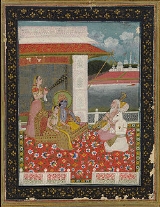
The raga-ragini scheme is an old classification scheme used from the 14th century to the 19th century. It usually consists of 6 'male' ragas each with 6 'wives'(raginis) and a number of sons (putras) and even 'daughters-in-law'. As it did not agree with various other schemes, and the 'related' ragas had very little or no similarity, the raga-ragini scheme is no longer very popular.


Ragas and raginis were often pictured as Hindu gods, Rajput
Rajput

A Rajput is a member of one of the major Hindu Kshatriya groups of Indian subcontinent. The Rajputs trace their roots to Rajputana. They enjoy a reputation as formidable soldiers and it is common to find many of them serving in the Indian Armed Forces....
 princes and aristocratic women in an eternal cycle of love, longing and fulfillment, (e.g. , , and an example of this can be seen in a Mughal
Mughal painting

Mughal painting is a particular style of Indian painting, generally confined to miniature either as book illustrations or as single works to be kept in albums, which emerged from Persian miniature painting, with Indian Hindu and Buddhist influences, and developed during the period of the Mughal Empire ....
 style album painted c. 1610, which is now in possession of the British Museum
British Museum

The British Museum is a museum of human history and culture situated in London. Its collections, which number more than 7 million Object , are amongst the largest and most comprehensive in the world and originate from all continents, illustrating and documenting the story of human culture from its beginning to the present....
, London
London

London is the capital of both England and the United Kingdom, and the most populous municipality in the European Union. An important settlement for two millennia, History of London goes back to its founding by the Roman Empire....
.

Literature

  • .*.

Published Sanskrit
Sanskrit

Sanskrit is a historical Indo-Aryan language, one of the liturgical languages of Hinduism and Buddhism, and one of the 22 official languages of India....
 works (listed in

The First period: Names mentioned in the and in the epics (Mahabharata
Mahabharata

The is one of the two major Sanskrit Indian epic poetrys of History of India, the other being the '. The epic is part of the Hindu itihasa , and forms an important part of Hindu mythology....
 and ).
  • (Atharva Veda).Benares Sanskrit Series 1893
  • (of Narada)(Sama Veda) (with the commentary of ). Benares Sanskriet Series 1983. Mysore 1946
  • (of Bharata) (chapters 28, 29 and 38 deal with music) Text only: Benares, 1929; with text and commentary of Abhinava Gupta: Barode, 1926

The second period: starting somewhere between the 2nd century B.C. and the 4th century A.C.
The third period: starting in the 10th century
The fourth period: starting in the 16th century

Some Ragamala paintings can be found in:
  • .
  • .


External links

  • — an informative database with over ninety ragas (audio clips coming soon), tutorial on the North Indian notation system, raga classification, and explanation of how ragas work.
  • — a website dedicated to Hindustani Classical Music which contains information about various raags and contains various bandishes to listen.]
  • in Carnatic music.


See also

  • Melody type
    Melody type

    A melody type is a term used by musicologists and ethnomusicologists to represent a set of melodic formulas, figures, and patterns which are used in the composition of an enormous variety of music, especially non-Western and early Western music....
  • Maqam
    Maqam

    Maqam is a musical mode structure that characterizes the art of music of countries in North Africa, the Middle East and Central Asia. In this area we can distinguish three main musical cultures which all belong to the Maqam family, namely the Persian, the Arabic and the Turkish....
  • makam
    Makam

    In Turkish classical music, Mevlevi music, and some Mosque music, a system of melody types called makam provides a complex set of rules for composing....
  • echos
    Echos

    Echos is the name in Byzantine music theory for the melody type used in the composition of music. It is akin to a Western medieval musical modes or an Arabian maqam....
  • muqam
    Muqam

    A muqam is the melody type used in Uyghur music, that is, a musical mode and set of melodic formulas used to guide improvisation and musical composition....
  • Nava rasas
    Nava rasas

    The Nine Rasas are the nine basic emotions that are fundamental to all Indian art and art forms - Dance in India, music and Indian literature. Bharata Muni enunciated 8 Rasa for the first time....
  • List of ragas
  • Raga
    Raga (film)

    Raga is a documentary about the life and music of sitarist Ravi Shankar. It is directed by Howard Worth.External links...
    , a documentary about the life and music of Ravi Shankar
    Ravi Shankar

    Pandit Ravi Shankar is a Bengali people Indian sitar player and composer. He is a disciple of Allauddin Khan, the founder of the Maihar gharana of Hindustani classical music....