

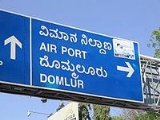
Kannada language

Encyclopedia
Kannada or , is a language spoken in India
predominantly in the state of Karnataka
. Kannada, whose native speakers are called Kannadigas and number roughly 50 million, is one of the 30 most spoken languages in the world. It is one of the scheduled languages of India and the official and administrative language of the state of Karnataka.
The Kannada language is written using the Kannada script
, which evolved from the Kadamba script
. Kannada is attested epigraphically from the first millennium AD, and literary Old Kannada flourished in the 6th century Ganga dynasty and during 9th century Rashtrakuta Dynasty
. With an unbroken literary history of over a thousand years, the excellence of Kannada literature
continues into the present day. Works of Kannada literature have received eight Jnanpith awards
and fifty-one Sahitya Akademi
awards.
Based on the recommendations of the Committee of Linguistic Experts, appointed by the Ministry of Culture, the Government of India
officially recognised Kannada as a classical language
. In July 2011, it set up a Centre for study of Kannada as a classical language at Mysore to facilitate research and other activities related to Kannada, which will function under the aegis of Central Institute of Indian Languages (CIIL).
Kannada is influenced to an appreciable extent by Sanskrit. Words from other languages such as Sanskrit
, Tamil
, Greek
, Portuguese
and Persian
can be found in modern Kannada language.

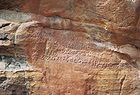
 Pre-old Kannada (or Purava HaleGannada) was the language of Banavasi
in the early Common Era, the Satavahana
and Kadamba periods and hence has a history of over 2000 years. The Ashoka rock edict found at Brahmagiri
(dated to 230 BC) has been suggested to contain words in identifiable Kannada.
A possibly more definite reference to Kannada is found in the 'Charition mime
' of the 1st or 2nd CE.
The farce by an unknown author was discovered at the beginning of the 20th century at Oxyrynchus in Egypt
.
It is concerned with a Greek lady named Charition who has been stranded on the coast of a country bordering the Indian Ocean. The king of this place, and his countrymen, sometimes use their own language, and the sentences spoken by them include ' Koncha madhu patrakke haki – having poured a little wine into the cup separately', and ' paanam beretti katti madhuvam ber ettuvenu – having taken up the cup separately and having covered it, I shall take wine separately'. The language employed in the papyrus indicates that the play is set in one of the numerous small ports on the western coast of India between Karwar and Mangalore.
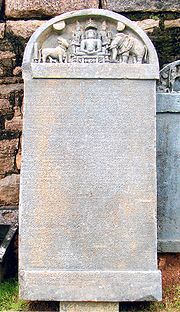
The written tradition of Kannada begins in the early centuries of common era. The earliest examples of a full-length Kannada language stone inscription (shilashaasana) containing Brahmi characters with characteristics attributed to those of proto-Kannada
in Hale Kannada (Old Kannada) script can be found in the Halmidi inscription
, dated 450 AD, indicating that Kannada had become an administrative language by this time. The 5th century Tamatekallu inscription of Chitradurga
and the Chikkamagaluru
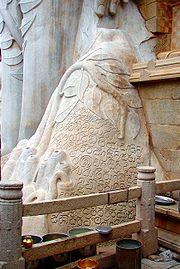
inscription of 500 AD are further examples. Recent reports indicate that the 'Nishadi' Inscription, of Shravanabelagola
which is in Old-Kannada
is older than Halmidi inscription by about fifty to hundred years and may belong to c.(350-400)CE. The Halmidi inscription provides invaluable information about the history and culture of Karnataka. Dr S.Settar has opined recently that another inscription by Kongunivarma (c.250 CE) of Ganga dynasty is also older than the Halmidi inscrption.
Over 30,000 inscriptions written in the Kannada language have been discovered so far. Prior to the Halmidi inscription, there is an abundance of inscriptions containing Kannada words, phrases and sentences, proving its antiquity. The 543 AD Badami cliff inscription of Pulakesi I is an example of a Sanskrit inscription in Hale Kannada script.
The earliest full-length Kannada copper plates in Old Kannada script (early 8th century AD) belongs to the Alupa
King Aluvarasa II from Belmannu, South Kanara district and displays the double crested fish, his royal emblem. The oldest well-preserved palm leaf manuscript is in Old Kannada and is that of Dhavala, dated to around the 9th century, preserved in the Jain Bhandar, Mudbidri, Dakshina Kannada
district. The manuscript contains 1478 leaves written using ink.
, the Western Chalukyas
, the Rashtrakutas, the Hoysalas, the Vijayanagar Empire, the Kadamba Dynasty of Banavasi, the Keladi Nayaka
s and the Mysore Kingdom, the Badami Chalukya coins being a recent discovery. The coins of the Kadambas of Goa are unique in that they have alternate inscription of the king's name in Kannada and Devanagari in triplicate, a few coins of the Kadambas of Hangal
are also available.
had a great influence on Middle Kannada ( Nadugannada) language and literature.
The Sanskrit influence is present in most abstract, religious, scientific and rhetorical terms.
Kannada also has several Hindi words chiefly relating to feudalism and militia. Kannada also has many Marathi words.
Hindu saints of the Vaishnava sect such as Kanakadasa, Purandaradasa, Naraharitirtha
, Vyasatirtha
, Sripadaraya
, Vadirajatirtha
, Vijaya Dasa
, Jagannathadasa, Prasanna Venkatadasa etc., produced devotional poems in this period. Kanakadasa's Ramadhanya Charite is a rare work, concerning itself with the issue of class struggle. This period saw the advent of Haridasa
Sahitya which made rich contributions to bhakti
literature and sowed the seeds of Carnatic music.
Recently some people have raised the issue of indiscriminate use of Sanskrit words in Kannada. Sanskrit words found a place in Kannada in the middle period when many writers found it convenient to use them instead of coining Kannada equivalents.
record of 700 AD. Kavirajamarga
by King Nripatunga Amoghavarsha
I (850 AD) is the earliest existing literary work in Kannada. It is a writing on literary criticism and poetics meant to standardize various written Kannada dialects used in literature in previous centuries. The book makes reference to Kannada works by early writers such as King Durvinita
of the 6th century and Ravikirti, the author of the Aihole record of 636 AD. Since the earliest available Kannada work is one on grammar and a guide of sorts to unify existing variants of Kannada grammar
and literary styles, it can be safely assumed that literature in Kannada must have started several centuries earlier. An early extant
prose work, the Vaddaradhane by Shivakotiacharya of 900 AD provides an elaborate description of the life of Bhadrabahu of Shravanabelagola
.
Kannada works from earlier centuries mentioned in the Kavirajamarga
are not yet traced. Some ancient texts now considered extinct but referenced in later centuries are Prabhrita (650 AD) by Syamakundacharya, Chudamani (Crest Jewel—650 AD) by Srivaradhadeva, also known as Tumbuluracharya, which is a work of 96,000 verse-measures and a commentary on logic (Tatwartha-mahashastra). Other sources date Chudamani to the 6th century or earlier. The Karnateshwara Katha, a eulogy for King Pulakesi II
, is said to have belonged to the 7th century; the Gajastaka, a work on elephant management by King Shivamara II
, belonged to the 8th century, and the Chandraprabha-purana by Sri Vijaya, a court poet of King Amoghavarsha I, is ascribed to the early 9th century. Tamil Buddhist commentators of the 10th century AD (in the commentary on Nemrinatham, a Tamil grammatical work) make references that show that Kannada literature must have flourished as early as the 4th century AD.
The Middle Kannada period gave birth to several genres of Kannada literature, with new forms of composition coming into use, including Ragale (a form of blank verse) and meters like Sangatya and Shatpadi. The works of this period are based on Jain
and Hindu
principles. Two of the early writers of this period are Harihara
and Raghavanka, trailblazers in their own right. Harihara established the Ragale form of composition while Raghavanka
popularized the Shatpadi(six-lined stanza) meter. A famous Jaina
writer of the same period is Janna
, who expressed Jain religious teachings through his works.
The Vachana Sahitya tradition of the 12th century is purely native and unique in world literature, and the sum of contributions by all sections of society. Vachanas were pithy poems on that period's social, religious and economic conditions. More importantly, they held a mirror to the seed of social revolution, which caused a radical re-examination of the ideas of caste, creed and religion. Some of the important writers of Vachana literature include Basavanna, Allama Prabhu
and Akka Mahadevi
. Kumara Vyasa
, who wrote the Karnata Bharata Kathamanjari, has arguably been the most famous and most influential Kannada writer of all time. His work, entirely composed in the Bhamini Shatpadi meter, is a sublime adaptation of the first ten books of the Mahabharata
. The Bhakti movement
gave rise to Dasa Sahitya
around the 15th century which significantly contributed to the evolution of Carnatic music
in its present form. This period witnessed great Haridasa
s like Purandara Dasa
who has been aptly called the Pioneer of Carnatic music, Kanaka Dasa
, Vyasathirtha and Vijaya Dasa
.
Modern Kannada in the 20th century has been influenced by many movements, notably Navodaya, Navya, Navyottara, Dalita and Bandaya. Contemporary Kannada literature has been highly successful in reaching people of all classes in society. Works of Kannada literature have received eight Jnanpith awards, which is the highest number awarded for the literature in any Indian language. It has also received fifty-one Sahitya Academy awards.
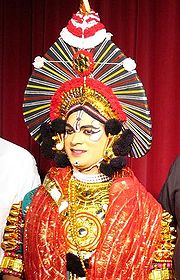 Yakshagana
, a theatre art form from Karnataka, which is also prevalent in north Kerala
, is usually staged in Kannada. Yakshagana as an art form preserves the finest aspects of the Kannada language. Kannada films and plays usually cater to the modern masses and the Kannada used in them is influenced by modernity. This form of Kannada enjoys relative popularity.
reports "about 20 dialects" of Kannada. Among them are Kundagannada
(spoken exclusively in Kundapura
), Nadavar-Kannada (spoken by Nadavaru
), Havigannada
(spoken mainly by Havyaka
Brahmins), Are Bhashe
(spoken by Gowda community mainly in the Sullia
region of Dakshina Kannada
), Soliga
, Gulbarga Kannada, Dharawad Kannada, Chitradurga Kannada, and others. All of these dialects are influenced by their regional and cultural background.
Ethnologue also classifies a group of "Kannada languages" comprising four members, besides Kannada proper including Badaga
, Holiya and Urali.
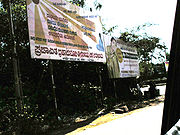 Kannada is mainly spoken in Karnataka
in India
, and to a good extent in the neighbouring states of Andhra Pradesh
, Maharashtra
, Tamil Nadu
, Kerala
and Goa
, as well as in sizeable communities in the USA, Europe
, Saudi Arabia, UAE, Middle Eastern countries, Canada, Malaysia, Australia, the UK, and Singapore
.
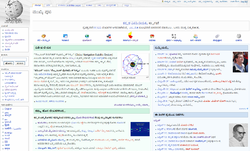 The language uses forty-nine phonemic letters, divided into three groups: swaragalu (vowels – thirteen letters); vyanjanagalu (consonants – thirty-four letters); and yogavaahakagalu (neither vowel nor consonant – two letters: the anusvara
and the visarga
), . The character set is almost identical to that of other Indian languages. The script itself, derived from Brahmi script
, is fairly complicated like most other languages of India owing to the occurrence of various combinations of "half-letters" (glyph
s), or symbols that attach to various letters in a manner similar to diacritical marks
in the Romance languages
. The Kannada script is almost perfectly phonetic, but for the sound of a "half n" (which becomes a half m). The number of written symbols, however, is far more than the forty-nine characters in the alphabet, because different characters can be combined to form compound characters (vattakshara). Each written symbol in the Kannada script corresponds with one syllable
, as opposed to one phoneme
in languages like English. The Kannada script is syllabic.
. The letters dropped out of use in the 12th and 18th centuries, respectively. Later Kannada works replaced 'rh' and 'lh' with (ra) and (la) respectively.
Another letter (or unclassified vyanjana (consonant)) that has become extinct is 'nh' or 'inn'. (Likewise, this has its equivalent in Malayalam and Tamil.) The usage of this consonant was observed until the 1980s in Kannada works from the mostly coastal areas of Karnataka (especially the Dakshina Kannada
district). Now hardly any mainstream works use this consonant. This letter has been replaced by (consonant n).
Several transliteration
schemes/tools are used to type Kannada characters using a standard keyboard. These include Baraha
(based on ITRANS
) and Quillpad (predictive transliterator). Nudi
, the government of Karnataka's standard for Kannada Input, is a phonetic layout loosely based on transliteration.
Unicode:
Kannada is a highly inflected
language with three gender
s (masculine, feminine, and neuter or common) and two numbers (singular and plural). It is inflected for gender, number and tense, among other things. The first authoritative known book on Kannada grammar is Shabdhamanidarpana by Keshiraaja. The first available Kannada book is a treatise on poetry: Kaviraja Maarga.
, composed the first Kannada–English dictionary, consisting of more than 70,000 words. Ferdinand Kittel
also wrote a book on Kannada grammar called "A Grammar of the Kannada Language: Comprising the Three Dialects of the Language".
ProtoKannada -> PreOldKannada -> OldKannada -> ModernKannada.
The ProtoKannada script has its root in ancient Brahmi and evolved around c.3rd century BCE. The PreOldKannada script evolved around c.4th century CE. OldKannada script can be traced to c.10th Century CE. while ModernKannada script came around c.17th Century CE.
India
India , officially the Republic of India , is a country in South Asia. It is the seventh-largest country by geographical area, the second-most populous country with over 1.2 billion people, and the most populous democracy in the world...
predominantly in the state of Karnataka
Karnataka
Karnataka , the land of the Kannadigas, is a state in South West India. It was created on 1 November 1956, with the passing of the States Reorganisation Act and this day is annually celebrated as Karnataka Rajyotsava...
. Kannada, whose native speakers are called Kannadigas and number roughly 50 million, is one of the 30 most spoken languages in the world. It is one of the scheduled languages of India and the official and administrative language of the state of Karnataka.
The Kannada language is written using the Kannada script
Kannada script
The Kannada script is an alphasyllabary of the Brahmic family, used primarily to write the Kannada language, one of the Dravidian languages of southern India and also Sanskrit in the past. The Telugu script is derived from Old Kannada, and resembles Kannada script...
, which evolved from the Kadamba script
Kadamba script
The Kadamba script marks the birth of a dedicated Kannada script that was used for Kannada language. It is a descendant of the Brahmi script. The Kadamba script was developed during the reign of the Kadambas in the 4th - 6th centuries. The Kadamba script is also known as Pre-Old-Kannada script...
. Kannada is attested epigraphically from the first millennium AD, and literary Old Kannada flourished in the 6th century Ganga dynasty and during 9th century Rashtrakuta Dynasty
Rashtrakuta Dynasty
The Rashtrakuta Empire was a royal dynasty ruling large parts of the Indian Subcontinent between the sixth and the 10th centuries. During this period they ruled as several closely related, but individual clans. Rastrakutas in inscriptions represented as descendants of Satyaki, a Yadava well known...
. With an unbroken literary history of over a thousand years, the excellence of Kannada literature
Kannada literature
Kannada literature is the corpus of written forms of the Kannada language, a member of the Dravidian family spoken mainly in the Indian state of Karnataka and written in the Kannada script....
continues into the present day. Works of Kannada literature have received eight Jnanpith awards
Jnanpith Award
The Jnanpith Award is a literary award in India. Along with the Sahitya Akademi Fellowship, it is one of the two most prestigious literary honours in the country...
and fifty-one Sahitya Akademi
Sahitya Akademi
The Sahitya Akademi ', India's National Academy of Letters, is an organisation dedicated to the promotion of literature in the languages of India...
awards.
Based on the recommendations of the Committee of Linguistic Experts, appointed by the Ministry of Culture, the Government of India
Government of India
The Government of India, officially known as the Union Government, and also known as the Central Government, was established by the Constitution of India, and is the governing authority of the union of 28 states and seven union territories, collectively called the Republic of India...
officially recognised Kannada as a classical language
Classical language
A classical language is a language with a literature that is classical. According to UC Berkeley linguist George L. Hart, it should be ancient, it should be an independent tradition that arose mostly on its own, not as an offshoot of another tradition, and it must have a large and extremely rich...
. In July 2011, it set up a Centre for study of Kannada as a classical language at Mysore to facilitate research and other activities related to Kannada, which will function under the aegis of Central Institute of Indian Languages (CIIL).
History
Kannada is a southern Dravidian Language and the history of Kannada is conventionally divided in three periods, Old Kannada (6th to 13th centuries), Middle Kannada (14th to 18th century) and Modern Kannada (19th century to present).Kannada is influenced to an appreciable extent by Sanskrit. Words from other languages such as Sanskrit
Sanskrit
Sanskrit , is a historical Indo-Aryan language and the primary liturgical language of Hinduism, Jainism and Buddhism.Buddhism: besides Pali, see Buddhist Hybrid Sanskrit Today, it is listed as one of the 22 scheduled languages of India and is an official language of the state of Uttarakhand...
, Tamil
Tamil language
Tamil is a Dravidian language spoken predominantly by Tamil people of the Indian subcontinent. It has official status in the Indian state of Tamil Nadu and in the Indian union territory of Pondicherry. Tamil is also an official language of Sri Lanka and Singapore...
, Greek
Greek language
Greek is an independent branch of the Indo-European family of languages. Native to the southern Balkans, it has the longest documented history of any Indo-European language, spanning 34 centuries of written records. Its writing system has been the Greek alphabet for the majority of its history;...
, Portuguese
Portuguese language
Portuguese is a Romance language that arose in the medieval Kingdom of Galicia, nowadays Galicia and Northern Portugal. The southern part of the Kingdom of Galicia became independent as the County of Portugal in 1095...
and Persian
Persian language
Persian is an Iranian language within the Indo-Iranian branch of the Indo-European languages. It is primarily spoken in Iran, Afghanistan, Tajikistan and countries which historically came under Persian influence...
can be found in modern Kannada language.
Early epigraphy
Banavasi
Banavasi is an ancient temple town in Uttara Kannada District bordering Shivamogga district in the South Indian state of Karnataka .-History:Banavasi is one of the oldest towns in the Karnataka state...
in the early Common Era, the Satavahana
Satavahana
The Sātavāhana Empire or Andhra Empire, was a royal Indian dynasty based from Dharanikota and Amaravati in Andhra Pradesh as well as Junnar and Prathisthan in Maharashtra. The territory of the empire covered much of India from 230 BCE onward...
and Kadamba periods and hence has a history of over 2000 years. The Ashoka rock edict found at Brahmagiri
Brahmagiri archaeological site
Brahmagiri is an archaeological site located in the Chitradurga district of the state of Karnataka, India. The site was first explored by Benjamin L. Rice in 1891, who discovered rock edicts of Emperor Ashoka here. These rock edicts indicated that the locality was termed as Isila and denoted the...
(dated to 230 BC) has been suggested to contain words in identifiable Kannada.
A possibly more definite reference to Kannada is found in the 'Charition mime
Charition mime
The Charition mime is a Greek mime found in Oxyrhynchus Papyrus 413. The manuscript, which is possibly incomplete, is untitled, and the mime's name comes from the name of its protagonist....
' of the 1st or 2nd CE.
The farce by an unknown author was discovered at the beginning of the 20th century at Oxyrynchus in Egypt
Egypt
Egypt , officially the Arab Republic of Egypt, Arabic: , is a country mainly in North Africa, with the Sinai Peninsula forming a land bridge in Southwest Asia. Egypt is thus a transcontinental country, and a major power in Africa, the Mediterranean Basin, the Middle East and the Muslim world...
.
It is concerned with a Greek lady named Charition who has been stranded on the coast of a country bordering the Indian Ocean. The king of this place, and his countrymen, sometimes use their own language, and the sentences spoken by them include ' Koncha madhu patrakke haki – having poured a little wine into the cup separately', and ' paanam beretti katti madhuvam ber ettuvenu – having taken up the cup separately and having covered it, I shall take wine separately'. The language employed in the papyrus indicates that the play is set in one of the numerous small ports on the western coast of India between Karwar and Mangalore.
The written tradition of Kannada begins in the early centuries of common era. The earliest examples of a full-length Kannada language stone inscription (shilashaasana) containing Brahmi characters with characteristics attributed to those of proto-Kannada
Halegannada
Proto-Kannada is said to have evolved after separating from its source around c. 1500 BCE, while its script evolved during Ashokan times around the 4th or 3rd century BCE from ancient Brahmi...
in Hale Kannada (Old Kannada) script can be found in the Halmidi inscription
Halmidi inscription
The Halmidi inscription is the oldest known Kannada language inscription in the Kannada script. Experts agree on the relative date , but differ on absolute date. Estimates vary by about 50 years either side of about 500 AD . The inscription was discovered in 1936 by Dr. M. H...
, dated 450 AD, indicating that Kannada had become an administrative language by this time. The 5th century Tamatekallu inscription of Chitradurga
Chitradurga
Chitradurga is a town in the southern part of the Indian state of Karnataka. It is also the headquarters of Chitradurga district. Chitradurga was also known by the names Chitradurg, Chitrakaladurga, Chittaldurg. Chittaldrug was the name officially used by the British Govt.-Geography:Chitradurga is...
and the Chikkamagaluru
Chikkamagaluru
Chikmagalur is a town located in Chikkamagaluru district in the Indian state of Karnataka. Located in the foothills of Mullayanagiri range chikmagalur is famous for the coffee, it is known as the coffee land of karnataka. it has international school called ambar valley and a star resort by name...
inscription of 500 AD are further examples. Recent reports indicate that the 'Nishadi' Inscription, of Shravanabelagola
Shravanabelagola
Shravana Belgola is a city located in the Hassan district in the Indian state of Karnataka and is 158 km from Bangalore. The statue of Gommateshvara Bahubali at Śravaṇa Beḷgoḷa is one of the most important pilgrimage destinations in Jainism, one that reached a peak in architectural and sculptural...
which is in Old-Kannada
Halegannada
Proto-Kannada is said to have evolved after separating from its source around c. 1500 BCE, while its script evolved during Ashokan times around the 4th or 3rd century BCE from ancient Brahmi...
is older than Halmidi inscription by about fifty to hundred years and may belong to c.(350-400)CE. The Halmidi inscription provides invaluable information about the history and culture of Karnataka. Dr S.Settar has opined recently that another inscription by Kongunivarma (c.250 CE) of Ganga dynasty is also older than the Halmidi inscrption.
Over 30,000 inscriptions written in the Kannada language have been discovered so far. Prior to the Halmidi inscription, there is an abundance of inscriptions containing Kannada words, phrases and sentences, proving its antiquity. The 543 AD Badami cliff inscription of Pulakesi I is an example of a Sanskrit inscription in Hale Kannada script.
The earliest full-length Kannada copper plates in Old Kannada script (early 8th century AD) belongs to the Alupa
Alupas
The Alupas kings were a minor dynasty who ruled parts of coastal Karnataka. Later with the dominance of Kadambas in Banavasi, they became feudatory to them. With the changing political scenario, soon they became the feudatories to Chalukyas, Hoysalas and Vijayanagara Rayas...
King Aluvarasa II from Belmannu, South Kanara district and displays the double crested fish, his royal emblem. The oldest well-preserved palm leaf manuscript is in Old Kannada and is that of Dhavala, dated to around the 9th century, preserved in the Jain Bhandar, Mudbidri, Dakshina Kannada
Dakshina Kannada
- Geography :The district geography consists of sea shore in the west and Western Ghats in the east. The major rivers are Netravathi, Kumaradhara, Phalguni, Shambhavi, Nandini or Pavanje and Payaswini which all join Arabian sea. Vast areas of evergreen forests which once covered this district, have...
district. The manuscript contains 1478 leaves written using ink.
Coins
Some early Kadamba Dynasty coins bearing the Kannada inscription Vira and Skandha were found in Satara collectorate. A gold coin bearing three inscriptions of Sri and an abbreviated inscription of king Bhagiratha's name called bhagi (390–420 AD) in old Kannada exists. A Kadamba copper coin dated to the 5th century AD with the inscription Srimanaragi in Kannada script was discovered in Banavasi, Uttara Kannada district. Coins with Kannada legends have been discovered spanning the rule of the Western Ganga Dynasty, the Badami Chalukyas, the AlupasAlupas
The Alupas kings were a minor dynasty who ruled parts of coastal Karnataka. Later with the dominance of Kadambas in Banavasi, they became feudatory to them. With the changing political scenario, soon they became the feudatories to Chalukyas, Hoysalas and Vijayanagara Rayas...
, the Western Chalukyas
Western Chalukyas
The Western Chalukya Empire ruled most of the western Deccan, South India, between the 10th and 12th centuries. This dynasty is sometimes called the Kalyani Chalukya after its regal capital at Kalyani, today's Basavakalyan in Karnataka and alternatively the Later Chalukya from its theoretical...
, the Rashtrakutas, the Hoysalas, the Vijayanagar Empire, the Kadamba Dynasty of Banavasi, the Keladi Nayaka
Keladi Nayaka
Keladi Nayaka Kingdom were an important ruling dynasty of post-medieval Karnataka, India. They initially started to rule as a feudatory of the Vijayanagar Empire...
s and the Mysore Kingdom, the Badami Chalukya coins being a recent discovery. The coins of the Kadambas of Goa are unique in that they have alternate inscription of the king's name in Kannada and Devanagari in triplicate, a few coins of the Kadambas of Hangal
Hangal
Hangal is a town in Haveri district in the Indian state of Karnataka. It is 75 km away from Hubli-Dharwad.It is on the left bank of the Dharma river, and has ruins of some fortification on the...
are also available.
Middle Kannada (14th – 18th centuries)
In the period between the 14th and 18th centuries, HinduismHinduism
Hinduism is the predominant and indigenous religious tradition of the Indian Subcontinent. Hinduism is known to its followers as , amongst many other expressions...
had a great influence on Middle Kannada ( Nadugannada) language and literature.
The Sanskrit influence is present in most abstract, religious, scientific and rhetorical terms.
Kannada also has several Hindi words chiefly relating to feudalism and militia. Kannada also has many Marathi words.
Hindu saints of the Vaishnava sect such as Kanakadasa, Purandaradasa, Naraharitirtha
Naraharitirtha
Sri Naraharitirtha CE. was a disciple of 13th Century Indian saint Madhvacharya and is considered by some as the founder of the Haridasa movement in India. He was not only a great saint but also a royal pontiff as evidenced by some inscriptions...
, Vyasatirtha
Vyasatirtha
Vyasatirtha , also called Vyasaraja or Vyasaraya or Vyasraja swamin, was acclaimed as one of the three spiritual lights or munitrayam of dvaita Vedanta, i.e., Sri Madhvacharya, Sri Jayatirtha and Sri Vyasatirtha. He was a scholar of very high order with a judicious defence of the Dvaita Vedanta...
, Sripadaraya
Sripadaraya
Sripadaraya, a haridasa, is also known as Sripadaraja or Lakshminarayana Tirtha .Sripadaraya was born in Abburu in Chennapattana taluk of Karnataka state. It is believed that he was the incarnation of dhruva...
, Vadirajatirtha
Vadirajatirtha
Sri Vadirajatirtha , traditionally 1480 - 1600, a Haridasa, is said to have been a Shivalli Tulu Brahmin and native of the village of Hoovinakere, near Kumbhashi in Kundapura taluk, Udupi District in Karnataka state...
, Vijaya Dasa
Vijaya Dasa
Vijaya Dasa or Sri Vijaya Dasa was a prominent saint from the Haridasa tradition of Karnataka, India in the 18th century. Sri VijayaDasaru is an amsha of Sri Brighu Muni; the very same muni, who was the nimmita for the eternal kshetra Tirumala ! Sri Krishna himself in BG 10.25 says "maharsinam...
, Jagannathadasa, Prasanna Venkatadasa etc., produced devotional poems in this period. Kanakadasa's Ramadhanya Charite is a rare work, concerning itself with the issue of class struggle. This period saw the advent of Haridasa
Haridasa
The Haridasa devotional movement is considered as one of the turning points in the cultural history of India. Over a span of nearly six centuries, several saints and mystics helped shape the culture, philosophy and art of South India and Karnataka in particular by exerting considerable spiritual...
Sahitya which made rich contributions to bhakti
Bhakti
In Hinduism Bhakti is religious devotion in the form of active involvement of a devotee in worship of the divine.Within monotheistic Hinduism, it is the love felt by the worshipper towards the personal God, a concept expressed in Hindu theology as Svayam Bhagavan.Bhakti can be used of either...
literature and sowed the seeds of Carnatic music.
Modern Kannada (1800 – present)
The Kannada works produced by the end of the 19th century and later are classified as Hosagannada or Modern Kannada. However, till the beginning of the 20th century there were no Kannada literary works that could still be classified under the heading of Middle Kannada. Most notable among them are the poet Muddana's works. His works may be described as the "Dawn of Modern Kannada". Generally, linguists treat Indira Bai or Saddharma Vijayavu by Gulvadi Venkata Raya as the first literary works in Modern Kannada.Recently some people have raised the issue of indiscriminate use of Sanskrit words in Kannada. Sanskrit words found a place in Kannada in the middle period when many writers found it convenient to use them instead of coining Kannada equivalents.
Literature and poetry
The oldest existing record of Kannada poetry in tripadi metre is the Kappe ArabhattaKappe Arabhatta
Kappe Arabhatta was a Chalukya warrior of the 8th century who is known from a Kannada verse inscription, dated to c. 700 CE, and carved on a cliff overlooking the northeast end of the artificial lake in Badami, Karnataka, India. The inscription consists of five stanzas written out in ten lines in...
record of 700 AD. Kavirajamarga
Kavirajamarga
Kavirajamarga is the earliest available writing on rhetoric, poetics and grammar in the Kannada language. It was written by the famous Rashtrakuta King "Nripatunga" Amoghavarsha I and some say that it is based partly on an earlier Sanskrit writing, Kavyadarsa...
by King Nripatunga Amoghavarsha
Amoghavarsha
Amoghavarsha I was a Rashtrakuta emperor, the greatest ruler of the Rashtrakuta dynasty, and one of the great emperors of India. His nominal reign of 64 years is the longest precisely dated monarchical reign on record in India and one of the longest documented reigns of all monarchy since...
I (850 AD) is the earliest existing literary work in Kannada. It is a writing on literary criticism and poetics meant to standardize various written Kannada dialects used in literature in previous centuries. The book makes reference to Kannada works by early writers such as King Durvinita
Durvinita
Durvinita is seen as the most successful ruler of the Western Ganga Dynasty. Son of the previous ruler, Avinita, Durvinita's assession to the throne was disputed by his brother, who had gained the support of the Pallavas and Kadambas. There are Nallala and Kadagattur inscriptions that refer to...
of the 6th century and Ravikirti, the author of the Aihole record of 636 AD. Since the earliest available Kannada work is one on grammar and a guide of sorts to unify existing variants of Kannada grammar
Kannada grammar
The Kannada grammar is primarily based on Keshiraja's Shabdamanidarpana , which provides the fullest systematic exposition of the Kannada language...
and literary styles, it can be safely assumed that literature in Kannada must have started several centuries earlier. An early extant
Extant literature
Extant literature refers to texts that have survived from the past to the present time. Extant literature can be divided into extant original manuscripts, copies of original manuscripts, quotations and paraphrases of passages of non-extant texts contained in other works, translations of non-extant...
prose work, the Vaddaradhane by Shivakotiacharya of 900 AD provides an elaborate description of the life of Bhadrabahu of Shravanabelagola
Shravanabelagola
Shravana Belgola is a city located in the Hassan district in the Indian state of Karnataka and is 158 km from Bangalore. The statue of Gommateshvara Bahubali at Śravaṇa Beḷgoḷa is one of the most important pilgrimage destinations in Jainism, one that reached a peak in architectural and sculptural...
.
Kannada works from earlier centuries mentioned in the Kavirajamarga
Kavirajamarga
Kavirajamarga is the earliest available writing on rhetoric, poetics and grammar in the Kannada language. It was written by the famous Rashtrakuta King "Nripatunga" Amoghavarsha I and some say that it is based partly on an earlier Sanskrit writing, Kavyadarsa...
are not yet traced. Some ancient texts now considered extinct but referenced in later centuries are Prabhrita (650 AD) by Syamakundacharya, Chudamani (Crest Jewel—650 AD) by Srivaradhadeva, also known as Tumbuluracharya, which is a work of 96,000 verse-measures and a commentary on logic (Tatwartha-mahashastra). Other sources date Chudamani to the 6th century or earlier. The Karnateshwara Katha, a eulogy for King Pulakesi II
Pulakesi II
Pulakesin II is the most famous ruler of the Chalukya dynasty. In his reign the Chalukyas of Badami saw their kingdom extend over most of the Deccan.-Early life and accession:...
, is said to have belonged to the 7th century; the Gajastaka, a work on elephant management by King Shivamara II
Shivamara II
Shivamara II was the son of Sripurusha and ruled the Western Ganga Dynasty from 788 - 816 C.E. He was also a noted scholar in Kannada, Sanskrit and Prakrit...
, belonged to the 8th century, and the Chandraprabha-purana by Sri Vijaya, a court poet of King Amoghavarsha I, is ascribed to the early 9th century. Tamil Buddhist commentators of the 10th century AD (in the commentary on Nemrinatham, a Tamil grammatical work) make references that show that Kannada literature must have flourished as early as the 4th century AD.
The Middle Kannada period gave birth to several genres of Kannada literature, with new forms of composition coming into use, including Ragale (a form of blank verse) and meters like Sangatya and Shatpadi. The works of this period are based on Jain
Jainism
Jainism is an Indian religion that prescribes a path of non-violence towards all living beings. Its philosophy and practice emphasize the necessity of self-effort to move the soul towards divine consciousness and liberation. Any soul that has conquered its own inner enemies and achieved the state...
and Hindu
Hinduism
Hinduism is the predominant and indigenous religious tradition of the Indian Subcontinent. Hinduism is known to its followers as , amongst many other expressions...
principles. Two of the early writers of this period are Harihara
Harihara (poet)
Harihara was a noted Kannada poet and writer in the 12th century. A native of Halebidu in modern Hassan district, he came from a family of accountants and initially served in that capacity in the court of Hoysala King Narasimha I . Later, he moved to Hampi and authored many classics...
and Raghavanka, trailblazers in their own right. Harihara established the Ragale form of composition while Raghavanka
Raghavanka
Raghavanka was a noted Kannada writer and a poet in the Hoysala court which flourished in the late 12th to early 13th century. Raghavanka is credited for popularising the use of the native shatpadi metre in Kannada literature...
popularized the Shatpadi(six-lined stanza) meter. A famous Jaina
Jainism
Jainism is an Indian religion that prescribes a path of non-violence towards all living beings. Its philosophy and practice emphasize the necessity of self-effort to move the soul towards divine consciousness and liberation. Any soul that has conquered its own inner enemies and achieved the state...
writer of the same period is Janna
Janna
Janna was one of the well-known Kannada poets of the early 13th century who also served in the capacity of a minister and a builder of temples. He graced the court of Hoysala empire king Veera Ballala II and earned the title Kavichakravarthi...
, who expressed Jain religious teachings through his works.
The Vachana Sahitya tradition of the 12th century is purely native and unique in world literature, and the sum of contributions by all sections of society. Vachanas were pithy poems on that period's social, religious and economic conditions. More importantly, they held a mirror to the seed of social revolution, which caused a radical re-examination of the ideas of caste, creed and religion. Some of the important writers of Vachana literature include Basavanna, Allama Prabhu
Allama Prabhu
Allama Prabhu is a mystic-saint and Vachana poet of the Kannada language in the 12th century. Prabhu is the patron saint , the undisputed spiritual authority, and an integral part of the Lingayata movement that decisively shaped society in medieval Karnataka and...
and Akka Mahadevi
Akka Mahadevi
Akka Mahadevi was a prominent figure of the Veerashaiva Bhakti movement of the 12th century Karnataka. Her Vachanas in Kannada, a form of didactic poetry are considered her greatest contribution to Kannada Bhakti literature. In all she wrote about 430 Vachanas which is relatively fewer than that...
. Kumara Vyasa
Kumara Vyasa
Kumara Vyasa is the pen name of Gadhugina Veera Naranappa , a classical poet of Kannada. His pen name is a tribute to his magnum opus, a rendering of the Mahabharatha in Kannada. Kumara Vyasa literally means Little Vyasa or Son of Vyasa....
, who wrote the Karnata Bharata Kathamanjari, has arguably been the most famous and most influential Kannada writer of all time. His work, entirely composed in the Bhamini Shatpadi meter, is a sublime adaptation of the first ten books of the Mahabharata
Mahabharata
The Mahabharata is one of the two major Sanskrit epics of ancient India and Nepal, the other being the Ramayana. The epic is part of itihasa....
. The Bhakti movement
Bhakti movement
The Bhakti movement is a Hindu religious movement in which the main spiritual practice is loving devotion among the Shaivite and Vaishnava saints. The Bhakti movement originated in ancient Tamil Nadu and began to spread to the north during the late medieval ages when north India was under Islamic...
gave rise to Dasa Sahitya
Dasa Sahitya
Dasa Sahitya is the literature of bhakti movement composed by devotees in honor of Lord Vishnu or one of his Avatars. Dasa is literally servant in Kannada and sahitya is literature. Haridasas were preachers of bhakti to Lord Vishnu or one of his avatars. The bhakti literature of these Haridasas...
around the 15th century which significantly contributed to the evolution of Carnatic music
Carnatic music
Carnatic music is a system of music commonly associated with the southern part of the Indian subcontinent, with its area roughly confined to four modern states of India: Andhra Pradesh, Karnataka, Kerala, and Tamil Nadu...
in its present form. This period witnessed great Haridasa
Haridasa
The Haridasa devotional movement is considered as one of the turning points in the cultural history of India. Over a span of nearly six centuries, several saints and mystics helped shape the culture, philosophy and art of South India and Karnataka in particular by exerting considerable spiritual...
s like Purandara Dasa
Purandara Dasa
Purandara Dāsa is one of the most prominent composers of Carnatic music and is widely regarded as the "father of Carnatic Music". Purandara Dasa addressed social issues in addition to worship in his compositions, a practice emulated by his younger contemporary, Kanaka Dasa...
who has been aptly called the Pioneer of Carnatic music, Kanaka Dasa
Kanaka Dasa
Kanaka Dasa was a great poet, philosopher, musician and composer from Karnataka. He is known for his Kirtanes and Ugabhoga compositions in the Kannada language for Carnatic music...
, Vyasathirtha and Vijaya Dasa
Vijaya Dasa
Vijaya Dasa or Sri Vijaya Dasa was a prominent saint from the Haridasa tradition of Karnataka, India in the 18th century. Sri VijayaDasaru is an amsha of Sri Brighu Muni; the very same muni, who was the nimmita for the eternal kshetra Tirumala ! Sri Krishna himself in BG 10.25 says "maharsinam...
.
Modern Kannada in the 20th century has been influenced by many movements, notably Navodaya, Navya, Navyottara, Dalita and Bandaya. Contemporary Kannada literature has been highly successful in reaching people of all classes in society. Works of Kannada literature have received eight Jnanpith awards, which is the highest number awarded for the literature in any Indian language. It has also received fifty-one Sahitya Academy awards.
Theatre art
Yakshagana
Yakshagana is a musical theater popular in the coastal and Malenadu regions of Karnataka, India. Yakshagana is the recent scholastic name for what are known as kēḷike, āṭa, bayalāṭa, bayalāṭa, daśāvatāra . It is believed to have evolved from pre-classical music and theatre during Bhakti movement...
, a theatre art form from Karnataka, which is also prevalent in north Kerala
Kerala
or Keralam is an Indian state located on the Malabar coast of south-west India. It was created on 1 November 1956 by the States Reorganisation Act by combining various Malayalam speaking regions....
, is usually staged in Kannada. Yakshagana as an art form preserves the finest aspects of the Kannada language. Kannada films and plays usually cater to the modern masses and the Kannada used in them is influenced by modernity. This form of Kannada enjoys relative popularity.
Dialects
There is also considerable difference between the spoken and written forms of the language. Spoken Kannada tends to vary from region to region. The written form is more or less constant throughout Karnataka, however. Subjectively, three major varieties are perceived: Mysore Kannada (Southern); Dharwar Kannada (Northern) and Mangalore Kannada (Coastal). Within each of these broad varieties, many sub-varieties are found – e.g. Bijapura Kannada, etc. The EthnologueEthnologue
Ethnologue: Languages of the World is a web and print publication of SIL International , a Christian linguistic service organization, which studies lesser-known languages, to provide the speakers with Bibles in their native language and support their efforts in language development.The Ethnologue...
reports "about 20 dialects" of Kannada. Among them are Kundagannada
Kundagannada
Kundagannada or Kundapura Kannada is a dialect of Kannada Spoken in Kundapura Taluk of Udupi district, Karnataka. Some people who speak this language claim that the Kundapura Kannada is the original and chaste Kannada that has not been influenced by any other language.It is also called as Kota...
(spoken exclusively in Kundapura
Kundapura
-Languages and culture :The town mainly consists of Kannadigas who speak Kundagannada, Konkanis and Tuluvas. The Goud Saraswat Brahmins who fled Goa during the Portuguese arrival in the 16th century arrived by Boat in Basrur and some settled in Kundapura and surrounding villages. These people and...
), Nadavar-Kannada (spoken by Nadavaru
Nadavaru
Nadavaru or Nadavara is a prominent agrarian community of Uttara Kannada district of Karnataka, India.-Etymology and Origins:...
), Havigannada
Havigannada
Havigannada or Havyaka Bhaashe or Havyaka Kannada is the native language of Havyakas. It is a dialect of Kannada.- Usage :Havigannada is used only by Havyakas. It uses similar verbs and words as mainstream Kannada. However, it has more in common with Halegannada...
(spoken mainly by Havyaka
Havyaka
Havyaka Brahmins are a Hindu Pancha Dravida Brahmin subsect primarily from the Indian state of Karnataka and Northern Kerala. Havyakas profess the Advaita philosophy propounded by Adi Shankaracharya.-Etymology:...
Brahmins), Are Bhashe
Are Bhashe
Arebhashe or Gowda Kannada is a dialect of the Kannada language, particularly, spoken by the people belonging to ‘Gowda’ community who are the natives of Madikeri, Somwarpet, Bhagamandala and Kushalanagara of Kodagu district and Sullia of Dakshina Kannada. It is also spoken by eastern parts of...
(spoken by Gowda community mainly in the Sullia
Sullia
Sullia is a taluk in the Dakshina Kannada district of the state of Karnataka, India. It is a small town, surrounded with evergreen wooded mountains in the Western Ghats range in South India. Sullia has plantations of rubber, areca nut, coconut, cashew nut, black pepper and banana...
region of Dakshina Kannada
Dakshina Kannada
- Geography :The district geography consists of sea shore in the west and Western Ghats in the east. The major rivers are Netravathi, Kumaradhara, Phalguni, Shambhavi, Nandini or Pavanje and Payaswini which all join Arabian sea. Vast areas of evergreen forests which once covered this district, have...
), Soliga
Soliga
A Soliga is a member of a tribe in India that inhabits the Biligirirangan and associated hill ranges in Southern Karnataka, mostly in Chamarajanagar District, bordering the Erode district of Tamil Nadu . Most of them are concentrated in and around the BR Hills in Yelandur and Kollegal Taluks of...
, Gulbarga Kannada, Dharawad Kannada, Chitradurga Kannada, and others. All of these dialects are influenced by their regional and cultural background.
Ethnologue also classifies a group of "Kannada languages" comprising four members, besides Kannada proper including Badaga
Badaga language
The Badaga language is a southern Dravidian language spoken by approximately 400,000 people in the Nilgiri Hills in Southern India. It is known for its retroflex vowels. The word Badaga refers to the Badaga language as well as the Badaga community/tribe...
, Holiya and Urali.
Geographic distribution
Karnataka
Karnataka , the land of the Kannadigas, is a state in South West India. It was created on 1 November 1956, with the passing of the States Reorganisation Act and this day is annually celebrated as Karnataka Rajyotsava...
in India
India
India , officially the Republic of India , is a country in South Asia. It is the seventh-largest country by geographical area, the second-most populous country with over 1.2 billion people, and the most populous democracy in the world...
, and to a good extent in the neighbouring states of Andhra Pradesh
Andhra Pradesh
Andhra Pradesh , is one of the 28 states of India, situated on the southeastern coast of India. It is India's fourth largest state by area and fifth largest by population. Its capital and largest city by population is Hyderabad.The total GDP of Andhra Pradesh is $100 billion and is ranked third...
, Maharashtra
Maharashtra
Maharashtra is a state located in India. It is the second most populous after Uttar Pradesh and third largest state by area in India...
, Tamil Nadu
Tamil Nadu
Tamil Nadu is one of the 28 states of India. Its capital and largest city is Chennai. Tamil Nadu lies in the southernmost part of the Indian Peninsula and is bordered by the union territory of Pondicherry, and the states of Kerala, Karnataka, and Andhra Pradesh...
, Kerala
Kerala
or Keralam is an Indian state located on the Malabar coast of south-west India. It was created on 1 November 1956 by the States Reorganisation Act by combining various Malayalam speaking regions....
and Goa
Goa
Goa , a former Portuguese colony, is India's smallest state by area and the fourth smallest by population. Located in South West India in the region known as the Konkan, it is bounded by the state of Maharashtra to the north, and by Karnataka to the east and south, while the Arabian Sea forms its...
, as well as in sizeable communities in the USA, Europe
Europe
Europe is, by convention, one of the world's seven continents. Comprising the westernmost peninsula of Eurasia, Europe is generally 'divided' from Asia to its east by the watershed divides of the Ural and Caucasus Mountains, the Ural River, the Caspian and Black Seas, and the waterways connecting...
, Saudi Arabia, UAE, Middle Eastern countries, Canada, Malaysia, Australia, the UK, and Singapore
Singapore
Singapore , officially the Republic of Singapore, is a Southeast Asian city-state off the southern tip of the Malay Peninsula, north of the equator. An island country made up of 63 islands, it is separated from Malaysia by the Straits of Johor to its north and from Indonesia's Riau Islands by the...
.
Official status
Kannada is one of the twenty-two official languages of India and is the sole administrative language of the State of Karnataka. It is also one of the four classical languages of India.Writing system
Anusvara
Anusvara is the diacritic used to mark a type of nasalization used in a number of Indic languages. Depending on the location of the anusvara in the word and the language within which it is used, its exact pronunciation can vary greatly....
and the visarga
Visarga
Visarga is a Sanskrit word meaning "sending forth, discharge". In Sanskrit phonology , is the name of a phone, , written as IAST , Harvard-Kyoto , Devanagari . Visarga is an allophone of and in pausa...
), . The character set is almost identical to that of other Indian languages. The script itself, derived from Brahmi script
Brāhmī script
Brāhmī is the modern name given to the oldest members of the Brahmic family of scripts. The best-known Brāhmī inscriptions are the rock-cut edicts of Ashoka in north-central India, dated to the 3rd century BCE. These are traditionally considered to be early known examples of Brāhmī writing...
, is fairly complicated like most other languages of India owing to the occurrence of various combinations of "half-letters" (glyph
Glyph
A glyph is an element of writing: an individual mark on a written medium that contributes to the meaning of what is written. A glyph is made up of one or more graphemes....
s), or symbols that attach to various letters in a manner similar to diacritical marks
Diacritic
A diacritic is a glyph added to a letter, or basic glyph. The term derives from the Greek διακριτικός . Diacritic is both an adjective and a noun, whereas diacritical is only an adjective. Some diacritical marks, such as the acute and grave are often called accents...
in the Romance languages
Romance languages
The Romance languages are a branch of the Indo-European language family, more precisely of the Italic languages subfamily, comprising all the languages that descend from Vulgar Latin, the language of ancient Rome...
. The Kannada script is almost perfectly phonetic, but for the sound of a "half n" (which becomes a half m). The number of written symbols, however, is far more than the forty-nine characters in the alphabet, because different characters can be combined to form compound characters (vattakshara). Each written symbol in the Kannada script corresponds with one syllable
Syllable
A syllable is a unit of organization for a sequence of speech sounds. For example, the word water is composed of two syllables: wa and ter. A syllable is typically made up of a syllable nucleus with optional initial and final margins .Syllables are often considered the phonological "building...
, as opposed to one phoneme
Phoneme
In a language or dialect, a phoneme is the smallest segmental unit of sound employed to form meaningful contrasts between utterances....
in languages like English. The Kannada script is syllabic.
Extinct Kannada letters
Kannada literary works employed the letters (transliterated '' or 'rh') and (transliterated '', 'lh' or 'zh'), whose manner of articulation most plausibly could be akin to those in present-day Malayalam and TamilTamil language
Tamil is a Dravidian language spoken predominantly by Tamil people of the Indian subcontinent. It has official status in the Indian state of Tamil Nadu and in the Indian union territory of Pondicherry. Tamil is also an official language of Sri Lanka and Singapore...
. The letters dropped out of use in the 12th and 18th centuries, respectively. Later Kannada works replaced 'rh' and 'lh' with (ra) and (la) respectively.
Another letter (or unclassified vyanjana (consonant)) that has become extinct is 'nh' or 'inn'. (Likewise, this has its equivalent in Malayalam and Tamil.) The usage of this consonant was observed until the 1980s in Kannada works from the mostly coastal areas of Karnataka (especially the Dakshina Kannada
Dakshina Kannada
- Geography :The district geography consists of sea shore in the west and Western Ghats in the east. The major rivers are Netravathi, Kumaradhara, Phalguni, Shambhavi, Nandini or Pavanje and Payaswini which all join Arabian sea. Vast areas of evergreen forests which once covered this district, have...
district). Now hardly any mainstream works use this consonant. This letter has been replaced by (consonant n).
Kannada script in computing
Transliteration:Several transliteration
Transliteration
Transliteration is a subset of the science of hermeneutics. It is a form of translation, and is the practice of converting a text from one script into another...
schemes/tools are used to type Kannada characters using a standard keyboard. These include Baraha
Baraha
Baraha is a word processing application for creating documents in Indian languages. It was developed by Sheshadrivasu Chandrashekaran with an intention to provide a freeware to enable and encourage Indians use their native languages on the computers. Baraha can be effectively used for creating...
(based on ITRANS
ITRANS
The "Indian languages TRANSliteration" is an ASCII transliteration scheme for Indic scripts, particularly for Devanagari script. It was developed by Avinash Chopde. The latest version of ITRANS is version 5.30 released in July, 2001...
) and Quillpad (predictive transliterator). Nudi
Nudi (software)
Nudi is a computer program and font-encoding standard used for managing and displaying the Kannada script.The Karnataka government owns and makes the Nudi software available for free. It was developed by the Kannada Ganaka Parishat, a non-profit organisation...
, the government of Karnataka's standard for Kannada Input, is a phonetic layout loosely based on transliteration.
Unicode:
Grammar
The canonical word order of Kannada is SOV (subject–object–verb) as is the case with Dravidian languages.Kannada is a highly inflected
Inflection
In grammar, inflection or inflexion is the modification of a word to express different grammatical categories such as tense, grammatical mood, grammatical voice, aspect, person, number, gender and case...
language with three gender
Grammatical gender
Grammatical gender is defined linguistically as a system of classes of nouns which trigger specific types of inflections in associated words, such as adjectives, verbs and others. For a system of noun classes to be a gender system, every noun must belong to one of the classes and there should be...
s (masculine, feminine, and neuter or common) and two numbers (singular and plural). It is inflected for gender, number and tense, among other things. The first authoritative known book on Kannada grammar is Shabdhamanidarpana by Keshiraaja. The first available Kannada book is a treatise on poetry: Kaviraja Maarga.
Dictionary
A German priest, the Reverend Ferdinand KittelFerdinand Kittel
Reverend Ferdinand Kittel was a priest and indologist with the Basel Mission in south India and worked in Mangalore, Madikeri and Dharwad in Karnataka. He is most famous for his studies of the Kannada language and for producing the first ever Kannada-English dictionary of about 70,000 words in 1894...
, composed the first Kannada–English dictionary, consisting of more than 70,000 words. Ferdinand Kittel
Ferdinand Kittel
Reverend Ferdinand Kittel was a priest and indologist with the Basel Mission in south India and worked in Mangalore, Madikeri and Dharwad in Karnataka. He is most famous for his studies of the Kannada language and for producing the first ever Kannada-English dictionary of about 70,000 words in 1894...
also wrote a book on Kannada grammar called "A Grammar of the Kannada Language: Comprising the Three Dialects of the Language".
Kannada Script Evolution
The Image below shows the evolution of Kannada script from prehistoric times to modern period. The Kannada script evolved in stages like:ProtoKannada -> PreOldKannada -> OldKannada -> ModernKannada.
The ProtoKannada script has its root in ancient Brahmi and evolved around c.3rd century BCE. The PreOldKannada script evolved around c.4th century CE. OldKannada script can be traced to c.10th Century CE. while ModernKannada script came around c.17th Century CE.
See also
- Cinema of KarnatakaCinema of KarnatakaThe cinema of Karnataka , sometimes colloquially referred to as Sandalwood and as Chandanavana in Kannada, encompasses movies made in the Indian state of Karnataka based in Bangalore. Most of the movies are made in Kannada, with a handful of them in Konkani or Tulu. Today more than 100 films are...
- Bangalore KannadaBangalore KannadaBangalore Kannada is a vernacular dialect of the Indian language, Kannada, spoken mainly by people residing in and around Karnataka, especially South-East Karnataka ....
- Gokak agitationGokak agitationGokak agitation was a successful language rights agitation in the 1980s that fought for the first language status of the Kannada language in the state of Karnataka, India....
- Kannada AmericanKannada AmericanKannada American or Kannada Americans is the community of those who speak Kannada language and were born or settled in USA. There are large Kannada American communities in various cities, including the New York City, New Jersey, Chicago, Illinois, San Francisco Bay Area, the suburbs of Washington,...
- Kannada language Wikipedia
- Kannada literatureKannada literatureKannada literature is the corpus of written forms of the Kannada language, a member of the Dravidian family spoken mainly in the Indian state of Karnataka and written in the Kannada script....
- Kannada Script Evolution
- Kannadiga
- KarnatakaKarnatakaKarnataka , the land of the Kannadigas, is a state in South West India. It was created on 1 November 1956, with the passing of the States Reorganisation Act and this day is annually celebrated as Karnataka Rajyotsava...
- Karnataka History TimelineKarnataka History TimelineThe name Karnataka is derived from "Karunadu" which means Loftyland . As Karnataka lies in the middle of Deccan plateau the name is justified. The name can also mean "Land of black soil" in Kannada. The history of Karnataka goes back to epics "Ramayana" and "Mahabharatha"...
- Karnataka literatureKarnataka LiteratureKarnataka literature denotes to the wealth of literature created in the region of Karnataka in South India roughly corresponding to the modern state of Karnataka...
– A list of famous Kannada scholars and their works. - Languages of IndiaLanguages of IndiaThe languages of India belong to several language families, the major ones being the Indo-European languages—Indo-Aryan and the Dravidian languages...
- List of Indian languages by total speakers
- Hermann MöglingHermann MöglingHermann Mögling was a German missionary from the Basel Mission who spent most of his career in the western regions of the state of Karnataka, India. He is credited to be the publisher of the first ever newspaper in the Kannada language called as Mangalooru Samachara in 1843. He was awarded a...
- Dr. RajkumarRajkumarRajkumar , born as Singanalluru Puttaswamayya Muthuraju was a popular actor and singer in the Kannada film industry...
- YakshaganaYakshaganaYakshagana is a musical theater popular in the coastal and Malenadu regions of Karnataka, India. Yakshagana is the recent scholastic name for what are known as kēḷike, āṭa, bayalāṭa, bayalāṭa, daśāvatāra . It is believed to have evolved from pre-classical music and theatre during Bhakti movement...
- D.V.Gundappa
- Kannadada Kavanagalu