

Sword

Encyclopedia
Blade
A blade is that portion of a tool, weapon, or machine with a cutting edge and/or a pointed tip that is designed to cut and/or puncture, stab, slash, chop, slice, thrust, or scrape animate or inanimate surfaces or materials...
d weapon (edged weapon) used primarily for cutting or thrusting
Mêlée weapon
A melee weapon is any weapon that does not involve a projectile — that is, both the user and target of the weapon are in contact with it simultaneously in normal use...
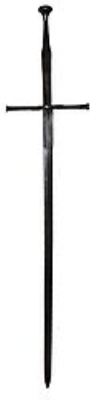
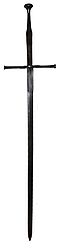
. The precise definition of the term varies with the historical epoch or the geographical region under consideration. In the most narrow sense, a sword consists of a blade
Blade
A blade is that portion of a tool, weapon, or machine with a cutting edge and/or a pointed tip that is designed to cut and/or puncture, stab, slash, chop, slice, thrust, or scrape animate or inanimate surfaces or materials...
with one or two edges, a hilt
Hilt
The hilt of a sword is its handle, consisting of a guard,grip and pommel. The guard may contain a crossguard or quillons. A ricasso may also be present, but this is rarely the case...
, and a crossguard
Crossguard
On a sword or some knives, the crossguard , also known as quillons, is a bar of metal at right angles to the blade, placed between the blade and the hilt. The crossguard stops the wielder from punching shields while swinging the weapon, thereby protecting the user's hand...
.
But in some cases the term may also refer to weapons without crossguard, or with only a single edge (backsword
Backsword
A backsword is a sword with a blade on one edge, or an "edge-and-a-quarter." The back of the sword is often the thickest part of the blade and acts to support and strengthen it....
).
The basic principles of swordsmanship have remained fairly constant through the centuries, but the actual techniques vary among cultures and periods as a result of the differences in blade design and purpose.
The names given to many swords in mythology
Mythology
The term mythology can refer either to the study of myths, or to a body or collection of myths. As examples, comparative mythology is the study of connections between myths from different cultures, whereas Greek mythology is the body of myths from ancient Greece...
, literature
Literature
Literature is the art of written works, and is not bound to published sources...
, and history
History
History is the discovery, collection, organization, and presentation of information about past events. History can also mean the period of time after writing was invented. Scholars who write about history are called historians...
reflect the high prestige of the weapon and the wealth of the owner.
The sword is said to be the emblem of military honor and should incite the bearer to a just and generous pursuit of honor and virtue. It is symbolic of liberty and strength. In the Middle Ages, the sword was often used as a symbol of the word of God.
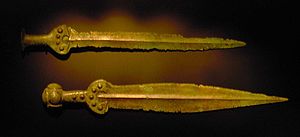
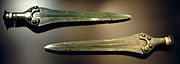
Historically, the sword developed in the Bronze Age
Bronze Age
The Bronze Age is a period characterized by the use of copper and its alloy bronze as the chief hard materials in the manufacture of some implements and weapons. Chronologically, it stands between the Stone Age and Iron Age...
, evolving from the dagger
Dagger
A dagger is a fighting knife with a sharp point designed or capable of being used as a thrusting or stabbing weapon. The design dates to human prehistory, and daggers have been used throughout human experience to the modern day in close combat confrontations...
; the earliest specimens
Bronze Age sword
Bronze Age swords appear from around the 17th century BC, in the Black Sea region and the Aegean, evolving out of the dagger. They are replaced by the Iron Age sword during the early part of the 1st millennium BC....
date to ca. 1600 BC. The Iron Age sword
Iron Age sword
Swords made of iron appear from the Early Iron Age , but do not become widespread before the 8th century BC....
remained fairly short and without a crossguard. The spatha
Spatha
The spatha was a type of straight sword, measuring between , in use throughout first millennium AD Europe, and in the territory of the Roman Empire until about 600 AD. Later swords from 600 AD to 1000 AD are recognizable derivatives, though they are not spathae.The spatha was used in gladiatorial...
as it developed in the Late Roman army
Late Roman army
The Late Roman army is the term used to denote the military forces of the Roman Empire from the accession of Emperor Diocletian in 284 until the Empire's definitive division into Eastern and Western halves in 395. A few decades afterwards, the Western army disintegrated as the Western empire...
became the predecessor of the European sword of the Middle Ages, at first adopted as the Migration period sword
Migration Period sword
Swords of the Migration Period show a transition from the Roman era Spatha to the "Viking sword" types of the Early Middle Ages....
, and only in the High Middle Ages
High Middle Ages
The High Middle Ages was the period of European history around the 11th, 12th, and 13th centuries . The High Middle Ages were preceded by the Early Middle Ages and followed by the Late Middle Ages, which by convention end around 1500....
developed into the classical Arming sword
Arming sword
The arming sword is the single handed cruciform sword of the High Middle Ages, in common use between ca. 1000 and 1500, possibly remaining in rare use into the 16th century...
with crossguard.
In the Early Modern period
Early modern period
In history, the early modern period of modern history follows the late Middle Ages. Although the chronological limits of the period are open to debate, the timeframe spans the period after the late portion of the Middle Ages through the beginning of the Age of Revolutions...
, the sword developed into the rapier
Rapier
A rapier is a slender, sharply pointed sword, ideally used for thrusting attacks, used mainly in Early Modern Europe during the 16th and 17th centuries.-Description:...
and eventually the smallsword, surviving into the 18th century only in the role of dueling weapon. By the 19th century, swords were reduced to the status of either ceremonial weapon
Ceremonial weapon
A ceremonial weapon is an object used for ceremonial purposes to display power or authority. They are often used in parades, and as part of dress uniforms.Although they are descended from weapons used in actual combat, they are not normally used as such...
or sport equipment in fencing
Fencing
Fencing, which is also known as modern fencing to distinguish it from historical fencing, is a family of combat sports using bladed weapons.Fencing is one of four sports which have been featured at every one of the modern Olympic Games...
.
Non-European weapons called "sword" include single-edged weapons such as the Middle Eastern saif, the Chinese dao
Dao (sword)
Daois a category of single-edge Chinese swords primarily used for slashing and chopping , often called a broadsword in English translation because some varieties have wide blades. In China, the dao is known as one of the four major weapons, along with the gun , qiang , and the jian , and referred...
and the related Japanese katana
Katana
A Japanese sword, or , is one of the traditional bladed weapons of Japan. There are several types of Japanese swords, according to size, field of application and method of manufacture.-Description:...
; these would more accurately be described as sabre
Sabre
The sabre or saber is a kind of backsword that usually has a curved, single-edged blade and a rather large hand guard, covering the knuckles of the hand as well as the thumb and forefinger...
s or backsword
Backsword
A backsword is a sword with a blade on one edge, or an "edge-and-a-quarter." The back of the sword is often the thickest part of the blade and acts to support and strengthen it....
s, but their high prestige in their respective cultures favoured the use of "sword".
The Chinese jian
Jian
The jian is a double-edged straight sword used during the last 2,500 years in China. The first Chinese sources that mention the jian date to the 7th century BCE during the Spring and Autumn Period; one of the earliest specimens being the Sword of Goujian.Historical one-handed versions have blades...
is an example of a non-European double-edged sword, like the European models derived from the double-edged Iron Age sword
Iron Age sword
Swords made of iron appear from the Early Iron Age , but do not become widespread before the 8th century BC....
.
The word sword comes from the Old English
Old English language
Old English or Anglo-Saxon is an early form of the English language that was spoken and written by the Anglo-Saxons and their descendants in parts of what are now England and southeastern Scotland between at least the mid-5th century and the mid-12th century...
sweord, cognate to Old High German
Old High German
The term Old High German refers to the earliest stage of the German language and it conventionally covers the period from around 500 to 1050. Coherent written texts do not appear until the second half of the 8th century, and some treat the period before 750 as 'prehistoric' and date the start of...
swert, Old Norse
Old Norse
Old Norse is a North Germanic language that was spoken by inhabitants of Scandinavia and inhabitants of their overseas settlements during the Viking Age, until about 1300....
sverð, from a Proto-Indo-European
Proto-Indo-European language
The Proto-Indo-European language is the reconstructed common ancestor of the Indo-European languages, spoken by the Proto-Indo-Europeans...
root *swer- "to wound, to cut".
Bronze Age
Dagger
A dagger is a fighting knife with a sharp point designed or capable of being used as a thrusting or stabbing weapon. The design dates to human prehistory, and daggers have been used throughout human experience to the modern day in close combat confrontations...
when the construction of longer blades became possible, from the late 3rd millennium BC in the Middle East, first in arsenic copper, then in tin-bronze. The oldest sword-like weapons are found at Arslantepe, Turkey
Turkey
Turkey , known officially as the Republic of Turkey , is a Eurasian country located in Western Asia and in East Thrace in Southeastern Europe...
, and date to around 3300 BC. However, it is generally considered that these are longer daggers, and not the first ancestors of swords. Sword blades longer than 60 cm (23.6 in) were rare and not practical until the late Bronze Age because at longer lengths, the tensile strength
Tensile strength
Ultimate tensile strength , often shortened to tensile strength or ultimate strength, is the maximum stress that a material can withstand while being stretched or pulled before necking, which is when the specimen's cross-section starts to significantly contract...
of bronze
Bronze
Bronze is a metal alloy consisting primarily of copper, usually with tin as the main additive. It is hard and brittle, and it was particularly significant in antiquity, so much so that the Bronze Age was named after the metal...
starts to decrease radically, and consequently longer blades would bend easily. It was not until the development of stronger alloys such as steel
Steel
Steel is an alloy that consists mostly of iron and has a carbon content between 0.2% and 2.1% by weight, depending on the grade. Carbon is the most common alloying material for iron, but various other alloying elements are used, such as manganese, chromium, vanadium, and tungsten...
, and improved heat treatment
Heat treatment
Heat treating is a group of industrial and metalworking processes used to alter the physical, and sometimes chemical, properties of a material. The most common application is metallurgical. Heat treatments are also used in the manufacture of many other materials, such as glass...
processes that longswords became practical for combat
Combat
Combat, or fighting, is a purposeful violent conflict meant to establish dominance over the opposition, or to terminate the opposition forever, or drive the opposition away from a location where it is not wanted or needed....
. They were also used as decorations.
British Isles
The British Isles are a group of islands off the northwest coast of continental Europe that include the islands of Great Britain and Ireland and over six thousand smaller isles. There are two sovereign states located on the islands: the United Kingdom of Great Britain and Northern Ireland and...
and Ireland
Ireland
Ireland is an island to the northwest of continental Europe. It is the third-largest island in Europe and the twentieth-largest island on Earth...
in particular. Robert Drews linked the Naue Type II Swords, which spread from Southern Europe into the Mediterranean, with the Late Bronze Age collapse
Bronze Age collapse
The Bronze Age collapse is a transition in southwestern Asia and the Eastern Mediterranean from the Late Bronze Age to the Early Iron Age that some historians believe was violent, sudden and culturally disruptive...
.
Sword production in China
Chinese swords
Swords have a long history in China. Stone swords were used in prehistoric times. Bronze swords have been traced back to the bronze daggers of the Shang period,. Bronze long swords suddenly appeared during the mid-third century BC. Later swords were made of iron or steel. These metals were...
is attested from the Bronze Age Shang Dynasty
Shang Dynasty
The Shang Dynasty or Yin Dynasty was, according to traditional sources, the second Chinese dynasty, after the Xia. They ruled in the northeastern regions of the area known as "China proper" in the Yellow River valley...
. The technology for bronze swords reached its high point during the Warring States period and Qin Dynasty. Amongst the Warring States period swords, some unique technologies were used, such as casting high tin edges over softer, lower tin cores, or the application of diamond shaped patterns on the blade (see sword of Goujian). Also unique for Chinese bronzes is the consistent use of high tin bronze (17–21% tin) which is very hard and breaks if stressed too far, whereas other cultures preferred lower tin bronze (usually 10%), which bends if stressed too far. Although iron swords were made alongside bronze, it was not until the early Han period that iron completely replaced bronze.
In South Asia earliest available Bronze age sword
Bronze Age sword
Bronze Age swords appear from around the 17th century BC, in the Black Sea region and the Aegean, evolving out of the dagger. They are replaced by the Iron Age sword during the early part of the 1st millennium BC....
s of copper were discovered in the Harappa
Harappa
Harappa is an archaeological site in Punjab, northeast Pakistan, about west of Sahiwal. The site takes its name from a modern village located near the former course of the Ravi River. The current village of Harappa is from the ancient site. Although modern Harappa has a train station left from...
n sites, in present-day Pakistan, and date back to 2300 BC. Swords have been recovered in archaeological findings throughout the Ganges-Jamuna Doab
Doab
A Doab is a term used in India and Pakistan for a "tongue" or tract of land lying between two confluent rivers...
region of Bangladesh
Bangladesh
Bangladesh , officially the People's Republic of Bangladesh is a sovereign state located in South Asia. It is bordered by India on all sides except for a small border with Burma to the far southeast and by the Bay of Bengal to the south...
, consisting of bronze
Bronze
Bronze is a metal alloy consisting primarily of copper, usually with tin as the main additive. It is hard and brittle, and it was particularly significant in antiquity, so much so that the Bronze Age was named after the metal...
but more commonly copper
Copper
Copper is a chemical element with the symbol Cu and atomic number 29. It is a ductile metal with very high thermal and electrical conductivity. Pure copper is soft and malleable; an exposed surface has a reddish-orange tarnish...
. Diverse specimens have been discovered in Fatehgarh
Fatehgarh
Fatehgarh is a cantonment town in Farrukhabad district in the state of Uttar Pradesh, India. It is located on the right bank of the Ganges River. It is the administrative headquarters of Farrukhabad District. Fatehgarh derives its name from an old fort. It is a small city with no significant...
, where there are several varieties of hilt. These swords have been variously dated to times between 1700–1400 BC, but were probably used more notably in the opening centuries of the 1st millennium BC.
Iron Age

Iron
Iron is a chemical element with the symbol Fe and atomic number 26. It is a metal in the first transition series. It is the most common element forming the planet Earth as a whole, forming much of Earth's outer and inner core. It is the fourth most common element in the Earth's crust...
became increasingly common from the 13th century BC, mainly due to the collapse of the bronze producing Civilizations
Bronze Age collapse
The Bronze Age collapse is a transition in southwestern Asia and the Eastern Mediterranean from the Late Bronze Age to the Early Iron Age that some historians believe was violent, sudden and culturally disruptive...
. The Hittites
Hittites
The Hittites were a Bronze Age people of Anatolia.They established a kingdom centered at Hattusa in north-central Anatolia c. the 18th century BC. The Hittite empire reached its height c...
, the Egyptians
Ancient Egypt
Ancient Egypt was an ancient civilization of Northeastern Africa, concentrated along the lower reaches of the Nile River in what is now the modern country of Egypt. Egyptian civilization coalesced around 3150 BC with the political unification of Upper and Lower Egypt under the first pharaoh...
and the Proto-Celtic Hallstatt culture
Hallstatt culture
The Hallstatt culture was the predominant Central European culture from the 8th to 6th centuries BC , developing out of the Urnfield culture of the 12th century BC and followed in much of Central Europe by the La Tène culture.By the 6th century BC, the Hallstatt culture extended for some...
(8th century BC) figured among the early users of iron swords. Iron has the advantage of mass-production due to the wider availability of the raw material. Early iron swords were not comparable to later steel
Steel
Steel is an alloy that consists mostly of iron and has a carbon content between 0.2% and 2.1% by weight, depending on the grade. Carbon is the most common alloying material for iron, but various other alloying elements are used, such as manganese, chromium, vanadium, and tungsten...
blades. The iron was not quench-hardened although often containing sufficient carbon, but work-hardened like bronze by hammering. This made them comparable or only slightly better in terms of strength and hardness to bronze swords. They could still bend during use rather than spring back into shape. But the easier production, and the better availability of the raw material for the first time permitted the equipment of entire armies with metal weapons, though Bronze Age Egyptian armies were at times fully equipped with bronze weapons.
Greco-Roman Antiquity
By the time of Classical AntiquityClassical antiquity
Classical antiquity is a broad term for a long period of cultural history centered on the Mediterranean Sea, comprising the interlocking civilizations of ancient Greece and ancient Rome, collectively known as the Greco-Roman world...
and the Parthian and Sassanid Empires in Iran, iron swords were common. The Greek xiphos and the Roman gladius
Gladius
Gladius was the Latin word for sword, and is used to represent the primary sword of Ancient Roman soldiers. Early ancient Roman swords were similar to those used by the Greeks. From the 3rd century BC, the Romans adopted swords similar to those used by the Celtiberians and others during the early...
are typical examples of the type, measuring some 60 to 70 cm (23.6 to 27.6 in). The late Roman Empire
Roman Empire
The Roman Empire was the post-Republican period of the ancient Roman civilization, characterised by an autocratic form of government and large territorial holdings in Europe and around the Mediterranean....
introduced the longer spatha
Spatha
The spatha was a type of straight sword, measuring between , in use throughout first millennium AD Europe, and in the territory of the Roman Empire until about 600 AD. Later swords from 600 AD to 1000 AD are recognizable derivatives, though they are not spathae.The spatha was used in gladiatorial...
(the term for its wielder, spatharius
Spatharius
The spatharii or spatharioi were a class of Late Roman imperial bodyguards in the court in Constantinople in the 5th-6th centuries, later becoming a purely honorary dignity in the Byzantine Empire...
, became a court rank in Constantinople), and from this time, the term longsword
Longsword
The longsword is a type of European sword designed for two-handed use, current during the late medieval and Renaissance periods, approximately 1350 to 1550 .Longswords have long cruciform hilts with grips over 10 to 15 cm length The longsword (of which stems the variation called the bastard...
is applied to swords comparatively long for their respective periods.
Swords from the Parthian and Sassanian Empires were quite long, the blades on some late Sassanian swords being just under a metre long.
Swords were also used to administer various physical punishment
Physical punishment
Physical punishment is any form of penalty in a judicial, educational or domestic setting that takes a physical form, by the infliction on the offender of pain, injury, discomfort or humiliation...
s, such as non-surgical amputation
Amputation
Amputation is the removal of a body extremity by trauma, prolonged constriction, or surgery. As a surgical measure, it is used to control pain or a disease process in the affected limb, such as malignancy or gangrene. In some cases, it is carried out on individuals as a preventative surgery for...
or capital punishment
Capital punishment
Capital punishment, the death penalty, or execution is the sentence of death upon a person by the state as a punishment for an offence. Crimes that can result in a death penalty are known as capital crimes or capital offences. The term capital originates from the Latin capitalis, literally...
by decapitation. The use of a sword, an honorable weapon, was regarded in Europe since Roman times
Roman Republic
The Roman Republic was the period of the ancient Roman civilization where the government operated as a republic. It began with the overthrow of the Roman monarchy, traditionally dated around 508 BC, and its replacement by a government headed by two consuls, elected annually by the citizens and...
as a privilege reserved for the nobility
Nobility
Nobility is a social class which possesses more acknowledged privileges or eminence than members of most other classes in a society, membership therein typically being hereditary. The privileges associated with nobility may constitute substantial advantages over or relative to non-nobles, or may be...
and the upper classes.
The Periplus of the Erythraean Sea
Periplus of the Erythraean Sea
The Periplus of the Erythraean Sea or Periplus of the Red Sea is a Greco-Roman periplus, written in Greek, describing navigation and trading opportunities from Roman Egyptian ports like Berenice along the coast of the Red Sea, and others along Northeast Africa and India...
mentions swords of Indian iron and steel being exported from India to Greece
Greece
Greece , officially the Hellenic Republic , and historically Hellas or the Republic of Greece in English, is a country in southeastern Europe....
. Sri Lanka
Sri Lanka
Sri Lanka, officially the Democratic Socialist Republic of Sri Lanka is a country off the southern coast of the Indian subcontinent. Known until 1972 as Ceylon , Sri Lanka is an island surrounded by the Indian Ocean, the Gulf of Mannar and the Palk Strait, and lies in the vicinity of India and the...
n and India
India
India , officially the Republic of India , is a country in South Asia. It is the seventh-largest country by geographical area, the second-most populous country with over 1.2 billion people, and the most populous democracy in the world...
n Blades made of Damascus steel
Damascus steel
Damascus steel was a term used by several Western cultures from the Medieval period onward to describe a type of steel used in swordmaking from about 300 BCE to 1700 CE. These swords are characterized by distinctive patterns of banding and mottling reminiscent of flowing water...
also found their way into Persia.
Chinese Antiquity
Chinese steel swords made their first appearance in the later part of the Western Zhou Dynasty, but were not widely used until the 3rd century BC Han DynastyHan Dynasty
The Han Dynasty was the second imperial dynasty of China, preceded by the Qin Dynasty and succeeded by the Three Kingdoms . It was founded by the rebel leader Liu Bang, known posthumously as Emperor Gaozu of Han. It was briefly interrupted by the Xin Dynasty of the former regent Wang Mang...
.
The Chinese Dao
Dao (sword)
Daois a category of single-edge Chinese swords primarily used for slashing and chopping , often called a broadsword in English translation because some varieties have wide blades. In China, the dao is known as one of the four major weapons, along with the gun , qiang , and the jian , and referred...
(刀 pinyin
Pinyin
Pinyin is the official system to transcribe Chinese characters into the Roman alphabet in China, Malaysia, Singapore and Taiwan. It is also often used to teach Mandarin Chinese and spell Chinese names in foreign publications and used as an input method to enter Chinese characters into...
dāo) is single-edged, sometimes translated as sabre
Sabre
The sabre or saber is a kind of backsword that usually has a curved, single-edged blade and a rather large hand guard, covering the knuckles of the hand as well as the thumb and forefinger...
or broadsword
Broadsword
Broadsword may refer to:*Broadsword , a military sword used by heavy cavalry during the 17th to early 19th centuriesIn more modern times, it has also been used to refer to:...
, and the Jian
Jian
The jian is a double-edged straight sword used during the last 2,500 years in China. The first Chinese sources that mention the jian date to the 7th century BCE during the Spring and Autumn Period; one of the earliest specimens being the Sword of Goujian.Historical one-handed versions have blades...
(劍or剑 pinyin
Pinyin
Pinyin is the official system to transcribe Chinese characters into the Roman alphabet in China, Malaysia, Singapore and Taiwan. It is also often used to teach Mandarin Chinese and spell Chinese names in foreign publications and used as an input method to enter Chinese characters into...
jiàn) is double-edged.
Europe and the Middle East
During the Middle AgesMiddle Ages
The Middle Ages is a periodization of European history from the 5th century to the 15th century. The Middle Ages follows the fall of the Western Roman Empire in 476 and precedes the Early Modern Era. It is the middle period of a three-period division of Western history: Classic, Medieval and Modern...
sword technology improved, and the sword became a very advanced weapon. It was frequently used by men in battle, particularly during an attack.
The spatha type remained popular throughout the Migration period
Migration Period
The Migration Period, also called the Barbarian Invasions , was a period of intensified human migration in Europe that occurred from c. 400 to 800 CE. This period marked the transition from Late Antiquity to the Early Middle Ages...
and well into the Middle Ages. Vendel Age spathas were decorated with Germanic artwork (not unlike the Germanic bracteate
Bracteate
A bracteate is a flat, thin, single-sided gold medal worn as jewelry that was produced in Northern Europe predominantly during the Migration Period of the Germanic Iron Age...
s fashioned after Roman coins). The Viking Age
Viking Age
Viking Age is the term for the period in European history, especially Northern European and Scandinavian history, spanning the late 8th to 11th centuries. Scandinavian Vikings explored Europe by its oceans and rivers through trade and warfare. The Vikings also reached Iceland, Greenland,...
saw again a more standardized production, but the basic design remained indebted to the spatha.
Around the 10th century, the use of properly quenched hardened and tempered steel started to become much more common than in previous periods. The Frankish 'Ulfberht' blades (the name of the maker inlaid in the blade) were of particularly consistent high quality. Charles the Bald
Charles the Bald
Charles the Bald , Holy Roman Emperor and King of West Francia , was the youngest son of the Emperor Louis the Pious by his second wife Judith.-Struggle against his brothers:He was born on 13 June 823 in Frankfurt, when his elder...
tried to prohibit the export of these swords, as they were used by Vikings in raids against the Franks
Franks
The Franks were a confederation of Germanic tribes first attested in the third century AD as living north and east of the Lower Rhine River. From the third to fifth centuries some Franks raided Roman territory while other Franks joined the Roman troops in Gaul. Only the Salian Franks formed a...
.
Wootz steel
Wootz steel
Wootz steel is a steel characterized by a pattern of bands or sheets of micro carbides within a tempered martensite or pearlite matrix. It was developed in India around 300 BCE...
which is also known as Damascus steel
Damascus steel
Damascus steel was a term used by several Western cultures from the Medieval period onward to describe a type of steel used in swordmaking from about 300 BCE to 1700 CE. These swords are characterized by distinctive patterns of banding and mottling reminiscent of flowing water...
was a unique and highly prized steel developed on the Indian subcontinent as early as the 5th century BC. Its properties were unique due to the special smelting and reworking of the steel creating networks of iron carbides described as a globular cementite in a matrix of pearlite. The use of Damascus steel in swords became extremely popular in the 16th and 17th centuries.
It was only from the 11th century that Norman
Normans
The Normans were the people who gave their name to Normandy, a region in northern France. They were descended from Norse Viking conquerors of the territory and the native population of Frankish and Gallo-Roman stock...
swords began to develop the quillons or crossguard
Crossguard
On a sword or some knives, the crossguard , also known as quillons, is a bar of metal at right angles to the blade, placed between the blade and the hilt. The crossguard stops the wielder from punching shields while swinging the weapon, thereby protecting the user's hand...
. During the Crusades
Crusades
The Crusades were a series of religious wars, blessed by the Pope and the Catholic Church with the main goal of restoring Christian access to the holy places in and near Jerusalem...
of the 12th to 13th century, this cruciform type of arming sword
Arming sword
The arming sword is the single handed cruciform sword of the High Middle Ages, in common use between ca. 1000 and 1500, possibly remaining in rare use into the 16th century...
remained essentially stable, with variations mainly concerning the shape of the pommel. These swords were designed as cutting weapons, although effective points were becoming common to counter improvements in armour, especially the 14th century change from chain mail
Mail (armour)
Mail is a type of armour consisting of small metal rings linked together in a pattern to form a mesh.-History:Mail was a highly successful type of armour and was used by nearly every metalworking culture....
to plate armour
Plate armour
Plate armour is a historical type of personal armour made from iron or steel plates.While there are early predecessors such the Roman-era lorica segmentata, full plate armour developed in Europe during the Late Middle Ages, especially in the context of the Hundred Years' War, from the coat of...
.
It was during the 14th century, with the growing use of more advanced armor, that the Hand and a half sword, also known as a "bastard sword", came into being. It had an extended grip that meant it could be used with either one or two hands. Though these swords did not provide a full two-hand grip they allowed their wielders to hold a shield
Shield
A shield is a type of personal armor, meant to intercept attacks, either by stopping projectiles such as arrows or redirecting a hit from a sword, mace or battle axe to the side of the shield-bearer....
or parrying dagger in their off hand, or to use it as a two-handed sword for a more powerful blow.
The earliest evidence of curved swords, or scimitars (and other regional variants as the Arabian saif, the Persian shamshir
Shamshir
A Shamshir also Shamsheer and Chimchir, is a type of sabre with a curve that is considered radical for a sword: 5 to 15 degrees from tip to tip. The name is derived from Persian شمشیر shamshīr, which means "sword"...
and the Turkic kilij
Kilij
A kilij is a type of saber used by the Turks throughout history starting from late Hsiung-nu period to Avar Empire and Göktürk Khaganate, Uyghur Khaganate, Seljuk Empire, Timurid Empire, Mamluk Empire, Ottoman Empire, and later Turkic Khanates of Central Asia...
) is from the 9th century, when it was used among soldiers in the Khurasan
Greater Khorasan
Greater Khorasan or Ancient Khorasan is a historical region of Greater Iran mentioned in sources from Sassanid and Islamic eras which "frequently" had a denotation wider than current three provinces of Khorasan in Iran...
region of Persia.
East Asia
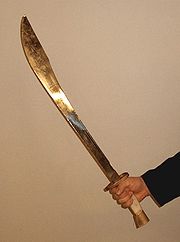
China
Chinese civilization may refer to:* China for more general discussion of the country.* Chinese culture* Greater China, the transnational community of ethnic Chinese.* History of China* Sinosphere, the area historically affected by Chinese culture...
Jian
Jian
The jian is a double-edged straight sword used during the last 2,500 years in China. The first Chinese sources that mention the jian date to the 7th century BCE during the Spring and Autumn Period; one of the earliest specimens being the Sword of Goujian.Historical one-handed versions have blades...
or dao, the Korea
Korea
Korea ) is an East Asian geographic region that is currently divided into two separate sovereign states — North Korea and South Korea. Located on the Korean Peninsula, Korea is bordered by the People's Republic of China to the northwest, Russia to the northeast, and is separated from Japan to the...
n hwandudaedo
Hwandudaedo
The Hwandudaedo is a type of ancient Korean sword from the Three Kingdoms of Korea era The Hwandudaedo, a type of Sohwandudaedo, were decorated swords first seen in the south with a folded blade and a ring pommel...
are known from the early medieval Three Kingdoms
Three Kingdoms of Korea
The Three Kingdoms of Korea refer to the ancient Korean kingdoms of Goguryeo, Baekje and Silla, which dominated the Korean peninsula and parts of Manchuria for much of the 1st millennium...
. Production of the Japan
Japan
Japan is an island nation in East Asia. Located in the Pacific Ocean, it lies to the east of the Sea of Japan, China, North Korea, South Korea and Russia, stretching from the Sea of Okhotsk in the north to the East China Sea and Taiwan in the south...
ese tachi
Tachi
The is one type of traditional Japanese sword worn by the samurai class of feudal Japan.-History and description:With a few exceptions katana and tachi can be distinguished from each other if signed, by the location of the signature on the tang...
, a precursor to the katana
Katana
A Japanese sword, or , is one of the traditional bladed weapons of Japan. There are several types of Japanese swords, according to size, field of application and method of manufacture.-Description:...
, is recorded from ca. 900 AD (see Japanese sword).
Japan was famous for the swords it forged in the early 13th century for the class of warrior-nobility known as the samurai. A samurai's primary weapon was the katana, which was used for infantry. Other infantry swords included: wakizashi
Wakizashi
The is one of the traditional Japanese swords worn by the samurai class in feudal Japan.-Description:...
(shorter companion sword for katana), nodachi
Nodachi
A nodachi is a large two-handed Japanese sword. Some have suggested that the meaning of "nodachi" is roughly the same as ōdachi meaning "large/great sword". A confusion between the terms has nearly synonymized "nodachi" with the very large "ōdachi"...
, kubikiri, tantō
Tanto
A is one of the traditional Japanese swords that were worn by the samurai class of feudal Japan. The tantō dates to the Heian period, when it was mainly used as a weapon but evolved in design over the years to become more ornate...
and hachiwara
Hachiwara
The , meaning 'helmet breaker' or 'skull breaker' was a type of knife-shaped weapon, resembling a jutte in many respects. This weapon was carried as a side-arm by the Samurai class of feudal Japan.-Types:...
. Cavalry swords were the tachi
Tachi
The is one type of traditional Japanese sword worn by the samurai class of feudal Japan.-History and description:With a few exceptions katana and tachi can be distinguished from each other if signed, by the location of the signature on the tang...
and ancient tachi. Temple swords included the one-handed tachi and Chokutō
Chokuto
The is a type of Japanese sword that dates back to pre-Heian times. Chokutō were made in later periods, but usually as temple offering swords. Chokutō were straight and single-edged hacking swords. That chokutō's design was originally imported to Japan from China, though seemingly most often...
. Anti-cavalry swords such as the extremely long Song Dynasty
Song Dynasty
The Song Dynasty was a ruling dynasty in China between 960 and 1279; it succeeded the Five Dynasties and Ten Kingdoms Period, and was followed by the Yuan Dynasty. It was the first government in world history to issue banknotes or paper money, and the first Chinese government to establish a...
era zhanmadao
Zhanmadao
The zhanmadao was a single-bladed anti-cavalry Chinese sword of the Song Dynasty.- General characteristics :The zhanmadao is a sabre with a single long broad blade, and a long handle suitable for two-handed use....
(literally "horse chopping sword") and the Japanese Zanbatō
Zanbato
A is an especially large type of Japanese sword, the historical use of which is disputed. The sword closely resembles the Nodachi or ōdachi, however it differs from the Nodachi by having a ricasso of approximately 12 to 18 inches . This lends more credence to the theory of the sword having a...
also developed at the time.

Japan
Japan is an island nation in East Asia. Located in the Pacific Ocean, it lies to the east of the Sea of Japan, China, North Korea, South Korea and Russia, stretching from the Sea of Okhotsk in the north to the East China Sea and Taiwan in the south...
ese katana
Katana
A Japanese sword, or , is one of the traditional bladed weapons of Japan. There are several types of Japanese swords, according to size, field of application and method of manufacture.-Description:...
reached the height of its development in the 15th and 16th centuries, when samurai increasingly found a need for a sword to use in closer quarters, leading to the creation of the modern katana
Katana
A Japanese sword, or , is one of the traditional bladed weapons of Japan. There are several types of Japanese swords, according to size, field of application and method of manufacture.-Description:...
.
South and Southeast Asia
The swords manufactured in Indian workshops, such as the KhandaKhanda (sword)
The blade is usually broad and quite heavy and broadens from the hilt to the tip. The blade transforms into tip rather abruptly. The hilt has a small metal spike coming out in the opposite direction typical of the khanda...
, find mention in the writing of Muhammad al-Idrisi
Muhammad al-Idrisi
Abu Abd Allah Muhammad al-Idrisi al-Qurtubi al-Hasani al-Sabti or simply Al Idrisi was a Moroccan Muslim geographer, cartographer, Egyptologist and traveller who lived in Sicily, at the court of King Roger II. Muhammed al-Idrisi was born in Ceuta then belonging to the Almoravid Empire and died in...
.
In Sri Lanka
Sri Lanka
Sri Lanka, officially the Democratic Socialist Republic of Sri Lanka is a country off the southern coast of the Indian subcontinent. Known until 1972 as Ceylon , Sri Lanka is an island surrounded by the Indian Ocean, the Gulf of Mannar and the Palk Strait, and lies in the vicinity of India and the...
, a unique wind furnace was used to produce the high quality steel. This gave the blade a very hard cutting edge and beautiful patterns. For these reasons it became a very popular trading material.
The Talwar
Talwar
The talwar is a type of curved sword or sabre from India and modern-day Pakistan...
is a type of curved sword that was introduced to India in the 13th century by invading Muslim conquerors and was adopted by communities who favoured the sword as their main weapon, including the Rajputs, Marathas and Sikhs. It became more widespread under the Mughals who fought with curved swords from horseback. It was revered by the Rajput
Rajput
A Rajput is a member of one of the patrilineal clans of western, central, northern India and in some parts of Pakistan. Rajputs are descendants of one of the major ruling warrior classes in the Indian subcontinent, particularly North India...
s as a symbol of the god
God
God is the English name given to a singular being in theistic and deistic religions who is either the sole deity in monotheism, or a single deity in polytheism....
shiva
Shiva
Shiva is a major Hindu deity, and is the destroyer god or transformer among the Trimurti, the Hindu Trinity of the primary aspects of the divine. God Shiva is a yogi who has notice of everything that happens in the world and is the main aspect of life. Yet one with great power lives a life of a...
, and is still used today as the primary weapon of the Sikh
Sikh
A Sikh is a follower of Sikhism. It primarily originated in the 15th century in the Punjab region of South Asia. The term "Sikh" has its origin in Sanskrit term शिष्य , meaning "disciple, student" or शिक्ष , meaning "instruction"...
martial art Gatka
Gatka
Gatka is a weapon-based Indian martial art created by the Sikhs of the Punjab region. The word gatka refers to the wooden stick used in sparring matches. The term might have originated as a diminutive of the Sanskrit word gadha or mace....
and also by South Asian Shiite Muslims for Tatbir.
The Firangi
Firangi (sword)
The firangi derived from the Arabic term for a Western European [a "Frank"]) was an Indian sword type which used blades manufactured in Western Europe and imported by the Portuguese, or made locally in imitation of European blades.-Physical characteristics:...
(icon; derived from the Arabic term for a Western European a "Frank
Franks
The Franks were a confederation of Germanic tribes first attested in the third century AD as living north and east of the Lower Rhine River. From the third to fifth centuries some Franks raided Roman territory while other Franks joined the Roman troops in Gaul. Only the Salian Franks formed a...
") was a sword type which used blades manufactured in Western Europe and imported by the Portuguese
Portuguese India
The Portuguese Viceroyalty of India , later the Portuguese State of India , was the aggregate of Portugal's colonial holdings in India.The government started in 1505, six years after the discovery of a sea route to India by Vasco da Gama, with the nomination of the first Viceroy Francisco de...
, or made locally in imitation of European blades. Because of its length the firangi is usually regarded as primarily a cavalry weapon. The sword has been especially associated with the Maratha
Maratha
The Maratha are an Indian caste, predominantly in the state of Maharashtra. The term Marāthā has three related usages: within the Marathi speaking region it describes the dominant Maratha caste; outside Maharashtra it can refer to the entire regional population of Marathi-speaking people;...
s, who were famed for their cavalry. However, the firangi was widely used by the Mughals and those peoples who came under their rule, including Sikhs and Rajputs.
In Indonesia
Indonesia
Indonesia , officially the Republic of Indonesia , is a country in Southeast Asia and Oceania. Indonesia is an archipelago comprising approximately 13,000 islands. It has 33 provinces with over 238 million people, and is the world's fourth most populous country. Indonesia is a republic, with an...
, the images of Indian style swords can be found in Hindu gods statues from ancient Java circa 8th to 10th century, which means swords already known in ancient Indonesia culture. However the native types of blade known as kris
Kris
The kris or keris is an asymmetrical dagger or sword nowadays most strongly associated with the culture of Indonesia, but also indigenous to Malaysia, Southern Thailand and Brunei. It is known as kalis in the southern Philippines. The kris is famous for its distinctive wavy blade , but many have...
, parang
Parang (knife)
The parang is the Indonesia equivalent of the machete. Typical vegetation in South East Asia is more woody than in South America and the parang is therefore optimized for a stronger chopping action with a heavier blade and a "sweet spot" further forward of the handle, the blade is also beveled more...
, klewang
Klewang
The klewang is a traditional single-edged sword from Indonesia. In size, weight and shape it is halfway between the golok and the kampilan. The style of the klewang differs between the various cultures of Indonesia; there are straight bladed types, but most are curved.During the Aceh War the...
and golok
Golok
right|thumb|Golok copying the Martindale No 2 designThe golok is a type of machete or broadsword originating in Southeast Asia. The word golok is of Indonesian origin but is also used in Malaysia and is known as gulok in the Philippines...
are popular to be used as weapon rather than sword. These daggers are shorter than sword but longer than common dagger.
In The Philippines a large swords known as the Kampilan
Kampilan
The kampílan is a type of single-edged long sword of the Filipino people. Being ancient origin, it has been used in the Philippine islands of Mindanao, Visayas, and Luzon for centuries, used for head-chopping....
and the Panabas
Panabas
The Panabas is a large, forward-curved sword, used by Muslim tribes in the southern Philippines. It can range in size from 2 to 4 feet and can be held with one or both hands, delivering a deep, meat-cleaver-like cut. In their heyday, they were used as a combat weapon, as an execution tool, and as a...
were used in combat by the local Moro tribes in the southern island of Mindanao
Mindanao
Mindanao is the second largest and easternmost island in the Philippines. It is also the name of one of the three island groups in the country, which consists of the island of Mindanao and smaller surrounding islands. The other two are Luzon and the Visayas. The island of Mindanao is called The...
. A notable wielder of the kampílan was Datu
Datu
Datu is the title for tribal chiefs, sovereign princes, and monarchs in the Visayas and Mindanao Regions of the Philippines. Together with Lakan , Apo in Central and Northern Luzon, Sultan and Rajah, they are titles used for native royalty, and are still currently used in the Philippines...
Lapu-Lapu
Lapu-Lapu
Lapu-Lapu was the ruler of Mactan, an island in the Visayas, Philippines, who is known as the first native of the archipelago to have resisted the Spanish colonization...
, the Muslim king of Mactan and his warriors who defeated the Spaniards and killed Portuguese explorer Ferdinand Magellan
Ferdinand Magellan
Ferdinand Magellan was a Portuguese explorer. He was born in Sabrosa, in northern Portugal, and served King Charles I of Spain in search of a westward route to the "Spice Islands" ....
at the Battle of Mactan
Battle of Mactan
The Battle of Mactan was fought in the Philippines on April 27, 1521. The warriors of Lapu-Lapu, a native chieftain of Mactan Island, defeated Spanish forces under the command of Ferdinand Magellan, who was killed in the battle.- Background :...
on April 27, 1521.
Late Middle Ages and Renaissance
From around 1300 to 1500, in concert with improved armourArmour
Armour or armor is protective covering used to prevent damage from being inflicted to an object, individual or a vehicle through use of direct contact weapons or projectiles, usually during combat, or from damage caused by a potentially dangerous environment or action...
, innovative sword designs evolved more and more rapidly. The main transition was the lengthening of the grip, allowing two-handed use, and a longer blade. By 1400, this type of sword, at the time called langes Schwert
Longsword
The longsword is a type of European sword designed for two-handed use, current during the late medieval and Renaissance periods, approximately 1350 to 1550 .Longswords have long cruciform hilts with grips over 10 to 15 cm length The longsword (of which stems the variation called the bastard...
(longsword) or spadone, was common, and a number of 15th and 16th century Fechtbücher
Fechtbuch
Martial arts manuals are instructions, with or without illustrations, detailing specific techniques of martial arts.Prose descriptions of martial arts techniques appear late within the history of literature, due to the inherent difficulties of describing a technique rather than just demonstrating...
offering instructions on their use survive. Another variant was the specialized armour-piercing swords of the estoc
Estoc
The French estoc or English "tuck" was a variation of the longsword focused intensely on fighting against mail or plate armour. It was long, straight and stiff, with a diamond or triangular cross-section. An estoc had no cutting edge, just a point. Examples from Poland are more than long, with a...
type. The longsword
Longsword
The longsword is a type of European sword designed for two-handed use, current during the late medieval and Renaissance periods, approximately 1350 to 1550 .Longswords have long cruciform hilts with grips over 10 to 15 cm length The longsword (of which stems the variation called the bastard...
became popular due to its extreme reach and cutting and thrusting abilities.
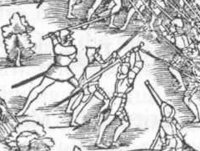
Estoc
The French estoc or English "tuck" was a variation of the longsword focused intensely on fighting against mail or plate armour. It was long, straight and stiff, with a diamond or triangular cross-section. An estoc had no cutting edge, just a point. Examples from Poland are more than long, with a...
became popular because of its ability to thrust into the gaps between plates of armour. The grip was sometimes wrapped in wire or coarse animal hide to provide a better grip and to make it harder to knock a sword out of the user's hand.
A number of manuscripts covering longsword combat and techniques dating from the 13th–16th centuries exist in German, Italian, and English, providing extensive information on longsword combatives as used throughout this period. Many of these are now readily available online.
In the 16th century, the large zweihander was used by the elite German mercenaries known as doppelsoldners. Zweihander, literally translated, means two-hander. The zweihander possesses a long, blade, as well as a huge guard for protection. It is estimated that some zweihander swords were over 6 feet (1.8 m) long, with the one ascribed to Frisia
Frisia
Frisia is a coastal region along the southeastern corner of the North Sea, i.e. the German Bight. Frisia is the traditional homeland of the Frisians, a Germanic people who speak Frisian, a language group closely related to the English language...
n warrior Pier Gerlofs Donia
Pier Gerlofs Donia
Pier Gerlofs Donia was a Frisian warrior, pirate, and rebel. He is best known by his West Frisian nickname "Grutte Pier" , or by the Dutch translations "Grote Pier" and "Lange Pier", or, in Latin, "Pierius Magnus", which referred to his legendary size and strength. His life is mostly shrouded in...
being 2.13 metres (7 ft) long. The gigantic blade length was perfectly designed for manipulating and pushing away enemy pole-arms, which were major weapons around this time, in both Germany and Eastern Europe. Doppelsoldners also used katzbalgers, which means 'cat-gutter'. The katzbalger's S-shaped guard and 2 foot (0.6096 m) blade made it perfect for bringing in when the fighting became too close to use a zweihander.
Civilian use of swords became increasingly common during the late Renaissance, with duels being a preferred way to honorably settle disputes. The practice of civilian dueling, with specifically designed civilian swords such as the Italian Cinquedea
Cinquedea
The cinquedea is a civilian short sword . It was developed in northern Italy and enjoyed a period of popularity during the Italian renaissance of the 15th and early 16th centuries....
and Swiss Baselard
Baselard
The baselard is a historical type of dagger or short sword of the Late Middle Ages.In modern use by antiquarians, the term baselard is mostly reserved for a type of 14th...
, became so popular that according to one scholar: "In France during the reign of Henry IV
Henry IV of France
Henry IV , Henri-Quatre, was King of France from 1589 to 1610 and King of Navarre from 1572 to 1610. He was the first monarch of the Bourbon branch of the Capetian dynasty in France....
(1589–1610), more than 4,000 French aristocrats were killed in duels in an eighteen-year period...During the reign of Louis XIII
Louis XIII of France
Louis XIII was a Bourbon monarch who ruled as King of France and of Navarre from 1610 to 1643.Louis was only eight years old when he succeeded his father. His mother, Marie de Medici, acted as regent during Louis' minority...
(1610–1643)...in a twenty-year period 8,000 pardons were issued for murders associated with duels."
The side-sword
Side-sword
The spada da lato or "side-sword" is the Italian term for the type of sword popular during the late 16th century, corresponding to the Spanish espada ropera....
was a type of war sword used by infantry during the Renaissance
Renaissance
The Renaissance was a cultural movement that spanned roughly the 14th to the 17th century, beginning in Italy in the Late Middle Ages and later spreading to the rest of Europe. The term is also used more loosely to refer to the historical era, but since the changes of the Renaissance were not...
of Europe
Europe
Europe is, by convention, one of the world's seven continents. Comprising the westernmost peninsula of Eurasia, Europe is generally 'divided' from Asia to its east by the watershed divides of the Ural and Caucasus Mountains, the Ural River, the Caspian and Black Seas, and the waterways connecting...
. This sword was a direct descendant of the arming sword
Arming sword
The arming sword is the single handed cruciform sword of the High Middle Ages, in common use between ca. 1000 and 1500, possibly remaining in rare use into the 16th century...
. Quite popular between the 16th and 17th centuries, they were ideal for handling the mix of armored and unarmored opponents of that time. A new technique of placing one's finger on the ricasso
Ricasso
A ricasso is a part of sword and knife blades. It is the section just above the guard or handle. It is sometimes unsharpened and unbevelled.The first unsharpened ricassos were found on Middle Bronze Age swords...
to improve the grip (a practice that would continue in the rapier
Rapier
A rapier is a slender, sharply pointed sword, ideally used for thrusting attacks, used mainly in Early Modern Europe during the 16th and 17th centuries.-Description:...
) led to the production of hilts with a guard for the finger.
This sword design eventually led to the development of the civilian rapier
Rapier
A rapier is a slender, sharply pointed sword, ideally used for thrusting attacks, used mainly in Early Modern Europe during the 16th and 17th centuries.-Description:...
, but it was not replaced by it, and the side-sword continued to be used during the rapier's lifetime. As it could be used for both cutting and thrusting, the term cut and thrust sword is sometimes used interchangeably with side-sword. Also of note is that as rapiers became more popular, attempts were made to hybridize the blade, sacrificing the effectiveness found in each unique weapon design. These are still considered side-swords and are sometimes labeled sword rapier or cutting rapier by modern collectors.
Also of note, side-swords used in conjunction with buckler
Buckler
A buckler is a small shield, 15 to 45 cm in diameter, gripped in the fist; it was generally used as a companion weapon in hand-to-hand combat during the Medieval and Renaissance, as its size made it poor protection against missile weapons but useful in deflecting the blow of...
s became so popular that it caused the term swashbuckler
Swashbuckler
Swashbuckler or swasher is a term that emerged in the 16th century and has been used for rough, noisy and boastful swordsmen ever since. A possible explanation for this term is that it derives from a fighting style using a side-sword with a buckler in the off-hand, which was applied with much...
to be coined. This word stems from the new fighting style of the side-sword and buckler which was filled with much "swashing and making a noise on the buckler".
Within the Ottoman Empire
Ottoman Empire
The Ottoman EmpireIt was usually referred to as the "Ottoman Empire", the "Turkish Empire", the "Ottoman Caliphate" or more commonly "Turkey" by its contemporaries...
, the use of a curved sabre called the Yatagan
Yatagan
The yatagan or yataghan is a type of Ottomanknife or short sabre used from the mid-16th to late 19th centuries....
started in the mid-16th century. It would become the weapon of choice for many in Turkey
Turkey
Turkey , known officially as the Republic of Turkey , is a Eurasian country located in Western Asia and in East Thrace in Southeastern Europe...
and the Balkans
Balkans
The Balkans is a geopolitical and cultural region of southeastern Europe...
.
The sword in this time period was the most personal weapon, the most prestigious, and the most versatile for close combat, but it came to decline in military use as technology, such as the crossbow
Crossbow
A crossbow is a weapon consisting of a bow mounted on a stock that shoots projectiles, often called bolts or quarrels. The medieval crossbow was called by many names, most of which derived from the word ballista, a torsion engine resembling a crossbow in appearance.Historically, crossbows played a...
and firearms changed warfare. However, it maintained a key role in civilian self-defense.
Early Modern period
The rapierRapier
A rapier is a slender, sharply pointed sword, ideally used for thrusting attacks, used mainly in Early Modern Europe during the 16th and 17th centuries.-Description:...
is believed to have evolved either from the Spanish espada ropera
Espada ropera
The espada ropera was a sword developed in the mid-15th century in Spain. The name referred to swords worn by civilians, as opposed for those meant for battlefield use. Compared to earlier swords, the espada ropera was lighter, thinner, and more ornate. It was first mentioned in an inventory of Don...
or from the swords of the Italian nobility somewhere in the later part of the 16th century. The rapier differed from most earlier swords in that it was not a military weapon but a primarily civilian sword. Both the rapier and the Italian schiavona developed the crossguard into a basket-shaped guard
Basket-hilted sword
The basket-hilted sword is the name of a group of early modern sword types characterized by a basket-shaped guard that protects the hand. The basket hilt is a development of the quillons added to swords' crossguards since the Late Middle Ages...
for hand protection. During the 17th and 18th centuries, the shorter smallsword became an essential fashion accessory in European countries and the New World, though in some places such as the Scottish
Scotland
Scotland is a country that is part of the United Kingdom. Occupying the northern third of the island of Great Britain, it shares a border with England to the south and is bounded by the North Sea to the east, the Atlantic Ocean to the north and west, and the North Channel and Irish Sea to the...
Highlands
Scottish Highlands
The Highlands is an historic region of Scotland. The area is sometimes referred to as the "Scottish Highlands". It was culturally distinguishable from the Lowlands from the later Middle Ages into the modern period, when Lowland Scots replaced Scottish Gaelic throughout most of the Lowlands...
large swords as the basket-hilted broadsword were preferred, and most wealthy men and military officers carried one slung from a belt. Both the smallsword and the rapier remained popular dueling swords well into the 18th century.
As the wearing of swords fell out of fashion, canes took their place in a gentleman's wardrobe. This developed to the gentlemen in the Victorian era to use the umbrella
Umbrella
An umbrella or parasol is a canopy designed to protect against rain or sunlight. The term parasol usually refers to an item designed to protect from the sun; umbrella refers to a device more suited to protect from rain...
. Some examples of canes—those known as sword canes or swordstick
Swordstick
A swordstick or cane-sword is a cane incorporating a concealed blade. The term is typically used to describe European weapons from around the 18th century, but similar devices have been used throughout history, notably the Japanese shikomizue and the Ancient Roman dolon.- Popularity :The swordstick...
s—incorporate a concealed blade. The French
France
The French Republic , The French Republic , The French Republic , (commonly known as France , is a unitary semi-presidential republic in Western Europe with several overseas territories and islands located on other continents and in the Indian, Pacific, and Atlantic oceans. Metropolitan France...
martial art la canne developed to fight with canes and swordsticks and has now evolved into a sport. The English martial art singlestick
Singlestick
Singlestick, also known as cudgels, refers to both a martial art that uses a wooden stick as well as the weapon used in the art. It began as a way of training soldiers in the use of swords such as the sabre...
is very similar.
Modern history
Towards the end of its useful life, the sword served more as a weapon of self-defense than for use on the battlefield, and the military importance of swords steadily decreased during the Modern AgeModern Age
Modern Age is an American conservative academic quarterly journal, founded in 1957 by Russell Kirk in close collaboration with Henry Regnery...
. Even as a personal sidearm, the sword began to lose its preeminence in the early 19th century, paralleling the development of reliable handgun
Handgun
A handgun is a firearm designed to be held and operated by one hand. This characteristic differentiates handguns as a general class of firearms from long guns such as rifles and shotguns ....
s.
However, swords were still used in combat, especially in Colonial War
Colonial war
Colonial war is a blanket term relating to the various conflicts that arose as the result of overseas territories being settled by foreignpowers creating a colony...
s between native populations and Colonial Empire
Colonial empire
The Colonial empires were a product of the European Age of Exploration that began with a race of exploration between the then most advanced maritime powers, Portugal and Spain, in the 15th century...
s. For example, during the Aceh War
Aceh War
The Aceh War, also known as the Dutch War or the Infidel War , was an armed military conflict between the Sultanate of Aceh and the Netherlands which was triggered by discussions between representatives of Aceh and the U.S. in Singapore during early 1873...
the Acehnese
Aceh Sultanate
The Sultanate of Aceh, officially the Kingdom of Aceh Darussalam was a sultanate centered in the modern area of Aceh Province, Sumatra, Indonesia, which was a major regional power in the 16th and 17th centuries, before experiencing a long period of decline...
Klewang
Klewang
The klewang is a traditional single-edged sword from Indonesia. In size, weight and shape it is halfway between the golok and the kampilan. The style of the klewang differs between the various cultures of Indonesia; there are straight bladed types, but most are curved.During the Aceh War the...
s, a sword similar to the machete, proved very effective in close quarters combat with Dutch troops, leading the Royal Netherlands East Indies Army
Royal Netherlands East Indies Army
The Royal Netherlands East Indies Army was the military force maintained by the Netherlands in its colony of the Netherlands East Indies . The KNIL's air arm was the Royal Netherlands East Indies Army Air Force...
to adopt a heavy cutlass, also called klewang (very similar in appearance to the US Navy Model 1917 Cutlass) to counter it. Mobile troops armed with carbine
Carbine
A carbine , from French carabine, is a longarm similar to but shorter than a rifle or musket. Many carbines are shortened versions of full rifles, firing the same ammunition at a lower velocity due to a shorter barrel length....
s and klewangs succeeded in suppressing Aceh resistance where traditional infantry with rifle
Rifle
A rifle is a firearm designed to be fired from the shoulder, with a barrel that has a helical groove or pattern of grooves cut into the barrel walls. The raised areas of the rifling are called "lands," which make contact with the projectile , imparting spin around an axis corresponding to the...
and bayonet
Bayonet
A bayonet is a knife, dagger, sword, or spike-shaped weapon designed to fit in, on, over or underneath the muzzle of a rifle, musket or similar weapon, effectively turning the gun into a spear...
had failed. From that time on until the 1950s the Royal Dutch East Indies Army, Royal Dutch Army, Royal Dutch Navy and Dutch police used these cutlasses called Klewang.
Swords continued in use, but were increasingly limited to military commissioned officers'
Officer (armed forces)
An officer is a member of an armed force or uniformed service who holds a position of authority. Commissioned officers derive authority directly from a sovereign power and, as such, hold a commission charging them with the duties and responsibilities of a specific office or position...
and non-commissioned officer
Non-commissioned officer
A non-commissioned officer , called a sub-officer in some countries, is a military officer who has not been given a commission...
s' ceremonial uniform
Uniform
A uniform is a set of standard clothing worn by members of an organization while participating in that organization's activity. Modern uniforms are worn by armed forces and paramilitary organizations such as police, emergency services, security guards, in some workplaces and schools and by inmates...
s, although most armies retained heavy cavalry until well after World War I
World War I
World War I , which was predominantly called the World War or the Great War from its occurrence until 1939, and the First World War or World War I thereafter, was a major war centred in Europe that began on 28 July 1914 and lasted until 11 November 1918...
. For example, the British Army formally adopted a completely new design of cavalry sword
1908 and 1912 Pattern British Army Cavalry Swords
The 1908 Pattern Cavalry Trooper's Sword was the last service sword issued to the cavalry of the British Army...
in 1908, almost the last change in British Army weapons before the outbreak of the war. At the outbreak of World War I, in August 1914, infantry officers in all combatant armies still carried swords as part of their field equipment. The high visibility and limited practical use of the weapon however led to it being abandoned within weeks, although most mounted cavalry continued to carry sabres throughout the War. In China troops used the long anti-cavalry Miao dao
Miao dao
The Miao Dao is a Chinese two-handed dao or saber of the Republican era, with a narrow blade of up to 1.2 meters or more and a long hilt. The name means "sprout saber", presumably referring to a likeness between the weapon and a newly sprouted plant...
well into the Second Sino-Japanese War
Second Sino-Japanese War
The Second Sino-Japanese War was a military conflict fought primarily between the Republic of China and the Empire of Japan. From 1937 to 1941, China fought Japan with some economic help from Germany , the Soviet Union and the United States...
. The last units of British heavy cavalry switched to using armoured vehicles as late as 1938. Swords and other dedicated melee weapons were used occasionally by many countries during World War II
World War II
World War II, or the Second World War , was a global conflict lasting from 1939 to 1945, involving most of the world's nations—including all of the great powers—eventually forming two opposing military alliances: the Allies and the Axis...
, but typically as a secondary weapon as they were outclassed by coexisting firearms.
The production of replicas
Sword replica
Sword replicas may be produced as a singular reproduction of a specific historical sword, e.g. commissioned by a museum, or they may be produced commercially in series, again either based on a specific sword, a certain historical type of sword, or an original design loosely based on historical...
of historical swords originates with 19th century historicism
Historicism (art)
Historicism refers to artistic styles that draw their inspiration from copying historic styles or artisans. After neo-classicism, which could itself be considered a historicist movement, the 19th century saw a new historicist phase marked by a return to a more ancient classicism, in particular in...
. Contemporary replicas can range from cheap factory produced look-alikes to exact recreations of individual artifacts, including an approximation of the historical production methods.
Some kinds of swords are still commonly used today as weapons, often as a side arm for military infantry. The Japanese katana, wakizashi and tanto are carried by some infantry and officers in Japan and other parts of Asia and the kukri
Kukri
The kukri is a curved Nepalese Knife, similar to the machete, used as both a tool and as a weapon...
is the official melee weapon for India. Other swords in use today are the sabre
Sabre
The sabre or saber is a kind of backsword that usually has a curved, single-edged blade and a rather large hand guard, covering the knuckles of the hand as well as the thumb and forefinger...
, the scimitar
Scimitar
A scimitar is a backsword or sabre with a curved blade, originating in Southwest Asia .The Arabic term saif translates to "sword" in general, but is normally taken to refer to the scimitar type of curved backsword in particular.The curved sword or "scimitar" was widespread throughout the Muslim...
, the shortsword
Shortsword
Shortsword may refer to a number of weapons intermediate between the sword and the dagger*short Iron Age swords**Gladius, an early ancient Roman sword **Xiphos, a double-edged, single-hand sword used by the ancient Greeks...
and the machete
Machete
The machete is a large cleaver-like cutting tool. The blade is typically long and usually under thick. In the English language, an equivalent term is matchet, though it is less commonly known...
.
In the 2011 Libyan civil war
2011 Libyan civil war
The 2011 Libyan civil war was an armed conflict in the North African state of Libya, fought between forces loyal to Colonel Muammar Gaddafi and those seeking to oust his government. The war was preceded by protests in Benghazi beginning on 15 February 2011, which led to clashes with security...
, some rebels have been seen armed with swords as either primary or secondary weapons.
Ceremonial use
Swords are commonly worn as a ceremonial itemCeremonial weapon
A ceremonial weapon is an object used for ceremonial purposes to display power or authority. They are often used in parades, and as part of dress uniforms.Although they are descended from weapons used in actual combat, they are not normally used as such...
in many military and naval services throughout the world. Occasions to wear swords include any event in dress uniforms where the rank-and-file carry arms: parade
Parade
A parade is a procession of people, usually organized along a street, often in costume, and often accompanied by marching bands, floats or sometimes large balloons. Parades are held for a wide range of reasons, but are usually celebrations of some kind...
s, reviews, tattoos
Military tattoo
The original meaning of military tattoo is a military drum performance, but nowadays it sometimes means army displays more generally.It dates from the 17th century when the British Army was fighting in the Low Countries...
, and changes of command. They are also commonly worn for officers' weddings, and when wearing dress uniforms to church—although they are rarely actually worn in the church itself.
In the British forces they are also worn for any appearance at Court. In the United States
United States
The United States of America is a federal constitutional republic comprising fifty states and a federal district...
, every Naval officer at or above the rank of Lieutenant Commander
Lieutenant Commander
Lieutenant Commander is a commissioned officer rank in many navies. The rank is superior to a lieutenant and subordinate to a commander...
is required to own a sword, which can be prescribed for any formal outdoor ceremonial occasion; they are normally worn for changes of command and parades. For some Navy parades, cutlasses are issued to Petty Officers and Chief Petty Officer
Chief Petty Officer
A chief petty officer is a senior non-commissioned officer in many navies and coast guards.-Canada:"Chief Petty Officer" refers to two ranks in the Canadian Navy...
s.
In the U.S. Marine Corps every officer must own a sword, which are prescribed for formal parades and other ceremonies where dress uniforms are worn and the rank-and-file are under arms. On these occasions depending on their billet, Marine Staff Non-Commissioned Officers (E-6 and above) may also be required to carry swords, which have hilts of a pattern similar to U.S. Naval officers' swords but are actually sabre
Sabre
The sabre or saber is a kind of backsword that usually has a curved, single-edged blade and a rather large hand guard, covering the knuckles of the hand as well as the thumb and forefinger...
s. The USMC Model 1859 NCO Sword is the longest continuously-issued edged weapon in the U.S. inventory
The Marine officer swords are of the Mameluke
Mameluke Sword
A Mameluke sword is a cross-hilted, curved, scimitar-like sword historically derived from sabres used by Mamluk warriors of Mamluk Egypt from whom the sword derives its name. It is related to the shamshir, which had its origins in Persia from where the style migrated to India, Egypt and North...
pattern which was adopted in 1825 in recognition of the Marines' key role in the capture of the Tripolitan city of Derna
Battle of Derna
The Battle of Derne was a decisive victory of a mercenary army led by a detachment of United States Marines and soldiers over pirate forces along the Barbary coast nation of Tripoli during the First Barbary War...
during the First Barbary War
First Barbary War
The First Barbary War , also known as the Barbary Coast War or the Tripolitan War, was the first of two wars fought between the United States and the North African Berber Muslim states known collectively as the Barbary States...
. Taken out of issue for approximately 20 years from 1855 go 1875, it was restored to service in the year of the Corps' centennial and has remained in issue since.
Morphology
The sword consists of the bladeBlade
A blade is that portion of a tool, weapon, or machine with a cutting edge and/or a pointed tip that is designed to cut and/or puncture, stab, slash, chop, slice, thrust, or scrape animate or inanimate surfaces or materials...
and the hilt
Hilt
The hilt of a sword is its handle, consisting of a guard,grip and pommel. The guard may contain a crossguard or quillons. A ricasso may also be present, but this is rarely the case...
.
The term scabbard
Scabbard
A scabbard is a sheath for holding a sword, knife, or other large blade. Scabbards have been made of many materials over the millennia, including leather, wood, and metals such as brass or steel.-Types of scabbards:...
applies to the cover for the sword blade when not in use.
Double-edged blades
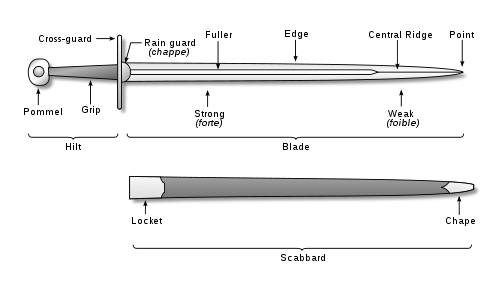
The blade may have grooves known as fullers
Fuller (weapon)
A fuller is a rounded or beveled groove or slot in the flat side of a blade . A fuller is often used to lighten the blade, much in the way that an I-beam shape allows a given amount of strength to be achieved with less material...
for lightening the blade while allowing it to retain its strength and stiffness, similar to the effect produced by a steel I-beam
I-beam
-beams, also known as H-beams, W-beams , rolled steel joist , or double-T are beams with an - or H-shaped cross-section. The horizontal elements of the "" are flanges, while the vertical element is the web...
used in construction. The blade may taper more or less sharply towards a point, used for thrusting. The part of the blade between the Center of Percussion
Center of percussion
The center of percussion is the point on an object where a perpendicular impact will produce translational and rotational forces which perfectly cancel each other out at some given pivot point, so that the pivot will not be moving momentarily after the impulse....
(CoP) and the point is called the foible (weak) of the blade, and that between the Center of Balance (CoB) and the hilt is the forte (strong). The section in between the CoP and the CoB is the middle. The ricasso
Ricasso
A ricasso is a part of sword and knife blades. It is the section just above the guard or handle. It is sometimes unsharpened and unbevelled.The first unsharpened ricassos were found on Middle Bronze Age swords...
or shoulder identifies a short section of blade immediately forward of the guard that is left completely unsharpened, and can be gripped with a finger to increase tip control. Many swords have no ricasso. On some large weapons, such as the German
Germany
Germany , officially the Federal Republic of Germany , is a federal parliamentary republic in Europe. The country consists of 16 states while the capital and largest city is Berlin. Germany covers an area of 357,021 km2 and has a largely temperate seasonal climate...
Zweihänder, a metal cover surrounded the ricasso, and a swordsman might grip it in one hand to wield the weapon more easily in close-quarter combat.
The ricasso normally bears the maker's mark
Trademark
A trademark, trade mark, or trade-mark is a distinctive sign or indicator used by an individual, business organization, or other legal entity to identify that the products or services to consumers with which the trademark appears originate from a unique source, and to distinguish its products or...
.
Tang
- In the case of a rat-tail tang, the maker welds a thin rod to the end of the blade at the crossguard; this rod goes through the grip.
- In traditional construction, Swordsmiths peenedPeeningPeening is the process of working a metal's surface to improve its material properties, usually by mechanical means such as hammer blows or by blasting with shot . Peening is normally a cold work process...
such tangs over the end of the pommel, or occasionally welded the hilt furniture to the tang and threaded the end for screwing on a pommel. This style is often referred to as a "narrow" or "hidden" tang. Modern, less traditional, replicas often feature a threaded pommel or a pommel nut which holds the hilt together and allows dismantling. - In a "full" tang (most commonly used in knives and macheteMacheteThe machete is a large cleaver-like cutting tool. The blade is typically long and usually under thick. In the English language, an equivalent term is matchet, though it is less commonly known...
s), the tang has about the same width as the blade, and is generally the same shape as the grip. In European or Asian swords sold today, many advertised "full" tangs may actually involve a forged rat-tail tang.
On Japanese blades, the maker's mark appears on the tang
Tang (weaponry)
A tang or shank is the back portion of a tool where it extends into stock material or is connected to a handle as on a knife, sword, spear, arrowhead, chisel, screwdriver, etc...
under the grip.
Single-edged blades
Single-edged blades do not fall under the term "sword" in the narrow sense (see sabreSabre
The sabre or saber is a kind of backsword that usually has a curved, single-edged blade and a rather large hand guard, covering the knuckles of the hand as well as the thumb and forefinger...
, scimitar
Scimitar
A scimitar is a backsword or sabre with a curved blade, originating in Southwest Asia .The Arabic term saif translates to "sword" in general, but is normally taken to refer to the scimitar type of curved backsword in particular.The curved sword or "scimitar" was widespread throughout the Muslim...
), but are often included in a more loose meaning of the term. These blades often have a secondary "false edge" near the tip.
Hilt
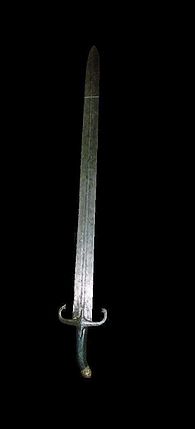
Hilt
The hilt of a sword is its handle, consisting of a guard,grip and pommel. The guard may contain a crossguard or quillons. A ricasso may also be present, but this is rarely the case...
is the collective term for the parts allowing for the handling and control of the blade; these consist of the grip, the pommel, and a simple or elaborate guard, which in post-Viking Age
Viking Age
Viking Age is the term for the period in European history, especially Northern European and Scandinavian history, spanning the late 8th to 11th centuries. Scandinavian Vikings explored Europe by its oceans and rivers through trade and warfare. The Vikings also reached Iceland, Greenland,...
swords could consist of only a crossguard
Crossguard
On a sword or some knives, the crossguard , also known as quillons, is a bar of metal at right angles to the blade, placed between the blade and the hilt. The crossguard stops the wielder from punching shields while swinging the weapon, thereby protecting the user's hand...
(called a cruciform
Cruciform
Cruciform means having the shape of a cross or Christian cross.- Cruciform architectural plan :This is a common description of Christian churches. In Early Christian, Byzantine and other Eastern Orthodox forms of church architecture this is more likely to mean a tetraconch plan, a Greek cross,...
hilt or quillons). In addition to improving the sword's balance and grip, the pommel can also be used as a blunt instrument at close range, and its weight affects the center of percussion. It may also have a sword knot or tassel. By the 17th century, with the growing use of firearms and the accompanying decline in the use of armour
Armour
Armour or armor is protective covering used to prevent damage from being inflicted to an object, individual or a vehicle through use of direct contact weapons or projectiles, usually during combat, or from damage caused by a potentially dangerous environment or action...
, many rapier
Rapier
A rapier is a slender, sharply pointed sword, ideally used for thrusting attacks, used mainly in Early Modern Europe during the 16th and 17th centuries.-Description:...
s and dueling swords had developed elaborate basket hilts, which protect the palm of the wielder and rendered the gauntlet obsolete.
The tang
Tang (weaponry)
A tang or shank is the back portion of a tool where it extends into stock material or is connected to a handle as on a knife, sword, spear, arrowhead, chisel, screwdriver, etc...
consists of the extension of the blade structure through the hilt.
Sword scabbards and suspension
Common accessories to the sword include the scabbardScabbard
A scabbard is a sheath for holding a sword, knife, or other large blade. Scabbards have been made of many materials over the millennia, including leather, wood, and metals such as brass or steel.-Types of scabbards:...
, as well as the sword belt.
- Scabbard: The scabbard, also known as the Sheath, is a protective cover often provided for the sword blade. Over the millennia, scabbards have been made of many materials, including leather, wood, and metals such as brass or steel. The metal fitting where the blade enters the leather or metal scabbard is called the throat, which is often part of a larger scabbard mount, or locket, that bears a carrying ring or stud to facilitate wearing the sword. The blade's point in leather scabbards is usually protected by a metal tip, or chape, which on both leather and metal scabbards is often given further protection from wear by an extension called a drag, or shoe.
- Sword belt: The sword belt is a beltBelt (clothing)A belt is a flexible band or strap, typically made of leather or heavy cloth, and worn around the waist. A belt supports trousers or other articles of clothing.-History:...
with an attachment for the sword, used to carry it when not in use. It is usually fixed to the scabbard of the sword, providing a fast means of drawing the sword in battle. Examples of sword belts include the Balteus used by the Roman legionary.
Typology
Swords can fall into categories of varying scope. The main distinguishing characteristics include blade shape (cross-section, taper, and length), shape and size of the hilt and pommel, age, and place of origin.The relatively comprehensive Oakeshott typology
Oakeshott typology
Ewart Oakeshott's typology of the medieval sword is based on blade morphology. It categorizes swords into 13 main types labelled X to XXII. Ewart Oakeshott introduced it in his The Archeology of Weapons: Arms and Armour from Prehistory to the Age of Chivalry in 1960.The system is a continuation of...
was created by historian and illustrator Ewart Oakeshott
Ewart Oakeshott
Ewart Oakeshott was a British illustrator, collector, and amateur historian who wrote prodigiously on medieval arms and armour. He was a Fellow of the Society of Antiquaries, a Founder Member of the Arms and Armour Society, and the Founder of the Oakeshott Institute...
as a way to define and catalogue swords based on physical form, though a rough sense of chronology is apparent. However, this typology does not set forth a prototypical definition for the longsword. Instead, it divides the broad field of weaponry into many exclusive types based on their predominant physical characteristics, including blade shape and hilt configuration. The typology also focuses on the smaller, and in some cases contemporary, single-handed swords such as the arming sword
Arming sword
The arming sword is the single handed cruciform sword of the High Middle Ages, in common use between ca. 1000 and 1500, possibly remaining in rare use into the 16th century...
.
For any other type than listed below, and even for uses other than as a weapon, see the article Sword-like object.
Single and double-edged
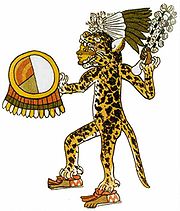
As noted above, the terms longsword
Longsword
The longsword is a type of European sword designed for two-handed use, current during the late medieval and Renaissance periods, approximately 1350 to 1550 .Longswords have long cruciform hilts with grips over 10 to 15 cm length The longsword (of which stems the variation called the bastard...
, broad sword, great sword
Great sword
The term great sword or greatsword refers to an example of any of a number of large swords used in medieval Europe:* Longsword, in both the Middle Ages and Renaissance....
, and Gaelic claymore
Claymore
The term claymore refers to the Scottish variant of the late medieval longsword, two-handed swords with a cross hilt, of which the guards were in use during the 15th and 16th centuries.-Terminology:...
are used relative to the era under consideration, and each term designates a particular type of sword.
In most Asian countries, a sword (jian
Jian
The jian is a double-edged straight sword used during the last 2,500 years in China. The first Chinese sources that mention the jian date to the 7th century BCE during the Spring and Autumn Period; one of the earliest specimens being the Sword of Goujian.Historical one-handed versions have blades...
劍, geom (검), ken/tsurugi (剣), pedang) is a double-edged straight-bladed weapon, while a knife or saber (dāo
DAO
DAO may refer to:* D-amino acid oxidase, a peroxisomal enzyme.* Data access object, a design pattern used in object-oriented software engineering* De-asphalted oil, a crude oil refinery process stream...
刀, do (도), to/katana
Katana
A Japanese sword, or , is one of the traditional bladed weapons of Japan. There are several types of Japanese swords, according to size, field of application and method of manufacture.-Description:...
(刀), pisau, golok) refers to a single-edged object. In Sikh history, the sword is held in very high esteem. A single-edged sword is called a kirpan, and its double-edged counterpart a khanda or tega.
Europeans also frequently refer to their own single-edged weapons as swords—generically backsword
Backsword
A backsword is a sword with a blade on one edge, or an "edge-and-a-quarter." The back of the sword is often the thickest part of the blade and acts to support and strengthen it....
s, including sabers. Other terms include falchion
Falchion
A falchion is a one-handed, single-edged sword of European origin, whose design is reminiscent of the Persian scimitar and the Chinese dao....
, scimitar
Scimitar
A scimitar is a backsword or sabre with a curved blade, originating in Southwest Asia .The Arabic term saif translates to "sword" in general, but is normally taken to refer to the scimitar type of curved backsword in particular.The curved sword or "scimitar" was widespread throughout the Muslim...
, cutlass
Cutlass
A cutlass is a short, broad sabre or slashing sword, with a straight or slightly curved blade sharpened on the cutting edge, and a hilt often featuring a solid cupped or basket shaped guard...
, dussack
Dussack
A Dussack is a type of short, single-edged sword from Central and Eastern Europe ....
, Messer or mortuary sword. Many of these refer to essentially identical weapons, and the varying names may relate to their use in different countries at different times. A machete
Machete
The machete is a large cleaver-like cutting tool. The blade is typically long and usually under thick. In the English language, an equivalent term is matchet, though it is less commonly known...
as a tool resembles such a single-edged sword is used to cut through thick vegetation, and many of the terms listed above describe battlefield weapons that originated as farmers' tools.
Two-handed
A two-handed sword generally refers to any sword that usually requires two hands to wield. Throughout history two-handed swords have generally been less common than their one-handed counterparts, one exception being their common use in Japan.Hand and a half sword
A Hand and a half sword, colloquially known as a "bastard sword", was a sword with an extended grip that could be used with either one or two hands. These swords did not provide a full two-hand grip but they allowed its wielders to hold a shieldShield
A shield is a type of personal armor, meant to intercept attacks, either by stopping projectiles such as arrows or redirecting a hit from a sword, mace or battle axe to the side of the shield-bearer....
or parrying dagger in their off hand, or to use it as a two-handed sword for a more powerful blow.
Crossed swords symbol
The crossed swords symbol (⚔ at UnicodeUnicode
Unicode is a computing industry standard for the consistent encoding, representation and handling of text expressed in most of the world's writing systems...
U+2694) is used to represent battleground
Battleground
A battleground is the site of a battle. It may also refer to:-Film & Television:* Battleground , a 1949 war film about the Battle of the Bulge...
s on maps. It is also used to show that person died in battle or that a war machine was lost in action. Two crossed swords also look like a Christian cross
Christian cross
The Christian cross, seen as a representation of the instrument of the crucifixion of Jesus Christ, is the best-known religious symbol of Christianity...
and the mixed symbolism has been used in military decorations, for instance in the Polish Order of the White Eagle (before 1730) and the Cross of Independence
Cross of Independence
Cross of Independence was one of the highest Polish military decorations between World Wars I and II. It was awarded to individuals who had "fought heroically for the independence of Poland," and was released in three versions.- History :...
. Several German military orders in both world wars had grades adorned with crossed swords, e.g Knight's Cross with Oak Leaves and Swords (mit Eichenlaub und Schwertern), and so was the British Order of Merit
Order of Merit
The Order of Merit is a British dynastic order recognising distinguished service in the armed forces, science, art, literature, or for the promotion of culture...
when awarded for military achievements. Crossed swords are also used in tatoos as a symbol of power, violence and death.
See also
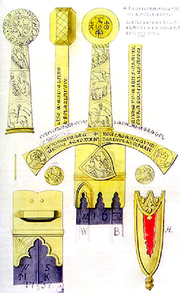
- List of swords
- Japanese swords
- Chinese swordsChinese swordsSwords have a long history in China. Stone swords were used in prehistoric times. Bronze swords have been traced back to the bronze daggers of the Shang period,. Bronze long swords suddenly appeared during the mid-third century BC. Later swords were made of iron or steel. These metals were...
- Korean swords
- SwordsmanshipSwordsmanshipSwordsmanship refers to the skills of a swordsman, a person versed in the art of the sword. The term is modern, and as such was mainly used to refer to smallsword fencing, but by extension it can also be applied to any martial art involving the use of a sword...
- Types of swordsTypes of swordsThis is a list of types of swords.The term sword is here used in a narrow sense. This is not a general list of bladed weapons and does not include the machete or similar "sword-like" weapons....
- Oakeshott typologyOakeshott typologyEwart Oakeshott's typology of the medieval sword is based on blade morphology. It categorizes swords into 13 main types labelled X to XXII. Ewart Oakeshott introduced it in his The Archeology of Weapons: Arms and Armour from Prehistory to the Age of Chivalry in 1960.The system is a continuation of...
- Sword makingSword makingSword making, historically, has been the work of specialized smiths or metalworkers called bladesmiths or swordsmiths. Swords have been made of many different materials over the centuries and with a variety of tools and techniques...
- List of sword manufacturers
- Sword replicaSword replicaSword replicas may be produced as a singular reproduction of a specific historical sword, e.g. commissioned by a museum, or they may be produced commercially in series, again either based on a specific sword, a certain historical type of sword, or an original design loosely based on historical...
- WasterWasterA waster is a practice weapon, usually a sword, and usually made out of wood, though nylon wasters are also available. The use of wood or nylon instead of metal provides an economic and safe option for initial weapons training and sparring, at some loss of genuine experience...