
All Topics  
Bodhidharma

 
Bodhidharma

   Email Print
   Bookmark   Link


Bodhidharma


Bodhidharma (c.
Circa

Circa means "in approximately", generally referring to a year. It is widely used in genealogy and historical writing, when the dates of events are approximately known....
 early 5th century CE
Common Era

Common Era, abbreviated as CE, is a designation for the calendar system most commonly used in the Western world, and also internationally, for numbering the year part of the calendar date....
) was the Buddhist
Buddhism

Buddhism is a family of beliefs and practices considered by most to be a religionand is based on the teachings attributed to Siddhartha Gautama, commonly known as "The Buddha" , who was born in what is today Nepal....
 monk
Bhikkhu

A Bhikkhu , Bhiksu is a fully ordained male Buddhism monastic. Female monastics are called Bhikkhunis . Bhikkhus and Bhikkhunis keep many precepts: they live by the vinaya's framework of monastic discipline, the basic rules of which are called the patimokkha....
 traditionally credited as the transmitter of Zen
Zen

Zen is a school of Mahayana Buddhism, referred to in Chinese as Ch?n. Ch?n is itself derived from the Sanskrit Dhyana, which means "meditation" ....
 to China.


Discussion
Ask a question about 'Bodhidharma'
Start a new discussion about 'Bodhidharma'
Answer questions from other users
Full Discussion Forum


Encyclopedia


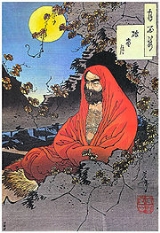
Bodhidharmayoshitoshi1887

Bodhidharma, woodblock
Woodblock printing

Woodblock printing is a technique for printing text, or patterns used widely throughout East Asia and originating in China in antiquity as a method of printing on textiles and later paper....
 print by Yoshitoshi
Yoshitoshi

Tsukioka Yoshitoshi was a Japanese artist.He is widely recognized as the last great master of Ukiyo-e, a type of Japanese woodblock printing....
, 1887.
Names (details)
Known in English as:Bodhidharma
Sanskrit
Sanskrit

Sanskrit is a historical Indo-Aryan language, one of the liturgical languages of Hinduism and Buddhism, and one of the 22 official languages of India....
:
????????
Simplified Chinese:????
Traditional Chinese:????
Chinese abbreviation:??
Hanyu Pinyin:Pútídámó
Wade-Giles
Wade-Giles

Wade-Giles , sometimes abbreviated Wade, is a Romanization system for the Mandarin Chinese language used in Beijing. It developed from a system produced by Thomas Francis Wade in the mid-19th century, and reached settled form with Herbert Giles' Chinese language-English language dictionary of 1892....
:
P'u-t'i-ta-mo
Japanese
Japanese language

IPA: [n?iho?go] is a language spoken by over 130 million people in Japan and in Japanese emigrant communities. It is related to the Ryukyuan languages....
:
?? Daruma
Korean
Korean language

Korean is the official language of North Korea and South Korea. It is also one of the two official languages in the Yanbian Korean Autonomous Prefecture in People's Republic of China....
:
?? Dalma
Vietnamese
Vietnamese language

Vietnamese , formerly known under French colonization as Annamese , is the national language and official language language of Vietnam. It is the mother tongue of the Vietnamese people , who constitute 86% of Demographics of Vietnam, and of about three million overseas Vietnamese, most of whom live in the United States....
:
B?-d?-d?t-ma
Thai
Thai language

Thai , is the national language and official language language of Thailand and the mother tongue of the Thai people, Thailand's dominant ethnic group....
:
??????? Takmor
Malay
Malay language

The Malay language is an Austronesian languages spoken by the Malays and people of other ethnic groups who reside in Peninsular Malaysia, southern Thailand, Singapore, central eastern Sumatra, the Riau Islands and parts of the coast of Borneo....
:
Dharuma
Tibetan
Tibetan language

The Tibetan languages are a cluster of mutually unintelligible Tibeto-Burman languages spoken primarily by Tibetan peoples who live across a wide area of eastern Central Asia bordering South Asia, including the Tibetan Plateau and the northern Indian subcontinent in Baltistan, Ladakh, Nepal, Sikkim, and Bhutan....
:
????????????? Bodhidharmottara
Bodhidharma (c.
Circa

Circa means "in approximately", generally referring to a year. It is widely used in genealogy and historical writing, when the dates of events are approximately known....
 early 5th century CE
Common Era

Common Era, abbreviated as CE, is a designation for the calendar system most commonly used in the Western world, and also internationally, for numbering the year part of the calendar date....
) was the Buddhist
Buddhism

Buddhism is a family of beliefs and practices considered by most to be a religionand is based on the teachings attributed to Siddhartha Gautama, commonly known as "The Buddha" , who was born in what is today Nepal....
 monk
Bhikkhu

A Bhikkhu , Bhiksu is a fully ordained male Buddhism monastic. Female monastics are called Bhikkhunis . Bhikkhus and Bhikkhunis keep many precepts: they live by the vinaya's framework of monastic discipline, the basic rules of which are called the patimokkha....
 traditionally credited as the transmitter of Zen
Zen

Zen is a school of Mahayana Buddhism, referred to in Chinese as Ch?n. Ch?n is itself derived from the Sanskrit Dhyana, which means "meditation" ....
 to China. Very little contemporary biographical information on Bodhidharma is extant, and subsequent accounts became layered with legend, but most accounts agree that he was a South India
South India

South India is the area encompassing India's states of Andhra Pradesh, Karnataka, Kerala and Tamil Nadu as well as the Union territories of India of Lakshadweep and Pondicherry, occupying 19.31% of area....
n Pallava
Pallava

The Pallava kingdom was an ancient South Indian Tamil people kingdom with their capital at Kanchipuram. They rose in power during the reign of Mahendravarman I and Narasimhavarman I and dominated the Telugu people and northern parts of Ancient Tamil country region for about six hundred years until the end of the 9th century....
 prince-turned-monk who journeyed to Southern China and subsequently relocated northwards. The accounts differ on the date of his arrival, with one early account claiming that he arrived during the Liú Sòng Dynasty
Liu Song Dynasty

The Song Dynasty was first of the four Southern Dynasties in China, followed by the Southern Qi Dynasty.It was founded by Emperor Wu of Liu Song ?? , whose surname together with "Song" forms the most commonly used name for the dynasty, the Liu Song ??....
 (420–479) and later accounts dating his arrival to the Liáng Dynasty
Liang Dynasty

Liang Dynasty , also known as Southern Liang Dynasty , was the third of Southern dynasties in China, followed by the Chen Dynasty. Western Liang Dynasty , with its capital established at Jiangling in 555 by Emperor Xuan of Western Liang, a grandson of Liang's founder Emperor Wu of Liang, claimed to be the legitimate successor of...
 (502–557). Bodhidharma was primarily active in the lands of the Northern Wèi Dynasty
Northern Wei

The Northern Wei Dynasty , also known as the Tuoba Wei , Later Wei , or Yuan Wei , was "part of an era of political turbulence and intense social and cultural change"....
 (386–534). Modern scholarship dates him to about the early 5th century.

Biography


Contemporary accounts

There are two known extant accounts written by contemporaries of Bodhidharma.

Yáng Xuànzhi

The Record of the Buddhist Monasteries of Luoyang
Luoyang

Luoyang is a prefecture-level city in western Henan province of China, People's Republic of China. It borders the provincial capital of Zhengzhou to the east, Pingdingshan to the southeast, Nanyang to the south, Sanmenxia to the west, Jiyuan to the north, and Jiaozuo to the northeast....
 (????? Luòyáng Qiélánjì), was compiled in 547 by Yáng Xuànzhi
Yang Xuanzhi

Yang Xuanzhi was a China writer and translator of Mahayana Buddhist texts into the Chinese language, during the 6th century, under the Northern Wei Dynasty....
, a writer and translator of Mahayana
Mahayana

Mahayana is one of the two main existing schools of Buddhism and a term for classification of Buddhist philosophy and practice. It was History of Buddhism in India....
 Buddhist texts into the Chinese language.
At that time there was a monk of the Western Region named Bodhidharma, a Persian Central Asian. He traveled from the wild borderlands to China. Seeing the golden disks [on the pole on top of Yung-ning's stupa
Stupa

A stupa is a mound-like structure containing Buddhist relics, once thought to be places of Buddhist worship, typically the remains of a Buddha or saint....
] reflecting in the sun, the rays of light illuminating the surface of the clouds, the jewel-bells on the stupa blowing in the wind, the echoes reverberating beyond the heavens, he sang its praises. He exclaimed: "Truly this is the work of spirits." He said: "I am 150 years old, and I have passed through numerous countries. There is virtually no country I have not visited. But even in India
India

India, officially the Republic of India , is a country in South Asia. It is the List of countries and outlying territories by total area country by geographical area, the List of countries by population country, and the most populous liberal democracy in the world....
 there is nothing comparable to the pure beauty of this monastery. Even the distant Buddha realms lack this." He chanted homage and placed his palms together in salutation for days on end.
dates Bodhidharma's presence in Luoyang to between 516 and 526, when the temple referred to—Yongníngsì—was at the height of its glory. Starting in 526, Yongníngsì suffered damage from a series of events, ultimately leading to its destruction in 534.

Tánlín

The second account was written by Tánlín (??; 506–574). Tánlín's brief biography of the "Dharma Master" is found in his preface to the Two Entrances and Four Acts, a text traditionally attributed to Bodhidharma, and the first text to identify Bodhidharma as South Indian
South India

South India is the area encompassing India's states of Andhra Pradesh, Karnataka, Kerala and Tamil Nadu as well as the Union territories of India of Lakshadweep and Pondicherry, occupying 19.31% of area....
:
The Dharma Master was a South Indian of the Western Region. He was the third son of a great Indian king of the Pallava
Pallava

The Pallava kingdom was an ancient South Indian Tamil people kingdom with their capital at Kanchipuram. They rose in power during the reign of Mahendravarman I and Narasimhavarman I and dominated the Telugu people and northern parts of Ancient Tamil country region for about six hundred years until the end of the 9th century....
 dynasty. His ambition lay in the Mahayana
Mahayana

Mahayana is one of the two main existing schools of Buddhism and a term for classification of Buddhist philosophy and practice. It was History of Buddhism in India....
 path, and so he put aside his white layman's robe for the black robe of a monk [...] Lamenting the decline of the true teaching in the outlands, he subsequently crossed distant mountains and seas, traveling about propagating the teaching in Han and Wei.
Tánlín's account was the first to mention that Bodhidharma attracted disciples, specifically mentioning Dàoyù and Huìke
Huike

Dazu Huike is considered the Second Patriarch of Chinese Ch?n and the twenty-ninth since Gautama Buddha....
, the latter of whom would later figure very prominently in the Bodhidharma literature.

Tánlín has traditionally been considered a disciple of Bodhidharma, but it is more likely that he was a student of Huìke, who in turn was a student of Bodhidharma.

Later accounts


Dàoxuan
In the 7th-century historical work Further Biographies of Eminent Monks (???? Xù gaoseng zhuàn), Dàoxuan (??; 596-667) possibly drew on Tanlin's preface as a basic source, but made several significant additions:
Bodhidarma
Firstly, Dàoxuan adds more detail concerning Bodhidharma's origins, writing that he was of "South Indian Brahman
Brahmin

Brahmin is the class of educators, law makers, scholars and preachers of Dharma in Hinduism. It is said to occupy the highest position among the varna in Hinduism of Hinduism....
 stock" (??????? nán tianzhú póluómén zhong).

Secondly, more detail is provided concerning Bodhidharma's journeys. Tanlin's original is imprecise about Bodhidharma's travels, saying only that he "crossed distant mountains and seas" before arriving in Wei. Dàoxuan's account, however, implies "a specific itinerary": "He first arrived at Nan-yüeh
Nanyue

Nanyue was an ancient kingdom that consisted of parts of the modern Chinese provinces of Guangdong, Guangxi, Yunnan and much of modern northern Vietnam....
 during the Sung period. From there he turned north and came to the Kingdom of Wei". This implies that Bodhidharma had travelled to China by sea, and that he had crossed over the Yangtze River
Yangtze River

The Yangtze River, or Chang Jiang , is the longest river in China and Asia, and the List of rivers by length in the world, after the Nile in Africa and the Amazon River in South America....
.

Thirdly, Dàoxuan suggests a date for the Bodhidharma's arrival in China. He writes that Bodhidharma makes landfall in the time of the Song
Liu Song Dynasty

The Song Dynasty was first of the four Southern Dynasties in China, followed by the Southern Qi Dynasty.It was founded by Emperor Wu of Liu Song ?? , whose surname together with "Song" forms the most commonly used name for the dynasty, the Liu Song ??....
, thus making his arrival no later than the time of the Song's fall to the Southern Qi Dynasty
Southern Qi

The Southern Qi Dynasty ?? was the second of the Southern dynasties in China, followed by the Liang Dynasty. During its 23-year history, the dynasty was largely filled with instability, as after the death of the capable Emperor Gao of Southern Qi and Emperor Wu of Southern Qi, Emperor Wu's grandson Xiao Zhaoye was assassinated by Emperor W...
 in 479.

Finally, Dàoxuan provides information concerning Bodhidharma's death. Bodhidharma, he writes, died at the banks of the Luo River, where he was interred by his disciple Huike
Huike

Dazu Huike is considered the Second Patriarch of Chinese Ch?n and the twenty-ninth since Gautama Buddha....
, possibly in a cave. According to Dàoxuan's chronology, Bodhidharma's death must have occurred prior to 534, the date of the Northern Wei Dynasty's fall, because Huike subsequently leaves Luoyang for Ye
Ye

Ye can refer to:* Ye , a form of the second-person, Personal_pronoun "you"* Archaic spelling of the definite Article_ "?e" , used by early printers when the obsolescent letter "?" was not available....
. Furthermore, citing the shore of the Luo River as the place of death might possibly suggest that Bodhidharma died in the mass executions at Heyin
Emperor Xiaozhuang of Northern Wei

Emperor Xiaozhuang of Northern Wei , personal name Yuan Ziyou , was an emperor of the History of China/Xianbei dynasty Northern Wei. He was placed on the throne by the general Erzhu Rong, who refused to recognize the young emperor Yuan Zhao that Emperor Xiaoming of Northern Wei's mother Empress Dowager Hu placed on the throne after s...
 in 528. Supporting this possibility is a report in the Taisho shinshu daizokyo
Chinese Buddhist canon

The Chinese Buddhist Canon , which means Great Treasury of Scriptures, is the total body of Buddhist literature deemed canonical in China, Korea and Japan....
 stating that a Buddhist monk was among the victims at Heyin.

Epitaph for Farú
The idea of a patriarchal lineage
Lineage (Buddhism)

A lineage in Buddhism is a record of teachers and their disciples, or students. Several branches of Buddhism, including Zen and Tibetan Buddhism maintain records of their historical teachers who, according to the traditional history of that school, have passed the Dharma, or Buddhist teachings, from generation to generation in an unbroken lin...
 in Chán dates back to the epitaph
Epitaph

An epitaph is a short text honoring a deceased person, strictly speaking that inscribed on their tombstone or plaque, but also used figuratively....
 for Farú (?? 638–689), a disciple of the 5th patriarch Hóngren (?? 601–674), which gives a line of descent identifying Bodhidharma as the first patriarch.

Yongjia Xuánjué
According to the Song of Enlightenment (??? Zhèngdào ge) by Yongjia Xuánjué (665-713)—one of the chief disciples of Huìnéng
Huineng

Dajian Hu?n?ng was a China Zen monastic who is one of the most important figures in the entire tradition. Huineng is the Sixth Patriarch of Ch?n Buddhism, as well as the last official patriarch....
, sixth Patriarch of Chán—Bodhidharma was the 28th Patriarch of Buddhism in a line of descent from Sakyamuni Buddha via his disciple Mahakasyapa
Mahakasyapa

Mahakasyapa or Kasyapa was a brahman of Magadha, who became one of the principal disciples of Shakyamuni Buddha Buddha and who convened and directed the first Buddhist Councils....
, and the first Patriarch of Chán:
Mahakashyapa was the first, leading the line of transmission;
Twenty-eight Fathers followed him in the West;
The Lamp was then brought over the sea to this country;
And Bodhidharma became the First Father here
His mantle, as we all know, passed over six Fathers,
And by them many minds came to see the Light.
The idea of a line of descent from Sakyamuni Buddha is the basis for the distinctive lineage tradition of the Chán school.

Anthology of the Patriarchal Hall

In the Anthology of the Patriarchal Hall (??? Zutángjí) of 952, the elements of the traditional Bodhidharma story are in place. Bodhidharma is said to have been a disciple of Prajñatara
Prajnatara

Praj?adhara was the twenty-seventh patriarch of Indian Buddhism, according to the Chinese Zen lineage. He traveled around India preaching the Gautama Buddha's teachings....
, thus establishing the latter as the 27th patriarch in India. After a three-year journey, Bodhidharma reaches China in 527 during the Liang Dynasty
Liang Dynasty

Liang Dynasty , also known as Southern Liang Dynasty , was the third of Southern dynasties in China, followed by the Chen Dynasty. Western Liang Dynasty , with its capital established at Jiangling in 555 by Emperor Xuan of Western Liang, a grandson of Liang's founder Emperor Wu of Liang, claimed to be the legitimate successor of...
 (as opposed to the Song period of the 5th century, as in Dàoxuan). The Anthology of the Patriarchal Hall includes Bodhidharma's encounter with Emperor Wu, which was first recorded around 758 in the appendix to a text by Shen-hui, a disciple of Huineng.

Finally, as opposed to Daoxuan's figure of "over 150 years," the Anthology of the Patriarchal Hall states that Bodhidharma died at the age of 150. He was then buried on Mount Xiong'er (??? Xióng'er Shan) to the west of Luoyang. However, three years after the burial, in the Pamir Mountains
Pamir Mountains

The Pamir Mountains are a mountain range in Central Asia formed by the junction or knot of the Tian Shan, Karakoram, Kunlun Mountains, and Hindu Kush ranges....
, Sòngyún—an official of one of the later Wei kingdoms—encountered Bodhidharma, who claimed to be returning to India and was carrying a single sandal. Bodhidharma predicted the death of Songyun's ruler, a prediction which was borne out upon the latter's return. Bodhidharma's tomb was then opened, and only a single sandal was found inside.

Insofar as, according to the Anthology of the Patriarchal Hall, Bodhidharma left the Liang court in 527 and relocated to Mount Song
Mount Song

Mount Song, known in Mandarin as Song Shan , is one of the Taoism Sacred Mountains of China and is located in Henan province on the south bank of the Yellow River in China....
 near Luoyang and the Shaolin Monastery, where he "faced a wall for nine years, not speaking for the entire time", his date of death can have been no earlier than 536. Moreover, his encounter with the Wei official indicates a date of death no later than 554, three years before the fall of the last Wei kingdom.

Dàoyuán
Subsequent to the Anthology of the Patriarchal Hall, the only dated addition to the biography of Bodhidharma is in the 1004 Jingde Records of the Transmission of the Lamp (????? Jingdé chuándeng lù), by Dàoyuán, where it is stated that Bodhidharma's original name had been Bodhitara but had been changed by his master Prajñatara.

After death
Soon after his death, someone supposedly witnessed Bodhidharma walking back towards India barefoot and with a single shoe in hand. His grave was later exhumed, and according to legend, the only thing found in it was the shoe he left behind.
For nine years he had remained and nobody knew him;
Carrying a shoe in hand he went home quietly, without ceremony.


Modern scholarship


Bodhidharma's origins

Though Dàoxuan wrote that Bodhidharma was "of South Indian Brahman
Brahmin

Brahmin is the class of educators, law makers, scholars and preachers of Dharma in Hinduism. It is said to occupy the highest position among the varna in Hinduism of Hinduism....
 stock," notes that Bodhidharma's royal pedigree implies that he was of the Kshatriya
Kshatriya

Kshatriya is one of the four varna in Hinduism in Hinduism. It constitutes the military and ruling order of the traditional Vedic-Hindu social system as outlined by the Vedas and the Laws of Manu....
 warrior caste. argued that the Pallava
Pallava

The Pallava kingdom was an ancient South Indian Tamil people kingdom with their capital at Kanchipuram. They rose in power during the reign of Mahendravarman I and Narasimhavarman I and dominated the Telugu people and northern parts of Ancient Tamil country region for about six hundred years until the end of the 9th century....
 dynasty was Brahmin by origin but Kshatriya by profession, and proposed that Bodhidharma was born a prince of the Pallava dynasty in their capital of Kanchipuram
Kanchipuram

Kanchipuram, Kanchi, or Kancheepuram is a city and a municipality in Kanchipuram district in the Indian States and territories of India of Tamil Nadu....
.

Yáng Xuànzhi's eyewitness account identifies Bodhidharma as a Persian
Persian people

Persian identity, at least in terms of language, is traced to the ancient Indo-Iranians , who arrived in parts of Greater Iran circa 2000-1500 BCE....
 (????? bo-si guó hú rén) from Central Asia
Central Asia

Central Asia is a region of Asia from the Caspian Sea in the west to central China in the east, and from southern Russia in the north to northern India in the south....
 (?? xi yù), and notes that an Iranian Buddhist monk making his way to North China via the Silk Road is more likely than that of a South Indian master making his way by sea. also states that the language Yang uses in his description of Bodhidharma is specifically associated with "Central Asia and particularly to peoples of Iranian extraction" and that of "an Iranian speaker who hailed from somewhere in Central Asia". However, notes that Yáng may have actually been referring to another monk named Boddhidharma, not related to the historical founder of Chan Buddhism.

Bodhidharma known in Chinese as 'Dat-Mo' was the 28th Patriarch in the dhyana (Sanskrit for meditation and hence Ch'an and Zen) Buddhist tradition of India.He had been invited to China by the Emperor Wu, an ardent Buddhist. Bodhidharma later retired to the Shaolin Temple, and according to legend instructed the Monks there in a series of exercises that went on to form the basis of Shaolin Temple 'boxing'. Variously, these exercises are recorded as martial arts techniques and forms from Kerala
Kerala

Kerala is a Indian Union States and territories of India located in the southwestern part of India. With an Arabian Sea coastline on the west, it is bordered on the north by Karnataka and by Tamil Nadu on the south and east....
, or, simply calisthenics, as identified in the 'I Chin Ching' or "Muscle Changing Classic". Extant wall paintings and murals at the Honan Shaolin Temple in Northeast China show ethnic Indian Monks sparring and training in boxing skills with Chinese Monks, evidence sometimes presented as supporting the view that Bodhidharma's exercises were in fact martial arts - the martial arts of his homeland - Kerala
Kerala

Kerala is a Indian Union States and territories of India located in the southwestern part of India. With an Arabian Sea coastline on the west, it is bordered on the north by Karnataka and by Tamil Nadu on the south and east....
 .

Bodhidharma's name

notes that "Bodhidharma’s name appears sometimes truncated as Bodhi, or more often as Dharma (Ta-mo). In the first case, it may be confused with another of his rivals, Bodhiruci."

Tibetan sources give his name as "Bodhidharmottara" or "Dharmottara", that is, "Highest teaching (dharma) of enlightenment".

Practice and teaching


Meditation

Tanlin, in the preface to Two Entrances and Four Acts, and Daoxuan, in the Further Biographies of Eminent Monks, mention a practice of Bodhidharma's termed "wall-gazing" (?? bìguan). Both Tanlin and Daoxuan associate this "wall-gazing" with "quieting [the] mind" (?? an xin). Elsewhere, Daoxuan also states: "The merits of Mahayana wall-gazing are the highest". These are the first mentions in the historical record of what may be a type of meditation
Buddhist meditation

Buddhist meditation encompasses a variety of meditation techniques that develop mindfulness, samadhi, samatha and vipassana. Core meditation techniques are preserved in ancient Buddhist texts and have proliferated and diversified through the millennia of teacher-student transmissions....
 being ascribed to Bodhidharma. In the Two Entrances and Four Acts, traditionally attributed to Bodhidharma, the term "wall-gazing" also appears:
Those who turn from delusion back to reality, who meditate on walls, the absence of self and other, the oneness of mortal and sage, and who remain unmoved even by scriptures are in complete and unspoken agreement with reason.
Exactly what sort of practice Bodhidharma's "wall-gazing" was remains uncertain. Nearly all accounts have treated it either as an undefined variety of meditation, as Daoxuan and Dumoulin, or as a variety of seated meditation akin to the zazen
Zazen

Zazen is at the heart of Zen Buddhism practice. The aim of zazen is just sitting, "opening the hand of thought". This is done either through koans, Rinzai's primary method, or whole-hearted sitting , the Soto sect's method....
 (??; Chinese: zuòchán) that later became a defining characteristic of Chán; the latter interpretation is particularly common among those working from a Chán standpoint. There have also, however, been interpretations of "wall-gazing" as a non-meditative phenomenon.

The La?kavatara Sutra

The La?kavatara Sutra
Lankavatara Sutra

The is a sutra of Mahayana Buddhism. According to tradition, these are the actual words of the Gautama Buddha as he entered Sri Lanka and conversed with a bodhisattva named Mahamati....
, one of the Mahayana Buddhist
Mahayana sutras

Mahayana sutras are a very broad genre of Buddhism scriptures of which the Mahayana Buddhist tradition claim that they are original teachings of the Gautama Buddha....
 sutras
Sutra

Sutra , literally means a rope or thread that holds things together, and more metaphorically refers to an aphorism , or a collection of such aphorisms in the form of a manual....
, is a highly "difficult and obscure" text whose basic thrust is to emphasize "the inner enlightenment
Bodhi

Bodhi is both the Pali and Sanskrit word traditionally translated into English language as "enlightenment." The word "Buddhahood" means "one who has achieved bodhi." Bodhi is also frequently translated as "awakening."...
 that does away with all duality and is raised above all distinctions". It is among the first and most important texts in the Yogacara
Yogacara

Yogacara The orientation of the Yogacara school is largely consistent with the thinking of the Pali Nikayas. It frequently treats later developments in a way that realigns them earlier versions of Buddhist doctrines....
, or "Consciousness-only
Consciousness-only

In Buddhism, consciousness-only or mind-only is a theory according to which unenlightened conscious experience is nothing but false discriminations or imaginations....
", school of Mahayana Buddhism.

One of the recurrent emphases in the La?kavatara Sutra is a lack of reliance on words to effectively express reality:
If, Mahamati, you say that because of the reality of words the objects are, this talk lacks in sense. Words are not known in all the Buddha-lands; words, Mahamati, are an artificial creation. In some Buddha-lands ideas are indicated by looking steadily, in others by gestures, in still others by a frown, by the movement of the eyes, by laughing, by yawning, or by the clearing of the throat, or by recollection, or by trembling.


In contrast to the ineffectiveness of words, the sutra instead stresses the importance of the "self-realization" that is "attained by noble wisdom" and occurs "when one has an insight into reality as it is": "The truth is the state of self-realization and is beyond categories of discrimination". The sutra goes on to outline the ultimate effects of an experience of self-realization:
[The Bodhisattva
Bodhisattva

In the Buddhist context, a bodhisattva means either "enlightened existence " or "enlightenment-being" or, given the variant Sanskrit spelling satva rather than sattva, "heroic-minded one for enlightenment "....
] will become thoroughly conversant with the noble truth of self-realization, will become a perfect master of his own mind, will conduct himself without effort, will be like a gem reflecting a variety of colours, will be able to assume the body of transformation, will be able to enter into the subtle minds of all beings, and, because of his firm belief in the truth of Mind-only, will, by gradually ascending the stages, become established in Buddhahood.
One of the fundamental Chán texts attributed to Bodhidharma is a four-line stanza whose first two verses echo the La?kavatara Sutras disdain for words and whose second two verses stress the importance of the insight into reality achieved through "self-realization":
A special transmission outside the scriptures,
Not founded upon words and letters;
By pointing directly to [one's] mind
It lets one see into [one's own true] nature and [thus] attain Buddhahood.
The stanza, in fact, is not Bodhidharma's, but rather dates to the year 1108. Nonetheless, there are earlier texts which explicitly associate Bodhidharma with the
La?kavatara Sutra. Daoxuan, for example, in a late recension of his biography of Bodhidharma's successor Huike, has the sutra as a basic and important element of the teachings passed down by Bodhidharma:
In the beginning Dhyana Master Bodhidharma took the four-roll La?ka Sutra, handed it over to Huike, and said: "When I examine the land of China, it is clear that there is only this sutra. If you rely on it to practice, you will be able to cross over the world."
Another early text, the Record of the Masters and Disciples of the La?kavatara Sutra (????? Léngqié shizi jì) of Jìngjué (??; 683–750), also mentions Bodhidharma in relation to this text. Jingjue's account also makes explicit mention of "sitting meditation", or zazen:
For all those who sat in meditation, Master Bodhi[dharma] also offered expositions of the main portions of the La?kavatara Sutra, which are collected in a volume of twelve or thirteen pages, [...] bearing the title of Teaching of [Bodhi-]Dharma.
In other early texts, the school that would later become known as Chán is sometimes referred to as the "La?kavatara school" (??? Léngqié zong).

Portrayals of Bodhidharma

Throughout Buddhist art
Buddhist art

Buddhist art originated on the Indian subcontinent following the historical life of Gautama Buddha, 6th to 5th century BCE, and thereafter evolved by contact with other cultures as it spread throughout Asia and the world....
, Bodhidharma is depicted as a rather ill-tempered, profusely bearded and wide-eyed barbarian. He is described as "The Blue-Eyed Barbarian
Barbarian

"Barbarian" is a pejorative term for an uncivilized person, either in a general reference to a member of a nation or ethnos, typically a tribal society as seen by an urban civilization either viewed as inferior, or admired as a noble savage....
" ?????? (lán yanjingde yerén) in Chinese texts.

The
Anthology of the Patriarchal Hall (952) identifies Bodhidharma as the 28th Patriarch of Buddhism in an uninterrupted line that extends all the way back to the Buddha
Gautama Buddha

Siddhartha Gautama was a Spirituality teacher in the northern region of the Indian subcontinent who founded Buddhism. He is generally seen by Buddhists as the Supreme Buddhahood of our age....
 himself. D.T. Suzuki contends that Chán's growth in popularity during the 7th and 8th centuries attracted criticism that it had "no authorized records of its direct transmission from the founder of Buddhism" and that Chán historians made Bodhidharma the 28th patriarch of Buddhism in response to such attacks.

Legends


Bodhidharma and martial arts

The
Yi Jin Jing
Yì Jin Jing

The Y? Jin Jing is a q?gong manual most notable as the source of the attribution of Shaolin Kung Fu to Bodhidharma, though this has been doubted by several martial arts historians....
credits Shaolin Kung Fu
Shaolin kung fu

'Shaolin Kung Fu' refers to a collection of Chinese martial arts that claim affiliation with the Shaolin Monastery. Of the tens of thousands of kung fu wushu styles, several hundred might have some relationship to Shaolin; however, aside from a few very well known systems, such as Xiao Hong Quan, the Da Hong Quan, Yin Shou Gun, D...
 to Bodhidharma, which would make him an important influence on Asian martial arts in general. Bodhidharma is remembered in the Kerala
Kerala

Kerala is a Indian Union States and territories of India located in the southwestern part of India. With an Arabian Sea coastline on the west, it is bordered on the north by Karnataka and by Tamil Nadu on the south and east....
 Region of Southern India (the Homeland of Kalari
Kalari

Kalari is the Malayalam word for the kind of Gym where Kalarippayattu, a martial art from Kerala, is practiced. Kalari translates as "threshing floor" or "battlefield". ...
) as both a lineage Kalari Master and as the Father of Han-Chinese Shaolin Kung Fu. However, both the attribution of Shaolin Kung Fu to Bodhidharma and the authenticity of the
Yi Jin Jing itself have been discredited by historians including Tang Hao, Xu Zhen and Matsuda Ryuchi. This argument is summarized by modern historian Lin Boyuan in his Zhongguo wushu shi as follows:

The oldest available copy was published in 1827 and the composition of the text itself has been dated to 1624. Even then, the association of Bodhidharma with martial arts only becomes widespread as a result of the 1904–1907 serialization of the novel
The Travels of Lao Ts'an in Illustrated Fiction Magazine.

Huiguang and Sengchou were expert in the martial arts before they became two of the very first Shaolin monks—years before the arrival of Bodhidharma. The
Taisho Tripi?aka
Chinese Buddhist canon

The Chinese Buddhist Canon , which means Great Treasury of Scriptures, is the total body of Buddhist literature deemed canonical in China, Korea and Japan....
documents Sengchou's skill with the tin staff.

Bodhidharma is associated with the idea that spiritual, intellectual and physical excellence are an indivisible whole necessary for enlightenment. Such an approach to enlightenment ultimately proved highly attractive to the Samurai
Samurai

is the term for the military nobility of Pre-industrial society Japan. According to translator William Scott Wilson: "In Chinese, the character ? was originally a verb meaning to wait upon or accompany a person in the upper ranks of society, and this is also true of the original term in Japanese, saburau....
 class in Japan
Japan

Japan is an island country in East Asia. Located in the Pacific Ocean, it lies to the east of the Sea of Japan, People's Republic of China, North Korea, South Korea and Russia, stretching from the Sea of Okhotsk in the north to the East China Sea and Taiwan in the south....
, who made Zen
Zen

Zen is a school of Mahayana Buddhism, referred to in Chinese as Ch?n. Ch?n is itself derived from the Sanskrit Dhyana, which means "meditation" ....
 their way of life, following their encounter with the martial-arts-oriented Chán Lingji School introduced to Japan
Japan

Japan is an island country in East Asia. Located in the Pacific Ocean, it lies to the east of the Sea of Japan, People's Republic of China, North Korea, South Korea and Russia, stretching from the Sea of Okhotsk in the north to the East China Sea and Taiwan in the south....
 by Eisai
Eisai

Myoan Eisai was a Japanese Buddhism priest, credited with bringing the Rinzai school of Zen Buddhism and green tea from China to Japan. He is often known simply as Eisai Zenji , literally "Zen master Eisai"....
 in the 12th century.

Yet in some versions of his legend, Bodhidharma's focus was so single-minded during his nine years of meditation that his legs atrophied.

In Southeast Asia

In the Malay Peninsula
Malay Peninsula

The Malay Peninsula or Thai-Malay Peninsula is a major peninsula located in Southeast Asia. It is also known as the Kra Peninsula and runs approximately north-south through the Kra Isthmus....
, Bodhidharma was believed to have been a Buddhist monk from South India
South India

South India is the area encompassing India's states of Andhra Pradesh, Karnataka, Kerala and Tamil Nadu as well as the Union territories of India of Lakshadweep and Pondicherry, occupying 19.31% of area....
 who came to Palembang
Palembang

Palembang is a city of 1,286,000 in the south of the Indonesian island of Sumatra. It is the capital of the Provinces of Indonesia of South Sumatra and its metropolitan area includes more than 1,730,000 people....
 by boat. He spent a significant amount of time there before journeying north into Malaysia
Malaysia

Malaysia is a federation that consists of States of Malaysia in Southeast Asia with a total landmass of . The capital city is Kuala Lumpur, while Putrajaya is the seat of the federal government....
 and Siam. He travelled throughout the Indo-chinese
Indochina

Indochina, or the Indochinese Peninsula, is a subregion in Southeast Asia. It lies roughly east of India, south of China.The word has French origins, Indochine, and was adopted when French colonizers in Vietnam began expanding their territory to bordering countries....
 region bringing his knowledge of both Buddhism
Buddhism

Buddhism is a family of beliefs and practices considered by most to be a religionand is based on the teachings attributed to Siddhartha Gautama, commonly known as "The Buddha" , who was born in what is today Nepal....
 and martial arts
Martial arts

Martial arts are systems of codified practices and traditions of training for combat. While they may be studied for various reasons, martial arts share a single objective: to physically defeat other persons and to defend oneself or others from physical threat....
 before eventually reaching China
China

China is a Culture of China, an ancient civilization, and, depending on perspective, a national or multinational entity extending over a large area in East Asia....
.

Encounter with Emperor Liang

According to the
Anthology of the Patriarchal Hall, in 527 during the Liang Dynasty
Liang Dynasty

Liang Dynasty , also known as Southern Liang Dynasty , was the third of Southern dynasties in China, followed by the Chen Dynasty. Western Liang Dynasty , with its capital established at Jiangling in 555 by Emperor Xuan of Western Liang, a grandson of Liang's founder Emperor Wu of Liang, claimed to be the legitimate successor of...
, Bodhidharma, the first Patriarch of Chán, visited the Emperor Wu, a fervent patron of Buddhism. The emperor asked Bodhidharma, "What is the highest meaning of noble truth?" Bodhidharma answered, "There is no noble truth." The emperor then asked Bodhidharma, "Who is standing before me?" Bodhidharma answered, "I don't know." The emperor then asked Bodhidharma, "How much karmic merit have I earned by ordaining Buddhist monks, building monasteries, having sutras copied, and commissioning Buddha images?" Bodhidharma answered, "None."

From then on, the emperor refused to listen to whatever Bodhidharma had to say. Although Bodhidharma came from India
India

India, officially the Republic of India , is a country in South Asia. It is the List of countries and outlying territories by total area country by geographical area, the List of countries by population country, and the most populous liberal democracy in the world....
 to China
China

China is a Culture of China, an ancient civilization, and, depending on perspective, a national or multinational entity extending over a large area in East Asia....
 to become the first patriarch of China
China

China is a Culture of China, an ancient civilization, and, depending on perspective, a national or multinational entity extending over a large area in East Asia....
, the emperor refused to recognize him. Since he refused to believe in what Bodhidharma told him, he practically missed his chance to come face to face with someone who was important to Buddhism
Buddhism

Buddhism is a family of beliefs and practices considered by most to be a religionand is based on the teachings attributed to Siddhartha Gautama, commonly known as "The Buddha" , who was born in what is today Nepal....
. Bodhidharma knew that he would face difficulty in the near future, but had the emperor been able to leave the throne and yield it to someone else, he could have avoided his fate of starving to death.

According to the teaching, Emperor Wu's past life was as a bhikshu. While he cultivated in the mountains, a monkey would always steal and eat the things he planted for food, as well as the fruit in the trees. One day, he was able to trap the monkey in a cave and blocked the entrance of the cave with rocks, hoping to teach the monkey a lesson. However, after two days, the bhikshu found that the monkey had died of starvation.

Supposedly, that monkey was reincarnated into Hou Jing
Hou Jing

Hou Jing , courtesy name Wanjing , was a general for the History of China states Northern Wei, Eastern Wei, and Liang Dynasty, and briefly, after controlling the Liang imperial regime for several years, usurped the Liang throne, establishing a state of Han....
 of the Northern Wei Dynasty, who led his soldiers to attack Nanjing
Nanjing

is the capital city of China's Jiangsu province of China, and a city with a prominent place in Chinese history and Chinese culture. Nanjing served as the capital of China during several historical periods and is listed as one of the Historical capitals of China....
. After Nanjing was taken, the emperor was held in captivity in the palace and was not provided with any food, and was left to starve to death. Though Bodhidharma wanted to save him and brought forth a compassionate mind toward him, the emperor failed to recognize him, so there was nothing Bodhidharma could do. Thus, Bodhidharma had no choice but to leave Emperor Wu to die and went into meditation in a cave for nine years.

This encounter would later form the basis of the first koan
Koan

A koan is a narrative, dialogue, question, or statement in the history and lore of Ch?n Buddhism, generally containing aspects that are inaccessible to rationality understanding, yet may be accessible to intuition ....
 of the collection
The Blue Cliff Record
Blue Cliff Record

The Blue Cliff Record is a collection of Ch?n Buddhism koans originally compiled in China during the Song Dynasty in 1125 and then expanded into its present form by the Ch?n master Yuanwu Keqin ....
. However that version of the story is somewhat different. In the Blue Cliff's telling of the story, there is no claim that Emperor Wu did not listen to Bodhidharma after the Emperor was unable to grasp the meaning. Instead, Bodhidharma left the presence of the Emperor once Bodhidharma saw that the Emperor was unable to understand. Then Bodhidharma went across the river to the kingdom of Wei.

After Bodhidharma left, the Emperor asked the official in charge of the Imperial Annals about the encounter. The Official of the Annals then asked the Emperor if he still denied knowing who Bodhidharma was? When the Emperor said he didn't know, the Official said, "This was the Great-being Guanyin (i.e., the Mahasattva Avalokitesvara
Avalokitesvara

Avalokitesvara is a bodhisattva who embodies the compassion of all Buddhahood. He is one of the more widely revered bodhisattvas in mainstream Mahayana Buddhism....
) transmitting the imprint of the Buddha's Heart-Mind."

The Emperor regretted his having let Bodhidharma leave and was going to dispatch a messenger to go and beg Bodhidharma to return. The Official then said, "Your Highness, do not say to send out a messenger to go fetch him. The people of the entire nation could go, and he still would not return."

Nine years of gazing at a wall

Failing to make a favorable impression in Southern China, Bodhidharma is said to have retreated to the northern Chinese kingdom of Wei to a cave near the Shaolin Monastery where he "faced a wall for nine years, not speaking for the entire time".

In one version of the story, he is said to have fallen asleep seven years into his nine years of wall-gazing. Becoming angry with himself, he cut off his eyelids to prevent it from happening again. According to the legend, as his eyelids hit the floor the first tea plants sprang up; and thereafter tea
Tea

Tea refers to the agricultural products of the leaves, leaf buds, and internodes of the Camellia sinensis plant, prepared and cured by various methods....
 would provide a stimulant to help keep students of Chán awake during meditation
Zazen

Zazen is at the heart of Zen Buddhism practice. The aim of zazen is just sitting, "opening the hand of thought". This is done either through koans, Rinzai's primary method, or whole-hearted sitting , the Soto sect's method....
.

In another version of the story, after the nine years, Bodhidharma "passed away, seated upright".

In another, Bodhidharma disappeared, leaving behind the
Yi Jin Jing
Yì Jin Jing

The Y? Jin Jing is a q?gong manual most notable as the source of the attribution of Shaolin Kung Fu to Bodhidharma, though this has been doubted by several martial arts historians....
.

In yet another version of the legend, Bodhidharma's legs atrophied after nine years of sitting, which is why Japanese Bodhidharma dolls
Daruma doll

, also known as dharma dolls, are hollow and round Japanese wish dolls with no arms or legs, modeled after Bodhidharma, the founder and first patriarch of Zen....
 have no legs.

Teaching

In one legend, Bodhidharma refused to resume teaching until his would-be student, Hui-k'o, who had kept vigil for weeks in the deep snow outside of the monastery, cut off his own right arm to demonstrate sincerity.

The lineage from Shakyamuni Buddha to Bodhidharma

  • Shakyamuni Buddha
  • 1.Mahakasyapa
    Mahakasyapa

    Mahakasyapa or Kasyapa was a brahman of Magadha, who became one of the principal disciples of Shakyamuni Buddha Buddha and who convened and directed the first Buddhist Councils....
  • 2.Ananda
    Ananda

    Ananda was one of many principal disciples and a devout attendant of the Gotama Buddha. Amongst the Buddha's many disciples, Ananda had the most retentive memory and most of the Sutra in the Sutta Pitaka are attributed to his recollection of the Buddha's teachings during the First Buddhist Council....
  • 3.Sanavasa
  • 4.Upagupta
  • 5.Dhritaka
  • 6.Michaka
  • 7.Vasumitra
  • 8.Buddhanandi
  • 9.Buddhamitra
    Buddhamitra

    Buddhamitra was born around 90 and lived in the Kushan Empire. She entered into the Sangha and became a Buddhist Nun . Though her life before becoming a nun is not recorded in historical records, she is noted in several important historical records....
  • 10.Parhsva
  • 11.Punyayasas
  • 12.Asvaghosa
    Asvaghosa

    was an Indian philosopher-poet, born in Saketa in northern India. He is believed to have been the first Sanskrit dramatist, and is considered the greatest Indian poet before Kalidasa....
  • 13.Kapimala
  • 14.Nagarjuna
    Nagarjuna

    File:Nagarjuna at Samye Ling Monastery.JPGFile:Nagarjuna.JPGAcharya Nagarjuna was an Indian philosophy and the founder of the Madhyamaka school of Mahayana Buddhism....
  • 15.Kanadeva
  • 16.Rahulata
  • 17.Sanghanandi
  • 18.Sanghayasas
  • 19.Kumarata
  • 20.Jayata
  • 21.Vasubandhu
    Vasubandhu

    Vasubandhu was, according to Mahayana Buddhist tradition, an Indian Buddhist scholar-monk, and along with his half-brother Asanga, one of the main founders of the Indian Yogacara school....
  • 22.Manura (Manorhita/Manorhata)
  • 23.Haklenayasas
  • 24.Sinha
    Sinha

    Sinha is a common surname in Northern India. It is mainly used by Kayastha as well as Bhumihar, Rajputs, and Kurmis.In Orissa and South West Bengal , Sinha is also a shortened version of the surname Singhamahapatra....
  • 25.Vasiasta(Vasi-Asita)
  • 26.Punyamitra
  • 27.Prajnatara
    Prajnatara

    Praj?adhara was the twenty-seventh patriarch of Indian Buddhism, according to the Chinese Zen lineage. He traveled around India preaching the Gautama Buddha's teachings....
  • 28.Bodhidharma
    Bodhidharma

    Bodhidharma was the Buddhism Bhikkhu traditionally credited as the transmitter of Zen to China. Very little contemporary biographical information on Bodhidharma is extant, and subsequent accounts became layered with legend, but most accounts agree that he was a South Indian Pallava prince-turned-monk who journeyed to Southern China and subse...


The lineage of Bodhidharma and his disciples

In the
Two Entrances and Four Acts and the Continued Biographies of Eminent Monks, Daoyu and Huike are the only explicitly identified disciples of Bodhidharma. The Jingde Records of the Transmission of the Lamp gives Bodhidharma four disciples who, in increasing order of understanding, are Daofu, who attains Bodhidharma's skin; the nun Dharani, who attains Bodhidharma's flesh; Daoyu, who attains Bodhidharma's bone; and Huike, who attains Bodhidharma's marrow.

  • Bodhidharma
    • Daoyu
    • Yuan (Yuan-chi?)
      • Tao-chih
    • Huike
      Huike

      Dazu Huike is considered the Second Patriarch of Chinese Ch?n and the twenty-ninth since Gautama Buddha....
      • Tanlin (506–574)
      • Huineng
        Huineng

        Dajian Hu?n?ng was a China Zen monastic who is one of the most important figures in the entire tradition. Huineng is the Sixth Patriarch of Ch?n Buddhism, as well as the last official patriarch....
         (638-713)
        • Hsuan-chueh (665-713)
      • Layman Hsiang
      • Hua-kung
      • Yen-kung
      • Dhyana Master Na
      • Dhyana Master Ho
        • Hsuan-ching
        • Ching-ai
          • T'an-yen
          • Tao-an
          • Tao-p'an
          • Chih-tsang
          • Seng-chao
          • P'u-an
            • Ching-yuan (1067-1120)


Works attributed to Bodhidharma

  • The Outline of Practice or Two Entrances
  • The Bloodstream Sutra
  • The Breakthrough Sutra
  • The Wake-Up Sutra


See also

  • Buddhism in China
    Buddhism in China

    Chinese Buddhism refers collectively to the various schools of Buddhism that have flourished in China proper since ancient times. Many of these schools integrated the ideas of Confucianism, Taoism and other indigenous philosophical systems so that what was initially a foreign religion came to be a natural part of Chinese civilization, albe...
  • List of Buddhist topics
    List of Buddhist topics

    The following is a List of Buddhist topics:...


External links

  • By Bodhidharma, with annotations. Also known as "The Outline of Practice."