

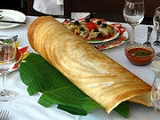
Indian cuisine

Encyclopedia
Indian cuisine consists of thousands of regional cuisines which date back thousands of years. The dishes of India
are characterised by the extensive use of various Indian spices, herb
s, vegetables and fruit
. Indian cuisine is also known for the widespread practice of vegetarianism
in Indian society. Each family of Indian cuisine includes a wide assortment of dishes and cooking techniques. Indian cuisine also varies from region to region, reflecting the varied demographics
of the ethnically-diverse subcontinent.
Hindu beliefs
and culture have played an influential role in the evolution of Indian cuisine. However, cuisine across India also evolved as a result of the subcontinent's large-scale cultural interactions with Mongols
and Britain making it a unique blend of some various cuisines. The spice trade
between India and Europe is often cited as the main catalyst for Europe's Age of Discovery
. Indian cuisine has influenced cuisines across the world, especially those from Southeast Asia and the Caribbean.
, when India was still heavily forested and agriculture was complemented with game hunting and forest produce. In Vedic times, a normal diet consisted of fruit, vegetables, grain, dairy products, honey, and poultry and other sorts of meats. Over time, some segments of the population embraced vegetarianism. This was facilitated by the advent of Buddhism and an equitable climate permitting a variety of fruits, vegetables, and grains to be grown throughout the year. A food classification system that categorized any item as saatvic, raajsic or taamsic developed in Ayurveda
. A reference to the kind of food one is to eat is also discussed in the Bhagavad Gita (Chapter 17, Verses 8,9 & 10). In this period eating beef became taboo, a belief still commonly held today.
and spices. Later, India saw the period of Central Asian and Afghan conquerors, which saw the emergence of the Mughlai cuisine
that many people now associate with India. This included the addition of several seasonings like saffron
, the addition of nuts, and the practice of cooking in a sealed pot called a "dum".
 The staples of Indian cuisine are Bajra
, rice
, atta (whole wheat flour
), and a variety of pulses
, of which the most central to this cuisine are masoor (most often red lentil
s), channa (bengal gram), toor (pigeon pea
or yellow gram), urad
(black gram), and moong (green gram). Pulses may be used whole, dehusked – for example, dhuli moong or dhuli urad – or split. Split pulses, or dal
, are used extensively. Some pulses, like channa and mung, are also processed into flour (besan
).
Most Indian curries are cooked in vegetable oil. In northern and western India, peanut oil
is popular, while in eastern India, mustard oil
is more commonly used. Coconut oil
is used widely along the western coast, especially in Kerala; gingelly (sesame) oil is common in the south as well. In recent decades, sunflower
and soybean
oil have become popular across India. Hydrogenated vegetable oil, known as Vanaspati
ghee, is another popular cooking medium. Butter-based ghee
, or desi ghee, is used very frequently, but still less used than before.
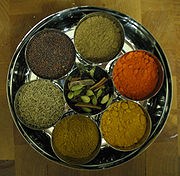
The most important or frequently used spices in Indian cuisine are chilli pepper, black mustard seed (sarso), cumin
(jeera), turmeric
(haldi), fenugreek
(methi), asafoetida
(hing), ginger
(adrak), coriander
(dhania), and garlic
(lehsun). Popular spice mix
es are garam masala
, a powder that typically includes five or more dried spices, especially cardamom, cinnamon, and clove
. Each region, and sometimes each individual chef, has a distinctive garam masala blend. Goda masala is a comparable, though sweet, spice mix that is popular in Maharashtra
. Some leaves commonly used for flavoring include tejpat (Bay leaf), coriander
leaf, fenugreek
leaf, and mint
leaf. The use of curry
leaves and roots is typical of Gujarati and all South Indian cuisine. Sweet dishes are seasoned with cardamom
, saffron
, nutmeg
, and rose
petal essences.
plays a major role in the cuisines of Andaman and Nicobar Islands, which were, and still are inhabited by the indigenous Andamanese
. Since they had very little contact with the outside world, raw fish and fruits were their staple diet for a long time, but as people immigrated from other regions of India, the cuisine became more varied.
 Cuisine of the southern state of Andhra Pradesh
is referred to as Telugu
and Hyderabadi
cuisine. Rice
is the staple starch and is usually consumed with a variety of curries and lentil
soup
s or broth
s. Although many people in this region are vegetarians, people living in the coastal areas are known for their seafood
dishes. Food in Andhra Pradesh is known for the heavy usage of spice
s and chillies
. One of the most important parts of the Andhra cuisine is the use of various pickle
s, such as avakaya, a pickle made from green mango
, and gongura
, a pickle made from Red Sorrel Leaves. Curd
s are a common addition to meals to neutralize the spiciness of the food. Another popular Andhra Pradesh dish is Hyderabadi biryani, a mixture of rice, yogurt, onions, meat and spices. Hyderabadi Biryani is popular for its exquisite taste and is derived from the Persian
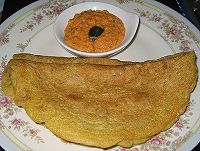
style of slow cooking. While a small proportion of the Hyderabad populace are vegetarians, vegetarian food is still quite popular. Vegetarian food is generally served for breakfast and lunch. Breakfast items like Dosa
, Vada
have origins in Udipi, Karnataka
but are influenced by spices native to Andhra Pradesh
.
of Arunachal Pradesh
is rice
, along with fish
, meat
and green vegetables. Many varieties of rice are available. Lettuce
is the most common vegetable, prepared by boiling with ginger
, coriander
and green chillies. Boiled rice cakes wrapped in leaves is a popular snack. Thukpa
is a kind of noodle soup common among the Monpa tribe of Arunachal.
 Assamese cuisine, from Assam
, a state in North-East India
, is a mixture of different indigenous
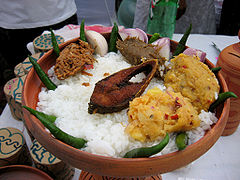
styles with considerable regional variations and some external influences. Although it is characterized by the limited use of spices, the flavors are still strong due to the use of endemic exotic herbs, fruits and vegetables that are either fresh, dried or fermented. Fish is widely used, and so are birds such as duck or pigeon. Preparations are rarely elaborate; the practice of bhuna, the gentle frying of spices before the addition of the main ingredients, which is so common in Indian cooking, is absent in the cuisine of Assam. A traditional meal in Assam begins with a khar, a class of dishes named after the main ingredient, and ends with a tenga, a sour dish. The food is usually served in bell metal
utensils. Pann
, the practice of chewing betel nut
, generally concludes the meal.
 The cuisine of Bihar
is similar to North Indian cuisine
, the food culture in Hindi Belt
, and share similarity with neighboring West Bengal
and Orissa
. Bihari society is not strictly vegetarian, but people avoid eating non-vegetarian food daily. Religious people avoid eating non-vegetarian food on Tuesday, Thursday and Saturday. Bihari people typically eat boiled rice
and daal with cooked vegetables for lunch, and roti with cooked vegetables for dinner. Roti
and boiled rice
are not usually eaten together. Due to this area's strong Hindu
-Muslim
heritage, river fish
, chicken
and goat meat
are popular meats. Lamb's Mutton is considered offensive by many people. Meat-based dishes are eaten mainly with boiled rice. Fish curry is made using mustard paste, a similar technique to the Oriya
way of cooking fish. Dairy
products, such as yoghurt
(known as dahi), buttermilk
(called mattha), butter
, ghee
(clarified butter), and lassi
, are consumed throughout the year. Watery foods such as watermelon
and sherbet made of pulp of the wood-apple fruit are consumed mainly in the summer months, and dry foods and preparations made of sesame or poppy seeds mainly in the winter months. People generally eat roti
soaked in milk
. There is a custom of eating poha (flattened rice
) with yoghurt and sugar. Bihar is famous for Sattu Parathas, which are paratha
s stuffed with fried chickpea flour, Chokha (spicy mashed potatoes), Fish
curry
, Litti, Bihari Kebab, and Postaa-dana kaa halwaa. Another common dish is alu-bhujia
(not to be confused with Bikaneri Bhujia
, also known as rajasthan
i bhujia
), made from potatoes cut like French-fries and cooked in mustard oil and mild spices, and eaten with roti or rice-daal. Tangy raita made from lauki (winter melon
) or unripened papaya, yoghurt, and spices, often a paste of green chilli, ginger, garlic and mustard, is popular in many parts of Bihar.
flower. The tribal people of the Bastar
region of Chhattisgarh eat whatever is available, choosing food which would not be eaten by people of other states and regions. Red ant chutney is a favorite dish. Flying ants, mushrooms, squirrels, and rats are considered delicacies, but fish and pork constitute a large part of Chhatisgarhi cuisine. Pork forms a major item in their diet and almost every major ceremony starts with the sacrifice of a pig.
, was a former colonial possession of Portugal
. Consequently, both native Gujarati food and traditional Portugese food are available. The neighbouring state of Gujarat has prohibited alcohol, and as a result, dining and wining is the most popular pleasure in the territory, with almost all popular brands of foreign liquor available.
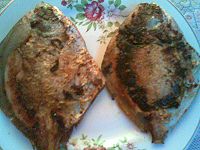 Seafood, coconut milk
, rice and paste are main ingredients of Goan delicacies. The area is located in a tropical climate, and spices and flavors are intense. Use of Kokum is a distinct feature. Goan cuisine is mostly seafood based; the staple food
s are rice and fish
. Kingfish (Vison or Visvan)
is the most common delicacy, others include pomfret
, shark
, tuna
and mackerel
. Among the shellfish
are crab
s, prawn
s, tiger prawns, lobster
, squid
and mussels. The cuisine of Goa is influenced by its Hindu
origins, four hundred years of Portuguese colonialism
, and modern techniques. The state is frequented by tourists visiting its beaches and historic sites, so its food has an international aspect. Goan Saraswat Brahmin and Daivajna Brahmins can be considered facultative vegetarians, as they eat fish and chicken most days, reverting to vegetarianism occasionally for religious reasons, although Brahmins belonging to Pancha Dravida are strictly vegetarian.
is primarily vegetarian. The typical Gujarati Thali
consists of Roti
(a flat bread made from wheat flour, and called Rotli in Gujarati), daal or kadhi, rice, and sabzi/shaak (a dish made up of different combinations of vegetables and spices, which may be stir fried, spicy or sweet). Cuisine can vary widely in flavor and heat, depending on a given family's tastes as well as the region of Gujarat they are from. North Gujarat, Kathiawad, Kachchh, and South Gujarat are the four major regions of Gujarati cuisine. Many Gujarati dishes are distinctively sweet, salty, and spicy at the same time. The cuisine changes with the seasonal availability of vegetables. In mango season, for example, Keri no ras (fresh mango pulp) is often an integral part of the meal. The spices used also change depending on the season. Garam Masala
and its constituent spices are used less in summer. Regular fasting, with diets limited to milk
and dried fruit
s, and nuts
, is a common practice.
Lassi and Sherbat are the two popular non-alcoholic beverages of Haryana. There are a number of liquor shops in this Indian state, due to the traffic of many truck drivers.
, broth
, rice
, vegetable
s and bread
, although non-vegetarian cuisine is preferred. Some of the specialities of Himachal include Pateer, Chouck, Bhagjery and chutney of Til.
from the region of modern Uzbekistan
. Subsequently, it has been strongly influenced by the cuisines of Central Asian, Persia, and the North Indian plains. The most notable ingredient in Kashmir cuisine is mutton (lamb), of which there are over 30 varieties.
Kashmiri Pandit food is also very elaborate, and is an important part of the Pandits' ethnic identity. One of the key differences between Kashmiri cuisine and Punjabi cuisine is that the staple in Kashmiri cuisine is rice, whereas that in Punjabi cuisine is Chappati also known as Roti
. The Kashmiri Pandit cuisine usually uses yogurt, oils and spices as such turmeric, Red Chilli powder, Cumin powder, Ginger powder and Fennel Powder.
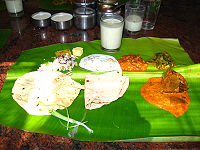 The cuisine of Karnataka includes many vegetarian and non-vegetarian cuisines. The varieties reflect influences from the food habits of the three neighbouring South Indian states, as well as the state of Maharashtra
and Goa
to its north. Some typical dishes include Bisi bele bath
, Jolada rotti
, Chapati
, Ragi rotti
, Akki rotti
, Saaru, Huli, Vangi Bath, Khara Bath, Kesari Bath, Davanagere Benne Dosa, Ragi mudde
, and Uppittu
. Masala Dosa traces its origin to Udupi cuisine
. Plain and Rave Idli, Mysore Masala Dosa and Maddur Vade
are popular in South Karnataka. Coorg district is famous for spicy pork curries while coastal Karnataka
has seafood specialities. Among sweets, Mysore Pak
, Dharwad pedha
, Chiroti are well known. Although the ingredients differ regionally, a typical Kannadiga Oota (Kannadiga meal) includes the following dishes in the order specified and is served on a banana leaf: Uppu(salt
), Kosambari, Pickle, Palya, Gojju, Raita, Dessert, Thovve, Chitranna, Rice and Ghee.
The coastal regions of Mangalore and Udupi have a slightly varying cuisine with extensive use of coconut in curries and an inclination towards sea food. Some of the Mangalore specialities are pathrode, pundi, neer dosa, kori rotti, tendli kaju, goli baje, basale (type of spinach), kashi halva, etc.
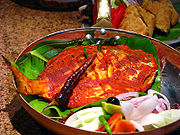 Kerala cuisine is a blend of indigenous dishes and foreign dishes adapted to Kerala tastes. Coconut
s grow in abundance in Kerala, and consequently, grated coconut and coconut milk
are widely used in dishes and curries
as a thickener and flavouring ingredient. Kerala's long coastline, numerous rivers and backwater networks, and strong fishing industry have contributed to many sea- and river-food based dishes. Rice
is grown in abundance, and could be said, along with tapioca
(manioc/cassava), to be the main starch ingredient used in Kerala food. Having been a major production area of spices for thousands of years, black pepper
, cardamom
, cloves, ginger
, and cinnamon
play a large part in its food. Most of Kerala's Hindu
s eat fish except the Brahmin community and because Kerala has large minorities of Muslim
s and Christians
that are predominantly non-vegetarians, Kerala cuisine has a multitude of both vegetarian and dishes prepared using fish
, poultry
and meat
. Rice and fish along with some vegetables is the staple diet in most Kerala households. Kerala also has a variety of breakfast dishes like idli, dosa
, appam
, idiyappam
, puttu
, and pathiri
.
is quite evident in the cuisines of Lakshadweep. Since the island has a close proximity with Kerala, hence the cuisines reflect the taste of the inhabitants of that place. The local food of Lakshadweep primarily comprises coconut and sea fish. The people of the island have a great inclination towards the coconut water as it is the most abundant aerated drink of the place. Almost all the dishes have a touch of coconut since it is an integral ingredient of Lakshadweep cuisines.
One other popular dish in the region is the Dal bafla. Bafla is a steamed and grilled wheat cake dunked in rich ghee which is eaten with daal (a pungent lentil broth). It is followed by sweet ladoos. Another popular dish in Malwa region (central M.P) is poha (flattened rice
), it is mostly a breakfast item served with Jalebi.
Indore, Ujjain and Ratlam are world famous for their savory snacks that are made from chick-pea flour. The city restaurants also serve tasty chaats (snacks), kachoris and samosa
s.
In summers, the meals tend to end with fruits such as mangoes (dusseharis), melons and watermelons, custard apples, bananas, papayas and guavas.
The beverages in the region include lassi
(buttermilk), sugarcane juice, a beer and a fine rum which is produced from the cane. There also is the local liquor which is distilled from the flowers of the mahua tree. In the tribal regions a popular drink it is the sap of the sulfi tree which can be drunk fresh [ non alcoholic] or kept overnight [for fermentation ] and drunk later. The date palm toddy is also one of the popular drink is some regions.

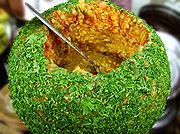 Maharashtrian cuisine covers a range from being mild to very spicy dishes. Bajri, Wheat, rice, jowar, vegetables, lentils and fruit form important components of Maharashtrian diet. Popular dishes include puran poli
, ukdiche Modak
and batata wada. The staple dishes of Maharashtrian cuisine are based on Bajri, Jowar and Rice(Tandul). The cuisine of Maharashtra has its own distinctive flavors and tastes. It can be divided into two major sections–the coastal and the interior. A part of Maharashtra, which lies on the coast of the Arabian Sea, is loosely called the Konkan and boasts of its own Konkani cuisine, which is a homogeneous combination of Malvani, Gaud Saraswat Brahmin
, and Goan cuisines. Besides the coastal cuisine, the interior of Maharashtra—the Vidarbha area, has its own distinctive cuisine known as the Varadi cuisine. As in many states of India, rice is the staple food grain in Maharashtra. Like the other coastal states, there is an enormous variety of vegetables in the regular diet and lots of fish and coconuts are used. Grated coconuts spice many kinds of dishes, but coconut oil is not very widely used as a cooking medium. Peanuts and cashew nuts are widely used in vegetables and peanut oil is the main cooking medium. Another feature is the use of kokum, a deep purple berry that has a pleasing sweet and sour taste. Kokum, most commonly used in an appetizer-digestive called the sol kadhi, is served chilled. During summer another drink called panha made from boiled raw mango is consumed.
Rest of the Maharashtra apart from Konkan, uses ground nuts, jaggary, wheat, jowar and bajra extensively. Maharashtrian meal consists of rice and bread both along with 'varan'/'aamtee' – a type of lentils and spiced veggies. Maharashtrian dishes for 'Upwas' have a special mention as most of them are favourites for life time e.g. sabudana khichadi.
i cuisine is simple, organic and healthy. Dishes are typically spicy foods that use chili pepper
rather than Garam masala
. The staple diet of Manipur consists of rice, leafy vegetables, and fish. Manipuris typically raise vegetables in a kitchen garden and rear fish in small ponds around their house. The Umarok is a very popular chili that is used in the cuisine.It is called in different names in the other north eastern states of India, like king chili, naga jolokia, ghost chili etc.
. Meghalaya
, also one of the seven sisters
and home of three Mongoloid tribes, has a unique cuisine of its own, different from other states in the north east of India. The staple food of the people is rice with spicy meat and fish preparations. They rear goats, pigs, fowl, ducks and cows and relish their meat. The popular dishes are Jadoh, Ki Kpu, Tung-rymbai, and pickled bamboo shoots. Like the other tribes in the north-east, they ferment rice beer, which is consumed in religious rites and at major ceremonies and celebrations.
is very different from most Indian cuisines, mainly sharing similarities with other cuisines from the North-East of India. Mizo cuisine is a blend of Chinese and north Indian cuisines, and Mizoram cuisine offers mainly non-vegetarian delicacies. Dishes may be served on fresh green banana leaves. Meals are usually less spicy and plain in taste, retaining the nutritive value of the food. A popular dish is Bai, eaten with rice. Which can be made from boiling spinach with pork and bamboo shoot. Another common dish is Sawchair made of rice cooked with pork or chicken.
is known for exotic meats cooked with simple and flavorful ingredients like the extremely hot bhut jolokia or ghost chili, fermented bamboo shoots and soya beans. The Nagamese use oil minimally, they prefer to ferment, dry and smoke their meats and fishes so their food is healthy and light. Traditional homes have external kitchens like smoke houses.
(curry powder) and haladi (turmeric) are commonly used for non-vegetarian curries. Pakhala
, a dish made of rice, water, and yoghurt, that is fermented overnight, is very popular in summer, particularly in the rural areas. Oriyas are very fond of sweets and no Oriya repast is considered complete without some dessert at the end. Vegeterian foods also include foods prepared without onion and garlic as in temple prasadam and bramhin cuisine.
The French and the Indo style have given birth to an innovative taste. The influence of the neighboring areas like Tamil Nadu, Andhra Pradesh and Kerala is also visible.
Some of the hot favorite cookery items in Pondicherry are Coconut Curry, Tandoori Potato, Soya Dosa, Podanlangkai, Assad, Curried Vegetables, Stuffed Cabbage, Baked Beans:
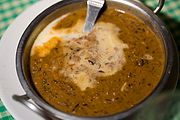
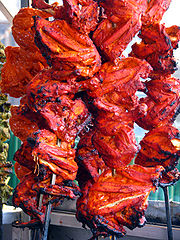 Punjabi cuisine can be non-vegetarian or completely vegetarian. One of the main features of Punjabi cuisine is its diverse range of dishes. Home cooked and restaurant Punjabi cuisine can vary significantly, with restaurant style using large amounts of ghee
, with liberal amounts of butter
and cream
with home cooked concentrating on mainly upon preparations with whole wheat
, rice
and other ingredients flavored with masala
s.
Within the area itself, there are different preferences. People in the area of Amritsar
prefer stuffed paratha
s and dairy products, of which the area is well known for. There are certain dishes which are exclusive to Punjab, such as Mah Di Dal, saron da saag, and many othe things.The food is tailor-made for the Punjabi lifestyle in which most of the rural
folk burn up a lot of calories while working in the fields. The main masala in a Punjabi dish consists of onion
, garlic
and ginger
. Tandoori food is a Punjabi speciality especially for non-vegetarian dishes.
Many of the most popular elements of Anglo-Indian cuisine
– such as Tandoor, Naan, Pakoras and vegetable dishes with paneer – derive from the Punjab.
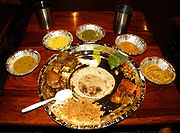 Rajasthani cooking was influenced by the availability of ingredients in this arid region. In Rajasthan water is at a premium, and hence the food is generally cooked in milk
or ghee
, making it quite rich. On the other hand, Besan or gram flour is a mainstay of Marwari food mainly because of the scarcity of vegetables in this arid land.
There is a distinctness in the Rajasthani cuisine which comes from a tradition that is old and tranquil, and from a culture that has churned the best from its neighboring states of Gujarat, Haryana and Punjab. Food that could last for several days and could be eaten without heating was preferred. Scarcity of water and fresh green vegetables have all had their effect on the cooking. Major dishes of a Rajasthani platter includes Daal-Baati
, Tarfini, Raabdi, ghewar, Bail-Gatte, Panchkoota, Chaavadi, Laapsi, Kadhi and Boondi
, and snacks like Bikaneri Bhujia
, Mirchi Bada
, Pyaaj Kachori
, Dal Kachori.
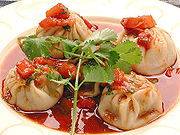 Sikkim has its own unique dietary culture with specific cuisine and food recipes. In the Sikkim Himalayas
traditional foods are an integral part of the dietary culture of the various ethnic groups of people consisting of the Nepal
ese, Bhutias and Lepchas
. Rice is the staple food. Meat and dairy products are also consumed depending on availability. Besides these, various traditional fermented foods and beverages, which constitute of about 20 per cent of the basic diet for long centuries are prepared and consumed. The dietary-culture of this region is mostly reflected in the pattern of food production. Depending on the altitudinal variation, finger millet, wheat, buckwheat, barley, vegetable, potato, soybeans, etc. are grown. Some of the common traditional cuisine with their food recipes has been presented for introduction of dietary culture of the Sikkim Himalayas, as well as for product diversification.
from the Sindh
region, Pakistan
. While Sindh
is not present in modern India, Sindhi food is eaten in India
, where a sizeable number of Hindu Sindhi people migrated following the Partition of India
, especially in Sindhi enclaves such as Ulhasnagar
and Gandhidam.
The daily food in most Sindh
i households consists of wheat
-based flat-bread (phulka) and rice accompanied by two dishes, one gravy
and one dry.
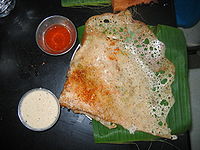 Tamil food is characterized by the use of rice
, legumes and lentil
s, its distinct aroma and flavour achieved by the blending of spice
s including curry leaves, tamarind
, coriander
, ginger
, garlic
, chili, pepper
, cinnamon
, clove
s, cardamom
, cumin
, nutmeg
, coconut
and rosewater
. The word "curry
" is derived from the Tamil
word 'kari' which means "an additive to the main course or a side dish" Rice
and legumes play an important role in Tamil cuisine. Lentil
s are also consumed extensively, either accompanying rice preparations, or in the form of independent dishes. Vegetable
s and dairy
products are essential accompaniments. Tamil Nadu is famous for its spicy non vegetarian dishes. The southern regions in Tamil Nadu, namely; Madurai
, Kaaraikudi
or Chettinaadu
are famous for their spicy non vegetarian dishes.
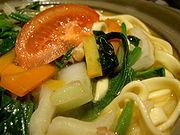 The Tripuri (Tipra or Tipperah) people are the original inhabitants of the state of Tripura
in North East India. The indigenous Tripuri people comprises the communities of Tipra, Reang
, Jamatia
, Noatia
, Uchoi
and others. The Tripuri people have their own culture and cuisine. The Tripuris are non-vegetarian, though there is a minority modern vaishnavite Hindu vegetarian following. The major ingredient of Tripuris cuisine for non-vegetarian food includes pork
, chicken
, mutton, turtle
, fish
, prawns, crabs, and frogs.
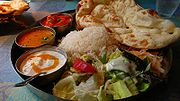 Traditionally the Uttar Pradeshi cuisine consists of Awadhi
and Mughlai
cuisine but a vast majority of the state enjoys sober vegetarian meals with Dal
, roti
, sabzi
and rice constituting the essentials of daily food habits. Pooris and kachori
s are relished on special occasions. Uttar Pradesh has been greatly influenced by Mughal
(Mughlai cuisine
) cooking techniques which is very popular worldwide. The Chaat
, samosa
and pakora
, among the most popular snacks in all of India, are also originally from Uttar Pradesh. Awadhi
is a type of West-Central Uttar Pradeshi cuisine found in the state's Awadh Region.
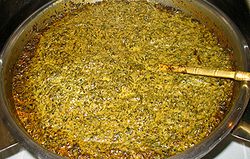 The food from Uttrakhand is known to be wholesome to suit the high-energy necessities of the mountainous and wintry region. It is traditionally cooked over wood fire. The cuisine mainly consists of food from two different sub regions Garhwal
and Kumaon
, though the basic ingredients of both Garhwali and Kumaoni cuisine are the same, there are some basic differences that tell apart the two. The distinctive trait of the Kumauni cuisine is the tightfisted use of especially milk and milk-based products as cows from hilly areas do not yield high-quality or amount of milk. The similarity between both of them is the liberal use of Ghee and charcoal cooking. Both Garhwalis and Kumaunis are fond of lentil or pulses and ‘Bhaatt’ or rice. To combat the extreme winters and possible exhausting of food, they also use Badi (sun-dried Urad Dal balls) and Mangodi (sun-dried Moong Dal balls) as substitute for vegetables at times. Main dishes from Uttarakhand include Chainsoo, Kafuli, Jholi, Thechwani, Baadi, etc.
The dishes prepared by the people of Uttarakhan are similar to Uttar Pradesh. They eat rice, pulses, chapatis, vegetable. Tomatoes, onions and spices are used to make the food delicious.
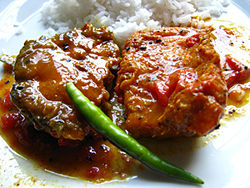
Bengali cuisine is a style of food preparation originating in the eastern India which includes states of Tripura
, Barak Valley
of Assam
and West Bengal
. With an emphasis on fish
and lentils served with rice as a staple diet, Bengali cuisine is known for its subtle flavours, its confectioneries and desserts, and has perhaps the only multi-course tradition from India that is analogous with French
and Italian cuisine
in structure. The nature and variety of dishes found in Bengali cooking are unique even in India. Fish cookery is one of its better-known features and distinguishes it from the cooking of the landlocked regions. Bengal's many rivers, ponds and lakes teem with many kinds of freshwater fish that closely resemble catfish
, bass
, shad
or mullet
. Bengalis prepare fish in innumerable ways – steamed or braised, or stewed with greens or other vegetables and with sauces that are mustard-based or thickened with poppyseeds.
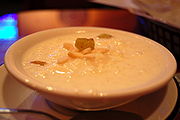 Indian sweets, known as mithai, are a type of confectionery. Many are made with sugar, milk and condensed milk, and cooked by frying. The bases of the sweets and other ingredients vary by region. In the Eastern part of India, for example, milk is a staple, and most sweets from this region are based on milk products.
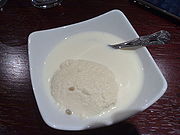
 Barfi
Barfi
is a sweet made of dried milk with ground cashews or pistachios. It is customary to attach a thin layer of edible silver foil as decoration.
Chikki
A simple sweet made out of peanuts and molasses.
Gulab jamun
is an Indian dessert made out of fried milk balls soaked in sweet syrup.
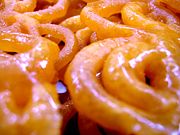
Jalebi
is made by deep-frying flour in a circular (coil-like) shape and then dipping in sugar syrup. Imarti is a variant of Jalebi, with a different flour mixture, and has a more coiled texture. Typically Jalebi is brown or yellow, while Imarti is reddish in color. Often taken with milk, tea or even yogurt (or Lassi
)
Khaja
is a sweet food of Orissa
and Bihar
states in India. Refined wheat flour, sugar and oils are the chief ingredients of khaja.
It is believed that, even 2000 years ago, Khajas were prepared in the southern side of the Gangetic Plains of Bihar. These areas which are home to khaja, once comprised the central part of Maurya and Gupta empires. Presently, Khajas are prepared and sold in the city of Patna
, Gaya
and several other places across the state of Bihar. Khajas of the Silao and Rajgir are known for their puffiness.
Khajas have travelled to some other parts of India, including Andhra Pradesh. Khaja of Kakinada is a coastal town of Andhra Pradesh. At first, a paste is made out of wheat flour, mawa
and oil. It is then deep fried until crisp. Then a sugar syrup is made, which is known as "pak". The crisp croissants are then soaked in the sugar syrup until they absorb the sugar syrup. In Kakinada Khaja, it is made dry outside and full of sugar syrup inside, and is juicy.
Kulfi
is Indian ice-cream, where the sweetened milk/cream is frozen in small metal cans to be served frozen. Usually it has a milky appearance, but additional colors may be applied for display. A summer-time favorite in most of India, especially in the northern India. It comes in a variety of flavors such as mango kesar
or cardamom
. It is typically sold by street-side hawkers who carry around these frozen cans of kulfi in a big earthen pot. The street-side hawkers, called "kulfiwalla" (one who sells kulfi) are much awaited by school kids who savor kulfis during school lunch-times.
Kheer
is a sweet rice pudding, usually made from rice and milk. It is also known as "payas", or payasam in South India. It has been a cultural dish throughout the history of India, being usually found at ceremonies, feasts and celebrations. In many parts of India, ancient traditions maintain that a wedding is not fully blessed if payas is not served at the feast during traditional ceremonies like marriage, child birth, annaprasan (first solid feed to child) etc.
Laddu
(sometimes transliterated as laddoo) is made of flour and other ingredients formed into balls that are dipped in sugar syrup. The popularity of Laddu is due to its ease of preparation.
Variations in the preparation of Laddu result in a spectrum of tastes. Laddu is often made to celebrate festivals or household events such as weddings.
Malpoa is one of the most ancient homemade sweets of India. It is a form of
pancake (made of what or rice flour) deep fried and dipped in sugar syrup. Several variations exist in different parts of India, and it is especially popular in Bihar, Bengal and Orissa.
Motichoor Ka Ladoo is a sweet food of the central Bihar
made from grilled gram flour
flakes which are sweetened, mixed with almonds, pressed into balls and fried in ghee
. It is now made and consumed throughout India and Pakistan.
Rasgulla is a popular relished sweetmeat in India, which originated in Orissa
, in the eastern region of the country, but was made known to the outside world by Nobin Chandra Das of Kolkata. Originally a dessert in Orissa for centuries, this dish made its way to West Bengal when the Oriya cooks started migrating to West Bengal in search of jobs, bringing along the recipe. It was only then that Nobin Chandra Das of Kolkata modified its recipe to give it its current form. This dish is produced by the boiling of small balls of casein
in sugar syrup. This sweet dessert can be found in many eastern Indian households.
Sandesh is a sweet made from fine cheese made from cow's milk kneaded with fine ground sugar or molasses. This is a signature sweet from West Bengal in India. Revered for its delicate making, and appreciated by the connoisseur, this represents sweet making at its finest. Sandesh comes in two varieties, "Norom Pak" (the softer version) and "Koda Pak" (the harder version). The softer version although considered better, is fragile. The harder version is robust and often easier for storage. Molasses made from dates can be used to make a special variation of Sandesh called "Noleen Gurher Sandesh" (a Sandesh made from "Noleen Gurh" or molasses from dates) or simply "Noleen Sandesh" (as shown in the figure).
Shrikhand
is a creamy dessert made out of strained yogurt, from which all water is drained off, leaving the thick yogurt cream by itself. Adding dry fruits like mangoes enhances the Shrikhand's taste. It is a Western India traditional dish, and it has ancient roots in the Indian cuisine.
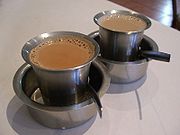 Tea
Tea
is a staple beverage throughout India; the finest varieties are grown in Darjeeling and Assam
. It is generally prepared as masala chai
, wherein the tea leaves are boiled in a mix of water, spices such as cardamom, cloves, cinnamon, and ginger, and large quantities of milk to create a thick, sweet, milky concoction. Different varieties and flavors of tea are prepared to suit different tastes all over the country.
Another popular beverage, coffee
, is largely served in South India. One of the finest varieties of Coffea arabica
is grown around Mysore, Karnataka
, and is marketed under the trade name "Mysore Nuggets". Indian filter coffee
, or kafee, is also especially popular in South India.
Lassi
is a popular and traditional yogurt-based drink of India. It is made by blending yogurt with water or milk and Indian spices. Salted lassi is more common in villages of Punjab & Indian Porbandar, Gujarat. It is prepared by blending yogurt with water and adding salt and other spices to taste. The resulting beverage is known as salted lassi. Traditional lassi is sometimes flavored with ground roasted cumin
. Sweet lassi is a form of lassi flavored with sugar, rosewater
and/or lemon
, strawberry
or other fruit juices. Saffron
lassis, which are particularly rich, are also very popular.
Sharbat
is a cold sweet beverage that is prepared from fruits or flower petals. It can be served in concentrate form and eaten with a spoon or diluted with water to create the drink. Popular sharbats are made of one or more of the following: Rose
, Sandalwood
, Bel, Gurhal (Hibiscus
), Lemon
, Orange
, Pineapple
, and Falsa (Grewia asiatica
). These are known to have several medicinal values and are known to be ayurvedic in nature.
Other beverages include nimbu pani (lemonade), chaach, badam doodh (almond milk with nuts and cardamom), Panha (Raw Mango sharbat) and coconut water
. In southern India, there is a chilled beverage known as "Panner Soda" or "Gholi Soda", a mixture of carbonated water
, rose water, and sugar. Another beverage from the south, rose milk, is also served cold.
The industry was previously dominated by competition between the United Breweries Group and the Shaw Wallace
. The scenario changed, however, with the entry of SABMiller
to the Indian market. The international beer giant started by acquiring small breweries in the south but then completely changed the landscape with the acquisition of Shaw Wallace's beer portfolio. The most notable Indian brewer is United Breweries, even though there are several other popular ones including the foreign brewers.
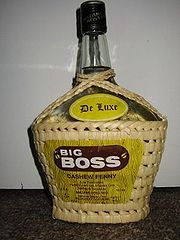 There are also several other popular alcoholic drinks in India. Fenny
is a Goa
n liquor
made from either coconut
or the juice of the cashew
apple and fenny (also feni) originated here. The popular brands of fenny are 'Cashyo' (the makers of which spell it feni), 'Reals' , and 'Big Boss'. Goa has registered for a geographical indicator
that would allow it to claim the sole right to term drink created in the region as fenny or 'Goan Cashew Feni'.
Hadia
is a rice
beer
commonly made in the Bihar
, Jharkhand
, Orissa
, Madhya Pradesh
and Chhattisgarh
states of India. It may alternatively be spelt hadiya. The making involves the use of herbs mixed with boiled rice and left to ferment. The drink is generally ready within a week. It is served cool and has lower alcoholic strength than other Indian country liquors. Palm wine
locally known as neera
is a sap extracted from Inflorescence
of various species of Toddy palms. It is sweet, oyster white, and translucent. Chuak
is the traditional Tripuri
rice-beer. It is made by fermenting rice in water. It is usually drunk on social occasions of any Tripuri ceremony as a ritual. Chuak is offered to village elders on any occasion or celebration in a traditional Tripuri family.
Chhaang
is consumed by the people of Sikkim
and Darjeeling Himalayan hill region
of West Bengal
with great enthusiasm. It is usually drunk at room temperature in summer, but is often served piping hot in brass bowls or wooden mugs when the weather is cold. Chhaang is a relative of the more universally known beer
. Barley, millet
(finger-millet) or rice
is used to brew the drink. Semi-fermented
seeds of millet are served, stuffed in a barrel of bamboo
called the Dhungro. Then boiling water is poured and sipped through a narrow bore bamboo pipe called the Pipsing.
, parathas, and a vegetable dish, accompanied by achar (pickles) and some curd; people of western India, dhokla
and milk; South Indians, idlis and dosas, generally accompanied by various chutneys.
Lunch in India usually consists of a main dish of rice in the south and east and rotis made from whole wheat in the northern and western parts of India. It typically includes two or three kinds of vegetables. Lunch may be accompanied by items such as kulcha, nan, or parathas. Curd and two or three sweets are also included in the main course. Paan
(betel leaves), which aid digestion, are often eaten after lunch in parts of India.
Indian families will gather for "evening breakfast" to talk, drink tea, and eat snacks.
Dinner is considered the main meal of the day, and the whole family gathers for the occasion. Dinner may be followed by dessert, ranging from fruit to traditional desserts like kheer, gulab jamun, gajraila, qulfi or ras malai.
. In the wheat growing/consuming north, a piece of roti
is gripped with the thumb and middle finger and ripped off while holding holding the roti
down with the index finger. Traditional serving styles vary from region to region in India.
In South India, cleaned banana leaves, which can be disposed of after the meal, are used traditionally. When hot food is served on banana leaves, the leaves add aroma and taste to the food. Leaf plates are still utilized on auspicious and festive occasions but are less common today.
Traditional ways of dining are being influenced by eating styles from other parts of the world. Among the middle class throughout India, spoons and forks are commonplace.
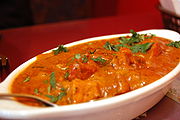 In 2003, there were as many as 10,000 restaurants serving Indian cuisine in England and Wales alone. According to Britain's
Food Standards Agency
, the Indian food industry in the United Kingdom is worth £3.2 billion, accounts for two-thirds of all eating out, and serves about 2.5 million British customers every week. Pat Chapman
's Curry Club has a membership of several thousand.
Specifically Anglo-Indian dishes include mango chutney, mulligatawny soup, balti
and chicken tikka masala
. British people of non-Indian origin often home-cook curries using ready-made curry powder
s, sauces or pastes.
, New Jersey
, Chicago
and Los Angeles
that have specialized cuisines that serve authentic Indian food. Most of the Indian restaurants in the United States
serve Americanized versions of North Indian food, which is generally less spicy. South Indian restaurants also exist and are slowly becoming popular but are less preferred by the locals because the food is considered very spicy.
and Buddhist historical cultural influence in the region and on its cuisines. Indian cuisine has had considerable influence on Malaysian cooking styles and also enjoys popularity in Singapore
. There are numerous North and South Indian restaurants all around Singapore, most of them located in Little India. Singapore is also well known for its fusion take on Indian cuisines. The fish head curry for example, is a local creation with a strong Indian influence reflected by its complex use of spices. Indian influence on Malay cuisine dates to the 19th century. Other cuisines which borrow Indian cooking styles include Filipino, Vietnamese, Indonesian, and Thai. The spread of vegetarianism in other parts of Asia is often credited to ancient Indian Hindu and Buddhist practices.
because of its similarity to and influence on Arab cuisine
.
Curry's international appeal has been compared to that of pizza
. Indian tandoor
i dishes, such as chicken tikka
, enjoy widespread popularity. Historically, Indian spices and herbs were among the most sought-after trade commodities. The spice trade
between India and Europe led to the rise and dominance of Arab traders, to such an extent that European explorers such as Vasco da Gama
and Christopher Columbus
set out to find new trade routes with India, leading to the Age of Discovery
.
and Hong Kong SAR. There are many Indian restaurants in Beijing
, Shanghai
and Shenzhen
. Hong Kong SAR has more than 50 Indian restaurants. History of Indian restaurant in Hong Kong SAR goes as back as 1980. Most of the Indian restaurants in Hong Kong SAR are in Tsim Sha Tsui
or Central
area.
India
India , officially the Republic of India , is a country in South Asia. It is the seventh-largest country by geographical area, the second-most populous country with over 1.2 billion people, and the most populous democracy in the world...
are characterised by the extensive use of various Indian spices, herb
Herb
Except in botanical usage, an herb is "any plant with leaves, seeds, or flowers used for flavoring, food, medicine, or perfume" or "a part of such a plant as used in cooking"...
s, vegetables and fruit
Fruit
In broad terms, a fruit is a structure of a plant that contains its seeds.The term has different meanings dependent on context. In non-technical usage, such as food preparation, fruit normally means the fleshy seed-associated structures of certain plants that are sweet and edible in the raw state,...
. Indian cuisine is also known for the widespread practice of vegetarianism
Vegetarianism
Vegetarianism encompasses the practice of following plant-based diets , with or without the inclusion of dairy products or eggs, and with the exclusion of meat...
in Indian society. Each family of Indian cuisine includes a wide assortment of dishes and cooking techniques. Indian cuisine also varies from region to region, reflecting the varied demographics
Demographics of India
The demographics of India are inclusive of the second most populous country in the world, with over 1.21 billion people , more than a sixth of the world's population. Already containing 17.5% of the world's population, India is projected to be the world's most populous country by 2025, surpassing...
of the ethnically-diverse subcontinent.
Hindu beliefs
Hinduism
Hinduism is the predominant and indigenous religious tradition of the Indian Subcontinent. Hinduism is known to its followers as , amongst many other expressions...
and culture have played an influential role in the evolution of Indian cuisine. However, cuisine across India also evolved as a result of the subcontinent's large-scale cultural interactions with Mongols
Mongol Empire
The Mongol Empire , initially named as Greater Mongol State was a great empire during the 13th and 14th centuries...
and Britain making it a unique blend of some various cuisines. The spice trade
Spice trade
Civilizations of Asia were involved in spice trade from the ancient times, and the Greco-Roman world soon followed by trading along the Incense route and the Roman-India routes...
between India and Europe is often cited as the main catalyst for Europe's Age of Discovery
Age of Discovery
The Age of Discovery, also known as the Age of Exploration and the Great Navigations , was a period in history starting in the early 15th century and continuing into the early 17th century during which Europeans engaged in intensive exploration of the world, establishing direct contacts with...
. Indian cuisine has influenced cuisines across the world, especially those from Southeast Asia and the Caribbean.
History
Indian cuisine has been influenced by a 5000 year history of various groups and cultures interacting with the subcontinent, leading to the diversity of flavors and regional cuisines found in modern-day India.Antiquity
Many recipes first emerged during the initial Vedic periodVedic period
The Vedic period was a period in history during which the Vedas, the oldest scriptures of Hinduism, were composed. The time span of the period is uncertain. Philological and linguistic evidence indicates that the Rigveda, the oldest of the Vedas, was composed roughly between 1700–1100 BCE, also...
, when India was still heavily forested and agriculture was complemented with game hunting and forest produce. In Vedic times, a normal diet consisted of fruit, vegetables, grain, dairy products, honey, and poultry and other sorts of meats. Over time, some segments of the population embraced vegetarianism. This was facilitated by the advent of Buddhism and an equitable climate permitting a variety of fruits, vegetables, and grains to be grown throughout the year. A food classification system that categorized any item as saatvic, raajsic or taamsic developed in Ayurveda
Ayurveda
Ayurveda or ayurvedic medicine is a system of traditional medicine native to India and a form of alternative medicine. In Sanskrit, words , meaning "longevity", and , meaning "knowledge" or "science". The earliest literature on Indian medical practice appeared during the Vedic period in India,...
. A reference to the kind of food one is to eat is also discussed in the Bhagavad Gita (Chapter 17, Verses 8,9 & 10). In this period eating beef became taboo, a belief still commonly held today.
Middle Ages
This was the period in which several North Indian dynasties were predominant, including the Gupta dynasty. Travelers who visited India brought with them new cooking methods and products like teaTea
Tea is an aromatic beverage prepared by adding cured leaves of the Camellia sinensis plant to hot water. The term also refers to the plant itself. After water, tea is the most widely consumed beverage in the world...
and spices. Later, India saw the period of Central Asian and Afghan conquerors, which saw the emergence of the Mughlai cuisine
Mughlai cuisine
Mughlai cuisine is a style of cookery developed in the Indian Subcontinent by the imperial kitchens of the Mughal Empire. It represents the cooking style used in Uttar Pradesh, Delhi, Pakistan and in parts of Dhaka in Bangladesh and Hyderabad in Andhra Pradesh...
that many people now associate with India. This included the addition of several seasonings like saffron
Saffron
Saffron is a spice derived from the flower of Crocus sativus, commonly known as the saffron crocus. Crocus is a genus in the family Iridaceae. Each saffron crocus grows to and bears up to four flowers, each with three vivid crimson stigmas, which are each the distal end of a carpel...
, the addition of nuts, and the practice of cooking in a sealed pot called a "dum".
Ingredients
Pearl millet
Pearl millet is the most widely grown type of millet. Grown in Africa and the Indian subcontinent since prehistoric times, it is generally accepted that pearl millet originated in Africa and was subsequently introduced into India. The center of diversity, and suggested area of domestication, for...
, rice
Rice
Rice is the seed of the monocot plants Oryza sativa or Oryza glaberrima . As a cereal grain, it is the most important staple food for a large part of the world's human population, especially in East Asia, Southeast Asia, South Asia, the Middle East, and the West Indies...
, atta (whole wheat flour
Whole wheat flour
Whole wheat flour is a powdery substance derived by grinding or mashing the wheat's whole grain. It is used in baking but typically added to other "white" flours to provide nutrients , texture, and body to the finished product....
), and a variety of pulses
Pulse (legume)
A pulse is an annual leguminous crop yielding from one to twelve seeds of variable size, shape, and color within a pod. Pulses are used for food and animal feed. The term "pulse", as used by the Food and Agricultural Organization , is reserved for crops harvested solely for the dry seed...
, of which the most central to this cuisine are masoor (most often red lentil
Lentil
The lentil is an edible pulse. It is a bushy annual plant of the legume family, grown for its lens-shaped seeds...
s), channa (bengal gram), toor (pigeon pea
Pigeon pea
The pigeon pea , also known as tropical green pea, toor dāl or arhar dāl , ತೊಗರಿ ಬೇಳೆ kadios , or Congo pea or gungo pea , pois Congo , gandul , gunga pea, or no-eye pea, [Cajanus...
or yellow gram), urad
Urad (bean)
Vigna mungo, known as urad, urad dal, udad dal, urd bean, urd, urid, black matpe bean, black gram, black lentil [not to be confused with the much smaller true black lentil ], maas , đậu đen or white lentil, is a bean grown in southern Asia...
(black gram), and moong (green gram). Pulses may be used whole, dehusked – for example, dhuli moong or dhuli urad – or split. Split pulses, or dal
Dal
Dal is a preparation of pulses which have been stripped of their outer hulls and split. It also refers to the thick stew prepared from these, an important part of Indian, Nepali, Pakistani, Sri Lankan, and Bangladeshi cuisine...
, are used extensively. Some pulses, like channa and mung, are also processed into flour (besan
Gram flour
Gram flour is a cereal flour made from ground chickpeas. It is also known as chickpea flour, garbanzo flour, or besan . Used in many countries, it is a staple ingredient in Indian, Pakistani and Bangladeshi cuisines, and, in the form of a paste with water or yoghurt, a popular facial exfoliant in...
).
Most Indian curries are cooked in vegetable oil. In northern and western India, peanut oil
Peanut oil
Peanut oil is an organic material oil derived from peanuts, noted to have the aroma and taste of its parent legume....
is popular, while in eastern India, mustard oil
Mustard oil
The term mustard oil is used for three different oils that are made from mustard seeds:*A fatty vegetable oil resulting from pressing the seeds,...
is more commonly used. Coconut oil
Coconut oil
Coconut oil is an edible oil extracted from the kernel or meat of matured coconuts harvested from the coconut palm . Throughout the tropical world, it has provided the primary source of fat in the diets of millions of people for generations. It has various applications in food, medicine, and industry...
is used widely along the western coast, especially in Kerala; gingelly (sesame) oil is common in the south as well. In recent decades, sunflower
Sunflower
Sunflower is an annual plant native to the Americas. It possesses a large inflorescence . The sunflower got its name from its huge, fiery blooms, whose shape and image is often used to depict the sun. The sunflower has a rough, hairy stem, broad, coarsely toothed, rough leaves and circular heads...
and soybean
Soybean
The soybean or soya bean is a species of legume native to East Asia, widely grown for its edible bean which has numerous uses...
oil have become popular across India. Hydrogenated vegetable oil, known as Vanaspati
Vanaspati
Vanaspati is the Sanskrit word that now refers to the entire plant kingdom. However, according to Charaka Samhitā and Sushruta Samhita medical texts and the Vaisesikas school of philosophy, "vanaspati" is limited to plants that bear fruits but no evident flowers...
ghee, is another popular cooking medium. Butter-based ghee
Ghee
Ghee is a class of clarified butter that originated in South Asia and is commonly used in South Asian cuisine....
, or desi ghee, is used very frequently, but still less used than before.
The most important or frequently used spices in Indian cuisine are chilli pepper, black mustard seed (sarso), cumin
Cumin
Cumin is a flowering plant in the family Apiaceae, native from the east Mediterranean to India. Its seeds are used in the cuisines of many different cultures, in both whole and ground form.-Etymology:...
(jeera), turmeric
Turmeric
Turmeric is a rhizomatous herbaceous perennial plant of the ginger family, Zingiberaceae. It is native to tropical South Asia and needs temperatures between 20 °C and 30 °C and a considerable amount of annual rainfall to thrive...
(haldi), fenugreek
Fenugreek
Fenugreek is a plant in the family Fabaceae. Fenugreek is used both as a herb and as a spice . The leaves and sprouts are also eaten as vegetables...
(methi), asafoetida
Asafoetida
Asafoetida , alternative spelling asafetida, is the dried latex exuded from the living underground rhizome or tap root of several species of Ferula, which is a perennial herb...
(hing), ginger
Ginger
Ginger is the rhizome of the plant Zingiber officinale, consumed as a delicacy, medicine, or spice. It lends its name to its genus and family . Other notable members of this plant family are turmeric, cardamom, and galangal....
(adrak), coriander
Coriander
Coriander is an annual herb in the family Apiaceae. Coriander is native to southern Europe and North Africa to southwestern Asia. It is a soft, hairless plant growing to tall. The leaves are variable in shape, broadly lobed at the base of the plant, and slender and feathery higher on the...
(dhania), and garlic
Garlic
Allium sativum, commonly known as garlic, is a species in the onion genus, Allium. Its close relatives include the onion, shallot, leek, chive, and rakkyo. Dating back over 6,000 years, garlic is native to central Asia, and has long been a staple in the Mediterranean region, as well as a frequent...
(lehsun). Popular spice mix
Spice mix
Spice mixes are blended spices or herbs. When a certain combination of herbs or spices is called for in many different recipes , it is convenient to blend these ingredients beforehand...
es are garam masala
Garam masala
Garam masala is a blend of ground spices common in North Indian and other South Asian cuisines. It is used alone or with other seasonings. The word garam refers to intensity of the spices rather than capsaicin content...
, a powder that typically includes five or more dried spices, especially cardamom, cinnamon, and clove
Clove
Cloves are the aromatic dried flower buds of a tree in the family Myrtaceae. Cloves are native to the Maluku islands in Indonesia and used as a spice in cuisines all over the world...
. Each region, and sometimes each individual chef, has a distinctive garam masala blend. Goda masala is a comparable, though sweet, spice mix that is popular in Maharashtra
Maharashtra
Maharashtra is a state located in India. It is the second most populous after Uttar Pradesh and third largest state by area in India...
. Some leaves commonly used for flavoring include tejpat (Bay leaf), coriander
Coriander
Coriander is an annual herb in the family Apiaceae. Coriander is native to southern Europe and North Africa to southwestern Asia. It is a soft, hairless plant growing to tall. The leaves are variable in shape, broadly lobed at the base of the plant, and slender and feathery higher on the...
leaf, fenugreek
Fenugreek
Fenugreek is a plant in the family Fabaceae. Fenugreek is used both as a herb and as a spice . The leaves and sprouts are also eaten as vegetables...
leaf, and mint
Mentha
Mentha is a genus of flowering plants in the family Lamiaceae . The species are not clearly distinct and estimates of the number of species varies from 13 to 18. Hybridization between some of the species occurs naturally...
leaf. The use of curry
Curry
Curry is a generic description used throughout Western culture to describe a variety of dishes from Indian, Pakistani, Bangladeshi, Sri Lankan, Thai or other Southeast Asian cuisines...
leaves and roots is typical of Gujarati and all South Indian cuisine. Sweet dishes are seasoned with cardamom
Cardamom
Cardamom refers to several plants of the genera Elettaria and Amomum in the ginger family Zingiberaceae. Both genera are native to India and Bhutan; they are recognised by their small seed pod, triangular in cross-section and spindle-shaped, with a thin papery outer shell and small black seeds...
, saffron
Saffron
Saffron is a spice derived from the flower of Crocus sativus, commonly known as the saffron crocus. Crocus is a genus in the family Iridaceae. Each saffron crocus grows to and bears up to four flowers, each with three vivid crimson stigmas, which are each the distal end of a carpel...
, nutmeg
Nutmeg
The nutmeg tree is any of several species of trees in genus Myristica. The most important commercial species is Myristica fragrans, an evergreen tree indigenous to the Banda Islands in the Moluccas of Indonesia...
, and rose
Rose
A rose is a woody perennial of the genus Rosa, within the family Rosaceae. There are over 100 species. They form a group of erect shrubs, and climbing or trailing plants, with stems that are often armed with sharp prickles. Flowers are large and showy, in colours ranging from white through yellows...
petal essences.
Regional cuisines
Cuisine differs across India's diverse regions as a result of variation in local cultures, geographical locations (e.g., whether a region is close to the sea, desert or the mountains), and economics. Indian cuisine also varies seasonally, depending on what fruits and vegetables are ripe.Andaman and Nicobar Islands
SeafoodSeafood
Seafood is any form of marine life regarded as food by humans. Seafoods include fish, molluscs , crustaceans , echinoderms . Edible sea plants, such as some seaweeds and microalgae, are also seafood, and are widely eaten around the world, especially in Asia...
plays a major role in the cuisines of Andaman and Nicobar Islands, which were, and still are inhabited by the indigenous Andamanese
Andamanese
The Andamanese people are the various aboriginal inhabitants of the Andaman Islands, which is the northern district of the Andaman and Nicobar Islands union territory of India, located in the southeastern part of the Bay of Bengal. They include the Great Andamanese, Jarawa, Onge, Sentinelese, and...
. Since they had very little contact with the outside world, raw fish and fruits were their staple diet for a long time, but as people immigrated from other regions of India, the cuisine became more varied.
Andhra Pradesh
Andhra Pradesh
Andhra Pradesh , is one of the 28 states of India, situated on the southeastern coast of India. It is India's fourth largest state by area and fifth largest by population. Its capital and largest city by population is Hyderabad.The total GDP of Andhra Pradesh is $100 billion and is ranked third...
is referred to as Telugu
Telugu people
The Telugu people or Telugu Prajalu are an ethnic group of India. They are the native speakers of the Telugu language, the most commonly spoken language in India after Hindi and Bengali...
and Hyderabadi
Hyderabadi cuisine
Hyderabadi cuisine is a princely legacy of the Nizams of Hyderabad, India. The city was founded by the Sultan's of Golconda, who has developed its own cuisine over the centuries...
cuisine. Rice
Rice
Rice is the seed of the monocot plants Oryza sativa or Oryza glaberrima . As a cereal grain, it is the most important staple food for a large part of the world's human population, especially in East Asia, Southeast Asia, South Asia, the Middle East, and the West Indies...
is the staple starch and is usually consumed with a variety of curries and lentil
Lentil
The lentil is an edible pulse. It is a bushy annual plant of the legume family, grown for its lens-shaped seeds...
soup
Soup
Soup is a generally warm food that is made by combining ingredients such as meat and vegetables with stock, juice, water, or another liquid. Hot soups are additionally characterized by boiling solid ingredients in liquids in a pot until the flavors are extracted, forming a broth.Traditionally,...
s or broth
Broth
Broth is a liquid food preparation, typically consisting of either water or an already flavored stock, in which bones, meat, fish, cereal grains, or vegetables have been simmered. Broth is used as a basis for other edible liquids such as soup, gravy, or sauce. It can be eaten alone or with garnish...
s. Although many people in this region are vegetarians, people living in the coastal areas are known for their seafood
Seafood
Seafood is any form of marine life regarded as food by humans. Seafoods include fish, molluscs , crustaceans , echinoderms . Edible sea plants, such as some seaweeds and microalgae, are also seafood, and are widely eaten around the world, especially in Asia...
dishes. Food in Andhra Pradesh is known for the heavy usage of spice
Spice
A spice is a dried seed, fruit, root, bark, or vegetative substance used in nutritionally insignificant quantities as a food additive for flavor, color, or as a preservative that kills harmful bacteria or prevents their growth. It may be used to flavour a dish or to hide other flavours...
s and chillies
Chili pepper
Chili pepper is the fruit of plants from the genus Capsicum, members of the nightshade family, Solanaceae. The term in British English and in Australia, New Zealand, India, Malaysia and other Asian countries is just chilli without pepper.Chili peppers originated in the Americas...
. One of the most important parts of the Andhra cuisine is the use of various pickle
Indian pickle
Indian pickles are made from certain individual varieties of vegetables and fruits that are chopped into small pieces and cooked in edible oils like sesame oil or brine with many different Indian spices like asafetida, red chili powder, turmeric, fenugreek and plenty of salt. Some regions also...
s, such as avakaya, a pickle made from green mango
Mango
The mango is a fleshy stone fruit belonging to the genus Mangifera, consisting of numerous tropical fruiting trees in the flowering plant family Anacardiaceae. The mango is native to India from where it spread all over the world. It is also the most cultivated fruit of the tropical world. While...
, and gongura
Gongura
Gongura , a relative of the Roselle, is an edible plant grown in India.-Culinary Information:Gongura pacchadi is quintessentially Telugu cuisine along with pacchadi . While it has many culinary uses, the most popular is the pickled version...
, a pickle made from Red Sorrel Leaves. Curd
Curd
Curds are a dairy product obtained by curdling milk with rennet or an edible acidic substance such as lemon juice or vinegar, and then draining off the liquid portion. The increased acidity causes the milk proteins to tangle into solid masses, or curds. The remaining liquid, which contains only...
s are a common addition to meals to neutralize the spiciness of the food. Another popular Andhra Pradesh dish is Hyderabadi biryani, a mixture of rice, yogurt, onions, meat and spices. Hyderabadi Biryani is popular for its exquisite taste and is derived from the Persian
Persian language
Persian is an Iranian language within the Indo-Iranian branch of the Indo-European languages. It is primarily spoken in Iran, Afghanistan, Tajikistan and countries which historically came under Persian influence...
style of slow cooking. While a small proportion of the Hyderabad populace are vegetarians, vegetarian food is still quite popular. Vegetarian food is generally served for breakfast and lunch. Breakfast items like Dosa
Dosa
Dosa or Dhosai is a fermented crepe or pancake made from rice batter and black lentils. It is indigenous to and is a staple dish in the southern Indian states of Andhra Pradesh, Karnataka, Kerala, and Tamil Nadu, as well as being popular in Sri Lanka...
, Vada
Vada
Vada ; also known as wada or vade or vadai , is a savoury fritter-type snack from South India.-Description:Vada can vary in shape and size, but are usually either doughnut- or disc-shaped and are about between 5 and 8 cm across. They are made from dal, lentil, gram flour or potato.Vada is a...
have origins in Udipi, Karnataka
Karnataka
Karnataka , the land of the Kannadigas, is a state in South West India. It was created on 1 November 1956, with the passing of the States Reorganisation Act and this day is annually celebrated as Karnataka Rajyotsava...
but are influenced by spices native to Andhra Pradesh
Andhra Pradesh
Andhra Pradesh , is one of the 28 states of India, situated on the southeastern coast of India. It is India's fourth largest state by area and fifth largest by population. Its capital and largest city by population is Hyderabad.The total GDP of Andhra Pradesh is $100 billion and is ranked third...
.
Arunachal Pradesh
The staple foodStaple food
A staple food is one that is eaten regularly and in such quantities that it constitutes a dominant portion of a diet, and that supplies a high proportion of energy and nutrient needs. Most people live on a diet based on one or more staples...
of Arunachal Pradesh
Arunachal Pradesh
Arunachal Pradesh is a state of India, located in the far northeast. It borders the states of Assam and Nagaland to the south, and shares international borders with Burma in the east, Bhutan in the west, and the People's Republic of China in the north. The majority of the territory is claimed by...
is rice
Rice
Rice is the seed of the monocot plants Oryza sativa or Oryza glaberrima . As a cereal grain, it is the most important staple food for a large part of the world's human population, especially in East Asia, Southeast Asia, South Asia, the Middle East, and the West Indies...
, along with fish
Fish
Fish are a paraphyletic group of organisms that consist of all gill-bearing aquatic vertebrate animals that lack limbs with digits. Included in this definition are the living hagfish, lampreys, and cartilaginous and bony fish, as well as various extinct related groups...
, meat
Meat
Meat is animal flesh that is used as food. Most often, this means the skeletal muscle and associated fat and other tissues, but it may also describe other edible tissues such as organs and offal...
and green vegetables. Many varieties of rice are available. Lettuce
Lettuce
Lettuce is a temperate annual or biennial plant of the daisy family Asteraceae. It is most often grown as a leaf vegetable. It is eaten either raw, notably in salads, sandwiches, hamburgers, tacos, and many other dishes, or cooked, as in Chinese cuisine in which the stem becomes just as important...
is the most common vegetable, prepared by boiling with ginger
Ginger
Ginger is the rhizome of the plant Zingiber officinale, consumed as a delicacy, medicine, or spice. It lends its name to its genus and family . Other notable members of this plant family are turmeric, cardamom, and galangal....
, coriander
Coriander
Coriander is an annual herb in the family Apiaceae. Coriander is native to southern Europe and North Africa to southwestern Asia. It is a soft, hairless plant growing to tall. The leaves are variable in shape, broadly lobed at the base of the plant, and slender and feathery higher on the...
and green chillies. Boiled rice cakes wrapped in leaves is a popular snack. Thukpa
Thukpa
Thukpa is a Tibetan noodle soup, usually served with meat. It is popular in Tibet, Bhutan, Nepal, and also in the states of Sikkim, Ladakh, Arunachal Pradesh and some other parts of India. The food is widely available in restaurants in these regions...
is a kind of noodle soup common among the Monpa tribe of Arunachal.
Assam
Assam
Assam , also, rarely, Assam Valley and formerly the Assam Province , is a northeastern state of India and is one of the most culturally and geographically distinct regions of the country...
, a state in North-East India
North-East India
Northeast India refers to the easternmost region of India consisting of the contiguous Seven Sister States, Sikkim, and parts of North Bengal...
, is a mixture of different indigenous
Indigenous peoples
Indigenous peoples are ethnic groups that are defined as indigenous according to one of the various definitions of the term, there is no universally accepted definition but most of which carry connotations of being the "original inhabitants" of a territory....
styles with considerable regional variations and some external influences. Although it is characterized by the limited use of spices, the flavors are still strong due to the use of endemic exotic herbs, fruits and vegetables that are either fresh, dried or fermented. Fish is widely used, and so are birds such as duck or pigeon. Preparations are rarely elaborate; the practice of bhuna, the gentle frying of spices before the addition of the main ingredients, which is so common in Indian cooking, is absent in the cuisine of Assam. A traditional meal in Assam begins with a khar, a class of dishes named after the main ingredient, and ends with a tenga, a sour dish. The food is usually served in bell metal
Bell metal
Bell metal is a hard alloy used for making bells. It is a form of bronze, usually approximately 4:1 ratio of copper to tin...
utensils. Pann
Pann
Pann is the melolic mode used by the Tamil people in their music since the ancient times. The ancient panns over centuries evolved first into a pentatonic scale and later into the seven note Carnatic Solfege...
, the practice of chewing betel nut
Betel nut
The Areca nut is the seed of the Areca palm , which grows in much of the tropical Pacific, Asia, and parts of east Africa. It is commonly referred to as "betel nut" as it is often chewed wrapped in betel leaves.-Description:...
, generally concludes the meal.
Bihar
Bihar
Bihar is a state in eastern India. It is the 12th largest state in terms of geographical size at and 3rd largest by population. Almost 58% of Biharis are below the age of 25, which is the highest proportion in India....
is similar to North Indian cuisine
North Indian cuisine
North Indian cuisine , part of Indian cuisine, is a term used to refer to the cuisines found in Northern India which includes the Indian states: Jammu and Kashmir, Punjab, Haryana, Himachal Pradesh, Rajasthan, Uttarakhand and West-Central Uttar Pradesh...
, the food culture in Hindi Belt
Hindi belt
The Hindi Belt or Hindi Heartland is a loosely defined linguistic region in North and Central India where Hindi languages are widely spoken, either as primary or secondary languages....
, and share similarity with neighboring West Bengal
West Bengal
West Bengal is a state in the eastern region of India and is the nation's fourth-most populous. It is also the seventh-most populous sub-national entity in the world, with over 91 million inhabitants. A major agricultural producer, West Bengal is the sixth-largest contributor to India's GDP...
and Orissa
Orissa
Orissa , officially Odisha since Nov 2011, is a state of India, located on the east coast of India, by the Bay of Bengal. It is the modern name of the ancient nation of Kalinga, which was invaded by the Maurya Emperor Ashoka in 261 BC. The modern state of Orissa was established on 1 April...
. Bihari society is not strictly vegetarian, but people avoid eating non-vegetarian food daily. Religious people avoid eating non-vegetarian food on Tuesday, Thursday and Saturday. Bihari people typically eat boiled rice
Rice
Rice is the seed of the monocot plants Oryza sativa or Oryza glaberrima . As a cereal grain, it is the most important staple food for a large part of the world's human population, especially in East Asia, Southeast Asia, South Asia, the Middle East, and the West Indies...
and daal with cooked vegetables for lunch, and roti with cooked vegetables for dinner. Roti
Roti
Roti is generally a South Asian bread made from stoneground wholemeal flour, traditionally known as atta flour, that originated and is consumed in India, Pakistan, Bangladesh, Nepal and Sri Lanka. It is also consumed in parts of the Southern Caribbean, particularly in Guyana, Suriname, Trinidad and...
and boiled rice
Rice
Rice is the seed of the monocot plants Oryza sativa or Oryza glaberrima . As a cereal grain, it is the most important staple food for a large part of the world's human population, especially in East Asia, Southeast Asia, South Asia, the Middle East, and the West Indies...
are not usually eaten together. Due to this area's strong Hindu
Hindu
Hindu refers to an identity associated with the philosophical, religious and cultural systems that are indigenous to the Indian subcontinent. As used in the Constitution of India, the word "Hindu" is also attributed to all persons professing any Indian religion...
-Muslim
Muslim
A Muslim, also spelled Moslem, is an adherent of Islam, a monotheistic, Abrahamic religion based on the Quran, which Muslims consider the verbatim word of God as revealed to prophet Muhammad. "Muslim" is the Arabic term for "submitter" .Muslims believe that God is one and incomparable...
heritage, river fish
Fish
Fish are a paraphyletic group of organisms that consist of all gill-bearing aquatic vertebrate animals that lack limbs with digits. Included in this definition are the living hagfish, lampreys, and cartilaginous and bony fish, as well as various extinct related groups...
, chicken
Chicken
The chicken is a domesticated fowl, a subspecies of the Red Junglefowl. As one of the most common and widespread domestic animals, and with a population of more than 24 billion in 2003, there are more chickens in the world than any other species of bird...
and goat meat
Goat meat
Goat meat is the meat of the domestic goat . It is often called chevon or mutton when the meat comes from adults, and cabrito or kid when from young animals...
are popular meats. Lamb's Mutton is considered offensive by many people. Meat-based dishes are eaten mainly with boiled rice. Fish curry is made using mustard paste, a similar technique to the Oriya
Oriya people
The Oriya, known classically by various names , are an ethnic group of eastern India and of eastern Indo-Aryan stock...
way of cooking fish. Dairy
Dairy
A dairy is a business enterprise established for the harvesting of animal milk—mostly from cows or goats, but also from buffalo, sheep, horses or camels —for human consumption. A dairy is typically located on a dedicated dairy farm or section of a multi-purpose farm that is concerned...
products, such as yoghurt
Yoghurt
Yoghurt, yogurt or yogourt is a dairy product produced by bacterial fermentation of milk. The bacteria used to make yoghurt are known as "yoghurt cultures"...
(known as dahi), buttermilk
Buttermilk
Buttermilk refers to a number of dairy drinks. Originally, buttermilk was the liquid left behind after churning butter out of cream. It also refers to a range of fermented milk drinks, common in warm climates where unrefrigerated fresh milk otherwise sours quickly...
(called mattha), butter
Butter
Butter is a dairy product made by churning fresh or fermented cream or milk. It is generally used as a spread and a condiment, as well as in cooking applications, such as baking, sauce making, and pan frying...
, ghee
Ghee
Ghee is a class of clarified butter that originated in South Asia and is commonly used in South Asian cuisine....
(clarified butter), and lassi
Lassi
Lassi is a popular and traditional yogurt-based drink of the Indian Subcontinent. It is made by blending yogurt with water and Indian spices...
, are consumed throughout the year. Watery foods such as watermelon
Watermelon
Watermelon is a vine-like flowering plant originally from southern Africa. Its fruit, which is also called watermelon, is a special kind referred to by botanists as a pepo, a berry which has a thick rind and fleshy center...
and sherbet made of pulp of the wood-apple fruit are consumed mainly in the summer months, and dry foods and preparations made of sesame or poppy seeds mainly in the winter months. People generally eat roti
Roti
Roti is generally a South Asian bread made from stoneground wholemeal flour, traditionally known as atta flour, that originated and is consumed in India, Pakistan, Bangladesh, Nepal and Sri Lanka. It is also consumed in parts of the Southern Caribbean, particularly in Guyana, Suriname, Trinidad and...
soaked in milk
Milk
Milk is a white liquid produced by the mammary glands of mammals. It is the primary source of nutrition for young mammals before they are able to digest other types of food. Early-lactation milk contains colostrum, which carries the mother's antibodies to the baby and can reduce the risk of many...
. There is a custom of eating poha (flattened rice
Flattened rice
Flattened rice is a dehusked rice which is flattened into flat light dry flakes. These flakes of rice swell when added to liquid, whether hot or cold, as they absorb water, milk or any other liquids...
) with yoghurt and sugar. Bihar is famous for Sattu Parathas, which are paratha
Paratha
A paratha/parantha/parauntha is an Indian flat-bread that originated in the Indian subcontinent. Paratha is an amalgamation of the words parat and atta which literally means layers of cooked dough...
s stuffed with fried chickpea flour, Chokha (spicy mashed potatoes), Fish
Fish
Fish are a paraphyletic group of organisms that consist of all gill-bearing aquatic vertebrate animals that lack limbs with digits. Included in this definition are the living hagfish, lampreys, and cartilaginous and bony fish, as well as various extinct related groups...
curry
Curry
Curry is a generic description used throughout Western culture to describe a variety of dishes from Indian, Pakistani, Bangladeshi, Sri Lankan, Thai or other Southeast Asian cuisines...
, Litti, Bihari Kebab, and Postaa-dana kaa halwaa. Another common dish is alu-bhujia
Bhajji
For the Indian cricketer, see Harbhajan SinghFor the food item, see Bhajji Bhajji was a princely state in India. Until 1947, it was not part of British India but was subject to the suzerainty of the British crown....
(not to be confused with Bikaneri Bhujia
Bikaneri Bhujia
Bikaneri Bhujia often simply called Bhujia is a famous crisp snack and is prepared by using besan and spices, originating from, Bikaner, a town in the western state of Rajasthan in India. Its other ingredients include moth dal, vegetable oil, salt, red chilli, black pepper, cardamom, cloves etc....
, also known as rajasthan
Rajasthan
Rājasthān the land of Rajasthanis, , is the largest state of the Republic of India by area. It is located in the northwest of India. It encompasses most of the area of the large, inhospitable Great Indian Desert , which has an edge paralleling the Sutlej-Indus river valley along its border with...
i bhujia
Bhujia
Bhaji is a spicy Indian snack that consists of a core food , similar to potato fritters, with several variants. It is usually used as a topping on various Indian meals but has become popular to eat alone as a snack...
), made from potatoes cut like French-fries and cooked in mustard oil and mild spices, and eaten with roti or rice-daal. Tangy raita made from lauki (winter melon
Winter melon
The winter melon, also called white gourd, ash gourd, or "fuzzy melon", is a vine grown for its very large fruit, eaten as a vegetable when mature. It is the only member of the genus Benincasa. The fruit is fuzzy when young. The immature melon has thick white flesh that is sweet when eaten...
) or unripened papaya, yoghurt, and spices, often a paste of green chilli, ginger, garlic and mustard, is popular in many parts of Bihar.
Chattisgarh
Chattisgarh has many cuisines not found in the rest of India, although the staple diet, like much of the rest of India, is rice. Many Chattisgarhi people consume liquor brewed from the MahuwaMadhuca longifolia
Madhuca longifolia, commonly known as mahwa or mahua, is an Indian tropical tree found largely in the central and north Indian plains and forests. It is a fast-growing tree that grows to approximately 20 meters in height, possesses evergreen or semi-evergreen foliage, and belongs to the family...
flower. The tribal people of the Bastar
Bastar District
Bastar District is a district of the state of Chhattisgarh in central India. Jagdalpur is the district headquarters. The district has an area of 8755.79 km²...
region of Chhattisgarh eat whatever is available, choosing food which would not be eaten by people of other states and regions. Red ant chutney is a favorite dish. Flying ants, mushrooms, squirrels, and rats are considered delicacies, but fish and pork constitute a large part of Chhatisgarhi cuisine. Pork forms a major item in their diet and almost every major ceremony starts with the sacrifice of a pig.
Daman and Diu
Daman and Diu is a union territory of India which, like GoaGoa
Goa , a former Portuguese colony, is India's smallest state by area and the fourth smallest by population. Located in South West India in the region known as the Konkan, it is bounded by the state of Maharashtra to the north, and by Karnataka to the east and south, while the Arabian Sea forms its...
, was a former colonial possession of Portugal
Portugal
Portugal , officially the Portuguese Republic is a country situated in southwestern Europe on the Iberian Peninsula. Portugal is the westernmost country of Europe, and is bordered by the Atlantic Ocean to the West and South and by Spain to the North and East. The Atlantic archipelagos of the...
. Consequently, both native Gujarati food and traditional Portugese food are available. The neighbouring state of Gujarat has prohibited alcohol, and as a result, dining and wining is the most popular pleasure in the territory, with almost all popular brands of foreign liquor available.
Goa
Coconut milk
Coconut milk is the water that comes from the grated meat of a coconut. The colour and rich taste of the milk can be attributed to the high oil content. In many parts of the world, the term coconut milk is also used to refer to coconut water, the naturally occurring liquid found inside the hollow...
, rice and paste are main ingredients of Goan delicacies. The area is located in a tropical climate, and spices and flavors are intense. Use of Kokum is a distinct feature. Goan cuisine is mostly seafood based; the staple food
Staple food
A staple food is one that is eaten regularly and in such quantities that it constitutes a dominant portion of a diet, and that supplies a high proportion of energy and nutrient needs. Most people live on a diet based on one or more staples...
s are rice and fish
Fish
Fish are a paraphyletic group of organisms that consist of all gill-bearing aquatic vertebrate animals that lack limbs with digits. Included in this definition are the living hagfish, lampreys, and cartilaginous and bony fish, as well as various extinct related groups...
. Kingfish (Vison or Visvan)
Indo-Pacific king mackerel
Indo-Pacific king mackerel or popularly seer fish is a sea fish among the mackerel variety of fishes. It is found in around the Indian ocean and adjoining seas....
is the most common delicacy, others include pomfret
Pomfret
Pomfret are perciform fishes belonging to the family Bramidae.They are found in the Atlantic, Indian, and Pacific Oceans, and the largest species, the Atlantic pomfret, Brama brama, grows up to long....
, shark
Shark
Sharks are a type of fish with a full cartilaginous skeleton and a highly streamlined body. The earliest known sharks date from more than 420 million years ago....
, tuna
Tuna
Tuna is a salt water fish from the family Scombridae, mostly in the genus Thunnus. Tuna are fast swimmers, and some species are capable of speeds of . Unlike most fish, which have white flesh, the muscle tissue of tuna ranges from pink to dark red. The red coloration derives from myoglobin, an...
and mackerel
Mackerel
Mackerel is a common name applied to a number of different species of fish, mostly, but not exclusively, from the family Scombridae. They may be found in all tropical and temperate seas. Most live offshore in the oceanic environment but a few, like the Spanish mackerel , enter bays and can be...
. Among the shellfish
Shellfish
Shellfish is a culinary and fisheries term for exoskeleton-bearing aquatic invertebrates used as food, including various species of molluscs, crustaceans, and echinoderms. Although most kinds of shellfish are harvested from saltwater environments, some kinds are found only in freshwater...
are crab
Crab
True crabs are decapod crustaceans of the infraorder Brachyura, which typically have a very short projecting "tail" , or where the reduced abdomen is entirely hidden under the thorax...
s, prawn
Prawn
Prawns are decapod crustaceans of the sub-order Dendrobranchiata. There are 540 extant species, in seven families, and a fossil record extending back to the Devonian...
s, tiger prawns, lobster
Lobster
Clawed lobsters comprise a family of large marine crustaceans. Highly prized as seafood, lobsters are economically important, and are often one of the most profitable commodities in coastal areas they populate.Though several groups of crustaceans are known as lobsters, the clawed lobsters are most...
, squid
Squid
Squid are cephalopods of the order Teuthida, which comprises around 300 species. Like all other cephalopods, squid have a distinct head, bilateral symmetry, a mantle, and arms. Squid, like cuttlefish, have eight arms arranged in pairs and two, usually longer, tentacles...
and mussels. The cuisine of Goa is influenced by its Hindu
Hindu
Hindu refers to an identity associated with the philosophical, religious and cultural systems that are indigenous to the Indian subcontinent. As used in the Constitution of India, the word "Hindu" is also attributed to all persons professing any Indian religion...
origins, four hundred years of Portuguese colonialism
Portuguese Empire
The Portuguese Empire , also known as the Portuguese Overseas Empire or the Portuguese Colonial Empire , was the first global empire in history...
, and modern techniques. The state is frequented by tourists visiting its beaches and historic sites, so its food has an international aspect. Goan Saraswat Brahmin and Daivajna Brahmins can be considered facultative vegetarians, as they eat fish and chicken most days, reverting to vegetarianism occasionally for religious reasons, although Brahmins belonging to Pancha Dravida are strictly vegetarian.
Gujarat
Gujarati cuisineGujarati cuisine
Gujarati cuisine refers to the cuisine of the Gujaratis from India, who are predominant in western India. It is primarily a vegetarian cuisine, despite having an extensive coastline for sea food, due influence of Jain vegetarianism and traditional Hinduism...
is primarily vegetarian. The typical Gujarati Thali
Thali
Thali is a Western, Central, and North-Western Indian meal with contents varying from one region to another. More usual and famous thalis are Maharashtrian, Gujarati and Rajasthani. A thali is a selection of different dishes, usually served in small bowls on a round tray. The round tray is...
consists of Roti
Roti
Roti is generally a South Asian bread made from stoneground wholemeal flour, traditionally known as atta flour, that originated and is consumed in India, Pakistan, Bangladesh, Nepal and Sri Lanka. It is also consumed in parts of the Southern Caribbean, particularly in Guyana, Suriname, Trinidad and...
(a flat bread made from wheat flour, and called Rotli in Gujarati), daal or kadhi, rice, and sabzi/shaak (a dish made up of different combinations of vegetables and spices, which may be stir fried, spicy or sweet). Cuisine can vary widely in flavor and heat, depending on a given family's tastes as well as the region of Gujarat they are from. North Gujarat, Kathiawad, Kachchh, and South Gujarat are the four major regions of Gujarati cuisine. Many Gujarati dishes are distinctively sweet, salty, and spicy at the same time. The cuisine changes with the seasonal availability of vegetables. In mango season, for example, Keri no ras (fresh mango pulp) is often an integral part of the meal. The spices used also change depending on the season. Garam Masala
Garam masala
Garam masala is a blend of ground spices common in North Indian and other South Asian cuisines. It is used alone or with other seasonings. The word garam refers to intensity of the spices rather than capsaicin content...
and its constituent spices are used less in summer. Regular fasting, with diets limited to milk
Milk
Milk is a white liquid produced by the mammary glands of mammals. It is the primary source of nutrition for young mammals before they are able to digest other types of food. Early-lactation milk contains colostrum, which carries the mother's antibodies to the baby and can reduce the risk of many...
and dried fruit
Dried fruit
Dried fruit is fruit where the majority of the original water content has been removed either naturally, through sun drying, or through the use of specialized dryers or dehydrators. Dried fruit has a long tradition of use dating back to the fourth millennium BC in Mesopotamia, and is prized...
s, and nuts
Nut (fruit)
A nut is a hard-shelled fruit of some plants having an indehiscent seed. While a wide variety of dried seeds and fruits are called nuts in English, only a certain number of them are considered by biologists to be true nuts...
, is a common practice.
Haryana
Cattle are common in Haryana, so dairy is a common component of cuisine in this area. Specific dishes include Kadhi Pakora, Besan Masala Roti, Bajra Aloo Roti, Churma, Kheer, Bathua Raita, Methi Gajar, Singri ki Sabzi and Tamatar Chutney.Lassi and Sherbat are the two popular non-alcoholic beverages of Haryana. There are a number of liquor shops in this Indian state, due to the traffic of many truck drivers.
Himachal Pradesh
The daily diet of Himachalis is similar to the rest of north India, including lentilLentil
The lentil is an edible pulse. It is a bushy annual plant of the legume family, grown for its lens-shaped seeds...
, broth
Broth
Broth is a liquid food preparation, typically consisting of either water or an already flavored stock, in which bones, meat, fish, cereal grains, or vegetables have been simmered. Broth is used as a basis for other edible liquids such as soup, gravy, or sauce. It can be eaten alone or with garnish...
, rice
Rice
Rice is the seed of the monocot plants Oryza sativa or Oryza glaberrima . As a cereal grain, it is the most important staple food for a large part of the world's human population, especially in East Asia, Southeast Asia, South Asia, the Middle East, and the West Indies...
, vegetable
Vegetable
The noun vegetable usually means an edible plant or part of a plant other than a sweet fruit or seed. This typically means the leaf, stem, or root of a plant....
s and bread
Bread
Bread is a staple food prepared by cooking a dough of flour and water and often additional ingredients. Doughs are usually baked, but in some cuisines breads are steamed , fried , or baked on an unoiled frying pan . It may be leavened or unleavened...
, although non-vegetarian cuisine is preferred. Some of the specialities of Himachal include Pateer, Chouck, Bhagjery and chutney of Til.
Jammu & Kashmir
Kashmiri cuisine has evolved over hundreds of years. The first major influence was the food of the Kashmiri Hindus and Buddhists. The cuisine was then influenced by the cultures which arrived with the invasion of Kashmir by TimurTimur
Timur , historically known as Tamerlane in English , was a 14th-century conqueror of West, South and Central Asia, and the founder of the Timurid dynasty in Central Asia, and great-great-grandfather of Babur, the founder of the Mughal Dynasty, which survived as the Mughal Empire in India until...
from the region of modern Uzbekistan
Uzbekistan
Uzbekistan , officially the Republic of Uzbekistan is a doubly landlocked country in Central Asia and one of the six independent Turkic states. It shares borders with Kazakhstan to the west and to the north, Kyrgyzstan and Tajikistan to the east, and Afghanistan and Turkmenistan to the south....
. Subsequently, it has been strongly influenced by the cuisines of Central Asian, Persia, and the North Indian plains. The most notable ingredient in Kashmir cuisine is mutton (lamb), of which there are over 30 varieties.
Kashmiri Pandit food is also very elaborate, and is an important part of the Pandits' ethnic identity. One of the key differences between Kashmiri cuisine and Punjabi cuisine is that the staple in Kashmiri cuisine is rice, whereas that in Punjabi cuisine is Chappati also known as Roti
Roti
Roti is generally a South Asian bread made from stoneground wholemeal flour, traditionally known as atta flour, that originated and is consumed in India, Pakistan, Bangladesh, Nepal and Sri Lanka. It is also consumed in parts of the Southern Caribbean, particularly in Guyana, Suriname, Trinidad and...
. The Kashmiri Pandit cuisine usually uses yogurt, oils and spices as such turmeric, Red Chilli powder, Cumin powder, Ginger powder and Fennel Powder.
Jharkhand
Traditional Jharkhand cuisine is equally vegetarian as well as non-vegetarian. These traditional dishes are not available at the restaurants as they have not been commercialised. However on a visit to a tribal village or a tribal wedding in a remote area one can get a chance to taste such exotic food. All preparation except the pickles and festive ones are low on oil and spices.Karnataka
Maharashtra
Maharashtra is a state located in India. It is the second most populous after Uttar Pradesh and third largest state by area in India...
and Goa
Goa
Goa , a former Portuguese colony, is India's smallest state by area and the fourth smallest by population. Located in South West India in the region known as the Konkan, it is bounded by the state of Maharashtra to the north, and by Karnataka to the east and south, while the Arabian Sea forms its...
to its north. Some typical dishes include Bisi bele bath
Bisi Bele Bath
Bisi bele bhath is a rice-based dish with its origins in the state of Karnataka, India. Bisi-bele-bhaath translates to hot-lentil-rice in the Kannada language. It is also known as Bisi bele huliyanna. The traditional preparation of this dish is quite elaborate and involves the use of spicy masala,...
, Jolada rotti
Jolada rotti
Jolada rotti is a specialty North Karnataka unleavened Indian bread made out of jowar . The name literally translates into jowar bread....
, Chapati
Chapati
Chapati or Chapatti or Chapathi is an unleavened flatbread from the Indian subcontinent. Versions of it are found in Turkmenistan and in East African countries Kenya, Uganda and Tanzania...
, Ragi rotti
Ragi rotti
Ragi Rotti is a breakfast item unique to the state of Karnataka, India. It is mostly popular in the rural areas of Southern Karnataka. It is made of ragi flour. Ragi-Rotti means ragi-pancake in the native language, Kannada. It is prepared in the same way as Akki rotti. The ragi flour is mixed...
, Akki rotti
Akki rotti
Akki Rotti is a rice-based breakfast item unique to the state of Karnataka, India. Akki-Rotti means rice-pancake in the native language, Kannada. It is made of rice flour which is mixed with salt and water and kneaded well to make a soft dough. Sliced onions and carrots, chopped coriander and...
, Saaru, Huli, Vangi Bath, Khara Bath, Kesari Bath, Davanagere Benne Dosa, Ragi mudde
Ragi mudde
Ragi mudde also Ragi Sangati is a wholesome meal in Karnataka and Rayalaseema region in India. It is mainly popular with the rural folk of Karnataka...
, and Uppittu
Upma
Upma is a popular Indian breakfast dish originating in South India.-Etymology:The general name of the dish in most languages is formed from two words : salt and flour...
. Masala Dosa traces its origin to Udupi cuisine
Udupi cuisine
Udupi cuisine is a world-renowned cuisine of South India. It forms an important part of the Cuisine of Karnataka and takes its name from Udupi, a town on the southwest coast of India in the state of Karnataka. The Udupi cuisine has its origin in the Ashta mathas of Udupi founded by...
. Plain and Rave Idli, Mysore Masala Dosa and Maddur Vade
Maddur vada
Maddur vade is a type of vade or snack item which is unique to the state of Karnataka, India. Also known as Maddur vada, this snack derives its name from the town of Maddur which is in the Mandya district of Karnataka. Maddur lies between the cities of Bangalore and Mysore and Maddur Vada is...
are popular in South Karnataka. Coorg district is famous for spicy pork curries while coastal Karnataka
Karnataka
Karnataka , the land of the Kannadigas, is a state in South West India. It was created on 1 November 1956, with the passing of the States Reorganisation Act and this day is annually celebrated as Karnataka Rajyotsava...
has seafood specialities. Among sweets, Mysore Pak
Mysore pak
Mysore pak is a sweet dish of Karnataka, India, usually served as dessert. It is made of generous amounts of ghee , sugar and gram flour....
, Dharwad pedha
Dharwad pedha
Dharwad pedha is a sweet delicacy unique to the state of Karnataka, India. It derives its name from the city of Dharwad in Karnataka.This sweet's history is around 175 years old.-History:...
, Chiroti are well known. Although the ingredients differ regionally, a typical Kannadiga Oota (Kannadiga meal) includes the following dishes in the order specified and is served on a banana leaf: Uppu(salt
Salt
In chemistry, salts are ionic compounds that result from the neutralization reaction of an acid and a base. They are composed of cations and anions so that the product is electrically neutral...
), Kosambari, Pickle, Palya, Gojju, Raita, Dessert, Thovve, Chitranna, Rice and Ghee.
The coastal regions of Mangalore and Udupi have a slightly varying cuisine with extensive use of coconut in curries and an inclination towards sea food. Some of the Mangalore specialities are pathrode, pundi, neer dosa, kori rotti, tendli kaju, goli baje, basale (type of spinach), kashi halva, etc.
Kerala
Coconut
The coconut palm, Cocos nucifera, is a member of the family Arecaceae . It is the only accepted species in the genus Cocos. The term coconut can refer to the entire coconut palm, the seed, or the fruit, which is not a botanical nut. The spelling cocoanut is an old-fashioned form of the word...
s grow in abundance in Kerala, and consequently, grated coconut and coconut milk
Coconut milk
Coconut milk is the water that comes from the grated meat of a coconut. The colour and rich taste of the milk can be attributed to the high oil content. In many parts of the world, the term coconut milk is also used to refer to coconut water, the naturally occurring liquid found inside the hollow...
are widely used in dishes and curries
Curry
Curry is a generic description used throughout Western culture to describe a variety of dishes from Indian, Pakistani, Bangladeshi, Sri Lankan, Thai or other Southeast Asian cuisines...
as a thickener and flavouring ingredient. Kerala's long coastline, numerous rivers and backwater networks, and strong fishing industry have contributed to many sea- and river-food based dishes. Rice
Rice
Rice is the seed of the monocot plants Oryza sativa or Oryza glaberrima . As a cereal grain, it is the most important staple food for a large part of the world's human population, especially in East Asia, Southeast Asia, South Asia, the Middle East, and the West Indies...
is grown in abundance, and could be said, along with tapioca
Tapioca
Tapioca is a starch extracted Manihot esculenta. This species, native to the Amazon, Brazil, Colombia, Venezuela, Cuba, Puerto Rico, Haiti, the Dominican Republic, Honduras, and most of the West Indies, is now cultivated worldwide and has many names, including cassava, manioc, aipim,...
(manioc/cassava), to be the main starch ingredient used in Kerala food. Having been a major production area of spices for thousands of years, black pepper
Black pepper
Black pepper is a flowering vine in the family Piperaceae, cultivated for its fruit, which is usually dried and used as a spice and seasoning. The fruit, known as a peppercorn when dried, is approximately in diameter, dark red when fully mature, and, like all drupes, contains a single seed...
, cardamom
Cardamom
Cardamom refers to several plants of the genera Elettaria and Amomum in the ginger family Zingiberaceae. Both genera are native to India and Bhutan; they are recognised by their small seed pod, triangular in cross-section and spindle-shaped, with a thin papery outer shell and small black seeds...
, cloves, ginger
Ginger
Ginger is the rhizome of the plant Zingiber officinale, consumed as a delicacy, medicine, or spice. It lends its name to its genus and family . Other notable members of this plant family are turmeric, cardamom, and galangal....
, and cinnamon
Cinnamon
Cinnamon is a spice obtained from the inner bark of several trees from the genus Cinnamomum that is used in both sweet and savoury foods...
play a large part in its food. Most of Kerala's Hindu
Hindu
Hindu refers to an identity associated with the philosophical, religious and cultural systems that are indigenous to the Indian subcontinent. As used in the Constitution of India, the word "Hindu" is also attributed to all persons professing any Indian religion...
s eat fish except the Brahmin community and because Kerala has large minorities of Muslim
Muslim
A Muslim, also spelled Moslem, is an adherent of Islam, a monotheistic, Abrahamic religion based on the Quran, which Muslims consider the verbatim word of God as revealed to prophet Muhammad. "Muslim" is the Arabic term for "submitter" .Muslims believe that God is one and incomparable...
s and Christians
Christianity
Christianity is a monotheistic religion based on the life and teachings of Jesus as presented in canonical gospels and other New Testament writings...
that are predominantly non-vegetarians, Kerala cuisine has a multitude of both vegetarian and dishes prepared using fish
Fish
Fish are a paraphyletic group of organisms that consist of all gill-bearing aquatic vertebrate animals that lack limbs with digits. Included in this definition are the living hagfish, lampreys, and cartilaginous and bony fish, as well as various extinct related groups...
, poultry
Poultry
Poultry are domesticated birds kept by humans for the purpose of producing eggs, meat, and/or feathers. These most typically are members of the superorder Galloanserae , especially the order Galliformes and the family Anatidae , commonly known as "waterfowl"...
and meat
Meat
Meat is animal flesh that is used as food. Most often, this means the skeletal muscle and associated fat and other tissues, but it may also describe other edible tissues such as organs and offal...
. Rice and fish along with some vegetables is the staple diet in most Kerala households. Kerala also has a variety of breakfast dishes like idli, dosa
Dosa
Dosa or Dhosai is a fermented crepe or pancake made from rice batter and black lentils. It is indigenous to and is a staple dish in the southern Indian states of Andhra Pradesh, Karnataka, Kerala, and Tamil Nadu, as well as being popular in Sri Lanka...
, appam
Appam
Appam, Aappam hoppers, are a type of food in Kerala, Tamil Nadu and Sri Lankan cuisine. It is called chitau Pitha in Oriya, Paddu or Gulle Eriyappa in Kodava. It is known as ආප්ප in Sinhala. It is eaten most frequently for breakfast or dinner.Appum or aapum – pronunciation varies between regions...
, idiyappam
Idiyappam
Idiyappam is a culinary specialty in Tamilnadu, Kerala and Coastal areas of Karnataka. It is also popular in certain areas of Sri Lanka...
, puttu
Puttu
Puttu is a South Indian and Sri Lankan breakfast dish of steamed cylinders of ground rice layered with coconut. It is popular in the Indian states of Kerala and Tamil Nadu as well as in areas of Sri Lanka, where it is also known as pittu...
, and pathiri
Pathiri
Pathiri is a pancake made of rice flour. It is part of the local cuisine among the Mappilas of North Malabar and Malabar in Kerala State of Southern India. Crushed rice is made into a white dough and baked on pans called oadu...
.
Lakshadweep
The culinary influence of KeralaKerala
or Keralam is an Indian state located on the Malabar coast of south-west India. It was created on 1 November 1956 by the States Reorganisation Act by combining various Malayalam speaking regions....
is quite evident in the cuisines of Lakshadweep. Since the island has a close proximity with Kerala, hence the cuisines reflect the taste of the inhabitants of that place. The local food of Lakshadweep primarily comprises coconut and sea fish. The people of the island have a great inclination towards the coconut water as it is the most abundant aerated drink of the place. Almost all the dishes have a touch of coconut since it is an integral ingredient of Lakshadweep cuisines.
Madhya Pradesh
The cuisine in Madhya Pradesh varies from region to region, with the north and west of the state being mainly based around wheat and meat, and the wetter south and east being dominated by rice and fish. Gwalior and Indore abound in milk and milk-based preparations. The street food of Indore is renowned, with shops which have been selling the fare for generations. The Sarafa [Gold Market] converts into a food market in the night with Bhutte ka kees, Sabudane ki khicri, Aaloo Patis from Vijay Chat house, and many more delicacies served for the vegetarian and non-vegetarian palette. The Bhopal is known for meat and fish dishes, such as rogan josh, korma, keema, biryani pilaf and kababs such as shami and seekh. There is street named "Chatori Gali" in old Bhopal where one can find traditional Muslim non-veg fare like Paya Soup, Bun Kabab, Nalli - Nihari to name a few local specialities.One other popular dish in the region is the Dal bafla. Bafla is a steamed and grilled wheat cake dunked in rich ghee which is eaten with daal (a pungent lentil broth). It is followed by sweet ladoos. Another popular dish in Malwa region (central M.P) is poha (flattened rice
Flattened rice
Flattened rice is a dehusked rice which is flattened into flat light dry flakes. These flakes of rice swell when added to liquid, whether hot or cold, as they absorb water, milk or any other liquids...
), it is mostly a breakfast item served with Jalebi.
Indore, Ujjain and Ratlam are world famous for their savory snacks that are made from chick-pea flour. The city restaurants also serve tasty chaats (snacks), kachoris and samosa
Samosa
A samosa is a stuffed, deep fried,snack that is very popular in the Indian Subcontinent, Southeast Asia, Central Asia and Southwest Asia, the Arabian Peninsula, the Mediterranean, the Horn of Africa, North Africa and South Africa...
s.
In summers, the meals tend to end with fruits such as mangoes (dusseharis), melons and watermelons, custard apples, bananas, papayas and guavas.
The beverages in the region include lassi
Lassi
Lassi is a popular and traditional yogurt-based drink of the Indian Subcontinent. It is made by blending yogurt with water and Indian spices...
(buttermilk), sugarcane juice, a beer and a fine rum which is produced from the cane. There also is the local liquor which is distilled from the flowers of the mahua tree. In the tribal regions a popular drink it is the sap of the sulfi tree which can be drunk fresh [ non alcoholic] or kept overnight [for fermentation ] and drunk later. The date palm toddy is also one of the popular drink is some regions.
Maharashtra
Puran Poli
Puran Poli is a traditional type of sweet flatbread made in India in the states of Maharashtra, Gujarat, Karnataka, Tamil Nadu and Goa.-Ingredients:*300 gm - Channa dal or split yellow gram*300 gm - Jaggery...
, ukdiche Modak
Modak
A modak is a sweet dumpling popular in Western and South India. It is called "modak" in Marathi and Konkani, "modhaka" or "kadubu" in Kannada, "modhaka" or "kozhakkattai" in Tamil, and "kudumu" in Telugu. The sweet filling is made of fresh coconut and jaggery while the shell is of rice flour....
and batata wada. The staple dishes of Maharashtrian cuisine are based on Bajri, Jowar and Rice(Tandul). The cuisine of Maharashtra has its own distinctive flavors and tastes. It can be divided into two major sections–the coastal and the interior. A part of Maharashtra, which lies on the coast of the Arabian Sea, is loosely called the Konkan and boasts of its own Konkani cuisine, which is a homogeneous combination of Malvani, Gaud Saraswat Brahmin
Saraswat Brahmin
The Saraswats are a Brahmin caste of India.- History :According to the legend, Saraswat Brahmins are Brahmins who lived on the banks of the former Saraswati River that once flowed in northern India. Although it is said that at Prayag the three rivers meet or met.the fact is that the Saraswati never...
, and Goan cuisines. Besides the coastal cuisine, the interior of Maharashtra—the Vidarbha area, has its own distinctive cuisine known as the Varadi cuisine. As in many states of India, rice is the staple food grain in Maharashtra. Like the other coastal states, there is an enormous variety of vegetables in the regular diet and lots of fish and coconuts are used. Grated coconuts spice many kinds of dishes, but coconut oil is not very widely used as a cooking medium. Peanuts and cashew nuts are widely used in vegetables and peanut oil is the main cooking medium. Another feature is the use of kokum, a deep purple berry that has a pleasing sweet and sour taste. Kokum, most commonly used in an appetizer-digestive called the sol kadhi, is served chilled. During summer another drink called panha made from boiled raw mango is consumed.
Rest of the Maharashtra apart from Konkan, uses ground nuts, jaggary, wheat, jowar and bajra extensively. Maharashtrian meal consists of rice and bread both along with 'varan'/'aamtee' – a type of lentils and spiced veggies. Maharashtrian dishes for 'Upwas' have a special mention as most of them are favourites for life time e.g. sabudana khichadi.
Manipur
ManipurManipur
Manipur is a state in northeastern India, with the city of Imphal as its capital. Manipur is bounded by the Indian states of Nagaland to the north, Mizoram to the south and Assam to the west; it also borders Burma to the east. It covers an area of...
i cuisine is simple, organic and healthy. Dishes are typically spicy foods that use chili pepper
Chili pepper
Chili pepper is the fruit of plants from the genus Capsicum, members of the nightshade family, Solanaceae. The term in British English and in Australia, New Zealand, India, Malaysia and other Asian countries is just chilli without pepper.Chili peppers originated in the Americas...
rather than Garam masala
Garam masala
Garam masala is a blend of ground spices common in North Indian and other South Asian cuisines. It is used alone or with other seasonings. The word garam refers to intensity of the spices rather than capsaicin content...
. The staple diet of Manipur consists of rice, leafy vegetables, and fish. Manipuris typically raise vegetables in a kitchen garden and rear fish in small ponds around their house. The Umarok is a very popular chili that is used in the cuisine.It is called in different names in the other north eastern states of India, like king chili, naga jolokia, ghost chili etc.
Meghalaya
Meghalayan cuisine is the local cuisine of one of the Indian StatesStates and territories of India
India is a federal union of states comprising twenty-eight states and seven union territories. The states and territories are further subdivided into districts and so on.-List of states and territories:...
. Meghalaya
Meghalaya
Meghalaya is a state in north-eastern India. The word "Meghalaya" literally means the Abode of Clouds in Sanskrit and other Indic languages. Meghalaya is a hilly strip in the eastern part of the country about 300 km long and 100 km wide, with a total area of about 8,700 sq mi . The...
, also one of the seven sisters
Seven Sister States
The Seven Sister States also called "Paradise Unexplored" is a name given to the contiguous states of Arunachal Pradesh, Assam, Meghalaya, Manipur, Mizoram, Nagaland & Tripura in northeastern India. These states cover an area of about 250,000 sq. km. or about 7 percent of India's total area. They...
and home of three Mongoloid tribes, has a unique cuisine of its own, different from other states in the north east of India. The staple food of the people is rice with spicy meat and fish preparations. They rear goats, pigs, fowl, ducks and cows and relish their meat. The popular dishes are Jadoh, Ki Kpu, Tung-rymbai, and pickled bamboo shoots. Like the other tribes in the north-east, they ferment rice beer, which is consumed in religious rites and at major ceremonies and celebrations.
Mizoram
The cuisine of MizoramMizoram
Mizoram is one of the Seven Sister States in North Eastern India, sharing borders with the states of Tripura, Assam, Manipur and with the neighbouring countries of Bangladesh and Burma. Mizoram became the 23rd state of India on 20 February 1987. Its capital is Aizawl. Mizoram is located in the...
is very different from most Indian cuisines, mainly sharing similarities with other cuisines from the North-East of India. Mizo cuisine is a blend of Chinese and north Indian cuisines, and Mizoram cuisine offers mainly non-vegetarian delicacies. Dishes may be served on fresh green banana leaves. Meals are usually less spicy and plain in taste, retaining the nutritive value of the food. A popular dish is Bai, eaten with rice. Which can be made from boiling spinach with pork and bamboo shoot. Another common dish is Sawchair made of rice cooked with pork or chicken.
Nagaland
Naga cuisine, of the Naga peopleNaga people
The term Naga people refers to a conglomeration of several tribes inhabiting the North Eastern part of India and north-western Burma. The tribes have similar cultures and traditions, and form the majority ethnic group in the Indian state of Nagaland...
is known for exotic meats cooked with simple and flavorful ingredients like the extremely hot bhut jolokia or ghost chili, fermented bamboo shoots and soya beans. The Nagamese use oil minimally, they prefer to ferment, dry and smoke their meats and fishes so their food is healthy and light. Traditional homes have external kitchens like smoke houses.
Orissa
Oriya cuisine is rich and varied, while relying heavily on local ingredients. The flavors are usually subtle and delicately spiced, quite unlike the fiery curries typically associated with Indian cuisine. Fish and other seafood such as crab and shrimp are very popular. Chicken and mutton are also consumed. Panch phutana, a mix of cumin, mustard, fennel, fenugreek and kalonji (nigella) is widely used for tempering vegetables and dals, while garam masalaGaram masala
Garam masala is a blend of ground spices common in North Indian and other South Asian cuisines. It is used alone or with other seasonings. The word garam refers to intensity of the spices rather than capsaicin content...
(curry powder) and haladi (turmeric) are commonly used for non-vegetarian curries. Pakhala
Pakhala
Pakhaḷa is an Oriya term for an Indian food consisting of cooked rice washed or little fermented in water. The liquid part is known as Toraṇi. It is popular in Orissa, Bengal, Assam, Jharkhand and Chhattisgarh. The Bengali name for this dish is Panta Bhat. Eating pakhal has been recommended to...
, a dish made of rice, water, and yoghurt, that is fermented overnight, is very popular in summer, particularly in the rural areas. Oriyas are very fond of sweets and no Oriya repast is considered complete without some dessert at the end. Vegeterian foods also include foods prepared without onion and garlic as in temple prasadam and bramhin cuisine.
Puducherry
The union territory of Pondicherry in the country of India was a French settlement for a long time. The French way of life has left a deep impact on the lifestyle of the people in the union territory of Pondicherry, and French cuisine has become a large influence in cuisine in the territory.The French and the Indo style have given birth to an innovative taste. The influence of the neighboring areas like Tamil Nadu, Andhra Pradesh and Kerala is also visible.
Some of the hot favorite cookery items in Pondicherry are Coconut Curry, Tandoori Potato, Soya Dosa, Podanlangkai, Assad, Curried Vegetables, Stuffed Cabbage, Baked Beans:
Punjab
Ghee
Ghee is a class of clarified butter that originated in South Asia and is commonly used in South Asian cuisine....
, with liberal amounts of butter
Butter
Butter is a dairy product made by churning fresh or fermented cream or milk. It is generally used as a spread and a condiment, as well as in cooking applications, such as baking, sauce making, and pan frying...
and cream
Cream
Cream is a dairy product that is composed of the higher-butterfat layer skimmed from the top of milk before homogenization. In un-homogenized milk, over time, the lighter fat rises to the top. In the industrial production of cream this process is accelerated by using centrifuges called "separators"...
with home cooked concentrating on mainly upon preparations with whole wheat
Wheat
Wheat is a cereal grain, originally from the Levant region of the Near East, but now cultivated worldwide. In 2007 world production of wheat was 607 million tons, making it the third most-produced cereal after maize and rice...
, rice
Rice
Rice is the seed of the monocot plants Oryza sativa or Oryza glaberrima . As a cereal grain, it is the most important staple food for a large part of the world's human population, especially in East Asia, Southeast Asia, South Asia, the Middle East, and the West Indies...
and other ingredients flavored with masala
Masala
Masala or massala is a term used in South Asian cuisines to mostly describe a mixture of spices. A masala can either be a combination of dried spices, or a paste made from a mixture of spices and other ingredients—often garlic, ginger, onions and chilli paste...
s.
Within the area itself, there are different preferences. People in the area of Amritsar
Amritsar
Amritsar is a city in the northern part of India and is the administrative headquarters of Amritsar district in the state of Punjab, India. The 2001 Indian census reported the population of the city to be over 1,500,000, with that of the entire district numbering 3,695,077...
prefer stuffed paratha
Paratha
A paratha/parantha/parauntha is an Indian flat-bread that originated in the Indian subcontinent. Paratha is an amalgamation of the words parat and atta which literally means layers of cooked dough...
s and dairy products, of which the area is well known for. There are certain dishes which are exclusive to Punjab, such as Mah Di Dal, saron da saag, and many othe things.The food is tailor-made for the Punjabi lifestyle in which most of the rural
Rural
Rural areas or the country or countryside are areas that are not urbanized, though when large areas are described, country towns and smaller cities will be included. They have a low population density, and typically much of the land is devoted to agriculture...
folk burn up a lot of calories while working in the fields. The main masala in a Punjabi dish consists of onion
Onion
The onion , also known as the bulb onion, common onion and garden onion, is the most widely cultivated species of the genus Allium. The genus Allium also contains a number of other species variously referred to as onions and cultivated for food, such as the Japanese bunching onion The onion...
, garlic
Garlic
Allium sativum, commonly known as garlic, is a species in the onion genus, Allium. Its close relatives include the onion, shallot, leek, chive, and rakkyo. Dating back over 6,000 years, garlic is native to central Asia, and has long been a staple in the Mediterranean region, as well as a frequent...
and ginger
Ginger
Ginger is the rhizome of the plant Zingiber officinale, consumed as a delicacy, medicine, or spice. It lends its name to its genus and family . Other notable members of this plant family are turmeric, cardamom, and galangal....
. Tandoori food is a Punjabi speciality especially for non-vegetarian dishes.
Many of the most popular elements of Anglo-Indian cuisine
Anglo-Indian cuisine
Anglo-Indian cuisine is the often distinct cuisine of the Anglo-Indian community in both Britain and India, as well as in America and Australia....
– such as Tandoor, Naan, Pakoras and vegetable dishes with paneer – derive from the Punjab.
Rajasthan
Milk
Milk is a white liquid produced by the mammary glands of mammals. It is the primary source of nutrition for young mammals before they are able to digest other types of food. Early-lactation milk contains colostrum, which carries the mother's antibodies to the baby and can reduce the risk of many...
or ghee
Ghee
Ghee is a class of clarified butter that originated in South Asia and is commonly used in South Asian cuisine....
, making it quite rich. On the other hand, Besan or gram flour is a mainstay of Marwari food mainly because of the scarcity of vegetables in this arid land.
There is a distinctness in the Rajasthani cuisine which comes from a tradition that is old and tranquil, and from a culture that has churned the best from its neighboring states of Gujarat, Haryana and Punjab. Food that could last for several days and could be eaten without heating was preferred. Scarcity of water and fresh green vegetables have all had their effect on the cooking. Major dishes of a Rajasthani platter includes Daal-Baati
Baati
Baati is a hard, unleavened bread cooked in the desert areas of Rajasthan and Gujarat. It is prized there for its long shelf life and high nutritional content, as well as the minimal quantity of water required for its preparation. It is always eaten with dal. Bati is also known as litti...
, Tarfini, Raabdi, ghewar, Bail-Gatte, Panchkoota, Chaavadi, Laapsi, Kadhi and Boondi
Boondi
Boondi is a fried Rajasthani sweet snack made from chickpea flour. A savory version of Boondi called Khara is also made. Being very sweet, it can be stored for a week or so. Due to the need for preserving food in arid regions of Rajasthan, boondi Laddu are preferred.-Preparation:To prepare...
, and snacks like Bikaneri Bhujia
Bikaneri Bhujia
Bikaneri Bhujia often simply called Bhujia is a famous crisp snack and is prepared by using besan and spices, originating from, Bikaner, a town in the western state of Rajasthan in India. Its other ingredients include moth dal, vegetable oil, salt, red chilli, black pepper, cardamom, cloves etc....
, Mirchi Bada
Mirchi Bada
Mirchi Bada is a spicy Indian snack consisting of chili and potato stuffing, served hot with tomato sauce or occasionally with mint and tamarind chutney. It is very filling for its size....
, Pyaaj Kachori
Pyaaj Kachori
Pyaj Kachori is a kind of Rajasthani Kachori, a donut stuffed with onion. It is one of the famous spicy snack food from Jodhpur and vicinity. Popularity of this snack dish increased in other parts of North India when Rajasthani restaurants and food outlets opened throughout India. Today it has...
, Dal Kachori.
Sikkim
Himalayas
The Himalaya Range or Himalaya Mountains Sanskrit: Devanagari: हिमालय, literally "abode of snow"), usually called the Himalayas or Himalaya for short, is a mountain range in Asia, separating the Indian subcontinent from the Tibetan Plateau...
traditional foods are an integral part of the dietary culture of the various ethnic groups of people consisting of the Nepal
Nepal
Nepal , officially the Federal Democratic Republic of Nepal, is a landlocked sovereign state located in South Asia. It is located in the Himalayas and bordered to the north by the People's Republic of China, and to the south, east, and west by the Republic of India...
ese, Bhutias and Lepchas
Lepcha people
The Lepcha or Róng people , also called Róngkup , Mútuncí Róngkup Rumkup , and Rongpa , are the aboriginal people of Sikkim, who number between 30,000 and 50,000...
. Rice is the staple food. Meat and dairy products are also consumed depending on availability. Besides these, various traditional fermented foods and beverages, which constitute of about 20 per cent of the basic diet for long centuries are prepared and consumed. The dietary-culture of this region is mostly reflected in the pattern of food production. Depending on the altitudinal variation, finger millet, wheat, buckwheat, barley, vegetable, potato, soybeans, etc. are grown. Some of the common traditional cuisine with their food recipes has been presented for introduction of dietary culture of the Sikkim Himalayas, as well as for product diversification.
Sindh
Sindhi cuisine refers to the native cuisine of the Sindhi peopleSindhi people
Sindhis are a Sindhi speaking socio-ethnic group of people originating from Sindh, a province Formerly of British India, now in Pakistan. Today Sindhis that live in Pakistan belong to various religious denominations including Islam, Zoroastrianism, Hinduism, Sikhism and Christianity...
from the Sindh
Sindh
Sindh historically referred to as Ba'ab-ul-Islam , is one of the four provinces of Pakistan and historically is home to the Sindhi people. It is also locally known as the "Mehran". Though Muslims form the largest religious group in Sindh, a good number of Christians, Zoroastrians and Hindus can...
region, Pakistan
Pakistan
Pakistan , officially the Islamic Republic of Pakistan is a sovereign state in South Asia. It has a coastline along the Arabian Sea and the Gulf of Oman in the south and is bordered by Afghanistan and Iran in the west, India in the east and China in the far northeast. In the north, Tajikistan...
. While Sindh
Sindh
Sindh historically referred to as Ba'ab-ul-Islam , is one of the four provinces of Pakistan and historically is home to the Sindhi people. It is also locally known as the "Mehran". Though Muslims form the largest religious group in Sindh, a good number of Christians, Zoroastrians and Hindus can...
is not present in modern India, Sindhi food is eaten in India
India
India , officially the Republic of India , is a country in South Asia. It is the seventh-largest country by geographical area, the second-most populous country with over 1.2 billion people, and the most populous democracy in the world...
, where a sizeable number of Hindu Sindhi people migrated following the Partition of India
Partition of India
The Partition of India was the partition of British India on the basis of religious demographics that led to the creation of the sovereign states of the Dominion of Pakistan and the Union of India on 14 and 15...
, especially in Sindhi enclaves such as Ulhasnagar
Ulhasnagar
Ulhasnagar Ulhasnagar, also referred to as Sindhunagar, has an estimated population of 472,943 people .The name derives from the Ulhas river which flows through it. Kalyan is situated near Ulhasnagar. The city is home to many types of businesses....
and Gandhidam.
The daily food in most Sindh
Sindh
Sindh historically referred to as Ba'ab-ul-Islam , is one of the four provinces of Pakistan and historically is home to the Sindhi people. It is also locally known as the "Mehran". Though Muslims form the largest religious group in Sindh, a good number of Christians, Zoroastrians and Hindus can...
i households consists of wheat
Wheat
Wheat is a cereal grain, originally from the Levant region of the Near East, but now cultivated worldwide. In 2007 world production of wheat was 607 million tons, making it the third most-produced cereal after maize and rice...
-based flat-bread (phulka) and rice accompanied by two dishes, one gravy
Gravy
Gravy is a sauce made often from the juices that run naturally from meat or vegetables during cooking. In North America the term can refer to a wider variety of sauces and gravy is often thicker than in Britain...
and one dry.
Tamil Nadu
Rice
Rice is the seed of the monocot plants Oryza sativa or Oryza glaberrima . As a cereal grain, it is the most important staple food for a large part of the world's human population, especially in East Asia, Southeast Asia, South Asia, the Middle East, and the West Indies...
, legumes and lentil
Lentil
The lentil is an edible pulse. It is a bushy annual plant of the legume family, grown for its lens-shaped seeds...
s, its distinct aroma and flavour achieved by the blending of spice
Spice
A spice is a dried seed, fruit, root, bark, or vegetative substance used in nutritionally insignificant quantities as a food additive for flavor, color, or as a preservative that kills harmful bacteria or prevents their growth. It may be used to flavour a dish or to hide other flavours...
s including curry leaves, tamarind
Tamarind
Tamarind is a tree in the family Fabaceae. The genus Tamarindus is monotypic .-Origin:...
, coriander
Coriander
Coriander is an annual herb in the family Apiaceae. Coriander is native to southern Europe and North Africa to southwestern Asia. It is a soft, hairless plant growing to tall. The leaves are variable in shape, broadly lobed at the base of the plant, and slender and feathery higher on the...
, ginger
Ginger
Ginger is the rhizome of the plant Zingiber officinale, consumed as a delicacy, medicine, or spice. It lends its name to its genus and family . Other notable members of this plant family are turmeric, cardamom, and galangal....
, garlic
Garlic
Allium sativum, commonly known as garlic, is a species in the onion genus, Allium. Its close relatives include the onion, shallot, leek, chive, and rakkyo. Dating back over 6,000 years, garlic is native to central Asia, and has long been a staple in the Mediterranean region, as well as a frequent...
, chili, pepper
Black pepper
Black pepper is a flowering vine in the family Piperaceae, cultivated for its fruit, which is usually dried and used as a spice and seasoning. The fruit, known as a peppercorn when dried, is approximately in diameter, dark red when fully mature, and, like all drupes, contains a single seed...
, cinnamon
Cinnamon
Cinnamon is a spice obtained from the inner bark of several trees from the genus Cinnamomum that is used in both sweet and savoury foods...
, clove
Clove
Cloves are the aromatic dried flower buds of a tree in the family Myrtaceae. Cloves are native to the Maluku islands in Indonesia and used as a spice in cuisines all over the world...
s, cardamom
Cardamom
Cardamom refers to several plants of the genera Elettaria and Amomum in the ginger family Zingiberaceae. Both genera are native to India and Bhutan; they are recognised by their small seed pod, triangular in cross-section and spindle-shaped, with a thin papery outer shell and small black seeds...
, cumin
Cumin
Cumin is a flowering plant in the family Apiaceae, native from the east Mediterranean to India. Its seeds are used in the cuisines of many different cultures, in both whole and ground form.-Etymology:...
, nutmeg
Nutmeg
The nutmeg tree is any of several species of trees in genus Myristica. The most important commercial species is Myristica fragrans, an evergreen tree indigenous to the Banda Islands in the Moluccas of Indonesia...
, coconut
Coconut
The coconut palm, Cocos nucifera, is a member of the family Arecaceae . It is the only accepted species in the genus Cocos. The term coconut can refer to the entire coconut palm, the seed, or the fruit, which is not a botanical nut. The spelling cocoanut is an old-fashioned form of the word...
and rosewater
Rosewater
Rose water or rose syrup is the hydrosol portion of the distillate of rose petals. Rose water, itself a by-product of the production of rose oil for use in perfume, is used to flavour food, as a component in some cosmetic and medical preparations, and for religious purposes throughout Europe and...
. The word "curry
Curry
Curry is a generic description used throughout Western culture to describe a variety of dishes from Indian, Pakistani, Bangladeshi, Sri Lankan, Thai or other Southeast Asian cuisines...
" is derived from the Tamil
Tamil language
Tamil is a Dravidian language spoken predominantly by Tamil people of the Indian subcontinent. It has official status in the Indian state of Tamil Nadu and in the Indian union territory of Pondicherry. Tamil is also an official language of Sri Lanka and Singapore...
word 'kari' which means "an additive to the main course or a side dish" Rice
Rice
Rice is the seed of the monocot plants Oryza sativa or Oryza glaberrima . As a cereal grain, it is the most important staple food for a large part of the world's human population, especially in East Asia, Southeast Asia, South Asia, the Middle East, and the West Indies...
and legumes play an important role in Tamil cuisine. Lentil
Lentil
The lentil is an edible pulse. It is a bushy annual plant of the legume family, grown for its lens-shaped seeds...
s are also consumed extensively, either accompanying rice preparations, or in the form of independent dishes. Vegetable
Vegetable
The noun vegetable usually means an edible plant or part of a plant other than a sweet fruit or seed. This typically means the leaf, stem, or root of a plant....
s and dairy
Dairy
A dairy is a business enterprise established for the harvesting of animal milk—mostly from cows or goats, but also from buffalo, sheep, horses or camels —for human consumption. A dairy is typically located on a dedicated dairy farm or section of a multi-purpose farm that is concerned...
products are essential accompaniments. Tamil Nadu is famous for its spicy non vegetarian dishes. The southern regions in Tamil Nadu, namely; Madurai
Madurai
Madurai is the third largest city in the Indian state of Tamil Nadu and one of the oldest continuously inhabited cities in the world. It served as the capital city of the Pandyan Kingdom. It is the administrative headquarters of Madurai District and is famous for its temples built by Pandyan and...
, Kaaraikudi
Karaikudi
Karaikudi is a town in Sivaganga District in the Indian state of Tamil Nadu.Chettinad literally 'Chetti land' in Tamil, is a collection of 76 villages/towns. Chettinad stretched from Ramnad District and Pudukottai State of 'British' India. The Chettiars, or more properly the Nattukottai...
or Chettinaadu
Chettinad
Chettinad is a region of the Sivaganga district of southern Tamil Nadu state, India. Karaikudi is known as the capital of Chettinad , which includes Karaikudi and 74 other villages...
are famous for their spicy non vegetarian dishes.
Tripura
Tripura
Tripura is a state in North-East India, with an area of . It is the third smallest state of India, according to area. Tripura is surrounded by Bangladesh on the north, south, and west. The Indian states of Assam and Mizoram lie to the east. The capital is Agartala and the main languages spoken are...
in North East India. The indigenous Tripuri people comprises the communities of Tipra, Reang
Reang
Reang or Riang, as it may be spelt, is one of the 21 scheduled tribes of Tripura state of India.Reang is mistakenly recorded by the government actually it's Bru. They are mainly dwelling in the North Tripura, Dalai and the South Tripura districts of Tripura state in India, but are also found in...
, Jamatia
Jamatia
Jamatia is one of the 21 scheduled tribes of Tripura state of India. They are mainly dwelling in the West Tripura and the South Tripura districts. They speak the language Kokborok which is of Tibeto-Burmese origin...
, Noatia
Noatia
Noatia is one of the 21 scheduled tribes of the Tripura state of India. The tribe mainly lives in the hills of Dhalai and the North Tripura districts of the Tripura state of India. They speak the Noatia dialect of Kokborok which is of Tibeto-Burmese origin. Their appearance is mongoloid.-See...
, Uchoi
Uchoi
Uchoi is one of the 21 scheduled tribes of Tripura state of India. They are mainly dwelling in the Dhalai and the South Tripura districts of Tripura state of India. They speak the language Reang dialect of Kokborok which is of Tibeto-Burmese origin. Their appearance is mongoloid...
and others. The Tripuri people have their own culture and cuisine. The Tripuris are non-vegetarian, though there is a minority modern vaishnavite Hindu vegetarian following. The major ingredient of Tripuris cuisine for non-vegetarian food includes pork
Pork
Pork is the culinary name for meat from the domestic pig , which is eaten in many countries. It is one of the most commonly consumed meats worldwide, with evidence of pig husbandry dating back to 5000 BC....
, chicken
Chicken
The chicken is a domesticated fowl, a subspecies of the Red Junglefowl. As one of the most common and widespread domestic animals, and with a population of more than 24 billion in 2003, there are more chickens in the world than any other species of bird...
, mutton, turtle
Turtle
Turtles are reptiles of the order Testudines , characterised by a special bony or cartilaginous shell developed from their ribs that acts as a shield...
, fish
Fish
Fish are a paraphyletic group of organisms that consist of all gill-bearing aquatic vertebrate animals that lack limbs with digits. Included in this definition are the living hagfish, lampreys, and cartilaginous and bony fish, as well as various extinct related groups...
, prawns, crabs, and frogs.
Uttar Pradesh
Awadhi cuisine
Awadhi Cuisine is from the city of Lucknow which is the capital of the state of Uttar Pradesh located in Central-South Asia and Northern India, and the cooking patterns of the city are similar to those of Central Asia, the Middle East, and Northern India as well. The cuisine consists of both...
and Mughlai
Mughlai cuisine
Mughlai cuisine is a style of cookery developed in the Indian Subcontinent by the imperial kitchens of the Mughal Empire. It represents the cooking style used in Uttar Pradesh, Delhi, Pakistan and in parts of Dhaka in Bangladesh and Hyderabad in Andhra Pradesh...
cuisine but a vast majority of the state enjoys sober vegetarian meals with Dal
Dal
Dal is a preparation of pulses which have been stripped of their outer hulls and split. It also refers to the thick stew prepared from these, an important part of Indian, Nepali, Pakistani, Sri Lankan, and Bangladeshi cuisine...
, roti
Roti
Roti is generally a South Asian bread made from stoneground wholemeal flour, traditionally known as atta flour, that originated and is consumed in India, Pakistan, Bangladesh, Nepal and Sri Lanka. It is also consumed in parts of the Southern Caribbean, particularly in Guyana, Suriname, Trinidad and...
, sabzi
Sabzi
- Etymology and linguistic definitions :Sabzi is a Persian word derived from the root word "sabz", pronunced , which means green. The "i" added to Persian color names will imply a lot of something which has that specific color...
and rice constituting the essentials of daily food habits. Pooris and kachori
Kachori
Kachori or Kachauri or Kachodi or Katchuri is a spicy snack popular in various parts India including Uttar Pradesh, Rajasthan, Delhi, Maharashtra, Madhya Pradesh, Gujarat, Bengal and Orissa."-Variations:...
s are relished on special occasions. Uttar Pradesh has been greatly influenced by Mughal
Mughal Empire
The Mughal Empire , or Mogul Empire in traditional English usage, was an imperial power from the Indian Subcontinent. The Mughal emperors were descendants of the Timurids...
(Mughlai cuisine
Mughlai cuisine
Mughlai cuisine is a style of cookery developed in the Indian Subcontinent by the imperial kitchens of the Mughal Empire. It represents the cooking style used in Uttar Pradesh, Delhi, Pakistan and in parts of Dhaka in Bangladesh and Hyderabad in Andhra Pradesh...
) cooking techniques which is very popular worldwide. The Chaat
Chaat
Chaat is a term describing savoury snacks, typically served at road-side tracks from stalls or carts in India. With its origins in east India, chaat has become immensely popular in the rest of India and the rest of South Asia...
, samosa
Samosa
A samosa is a stuffed, deep fried,snack that is very popular in the Indian Subcontinent, Southeast Asia, Central Asia and Southwest Asia, the Arabian Peninsula, the Mediterranean, the Horn of Africa, North Africa and South Africa...
and pakora
Pakora
Pakora is a fried snack found across South Asia. Pakoras are created by taking one or two ingredients such as onion, eggplant, potato, spinach, plantain, cauliflower, tomato, chilli, or occasionally bread or chicken and dipping them in a batter of gram flour and then deep-frying them...
, among the most popular snacks in all of India, are also originally from Uttar Pradesh. Awadhi
Awadhi cuisine
Awadhi Cuisine is from the city of Lucknow which is the capital of the state of Uttar Pradesh located in Central-South Asia and Northern India, and the cooking patterns of the city are similar to those of Central Asia, the Middle East, and Northern India as well. The cuisine consists of both...
is a type of West-Central Uttar Pradeshi cuisine found in the state's Awadh Region.
Uttarakhand
Garhwal Division
Garhwal is the north-western region and administrative division of the northern Indian state of Uttarakhand which is home to the Garhwali people. Lying in the Himalayas, It is bounded on the north by Tibet, on the east by Kumaon region, on the south by Uttar Pradesh state, and on the north-west by...
and Kumaon
Kumaon Division
For Kumaoni/Kumauni People see Kumauni PeopleKumaon or Kumaun is one of the two regions and administrative divisions of Uttarakhand, a mountainous state of northern India, the other being Garhwal. It includes the districts of Almora, Bageshwar, Champawat, Nainital, Pithoragarh, and Udham Singh Nagar...
, though the basic ingredients of both Garhwali and Kumaoni cuisine are the same, there are some basic differences that tell apart the two. The distinctive trait of the Kumauni cuisine is the tightfisted use of especially milk and milk-based products as cows from hilly areas do not yield high-quality or amount of milk. The similarity between both of them is the liberal use of Ghee and charcoal cooking. Both Garhwalis and Kumaunis are fond of lentil or pulses and ‘Bhaatt’ or rice. To combat the extreme winters and possible exhausting of food, they also use Badi (sun-dried Urad Dal balls) and Mangodi (sun-dried Moong Dal balls) as substitute for vegetables at times. Main dishes from Uttarakhand include Chainsoo, Kafuli, Jholi, Thechwani, Baadi, etc.
The dishes prepared by the people of Uttarakhan are similar to Uttar Pradesh. They eat rice, pulses, chapatis, vegetable. Tomatoes, onions and spices are used to make the food delicious.
West Bengal
Bengali cuisine is a style of food preparation originating in the eastern India which includes states of Tripura
Tripura
Tripura is a state in North-East India, with an area of . It is the third smallest state of India, according to area. Tripura is surrounded by Bangladesh on the north, south, and west. The Indian states of Assam and Mizoram lie to the east. The capital is Agartala and the main languages spoken are...
, Barak Valley
Barak Valley
Barak Valley is situated in the southern part of the Indian state of Assam.It's another name is East Bengal or Northeast Bengal The main city of the valley is Silchar. The place is named after the Barak river. Barak valley mainly consists of three districts namely Cachar, Karimganj, and Hailakandi...
of Assam
Assam
Assam , also, rarely, Assam Valley and formerly the Assam Province , is a northeastern state of India and is one of the most culturally and geographically distinct regions of the country...
and West Bengal
West Bengal
West Bengal is a state in the eastern region of India and is the nation's fourth-most populous. It is also the seventh-most populous sub-national entity in the world, with over 91 million inhabitants. A major agricultural producer, West Bengal is the sixth-largest contributor to India's GDP...
. With an emphasis on fish
Fish (food)
Fish is a food consumed by many species, including humans. The word "fish" refers to both the animal and to the food prepared from it. Fish has been an important source of protein for humans throughout recorded history.-Terminology:...
and lentils served with rice as a staple diet, Bengali cuisine is known for its subtle flavours, its confectioneries and desserts, and has perhaps the only multi-course tradition from India that is analogous with French
French cuisine
French cuisine is a style of food preparation originating from France that has developed from centuries of social change. In the Middle Ages, Guillaume Tirel , a court chef, authored Le Viandier, one of the earliest recipe collections of Medieval France...
and Italian cuisine
Italian cuisine
Italian cuisine has developed through centuries of social and political changes, with roots as far back as the 4th century BCE. Italian cuisine in itself takes heavy influences, including Etruscan, ancient Greek, ancient Roman, Byzantine, Jewish and Arab cuisines...
in structure. The nature and variety of dishes found in Bengali cooking are unique even in India. Fish cookery is one of its better-known features and distinguishes it from the cooking of the landlocked regions. Bengal's many rivers, ponds and lakes teem with many kinds of freshwater fish that closely resemble catfish
Catfish
Catfishes are a diverse group of ray-finned fish. Named for their prominent barbels, which resemble a cat's whiskers, catfish range in size and behavior from the heaviest and longest, the Mekong giant catfish from Southeast Asia and the second longest, the wels catfish of Eurasia, to detritivores...
, bass
Bass (fish)
Bass is a name shared by many different species of popular gamefish. The term encompasses both freshwater and marine species. All belong to the large order Perciformes, or perch-like fishes, and in fact the word bass comes from Middle English bars, meaning "perch."-Types of basses:*The temperate...
, shad
Shad
The shads or river herrings comprise the genus Alosa, fish related to herring in the family Clupeidae. They are distinct from others in that family by having a deeper body and spawning in rivers. The several species frequent different areas on both sides of the Atlantic Ocean, Mediterranean Sea....
or mullet
Mullet (fish)
The mullets or grey mullets are a family and order of ray-finned fish found worldwide in coastal temperate and tropical waters, and in some species in fresh water. Mullets have served as an important source of food in Mediterranean Europe since Roman times...
. Bengalis prepare fish in innumerable ways – steamed or braised, or stewed with greens or other vegetables and with sauces that are mustard-based or thickened with poppyseeds.
Desserts
Barfi
Barfi, sometimes burfi or burfee , is a sweet confection from the Indian subcontinent. Plain barfi is made from condensed milk, cooked with sugar until it solidifies. There are many varieties of barfi, which include besan barfi , kaaju barfi , and pista barfi...
is a sweet made of dried milk with ground cashews or pistachios. It is customary to attach a thin layer of edible silver foil as decoration.
Chikki
Chikki
Chikki is a traditional ready-to-eat Indian sweet generally made from groundnuts and jaggery. There are several different varieties of chikki in addition to the most common groundnut chikki. Each chikki is named depending upon the ingredients used...
A simple sweet made out of peanuts and molasses.
Gulab jamun
Gulab jamun
Gulab jamun is a popular dessert in countries of the Indian Subcontinent such as India, Pakistan, Sri Lanka, Nepal and Bangladesh. It is made of a dough consisting mainly of milk solids, traditionally, khoya, an Indian milk product is rolled into a ball together with some flour and then deep fried...
is an Indian dessert made out of fried milk balls soaked in sweet syrup.
Jalebi
Jalebi
-Further reading:*Epicure's Delectable Desserts of the World By Asha Khatau ISBN 81-7991-119-5...
is made by deep-frying flour in a circular (coil-like) shape and then dipping in sugar syrup. Imarti is a variant of Jalebi, with a different flour mixture, and has a more coiled texture. Typically Jalebi is brown or yellow, while Imarti is reddish in color. Often taken with milk, tea or even yogurt (or Lassi
Lassi
Lassi is a popular and traditional yogurt-based drink of the Indian Subcontinent. It is made by blending yogurt with water and Indian spices...
)
Khaja
Khaja
Khaja also Pheni is Oriya sweet made from Refined wheat flour, sugar and edible oils . It is made and eaten all throughout Indian subcontinent, though it is known by different names. It is prepared in the states of Bihar, Orissa, Uttar Pradesh, West Bengal and Andhra Pradesh.-Legend:Khaja is one...
is a sweet food of Orissa
Orissa
Orissa , officially Odisha since Nov 2011, is a state of India, located on the east coast of India, by the Bay of Bengal. It is the modern name of the ancient nation of Kalinga, which was invaded by the Maurya Emperor Ashoka in 261 BC. The modern state of Orissa was established on 1 April...
and Bihar
Bihar
Bihar is a state in eastern India. It is the 12th largest state in terms of geographical size at and 3rd largest by population. Almost 58% of Biharis are below the age of 25, which is the highest proportion in India....
states in India. Refined wheat flour, sugar and oils are the chief ingredients of khaja.
It is believed that, even 2000 years ago, Khajas were prepared in the southern side of the Gangetic Plains of Bihar. These areas which are home to khaja, once comprised the central part of Maurya and Gupta empires. Presently, Khajas are prepared and sold in the city of Patna
Patna
Paṭnā , is the capital of the Indian state of Bihar and the second largest city in Eastern India . Patna is one of the oldest continuously inhabited places in the world...
, Gaya
Gaya, India
Gaya is the second largest city of Bihar, India, and it is also the headquarters of Gaya District.Gaya is 100 kilometers south of Patna, the capital city of Bihar. Situated on the banks of Falgu River , it is a place sanctified by both the Hindu and the Buddhist religions...
and several other places across the state of Bihar. Khajas of the Silao and Rajgir are known for their puffiness.
Khajas have travelled to some other parts of India, including Andhra Pradesh. Khaja of Kakinada is a coastal town of Andhra Pradesh. At first, a paste is made out of wheat flour, mawa
Evaporated milk
Evaporated milk, also known as dehydrated milk, is a shelf-stable canned milk product with about 60% of the water removed from fresh milk. It differs from sweetened condensed milk, which contains added sugar. Sweetened condensed milk requires less processing since the added sugar inhibits ...
and oil. It is then deep fried until crisp. Then a sugar syrup is made, which is known as "pak". The crisp croissants are then soaked in the sugar syrup until they absorb the sugar syrup. In Kakinada Khaja, it is made dry outside and full of sugar syrup inside, and is juicy.
Kulfi
Kulfi
Kulfi or Qulfi is a popular frozen dairy dessert from the Indian Subcontinent. It is often described as "traditional Indian Subcontinent ice-cream". It is popular throughout countries such as Pakistan, Bangladesh, Nepal, Burma , and even the Middle East...
is Indian ice-cream, where the sweetened milk/cream is frozen in small metal cans to be served frozen. Usually it has a milky appearance, but additional colors may be applied for display. A summer-time favorite in most of India, especially in the northern India. It comes in a variety of flavors such as mango kesar
Kesar
Kesar is an Indian television serial that aired on STAR Plus, based on the life of a young girl from rural Punjab named Kesar. Kesar concluded on May 31, 2007 but is currently being repeated from the beginning on the TV Asia channel in USA.-Plot:...
or cardamom
Cardamom
Cardamom refers to several plants of the genera Elettaria and Amomum in the ginger family Zingiberaceae. Both genera are native to India and Bhutan; they are recognised by their small seed pod, triangular in cross-section and spindle-shaped, with a thin papery outer shell and small black seeds...
. It is typically sold by street-side hawkers who carry around these frozen cans of kulfi in a big earthen pot. The street-side hawkers, called "kulfiwalla" (one who sells kulfi) are much awaited by school kids who savor kulfis during school lunch-times.
Kheer
Kheer
Kheer also known as Payasam or Payesh is a rice pudding, which is a traditional South Asian sweet dish...
is a sweet rice pudding, usually made from rice and milk. It is also known as "payas", or payasam in South India. It has been a cultural dish throughout the history of India, being usually found at ceremonies, feasts and celebrations. In many parts of India, ancient traditions maintain that a wedding is not fully blessed if payas is not served at the feast during traditional ceremonies like marriage, child birth, annaprasan (first solid feed to child) etc.
Laddu
Laddu
Laddu or Laddoo is a ball-shaped sweet popular in South Asian countries including India, Pakistan, Nepal and Bangladesh as well as countries with immigrants from South Asia. Laddu is made of flour and sugar with other ingredients that vary by recipe...
(sometimes transliterated as laddoo) is made of flour and other ingredients formed into balls that are dipped in sugar syrup. The popularity of Laddu is due to its ease of preparation.
Variations in the preparation of Laddu result in a spectrum of tastes. Laddu is often made to celebrate festivals or household events such as weddings.
Malpoa is one of the most ancient homemade sweets of India. It is a form of
pancake (made of what or rice flour) deep fried and dipped in sugar syrup. Several variations exist in different parts of India, and it is especially popular in Bihar, Bengal and Orissa.
Motichoor Ka Ladoo is a sweet food of the central Bihar
Bihar
Bihar is a state in eastern India. It is the 12th largest state in terms of geographical size at and 3rd largest by population. Almost 58% of Biharis are below the age of 25, which is the highest proportion in India....
made from grilled gram flour
Gram flour
Gram flour is a cereal flour made from ground chickpeas. It is also known as chickpea flour, garbanzo flour, or besan . Used in many countries, it is a staple ingredient in Indian, Pakistani and Bangladeshi cuisines, and, in the form of a paste with water or yoghurt, a popular facial exfoliant in...
flakes which are sweetened, mixed with almonds, pressed into balls and fried in ghee
Ghee
Ghee is a class of clarified butter that originated in South Asia and is commonly used in South Asian cuisine....
. It is now made and consumed throughout India and Pakistan.
Rasgulla is a popular relished sweetmeat in India, which originated in Orissa
Orissa
Orissa , officially Odisha since Nov 2011, is a state of India, located on the east coast of India, by the Bay of Bengal. It is the modern name of the ancient nation of Kalinga, which was invaded by the Maurya Emperor Ashoka in 261 BC. The modern state of Orissa was established on 1 April...
, in the eastern region of the country, but was made known to the outside world by Nobin Chandra Das of Kolkata. Originally a dessert in Orissa for centuries, this dish made its way to West Bengal when the Oriya cooks started migrating to West Bengal in search of jobs, bringing along the recipe. It was only then that Nobin Chandra Das of Kolkata modified its recipe to give it its current form. This dish is produced by the boiling of small balls of casein
Casein
Casein is the name for a family of related phosphoprotein proteins . These proteins are commonly found in mammalian milk, making up 80% of the proteins in cow milk and between 60% and 65% of the proteins in human milk....
in sugar syrup. This sweet dessert can be found in many eastern Indian households.
Sandesh is a sweet made from fine cheese made from cow's milk kneaded with fine ground sugar or molasses. This is a signature sweet from West Bengal in India. Revered for its delicate making, and appreciated by the connoisseur, this represents sweet making at its finest. Sandesh comes in two varieties, "Norom Pak" (the softer version) and "Koda Pak" (the harder version). The softer version although considered better, is fragile. The harder version is robust and often easier for storage. Molasses made from dates can be used to make a special variation of Sandesh called "Noleen Gurher Sandesh" (a Sandesh made from "Noleen Gurh" or molasses from dates) or simply "Noleen Sandesh" (as shown in the figure).
Shrikhand
Shrikhand
Shrikhand is an Indian sweet dish made of strained yogurt. It is one of the main desserts in Gujarati cuisine and Maharashtrian cuisine. It is also served with Gujarati thali sometimes as a sweet dish. Preparation of this dish is very simple but it takes some time to process yogurt properly.The...
is a creamy dessert made out of strained yogurt, from which all water is drained off, leaving the thick yogurt cream by itself. Adding dry fruits like mangoes enhances the Shrikhand's taste. It is a Western India traditional dish, and it has ancient roots in the Indian cuisine.
Non-alcoholic beverages
Tea
Tea is an aromatic beverage prepared by adding cured leaves of the Camellia sinensis plant to hot water. The term also refers to the plant itself. After water, tea is the most widely consumed beverage in the world...
is a staple beverage throughout India; the finest varieties are grown in Darjeeling and Assam
Assam
Assam , also, rarely, Assam Valley and formerly the Assam Province , is a northeastern state of India and is one of the most culturally and geographically distinct regions of the country...
. It is generally prepared as masala chai
Masala chai
Masala chai is a beverage from the Indian subcontinent made by brewing tea with a mixture of aromatic Indian spices and herbs.-Terminology:-Plain chai:...
, wherein the tea leaves are boiled in a mix of water, spices such as cardamom, cloves, cinnamon, and ginger, and large quantities of milk to create a thick, sweet, milky concoction. Different varieties and flavors of tea are prepared to suit different tastes all over the country.
Another popular beverage, coffee
Coffee
Coffee is a brewed beverage with a dark,init brooo acidic flavor prepared from the roasted seeds of the coffee plant, colloquially called coffee beans. The beans are found in coffee cherries, which grow on trees cultivated in over 70 countries, primarily in equatorial Latin America, Southeast Asia,...
, is largely served in South India. One of the finest varieties of Coffea arabica
Coffea arabica
Coffea arabica is a species of Coffea originally indigenous to the mountains of Yemen in the Arabian Peninsula, hence its name, and also from the southwestern highlands of Ethiopia and southeastern Sudan. It is also known as the "coffee shrub of Arabia", "mountain coffee" or "arabica coffee"...
is grown around Mysore, Karnataka
Karnataka
Karnataka , the land of the Kannadigas, is a state in South West India. It was created on 1 November 1956, with the passing of the States Reorganisation Act and this day is annually celebrated as Karnataka Rajyotsava...
, and is marketed under the trade name "Mysore Nuggets". Indian filter coffee
Indian filter coffee
South Indian Coffee, also known as Filter Coffee is a sweet milky coffee made from dark roasted coffee beans and chicory , especially popular in the southern states of Karnataka and Tamil Nadu...
, or kafee, is also especially popular in South India.
Lassi
Lassi
Lassi is a popular and traditional yogurt-based drink of the Indian Subcontinent. It is made by blending yogurt with water and Indian spices...
is a popular and traditional yogurt-based drink of India. It is made by blending yogurt with water or milk and Indian spices. Salted lassi is more common in villages of Punjab & Indian Porbandar, Gujarat. It is prepared by blending yogurt with water and adding salt and other spices to taste. The resulting beverage is known as salted lassi. Traditional lassi is sometimes flavored with ground roasted cumin
Cumin
Cumin is a flowering plant in the family Apiaceae, native from the east Mediterranean to India. Its seeds are used in the cuisines of many different cultures, in both whole and ground form.-Etymology:...
. Sweet lassi is a form of lassi flavored with sugar, rosewater
Rosewater
Rose water or rose syrup is the hydrosol portion of the distillate of rose petals. Rose water, itself a by-product of the production of rose oil for use in perfume, is used to flavour food, as a component in some cosmetic and medical preparations, and for religious purposes throughout Europe and...
and/or lemon
Lemon
The lemon is both a small evergreen tree native to Asia, and the tree's ellipsoidal yellow fruit. The fruit is used for culinary and non-culinary purposes throughout the world – primarily for its juice, though the pulp and rind are also used, mainly in cooking and baking...
, strawberry
Garden Strawberry
The garden strawberry, Fragaria × ananassa, is a hybrid species that is cultivated worldwide for its fruit, the strawberry. The fruit is widely appreciated for its characteristic aroma, bright red color, juicy texture, and sweetness...
or other fruit juices. Saffron
Saffron
Saffron is a spice derived from the flower of Crocus sativus, commonly known as the saffron crocus. Crocus is a genus in the family Iridaceae. Each saffron crocus grows to and bears up to four flowers, each with three vivid crimson stigmas, which are each the distal end of a carpel...
lassis, which are particularly rich, are also very popular.
Sharbat
Sharbat
Sharbat or Sherbet is a popular Middle Eastern and South Asian drink that is prepared from fruits or flower petals. It is sweet and served chilled...
is a cold sweet beverage that is prepared from fruits or flower petals. It can be served in concentrate form and eaten with a spoon or diluted with water to create the drink. Popular sharbats are made of one or more of the following: Rose
Rose
A rose is a woody perennial of the genus Rosa, within the family Rosaceae. There are over 100 species. They form a group of erect shrubs, and climbing or trailing plants, with stems that are often armed with sharp prickles. Flowers are large and showy, in colours ranging from white through yellows...
, Sandalwood
Sandalwood
Sandalwood is the name of a class of fragrant woods from trees in the genus Santalum. The woods are heavy, yellow, and fine-grained, and unlike many other aromatic woods they retain their fragrance for decades. As well as using the harvested and cut wood in-situ, essential oils are also extracted...
, Bel, Gurhal (Hibiscus
Hibiscus
Hibiscus is a genus of flowering plants in the mallow family, Malvaceae. It is quite large, containing several hundred species that are native to warm-temperate, subtropical and tropical regions throughout the world...
), Lemon
Lemon
The lemon is both a small evergreen tree native to Asia, and the tree's ellipsoidal yellow fruit. The fruit is used for culinary and non-culinary purposes throughout the world – primarily for its juice, though the pulp and rind are also used, mainly in cooking and baking...
, Orange
Orange (fruit)
An orange—specifically, the sweet orange—is the citrus Citrus × sinensis and its fruit. It is the most commonly grown tree fruit in the world....
, Pineapple
Pineapple
Pineapple is the common name for a tropical plant and its edible fruit, which is actually a multiple fruit consisting of coalesced berries. It was given the name pineapple due to its resemblance to a pine cone. The pineapple is by far the most economically important plant in the Bromeliaceae...
, and Falsa (Grewia asiatica
Grewia asiatica
Grewia asiatica is a species of Grewia native to southern Asia from Pakistan east to Cambodia, and widely cultivated in other tropical countries. Grewia celtidifolia was initially considered a mere variety of Phalsa, but is now recognized as a distinct species.It is a shrub or small tree growing...
). These are known to have several medicinal values and are known to be ayurvedic in nature.
Other beverages include nimbu pani (lemonade), chaach, badam doodh (almond milk with nuts and cardamom), Panha (Raw Mango sharbat) and coconut water
Coconut water
Coconut water is the clear liquid inside young coconuts . As the fruit matures, the coconut water is gradually replaced by the coconut meat and air. A very young coconut has very little meat; the meat that it has is very tender, almost a gel...
. In southern India, there is a chilled beverage known as "Panner Soda" or "Gholi Soda", a mixture of carbonated water
Carbonated water
Carbonated water is water into which carbon dioxide gas under pressure has been dissolved, a process that causes the water to become effervescent....
, rose water, and sugar. Another beverage from the south, rose milk, is also served cold.
Beer
Beers in India are either lagers (4.8% alcohol) or strong lagers (7.8% alcohol). The Indian beer industry has witnessed steady growth of 10-17 percent per year over the last ten years, a rate of growth that has increased in recent years, with volumes exceeding 170 million cases during the 2008–2009 financial year. With the average age of the population decreasing and income levels on the rise, the popularity of beer in the country continues to increase while the Indian beer industry has witnessed major changes over the last five years.The industry was previously dominated by competition between the United Breweries Group and the Shaw Wallace
Shaw Wallace
Shaw Wallace & Company Limited is a liquor manufacturer in India, headquartered in the Wallace House in Kolkata.It is involved in the production and sales of Indian Made Foreign Liquor...
. The scenario changed, however, with the entry of SABMiller
SABMiller
SABMiller plc is a global brewing and bottling company headquartered in London, United Kingdom. It is the world's second-largest brewing company measured by revenues and is also a major bottler of Coca-Cola. Its brands include Grolsch, Miller Genuine Draft, Peroni Nastro Azzurro and Pilsner Urquell...
to the Indian market. The international beer giant started by acquiring small breweries in the south but then completely changed the landscape with the acquisition of Shaw Wallace's beer portfolio. The most notable Indian brewer is United Breweries, even though there are several other popular ones including the foreign brewers.
Miscellanea
Fenny
Fenny or Feni is a Goan Spirit made from either coconut or the juice of the cashew apple. The popular brands of fenny are 'Cashyo' , 'Reals' , and 'Big Boss'...
is a Goa
Goa
Goa , a former Portuguese colony, is India's smallest state by area and the fourth smallest by population. Located in South West India in the region known as the Konkan, it is bounded by the state of Maharashtra to the north, and by Karnataka to the east and south, while the Arabian Sea forms its...
n liquor
Distilled beverage
A distilled beverage, liquor, or spirit is an alcoholic beverage containing ethanol that is produced by distilling ethanol produced by means of fermenting grain, fruit, or vegetables...
made from either coconut
Coconut
The coconut palm, Cocos nucifera, is a member of the family Arecaceae . It is the only accepted species in the genus Cocos. The term coconut can refer to the entire coconut palm, the seed, or the fruit, which is not a botanical nut. The spelling cocoanut is an old-fashioned form of the word...
or the juice of the cashew
Cashew
The cashew is a tree in the family Anacardiaceae. Its English name derives from the Portuguese name for the fruit of the cashew tree, caju, which in turn derives from the indigenous Tupi name, acajú. It is now widely grown in tropical climates for its cashew nuts and cashew apples.-Etymology:The...
apple and fenny (also feni) originated here. The popular brands of fenny are 'Cashyo' (the makers of which spell it feni), 'Reals' , and 'Big Boss'. Goa has registered for a geographical indicator
Geographical indication
A geographical indication is a name or sign used on certain products which corresponds to a specific geographical location or origin...
that would allow it to claim the sole right to term drink created in the region as fenny or 'Goan Cashew Feni'.
Hadia
Hadia
Hadia is a rice beer commonly made in the Bihar, Jharkhand, Orissa, Madhya Pradesh and Chhattisgarh states of India. It may alternatively be spelt hadiya.The making involves the use of herbs mixed with boiled rice and left to ferment...
is a rice
Rice
Rice is the seed of the monocot plants Oryza sativa or Oryza glaberrima . As a cereal grain, it is the most important staple food for a large part of the world's human population, especially in East Asia, Southeast Asia, South Asia, the Middle East, and the West Indies...
beer
Beer
Beer is the world's most widely consumed andprobably oldest alcoholic beverage; it is the third most popular drink overall, after water and tea. It is produced by the brewing and fermentation of sugars, mainly derived from malted cereal grains, most commonly malted barley and malted wheat...
commonly made in the Bihar
Bihar
Bihar is a state in eastern India. It is the 12th largest state in terms of geographical size at and 3rd largest by population. Almost 58% of Biharis are below the age of 25, which is the highest proportion in India....
, Jharkhand
Jharkhand
Jharkhand is a state in eastern India. It was carved out of the southern part of Bihar on 15 November 2000. Jharkhand shares its border with the states of Bihar to the north, Uttar Pradesh and Chhattisgarh to the west, Orissa to the south, and West Bengal to the east...
, Orissa
Orissa
Orissa , officially Odisha since Nov 2011, is a state of India, located on the east coast of India, by the Bay of Bengal. It is the modern name of the ancient nation of Kalinga, which was invaded by the Maurya Emperor Ashoka in 261 BC. The modern state of Orissa was established on 1 April...
, Madhya Pradesh
Madhya Pradesh
Madhya Pradesh , often called the Heart of India, is a state in central India. Its capital is Bhopal and Indore is the largest city....
and Chhattisgarh
Chhattisgarh
Chhattisgarh is a state in Central India, formed when the 16 Chhattisgarhi-speaking South-Eastern districts of Madhya Pradesh gained separate statehood on 1 November 2000....
states of India. It may alternatively be spelt hadiya. The making involves the use of herbs mixed with boiled rice and left to ferment. The drink is generally ready within a week. It is served cool and has lower alcoholic strength than other Indian country liquors. Palm wine
Palm wine
Palm wine also called Palm Toddy also called "Kallu" written in Malayalam and கள்ளு in Tamil or simply Toddy is an alcoholic beverage created from the sap of various species of palm tree such as the palmyra, and coconut palms...
locally known as neera
Neera
Neera, also called Sweet Toddy or Palm Nectar is a sap extracted from Inflorescence of various species of Toddy palms. It is sweet, oyster white, and translucent. It is widely consumed in India, Srilanka, Africa, Malaysia, Thailand, Myanmar...
is a sap extracted from Inflorescence
Inflorescence
An inflorescence is a group or cluster of flowers arranged on a stem that is composed of a main branch or a complicated arrangement of branches. Strictly, it is the part of the shoot of seed plants where flowers are formed and which is accordingly modified...
of various species of Toddy palms. It is sweet, oyster white, and translucent. Chuak
Chuak
Chuak is the traditional Tripuri rice-beer. It is made by fermenting rice in water. It's usually drunk on social occasions of any Tripuri ceremony as a ritual. Chuak is offered to village elders on any occasion or celebration in a traditional Tripuri family....
is the traditional Tripuri
Tripuri cuisine
The Tripuri people are the original inhabitants of the state of Tripura in North East India. The indigenous Tripuri people comprises the communities of Tipra, Reang, Jamatia, Noatia, Uchoi and others...
rice-beer. It is made by fermenting rice in water. It is usually drunk on social occasions of any Tripuri ceremony as a ritual. Chuak is offered to village elders on any occasion or celebration in a traditional Tripuri family.
Chhaang
Chhaang
Chhaang or chang is a Tibetan/Sherpa/Limbu/Newari alcoholic beverage also popular in parts of eastern Himalayas.-Geographical prevalence:...
is consumed by the people of Sikkim
Sikkim
Sikkim is a landlocked Indian state nestled in the Himalayan mountains...
and Darjeeling Himalayan hill region
Darjeeling Himalayan hill region
Darjeeling Himalayan hill region or Darjeeling Himalaya is the mountainous area on the North-Western side of the state of West Bengal in India. This region belongs to the Eastern Himalaya range. The whole of the Darjeeling district except the Siliguri subdivision constitutes the region. It arises...
of West Bengal
West Bengal
West Bengal is a state in the eastern region of India and is the nation's fourth-most populous. It is also the seventh-most populous sub-national entity in the world, with over 91 million inhabitants. A major agricultural producer, West Bengal is the sixth-largest contributor to India's GDP...
with great enthusiasm. It is usually drunk at room temperature in summer, but is often served piping hot in brass bowls or wooden mugs when the weather is cold. Chhaang is a relative of the more universally known beer
Beer
Beer is the world's most widely consumed andprobably oldest alcoholic beverage; it is the third most popular drink overall, after water and tea. It is produced by the brewing and fermentation of sugars, mainly derived from malted cereal grains, most commonly malted barley and malted wheat...
. Barley, millet
Millet
The millets are a group of small-seeded species of cereal crops or grains, widely grown around the world for food and fodder. They do not form a taxonomic group, but rather a functional or agronomic one. Their essential similarities are that they are small-seeded grasses grown in difficult...
(finger-millet) or rice
Rice
Rice is the seed of the monocot plants Oryza sativa or Oryza glaberrima . As a cereal grain, it is the most important staple food for a large part of the world's human population, especially in East Asia, Southeast Asia, South Asia, the Middle East, and the West Indies...
is used to brew the drink. Semi-fermented
Fermentation (food)
Fermentation in food processing typically is the conversion of carbohydrates to alcohols and carbon dioxide or organic acids using yeasts, bacteria, or a combination thereof, under anaerobic conditions. Fermentation in simple terms is the chemical conversion of sugars into ethanol...
seeds of millet are served, stuffed in a barrel of bamboo
Bamboo
Bamboo is a group of perennial evergreens in the true grass family Poaceae, subfamily Bambusoideae, tribe Bambuseae. Giant bamboos are the largest members of the grass family....
called the Dhungro. Then boiling water is poured and sipped through a narrow bore bamboo pipe called the Pipsing.
Eating habits
People in India consider a healthy breakfast, or nashta, important. They generally prefer to drink tea or coffee with the first meal of the day. North Indian people prefer rotiRoti
Roti is generally a South Asian bread made from stoneground wholemeal flour, traditionally known as atta flour, that originated and is consumed in India, Pakistan, Bangladesh, Nepal and Sri Lanka. It is also consumed in parts of the Southern Caribbean, particularly in Guyana, Suriname, Trinidad and...
, parathas, and a vegetable dish, accompanied by achar (pickles) and some curd; people of western India, dhokla
Dhokla
Dhokla or Dhokra is a vegetarian food item that originates from the Indian state of Gujarat. It is made with a fermented batter of gram flour . Dhokla can be eaten for breakfast, as a main course, as a side dish or as a snack...
and milk; South Indians, idlis and dosas, generally accompanied by various chutneys.
Lunch in India usually consists of a main dish of rice in the south and east and rotis made from whole wheat in the northern and western parts of India. It typically includes two or three kinds of vegetables. Lunch may be accompanied by items such as kulcha, nan, or parathas. Curd and two or three sweets are also included in the main course. Paan
Paan
Paan, from the word pān is an Indian, Pakistani, Uttarvarshi and Southeast Asian tradition of chewing betel leaf with areca nut and slaked lime paste, and katha brown powder paste, with many regional and local variations...
(betel leaves), which aid digestion, are often eaten after lunch in parts of India.
Indian families will gather for "evening breakfast" to talk, drink tea, and eat snacks.
Dinner is considered the main meal of the day, and the whole family gathers for the occasion. Dinner may be followed by dessert, ranging from fruit to traditional desserts like kheer, gulab jamun, gajraila, qulfi or ras malai.
Etiquette
Several customs are associated with food consumption. Traditionally, meals were eaten while seated either on the floor or on very low stools or cushions. Food is most often eaten without cutlery, instead using the right hand. Often roti (flat bread) is used to scoop the curry without allowing it to touch the hands. Etiquette dictates eating only with one's right hand. Along the coast to the south, where the staple is parboiled riceParboiled rice
Parboiled rice is rice that has been partially boiled in the husk. The three basic steps of parboiling are soaking, steaming and drying.. These steps also make rice easier to process by hand, boost its nutritional profile and change its texture. About 50% of the world’s paddy production is parboiled...
. In the wheat growing/consuming north, a piece of roti
Roti
Roti is generally a South Asian bread made from stoneground wholemeal flour, traditionally known as atta flour, that originated and is consumed in India, Pakistan, Bangladesh, Nepal and Sri Lanka. It is also consumed in parts of the Southern Caribbean, particularly in Guyana, Suriname, Trinidad and...
is gripped with the thumb and middle finger and ripped off while holding holding the roti
Roti
Roti is generally a South Asian bread made from stoneground wholemeal flour, traditionally known as atta flour, that originated and is consumed in India, Pakistan, Bangladesh, Nepal and Sri Lanka. It is also consumed in parts of the Southern Caribbean, particularly in Guyana, Suriname, Trinidad and...
down with the index finger. Traditional serving styles vary from region to region in India.
In South India, cleaned banana leaves, which can be disposed of after the meal, are used traditionally. When hot food is served on banana leaves, the leaves add aroma and taste to the food. Leaf plates are still utilized on auspicious and festive occasions but are less common today.
Traditional ways of dining are being influenced by eating styles from other parts of the world. Among the middle class throughout India, spoons and forks are commonplace.
United Kingdom
United Kingdom
The United Kingdom of Great Britain and Northern IrelandIn the United Kingdom and Dependencies, other languages have been officially recognised as legitimate autochthonous languages under the European Charter for Regional or Minority Languages...
Food Standards Agency
Food Standards Agency
The Food Standards Agency is a non-ministerial government department of the Government of the United Kingdom. It is responsible for protecting public health in relation to food throughout the United Kingdom and is led by a board appointed to act in the public interest...
, the Indian food industry in the United Kingdom is worth £3.2 billion, accounts for two-thirds of all eating out, and serves about 2.5 million British customers every week. Pat Chapman
Pat Chapman
Patrick Lawrence Chapman is an English food writer, broadcaster and author, best known for founding The Curry Club.-Early days:Chapman was born in London during the Blitz...
's Curry Club has a membership of several thousand.
Specifically Anglo-Indian dishes include mango chutney, mulligatawny soup, balti
Balti (food)
A Balti is a British-style type of curry cooked and served up in a thin, pressed steel wok-like pan. It is served in many restaurants in the United Kingdom...
and chicken tikka masala
Chicken Tikka Masala
Chicken tikka masala is a curry dish of roasted chicken chunks in a spicy sauce. The sauce is usually creamy, spiced and orange-coloured...
. British people of non-Indian origin often home-cook curries using ready-made curry powder
Curry powder
Curry powder is a mixture of spices of widely varying composition based on South Asian cuisine. Curry powder, and the contemporary English use of the word curry are Western inventions and do not reflect any specific Indian food, though a similar mixture of spices used in north India is called...
s, sauces or pastes.
United States
A survey held in 2007 revealed that more than 1,200 Indian food products have been introduced in the United States since 2000. There are numerous Indian restaurants across the US. Indian cuisines in the US are quite diverse based on regional culture and climate. Major cuisines are North Indian and South Indian. There are also several places in New YorkNew York
New York is a state in the Northeastern region of the United States. It is the nation's third most populous state. New York is bordered by New Jersey and Pennsylvania to the south, and by Connecticut, Massachusetts and Vermont to the east...
, New Jersey
New Jersey
New Jersey is a state in the Northeastern and Middle Atlantic regions of the United States. , its population was 8,791,894. It is bordered on the north and east by the state of New York, on the southeast and south by the Atlantic Ocean, on the west by Pennsylvania and on the southwest by Delaware...
, Chicago
Chicago
Chicago is the largest city in the US state of Illinois. With nearly 2.7 million residents, it is the most populous city in the Midwestern United States and the third most populous in the US, after New York City and Los Angeles...
and Los Angeles
Los Ángeles
Los Ángeles is the capital of the province of Biobío, in the commune of the same name, in Region VIII , in the center-south of Chile. It is located between the Laja and Biobío rivers. The population is 123,445 inhabitants...
that have specialized cuisines that serve authentic Indian food. Most of the Indian restaurants in the United States
United States
The United States of America is a federal constitutional republic comprising fifty states and a federal district...
serve Americanized versions of North Indian food, which is generally less spicy. South Indian restaurants also exist and are slowly becoming popular but are less preferred by the locals because the food is considered very spicy.
South East Asia
Indian cuisine is very popular in South East Asia because of its strong HinduHindu
Hindu refers to an identity associated with the philosophical, religious and cultural systems that are indigenous to the Indian subcontinent. As used in the Constitution of India, the word "Hindu" is also attributed to all persons professing any Indian religion...
and Buddhist historical cultural influence in the region and on its cuisines. Indian cuisine has had considerable influence on Malaysian cooking styles and also enjoys popularity in Singapore
Singapore
Singapore , officially the Republic of Singapore, is a Southeast Asian city-state off the southern tip of the Malay Peninsula, north of the equator. An island country made up of 63 islands, it is separated from Malaysia by the Straits of Johor to its north and from Indonesia's Riau Islands by the...
. There are numerous North and South Indian restaurants all around Singapore, most of them located in Little India. Singapore is also well known for its fusion take on Indian cuisines. The fish head curry for example, is a local creation with a strong Indian influence reflected by its complex use of spices. Indian influence on Malay cuisine dates to the 19th century. Other cuisines which borrow Indian cooking styles include Filipino, Vietnamese, Indonesian, and Thai. The spread of vegetarianism in other parts of Asia is often credited to ancient Indian Hindu and Buddhist practices.
West Asia
Indian cuisine is also fairly popular in the Arab worldArab world
The Arab world refers to Arabic-speaking states, territories and populations in North Africa, Western Asia and elsewhere.The standard definition of the Arab world comprises the 22 states and territories of the Arab League stretching from the Atlantic Ocean in the west to the Arabian Sea in the...
because of its similarity to and influence on Arab cuisine
Arab cuisine
Arab cuisine is defined as the various regional cuisines spanning the Arab World, from Morocco and Tunisia to Saudi Arabia, and incorporating Levantine, Egyptian .-History:...
.
Curry's international appeal has been compared to that of pizza
Pizza
Pizza is an oven-baked, flat, disc-shaped bread typically topped with a tomato sauce, cheese and various toppings.Originating in Italy, from the Neapolitan cuisine, the dish has become popular in many parts of the world. An establishment that makes and sells pizzas is called a "pizzeria"...
. Indian tandoor
Tandoor
A tandoor is a cylindrical clay oven used in cooking and baking. The tandoor is used for cooking in Azerbaijan, India, Turkey, Iran, Armenia, Georgia, Pakistan, Uzbekistan, Afghanistan, the Balkans, the Middle East, and Central Asia, as well as Burma and Bangladesh.The heat for a tandoor was...
i dishes, such as chicken tikka
Chicken Tikka
Chicken tikka is a chicken dish served in Indian and Pakistani cuisine. It is popular in countries all over the world. It is traditionally small pieces of boneless chicken baked using skewers, in a clay-based oven called a tandoor, after marinating in spices and yogurt.The word tikka means "bits,...
, enjoy widespread popularity. Historically, Indian spices and herbs were among the most sought-after trade commodities. The spice trade
Spice trade
Civilizations of Asia were involved in spice trade from the ancient times, and the Greco-Roman world soon followed by trading along the Incense route and the Roman-India routes...
between India and Europe led to the rise and dominance of Arab traders, to such an extent that European explorers such as Vasco da Gama
Vasco da Gama
Vasco da Gama, 1st Count of Vidigueira was a Portuguese explorer, one of the most successful in the Age of Discovery and the commander of the first ships to sail directly from Europe to India...
and Christopher Columbus
Christopher Columbus
Christopher Columbus was an explorer, colonizer, and navigator, born in the Republic of Genoa, in northwestern Italy. Under the auspices of the Catholic Monarchs of Spain, he completed four voyages across the Atlantic Ocean that led to general European awareness of the American continents in the...
set out to find new trade routes with India, leading to the Age of Discovery
Age of Discovery
The Age of Discovery, also known as the Age of Exploration and the Great Navigations , was a period in history starting in the early 15th century and continuing into the early 17th century during which Europeans engaged in intensive exploration of the world, establishing direct contacts with...
.
China (including Hong Kong SAR)
Indian food is getting popular in ChinaChina
Chinese civilization may refer to:* China for more general discussion of the country.* Chinese culture* Greater China, the transnational community of ethnic Chinese.* History of China* Sinosphere, the area historically affected by Chinese culture...
and Hong Kong SAR. There are many Indian restaurants in Beijing
Beijing
Beijing , also known as Peking , is the capital of the People's Republic of China and one of the most populous cities in the world, with a population of 19,612,368 as of 2010. The city is the country's political, cultural, and educational center, and home to the headquarters for most of China's...
, Shanghai
Shanghai
Shanghai is the largest city by population in China and the largest city proper in the world. It is one of the four province-level municipalities in the People's Republic of China, with a total population of over 23 million as of 2010...
and Shenzhen
Shenzhen
Shenzhen is a major city in the south of Southern China's Guangdong Province, situated immediately north of Hong Kong. The area became China's first—and one of the most successful—Special Economic Zones...
. Hong Kong SAR has more than 50 Indian restaurants. History of Indian restaurant in Hong Kong SAR goes as back as 1980. Most of the Indian restaurants in Hong Kong SAR are in Tsim Sha Tsui
Tsim Sha Tsui
Tsim Sha Tsui , often abbreviated as TST, is an urbanized area in southern Kowloon, Hong Kong. The area is administratively part of the Yau Tsim Mong District. Tsim Sha Tsui East is a piece of land reclaimed from the Hung Hom Bay now east of Tsim Sha Tsui...
or Central
Central
Central is an adjective usually referring to being in the center.Central may also refer to:-Directions and generalised locations:* Central Africa, a region in the centre of Africa continent, also known as Middle Africa...
area.
See also
- Indian breadIndian breadIndian breads are a wide variety of flatbreads and crêpes which are an integral part of Indian cuisine. Their variation reflects the diversity of Indian culture and food habits....
- CurryCurryCurry is a generic description used throughout Western culture to describe a variety of dishes from Indian, Pakistani, Bangladeshi, Sri Lankan, Thai or other Southeast Asian cuisines...
- Spices
- Multilingual list of Indian Vegetables
- Marwari BhojnalayaMarwari BhojnalayaMarwari Bhojnalaya is a popular name among Marwari-style purely vegetarian restaurants in many cities in India.They are all independently owned. The term 'marwari' implies that it is intended for Marwari merchants, who are strictly vegetarian and prefer relatively simple and inexpensive food...
- Indian Chinese cuisineIndian Chinese cuisineIndian Chinese cuisine is the adaptation of Chinese seasoning and cooking techniques to Indian tastes. It is said to have been developed by the small Chinese community that has lived in Kolkata for over a century...