


Bihu

Encyclopedia
Bihu denotes a set of three different cultural festivals of Assam
and celebrated by the Assamese diaspora around the world. Though they owe their origins to ancient rites and practices they have taken definite urban features and have become popular festivals in urban and commercialized milieus in the recent decades. Bihu is also used to imply Bihu dance
and Bihu folk songs. The Bihus are the national festivals of Assam. The most important festivals of Assam are the Bihus, celebrated with fun and abundance by all Assamese people
irrespective of caste, creed, religion, faith and belief.
The word Bihu is derived from the language of the Dimasa Kacharis who have been agrarian since time immemorial. Their supreme god is Brai Shibrai or Father Shibrai. The First crops of the season are offered to Brai Shibrai while wishing for peace and prosperity. So Bi means "to ask" and Shu means "peace and prosperity" in the world. Hence the word BISHU gradually became Bihu to accommodate linguistic preferences. In Assam, Rongali Bihu draws from many different traditions— Austro-Asiatic, Sino-Burmese and Indo-Aryan—and is celebrated with great fervor. Celebrations begin in the middle of April and generally continue for a month. In addition there are two other Bihus: Kongali Bihu in October (associated with the September equinox) and Bhogali Bihu
in January (associated with the January solstice). Like most other Indian festivals, Bihu (all three) is associated with farming; as the traditional Assamese society is predominantly agricultural. In fact, similar festivals are also celebrated around the same time elsewhere in India.
As no people can live without Air & Water, Just Like that the Assamese people can not live without the celebration of Bihu festival.
(around April 15) and the coming of Spring. This marks the first day of the Hindu solar calendar and is also observed in Bengal, Manipur, Nepal, Orissa, Punjab, Kerala and Tamil Nadu though called by different names. It's a time of merriment and feasting and continues, in general, for seven days. The farmers prepare the fields for cultivation of paddy and there is a feeling of joy around. The women make pitha
, larus (traditional food made of rice
and coconut
) and Jolpan
which gives the real essence of the season. The first day of the bihu is called goru bihu or cow bihu, where the cows are washed and worshipped, which falls on the last day of the previous year, usually on April 14. This is followed by manuh (human) bihu on April 15, the New Year Day. This is the day of getting cleaned up, wearing new cloths and celebrating and getting ready for the new year with fresh vigor. The third day is Gosai (Gods) bihu; statues of Gods, worshiped in all households are cleaned and worshiped asking for a smooth new year.
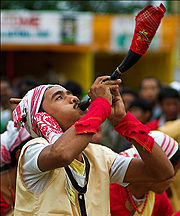 The folk songs associated with the Bohag Bihu are called Bihugeets or Bihu songs. The form of celebration and rites vary among different demographic groups.
Rongali Bihu is also a fertility festival, where the bihu dance with its sensous movements using the hips, arms, etc., by the young women call out to celebrate their fertility. In this aspect, the bihu dance can also be called a mating ritual by the young men and women.
Goru Bihu: The goru bihu or cattle worship rites are observed on the last day of the year. The cattle are washed, smeared with ground turmeric and other pastes, struck with sprigs of dighalati and makhiyati and endeared to be healthy and productive (lao kha, bengena kha, bosore bosore barhi ja/maar xoru, baper xoru, toi hobi bor bor goru—eat gourd, eat brinjal, grow from year to year/your mother is small, your father is small, but you be a large one). The old cattle ropes are cast away through the legs and new ropes are tied to them, and they are allowed to roam anywhere they wished for the entire day.
Manuh Bihu: The New Year day, the day after the goru bihu, is called the manuh bihu. Elders are shown respect, with gifts of bihuwan (a gamosa
), a hachoti (kerchief), a cheleng etc., and their blessings are sought. Children are given new clothes, and Husori singing begins on this day, and people visit their relatives and friends.
Husori: Village elders move from household to households singing carols, also in the style of bihu geets, called husoris. It possibly derives from the Dimasa Kachari word formation ha (land) and char (move over): hachari. Villages could have more than one Husori band, and they would visit households in a village non-contiguous to itself, first singing carols at the Naamghar. The husari singers then visit individual households, by first announcing their arrival at the gate (podulimukh) with drum beats. The singers are traditionally welcomed into the courtyard where they sing the husori songs and perform a ring dance. At the end of the performance they are thanked with an offering dakshina of paan (betel leaf) tamul (areka nut) in a xorai
(brass dish with stand), whereupon the singers bless the household for the coming year. If there is a bereavement in the family, or the family does not invite the husori singers due to an illness, the husori band offers blessings from podulimukh and move on. Generally the singers are all male.
Fat Bihu: This is a very old form of Bihu, characterized by spontaneity, popular in the Lakhimpur area of Assam. According to legend, the first Ahom king, Sukaphaa
, traveled to the region to watch it in the early 13th century.
Beshma: This is celebrated by koches , in this festival 'bhurbhura','shak' are marrimaking and festing,
Mukoli Bihu: Young unmarried men and women attired in traditional golden silk muga dance the bihu and sing bihu songs in the open fields. The songs have themes of romance and sexual love, requited or unrequited. Sometimes the songs describe tragic events too, but treated very lightly. The dance celebrates female sexuality.
Jeng Bihu: This is Bihu dance and song performed and watched only by women. The name "jeng" comes from the fact that in earlier days women in the villages used to surround the place of their performance with sticks dug into the ground called jeng in Assamese. It is also called gos tolor bihu (Bihu beneath tree).
Baisago: The Bodo-Kachari
people celebrate for seven days—the first day for cattle (Magou), the second day for man (Mansoi) and ancestor worship, feasting, singing and merriment. Songs follow the same themes as the Bihu songs.
Bihutoli Bihu: The rural festival made its transition to urban life when it was first time brought to the stage in Lataxil field in Guwahati by the Guwahati Bihu Sanmilani in 1962, promoted by leading citizens like Radha Govinda Baruah and others. Bihu to a great extent has been popularized by the Bihu 'Samrat'( king ), of Assam, Khagen Mahanta. Unlike the rural version, the dancers danced on a makeshift elevated stage in an open area that came to be known as a Bihutoli. Many such Bihutolis have sprouted since then in Guwahati and other urban areas. The performances are not confined to the bihu dance form, but may incorporate all forms of theatrical performances to keep the audience enthralled well into the early hours. Performances could include standup comedy, to concerts by solo singers. The stage form of bihu has become so popular, that organizers have begun extending the celebrations to bohagi bidai, or farewell to the Bohag month, which are similar performances held a month later.
Haat Bihu
: Rongali Bihu also called Haat Bihu (seven Bihus). It celebrates seven days, it's called so. On the other hand, Rangali Bihu is constitute of seven different types of Bihu - Chot Bihu, Raati Bihu, Manuh Bihu, Kutum Bihu, Mela Bihu and Chera Bihu.
light lamps at the foot of the siju (Euphorbia neriifolia) tree. This Bihu is also associated with the lighting of akaxi gonga or akaxbonti, lamps at the tip of a tall bamboo pole, to show the souls of the dead the way to heaven, a practice that is common to many communities in India
, as well as Asia and Europe.
, a typical kind of drums or playing games. Boys roam about in the dark stealing firewood and vegetables for fun. The next morning they take a bath and burn the main Meji. People gather around the Meji and throw Pitha
s (rice cakes) and betel nuts to it while burning it at the same time. They offer their prayers to the God of Fire and mark the end of the harvesting year. Thereafter they come back home carrying pieces of half burnt firewood for being thrown among fruit trees for favourable results. All the trees in the compound are tied to bamboo strips or paddy stems. Different types of sports like Buffalo-fight, Egg-fight, Cock-fight, Nightingale-fight etc. are held throughout the day. There are other conventional festivals observed by various ethnic-cultural
groups. Me-dam-me-phi, Ali-aye-ligang, Porag, Garja, Hapsa Hatarnai, Kherai are few among them.The koch celebrates this bihu as pushna
http://sankalpindia.net/drupal/?q=bihu-a-celebration-assamese-culture
Assam
Assam , also, rarely, Assam Valley and formerly the Assam Province , is a northeastern state of India and is one of the most culturally and geographically distinct regions of the country...
and celebrated by the Assamese diaspora around the world. Though they owe their origins to ancient rites and practices they have taken definite urban features and have become popular festivals in urban and commercialized milieus in the recent decades. Bihu is also used to imply Bihu dance
Bihu dance
The Bihu dance is a folk dance from the Indian state of Assam related to the festival of Bihu. This joyous dance is performed by both young men and women, and is characterized by brisk dance steps,and rapid hand movement...
and Bihu folk songs. The Bihus are the national festivals of Assam. The most important festivals of Assam are the Bihus, celebrated with fun and abundance by all Assamese people
Assamese people
The Assamese people are a well-defined subgroup of People of Assam. Though sometimes they are defined as the Assamese-speaking Indo-Aryans of the Brahmaputra valley,, this definition is not legally binding...
irrespective of caste, creed, religion, faith and belief.
The word Bihu is derived from the language of the Dimasa Kacharis who have been agrarian since time immemorial. Their supreme god is Brai Shibrai or Father Shibrai. The First crops of the season are offered to Brai Shibrai while wishing for peace and prosperity. So Bi means "to ask" and Shu means "peace and prosperity" in the world. Hence the word BISHU gradually became Bihu to accommodate linguistic preferences. In Assam, Rongali Bihu draws from many different traditions— Austro-Asiatic, Sino-Burmese and Indo-Aryan—and is celebrated with great fervor. Celebrations begin in the middle of April and generally continue for a month. In addition there are two other Bihus: Kongali Bihu in October (associated with the September equinox) and Bhogali Bihu
Bhogali Bihu
Magh Bihu is a harvest festival celebrated in Assam, India, which marks the end of harvesting season in the month of Maagha . It is the Assam celebration of Sankranthi, with feasting lasting for a week.The festival is marked by feasts and bonfires...
in January (associated with the January solstice). Like most other Indian festivals, Bihu (all three) is associated with farming; as the traditional Assamese society is predominantly agricultural. In fact, similar festivals are also celebrated around the same time elsewhere in India.
The three Bihus
In a year there are three Bihu festivals in Assam - in the months of Bohaag (Baisakh, the middle of April), Maagh (the middle of January), and Kaati (Kartik, the middle of October). The Bihus have been celebrated in Assam since ancient times. Each Bihu coincides with a distinctive phase in the farming calendar. The most important and colourful of the three Bihu festival is the Spring festival "Bohag Bihu" or Rongali Bihu celebrated in the middle of April. This is also the beginning of the agricultural season.As no people can live without Air & Water, Just Like that the Assamese people can not live without the celebration of Bihu festival.
Rongali Bihu
Rongali Bihu (mid-April, also called Bohag Bihu), the most popular Bihu celebrates the onset of the Assamese New YearBengali calendar
The Bengali calendar or Bangla calendar is a solar and sidereal Hindu calendar used by the Bengali people. It is used in the eastern Indian states of West Bengal, Assam and Tripura and in Bangladesh...
(around April 15) and the coming of Spring. This marks the first day of the Hindu solar calendar and is also observed in Bengal, Manipur, Nepal, Orissa, Punjab, Kerala and Tamil Nadu though called by different names. It's a time of merriment and feasting and continues, in general, for seven days. The farmers prepare the fields for cultivation of paddy and there is a feeling of joy around. The women make pitha
Pitha
Pitha , or pithe is a type of cake or bread common in Bangladesh and India, especially the eastern states of Assam, Orissa, West Bengal, Bihar, Jharkhand, and the northeastern region. Pithas are typically made of rice flour, although there are some types of pitha made of wheat flour...
, larus (traditional food made of rice
Rice
Rice is the seed of the monocot plants Oryza sativa or Oryza glaberrima . As a cereal grain, it is the most important staple food for a large part of the world's human population, especially in East Asia, Southeast Asia, South Asia, the Middle East, and the West Indies...
and coconut
Coconut
The coconut palm, Cocos nucifera, is a member of the family Arecaceae . It is the only accepted species in the genus Cocos. The term coconut can refer to the entire coconut palm, the seed, or the fruit, which is not a botanical nut. The spelling cocoanut is an old-fashioned form of the word...
) and Jolpan
Jolpan
Jolpan, or snacks, are often served at breakfast in the Cuisine of Assam, although they may also be served at Bihu festivals or weddings. The word jolpan includes all the preparations namely jolpan, pitha, laddu and tea...
which gives the real essence of the season. The first day of the bihu is called goru bihu or cow bihu, where the cows are washed and worshipped, which falls on the last day of the previous year, usually on April 14. This is followed by manuh (human) bihu on April 15, the New Year Day. This is the day of getting cleaned up, wearing new cloths and celebrating and getting ready for the new year with fresh vigor. The third day is Gosai (Gods) bihu; statues of Gods, worshiped in all households are cleaned and worshiped asking for a smooth new year.
Rongali Bihu is also a fertility festival, where the bihu dance with its sensous movements using the hips, arms, etc., by the young women call out to celebrate their fertility. In this aspect, the bihu dance can also be called a mating ritual by the young men and women.
Goru Bihu: The goru bihu or cattle worship rites are observed on the last day of the year. The cattle are washed, smeared with ground turmeric and other pastes, struck with sprigs of dighalati and makhiyati and endeared to be healthy and productive (lao kha, bengena kha, bosore bosore barhi ja/maar xoru, baper xoru, toi hobi bor bor goru—eat gourd, eat brinjal, grow from year to year/your mother is small, your father is small, but you be a large one). The old cattle ropes are cast away through the legs and new ropes are tied to them, and they are allowed to roam anywhere they wished for the entire day.
Manuh Bihu: The New Year day, the day after the goru bihu, is called the manuh bihu. Elders are shown respect, with gifts of bihuwan (a gamosa
Gamosa
The Gamosa is an article of great significance for the people of Assam.It is generally a white rectangular piece of cloth with primarily a red border on three sides and red woven motifs on the fourth...
), a hachoti (kerchief), a cheleng etc., and their blessings are sought. Children are given new clothes, and Husori singing begins on this day, and people visit their relatives and friends.
Husori: Village elders move from household to households singing carols, also in the style of bihu geets, called husoris. It possibly derives from the Dimasa Kachari word formation ha (land) and char (move over): hachari. Villages could have more than one Husori band, and they would visit households in a village non-contiguous to itself, first singing carols at the Naamghar. The husari singers then visit individual households, by first announcing their arrival at the gate (podulimukh) with drum beats. The singers are traditionally welcomed into the courtyard where they sing the husori songs and perform a ring dance. At the end of the performance they are thanked with an offering dakshina of paan (betel leaf) tamul (areka nut) in a xorai
Xorai
The Xorai is a traditional symbol of Assam. In simplistic terms it is an offering tray with a stand at the bottom. There are Xorais with or without a cover on the top.-Materials:...
(brass dish with stand), whereupon the singers bless the household for the coming year. If there is a bereavement in the family, or the family does not invite the husori singers due to an illness, the husori band offers blessings from podulimukh and move on. Generally the singers are all male.
Fat Bihu: This is a very old form of Bihu, characterized by spontaneity, popular in the Lakhimpur area of Assam. According to legend, the first Ahom king, Sukaphaa
Sukaphaa
Chaolung Sukaphaa , also Siu-Ka-Pha, the first Ahom king in medieval Assam, was the founder of the Ahom kingdom. A Tai prince originally from Mong Mao, the kingdom he established in 1228 existed for nearly six hundred years and in the process unified the various tribal and non-tribal peoples of...
, traveled to the region to watch it in the early 13th century.
Beshma: This is celebrated by koches , in this festival 'bhurbhura','shak' are marrimaking and festing,
Mukoli Bihu: Young unmarried men and women attired in traditional golden silk muga dance the bihu and sing bihu songs in the open fields. The songs have themes of romance and sexual love, requited or unrequited. Sometimes the songs describe tragic events too, but treated very lightly. The dance celebrates female sexuality.
Jeng Bihu: This is Bihu dance and song performed and watched only by women. The name "jeng" comes from the fact that in earlier days women in the villages used to surround the place of their performance with sticks dug into the ground called jeng in Assamese. It is also called gos tolor bihu (Bihu beneath tree).
Baisago: The Bodo-Kachari
Bodo-Kachari
Bodo-Kachari is a generic term applied to a number of ethnic groups predominantly in Assam speaking Tibeto-Burman languages or claiming a common ancestry.-Origins:...
people celebrate for seven days—the first day for cattle (Magou), the second day for man (Mansoi) and ancestor worship, feasting, singing and merriment. Songs follow the same themes as the Bihu songs.
Bihutoli Bihu: The rural festival made its transition to urban life when it was first time brought to the stage in Lataxil field in Guwahati by the Guwahati Bihu Sanmilani in 1962, promoted by leading citizens like Radha Govinda Baruah and others. Bihu to a great extent has been popularized by the Bihu 'Samrat'( king ), of Assam, Khagen Mahanta. Unlike the rural version, the dancers danced on a makeshift elevated stage in an open area that came to be known as a Bihutoli. Many such Bihutolis have sprouted since then in Guwahati and other urban areas. The performances are not confined to the bihu dance form, but may incorporate all forms of theatrical performances to keep the audience enthralled well into the early hours. Performances could include standup comedy, to concerts by solo singers. The stage form of bihu has become so popular, that organizers have begun extending the celebrations to bohagi bidai, or farewell to the Bohag month, which are similar performances held a month later.
Haat Bihu
Haat Bihu
Rangali Bihu is called Haat Bihu owing to it celebrates seven days from the date of Vishuva Sankranti of the month of Vaisakh...
: Rongali Bihu also called Haat Bihu (seven Bihus). It celebrates seven days, it's called so. On the other hand, Rangali Bihu is constitute of seven different types of Bihu - Chot Bihu, Raati Bihu, Manuh Bihu, Kutum Bihu, Mela Bihu and Chera Bihu.
Kongali Bihu
Kongali Bihu (mid-October, also called Kati-Bihu) has a different flavor as there is less merriment and the atmosphere has a sense of constrain and solemnity. During this time of the year, the paddy in the fields are in the growing stage and the granaries of the farmers are almost empty. On this day, earthen lamps (saki) are lit at the foot of the household tulsi plant, the granary, the garden (bari) and the paddy fields. To protect the maturing paddy, cultivators whirl a piece of bamboo and recite rowa-khowa chants and spells to ward off pests and the evil eye. During the evening, cattle are fed specially made rice items called pitha. The Bodo peopleBodo people
The Bodos are an ethnic and linguistic community, early settlers of Assam in the North-East of India. According to the 1991 census, there were 1.2 million Bodos in Assam which makes for 5.3% of the total population in the state. Bodos belong to a larger ethnic group called the Bodo-Kachari. The...
light lamps at the foot of the siju (Euphorbia neriifolia) tree. This Bihu is also associated with the lighting of akaxi gonga or akaxbonti, lamps at the tip of a tall bamboo pole, to show the souls of the dead the way to heaven, a practice that is common to many communities in India
India
India , officially the Republic of India , is a country in South Asia. It is the seventh-largest country by geographical area, the second-most populous country with over 1.2 billion people, and the most populous democracy in the world...
, as well as Asia and Europe.
Bhogali Bihu
Bhogali Bihu (mid-January, also called Magh Bihu) comes from the word Bhog that is eating and enjoyment. It is a harvest festival and marks the end of harvesting season. Since the granaries are full, there is a lot of feasting and eating during this period. On the eve of the day called uruka, i.e., the last day of pausa, menfolk, more particularly young men go to the field, preferably near a river, build a makeshift cottage called Bhelaghar with the hay of the harvest fields and the Meji, the most important thing for the night. During the night, they prepare food and there is community feasting everywhere.There is also exchange of sweets and greetings at this time. The entire night (called Uruka) is spent around a Meji with people singing bihu songs, beating DholDhol
Dhol can refer to any one of a number of similar types of double-headed drum widely used, with regional variations, throughout the Indian subcontinent and nearby regions. Its range of distribution in India and Pakistan primarily includes northern areas such as the Assam Valley, Bengal, Gujarat,...
, a typical kind of drums or playing games. Boys roam about in the dark stealing firewood and vegetables for fun. The next morning they take a bath and burn the main Meji. People gather around the Meji and throw Pitha
Pitha
Pitha , or pithe is a type of cake or bread common in Bangladesh and India, especially the eastern states of Assam, Orissa, West Bengal, Bihar, Jharkhand, and the northeastern region. Pithas are typically made of rice flour, although there are some types of pitha made of wheat flour...
s (rice cakes) and betel nuts to it while burning it at the same time. They offer their prayers to the God of Fire and mark the end of the harvesting year. Thereafter they come back home carrying pieces of half burnt firewood for being thrown among fruit trees for favourable results. All the trees in the compound are tied to bamboo strips or paddy stems. Different types of sports like Buffalo-fight, Egg-fight, Cock-fight, Nightingale-fight etc. are held throughout the day. There are other conventional festivals observed by various ethnic-cultural
Ethnocentrism
Ethnocentrism is the tendency to believe that one's ethnic or cultural group is centrally important, and that all other groups are measured in relation to one's own. The ethnocentric individual will judge other groups relative to his or her own particular ethnic group or culture, especially with...
groups. Me-dam-me-phi, Ali-aye-ligang, Porag, Garja, Hapsa Hatarnai, Kherai are few among them.The koch celebrates this bihu as pushna
http://sankalpindia.net/drupal/?q=bihu-a-celebration-assamese-culture
Instruments used in Bihu
- DholDholDhol can refer to any one of a number of similar types of double-headed drum widely used, with regional variations, throughout the Indian subcontinent and nearby regions. Its range of distribution in India and Pakistan primarily includes northern areas such as the Assam Valley, Bengal, Gujarat,...
(Drum) - Taal
- PepaPepaPepa may refer to:*Pepa, Democratic Republic of the Congo, a village in northeastern Katanga province with a population around 4,000*Pepa Airport, an airstrip in the Democratic Republic of the Congo near Pepa village...
(An instrument made of buffalo horn) - Toka
- Baanhi (FluteFluteThe flute is a musical instrument of the woodwind family. Unlike woodwind instruments with reeds, a flute is an aerophone or reedless wind instrument that produces its sound from the flow of air across an opening...
) - XutuliXutuliXutuli is a musical instrument used during Rongali Bihu festival in Assam, India. It is made with clay or the lower end of a Bamboo tree which is left after the main part falls or is cut off . Detail about this musical instrument can be available in xobdo.-References:# http://www.xobdo.org#...
- GogonaGogonaThe gogona is a type of jaw harp, a vibrating reed instrument that is used primarily in the traditional Bihu music in Assam. It is made of a piece of bamboo/horn that has a bifurcation on one end...