
All Topics  
Stucco

 
Stucco

   Email Print
   Bookmark   Link


Stucco


Stucco or render is a material made of an aggregate
Construction Aggregate

Construction aggregate, or simply "aggregate ", is a broad category of coarse particulate material used in construction, including sand, gravel, crushed stone, slag, recycled concrete and geosynthetic aggregates....
, a binder
Binder (material)

A binder is an ingredient used to bind together two or more other materials in mixtures. Its two principal properties are adhesion and cohesion ....
, and water. Stucco is applied wet and hardens to a very dense solid. It is used as a coating for walls and ceilings and for decoration. Stucco may be used to cover less visually appealing construction materials such as concrete
Concrete

Concrete is a construction material composed of cement as well as other cementitious materials such as fly ash and slag cement, construction aggregate , water , and Chemistry admixtures....
, cinder block
Cinder block

In the United States, a concrete masonry unit ? also called concrete block, cement block or foundation block ? is a large rectangular brick used in construction....
, or clay brick and adobe
Adobe

Adobe is a natural building material made from sand, clay, and water, with some kind of fibrous or organic material , which is shaped into bricks using frames and dried in the sun....
. difference in nomenclature between stucco, plaster
Plaster

The term plaster can refer to plaster of Paris, lime plaster, or cement plaster. This article deals mainly with plaster of Paris.Plaster of Paris is a type of building material based on calcium sulfate Hydrate, nominally CaSO4?0.5H2O....
, and mortar
Mortar (masonry)

Mortar is a workable paste formed by mixture of cement, water and fine aggregate masonry to bind construction blocks together and fill the gaps between them....
 is based more on use than composition.


Discussion
Ask a question about 'Stucco'
Start a new discussion about 'Stucco'
Answer questions from other users
Full Discussion Forum


Encyclopedia


Stucco or render is a material made of an aggregate
Construction Aggregate

Construction aggregate, or simply "aggregate ", is a broad category of coarse particulate material used in construction, including sand, gravel, crushed stone, slag, recycled concrete and geosynthetic aggregates....
, a binder
Binder (material)

A binder is an ingredient used to bind together two or more other materials in mixtures. Its two principal properties are adhesion and cohesion ....
, and water. Stucco is applied wet and hardens to a very dense solid. It is used as a coating for walls and ceilings and for decoration. Stucco may be used to cover less visually appealing construction materials such as concrete
Concrete

Concrete is a construction material composed of cement as well as other cementitious materials such as fly ash and slag cement, construction aggregate , water , and Chemistry admixtures....
, cinder block
Cinder block

In the United States, a concrete masonry unit ? also called concrete block, cement block or foundation block ? is a large rectangular brick used in construction....
, or clay brick and adobe
Adobe

Adobe is a natural building material made from sand, clay, and water, with some kind of fibrous or organic material , which is shaped into bricks using frames and dried in the sun....
.
Architecture121

Composition

The difference in nomenclature between stucco, plaster
Plaster

The term plaster can refer to plaster of Paris, lime plaster, or cement plaster. This article deals mainly with plaster of Paris.Plaster of Paris is a type of building material based on calcium sulfate Hydrate, nominally CaSO4?0.5H2O....
, and mortar
Mortar (masonry)

Mortar is a workable paste formed by mixture of cement, water and fine aggregate masonry to bind construction blocks together and fill the gaps between them....
 is based more on use than composition. Until the later part of the nineteenth century, it was common that plaster, which was used inside a building, and stucco, which was used outside, would consist of the same primary materials: lime and sand (which are also used in mortar). Animal or plant fibers were often added for additional strength. In the later part of the nineteenth century, Portland cement
Portland cement

Portland cement is the most common type of cement in general use around the world, because it is a basic ingredient of concrete, mortar , stucco and most non-specialty grout....
 was added with increasing frequency in an attempt to improve its durability. At the same time, traditional lime plaster
Lime plaster

Lime plaster is a mixture of calcium hydroxide and sand . Carbon dioxide in the atmosphere causes the plaster to set by transforming the calcium hydroxide into calcium carbonate ....
s were being replaced by gypsum
Gypsum

Gypsum is a very soft mineral composed of calcium sulfate dihydrate, with the chemical formula calciumsulfuroxygen4?2water....
 plaster.

Traditional stucco is made of lime
Lime (mineral)

Lime is a general term for calcium-containing inorganic materials, in which carbonates, oxides and hydroxides predominate. Strictly speaking, lime is calcium oxide or calcium hydroxide....
, sand
Sand

Sand is a naturally occurring granular material composed of finely divided rock and mineral particles.As the term is used by geologists, sand particles range in diameter from 0.0625 to 2 millimeters....
, and water. Modern stucco is made of Portland cement
Portland cement

Portland cement is the most common type of cement in general use around the world, because it is a basic ingredient of concrete, mortar , stucco and most non-specialty grout....
, sand, and water. Lime is added to decrease the permeability and increase the workability of modern stucco. Sometimes additives such as acrylic
Acrylic

Acrylic may refer to:* chemical compounds that contain the acryl group derived from acrylic acid* Acrylic fiber, a synthetic polymer fiber that contains at least 85% acrylonitrile...
s and glass fibers are added to improve the structural properties of the plaster. This is usually done with what is considered a one-coat stucco system, as opposed to the traditional three-coat method.

Lime stucco is a relatively hard material that can be broken or chipped by hand without too much difficulty. The lime itself is usually white; color comes from the aggregate or any added pigments. Lime stucco has the property of being self-healing to a limited degree because of the slight solubility of lime (which in solution can be deposited in cracks. where it solidifies). Portland cement stucco is very hard and brittle and can easily crack if the base on which it is applied is not stable. Typically its color was gray, from the innate color of most Portland cement, but white Portland cement is also used. Today's stucco manufacturers offer a very wide range of colors that can be mixed integrally in the finish coat.

Traditional Stucco


Stucco Wall
As a building material, stucco is a durable, attractive, and weather-resistant wall covering. It was traditionally used as both an interior and exterior finish applied in one or two thin layers directly over a solid masonry, brick or stone surface. The finish coat usually contained an integral color and was typically textured for appearance.

Then with the introduction and development of heavy timber and light wood-framed construction methods, stucco was adapted for this new use by adding a reinforcement lattice, or lath
Lath

A lath is a thin, narrow strip of some straight-grained wood or other material, including metal or gypsum. A lattice, or lattice-work, is a criss-crossed or interlaced arrangement of laths, or the pattern made by such an arrangement....
, attached to and spanning between the structural supports and by increasing the thickness and number of layers of the total system. The lath added support for the wet plaster and tensile strength to the brittle, cured stucco; while the increased thickness and number of layers helped control cracking.

The traditional application of stucco and lath occurs in three coats — the scratch coat, the brown coat and the finish coat. The two base coats of plaster are either hand-applied or machine sprayed. The finish coat can be troweled smooth, hand-textured, floated to a sand finish or sprayed.

Originally the lath material was strips of wood installed horizontally on the wall, with spaces between, that would support the wet plaster until it cured. This lath and plaster
Lath and plaster

Lath and plaster is a building process used mainly for interior walls in Canada and the United States until the late 1950s. After the 1950s, drywall began to replace the lath and plaster process in the these countries....
 technique became widely used.

In exterior wall applications, the lath is installed over a weather-resistant asphalt-impregnated felt or paper sheet that protects the framing from the moisture that can pass through the porous stucco.

Following World War II, the introduction of metal wire mesh, or netting, replaced the use of wood lath. Galvanizing the wire made it corrosion resistant and suitable for exterior wall applications. At the beginning of the 21st century, this "traditional" method of wire mesh lath and three coats of exterior plaster is still widely used. In some parts of the United States (California, Arizona, New Mexico and Florida), stucco is the predominant exterior for both residential and commercial construction. Stucco has also been used as a sculptural and artistic material. Baroque
Baroque

In the the arts, the Baroque was a Western cultural Epoch , starting roughly at the beginning of the 17th century in Rome, Italy. It was exemplified by drama and grandeur in Baroque sculpture, Baroque painting, literature, Baroque dance, and Baroque music....
 and Rococo
Rococo

Rococo is a style of 18th century French art and interior design. Rococo rooms were designed as total works of art with elegant and ornate furniture, small sculptures, ornamental mirrors, and tapestry complementing architecture, reliefs, and wall paintings....
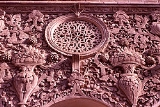
 architecture makes heavy use of stucco. Examples can be found in churches and palaces, where stucco is mostly used to provide a smooth, decorative transition from walls to ceiling, decorating and giving measure to ceiling surfaces. Stucco is an integral part of the art of belcomposto, the Baroque concept that integrates the three classic art
Art in Ancient Greece

The arts of ancient Greece has exercised an enormous influence on the culture of many countries from ancient times until the present, particularly in the areas of sculpture and architecture....
s, architecture
Architecture

The term architecture can refer to a process, a profession or documentation.As a process, architecture is the activity of designing and construction buildings and other physical structures by a person or a computer, primarily to provide shelter....
, sculpture
Sculpture

Sculpture is Three-dimensional space artwork created by shaping or combining hard and or plastic material, sound, and or text and or light, commonly Stone sculpture , metal, glass, or wood....
, and painting
Painting

Painting is the practice of applying paint, pigment, color or other medium to a surface . In art, the term describes both the act and the result, which is called a painting....
.

Since stucco can be used for decoration as well as for figurative representation, it provides an ideal transitive link from architectural details to wall paintings such as the typically Baroque
Baroque

In the the arts, the Baroque was a Western cultural Epoch , starting roughly at the beginning of the 17th century in Rome, Italy. It was exemplified by drama and grandeur in Baroque sculpture, Baroque painting, literature, Baroque dance, and Baroque music....
 trompe l'oeil
Trompe l'oeil

Trompe-l'?il, which can also be spelled without the hyphen in English, is an art technique involving extremely realistic imagery in order to create the optical illusion that the depicted objects appear in three-dimensions, instead of actually being a two-dimensional painting....
 ceilings, as in the work of the Wessobrunner School
Wessobrunner School

The Wessobrunner School is the name for a group of Baroque sculpture stucco-workers that, beginning at the end of the 17th century, developed in the Order of St....
. Here, the real architecture of the church is visually extended into a heavenly architecture with a depiction of Christ
Christ

Christ is the English language term for the Greek meaning "the anointing", which is a title given to the Reigning Messiah in the given age of the Zodiac....
, the Virgin Mary
Blessed Virgin Mary

The Blessed Virgin Mary, sometimes shortened to The Blessed Virgin or The Virgin Mary, is a traditional title used by most Christians and most specifically used by liturgical Christians such as Roman Catholics, Anglicanism, Eastern Orthodox and Eastern Catholics, and some others to describe Mary, mother of Jesus, the mother of...
 or the Last Judgment
Last Judgment

In Christian eschatology, the Last Judgment, Final Judgment, Judgment Day, or End time is the judgment by God of all nations....
 at the center. Stucco is used to form a semi-plastic extension of the real architecture that merges into the painted architecture.

Islamic art
Islamic art

File:Caucasian panel.jpgIslamic art encompasses the arts produced from the 7th century onwards by people who lived within the territory that was inhabited by culturally Islamic populations....
 makes use of stucco as a decorative means in mosque
Mosque

A mosque is a place of worship for followers of Islam. Muslims often refer to the mosque by its Arabic name, masjid, ? . The word "mosque" in English refers to all types of buildings dedicated for Islamic worship, although there is a distinction in Arabic between the smaller, privately owned mosque and the larger, "collective" mosque ,...
s and palaces. India
India

India, officially the Republic of India , is a country in South Asia. It is the List of countries and outlying territories by total area country by geographical area, the List of countries by population country, and the most populous liberal democracy in the world....
n architecture knows stucco as a material for sculpture in an architectural context. It is rare in the countryside.

Because of its "aristocratic" appearance, Baroque-looking stucco decoration was used frequently in upper-class apartments of the 19th and early 20th century.

Beginning in the 1920s, stucco, especially in its Neo-Renaissance
Neo-Renaissance

"Neo-Renaissance" is an all-encompassing style designation that covers many aspects of 19th century Revivalism which were neither Grecian nor Gothic but which instead drew inspiration from a wide range of classicizing Italian modes....
 and Neo-Baroque
Neo-baroque

Neo-Baroque is a term used to describe artistic creations which display important aspects of Baroque style, but are not from the Baroque period proper?i.e., the 17th and 18th centuries....
 materialization, became increasingly unpopular with modern architects in some countries, resulting in a widespread movement to remove the stucco from tenements.

Stucco was still employed in the 1950s in molded forms for decorating the joints between walls and ceilings inside houses. It was generally painted the same color as the ceiling and used in designs where a picture rail or rat rail was in use.

Modern stucco

Modern stucco is an exterior cement plaster wall covering. It is usually a mix of sand, Portland cement, lime and water, but may also consist of a proprietary mix of additives including fibers and synthetic acrylics that add strength and flexibility. Modern synthetic stucco can be applied as one base layer and a finish layer, which is thinner and faster to apply, compared to the traditional application of three-coat stucco.

As with any cement-based material, stucco must be reinforced to resist movement cracking. Plastic or wire mesh lath, attached with nails or screws to the structural framing, is embedded into the base coat to provided stiffening for the stucco. One method often used to help conceal the smaller surface cracks that may appear is the application of one of a variety of pre-mixed acrylic finishes. Flexible acrylic finishes have the ability to stretch and bridge over cracks, improving appearance and limiting the passage of moisture behind the stucco.

Where stucco is to be applied to a structure of wood-framing or light-gauge steel framing, the framing is protected from moisture damage by applying a vapor-permeable, water-resistant weather barrier; typically an asphalt-saturated paper or one of a variety of manufactured plastic-based sheets, known as "building wraps" or "stucco wraps". The properties of the weather barrier must not only protect the framing from rain and moisture, but at the same time allow the free passage of any water vapor generated inside the building to escape through the wall.

A wide variety of stucco accessories, such as weep screeds, control and expansion joints, corner-aids and architectural reveals are sometimes also incorporated into the lath. Wire lath is used to give the plaster something to attach to and to add strength. Types include expanded-metal lath, woven-wire lath, and welded-wire lath.

The first layer of plaster is called a "scratch coat," consisting of plastic cement and sand. A brush is used to scratch the surface horizontally or in a crisscross pattern to provide a key for the second layer. The first coat is allowed to dry (cure) before the second layer is applied.

The next layer is called the "brown coat" or leveling coat. It also consists of sand, cement, and lime. It is leveled with tools called "darbies," "rods," and "federeges," scraped smooth, and floated to provide a smooth, even surface onto which the finish coat is applied. It is then allowed to dry (cure) for 7-10 days minimum to allow "checking" (shrinkage) and cracking to take place.

If applied during very dry weather, the layers of stucco are sprayed with water for one or more days to keep a level of moisture within the stucco while it cures, a process known as "moist curing." If the stucco dries too soon, the chemical hardening ("hydration") will be incomplete, resulting in a weaker and brittler stucco.

The final, exterior layer is the final layer is the "finish coat," of which there are two recommended types:

1. Color Coat is a colored sand, cement, and lime mixed finish and is typically 3 mm (1/8") thick. It is applied over the second coat (brown coat) and can be floated with water for a sandy finish or textured over with a trowel to create various styles of finishes. Premixed, bagged stucco is gaining in use and is available in coarse graded sand and finer graded sand for creating a variety of troweled finishes; it is available in a variety of colors.

2. Acrylic Finish is an acrylic-based finish from 1.0 mm to 4.0 mm thick. It can be applied in many ways; it is the most recommended finish for long-lasting quality. It also can be ordered in any color.

(Hard Coating is another method of adding a finish to the stucco wall, although no longer recommended. In the 1960s and 1970s people added a variety of materials like glass chunks, stones or marble into the wet stucco wall. This kind of finish coat is very heavy and inflexible and is hard to repair.)

See also

  • Cement render
    Cement render

    Cement rendering is the application of a thin premixed surface ofsand, cement and lime to brick, cement, stone or mud brick. It isoften textured, coloured or painted after application....
  • Exterior Insulation Finishing System
    Exterior Insulation Finishing System

    Exterior Insulation and Finish Systems are a type of building product that provides exterior walls with an insulated finished surface, and waterproofing in an integrated composite material system....
  • Lath and plaster
    Lath and plaster

    Lath and plaster is a building process used mainly for interior walls in Canada and the United States until the late 1950s. After the 1950s, drywall began to replace the lath and plaster process in the these countries....
  • Pargeting
    Pargeting

    Pargeting is a decorative plastering applied to building walls.Pargeting derives from the word 'parget', a Middle English term that is probably derived from the Old French 'pargeter' / 'parjeter', to throw about, or 'porgeter', to roughcast a wall....
  • Plaster
    Plaster

    The term plaster can refer to plaster of Paris, lime plaster, or cement plaster. This article deals mainly with plaster of Paris.Plaster of Paris is a type of building material based on calcium sulfate Hydrate, nominally CaSO4?0.5H2O....
  • Plasterwork
    Plasterwork

    Plasterwork refers to construction or ornamentation done with plaster, such as a layer of plaster on an interior wall or plaster Molding on ceilings or walls....
  • Polished plaster
    Polished plaster

    Polished plaster is a term for the finish of some plasters and for the description of new and updated forms of traditional Italian plaster finishes....
  • Tadelakt
    Tadelakt

    Tadelakt or Tadellakt is a bright, nearly waterproof lime plaster which can be used on the inside of buildings and on the outside. It is the traditional coating of the palaces, hammams and bathrooms of the riad s in Morocco....


External links

  • Anne Grimmer, The Preservation and Repair of Historic Stucco, published by the Technical Preservation Services, Heritage Preservation Services Division, National Park Service , and duplicated all over the web