

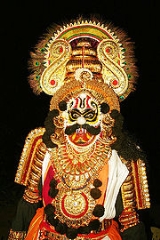
Rakshasa

Encyclopedia

Hinduism
Hinduism is the predominant and indigenous religious tradition of the Indian Subcontinent. Hinduism is known to its followers as , amongst many other expressions...
and Buddhist
Buddhism
Buddhism is a religion and philosophy encompassing a variety of traditions, beliefs and practices, largely based on teachings attributed to Siddhartha Gautama, commonly known as the Buddha . The Buddha lived and taught in the northeastern Indian subcontinent some time between the 6th and 4th...
religion. Rakshasas are also called man-eaters ("Nri-chakshas," "Kravyads"). A female Rakshasa is called a Rakshasi, and a female Rakshasa in human form is a Manushya-Rakshasi. Often Asura
Asura
-In Hinduism:In Hinduism, the Asuras constitute a group of power-seeking deities, sometimes considered sinful and materialistic. The Daityas and Danavas were combinedly known as Asuras. The Asura were opposed to the Devas. Both groups are children of Kasyapa...
and Rakshasa are interchangeably used.
According to the Ramayana
Ramayana
The Ramayana is an ancient Sanskrit epic. It is ascribed to the Hindu sage Valmiki and forms an important part of the Hindu canon , considered to be itihāsa. The Ramayana is one of the two great epics of India and Nepal, the other being the Mahabharata...
, Rakshasas were created from Brahma
Brahma
Brahma is the Hindu god of creation and one of the Trimurti, the others being Vishnu and Shiva. According to the Brahma Purana, he is the father of Mānu, and from Mānu all human beings are descended. In the Ramayana and the...
's foot; other sources claim they are descended from Pulastya
Pulastya
Pulatsya was one of the ten Prajapati or mind-born sons of Brahma, and one of the Saptarishis in the first Manvantara....
, or from Khasa, or from Nirriti and Nirrita. Hinduism maintains that the Rakshasas were particularly wicked humans in previous incarnations. Rakshasas are notorious for disturbing sacrifices, desecrating graves, harassing priest
Priest
A priest is a person authorized to perform the sacred rites of a religion, especially as a mediatory agent between humans and deities. They also have the authority or power to administer religious rites; in particular, rites of sacrifice to, and propitiation of, a deity or deities...
s, possessing
Demonic possession
Demonic possession is held by many belief systems to be the control of an individual by a malevolent supernatural being. Descriptions of demonic possessions often include erased memories or personalities, convulsions, “fits” and fainting as if one were dying...
human beings, and so on. Their fingernails are venomous, and they feed on human flesh and spoiled food. They are shapechangers
Shapeshifting
Shapeshifting is a common theme in mythology, folklore, and fairy tales. It is also found in epic poems, science fiction literature, fantasy literature, children's literature, Shakespearean comedy, ballet, film, television, comics, and video games...
, illusionists, and magicians.
In the Hindu Stories
Their origin is traced back to the sage Kashyapa.Kashyapa was married to the thirteen daughters of Daksha, among them were Aditi, Diti and Danu.
- The sons of Kashyapa with Danu are the Danavas (meaning of Danu).
- The sons of Kashyapa with Diti are the Daityas (meaning of Diti).
- The sons of Kashyapa with Aditi are the Adityas (meaning of Aditi). The Adityas are Devas (deities), also known by other names such as Suras.
Rakshas are depicted as mean, fierce looking, ugly, huge like a hill, usually black as soot, with two fangs protruding out of the mouth (like a vampire
Vampire
Vampires are mythological or folkloric beings who subsist by feeding on the life essence of living creatures, regardless of whether they are undead or a living person...
) with nails like claws, growling like a beast. They are depicted as cannibals with an insatiable hunger, who can smell the scent of animal, men or flesh. Some more ferocious ones are shown with flaming red eyes and flaming hair, drinking blood with their palms or from a human skull. Generally in these stories, they have the power to fly, can vanish and also increase or decrease their size at will. They can also take the form of any animal, human or other thing at their will. These powers are called Maya.
In the Hindu epics
In the world of the RamayanaRamayana
The Ramayana is an ancient Sanskrit epic. It is ascribed to the Hindu sage Valmiki and forms an important part of the Hindu canon , considered to be itihāsa. The Ramayana is one of the two great epics of India and Nepal, the other being the Mahabharata...
and Mahabharata
Mahabharata
The Mahabharata is one of the two major Sanskrit epics of ancient India and Nepal, the other being the Ramayana. The epic is part of itihasa....
, Rakshasas are a populous race of supernatural humanoids. There were both good and evil rakshasas, and as warriors they fought along side the armies of both good and evil. They are powerful warriors, expert magicians and illusionists. As shape-changers, they can assume various physical forms, and it is not always clear whether they have a true or natural form. As illusionists, they are capable of creating appearances which are real to those who believe in them or who fail to dispel them. Some of the rakshasas are said to be man-eaters, and make their gleeful appearance when the slaughter on the battlefield is at its worst. Occasionally they serve as rank-and-file soldiers in the service of one or the other warlord.
Aside from its treatment of unnamed rank-and-file Rakshasas, the epic tells the stories of certain members of the race who rose to prominence, some of them as heroes, most of them as villains.
In the Ramayana
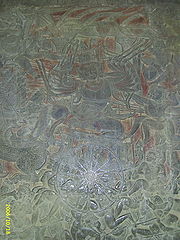
Ravana
' is the primary antagonist character of the Hindu legend, the Ramayana; who is the great king of Lanka. In the classic text, he is mainly depicted negatively, kidnapping Rama's wife Sita, to claim vengeance on Rama and his brother Lakshmana for having cut off the nose of his sister...
against an army of Vanaras or monkeys under Rama
Rama
Rama or full name Ramachandra is considered to be the seventh avatar of Vishnu in Hinduism, and a king of Ayodhya in ancient Indian...
and Sugriva
Sugriva
In the Hindu epic Ramayana, Sugriva , also spelled Sugreeva or Sugreev, was the younger brother of Bali, whom he succeeded as ruler of the vanara or monkey kingdom Kishkindha. Ruma was his wife. He was the son of Surya, the Hindu deity of the sun...
.
- RavanaRavana' is the primary antagonist character of the Hindu legend, the Ramayana; who is the great king of Lanka. In the classic text, he is mainly depicted negatively, kidnapping Rama's wife Sita, to claim vengeance on Rama and his brother Lakshmana for having cut off the nose of his sister...
, a Rakshasa with 10 heads, was the King of the Rakshasas and the mortal enemy of RamaRamaRama or full name Ramachandra is considered to be the seventh avatar of Vishnu in Hinduism, and a king of Ayodhya in ancient Indian...
, the hero of the RamayanaRamayanaThe Ramayana is an ancient Sanskrit epic. It is ascribed to the Hindu sage Valmiki and forms an important part of the Hindu canon , considered to be itihāsa. The Ramayana is one of the two great epics of India and Nepal, the other being the Mahabharata...
. In the RamayanaRamayanaThe Ramayana is an ancient Sanskrit epic. It is ascribed to the Hindu sage Valmiki and forms an important part of the Hindu canon , considered to be itihāsa. The Ramayana is one of the two great epics of India and Nepal, the other being the Mahabharata...
(Book III: Varna Parva, Section 271 ff.), the Sage MarkandeyaMarkandeyaMarkandeya is an ancient rishi from the Hindu tradition, born in the clan of Bhrigu Rishi. He is celebrated as a devotee of both Shiva and Vishnu and is mentioned in a number of stories from the Puranas...
recounts the story of how Ravana kidnapped Rama's wife SitaSITASITA is a multinational information technology company specialising in providing IT and telecommunication services to the air transport industry...
and whisked her off to his stronghold LankaLankaSri Lanka is the name given in Hindu mythology to the island fortress capital of the legendary king Ravana in the great Hindu epics, the Ramayana and the Mahabharata...
, and how Rama, aided by the monkey King SugrivaSugrivaIn the Hindu epic Ramayana, Sugriva , also spelled Sugreeva or Sugreev, was the younger brother of Bali, whom he succeeded as ruler of the vanara or monkey kingdom Kishkindha. Ruma was his wife. He was the son of Surya, the Hindu deity of the sun...
and his army of monkeys, laid siege to Lanka, slew Ravana, and rescued Sita. - VibhishanaVibhishanaVibhishana or Bibhishan is a character in the epic Ramayana. He was the younger brother of the demon Ravana. Though a half-demon himself, Vibhishana was of a noble character and advised Ravana, who kidnapped and abducted Sita, to return her to her husband Rama in an orderly fashion...
, RavanaRavana' is the primary antagonist character of the Hindu legend, the Ramayana; who is the great king of Lanka. In the classic text, he is mainly depicted negatively, kidnapping Rama's wife Sita, to claim vengeance on Rama and his brother Lakshmana for having cut off the nose of his sister...
's younger brother, was a rare good-hearted Rakshasa; he was beautiful, pious and assiduous in his religious observances. When BrahmaBrahmaBrahma is the Hindu god of creation and one of the Trimurti, the others being Vishnu and Shiva. According to the Brahma Purana, he is the father of Mānu, and from Mānu all human beings are descended. In the Ramayana and the...
granted him a boon, he asked never to swerve from the path of righteousness and to be illumined by divine knowledge (Book III, Varna Parva: Section 273.) Vibhishana joined RamaRamaRama or full name Ramachandra is considered to be the seventh avatar of Vishnu in Hinduism, and a king of Ayodhya in ancient Indian...
in his campaign against Ravana, and helped Rama's army to cross the ocean into Lanka (Section 281). When invisible Rakshasas infiltrated Rama's camp, Vibhishana caused them to become visible, and Rama's monkey soldiers destroyed them (Section 283). After Rama's final victory over Ravana, the loyal Vibhishana was made king of LankaLankaSri Lanka is the name given in Hindu mythology to the island fortress capital of the legendary king Ravana in the great Hindu epics, the Ramayana and the Mahabharata...
(Section 289). - KumbhakarnaKumbhakarnaKumbhakarna , is a rakshasa and brother of Ravana in the Indian Ramayana epic...
was another brother of RavanaRavana' is the primary antagonist character of the Hindu legend, the Ramayana; who is the great king of Lanka. In the classic text, he is mainly depicted negatively, kidnapping Rama's wife Sita, to claim vengeance on Rama and his brother Lakshmana for having cut off the nose of his sister...
. A fearsome warrior and master of illusion, he slept through most of the Battle of LankaLankaSri Lanka is the name given in Hindu mythology to the island fortress capital of the legendary king Ravana in the great Hindu epics, the Ramayana and the Mahabharata...
(having long before requested and received a gift of long-lasting sleep from BrahmaBrahmaBrahma is the Hindu god of creation and one of the Trimurti, the others being Vishnu and Shiva. According to the Brahma Purana, he is the father of Mānu, and from Mānu all human beings are descended. In the Ramayana and the...
), but arose and took the field when Ravana awakened him with alarming news about the progression of the conflict. Upon marching out of the city, Kumbhakarna was immediately swarmed by RamaRamaRama or full name Ramachandra is considered to be the seventh avatar of Vishnu in Hinduism, and a king of Ayodhya in ancient Indian...
's monkeys, causing him only to laugh and to wreak great mayhem among them. When the monkey king SugrivaSugrivaIn the Hindu epic Ramayana, Sugriva , also spelled Sugreeva or Sugreev, was the younger brother of Bali, whom he succeeded as ruler of the vanara or monkey kingdom Kishkindha. Ruma was his wife. He was the son of Surya, the Hindu deity of the sun...
attacked, Kumbhakarna grabbed him and started to drag him off. It was at that point that RamaRamaRama or full name Ramachandra is considered to be the seventh avatar of Vishnu in Hinduism, and a king of Ayodhya in ancient Indian...
and his brother LakshmanaLakshmanaLakshmana was the brother and close companion of Rama, and himself a hero in the famous epic Ramayana...
used arrows and a secret BrahmastraBrahmastraIn ancient Sanskrit writings, the Brahmastra was a weapon created by Brahma.-Features:It is sometimes known as the Brahma Astra . As described in a number of the Puranas, it was considered the deadliest weapon...
("Brahma's weapon") to kill KumbhakarnaKumbhakarnaKumbhakarna , is a rakshasa and brother of Ravana in the Indian Ramayana epic...
, dropping the Rakshasa like a huge tree cleft in twain by a thunderbolt. (Ramayana, Book III: Varna Parva, Section 285.)
Other Rakshasa that appear in the Ramayana include Kabandha
Kabandha
In Hindu mythology, Kabandha is a Rakshasa who is killed and freed from a curse by the god Rama – an Avatar of Vishnu – and his brother Lakshmana...
, Tataka
Tataka
Tatakā or Tadaka was a yakshasi in Indian mythology. Her father Suketu, a yaksha king performed tapasya for an offspring...
, Surpanakha
Surpanakha
Surpanakha or Shurpanakha is one of the most important characters in the Ramayana. Indeed, Valmiki comes close to claiming that if there had been no Kaikeyi and no Surpanakha, then there would have been no Ramayana and no war with Ravana...
, Maricha
Maricha
Maricha or Mareecha was a rakshasa who played a small but important part in the Indian Ramayana epic. He was thrown into a remote island by the arrow of Lord Rama when he tried to interrupt Sage Vishwamitra's yagna. After that he became very afraid of the very mention of the name Rama...
, Subahu
Subahu
Subahu is a rakshasa character in the Ramayana. He and his mother, Tataka, took immense pleasure in harassing the munis of the jungle, especially Vishvamitra, by disrupting their yajnas with rains of flesh and blood....
, Khara
Khara (Ramayana)
Khara was a man-eating rakshasa in the Indian Ramayana epic. He was a younger brother of Ravana, and was killed by Rama when he attacked Rama after Shurpanakha's humiliation.-References:...
, Indrajit
Indrajit
Indrajit or Meghanatha , a warrior mentioned in the Indian epic Ramayana, was the son of the Lankan king Ravana. The word 'Indrajit' literally means the 'conqueror of Indra '....
, Prahasta
Prahasta
In the Hindu epic the Ramayana, Prahasta was a powerful rakshasa warrior, and chief commander of Ravana's army of Lanka.Prahasta leads Ravana's army in the wars against Yama, Kubera and the Devas, and the Asuras and Daityas, through which Ravana establishes his sovereignty over the three worlds...
, Akshayakumara
Akshayakumara
Akshayakumara was the youngest son of Ravana and the brother of Indrajit. In the Ramayana, When Hanuman started destroying the Ashoka Vatika after talking to Sita, Ravana sent him at the head of a Rakshasa army to take care of it....
and Atikaya
Atikaya
Atikaya was the son of Ravana and his second wife Dhanyamalini in the Ramayana epic. Atikaya was the younger brother of Indrajit and was extremely powerful...
.
In the Mahabharata
The PandavaPandava
In the Hindu epic Mahābhārata, the Pandava are the five acknowledged sons of Pandu , by his two wives Kunti and Madri. Their names are Yudhisthira, Bhima, Arjuna, Nakula and Sahadeva. Although, Karna is told by Lord Krishna that according to the laws and ethics he is the first son of Kunti making...
hero Bhima
Bhima
In the Mahābhārata, Bhima is one of the central characters of Mahabharata and the second of the Pandava brothers...
was the nemesis of forest-dwelling Rakshasas who dined on human travellers and terrorized human settlements.
- HidimbaHidimbaIn the Mahābhārata, Hidimba was a rakshasa, the brother of Hidimbi and a forest dweller. He and his sister, Hidimbi were tempted at the sight of the Pandavas and wished to eat them. For this purpose Hidimbi changed herself into a beautiful woman and brought him near Hidimba...
was a cannibal Rakshasa who was slain by BhimaBhimaIn the Mahābhārata, Bhima is one of the central characters of Mahabharata and the second of the Pandava brothers...
. The MahabharataMahabharataThe Mahabharata is one of the two major Sanskrit epics of ancient India and Nepal, the other being the Ramayana. The epic is part of itihasa....
(Book I: Adi Parva, Section 154) describes him as a cruel cannibal with sharp, long teeth and prodigious strength. When HidimbaHidimbaIn the Mahābhārata, Hidimba was a rakshasa, the brother of Hidimbi and a forest dweller. He and his sister, Hidimbi were tempted at the sight of the Pandavas and wished to eat them. For this purpose Hidimbi changed herself into a beautiful woman and brought him near Hidimba...
saw the Pandavas sleeping in his forest, he decided to eat them. He made the mistake of sending his sister HidimbiHidimbiHidimbi or Hidimbā, in the Hindu epic Mahābhārata, is a Rakshasi. She met Bhima while he was travelling in the forest with his Pandava brothers and mother Kunti. After fleeing a burning palace at Varanavat, which was set up by their cousin Duryodhana to burn them alive; the Pandavas were wandering...
to reconnoiter the situation, and the damsel fell in love with the handsome BhimaBhimaIn the Mahābhārata, Bhima is one of the central characters of Mahabharata and the second of the Pandava brothers...
, whom she warned of the danger. Infuriated, Hidimba declared himself ready to kill not only the Pandavas but also his sister, but he was thwarted by the heroism of Bhima, who defeated and killed him in a duel.
Ghatotkacha
Ghatotkacha
Ghatotkacha , is a character in the Mahabharata, the son of Bhima and the giantess Hidimbi . His maternal parentage made him half-rakshasa and gave him many magical powers that made him an important fighter in the Kurukshetra war, the climax of the epic...
, was the son of Bhima and Hidimbi. His name refers to his round bald head with ghata meaning pot and utkacha meaning head in Sanskrit.
Ghatotkacha, when he was young, lived with his mother Hidimbi, when one day he had a fight with Abhimanyu, his cousin, without knowing that Abhimanyu was Arjuna's son.
Ghatotkacha is considered to be a loyal and humble figure. He made himself and his followers available to his father Bhima at any time; all Bhima had to do was to think of him and he would appear. Like his father, Ghatotkacha primarily fought with the mace.
His wife was Ahilawati and his son was Barbarika.
In the Mahābhārata, Ghatotkacha was summoned by Bhima to fight on the Pandava side in the Kurukshetra battle. Invoking his magical powers, he wrought great havoc in the Kaurava army. In particular after the death of Jayadratha, when the battle continued on past sunset, his powers were at their most effective (at night).
At this point in the battle, the Kaurava leader Duryodhana appealed to his best fighter, Karna, to kill Ghatotkacha as the whole Kaurava army was coming close to annihilation due to his ceaseless strikes from the air. Karna possessed a divine weapon, Shakti, granted by the god Indra. It could be used only once, and Karna had been saving it to use on his arch-enemy, the best Pandava fighter, Arjuna.
Unable to refuse Duryodhana, Karna used the Shakti against Ghatotkacha, killing him. This is considered to be the turning point of the war. After his death, the Pandava counselor Krishna smiled, as he considered the war to have been won for the Pandavas now that Karna no longer had a divine weapon to use in fighting Arjuna.
There is a temple built in Manali, Himachal Pradesh for Ghatotkacha near Hidimba Devi Temple.
- BakasuraBakasuraBakasura a great Asura who lived near the city of Ekachakra, and forced the Raja of the place to send him daily a large quantity of provisions, which he devoured, and not only the provisions, but the men who carried them...
was a cannibalistic forest-dwelling Rakshasa who terrorized the nearby human population by forcing them to take turns making him regular deliveries of food, including human victims. Unfortunately for Bakasura, the Pandavas travelled into the area and took up residence with a local BrahminBrahminBrahmin Brahman, Brahma and Brahmin.Brahman, Brahmin and Brahma have different meanings. Brahman refers to the Supreme Self...
whose turn had come up to make the delivery. As the BrahminBrahminBrahmin Brahman, Brahma and Brahmin.Brahman, Brahmin and Brahma have different meanings. Brahman refers to the Supreme Self...
and his family debated which one of them would have to be sacrificed, the rugged BhimaBhimaIn the Mahābhārata, Bhima is one of the central characters of Mahabharata and the second of the Pandava brothers...
volunteered to take care of the matter. Bhima went into the forest with the food delivery (consuming it on the way to annoy Bakasura) and engaged Bakasura in a ferocious wrestling match, which ended with Bhima breaking his opponent's back. The human townspeople were amazed and grateful, and the local Rakshasas begged for mercy, which Bhima granted them on the condition that they give up cannibalism. The Rakshasas agreed to the proposal, and soon acquired a reputation for being peaceful towards humans. (Book I: Adi Parva, Sections 159-166.) - KirmiraKirmiraKirmira was a Rakshasa, the brother of Bakasura, and a good friend of Hidimba. He lived in the forest of Kamyaka, and used to terrorize the Rishis who inhabited that forest. He ran into the Pandavas when they began their exile in the Kamyaka forest. Upon learning that Bhima was present, who had...
, the brother of Bakasura, was a cannibal and master illusionist. He haunted the wood of Kamyaka, dining on human travellers. Like his brother before him, Kirmira made the mistake of fighting the Pandava hero BhimaBhimaIn the Mahābhārata, Bhima is one of the central characters of Mahabharata and the second of the Pandava brothers...
, who killed him with his bare hands (Book III: Varna Parva, Section 11). - JatasuraJatasuraJatāsura was a Rakshasa who disguised himself as a Brahman and carried Yudhishthira, Sahadeva, Nakula, and Draupadi. He was overtaken and killed by Bhima....
was a cunning Rakshasa who, disguised as a BrahminBrahminBrahmin Brahman, Brahma and Brahmin.Brahman, Brahmin and Brahma have different meanings. Brahman refers to the Supreme Self...
, attempted to steal the Pandavas' weapons and to ravish their wife DraupadiDraupadiIn the epic Mahābhārata, Draupadi, also known as ' is the "emerged" daughter of King Drupada of Panchāla and the wife of the five Pandavas. When Yudhisthira becomes the king of Hastinapura at the end of the war, Draupadi becomes the queen of Indraprastha...
. Bhima arrived in time to intervene, and killed Jatasura in a duel. (Book III: Varna Parva, Section 156). Jatasura's son was Alamvusha, who fought on the side of the Kauravas at KurukshetraKurukshetraKurukshetra is a land of historical and religious importance. Historically the land belonged to Punjab now a district in Haryana state of India. It is a holy place and is also known as Dharmakshetra . According to the Puranas, Kurukshetra is named after King Kuru, the ancestor of Kauravas and...
.
Rakshasa heroes fought on both sides in the Battle of Kurukshetra.
- GhatotkachaGhatotkachaGhatotkacha , is a character in the Mahabharata, the son of Bhima and the giantess Hidimbi . His maternal parentage made him half-rakshasa and gave him many magical powers that made him an important fighter in the Kurukshetra war, the climax of the epic...
, a hero fighting on the side of the Pandavas, was the son of BhimaBhimaIn the Mahābhārata, Bhima is one of the central characters of Mahabharata and the second of the Pandava brothers...
and the Rakshasa woman, Hidimbi, the sister of a being slain by Bhima. After performing many heroic deeds on the battlefield and fighting numerous duels with other great warriors (including the Rakshasa Alamvusha, the elephant-riding king BhagadattaBhagadattaBhagadatta, was the son of Narakasura. He was a king of the city Pragjyotisha in the epic Mahabharata. In the Battle of Kurukshetra, Bhagadatta fought on the side of the Kauravas. He was very well known to attack his enemies with his elephant in the warfare. In the Mahabharata war, he was...
, and Aswatthaman, the son of DronaDronaIn the epic Mahābhārata, Drona or Dronacharya was the royal guru to Kauravas and Pandavas. He was a master of advanced military arts, including the Devastras. Arjuna was his favorite student. Dronas love for Arjuna was second only to his love for his son Ashwatthama...
), Ghatotkacha was himself slain by the human hero KarnaKarnaKarna or Radheya is one of the central characters in the epic Mahābhārata, from ancient India. He was the King of Anga...
. In order to defeat Ghatotkacha, Karna found himself compelled to use a one-time secret weapon that he had been intending to reserve for use against his bitter rival ArjunaArjunaArjuna in Indian mythology is the greatest warrior on earth and is one of the Pandavas, the heroes of the Hindu epic Mahābhārata. Arjuna, whose name means 'bright', 'shining', 'white' or 'silver' Arjuna (Devanagari: अर्जुन, Thai: อรชุน, Orachun, Tamil: Arjunan, Indonesian and Javanese: Harjuna,...
. When ArjunaArjunaArjuna in Indian mythology is the greatest warrior on earth and is one of the Pandavas, the heroes of the Hindu epic Mahābhārata. Arjuna, whose name means 'bright', 'shining', 'white' or 'silver' Arjuna (Devanagari: अर्जुन, Thai: อรชุน, Orachun, Tamil: Arjunan, Indonesian and Javanese: Harjuna,...
defeated KarnaKarnaKarna or Radheya is one of the central characters in the epic Mahābhārata, from ancient India. He was the King of Anga...
in battle, it was in no small part because Karna had already expended his secret weapon. (Book VII: Drona Parva, Section 179.) - Alamvusha was a Rakshasa skilled at fighting with both conventional weapons and the powers of illusion. According to the Mahabharata, he fought on the side of the Kauravas. ArjunaArjunaArjuna in Indian mythology is the greatest warrior on earth and is one of the Pandavas, the heroes of the Hindu epic Mahābhārata. Arjuna, whose name means 'bright', 'shining', 'white' or 'silver' Arjuna (Devanagari: अर्जुन, Thai: อรชุน, Orachun, Tamil: Arjunan, Indonesian and Javanese: Harjuna,...
defeated him in a duel (Book VII: Drona Parva, Section 167), as did Arjuna's son AbhimanyuAbhimanyuAbhimanyu is a tragic hero in the Hindu epic, the Mahābhārata. He is the son of Arjuna and Subhadra, who is the half-sister of Lord Krishna...
(Book VI: Bhishma Parva, Section 101-102). However, Alamvusha was able to kill IravanIravanIravan , also known as Iravat and Iravant, is a minor character from the Hindu epic of Mahabharata. The son of Pandava prince Arjuna and the Naga princess Ulupi, Iravan is the central god of the cult of Kuttantavar —which is also the name commonly given to him in that cult—and plays a major role...
, Arjuna's son by a NāgaNagaNaga or NAGA may refer to:* Nāga, a group of serpent deities in Hindu and Buddhist mythology.-People:* Nayan / Nayar/Nair people of Kerala Society* Naga people, a diverse ethnic identity in Northeast India...
princess UlupiUlupiUlūpī or Uloopi, in the Hindu epic Mahabharata, was one of Arjuna's wives. While Arjuna was in Manipur, the widow Naga princess became infatuated with him. She caused him to be abducted after he had been intoxicated with potent concoctions and had him conveyed to her realm in the netherworld. ...
, when the Rakshasa used his powers of illusion to take on the form of GarudaGarudaThe Garuda is a large mythical bird or bird-like creature that appears in both Hindu and Buddhist mythology.From an Indian perspective, Garuda is the Hindu name for the constellation Aquila and...
. Alamvusha was also defeated by BhimaBhimaIn the Mahābhārata, Bhima is one of the central characters of Mahabharata and the second of the Pandava brothers...
(Book VII: Drona Parva, Section 107), and he was slain by above-mentioned Rakshasa Ghatotkacha (Book VII: Drona Parva, Section 108).
In Theravada Buddhist literature
In the Maha Samaya Sutta, the defeated antagonist of the BuddhaGautama Buddha
Siddhārtha Gautama was a spiritual teacher from the Indian subcontinent, on whose teachings Buddhism was founded. In most Buddhist traditions, he is regarded as the Supreme Buddha Siddhārtha Gautama (Sanskrit: सिद्धार्थ गौतम; Pali: Siddhattha Gotama) was a spiritual teacher from the Indian...
, Mara
Mara (demon)
In Buddhism, Māra is the demon that tempted Gautama Buddha by trying to seduce him with the vision of beautiful women who, in various legends, are often said to be Mara's daughters. In Buddhist cosmology, Mara personifies unwholesome impulses, unskillfulness, the "death" of the spiritual life...
also known as "Namuci" or the "Dark One" is described as an Asura
Asura
-In Hinduism:In Hinduism, the Asuras constitute a group of power-seeking deities, sometimes considered sinful and materialistic. The Daityas and Danavas were combinedly known as Asuras. The Asura were opposed to the Devas. Both groups are children of Kasyapa...
whose army consisted of "Sensual passions, Discontent,Hunger & Thirst, Craving, Sloth & Drowsiness,Terror, Uncertainty, Hypocrisy & Stubbornness, Gains, Offerings, Fame, & Status wrongly gained,and whoever would praise self & disparage others" (Sn 3.2 Padhana Sutta). The Asuras try to capture the devas and bind them.
The Alavaka Sutta (SN 10.12) of the Pali Canon
Pāli Canon
The Pāli Canon is the standard collection of scriptures in the Theravada Buddhist tradition, as preserved in the Pāli language. It is the only completely surviving early Buddhist canon, and one of the first to be written down...
details a story where the Buddha was harassed by a Rakshasa, who asked him to leave and then come back over and over. The Buddha refused to leave, whereby the Rakshasa threatened to harm him if he could not answer his questions. The rest of the sutra concerns the question and answer dialogue, and at the end, the demon is then convinced and becomes a follower of the Buddha. Srilankan (Sinhala) ancentral legends refer to Yakshas as well.
One of Buddha's ten titles is "Sasta deva manusanam", or the teacher of gods and men.
In Mahayana Buddhist literature
RavanaRavana
' is the primary antagonist character of the Hindu legend, the Ramayana; who is the great king of Lanka. In the classic text, he is mainly depicted negatively, kidnapping Rama's wife Sita, to claim vengeance on Rama and his brother Lakshmana for having cut off the nose of his sister...
is mentioned in the famous Buddhist sutra, "Lankavatara Sutra
Lankavatara Sutra
The Laṅkāvatāra Sūtra is a sutra of Mahāyāna Buddhism. The sūtra recounts a teaching primarily between the Buddha and a bodhisattva named Mahāmati...
" as paying homage to the Buddha
Gautama Buddha
Siddhārtha Gautama was a spiritual teacher from the Indian subcontinent, on whose teachings Buddhism was founded. In most Buddhist traditions, he is regarded as the Supreme Buddha Siddhārtha Gautama (Sanskrit: सिद्धार्थ गौतम; Pali: Siddhattha Gotama) was a spiritual teacher from the Indian...
.
Chapter 26 of the Lotus Sutra
Lotus Sutra
The Lotus Sūtra is one of the most popular and influential Mahāyāna sūtras, and the basis on which the Tiantai and Nichiren sects of Buddhism were established.-Title:...
includes a dialogue between the Buddha and a group of Rakshasa daughters, who swear to uphold and protect the Lotus Sutra
Lotus Sutra
The Lotus Sūtra is one of the most popular and influential Mahāyāna sūtras, and the basis on which the Tiantai and Nichiren sects of Buddhism were established.-Title:...
. They also teach magical dharani
Dharani
A ' is a type of ritual speech similar to a mantra. The terms dharani and satheesh may be seen as synonyms, although they are normally used in distinct contexts....
s to protect followers who also uphold the sutra. In The Lotus-Born: The Life Story of Padmasambhava, recorded by Yeshe Tsogyal
Yeshe Tsogyal
Yeshe Tsogyal , was the consort of the great Indian tantric teacher Padmasambhava, the founder-figure of the Nyingma tradition of Tibetan Buddhism. Nyingma tradition considers her equal in realization to Padmasambhava himself. The meditational practices related to her, stress her enlightened...
, Padmasambhava
Padmasambhava
Padmasambhava ; Mongolian ловон Бадмажунай, lovon Badmajunai, , Means The Lotus-Born, was a sage guru from Oddiyāna who is said to have transmitted Vajrayana Buddhism to Bhutan and Tibet and neighbouring countries in the 8th century...
receives the nickname
Nickname
A nickname is "a usually familiar or humorous but sometimes pointed or cruel name given to a person or place, as a supposedly appropriate replacement for or addition to the proper name.", or a name similar in origin and pronunciation from the original name....
of "Rakshasa Demon" during one of his wrathful conquests to subdue Buddhist heretics.
Depictions of Rakshasas at Angkor in Cambodia

- The artists of AngkorAngkorAngkor is a region of Cambodia that served as the seat of the Khmer Empire, which flourished from approximately the 9th to 15th centuries. The word Angkor is derived from the Sanskrit nagara , meaning "city"...
in CambodiaCambodiaCambodia , officially known as the Kingdom of Cambodia, is a country located in the southern portion of the Indochina Peninsula in Southeast Asia...
frequently depicted RavanaRavana' is the primary antagonist character of the Hindu legend, the Ramayana; who is the great king of Lanka. In the classic text, he is mainly depicted negatively, kidnapping Rama's wife Sita, to claim vengeance on Rama and his brother Lakshmana for having cut off the nose of his sister...
in stone sculpture and bas-relief.- The "NāgaNagaNaga or NAGA may refer to:* Nāga, a group of serpent deities in Hindu and Buddhist mythology.-People:* Nayan / Nayar/Nair people of Kerala Society* Naga people, a diverse ethnic identity in Northeast India...
bridge" at the entrance to the 12th century city of Angkor ThomAngkor ThomAngkor Thom , located in present day Cambodia, was the last and most enduring capital city of the Khmer empire. It was established in the late twelfth century by king Jayavarman VII. It covers an area of 9 km², within which are located several monuments from earlier eras as well as those...
is lined with large stone statues of DevaDeva (Hinduism)' is the Sanskrit word for god or deity, its related feminine term is devi. In modern Hinduism, it can be loosely interpreted as any benevolent supernatural beings. The devs in Hinduism, also called Suras, are often juxtaposed to the Asuras, their half brothers. Devs are also the maintainers of...
s and AsuraAsura-In Hinduism:In Hinduism, the Asuras constitute a group of power-seeking deities, sometimes considered sinful and materialistic. The Daityas and Danavas were combinedly known as Asuras. The Asura were opposed to the Devas. Both groups are children of Kasyapa...
s engaged in churning the Ocean of MilkOcean of milkIn Hindu cosmology, the Ocean of Milk is the fifth from the center of the seven oceans that surround loka or directional space and separate it from aloka or non-directional space. It surrounds the continent known as Krauncha. The gods and demons worked together for a millennium to churn the sea...
. The ten-headed RavanaRavana' is the primary antagonist character of the Hindu legend, the Ramayana; who is the great king of Lanka. In the classic text, he is mainly depicted negatively, kidnapping Rama's wife Sita, to claim vengeance on Rama and his brother Lakshmana for having cut off the nose of his sister...
is shown anchoring the line of Asuras. - Likewise, a bas-relief at the 12th century temple of Angkor WatAngkor WatAngkor Wat is a temple complex at Angkor, Cambodia, built for the king Suryavarman II in the early 12th century as his state temple and capital city. As the best-preserved temple at the site, it is the only one to have remained a significant religious centre since its foundation – first Hindu,...
that depicts the churning has RavanaRavana' is the primary antagonist character of the Hindu legend, the Ramayana; who is the great king of Lanka. In the classic text, he is mainly depicted negatively, kidnapping Rama's wife Sita, to claim vengeance on Rama and his brother Lakshmana for having cut off the nose of his sister...
anchoring the line of Asuras that are pulling on the serpent's head. It is speculated that one of the figures in the line of DevasDeva (Hinduism)' is the Sanskrit word for god or deity, its related feminine term is devi. In modern Hinduism, it can be loosely interpreted as any benevolent supernatural beings. The devs in Hinduism, also called Suras, are often juxtaposed to the Asuras, their half brothers. Devs are also the maintainers of...
participating in the churning by pulling on the serpent's tail is Ravana's brother VibhishanaVibhishanaVibhishana or Bibhishan is a character in the epic Ramayana. He was the younger brother of the demon Ravana. Though a half-demon himself, Vibhishana was of a noble character and advised Ravana, who kidnapped and abducted Sita, to return her to her husband Rama in an orderly fashion...
. - A lintelLintel (architecture)A lintel can be a load-bearing building component, a decorative architectural element, or a combined ornamented structural item. It is often found over portals, doors, and windows.-Structural uses:...
at the 10th century temple of Banteay SreiBanteay SreiBanteay Srei or Banteay Srey is a 10th century Cambodian temple dedicated to the Hindu god Shiva. Located in the area of Angkor in Cambodia. It lies near the hill of Phnom Dei, north-east of the main group of temples that once belonged to the medieval capitals of Yasodharapura and Angkor Thom...
depicts Ravana shaking Mount Kailasa. - Likewise, a bas-relief at Angkor WatAngkor WatAngkor Wat is a temple complex at Angkor, Cambodia, built for the king Suryavarman II in the early 12th century as his state temple and capital city. As the best-preserved temple at the site, it is the only one to have remained a significant religious centre since its foundation – first Hindu,...
shows a 20-armed Ravana shaking Mount Kailasa.
- The "Nāga
- The artists of AngkorAngkorAngkor is a region of Cambodia that served as the seat of the Khmer Empire, which flourished from approximately the 9th to 15th centuries. The word Angkor is derived from the Sanskrit nagara , meaning "city"...
also depicted the Battle of LankaLankaSri Lanka is the name given in Hindu mythology to the island fortress capital of the legendary king Ravana in the great Hindu epics, the Ramayana and the Mahabharata...
between the Rakshasas under the command of RavanaRavana' is the primary antagonist character of the Hindu legend, the Ramayana; who is the great king of Lanka. In the classic text, he is mainly depicted negatively, kidnapping Rama's wife Sita, to claim vengeance on Rama and his brother Lakshmana for having cut off the nose of his sister...
and the Vanaras or monkeys under the command of RamaRamaRama or full name Ramachandra is considered to be the seventh avatar of Vishnu in Hinduism, and a king of Ayodhya in ancient Indian...
and SugrivaSugrivaIn the Hindu epic Ramayana, Sugriva , also spelled Sugreeva or Sugreev, was the younger brother of Bali, whom he succeeded as ruler of the vanara or monkey kingdom Kishkindha. Ruma was his wife. He was the son of Surya, the Hindu deity of the sun...
.- The 12th century KhmerKhmer peopleKhmer people are the predominant ethnic group in Cambodia, accounting for approximately 90% of the 14.8 million people in the country. They speak the Khmer language, which is part of the larger Mon–Khmer language family found throughout Southeast Asia...
temple Angkor WatAngkor WatAngkor Wat is a temple complex at Angkor, Cambodia, built for the king Suryavarman II in the early 12th century as his state temple and capital city. As the best-preserved temple at the site, it is the only one to have remained a significant religious centre since its foundation – first Hindu,...
contains a dramatic depiction in bas-relief of the Battle of LankaLankaSri Lanka is the name given in Hindu mythology to the island fortress capital of the legendary king Ravana in the great Hindu epics, the Ramayana and the Mahabharata...
between Ravana's Rakshasas and RamaRamaRama or full name Ramachandra is considered to be the seventh avatar of Vishnu in Hinduism, and a king of Ayodhya in ancient Indian...
's monkeys. Ravana himself is depicted with ten heads and twenty arms, mounted on a chariot drawn by creatures that look to be a mixture of horse, lion and bird. Vibhishana is shown standing behind and aligned with Rama and his brother LakshmanaLakshmanaLakshmana was the brother and close companion of Rama, and himself a hero in the famous epic Ramayana...
. KumbhakarnaKumbhakarnaKumbhakarna , is a rakshasa and brother of Ravana in the Indian Ramayana epic...
, mounted on a chariot similar to that of Ravana, is shown fighting SugrivaSugrivaIn the Hindu epic Ramayana, Sugriva , also spelled Sugreeva or Sugreev, was the younger brother of Bali, whom he succeeded as ruler of the vanara or monkey kingdom Kishkindha. Ruma was his wife. He was the son of Surya, the Hindu deity of the sun...
. - Likewise, the battle is depicted in a crude bas-relief at the 12th century temple of Preah KhanPreah KhanPreah Khan , sometimes transliterated as Prah Khan, is a temple at Angkor, Cambodia, built in the 12th century for King Jayavarman VII. It is located northeast of Angkor Thom and just west of the Jayatataka baray, with which it was associated. It was the centre of a substantial organisation,...
.
- The 12th century Khmer
Rakshasas in language
In IndonesianIndonesian language
Indonesian is the official language of Indonesia. Indonesian is a normative form of the Riau Islands dialect of Malay, an Austronesian language which has been used as a lingua franca in the Indonesian archipelago for centuries....
and Malaysian
Malaysian language
Malaysian or Standard Malay is the official language of Malaysia and a standardized form of the Malay language of the Austronesian family. It is over 80% cognate with Indonesian and is spoken natively by over 10 million people...
, "raksasa" simply means "giant", "gigantic" or "huge and strong", or "monster" in common usage. Indonesian and Malaysian are very closely related languages with significant Sanskrit influence. In Bengali
Bengali language
Bengali or Bangla is an eastern Indo-Aryan language. It is native to the region of eastern South Asia known as Bengal, which comprises present day Bangladesh, the Indian state of West Bengal, and parts of the Indian states of Tripura and Assam. It is written with the Bengali script...
, "rakhosh" is used as term for a person who eats incessantly and without burden. This derivation also occurred in Malay and Indonesian as "rakus", which means "greedy".
See also
- AsuraAsura-In Hinduism:In Hinduism, the Asuras constitute a group of power-seeking deities, sometimes considered sinful and materialistic. The Daityas and Danavas were combinedly known as Asuras. The Asura were opposed to the Devas. Both groups are children of Kasyapa...
- List of Rakshasas
- RakshaRaksha (Jungle Books)Raksha the Demon is a fictional character featured in Rudyard Kipling's Mowgli stories, collected in The Jungle Book and The Second Jungle Book...
, the name of Mowgli's wolf mother in Rudyard KiplingRudyard KiplingJoseph Rudyard Kipling was an English poet, short-story writer, and novelist chiefly remembered for his celebration of British imperialism, tales and poems of British soldiers in India, and his tales for children. Kipling received the 1907 Nobel Prize for Literature...
's The Jungle BookThe Jungle BookThe Jungle Book is a collection of stories by British Nobel laureate Rudyard Kipling. The stories were first published in magazines in 1893–4. The original publications contain illustrations, some by Rudyard's father, John Lockwood Kipling. Kipling was born in India and spent the first six...
.
External links
- The Mahabharata of Vyasa translated from Sanskrit into English by Kisari Mohan Ganguli, online version
- http://www.quora.com/What-is-the-difference-between-a-Danav-and-a-Rakshasa Origin of Dev Danav And Rakshasa