


Assamese language

Encyclopedia
Assamese (ɔxɔmija) is the easternmost Indo-Aryan language. It is used mainly in the state
of Assam
in North-East India
. It is also the official language of Assam. It is also spoken in parts of Arunachal Pradesh
and other northeast
Indian states. Nagamese, an Assamese-based Creole language
is widely used in Nagaland
and parts of Assam. Small pockets of Assamese speakers can be found in Bhutan
. The easternmost of Indo-European languages
, it is spoken by over 13 million people.
Assamese has derived its phonetic character set and its behaviour from Sanskrit. It is written using the Assamese script
. Assamese is written from left to right and top to bottom, in the same manner as English. A large number of ligatures are possible since potentially all the consonants can combine with one another. Vowels can either be independent or dependent upon a consonant or a consonant cluster.
The English word "Assamese" is built on the same principle as "Japanese", "Taiwanese", etc. It is based on the name "Assam" by which the tract consisting of the Brahmaputra valley was known. The people call their state and their language .
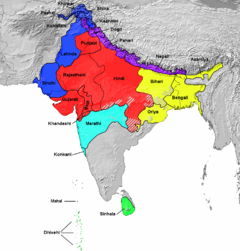
, Bengali
and Oriya
, developed from Magadhi Prakrit
. According to linguist Suniti Kumar Chatterji
, the Magadhi Prakrit in the east gave rise to four Apabhramsa dialects: Radha, Vanga, Varendra and Kamarupa; and the Kamarupa Apabhramsa
, keeping to the north of the Ganges, gave rise to the North Bengal
dialects in West Bengal
and Assamese in the Brahmaputra valley. Though early compositions in Assamese exist from the thirteenth century, the earliest relics of the language can be found in paleographic records of the Kamarupa Kingdom from the fifth century to the twelfth century. Assamese language features have been discovered in the ninth century Charyapada
, which are Buddhist verses discovered in 1907 in Nepal
, and which came from the end of the Apabhramsa period. Early compositions matured in the fourteenth century, during the reign of the Kamata
king
Durlabhnarayana of the Khen dynasty
, when Madhav Kandali composed the Kotha Ramayana
. Since the time of the Charyapada
, Assamese has been influenced by the languages belonging to the Sino-Tibetan and Austroasiatic families.
Assamese became the court language in the Ahom kingdom
by the seventeenth century.
, a variant of the Eastern Nagari script
, which traces its descent from the Gupta script
. It resembles very closely to the Mithilakshar
script of the Maithili language
as well as to the Bengali
script. There is a strong tradition of writing from early times. Examples can be seen in edicts, land grants and copper plates of medieval kings. Assam had its own system of writing on the bark of the saanchi tree in which religious texts and chronicles were written. The present-day spellings in Assamese are not necessarily phonetic. Hemkosh
, the second Assamese dictionary, introduced spellings based on Sanskrit
which are now the standard.
representation of the Assamese language, all English-language Wikipedia articles that include words in Assamese will use the Romanization scheme.
In International Phonetic Alphabet
(IPA) and Romanization
(ROM) transcriptions
stops. Historically, the dental stops and retroflex stops both merged into alveolar
stops. This makes Assamese resemble non-Indic languages in its use of the coronal major place of articulation. The only other language to have fronted retroflex stops into alveolars is the closely related eastern dialects of Bengali (although a contrast with dental stops remains in those dialects).
x,(x, IITG, pronounced by a native speaker) historically derived from what used to be coronal sibilants. The derivation of the velar fricative from the coronal sibilant [s] is evident in the name of the language in Assamese; some Assamese prefer to write Oxomiya/Ôxômiya instead of Asomiya/Asamiya to reflect the sound, represented by [x] in the International Phonetic Alphabet
. This sound appeared in the phonology of Assamese as a result of lenition
of the three Sanskrit
sibilants. It is present in other nearby languages, like Chittagonian
.
The sound is variously transcribed in the IPA as a voiceless velar fricative [x], a voiceless uvular fricative [χ], and a voiceless velar approximant [ɰ̥] by leading phonologists and phoneticians. Some variations of the sound is expected within different population groups and dialects, and depending on the speaker, speech register, and quality of recording, all three symbols may approximate the acoustic reading of the actual Assamese phoneme.
(the English
ng in sing) extensively. In many languages the velar nasal is always attached to a homorganic sound, whereas in Assamese it can occur intervocalically.
, Sylheti
, and Oriya
do not have a vowel length distinction, but have a wide set of back rounded vowels
. In the case of Assamese, there are four back rounded vowels, including ô [ɔ], o [o], û [ʊ], and u [u]. These four vowels contrast phonemically, as demonstrated by the minimal set কলা kôla [kɔla] 'deaf', ক'লা kola [kola] 'black', কোলা kûla [kʊla] 'lap', and কুলা kula [kula] 'winnowing fan'.
The high-mid back rounded vowel ও û [ʊ] is unique in this branch of the language family, and sounds very much to foreigners as something between অ' o [o] and উ u [u]. This vowel is found in Assamese words such as পোত pût [pʊt] "to bury".
area came into focus because it was made the official language of the state by the British and because the Christian missionaries based their work in this region. The Assamese taught in schools and used in newspapers today has evolved and incorporated elements from different dialects of the language. Banikanta Kakati identified two dialect
s which he named (1) Eastern and (2) Western dialects. However, recent linguistic studies have identified four dialect groups http://www.iitg.ernet.in/rcilts/asamiya.htm (Moral 1992), listed below from east to west:
s composed in the eighth-12th century. The first examples emerge in writings of court poets in the fourteenth century, the finest example of which is Madhav Kandali's Kotha Ramayana
, as well as popular ballad in the form of Ojapali. The sixteenth—17th century saw a flourishing of Vaishnavite literature, leading up to the emergence of modern forms of literature in the late nineteenth century.
States and territories of India
India is a federal union of states comprising twenty-eight states and seven union territories. The states and territories are further subdivided into districts and so on.-List of states and territories:...
of Assam
Assam
Assam , also, rarely, Assam Valley and formerly the Assam Province , is a northeastern state of India and is one of the most culturally and geographically distinct regions of the country...
in North-East India
North-East India
Northeast India refers to the easternmost region of India consisting of the contiguous Seven Sister States, Sikkim, and parts of North Bengal...
. It is also the official language of Assam. It is also spoken in parts of Arunachal Pradesh
Arunachal Pradesh
Arunachal Pradesh is a state of India, located in the far northeast. It borders the states of Assam and Nagaland to the south, and shares international borders with Burma in the east, Bhutan in the west, and the People's Republic of China in the north. The majority of the territory is claimed by...
and other northeast
North-East India
Northeast India refers to the easternmost region of India consisting of the contiguous Seven Sister States, Sikkim, and parts of North Bengal...
Indian states. Nagamese, an Assamese-based Creole language
Creole language
A creole language, or simply a creole, is a stable natural language developed from the mixing of parent languages; creoles differ from pidgins in that they have been nativized by children as their primary language, making them have features of natural languages that are normally missing from...
is widely used in Nagaland
Nagaland
Nagaland is a state in the far north-eastern part of India. It borders the state of Assam to the west, Arunachal Pradesh and part of Assam to the north, Burma to the east and Manipur to the south. The state capital is Kohima, and the largest city is Dimapur...
and parts of Assam. Small pockets of Assamese speakers can be found in Bhutan
Bhutan
Bhutan , officially the Kingdom of Bhutan, is a landlocked state in South Asia, located at the eastern end of the Himalayas and bordered to the south, east and west by the Republic of India and to the north by the People's Republic of China...
. The easternmost of Indo-European languages
Indo-European languages
The Indo-European languages are a family of several hundred related languages and dialects, including most major current languages of Europe, the Iranian plateau, and South Asia and also historically predominant in Anatolia...
, it is spoken by over 13 million people.
Assamese has derived its phonetic character set and its behaviour from Sanskrit. It is written using the Assamese script
Assamese script
The Assamese script is a variant of the Eastern Nagari script also used for Bengali and Bishnupriya Manipuri. The Eastern Nagari script belongs to the Brahmic family of scripts and has a continuous history of development from Nagari script, a precursor of Devanagari...
. Assamese is written from left to right and top to bottom, in the same manner as English. A large number of ligatures are possible since potentially all the consonants can combine with one another. Vowels can either be independent or dependent upon a consonant or a consonant cluster.
The English word "Assamese" is built on the same principle as "Japanese", "Taiwanese", etc. It is based on the name "Assam" by which the tract consisting of the Brahmaputra valley was known. The people call their state and their language .
History
Assamese and the cognate languages, MaithiliMaithili language
Maithili language is spoken in the eastern region of India and South-eastern region of Nepal. The native speakers of Maithili reside in Bihar, Jharkhand,parts of West Bengal and South-east Nepal...
, Bengali
Bengali language
Bengali or Bangla is an eastern Indo-Aryan language. It is native to the region of eastern South Asia known as Bengal, which comprises present day Bangladesh, the Indian state of West Bengal, and parts of the Indian states of Tripura and Assam. It is written with the Bengali script...
and Oriya
Oriya language
Oriya , officially Odia from November, 2011, is an Indian language, belonging to the Indo-Aryan branch of the Indo-European language family. It is mainly spoken in the Indian states of Orissa and West Bengal...
, developed from Magadhi Prakrit
Magadhi Prakrit
Magadhi Prakrit is of one of the three Dramatic Prakrits, the written languages of Ancient India following the decline of Pali and Sanskrit. Magadhi Prakrit was spoken in the eastern Indian subcontinent, in a region spanning what is now eastern India, Bangladesh, and Nepal. It is believed to be the...
. According to linguist Suniti Kumar Chatterji
Suniti Kumar Chatterji
Suniti Kumar Chatterji was an Indian linguist, educationist and litterateur. He was born on 26 November 1890 at Shibpur in Howrah...
, the Magadhi Prakrit in the east gave rise to four Apabhramsa dialects: Radha, Vanga, Varendra and Kamarupa; and the Kamarupa Apabhramsa
Kamrupi
Kamarupi or present Kamrupi is the language that was spoken in the Kamarupa kingdom in the first millennium, which, some linguists claim, gave rise to or influenced various eastern Indo-European languages like Assamese and Bengali.During British India at some point Kamrup was divided into two big...
, keeping to the north of the Ganges, gave rise to the North Bengal
North Bengal
North Bengal is a term used for the northern parts of Bangladesh and West Bengal. The Bangladesh part denotes the Rajshahi Division. Generally it is the area lying west of Jamuna River and north of Padma River, and includes the Barind Tract. The West Bengal part denotes Cooch Behar, Darjeeling,...
dialects in West Bengal
West Bengal
West Bengal is a state in the eastern region of India and is the nation's fourth-most populous. It is also the seventh-most populous sub-national entity in the world, with over 91 million inhabitants. A major agricultural producer, West Bengal is the sixth-largest contributor to India's GDP...
and Assamese in the Brahmaputra valley. Though early compositions in Assamese exist from the thirteenth century, the earliest relics of the language can be found in paleographic records of the Kamarupa Kingdom from the fifth century to the twelfth century. Assamese language features have been discovered in the ninth century Charyapada
Charyapada
The Charyapada is a collection of 8th-12th century Vajrayana Buddhist caryagiti, or mystical poems from the tantric tradition in eastern India. Being caryagiti , the Charyapada were intended to be sung. These songs of realization were spontaneously composed verses that expressed a practitioner's...
, which are Buddhist verses discovered in 1907 in Nepal
Nepal
Nepal , officially the Federal Democratic Republic of Nepal, is a landlocked sovereign state located in South Asia. It is located in the Himalayas and bordered to the north by the People's Republic of China, and to the south, east, and west by the Republic of India...
, and which came from the end of the Apabhramsa period. Early compositions matured in the fourteenth century, during the reign of the Kamata
Kamata Kingdom
The Kamata kingdom appeared in the western part of the older Kamarupa kingdom in the 13th century, after the fall of the Pala dynasty. The rise of the Kamata kingdom marked the end of the ancient period in the History of Assam and the beginning of the medieval period. The first rulers were the...
king
King
- Centers of population :* King, Ontario, CanadaIn USA:* King, Indiana* King, North Carolina* King, Lincoln County, Wisconsin* King, Waupaca County, Wisconsin* King County, Washington- Moving-image works :Television:...
Durlabhnarayana of the Khen dynasty
Khen dynasty
The Khen dynasty of Assam replaced the Pala dynasty in the 12th century. Their accession marks the end of the Kamarupa kingdom, and the beginning of the Kamata kingdom....
, when Madhav Kandali composed the Kotha Ramayana
Kotha Ramayana
Kotha Ramayana is a poem written by the powerful Assamese poet Madhava Kandali during the 14th century and is one of many versions of Ramayana in a regional Indian language other than Valmiki's Ramayana in Sanskrit...
. Since the time of the Charyapada
Charyapada
The Charyapada is a collection of 8th-12th century Vajrayana Buddhist caryagiti, or mystical poems from the tantric tradition in eastern India. Being caryagiti , the Charyapada were intended to be sung. These songs of realization were spontaneously composed verses that expressed a practitioner's...
, Assamese has been influenced by the languages belonging to the Sino-Tibetan and Austroasiatic families.
Assamese became the court language in the Ahom kingdom
Ahom kingdom
The Ahom Kingdom was a medieval kingdom in the Brahmaputra valley in Assam that maintained its sovereignty for nearly 600 years and successfully resisted Mughal expansion in North-East India...
by the seventeenth century.
Writing system
Assamese uses the Assamese scriptAssamese script
The Assamese script is a variant of the Eastern Nagari script also used for Bengali and Bishnupriya Manipuri. The Eastern Nagari script belongs to the Brahmic family of scripts and has a continuous history of development from Nagari script, a precursor of Devanagari...
, a variant of the Eastern Nagari script
Eastern Nagari script
The Eastern Nagari script is an Abugida system of writing belonging to the Brahmic family of scripts which use is associated with the two main languages Assamese and Bengali and other related variants such as, Bishnupriya Manipuri, Maithili, Mising, Meitei Manipuri, Sylheti, and Chittagonian...
, which traces its descent from the Gupta script
Gupta script
The Gupta script was used for writing Sanskrit and is associated with the Gupta Empire of India which was a period of material prosperity and great religious and scientific developments. The Gupta script was descended from Brahmi and gave rise to the Nagari, Sharada and Siddham scripts...
. It resembles very closely to the Mithilakshar
Mithilakshar
Tirhuta or Mithilakshar is the script traditionally used for the Maithili language, an Indo-European language spoken in the Indian state of Bihar, Jharkhand, parts of West Bengal and eastern Nepal...
script of the Maithili language
Maithili language
Maithili language is spoken in the eastern region of India and South-eastern region of Nepal. The native speakers of Maithili reside in Bihar, Jharkhand,parts of West Bengal and South-east Nepal...
as well as to the Bengali
Bengali language
Bengali or Bangla is an eastern Indo-Aryan language. It is native to the region of eastern South Asia known as Bengal, which comprises present day Bangladesh, the Indian state of West Bengal, and parts of the Indian states of Tripura and Assam. It is written with the Bengali script...
script. There is a strong tradition of writing from early times. Examples can be seen in edicts, land grants and copper plates of medieval kings. Assam had its own system of writing on the bark of the saanchi tree in which religious texts and chronicles were written. The present-day spellings in Assamese are not necessarily phonetic. Hemkosh
Hemkosh
Hemkosh is the first etymological dictionary of the Assamese Language based on Sanskrit spellings, compiled by Hemchandra Barua. It was first published in 1900 under the supervision of Capt. P. R. Gordon, ISC and Hemchandra Goswami, 33 years after the publication of the Bronson’s dictionary. It...
, the second Assamese dictionary, introduced spellings based on Sanskrit
Sanskrit
Sanskrit , is a historical Indo-Aryan language and the primary liturgical language of Hinduism, Jainism and Buddhism.Buddhism: besides Pali, see Buddhist Hybrid Sanskrit Today, it is listed as one of the 22 scheduled languages of India and is an official language of the state of Uttarakhand...
which are now the standard.
Morphology and grammar
The Assamese language has the following characteristic morphological features- Gender and number are not grammatically marked
- There is lexical distinction of gender in the third person pronoun.
- Transitive verbs are distinguished from intransitive.
- The agentive case is overtly marked as distinct from the accusative.
- Kinship nouns are inflected for personal pronominal possession.
- Adverbs can be derived from the verb roots.
- A passive construction may be employed idiomatically.
Phonology
The Assamese phonemic inventory consists of eight oral vowel phonemes, three nasalized vowel phonemes, fifteen diphthongs (two nasalized diphthongs) and twenty-one consonant phonemes. For a consistent phonemicPhoneme
In a language or dialect, a phoneme is the smallest segmental unit of sound employed to form meaningful contrasts between utterances....
representation of the Assamese language, all English-language Wikipedia articles that include words in Assamese will use the Romanization scheme.
In International Phonetic Alphabet
International Phonetic Alphabet
The International Phonetic Alphabet "The acronym 'IPA' strictly refers [...] to the 'International Phonetic Association'. But it is now such a common practice to use the acronym also to refer to the alphabet itself that resistance seems pedantic...
(IPA) and Romanization
Romanization
In linguistics, romanization or latinization is the representation of a written word or spoken speech with the Roman script, or a system for doing so, where the original word or language uses a different writing system . Methods of romanization include transliteration, for representing written...
(ROM) transcriptions
| Front | Central | Back | |||||||
| IPA | ROM | Script Assamese script The Assamese script is a variant of the Eastern Nagari script also used for Bengali and Bishnupriya Manipuri. The Eastern Nagari script belongs to the Brahmic family of scripts and has a continuous history of development from Nagari script, a precursor of Devanagari... |
IPA | ROM | Script Assamese script The Assamese script is a variant of the Eastern Nagari script also used for Bengali and Bishnupriya Manipuri. The Eastern Nagari script belongs to the Brahmic family of scripts and has a continuous history of development from Nagari script, a precursor of Devanagari... |
IPA | ROM | Script Assamese script The Assamese script is a variant of the Eastern Nagari script also used for Bengali and Bishnupriya Manipuri. The Eastern Nagari script belongs to the Brahmic family of scripts and has a continuous history of development from Nagari script, a precursor of Devanagari... |
|
| High | i | i | ই | u | u | উ | |||
| High-mid | ʊ | û | ও | ||||||
| Mid | e | e | এ' | o | o | অ' | |||
| Low-mid | ɛ | ê | এ | ɔ | ô | অ | |||
| Low | a | a | আ |
| Labial | Alveolar | Velar | Glottal | |||||||||
| IPA | ROM | Script Assamese script The Assamese script is a variant of the Eastern Nagari script also used for Bengali and Bishnupriya Manipuri. The Eastern Nagari script belongs to the Brahmic family of scripts and has a continuous history of development from Nagari script, a precursor of Devanagari... |
IPA | ROM | Script Assamese script The Assamese script is a variant of the Eastern Nagari script also used for Bengali and Bishnupriya Manipuri. The Eastern Nagari script belongs to the Brahmic family of scripts and has a continuous history of development from Nagari script, a precursor of Devanagari... |
IPA | ROM | Script Assamese script The Assamese script is a variant of the Eastern Nagari script also used for Bengali and Bishnupriya Manipuri. The Eastern Nagari script belongs to the Brahmic family of scripts and has a continuous history of development from Nagari script, a precursor of Devanagari... |
IPA | ROM | Script Assamese script The Assamese script is a variant of the Eastern Nagari script also used for Bengali and Bishnupriya Manipuri. The Eastern Nagari script belongs to the Brahmic family of scripts and has a continuous history of development from Nagari script, a precursor of Devanagari... |
|
| Voiceless stops | p pʰ |
p ph |
প ফ |
t tʰ |
t th |
ত/ট থ/ঠ |
k kʰ |
k kh |
ক খ |
|||
| Voiced stops | b bʱ |
b bh |
ব ভ |
d dʱ |
d dh |
দ/ড ধ/ঢ |
ɡ ɡʱ |
g gh |
গ ঘ |
|||
| Voiceless fricatives | s | s | চ/ছ | x | x | শ/ষ/স | h | h | হ | |||
| Voiced fricatives | z | z | জ/ঝ/য | |||||||||
| Nasals | m | m | ম | n | n | ন/ণ | ŋ | ng | ঙ/ং | |||
| Approximants | w | w | ৱ | l, ɹ | l,r | ল,ৰ |
Alveolar stops
The Assamese phoneme inventory is unique in the Indic group of languages in its lack of a dental-retroflex distinction in coronalCoronal consonant
Coronal consonants are consonants articulated with the flexible front part of the tongue. Only the coronal consonants can be divided into apical , laminal , domed , or subapical , as well as a few rarer orientations, because only the front of the tongue has such...
stops. Historically, the dental stops and retroflex stops both merged into alveolar
Alveolar plosive
In phonetics and phonology, an alveolar stop is a type of consonantal sound, made with the tongue in contact with the alveolar ridge located just behind the teeth , held tightly enough to block the passage of air . The most common sounds are the plosives and , as in English toe and doe...
stops. This makes Assamese resemble non-Indic languages in its use of the coronal major place of articulation. The only other language to have fronted retroflex stops into alveolars is the closely related eastern dialects of Bengali (although a contrast with dental stops remains in those dialects).
Voiceless velar fricative
Unlike most eastern Indic languages, Assamese is also noted for the presence of the voiceless velar fricativeVoiceless velar fricative
The voiceless velar fricative is a type of consonantal sound used in some spoken languages. The sound was part of the consonant inventory of Old English and can still be found in some dialects of English, most notably in Scottish English....
x,(x, IITG, pronounced by a native speaker) historically derived from what used to be coronal sibilants. The derivation of the velar fricative from the coronal sibilant [s] is evident in the name of the language in Assamese; some Assamese prefer to write Oxomiya/Ôxômiya instead of Asomiya/Asamiya to reflect the sound, represented by [x] in the International Phonetic Alphabet
International Phonetic Alphabet
The International Phonetic Alphabet "The acronym 'IPA' strictly refers [...] to the 'International Phonetic Association'. But it is now such a common practice to use the acronym also to refer to the alphabet itself that resistance seems pedantic...
. This sound appeared in the phonology of Assamese as a result of lenition
Lenition
In linguistics, lenition is a kind of sound change that alters consonants, making them "weaker" in some way. The word lenition itself means "softening" or "weakening" . Lenition can happen both synchronically and diachronically...
of the three Sanskrit
Sanskrit
Sanskrit , is a historical Indo-Aryan language and the primary liturgical language of Hinduism, Jainism and Buddhism.Buddhism: besides Pali, see Buddhist Hybrid Sanskrit Today, it is listed as one of the 22 scheduled languages of India and is an official language of the state of Uttarakhand...
sibilants. It is present in other nearby languages, like Chittagonian
Chittagonian language
Chittagonian is an Indo-Aryan language spoken by the people of Chittagong in Bangladesh and in much of the southeast of the country. It is closely related to Bangla, but is normally considered by linguists to be a separate language rather than a dialect of Bangla. It is estimated to have 14...
.
The sound is variously transcribed in the IPA as a voiceless velar fricative [x], a voiceless uvular fricative [χ], and a voiceless velar approximant [ɰ̥] by leading phonologists and phoneticians. Some variations of the sound is expected within different population groups and dialects, and depending on the speaker, speech register, and quality of recording, all three symbols may approximate the acoustic reading of the actual Assamese phoneme.
Velar nasal
Assamese and Bengali, in contrast to other Indo-Aryan languages, use the velar nasalVelar nasal
The velar nasal is the sound of ng in English sing. It is a type of consonantal sound, used in some spoken languages. The symbol in the International Phonetic Alphabet that represents this sound is , and the equivalent X-SAMPA symbol is N....
(the English
English language
English is a West Germanic language that arose in the Anglo-Saxon kingdoms of England and spread into what was to become south-east Scotland under the influence of the Anglian medieval kingdom of Northumbria...
ng in sing) extensively. In many languages the velar nasal is always attached to a homorganic sound, whereas in Assamese it can occur intervocalically.
Vowel inventory
Eastern Indic languages like Assamese, BengaliBengali language
Bengali or Bangla is an eastern Indo-Aryan language. It is native to the region of eastern South Asia known as Bengal, which comprises present day Bangladesh, the Indian state of West Bengal, and parts of the Indian states of Tripura and Assam. It is written with the Bengali script...
, Sylheti
Sylheti language
Sylheti is the language of Sylhet, which is also known as the Surma Valley and is located in the north-eastern region of Bangladesh, and also spoken in parts of the Northeast Indian states of Assam and Tripura...
, and Oriya
Oriya language
Oriya , officially Odia from November, 2011, is an Indian language, belonging to the Indo-Aryan branch of the Indo-European language family. It is mainly spoken in the Indian states of Orissa and West Bengal...
do not have a vowel length distinction, but have a wide set of back rounded vowels
Roundedness
In phonetics, vowel roundedness refers to the amount of rounding in the lips during the articulation of a vowel. That is, it is vocalic labialization. When pronouncing a rounded vowel, the lips form a circular opening, while unrounded vowels are pronounced with the lips relaxed...
. In the case of Assamese, there are four back rounded vowels, including ô [ɔ], o [o], û [ʊ], and u [u]. These four vowels contrast phonemically, as demonstrated by the minimal set কলা kôla [kɔla] 'deaf', ক'লা kola [kola] 'black', কোলা kûla [kʊla] 'lap', and কুলা kula [kula] 'winnowing fan'.
The high-mid back rounded vowel ও û [ʊ] is unique in this branch of the language family, and sounds very much to foreigners as something between অ' o [o] and উ u [u]. This vowel is found in Assamese words such as পোত pût [pʊt] "to bury".
Dialects
In the middle of the nineteenth century the dialect spoken in the SibsagarSibsagar
Sivasagar is a town in the Sibsagar district in the state of Assam in India, about north east of Guwahati....
area came into focus because it was made the official language of the state by the British and because the Christian missionaries based their work in this region. The Assamese taught in schools and used in newspapers today has evolved and incorporated elements from different dialects of the language. Banikanta Kakati identified two dialect
Dialect
The term dialect is used in two distinct ways, even by linguists. One usage refers to a variety of a language that is a characteristic of a particular group of the language's speakers. The term is applied most often to regional speech patterns, but a dialect may also be defined by other factors,...
s which he named (1) Eastern and (2) Western dialects. However, recent linguistic studies have identified four dialect groups http://www.iitg.ernet.in/rcilts/asamiya.htm (Moral 1992), listed below from east to west:
- Eastern group, spoken in and other districts around Sibsagar district
- Central group spoken in present NagaonNagaonNagaon , is a medium sized city and a municipal board in Nagaon district in the Indian state of Assam. It is situated east of Guwahati. An older spelling of the name is Nowgong.It is one of the fastest growing cities of the northeast.-History:...
, SonitpurSonitpurSonitpur is an administrative district in the state of Assam in India. The district headquarters are located at Tezpur. As of 2011 it is the third most populous district of Assam , after Nagaon and Dhubri.-Etymology:...
, Morigaon districts and adjoining areas - KamrupiKamrupiKamarupi or present Kamrupi is the language that was spoken in the Kamarupa kingdom in the first millennium, which, some linguists claim, gave rise to or influenced various eastern Indo-European languages like Assamese and Bengali.During British India at some point Kamrup was divided into two big...
group spoken in undivided Kamrup, Nalbari, Barpeta, Darrang, Kokrajhar and Bongaigaon districts - GoalpariaGoalpariaGoalpariya is a dialect of the erstwhile Goalpara district of Assam in India. It is largely spoken in Dhubri, Goalpara, Kokrajhar and Bongaigaon districts which were created from the erstwhile Goalpara district. The basic characteristic of the Goalpariya dialect is that it is a composite one into...
group spoken primarily in the Dhubri and Goalpara districts and in certain areas of Kokrajhar and Bongaigoan districts
Literature
There is a growing and strong body of literature in this language. The first characteristics of this language are seen in the CharyapadaCharyapada
The Charyapada is a collection of 8th-12th century Vajrayana Buddhist caryagiti, or mystical poems from the tantric tradition in eastern India. Being caryagiti , the Charyapada were intended to be sung. These songs of realization were spontaneously composed verses that expressed a practitioner's...
s composed in the eighth-12th century. The first examples emerge in writings of court poets in the fourteenth century, the finest example of which is Madhav Kandali's Kotha Ramayana
Kotha Ramayana
Kotha Ramayana is a poem written by the powerful Assamese poet Madhava Kandali during the 14th century and is one of many versions of Ramayana in a regional Indian language other than Valmiki's Ramayana in Sanskrit...
, as well as popular ballad in the form of Ojapali. The sixteenth—17th century saw a flourishing of Vaishnavite literature, leading up to the emergence of modern forms of literature in the late nineteenth century.
See also
- Indo-Aryan languagesIndo-Aryan languagesThe Indo-Aryan languages constitutes a branch of the Indo-Iranian languages, itself a branch of the Indo-European language family...
- CharyapadaCharyapadaThe Charyapada is a collection of 8th-12th century Vajrayana Buddhist caryagiti, or mystical poems from the tantric tradition in eastern India. Being caryagiti , the Charyapada were intended to be sung. These songs of realization were spontaneously composed verses that expressed a practitioner's...
- Languages of IndiaLanguages of IndiaThe languages of India belong to several language families, the major ones being the Indo-European languages—Indo-Aryan and the Dravidian languages...
- Languages with official status in India
- List of Indian languages by total speakers
- List of languages by number of native speakers
- Xobdo
External links
- Candrakānta abhidhāna : Asamiyi sabdara butpatti aru udaharanere Asamiya-Ingraji dui bhashara artha thaka abhidhana. second ed. Guwahati : Guwahati Bisbabidyalaya, 1962.
- A Dictionary in Assamese and English (1867) First Assamese dictionary by Miles BronsonMiles Bronson and the NoctesMiles Bronson and the Noctes in the Namsang Hill Miles Bronson, one of the pioneer American Baptist missionaries worked in Assam, arrived at Sadia in Assam on 8 July 1838. In the previous year, Nathan Brown and O.T. Cutter landed at Sadia with their families with an object to go to Northern...
from (books.google.com) - English-Assamese Online Dictionary
- English translation - Assamese Literature
- The Creative Visionary: Jyoti Prasad Agarwalla (1903-1951)
- Assamese Language and Literature
- Ethnologue report for Assamese
- Xophura - Collection of writings in Assamese
- Assamese – UCLA Phonetics Lab Data
- Assamese computing resources at TDIL
- Bharatiya Bhasha Jyoti: Asamiya —a textbook for learning Assamese through Hindi from the Central Institute of Indian Languages.