


Coronation of the British monarch

Encyclopedia
Ceremony
A ceremony is an event of ritual significance, performed on a special occasion. The word may be of Etruscan origin.-Ceremonial occasions:A ceremony may mark a rite of passage in a human life, marking the significance of, for example:* birth...
(specifically, initiation rite
Rite of passage
A rite of passage is a ritual event that marks a person's progress from one status to another. It is a universal phenomenon which can show anthropologists what social hierarchies, values and beliefs are important in specific cultures....
) in which the monarch of the United Kingdom
United Kingdom
The United Kingdom of Great Britain and Northern IrelandIn the United Kingdom and Dependencies, other languages have been officially recognised as legitimate autochthonous languages under the European Charter for Regional or Minority Languages...
is formally crowned
Crown (headgear)
A crown is the traditional symbolic form of headgear worn by a monarch or by a deity, for whom the crown traditionally represents power, legitimacy, immortality, righteousness, victory, triumph, resurrection, honour and glory of life after death. In art, the crown may be shown being offered to...
and invested with regalia
Regalia
Regalia is Latin plurale tantum for the privileges and the insignia characteristic of a Sovereign.The word stems from the Latin substantivation of the adjective regalis, 'regal', itself from Rex, 'king'...
. It corresponds to coronation ceremonies that formerly occurred in other European monarchies, which have currently abandoned coronations in favour of inauguration
Inauguration
An inauguration is a formal ceremony to mark the beginning of a leader's term of office. An example is the ceremony in which the President of the United States officially takes the oath of office....
or enthronement
Enthronement
An enthronement is a ceremony of inauguration, involving a person—usually a monarch or religious leader—being formally seated for the first time upon their throne. This ritual is generally distinguished from a coronation because there is no crown or other regalia that is physically...
ceremonies.
The coronation
Coronation
A coronation is a ceremony marking the formal investiture of a monarch and/or their consort with regal power, usually involving the placement of a crown upon their head and the presentation of other items of regalia...
usually takes place several months after the death of the previous monarch, as it is considered a joyous occasion that would be inappropriate when mourning
Mourning
Mourning is, in the simplest sense, synonymous with grief over the death of someone. The word is also used to describe a cultural complex of behaviours in which the bereaved participate or are expected to participate...
still continues. This also gives planners enough time to complete the elaborate arrangements required. For example, Elizabeth II was crowned on 2 June 1953, despite having ascended the throne on 6 February 1952, the instant her father died. British law states that the throne is not left vacant
Demise of the Crown
In relation to the shared monarchy of the Commonwealth realms and other monarchies, the demise of the Crown is the legal term for the end of a reign by a king, queen, or emperor, whether by death or abdication....
and the new monarch succeeds the old immediately.
The ceremony is performed by the Archbishop of Canterbury
Archbishop of Canterbury
The Archbishop of Canterbury is the senior bishop and principal leader of the Church of England, the symbolic head of the worldwide Anglican Communion, and the diocesan bishop of the Diocese of Canterbury. In his role as head of the Anglican Communion, the archbishop leads the third largest group...
, the most senior cleric of the Church of England
Church of England
The Church of England is the officially established Christian church in England and the Mother Church of the worldwide Anglican Communion. The church considers itself within the tradition of Western Christianity and dates its formal establishment principally to the mission to England by St...
. Other clergy and members of the nobility also have roles; most participants in the ceremony are required to wear ceremonial uniforms or robes. Many other government officials and guests attend, including representatives of foreign countries.
The essential elements of the coronation have remained largely unchanged for the past thousand years. The sovereign is first presented to, and acclaimed by, the people. He or she then swears an oath to uphold the law and the Church. Following that, the monarch is anointed with oil, crowned, and invested with the regalia, before receiving the homage
Homage
Homage is a show or demonstration of respect or dedication to someone or something, sometimes by simple declaration but often by some more oblique reference, artistic or poetic....
of his or her subjects.
History
The timing of the coronation has varied throughout British history. The first NormanNorman dynasty
Norman dynasty is the usual designation for the family that were the Dukes of Normandy and the English monarchs which immediately followed the Norman conquest and lasted until the Plantagenet dynasty came to power in 1154. It included Rollo and his descendants, and from William the Conqueror and...
monarch, William I "The Conqueror", was crowned on the day he became King25 December 1066. Most of his successors were crowned within weeks, or even days, of their accession. Edward I
Edward I of England
Edward I , also known as Edward Longshanks and the Hammer of the Scots, was King of England from 1272 to 1307. The first son of Henry III, Edward was involved early in the political intrigues of his father's reign, which included an outright rebellion by the English barons...
was fighting in the Ninth Crusade
Ninth Crusade
The Ninth Crusade, which is sometimes grouped with the Eighth Crusade, is commonly considered to be the last major medieval Crusade to the Holy Land. It took place in 1271–1272....
when he acceded to the throne in 1272; he was crowned soon after his return in 1274. Edward II
Edward II of England
Edward II , called Edward of Caernarfon, was King of England from 1307 until he was deposed by his wife Isabella in January 1327. He was the sixth Plantagenet king, in a line that began with the reign of Henry II...
's coronation, similarly, was delayed by a campaign in Scotland
Scotland
Scotland is a country that is part of the United Kingdom. Occupying the northern third of the island of Great Britain, it shares a border with England to the south and is bounded by the North Sea to the east, the Atlantic Ocean to the north and west, and the North Channel and Irish Sea to the...
in 1307. Henry VI
Henry VI of England
Henry VI was King of England from 1422 to 1461 and again from 1470 to 1471, and disputed King of France from 1422 to 1453. Until 1437, his realm was governed by regents. Contemporaneous accounts described him as peaceful and pious, not suited for the violent dynastic civil wars, known as the Wars...
was only a few months old when he acceded in 1422; he was crowned in 1429, but did not officially assume the reins of government until he was deemed of sufficient age, in 1437. Under the Hanoverian monarchs in the late eighteenth and nineteenth centuries, it was deemed appropriate to extend the waiting period to several months, following a period of mourning for the previous monarch and to allow time for preparation of the ceremony.
In the case of every monarch since, and including, George IV
George IV of the United Kingdom
George IV was the King of the United Kingdom of Great Britain and Ireland and also of Hanover from the death of his father, George III, on 29 January 1820 until his own death ten years later...
, at least one year has passed between accession and coronation, with the exception of George VI
George VI of the United Kingdom
George VI was King of the United Kingdom and the Dominions of the British Commonwealth from 11 December 1936 until his death...
, whose predecessor
Edward VIII of the United Kingdom
Edward VIII was King of the United Kingdom and the Dominions of the British Commonwealth, and Emperor of India, from 20 January to 11 December 1936.Before his accession to the throne, Edward was Prince of Wales and Duke of Cornwall and Rothesay...
did not die but abdicated
Edward VIII abdication crisis
In 1936, a constitutional crisis in the British Empire was caused by King-Emperor Edward VIII's proposal to marry Wallis Simpson, a twice-divorced American socialite....
. The Coronation date had already been set; planning simply continued with a new monarch.
Since a period of time has often passed between accession and coronation, some monarchs were never crowned. Edward V
Edward V of England
Edward V was King of England from 9 April 1483 until his deposition two months later. His reign was dominated by the influence of his uncle Richard, Duke of Gloucester, who succeeded him as Richard III...
and Lady Jane Grey
Lady Jane Grey
Lady Jane Grey , also known as The Nine Days' Queen, was an English noblewoman who was de facto monarch of England from 10 July until 19 July 1553 and was subsequently executed...
were both deposed before they could be crowned, in 1483 and 1553, respectively. Edward VIII
Edward VIII of the United Kingdom
Edward VIII was King of the United Kingdom and the Dominions of the British Commonwealth, and Emperor of India, from 20 January to 11 December 1936.Before his accession to the throne, Edward was Prince of Wales and Duke of Cornwall and Rothesay...
also went uncrowned, as he abdicated in 1936 before the end of the customary one-year period between accession and coronation. Under British law, however, a monarch accedes to the throne the moment their predecessor dies, not when they are crowned. i.e. "The King is dead. Long live the King."
The Anglo-Saxon
History of Anglo-Saxon England
Anglo-Saxon England refers to the period of the history of that part of Britain, that became known as England, lasting from the end of Roman occupation and establishment of Anglo-Saxon kingdoms in the 5th century until the Norman conquest of England in 1066 by William the Conqueror...
monarchs used various locations for their coronations, including Bath, Kingston upon Thames
Kingston upon Thames
Kingston upon Thames is the principal settlement of the Royal Borough of Kingston upon Thames in southwest London. It was the ancient market town where Saxon kings were crowned and is now a suburb situated south west of Charing Cross. It is one of the major metropolitan centres identified in the...
, London
London
London is the capital city of :England and the :United Kingdom, the largest metropolitan area in the United Kingdom, and the largest urban zone in the European Union by most measures. Located on the River Thames, London has been a major settlement for two millennia, its history going back to its...
, and Winchester
Winchester
Winchester is a historic cathedral city and former capital city of England. It is the county town of Hampshire, in South East England. The city lies at the heart of the wider City of Winchester, a local government district, and is located at the western end of the South Downs, along the course of...
. The last Anglo-Saxon monarch, Harold II
Harold Godwinson
Harold Godwinson was the last Anglo-Saxon King of England.It could be argued that Edgar the Atheling, who was proclaimed as king by the witan but never crowned, was really the last Anglo-Saxon king...
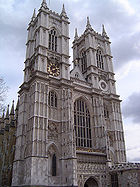
, was crowned at Westminster Abbey
Westminster Abbey
The Collegiate Church of St Peter at Westminster, popularly known as Westminster Abbey, is a large, mainly Gothic church, in the City of Westminster, London, United Kingdom, located just to the west of the Palace of Westminster. It is the traditional place of coronation and burial site for English,...
in 1066; the location was preserved for all future coronations. The basic elements of the coronation ceremony have also remained the same for the last thousand years; it was devised in 973 by Dunstan
Dunstan
Dunstan was an Abbot of Glastonbury Abbey, a Bishop of Worcester, a Bishop of London, and an Archbishop of Canterbury, later canonised as a saint. His work restored monastic life in England and reformed the English Church...
. When London was under the control of the French, Henry III
Henry III of England
Henry III was the son and successor of John as King of England, reigning for 56 years from 1216 until his death. His contemporaries knew him as Henry of Winchester. He was the first child king in England since the reign of Æthelred the Unready...
was crowned at Gloucester
Gloucester
Gloucester is a city, district and county town of Gloucestershire in the South West region of England. Gloucester lies close to the Welsh border, and on the River Severn, approximately north-east of Bristol, and south-southwest of Birmingham....
in 1216; he later chose to have a second coronation at Westminster in 1220. Two hundred years later, Henry VI also had two coronations; as King of England in London in 1429, and as King of France in Paris in 1431.
Following the English Civil War
English Civil War
The English Civil War was a series of armed conflicts and political machinations between Parliamentarians and Royalists...
, Oliver Cromwell
Oliver Cromwell
Oliver Cromwell was an English military and political leader who overthrew the English monarchy and temporarily turned England into a republican Commonwealth, and served as Lord Protector of England, Scotland, and Ireland....
declined the crown but underwent a coronation in all but name in his second investiture as Lord Protector
Lord Protector
Lord Protector is a title used in British constitutional law for certain heads of state at different periods of history. It is also a particular title for the British Heads of State in respect to the established church...
in 1657.
Coronations may be performed for a person other than the reigning monarch. In 1170, Henry the Young King
Henry the Young King
Henry, known as the Young King was the second of five sons of King Henry II of England and Eleanor of Aquitaine but the first to survive infancy. He was officially King of England; Duke of Normandy, Count of Anjou and Maine.-Early life:Little is known of the young prince Henry before the events...
, heir to the throne, was crowned as a second king of England, subordinate to his father Henry II
Henry II of England
Henry II ruled as King of England , Count of Anjou, Count of Maine, Duke of Normandy, Duke of Aquitaine, Duke of Gascony, Count of Nantes, Lord of Ireland and, at various times, controlled parts of Wales, Scotland and western France. Henry, the great-grandson of William the Conqueror, was the...
; such coronations were common practice in mediaeval France and Germany, but this is only one of two instances of its kind in England (the other being that of Ecgfrith of Mercia
Ecgfrith of Mercia
Ecgfrith was a King of Mercia who briefly ruled in the year 796. He was the son and heir of King Offa of Mercia and his wife Cynethryth. In 787, Offa had Ecgfrith crowned as co-ruler. He succeeded his father in July 796, but despite Offa's efforts to secure his son's succession, it is recorded...
in 796, crowned whilst his father, Offa of Mercia
Offa of Mercia
Offa was the King of Mercia from 757 until his death in July 796. The son of Thingfrith and a descendant of Eowa, Offa came to the throne after a period of civil war following the assassination of Æthelbald after defeating the other claimant Beornred. In the early years of Offa's reign it is likely...
, was still alive). More commonly, a king's wife is crowned as queen consort
Queen consort
A queen consort is the wife of a reigning king. A queen consort usually shares her husband's rank and holds the feminine equivalent of the king's monarchical titles. Historically, queens consort do not share the king regnant's political and military powers. Most queens in history were queens consort...
, though the husband of a queen regnant
Queen regnant
A queen regnant is a female monarch who reigns in her own right, in contrast to a queen consort, who is the wife of a reigning king. An empress regnant is a female monarch who reigns in her own right over an empire....
is never crowned. If the king is already married at the time of his coronation, a joint coronation of both king and queen may be performed. The first such coronation was of Henry II of England
Henry II of England
Henry II ruled as King of England , Count of Anjou, Count of Maine, Duke of Normandy, Duke of Aquitaine, Duke of Gascony, Count of Nantes, Lord of Ireland and, at various times, controlled parts of Wales, Scotland and western France. Henry, the great-grandson of William the Conqueror, was the...
and Eleanor of Aquitaine
Eleanor of Aquitaine
Eleanor of Aquitaine was one of the wealthiest and most powerful women in Western Europe during the High Middle Ages. As well as being Duchess of Aquitaine in her own right, she was queen consort of France and of England...
in 1154; seventeen such coronations have been performed, including that of the co-rulers William III
William III of England
William III & II was a sovereign Prince of Orange of the House of Orange-Nassau by birth. From 1672 he governed as Stadtholder William III of Orange over Holland, Zeeland, Utrecht, Guelders, and Overijssel of the Dutch Republic. From 1689 he reigned as William III over England and Ireland...
and Mary II
Mary II of England
Mary II was joint Sovereign of England, Scotland, and Ireland with her husband and first cousin, William III and II, from 1689 until her death. William and Mary, both Protestants, became king and queen regnant, respectively, following the Glorious Revolution, which resulted in the deposition of...
. The most recent was that of George VI
George VI of the United Kingdom
George VI was King of the United Kingdom and the Dominions of the British Commonwealth from 11 December 1936 until his death...
and the former Elizabeth Bowes-Lyon
Elizabeth Bowes-Lyon
Elizabeth Angela Marguerite Bowes-Lyon was the queen consort of King George VI from 1936 until her husband's death in 1952, after which she was known as Queen Elizabeth The Queen Mother, to avoid confusion with her daughter, Queen Elizabeth II...
in 1937. If the king married, or remarried, after his coronation, or if his wife were not crowned with him for some other reason, she might be crowned in a separate ceremony. The first such separate coronation of a Queen consort in England was that of Matilda of Flanders
Matilda of Flanders
Matilda of Flanders was the wife of William the Conqueror and, as such, Queen consort of the Kingdom of England. She bore William nine/ten children, including two kings, William II and Henry I.-Marriage:...
in 1068; the last was Anne Boleyn
Anne Boleyn
Anne Boleyn ;c.1501/1507 – 19 May 1536) was Queen of England from 1533 to 1536 as the second wife of Henry VIII of England and Marquess of Pembroke in her own right. Henry's marriage to Anne, and her subsequent execution, made her a key figure in the political and religious upheaval that was the...
's in 1533. The most recent King to wed post-Coronation, Charles II
Charles II of England
Charles II was monarch of the three kingdoms of England, Scotland, and Ireland.Charles II's father, King Charles I, was executed at Whitehall on 30 January 1649, at the climax of the English Civil War...
, did not have a separate coronation for his bride, Catherine of Braganza
Catherine of Braganza
Catherine of Braganza was a Portuguese infanta and queen consort of England, Scotland and Ireland as the wife of King Charles II.She married the king in 1662...
.
Elizabeth II's coronation in 1953 was televised
Television
Television is a telecommunication medium for transmitting and receiving moving images that can be monochrome or colored, with accompanying sound...
by the British Broadcasting Corporation
BBC
The British Broadcasting Corporation is a British public service broadcaster. Its headquarters is at Broadcasting House in the City of Westminster, London. It is the largest broadcaster in the world, with about 23,000 staff...
. Originally only events as far as the choir screen were to be televised live, with the remainder to be filmed and released later after any mishaps were edited out. This would prevent television viewers from seeing most of the main events of the coronation, including the actual crowning, live. This led to controversy in the press, and even questions in Parliament. The decision was subsequently altered, and the entire ceremony televised, with the exception of the anointing and communion, which had also been excluded from photography at the previous coronation. It was not revealed until 30 years later that the about-face was due to the personal intervention of the Queen. It is estimated that over twenty million individuals viewed the programme in the United Kingdom, an audience unprecedented in television history. The coronation greatly increased public interest in televisions.
The monarch is simultaneously crowned as sovereign of multiple nations; Elizabeth II was asked, for example: "Will you solemnly promise and swear to govern the Peoples of the United Kingdom of Great Britain and Northern Ireland, Canada, Australia, New Zealand, the Union of South Africa, Pakistan and Ceylon, and of your Possessions and other Territories to any of them belonging or pertaining, according to their respective laws and customs?"
Participants
Attendees include foreign and Commonwealth dignitaries as well as Britons, some of whom will participate in the ceremony directly. For Elizabeth II's Coronation in 1953, 7,500 guests were squeezed into the Abbey and each person had to make do with a maximum of 18 inches (457.2 mm) of seating.Clergy
The Archbishop of Canterbury, who has precedence over all other clergymen and over all laymen except members of the Royal Family, traditionally officiates at coronations; during his absence, another bishop appointed by the monarch may take his place. There have, however, been several exceptions. William I was crowned by the Archbishop of YorkArchbishop of York
The Archbishop of York is a high-ranking cleric in the Church of England, second only to the Archbishop of Canterbury. He is the diocesan bishop of the Diocese of York and metropolitan of the Province of York, which covers the northern portion of England as well as the Isle of Man...
, since the Archbishop of Canterbury had been appointed by the Antipope
Antipope
An antipope is a person who opposes a legitimately elected or sitting Pope and makes a significantly accepted competing claim to be the Pope, the Bishop of Rome and leader of the Roman Catholic Church. At times between the 3rd and mid-15th century, antipopes were typically those supported by a...
Benedict X, and this appointment was not recognised as valid by the Pope. Edward II
Edward II of England
Edward II , called Edward of Caernarfon, was King of England from 1307 until he was deposed by his wife Isabella in January 1327. He was the sixth Plantagenet king, in a line that began with the reign of Henry II...
was crowned by the Bishop of Winchester
Bishop of Winchester
The Bishop of Winchester is the head of the Church of England diocese of Winchester, with his cathedra at Winchester Cathedral in Hampshire.The bishop is one of five Church of England bishops to be among the Lords Spiritual regardless of their length of service. His diocese is one of the oldest and...
because the Archbishop of Canterbury had been exiled by Edward I
Edward I of England
Edward I , also known as Edward Longshanks and the Hammer of the Scots, was King of England from 1272 to 1307. The first son of Henry III, Edward was involved early in the political intrigues of his father's reign, which included an outright rebellion by the English barons...
. Mary I
Mary I of England
Mary I was queen regnant of England and Ireland from July 1553 until her death.She was the only surviving child born of the ill-fated marriage of Henry VIII and his first wife Catherine of Aragon. Her younger half-brother, Edward VI, succeeded Henry in 1547...
, a Catholic, refused to be crowned by the Protestant Archbishop Thomas Cranmer
Thomas Cranmer
Thomas Cranmer was a leader of the English Reformation and Archbishop of Canterbury during the reigns of Henry VIII, Edward VI and, for a short time, Mary I. He helped build a favourable case for Henry's divorce from Catherine of Aragon which resulted in the separation of the English Church from...
; the coronation was instead performed by the Bishop of Winchester. Finally, when James II
James II of England
James II & VII was King of England and King of Ireland as James II and King of Scotland as James VII, from 6 February 1685. He was the last Catholic monarch to reign over the Kingdoms of England, Scotland, and Ireland...
was deposed and replaced with William III and Mary II jointly, the Archbishop of Canterbury refused to recognise the new Sovereigns; he had to be replaced by the Bishop of London
Bishop of London
The Bishop of London is the ordinary of the Church of England Diocese of London in the Province of Canterbury.The diocese covers 458 km² of 17 boroughs of Greater London north of the River Thames and a small part of the County of Surrey...
. Hence, in almost all cases where the Archbishop of Canterbury has failed to participate, his place has been taken by a senior cleric: the Archbishop of York is second in precedence, the Bishop of London third, the Bishop of Durham fourth, and the Bishop of Winchester fifth. Elizabeth I
Elizabeth I of England
Elizabeth I was queen regnant of England and Ireland from 17 November 1558 until her death. Sometimes called The Virgin Queen, Gloriana, or Good Queen Bess, Elizabeth was the fifth and last monarch of the Tudor dynasty...
was crowned by the Bishop of Carlisle
Bishop of Carlisle
The Bishop of Carlisle is the Ordinary of the Church of England Diocese of Carlisle in the Province of York.The diocese covers the County of Cumbria except for Alston Moor and the former Sedbergh Rural District...
(to whose see
Episcopal See
An episcopal see is, in the original sense, the official seat of a bishop. This seat, which is also referred to as the bishop's cathedra, is placed in the bishop's principal church, which is therefore called the bishop's cathedral...
is attached no special precedence) because the senior prelate
Prelate
A prelate is a high-ranking member of the clergy who is an ordinary or who ranks in precedence with ordinaries. The word derives from the Latin prælatus, the past participle of præferre, which means "carry before", "be set above or over" or "prefer"; hence, a prelate is one set over others.-Related...
s considered her birth illegitimate.
Great Officers of State
The Great Officers of StateGreat Officer of State
In the United Kingdom, the Great Officers of State are traditional Crown ministers, who either inherit their positions or are appointed to exercise certain largely ceremonial functions. Separate Great Officers exist for England and Scotland, and formerly for Ireland...
traditionally participate during the ceremony. The offices of Lord High Steward
Lord High Steward
The position of Lord High Steward of England is the first of the Great Officers of State. The office has generally remained vacant since 1421, except at coronations and during the trials of peers in the House of Lords, when the Lord High Steward presides. In general, but not invariably, the Lord...
and Lord High Constable
Lord High Constable of England
The Lord High Constable of England is the seventh of the Great Officers of State, ranking beneath the Lord Great Chamberlain and above the Earl Marshal. His office is now called out of abeyance only for coronations. The Lord High Constable was originally the commander of the royal armies and the...
have not been regularly filled since the 15th and 16th centuries respectively; they are, however, revived for coronation ceremonies. The Lord Great Chamberlain
Lord Great Chamberlain
The Lord Great Chamberlain of England is the sixth of the Great Officers of State, ranking beneath the Lord Privy Seal and above the Lord High Constable...
enrobes the Sovereign with the ceremonial vestments, with the aid of the Groom of the Robes
Groom of the Robes
Groom of the Robes is an obsolete office in the Royal Household of the Sovereign of England, later Great Britain, ultimately the United Kingdom. It is equivalent to a Lady-in-Waiting for Queens Regnant.-List of Grooms of the Robes:...
and the Master
Master of the Robes
The Master of the Robes was an office in the British Royal Household. He was responsible for the King's robes at times such as a coronation, the annual Order of the Garter service and the State Opening of Parliament. Since the reign of King Edward VII, the office has only been filled for coronations...
(in the case of a King) or Mistress
Mistress of the Robes
The Mistress of the Robes is the senior lady of the British Royal Household. Formerly responsible for the Queen's clothes and jewellery, the post now has the responsibility for arranging the rota of attendance of the Ladies in Waiting on the Queen, along with various duties at State ceremonies...
(in the case of a Queen) of the Robes.
The Barons of the Cinque Ports
Cinque Ports
The Confederation of Cinque Ports is a historic series of coastal towns in Kent and Sussex. It was originally formed for military and trade purposes, but is now entirely ceremonial. It lies at the eastern end of the English Channel, where the crossing to the continent is narrowest...
also participated in the ceremony. Formerly, the Barons were the Members of the House of Commons representing the Cinque Ports of Hastings
Hastings (UK Parliament constituency)
Hastings was a parliamentary constituency in Sussex. It returned two Members of Parliament to the House of Commons of the Parliament of the United Kingdom until the 1885 general election, when its representation was reduced to one member....
, New Romney
New Romney (UK Parliament constituency)
New Romney was a parliamentary constituency in Kent, which elected two Members of Parliament to the House of Commons from 1371 until 1832, when it was abolished by the Great Reform Act....
, Hythe
Hythe (UK Parliament constituency)
Hythe was a constituency centred on the town of Hythe in Kent. It returned two Members of Parliament to the House of Commons until 1832, when its representation was reduced to one member...
, Dover
Dover (UK Parliament constituency)
Dover is a constituency represented in the House of Commons of the Parliament of the United Kingdom. It elects one Member of Parliament by the first past the post system of election.-Boundaries:...
and Sandwich
Sandwich (UK Parliament constituency)
Sandwich was a parliamentary constituency in Kent, which elected two Members of Parliament to the House of Commons from 1366 until 1885, when it was disfranchised for corruption.-History:...
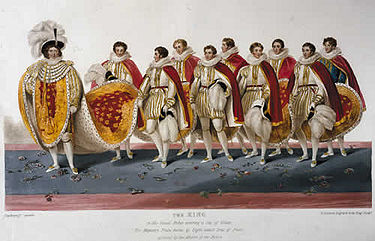
. Reforms in the nineteenth century, however, integrated the Cinque Ports into a regular constituency system applied throughout the nation. At later coronations, Barons were specially designated from among the city councillors for the specific purpose of attending coronations. Originally, the Barons were charged with bearing a ceremonial canopy over the Sovereign. The last time the Barons performed such a task was at the coronation of George IV in 1821. The Barons did not return for the coronations of William IV
William IV of the United Kingdom
William IV was King of the United Kingdom of Great Britain and Ireland and of Hanover from 26 June 1830 until his death...
(who insisted on a simpler, cheaper ceremonial) and Victoria
Victoria of the United Kingdom
Victoria was the monarch of the United Kingdom of Great Britain and Ireland from 20 June 1837 until her death. From 1 May 1876, she used the additional title of Empress of India....
. At coronations since Victoria's, the Barons have attended the ceremony, but they have not carried canopies.
Other claims to attend the coronation
Many landowners and other persons have honorific "duties" or privileges at the coronation. Such rights are determined by a special Court of Claims, over which the Lord High Steward traditionally presided. The first recorded Court of Claims was convened in 1377 for the coronation of Richard IIRichard II of England
Richard II was King of England, a member of the House of Plantagenet and the last of its main-line kings. He ruled from 1377 until he was deposed in 1399. Richard was a son of Edward, the Black Prince, and was born during the reign of his grandfather, Edward III...
. By the Tudor period, the hereditary post of Lord High Steward had merged with the Crown, and so Henry VIII
Henry VIII of England
Henry VIII was King of England from 21 April 1509 until his death. He was Lord, and later King, of Ireland, as well as continuing the nominal claim by the English monarchs to the Kingdom of France...
began the modern tradition of naming a temporary Steward for the coronation only, with separate commissioners to carry out the actual work of the court.
In 1952, for example, the Court accepted the claim of the Dean of Westminster to advise the Queen on the proper procedure during the ceremony (for nearly a thousand years he and his predecessor abbots have kept an unpublished Red Book of practices), the claim of the Lord Bishop of Durham and the Lord Bishop of Bath and Wells
Bishop of Bath and Wells
The Bishop of Bath and Wells heads the Church of England Diocese of Bath and Wells in the Province of Canterbury in England.The present diocese covers the vast majority of the county of Somerset and a small area of Dorset. The Episcopal seat is located in the Cathedral Church of Saint Andrew in...
to walk beside the Queen as she entered and exited the Abbey and to stand on either side of her through the entire coronation ritual, the claim of the Earl of Shrewsbury
Earl of Shrewsbury
Earl of Shrewsbury is a hereditary title of nobility created twice in the peerage of England.-First creation, 1074:The first creation occurred in 1074 for Roger de Montgomerie, one of William the Conqueror's principal counselors...
in his capacity as Lord High Steward of Ireland
Lord High Steward of Ireland
The Lord High Steward of Ireland is a hereditary Great Officer of State in Ireland, sometimes known as the Hereditary Great Seneschal. The Earls of Shrewsbury have held the office since the 15th century....
to carry a white staff, and the claim of the Queen's Scholars of Westminster School
Westminster School
The Royal College of St. Peter in Westminster, almost always known as Westminster School, is one of Britain's leading independent schools, with the highest Oxford and Cambridge acceptance rate of any secondary school or college in Britain...
to be the first to acclaim the monarch on behalf of the common people (their shouts of "Vivat! Vivat Regina!" were incorporated into an anthem).
Sovereign's robes
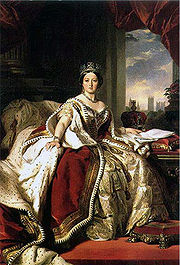

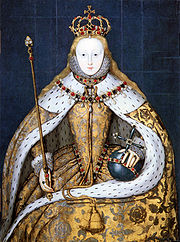
- Crimson surcoat – the regular dress during most of the ceremony, worn under all other robes. In 1953, Elizabeth II wore a newly made gown in place of a surcoat.
- Robe of State of crimson velvet or Parliament Robe – the first robe used at a coronation, worn on entry to the Abbey and later at State Openings of ParliamentState Opening of ParliamentIn the United Kingdom, the State Opening of Parliament is an annual event that marks the commencement of a session of the Parliament of the United Kingdom. It is held in the House of Lords Chamber, usually in November or December or, in a general election year, when the new Parliament first assembles...
. It consists of an ermine cape and a long crimson velvet train lined with further ermine and decorated with gold lace. - Anointing gown – a simple and austere garment worn during the anointing. It is plain white, bears no decoration and fastens at the back.
- Colobium sindonis ("shroud tunic") – the first robe with which the Sovereign is invested. It is a loose white undergarment of fine linen cloth edged with a lace border, open at the sides, sleeveless and cut low at the neck. It symbolises the derivation of Royal authority from the people.
- Supertunica – the second robe with which the Sovereign is invested. It is a long coat of gold silk which reaches to the ankles and has wide-flowing sleeves. It is lined with rose-coloured silk, trimmed with gold lace, woven with national symbols and fastened by a sword belt. It derives from the full dress uniform of a consul of the Byzantine EmpireByzantine EmpireThe Byzantine Empire was the Eastern Roman Empire during the periods of Late Antiquity and the Middle Ages, centred on the capital of Constantinople. Known simply as the Roman Empire or Romania to its inhabitants and neighbours, the Empire was the direct continuation of the Ancient Roman State...
. - Robe Royal or Pallium Regale – the main robe worn during the ceremony and used during the Crowning. It is a four-square mantle, lined in crimson silk and decorated with silver coronets, national symbols and silver imperial eagles in the four corners. It is lay, rather than liturgical, in nature.
- Stole Royal or armilla – a gold silk scarf which accompanies the Robe Royal, richly and heavily embroidered with gold and silver thread, set with jewels and lined with rose-coloured silk and gold fringing.
- Purple surcoat – the counterpart to the crimson surcoat, worn during the final part of the ceremony.
- Imperial Robe of purple velvet – the robe worn at the conclusion of the ceremony, on exit from the Abbey. It comprises an embroidered ermine cape with a train of purple silk velvet, trimmed with Canadian ermine and fully lined with pure silk English satin. The purple recalls the imperial robes of Roman EmperorRoman EmperorThe Roman emperor was the ruler of the Roman State during the imperial period . The Romans had no single term for the office although at any given time, a given title was associated with the emperor...
s.
In contrast to the history and tradition which surround the Regalia
Crown Jewels of the United Kingdom
The collective term Crown Jewels denotes the regalia and vestments worn by the sovereign of the United Kingdom during the coronation ceremony and at other state functions...
, it is customary for most coronation robes to be newly made for each monarch. The present exceptions are the supertunica and Robe Royal, which both date from the Coronation of George IV in 1821.
Official costume
Ermine
Ermine has several uses:* A common name for the stoat * The white fur and black tail end of this animal, which is historically worn by and associated with royalty and high officials...
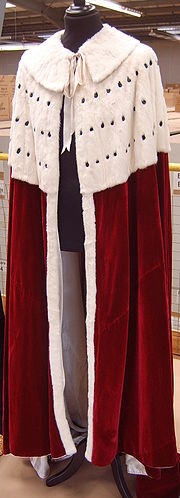
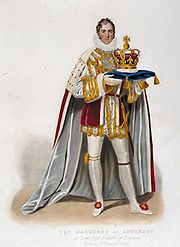
cape. Rows of sealskin spots on the cape designate the peer's rank; dukes use four rows, marquesses three and a half, earls three, viscounts two and a half, and barons and lords of Parliament two. Royal dukes use six rows of ermine, ermine on the front of the cape and long trains borne by pages. Peeresses' ranks are designated not by sealskin spots, but by the length of their trains and the width of the ermine edging on the same. For duchesses, the trains are two yards (2 m) long, for marchionesses one and three-quarters yards, for countesses one and a half yards, for viscountesses one and a quarter yards, and for baronesses and ladies one yard (1 m). The ermine edgings are five inches (127 mm) in width for duchesses, four inches (102 mm) for marchionesses, three inches (76 mm) for countesses, and two inches for viscountesses, baronesses and ladies. The robes of peers and peeresses are used only during coronations.
Crowns and coronets
Peers wear coronets, as do most members of the Royal Family; such coronets display heraldic emblems based on rank or association to the monarch. The heir-apparent's coronet displays four crosses-pattée alternating with four fleurs-de-lis, surmounted by an arch. The same style, without the arch, is used for the children and siblings of Sovereigns. The coronets of children of the heir-apparent display four fleurs-de-lis, two crosses-pattée and two strawberry leaves. A fourth style, including four crosses-pattée and four strawberry leaves, is used for the children of the sons and brothers of Sovereigns. The aforementioned coronets are borne instead of any coronets based on peerage dignities. The coronets of dukes show eight strawberry leaves, those of marquesses four strawberry leaves alternating with four raised silver balls, those of earls eight strawberry leaves alternating with eight raised silver balls, those of viscounts sixteen silver balls and those of barons six silver balls. Peeresses use the same design, except that they appear on smaller circlets than the peers' coronets.Aside from kings and queens, the only individuals authorised to wear crowns (as opposed to coronets) are the Kings of Arms
King of Arms
King of Arms is the senior rank of an officer of arms. In many heraldic traditions, only a king of arms has the authority to grant armorial bearings. In other traditions, the power has been delegated to other officers of similar rank.-Heraldic duties:...
, the United Kingdom's senior heraldic officials
Officer of arms
An officer of arms is a person appointed by a sovereign or state with authority to perform one or more of the following functions:*to control and initiate armorial matters*to arrange and participate in ceremonies of state...
. Garter
Garter Principal King of Arms
The Garter Principal King of Arms is the senior King of Arms, and the senior Officer of Arms of the College of Arms. He is therefore the most powerful herald within the jurisdiction of the College – primarily England, Wales and Northern Ireland – and so arguably the most powerful in the world...
, Clarenceaux, and Norroy and Ulster
Norroy and Ulster King of Arms
Norroy and Ulster King of Arms is one of the senior Officers of Arms of the College of Arms, and the junior of the two provincial Kings of Arms. The current office is the combination of two former appointments...
Kings of Arms have heraldic jurisdiction over England, Wales and Northern Ireland; Lord Lyon King of Arms is responsible for Scotland. In addition, there is a King of Arms attached to each of the Order of the Bath
Order of the Bath
The Most Honourable Order of the Bath is a British order of chivalry founded by George I on 18 May 1725. The name derives from the elaborate mediæval ceremony for creating a knight, which involved bathing as one of its elements. The knights so created were known as Knights of the Bath...
, Order of St. Michael and St. George and the Order of the British Empire
Order of the British Empire
The Most Excellent Order of the British Empire is an order of chivalry established on 4 June 1917 by George V of the United Kingdom. The Order comprises five classes in civil and military divisions...
. These have only a ceremonial role, but are authorised by the statutes of their orders to wear the same crown as Garter at a coronation. The crown of a King of Arms is silver-gilt and consists of sixteen acanthus leaves alternating in height, and inscribed with the words Miserere mei Deus secundum magnam misericordiam tuam (Latin: "Have mercy on me O God according to Thy great mercy", from Psalm 51). The Lord Lyon King of Arms has worn a crown of this style at all coronations since that of George III
George III of the United Kingdom
George III was King of Great Britain and King of Ireland from 25 October 1760 until the union of these two countries on 1 January 1801, after which he was King of the United Kingdom of Great Britain and Ireland until his death...
. Prior to that he wore a replica of the Crown of Scotland. In 2004 a new replica of this crown was created for use by the Lord Lyon at future coronations.
Other participants
Along with persons of nobility, the coronation ceremonies are also attended by a wide range of political figures, including the Prime MinisterPrime Minister of the United Kingdom
The Prime Minister of the United Kingdom of Great Britain and Northern Ireland is the Head of Her Majesty's Government in the United Kingdom. The Prime Minister and Cabinet are collectively accountable for their policies and actions to the Sovereign, to Parliament, to their political party and...
and all members of the Cabinet of the United Kingdom
Cabinet of the United Kingdom
The Cabinet of the United Kingdom is the collective decision-making body of Her Majesty's Government in the United Kingdom, composed of the Prime Minister and some 22 Cabinet Ministers, the most senior of the government ministers....
, all Governors-General
Governor-General
A Governor-General, is a vice-regal person of a monarch in an independent realm or a major colonial circonscription. Depending on the political arrangement of the territory, a Governor General can be a governor of high rank, or a principal governor ranking above "ordinary" governors.- Current uses...
and Prime Ministers of the Commonwealth realm
Commonwealth Realm
A Commonwealth realm is a sovereign state within the Commonwealth of Nations that has Elizabeth II as its monarch and head of state. The sixteen current realms have a combined land area of 18.8 million km² , and a population of 134 million, of which all, except about two million, live in the six...
s, all Governor
Governor
A governor is a governing official, usually the executive of a non-sovereign level of government, ranking under the head of state...
s of British Crown Colonies
Crown colony
A Crown colony, also known in the 17th century as royal colony, was a type of colonial administration of the English and later British Empire....
, as well as the Heads of State
Head of State
A head of state is the individual that serves as the chief public representative of a monarchy, republic, federation, commonwealth or other kind of state. His or her role generally includes legitimizing the state and exercising the political powers, functions, and duties granted to the head of...
of dependent nations. Dignitaries and representatives from other nations are also customarily invited.
Recognition and oath
Once the Sovereign takes his or her seat on the Chair of Estate, the Garter Principal King of Arms, the Archbishop of Canterbury, the Lord Chancellor
Lord Chancellor
The Lord High Chancellor of Great Britain, or Lord Chancellor, is a senior and important functionary in the government of the United Kingdom. He is the second highest ranking of the Great Officers of State, ranking only after the Lord High Steward. The Lord Chancellor is appointed by the Sovereign...
, the Lord Great Chamberlain
Lord Great Chamberlain
The Lord Great Chamberlain of England is the sixth of the Great Officers of State, ranking beneath the Lord Privy Seal and above the Lord High Constable...
, the Lord High Constable
Lord High Constable
There are two current and one former royal offices in the United Kingdom of Lord High Constable:* The Lord High Constable of England, the seventh of the Great Officers of State, ranking beneath the Lord Great Chamberlain and above the Earl Marshal...
and the Earl Marshal
Earl Marshal
Earl Marshal is a hereditary royal officeholder and chivalric title under the sovereign of the United Kingdom used in England...
go to the east, south, west and north of the Abbey. At each side, the Archbishop calls for the Recognition of the Sovereign, with the words, "Sirs, I here present unto you ..., your undoubted King. Wherefore all you who are come this day to do your homage and service, are you willing to do the same?" After the people acclaim the Sovereign at each side, the Archbishop administers an oath to the Sovereign. Since the Glorious Revolution
Glorious Revolution
The Glorious Revolution, also called the Revolution of 1688, is the overthrow of King James II of England by a union of English Parliamentarians with the Dutch stadtholder William III of Orange-Nassau...
, the Coronation Oath Act of 1688
Coronation Oath Act 1688
The Coronation Oath Act 1688 was an Act of Parliament of the Parliament of England passed in 1689, the long title of which is "An Act for Establishing the Coronation Oath"...
has required, among other things, that the Sovereign "Promise and Sweare to Governe the People of this Kingdome of England and the Dominions thereto belonging according to the Statutes in Parlyament Agreed on and the Laws and Customs of the same". The oath has been modified without statutory authority; for example, at the Coronation of Elizabeth II, the exchange between the Queen and the Archbishop was as follows:
- The Archbishop of Canterbury: "Will you solemnly promise and swear to govern the Peoples of the United Kingdom of Great Britain and Northern Ireland, CanadaCanadaCanada is a North American country consisting of ten provinces and three territories. Located in the northern part of the continent, it extends from the Atlantic Ocean in the east to the Pacific Ocean in the west, and northward into the Arctic Ocean...
, AustraliaAustraliaAustralia , officially the Commonwealth of Australia, is a country in the Southern Hemisphere comprising the mainland of the Australian continent, the island of Tasmania, and numerous smaller islands in the Indian and Pacific Oceans. It is the world's sixth-largest country by total area...
, New ZealandNew ZealandNew Zealand is an island country in the south-western Pacific Ocean comprising two main landmasses and numerous smaller islands. The country is situated some east of Australia across the Tasman Sea, and roughly south of the Pacific island nations of New Caledonia, Fiji, and Tonga...
, the Union of South AfricaUnion of South AfricaThe Union of South Africa is the historic predecessor to the present-day Republic of South Africa. It came into being on 31 May 1910 with the unification of the previously separate colonies of the Cape, Natal, Transvaal and the Orange Free State...
, PakistanDominion of PakistanThe Dominion of Pakistan was an independent federal Commonwealth realm in South Asia that was established in 1947 on the partition of British India into two sovereign dominions . The Dominion of Pakistan, which included modern-day Pakistan and Bangladesh, was intended to be a homeland for the...
and CeylonDominion of CeylonThe Dominion of Ceylon, known today as Sri Lanka, was a dominion, in the British Empire between 1948 and 1972. In 1948, British Ceylon was granted independence as the Dominion of Ceylon. In 1972, the Dominion of Ceylon became a republic within the Commonwealth, and its name was changed to Sri Lanka...
, and of your Possessions and other Territories to any of them belonging or pertaining, according to their respective laws and customs?" - The Queen: "I solemnly promise so to do."
- The Archbishop of Canterbury: "Will you to your power cause Law and Justice, in Mercy, to be executed in all your judgments?"
- The Queen: "I will."
- The Archbishop of Canterbury: "Will you to the utmost of your power maintain the Laws of God and the true profession of the Gospel? Will you to the utmost of your power maintain in the United Kingdom the Protestant Reformed Religion established by law? Will you maintain and preserve inviolable the settlement of the Church of England, and the doctrine, worship, discipline, and government thereof, as by law established in England? And will you preserve unto the Bishops and Clergy of England, and to the Churches there committed to their charge, all such rights and privileges, as by law do or shall appertain to them or any of them?"
- The Queen: "All this I promise to do. The things which I have here before promised, I will perform, and keep. So help me God."
The monarch additionally swears an oath to preserve Presbyterian
Presbyterianism
Presbyterianism refers to a number of Christian churches adhering to the Calvinist theological tradition within Protestantism, which are organized according to a characteristic Presbyterian polity. Presbyterian theology typically emphasizes the sovereignty of God, the authority of the Scriptures,...
church government in the Church of Scotland
Church of Scotland
The Church of Scotland, known informally by its Scots language name, the Kirk, is a Presbyterian church, decisively shaped by the Scottish Reformation....
. This part of the oath is taken before the coronation.
Once the taking of the oath concludes, an ecclesiastic presents a Bible
Bible
The Bible refers to any one of the collections of the primary religious texts of Judaism and Christianity. There is no common version of the Bible, as the individual books , their contents and their order vary among denominations...
to the Sovereign, saying "Here is Wisdom; This is the royal Law; These are the lively Oracles of God." The Bible used is a full King James Bible, including the Apocrypha. At Elizabeth II's coronation, the Bible was presented by the Moderator of the General Assembly
Moderator of the General Assembly of the Church of Scotland
The Moderator of the General Assembly of Church of Scotland is a Minister, Elder or Deacon of the Church of Scotland chosen to "moderate" the annual General Assembly of the Church of Scotland, which is held for a week in Edinburgh every May....
of the Church of Scotland
Church of Scotland
The Church of Scotland, known informally by its Scots language name, the Kirk, is a Presbyterian church, decisively shaped by the Scottish Reformation....
. Once the Bible is presented, the Holy Communion
Eucharist
The Eucharist , also called Holy Communion, the Sacrament of the Altar, the Blessed Sacrament, the Lord's Supper, and other names, is a Christian sacrament or ordinance...
is celebrated, but the service is interrupted after the Nicene Creed
Nicene Creed
The Nicene Creed is the creed or profession of faith that is most widely used in Christian liturgy. It is called Nicene because, in its original form, it was adopted in the city of Nicaea by the first ecumenical council, which met there in the year 325.The Nicene Creed has been normative to the...
.
Anointing and crowning
King Edward's Chair
King Edward's Chair, sometimes known as St Edward's Chair or The Coronation Chair, is the throne on which the British monarch sits for the coronation. It was commissioned in 1296 by King Edward I to contain the coronation stone of Scotland — known as the Stone of Scone — which he had captured from...
, which has been set in a most prominent position, wearing the anointing gown. (In 1953, King Edward's Chair stood atop a dais of several steps.) This mediaeval chair has a slot in the base into which the Stone of Scone
Stone of Scone
The Stone of Scone , also known as the Stone of Destiny and often referred to in England as The Coronation Stone, is an oblong block of red sandstone, used for centuries in the coronation of the monarchs of Scotland and later the monarchs of England, Great Britain and the United Kingdom...
is fitted for the ceremony. Also known as the "stone of destiny", it was used for ancient Scottish coronations until brought to England by Edward I
Edward I of England
Edward I , also known as Edward Longshanks and the Hammer of the Scots, was King of England from 1272 to 1307. The first son of Henry III, Edward was involved early in the political intrigues of his father's reign, which included an outright rebellion by the English barons...
. It has been used for every coronation at Westminster Abbey since. Until 1996 the stone was kept with the chair in Westminster Abbey between coronations, but it was returned that year to Scotland, where it will remain on display in Edinburgh Castle
Edinburgh Castle
Edinburgh Castle is a fortress which dominates the skyline of the city of Edinburgh, Scotland, from its position atop the volcanic Castle Rock. Human habitation of the site is dated back as far as the 9th century BC, although the nature of early settlement is unclear...
until it is needed for a coronation.
Once seated in this chair, a canopy
Baldachin
A baldachin, or baldaquin , is a canopy of state over an altar or throne. It had its beginnings as a cloth canopy, but in other cases it is a sturdy, permanent architectural feature, particularly over high altars in cathedrals, where such a structure is more correctly called a ciborium when it is...
is held over the monarch's head for the anointing
Anointing
To anoint is to pour or smear with perfumed oil, milk, water, melted butter or other substances, a process employed ritually by many religions. People and things are anointed to symbolize the introduction of a sacramental or divine influence, a holy emanation, spirit, power or God...
. The duty of acting as canopy-bearers was performed in recent coronations by four Knights of the Garter
Order of the Garter
The Most Noble Order of the Garter, founded in 1348, is the highest order of chivalry, or knighthood, existing in England. The order is dedicated to the image and arms of St...
. This element of the coronation service is considered sacred and is concealed from public gaze; it was not photographed in 1937 or televised in 1953. The Dean of Westminster pours consecrated oil from an eagle-shaped ampulla into a spoon; the Archbishop of Canterbury then anoints the Sovereign on the hands, head, and heart. The filigree
Filigree
Filigree is a delicate kind of jewellery metalwork made with twisted threads usually of gold and silver or stitching of the same curving motifs. It often suggests lace, and in recent centuries remains popular in Indian and other Asian metalwork, and French from 1660 to the late 19th century...
d spoon is the only part of the mediaeval crown jewels which survived the commonwealth
Commonwealth of England
The Commonwealth of England was the republic which ruled first England, and then Ireland and Scotland from 1649 to 1660. Between 1653–1659 it was known as the Commonwealth of England, Scotland and Ireland...
. The Archbishop concludes by stating a blessing.
The Sovereign is then enrobed in the colobium sindonis, over which is placed the supertunica.
The Lord Great Chamberlain presents the spur
Spur
A spur is a metal tool designed to be worn in pairs on the heels of riding boots for the purpose of directing a horse to move forward or laterally while riding. It is usually used to refine the riding aids and to back up the natural aids . The spur is used in every equestrian discipline...
s, which represent chivalry
Chivalry
Chivalry is a term related to the medieval institution of knighthood which has an aristocratic military origin of individual training and service to others. Chivalry was also the term used to refer to a group of mounted men-at-arms as well as to martial valour...
. The Archbishop of Canterbury, assisted by other bishops, then presents the Sword of State to the Sovereign. The Sovereign is then further robed, this time putting the Robe Royal and Stole Royal on top of the supertunica. The Archbishop then delivers several Crown Jewels
Crown Jewels of the United Kingdom
The collective term Crown Jewels denotes the regalia and vestments worn by the sovereign of the United Kingdom during the coronation ceremony and at other state functions...
to the Sovereign. First, he delivers the Orb
Sovereign's Orb
The Sovereign's Orb is a type of regalia known as a globus cruciger and is one of the British Crown Jewels.- History :It was created for the coronation of King Charles II in 1661 along with the Sceptre with the Cross and Ampulla....
, a hollow golden sphere set with numerous precious and semi-precious stones. The Orb is surmounted by a cross, representing the rule of Jesus
Jesus
Jesus of Nazareth , commonly referred to as Jesus Christ or simply as Jesus or Christ, is the central figure of Christianity...
over the world; it is returned to the Altar immediately after being received. Next, the Sovereign receives a ring representing the "marriage" between him or her and the nation. The Sceptre with the Dove
Sceptre with the Dove
The Sceptre with the Dove, also known as the Rod with the Dove or the Rod of Equity and Mercy, is a sceptre of the British Crown Jewels. It was originally made for the coronation of King Charles II in 1661...
(so called because it is surmounted by a dove representing the Holy Spirit
Holy Spirit
Holy Spirit is a term introduced in English translations of the Hebrew Bible, but understood differently in the main Abrahamic religions.While the general concept of a "Spirit" that permeates the cosmos has been used in various religions Holy Spirit is a term introduced in English translations of...
) and the Sceptre with the Cross
Sceptre with the Cross
The Sceptre with the Cross, also known as the St Edward's Sceptre, the Sovereign's Sceptre or the Royal Sceptre, is a sceptre of the British Crown Jewels. It was originally made for the coronation of King Charles II in 1661. In 1905, it was redesigned after the discovery of the Cullinan Diamond...
(which incorporates Cullinan I
Cullinan Diamond
The Cullinan diamond is the largest rough gem-quality diamond ever found, at .The largest polished gem from the stone is named Cullinan I or the Great Star of Africa, and at was the largest polished diamond in the world until the 1985 discovery of the Golden Jubilee Diamond, , also from the...
) are delivered to the Sovereign. As the Sovereign holds the two sceptres, the Archbishop of Canterbury places St Edward's Crown on his or her head. All cry "God Save the King [Queen]", placing their coronets and caps on their heads. Cannon are fired from the Tower of London.
End of the ceremony
If there is a Queen Consort
Queen consort
A queen consort is the wife of a reigning king. A queen consort usually shares her husband's rank and holds the feminine equivalent of the king's monarchical titles. Historically, queens consort do not share the king regnant's political and military powers. Most queens in history were queens consort...
, she is crowned in a very simple ceremony immediately before homage is paid. A Queen Regnant
Queen regnant
A queen regnant is a female monarch who reigns in her own right, in contrast to a queen consort, who is the wife of a reigning king. An empress regnant is a female monarch who reigns in her own right over an empire....
's husband, however, is not separately crowned. The Communion ceremony interrupted earlier is resumed and completed.
The Sovereign then exits the Coronation Theatre, entering St Edward's Chapel (also within the Abbey), preceded by the bearers of the Sword of State, the Sword of Spiritual Justice, the Sword of Temporal Justice and the Sword of Mercy (the last has a blunt tip). The Crown
Crown (headgear)
A crown is the traditional symbolic form of headgear worn by a monarch or by a deity, for whom the crown traditionally represents power, legitimacy, immortality, righteousness, victory, triumph, resurrection, honour and glory of life after death. In art, the crown may be shown being offered to...
and Sceptre
Sceptre
A sceptre is a symbolic ornamental rod or wand borne in the hand by a ruling monarch as an item of royal or imperial insignia.-Antiquity:...
s worn by the Sovereign, as well as all other regalia, are laid at the Altar; the Sovereign removes the Robe Royal and Stole Royal, exchanges the crimson surcoat for the purple surcoat and is enrobed in the Imperial Robe of purple velvet. He or she then wears the Imperial State Crown
Imperial State Crown
The Imperial State Crown is one of the Crown Jewels of the United Kingdom.- Design :The Crown is of a design similar to St Edward's Crown: it includes a base of four crosses pattée alternating with four fleurs-de-lis, above which are four half-arches surmounted by a cross. Inside is a velvet cap...
and takes into his or her hands the Sceptre with the Cross and the Orb and leaves the chapel while all present sing the National Anthem
God Save the Queen
"God Save the Queen" is an anthem used in a number of Commonwealth realms and British Crown Dependencies. The words of the song, like its title, are adapted to the gender of the current monarch, with "King" replacing "Queen", "he" replacing "she", and so forth, when a king reigns...
.
Music
Music played at coronations is primarily classical and religiously inspired. The most oft-used piece is Zadok the PriestZadok the Priest
Zadok the Priest is a coronation anthem composed by George Frideric Handel using texts from the King James Bible. It is one of the four Coronation Anthems that Handel composed for the coronation of George II of Great Britain in 1727,The other Coronation Anthems Handel composed are: The King Shall...
, a religious composition by George Frideric Handel
George Frideric Handel
George Frideric Handel was a German-British Baroque composer, famous for his operas, oratorios, anthems and organ concertos. Handel was born in 1685, in a family indifferent to music...
based on texts from the Bible
Bible
The Bible refers to any one of the collections of the primary religious texts of Judaism and Christianity. There is no common version of the Bible, as the individual books , their contents and their order vary among denominations...
. The work was commissioned for George II's coronation in 1727, and has featured in every coronation since, an achievement unparalleled by any other piece. Hubert Parry
Hubert Parry
Sir Charles Hubert Hastings Parry, 1st Baronet was an English composer, teacher and historian of music.Parry's first major works appeared in 1880. As a composer he is best known for the choral song "Jerusalem", the coronation anthem "I was glad" and the hymn tune "Repton", which sets the words...
's I Was Glad was written as the entrance anthem for the coronation of Edward VII
Edward VII of the United Kingdom
Edward VII was King of the United Kingdom and the British Dominions and Emperor of India from 22 January 1901 until his death in 1910...
, and contains a bridge section partway through so that the King's or Queen's Scholars of Westminster School
Westminster School
The Royal College of St. Peter in Westminster, almost always known as Westminster School, is one of Britain's leading independent schools, with the highest Oxford and Cambridge acceptance rate of any secondary school or college in Britain...
can exercise their right to be the first commoners to acclaim the sovereign, shouting their traditional "vivat"s as he or she enters the coronation theatre. This anthem and Charles Villiers Stanford
Charles Villiers Stanford
Sir Charles Villiers Stanford was an Irish composer who was particularly notable for his choral music. He was professor at the Royal College of Music and University of Cambridge.- Life :...
's Gloria in Excelsis have also been used regularly in recent coronations, as has the national anthem, God Save the Queen
God Save the Queen
"God Save the Queen" is an anthem used in a number of Commonwealth realms and British Crown Dependencies. The words of the song, like its title, are adapted to the gender of the current monarch, with "King" replacing "Queen", "he" replacing "she", and so forth, when a king reigns...
(or King). Other composers whose music featured in Elizabeth II's coronation include Sir George Dyson
George Dyson (composer)
Sir George Dyson KCVO was a well-known English musician and composer. His son is the physicist and mathematician Freeman Dyson and among his grandchildren are the science historian George Dyson and Esther Dyson...
, Gordon Jacob
Gordon Jacob
Gordon Percival Septimus Jacob was an English composer. He is known for his wind instrument composition and his instructional writings.-Life:...
, Sir William Henry Harris
William Henry Harris
Sir William Henry Harris was an English organist and composer, affectionately nicknamed 'Doc H' by his choristers.Harris was born in Fulham, London and died in Petersfield. He was a chorister of Holy Trinity, Tulse Hill...
, Herbert Howells
Herbert Howells
Herbert Norman Howells CH was an English composer, organist, and teacher, most famous for his large output of Anglican church music.-Life:...
, Sir William Walton
William Walton
Sir William Turner Walton OM was an English composer. During a sixty-year career, he wrote music in several classical genres and styles, from film scores to opera...
, Samuel Sebastian Wesley
Samuel Sebastian Wesley
Samuel Sebastian Wesley was an English organist and composer.-Biography:Born in London, he was the eldest child in the composer Samuel Wesley's second family, which he formed with Sarah Suter having separated from his wife Charlotte. Samuel Sebastian was the grandson of Charles Wesley...
, Ralph Vaughan Williams
Ralph Vaughan Williams
Ralph Vaughan Williams OM was an English composer of symphonies, chamber music, opera, choral music, and film scores. He was also a collector of English folk music and song: this activity both influenced his editorial approach to the English Hymnal, beginning in 1904, in which he included many...
and the Canadian-resident but English-born Healey Willan
Healey Willan
Healey Willan, was an Anglo-Canadian organist and composer. He composed more than 800 works including operas, symphonies, chamber music, a concerto, and pieces for band, orchestra, organ, and piano...
. Ralph Vaughan Williams suggested that a congregational hymn be included. This was approved by the Archbishop of Canterbury, so Vaughan Williams recast his 1928 setting of the English metrical version of Psalm 100, the Jubilate Deo ("All people that on earth do dwell") for congregation, organ and orchestra: the setting has become ubiquitous at festal occasions in the Anglophone world.
Coronation banquet

Palace of Westminster
The Palace of Westminster, also known as the Houses of Parliament or Westminster Palace, is the meeting place of the two houses of the Parliament of the United Kingdom—the House of Lords and the House of Commons...
(which also serves as the home to the Houses of Parliament). The King's Champion
Queen's Champion
The feudal holder of the Manor of Scrivelsby since 1066 has held that manor from the Crown by grand serjeanty of being The Honourable The King's/Queen's Champion. Such person is also Standard Bearer of England.- Origins :...
(the office being held by the Dymoke
Dymoke
Dymoke is the name of an English family holding the office of king's champion. The functions of the champion were to ride into Westminster Hall at the coronation banquet, and challenge all comers to impugn the King's title . The earliest record of the ceremony at the coronation of an English king...
family in connection with the Manor of Scrivelsby
Manor of Scrivelsby
The Manor of Scrivelsby, Lincolnshire, England is a manor held by grand serjeanty, a form of tenure which requires the performance of a service rather than a money payment – in this case as the King or Queens Champion....
) would ride into the hall on horseback, wearing a knight's armour, with the Lord High Constable riding to his right and the Earl Marshal riding to his left. A herald would then proclaim,
- "If any person, of what degree soever, high or low, shall deny or gainsay our Sovereign Lord ..., King of the United Kingdom of Great Britain and Ireland, Defender of the Faith, son and next heir unto our Sovereign Lord the last King deceased, to be the right heir to the Imperial Crown of this Realm of Great Britain and Ireland, or that he ought not to enjoy the same; here is his Champion, who saith that he lieth, and is a false traitor, being ready in person to combat with him; and in this quarrel will adventure his life against him, on what day soever he shall be appointed."
The King's Champion would then throw down the gauntlet; the ceremony would be repeated at the centre of the hall and at the High Table (where the Sovereign would be seated). The Sovereign would then drink to the Champion from a gold cup, which he would then present to the latter.
The offices of Chief Butler of England
Chief Butler of England
The Chief Butler of England is an office of Grand Sergeanty associated with the feudal Manor of Kenninghall in Norfolk. The office requires service to be provided to the Monarch at the Coronation, in this case the service of Pincera Regis, or Chief Butler at the Coronation banquet.The manor of...
, Grand Carver of England
Grand Carver of England
The Grand Carver of England is a hereditary office of the Royal Household of the sovereign of England and later the United Kingdom, held in gross.The holder is the Earl of Denbigh and Desmond....
and Master Carver of Scotland were also associated with the Coronation Banquet.
Banquets have not been held since the coronation of George IV in 1821. George IV's coronation was the most elaborate in history; his brother and successor William IV eliminated the banquet, and William's desire to eliminate the costly banquet has now apparently become the custom. A banquet was considered in 1902 for Edward VII
Edward VII of the United Kingdom
Edward VII was King of the United Kingdom and the British Dominions and Emperor of India from 22 January 1901 until his death in 1910...
but his sudden illness put a stop to the plans. In 1953, the dish Coronation Chicken
Coronation chicken
Coronation chicken is a combination of precooked cold chicken meat, herbs and spices, and a creamy mayonnaise-based sauce which can be eaten as a salad or used to fill sandwiches.- Composition :...
was created for the informal meal served to the guests.
Enthronement as Emperor
Victoria assumed the title Empress of IndiaEmperor of India
Emperor/Empress of India was used as a title by the last Mughal emperor Bahadur Shah II, and revived by the colonial British monarchs during the British Raj in India....
in 1876. A durbar
Delhi Durbar
The Delhi Durbar , meaning "Court of Delhi", was a mass assembly at Coronation Park, Delhi, India, to mark the coronation of a King and Queen of the United Kingdom. Also known as the Imperial Durbar, it was held three times, in 1877, 1903, and 1911, at the height of the British Empire. The 1911...
(court) was held at Delhi
Delhi
Delhi , officially National Capital Territory of Delhi , is the largest metropolis by area and the second-largest by population in India, next to Mumbai. It is the eighth largest metropolis in the world by population with 16,753,265 inhabitants in the Territory at the 2011 Census...
on 1 January 1877 to proclaim the assumption of the title. Victoria did not attend personally, but was represented by the Viceroy, Lord Lytton
Robert Bulwer-Lytton, 1st Earl of Lytton
Edward Robert Lytton Bulwer-Lytton, 1st Earl of Lytton, GCB, GCSI, GCIE, PC was an English statesman and poet...
. A similar durbar was held on 1 January 1903 to celebrate the accession of Edward VII, who was represented by his brother the Duke of Connaught
Prince Arthur, Duke of Connaught and Strathearn
Prince Arthur, Duke of Connaught and Strathearn was a member of the shared British and Saxe-Coburg and Gotha royal family who served as the Governor General of Canada, the 10th since Canadian Confederation.Born the seventh child and third son of Queen Victoria and Prince Albert of Saxe-Coburg and...
. In 1911, George V
George V of the United Kingdom
George V was King of the United Kingdom and the British Dominions, and Emperor of India, from 6 May 1910 through the First World War until his death in 1936....
also held a coronation durbar; however, he and his wife attended in person. Since it was deemed inappropriate for the Christian anointing and coronation to take place in a largely non-Christian nation, George V was not crowned in India; instead, he wore a crown as he entered the Durbar. British law prohibited the removal of the British Crown Jewels from the nation; therefore, a separate crown, known as the Imperial Crown of India
Imperial Crown of India
The Imperial Crown of India was the crown of the Sovereign as Emperor of India during the time of the British Raj. The crown is housed with, but is not part of, the Crown Jewels of the United Kingdom.-History:...
, was created for him. The Emperor was enthroned, and the Indian princes paid homage to him. Thereafter, certain political decisions, such as the decision to move the capital from Calcutta to Delhi, were announced at the Durbar. The ceremony was not repeated, and the imperial title was abandoned by George VI in 1948 (though India had become independent a year earlier).
See also
- List of people involved in coronations of the British monarch
- List of participants in Queen Elizabeth II coronation procession
- Coronation of the French monarchCoronation of the French monarchThe accession of the King of France was legitimated by coronation ceremony performed with the Crown of Charlemagne at Notre-Dame de Reims. However, the person did not need to be crowned in order to be recognized as French monarch; the new king ascended the throne when the coffin of the previous...
External links
- Forty-minute RealPlayer video of excerpts from the coronation in 1953.
- Lord Wakehurst's Long to Reign Over Us, Chapter Three: The Coronation, from The Royal Channel, YouTubeYouTubeYouTube is a video-sharing website, created by three former PayPal employees in February 2005, on which users can upload, view and share videos....
. - Book describing English medieval Coronation and Funeral Ceremonial found in Pamplona, Medieval History of Navarre website, (in Spanish)