

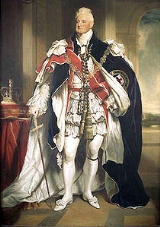
William IV of the United Kingdom

Encyclopedia
William IV was King of the United Kingdom of Great Britain and Ireland
and of Hanover
from 26 June 1830 until his death. William, the third son of George III
and younger brother and successor to George IV
, was the last king and penultimate monarch of Britain's House of Hanover
.
He served in the Royal Navy
in his youth and was, both during his reign and afterwards, nicknamed the "Sailor King". He served in North America and the Caribbean
, but saw little actual fighting. Since his two older brothers died without leaving legitimate issue, he inherited the throne
when he was 64 years old. His reign saw several reforms: the poor law
was updated, child labour restricted, slavery abolished in nearly all the British Empire
, and the Reform Act 1832
refashioned the British electoral system. Though William did not engage in politics as much as his brother or his father, he was the last monarch to appoint a Prime Minister contrary to the will of Parliament. Through his brother
, the Viceroy
of Hanover, he granted that kingdom a short-lived liberal constitution.
At his death William had no surviving legitimate children, though he was survived by eight of the ten illegitimate children he had by the actress Dorothea Jordan, with whom he cohabited for 20 years. William was succeeded in the United Kingdom by his niece, Victoria, and in Hanover by his brother, Ernest Augustus I
.
, the third child and son of King George III
and Queen Charlotte
. He had two elder brothers, George
and Frederick, and was not expected to inherit the Crown. He was baptised in the Great Council Chamber of St James's Palace on 20 September 1765. His godparents were his paternal uncles, the Duke of Gloucester
and Prince Henry (later Duke of Cumberland), and his paternal aunt, Princess Augusta, then Hereditary Duchess of Brunswick-Wolfenbüttel.
Most of his early life was spent at Richmond and Kew Palace
, where he was educated by private tutors. At the age of thirteen, he joined the Royal Navy
as a midshipman
, and was present at the Battle of Cape St. Vincent
in 1780. His experiences in the navy seem to have been little different from those of other midshipmen (though a tutor accompanied him on board ship) doing his share of the cooking and getting arrested with his shipmates after a drunken brawl on Gibraltar
(he was hastily released when his identity became known). He served in New York during the American War of Independence
. While the prince was in America, George Washington
approved a plot to kidnap him, writing "The spirit of enterprise so conspicuous in your plan for surprising in their quarters and bringing off the Prince William Henry and Admiral Digby merits applause; and you have my authority to make the attempt in any manner, and at such a time, as your judgment may direct. I am fully persuaded, that it is unnecessary to caution you against offering insult or indignity to the persons of the Prince or Admiral..." The plot did not come to fruition; the British heard of it and assigned guards to the prince, who had up till then walked around New York unescorted.
William became a Lieutenant in 1785 and Captain
of the following year. In late 1786, he was stationed in the West Indies under Horatio Nelson, who wrote of William, "In his professional line, he is superior to two-thirds, I am sure, of the [Naval] list; and in attention to orders, and respect to his superior officer, I hardly know his equal." The two were great friends, and dined together almost nightly. At Nelson's wedding, the prince insisted on giving the bride
away. He was given command of the frigate in 1788, and was promoted to Rear-Admiral
in command of the following year.
William sought to be made a Duke
like his elder brothers, and to receive a similar Parliamentary grant, but his father was reluctant. To put pressure on him, William threatened to run for the House of Commons
for the constituency of Totnes
in Devon. Appalled at the prospect of his son making his case to the voters, George III created him Duke of Clarence and St Andrews and Earl of Munster
on 16 May 1789, supposedly saying, "I well know it is another vote added to the Opposition." Although he allied himself publicly with the Whigs and his elder brothers (who were known for their conflict with their father), the Prince of Wales and the Duke of York, William's record was inconsistent and, like many politicians of the time, cannot be certainly ascribed to a single party.
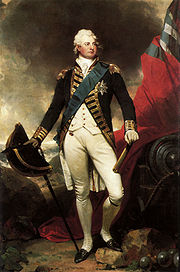 The newly created Duke ceased his active service in the Royal Navy in 1790. When the United Kingdom declared war on France in 1793, he was anxious to serve his country and expected a command, but was not given a ship, perhaps at first because he had broken his arm by falling down some stairs drunk, but later because he gave a speech in the House of Lords
opposing the war. The following year he spoke in favour of the war, expecting a command after his change of heart. None came. The Admiralty did not even reply to his request. He did not lose hope of being appointed to an active post, but when he was made an admiral in 1798, the rank was purely titular. Despite repeated petitions, he was never given a command throughout the Napoleonic Wars
. In 1811, he was appointed to the honorary position of Admiral of the Fleet
. In 1813, he came nearest to any actual fighting, when he visited the British troops fighting in the Low Countries
. Watching the bombardment of Antwerp from a church steeple, he came under fire. A bullet pierced his coat.
Instead of serving at sea, he spent time in the House of Lords, where he spoke in opposition to the abolition of slavery, which although not legal in the United Kingdom still existed in the British colonies. Freedom would do the slaves little good, he argued. He had travelled widely and, in his eyes, the living standard among freemen in the Highlands and Islands
of Scotland was worse than that among slaves in the West Indies. His experience in the West Indies lent gravitas to his position, which was perceived as well-argued and just by some of his contemporaries. Others thought it "shocking that so young a man, under no bias of interest, should be earnest in continuance of the slave trade". In his speech to the House of Lords, the Duke insulted the leading abolitionist, saying "the proponents of the abolition are either fanatics or hypocrites, and in one of those classes I rank Mr. Wilberforce
". On other issues he was more liberal, such as supporting moves to abolish penal law
s against dissenting Christians
. He also opposed efforts to bar those found guilty of adultery
from remarriage.
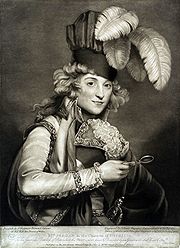 From 1791, the Duke of Clarence lived for 20 years with an Irish actress, Dorothea Bland, better known by her stage name, Mrs. Jordan, the title "Mrs" being assumed at the start of her stage career to explain an inconvenient pregnancy and "Jordan" because she had "crossed the water" from Ireland to Britain.
William was part of the first generation to grow to maturity under the Royal Marriages Act 1772
, which forbade descendants of George II from marrying unless they obtained the monarch's consent, or, if over the age of 25, giving twelve months' notice to the Privy Council
. Several of George III's sons, including William, chose to cohabit with the women they loved, rather than seeking a wife. After all, the younger sons, including William, were not expected to figure in the succession, which was considered secure once the Prince of Wales married and had a daughter, Princess Charlotte
.
While William had an eye for the ladies as a young man, he appeared to enjoy the domesticity of his life with Mrs. Jordan. The Duke remarked to a friend, "Mrs. Jordan is a very good creature, very domestic and careful of her children. To be sure she is absurd sometimes and has her humours. But there are such things more or less in all families." The couple, while living quietly, enjoyed entertaining, with Mrs. Jordan writing in late 1809: "We shall have a full and merry house this Christmas, 'tis what the dear Duke delights in." The King, generally somewhat of a prude, was accepting of his son's relationship with the actress (though recommending that he halve her allowance) and in 1797, created William Ranger of Bushy Park, which included a large residence, Bushy House
, for William's growing family. William used Bushy as his principal residence until he became King. His London residence, Clarence House
, was constructed to the designs of John Nash
between 1825 and 1827.
The couple had ten illegitimate children, five sons and five daughters, nine of whom were named for William's siblings, and who were given the surname "FitzClarence". The affair lasted for twenty years before ending in 1811. Mrs. Jordan at least had no doubt as to the reason for the break-up: "Money, money, my good friend, has, I am convinced made HIM at this moment the most wretched of men," adding, "With all his excellent qualities, his domestic virtues, his love for his lovely children, what must he not at this moment suffer?" Mrs. Jordan was given a financial settlement of £4400 (equal to £ today) per year and custody of the daughters, on condition she did not resume the stage. When she did take up her acting career again, to repay debts incurred by her son-in-law (the husband of one of Mrs. Jordan's daughters from a previous relationship), the Duke took custody of the daughters and stopped paying the £1500 (equal to £ today) designated for their maintenance. With her career failing, she fled to France to escape her creditors, and died, impoverished, near Paris in 1816.
William had another illegitimate son, William, before he met Mrs. Jordan and whose mother is unknown, who drowned off Madagascar
in HMS Blenheim
in 1807. Caroline von Linsingen, whose father was a general in the Hanoverian infantry, claimed to have had a son, Heinrich, by William in around 1790 but William was not in Hanover at the time that she claims and the story is considered implausible.
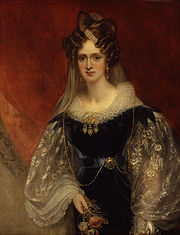 Deep in debt, the Duke made multiple attempts towards marrying a wealthy heiress, but his suits were unsuccessful. However, when the Duke's niece, Princess Charlotte, the second-in-line to the throne, died in childbirth in 1817, the King was left with twelve children, but no legitimate grandchildren. The race was on among the Royal Dukes to marry and produce an heir. William had great advantages in this race—his two older brothers were both childless and estranged from their wives (who were both probably beyond childbearing age) and William was the healthiest of the three. If he lived long enough, he would almost certainly become King, and have the opportunity to sire the next monarch. However, William's first choices to wed either met with the disapproval of the Prince Regent or turned him down. His younger brother, the Duke of Cambridge
, was sent to Germany to scout out the available Protestant
princesses; he came up with Princess Augusta of Hesse-Cassel, but her father declined the match. Two months later, the Duke of Cambridge married her himself. Eventually, a princess was found who was amicable, home-loving, and was willing to accept, even enthusiastically welcome, William's nine surviving children, several of whom had not yet reached adulthood. At Kew
on 11 July 1818, William married Princess Adelaide of Saxe-Meiningen
, the daughter of the Duke of Saxe-Meiningen. At 25, Adelaide was half William's age.
The marriage, which lasted almost twenty years until William's death, was a happy one. The new Duchess took both William and his finances in hand. For their first year of marriage, the couple lived in economical fashion in Germany, William's debts were soon on the way to being paid, especially since Parliament had voted him an increased allowance, which he reluctantly accepted after his requests to increase it further were refused. William is not known to have had mistresses.
The couple had two short-lived daughters, and Adelaide suffered three miscarriages. Despite this, false rumours that Adelaide was pregnant persisted into William's reign—he dismissed them as "damned stuff". Charlotte Augusta Louisa was born on 27 March 1819 at the Fürstenhof in Hannover, and died later the same day. Elizabeth Georgiana Adelaide was born on 10 December 1820 at St. James's Palace
, London. She was christened on the day of her birth (or possibly the day after), by the Bishop of London
, William Howley
. Although she was born before term, Elizabeth enjoyed good health at first, but she died on 4 March 1821, succumbing to convulsions and intertwining of the bowels. She was buried at St. George's Chapel, Windsor Castle
.
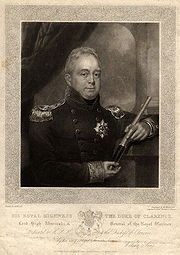 William's elder brother, the Prince of Wales, had been Prince Regent
since 1811 because of the mental illness of their father, George III. In 1820, the King died, leaving the Crown to the Prince Regent, who became George IV
. William was now second in line to the Throne, preceded only by his brother, Frederick, Duke of York. Reformed since his marriage, William walked for hours, ate relatively frugally, and the only drink he imbibed in quantity was barley water
flavoured with lemon. Both of his older brothers were unhealthy, and it was considered only a matter of time before he became King. When the Duke of York died in 1827, William, then more than 60 years old, became heir presumptive. Later that year, the incoming Prime Minister, George Canning
, appointed William to the office of Lord High Admiral, which had been in commission (that is, exercised by a board rather than by a single individual) since 1709. While in office, the Duke had repeated conflicts with his Council, which was composed of Admiralty
officers. Things finally came to a head in 1828 when the Lord High Admiral put to sea with a squadron of ships, leaving no word of where they were going, and remaining away for ten days. The King, through the Prime Minister, by now Arthur Wellesley, 1st Duke of Wellington
, requested his resignation; the Duke of Clarence complied.
Despite the difficulties the Duke experienced, he did considerable good as Lord High Admiral. He abolished the cat o' nine tails
for most offences other than mutiny
; attempted to improve the standard of naval gunnery and he required regular reports of the condition and preparedness of each ship. He commissioned the first steam warship and advocated for more. Holding the office permitted William to make mistakes and learn from them—a process that might have been far more costly had he not learnt before becoming King that he should act only with the advice of his councillors.
William spent the remaining time during his brother's reign in the House of Lords. He supported the Catholic Emancipation
Bill against the opposition of his younger brother, the Duke of Cumberland
, describing the latter's position on the Bill as "infamous", to the younger Duke's outrage. George IV's health was increasingly bad; it was obvious by early 1830 that he was near death. The King took his leave of his younger brother at the end of May, stating, "God's will be done. I have injured no man. It will all rest on you then." William's genuine affection for his older brother could not mask his rising anticipation that he would soon be King.
, William was known, especially early in his reign, to walk, unaccompanied, through London or Brighton
. Until the Reform Crisis eroded his standing, he was very popular among the people, who saw him as more approachable and down-to-earth than his brother.
The King immediately proved himself a conscientious worker. The King's first Prime Minister, the Duke of Wellington, stated that he had done more business with King William in ten minutes than he had with George IV in as many days. Lord Brougham
described him as an excellent man of business, asking enough questions to help him understand the matter—whereas George IV feared to ask questions lest he display his ignorance and George III would ask too many and then not wait for a response.
The King did his best to endear himself to the people. Lady Charlotte Williams-Wynn wrote shortly after his accession, "Hitherto the King has been indefatigable in his efforts to make himself popular, and do good natured and amiable things in every possible instance." Noted the diarist Emily Eden, "He is an immense improvement on the last unforgiving animal, who died growling sulkily in his den at Windsor. This man at least wishes to make everybody happy, and everything he has done has been benevolent."
William dismissed his brother's French chefs and German band, replacing them with English ones to public approval. He gave much of George IV's painting collection to the nation, and reduced the royal stud. George IV had begun an extensive (and expensive) renovation of Buckingham Palace
; his brother refused to reside there, and twice tried to give the palace away, once to the Army as a barracks, and once to Parliament after the Houses of Parliament burned down in 1834. His informality could be startling: When in residence at the Royal Pavilion
in Brighton, King William used to send to the hotels for a list of their guests and invite anyone whom he knew to dinner, urging guests not to "bother about clothes. The Queen does nothing but embroider flowers after dinner."
Upon taking the throne, William did not forget his nine surviving illegitimate children, creating his eldest son Earl of Munster
and granting the other children the precedence of a younger son (or daughter) of a marquess. Despite this his children importuned for greater opportunities, disgusting elements of the press which reported that the "impudence and rapacity of the FitzJordans is unexampled". The relationship between William and his sons "was punctuated by a series of savage and, for the King at least, painful quarrels" over money and honours. His daughters, on the other hand, proved an ornament to his court, as, "They are all, you know, pretty and lively, and make society in a way that real princesses could not."
required fresh elections and, in the general election of 1830
, Wellington's Tories
lost ground to the Whigs
under Charles Grey, 2nd Earl Grey
, though the Tories still had the largest number of seats. With the Tories bitterly divided, Wellington was defeated in the House of Commons in November, and Lord Grey formed a government. Lord Grey pledged to reform the electoral system, which had seen few changes since the fifteenth century. The inequities in the system were great; for example, large towns such as Manchester
and Birmingham
elected no members (though they were part of county constituencies), while small boroughs—known as rotten
or pocket boroughs—such as Old Sarum
with just seven voters, elected two members of Parliament each. Often, the rotten boroughs were controlled by great aristocrats, whose nominees were invariably elected by the constituents—who were, most often, their tenants—especially since the secret ballot was not yet used in Parliamentary elections. Landowners who controlled seats were even able to sell them to prospective candidates.
When the House of Commons defeated the First Reform Bill in 1831, Lord Grey's ministry urged William to dissolve Parliament, which would lead to a new general election. At first, William hesitated to exercise his prerogative to dissolve Parliament because elections had just been held the year before and the country was in a state of high excitement which might boil over into violence. He was, however, irritated by the conduct of the Opposition, which announced its intention to move the passage of an Address, or resolution, in the House of Lords, against dissolution. Regarding the Opposition's motion as an attack on his prerogative, and at the urgent request of Lord Grey and his ministers, William IV prepared to go in person to the House of Lords and prorogue Parliament. The monarch's arrival would stop all debate and prevent passage of the Address. When initially told that his horses could not be ready at such short notice, William is supposed to have said, "Then I will go in a hackney cab!" Coach and horses were assembled quickly and William immediately proceeded to Parliament. Said The Times of the scene before William's arrival, "It is utterly impossible to describe the scene ... The violent tones and gestures of noble Lords ... astonished the spectators, and affected the ladies who were present with visible alarm." Lord Londonderry
brandished a whip, threatening to thrash the Government supporters, and was held back by four of his colleagues. William hastily put on the crown, entered the Chamber, and dissolved Parliament. This forced new elections for the House of Commons
, which yielded a great victory for the reformers. But although the House of Commons was clearly in favour of parliamentary reform, the House of Lords
remained implacably opposed to it.
The crisis saw a brief interlude for the celebration of the King's Coronation
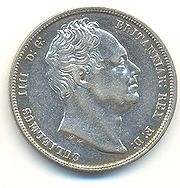
on 8 September 1831. At first, the King wished to dispense with the coronation entirely, feeling that his wearing the crown while proroguing Parliament answered any need. He was persuaded otherwise by traditionalists. He refused, however, to celebrate the coronation in the expensive way his brother had—the 1821 coronation had cost £240,000, of which £16,000 was merely to hire the jewels. At William's instructions, the Privy Council budgeted less than £30,000 for the coronation. When traditionalist Tories threatened to boycott what they called the "Half Crown
-nation", the King retorted that they should go ahead, and that he anticipated "greater convenience of room and less heat".
After the rejection of the Second Reform Bill by the Upper House in October 1831, agitation for reform grew across the country; demonstrations grew violent in so-called "Reform Riots". In the face of popular excitement, the Grey ministry refused to accept defeat in the House of Lords, and re-introduced the Bill, which still faced difficulties in the House of Lords. Frustrated by the Lords' recalcitrance, Grey suggested that the King create a sufficient number of new peers to ensure the passage of the Reform Bill. The King objected—though he had the power to create an unlimited number of peers, he had already created 22 new peers in his Coronation Honours. William reluctantly agreed to the creation of the number of peers sufficient "to secure the success of the bill". However, the King, citing the difficulties with a permanent expansion of the Peerage
, told Grey that the creations must be restricted as much as possible to the eldest sons and collateral heirs of existing peers, so that the created peerages would eventually be absorbed as subsidiary titles. This time, the Lords did not reject the bill outright, but began preparing to change its basic character through amendments. Grey and his fellow ministers decided to resign if the King did not agree to an immediate and large creation to force the bill through in its entirety. The King refused, and accepted their resignations. The King attempted to restore the Duke of Wellington to office, but Wellington had insufficient support to form a ministry and the King's popularity sank to an all-time low. Mud was slung at his carriage and he was publicly hissed. The King agreed to reappoint Grey's ministry, and to create new peers if the House of Lords continued to pose difficulties. Concerned by the threat of the creations, most of the bill's opponents abstained and the Reform Act 1832
was passed. The mob blamed William's actions on the influence of his wife and brother, and his popularity recovered.
. William was supportive of Belgian independence
and, after unacceptable Dutch and French candidates were put forward, favoured Prince Leopold of Saxe-Coburg and Gotha
, the widower of his niece, Charlotte, as a candidate for the newly created Belgian throne.
Though he had a reputation for tactlessness and buffoonery, William could be shrewd and diplomatic. He foresaw that the potential construction of a canal at Suez
would make good relations with Egypt
vital to Britain. Later in his reign he flattered the American ambassador at a dinner by announcing that he regretted not being "born a free, independent American, so much did he respect that nation, which had given birth to George Washington, the greatest man that ever lived". By exercising his personal charm, William assisted in the repair of Anglo-American relations, which had been so deeply damaged during the reign of his father.
as its King. His brother, Prince Adolphus, Duke of Cambridge
, acted as viceroy
there throughout William's reign as he had throughout George IV's reign.
Public perception in Germany was that Britain dictated Hanoverian policy. This was not the case. In 1832, Metternich introduced laws which curbed fledging liberal movements in Germany. Britain's Foreign Secretary Lord Palmerston opposed this, and sought William's influence to cause the Hanoverian government to take the same position. The Hanoverian government instead agreed with Metternich, much to Palmerston's dismay, and William declined to intervene. The conflict between William and Palmerston over Hanover was renewed the following year when Metternich called a conference of the German states, to be held in Vienna
, and Palmerston wanted Hanover to decline the invitation. Instead, the Viceroy accepted, backed fully by William.
In 1833, William signed a new constitution for Hanover which empowered the middle class, gave limited power to the lower classes, and expanded the role of the parliament of Hanover. The constitution was revoked after William's death by the new king, William's brother, Prince Ernest Augustus, Duke of Cumberland
.
, William Lamb, 2nd Viscount Melbourne
, replaced him. Lord Melbourne retained most Cabinet members, and his ministry retained an overwhelming majority in the House of Commons. Some members of the Government, however, were anathema to the King, and increasingly left-wing policies concerned him. The previous year Grey had already pushed through a bill reforming the Protestant Church of Ireland
. The Church collected tithe
s throughout Ireland, supported multiple bishoprics and was wealthy. However, barely an eighth of the Irish population belonged to the Church of Ireland. In some parishes, there were no Church of Ireland members at all, but there was still a priest paid for by tithes collected from the local Catholics and Presbyterians
, leading to charges that idle priests were living in luxury at the expense of the Irish living at the level of subsistence. Grey's bill had reduced the number of bishoprics by half, abolished some of the sinecures and overhauled the tithe system. Further measures to appropriate the surplus revenues of the Church of Ireland were mooted by the more radical members of the Government, including Lord John Russell
. The King had an especial dislike for Russell, calling him "a dangerous little Radical."
In November 1834, the Leader of the House of Commons
and Chancellor of the Exchequer
, John Charles Spencer, Viscount Althorp, inherited a peerage, thus removing him from the House of Commons to the Lords. Melbourne had to appoint a new Commons leader and a new Chancellor (who by long custom, must be drawn from the Commons), but the only candidate that Melbourne felt suitable to replace Althorp as Commons leader was Lord John Russell, whom William (and many others) found unacceptable due to his Radical politics. William claimed that the ministry had been weakened beyond repair and used the removal of Lord Althorp—who had previously indicated that he would retire from politics upon becoming a peer—as the pretext for the dismissal of the entire ministry. With Lord Melbourne gone, William chose to entrust power to a Tory, Sir Robert Peel
. Since Peel was then in Italy, the Duke of Wellington was provisionally appointed Prime Minister. When Peel returned and assumed leadership of the ministry for himself, he saw the impossibility of governing because of the Whig majority in the House of Commons. Consequently, Parliament was dissolved to force fresh elections
. Although the Tories won more seats than in the previous election
, they were still in the minority. Peel remained in office for a few months, but resigned after a series of parliamentary defeats. Lord Melbourne was restored to the Prime Minister's office, remaining there for the rest of William's reign, and the King was forced to accept Russell as Commons leader.
The King had a mixed relationship with Lord Melbourne. Melbourne's government mooted more ideas to introduce greater democracy, such as the devolution of powers to the Legislative Council of Lower Canada
, which greatly alarmed the King, who feared it would eventually lead to the loss of the colony. At first, the King bitterly opposed these proposals. William exclaimed to Canada Governor General-designate Lord Gosford
, "Mind what you are about in Canada ... mind me, my Lord, the Cabinet is not my Cabinet; they had better take care or by God, I will have them impeached." When William's son Augustus Fitzclarence enquired of his father whether the King would be entertaining during Ascot week, William gloomily replied, "I cannot give any dinners without inviting the ministers, and I would rather see the devil than any one of them in my house." Nevertheless, William approved the Cabinet's recommendations for reform. Despite his disagreements with Lord Melbourne, the King wrote warmly to congratulate the Prime Minister when he triumphed in the adultery case brought against him concerning Lady Caroline Norton—he had refused to permit Melbourne to resign when the case was first brought. The King and Prime Minister eventually found a modus vivendi; Melbourne applying tact and firmness when called for; while William realised that his First Minister was far less radical in his politics than the King had feared.
 Both the King and Queen were fond of their niece, Princess Victoria of Kent. Their attempts to forge a close relationship with the girl were frustrated by the conflict between the King and the Dowager Duchess of Kent
, the young princess's mother. The King, angered at what he took to be disrespect from the Duchess to his wife, took the opportunity at what proved to be his final birthday banquet in August 1836 to settle the score. Speaking to those assembled at the banquet, who included the Duchess and Princess Victoria, William expressed his hope that he would survive until Princess Victoria was 18 so that the Duchess of Kent would never be Regent. He said, "I trust to God that my life may be spared for nine months longer ... I should then have the satisfaction of leaving the exercise of the Royal authority to the personal authority of that young lady, heiress presumptive to the Crown, and not in the hands of a person now near me, who is surrounded by evil advisers and is herself incompetent to act with propriety in the situation in which she would be placed." The speech was so shocking that Victoria burst into tears, while her mother sat in silence and was only with difficulty persuaded not to leave immediately after dinner (the two left the next day). William's outburst undoubtedly contributed to Victoria's tempered view of him as "a good old man, though eccentric and singular". William survived, though mortally ill, to the month after Victoria's coming of age. "Poor old man!", Victoria wrote as he was dying, "I feel sorry for him; he was always personally kind to me."
William was "very much shaken and affected" by the death of his eldest daughter, Sophia, Lady de L'Isle, in childbirth in April 1837. A watercolour sketch made by her during her later pregnancy in early 1837 shows his frailty then. William and his eldest son, George, Earl of Munster, were estranged at the time, but William hoped that a letter of condolence from Munster signalled a reconciliation. His hopes were not fulfilled and Munster, still thinking he had not been given sufficient money or patronage, remained bitter to the end.
Queen Adelaide attended the dying William devotedly, not going to bed herself for more than ten days. William IV died from heart failure
in the early hours of the morning of 20 June 1837 at Windsor Castle
, where he was buried. As he had no living legitimate issue, the Crown of the United Kingdom passed to Princess Victoria of Kent, the only child of Edward Augustus, Duke of Kent, George III's fourth son. Under Salic Law
, a woman could not rule Hanover; thus, the Hanoverian Crown went to George III's fifth son, Ernest Augustus, Duke of Cumberland
. William's death thus ended the personal union of Britain and Hanover, which had persisted since 1714. The main beneficiaries of his will were his eight surviving children by Mrs. Jordan. Although William IV is not the direct ancestor of the later monarchs of the United Kingdom, he has many notable descendants through his illegitimate family with Mrs. Jordan, including Prime Minister David Cameron
, TV presenter Adam Hart-Davis
, author and statesman Duff Cooper
, and the Duke of Fife
, who married Queen Victoria's granddaughter Louise
.
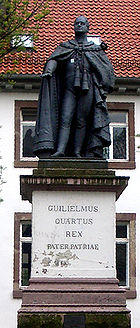 William's reign was short, but eventful. The ascendancy of the House of Commons and the corresponding decline of the House of Lords were marked by the Reform Crisis, during which the threat of flooding the Upper House with peers was used effectively for the first time by a ministry. The weakening of the House of Lords continued during the nineteenth century, and culminated during the twentieth century with the passage of the Parliament Act 1911
. The same threat which had been used during the Reform Crisis—the threat to flood the House of Lords by creating several new peers—was used to procure its passage.
The reduction in the influence of the Crown was clearly indicated by the events of William's reign, especially the dismissal of the Melbourne ministry. The crisis relating to Melbourne's dismissal also indicated the reduction in the King's influence with the people. During the reign of George III, the King could have dismissed one ministry, appointed another, dissolved Parliament, and expected the people to vote in favour of the new administration. Such was the result of a dissolution in 1784, after the dismissal of the Fox-North Coalition
, and 1807, after the dismissal of William Wyndham Grenville, 1st Baron Grenville
. But when William IV dismissed the Melbourne ministry, the Tories under Sir Robert Peel were not able to win the ensuing elections. The King's ability to influence the opinion of the people, and therefore national policy, had been reduced. None of William's successors has attempted to remove a government or appoint another against the wishes of Parliament. William understood that as a constitutional monarch he was powerless to act against the opinion of Parliament. He said, "I have my view of things, and I tell them to my ministers. If they do not adopt them, I cannot help it. I have done my duty."
During his reign great reforms were enacted by Parliament including the Factory Act, preventing child labour, the Abolition Act, emancipating slaves in the colonies, and the Poor Law, standardising provision for the destitute. He attracted criticism from reformers, who felt that reform did not go far enough, and from reactionaries, who felt that reform went too far. The modern interpretation is that he failed to satisfy either political extreme by trying to find compromise between two bitterly opposed factions, but in the process proved himself more capable as a constitutional monarch than many had supposed.
William's official style as King of the United Kingdom was "William the Fourth, by the Grace of God, of the United Kingdom of Great Britain and Ireland, King, Defender of the Faith". He was the first king of the United Kingdom named William, though there were three previous kings of England
called William and two of Scotland
.
His style in Hanover was "William the Fourth, by the Grace of God, King of the United Kingdom of Great Britain and Ireland, etc., and also King of Hanover, Duke of Brunswick and Lüneburg, etc."
(without the electoral inescutcheon in the Hanoverian quarter
) in 1781, differenced by a label
of three points argent
, the centre point bearing a cross gules
, the outer points each bearing an anchor azure
. In 1801 his arms altered with the royal arms, however the marks of difference remained the same.
As king his arms were those of his two kingdoms, the United Kingdom and Hanover, superimposed: Quarterly, I and IV Gules three lions passant guardant in pale
Or
(for England); II Or a lion rampant rampant within a tressure flory-counter-flory Gules (for Scotland
); III Azure a harp Or stringed Argent (for Ireland
); overall an escutcheon tierced per pale and per chevron
(for Hanover), I Gules two lions passant guardant Or (for Brunswick), II Or a semy of hearts Gules a lion rampant Azure (for Lüneburg), III Gules a horse courant Argent (for Westphalia
), overall an inescutcheon Gules charged with the crown of Charlemagne Or, the whole escutcheon surmounted by a crown.
United Kingdom of Great Britain and Ireland
The United Kingdom of Great Britain and Ireland was the formal name of the United Kingdom during the period when what is now the Republic of Ireland formed a part of it....
and of Hanover
Kingdom of Hanover
The Kingdom of Hanover was established in October 1814 by the Congress of Vienna, with the restoration of George III to his Hanoverian territories after the Napoleonic era. It succeeded the former Electorate of Brunswick-Lüneburg , and joined with 38 other sovereign states in the German...
from 26 June 1830 until his death. William, the third son of George III
George III of the United Kingdom
George III was King of Great Britain and King of Ireland from 25 October 1760 until the union of these two countries on 1 January 1801, after which he was King of the United Kingdom of Great Britain and Ireland until his death...
and younger brother and successor to George IV
George IV of the United Kingdom
George IV was the King of the United Kingdom of Great Britain and Ireland and also of Hanover from the death of his father, George III, on 29 January 1820 until his own death ten years later...
, was the last king and penultimate monarch of Britain's House of Hanover
House of Hanover
The House of Hanover is a deposed German royal dynasty which has ruled the Duchy of Brunswick-Lüneburg , the Kingdom of Hanover, the Kingdom of Great Britain, the Kingdom of Ireland and the United Kingdom of Great Britain and Ireland...
.
He served in the Royal Navy
Royal Navy
The Royal Navy is the naval warfare service branch of the British Armed Forces. Founded in the 16th century, it is the oldest service branch and is known as the Senior Service...
in his youth and was, both during his reign and afterwards, nicknamed the "Sailor King". He served in North America and the Caribbean
Caribbean
The Caribbean is a crescent-shaped group of islands more than 2,000 miles long separating the Gulf of Mexico and the Caribbean Sea, to the west and south, from the Atlantic Ocean, to the east and north...
, but saw little actual fighting. Since his two older brothers died without leaving legitimate issue, he inherited the throne
Hereditary monarchy
A hereditary monarchy is the most common type of monarchy and is the form that is used by almost all of the world's existing monarchies.Under a hereditary monarchy, all the monarchs come from the same family, and the crown is passed down from one member to another member of the family...
when he was 64 years old. His reign saw several reforms: the poor law
Poor Law
The English Poor Laws were a system of poor relief which existed in England and Wales that developed out of late-medieval and Tudor-era laws before being codified in 1587–98...
was updated, child labour restricted, slavery abolished in nearly all the British Empire
British Empire
The British Empire comprised the dominions, colonies, protectorates, mandates and other territories ruled or administered by the United Kingdom. It originated with the overseas colonies and trading posts established by England in the late 16th and early 17th centuries. At its height, it was the...
, and the Reform Act 1832
Reform Act 1832
The Representation of the People Act 1832 was an Act of Parliament that introduced wide-ranging changes to the electoral system of England and Wales...
refashioned the British electoral system. Though William did not engage in politics as much as his brother or his father, he was the last monarch to appoint a Prime Minister contrary to the will of Parliament. Through his brother
Prince Adolphus, Duke of Cambridge
The Prince Adolphus, 1st Duke of Cambridge , was the tenth child and seventh son of George III and Queen Charlotte. He held the title of Duke of Cambridge from 1801 until his death. He also served as Viceroy of Hanover on behalf of his brothers George IV and William IV...
, the Viceroy
Viceroy
A viceroy is a royal official who runs a country, colony, or province in the name of and as representative of the monarch. The term derives from the Latin prefix vice-, meaning "in the place of" and the French word roi, meaning king. A viceroy's province or larger territory is called a viceroyalty...
of Hanover, he granted that kingdom a short-lived liberal constitution.
At his death William had no surviving legitimate children, though he was survived by eight of the ten illegitimate children he had by the actress Dorothea Jordan, with whom he cohabited for 20 years. William was succeeded in the United Kingdom by his niece, Victoria, and in Hanover by his brother, Ernest Augustus I
Ernest Augustus I of Hanover
Ernest Augustus I was King of Hanover from 20 June 1837 until his death. He was the fifth son and eighth child of George III, who reigned in both the United Kingdom and Hanover...
.
Early life
William was born in the early hours of the morning on 21 August 1765 at Buckingham HouseBuckingham Palace
Buckingham Palace, in London, is the principal residence and office of the British monarch. Located in the City of Westminster, the palace is a setting for state occasions and royal hospitality...
, the third child and son of King George III
George III of the United Kingdom
George III was King of Great Britain and King of Ireland from 25 October 1760 until the union of these two countries on 1 January 1801, after which he was King of the United Kingdom of Great Britain and Ireland until his death...
and Queen Charlotte
Charlotte of Mecklenburg-Strelitz
Charlotte of Mecklenburg-Strelitz was the Queen consort of the United Kingdom as the wife of King George III...
. He had two elder brothers, George
George IV of the United Kingdom
George IV was the King of the United Kingdom of Great Britain and Ireland and also of Hanover from the death of his father, George III, on 29 January 1820 until his own death ten years later...
and Frederick, and was not expected to inherit the Crown. He was baptised in the Great Council Chamber of St James's Palace on 20 September 1765. His godparents were his paternal uncles, the Duke of Gloucester
Prince William Henry, Duke of Gloucester and Edinburgh
Prince William, Duke of Gloucester and Edinburgh was a member of the British Royal Family, a grandson of George II and a younger brother of George III.-Early life:...
and Prince Henry (later Duke of Cumberland), and his paternal aunt, Princess Augusta, then Hereditary Duchess of Brunswick-Wolfenbüttel.
Most of his early life was spent at Richmond and Kew Palace
Kew Palace
Kew Palace is a British Royal Palace in Kew Gardens on the banks of the Thames up river from London. There have been at least four Palaces at Kew, and three have been known as Kew Palace; the first building may not have been known as Kew as no records survive other than the words of another...
, where he was educated by private tutors. At the age of thirteen, he joined the Royal Navy
Royal Navy
The Royal Navy is the naval warfare service branch of the British Armed Forces. Founded in the 16th century, it is the oldest service branch and is known as the Senior Service...
as a midshipman
Midshipman
A midshipman is an officer cadet, or a commissioned officer of the lowest rank, in the Royal Navy, United States Navy, and many Commonwealth navies. Commonwealth countries which use the rank include Australia, New Zealand, South Africa, India, Pakistan, Singapore, Sri Lanka and Kenya...
, and was present at the Battle of Cape St. Vincent
Battle of Cape St. Vincent (1780)
The naval Battle of Cape St Vincent, took place off the coast of Portugal on 16 January 1780 during the American War of Independence. A British fleet under Admiral Sir George Rodney defeated a Spanish squadron under Don Juan de Lángara. The battle is sometimes referred to as the Moonlight Battle,...
in 1780. His experiences in the navy seem to have been little different from those of other midshipmen (though a tutor accompanied him on board ship) doing his share of the cooking and getting arrested with his shipmates after a drunken brawl on Gibraltar
Gibraltar
Gibraltar is a British overseas territory located on the southern end of the Iberian Peninsula at the entrance of the Mediterranean. A peninsula with an area of , it has a northern border with Andalusia, Spain. The Rock of Gibraltar is the major landmark of the region...
(he was hastily released when his identity became known). He served in New York during the American War of Independence
American Revolutionary War
The American Revolutionary War , the American War of Independence, or simply the Revolutionary War, began as a war between the Kingdom of Great Britain and thirteen British colonies in North America, and ended in a global war between several European great powers.The war was the result of the...
. While the prince was in America, George Washington
George Washington
George Washington was the dominant military and political leader of the new United States of America from 1775 to 1799. He led the American victory over Great Britain in the American Revolutionary War as commander-in-chief of the Continental Army from 1775 to 1783, and presided over the writing of...
approved a plot to kidnap him, writing "The spirit of enterprise so conspicuous in your plan for surprising in their quarters and bringing off the Prince William Henry and Admiral Digby merits applause; and you have my authority to make the attempt in any manner, and at such a time, as your judgment may direct. I am fully persuaded, that it is unnecessary to caution you against offering insult or indignity to the persons of the Prince or Admiral..." The plot did not come to fruition; the British heard of it and assigned guards to the prince, who had up till then walked around New York unescorted.
William became a Lieutenant in 1785 and Captain
Captain (naval)
Captain is the name most often given in English-speaking navies to the rank corresponding to command of the largest ships. The NATO rank code is OF-5, equivalent to an army full colonel....
of the following year. In late 1786, he was stationed in the West Indies under Horatio Nelson, who wrote of William, "In his professional line, he is superior to two-thirds, I am sure, of the [Naval] list; and in attention to orders, and respect to his superior officer, I hardly know his equal." The two were great friends, and dined together almost nightly. At Nelson's wedding, the prince insisted on giving the bride
Frances Nelson
Frances "Fanny" Nelson, Viscountess Nelson , is best known as the wife of Horatio Nelson, the British naval officer who won several victories over the French during the French Revolutionary and Napoleonic Wars....
away. He was given command of the frigate in 1788, and was promoted to Rear-Admiral
Admiral
Admiral is the rank, or part of the name of the ranks, of the highest naval officers. It is usually considered a full admiral and above vice admiral and below admiral of the fleet . It is usually abbreviated to "Adm" or "ADM"...
in command of the following year.
William sought to be made a Duke
Duke
A duke or duchess is a member of the nobility, historically of highest rank below the monarch, and historically controlling a duchy...
like his elder brothers, and to receive a similar Parliamentary grant, but his father was reluctant. To put pressure on him, William threatened to run for the House of Commons
British House of Commons
The House of Commons is the lower house of the Parliament of the United Kingdom, which also comprises the Sovereign and the House of Lords . Both Commons and Lords meet in the Palace of Westminster. The Commons is a democratically elected body, consisting of 650 members , who are known as Members...
for the constituency of Totnes
Totnes (UK Parliament constituency)
Totnes is a county constituency represented in the House of Commons of the Parliament of the United Kingdom. It elects one Member of Parliament , using the first-past-the-post voting system....
in Devon. Appalled at the prospect of his son making his case to the voters, George III created him Duke of Clarence and St Andrews and Earl of Munster
Earl of Munster
Earl of Munster is a title that has been created twice, once in the Peerage of Ireland and once in the Peerage of the United Kingdom. The first creation came in the Peerage of Ireland in 1789 in favour of Prince William, the third son of King George III. He was made Duke of Clarence and St Andrews...
on 16 May 1789, supposedly saying, "I well know it is another vote added to the Opposition." Although he allied himself publicly with the Whigs and his elder brothers (who were known for their conflict with their father), the Prince of Wales and the Duke of York, William's record was inconsistent and, like many politicians of the time, cannot be certainly ascribed to a single party.
Service and politics
House of Lords
The House of Lords is the upper house of the Parliament of the United Kingdom. Like the House of Commons, it meets in the Palace of Westminster....
opposing the war. The following year he spoke in favour of the war, expecting a command after his change of heart. None came. The Admiralty did not even reply to his request. He did not lose hope of being appointed to an active post, but when he was made an admiral in 1798, the rank was purely titular. Despite repeated petitions, he was never given a command throughout the Napoleonic Wars
Napoleonic Wars
The Napoleonic Wars were a series of wars declared against Napoleon's French Empire by opposing coalitions that ran from 1803 to 1815. As a continuation of the wars sparked by the French Revolution of 1789, they revolutionised European armies and played out on an unprecedented scale, mainly due to...
. In 1811, he was appointed to the honorary position of Admiral of the Fleet
Admiral of the Fleet (Royal Navy)
Admiral of the fleet is the highest rank of the British Royal Navy and other navies, which equates to the NATO rank code OF-10. The rank still exists in the Royal Navy but routine appointments ceased in 1996....
. In 1813, he came nearest to any actual fighting, when he visited the British troops fighting in the Low Countries
Low Countries
The Low Countries are the historical lands around the low-lying delta of the Rhine, Scheldt, and Meuse rivers, including the modern countries of Belgium, the Netherlands, Luxembourg and parts of northern France and western Germany....
. Watching the bombardment of Antwerp from a church steeple, he came under fire. A bullet pierced his coat.
Instead of serving at sea, he spent time in the House of Lords, where he spoke in opposition to the abolition of slavery, which although not legal in the United Kingdom still existed in the British colonies. Freedom would do the slaves little good, he argued. He had travelled widely and, in his eyes, the living standard among freemen in the Highlands and Islands
Highlands and Islands
The Highlands and Islands of Scotland are broadly the Scottish Highlands plus Orkney, Shetland and the Hebrides.The Highlands and Islands are sometimes defined as the area to which the Crofters' Act of 1886 applied...
of Scotland was worse than that among slaves in the West Indies. His experience in the West Indies lent gravitas to his position, which was perceived as well-argued and just by some of his contemporaries. Others thought it "shocking that so young a man, under no bias of interest, should be earnest in continuance of the slave trade". In his speech to the House of Lords, the Duke insulted the leading abolitionist, saying "the proponents of the abolition are either fanatics or hypocrites, and in one of those classes I rank Mr. Wilberforce
William Wilberforce
William Wilberforce was a British politician, a philanthropist and a leader of the movement to abolish the slave trade. A native of Kingston upon Hull, Yorkshire, he began his political career in 1780, eventually becoming the independent Member of Parliament for Yorkshire...
". On other issues he was more liberal, such as supporting moves to abolish penal law
Penal law
In the most general sense, penal is the body of laws that are enforced by the State in its own name and impose penalties for their violation, as opposed to civil law that seeks to redress private wrongs...
s against dissenting Christians
English Dissenters
English Dissenters were Christians who separated from the Church of England in the 16th, 17th and 18th centuries.They originally agitated for a wide reaching Protestant Reformation of the Established Church, and triumphed briefly under Oliver Cromwell....
. He also opposed efforts to bar those found guilty of adultery
Adultery
Adultery is sexual infidelity to one's spouse, and is a form of extramarital sex. It originally referred only to sex between a woman who was married and a person other than her spouse. Even in cases of separation from one's spouse, an extramarital affair is still considered adultery.Adultery is...
from remarriage.
Relationships and marriage
William was part of the first generation to grow to maturity under the Royal Marriages Act 1772
Royal Marriages Act 1772
The Royal Marriages Act 1772 is an Act of the Parliament of Great Britain which prescribes the conditions under which members of the British Royal Family may contract a valid marriage, in order to guard against marriages that could diminish the status of the Royal House...
, which forbade descendants of George II from marrying unless they obtained the monarch's consent, or, if over the age of 25, giving twelve months' notice to the Privy Council
Privy Council of the United Kingdom
Her Majesty's Most Honourable Privy Council, usually known simply as the Privy Council, is a formal body of advisers to the Sovereign in the United Kingdom...
. Several of George III's sons, including William, chose to cohabit with the women they loved, rather than seeking a wife. After all, the younger sons, including William, were not expected to figure in the succession, which was considered secure once the Prince of Wales married and had a daughter, Princess Charlotte
Princess Charlotte Augusta of Wales
Princess Charlotte of Wales was the only child of George, Prince of Wales and Caroline of Brunswick...
.
While William had an eye for the ladies as a young man, he appeared to enjoy the domesticity of his life with Mrs. Jordan. The Duke remarked to a friend, "Mrs. Jordan is a very good creature, very domestic and careful of her children. To be sure she is absurd sometimes and has her humours. But there are such things more or less in all families." The couple, while living quietly, enjoyed entertaining, with Mrs. Jordan writing in late 1809: "We shall have a full and merry house this Christmas, 'tis what the dear Duke delights in." The King, generally somewhat of a prude, was accepting of his son's relationship with the actress (though recommending that he halve her allowance) and in 1797, created William Ranger of Bushy Park, which included a large residence, Bushy House
Bushy House
Bushy House is a former royal residence in Teddington in South West London, on the site of the National Physical Laboratory, overlooking Bushy Park....
, for William's growing family. William used Bushy as his principal residence until he became King. His London residence, Clarence House
Clarence House
Clarence House is a royal home in London, situated on The Mall, in the City of Westminster. It is attached to St. James's Palace and shares the palace's garden. For nearly 50 years, from 1953 to 2002, it was home to Queen Elizabeth, the Queen Mother, but is since then the official residence of The...
, was constructed to the designs of John Nash
John Nash (architect)
John Nash was a British architect responsible for much of the layout of Regency London.-Biography:Born in Lambeth, London, the son of a Welsh millwright, Nash trained with the architect Sir Robert Taylor. He established his own practice in 1777, but his career was initially unsuccessful and...
between 1825 and 1827.
The couple had ten illegitimate children, five sons and five daughters, nine of whom were named for William's siblings, and who were given the surname "FitzClarence". The affair lasted for twenty years before ending in 1811. Mrs. Jordan at least had no doubt as to the reason for the break-up: "Money, money, my good friend, has, I am convinced made HIM at this moment the most wretched of men," adding, "With all his excellent qualities, his domestic virtues, his love for his lovely children, what must he not at this moment suffer?" Mrs. Jordan was given a financial settlement of £4400 (equal to £ today) per year and custody of the daughters, on condition she did not resume the stage. When she did take up her acting career again, to repay debts incurred by her son-in-law (the husband of one of Mrs. Jordan's daughters from a previous relationship), the Duke took custody of the daughters and stopped paying the £1500 (equal to £ today) designated for their maintenance. With her career failing, she fled to France to escape her creditors, and died, impoverished, near Paris in 1816.
William had another illegitimate son, William, before he met Mrs. Jordan and whose mother is unknown, who drowned off Madagascar
Madagascar
The Republic of Madagascar is an island country located in the Indian Ocean off the southeastern coast of Africa...
in HMS Blenheim
HMS Blenheim (1761)
HMS Blenheim was a 90-gun second rate ship of the line of the Royal Navy, launched on 5 July 1761 at Woolwich.-Service:Under the command of John Bazely, she took part in the Battle of Hyères Islands in 1795. Blenheim then fought at Battle of Cape St Vincent in 1797. By 1801, she had become so badly...
in 1807. Caroline von Linsingen, whose father was a general in the Hanoverian infantry, claimed to have had a son, Heinrich, by William in around 1790 but William was not in Hanover at the time that she claims and the story is considered implausible.
Prince Adolphus, Duke of Cambridge
The Prince Adolphus, 1st Duke of Cambridge , was the tenth child and seventh son of George III and Queen Charlotte. He held the title of Duke of Cambridge from 1801 until his death. He also served as Viceroy of Hanover on behalf of his brothers George IV and William IV...
, was sent to Germany to scout out the available Protestant
Protestantism
Protestantism is one of the three major groupings within Christianity. It is a movement that began in Germany in the early 16th century as a reaction against medieval Roman Catholic doctrines and practices, especially in regards to salvation, justification, and ecclesiology.The doctrines of the...
princesses; he came up with Princess Augusta of Hesse-Cassel, but her father declined the match. Two months later, the Duke of Cambridge married her himself. Eventually, a princess was found who was amicable, home-loving, and was willing to accept, even enthusiastically welcome, William's nine surviving children, several of whom had not yet reached adulthood. At Kew
Kew
Kew is a place in the London Borough of Richmond upon Thames in South West London. Kew is best known for being the location of the Royal Botanic Gardens, now a World Heritage Site, which includes Kew Palace...
on 11 July 1818, William married Princess Adelaide of Saxe-Meiningen
Adelaide of Saxe-Meiningen
Princess Adelaide of Saxe-Meiningen was the queen consort of the United Kingdom and of Hanover as spouse of William IV of the United Kingdom. Adelaide, the capital city of South Australia, is named after her.-Early life:Adelaide was born on 13 August 1792 at Meiningen, Thuringia, Germany...
, the daughter of the Duke of Saxe-Meiningen. At 25, Adelaide was half William's age.
The marriage, which lasted almost twenty years until William's death, was a happy one. The new Duchess took both William and his finances in hand. For their first year of marriage, the couple lived in economical fashion in Germany, William's debts were soon on the way to being paid, especially since Parliament had voted him an increased allowance, which he reluctantly accepted after his requests to increase it further were refused. William is not known to have had mistresses.
The couple had two short-lived daughters, and Adelaide suffered three miscarriages. Despite this, false rumours that Adelaide was pregnant persisted into William's reign—he dismissed them as "damned stuff". Charlotte Augusta Louisa was born on 27 March 1819 at the Fürstenhof in Hannover, and died later the same day. Elizabeth Georgiana Adelaide was born on 10 December 1820 at St. James's Palace
St. James's Palace
St. James's Palace is one of London's oldest palaces. It is situated in Pall Mall, just north of St. James's Park. Although no sovereign has resided there for almost two centuries, it has remained the official residence of the Sovereign and the most senior royal palace in the UK...
, London. She was christened on the day of her birth (or possibly the day after), by the Bishop of London
Bishop of London
The Bishop of London is the ordinary of the Church of England Diocese of London in the Province of Canterbury.The diocese covers 458 km² of 17 boroughs of Greater London north of the River Thames and a small part of the County of Surrey...
, William Howley
William Howley
William Howley was a clergyman in the Church of England. He served as Archbishop of Canterbury from 1828 to 1848.-Early Life, education, and interests:...
. Although she was born before term, Elizabeth enjoyed good health at first, but she died on 4 March 1821, succumbing to convulsions and intertwining of the bowels. She was buried at St. George's Chapel, Windsor Castle
St. George's Chapel, Windsor Castle
St George's Chapel is the place of worship at Windsor Castle in England, United Kingdom. It is both a royal peculiar and the chapel of the Order of the Garter...
.
Lord High Admiral
Prince Regent
A prince regent is a prince who rules a monarchy as regent instead of a monarch, e.g., due to the Sovereign's incapacity or absence ....
since 1811 because of the mental illness of their father, George III. In 1820, the King died, leaving the Crown to the Prince Regent, who became George IV
George IV of the United Kingdom
George IV was the King of the United Kingdom of Great Britain and Ireland and also of Hanover from the death of his father, George III, on 29 January 1820 until his own death ten years later...
. William was now second in line to the Throne, preceded only by his brother, Frederick, Duke of York. Reformed since his marriage, William walked for hours, ate relatively frugally, and the only drink he imbibed in quantity was barley water
Barley water
Barley water, usually flavoured with lemon or other fruit, is a traditional British soft drink. It is made by boiling washed pearl barley, straining, then pouring the hot water over the rind and/or pulp of the fruit, and adding fruit juice and sugar to taste. The rind may also be boiled with the...
flavoured with lemon. Both of his older brothers were unhealthy, and it was considered only a matter of time before he became King. When the Duke of York died in 1827, William, then more than 60 years old, became heir presumptive. Later that year, the incoming Prime Minister, George Canning
George Canning
George Canning PC, FRS was a British statesman and politician who served as Foreign Secretary and briefly Prime Minister.-Early life: 1770–1793:...
, appointed William to the office of Lord High Admiral, which had been in commission (that is, exercised by a board rather than by a single individual) since 1709. While in office, the Duke had repeated conflicts with his Council, which was composed of Admiralty
Admiralty
The Admiralty was formerly the authority in the Kingdom of England, and later in the United Kingdom, responsible for the command of the Royal Navy...
officers. Things finally came to a head in 1828 when the Lord High Admiral put to sea with a squadron of ships, leaving no word of where they were going, and remaining away for ten days. The King, through the Prime Minister, by now Arthur Wellesley, 1st Duke of Wellington
Arthur Wellesley, 1st Duke of Wellington
Field Marshal Arthur Wellesley, 1st Duke of Wellington, KG, GCB, GCH, PC, FRS , was an Irish-born British soldier and statesman, and one of the leading military and political figures of the 19th century...
, requested his resignation; the Duke of Clarence complied.
Despite the difficulties the Duke experienced, he did considerable good as Lord High Admiral. He abolished the cat o' nine tails
Cat o' nine tails
The cat o' nine tails, commonly shortened to the cat, is a type of multi-tailed whipping device that originated as an implement for severe physical punishment, notably in the Royal Navy and Army of the United Kingdom, and also as a judicial punishment in Britain and some other...
for most offences other than mutiny
Mutiny
Mutiny is a conspiracy among members of a group of similarly situated individuals to openly oppose, change or overthrow an authority to which they are subject...
; attempted to improve the standard of naval gunnery and he required regular reports of the condition and preparedness of each ship. He commissioned the first steam warship and advocated for more. Holding the office permitted William to make mistakes and learn from them—a process that might have been far more costly had he not learnt before becoming King that he should act only with the advice of his councillors.
William spent the remaining time during his brother's reign in the House of Lords. He supported the Catholic Emancipation
Catholic Emancipation
Catholic emancipation or Catholic relief was a process in Great Britain and Ireland in the late 18th century and early 19th century which involved reducing and removing many of the restrictions on Roman Catholics which had been introduced by the Act of Uniformity, the Test Acts and the penal laws...
Bill against the opposition of his younger brother, the Duke of Cumberland
Ernest Augustus I of Hanover
Ernest Augustus I was King of Hanover from 20 June 1837 until his death. He was the fifth son and eighth child of George III, who reigned in both the United Kingdom and Hanover...
, describing the latter's position on the Bill as "infamous", to the younger Duke's outrage. George IV's health was increasingly bad; it was obvious by early 1830 that he was near death. The King took his leave of his younger brother at the end of May, stating, "God's will be done. I have injured no man. It will all rest on you then." William's genuine affection for his older brother could not mask his rising anticipation that he would soon be King.
Early reign
When George IV died on 26 June 1830 without surviving legitimate issue, the Duke of Clarence ascended the Throne, aged 64, as William IV, the oldest person ever to assume the British throne. Unlike his extravagant brother, William was unassuming, discouraging pomp and ceremony. In contrast to George IV, who tended to spend most of his time in Windsor CastleWindsor Castle
Windsor Castle is a medieval castle and royal residence in Windsor in the English county of Berkshire, notable for its long association with the British royal family and its architecture. The original castle was built after the Norman invasion by William the Conqueror. Since the time of Henry I it...
, William was known, especially early in his reign, to walk, unaccompanied, through London or Brighton
Brighton
Brighton is the major part of the city of Brighton and Hove in East Sussex, England on the south coast of Great Britain...
. Until the Reform Crisis eroded his standing, he was very popular among the people, who saw him as more approachable and down-to-earth than his brother.
The King immediately proved himself a conscientious worker. The King's first Prime Minister, the Duke of Wellington, stated that he had done more business with King William in ten minutes than he had with George IV in as many days. Lord Brougham
Henry Brougham, 1st Baron Brougham and Vaux
Henry Peter Brougham, 1st Baron Brougham and Vaux was a British statesman who became Lord Chancellor of Great Britain.As a young lawyer in Scotland Brougham helped to found the Edinburgh Review in 1802 and contributed many articles to it. He went to London, and was called to the English bar in...
described him as an excellent man of business, asking enough questions to help him understand the matter—whereas George IV feared to ask questions lest he display his ignorance and George III would ask too many and then not wait for a response.
The King did his best to endear himself to the people. Lady Charlotte Williams-Wynn wrote shortly after his accession, "Hitherto the King has been indefatigable in his efforts to make himself popular, and do good natured and amiable things in every possible instance." Noted the diarist Emily Eden, "He is an immense improvement on the last unforgiving animal, who died growling sulkily in his den at Windsor. This man at least wishes to make everybody happy, and everything he has done has been benevolent."
William dismissed his brother's French chefs and German band, replacing them with English ones to public approval. He gave much of George IV's painting collection to the nation, and reduced the royal stud. George IV had begun an extensive (and expensive) renovation of Buckingham Palace
Buckingham Palace
Buckingham Palace, in London, is the principal residence and office of the British monarch. Located in the City of Westminster, the palace is a setting for state occasions and royal hospitality...
; his brother refused to reside there, and twice tried to give the palace away, once to the Army as a barracks, and once to Parliament after the Houses of Parliament burned down in 1834. His informality could be startling: When in residence at the Royal Pavilion
Royal Pavilion
The Royal Pavilion is a former royal residence located in Brighton, England. It was built in three campaigns, beginning in 1787, as a seaside retreat for George, Prince of Wales, from 1811 Prince Regent. It is often referred to as the Brighton Pavilion...
in Brighton, King William used to send to the hotels for a list of their guests and invite anyone whom he knew to dinner, urging guests not to "bother about clothes. The Queen does nothing but embroider flowers after dinner."
Upon taking the throne, William did not forget his nine surviving illegitimate children, creating his eldest son Earl of Munster
George FitzClarence, 1st Earl of Munster
George Augustus Frederick FitzClarence, 1st Earl of Munster PC , was the eldest natural son of William IV of the United Kingdom and his long-time mistress Dorothy Jordan....
and granting the other children the precedence of a younger son (or daughter) of a marquess. Despite this his children importuned for greater opportunities, disgusting elements of the press which reported that the "impudence and rapacity of the FitzJordans is unexampled". The relationship between William and his sons "was punctuated by a series of savage and, for the King at least, painful quarrels" over money and honours. His daughters, on the other hand, proved an ornament to his court, as, "They are all, you know, pretty and lively, and make society in a way that real princesses could not."
Reform crisis
At the time, the death of the monarchDemise of the Crown
In relation to the shared monarchy of the Commonwealth realms and other monarchies, the demise of the Crown is the legal term for the end of a reign by a king, queen, or emperor, whether by death or abdication....
required fresh elections and, in the general election of 1830
United Kingdom general election, 1830
The 1830 United Kingdom general election, was triggered by the death of King George IV and produced the first parliament of the reign of his successor, William IV. Fought in the aftermath of the Swing Riots, it saw electoral reform become a major election issue...
, Wellington's Tories
Tory
Toryism is a traditionalist and conservative political philosophy which grew out of the Cavalier faction in the Wars of the Three Kingdoms. It is a prominent ideology in the politics of the United Kingdom, but also features in parts of The Commonwealth, particularly in Canada...
lost ground to the Whigs
British Whig Party
The Whigs were a party in the Parliament of England, Parliament of Great Britain, and Parliament of the United Kingdom, who contested power with the rival Tories from the 1680s to the 1850s. The Whigs' origin lay in constitutional monarchism and opposition to absolute rule...
under Charles Grey, 2nd Earl Grey
Charles Grey, 2nd Earl Grey
Charles Grey, 2nd Earl Grey, KG, PC , known as Viscount Howick between 1806 and 1807, was Prime Minister of the United Kingdom of Great Britain and Ireland from 22 November 1830 to 16 July 1834. A member of the Whig Party, he backed significant reform of the British government and was among the...
, though the Tories still had the largest number of seats. With the Tories bitterly divided, Wellington was defeated in the House of Commons in November, and Lord Grey formed a government. Lord Grey pledged to reform the electoral system, which had seen few changes since the fifteenth century. The inequities in the system were great; for example, large towns such as Manchester
Manchester
Manchester is a city and metropolitan borough in Greater Manchester, England. According to the Office for National Statistics, the 2010 mid-year population estimate for Manchester was 498,800. Manchester lies within one of the UK's largest metropolitan areas, the metropolitan county of Greater...
and Birmingham
Birmingham
Birmingham is a city and metropolitan borough in the West Midlands of England. It is the most populous British city outside the capital London, with a population of 1,036,900 , and lies at the heart of the West Midlands conurbation, the second most populous urban area in the United Kingdom with a...
elected no members (though they were part of county constituencies), while small boroughs—known as rotten
Rotten borough
A "rotten", "decayed" or pocket borough was a parliamentary borough or constituency in the United Kingdom that had a very small electorate and could be used by a patron to gain undue and unrepresentative influence within Parliament....
or pocket boroughs—such as Old Sarum
Old Sarum (UK Parliament constituency)
Old Sarum was the most infamous of the so-called 'rotten boroughs', a parliamentary constituency of the United Kingdom of Great Britain and Ireland which was effectively controlled by a single person, until it was abolished under the Reform Act 1832. The constituency was the site of what had been...
with just seven voters, elected two members of Parliament each. Often, the rotten boroughs were controlled by great aristocrats, whose nominees were invariably elected by the constituents—who were, most often, their tenants—especially since the secret ballot was not yet used in Parliamentary elections. Landowners who controlled seats were even able to sell them to prospective candidates.
When the House of Commons defeated the First Reform Bill in 1831, Lord Grey's ministry urged William to dissolve Parliament, which would lead to a new general election. At first, William hesitated to exercise his prerogative to dissolve Parliament because elections had just been held the year before and the country was in a state of high excitement which might boil over into violence. He was, however, irritated by the conduct of the Opposition, which announced its intention to move the passage of an Address, or resolution, in the House of Lords, against dissolution. Regarding the Opposition's motion as an attack on his prerogative, and at the urgent request of Lord Grey and his ministers, William IV prepared to go in person to the House of Lords and prorogue Parliament. The monarch's arrival would stop all debate and prevent passage of the Address. When initially told that his horses could not be ready at such short notice, William is supposed to have said, "Then I will go in a hackney cab!" Coach and horses were assembled quickly and William immediately proceeded to Parliament. Said The Times of the scene before William's arrival, "It is utterly impossible to describe the scene ... The violent tones and gestures of noble Lords ... astonished the spectators, and affected the ladies who were present with visible alarm." Lord Londonderry
Charles Stewart, 3rd Marquess of Londonderry
Charles William Vane, 3rd Marquess of Londonderry KG, GCB, GCH, PC , styled The Honourable Charles Stewart from 1789 until 1813 and The Honourable Sir Charles Stewart from 1813 to 1814 and known as The Lord Stewart from 1814 to 1822, was a British soldier, politician and nobleman...
brandished a whip, threatening to thrash the Government supporters, and was held back by four of his colleagues. William hastily put on the crown, entered the Chamber, and dissolved Parliament. This forced new elections for the House of Commons
United Kingdom general election, 1831
The 1831 general election in the United Kingdom saw a landslide win by supporters of electoral reform, which was the major election issue. As a result it was the last unreformed election, as the Parliament which resulted ensured the passage of the Reform Act 1832. Polling was held from 28 April to...
, which yielded a great victory for the reformers. But although the House of Commons was clearly in favour of parliamentary reform, the House of Lords
House of Lords
The House of Lords is the upper house of the Parliament of the United Kingdom. Like the House of Commons, it meets in the Palace of Westminster....
remained implacably opposed to it.
The crisis saw a brief interlude for the celebration of the King's Coronation
Coronation of the British monarch
The coronation of the British monarch is a ceremony in which the monarch of the United Kingdom is formally crowned and invested with regalia...
on 8 September 1831. At first, the King wished to dispense with the coronation entirely, feeling that his wearing the crown while proroguing Parliament answered any need. He was persuaded otherwise by traditionalists. He refused, however, to celebrate the coronation in the expensive way his brother had—the 1821 coronation had cost £240,000, of which £16,000 was merely to hire the jewels. At William's instructions, the Privy Council budgeted less than £30,000 for the coronation. When traditionalist Tories threatened to boycott what they called the "Half Crown
Half crown
Half crown may refer to:* Half crown , a pre-decimalisation coin of the United Kingdom* Half crown , a pre-decimalisation coin of Ireland...
-nation", the King retorted that they should go ahead, and that he anticipated "greater convenience of room and less heat".
After the rejection of the Second Reform Bill by the Upper House in October 1831, agitation for reform grew across the country; demonstrations grew violent in so-called "Reform Riots". In the face of popular excitement, the Grey ministry refused to accept defeat in the House of Lords, and re-introduced the Bill, which still faced difficulties in the House of Lords. Frustrated by the Lords' recalcitrance, Grey suggested that the King create a sufficient number of new peers to ensure the passage of the Reform Bill. The King objected—though he had the power to create an unlimited number of peers, he had already created 22 new peers in his Coronation Honours. William reluctantly agreed to the creation of the number of peers sufficient "to secure the success of the bill". However, the King, citing the difficulties with a permanent expansion of the Peerage
Peerage
The Peerage is a legal system of largely hereditary titles in the United Kingdom, which constitute the ranks of British nobility and is part of the British honours system...
, told Grey that the creations must be restricted as much as possible to the eldest sons and collateral heirs of existing peers, so that the created peerages would eventually be absorbed as subsidiary titles. This time, the Lords did not reject the bill outright, but began preparing to change its basic character through amendments. Grey and his fellow ministers decided to resign if the King did not agree to an immediate and large creation to force the bill through in its entirety. The King refused, and accepted their resignations. The King attempted to restore the Duke of Wellington to office, but Wellington had insufficient support to form a ministry and the King's popularity sank to an all-time low. Mud was slung at his carriage and he was publicly hissed. The King agreed to reappoint Grey's ministry, and to create new peers if the House of Lords continued to pose difficulties. Concerned by the threat of the creations, most of the bill's opponents abstained and the Reform Act 1832
Reform Act 1832
The Representation of the People Act 1832 was an Act of Parliament that introduced wide-ranging changes to the electoral system of England and Wales...
was passed. The mob blamed William's actions on the influence of his wife and brother, and his popularity recovered.
Foreign policy
William distrusted foreigners, particularly anyone French, which he acknowledged as a "prejudice". He also felt strongly that Britain should not interfere in the internal affairs of other nations, which brought him into conflict with the interventionist Foreign Secretary, Lord PalmerstonHenry Temple, 3rd Viscount Palmerston
Henry John Temple, 3rd Viscount Palmerston, KG, GCB, PC , known popularly as Lord Palmerston, was a British statesman who served twice as Prime Minister in the mid-19th century...
. William was supportive of Belgian independence
Belgian Revolution
The Belgian Revolution was the conflict which led to the secession of the Southern provinces from the United Kingdom of the Netherlands and established an independent Kingdom of Belgium....
and, after unacceptable Dutch and French candidates were put forward, favoured Prince Leopold of Saxe-Coburg and Gotha
Leopold I of Belgium
Leopold I was from 21 July 1831 the first King of the Belgians, following Belgium's independence from the Netherlands. He was the founder of the Belgian line of the House of Saxe-Coburg-Gotha...
, the widower of his niece, Charlotte, as a candidate for the newly created Belgian throne.
Though he had a reputation for tactlessness and buffoonery, William could be shrewd and diplomatic. He foresaw that the potential construction of a canal at Suez
Suez Canal
The Suez Canal , also known by the nickname "The Highway to India", is an artificial sea-level waterway in Egypt, connecting the Mediterranean Sea and the Red Sea. Opened in November 1869 after 10 years of construction work, it allows water transportation between Europe and Asia without navigation...
would make good relations with Egypt
Egypt
Egypt , officially the Arab Republic of Egypt, Arabic: , is a country mainly in North Africa, with the Sinai Peninsula forming a land bridge in Southwest Asia. Egypt is thus a transcontinental country, and a major power in Africa, the Mediterranean Basin, the Middle East and the Muslim world...
vital to Britain. Later in his reign he flattered the American ambassador at a dinner by announcing that he regretted not being "born a free, independent American, so much did he respect that nation, which had given birth to George Washington, the greatest man that ever lived". By exercising his personal charm, William assisted in the repair of Anglo-American relations, which had been so deeply damaged during the reign of his father.
King of Hanover
William never visited HanoverKingdom of Hanover
The Kingdom of Hanover was established in October 1814 by the Congress of Vienna, with the restoration of George III to his Hanoverian territories after the Napoleonic era. It succeeded the former Electorate of Brunswick-Lüneburg , and joined with 38 other sovereign states in the German...
as its King. His brother, Prince Adolphus, Duke of Cambridge
Prince Adolphus, Duke of Cambridge
The Prince Adolphus, 1st Duke of Cambridge , was the tenth child and seventh son of George III and Queen Charlotte. He held the title of Duke of Cambridge from 1801 until his death. He also served as Viceroy of Hanover on behalf of his brothers George IV and William IV...
, acted as viceroy
Viceroy
A viceroy is a royal official who runs a country, colony, or province in the name of and as representative of the monarch. The term derives from the Latin prefix vice-, meaning "in the place of" and the French word roi, meaning king. A viceroy's province or larger territory is called a viceroyalty...
there throughout William's reign as he had throughout George IV's reign.
Public perception in Germany was that Britain dictated Hanoverian policy. This was not the case. In 1832, Metternich introduced laws which curbed fledging liberal movements in Germany. Britain's Foreign Secretary Lord Palmerston opposed this, and sought William's influence to cause the Hanoverian government to take the same position. The Hanoverian government instead agreed with Metternich, much to Palmerston's dismay, and William declined to intervene. The conflict between William and Palmerston over Hanover was renewed the following year when Metternich called a conference of the German states, to be held in Vienna
Vienna
Vienna is the capital and largest city of the Republic of Austria and one of the nine states of Austria. Vienna is Austria's primary city, with a population of about 1.723 million , and is by far the largest city in Austria, as well as its cultural, economic, and political centre...
, and Palmerston wanted Hanover to decline the invitation. Instead, the Viceroy accepted, backed fully by William.
In 1833, William signed a new constitution for Hanover which empowered the middle class, gave limited power to the lower classes, and expanded the role of the parliament of Hanover. The constitution was revoked after William's death by the new king, William's brother, Prince Ernest Augustus, Duke of Cumberland
Ernest Augustus I of Hanover
Ernest Augustus I was King of Hanover from 20 June 1837 until his death. He was the fifth son and eighth child of George III, who reigned in both the United Kingdom and Hanover...
.
Later life
For the remainder of his reign, William interfered actively in politics only once, in 1834; when he became the last British sovereign to choose a Prime Minister contrary to the will of Parliament. In 1834, the ministry was facing increasing unpopularity and Lord Grey retired; the Home SecretaryHome Secretary
The Secretary of State for the Home Department, commonly known as the Home Secretary, is the minister in charge of the Home Office of the United Kingdom, and one of the country's four Great Offices of State...
, William Lamb, 2nd Viscount Melbourne
William Lamb, 2nd Viscount Melbourne
William Lamb, 2nd Viscount Melbourne, PC, FRS was a British Whig statesman who served as Home Secretary and Prime Minister . He is best known for his intense and successful mentoring of Queen Victoria, at ages 18-21, in the ways of politics...
, replaced him. Lord Melbourne retained most Cabinet members, and his ministry retained an overwhelming majority in the House of Commons. Some members of the Government, however, were anathema to the King, and increasingly left-wing policies concerned him. The previous year Grey had already pushed through a bill reforming the Protestant Church of Ireland
Church of Ireland
The Church of Ireland is an autonomous province of the Anglican Communion. The church operates in all parts of Ireland and is the second largest religious body on the island after the Roman Catholic Church...
. The Church collected tithe
Tithe
A tithe is a one-tenth part of something, paid as a contribution to a religious organization or compulsory tax to government. Today, tithes are normally voluntary and paid in cash, cheques, or stocks, whereas historically tithes were required and paid in kind, such as agricultural products...
s throughout Ireland, supported multiple bishoprics and was wealthy. However, barely an eighth of the Irish population belonged to the Church of Ireland. In some parishes, there were no Church of Ireland members at all, but there was still a priest paid for by tithes collected from the local Catholics and Presbyterians
Presbyterianism
Presbyterianism refers to a number of Christian churches adhering to the Calvinist theological tradition within Protestantism, which are organized according to a characteristic Presbyterian polity. Presbyterian theology typically emphasizes the sovereignty of God, the authority of the Scriptures,...
, leading to charges that idle priests were living in luxury at the expense of the Irish living at the level of subsistence. Grey's bill had reduced the number of bishoprics by half, abolished some of the sinecures and overhauled the tithe system. Further measures to appropriate the surplus revenues of the Church of Ireland were mooted by the more radical members of the Government, including Lord John Russell
John Russell, 1st Earl Russell
John Russell, 1st Earl Russell, KG, GCMG, PC , known as Lord John Russell before 1861, was an English Whig and Liberal politician who served twice as Prime Minister of the United Kingdom in the mid-19th century....
. The King had an especial dislike for Russell, calling him "a dangerous little Radical."
In November 1834, the Leader of the House of Commons
Leader of the House of Commons
The Leader of the House of Commons is a member of the Cabinet of the United Kingdom who is responsible for arranging government business in the House of Commons...
and Chancellor of the Exchequer
Chancellor of the Exchequer
The Chancellor of the Exchequer is the title held by the British Cabinet minister who is responsible for all economic and financial matters. Often simply called the Chancellor, the office-holder controls HM Treasury and plays a role akin to the posts of Minister of Finance or Secretary of the...
, John Charles Spencer, Viscount Althorp, inherited a peerage, thus removing him from the House of Commons to the Lords. Melbourne had to appoint a new Commons leader and a new Chancellor (who by long custom, must be drawn from the Commons), but the only candidate that Melbourne felt suitable to replace Althorp as Commons leader was Lord John Russell, whom William (and many others) found unacceptable due to his Radical politics. William claimed that the ministry had been weakened beyond repair and used the removal of Lord Althorp—who had previously indicated that he would retire from politics upon becoming a peer—as the pretext for the dismissal of the entire ministry. With Lord Melbourne gone, William chose to entrust power to a Tory, Sir Robert Peel
Robert Peel
Sir Robert Peel, 2nd Baronet was a British Conservative statesman who served as Prime Minister of the United Kingdom from 10 December 1834 to 8 April 1835, and again from 30 August 1841 to 29 June 1846...
. Since Peel was then in Italy, the Duke of Wellington was provisionally appointed Prime Minister. When Peel returned and assumed leadership of the ministry for himself, he saw the impossibility of governing because of the Whig majority in the House of Commons. Consequently, Parliament was dissolved to force fresh elections
United Kingdom general election, 1835
The 1835 United Kingdom general election was called when Parliament was dissolved on 29 December 1834. Polling took place between 6 January and 6 February 1835, and the results saw Robert Peel's Conservatives make large gains from their low of the 1832 election, but the Whigs maintained a large...
. Although the Tories won more seats than in the previous election
United Kingdom general election, 1832
-Seats summary:-Parties and leaders at the general election:The Earl Grey had been Prime Minister since 22 November 1830. His was the first predominantly Whig administration since the Ministry of all the Talents in 1806-1807....
, they were still in the minority. Peel remained in office for a few months, but resigned after a series of parliamentary defeats. Lord Melbourne was restored to the Prime Minister's office, remaining there for the rest of William's reign, and the King was forced to accept Russell as Commons leader.
The King had a mixed relationship with Lord Melbourne. Melbourne's government mooted more ideas to introduce greater democracy, such as the devolution of powers to the Legislative Council of Lower Canada
Legislative Council of Lower Canada
The Legislative Council of Lower Canada was the upper house of the bicameral structure of provincial government in Lower Canada until 1838. The upper house consisted of appointed councillors who voted on bills passed up by the Legislative Assembly of Lower Canada. The legislative council was...
, which greatly alarmed the King, who feared it would eventually lead to the loss of the colony. At first, the King bitterly opposed these proposals. William exclaimed to Canada Governor General-designate Lord Gosford
Archibald Acheson, 2nd Earl of Gosford
Archibald Acheson, 2nd Earl of Gosford GCB , styled The Honourable Archibald Acheson from 1790 to 1806 and Lord Acheson from 1806 to 1807, was a British politician who served as Lieutenant-Governor of Lower Canada and Governor General of British North America in the 19th century.-Background:Born at...
, "Mind what you are about in Canada ... mind me, my Lord, the Cabinet is not my Cabinet; they had better take care or by God, I will have them impeached." When William's son Augustus Fitzclarence enquired of his father whether the King would be entertaining during Ascot week, William gloomily replied, "I cannot give any dinners without inviting the ministers, and I would rather see the devil than any one of them in my house." Nevertheless, William approved the Cabinet's recommendations for reform. Despite his disagreements with Lord Melbourne, the King wrote warmly to congratulate the Prime Minister when he triumphed in the adultery case brought against him concerning Lady Caroline Norton—he had refused to permit Melbourne to resign when the case was first brought. The King and Prime Minister eventually found a modus vivendi; Melbourne applying tact and firmness when called for; while William realised that his First Minister was far less radical in his politics than the King had feared.
Princess Victoria of Saxe-Coburg-Saalfeld
Princess Victoria of Saxe-Coburg-Saalfeld was the mother of Queen Victoria of the United Kingdom.-Early life:...
, the young princess's mother. The King, angered at what he took to be disrespect from the Duchess to his wife, took the opportunity at what proved to be his final birthday banquet in August 1836 to settle the score. Speaking to those assembled at the banquet, who included the Duchess and Princess Victoria, William expressed his hope that he would survive until Princess Victoria was 18 so that the Duchess of Kent would never be Regent. He said, "I trust to God that my life may be spared for nine months longer ... I should then have the satisfaction of leaving the exercise of the Royal authority to the personal authority of that young lady, heiress presumptive to the Crown, and not in the hands of a person now near me, who is surrounded by evil advisers and is herself incompetent to act with propriety in the situation in which she would be placed." The speech was so shocking that Victoria burst into tears, while her mother sat in silence and was only with difficulty persuaded not to leave immediately after dinner (the two left the next day). William's outburst undoubtedly contributed to Victoria's tempered view of him as "a good old man, though eccentric and singular". William survived, though mortally ill, to the month after Victoria's coming of age. "Poor old man!", Victoria wrote as he was dying, "I feel sorry for him; he was always personally kind to me."
William was "very much shaken and affected" by the death of his eldest daughter, Sophia, Lady de L'Isle, in childbirth in April 1837. A watercolour sketch made by her during her later pregnancy in early 1837 shows his frailty then. William and his eldest son, George, Earl of Munster, were estranged at the time, but William hoped that a letter of condolence from Munster signalled a reconciliation. His hopes were not fulfilled and Munster, still thinking he had not been given sufficient money or patronage, remained bitter to the end.
Queen Adelaide attended the dying William devotedly, not going to bed herself for more than ten days. William IV died from heart failure
Congestive heart failure
Heart failure often called congestive heart failure is generally defined as the inability of the heart to supply sufficient blood flow to meet the needs of the body. Heart failure can cause a number of symptoms including shortness of breath, leg swelling, and exercise intolerance. The condition...
in the early hours of the morning of 20 June 1837 at Windsor Castle
Windsor Castle
Windsor Castle is a medieval castle and royal residence in Windsor in the English county of Berkshire, notable for its long association with the British royal family and its architecture. The original castle was built after the Norman invasion by William the Conqueror. Since the time of Henry I it...
, where he was buried. As he had no living legitimate issue, the Crown of the United Kingdom passed to Princess Victoria of Kent, the only child of Edward Augustus, Duke of Kent, George III's fourth son. Under Salic Law
Salic law
Salic law was a body of traditional law codified for governing the Salian Franks in the early Middle Ages during the reign of King Clovis I in the 6th century...
, a woman could not rule Hanover; thus, the Hanoverian Crown went to George III's fifth son, Ernest Augustus, Duke of Cumberland
Ernest Augustus I of Hanover
Ernest Augustus I was King of Hanover from 20 June 1837 until his death. He was the fifth son and eighth child of George III, who reigned in both the United Kingdom and Hanover...
. William's death thus ended the personal union of Britain and Hanover, which had persisted since 1714. The main beneficiaries of his will were his eight surviving children by Mrs. Jordan. Although William IV is not the direct ancestor of the later monarchs of the United Kingdom, he has many notable descendants through his illegitimate family with Mrs. Jordan, including Prime Minister David Cameron
David Cameron
David William Donald Cameron is the current Prime Minister of the United Kingdom, First Lord of the Treasury, Minister for the Civil Service and Leader of the Conservative Party. Cameron represents Witney as its Member of Parliament ....
, TV presenter Adam Hart-Davis
Adam Hart-Davis
Adam John Hart-Davis is an English scientist, author, photographer, historian and broadcaster, well-known in the UK for presenting the BBC television series Local Heroes and What the Romans Did for Us, the latter spawning several spin-off series involving the Victorians, the Tudors, the Stuarts,...
, author and statesman Duff Cooper
Duff Cooper
Alfred Duff Cooper, 1st Viscount Norwich GCMG, DSO, PC , known as Duff Cooper, was a British Conservative Party politician, diplomat and author. He wrote six books, including an autobiography, Old Men Forget, and a biography of Talleyrand...
, and the Duke of Fife
Alexander Duff, 1st Duke of Fife
Alexander William George Duff, 1st Duke of Fife KG, KT, GCVO, PC, VD , styled Viscount Macduff between 1857 and 1879 and known as The Earl Fife between 1879 and 1889, was a British Peer who married Princess Louise of Wales, the third child and eldest daughter of King Edward VII and Alexandra of...
, who married Queen Victoria's granddaughter Louise
Louise, Princess Royal and Duchess of Fife
The Princess Louise, Princess Royal and Duchess of Fife was the third child and the eldest daughter of King Edward VII and Alexandra of Denmark...
.
Legacy
Parliament Act 1911
The Parliament Act 1911 is an Act of the Parliament of the United Kingdom. It is constitutionally important and partly governs the relationship between the House of Commons and the House of Lords which make up the Houses of Parliament. This Act must be construed as one with the Parliament Act 1949...
. The same threat which had been used during the Reform Crisis—the threat to flood the House of Lords by creating several new peers—was used to procure its passage.
The reduction in the influence of the Crown was clearly indicated by the events of William's reign, especially the dismissal of the Melbourne ministry. The crisis relating to Melbourne's dismissal also indicated the reduction in the King's influence with the people. During the reign of George III, the King could have dismissed one ministry, appointed another, dissolved Parliament, and expected the people to vote in favour of the new administration. Such was the result of a dissolution in 1784, after the dismissal of the Fox-North Coalition
Fox-North Coalition
The Fox-North Coalition was a government in Great Britain that held office during 1783. As the name suggests, the ministry was a coalition of the groups supporting Charles James Fox and Lord North...
, and 1807, after the dismissal of William Wyndham Grenville, 1st Baron Grenville
William Wyndham Grenville, 1st Baron Grenville
William Wyndham Grenville, 1st Baron Grenville PC, PC was a British Whig statesman. He served as Prime Minister of the United Kingdom from 1806 to 1807 as head of the Ministry of All the Talents.-Background :...
. But when William IV dismissed the Melbourne ministry, the Tories under Sir Robert Peel were not able to win the ensuing elections. The King's ability to influence the opinion of the people, and therefore national policy, had been reduced. None of William's successors has attempted to remove a government or appoint another against the wishes of Parliament. William understood that as a constitutional monarch he was powerless to act against the opinion of Parliament. He said, "I have my view of things, and I tell them to my ministers. If they do not adopt them, I cannot help it. I have done my duty."
During his reign great reforms were enacted by Parliament including the Factory Act, preventing child labour, the Abolition Act, emancipating slaves in the colonies, and the Poor Law, standardising provision for the destitute. He attracted criticism from reformers, who felt that reform did not go far enough, and from reactionaries, who felt that reform went too far. The modern interpretation is that he failed to satisfy either political extreme by trying to find compromise between two bitterly opposed factions, but in the process proved himself more capable as a constitutional monarch than many had supposed.
Titles and styles
- 21 August 1765 – 16 May 1789: His Royal Highness The Prince William Henry
- 16 May 1789 – 26 June 1830: His Royal Highness The Duke of Clarence and St Andrews
- 26 June 1830 – 20 June 1837: His Majesty The King
William's official style as King of the United Kingdom was "William the Fourth, by the Grace of God, of the United Kingdom of Great Britain and Ireland, King, Defender of the Faith". He was the first king of the United Kingdom named William, though there were three previous kings of England
Kingdom of England
The Kingdom of England was, from 927 to 1707, a sovereign state to the northwest of continental Europe. At its height, the Kingdom of England spanned the southern two-thirds of the island of Great Britain and several smaller outlying islands; what today comprises the legal jurisdiction of England...
called William and two of Scotland
Kingdom of Scotland
The Kingdom of Scotland was a Sovereign state in North-West Europe that existed from 843 until 1707. It occupied the northern third of the island of Great Britain and shared a land border to the south with the Kingdom of England...
.
His style in Hanover was "William the Fourth, by the Grace of God, King of the United Kingdom of Great Britain and Ireland, etc., and also King of Hanover, Duke of Brunswick and Lüneburg, etc."
Honours
British Honours- KT: Knight of the ThistleOrder of the ThistleThe Most Ancient and Most Noble Order of the Thistle is an order of chivalry associated with Scotland. The current version of the Order was founded in 1687 by King James VII of Scotland who asserted that he was reviving an earlier Order...
, 1770 - KG: Knight of the GarterOrder of the GarterThe Most Noble Order of the Garter, founded in 1348, is the highest order of chivalry, or knighthood, existing in England. The order is dedicated to the image and arms of St...
, 1782
Arms
As a son of the sovereign, William was granted the use of the royal armsRoyal coat of arms of the United Kingdom
The Royal coat of arms of the United Kingdom is the official coat of arms of the British monarch, currently Queen Elizabeth II. These arms are used by the Queen in her official capacity as monarch of the United Kingdom, and are officially known as her Arms of Dominion...
(without the electoral inescutcheon in the Hanoverian quarter
Quartering (heraldry)
Quartering in heraldry is a method of joining several different coats of arms together in one shield by dividing the shield into equal parts and placing different coats of arms in each division....
) in 1781, differenced by a label
Label (heraldry)
In heraldry, a label is a charge resembling the strap crossing the horse’s chest from which pendants are hung. It is usually a mark of difference, but has sometimes been borne simply as a charge in its own right....
of three points argent
Argent
In heraldry, argent is the tincture of silver, and belongs to the class of light tinctures, called "metals". It is very frequently depicted as white and usually considered interchangeable with it...
, the centre point bearing a cross gules
Gules
In heraldry, gules is the tincture with the colour red, and belongs to the class of dark tinctures called "colours". In engraving, it is sometimes depicted as a region of vertical lines or else marked with gu. as an abbreviation....
, the outer points each bearing an anchor azure
Azure
In heraldry, azure is the tincture with the colour blue, and belongs to the class of tinctures called "colours". In engraving, it is sometimes depicted as a region of horizontal lines or else marked with either az. or b. as an abbreviation....
. In 1801 his arms altered with the royal arms, however the marks of difference remained the same.
As king his arms were those of his two kingdoms, the United Kingdom and Hanover, superimposed: Quarterly, I and IV Gules three lions passant guardant in pale
Pale (heraldry)
A pale is a term used in heraldic blazon and vexillology to describe a charge on a coat of arms , that takes the form of a band running vertically down the center of the shield. Writers broadly agree that the width of the pale ranges from about one-fifth to about one-third of the width of the...
Or
Or (heraldry)
In heraldry, Or is the tincture of gold and, together with argent , belongs to the class of light tinctures called "metals". In engravings and line drawings, it may be represented using a field of evenly spaced dots...
(for England); II Or a lion rampant rampant within a tressure flory-counter-flory Gules (for Scotland
Royal coat of arms of Scotland
The royal coat of arms of Scotland was the official coat of arms of the monarchs of Scotland, and was used as the official coat of arms of the Kingdom of Scotland until the Acts of Union of 1707...
); III Azure a harp Or stringed Argent (for Ireland
Coat of arms of Ireland
The arms of Ireland is blazoned as Azure a harp Or, stringed Argent . These arms have long been Ireland's heraldic emblem. References to them as being the arms of the king of Ireland can be found as early as the 13th century...
); overall an escutcheon tierced per pale and per chevron
Division of the field
In heraldry, the field of a shield can be divided into more than one area of different tinctures, usually following the lines of one of the ordinaries and carrying its name...
(for Hanover), I Gules two lions passant guardant Or (for Brunswick), II Or a semy of hearts Gules a lion rampant Azure (for Lüneburg), III Gules a horse courant Argent (for Westphalia
Coat of arms of Lower Saxony
The coat of arms of the German federal-state of Lower Saxonyshows a white Saxon steed on a red background.It is used on the flag of Lower Saxony.-History:...
), overall an inescutcheon Gules charged with the crown of Charlemagne Or, the whole escutcheon surmounted by a crown.
Ancestry
External links
- William IV at the official website of the British monarchy