
All Topics  
Edinburgh Castle

 
Edinburgh Castle

   Email Print
   Bookmark   Link


Edinburgh Castle


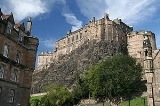
Edinburgh Castle is an ancient stronghold
Stronghold

A stronghold is a strongly fortified defensive structure.The history of fortified buildings extends from antiquity to modern times.From Celtic Europe, an example of a stronghold is the Hill fort, a large structure, with walls made of wooden stakes, and built on a steep hill....
 which dominates the sky-line of the city of Edinburgh
Edinburgh

Edinburgh ; is the Capital city of Scotland, a position it has held since 1437. It is the seventh largest city in the United Kingdom and the second largest Scottish City status in the United Kingdom after Glasgow....
 from its position atop the volcanic Castle Rock. Human habitation of the site is dated back as far as the 9th century BC, although the nature of early settlement is unclear. There has been a royal Castle here since at least the reign of David I
David I of Scotland

David I or Dabhidh Mac Maol Chaluim was a 12th-century ruler who was Prince of the Cumbrians and later List of monarchs of Scotland . The youngest son of Maol Chaluim Mac Donnchaidh and Saint Margaret of Scotland, David spent most of his childhood in Scotland, but was exiled to England temporarily in 1093....
 in the 12th century, and the site continued to be a royal residence until the Union of the Crowns
Union of the Crowns

The Union of the Crowns was the accession of James VI, King of Scots, to the throne of Kingdom of England, thus uniting Scotland and England under one monarch....
 in 1603.


Discussion
Ask a question about 'Edinburgh Castle'
Start a new discussion about 'Edinburgh Castle'
Answer questions from other users
Full Discussion Forum


Encyclopedia


Edinburgh Castle is an ancient stronghold
Stronghold

A stronghold is a strongly fortified defensive structure.The history of fortified buildings extends from antiquity to modern times.From Celtic Europe, an example of a stronghold is the Hill fort, a large structure, with walls made of wooden stakes, and built on a steep hill....
 which dominates the sky-line of the city of Edinburgh
Edinburgh

Edinburgh ; is the Capital city of Scotland, a position it has held since 1437. It is the seventh largest city in the United Kingdom and the second largest Scottish City status in the United Kingdom after Glasgow....
 from its position atop the volcanic Castle Rock. Human habitation of the site is dated back as far as the 9th century BC, although the nature of early settlement is unclear. There has been a royal Castle here since at least the reign of David I
David I of Scotland

David I or Dabhidh Mac Maol Chaluim was a 12th-century ruler who was Prince of the Cumbrians and later List of monarchs of Scotland . The youngest son of Maol Chaluim Mac Donnchaidh and Saint Margaret of Scotland, David spent most of his childhood in Scotland, but was exiled to England temporarily in 1093....
 in the 12th century, and the site continued to be a royal residence until the Union of the Crowns
Union of the Crowns

The Union of the Crowns was the accession of James VI, King of Scots, to the throne of Kingdom of England, thus uniting Scotland and England under one monarch....
 in 1603. As one of the most important fortresses in the Kingdom of Scotland
Kingdom of Scotland

The Kingdom of Scotland was a state in North-West Europe which existed from 843 until 1707. It occupied the northern third of the island of Great Britain and shared a Anglo-Scottish border to the south with the Kingdom of England, with which it was united to form the Kingdom of Great Britain, under the terms of the Acts of Union 1707, in 170...
, Edinburgh Castle has been involved in many historical conflicts, from the Wars of Scottish Independence
Wars of Scottish Independence

The Wars of Scottish Independence were a series of military campaigns fought between the Kingdom of Scotland and the Kingdom of England in the late thirteenth and early fourteenth centuries....
 in the 14th century, up to the Jacobite Rising
Jacobite rising

The Jacobite Risings were a series of uprisings, rebellions, and wars in the kingdoms of Kingdom of England, Kingdom of Scotland , and Kingdom of Ireland occurring between 1688 and 1746....
 of 1745, and has been besieged, both successfully and unsuccessfully, on several occasions. From the later 17th century, the Castle became a military base, with a large garrison. Its importance as a historic monument was recognised from the 19th century, and various restoration programmes have been carried out since.

Few of the present buildings pre-date the Lang Siege of the 16th century, when the fortifications were largely destroyed by artillery bombardment. The notable exception is St Margaret's Chapel, the oldest surviving building in Edinburgh, which dates from the early 12th century. Among other significant buildings of the Castle are the Royal Palace, and the 15th-century Great Hall. The Castle also houses the Scottish National War Memorial, and National War Museum of Scotland
National War Museum of Scotland

The National War Museum is housed in Edinburgh, and forms part of the National Museums of Scotland of Scotland. It is located within Edinburgh Castle, and admission is included in the entry charge for the castle....
.

The Castle is now in the care of Historic Scotland
Historic Scotland

Historic Scotland is an executive agency of the Scottish Government, responsible for historic monuments in Scotland.Its website states:It has direct responsibility for maintaining and running over 360 monuments in its care, about a quarter of which are manned and charge admission entry....
, and is Scotland's
Scotland

conventional_long_name = ScotlandAlba|common_name= Scotland|image_flag = Flag of Scotland.svg|flag_width = 130px...
 second-most-visited tourist attraction. Although the garrison left in the 1920s, there is still a military presence at the Castle, largely ceremonial and administrative, and including a number of regimental museum
Regimental museum

In countries whose armies are organised on a regimental basis, such as the British Army of the United Kingdom, a regimental museum is a :Category:Military and war museums dedicated to the history of a specific army regiment....
s. It is also the backdrop to the annual Edinburgh Military Tattoo
Edinburgh Military Tattoo

The Edinburgh Military Tattoo is an annual Military tattoo given by British Armed Forces, Commonwealth of Nations and International military bands and display teams in the Scotland capital Edinburgh....
, and has become a recognisable symbol of Edinburgh and of Scotland.

History


Pre-history of Castle Rock


Geology
The Castle stands upon the basalt
Basalt

Basalt is a common extrusive volcanic rock. It is usually gray to black and fine-grained due to rapid cooling of lava at the surface of a planet....
 plug
Volcanic plug

A volcanic plug, also called a volcanic neck or lava neck, is a volcano landform created when magma hardens within a vent on an active volcano....
 of an extinct volcano which is estimated to have risen some 340 million years ago, during the lower Carboniferous
Carboniferous

The Carboniferous is a geologic period that extends from the end of the Devonian period, about 359.2 ? 2.5 annum , to the beginning of the Permian period, about 299.0 ? 0.8 Ma ...
 period. Standing above sea level, the Castle Rock, and the sloping hill to the east, is a classic example of a crag and tail
Crag and tail

A crag is a rocky hill or mountain, generally isolated from other high ground. Crags are formed when a glacier or ice-sheet passes over an area that contains a particularly resilient chunk of rock ....
 formation. These geological
Geology of Scotland

The geology of Scotland is unusually varied for a country of its size, with a large number of differing geology features. There are three main geographical sub-divisions: the Highlands and Islands is a diverse area which lies to the north and west of the Highland Boundary Fault; the Central Lowlands is a rift valley mainly comprising Paleozo...
 foundations cannot be underestimated in their significance for the subsequent development of the Castle, and indeed the city, and the events which have defined its history
Timeline of Edinburgh history

This article is intended to show a timeline of the history of Edinburgh, Scotland, up to the present day. It shows its rise from an early hill fort and later royal residence to become the bustling city and capital of Scotland that it is today....
. To the south, west and north, the castle is protected by sheer cliffs rearing some from the surrounding landscape. This means that the only readily accessible route to the castle lies to the east, where the ridge slopes more gently. But just as its location has rendered the Castle all but impregnable, it has also presented difficulties. Not the least of these is that basalt is an extremely poor aquifer
Aquifer

An aquifer is an underground layer of water-bearing permeable rock or unconsolidated materials from which groundwater can be usefully extracted using a water well....
, and therefore providing water to the Upper Ward of the Castle in particular has long been problematic, and has proved disastrous under siege conditions, for instance when the garrison ran out of water during the Lang Siege of 1573.

Earliest habitation

The origins of Edinburgh lie so deep beneath the mound of history that writing on the matter is largely speculative and often contradictory. It has been suggested that an early reference to occupation of the site of the Castle can be found as early as the mid-second century AD. Ptolemy
Ptolemy

Claudius Ptolemaeus , known in English as Ptolemy , was a Roman Greek mathematics, Greek astronomy, geographer and astrologer. He lived in History of Roman Egypt, and was probably born there in a town in the Thebaid called Ptolemais Hermiou; he died in Alexandria around 168 AD....
 (c. 83 – c. 168) refers to a settlement of the Votadini
Votadini

The Votadini were a people of the British Iron Age in Great Britain, and their territory was briefly part of the Roman province Roman Britain....
 known to the Romans
Roman Empire

The Roman Empire was the Roman Republic phase of the Ancient Rome, characterised by an autocracy form of government and large territorial holdings in Europe and around the Mediterranean....
 as "Alauna", meaning "rock place", which may be the earliest known name for the Castle Rock.

More doubtful evidence of still earlier habitation is provided by Andrew of Wyntoun
Andrew of Wyntoun

Andrew Wyntoun, known as Andrew of Wyntoun was a Scotland poet, a Canon and prior of Loch Leven on St Serf's Inch and later, a canon of St....
 (c. 1350 – c. 1423), an early chronicler of Scottish history. Wyntoun's Orygynale Cronykil alludes to "Ebrawce" (Ebraucus
Ebraucus

Ebraucus was a legendary king of the Britons , as recounted by Geoffrey of Monmouth. He was the son of King Mempricius before he abandoned the family....
), a legendary King of the Britons
List of legendary kings of Britain

The following list of legendary kings of Britain derives predominantly from Geoffrey of Monmouth's circa 1136 work Historia Regum Britanniae ....
, who "byggyd [built] Edynburgh". According to the earlier English chronicler, Geoffrey of Monmouth
Geoffrey of Monmouth

Geoffrey of Monmouth was a clergyman and one of the major figures in the English historians in the Middle Ages and the popularity of tales of King Arthur....
 (c. 1100 – c. 1155), Ebraucus had fifty children by his twenty wives, and was the founder of "Kaerebrauc" (York
York

York is a walled city, sited at the confluence of the rivers River Ouse, Yorkshire and River Foss in North Yorkshire, England. The city status in the United Kingdom is noted for its rich heritage and it has played an important role throughout much of its almost 2,000 year existence....
), "Alclud" (Dumbarton
Dumbarton

Dumbarton is a burgh in Scotland, lying on the north bank of the River Clyde where the River Leven, Dunbartonshire flows into the Clyde estuary....
), and the "Maidens' Castle". Monmouth's History states that Ebraucus reigned in Britain at the same time that David
David

David , was the second king of the united Kingdom of Israel according to the Hebrew Bible/Old Testament. He is depicted as a righteous king, although not without fault, as well as an acclaimed warrior, musician and poet ....
 reigned in Israel (around 1000 BC). John Stow
John Stow

John Stow , was an England historian and antiquarian....
 (c. 1525 – 1605), credited Ebraucus with building "the Castell of Maidens called Edenbrough". The name "Maiden Castle", or Castell Puellarum in Latin, was commonly used until at least the 16th century, and may relate to Arthurian legends, which suggested that the site once held a shrine to Morgain la Fee
Morgan le Fay

Morgan le Fay, alternatively known as Morgane, Morgain, Morgana and other variants, is a powerful Magician and antagonist of King Arthur and Guinevere in the Arthurian legend....
.

While there must be serious doubts about the veracity of these early chronicles, an archaeological survey of the Castle in the late 1980s does lend credence to the idea of the site having been settled during the late Bronze Age
Bronze Age

The Bronze Age is, with respect to a given prehistory, the period in that society when the most advanced metalworking included smelting copper and tin from naturally-occurring outcroppings of copper and tin ores, creating a bronze alloy by melting those metals together, and casting them into bronze artifact s....
 or early Iron Age
Iron Age

In archaeology, the Iron Age was the stage in the development of any people in which tools and weapons whose main ingredient was iron were prominent....
, potentially making Castle Rock the longest continually occupied site in Scotland. However, the extent of the finds was not particularly significant and was insufficient to draw any certain conclusions about the precise nature or scale of this earliest known phase of occupation. Whether this was indeed the hall of the fecund King Ebrawce can only be a matter of speculation.

The archaeological evidence becomes more compelling in the Iron Age. Traditionally, it had been supposed that the tribes
Scottish people

The Scots people are a nation and an ethnic group indigenous to Scotland.Historically, as an ethnic group, they emerged from an amalgamation of Celts, Picts, Gaels and Brythons....
 which inhabited this part of central Scotland had made little or no use of the Castle Rock. Excavations at nearby Traprain Law
Traprain Law

Traprain Law is a hill about 221m in elevation, located 6km east of Haddington in East Lothian, Scotland. It is the site of an oppidum or hill fort, which covered at its maximum extent about 16 ha and must have been a veritable town....
, Dunsapie Hill
Arthur's Seat, Edinburgh

Arthur's Seat is the main peak of the group of hills which form most of Holyrood Park, a remarkably wild piece of highland landscape in the centre of the city of Edinburgh, about a mile to the east of Edinburgh Castle....
, Duddingston
Duddingston

Duddingston is a former village in the east of Edinburgh, Scotland, next to Holyrood Park.The settlement dates from when Duddingston Kirk was built, in 1124....
 and Inveresk
Inveresk

Inveresk was formerly a village and now forms the southern part of Musselburgh. It is situated on slightly elevated ground at the south of Musselburgh in East Lothian, Scotland....
 had revealed relatively large settlements and it was supposed that these sites had, for some reason, been chosen in preference to the Castle Rock. However, the excavations of the 1980s suggested that there was probably an enclosed hill fort
Hill fort

A hill fort is type of fortification refuge or defended settlement, located to exploit a rise in elevation for defensive advantage. They are typically European and of the Bronze Age and Iron Ages....
 on the rock, although only the fringes of the site were excavated. House fragments revealed were similar to Votadini houses previously found in Northumbria.

The dig revealed clear signs of habitation from the first and second centuries AD, consistent with Ptolemy
Ptolemy

Claudius Ptolemaeus , known in English as Ptolemy , was a Roman Greek mathematics, Greek astronomy, geographer and astrologer. He lived in History of Roman Egypt, and was probably born there in a town in the Thebaid called Ptolemais Hermiou; he died in Alexandria around 168 AD....
's reference to "Alauna". Interestingly, these signs of occupation included a good deal of Roman
Roman Britain

Roman Britain refers to those parts of the island of Great Britain controlled by the Roman Empire between AD 43 and 410. The Romans referred to their province as Britannia....
 material, including pottery, bronzes and brooches. This may reflect a trading relationship between the Votadini and the Romans beginning with Agricola's
Gnaeus Julius Agricola

Gnaeus Julius Agricola was a Roman Empire general responsible for much of the Roman conquest of Roman Britain. His biography, the Agricola , was the first published work of his son-in-law, the historian Tacitus, and is the source for most of what is known about him....
 foray north, and continuing through to the establishment of the Antonine Wall
Antonine Wall

The Antonine Wall also known as the Severan Wall, is a rock and sod fortification, built by the Roman Empire across what is now the central belt of Scotland and is also known as the Clyde-Forth frontier line....
, when the Romans temporarily established themselves nearby at Cramond
Cramond

Cramond is a seaside village now part of suburban Edinburgh, Scotland, located in the north-west corner of the city at the mouth of the River Almond, Lothian where it enters the Firth of Forth....
.The nature of the settlement at this time is inconclusive, but Driscoll and Yeoman suggest it may have been a broch
Broch

A Broch is an Iron Age drystone hollow-walled structure of a type found only in Scotland. Brochs include some of the most sophisticated examples of drystone architecture ever created, and belong to the classification "complex atlantic roundhouse" devised by Scottish archaeologists in the 1980s....
, similar to the one at Edin's Hall
Edin's Hall Broch

Edin's Hall Broch is a 2nd century broch near Duns in the Scottish Borders of Scotland. It is one of very few brochs found in southern Scotland. It is roughly 27m in diameter....
 in the Borders
Scottish Borders

The Scottish Borders , often referred to simply as the Borders, is one of 32 local government Council areas of Scotland of Scotland. It is bordered by Dumfries and Galloway in the west, South Lanarkshire and West Lothian in the north west, City of Edinburgh, East Lothian, Midlothian to the north; and the Metropolitan and non-metropolit...
. There is no evidence that the Romans actually occupied the Castle Rock, as they did at nearby Traprain Law
Traprain Law

Traprain Law is a hill about 221m in elevation, located 6km east of Haddington in East Lothian, Scotland. It is the site of an oppidum or hill fort, which covered at its maximum extent about 16 ha and must have been a veritable town....
. From this point onwards there is strong evidence pointing towards continuous habitation of the site through to the present—albeit with fluctuations in population levels.

Early Middle Ages

Y Gogledd
The castle does not re-appear in contemporary historical records from the time of Ptolemy until around AD 600. Then, in the brythonic
Brythonic languages

The Brythonic languages form one of the two branches of the Insular Celtic languages language family, the other being Goidelic. The name Brythonic was derived by Wales Celtic studies Sir John Rhys from the Welsh language word Brython, meaning an indigenous Brython as opposed to an Anglo-Saxons or Gaels....
 epic Y Gododdin
Y Gododdin

Y Gododdin is a medieval Welsh language poem consisting of a series of elegy to the men of the Britons kingdom of Gododdin and its allies who, according to the conventional interpretation, died fighting the Angles of Deira and Bernicia at a place named Catraeth....
, we find a reference to Din Eidyn, "the stronghold of Eidyn". This has been viewed as an early reference to the Castle Rock. The poem tells of the Gododdin
Gododdin

The Gododdin were a Britons people of north-eastern Roman Britain in the sub-Roman Britain period, the area known as the Hen Ogledd or Old North....
 King Mynyddog Mwynfawr
Mynyddog Mwynfawr

Mynyddog Mwynfawr was, according to Welsh tradition founded on the early Welsh language poem Y Gododdin, attributed to Aneirin, a Brythonic ruler of the the kingdom of Gododdin in the Hen Ogledd ....
, and his band of warriors, who, after a year of feasting in their fortress, set out to do battle with the Angles
Angles

The Angles is a modern English language word for a Germanic languages people who took their name from the cultural ancestral region of Angeln, a modern district located in Schleswig-Holstein, Germany....
 in the area of contemporary Yorkshire. Despite performing glorious deeds of valour and bravery the Brython
Brython

Historically, the Britons were the P-Celtic indigenous peoples inhabiting the island of Great Britain south of the river Forth. They were speakers of the Brythonic languages and shared common cultural traditions; the surviving P-Celtic languages are Welsh language, Cornish language and Breton....
s were massacred.

The Irish annals
Irish annals

A number of Irish annals were compiled up to and shortly after the end of Gaelic Ireland in the 17th century. Manuscript copies of extant annals include the following:...
 record that in 638, after the events related in Y Gododdin, "Etin" was besieged by the Angles under Oswald of Northumbria
Oswald of Northumbria

Oswald was List of monarchs of Northumbria from 634 until his death, and is now venerated as a Christian saint. He was the son of ?thelfrith of Northumbria and came to rule after spending a period in exile; after defeating the British ruler Cadwallon ap Cadfan, Oswald brought the two Northumbrian kingdoms of Bernicia and Deira once again un...
, and the Gododdin were defeated. The territory around Edinburgh then became part of the Kingdom of Northumbria
Northumbria

Northumbria is primarily the name of both a medieval petty kingdom of the Angles people, in what is now north east England and southern Scotland, and of the earldom which succeeded it when a united Anglo-Saxon kingdom became England....
, which was itself absorbed by England
Kingdom of England

The Kingdom of England was, from 927 to 1707, a state in North-West Europe. The Kingdom of England spanned the southern two-thirds of the island of Great Britain and a number of smaller outlying islands?what is today the legal unit of England and Wales....
 in the 10th century, when Athelstan of England
Athelstan of England

Athelstan , called the Glorious, was the List of English monarchs from 924/925 to 939. He was the son of King Edward the Elder, and nephew of Ethelfleda of Mercia....
, according to the Annals of Clonmacnoise
Annals of Clonmacnoise

The Annals of Clonmacnoise are an early 17th-century Early Modern English translation of a lost Irish chronicle, which covered events in Ireland from pre-history to A.D....
, "spoiled the Kingdom of Edinburgh". The English withdrew, and Lothian became part of Scotland, during the reign of either Malcolm I of Scotland
Malcolm I of Scotland

M?el Coluim mac Domnaill , anglicised as Malcolm I, and nicknamed An Bodhbhdercc, "the Dangerous Red" was king of Scots, becoming king when his cousin Constantine II of Scotland abdicated to become a monk....
 (ruled 943–954), or his successor Indulf
Indulf of Scotland

Ildulb mac Causant?n, anglicised as Indulf, nicknamed An Ionsaighthigh, "the Aggressor" was king of Scots from 954. He was the son of Constantine II of Scotland ; his mother may have been a daughter of Earl Eadulf I of Bernicia, who was an exile in Scotland....
 (ruled 954–962).

The archaeological evidence is equivocal; for the relevant period it is entirely based on analysis of midden
Midden

A midden, also known as a kitchen midden, or a shell heap, is a landfill. The word is of Scandinavian via Middle English derivation, but is used by archaeology worldwide to describe any kind of feature containing waste products relating to day-to-day human life....
 heaps, with no evidence of structures. Few conclusions can therefore be derived about the status of the settlement during this period, although the midden deposits show no clear break since Roman times.

High Middle Ages


The first documentary reference to a castle at Edinburgh is in John of Fordun's
John of Fordun

John of Fordun was a Scotland chronicler. It is generally stated that he was born at Fordoun, Mearns. It is certain that he was a secular priest, and that he composed his history in the latter part of the 14th century; and it is probable that he was a chaplain in the cathedral of Aberdeen....
 account of the death of King Malcolm III
Malcolm III of Scotland

M?el Coluim mac Donnchada , called in most Anglicisation regnal lists Malcolm III, and in later centuries nicknamed Canmore, "Big Head" or Long-neck , was King of Scots....
. Fordun places his widow, the future Saint Margaret
Saint Margaret of Scotland

Saint Margaret , was the sister of Edgar ?theling, the short-ruling and uncrowned Anglo-Saxons King of England. She married Malcolm III of Scotland, King of Scots, becoming his Queen consort....
, at the "Castle of Maidens", where she learns of his death in November 1093. Fordun's account goes on to relate how Margaret died of grief within days, and how Malcolm's brother Donald Bane
Donald III of Scotland

Domnall mac Donnchada , anglicisation as Donald III, and nicknamed Domnall B?n, "Donald the Fair" , was King of Scots from 1094?1097....
 laid siege to the castle. However, Fordun's chronicle was not written until the later 14th century, and the near-contemporary account of the life of St Margaret, by Bishop Turgot
Thurgot

Thurgot was the first "Normans" Bishop of St. Andrews . He had previously been the Prior of the Benedictine convent of Durham Cathedral, and was probably the confessor of Saint Margaret of Scotland, the Anglo-Saxons second wife of Malcolm III of Scotland , and hence probably known to King Alexander I of Scotland and Prince David of the Kingd...
, makes no mention of a castle. During the reign of Malcolm III, Dunfermline
Dunfermline

Dunfermline is a town in Fife which had official City_status_in_the_United_Kingdom#Pretenders until 1970. It is located on high ground five miles from the northern shore of the Firth of Forth on the route of major road and rail crossings across the firth to Edinburgh and the south....
 rather than Edinburgh was the primary royal residence. This began to change though during the reign of his youngest son, King David I
David I of Scotland

David I or Dabhidh Mac Maol Chaluim was a 12th-century ruler who was Prince of the Cumbrians and later List of monarchs of Scotland . The youngest son of Maol Chaluim Mac Donnchaidh and Saint Margaret of Scotland, David spent most of his childhood in Scotland, but was exiled to England temporarily in 1093....
 (ruled 1124–1153).

King David's largest contribution to the development of Edinburgh as a site of royal power undoubtedly lay in his administrative reforms
Davidian Revolution

The Davidian Revolution is a term given by many scholars to the changes which took place in the Kingdom of Scotland during the reign of David I of Scotland ....
. However, he is also credited with effecting more tangible changes to the fabric of the castle. Knowing that the first meeting of the Scottish Parliament
Parliament of Scotland

The Parliament of Scotland, officially the Estates of Parliament, was the legislature of the Independence Kingdom of Scotland.The unicameral parliament of Scotland is first found on record during the early thirteenth century, and the first meeting for which reliable evidence survives was at Kirkliston in 1235, during the reign of A...
 occurred at the castle around 1140, it seems there were large buildings occupying the rock at this time. These buildings, and any defences, would probably have been of timber, although two 12th-century stone buildings are known. Of these, St. Margaret's Chapel
St. Margaret's Chapel

St. Margaret's Chapel, the oldest surviving building in Edinburgh Castle, is an example of Norman architecture and the oldest building in Edinburgh, Scotland....
 remains at the summit of the rock. The second was a church, dedicated to St. Mary, which stood on the site of the Scottish National War Memorial. Given that the southern part of the Upper Ward (where Crown Square is now sited) was not suited to being built upon until the construction of the vaults in the fifteenth century, it seems probable that these earlier buildings would have been located towards the northern part of the rock; that is around the area where St. Margaret's Chapel stands. This has led to a suggestion that the chapel is the last remnant of a square, stone keep, which would have formed the bulk of the twelfth-century fortification. The structure may have been similar to the keep of Carlisle Castle
Carlisle Castle

Carlisle Castle is situated in Carlisle, Cumbria, England. The castle is over 900 years old and has been the scene of many historical episodes in British history....
, which David I began after 1135.

In 1174, David's successor King William "the Lion"
William I of Scotland

William I , known as the Lion or Garbh, "the Rough", reigned as King of Scots from 1165 to 1214. His reign was the second longest in Scottish history before the Acts of Union 1707 with England in 1707, ....
 (ruled 1165–1214) was captured by the English at the Battle of Alnwick
Battle of Alnwick (1174)

The Battle of Alnwick is one of two battles fought near the town of Alnwick, in Northumberland. In the battle, which occurred on 12 July 1174, William I of Scotland, also known as William the Lion, was captured by a small English force led by Ranulf de Glanvill....
. He was forced to sign the Treaty of Falaise
Treaty of Falaise

The Treaty of Falaise was an agreement made in December 1174 by the captive William I of Scotland, King of Scots, and the England King Henry II of England....
 to secure his release, in return for surrendering Edinburgh Castle, along with the castles of Berwick
Berwick Castle

Berwick Castle is a ruined castle in Berwick-Upon-Tweed, Northumberland, England .It was founded in the 12th century by the Scottish David I of Scotland....
, Roxburgh
Roxburgh Castle

Roxburgh Castle was a castle sited near modern Roxburgh, in the Scottish Borders region of Scotland.The castle was founded by David I of Scotland....
 and Stirling
Stirling Castle

Stirling Castle, located in Stirling, is one of the largest and most important castles, both historically and architecturally, in Scotland. The Castle sits atop the Castle Hill, a volcanic Crag and tail, which forms part of the Stirling Sill geological formation....
, to the English King, Henry II
Henry II of England

Henry II, called Curtmantle ruled as King of England , Count of Anjou, Duke of Normandy, Duke of Aquitaine, Duke of Gascony, Count of Nantes, Lord of Ireland and, at various times, controlled parts of Wales, Scotland and western France....
. The castle was occupied by the English for twelve years, until 1186, when it was returned to William as the dowry
Dowry

A dowry is the money, goods, or estate that a woman brings to her new husband. Compare bride price, which is paid to the bride's parents, and dower, which is property settled on the bride herself by the groom at the time of marriage....
 of his English bride, Ermengarde de Beaumont
Ermengarde de Beaumont

Ermengarde de Beaumont was Queen Consort of the Kingdom of Scotland.Ermengarde was born c. 1170 to Richard I, Viscount de Beaumont and his wife Constance FitzRoy, illegitimate daughter of Henry I of England....
, who had been chosen for him by King Henry.

Wars of Scottish Independence

A century later, on the death of King Alexander III
Alexander III of Scotland

Alexander III , King of Scots, was born at Roxburgh, the only son of Alexander II of Scotland by his second wife Marie de Coucy. Alexander's father died on 6 July 1249 and he became king at the age of eight, inaugurated at Scone, Perth and Kinross on 13 July 1249....
, the throne of Scotland became vacant. Edward I of England
Edward I of England

Edward I , popularly known as Longshanks, the English Justinian, and the Hammer of the Scots , was a House of Plantagenet King of England who achieved historical fame by conquering large parts of Wales and almost succeeding in doing the same to Scotland....
 was appointed to adjudicate the competing claims
Competitors for the Crown of Scotland

With the death of Alexander III of Scotland in 1286 without a male heir, the throne of Scotland had become the possession of the three-year old Margaret I of Scotland, the granddaughter of the King....
 for the Scottish crown, but attempted to use the opportunity to establish himself as the feudal overlord of Scotland. During the negotiations, Edward stayed briefly at Edinburgh Castle, and had much of the country's records and treasure removed to England.

In March 1296, Edward I launched an invasion of Scotland, sparking the First War of Scottish Independence
First War of Scottish Independence

The First War of Scottish Independence lasted from the outbreak of the war with the invasion by England in 1296 until the de jure restoration of Scottish independence with the Treaty of Edinburgh-Northampton in 1328....
. Edinburgh Castle soon came under English control, surrendering after three days of bombardment. A large garrison was installed, 347 strong in 1300. After the death of Edward I in 1307, however, England's control over Scotland weakened. On 14 March 1314, a surprise night attack by Thomas Randolph, 1st Earl of Moray
Thomas Randolph, 1st Earl of Moray

Thomas Randolph, 1st Earl of Moray was Regent of Scotland, an important figure in the Scottish Wars of Independence, and one of the signers of the Declaration of Arbroath....
, recaptured the castle. The daring plan involved a party of thirty hand-picked men, led by one William Francis, who had lived in the castle as a boy, making a difficult ascent up the north face of the Castle Rock, and taking the garrison by surprise. Robert the Bruce
Robert I of Scotland

Robert I, King of the Scots usually known in modern English as Robert the Bruce was King of the Scots from 1306 until his death in 1329....
 immediately ordered the destruction of the Castle's defences to prevent re-occupation by the English. Shortly after, Bruce's army secured victory at the Battle of Bannockburn
Battle of Bannockburn

The Battle of Bannockburn was a significant Scotland victory in the Wars of Scottish Independence. It was the decisive battle in the First War of Scottish Independence....
.

After Bruce's death, Edward III of England
Edward III of England

Edward III was one of the most successful List of the monarchs of the Kingdom of Englands of the Britain in the Middle Ages. Restoring royal authority after the disastrous reign of his father, Edward II of England, Edward III went on to transform the Kingdom of England into the most efficient military power in Europe....
 determined to carry on his grandfather's project, and supported the claim of Edward Balliol
Edward Balliol

Edward de Balliol was the short-lived King of Scotland during the simultaneous reign of King David II of Scotland. In the autumn of 1332, and again in 1333-6 he was able to establish a temporary hold in parts of southern Scotland with English military aid; but with little native support his rule was transient and unstable....
, son of the former King John Balliol
John of Scotland

John de Balliol was Elective kingshiped King of the Scots from 1292 to 1296....
, over that of the young David II
David II of Scotland

Daibhidh a Briuis , anglicised as David II , was King of Scotland between 7 June 1329 and 22 February 1371....
, son of the Bruce. Edward invaded in 1333, marking the start of the Second War of Scottish Independence
Second War of Scottish Independence

The Second War of Scottish Independence began properly in 1333 when Edward III of England overturned the 1328 Treaty of Northampton, under which England recognised the legitimacy of the dynasty established by Robert I of Scotland....
, and the English forces reoccupied and refortified Edinburgh Castle in 1335, holding it until 1341. This time, the Scottish assault was led by William Douglas, 1st Earl of Douglas
William Douglas, 1st Earl of Douglas

William Douglas, 1st Earl of Douglas , was a Kingdom of Scotland nobleman.He was the son of Sir Archibald Douglas and Beatrice Lindsay, and nephew of James Douglas, Lord of Douglas, Robert I of Scotland's trusted deputy....
. Douglas's party disguised themselves as merchants bringing supplies to the garrison. Driving a cart into the Castle, they halted it to prevent the gates closing. A larger force hidden nearby rushed to join them, and the Castle was retaken. The English garrison, numbering 100, were all killed.

David's Tower and the fifteenth century

The Treaty of Berwick
Treaty of Berwick (1357)

The Treaty of Berwick, signed at Berwick-upon-Tweed, Kingdom of Scotland, in 1357, officially ended the Second War of Scottish Independence. In this second phase of the Wars of Scottish Independence, which began in 1333, King Edward III of England attempted to install Edward Balliol on the Scottish throne, in place of King David II of Scotlan...
 of 1357 brought the Wars of Independence to a close. David II resumed his rule, and set about rebuilding Edinburgh Castle, which became his principal seat of government. David's Tower was begun around 1367, and was incomplete when David died at the Castle in 1371, being completed by his successor, Robert II
Robert II of Scotland

Robert II became King of Scots in 1371 and was the first of the House of Stewart. Before his accession he held the titles of High Steward of Scotland and the Earl of Strathearn....
, in the 1370s. The tower stood on the site of the present Half Moon Battery, and was connected by a section of curtain wall
Curtain wall (fortification)

A curtain wall is a type of defensive wall forming part of the defences of some medieval castles.The curtain wall surrounded and protected the interior courtyard, or bailey, of a castle....
 to the smaller, Constable's Tower, a round tower built between 1375 and 1379 where the Portcullis Gate now stands. It was enormous by the standards of the time, standing high; twice as high as the Half Moon Battery. The tower initially served as the principal entrance to the castle, but by later years it was expanded to include many more rooms for guests and visiting nobility, and the original main entrance became boxed off by a guest room.

In the early 15th century, another English invasion, this time under Henry IV
Henry IV of England

Henry IV was King of England and Lord of Ireland . Like other kings of England, he also claimed the title of King of France. He was born at Bolingbroke Castle in Lincolnshire, hence the other name by which he was known, Henry Bolingbroke....
, reached Edinburgh Castle and began a siege, but due to a lack of supplies, the English withdrew. From 1437, Sir William Crichton
William Crichton, 1st Lord Crichton

William Crichton, 1st Lord Crichton of Sanquhar was an important political figure in Scotland.He held various positions within the court of James I of Scotland....
 was Keeper of Edinburgh Castle, and soon after became Chancellor of Scotland. In an attempt to gain the regency
Regent

A regent, from the Latin regens "reigning", is a person selected to act as head of state because the ruler is a minor, not present or debilitated....
 of Scotland, Crichton sought to overthrow the power of the Earls of Douglas
Earl of Douglas

This page is concerned with the holders of the extinct title Earl of Douglas and the preceding feudal barons of Douglas, South Lanarkshire. The title was created in the Peerage of Scotland of Scotland in 1358 for William Douglas, 1st Earl of Douglas, son of Sir Archibald Douglas, Guardian of Scotland....
, the principal noble family in the kingdom. The sixteen-year-old William Douglas, 6th Earl of Douglas
William Douglas, 6th Earl of Douglas

William Douglas was a short-lived Kingdom of Scotland Nobleman. He was Earl of Douglas and Wigtown, Lord of Galloway, Lord of Bothwell, Selkirk and Ettrick Forest, Eskdale, Lauderdale, and Annandale in Scotland, and de jure Duke of Touraine, Count of Longueville, and Sire of Dun-le-roi in France....
, and his younger brother David, were summoned to Edinburgh Castle in November 1440. The so-called "Black Dinner" which followed saw the two boys summarily beheaded on trumped-up charges, in the presence of the ten-year-old King James II
James II of Scotland

James II of Scotland reigned as king of Scots from 1437 to 1460.He was the son of James I of Scotland and of Joan Beaufort, Queen of Scotland ....
 (ruled 1437–1460). Douglas' supporters subsequently laid siege to the Castle, causing some damage. Construction continued during these events, with the area now known as Crown Square being laid out over vaults
Vault (architecture)

A Vault is an architecture term for an arched form used to provide a space with a ceiling or roof. The parts of a vault exert a thrust that require a counter Friction....
 in the 1430s. Royal apartments were built, forming the nucleus of the later palace block, and a Great Hall was in existence by 1458. In 1464, the access to the castle was improved, with the current approach road up the north-east laid out.

In 1479, Alexander Stewart, Duke of Albany, was imprisoned in David's Tower for plotting against his brother, King James III
James III of Scotland

James III was King of Scots from 1460 to 1488. James was an unpopular and ineffective monarch owing to an unwillingness to administer justice fairly, a policy of pursuing alliance with the Kingdom of England, and a disastrous relationship with nearly all his extended family....
 (ruled 1460–1488). He escaped by getting his guards drunk, then lowering himself from a window on a rope. Albany fled to France, then England, where he allied himself with King Edward IV
Edward IV of England

Edward IV was Kingdom of England from 4 March 1461 until 2 October 1470, and again from 11 April 1471 until his death....
. In 1482, Albany marched into Scotland with Richard, Duke of Gloucester
Richard III of England

Richard III was List of the monarchs of the Kingdom of England of Kingdom of England from 1483 until his death. He was the last king from the House of York, and his defeat at the Battle of Bosworth Field marked the culmination of the Wars of the Roses and the end of the Plantagenet dynasty....
 (later King Richard III) and an English army. He occupied Edinburgh Castle, and imprisoned the King for two months, before the rebellion collapsed.

During the 15th century, the Castle was increasingly used as an arsenal
Arsenal

An arsenal is an establishment for the construction, repair, storage and issue of weapons and ammunition. The word arsenal appears in various forms in Romance languages , i.e....
 and armaments factory. The first known purchase of a gun was in 1384, and the "great bombard
Bombard (weapon)

A bombard is a large-caliber, front-loading medieval cannon or Mortar , used chiefly in sieges for throwing heavy stone balls. The name bombarde was first noted and sketched in a French historical text around 1380....
" Mons Meg
Mons Meg

Mons Meg is a large Bombard now located at Edinburgh Castle, Scotland. There are conflicting theories about its origins, but it appears from the accounts of Philip III, Duke of Burgundy that it was made to his order around 1449 and sent as a gift 8 years later to King James II of Scotland, with other artillery supplies....
 was delivered to Edinburgh in 1457. Meanwhile, the royal family began to stay more frequently at the Abbey of Holyrood
Holyrood Abbey

Holyrood Abbey is a ruined Augustinian Abbey in Edinburgh, Scotland. The abbey was built in 1128 at the order of King David I of Scotland....
, at the opposite end of the Royal Mile. Around the end of the century, King James IV
James IV of Scotland

James IV was King of Scots from 11 June 1488 to his death. He is generally regarded as the most successful of the House of Stuart monarchs of Scotland, but his reign ended with the disastrous defeat at the Battle of Flodden Field, where he became the last British monarch to be killed in battle....
 (ruled 1488–1513) built Holyroodhouse
Holyrood Palace

The Palace of Holyroodhouse, or informally Holyrood Palace, founded as a monastery by David I of Scotland in 1128, has served as the principal residence of the Kings and Queens of Scotland since the fifteenth century....
, by the abbey, for his principal Edinburgh residence, and the Castle's role as a royal home subsequently declined. James IV did, however, construct the present Great Hall, which was completed in 1511.

Sixteenth century and the Lang Siege

James IV was killed in battle at Flodden Field
Battle of Flodden Field

The Battle of Flodden or Flodden Field was fought in the county of Northumberland in northern England on 9 September 1513, between an invading Scottish people army under King James IV of Scotland and an English army commanded by Thomas Howard, Earl of Surrey....
, on 9 September 1513. Expecting the English to press their advantage, the Scots hastily constructed a town wall
Flodden Wall

The Flodden Wall was a defensive structure built around the city of Edinburgh, Scotland, after the disastrous Battle of Flodden , in which James IV of Scotland was killed....
 around Edinburgh and augmented the Castle's defences. A Frenchman, Antoine d'Arces, Sieur de la Bastie, was involved in designing artillery works in 1514. Three years later, King James V
James V of Scotland

James V was King of Scots from 9 September 1513 until his premature death at the age of thirty, which followed the Scottish defeat at the Battle of Solway Moss....
 (ruled 1513–1542), still only five years old, was brought to the castle for safety. Upon James' death 25 years later, the crown passed to his week-old daughter, Mary, Queen of Scots
Mary I of Scotland

Mary I was Queen of Scots from 14 December 1542 to 24 July 1567.She was the only surviving legitimate child of James V of Scotland. She was only six days old when her father died and left her Queen of Scots....
. English invasions followed, as King Henry VIII
Henry VIII of England

Henry VIII was King of England from 21 April 1509 until his death. He was also Lordship of Ireland and claimant to the Early Modern France. Henry was the second monarch of the House of Tudor, succeeding his father, Henry VII of England....
 attempted to force a dynastic marriage on Scotland, although Edinburgh Castle remained largely unaffected. Following these campaigns, refortifications included an earthen angle-bastion of the type known as trace italienne, one of the earliest examples in Britain. It my have been designed by Migliorino Ubaldini, an Italian engineer from the court of Henry II of France
Henry II of France

Henry II , of the House of Valois and the son and successor of Francis I of France, was King of France from 31 March 1547, until his death....
. Mary's mother, Mary of Guise
Mary of Guise

Mary of Guise was the Queen Consort of James V of Scotland and the mother of Mary I of Scotland. She was Regent, or Governor, of Scotland 1554–1560....
, based herself at Edinburgh Castle, acting as regent
Regent

A regent, from the Latin regens "reigning", is a person selected to act as head of state because the ruler is a minor, not present or debilitated....
 from 1554 until 1560, when she died at the Castle. The following year, her daughter Mary returned from France to begin her reign.

The reign of the Catholic Queen Mary was marred by crises and quarrels amongst the powerful Scottish nobility. In 1565, the Queen married Henry Stuart, Lord Darnley
Henry Stuart, Lord Darnley

Henry Stuart, 1st Duke of Albany , commonly known as Lord Darnley, was a King Consort of Scotland, the first cousin and second husband of Mary I of Scotland, and the father of her son James I of England, who also succeeded Elizabeth I of England as King James I of England....
, and the following year, in a small room of the Palace at Edinburgh Castle, she gave birth to James
James I of England

James VI and I was List of monarchs of Scotland as James VI, and List of English monarchs and King of Ireland as James I. He ruled in Kingdom of Scotland as James VI from 24 July 1567, when he was only one year old, succeeding his mother Mary I of Scotland....
, who would later be King of both Scotland and England. Mary's own reign, however, was already drawing to a close. Three months after the murder of Darnley at Kirk o' Field
Kirk o' Field

Kirk o' Field in Edinburgh, Scotland, is best known as the site of the murder of Henry Stuart, Lord Darnley, second husband of Mary I of Scotland in 1567....
 in 1567, she married James Hepburn, 4th Earl of Bothwell
James Hepburn, 4th Earl of Bothwell

James Hepburn, 1st Duke of Orkney , better known by his inherited title as 4th Earl of Bothwell, was Hereditary Lord High Admiral of Scotland....
, one of the murder suspects. A large proportion of the nobility rebelled, resulting ultimately in the imprisonment and deposition
Deposition (politics)

Deposition by political means concerns the removal of a politician or monarch. It may be done by coup, impeachment, invasion or forced abdication....
 of Mary at Loch Leven Castle
Loch Leven Castle

Loch Leven Castle is a ruined castle on an island in Loch Leven, in the Perth and Kinross region of Scotland. Possibly built around 1300, the castle saw military action during the Wars of Scottish Independence ....
. However, she eventually escaped and fled to England
England

native_name =|conventional_long_name = England|common_name = England|image_flag = Flag of England.svg|image_coat = England COA.svg|symbol_type = Royal Coat of Arms...
, and some of the nobility remained faithful to her cause. Edinburgh Castle was initially handed by its Captain, James Balfour, to the Regent Moray
James Stewart, 1st Earl of Moray

File:James Stewart Earl of Moray.jpgJames Stewart, 1st Earl of Moray , a member of the House of Stewart, was Regent of Scotland from 1567 until his assassination in 1570....
, who had forced Mary's abdication, and now held power in the name of the infant King James VI. Moray appointed Sir William Kirkcaldy of Grange
William Kirkcaldy of Grange

Sir William Kirkcaldy of Grange , Scotland politician and general, was the eldest son of Sir James Kirkcaldy of Grange , a member of an old Fife family....
 as Keeper of the Castle.

Kirkcaldy of Grange was a trusted lieutenant of the Regent, but after Moray's murder in January 1570 his allegiance to the King's cause began to waver. Intermittent civil war continued between the two monarch's supporters, and in April 1571 Dumbarton Castle
Dumbarton Castle

Dumbarton Castle has the longest recorded history of any stronghold in Great Britain. It overlooks the Scotland town of Dumbarton, and sits on a plug of volcano basalt known as Dumbarton Rock which is high....
 fell to the King's men. Under the influence of William Maitland of Lethington
William Maitland of Lethington

Sir William Maitland of Lethington was a Scotland politician and reformer, and the eldest son of the poet Richard Maitland.William was the renowned 'Secretary Lethington' to Mary I of Scotland....
, Mary's secretary, Grange changed sides, occupying the town and castle of Edinburgh for Queen Mary, and against the new regent, the Earl of Lennox
Matthew Stewart, 4th Earl of Lennox

Matthew Stewart was the 4th Earl of Lennox, and leader of the Catholic nobility in Scotland. He was the son of John Stewart, 3rd Earl of Lennox....
. The "Lang Siege" which followed was not resolved until two years later. Hostilities began in May, with a month-long siege of the town, and a short second siege in October. Blockades and skirmishing continued meanwhile, and Grange continued to refortify the Castle. The King's party appealed to Elizabeth I of England
Elizabeth I of England

Elizabeth I was List of English monarchs and Queen of Ireland from 17 November 1558 until her death. Sometimes called The Virgin Queen, Gloriana, or Good Queen Bess, Elizabeth was the fifth and last monarch of the House of Tudor....
 for assistance, as they lacked the artillery and money required to reduce the Castle, and feared that Grange would receive aid from France. Elizabeth sent ambassadors to negotiate, and in July 1572 a truce was agreed and the blockade lifted. The town was effectively surrendered to the King's party, with Grange confined to the Castle.

The truce ran out on 1 January 1573, and Grange began bombarding the town. His supplies of powder and shot, however, were running low, and despite having 40 cannon available, there were only seven gunners in the garrison. The King's forces, now with the Earl of Morton
James Douglas, 4th Earl of Morton

James Douglas, jure uxoris 4th Earl of Morton was the last of the four regents of Scotland during the minority of James I of England. He was in some ways the most successful of the four, since he did manage to win the civil war which had been dragging on with the supporters of the exiled Mary I of Scotland....
 in charge as regent, were making headway with plans for a siege. Trenches were dug to surround the Castle, and St Margaret's Well was poisoned. By February, all Queen Mary's other supporters had surrendered to the Regent, but Grange resolved to resist, despite water shortages within the Castle. The garrison continued to bombard the town, killing a number of citizens. Grange's unpopularity with the townsfolk was further increased after his men made a sortie to set fires, burning 100 houses in the town, and then firing on anyone attempting to put out the flames.

In April, a force of around 1000 English troops, led by Sir William Drury
William Drury

For the author see William Price DrurySir William Drury, Knt., , England statesman and soldier, was a son of Sir Robert Drury of Hedgerley in Buckinghamshire, and grandson of another Sir Robert Drury , who was speaker of the British House of Commons in 1495....
, arrived in Edinburgh. They were followed by 27 cannon from Berwick-upon-Tweed
Berwick-upon-Tweed

Berwick-upon-Tweed , situated in the county of Northumberland, is the northernmost town in England, on the east coast at the mouth of the River Tweed....
, including one that had been cast within Edinburgh Castle, and captured by the English at Flodden. The English troops built a battery on Castle Hill, immediately facing the east walls of the Castle, and five other batteries to the north, west and south. By 17 May these were ready, and the bombardment began. Over the next 12 days, the gunners dispatched around 3000 shots at the Castle. On 22 May, the south wall of David's Tower collapsed, and the next day the Constable's Tower also fell. The debris blocked the Castle entrance, as well as the Fore Well, although this had already run dry. On 26 May, the English attacked and captured the Spur, the outer fortification of the Castle, which had been isolated by the collapse. The following day, Grange came out, calling a ceasefire while surrender could be negotiated. When it was made clear that he would not be allowed to go free, Grange resolved to continue the resistance, but the garrison threatened to mutiny. He therefore arranged for Drury and his men to come into the Castle on 28 May, surrendering to the English rather than to the Regent Morton. The Castle was handed over to George Douglas of Parkhead, the Regent's brother, and the garrison were allowed to go free. William Kirkcaldy of Grange, his brother James, and two jewellers who had been minting coins in Mary's name inside the Castle, were hanged at the mercat cross
Mercat cross

A mercat cross is a market cross found in Scotland cities and towns where trade and commerce was a part of economic life. It was originally a place where merchants would gather, and later became the focal point of many town events such as executions, announcements and proclamations....
 on 3 August.

Nova Scotia and Civil War

Much of the castle was subsequently rebuilt by Regent Morton, including the Spur, the new Half Moon Battery, and the Portcullis Gate. The battered palace block remained unused, although James VI had repairs carried out in 1584, and again in 1615-1617, in preparation for his return visit to Scotland, after he had acceded to the English throne in 1603. James held court in the refurbished Palace, but still preferred to sleep at Holyrood.

In 1621, King James granted Sir William Alexander
William Alexander, 1st Earl of Stirling

William Alexander, Earl of Stirling was a Scotland who was an early developer of Scottish colonisation of Nova Scotia.When a young man he was appointed tutor to the Earl of Argyll and accompanied him abroad....
 the land in North America
North America

North America is the northern continent of the Americas, situated in the Earth's northern hemisphere and almost totally in the western hemisphere....
 between New England
New England

New England is a region of the United States located in the northeastern corner of the country, bounded by the Atlantic Ocean, Canada and New York State, and consisting of the modern U.S....
 and Newfoundland, as Nova Scotia
Nova Scotia

Nova Scotia is a Canadian Provinces and territories of Canada located on Canada's southeastern coast. It is the most populous province in Atlantic Canada....
 ("New Scotland"). To promote the settlement and plantation
Plantation

A plantation is usually a large farm or Estate , especially in a tropical or semitropical country, like Brazil or Nicaragua on which cotton, tobacco, lice coffee, sugar cane and the like are cultivated, usually by resident laborers....
 of Nova Scotia, the Baronetage of Nova Scotia was created in 1624. Under Scots Law
Scots law

Scots law is a unique Legal systems of the world with an ancient basis in Roman law. Grounded in Codification Civil law dating back to the Corpus Juris Civilis, it also features elements of common law with Legal institutions of Scotland in the High Middle Ages sources....
, baronet
Baronet

A baronet or the rare female equivalent, a baronetess , is the holder of a hereditary title awarded by the British Crown known as a baronetcy....
s had to "take sasine
Sasine

DefinitionSasine : The delivery of Feudalism property, typically land.Feudal property means immovable property, and includes everything that naturally goes with the property....
" by symbolically receiving the "earth and stone" of the land of which they were baronet. To make this possible, since Nova Scotia was far distant, the King declared that sasine could be taken either in Nova Scotia or, alternatively, "at the castle of Edinburgh as the most eminent and principal place of Scotland."

James' successor, King Charles I
Charles I of England

Charles I was List of English monarchs, List of monarchs of Scotland and King of Ireland from 27 March 1625 until his capital punishment on 30 January 1649....
, visited Edinburgh Castle only once, hosting a feast in the Great Hall, and staying the night before his coronation as King of Scots in 1633, the last occasion that a reigning monarch has resided in the castle. In 1639, in response to Charles' attempts to reform the Scottish Church
Church of Scotland

The Church of Scotland , known informally by its Scots language name, The Kirk, is the national church of Scotland. It is a Presbyterianism church , decisively shaped by the Scottish Reformation....
, civil war broke out between the King's forces and the Covenanter
Covenanter

The Covenanters formed an important movement in the Religion in Scotland and Politics of Scotland of Scotland in the 17th century. In religion the movement is most associated with the promotion and development of Presbyterianism as a form of church government favoured by the people, as opposed to Scottish Episcopal Church, favoured by Mon...
s. The Covenanters, led by Alexander Leslie
Alexander Leslie, 1st Earl of Leven

Alexander Leslie, 1st Earl of Leven , was a Scotland soldier, in Dutch and then Sweden service from 1605 until 1638, where he rose to the rank of List of Swedish Field Marshals....
, captured Edinburgh Castle after a short siege, although it was restored to Charles after the Peace of Berwick
Treaty of Berwick (1639)

The Treaty of Berwick was signed on 18 June 1639 between England and Scotland. Archibald Johnston was involved in the negotiations before King Charles was forced to sign the treaty....
 of June the same year. The peace was short lived, however, and the following year the Covenanters took the Castle again, this time after a three-month siege, during which the garrison ran out of supplies. The Spur was badly damaged, and was demolished in the 1640s. The Royalist commander James Graham, 1st Marquess of Montrose
James Graham, 1st Marquess of Montrose

James Graham, 1st Marquess of Montrose , was a Scottish people nobleman and soldier, who initially joined the Covenanters in the Wars of the Three Kingdoms, but subsequently supported King Charles I of England as the English Civil War developed....
 was imprisoned here after his capture in 1650.

In May 1650, the Scots Covenanters signed the Treaty of Breda
Treaty of Breda (1650)

The Treaty of Breda was signed on May 1, 1650 between Charles II of England and the Scottish people Covenanters during the Wars of the Three Kingdoms....
, allying themselves with King Charles II
Charles II of England

Charles II was the Monarchy of Kingdom of England, Kingdom of Scotland, and Kingdom of Ireland.His father Charles I of England Regicide#The regicide of Charles I of England at Palace of Whitehall on 30 January 1649, at the climax of the English Civil War....
 against the English Parliamentarians, who had executed King Charles I
Charles I of England

Charles I was List of English monarchs, List of monarchs of Scotland and King of Ireland from 27 March 1625 until his capital punishment on 30 January 1649....
 the previous year. In response, Oliver Cromwell
Oliver Cromwell

Oliver Cromwell was an English people Military history of the United Kingdom and Politics of England leader best known for his involvement in making England into a republican Commonwealth and for his later role as Lord Protector of England, Scotland, and Ireland....
 launched an invasion of Scotland, defeating the Covenanter army at Dunbar
Battle of Dunbar (1650)

The Battle of Dunbar was a battle of the Third English Civil War. The English Parliamentary forces under Oliver Cromwell defeated a Scottish army commanded by David Leslie which was loyal to King Charles II of England, who had been proclaimed King in Scotland on 5 February 1649....
 in September. Edinburgh Castle was taken after a three-month siege, which caused further damage. The Governor of the Castle, Colonel Walter Dundas, surrendered to Cromwell despite having enough supplies to hold out, allegedly because he wished to change sides.

in 1675, showing an unexecuted scheme for outer defences]]

Garrison fortress: Jacobites and prisoners

After his Restoration
English Restoration

The English Restoration, or simply The Restoration began in 1660 when the English monarchy, Scottish monarchy and Irish monarchy were restored under Charles II of England after the Interregnum that followed the English Civil War....
 as King of England and Scotland in 1660, Charles II opted to maintain a full-time standing army
Standing army

A standing army is an army composed of full-time career soldiers who 'stand over', in other words, who do not disband during times of peace. They differ from army reserves who are activated only during such times as war or natural disasters....
 based on Cromwell's New Model Army
New Model Army

The New Model Army was formed in 1645 by the roundhead in the English Civil War. It differed from other armies in the same conflict in that it was intended as an army liable for service anywhere in the country, rather than being tied to a single area or garrison....
. From this time until 1923, a garrison was continuously maintained at the Castle. During that time the medieval royal castle was transformed into a garrison fortress, but continued to see military and political action. The Marquis of Argyll
Archibald Campbell, 1st Marquess of Argyll

Archibald Campbell, 1st Marquess of Argyll, 8th Earl of Argyll, chief of Clan Campbell, was the de facto head of government in Scotland during most of the conflict known as the Wars of the Three Kingdoms....
 was imprisoned here in 1661, during the mopping up of the King's enemies after the Restoration. Twenty years later, his son, the Earl of Argyll
Archibald Campbell, 9th Earl of Argyll

Archibald Campbell, 9th Earl of Argyll was Earl from 1663 following the restoration of the title two years after his father, the Marquess of Argyll, was executed for treason....
, was also imprisoned in the Castle for religious Nonconformism
Nonconformism

Nonconformism is the refusal to conform to common standards, conventions, rules, customs, traditions, norms, or laws. In specific usage Nonconformism , however, refers to the Protestant Christians of England and Wales who refused to "conform", or follow the governance and usages of the Church of England....
. He escaped by disguising himself as his sister's footman
Footman

A footman is a male servant, notably as domestic staff....
, but was brought back to the Castle after his failed rebellion against King James VII
James II of England

James II and VII was List of English monarchs, List of Scottish monarchs, and King of Ireland from 6 February 1685. He was the last Roman Catholic Church monarch to reign over the Kingdoms of Kingdom of England, Kingdom of Scotland, and Kingdom of Ireland....
 in 1685.

James VII was deposed and exiled by the Glorious Revolution
Glorious Revolution

The Glorious Revolution, also called the Revolution of 1688, was the overthrow of British monarchy James II of England in 1688 by a union of Parliament of England with an invading army led by the Dutch Republic stadtholder William III of England , who as a result ascended the English throne as William III of England....
 of 1688-89, which installed William of Orange
William III of England

William III was a Prince of Orange by birth. From 1672 onwards, he governed as List_of_stadtholders_for_the_Low_Countries_provinces William III of Orange over Holland, Zeeland, Utrecht, Guelders, and Overijssel of the Dutch Republic....
 as King of England. The Parliament of Scotland
Parliament of Scotland

The Parliament of Scotland, officially the Estates of Parliament, was the legislature of the Independence Kingdom of Scotland.The unicameral parliament of Scotland is first found on record during the early thirteenth century, and the first meeting for which reliable evidence survives was at Kirkliston in 1235, during the reign of A...
 also accepted William as their new king, and required the Duke of Gordon
George Gordon, 1st Duke of Gordon

George Gordon, 1st Duke of Gordon Order of the Thistle, Privy Council of Scotland , styled the Marquess of Huntly from 1661 to 1684, was a Scottish peer....
, Governor of the Castle, to surrender the fortress. Gordon, who had been appointed by James VII as a fellow Catholic, refused. On 18 March 1689, the Castle was blockaded by 7,000 troops, against a garrison of 160 men, who were further weakened by religious disputes. On 19 March, Viscount Dundee
John Graham, 1st Viscount of Dundee

John Graham of Claverhouse, 1st Viscount Dundee was a Scotland soldier and nobleman, a Tory and an Scottish Episcopal Church. Claverhouse is remembered by history in two distinct characters....
 climbed up the Castle Rock to confer with Gordon, prior to launching his own rebellion in favour of James. Gordon refused to fire upon the town, while the besiegers inflicted little damage on the Castle. Despite Dundee's successes in the north, Gordon eventually surrendered on 14 June, due to dwindling supplies, and having lost 70 men during the three-month siege. At the Union of England and Scotland in 1707, Edinburgh was one of the four Scottish castles to be maintained and permanently garrisoned under the treaty.

Edinpain
The Castle was almost taken in the first Jacobite rising
Jacobite rising

The Jacobite Risings were a series of uprisings, rebellions, and wars in the kingdoms of Kingdom of England, Kingdom of Scotland , and Kingdom of Ireland occurring between 1688 and 1746....
 in support of James Stuart
James Francis Edward Stuart

Prince James, Prince of Wales was the son of the deposed James II of England. As such, he claimed the English, Scottish and Irish thrones from the death of his father in 1701, when he was proclaimed king of England, Scotland and Ireland by his cousin Louis XIV of France....
, the "Old Pretender", in 1715. On 8 September, just two days after the rising began, a party of around 100 Jacobite Highlanders, led by Lord Drummond
James Drummond, 2nd Duke of Perth

James Drummond, 2nd Duke of Perth, etc., of the Peerage created for his father, James Drummond, 4th Earl of Perth by the exiled Stuart monarchs at Ch?teau de Saint-Germain-en-Laye....
, attempted to scale the walls with the assistance of members of the garrison. However, the rope ladder lowered by the Castle sentries was too short, and the alarm was raised after a change in the watch. The Jacobites fled, while the deserters within the Castle were hanged or flogged. General Wade
George Wade

Field Marshal George Wade served as a British military commander and Commander-in-Chief of the Forces....
 reported in 1728 that the Castle's defences were decayed and inadequate, and major refortifications were carried out throughout the 1720s and 1730s, when most of the artillery defences and bastion
Bastion

A 'bastion' is a structure projecting outward from the main enclosure of a fortification, situated in both corners of a straight wall , with the shape of a sharp point, facilitating active defense against assaulting troops....
s on the north and west sides of the castle were built. These were designed by military engineer Captain John Romer, and built by William Adam, and include the Argyle Battery, Mills Mount Battery, the Low Defences and the Western Defences.

The last military action the castle saw was during the 1745 Jacobite Rising
Jacobite rising

The Jacobite Risings were a series of uprisings, rebellions, and wars in the kingdoms of Kingdom of England, Kingdom of Scotland , and Kingdom of Ireland occurring between 1688 and 1746....
. The Jacobite army, under Charles Edward Stuart
Charles Edward Stuart

Charles Edward Stuart was the exiled Jacobitism claimant to the thrones of England, Scotland, and Kingdom of Ireland. He is commonly known in English and Scots language as Bonnie Prince Charlie....
, "Bonnie Prince Charlie", captured Edinburgh without a fight in September 1745, but the Castle remained in the hands of the ageing Deputy Governor, General George Preston, who refused to surrender. After their victory over the government army at Prestonpans
Battle of Prestonpans

The Battle of Prestonpans was the first significant conflict in the second Jacobite Rising. The battle took place at 4am on 21 September 1745. The Jacobitism army loyal to James Francis Edward Stuart and led by his son Charles Edward Stuart defeated the army loyal to the Hanoverian George II of England led by John Cope ....
 on 21 September, the Jacobites attempted to blockade the Castle. Preston's response was to bombard Jacobite positions within the town. After several buildings had been demolished, and four people killed, Charles called off the blockade. The Jacobites themselves had no heavy guns with which to respond, and by November they had marched on to England, leaving Edinburgh to the castle garrison.

Over the next century, the castle vaults were used to hold prisoners of war during several conflicts, such as the Seven Years' War
Seven Years' War

The Seven Years' War lasted between 1756?1763 and involved all of the major European powers of the period. The war pitted Kingdom of Prussia and Kingdom of Great Britain and a coalition of smaller German states against an alliance consisting of Archduchy of Austria, Early Modern France, Russian Empire, Kingdom of Sweden, and Electorate of Sa...
 (1756–1763), the American War of Independence (1775–1783) and the Napoleonic Wars
Napoleonic Wars

The Napoleonic Wars were a series of conflicts involving Napoleon I of France First French Empire and changing sets of European allies and opposing coalitions that ran from 1803 to 1815....
 (1803–1815). During this time, several new buildings were erected within the Castle, including powder magazines, stores, the Governor's House (1742), and the New Barracks (1796–1799).

19th century to the present

A mass prison break in 1811, in which 49 prisoners of war escaped via a hole in the south wall, persuaded the authorities that the Castle vaults were no longer a suitable prison. This use ceased in 1814, and the Castle began to take on a different role, as a national monument. In 1818, Sir Walter Scott
Walter Scott

Sir Walter Scott, 1st Baronet, was a prolific Scotland historical novelist and poet popular throughout Europe during his time.In some ways Scott was the first English-language author to have a truly international career in his lifetime, with many contemporary readers all over Europe, Australia, and North America....
 was given permission to search for the Scottish Crown, which had been stored away since the dissolution of the Parliament of Scotland
Parliament of Scotland

The Parliament of Scotland, officially the Estates of Parliament, was the legislature of the Independence Kingdom of Scotland.The unicameral parliament of Scotland is first found on record during the early thirteenth century, and the first meeting for which reliable evidence survives was at Kirkliston in 1235, during the reign of A...
 upon Union with England in 1707. Breaking open the Crown Room, he retrieved the Honours of Scotland
Honours of Scotland

The Honours of Scotland, also known as the Scottish regalia and the Scottish Crown Jewels, dating from the fifteenth and sixteenth centuries, are the oldest set of Crown Jewels in the British Isles....
, which were then put on public display, with an entry charge of one shilling
Shilling

The shilling is a unit of currency used in current and former Commonwealth of Nations countries, and continued to be used in countries that left the commonwealth, such as Republic of Ireland and Tanzania....
. In 1822, King George IV made a visit to Edinburgh
Visit of King George IV to Scotland

The 1822 visit of King George IV to Scotland was the first visit of a reigning Monarchs of Scotland to Scotland since 1650. Government ministers had pressed the King to bring forward a proposed visit to Scotland, to divert him from diplomacy intrigue at the Congress of Verona....
, becoming the first reigning monarch to visit to the Castle since 1651. In 1829, Mons Meg was returned from London, and the Palace began to be opened up to visitors during the 1830s. St Margaret's Chapel was "rediscovered" in 1845, having been used as a store for many years. Works in the 1880s, funded by the publisher William Nelson, and carried out by Hippolyte Blanc
Hippolyte Blanc

Hippolyte Jean Blanc was a Scotland architect. Best known for his church buildings in the Gothic revival architecture style, Blanc was also a keen antiquarian who oversaw meticulously researched restoration projects....
, saw the Argyle Tower built over the Portcullis Gate, and the Great Hall restored after years of use as a barracks. A new gatehouse was built in 1888. During the 19th century, several schemes were put forward for rebuilding the whole castle as a Scottish Baronial
Scottish baronial style

The Scottish Baronial style is part of the Gothic revival in architecture styles, drawing on stylistic elements and forms from castles, tower houses and mansions of the Renaissance period in Scotland, such as Craigievar Castle and Newark Castle, Port Glasgow....
 style château. Work began in 1858, but was soon abandoned, and only the hospital building was remodelled in 1897. The architect David Bryce
David Bryce

David Bryce was a Scotland architect. Born in Edinburgh, he was educated at the Royal High School and joined the office of architect William Burn in 1825, aged 22....
 put forward a proposal for a keep as a memorial to Prince Albert, although Queen Victoria
Victoria of the United Kingdom

Victoria was from 20 June 1837 the Queen regnant of the United Kingdom of Great Britain and Ireland and from 1 May 1876 the first Empress of India of the British Raj until her death....
 objected, and the scheme was not built.

In 1905, responsibility for the Castle was transferred from the War Office
War Office

The War Office was a former department of the British Government, responsible for the administration of the British Army between the 17th century and 1963, when its functions were transferred to the Ministry of Defence ....
 to the Office of Works
Office of Works

The Office of Works was established in the England Royal Household in 1378 to oversee the building of the royal castles and residences. In 1832 it became the Works Department within the Office of Woods, Forests, Land Revenues, Works and Buildings....
, although the garrison remained until 1923, when the troops moved to Redford Barracks
Redford Barracks

File:RedfordCavalryBlock.jpgRedford Cavalry and Infantry Barracks are located on Colinton Road, near the Edinburgh City Bypass, east of the suburb of Colinton in Edinburgh, Scotland....
 in south-west Edinburgh. The Castle again became a prison during the First World War, when "Red Clydeside
Red Clydeside

Red Clydeside is a term used to describe the era of political radicalism that characterised the city of Glasgow in Scotland, and urban areas around the city on the banks of the River Clyde such as Clydebank, Greenock and Paisley....
r" David Kirkwood
David Kirkwood

David Kirkwood, 1st Baron Kirkwood, PC was a socialist from the East End of Glasgow, Scotland, viewed as a leading figure of the Red Clydeside era....
 was confined here, and the Second World War, when it housed German Luftwaffe pilots. Several military administrative functions are still based at the Castle. The position of Governor of Edinburgh Castle
List of Governors of Edinburgh Castle

The Governor of Edinburgh Castle, also sometimes known as the Keeper or Captain, had overall control of the Royal castle of Edinburgh, Scotland. The Governor was usually assisted by a Deputy-Governor and a Constable, the latter being under the command of the Lord High Constable of Scotland....
, which had been vacant since 1876, was revived in 1935 as an honorary title for the General Officer Commanding
General Officer Commanding

General Officer Commanding is the usual title given in the armies of Commonwealth of Nations nations to a general officer who holds a command appointment....
 in Scotland, the first holder being Lieutenant-General Sir Archibald Cameron of Lochiel. The Castle passed into the care of Historic Scotland
Historic Scotland

Historic Scotland is an executive agency of the Scottish Government, responsible for historic monuments in Scotland.Its website states:It has direct responsibility for maintaining and running over 360 monuments in its care, about a quarter of which are manned and charge admission entry....
 when it was established in 1991, and is a Scheduled Ancient Monument
Scheduled Ancient Monument

In the United Kingdom, a scheduled monument is a 'nationally important' archaeological site or historic building, given protection against unauthorised change....
. The buildings of the Castle are further protected by 18 separate listings
Listed building

A listed building in the United Kingdom is a building or other structure officially designated as being of special architectural, historical or cultural significance....
, including 13 at category A
Listed building

A listed building in the United Kingdom is a building or other structure officially designated as being of special architectural, historical or cultural significance....
, the highest level of protection for a historic building in Scotland.

Description


Edinburgh Castle is located at the top of the Royal Mile
Royal Mile

The Royal Mile is the popular name for the succession of streets which form the main thoroughfare of Old Town, Edinburgh.As the name suggests, the Royal Mile is approximately one Mile long, and runs between two foci of History of Scotland in Scotland, from Edinburgh Castle at the top of the Castle Rock, Edinburgh down to Holyrood Abbey....
, at the west end of Edinburgh's Old Town
Old Town, Edinburgh

The Old Town of Edinburgh, the capital of Scotland, is a UNESCO World Heritage Site. It has preserved its medieval plan and many Scottish Reformation-era buildings....
. The volcanic Castle Rock offers a naturally defended position, with sheer cliffs to north and south, and a steep ascent from the west. The only easy approach is from the town to the east, and the castle's defences are situated accordingly. The castle is divided into three areas, or "wards", separated by gates, rising up to the summit area of the Castle Rock.

In front of the castle is a long sloping forecourt known as the Esplanade. Originally the Spur, a 16th-century hornwork, was located here. The present Esplanade was laid out as a parade ground in 1753, and extended in 1845. It is upon this Esplanade that the Edinburgh Military Tattoo
Edinburgh Military Tattoo

The Edinburgh Military Tattoo is an annual Military tattoo given by British Armed Forces, Commonwealth of Nations and International military bands and display teams in the Scotland capital Edinburgh....
 takes place annually. From the Esplanade may be seen the Half Moon Battery, with the Royal Palace to its left, and the main gate below, which gives access to the Lower Ward.

Lower Ward

The gatehouse
Gatehouse

A gatehouse is a feature of European castles, manor houses and mansions. Originally a gatehouse was a fortified structure built over the gateway to a city or castle....
 was built as an architecturally cosmetic addition to the castle in 1888. Statues of Robert the Bruce and William Wallace
William Wallace

William Wallace was a Scotland knight and landowner who is known for leading a resistance during the Wars of Scottish Independence and regarded as a patriot and national hero....
 flanking the entrance were added in 1929 by Robert Lorimer
Robert Lorimer

Sir Robert Stodart Lorimer was a prolific Scotland architect noted for his restoration work on historic houses and castles, and for promotion of the Arts and Crafts movement style....
. The dry ditch in front of the entrance was completed in its present form in 1742. Within the gatehouse are offices, and to the north is the most recent addition to the castle; the ticket office, completed in 2008 to a design by Gareth Hoskins Architects. The road, built by James III in 1464 for the transport of cannon, leads upward and around to the north of the Half Moon Battery and the Forewall Battery, to the Portcullis Gate, the entrance to the Middle Ward.

Middle Ward

The Portcullis
Portcullis

A portcullis is a latticed grille or gate made of wood, metal or a combination of the two. Portcullises fortified the entrances to many medieval castles, acting as a last line of defence during time of attack or siege....
 Gate was built after the Lang Siege of 1571–73 to replace the round Constable's Tower, which was destroyed in the siege. The Portcullis Gate was rebuilt in 1584 by Regent Morton, and again in 1750 and 1886, when the upper parts, known as the Argyle Tower, were added by the architect Hippolyte Blanc
Hippolyte Blanc

Hippolyte Jean Blanc was a Scotland architect. Best known for his church buildings in the Gothic revival architecture style, Blanc was also a keen antiquarian who oversaw meticulously researched restoration projects....
. Just inside the gate is the Argyle Battery overlooking Princes Street
Princes Street

Princes Street is one of the major thoroughfares in central Edinburgh, Scotland, and its main shopping street. It is the southernmost street of Edinburgh's New Town, Edinburgh, stretching around 1 mile from Lothian Road in the west to Leith Street in the east....
, with Mills Mount Battery, the location of the One O'Clock Gun, to the west. Below these is the Low Defence, while at the base of the rock is the ruined 14th-century Wellhouse Tower, which guarded St. Margaret's Well. This natural spring provided and important secondary source of water for the Castle, the water being lifted up by a crane mounted on a platform known as the Crane Bastion.

Adjacent to Mills Mount are the 18th-century cart sheds, now the tea rooms. The Governor's House to the south was built in 1742 as accommodation for the Governor, Storekeeper, and Master Gunner, and was used until the post of Governor became vacant in the later 19th century; it was then used by nurses of the Castle hospital. Today, it functions as an officers' mess
Mess

A mess is the place where military personnel socialise, eat, and live. In some societies this military usage has extended to other disciplined services eateries such as civilian fire fighting and police forces....
, and as the office of the Governor
List of Governors of Edinburgh Castle

The Governor of Edinburgh Castle, also sometimes known as the Keeper or Captain, had overall control of the Royal castle of Edinburgh, Scotland. The Governor was usually assisted by a Deputy-Governor and a Constable, the latter being under the command of the Lord High Constable of Scotland....
, since the restoration of the post in 1936.

Edinburgh Castle 2006   Hq 52 Inf Bde
South of the Governor's House is the New Barrack Block, completed in 1799 to house 600 soldiers, and replacing the outdated accommodation in the Great Hall. It now houses the headquarters of the 52nd Infantry Brigade
British 52nd Infantry Brigade

The 52nd Infantry Brigade is a Scotland formation in the British Army. It was formed and disbanded several times during the 20th Century....
, the Regimental Headquarters of the Royal Regiment of Scotland, and the regimental Headquarters and museum of the Royal Scots Dragoon Guards (Carabiniers and Greys)
Royal Scots Dragoon Guards

The Royal Scots Dragoon Guards is a Cavalry regiments of the British Army of the British Army, and the senior Scottish regiment. It was formed on 2 July 1971 at Holyrood, Edinburgh, by the amalgamation of the 3rd Carabiniers , and Scots Greys....
. The latter was opened in 2006 by the regiment's Colonel, Queen Elizabeth II
Elizabeth II of the United Kingdom

Elizabeth II is the queen regnant of sixteen independent states known as the Commonwealth realms: Monarchy of the United Kingdom, Monarchy of Canada, Monarchy of Australia, Monarchy of New Zealand, Monarchy of Jamaica, Monarchy of Barbados, the Bahamas, Grenada, Papua New Guinea, the Monarchy of the Solomon Islands, Tuvalu, Saint Lucia, Sain...
, after a refurbishment. Also nearby, in the former Royal Scots drill hall
Drill hall

A drill hall is a place such as a building or a hangar where people go to practice and perform Parade . In the United Kingdom and Commonwealth of Nations, the term was also used for the whole headquarters building of a military reserve unit, which usually incorporated such a hall....
, constructed in 1900, is the regimental museum of the Royal Scots (The Royal Regiment)
The Royal Scots

The Royal Scots , once known as the Royal Regiment of Foot, was the oldest, and therefore most senior, infantry regiment of the line in the British Army, having been raised in 1633 during the reign of Charles I of England....
. The military prison
Military prison

A military prison is a prison operated by the military. Military prisons are used variously to house prisoners of war, enemy combatants, those whose freedom is deemed a national security risk by military or civilian authorities, and members of the military found guilty of a serious crime....
 was built in 1842 for the castle garrison and was extended in the 1880s. It was last used in 1923, when the garrison moved to Redford Barracks
Redford Barracks

File:RedfordCavalryBlock.jpgRedford Cavalry and Infantry Barracks are located on Colinton Road, near the Edinburgh City Bypass, east of the suburb of Colinton in Edinburgh, Scotland....
.

National War Museum of Scotland

West of the Governor's House, two stores for munitions were built in 1753, on either side of a courtyard. These were designed by Colonel William Skinner, a military engineer best known for his design of Fort George
Fort George, Highland

Fort George, Ardersier, Highland , Scotland, is a large 18th century fortress near Inverness with perhaps the mightiest artillery fortifications in Europe....
 near Inverness
Inverness

Inverness is a City status in the United Kingdom in northern Scotland. The city is the administrative centre for the Highland Council areas of Scotland, and it is promoted as the capital of the Scottish Highlands....
. The main gunpowder magazine also originally stood on the west side of the courtyard. This was demolished in 1887 and the two storehouses remodelled as a military hospital, formerly housed in the Great Hall. The north storehouse is now the National War Museum of Scotland, which forms part of the National Museums of Scotland
National Museums of Scotland

National Museums Scotland is the family of several national museums in Scotland....
. It was formerly known as the Scottish United Services Museum, and, prior to this, the Scottish Naval and Military Museum, when it was located in the Queen Anne Building
Edinburgh Castle

Edinburgh Castle is an ancient stronghold which dominates the sky-line of the city of Edinburgh from its position atop the volcanic Castle Rock....
. It covers Scottish military history
Military of Scotland

Historically, Scotland has a long British military history that predates the Acts of Union 1707 with England. Its armed forces now form part of those of the United Kingdom and are known as the British Armed Forces....
 over the past 400 years, and includes a wide range of military artefacts, such as uniforms, medals and weapons. The exhibitions also place emphasis on the history and causes behind the many wars Scotland has been involved in. Beside the museum is Butts Battery, named for the archery
Archery

Archery is the art, practice or skill of shooting with Bow and arrow. Archery has historically been used in hunting and combat and has become a precision sport....
 butts, or targets, formerly placed here. Below it are the Western Defences, where a postern gate gives access to the western slope of the rock.

Upper Ward

The Upper Ward occupies the highest part of the Castle Rock, and is entered from the Middle Ward via the late 17th-century Foog's Gate. The origin of this name is unknown, although it may relate to the dense sea-fog, known as haar
Haar

There are several meanings of Haar:* Haar , a Scots word for the fog or sea mist* Haar, Bavaria, a municipality near Munich, Germany* Lance Haar oelwein native...
, which commonly affects Edinburgh. Adjacent to the gates are the reservoirs, built to reduce the castle's dependency on well water, and a former fire station, now used as a shop. The summit of the rock is occupied by St Margaret's Chapel, and the 15th century siege gun Mons Meg. On a ledge below this area is a small, 19th-century cemetery of soldiers' and regimental mascot dogs. Beside this, the Lang Stair leads down to the Middle Ward, past a section of a medieval bastion, and gives access to the Argyle Tower. The eastern end of the Upper Ward is occupied by the Forewall and Half Moon Batteries, with Crown Square to the south.

St Margrets Chapel

St. Margaret's Chapel

The oldest building in the castle, and in Edinburgh, is the small St. Margaret's Chapel. One of the few 12th century structures surviving in any Scottish castle, it dates to the reign of King David I
David I of Scotland

David I or Dabhidh Mac Maol Chaluim was a 12th-century ruler who was Prince of the Cumbrians and later List of monarchs of Scotland . The youngest son of Maol Chaluim Mac Donnchaidh and Saint Margaret of Scotland, David spent most of his childhood in Scotland, but was exiled to England temporarily in 1093....
 (ruled 1124–1153), who built it as a private chapel for the royal family and dedicated it to his mother, Saint Margaret of Scotland
Saint Margaret of Scotland

Saint Margaret , was the sister of Edgar ?theling, the short-ruling and uncrowned Anglo-Saxons King of England. She married Malcolm III of Scotland, King of Scots, becoming his Queen consort....
, who died in the castle in 1093. It survived the slighting of 1314, when the Castle's defences were destroyed, and was used as a gunpowder store from the 16th century, when the present roof was built. In 1845, when it was "discovered" by the antiquary Daniel Wilson
Daniel Wilson

Sir Daniel Wilson was a British-born Canada archaeologist, ethnologist and author.Wilson was born and educated at the Royal High School of Edinburgh, and after acting as secretary of the Edinburgh Society of Antiquaries, went to Toronto as Professor of History and English Literature....
, it formed part of the larger garrison chapel, and was restored in 1851–1852. The Chapel is still used for various religious ceremonies, such as weddings and christenings, with a capacity of approximately 25 people.

Mons Meg

The fifteenth-century siege cannon
Cannon

A cannon is any tubular piece of artillery, that uses gunpowder or other usually explosive-based propellants to launch a projectile over a distance....
 known as Mons Meg is on display outside St. Margaret's Chapel. Mons Meg was constructed in Flanders
Flanders

Flanders is a geographical region located in parts of present-day Belgium, France, and the Netherlands. Over the course of history, the geographical territory that was called "Flanders" has varied....
 on the orders of Philip III, Duke of Burgundy
Philip III, Duke of Burgundy

Philip the Good , also Philip III, Duke of Burgundy was Duke of Burgundy from 1419 until his death. He was a member of a cadet branch of the Valois dynasty ....
 in 1449, and was given by him to his niece's husband, King James II
James II of Scotland

James II of Scotland reigned as king of Scots from 1437 to 1460.He was the son of James I of Scotland and of Joan Beaufort, Queen of Scotland ....
 in 1457. The six-tonne
Tonne

A tonne or metric ton , also referred to as a metric tonne, is a measurement of mass equal to 1,000 kilograms, or 2204.6226 pounds....
 bombard
Bombard (weapon)

A bombard is a large-caliber, front-loading medieval cannon or Mortar , used chiefly in sieges for throwing heavy stone balls. The name bombarde was first noted and sketched in a French historical text around 1380....
 faces north across the city, towards the Botanic Gardens
Royal Botanic Garden Edinburgh

The Royal Botanic Garden Edinburgh is both a scientific institution and a tourist attraction. It was originally founded in 1670 as a physic garden to grow medicinal plants....
, which lie distant. It was on the site of the gardens that one of the cannon's gun stones was found to have landed, when it was fired from the Castle in celebration of the marriage of Mary, Queen of Scots
Mary I of Scotland

Mary I was Queen of Scots from 14 December 1542 to 24 July 1567.She was the only surviving legitimate child of James V of Scotland. She was only six days old when her father died and left her Queen of Scots....
, to the French dauphin François II in 1558. Mons Meg has been defunct since her barrel burst on 14 October 1681 when firing a birthday salute for the Duke of Albany
James II of England

James II and VII was List of English monarchs, List of Scottish monarchs, and King of Ireland from 6 February 1685. He was the last Roman Catholic Church monarch to reign over the Kingdoms of Kingdom of England, Kingdom of Scotland, and Kingdom of Ireland....
.

Half Moon Battery and David's Tower

The Half Moon Battery, which remains a prominent feature on the east side of the Castle, was built as part of the reconstruction works supervised by the Regent Morton
James Douglas, 4th Earl of Morton

James Douglas, jure uxoris 4th Earl of Morton was the last of the four regents of Scotland during the minority of James I of England. He was in some ways the most successful of the four, since he did manage to win the civil war which had been dragging on with the supporters of the exiled Mary I of Scotland....
, and was erected between 1573 and 1588. The Forewall to the north was built between 1689 and 1695, to link the Half Moon to the Portcullis Tower, although part of the original wall of 1540 was incorporated into it.

The Half Moon Battery was built around and over the ruins of David's Tower, two storeys of which survive underneath the Battery, with windows facing out onto the interior wall of the Battery. Several rooms are accessible to the public, although the lower (ground floor) elements are generally closed. David's Tower was built on an L-plan, the main block being , with a wing measuring to the west. The entrance was in the inner angle, although this was later filled in to make the tower a solid rectangle. Outside the tower, but within the Battery, is a three-story room, where large portions of the exterior wall are still visible. The walls of these sections are pitted with holes, where chunks of stone were removed to provide nesting places for pigeons, for consumption during the winter months.

Crown Square


Crown Square is the citadel at the top of the castle. It was created in the 15th century, during the reign of King James III
James III of Scotland

James III was King of Scots from 1460 to 1488. James was an unpopular and ineffective monarch owing to an unwillingness to administer justice fairly, a policy of pursuing alliance with the Kingdom of England, and a disastrous relationship with nearly all his extended family....
, as the principal courtyard of the castle. The foundations were formed by the construction of a series of large stone vaults
Vault (architecture)

A Vault is an architecture term for an arched form used to provide a space with a ceiling or roof. The parts of a vault exert a thrust that require a counter Friction....
 built onto the uneven Castle Rock in the 1430s. These vaults were used as a state prison until the 19th century, although more important prisoners were "warded" in the main parts of the Castle. The name Crown Square came into use after the recovery of the Honours of Scotland
Honours of Scotland

The Honours of Scotland, also known as the Scottish regalia and the Scottish Crown Jewels, dating from the fifteenth and sixteenth centuries, are the oldest set of Crown Jewels in the British Isles....
 in 1818; before that time it was known as Palace Yard. The square is formed by the Royal Palace to the east, the Great Hall to the south, the Queen Anne Building to the west, and the National War Memorial to the north.

Royal Palace

These are the former Royal apartments, and were the residence of the later Stewart
House of Stuart

The House of Stuart, also known as the House of Stewart is an important European royal house. Founded by Robert II of Scotland, the Stewarts first became monarchs of the Kingdom of Scotland during the late 14th century....
 monarchs. When it was begun in the mid 15th century, it communicated with David's Tower, and was later extended to its present dimensions. On the ground floor is the Laich (low) Hall, and upstairs is a small room, known as the Birth Chamber or Mary Room, where King James VI
James I of England

James VI and I was List of monarchs of Scotland as James VI, and List of English monarchs and King of Ireland as James I. He ruled in Kingdom of Scotland as James VI from 24 July 1567, when he was only one year old, succeeding his mother Mary I of Scotland....
 was born to Mary, Queen of Scots
Mary I of Scotland

Mary I was Queen of Scots from 14 December 1542 to 24 July 1567.She was the only surviving legitimate child of James V of Scotland. She was only six days old when her father died and left her Queen of Scots....
 1566. The building was extensively remodelled for the visit of King James VI to the Castle in 1617.

Crown Room

This vaulted 17th-century strongroom
Bank vault

A bank vault is a secure space where money, valuables, records, and documents can be stored. Vaults protect their contents with armored walls and a tightly fashioned door closed with a complex lock....
 is located on the first floor of the Royal Palace, and contains the Honours of Scotland
Honours of Scotland

The Honours of Scotland, also known as the Scottish regalia and the Scottish Crown Jewels, dating from the fifteenth and sixteenth centuries, are the oldest set of Crown Jewels in the British Isles....
: the Crown of Scotland
Crown of Scotland

The Crown of Scotland was remade in its modern form for King James V of Scotland of Scotland in 1540. It is part of the Honours of Scotland, the oldest set of Crown Jewels in the United Kingdom....
, the sceptre and the sword of state. The Crown dates from 1540, is made of Scottish gold
Gold

Gold is a chemical element with the symbol Au and atomic number 79. It is a highly sought-after precious metal, having been used as money, as a store of value, in jewelry, in sculpture, and for ornamentation since the beginning of recorded history....
 and is set with 94 pearl
Pearl

A pearl is a hard, roundish object produced within the soft tissue of a living animal shelled mollusk. Just like the shell of mollusks, a pearl is made up of of calcium carbonate in minute crystalline form, which has been deposited in concentric layers....
s, ten diamond
Diamond

In mineralogy, diamond is the Allotropes of carbon where the carbon atoms are arranged in an isometric-hexoctahedral crystal lattice. After graphite, diamond is the second most stable form of carbon....
s and 33 other precious and semi-precious gemstone
Gemstone

A gemstone or gem, also called a precious or semi-precious stone, is a piece of attractive mineral, which — when cut and polished — is used to make jewellery or other adornments....
s. The Sceptre is also made of gold, and topped with a large rock crystal
Quartz

Quartz is the most abundant mineral in the Earth's continental crust . It is made up of a Crystal structure of silica tetrahedra. Quartz has a hardness of 7 on the Mohs scale and a density of 2.65 g/cm?....
. The Stone of Scone
Stone of Scone

The Stone of Scone , also commonly known as the Stone of Destiny or the Coronation Stone is an oblong block of red sandstone, about by by in size and weighing approximately ....
, upon which the monarchs of Scotland were traditionally crowned, is also kept in the Crown Room, since its return to Scotland in 1996.

Edinburgh Casle Great Hall Stained Glass

Great Hall

The Great Hall was built on the orders of King James IV
James IV of Scotland

James IV was King of Scots from 11 June 1488 to his death. He is generally regarded as the most successful of the House of Stuart monarchs of Scotland, but his reign ended with the disastrous defeat at the Battle of Flodden Field, where he became the last British monarch to be killed in battle....
 as the chief place of state assembly in the Castle, and was completed in 1511. It still has its original hammerbeam roof
Hammerbeam roof

Hammerbeam roof, in architecture, the name given to a Gothic architecture open timber roof, of which the finest example is that over Westminster Hall ....
, one of only two medieval halls in Scotland with its original roof. It was used for meetings of the Parliament of Scotland
Parliament of Scotland

The Parliament of Scotland, officially the Estates of Parliament, was the legislature of the Independence Kingdom of Scotland.The unicameral parliament of Scotland is first found on record during the early thirteenth century, and the first meeting for which reliable evidence survives was at Kirkliston in 1235, during the reign of A...
 prior to the building of Parliament Hall next to St. Giles' Cathedral
St. Giles' Cathedral

A prominent feature of the Edinburgh skyline, St. Giles' Cathedral or the High Kirk of Edinburgh is a Church of Scotland place of worship decorating the midpoint of the Royal Mile with its highly distinctive hollow-crown tower....
 in 1639. Following Oliver Cromwell
Oliver Cromwell

Oliver Cromwell was an English people Military history of the United Kingdom and Politics of England leader best known for his involvement in making England into a republican Commonwealth and for his later role as Lord Protector of England, Scotland, and Ireland....
's seizure of the Castle in 1650, the Great Hall was converted into a barracks for his troops, and was subdivided into three storeys in 1737, to house 312 soldiers. Following the construction of the New Barracks in the 1790s, it became a military hospital until 1887. It was then restored by Hippolyte Blanc in line with contemporary ideas of medieval architecture. The Great Hall is still sometimes used for ceremonial occasions, and is a venue on Hogmanay
Hogmanay

File:Hogmanay Party.jpgHogmanay is the Scots Language word for the last day of the year and is synonymous with the celebration of the New Year in the Scottish manner....
 for BBC Scotland
BBC Scotland

BBC Scotland is a constituent part of the BBC, the Public broadcasting of the United Kingdom. It is, in effect, the national broadcaster for Scotland, having a considerable amount of autonomy from the BBC's London headquarters, and is run by the BBC Trust, who are advised in Scotland, by the Audience Council Scotland....
's Hogmanay Live
Hogmanay Live

Hogmanay Live is BBC Scotland's annual live event programme broadcast from either Edinburgh Castle's Great Hall or BBC Scotland's Pacific Quay Studios on Hogmanay, New Years Eve....
 programme. To the south of the Hall is a section of 14th century curtain wall, although with a later parapet.

Queen Anne Building
In the 16th century, this area housed the kitchens serving the adjacent Great Hall, and was later the site of the Royal Gunhouse. The present building was named for Queen Anne
Anne of Great Britain

Anne became Queen of England, Queen of Scots and Kingdom of Ireland on 8 March 1702, succeeding her brother-in-law, William III of England. Her Roman Catholic father, James II of England, was Glorious Revolution in 1688/9; her brother-in-law and her sister then became joint monarchs as William III & II and Mary II of England, the only such c...
 and built during the attempted invasion by the Old Pretender
James Francis Edward Stuart

Prince James, Prince of Wales was the son of the deposed James II of England. As such, he claimed the English, Scottish and Irish thrones from the death of his father in 1701, when he was proclaimed king of England, Scotland and Ireland by his cousin Louis XIV of France....
 in 1708. It was designed by Captain Theodore Dury, military engineer for Scotland, who also designed the eponymous Dury's Battery on the south side of the castle in 1713. The building provided accommodation for Staff Officers. It was remodelled in the 1920s as the Naval and Military Museum to complement the newly-opened Scottish National War Memorial. It now houses a function suite and an education centre.

National War Museum of Scotland

Scottish National War Memorial

The medieval St. Mary's Church was rebuilt in 1366, and was converted into an armoury in 1540. It was demolished in 1755 to make room for a new North Barrack Block, which was vacated by the Army in 1923. It was then adapted by Sir Robert Lorimer
Robert Lorimer

Sir Robert Stodart Lorimer was a prolific Scotland architect noted for his restoration work on historic houses and castles, and for promotion of the Arts and Crafts movement style....
 as the Scottish National War Memorial, to commemorate Scots and those serving with Scottish regiments who had died in the First World War and subsequent conflicts. The conversion was formally opened on 14 July 1927. The stained-glass windows are by Douglas Strachan
Douglas Strachan

Dr. Douglas Strachan was a Scotland designer of stained glass windows. He studied at both Gray's School of Art in Aberdeen, and the Royal Academy in London....
. As a mark of respect, photography is prohibited within this building.

Present use


Tourist attraction

James Hepburn, 4th Earl of Bothwell
The Castle is now run and administered, for the most part, by Historic Scotland
Historic Scotland

Historic Scotland is an executive agency of the Scottish Government, responsible for historic monuments in Scotland.Its website states:It has direct responsibility for maintaining and running over 360 monuments in its care, about a quarter of which are manned and charge admission entry....
, an executive agency of the Scottish Government. It undertakes the dual, and sometimes mutually contradictory, tasks of operating the Castle as a commercially viable tourist attraction
Tourism in Scotland

Scotland is a well-developed tourist destination, with tourism generally being responsible for sustaining 200,000 jobs mainly in the service sector, with tourist spending averaging at ?4bn per year ....
, while simultaneously having responsibility for conservation of the site. Edinburgh Castle is Historic Scotland's most visited site, and is the most popular paid visitor attraction in Scotland, with over 1.2 million visitors in 2007.

Historic Scotland maintains a number of facilities within the Castle, including two cafés/restaurants, several shops, and numerous historical displays. An educational centre in the Queen Anne Building runs events for schools and educational groups, including re-enactors
Historical reenactment

Historical reenactment is a type of roleplay in which participants attempt to recreate some aspects of a historical event or period. This may be as narrow as a specific moment from a battle, such as the reenactment of Pickett's Charge at the Great Reunion of 1913, or as broad as an entire period....
 in costume and with period weaponry. There are also a number of re-enactors employed for the general public.

Military role


Direct administration of the castle by the War Office
War Office

The War Office was a former department of the British Government, responsible for the administration of the British Army between the 17th century and 1963, when its functions were transferred to the Ministry of Defence ....
 came to an end in 1905, and in 1923 the army formally moved to the city's new Redford Barracks
Redford Barracks

File:RedfordCavalryBlock.jpgRedford Cavalry and Infantry Barracks are located on Colinton Road, near the Edinburgh City Bypass, east of the suburb of Colinton in Edinburgh, Scotland....
. Nevertheless, the Castle continues to have a strong connection with the Army, and is one of the few ancient castles that still has a military garrison, albeit for largely ceremonial and administrative purposes. Public duties
Public duties

Public duties are performed by military personnel, and usually have a ceremonial or historic significance rather than an overtly operational role....
 performed by the garrison include guarding the Honours of Scotland
Honours of Scotland

The Honours of Scotland, also known as the Scottish regalia and the Scottish Crown Jewels, dating from the fifteenth and sixteenth centuries, are the oldest set of Crown Jewels in the British Isles....
, and armed sentries
Sentry

Sentry may refer to:*A sentry is a guard at a gate or other point of passage. See General Orders for Sentries*Sentry , an automatic near-Earth asteroid collision monitoring system...
 still stand watch at the Castle gatehouse outside opening hours. The post of Governor of Edinburgh Castle is now a ceremonial post, held by the General Officer Commanding
General Officer Commanding

General Officer Commanding is the usual title given in the armies of Commonwealth of Nations nations to a general officer who holds a command appointment....
 of the British Army
British Army

The British Army is the Army branch of the British Armed Forces. It came into being with the unification of the Kingdoms of Kingdom of England and Kingdom of Scotland into the Kingdom of Great Britain in 1707....
's 2nd Division
British 2nd Infantry Division

The British 2nd Division was originally formed in 1809 by Arthur Wellesley, 1st Duke of Wellington for service in the Peninsula War. During the World War I it was a permanently established Regular Army division that was amongst the first to be sent to France at the outbreak of the war....
, and the current Governor is Major General
Major General

Major General or Major-General is a military rank used in many countries. It is derived from the older rank of Sergeant Major General. A Major General is a high-ranking officer, normally subordinate to the rank of Lieutenant General and senior to the ranks of Brigadier and Brigadier General....
 David MacDowall. The New Barrack Block is home to the Home Headquarters of the Royal Regiment of Scotland and 52 Infantry Brigade
British 52nd Infantry Brigade

The 52nd Infantry Brigade is a Scotland formation in the British Army. It was formed and disbanded several times during the 20th Century....
. The Army is also responsible for the Governor's House, which serves as the Officers' Mess.

Military Tattoo


Edinburgh Castle Tattoo
A series of performances known as the Edinburgh Military Tattoo take place on the Esplanade each year during August. The basis of the performance is a parade of the pipes and drums of the Scottish regiments, however, since the first performance in 1950, the Tattoo has developed a complex format which includes many invited performers from around the world, although still with a military focus. The climax of the evening is the lone piper
Piper

Piper can mean:...
 on the Castle battlements, playing a pibroch
Piobaireachd

A pibroch is a List_of_classical_music_styles form native to the Scottish Highlands and performed on the Great Highland Bagpipe. The form is also sometimes played on the Scottish fiddle and the clarsach as part of a recent revival....
 in memory of dead comrades in arms, followed by the massed pipe bands joining in a medley of traditional Scottish tunes. The Tattoo attracts an annual audience of around 217,000 people, and is broadcast around the world.

One Oclock Gun

One O'Clock Gun


The One O'Clock Gun is a time signal
Time signal

A time signal is a visible, audible, mechanical, or electronic signal used as a reference to determine the time of day....
, and is fired every day, except Sunday, at precisely 13:00. The gun was established in 1861, as a time signal for ships in the Firth of Forth
Firth of Forth

The Firth of Forth is the estuary or firth of Scotland River Forth, where it flows into the North Sea between Fife to the north, and West Lothian, the City of Edinburgh, and East Lothian to the south....
, and complemented the time ball
Time ball

A time ball is a large painted wooden or metal ball that drops at a predetermined time, principally to enable sailors to check their marine chronometers....
, which was installed on Nelson's Monument
Nelson's Monument

Nelson's Monument is a commemorative tower to Horatio Nelson, 1st Viscount Nelson, situated on top of Calton Hill, Edinburgh, Edinburgh, Scotland....
 in 1852, but which was useless during foggy weather. The gun could easily be heard by ships in Leith Harbour
Leith

Leith is a district and former municipal burgh in the north of the city of Edinburgh at the mouth of the Water of Leith and is the Seaport of Edinburgh, Scotland....
, away. Because sound travels relatively slowly (approximately ), maps were produced in the 1860s to show the actual time when the sound of the gun was heard at various locations in Edinburgh.

The original gun was an 18-pound muzzle loading
Muzzleloader

A muzzleloader is any firearm into which the bullet and usually the propellant charge is loaded from the firearm muzzle of the gun . This is distinct from the more popular modern design of breech-loading firearms....
 cannon, which needed four men to load, and was fired from the Half Moon Battery. This was replaced in 1913 by a 32-pound breech loader
Breech-loading weapon

A breech-loading weapon is a firearm in which the bullet or shell is inserted or loaded at the rear of the Gun barrel, or breech; the opposite of muzzle-loading....
, and in May 1952 by a 25-pound Howitzer
Ordnance QF 25 pounder

The Ordnance QF 25 pounder , or more simply, 25-pounder or 25-pdr, was introduced into service just before World War II, during which it served as the major United Kingdom field gun/howitzer....
. The present One O'Clock Gun is a L118 Light Gun
L118 Light Gun

The L118 Light Gun is a 105 mm towed howitzer, originally produced for the British Army in the 1970s and widely exported since, including to the United States, where a modified version is known as the M119 howitzer....
, brought into service on 30 November 2001.

The Gun is now fired from Mill's Mount Battery, on the north face of the Castle, by the District Gunner from 105th Regiment Royal Artillery (Volunteers)
105th Regiment Royal Artillery (Volunteers)

105th Regiment Royal Artillery The Scottish & Ulster Gunners is a British Army Territorial Army Regiment of the Royal Artillery. The regiment is part of British 51st Infantry Brigade and is currently equipped with the L118 Light Gun, which includes the famous One O'Clock Gun at Edinburgh Castle....
. Although the gun is no longer required for its original purpose, the ceremony has become a popular tourist attraction, and is also fired to mark the arrival of the New Year
New Year

The New Year is an event that happens when a culture celebrates the end of one year and the beginning of the next year. Cultures that measure yearly calendars all have New Year celebrations....
 as part of Edinburgh's Hogmanay
Hogmanay

File:Hogmanay Party.jpgHogmanay is the Scots Language word for the last day of the year and is synonymous with the celebration of the New Year in the Scottish manner....
 celebrations. The longest-serving District Gunner, Staff Sergeant Thomas McKay MBE
Order of the British Empire

The Most Excellent Order of the British Empire is a United Kingdom order of chivalry established on 4 June 1917 by George V of the United Kingdom....
, nicknamed "Tam the Gun", fired the One O'Clock Gun from 1979 until his death in 2005. McKay established the One O'Clock Gun Association, which opened a small exhibition at Mill's Mount.

Symbol of Edinburgh


The Castle has become a recognisable symbol of Edinburgh, and of Scotland. It appears, in stylised form, on the coats of arms
Coat of arms

A coat of arms, more properly called an armorial achievement, armorial bearings or often just arms for short, in European tradition, is a design belonging to a particular person and used by them in a wide variety of ways....
 of the City of Edinburgh and the University of Edinburgh
University of Edinburgh

The University of Edinburgh founded in 1582, is an internationally renowned centre for teaching and research in Edinburgh, Scotland, United Kingdom....
. Images of the Castle are used as a logo by organisations including Edinburgh Rugby, the Edinburgh Evening News
Edinburgh Evening News

The Edinburgh Evening News is a local newspaper based in Edinburgh, Scotland. It is published daily . It has a circulation of 68,000 and is owned by Johnston Press, which also owns The Scotsman and many regional titles throughout the UK....
, Hibernian F.C.
Hibernian F.C.

Hibernian Football Club are a Scottish professional Football Football team based in Leith, in the north of Edinburgh. Along with Edinburgh derby Heart of Midlothian F.C., they represent the city in the Scottish Premier League....
 and the Edinburgh Marathon
Edinburgh Marathon

The Edinburgh Marathon is a marathon race that has been held each year in Edinburgh, Scotland since 2003, usually in June. It is run over the traditional distance of ....
. It also appears on the "Castle series
Castle series

The Castle series or Castle High Value series are two definitive stamp series issued in the United Kingdom during Elizabeth II of the United Kingdom's reign....
" of Royal Mail postage stamp
Postage stamp

A postage stamp is adhesive paper evidence of a fee paid for Mail services. Usually a small rectangle attached to an envelope, the stamp signifies the person sending it has fully or partly paid for delivery....
s, and has been represented on various issues of banknotes issued by Scottish clearing banks. In the 1960s the castle was illustrated on £5 notes issued by the Royal Bank of Scotland
Royal Bank of Scotland

The Royal Bank of Scotland Group is a majority part-nationalised British people banking and insurance holding company in which HM Treasury holds an 74% controlling shareholding, through the UK Financial Investments Limited....
, and since 1987 it has featured on the reverse of £1 notes also issued by the Royal Bank. In 1997 the Clydesdale Bank
Clydesdale Bank

The Clydesdale Bank PLC is a commercial bank in Scotland, a subsidiary of the National Australia Bank Group. In Scotland, the Clydesdale Bank is the third largest clearing bank, although it also retains a branch network in London and the north of England....
 also issued a special commemorative £20 note which included an illustration of Edinburgh Castle.

See also

  • List of Governors of Edinburgh Castle
    List of Governors of Edinburgh Castle

    The Governor of Edinburgh Castle, also sometimes known as the Keeper or Captain, had overall control of the Royal castle of Edinburgh, Scotland. The Governor was usually assisted by a Deputy-Governor and a Constable, the latter being under the command of the Lord High Constable of Scotland....
  • Castles in Scotland
    Castles in Scotland

    This list of castles in Scotland is a link page for any castle in Scotland.The first castles were built in Scotland in the 11th and 12th centuries, with the introduction of Normans influence....
  • Military of Scotland
    Military of Scotland

    Historically, Scotland has a long British military history that predates the Acts of Union 1707 with England. Its armed forces now form part of those of the United Kingdom and are known as the British Armed Forces....


Bibliography


External links

  • from Scotland on TV