
All Topics  
Order of the Bath

 
Order of the Bath

   Email Print
   Bookmark   Link


Order of the Bath


The Most Honourable Order of the Bath (formerly The Most Honourable Military Order of the Bath) is a British
United Kingdom

The United Kingdom of Great Britain and Northern Ireland, commonly known as the United Kingdom , the UK or Britain,is a sovereign state located off the northwestern coast of continental Europe....
 order of chivalry founded by George I
George I of Great Britain

George I was List of British Monarchs#House of Hanover and King of Ireland from 1 August 1714 until his death, and ruler of Electorate of Hanover in the Holy Roman Empire from 1698....
 on 18 May 1725. The name derives from the medieval ceremony for creating a knight
Knight

File:Gothic armor 2.jpgKnight is the term for a social position originating in the Middle Ages. In the Commonwealth of Nations, knighthood is a non-heritable form of gentry....
, which involved bathing
Bathing

Bathing is the immersion of the body in a fluid, usually water or an aqueous solution. It may be practiced for hygiene, religion or therapy purposes or as a recreational activity....
 (as a symbol of purification) as one of its elements. The knights so created were known as Knights of the Bath. George I "erected the Knights of the Bath into a regular Military Order".


Discussion
Ask a question about 'Order of the Bath'
Start a new discussion about 'Order of the Bath'
Answer questions from other users
Full Discussion Forum


Encyclopedia


The Most Honourable Order of the Bath (formerly The Most Honourable Military Order of the Bath) is a British
United Kingdom

The United Kingdom of Great Britain and Northern Ireland, commonly known as the United Kingdom , the UK or Britain,is a sovereign state located off the northwestern coast of continental Europe....
 order of chivalry founded by George I
George I of Great Britain

George I was List of British Monarchs#House of Hanover and King of Ireland from 1 August 1714 until his death, and ruler of Electorate of Hanover in the Holy Roman Empire from 1698....
 on 18 May 1725. The name derives from the medieval ceremony for creating a knight
Knight

File:Gothic armor 2.jpgKnight is the term for a social position originating in the Middle Ages. In the Commonwealth of Nations, knighthood is a non-heritable form of gentry....
, which involved bathing
Bathing

Bathing is the immersion of the body in a fluid, usually water or an aqueous solution. It may be practiced for hygiene, religion or therapy purposes or as a recreational activity....
 (as a symbol of purification) as one of its elements. The knights so created were known as Knights of the Bath. George I "erected the Knights of the Bath into a regular Military Order". He did not (as is often stated) revive the Order of the Bath, since it had never previously existed as an Order, in the sense of a body of knights who were governed by a set of statutes and whose numbers were replenished when vacancies occurred.

The Order consists of the Sovereign (currently HM Queen Elizabeth II
Elizabeth II of the United Kingdom

Elizabeth II is the queen regnant of sixteen independent states known as the Commonwealth realms: Monarchy of the United Kingdom, Monarchy of Canada, Monarchy of Australia, Monarchy of New Zealand, Monarchy of Jamaica, Monarchy of Barbados, the Bahamas, Grenada, Papua New Guinea, the Monarchy of the Solomon Islands, Tuvalu, Saint Lucia, Sain...
), the Great Master (currently HRH The Prince of Wales
Charles, Prince of Wales

The Prince Charles, Prince of Wales is the eldest child of Elizabeth II of the United Kingdom and Prince Philip, Duke of Edinburgh, making him heir apparent, equally and separately, to the thrones of Commonwealth realm....
), and three Classes of members:
  • Knight Grand Cross (GCB) or Dame Grand Cross (GCB)
  • Knight Commander (KCB) or Dame Commander (DCB)
  • Companion (CB)
Members belong to either the Civil or the Military Division. Prior to 1815, the order had only a single class, Knights Companion (KB), which no longer exists. Recipients of the Order are now usually senior military officers or senior civil servants.

The Order of the Bath is the fourth-most senior of the British Orders of Chivalry
British honours system

The United Kingdom honours system is a means of rewarding individuals' personal bravery, achievement, or service to the United Kingdom. The system consists of three types of award: honours, decorations and medals:...
, after The Most Noble Order of the Garter
Order of the Garter

The Most Noble Order of the Garter is an order of chivalry, or knighthood, originating in medieval England, and presently bestowed on recipients in the United Kingdom and other Commonwealth realms; it is the pinnacle of the Orders, decorations, and medals of the United Kingdom....
, The Most Ancient and Most Noble Order of the Thistle
Order of the Thistle

The Most Ancient and Most Noble Order of the Thistle is an order of chivalry associated with Scotland. The current version of the Order was founded in 1687 by King James VII of Scotland who asserted that he was reviving an earlier Order....
, and The Most Illustrious Order of St Patrick. The last of the aforementioned Orders, which relates to Ireland
Ireland

Ireland is the List of islands by area in Europe, and the twentieth-largest island in the world. It lies to the north-west of continental Europe and is surrounded by hundreds of islands and islet....
, still exists but has been in disuse since the formation of the Irish Free State
Irish Free State

The Irish Free State was the state established as a Dominion on 6 December 1922 under the Anglo-Irish Treaty, signed by the British government and Irish representatives exactly twelve months beforehand....
.

History


Knights of the Bath

Edmund Blair Leighton Accolade
In the Middle Ages
Middle Ages

File:Karl 1 mit papst gelasius gregor1 sacramentar v karl d kahlen.jpgThe Middle Ages of European history are a period in history which lasted for roughly a millennium, commonly dated from the fall of the Roman Empire in the 5th century to the beginning of the Early Modern Period in the 16th century, marked by the division of Western Christi...
, knighthood was often conferred with elaborate ceremonies. These usually involved the knight-to-be taking a bath (possibly symbolic of spiritual purification) during which he was instructed in the duties of knighthood by more senior knights. He was then put to bed in order to dry. Clothed in a special robe, he was led with music to the chapel where he spent the night in a vigil
Vigil

A vigil is a period of purposeful sleeplessness, an occasion for devotional watching, or an observance.It can also be the eve of a Religious festival#Christian religious festivals observed by staying awake as a devotional exercise or ritual devotions observed on the eve of a holy day , such as the Easter Vigil held on Holy Saturday....
. At dawn he made confession
Confession

The confession of one's sins is a religious practice important to many faiths, e.g., Roman Catholicism and Eastern Orthodoxy....
 and attended Mass
Mass (liturgy)

The Mass is the Eucharistic celebration in the Latin liturgical rites of the Roman Catholic Church. The term is used also of similar celebrations in Old Catholic Churches, in the Anglo-Catholic tradition of Anglicanism, and in some largely High Church Lutheranism Lutheranism regions, including the Scandinavian and Baltic states countries....
, then retired to his bed to sleep until it was fully daylight. He was then brought before the King, who after instructing two senior knights to buckle the spur
Spur

A spur is a metal tool designed to be worn in pairs on the heels of riding boots for the purpose of directing a horse to move forward or laterally while equestrianism....
s to the knight-elect's heels, fastened a belt around his waist, then struck him on the neck (with either a hand or a sword), thus making him a knight. It was this "accolade
Accolade

In the Middle Ages, the accolade was the central act in the Rite of passage Ceremony conferring knighthood....
" which was the essential act in creating a knight, and a simpler ceremony developed, conferring knighthood merely by striking or touching the knight-to-be on the shoulder with a sword, or "dubbing" him, as is still done today. In the early medieval period the difference seems to have been that the full ceremonies were used for men from more prominent families.

From the coronation of Henry IV
Henry IV of England

Henry IV was King of England and Lord of Ireland . Like other kings of England, he also claimed the title of King of France. He was born at Bolingbroke Castle in Lincolnshire, hence the other name by which he was known, Henry Bolingbroke....
 in 1399 the full ceremonies were restricted to major royal occasions such as coronations
Coronation of the British monarch

The Coronation of the British Monarch is a ceremony in which the monarch of the United Kingdom and of the other Commonwealth realms is formally Crown and invested with regalia....
, investitures of the Prince of Wales or royal Dukes, and royal weddings, and the knights so created became known as Knights of the Bath. Knights Bachelor continued to be created with the simpler form of ceremony. The last occasion on which Knights of the Bath were created was the coronation of Charles II
Charles II of England

Charles II was the Monarchy of Kingdom of England, Kingdom of Scotland, and Kingdom of Ireland.His father Charles I of England Regicide#The regicide of Charles I of England at Palace of Whitehall on 30 January 1649, at the climax of the English Civil War....
 in 1661.

From at least 1625, and possibly from the reign of James I
James I of England

James VI and I was List of monarchs of Scotland as James VI, and List of English monarchs and King of Ireland as James I. He ruled in Kingdom of Scotland as James VI from 24 July 1567, when he was only one year old, succeeding his mother Mary I of Scotland....
, Knights of the Bath were using the motto Tria iuncta in uno (Latin
Latin

Latin is an Italic language, historically spoken in Latium and Ancient Rome. Through the Military history of the Roman Empire, Latin spread throughout the Mediterranean and a large part of Europe....
 for "Three joined in one"), and wearing as a badge three crowns within a plain gold oval. These were both subsequently adopted by the Order of the Bath; a similar design of badge is still worn by members of the Civil Division. Their symbolism however is not entirely clear. The 'three joined in one' may be a reference to the kingdoms of England
England

native_name =|conventional_long_name = England|common_name = England|image_flag = Flag of England.svg|image_coat = England COA.svg|symbol_type = Royal Coat of Arms...
, Scotland
Scotland

conventional_long_name = ScotlandAlba|common_name= Scotland|image_flag = Flag of Scotland.svg|flag_width = 130px...
 and either France
France

France , officially the French Republic , is a country whose Metropolitan France is located in Western Europe and that also comprises various Overseas departments and territories of France....
 or Ireland
Ireland

Ireland is the List of islands by area in Europe, and the twentieth-largest island in the world. It lies to the north-west of continental Europe and is surrounded by hundreds of islands and islet....
, which were held (or claimed in the case of France) by British monarchs. This would correspond to the three crowns in the badge. Another explanation of the motto is that it refers to the Holy Trinity. Nicolas quotes a source (although he is sceptical of it) who claims that prior to James I the motto was Tria numina iuncta in uno, (three powers/gods joined in one), but from the reign of James I the word numina was dropped and the motto understood to mean Tria [regna] iuncta in uno (three kingdoms joined in one).

Foundation of the Order

The prime mover in the establishment of the Order of the Bath was John Anstis
John Anstis

John Anstis was an England officer of arms and antiquarian. He rose to the highest heraldry office in England and became Garter King of Arms in 1718 after years of plotting....
, Garter King of Arms
Garter Principal King of Arms

Garter Principal King of Arms is the senior King of Arms, and the senior Officer of Arms of the College of Arms. The office takes its name from the Order of the Garter....
, England's highest heraldic
Heraldry

Heraldry is the profession, study, or art of devising, granting, and blazoning Coat of arms and ruling on questions of rank or protocol, as exercised by an officer of arms....
 officer. Sir Anthony Wagner
Anthony Wagner

Sir Anthony Richard Wagner, Order of the Bath, Royal Victorian Order, Society of Antiquaries of London was a long-serving Officer of Arms at the College of Arms in London....
, a recent holder of the office of Garter, wrote of Anstis's motivations:
It was Martin Leake's opinion that the trouble and opposition Anstis met with in establishing himself as Garter so embittered him against the herald
Herald

A herald, or, more correctly, a herald of arms, is an Officer of Arms, ranking between pursuivant and king of arms. The title is often applied erroneously to all officers of arms....
s that when at last in 1718 he succeeded, he made it his prime object to aggrandise himself and his office at their expense. It is clear at least that he set out to make himself indispensable to the Earl Marshal
Earl Marshal

Earl Marshal is an ancient chivalric title used separately in England, Ireland and the United Kingdom....
, which was not hard, their political principles being congruous and their friendship already established, but also to Sir Robert Walpole
Robert Walpole

Robert Walpole, 1st Earl of Orford, Order of the Garter, Order of the Bath, Privy Council of Great Britain , known before 1742 as Sir Robert Walpole, was a Kingdom of Great Britain statesman who is generally regarded as having been the first Prime Minister of the United Kingdom....
 and the Whig
British Whig Party

The Whigs are often described as one of two political party in Kingdom of England and later the United Kingdom from the late 17th to the mid-19th centuries....
 ministry, which can by no means have been easy, considering his known attachment to the Pretender
Pretender

A pretender is a claimant to an abolished throne or to a throne already occupied by somebody else. The English word :wikt:pretend comes from the French word pr?tendre, meaning "to put forward, to profess or claim"....
 and the circumstances under which he came into office ... The main object of Anstis's next move, the revival or institution of the Order of the Bath was probably that which it in fact secured, of ingratiating him with the all-powerful Prime Minister
Prime minister

A prime minister is the most senior minister of Cabinet in the Executive branch of government in a parliamentary system. The position is usually held by, but need not always be held by, a politician....
 Sir Robert Walpole.


Robertwalpole
The use of honours in the early 18th century differed considerably from the modern honours system
British honours system

The United Kingdom honours system is a means of rewarding individuals' personal bravery, achievement, or service to the United Kingdom. The system consists of three types of award: honours, decorations and medals:...
 in which hundreds, if not thousands, of people each year receive honours on the basis of deserving accomplishments. The only honours available at that time were hereditary (not life) peer
Peer

Peer may refer to:*A member of the peerage, a system of honours or nobility in various countries;*A variant of the name Peter in Scandinavic languages;...
ages and baronet
Baronet

A baronet or the rare female equivalent, a baronetess , is the holder of a hereditary title awarded by the British Crown known as a baronetcy....
cies, knighthoods and the Order of the Garter (or the Order of the Thistle
Order of the Thistle

The Most Ancient and Most Noble Order of the Thistle is an order of chivalry associated with Scotland. The current version of the Order was founded in 1687 by King James VII of Scotland who asserted that he was reviving an earlier Order....
 for Scots), none of which were awarded in large numbers (the Garter and the Thistle are limited to 24 and 16 living members respectively.) The political environment was also significantly different from today:
The Sovereign still exercised a power to be reckoned with in the eighteenth century. The Court remained the centre of the political world. The King was limited in that he had to choose Ministers who could command a majority in Parliament, but the choice remained his. The leader of an administration still had to command the King's personal confidence and approval. A strong following in Parliament depended on being able to supply places, pensions, and other marks of Royal favour to the government's supporters.
The attraction of the new Order for Walpole was that it would provide a source of such favours to strengthen his political position. George I having agreed to Walpole's proposal, Anstis was commissioned to draft statutes for the Order of the Bath. As noted above, he adopted the motto and badge used by the Knights of the Bath, as well as the colour of the riband and mantle, and the ceremony for creating a knight. The rest of the statutes were mostly based on those of the Order of the Garter, of which he was an officer (as Garter King of Arms). The Order was founded by letters patent
Letters patent

Letters patent are a type of legal instrument in the form of an open letter issued by a monarch or government, granting an office, right, government-granted monopoly, title, or status to a person or to some entity such as a corporation....
 under the Great Seal
Great Seal of the Realm

The Great Seal of the Realm or Great Seal of the United Kingdom is a Seal that is used to symbolise the monarch's approval of important state documents....
 dated 18 May 1725, and the statutes issued the following week.

The Order initially consisted of the Sovereign, a Prince of the blood Royal as Principal Knight, a Great Master and thirty-five Knights Companion. Seven officers (see below) were attached to the Order. These provided yet another opportunity for political patronage, as they were to be sinecure
Sinecure

A sinecure means an office which requires or involves little or no responsibility, labour, or active service. Sinecures have historically provided a potent tool for governments or monarchs to distribute patronage, while recipients are able to store up titles and easy salaries....
s at the disposal of the Great Master, supported by fees from the knights. Despite the fact that the Bath was represented as a military Order, only a few military officers were among the initial appointments (see List of Knights Companion of the Order of the Bath
List of Knights Companion of the Order of the Bath

This is a list of those men who were made Knights Companion of the Order of the Bath from the date of the Order's revival by King George I of Great Britain, 18 May 1725, to its reorganisation on 2 January 1815....
). They may be broken down into categories as follows (note that some are classified in more than one category):
  • Members of the House of Commons
    British House of Commons

    The House of Commons is the lower house of the Parliament of the United Kingdom, which also comprises the British monarchy and the House of Lords ....
    : 14
  • The Royal Household
    Royal Household

    The royal household in all the early medieval monarchies of Western Europe formed the basis for the general government of the country. In the modern period in Europe, royal households have become increasingly separate from government, where they still exist....
     or sinecures: 11
  • Diplomats: 4
  • The Walpole family, including the Prime Minister: 3
  • Naval and Army Officers: 3
  • Irish Peers: 2
  • Country gentlemen with Court Appointments: 2
Mosnier, George Rodney
The majority of the new Knights Companion were knighted by the King and invested with their ribands and badges on 27 May 1725. Although the statutes set out the full medieval ceremony which was to be used for creating knights, this was not performed, and indeed was possibly never intended to be, as the original statutes contained a provision allowing the Great Master to dispense Knights Companion from these requirements. The original knights were dispensed from all the medieval ceremonies with the exception of the Installation, which was performed in the Order's Chapel, the Henry VII Chapel in Westminster Abbey
Westminster Abbey

The Collegiate Church of St Peter at Westminster, which is almost always referred to popularly and informally as Westminster Abbey, is a large, mainly Gothic architecture Church , in Westminster, London, just to the west of the Palace of Westminster....
, on June 17. This precedent was followed until 1812, after which the Installation was also dispensed with, until its revival in the twentieth century. The ceremonies however remained part of the Statutes until 1847.

Although the initial appointments to the Order were largely political, from the 1770s appointments to the Order were increasingly made for naval, military or diplomatic achievements. This is partly due to the conflicts Britain was engaged in over this period. The Peninsular War
Peninsular War

The Peninsular War or Spanish War of Independence was a contest between First French Empire and the allied powers of Spain, the United Kingdom of Great Britain and Ireland, and Kingdom of Portugal for control of the Iberian Peninsula during the Napoleonic Wars....
 resulted in so many deserving candidates for the Bath that a statute was issued allowing the appointment of Extra Knights in time of war, who were to be additional to the numerical limits imposed by the statutes, and whose number was not subject to any restrictions. Another statute, this one issued some 80 years earlier, had also added a military note to the Order. Each knight was required, under certain circumstances, to supply and support four men-at-arms for a period not exceeding 42 days in any year, to serve in any part of Great Britain. This company was to be captained by the Great Master, who had to supply four trumpeters, and was also to appoint eight officers for this body, however the statute was never invoked.

Restructuring in 1815

In 1815, with the end of the Napoleonic Wars
Napoleonic Wars

The Napoleonic Wars were a series of conflicts involving Napoleon I of France First French Empire and changing sets of European allies and opposing coalitions that ran from 1803 to 1815....
, the Prince Regent (later George IV) expanded the Order of the Bath "to the end that those Officers who have had the opportunities of signalising themselves by eminent services during the late war may share in the honours of the said Order, and that their names may be delivered down to remote posterity, accompanied by the marks of distinction which they have so nobly earned."

The Order was now to consist of three classes: Knights Grand Cross, Knights Commander, and Companions. The existing Knights Companion (of which there were 60) became Knight Grand Cross; this class was limited to 72 members, of which twelve could be appointed for civil or diplomatic services. The military members had to be of the rank of at least Major-General or Rear Admiral. The Knights Commander were limited to 180, exclusive of foreign nationals holding British commissions, up to ten of whom could be appointed as honorary Knights Commander. They had to be of the rank of Lieutenant-Colonel or Post-Captain
Post-Captain

Post-Captain is an obsolete alternative form of the rank of Captain in the Royal Navy.The term served to distinguish those who were captains by rank from...
. The number of Companions was not specified, but they had to have received a medal or been mentioned in despatches since the start of the war in 1803. A list of about 500 names was subsequently published. Two further officers were appointed, an "Officer of arms attendant on the Knights Commanders and Companions", and a "Secretary appertaining to the Knights Commanders and Companions" The large increase in numbers caused some complaints that such an expansion would reduce the prestige of the Order.

The Victorian era

In 1847 Queen Victoria issued new statutes eliminating all references to an exclusively military Order. As well as removing the word 'Military' from the full name of the Order, this opened up the grades of Knight Commander and Companion to civil appointments, and the Military and Civil Divisions of the Order were established. New numerical limits were imposed, and the opportunity also taken to regularise the 1815 expansion of the Order. The 1847 statutes also abolished all the medieval ritual, however they did introduce a formal Investiture ceremony, conducted by the Sovereign wearing the Mantle and insignia of the Order, attended by the Officers and as many GCBs as possible, in their Mantles.

In 1859 a further edition of the Statutes was issued; the changes related mainly to the costs associated with the Order. Prior to this date it had been the policy that the insignia (which were provided by the Crown) were to be returned on the death of the holder; the exception had been foreigners who had been awarded honorary membership. In addition foreigners had usually been provided with stars made of silver and diamonds, whereas ordinary members had only embroidered stars. The decision was made to award silver stars to all members, and only require the return of the Collar. The Crown had also been paying the fees due to the officers of the Order for members who had been appointed for the services in the recent war. The fees were abolished and replaced with a salary of approximately the same average value. The offices of Genealogist and Messenger were abolished, and those of Registrar and Secretary combined.

The 20th century

Sir Richard Johns
In 1910, after his accession to the throne, George V
George V of the United Kingdom

George V was the first British monarch belonging to the House of Windsor, which he created from the British branch of the German House of Saxe-Coburg and Gotha....
 ordered the revival of the Installation ceremony, perhaps prompted by the first Installation ceremony of the more junior Order of St Michael and St George
Order of St Michael and St George

The Most Distinguished Order of Saint Michael and Saint George is a British order of chivalry founded on 28 April 1818 by George IV of the United Kingdom whilst he was acting as Prince Regent for his father, George III of the United Kingdom....
, held a few years earlier, and the building of a new chapel for the Order of the Thistle in 1911.

The Installation ceremony took place on 22 July 1913 in the Henry VII Chapel, and Installations have been held at regular intervals since.

Prior to the 1913 Installation it was necessary to adapt the chapel to accommodate the larger number of members. An appeal was made to the members of the Order, and following the Installation a surplus remained. A Committee was formed from the Officers to administer the 'Bath Chapel Fund', and over time this committee has come to consider other matters than purely financial ones.

Another revision of the statutes of the Order was undertaken in 1925, to consolidate the 41 additional statutes which had been issued since the 1859 revision.

Women were admitted to the Order in 1971. In 1975, Princess Alice, Duchess of Gloucester
Princess Alice, Duchess of Gloucester

Princess Alice, Duchess of Gloucester...
, an aunt of Elizabeth II
Elizabeth II of the United Kingdom

Elizabeth II is the queen regnant of sixteen independent states known as the Commonwealth realms: Monarchy of the United Kingdom, Monarchy of Canada, Monarchy of Australia, Monarchy of New Zealand, Monarchy of Jamaica, Monarchy of Barbados, the Bahamas, Grenada, Papua New Guinea, the Monarchy of the Solomon Islands, Tuvalu, Saint Lucia, Sain...
, became the first to reach the highest rank, Dame Grand Cross. Princess Alice (whose maiden name was Lady Alice Douglas-Montagu-Scott) was a direct descendant of the Order's first Great Master, and her husband, who had died the previous year, had also held that office.

Senior civil servants, such as permanent secretaries, and senior members of the armed forces, such as generals, are often appointed to the order. Civil servants associated with the Foreign Office, including ambassadors, are usually appointed to the Order of St Michael and St George
Order of St Michael and St George

The Most Distinguished Order of Saint Michael and Saint George is a British order of chivalry founded on 28 April 1818 by George IV of the United Kingdom whilst he was acting as Prince Regent for his father, George III of the United Kingdom....
.

Composition


Sovereign

The British Sovereign
British monarchy

The Monarchy of the United Kingdom is the constitutional monarchy of the United Kingdom and its British overseas territory.The present monarch, Queen Elizabeth II of the United Kingdom, has reigned since 6 February 1952....
 is the Sovereign of the Order of the Bath. As with all honours except those in the Sovereign's personal gift, the Sovereign makes all appointments to the Order on the advice of the Government.

Great Master

Knight Grand Cross of the Order of the Bath
The next-most senior member of the Order is the Great Master, of which there have been nine:
  • 1725–1749: John Montagu, 2nd Duke of Montagu
    John Montagu, 2nd Duke of Montagu

    John Montagu, 2nd Duke of Montagu, Order of the Garter, Order of the Bath, Privy Council of Great Britain , in 1745 raised a cavalry regiment known as Montagu's Carabineers, which, however, was disbanded after the Battle of Culloden....
  • 1749–1767: (vacant)
  • 1767–1827: Prince Frederick, Duke of York and Albany
    Prince Frederick, Duke of York and Albany

    The Prince Frederick, Duke of York and Albany was a member of the Kingdom of Hanover and British Royal Family, the second eldest child, and second son, of George III of the United Kingdom....
  • 1827–1830: Prince William, Duke of Clarence and St Andrews
    William IV of the United Kingdom

    William IV was King of the United Kingdom of Great Britain and Ireland and of Kingdom of Hanover from 26 June 1830 until his death. William, the third son of George III of the United Kingdom and younger brother and successor to George IV of the United Kingdom, was the last king and penultimate monarch of the House of Hanover....
     (later King William IV)
  • 1830–1837: (vacant)
  • 1837–1843: Prince Augustus Frederick, Duke of Sussex
  • 1843–1861: Albert, Prince Consort
  • 1861–1897: (vacant)
  • 1897–1901: Albert Edward, Prince of Wales
    Edward VII of the United Kingdom

    Edward VII was Monarch of the United Kingdom of Great Britain and Ireland and the British Dominions and Emperor of India from 22 January 1901 until his death on 6 May 1910....
     (later King Edward VII)
  • 1901–1942: Prince Arthur, Duke of Connaught and Strathearn
    Prince Arthur, Duke of Connaught and Strathearn

    The Prince Arthur, Duke of Connaught and Strathearn was a member of the British Royal Family, the third son and seventh child of Victoria of the United Kingdom....
  • 1942–1974: Prince Henry, Duke of Gloucester
    Prince Henry, Duke of Gloucester

    The Prince Henry, Duke of Gloucester Privy Council, Order of the Garter, Order of the Thistle, Order of St Patrick, Order of the Bath, Order of St Michael and St George, Royal Victorian Order, Venerable Order of St John was a member of the British Royal Family, the third son of George V of the United Kingdom of the United Kingdom and Mary of...
  • 1974–present: Charles, Prince of Wales
    Charles, Prince of Wales

    The Prince Charles, Prince of Wales is the eldest child of Elizabeth II of the United Kingdom and Prince Philip, Duke of Edinburgh, making him heir apparent, equally and separately, to the thrones of Commonwealth realm....
    .


Originally a Prince of the Blood Royal, as the Principal Knight Companion, ranked next after the sovereign. This position was joined to that of the Great Master in the statutes of 1847. The Great Master and Principal Knight is now either a descendant of George I or "some other exalted personage"; the holder of the office has custody of the seal of the order and is responsible for enforcing the statutes.

Members

The statutes also provide for the following:
  • 120 Knights or Dames Grand Cross (GCB) (of whom the Great Master is the First and Principal)
  • 355 Knights Commander (KCB) or Dames Commander (DCB)
  • 1,925 Companions (CB)


Regular membership is limited to citizens of the United Kingdom and of other Commonwealth countries of which the Queen is Sovereign. Members appointed to the Civil Division must "by their personal services to [the] crown or by the performance of public duties have merited ... royal favour." Appointments to the Military Division are restricted by the rank of the individual. GCBs must hold the rank of Rear Admiral
Rear Admiral

Rear Admiral is a naval commissioned officer rank above that of a Commodore and Captain , and below that of a Vice Admiral. It is the lowest form of Admiral....
, Major General or Air Vice Marshal. KCBs must hold the rank of Captain
Captain (Royal Navy)

Captain is a senior officer rank of the Royal Navy. It ranks above Commander and below Commodore and has a NATO ranking code of OF-5. The rank is equivalent to a Colonel in the British Army or Royal Marines and to a Group Captain in the Royal Air Force....
 in the Royal Navy, Colonel in the Army or Royal Marines, or Group Captain
Group Captain

Group Captain is a senior commissioned rank in the Royal Air Force and the air forces of many other Commonwealth of Nations countries. It ranks above Wing Commander and immediately below Air Commodore....
 in the Royal Air Force. CBs must be of the rank of Lieutenant Commander
Lieutenant Commander

Lieutenant Commander is a commissioned officer military rank in many navy superior to a Lieutenant and subordinate to a Commander. The corresponding rank in most army, and air forces is Major, and in the Royal Air Force and other Commonwealth of Nations air forces is Squadron Leader also....
, Major or Squadron Leader
Squadron Leader

Squadron Leader is a commissioned officer rank in the Royal Air Force and the air forces of many countries which have historical British influence....
, and in addition must have been mentioned in despatches for distinction in a command position in a combat situation. Non-line officers (e.g. engineers, medics) may be appointed only for meritorious service in war time.

Commonwealth citizens not subjects of the Queen and foreigners may be made Honorary Members. Queen Elizabeth II has established the custom of awarding an honorary GCB to visiting heads of state, for example Gustav Heinemann
Gustav Heinemann

Gustav Walter Heinemann, Order of the Bath was a Germany politician. He was Minister of Interior Affairs from 1949 to 1950, Minister of Justice from 1966 to 1969 and President of Germany from 1969 to 1974....
 (in 1972), Ronald Reagan
Ronald Reagan

Ronald Wilson Reagan was the List of Presidents of the United States President of the United States and the 33rd Governor of California . Born in Illinois, Reagan moved to Los Angeles, California in the 1930s, where he was an actor, president of the Screen Actors Guild , and a spokesman for General Electric ....
 (in 1989), Lech Walesa
Lech Walesa

Lech Walesa is a Poland politician and a former trade union and human rights activist. He co-founded Solidarity , the Eastern bloc first independent trade union, won the Nobel Peace Prize in 1983, and served as President of Poland from 1990 to 1995....
 (in 1991), Fernando Henrique Cardoso
Fernando Henrique Cardoso

"Fernando Henrique" redirects here. For the Brazilian goalkeeper, see Fernando Henrique dos Anjos.Fernando Henrique Cardoso, Privy Councillor - also known by his initials FHC - was the 34th President of the Federative Republic of Brazil for two terms from January 1, 1995 to January 1, 2003....
, George H. W. Bush
George H. W. Bush

George Herbert Walker Bush served as the List of Presidents of the United States President of the United States from 1989 to 1993. Bush held a variety of political positions prior to his presidency, including Vice President of the United States in the administration of Ronald Reagan and Director of Central Intelligence under Gerald R....
 (in 1993), Nicolas Sarkozy
Nicolas Sarkozy

Nicolas Sarkozy is the 23rd President of the French Republic and ex officio List of Co-Princes of Andorra. He assumed the office on 16 May 2007 after defeating Socialist Party candidate S?gol?ne Royal ten days earlier....
 in March 2008, Turkish President Abdullah Gül
Abdullah Gül

Abdullah G?l, Knight Grand Cross of the Order of the Bath, Ph.D is the List of Presidents of Turkey President of Turkey, serving in that office since 28 August 2007....
, and most recently, Slovenia
Slovenia

Slovenia , officially the Republic of Slovenia , is a country in southern Central Europe bordering Italy to the west, the Adriatic Sea to the southwest, Croatia to the south and east, Hungary to the northeast, and Austria to the north....
n President Dr Danilo Türk
Danilo Türk

Danilo T?rk is a Slovenian lawyer and diplomat, and the current President of Slovenia....
. Foreign generals are also often given honorary appointments to the Order, for example Georgy Zhukov
Georgy Zhukov

Marshal of the Soviet Union Georgy Konstantinovich Zhukov, Order of the Bath was a Soviet Union military commander who, in the course of World War II, played an important role in leading the Red Army to liberate the Soviet Union from the Axis Powers' occupation, to advance through much of Eastern Europe, and to conquer Nazi Germany's capita...
, Dwight D. Eisenhower
Dwight D. Eisenhower

Dwight David ?Ike? Eisenhower was the List of Presidents of the United States President of the United States from 1953 until 1961 and a General of the Army in the United States Army....
 and Douglas MacArthur
Douglas MacArthur

General of the Army Douglas MacArthur, Order of the Bath was an United States General officer, United Nations general and Field Marshal of the Philippine Army....
 during World War II
World War II

World War II, or the Second World War , was a global military conflict which involved a Participants in World War II, including all of the great powers, organised into two opposing military alliances: the Allies of World War II and the Axis powers....
, and Norman Schwarzkopf and Colin Powell
Colin Powell

Colin Luther Powell, Knight Commander of the Order of the Bath, Meritorious Service Decoration, is an American statesman and a former four-star General in the United States Army....
 after the Gulf War
Gulf War

"Persian Gulf War" and "First Gulf War" redirect here. For other uses, see Persian Gulf War .The Persian Gulf War was a United Nations-authorized military conflict between Iraq and a Coalition of Gulf War from 34 nations commissioned with expelling Iraqi forces from Kuwait after Iraq's Invasion of Kuwait of Kuwait in August 1990....
. A more controversial member of the Order was Robert Mugabe
Robert Mugabe

Robert Gabriel Mugabe is the List of Presidents of Zimbabwe of Zimbabwe. He has held power as the head of government since 1980, as Prime Minister of Zimbabwe from 1980 to 1987, and as the first executive head of state since 1987....
, whose honour was stripped by the Queen, on the advice of Foreign Secretary, David Miliband
David Miliband

David Wright Miliband Member of Parliament, is a Politics of the United Kingdom who is the current Secretary of State for Foreign and Commonwealth Affairs and Member of Parliament for the constituency of South Shields ....
, on 25 June 2008 as "as a mark of revulsion at the abuse of human rights and abject disregard for the democratic process in Zimbabwe over which President Mugabe has presided."

Honorary members do not count towards the numerical limits in each class. In addition the statutes allow the Sovereign to exceed the limits in time of war or other exceptional circumstances.

Officers

The Order of the Bath now has six officers:
  • the Dean: John Robert Hall
    John Robert Hall

    The Very Reverend John Robert Hall is an English clergyman and Dean of Westminster Abbey.He was educated at St Dunstan's College, Catford, and St Chad's College, University of Durham ; following two years as a teacher he trained for the ministry at Ripon College Cuddesdon, Oxford....
  • the King of Arms
    King of Arms of the Order of the Bath

    The King of Arms of the Order of the Bath is the herald of the Order of the Bath....
    : Gen. Sir Brian Kenny
  • the Registrar and Secretary: R-Adm. Iain Henderson
  • the Deputy Secretary: Lt-Col. Alexander Matheson, younger, of Matheson
  • the Genealogist: Peter Gwynn-Jones
    Peter Gwynn-Jones

    Peter Llewellyn Gwynn-Jones, Royal Victorian Order is a long-serving Officer of Arms at the College of Arms in London. He is the current Garter Principal King of Arms, the senior England officer of arms....
  • the Gentleman Usher of the Scarlet Rod
    Gentleman Usher of the Scarlet Rod

    The Gentleman Usher of the Scarlet Rod is the Gentleman Usher to the Order of the Bath, established in 1725....
    : Maj-Gen. Charles Vyvyan


The office of Dean is held by the Dean of Westminster. The King of Arms, responsible for heraldry
Heraldry

Heraldry is the profession, study, or art of devising, granting, and blazoning Coat of arms and ruling on questions of rank or protocol, as exercised by an officer of arms....
, is known as the Bath King of Arms; he is not, however, a member of the College of Arms
College of Arms

The College of Arms, or Heralds' College, is an office regulating heraldry and granting new armorial bearings for England, Wales and Northern Ireland....
, like many heralds. The Order's Usher is known as the Gentleman Usher of the Scarlet Rod; he does not, unlike his Order of the Garter equivalent (the Gentleman Usher of the Black Rod
Black Rod

The Gentleman Usher of the Black Rod, generally shortened to just Black Rod, is an official in the parliaments of a number of Commonwealth of Nations countries....
) perform any duties in the House of Lords
House of Lords

The House of Lords is the second house of the Parliament of the United Kingdom and is also commonly referred to as "the Lords". The Parliament comprises the British monarchy, the British House of Commons , and the Lords....
.

There were originally seven officers, each of whom was to receive fees from the Knights Companion both on appointment and annually thereafter. The office of Messenger was abolished in 1859. The office of Genealogist was abolished at the same time, but revived in 1913. The offices of Registrar and Secretary were formally merged in 1859, although the two positions had been held concurrently for the previous century. An Officer of Arms and a Secretary for the Knights Commander and Companions were established in 1815, but abolished in 1847. The office of Deputy Secretary was created in 1925.

Under the Hanoverian kings certain of the officers also held heraldic office. The office of Blanc Coursier Herald of Arms was attached to that of the Genealogist, Brunswick Herald of Arms to the Gentleman Usher, and Bath King of Arms was also made Gloucester King of Arms with heraldic jurisdiction over Wales. This was the result of a move by Anstis to give the holders of these sinecures greater security; the offices of the Order of the Bath were held at the pleasure of the Great Master, while appointments to the heraldic offices were made by the King under the Great Seal and were for life.

Vestments and accoutrements

Insignia of Civil Gcb
Insignia of Military Gcb
Members of the Order wear elaborate costumes on important occasions (such as its quadrennial installation ceremonies and coronations
Coronation of the British monarch

The Coronation of the British Monarch is a ceremony in which the monarch of the United Kingdom and of the other Commonwealth realms is formally Crown and invested with regalia....
), which vary by rank:

The mantle, worn only by Knights and Dames Grand Cross, is made of crimson satin
Satin

Satin is a cloth that typically has a glossy surface and a dull back. It is a warp -dominated weaving technique that forms a minimum number of interlacings in a fabric....
 lined with white taffeta
Taffeta

Taffeta is a crisp, smooth woven fabric made from silk or synthetic fibres. The word is Persian language in origin, and means "twisted woven." It is considered to be a "high end" fabric, suitable for use in ball gowns, wedding dresses, and in interiors for curtains or wallcovering....
. On the left side is a representation of the star (see below). The mantle is bound with two large tassels.

The hat
Hat

A hat is a headcovering. It may be worn for protection against the elements, for religious reasons, for safety, or as a fashion accessory. In the past, hats were an indicator of social status....
, worn only by Knights and Dames Grand Cross and Knights and Dames Commander, is made of black velvet
Velvet

File:Ottoman cover.jpgVelvet is a type of tufted textile in which the cut yarns are very evenly distributed, with a short dense pile, giving it a distinct feel....
; it includes an upright plume of feather
Feather

Feathers are one of the epidermal growths that form the distinctive outer covering, or plumage, on birds. They are considered the most complex integumentary structures found in vertebrates....
s.

The collar, worn only by Knights and Dames Grand Cross, is made of gold
Gold

Gold is a chemical element with the symbol Au and atomic number 79. It is a highly sought-after precious metal, having been used as money, as a store of value, in jewelry, in sculpture, and for ornamentation since the beginning of recorded history....
 and weighs 30 troy ounces (933 g). It consists of depictions of nine imperial crowns and eight sets of flowers (rose
Rose

A rose is a perennial plant flower shrub or vine of the genus Rosa, within the family Rosaceae, that contains over 100 species and comes in a variety of colors....
s for England, thistle
Thistle

Thistle is the common name of a group of flowering plants characterised by leaf with sharp prickles on the margins, mostly in the plant family Asteraceae....
s for Scotland and shamrock
Shamrock

The shamrock is a symbol of Republic of Ireland. It is a three-leafed old white clover. It is sometimes of the variety White clover but today usually Trifolium dubium ....
s for Ireland), connected by seventeen silver knots.

On lesser occasions, simpler insignia are used: The star is used only by Knights and Dames Grand Cross and Knights and Dames Commander. Its style varies by rank and division; it is worn pinned to the left breast:

The star for military Knights and Dames Grand Cross consists of a Maltese Cross on top of an eight-pointed silver star; the star for military Knights and Dames Commander is an eight-pointed silver cross pattée. Each bears in the centre three crowns surrounded by a red ring bearing the motto of the Order in gold letters. The circle is flanked by two laurel branches and is above a scroll bearing the words Ich dien (older German
German language

German is a West Germanic languages, thus related to and classified alongside English language and Dutch language. It is one of the world's world language and the most widely spoken mother tongue in the European Union....
 for "I serve") in gold letters.

The star for civil Knights and Dames Grand Cross consists of an eight-pointed silver star, without the Maltese cross; the star for civil Knights and Dames Commander is an eight-pointed silver cross pattée. The design of each is the same as the design of the military stars, except that the laurel branches and the words Ich dien are excluded.

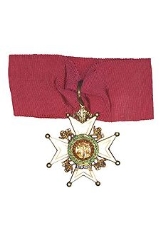
The badge varies in design, size and manner of wearing by rank and division. The Knight and Dame Grand Cross' badge is larger than the Knight and Dame Commander's badge, which is in turn larger than the Companion's badge; however, these are all suspended on a crimson ribbon. Knights and Dames Grand Cross wear the badge on a riband or sash, passing from the right shoulder to the left hip. Knights Commander and male Companions wear the badge from a ribbon worn around the neck. Dames Commander and female Companions wear the badge from a bow on the left side:

The military badge is a gold Maltese Cross of eight points, enamelled in white. Each point of the cross is decorated by a small gold ball; each angle has a small figure of a lion. The centre of the cross bears three crowns on the obverse side, and a rose, a thistle
Thistle

Thistle is the common name of a group of flowering plants characterised by leaf with sharp prickles on the margins, mostly in the plant family Asteraceae....
 and a shamrock
Shamrock

The shamrock is a symbol of Republic of Ireland. It is a three-leafed old white clover. It is sometimes of the variety White clover but today usually Trifolium dubium ....
, emanating from a sceptre
Sceptre

A sceptre or scepter is a symbolic ornamental Staff held by a ruling monarch, a prominent item of royal regalia. While some sceptres resemble a Ceremonial mace, their use is quite different....
 on the reverse side. Both emblems are surrounded by a red circular ring bearing the motto of the Order, which are in turn flanked by two laurel branches, above a scroll bearing the words Ich dien in gold letters.

The civil badge is a plain gold oval, bearing three crowns on the obverse side, and a rose, a thistle
Thistle

Thistle is the common name of a group of flowering plants characterised by leaf with sharp prickles on the margins, mostly in the plant family Asteraceae....
 and a shamrock
Shamrock

The shamrock is a symbol of Republic of Ireland. It is a three-leafed old white clover. It is sometimes of the variety White clover but today usually Trifolium dubium ....
, emanating from a sceptre
Sceptre

A sceptre or scepter is a symbolic ornamental Staff held by a ruling monarch, a prominent item of royal regalia. While some sceptres resemble a Ceremonial mace, their use is quite different....
 on the reverse side; both emblems are surrounded by a ring bearing the motto of the Order.

On certain "collar days" designated by the Sovereign, members attending formal events may wear the Order's collar over their military uniform or eveningwear. When collars are worn (either on collar days or on formal occasions such as coronations), the badge is suspended from the collar.

The collars and badges of Knights and Dames Grand Cross are returned to the Central Chancery of the Orders of Knighthood
Central Chancery of the Orders of Knighthood

The Central Chancery of the Orders of Knighthood is a small office within the Royal Household of the Monarch of the United Kingdom responsible for the administration of Orders of Chivalry and some aspects of honours in general....
 upon the decease of their owners. All other insignia may be retained by their owners.

Chapel

Westminster Abbey By Canaletto, 1749
The Chapel of the Order is Henry VII Lady Chapel
Henry VII Lady Chapel

The Henry VII Lady Chapel, now more often known just as the Henry VII Chapel, is a large Lady chapel at the far eastern end of Westminster Abbey built in the Perpendicular Gothic style....
 in Westminster Abbey
Westminster Abbey

The Collegiate Church of St Peter at Westminster, which is almost always referred to popularly and informally as Westminster Abbey, is a large, mainly Gothic architecture Church , in Westminster, London, just to the west of the Palace of Westminster....
. Every four years, an installation ceremony, presided over by the Great Master, and a religious service are held in the Chapel; the Sovereign attends every alternate ceremony. The last such service was in May 2006 and was attended by the Sovereign. The Sovereign and each knight who has been installed is allotted a stall in the choir
Cathedral diagram

This article discusses cathedral diagrams in Western ecclesiastical architecture. These floor plans show the sections of walls and piers, giving an idea of the profiles of their columns and ribbing....
 of the chapel. Since there are a limited number of stalls in the Chapel, only the most senior Knights and Dames Grand Cross are installed. A stall made vacant by the death of a military Knight Grand Cross is offered to the next most senior uninstalled military GCB, and similarly for vacancies among civil GCBs. Waits between admission to the Order and installation may be very long; for instance, Marshal of the Air Force Lord Craig of Radley
David Craig, Baron Craig of Radley

Marshal of the Royal Air Force David Brownrigg Craig, Baron Craig of Radley, Order of the Bath, Order of the British Empire is a retired Royal Air Force officer and member of the House of Lords....
 was created a Knight Grand Cross in 1984, but was not installed until 2006.

Above each stall, the occupant's heraldic devices are displayed. Perched on the pinnacle of a knight's stall is his helm, decorated with a mantling and topped by his crest. Under English heraldic law, women other than monarchs do not bear helms or crests; instead, the coronet
Coronet

A coronet is a small Crown consisting of ornaments fixed on a metal ring. Unlike a crown, a coronet never has arches.The word stems from the Old French coronete, a diminutive of coronne , itself from the Latin corona ....
 appropriate to the dame's rank (if she is a peer or member of the Royal family) is used.

Above the crest or coronet, the knight's or dame's heraldic banner
Banner

A banner is a flag or other piece of cloth bearing a symbol, logo, slogan or other message. Banner-making is an ancient craft.The word derives from Vulgar Latin bandum, a cloth out of which a flag is made ....
 is hung, emblazoned with his or her coat of arms
Coat of arms

A coat of arms, more properly called an armorial achievement, armorial bearings or often just arms for short, in European tradition, is a design belonging to a particular person and used by them in a wide variety of ways....
. At a considerably smaller scale, to the back of the stall is affixed a piece of brass
Brass

Brass is any alloy of copper and zinc; the proportions of zinc and copper can be varied to create a range of brasses with varying properties. In comparison, bronze is principally an alloy of copper and tin....
 (a "stall plate") displaying its occupant's name, arms and date of admission into the Order.

Upon the death of a Knight, the banner, helm, mantling and crest (or coronet or crown) are taken down. The stall plates, however, are not removed; rather, they remain permanently affixed somewhere about the stall, so that the stalls of the chapel are festooned with a colourful record of the Order's Knights (and now Dames) throughout history.

When the grade of Knight Commander was established in 1815 the regulations specified that they too should have a banner and stall plate affixed in the chapel. This was never implemented (despite some of the KCBs paying the appropriate fees) primarily due to lack of space, although the 1847 statutes allow all three classes to request the erection of a plate in the chapel bearing the member's name, date of nomination, and (for the two higher classes) optionally the coat of arms.

Precedence and privileges

Members of the Order of the Bath are assigned positions in the order of precedence. Wives of male members also feature on the order of precedence, as do sons, daughters and daughters-in-law of Knights Grand Cross and Knights Commander; relatives of female members, however, are not assigned any special precedence. Generally, individuals can derive precedence from their fathers or husbands, but not from their mothers or wives. (See order of precedence in England and Wales
Order of precedence in England and Wales

The Order of precedence in England and Wales as of 12 November 2008:Names in italics indicate higher precedence elsewhere in the table: e.g., many Order of the Garter have higher precedence as peers....
 for the exact positions.)

Knights Grand Cross and Knights Commander prefix "Sir," and Dames Grand Cross and Dames Commander prefix "Dame," to their forenames. Wives of Knights may prefix "Lady" to their surnames, but no equivalent privilege exists for husbands of Dames. Such forms are not used by peers and princes, except when the names of the former are written out in their fullest forms. Furthermore, honorary members and clergymen do not receive the accolade of knighthood.

Knights and Dames Grand Cross use the post-nominal
List of post-nominal letters

Post-nominal letters are letters placed after the name of a person to indicate that the individual holds a position, office, or honour.An individual may use several different sets of post-nominal letters....
 "GCB"; Knights Commander use "KCB"; Dames Commander use "DCB"; Companions use "CB".

Knights and Dames Grand Cross are also entitled to receive heraldic supporters. Furthermore, they may encircle their arms with a depiction of the circlet (a red circle bearing the motto) with the badge pendant thereto and the collar; the former is shown either outside or on top of the latter.

Knights and Dames Commander and Companions may display the circlet, but not the collar, around their arms. The badge is depicted suspended from the collar or circlet. Members of the Military division may encompass the circlet with "two laurel branches issuant from an escrol azure inscribed Ich dien", as appears on the badge.

Revocation

It is possible for membership in the Order to be revoked. Under the 1725 statutes the grounds for this were heresy, high treason, or fleeing from battle out of cowardice. Knights Companion could in such cases be degraded at the next Chapter meeting. It was then the duty of the Gentleman Usher to "pluck down the escocheon [i.e. stallplate] of such knight and spurn it out of the chapel" with "all the usual marks of infamy". Only two people were ever degraded — Lord Cochrane
Thomas Cochrane, 10th Earl of Dundonald

Admiral Sir Thomas Cochrane, 10th Earl of Dundonald, Marques do Maranh?o, GCB RN , styled Lord Cochrane between 1778 and 1831 , was a British naval officer and radical politician....
 in 1813 and General Sir Eyre Coote in 1816, both for political reasons, rather than any of the grounds given in the statute. Lord Cochrane was subsequently reinstated, Coote had died a few years after his degradation.

Under Queen Victoria's 1847 statutes a member "convicted of treason, cowardice, felony, or any infamous crime derogatory to his honour as a knight or gentleman, or accused and does not submit to trial in a reasonable time, shall be degraded from the Order by a special ordinance signed by the sovereign". The Sovereign was to be the sole judge, and also had the power to restore such members.

The situation today is that membership may be cancelled or annulled, and the entry in the register erased, by an ordinance signed by the Sovereign and sealed with the seal of the Order, on the recommendation of the appropriate Minister. Such cancellations may be subsequently reversed.

William Pottinger, a senior civil servant, lost both his Companionship of the Order of the Bath and CVO
Royal Victorian Order

The Royal Victorian Order is a dynastic order of knighthood and a House Order of chivalry in the Commonwealth realms. Created by Queen Victoria of the United Kingdom on 21 April 1896, with the motto Victoria and 20 June as the official day, the order was established to recognise those who have served the monarch with distinction, each be...
 in 1975 when he was gaoled for corruptly receiving gifts from the architect John Poulson
John Poulson

John Garlick Llewellyn Poulson was a disgraced British people Architecture who caused a major political scandal when his use of bribery and connections to senior politicians were disclosed in 1972....
.

Romanian president
President of Romania

The President of Romania is the head of state of Romania. The President is directly elected by a two-round system for a five-year term . He or she can serve two terms....
 Nicolae Ceausescu
Nicolae Ceausescu

Nicolae Ceausescu was the Secretary General of the Romanian Workers' Party, later the Romanian Communist Party from 1965 until 1989, President of the Council of State from 1967 and President of Romania from 1974 until 1989....
 was stripped of his honorary GCB by Queen Elizabeth II on 24 December 1989.

Robert Mugabe
Robert Mugabe

Robert Gabriel Mugabe is the List of Presidents of Zimbabwe of Zimbabwe. He has held power as the head of government since 1980, as Prime Minister of Zimbabwe from 1980 to 1987, and as the first executive head of state since 1987....
, President of Zimbabwe
Zimbabwe

Zimbabwe , is a landlocked country located in the southern part of the continent of Africa, between the Zambezi and Limpopo River rivers. It is bordered by South Africa to the south, Botswana to the southwest, Zambia to the northwest and Mozambique to the east....
, was stripped of his honorary GCB by the Queen, on the advice of Foreign Secretary, David Miliband
David Miliband

David Wright Miliband Member of Parliament, is a Politics of the United Kingdom who is the current Secretary of State for Foreign and Commonwealth Affairs and Member of Parliament for the constituency of South Shields ....
, on 25 June 2008 as "as a mark of revulsion at the abuse of human rights and abject disregard for the democratic process in Zimbabwe over which President Mugabe has presided."

See also

For people who have been appointed to the Order of the Bath, see the following categories:
Category:Knights Grand Cross of the Order of the Bath
Category:Dames Grand Cross of the Order of the Bath
Category:Knights Commander of the Order of the Bath
Category:Dames Commander of the Order of the Bath
Category:Knights Companion of the Order of the Bath
  • List of Knights Companion of the Order of the Bath
    List of Knights Companion of the Order of the Bath

    This is a list of those men who were made Knights Companion of the Order of the Bath from the date of the Order's revival by King George I of Great Britain, 18 May 1725, to its reorganisation on 2 January 1815....
Category:Knights of the Bath
Category:Companions of the Order of the Bath
  • List of people who have declined a British honour
    List of people who have declined a British honour

    The following is a partial list of people who have declined a British honours system, such as a knighthood or an honour usually within the Order of the British Empire....
  • List of revocations of appointments to orders and awarded decorations and medals of the United Kingdom


External links

  • Cambridge University Heraldic and Genealogical Society
    Cambridge University Heraldic and Genealogical Society

    The Cambridge University Heraldic and Genealogical Society was formed as the result of the merger in 1957 of a previous Heraldic Society with the Cambridge University Society of Genealogists ....
    .