
All Topics  
Prime Minister of the United Kingdom

 
Prime Minister of the United Kingdom

   Email Print
   Bookmark   Link


Prime Minister of the United Kingdom


This is a descriptive article. For a list, see List of Prime Ministers of the United Kingdom
List of Prime Ministers of the United Kingdom

The Prime Minister of the United Kingdom is the political leader of the United Kingdom and the Head of Her Majesty's Government. The office holder is responsible for selecting all other members of the government, chairing Cabinet of the United Kingdom meetings and deciding when to call a new Elections in the United Kingdom for the Ho...
.


The Prime Minister of the United Kingdom of Great Britain and Northern Ireland is the political leader of the United Kingdom
United Kingdom

The United Kingdom of Great Britain and Northern Ireland, commonly known as the United Kingdom , the UK or Britain,is a sovereign state located off the northwestern coast of continental Europe....
 and the Head of
Head of government

The head of government is the chief officer of the executive branch of a government, often presiding over a cabinet . In a parliamentary system, the head of government is often styled Prime Minister, President of the Government, Premier, etc....
 His/Her Majesty's Government
Her Majesty's Government

Her Majesty's Government is a term used to refer to the government of the United Kingdom. Apart from the United Kingdom, the phrase has been used by other countries which recognise the British head of state as their own also....
. The Prime Minister and Cabinet (consisting of all the most senior government department heads) are collectively accountable
Accountability

Accountability is a concept in ethics with several meanings. It is often used synonymously with such concepts as Social responsibility, answerability, enforcement, blameworthiness, liability and other terms associated with the expectation of account-giving....
 for their policies and actions to the Sovereign, to Parliament
Parliament of the United Kingdom

The Parliament of the United Kingdom of Great Britain and Northern Ireland is the supreme legislature in the United Kingdom and British overseas territories....
, to their political party
List of political parties in the United Kingdom

This is a list of Political party in the Politics of the United Kingdom....
, and ultimately to the electorate.

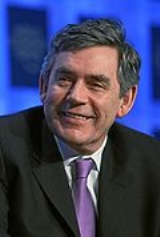
The current Prime Minister of the United Kingdom is Gordon Brown
Gordon Brown

James Gordon Brown UK Member of Parliament is a United Kingdom Labour Party politician and the Prime Minister of the United Kingdom. Brown assumed office in June 2007, after the resignation of Tony Blair and three days after becoming leader of the governing Labour Party....
, who assumed the position in June 2007.

Constitutional background
The modern Prime Minister of the United Kingdom wields broad executive and legislative powers.


Discussion
Ask a question about 'Prime Minister of the United Kingdom'
Start a new discussion about 'Prime Minister of the United Kingdom'
Answer questions from other users
Full Discussion Forum


Timeline

1743   Henry Pelham becomes British Prime Minister

1782   Charles Watson-Wentworth, 2nd Marquess of Rockingham becomes Prime Minister of the United Kingdom.

1801   William Pitt the Younger resigns as Prime Minister of the United Kingdom.

1804   Henry Addington resigns as Prime Minister of the United Kingdom.

1804   William Pitt the younger begins his second term as a Prime Minister of the United Kingdom.

1827   UK: George Canning succeeds Lord Liverpool as British Prime Minister.

1828   UK: The Duke of Wellington succeeds Lord Goderich as Prime Minister of the United Kingdom.

1830   The Whig Charles Grey, 2nd Earl Grey succeeds Arthur Wellesley, 1st Duke of Wellington as Prime Minister of the United Kingdom

1835   Lord Melbourne succeeds Sir Robert Peel as British Prime Minister.

1855   Lord Aberdeen resigns as Prime Minister of the United Kingdom over the management of the Crimean War.


Encyclopedia


This is a descriptive article. For a list, see List of Prime Ministers of the United Kingdom
List of Prime Ministers of the United Kingdom

The Prime Minister of the United Kingdom is the political leader of the United Kingdom and the Head of Her Majesty's Government. The office holder is responsible for selecting all other members of the government, chairing Cabinet of the United Kingdom meetings and deciding when to call a new Elections in the United Kingdom for the Ho...
.


The Prime Minister of the United Kingdom of Great Britain and Northern Ireland is the political leader of the United Kingdom
United Kingdom

The United Kingdom of Great Britain and Northern Ireland, commonly known as the United Kingdom , the UK or Britain,is a sovereign state located off the northwestern coast of continental Europe....
 and the Head of
Head of government

The head of government is the chief officer of the executive branch of a government, often presiding over a cabinet . In a parliamentary system, the head of government is often styled Prime Minister, President of the Government, Premier, etc....
 His/Her Majesty's Government
Her Majesty's Government

Her Majesty's Government is a term used to refer to the government of the United Kingdom. Apart from the United Kingdom, the phrase has been used by other countries which recognise the British head of state as their own also....
. The Prime Minister and Cabinet (consisting of all the most senior government department heads) are collectively accountable
Accountability

Accountability is a concept in ethics with several meanings. It is often used synonymously with such concepts as Social responsibility, answerability, enforcement, blameworthiness, liability and other terms associated with the expectation of account-giving....
 for their policies and actions to the Sovereign, to Parliament
Parliament of the United Kingdom

The Parliament of the United Kingdom of Great Britain and Northern Ireland is the supreme legislature in the United Kingdom and British overseas territories....
, to their political party
List of political parties in the United Kingdom

This is a list of Political party in the Politics of the United Kingdom....
, and ultimately to the electorate.

The current Prime Minister of the United Kingdom is Gordon Brown
Gordon Brown

James Gordon Brown UK Member of Parliament is a United Kingdom Labour Party politician and the Prime Minister of the United Kingdom. Brown assumed office in June 2007, after the resignation of Tony Blair and three days after becoming leader of the governing Labour Party....
, who assumed the position in June 2007.

Constitutional background


The modern Prime Minister of the United Kingdom wields broad executive and legislative powers. The incumbent leads a major political party, commands a majority in the House of Commons (the Legislature), and is the leader of the Cabinet (the Executive). Under the British system, there is a unity of powers rather than separation
Separation of powers

Separation of powers, a term ascribed to France Age of Enlightenment political philosopher Charles de Secondat, baron de Montesquieu, is a model for the governance of democracy states, having its origins in an ancient idea of mixed government....
. Many of these powers are still formally vested in the Head of State, the Sovereign. Called "royal prerogative
Royal Prerogative

The Royal Prerogative is a body of customary authority, privilege, and immunity, recognised in common law and, sometimes, in Civil law jurisdictions possessing a monarchy as belonging to the Sovereign alone....
s", they were devolved to the Prime Minister as incumbents gradually acquired a dominant position in the constitutional hierarchy.

The Premiership was not intentionally created. The office is not defined by a codified Constitution, but by customs known as convention
Constitutional convention (political custom)

Alternative meaning: Constitutional convention A constitutional convention is an informal and uncodified procedural agreement that is followed by the institutions of a state....
s that became accepted practice. Until the 20th century, the relationship between the Prime Minister and the Sovereign, Parliament, and Cabinet was defined entirely by these conventions.

The office developed in the shadow of the Monarchy, competing with it for executive authority. Before the Glorious Revolution of 1688, the Sovereign was both Head of State and Government. Afterwards, Parliament allowed the Sovereign to remain Head of State, but gradually placed day-to-day governance under its control. It did not, however, create a formal mechanism by which to wield these executive powers. The Premiership filled this void. Evolving behind the scenes, Parliament transferred executive powers to the Cabinet led by the First Lord of the Treasury
First Lord of the Treasury

The First Lord of the Treasury is the head of the Government agency exercising the ancient office of Lord High Treasurer in the United Kingdom, and is usually?but not always?also the Prime Minister of the United Kingdom....
, who became known unofficially as the Prime Minister. During the same period, Parliament deferentially maintained the legal fiction that the Sovereign retained the power to govern directly, giving little formal recognition to the position of Prime Minister.

This arrangement makes it appear that Britain has two executives: the Prime Minister and the Sovereign. The concept of "the Crown
The Crown

Throughout the Commonwealth realms, the Crown is an abstract metonymy concept which represents the legal authority for the existence of any government....
" resolves this paradox. The Crown symbolises the state’s authority to govern: to make laws and execute them, impose taxes and collect them, declare war and make peace. Before 1688, the Sovereign wore the Crown and exercised the powers it symbolizes. Afterwards, Parliament gradually made Sovereigns give up these powers and forced them assume a neutral political position. They placed the Crown in "commission", entrusting its authority to responsible Ministers (the Prime Minister and Cabinet), accountable for their policies and actions to Parliament and the people. Although the Sovereign still wears the Crown, Parliament has removed her from everyday governance, leaving her in practice with three constitutional rights: to be kept informed, to advise, and to warn.

Foundations of the office of Prime Minister: 1688–1720


Revolutionary settlement


Since the Premiership was not intentionally created, there is no exact date when the position appeared or its evolution began. A meaningful starting point, however, is 1688 when James II
James II of England

James II and VII was List of English monarchs, List of Scottish monarchs, and King of Ireland from 6 February 1685. He was the last Roman Catholic Church monarch to reign over the Kingdoms of Kingdom of England, Kingdom of Scotland, and Kingdom of Ireland....
 fled England
Kingdom of England

The Kingdom of England was, from 927 to 1707, a state in North-West Europe. The Kingdom of England spanned the southern two-thirds of the island of Great Britain and a number of smaller outlying islands?what is today the legal unit of England and Wales....
. The throne being vacant, the Parliament of England
Parliament of England

The Parliament of England was the legislature of the Kingdom of England. Its roots can be traced back to the early medieval period. In a series of developments, it came increasingly to constrain the power of the King of England, and went on after the Act of Union 1707 to merge with the Parliament of Scotland and form the main basis of the Pa...
 confirmed William and Mary as England's
Kingdom of England

The Kingdom of England was, from 927 to 1707, a state in North-West Europe. The Kingdom of England spanned the southern two-thirds of the island of Great Britain and a number of smaller outlying islands?what is today the legal unit of England and Wales....
 joint constitutional monarchs, enacting legislation that limited their authority and that of their successors: the Bill of Rights (1689)
Bill of Rights 1689

The Bill of Rights is an Act of Parliament of the Parliament of England, whose long title is An Act Declaring the Rights and Liberties of the Subject and Settling the Succession of the Crown....
, the Mutiny Bill (1689), the Triennial Bill
Triennial Acts

The Triennial Act 1641 was an Act of Parliament passed on 15 February 1641, by the England Long Parliament, during the reign of Charles I of England....
 (1694), the Treason Act (1696)
Treason Act 1695

The Treason Act 1695 is an Act of Parliament of the Parliament of England which laid down rules of evidence and procedure in high treason trials....
  and the Act of Settlement (1701)
Act of Settlement 1701

The Act of Settlement is an act of the Parliament of England, originally filed in 1700, and passed in 1701, to settle the Order of succession to the List of English monarchs on the Electress Sophia of Hanover a granddaughter of James I of England and her Protestantism heirs....
. Known collectively as the Revolutionary Settlement, these acts transformed the constitution, shifting the balance of power from the Sovereign to Parliament. Unknown at the time, they also provided the basis for the evolution of the Prime Minister.

The Treasury Bench


The Revolutionary Settlement gave the Commons control over finances and legislation and, thereby, changed the relationship between the Executive and the Legislature. For want of money, Sovereigns had to summon Parliament annually and could no longer dissolve or prorogue it without its advice and consent. Parliament became a permanent feature of political life. The veto fell into disuse because Sovereigns feared that if they denied legislation, Parliament would deny them money. No Sovereign has denied royal assent
Royal Assent

The granting of Royal Assent is the formal method by which a constitutional monarchy completes the legislative process of lawmaking by formally assenting to an Act of Parliament....
 since Queen Anne vetoed the Scottish Militia Bill
Scottish Militia Bill 1708

The Scottish Militia Bill is the usual name given to a bill that was passed by the British House of Commons and House of Lords of the Parliament of Kingdom of Great Britain in spring 1708, but vetoed by Anne of Great Britain on 11 March 1708 for fear that the proposed militia created would be disloyal....
 in 1708.
House of Commons Microcosm
Treasury officials and other department heads were drawn into Parliament serving as liaisons between it and the Sovereign. Ministers had to present the government's policies, and negotiate with Members to gain the support of the majority; they had to explain the government’s financial needs, suggest ways of meeting them and give an account of how money had been spent. The Sovereign’s representatives attended Commons sessions so regularly that they were given reserved seats at the front, known as the Treasury Bench. This is the beginning of "unity of powers": the Sovereign's Ministers (the Executive) became leading members of Parliament (the Legislature). Today, the Prime Minister (First Lord of the Treasury), the Chancellor of the Exchequer (responsible for the budget) and other senior members of the Cabinet sit on the Treasury bench and present policies in much the same way Ministers did late in the 17th century.

Standing Order 66


After the Revolution, there was a constant threat that non-government members of Parliament would ruin the country's finances by proposing ill-considered money bills. Vying for control to avoid chaos, the Crown's Ministers gained an advantage in 1706 when the Commons informally declared, "That this House will receive no petition for any sum of money relating to public Service, but what is recommended from the Crown." On June 11, 1713, this non-binding rule became Standing Order 66: that “the Commons would not vote money for any purpose, except on a motion of a Minister of the Crown.” Standing Order 66 remains in effect today, essentially unchanged for three hundred years.

Empowering Ministers with sole financial initiative had an immediate and lasting impact. Apart from achieving its intended purpose – to stabilise the budgetary process – it naturally gave the Crown a leadership role in the Commons; and, the Lord Treasurer assumed a leading position among Ministers. The power of financial initiative was not, however, absolute. Only Ministers might initiate money bills, but Parliament now reviewed and consented to them. Standing Order 66 therefore represents the beginnings of Ministerial responsibility and accountability.

The term "Prime Minister" first appears at this time as an unofficial title for the head of the Treasury. Jonathan Swift, for example, wrote in 1713 about "those who are now commonly called Prime Minister among us", referring to Sidney Godolphin, 1st Earl of Godolphin
Sidney Godolphin, 1st Earl of Godolphin

Sidney Godolphin, 1st Earl of Godolphin Privy Council of England , was a leading British politician of the late seventeenth and early eighteenth centuries....
 and Robert Harley
Robert Harley, 1st Earl of Oxford and Mortimer

Robert Harley, 1st Earl of Oxford and Earl Mortimer , was an British politician and statesman of the late Stuart dynasty and early Georgian era periods....
, Queen Anne's Lord Treasurers and chief ministers. From this time, every head of the Sovereign's government – with one exception in the 18th century and one in the 19th – has been either Lord High Treasurer or, more commonly, First Lord of the Treasury.

Beginnings of the Prime Minister's party leadership


The modern Prime Minister is the leader of a major political party with millions of followers. In the general election of 1997, for example, 13.5 million people voted for the Labour Party led by Tony Blair; 9.6 million for the Conservative Party, led by John Major, the incumbent Prime Minister; and, 5.2 million for the Liberal Democrat Party led by Paddy Ashdown. Generally agreeing on policies, party leaders and their supporters suppress their differences of opinion at the polls for the sake of gaining a majority of seats in the Commons and being able to form a government.

Political parties first appeared during the Exclusion Crisis of 1678–1681. The Whigs, who believed in limited Monarchy, wanted to exclude James Stuart from succeeding to the throne because he was a Catholic and espoused absolutist ideas about the Kingship. The Tories, who believed in the "Divine Right of Kings", defended James' hereditary claim. These parties dominated British politics for over 150 years, the Whigs generally being liberal; the Tories conservative. Indeed, in the 19th century, the Whigs evolved into the Liberal Party; the Tories, the Conservative. Even today, Conservatives are often called "Tories".

Political parties were not well organised or disciplined in the 17th century. They were more like factions with "members" drifting in and out, collaborating temporarily on issues when it was to their advantage, then disbanding when it was not. A major deterrent to the development of opposing parties was the idea that there could only be one: the “King’s Party”. To oppose the King’s party was disloyal, even treasonous. This idea lingered throughout the 18th century. Nevertheless, it became possible at the end of the 17th century to identify Parliaments and Ministries as being either "Whig" or "Tory" in composition.

The Early Cabinet


The modern Prime Minister is also the leader of the Cabinet. A convention of the constitution, the modern Cabinet is a group of about twenty ministers who formulate policies. For example, former Prime Minister Tony Blair’s first Cabinet from 1997 – 2001 consisted of 22 members. As the political heads of government departments, Cabinet Ministers ensure that policies are carried out by permanent civil servants. Although the modern Prime Minister selects Ministers, the Sovereign still officially appoints them. With the Prime Minister as its leader, the Cabinet forms the "executive branch".

The term "Cabinet" first appears after the Revolutionary Settlement to describe those ministers who conferred privately with the Sovereign. The growth of the Cabinet met with widespread complaint and opposition because its meetings were often held in secret and it excluded the ancient Privy Council from the Sovereign's circle of advisers, reducing it to an honorary body.

The early Cabinet included the Treasurer and other department heads who sat on the Treasury bench as it does today. However, it might also include household officers (such as the Master of the Horse) and even members of the royal family who held no office and had neither skills in governance nor political influence.

Early in his reign, William (1688-1702) preferred "Mixed Ministries" choosing his ministers from both the Tory and Whig parties. This approach did not work well. These Cabinets had no leader and Ministers bickered and worked at odds with each other. This has been the case ever since. Mixed Ministries (Coalitions) have rarely been effective under the British system, except in times of crisis such as the Great War (1914–1918) and World War II (1939–1945).

Mixed Ministries having failed, William formed a homogeneous Whig ministry in 1697 known as the Junto, often cited as the first true Cabinet because its members were all Whigs, reflecting the composition of the Commons which was also Whig.

Anne (1702-1714) followed this pattern but preferred Tory Cabinets. This approach worked well as long as Parliament was also Tory. In 1702, the Tories dominated the Commons. However, in 1708, when the Whigs obtained a majority, Anne did not call on them to form a government; she refused to admit that politicians could force themselves on her merely because their party had a majority. She never parted with an entire Ministry or accepted an entirely new one regardless of the results of an election. Consequently, although Anne's chief ministers Sidney Godolphin, 1st Earl of Godolphin
Sidney Godolphin, 1st Earl of Godolphin

Sidney Godolphin, 1st Earl of Godolphin Privy Council of England , was a leading British politician of the late seventeenth and early eighteenth centuries....
 and Robert Harley
Robert Harley, 1st Earl of Oxford and Mortimer

Robert Harley, 1st Earl of Oxford and Earl Mortimer , was an British politician and statesman of the late Stuart dynasty and early Georgian era periods....
 led their Cabinets and were called "Prime Minister" by some, they had difficulty executing policy in the face of a hostile Parliament. It was not until the 1830s that the constitutional convention was established that the Sovereign must select Prime Ministers and the Cabinet from the party whose views reflect those of the majority in Parliament.

Both William and Anne appointed and dismissed Cabinet members, attended meetings, made decisions, and followed up on actions. Relieving the Sovereign of these responsibilities and gaining control over the Cabinet's composition was an essential part of evolution of the Premiership.

Establishing the convention that Sovereigns do not attend Cabinet meetings began soon after the Hanoverian Succession. Although George I (1714–1727) attended regularly at first, after 1717 he withdrew, partly because he did not speak English, but mostly because he was bored with the discussions. George II (1727–1760) occasionally presided at Cabinet meetings but George III (1760–1820), is known to have attended only two during his 60 year reign. Thus, the convention that Sovereigns do not attend Cabinet meetings was establish primarily through royal indifference to the everyday tasks of governance. The Prime Minister became responsible for calling meetings, presiding, taking notes, and reporting to the Sovereign. These simple executive tasks naturally gave the Prime Minister ascendancy over his Cabinet colleagues.

Although they rarely attended Cabinet meetings, the first Hanoverian Sovereigns insisted on their prerogatives to appoint and dismiss ministers and to direct overall policy even if from outside the Cabinet. It was not until late in the 18th century that Prime Ministers gained control over Cabinet composition and government policies (see Section 4.1 below).

The Treasury Commission: 1714


The Premiership is still largely a convention of the constitution; its legal authority is derived primarily from the fact that the Prime Minister is also First Lord of the Treasury. The connection of these two offices – one a convention, the other a legal office – began with the Hanoverian Succession in 1714.

When George I succeeded to the English throne in 1714, his German ministers advised him to leave the office of Lord High Treasurer vacant because those who had held it in recent years (referring to Godolphin and Harley) had grown overly powerful, in effect, replacing the Sovereign as head of the government. They also feared that a Lord High Treasurer would undermine their own influence with the new King. They therefore suggested that instead he place the office in "commission', meaning that a committee of five ministers would perform its functions together. Theoretically, this dilution of authority would prevent any one of them from presuming to be the head of the government. The King agreed and created the Treasury Commission consisting of the First Lord of the Treasury, the Second Lord, and three Junior Lords.

No one has been appointed to the Lord High Treasureship since 1714; it has remained in commission for three hundred years. The Treasury Commission ceased to meet late in the 18th century but has survived, albeit with very different functions: the First Lord of the Treasury is now the Prime Minister, the Second Lord is the Chancellor of the Exchequer (and actually in charge of the Treasury), and the Junior Lords are government Whips maintaining party discipline in the House of Commons; they no longer have any duties related to the Treasury.

Early Prime Ministers: 1720–1784


The "first" Prime Minister - Walpole (1720–1742)


Since the office was not created, there is no "first" Prime Minister as there is a first Prime Minister of Canada
John A. Macdonald

Sir John Alexander Macdonald, Order of the Bath, Order of St Michael and St George, Her Majesty's Most Honourable Privy Council, Queen's Privy Council for Canada, was the first Prime Minister of Canada and the dominant figure of Canadian Confederation....
. However, the honorary appellation is traditionally given to Sir Robert Walpole who became First Lord of the Treasury in 1721.
Robertwalpole
In 1720, the South Sea Company, created to trade in cotton, agricultural goods and slaves, collapsed, causing the financial ruin of thousands of investors and heavy losses for many others including members of the royal family. King George I called on Robert Walpole, well-known for his political and financial acumen, to handle the emergency. With considerable skill and some luck, Walpole acted quickly to restore public credit and confidence, and lead the country out of the crisis. A year later, the King appointed him First Lord of the Treasury, Chancellor of the Exchequer and Leader of the House of Commons making him the most powerful minister in the government. Ruthless, crude, and hard-working, he had a "sagacious business sense" and was a superb manager of men. At the head of affairs for the next two decades, Walpole stabilised the nation's finances, kept it at peace, made it prosperous, and secured the Hanoverian Succession.

Walpole demonstrated for the first time how a chief minister – a Prime Minister – could be the actual Head of the Government under the new constitutional framework. First, recognising that the Sovereign could no longer govern directly but was still the nominal head of the government, he insisted that he was nothing more than the "King's Servant". Second, recognising that power had shifted to the Commons, he conducted the nation's business there and made it dominant over the Lords in all matters. Third, recognising that the Cabinet had become the executive and must be united, he dominated the other members and demanded their complete support for his policies. Fourth, recognising that political parties were the source of ministerial strength, he led the Whig party and maintained discipline. In the Commons, he insisted on the support of all Whigs members, especially those who held office. Finally, he set an example for future Prime Ministers by resigning his offices in 1742 when he no longer had the confidence of a majority, even though he still retained the confidence of the Sovereign.

Ambivalence and denial: 1742–1784


For all his contributions, Walpole was not a Prime Minister in the modern sense. The King chose him, not Parliament; and, the King chose the Cabinet, not Walpole. Walpole set an example not a precedent, and few followed his example. For over 40 years after Walpole's fall in 1742, there was widespread ambivalence about the position. In some cases, the Prime Minister was a figurehead with power being wielded by other individuals; in others there was a reversion to the "chief minister" model of earlier times in which the Sovereign actually governed. Furthermore, many thought that the title "Prime Minister" usurped the Sovereign's constitutional position as "head of the government" and that it was an affront to other ministers because they were all appointed by and equally responsible to the Sovereign.

For all of these reasons there was a reluctance to use the title. Although Walpole is now called the "First" Prime Minister, the title was not commonly used during his tenure. Walpole himself denied it. In 1741, during the attack on Walpole that led to his downfall, Sandys declared that "According to our Constitution we can have no sole and prime minister . . . " In his defense, Walpole said "I unequivocally deny that I am sole or Prime Minister and that to my influence and direction all the affairs of government must be attributed...." George Grenville, Prime Minister in the 1760s, said it was "an odious title" and never used it. Lord North, the reluctant head of the King's Government during the American Revolution, "would never suffer himself to be called Prime Minister, because it was an office unknown to the Constitution."

Denials of the Premiership's legal existence continued throughout the 19th century. In 1806, for example, one member of the Commons said, "the Constitution abhors the idea of a prime minister". In 1829 another said, "nothing could be more mischievous or unconstitutional than to recognize by act of parliament the existence of such an office."

By the turn of the 20th century the Premiership had become, by convention, the most important position in the constitutional hierarchy. Yet there were no legal documents describing its the powers or acknowledging its existence. Incumbents had no statutory authority in their own right. As late as 1904, Arthur Balfour explained the status of his office in a speech at Haddington: "The Prime Minister has no salary as Prime Minister. He has no statutory duties as Prime Minister, his name occurs in no Acts of Parliament, and though holding the most important place in the constitutional hierarchy, he has no place which is recognized by the laws of his country. This is a strange paradox"

In 1905 the position was given some official recognition when the "Prime Minister" was named in the order of precedence
United Kingdom order of precedence

The Order of precedence in the United Kingdom is different in each of its four constituent member nations. See:* Order of precedence in England and Wales...
, outranked, among non-royals, only by the Archbishops of Canterbury
Archbishop of Canterbury

The Archbishop of Canterbury is the chief bishop and principal leader of the Church of England, the symbolic head of the worldwide Anglican Communion and the Diocesan Bishop of the Diocese of Canterbury, the Episcopal see that churches must be in communion with in order to be a part of the Anglican Communion....
 and York
Archbishop of York

File:Williamtemple1.jpgArchbishop of York is a high-ranking cleric in the Church of England, second only to the Archbishop of Canterbury. He is the diocesan bishop of the Diocese of York and metropolitan bishop of the Province of York, which covers the northern portion of England as well as the Isle of Man....
, The Moderator of the Church of Scotland and by the Lord Chancellor
Lord Chancellor

The Lord High Chancellor of Great Britain, or Lord Chancellor, is a senior and important functionary in the government of the United Kingdom....
.

The first Act of Parliament to mention the Premiership was the Chequers Estate Act on 20 December 1917. This law conferred the Chequers
Chequers

Chequers, or Chequers Court, is a country house near Ellesborough, to the south east of Aylesbury in Buckinghamshire, England, at the foot of the Chiltern Hills....
 Estate owned by Sir Arthur
Arthur Lee, 1st Viscount Lee of Fareham

Arthur Hamilton Lee, 1st Viscount Lee of Fareham, Order of the Bath, Order of the British Empire, Order of the Star of India was a United Kingdom soldier, diplomat, politician and administrator serving in Canada and the USA....
 and Lady Lee, as a gift to the Crown for use as a country home for future Prime Ministers.

Unequivocal legal recognition was given in the Ministers of the Crown Act (1937) which made provision for paying a salary to the person who is both "the First Lord of the Treasury and Prime Minister". Explicitly recognising two hundred years' of ambivalence, the act states that it intended To give statutory recognition to the existence of the position of Prime Minister, and to the historic link between the Premiership and the office of First Lord of the Treasury, by providing in respect to that position and office a salary of . . . The Act made a distinction between the "position" (Prime Minister) and the "office" (First Lord of the Treasury), emphasising the unique political character of the former. Nevertheless, the brass plate on the door of the Prime Minister's home, 10 Downing Street
10 Downing Street

Number 10 Downing Street is the residence and office of the First Lord of the Treasury and Prime Minister of the United Kingdom. The headquarters of Her Majesty's Government, it is situated on Downing Street in the City of Westminster in London, England....
, still bears the title of "First Lord of the Treasury", as it has since the 18th century.

"First among equals": 1784–1911


Emergence of Cabinet Government - Pitt and Liverpool (1784–1830)


Despite the reluctance to legally recognise the Premiership, ambivalence toward it waned in the 1780s. As noted previously, George III (1760–1820) is known to have attended only two Cabinet meetings. However, during the first twenty years of his reign, he tried to be his own "prime minister" by controlling policy from outside the Cabinet, appointing and dismissing ministers, meeting privately with individual ministers, and giving them instructions. These practices caused confusion and dissention in Cabinet meetings, especially during the dysfunctional ministries of the Earl of Chatham from 1766-1768 and of the Duke of Grafton from 1768-1770 when no one, not even the King, seemed to be in charge.

In 1782, the Marquess of Rockingham
Charles Watson-Wentworth, 2nd Marquess of Rockingham

Charles Watson-Wentworth, 2nd Marquess of Rockingham, Order of the Garter, Privy Council of the United Kingdom , styled The Hon. Charles Watson-Wentworth before 1733, Viscount Higham between 1733 and 1746, Earl of Malton between 1746 and 1750 and The Earl Malton in 1750, was a Kingdom of Great Britain British Whig Par...
 reasserted the Prime Minister's control over the Cabinet. After the failure of Lord North's ministry (1770 - 1782), Rockingham assumed the Premiership "on the distinct understanding that measures were to be changed as well as men; and that the measures for which the new ministry required the royal consent were the measures which they, while in opposition, had advocated." He and his Cabinet were united in their policies and would stand or fall together; they also refused to accept anyone in the Cabinet who did not agree. George threatened to resign but in the end reluctantly agreed out of necessity: he had to have a government.

From this time, there was a growing acceptance of the position of Prime Minister and the title was more commonly used, if only unofficially. Associated initially with the Whigs, even the Tories started to accept it. Lord North, for example, who had said the office was "unknown to the constitution", reversed himself in 1783 when he said, "In this country some one man or some body of men like a Cabinet should govern the whole and direct every measure." In 1803, William Pitt the Younger
William Pitt the Younger

William Pitt, the Younger was a Kingdom of Great Britain politician of the late eighteenth century and early nineteenth century. He became the youngest Prime Minister of the United Kingdom in 1783 at the age of 24....
, also a Tory, suggested to a friend that "this person generally called the first minister" was an absolute necessity for a government to function, and expressed his belief that this person should be the minister in charge of the finances.

The Tories' wholesale conversion started in 1784 when Pitt was confirmed as Prime Minister. For the next 17 years until 1801 (and again from 1804 to 1806), Pitt, the Tory, was Prime Minister in the same sense that Walpole, the Whig, had been earlier. Thus, the Tories, for practical political reasons, finally accepted the constitutional changes implied in the Revolutionary Settlement.

Their conversion was reinforced after 1810. In that year, George III, who had suffered periodically from mental instability (due to a blood disorder now known as porphyria
Porphyria

Porphyrias are a group of inherited or acquired disorders of certain enzymes in the heme biosynthetic pathway . They are broadly classified as acute porphyrias and cutaneous porphyrias, based on the site of the overproduction and accumulation of the porphyrins ....
), became permanently insane and spent the remaining 10 years of his life unable to discharge his duties. The Prince Regent, also named George, was prevented from using the full powers of Kingship. The Regent became King George IV in 1820, but during his 10 year reign was indolent and frivolous. Consequently, for 20 years the throne was virtually vacant and Tory Cabinets led by Tory Prime Ministers filled the void, governing virtually on their own.

The Tories were in power for almost 50 years, except for a short Whig ministry from 1806 to 1807. Lord Liverpool was Prime Minister for 15 years. Together, he and Pitt held the position for 34 years. Cabinet government became a permanent convention of the constitution. Although many subtle issues remained to be settled, the Cabinet system of government
Cabinet government

Cabinet government refers to any government in which most executive power is invested in a Cabinet - often the members act with cabinet collective responsibility....
 is essentially the same today as it was in 1830.

Under this system. sometimes called the Westminster System
Westminster System

The Westminster system is a Democracy parliamentary system of government modelled after the British government . The term comes from the Palace of Westminster, the seat of the UK Parliament....
, the Sovereign is Head of State
Head of State

Head of state is the generic term for the individual or collective office that serves as the chief public representative of a monarchic or republican nation-state, federation, commonwealth or any other political state....
 and titular head of Her Majesty's Government
Her Majesty's Government

Her Majesty's Government is a term used to refer to the government of the United Kingdom. Apart from the United Kingdom, the phrase has been used by other countries which recognise the British head of state as their own also....
. She selects as her Prime Minister the person who is able to command a working majority in the House of Commons, and invites him to form a government. As the actual Head of Government
Head of government

The head of government is the chief officer of the executive branch of a government, often presiding over a cabinet . In a parliamentary system, the head of government is often styled Prime Minister, President of the Government, Premier, etc....
, the Prime Minister selects his Cabinet, choosing its members from among those in Parliament who agree or at least generally agree with his intended policies. He then recommends them to the Sovereign who confirms his selections by formally appointing them to their respective offices. Led by the Prime Minister, the Cabinet is collectively responsible for everything the government does. The Sovereign does not confer with its members privately or attend its meetings. With respect to actual governance, she has only three constitutional rights: to be kept informed, to advise, and to warn. In practice this means that the Sovereign reviews state papers and meets regularly with the Prime Minister, usually weekly, when she may advise and warn him regarding the proposed decisions and actions of Her Government.

The Loyal Opposition


The expression "His Majesty's Opposition" was coined during this period of Tory ascendancy. In 1826, John Cam Hobhouse, Lord Broughton, announced in the Commons that he opposed the report of a Bill. As a joke, he said, "It was said to be very hard on His Majesty's ministers to raise objections to this proposition. For my part, I think it is much more hard on His Majesty's Opposition to compel them to take this course." The phrase caught on and has been applied ever since to the second largest party in the Commons. Sometimes translated as the "Loyal Opposition
Loyal opposition

Loyal opposition is the concept that one can be opposed to the actions of the executive or ruling party of the day without being opposed to the constitution of the political system....
", it acknowledges the legitimate existence of the two party system, and aptly describes an important constitutional concept: opposing the King's government is not treason; reasonable men can oppose the government's policies and still be loyal to the nation, the Sovereign and constitutional monarchy.

Today, the leaders of "Her Majesty's Opposition" (the "Loyal Opposition") sit in the Commons on the front bench opposite the Treasury Bench, to the Speaker's left. They form a "Shadow Government", complete with a "Shadow Prime Minister" (or "Leader of the Opposition
Leader of the Opposition

The Leader of the Opposition is a title traditionally held by the leader of the Opposition in a Westminster System of parliamentary government....
", the 2nd largest party), ready to assume office if the government of the day falls or loses the next election. Although accepted as a convention of the constitution for over 100 years, the position of Leader of the Opposition was not given statutory recognition until the Ministers of the Crown Act of 1937. The current Shadow Prime Minister is David Cameron
David Cameron

David William Donald Cameron is the current leader of the Conservative Party and Leader of the Opposition in the United Kingdom. He has occupied both positions since December of 2005....
, leader of the Conservative Party.

The Great Reform Bill and the premiership - Grey


British Prime Ministers have never been elected directly by the public. They have all become Prime Minister indirectly because firstly, they were members of either the Commons or Lords; secondly, they were the leader of a great political party; and, thirdly, they either inherited a majority in the Commons, or won more seats than the opposition in a general election.

Charles Grey   2nd Earl Grey   Atop the Grey Momument   Newcastle Upon Tyne   England   140804
Since 1722, most Prime Ministers have been members of the Commons; since 1902, all have had a seat there. Like other members, they are elected initially to represent only a constituency. Former Prime Minister Tony Blair
Tony Blair

Anthony Charles Lynton "Tony" Blair is a British politician, who served as Prime Minister of the United Kingdom from 2 May 1997 to 27 June 2007....
, for example, represented Sedgefield
Sedgefield

Sedgefield is a small town in the Sedgefield in County Durham, England. It has a population of approximately 5,000. Sedgefield is in the parish of Upper Skerne....
 in County Durham from 1983 to 2007. He became Prime Minister because he was elected Labour Party leader in 1994 and then led the party to victory in the 1997 general election
United Kingdom general election, 1997

The UK general election, 1997 was held on 1 May 1997. The Labour Party won the general election in a landslide victory with 418 seats, the most seats the party has ever held....
, winning 418 seats compared to 165 for the Conservatives and gaining a majority in the House of Commons.

Neither the Sovereign nor the House of Lords
House of Lords

The House of Lords is the second house of the Parliament of the United Kingdom and is also commonly referred to as "the Lords". The Parliament comprises the British monarchy, the British House of Commons , and the Lords....
 had any meaningful influence over who was elected to the Commons in 1997 or in deciding whether or not Blair would become Prime Minister. Their detachment from the electoral process has been a convention of the constitution for almost 200 years.

Prior to the 19th century, however, they had significant influence, using to their advantage the fact that most citizens were disenfranchised and seats in the Commons were allocated disproportionately. The system was based on legislation passed in 1429 and virtually unchanged for 400 years. In 1832, only 440,000 met the voter qualifications in a population of 17 million. Although populations shifted, representation in the Commons remained the same. Consequently, some constituencies were over-represented; others under-represented. The Crown and Lords, through patronage, corruption and bribery, personally “owned” about 30% of the seats; representatives from these “pocket” or “rotten boroughs” were elected through the influence of the Crown or a Lord.

In 1830, Charles Grey
Charles Grey, 2nd Earl Grey

Charles Grey, 2nd Earl Grey, Order of the Garter, Privy Council of the United Kingdom , known as Viscount Howick between 1806 and 1807, was a United Kingdom of Great Britain and Ireland British Whig Party statesman and Prime Minister of the United Kingdom ....
, a life-long Whig, became Prime Minister determined to reform the electoral system. For two years, he and his Cabinet (including four future Prime Ministers – Melbourne
William Lamb, 2nd Viscount Melbourne

William Lamb, 2nd Viscount Melbourne, Privy Council of the United Kingdom, Fellow of the Royal Society was a United Kingdom British Whig Party statesman who served as Home Secretary and Prime Minister of the United Kingdom , and was a mentor of Victoria of the United Kingdom....
, Russell
John Russell, 1st Earl Russell

John Russell, 1st Earl Russell, Order of the Garter, Order of St Michael and St George, Privy Council of the United Kingdom , known as Lord John Russell before 1861, was an England British Whig Party and Liberal Party politician who served twice as Prime Minister of the United Kingdom in the mid-19th century....
, Palmerston
Henry Temple, 3rd Viscount Palmerston

Henry John Temple, 3rd Viscount Palmerston, Order of the Garter, Order of the Bath, Privy Council of the United Kingdom was a United Kingdom of Great Britain and Ireland statesman who served twice as Prime Minister of the United Kingdom in the mid-19th century....
 and Derby
Edward Smith-Stanley, 14th Earl of Derby

Edward George Geoffrey Smith-Stanley, 14th Earl of Derby, Order of the Garter, Privy Council of the United Kingdom was an England statesman, three times Prime Minister of the United Kingdom, and to date the longest serving leader of the Conservative Party ....
 – and one former one, Goderich) fought to pass what has come to be known as the Great Reform Bill of 1832
Reform Act 1832

The Representation of the People Act 1832, commonly known as the Reform Act 1832, was an Act of Parliament that introduced wide-ranging changes to the electoral system of the United Kingdom of Great Britain and Ireland....
.

The greatness of the Great Reform Bill lay less in substance than symbolism. Substantively, it only increase the franchise 65% to 717,000 with the middle class receiving most of the new votes. The representation of 56 rotten boroughs was eliminated completely and half the representation of 30 others; the freed up seats were distributed to boroughs created for previously disenfranchised areas. However, many rotten boroughs remained and the Bill did not transfer political power completely to the people; it still excluded millions of working class men and all women.

Symbolically, however, the Bill exceeded expectations and is now ranked with Magna Carta and the Bill of Rights as one of the most important pieces of legislation ever passed by Parliament.

First, the Great Reform Bill eliminated the Sovereign from the election process and the choice of Prime Minister. Slowly evolving for 100 years, this convention was confirmed in 1834 when King William IV dismissed Melbourn as Premier, but then recalled him when Robert Peel
Robert Peel

Sir Robert Peel, 2nd Baronet was the Conservative Party Prime Minister of the United Kingdom from 10 December 1834 to 8 April 1835, and again from 30 August 1841 to 29 June 1846....
, the King's choice, could not form a working majority. Since then, no Sovereign has tried to impose a Prime Minister on Parliament.

Second, the Bill reduced the Lords' power by eliminating many of their pocket boroughs and creating new boroughs where they had no influence. Weakened, they were unable to prevent the passage of more comprehensive electoral reforms in 1867, 1884, 1918 and 1928 when universal equal suffrage was achieved. Ultimately, this erosion of power led to the Parliament Act of 1911 that marginalised their role in the legislative process and to the convention that a Prime Minister cannot sit in the House of Lords. The last to do so was Robert Gascoyne-Cecil, 3rd Marquess of Salisbury
Robert Gascoyne-Cecil, 3rd Marquess of Salisbury

Robert Arthur Talbot Gascoyne-Cecil, 3rd Marquess of Salisbury, Order of the Garter, Royal Victorian Order, Privy Council of the United Kingdom , known as Lord Robert Cecil before 1865 and as Viscount Cranborne from 1865 until 1868, was a United Kingdom statesman and thrice Prime Minister of the United Kingdom, serving for a total...
, from 1895 to 1902.

Punchdizzyreformbill
Grey's bearing changed the Premiership. Often called the first "modern Prime Minister", he set both an example and a precedent for his successors. He was, as Bagehot said in 1867 of the Prime Minister's status, primus inter pares, "first among equals". Using his Whig victory as a mandate for reform, Grey was unrelenting in the pursuit of this goal, using every Parliamentary devise to achieve it. And, although respectful toward the King, he made it clear that his constitutional duty was to acquiesce to the will of the people and Parliament.

The Loyal Opposition acquiesced too. Some Tories threatened they would repeal the Bill once they regained a majority. But in 1834, Robert Peel, the new Conservative leader, put an end to it when he proclaimed in his Tamworth Manifesto
Tamworth Manifesto

The Tamworth Manifesto was a political manifesto issued by Sir Robert Peel in 1834 in Tamworth , which is widely credited by historians as having laid down the principles upon which the modern British Conservative Party is based....
 that the Bill was "a final and irrevocable settlement of a great constitutional question which no friend to the peace and welfare of this country would attempt to disturb". Thus, Peel affirmed a convention of the constitution that promotes stability in the British system: the Parliament of the day must respect the settlement of constitutional issues made by previous Parliaments.

Populist Prime Ministers - Disraeli and Gladstone


The Premiership was a reclusive office prior to 1832. The incumbent worked with his Cabinet and other government officials; he occasionally met with the Sovereign, and attended Parliament when it was in session during the spring and summer. He never went out on the stump to campaign, even during elections; he rarely spoke directly to ordinary voters about policies and issues.

After the passage of the Great Reform Bill, the nature of the position changed; Prime Ministers had to go out among the people. The Bill increased the electorate to 717,000. Subsequent legislation (and population growth) raised it to 2 million in 1867, 5.5 million in 1884 and 21.4 million in 1918. As the franchise increased, power shifted to the people and Prime Ministers assumed more responsibilities with respect to party leadership. The introduction of the penny press and photography in the 19th century, and then radio, motion pictures, television, and the internet in the 20th reinforced this change. It naturally fell on Prime Ministers to motivate and organise their followers, explain party policies, and deliver its “message”. Successful political leaders had to have a new set of skills: to give a good speech, present a favourable image, and interact with a crowd. They became the "voice", the “face” and the "image" of the party and ministry.

Robert Peel, often called the “model Prime Minister”, was the first to recognise this new role. In the next generation, none understood the change better than Benjamin Disraeli and William Gladstone. Known by their nicknames “Dizzy” and the “Grand Old Man”, their colourful, sometimes bitter, personal and political rivalry over the issues of their time – Imperialism vs. Anti-Imperialism, expansion of the franchise, labour reform, and Irish Home Rule – spanned almost twenty years until Disraeli’s death in 1881. Documented by the penny press, photographs and political cartoons, their rivalry linked specific personalities with the Premiership in the public mind and further enhanced its status.

Victoria Disraeli Cartoon
Each created a different public image of himself and his party. Disraeli, who expanded the Empire to protect British interests abroad, cultivated the image of himself as an "Imperialist", making grand gestures such as conferring the title "Empress of India" on Queen Victoria in 1876. Gladstone, who saw little value in the Empire, proposed an anti-Imperialist philosophy (later called "Little England"), and cultivated the image of himself as a "man of the people" by cutting down great oak trees with an axe as a hobby.

Gladstone went beyond image by appealing directly to the people. In his Midlothian Campaign
Midlothian campaign

The Midlothian campaign was a series of foreign policy speeches given by William Gladstone. It often cited as the first modern political campaign....
 – so called because he stood as a candidate for that county – Gladstone spoke in fields, halls and railway stations to hundreds, sometimes thousands, of students, farmers, labourers and middle class workers. Although not the first leader to speak directly to voters – both he and Disraeli had done it before on special occasions – he was the first to canvass an entire constituency delivering his message to anyone who would listen. The speeches were publicised nationwide so that Gladstone's message became that of the party. Noting its significance, Lord Shaftsbury said, "It is a new thing and a very serious thing to see the Prime Minister on the stump."

Campaigning directly to the people became commonplace. Several 20th century Prime Ministers, such as David Lloyd George
David Lloyd George

David Lloyd George, 1st Earl Lloyd-George of Dwyfor Order of Merit , Privy Council of the United Kingdom was a United Kingdom statesman and the only Wales Prime Minister of the United Kingdom - he is also the only one to have spoken English language as a second language, Welsh language having been his first....
 and Winston Churchill
Winston Churchill

Sir Winston Leonard Spencer-Churchill, Order of the Garter, Order of Merit, Order of the Companions of Honour, Territorial Decoration, Fellow of the Royal Society, Her Majesty's Most Honourable Privy Council, Queen's Privy Council for Canada was a Politics of the United Kingdom known chiefly for his leadership of the United King...
, were famous for their oratorical skills. After the introduction of radio, motion pictures, television, and the internet, many used these technologies to project their public image and address the nation. Stanley Baldwin
Stanley Baldwin

Stanley Baldwin, 1st Earl Baldwin of Bewdley, Order of the Garter, Privy Council of the United Kingdom was a British Conservative Party politician, statesman, and major figure on the political scene in the interwar years....
, a master of the radio broadcast in the 1920s and 1930s, reached a national audience in his talks filled with homely advise and simple expressions of national pride. Churchill also used the radio to great effect, inspiring, reassuring and informing the people with his speeches during the Second World War. Two recent Prime Ministers, Margaret Thatcher
Margaret Thatcher

Margaret Hilda Thatcher, Baroness Thatcher Order of the Garter, Order of Merit, Her Majesty's Most Honourable Privy Council, Fellow of the Royal Society was Prime Minister of the United Kingdom from 1979 to 1990 and Leader of the Conservative Party of the Conservative Party from 1975 to 1990....
 and Tony Blair
Tony Blair

Anthony Charles Lynton "Tony" Blair is a British politician, who served as Prime Minister of the United Kingdom from 2 May 1997 to 27 June 2007....
, achieved celebrity status, like rock stars. "The props in Blair's theatre of celebrity," according to Anthony King
Anthony King

Anthony King is an United States writer, Theatre director, and comedian based in New York City. He is the Artistic Director of the Upright Citizens Brigade Theatre in New York City....
, "included . . . his guitar, his casual clothes . . . footballs bounced skillfully off the top of his head . . . and carefully choreographed speeches-cum-performances at Labour Party conferences."

The modern premiership: 1911 to the present


The Parliament Act and the premiership: 1911


In addition to being the leader of a great political party and the head of Her Majesty’s Government, the modern Prime Minister is the leader of the House of Commons. From this commanding position, the Prime Minister directs the law-making process, enacting into law his party’s programme. For example, former Prime Minister Tony Blair
Tony Blair

Anthony Charles Lynton "Tony" Blair is a British politician, who served as Prime Minister of the United Kingdom from 2 May 1997 to 27 June 2007....
, whose Labour party was elected in 1997 partly on a promise to enact a British Bill of Rights and to create devolved governments for Scotland and Wales, subsequently stewarded through Parliament the Human Rights Act (1998), the Scotland Act (1998) and the Government of Wales Act (1998).

From its appearance in the 14th century, Parliament has been a bicameral legislature consisting of the House of Commons and the House of Lords. Members of the Commons are elected; those in the Lords are not. Most Lords are called "Temporal" with titles such as Duke, Marquess, Earl and Viscount. The balance are Spiritual and Law Lords (prelates of the Anglican Church and judges). For most of the history of the Upper House, Temporal Lords were land owners who held their estates, titles and seats as an hereditary right passed down from one generation to the next in some cases for centuries. In 1910, for example, there were nineteen whose title was created before 1500.

Until 1911, Prime Ministers had to guide legislation through the Commons and the Lords and obtain a majority approval in both to translate it into law. This was not always easy because political differences usually separated the chambers. Representing the landed aristocracy, Temporal Lords were generally Tory (later Conservative) who wanted to maintain the status quo and resisted progressive measures such as extending the franchise. The party affiliation of members of the Commons was less predictable. During the 18th century, its makeup varied because the Lords had considerable control over elections: sometimes Whigs dominated it, sometimes Tories. After the passage of the Great Reform Bill in 1832, the Commons gradually became more progressive, a tendency that increased with the passage of each subsequent expansion of the franchise.

In 1906, the Liberal party, led by Sir Henry Campbell-Bannerman
Henry Campbell-Bannerman

Sir Henry Campbell-Bannerman, Order of the Bath was a United Kingdom of Great Britain and Ireland The Liberal Party statesman who served as Prime Minister of the United Kingdom from 5 December 1905 until resigning due to ill health on 3 April 1908....
, won an overwhelming victory on a platform that promised social reforms for the working class. With 379 seats compared to the Conservatives' 132, the Liberals could confidently expect to pass their legislative programme through the Commons. At the same time, however, the Conservative Party had a huge majority in the Lords; it could easily veto any legislation passed by the Commons that was against their interests.

For five years, the Commons and the Lords fought over one bill after another. The Liberals pushed through parts of their programme, but the Conservatives vetoed or modified others. When the Lords vetoed the "People's Budget" in 1909, the controversy moved almost inevitably toward a constitutional crisis.

In 1910, Prime Minister Herbert Asquith introduced a bill "for regulating the relations between the Houses of Parliament" which would eliminate the Lords’ veto power over legislation.

Passed by the Commons, the Lords rejected it. In a general election fought on this issue, the Liberals were weakened but still had a comfortable majority. At Asquith’s request, King George V
George V of the United Kingdom

George V was the first British monarch belonging to the House of Windsor, which he created from the British branch of the German House of Saxe-Coburg and Gotha....
 then threatened to create a sufficient number of new Liberal Peers to ensure the bill’s passage. Rather than accept a permanent Liberal majority, the Conservative Lords yielded, and the bill became law.

The Parliament Act 1911
Parliament Act 1911

The Parliament Act 1911 was an Act of Parliament of the Parliament of the United Kingdom of Great Britain and Ireland .This Act is to be construed as one with the Parliament Act 1949....
 established the supremacy of the Commons. It provided that the Lords could not delay for more than one month any bill certified by the Speaker of the Commons as a money bill. Furthermore, the act provided that any bill rejected by the Lords would nevertheless become law if passed by the Commons in three successive sessions provided that two years had elapsed since its original passage. The Lords could still delay or suspend the enactment of legislation but could no longer veto it. Subsequently the Lords “suspending” power was reduced to one year by the Parliament Act 1949
Parliament Act 1949

The Parliament Act 1949 is an Act of Parliament of the Parliament of the United Kingdom.This Act is to be construed as one with the Parliament Act 1911....
.

"Presidential" premiership


Indirectly, the Act enhanced the already dominant position of Prime Minister in the constitutional hierarchy. The Lords are still involved in the legislative process and the Prime Minister must still guide legislation through both Houses, but the Lords no longer have the power to veto or even obstruct the will of the people as expressed in the Commons. Provided that he controls the Cabinet, maintains party discipline, and commands a majority in the Commons, the Prime Minister is assured of putting through his legislative agenda.

The role and power of the Prime Minister have been subject to much change in the last fifty years. There has gradually been a change from Cabinet decision making and deliberation to the dominance of the Prime Minister. As early as 1965, in a new introduction to Walter Bagehot
Walter Bagehot

Walter Bagehot, pronounced BAD-jit, , was a British businessman, essayist, and journalism who wrote extensively about literature, government, and economics affairs....
's classic work The English Constitution
The English Constitution

The English Constitution is a book by Walter Bagehot. Written in 1867, it explores the constitution of the United Kingdom, specifically the functioning of Parliament of the United Kingdom and the British monarchy and the contrasts between British and Federal Government of the United States....
, Richard Crossman
Richard Crossman

Richard Howard Stafford Crossman, known as Dick Crossman, was a United Kingdom Labour Party politician, author and editing of the New Statesman....
 identified a new era of "Prime Ministerial" government. Some commentators, such as the political scientist Michael Foley, have argued there is a de facto "British Presidency". In Tony Blair's government, many sources such as former ministers have suggested that decision-making was centred around him and Gordon Brown, and the Cabinet was no longer used for decision making. Former ministers such as Clare Short
Clare Short

Clare Short is a United Kingdom politician and a member of the British Labour Party . She is currently the Independent Member of Parliament for Birmingham Ladywood , having been elected as a Labour Party MP in 1983, and was Secretary of State for International Development in the UK Labour government from 3 May 1997 until her resignation o...
 and Chris Smith
Chris Smith, Baron Smith of Finsbury

Christopher Robert "Chris" Smith, Baron Smith of Finsbury Privy Council of the United Kingdom is a United Kingdom Labour Party politician and former Member of Parliament and Cabinet of the United Kingdom....
 have criticised the total lack of decision-making in Cabinet. On her resignation, Short denounced "the centralisation of power into the hands of the Prime Minister and an increasingly small number of advisers" The Butler Review
Butler Review

On February 3 2004, the British Government announced an inquiry into the intelligence relating to Iraq's weapons of mass destruction which played a key part in the Government's decision to invade Iraq in 2003....
 of 2004 condemned Blair's style of "sofa government".
Churchill Waves To Crowds
At the opposite extreme, however, Prime Ministers may dominate the Cabinet so much that they become "Semi-Presidents." Examples include William Ewart Gladstone
William Ewart Gladstone

William Ewart Gladstone was a United Kingdom of Great Britain and Ireland Liberal Party statesman and four times Prime Minister of the United Kingdom ....
, David Lloyd George
David Lloyd George

David Lloyd George, 1st Earl Lloyd-George of Dwyfor Order of Merit , Privy Council of the United Kingdom was a United Kingdom statesman and the only Wales Prime Minister of the United Kingdom - he is also the only one to have spoken English language as a second language, Welsh language having been his first....
, Neville Chamberlain
Neville Chamberlain

Arthur Neville Chamberlain was a British Conservative Party politician and Prime Minister of the United Kingdom from 1937 to 1940. Chamberlain is best known for appeasement foreign policy, in particular regarding his signing of the Munich Agreement in 1938, conceding the Sudetenland region of Czechoslovakia to Germany, and for his "containm...
, Winston Churchill
Winston Churchill

Sir Winston Leonard Spencer-Churchill, Order of the Garter, Order of Merit, Order of the Companions of Honour, Territorial Decoration, Fellow of the Royal Society, Her Majesty's Most Honourable Privy Council, Queen's Privy Council for Canada was a Politics of the United Kingdom known chiefly for his leadership of the United King...
, Margaret Thatcher
Margaret Thatcher

Margaret Hilda Thatcher, Baroness Thatcher Order of the Garter, Order of Merit, Her Majesty's Most Honourable Privy Council, Fellow of the Royal Society was Prime Minister of the United Kingdom from 1979 to 1990 and Leader of the Conservative Party of the Conservative Party from 1975 to 1990....
, and Tony Blair
Tony Blair

Anthony Charles Lynton "Tony" Blair is a British politician, who served as Prime Minister of the United Kingdom from 2 May 1997 to 27 June 2007....
. The powers of some Prime Ministers waxed or waned, depending upon their own level of energy, political skills or outside events: Ramsay MacDonald
Ramsay MacDonald

James Ramsay MacDonald was a British politician and twice Prime Minister of the United Kingdom. He rose from humble origins to become the first Labour Party Prime Minister in 1924....
, for example, was dominant in his Labour governments, but during his National Government
UK National Government

In the United Kingdom the term National Government is in an abstract sense used to refer to a coalition of some or all List of political parties in the United Kingdom#Major political parties in the United Kingdom....
 his powers diminished so that he was merely the figurehead of the government. In modern times, Prime Ministers have never been merely titular; dominant or somewhat dominant personalities are the norm.

Ultimately, however, the Prime Minister will be held responsible by the nation for the consequences of legislation or of general government policy. Margaret Thatcher's party forced her from power after the introduction of the poll tax
Community Charge

The Community Charge, popularly known as the "poll tax", was a system of taxation introduced in replacement of the Rates_ to part fund local government in Scotland from 1989, and Local government in England and Local government in Wales from 1990....
; Sir Anthony Eden
Anthony Eden

Robert Anthony Eden, 1st Earl of Avon, Order of the Garter, Military Cross, Privy Council of the United Kingdom was a British people Conservative Party politician, who was Secretary of State for Foreign and Commonwealth Affairs for three periods between 1935 and 1955, including during World War II....
 fell from power following the Suez Crisis
Suez Crisis

The Suez Crisis, also referred to as the Tripartite Aggression, was a military attack on Egypt by United Kingdom, France, and Israel beginning on 29 October 1956....
; and Neville Chamberlain
Neville Chamberlain

Arthur Neville Chamberlain was a British Conservative Party politician and Prime Minister of the United Kingdom from 1937 to 1940. Chamberlain is best known for appeasement foreign policy, in particular regarding his signing of the Munich Agreement in 1938, conceding the Sudetenland region of Czechoslovakia to Germany, and for his "containm...
 resigned after being criticised for his handling of negotiations with Germany prior to the outbreak of World War II
World War II

World War II, or the Second World War , was a global military conflict which involved a Participants in World War II, including all of the great powers, organised into two opposing military alliances: the Allies of World War II and the Axis powers....
, and for failing to prevent the fall of Norway
Norway

Norway , officially the Kingdom of Norway, is a constitutional monarchy in Northern Europe that occupies the western portion of the Scandinavian Peninsula....
 to the Nazi
Nazism

Nazism, officially National Socialism , refers to the ideology and practices of the National Socialist German Workers? Party under Adolf Hitler, and the policies adopted by the dictatorial government of Nazi Germany from 1933 to 1945....
 onslaught.

The Prime Minister's powers are also limited by the House of Commons, whose support the Government is obliged to maintain. The Commons checks the powers of the Prime Minister through committee hearings and through Question Time
Question Time

Question Time in a parliament occurs when backbenchers ask questions of the Prime Minister which he or she is obliged to answer. It usually occurs daily while parliament is sitting, though it can be cancelled in exceptional circumstances....
, a weekly occurrence in which the Prime Minister is obliged to respond to the questions of the Leader of the Opposition and other members of the House. In practice, however, a Government with a strong majority need rarely fear "backbench rebellions."

Powers and constraints


When commissioned by the Sovereign, a potential Prime Minister's first requisite is to "form a Government" – create a Cabinet and Ministry that has the support of the House of Commons, of which they are expected to be a member. The Prime Minister then formally kisses the hands of his Sovereign, whose royal prerogative is thereafter exercised solely on the advice of the Prime Minister and Her Majesty's Government ("HMG"). The Prime Minister has weekly audiences with the Sovereign, whose functions are constitutionally limited "to advise, to be consulted, and to warn"; the extent of the Sovereign's ability to influence the nature of the Prime Ministerial advice is unknown, but presumably varies depending upon the personal relationship between the Sovereign and the Prime Minister of the day.

The Prime Minister will appoint all other cabinet members (who then become active Privy Councilors) and ministers, although consulting senior ministers on their junior ministers, without any Parliamentary or other control or process over these powers. At any time he may obtain the appointment, dismissal or nominal resignation of any other minister; he may resign, either purely personally or with his whole government; or obtain the dissolution of Parliament, precipitating the loss of all MPs' seats and salaries and a General Election (Ministers will remain in power pending the election of the new House of Commons). The Prime Minister generally co-ordinates the policies and activities of the Cabinet and Government departments, acting as the main public "face" of Her Majesty's Government.

Although the Commander-in-Chief
Commander-in-Chief

A commander-in-chief is the commander of a nation's military forces or significant element of those forces. In the latter case, the force element may be defined as those forces within a particular region or those forces which are associated by function....
 of the British Armed Forces
British Armed Forces

The armed forces of the United Kingdom, commonly known as the British Armed Forces or His/Her Majesty's Armed Forces, and sometimes legally the Armed Forces of the Crown, encompasses a Royal Navy, an British Army, and an Royal Air Force....
 is legally the Sovereign, under constitutional practice the Prime Minister, with the Secretary of State for Defence whom he may appoint or dismiss, holds power over the deployment and disposition of British forces, and the declaration of war. The Prime Minister can authorise, but not directly order, the use of Britain's nuclear weapons
Nuclear weapons and the United Kingdom

The United Kingdom was the third state to test an independently developed nuclear weapon in October 1952. It is one of the five "Nuclear Weapons States" under the Nuclear Non-Proliferation Treaty, which the UK ratified in 1968....
 and the Prime Minister is hence forth a Commander-in-Chief in all but name.

The Prime Minister makes all the most senior Crown appointments, and most others are made by Ministers over whom he has the power of appointment and dismissal. Privy Counsellors
Privy Council of the United Kingdom

Her Majesty's Most Honourable Privy Council is a body of advisors to the British monarchy. Its members are largely senior politicians, who were or are members of either the House of Commons of the United Kingdom or House of Lords....
, Ambassador
Ambassador

An ambassador is the highest ranking diplomat who represents their country. They are usually accredited to a Sovereignty or government, or to an international organization, to serve as the official representative of their country....
s and High Commissioner
High Commissioner

High Commissioner is the title of various high-ranking, special executive positions held by a commission of appointment.The English term is also used to render various equivalent titles in other languages....
s, senior civil servants
Civil service

The term civil service has two distinct meanings:* Branch of governmental service in which individuals are hired on the basis of merit which is proven by the use of competitive examinations....
, senior military officers, members of important committees and commissions, and other officials are selected, and in most cases may be removed, by the Prime Minister. He also formally advises the Sovereign on the appointment of Archbishops and Bishops of the Church of England
Church of England

The Church of England is the State religion Christianity Ecclesia in England, the Mother Church of the worldwide Anglican Communion and the oldest among the communion's thirty-eight independent national and regional churches....
, but his discretion is limited by the existence of the Crown Nominations Commission. The appointment of senior judges, while constitutionally still on the advice of the Prime Minister, is now made on the basis of recommendations from independent bodies.

Peerages, knighthoods, and other honours are bestowed by the Sovereign only on the advice of the Prime Minister. The only important British honours over which the Prime Minister does not have control are the Orders of the Garter
Order of the Garter

The Most Noble Order of the Garter is an order of chivalry, or knighthood, originating in medieval England, and presently bestowed on recipients in the United Kingdom and other Commonwealth realms; it is the pinnacle of the Orders, decorations, and medals of the United Kingdom....
, Thistle
Order of the Thistle

The Most Ancient and Most Noble Order of the Thistle is an order of chivalry associated with Scotland. The current version of the Order was founded in 1687 by King James VII of Scotland who asserted that he was reviving an earlier Order....
, and Merit
Order of Merit

The Order of Merit is a United Kingdom and Commonwealth of Nations Order bestowed by the Elizabeth II of the United Kingdom. It was established in 1902 by King Edward VII of the United Kingdom as a reward for distinguished service in the armed forces, science, art, literature, or for the promotion of culture....
, and the Royal Victorian Order
Royal Victorian Order

The Royal Victorian Order is a dynastic order of knighthood and a House Order of chivalry in the Commonwealth realms. Created by Queen Victoria of the United Kingdom on 21 April 1896, with the motto Victoria and 20 June as the official day, the order was established to recognise those who have served the monarch with distinction, each be...
, which are all within the "personal gift" of the Sovereign.

The Prime Minister appoints Ministers known as the "Whips", who use his patronage to negotiate for the support of MPs and to discipline dissenters of the government parliamentary party. Party discipline is strong since electors generally vote for parties rather than individuals. Members of Parliament may be expelled from their party for failing to support the Government on important issues, and although this will not mean they must resign as MPs, it will usually make re-election difficult. Members of Parliament who hold ministerial office or political privileges can expect removal for failing to support the Prime Minister. Restraints imposed by the Commons grow weaker when the Government's party enjoys a large majority in that House, or in the electorate. In general, however, the Prime Minister and their colleagues may secure the Commons' support for almost any bill by internal party negotiations with little regard to opposition MPs.

However, even a government with a healthy majority can on occasion find itself unable to pass legislation. For example, on January 31, 2006 Tony Blair's Government was defeated over proposals to outlaw religious hatred; and, on November 9, 2005 it was defeated over plans which would have allowed police to detain terror suspects for up to 90 days without charge. On other occasions, the Government alters its proposals in order to avoid defeat in the Commons, as Tony Blair's Government did in February 2006 over education reforms.

Formerly, a Prime Minister whose government lost a Commons vote would be regarded as fatally weakened, and his whole government would resign, usually precipitating a General Election. In modern practice, when the Government party generally has an absolute majority in the House, only the express vote "that this House has no confidence in Her Majesty's Government" is treated as having this effect; dissentients on a minor issue within the majority party are unlikely to force an election with the probable loss of their seats and salaries, and any future in the party.

Likewise, a Prime Minister is no longer just "first amongst equals" in HM Government; although theoretically his Cabinet might still vote him out, in practice he progressively entrenches his position by retaining only personal supporters in the Cabinet. In periodical reshuffles, the Prime Minister can sideline and simply drop from the cabinet Members who have fallen out of favour: they remain Privy Councillors, but the Prime Minister decides which of them are summoned to meetings.

Precedence, privileges and form of address


Blair Cheney At Number 10
Throughout the United Kingdom, the Prime Minister outranks all other dignitaries except the Royal Family, the Lord Chancellor
Lord Chancellor

The Lord High Chancellor of Great Britain, or Lord Chancellor, is a senior and important functionary in the government of the United Kingdom....
, and senior ecclesiastical functionaries (in England and Wales
England and Wales

England and Wales is a legal unit within the United Kingdom. It consists of England and Wales, two of the four countries of the United Kingdom....
, the Anglican
Church of England

The Church of England is the State religion Christianity Ecclesia in England, the Mother Church of the worldwide Anglican Communion and the oldest among the communion's thirty-eight independent national and regional churches....
 Archbishops of Canterbury and York; in Scotland
Scotland

conventional_long_name = ScotlandAlba|common_name= Scotland|image_flag = Flag of Scotland.svg|flag_width = 130px...
, the Lord High Commissioner and the Moderator of the General Assembly
Moderator of the General Assembly of the Church of Scotland

The Moderator of the General Assembly of the Church of Scotland is an honorary role, held for 12 months.Meetings of the General Assembly of the Church of Scotland of the Church of Scotland, held in May each year, are chaired by the Moderator....
 of the Church of Scotland
Church of Scotland

The Church of Scotland , known informally by its Scots language name, The Kirk, is the national church of Scotland. It is a Presbyterianism church , decisively shaped by the Scottish Reformation....
; in Northern Ireland
Northern Ireland

conventional_long_name = Northern Ireland|native_name= Tuaisceart ?ireannNorlin Airlann|motto =|image_map = Europe location N-IRL2.png...
, the Anglican
Church of Ireland

The Church of Ireland is an autonomous province of the Anglican Communion, operating across the island of Ireland. Like other Anglican churches, it considers itself to be both Catholicism and Protestant Reformation....
 and Roman Catholic
Roman Catholic Church

The Roman Catholic Church, officially known as the Catholic Church is the world's largest Christianity Ecclesia , representing over half of all Christians and one-sixth of the world population....
 Archbishops of Armagh and Dublin and the Moderator of the General Assembly
Moderator of the Presbyterian Church in Ireland

The Moderator of the General Assembly of the Presbyterian Church in Ireland is the most senior office-bearer within the Presbyterian Church in Ireland, which is Northern Ireland's largest Protestant denomination....
 of the Presbyterian Church
Presbyterian Church in Ireland

The Presbyterian Church in Ireland , operating seamlessly across the border between the Republic of Ireland and Northern Ireland, is the largest Presbyterian denomination in Ireland, and the largest Protestant denomination in Northern Ireland....
).

By tradition, before a new Prime Minister can enter 10 Downing Street
10 Downing Street

Number 10 Downing Street is the residence and office of the First Lord of the Treasury and Prime Minister of the United Kingdom. The headquarters of Her Majesty's Government, it is situated on Downing Street in the City of Westminster in London, England....
 for the first time as its occupant, they are required to announce to the country and the world that they have kissed hands with the reigning monarch, and thus has become Prime Minister. This is usually done by saying words to the effect of:

"Her Majesty the Queen [His Majesty the King] has asked me to form a government and I have accepted."
Although it wasn't required, Tony Blair also said these words after he was re-elected in 2001
United Kingdom general election, 2001

The UK general election, 2001 was held on 7 June 2001 and was dubbed "the quiet landslide" by the media. There was little change at all - outside Northern Ireland - with 620 out of 641 seats remaining unchanged....
 and 2005
United Kingdom general election, 2005

The United Kingdom general election of 2005 was held on Thursday, 5 May 2005 to elect members to the British House of Commons. The Labour Party under Tony Blair won its third consecutive victory, with a reduced Majority government of 66....
.

At present the Prime Minister receives £127,334 in addition to a salary of £60,277 as a Member of Parliament. Until 2006 the Lord Chancellor
Lord Chancellor

The Lord High Chancellor of Great Britain, or Lord Chancellor, is a senior and important functionary in the government of the United Kingdom....
 was the highest paid member of the government ahead of the Prime Minister. This reflected the Lord Chancellor's position at the top of the judicial pay scale
Judiciary of England and Wales

There are various levels of judiciary in England and Wales ? different types of courts have different styles of judges. They also form a strict hierarchy of importance, in line with the order of the courts in which they sit, so that judges of the Court of Appeal of England and Wales are generally given more weight than district judges sitting...
, as British judges are on the whole better paid than British politicians and until 2005 the Lord Chancellor was both politician and the head of the judiciary. The Constitutional Reform Act 2005
Constitutional Reform Act 2005

The Constitutional Reform Act 2005 is an Act of Parliament of the Parliament of the United Kingdom. It provides for a Supreme Court of the United Kingdom to take over the existing role of the Law Lords and some powers of the Judicial Committee of the Privy Council, and remove the functions of Speaker of the House of Lords and Head of the Jud...
 stripped the Lord Chancellor of his judicial functions and his salary was reduced to below that of the Prime Minister.

Chequers2
The Prime Minister traditionally resides at 10 Downing Street
10 Downing Street

Number 10 Downing Street is the residence and office of the First Lord of the Treasury and Prime Minister of the United Kingdom. The headquarters of Her Majesty's Government, it is situated on Downing Street in the City of Westminster in London, England....
 in London
London

London is the capital of both England and the United Kingdom, and the most populous municipality in the European Union. An important settlement for two millennia, History of London goes back to its founding by the Roman Empire....
 and is also entitled to use the country house of Chequers
Chequers

Chequers, or Chequers Court, is a country house near Ellesborough, to the south east of Aylesbury in Buckinghamshire, England, at the foot of the Chiltern Hills....
 in Buckinghamshire
Buckinghamshire

Buckinghamshire is a Ceremonial counties of England and Metropolitan and non-metropolitan counties of England home counties Counties of England in South East England England....
.

The Prime Minister is customarily a member of the Privy Council; thus, they become entitled to prefix "The Right Honourable
The Right Honourable

The Right Honourable is an honorific prefix that is traditionally applied to certain people in the United Kingdom, Canada, Australia, New Zealand, the Anglophone Caribbean and other Commonwealth Realms, and occasionally elsewhere....
" to their name. Membership of the Council is retained for life. It is a constitutional convention that only a Privy Counsellor can be appointed Prime Minister, but invariably all potential candidates have already attained this status. The only occasion when a non-Privy Councillor was the natural appointment was Ramsay MacDonald in 1924, but the issue was resolved by appointing him to the Council immediately prior to his appointment as Prime Minister.

According to the now defunct Department for Constitutional Affairs
Department for Constitutional Affairs

The Department for Constitutional Affairs was a United Kingdom government department. Its creation was announced on 12 June 2003 with the intention of replacing the Lord Chancellor's Department....
, the Prime Minister is made a Privy Counsellor as a result of taking office and should be addressed by the official title prefixed by "The Right Honourable" and not by a personal name. This form of address is employed at formal occasions but is rarely used by the media. Tony Blair, the previous Prime Minister, was frequently referred to in print as "Mr Blair", "Tony Blair" or "Blair". Colleagues sometimes referred to him simply as "Tony". The Prime Minister is usually addressed (for example by interviewers) as "Prime Minister". Since 'Prime Minister' is a position, not a title, he/she should be referred to as "the Prime Minister" or (e.g.) "Mr. Blair". The form "Prime Minister Blair" is incorrect but is sometimes used erroneously outside the UK.

Retirement honours


It is customary for the Sovereign to grant a Prime Minister some honour or dignity when that individual retires from politics. The honour commonly, but not invariably, bestowed on Prime Ministers is membership of the United Kingdom's most senior order of chivalry, the Order of the Garter
Order of the Garter

The Most Noble Order of the Garter is an order of chivalry, or knighthood, originating in medieval England, and presently bestowed on recipients in the United Kingdom and other Commonwealth realms; it is the pinnacle of the Orders, decorations, and medals of the United Kingdom....
. The practice of creating retired Prime Ministers Knights of the Garter has been fairly prevalent since the middle-nineteenth century. On the retirement of a Prime Minister who is Scottish, it is likely that the primarily Scottish honour of the Order of the Thistle
Order of the Thistle

The Most Ancient and Most Noble Order of the Thistle is an order of chivalry associated with Scotland. The current version of the Order was founded in 1687 by King James VII of Scotland who asserted that he was reviving an earlier Order....
 will be used instead of the Order of the Garter, which is generally regarded as an English honour.

It has also been common for Prime Ministers to be granted peerage
Peerage

The Peerage is a system of titles of nobility in the United Kingdom, part of the British honours system. The term is used both collectively to refer to the entire body of titles, and individually to refer to a specific title....
s upon their retirement which elevates the individual to the House of Lords
House of Lords

The House of Lords is the second house of the Parliament of the United Kingdom and is also commonly referred to as "the Lords". The Parliament comprises the British monarchy, the British House of Commons , and the Lords....
 upon his retirement from the Commons. Formerly, the peerage bestowed was usually an earldom (which was always hereditary), with Churchill offered
Honours of Winston Churchill

Sir Winston Churchill received numerous honours and awards throughout his career as a statesman and author. Perhaps the highest of these was the state funeral held at St Paul's Cathedral after his body had lain in state for three days in Westminster Hall, a signal honour only rarely granted to anybody but a monarch or consort....
 a duke
Duke

A duke is a member of the nobility, historically of highest rank below the monarch, and historically controlling a duchy or a dukedom. The title comes from the Latin language Dux Bellorum, which had the sense of "military commander" and was employed by both the Germanic peoples themselves and by the Ancient Rome authors covering them to r...
dom. However, since the 1960s, hereditary peerages have generally been eschewed, and life peerages have been preferred, although in the 1980s Harold Macmillan
Harold Macmillan

Harold Macmillan, 1st Earl of Stockton, Order of Merit, Her Majesty's Most Honourable Privy Council was a British Conservative Party politician and Prime Minister of the United Kingdom from 10 January 1957 to 18 October 1963....
 was created Earl of Stockton
Earl of Stockton

Earl of Stockton is a title in the Peerage of the United Kingdom. It was created on 24 February 1984 for Harold Macmillan, the former Conservative Party Prime Minister....
 on retirement. Sir Alec Douglas-Home
Alec Douglas-Home

Alexander Frederick Douglas-Home, Baron Home of the Hirsel, Order of the Thistle, Imperial Privy Council , 14th Earl of Home from 1951 to 1963, was a British Conservative Party politician, and served as Prime Minister of the United Kingdom for a year from October 1963 to October 1964 ....
, Harold Wilson
Harold Wilson

James Harold Wilson, Baron Wilson of Rievaulx, Order of the Garter, Order of the British Empire, Fellow of the Royal Society, Her Majesty's Most Honourable Privy Council was one of the most prominent British politicians of the later half of the 20th century....
, James Callaghan
James Callaghan

Leonard James Callaghan, Baron Callaghan of Cardiff, Order of the Garter, Her Majesty's Most Honourable Privy Council , was Prime Minister of the United Kingdom from 1976 to 1979 and leader of the Labour Party from 1976 to 1980....
 and Margaret Thatcher
Margaret Thatcher

Margaret Hilda Thatcher, Baroness Thatcher Order of the Garter, Order of Merit, Her Majesty's Most Honourable Privy Council, Fellow of the Royal Society was Prime Minister of the United Kingdom from 1979 to 1990 and Leader of the Conservative Party of the Conservative Party from 1975 to 1990....
 accepted life peerages. However, neither Edward Heath
Edward Heath

Sir Edward Richard George Heath, Order of the Garter, Order of the British Empire , often known as Ted Heath, was Prime Minister of the United Kingdom from 1970 to 1974 and leader of the Conservative Party from 1965 to 1975....
 nor John Major
John Major

Sir John Major, Order of the Garter, Order of the Companions of Honour, Chartered Institute of Bankers , was Prime Minister of the United Kingdom of the United Kingdom and Leaders of the Conservative and Unionist Party of the Conservative Party during 1990 to 1997....
 accepted peerages of any kind on stepping down as MPs. Margaret Thatcher's son Mark
Mark Thatcher

The Honourable Sir Mark Thatcher, 2nd Baronet is the only son of Denis Thatcher and The Rt Hon. The Margaret Thatcher, the former Prime Minister of the United Kingdom, and twin brother of Carol Thatcher....
 is a baronet
Baronet

A baronet or the rare female equivalent, a baronetess , is the holder of a hereditary title awarded by the British Crown known as a baronetcy....
, which he inherited from his father Denis
Denis Thatcher

Major Sir Denis Thatcher, 1st Baronet, Order of the British Empire, Territorial Decoration was an England businessman, and the husband of the former Prime Minister of the United Kingdom, Margaret Thatcher....
, but this is not a peerage.

Of the nineteen Prime Ministers since 1902, eight have been created both peers and Knights of the Garter; three were ennobled but not knighted; three became Knights of the Garter but not peers; and five were not granted either honour— in two cases due to their death while still active in politics; two others declined honours.

The retired Prime Ministers who are still living are:
  • The Rt Hon The Baroness Thatcher
    Margaret Thatcher

    Margaret Hilda Thatcher, Baroness Thatcher Order of the Garter, Order of Merit, Her Majesty's Most Honourable Privy Council, Fellow of the Royal Society was Prime Minister of the United Kingdom from 1979 to 1990 and Leader of the Conservative Party of the Conservative Party from 1975 to 1990....
     LG
    Order of the Garter

    The Most Noble Order of the Garter is an order of chivalry, or knighthood, originating in medieval England, and presently bestowed on recipients in the United Kingdom and other Commonwealth realms; it is the pinnacle of the Orders, decorations, and medals of the United Kingdom....
     OM
    Order of Merit

    The Order of Merit is a United Kingdom and Commonwealth of Nations Order bestowed by the Elizabeth II of the United Kingdom. It was established in 1902 by King Edward VII of the United Kingdom as a reward for distinguished service in the armed forces, science, art, literature, or for the promotion of culture....
     PC
  • The Rt Hon Sir John Major
    John Major

    Sir John Major, Order of the Garter, Order of the Companions of Honour, Chartered Institute of Bankers , was Prime Minister of the United Kingdom of the United Kingdom and Leaders of the Conservative and Unionist Party of the Conservative Party during 1990 to 1997....
     KG
    Order of the Garter

    The Most Noble Order of the Garter is an order of chivalry, or knighthood, originating in medieval England, and presently bestowed on recipients in the United Kingdom and other Commonwealth realms; it is the pinnacle of the Orders, decorations, and medals of the United Kingdom....
     CH
  • The Rt Hon Tony Blair
    Tony Blair

    Anthony Charles Lynton "Tony" Blair is a British politician, who served as Prime Minister of the United Kingdom from 2 May 1997 to 27 June 2007....


See also


  • List of Prime Ministers of the United Kingdom
    List of Prime Ministers of the United Kingdom

    The Prime Minister of the United Kingdom is the political leader of the United Kingdom and the Head of Her Majesty's Government. The office holder is responsible for selecting all other members of the government, chairing Cabinet of the United Kingdom meetings and deciding when to call a new Elections in the United Kingdom for the Ho...
  • Deputy Prime Minister of the United Kingdom
    Deputy Prime Minister of the United Kingdom

    The Deputy Prime Minister of the United Kingdom is a senior member of the British Cabinet. There is not always a Deputy Prime Minister; the office itself is not part of the UK's uncodified constitution, nor does the Government possess a formal permanent office of Deputy Prime Minister....
  • Historical rankings of British Prime Ministers
    Historical rankings of British Prime Ministers

    Although many surveys have been conducted in order to construct rankings of the success of individuals who have served as President of the United States, until the late 1990s few had been done for Prime Ministers of the United Kingdom....
  • Parliament of the United Kingdom
    Parliament of the United Kingdom

    The Parliament of the United Kingdom of Great Britain and Northern Ireland is the supreme legislature in the United Kingdom and British overseas territories....
  • Prime Minister's Questions
    Prime Minister's Questions

    Prime Minister's Questions is a constitutional convention in the United Kingdom, where every Wednesday when the British House of Commons is sitting the Prime Minister of the United Kingdom spends half an hour answering questions from Member of Parliament ....
  • Records of Prime Ministers of the United Kingdom
    Records of Prime Ministers of the United Kingdom

    Records of Prime Ministers of Great Britain and Prime Minister of the United Kingdom:...
  • Spouses of the Prime Ministers of the United Kingdom
    Spouses of the Prime Ministers of the United Kingdom

    The spouse of the Prime Minister of the United Kingdom is a position which has been heldto date, by the 44 women and one man who have been married to British Prime Ministers whilst in office....
  • Detailed timeline of UK Prime Ministers from Lord Palmerston to Gordon Brown
    UK Prime Ministers timeline

    This timeline shows the birth, death and political career of each Prime Minister of the United Kingdom from Lord Palmerston. Unlike countries where the leader is elected directly to high office, the Prime Minister of the United Kingdom must first establish a political career in Parliament and typically serves many years in the British House o...
  • Westminster System
    Westminster System

    The Westminster system is a Democracy parliamentary system of government modelled after the British government . The term comes from the Palace of Westminster, the seat of the UK Parliament....
  • 10 Downing Street
    10 Downing Street

    Number 10 Downing Street is the residence and office of the First Lord of the Treasury and Prime Minister of the United Kingdom. The headquarters of Her Majesty's Government, it is situated on Downing Street in the City of Westminster in London, England....
  • List of UK Parliament constituencies represented by sitting Prime Ministers
    List of UK Parliament constituencies represented by sitting Prime Ministers

    This is a chronological list of United Kingdom constituencies in the Kingdom of Great Britain and its successor state the United Kingdom which were represented by sitting Prime Minister of the United Kingdoms....


External links


  • A general introduction to the constitutional function of the UK Prime Minister