


Westminster School

Encyclopedia
The Royal College of St. Peter in Westminster, almost always known as Westminster School, is one of Britain's leading independent schools, with the highest Oxford and Cambridge acceptance rate of any secondary school or college in Britain. Standing in the precincts of Westminster Abbey
in central London, and with a history stretching back to the 11th century, the school's notable alumni include Ben Jonson
, Robert Hooke
, Christopher Wren
, John Locke
, Jeremy Bentham
, Edward Gibbon
, Henry Mayhew
, A.A. Milne and Tony Benn
. The school traditionally encourages independent and individual thinking. Boys are admitted to the Under School
at age seven, and to the senior school at age thirteen; girls are admitted only at sixteen. The school has around 750 pupils; around a quarter are boarders
, most of whom go home at weekends, after Saturday morning school. It is one of the original nine British public schools as defined by the Public Schools Act 1868
.
(i.e., a school available to members of the public from across the country, so long as they could pay their own costs, rather than private tuition provided to the nobility) as a decree of Pope Alexander III
required the Benedictine
monks of the Abbey at Westminster
to provide a charity school to local boys. Parts of the school's buildings date back to the 11th century, older than the current Abbey.
This arrangement changed in 1540, when Henry VIII
ordered the dissolution of the monasteries
in England, but personally ensured the School's survival by his royal charter. The College of St. Peter carried on with forty "King's Scholars" financed from the royal purse. During Mary I
's brief reign the Abbey was reinstated as a Roman Catholic monastery. The School occupies a number of the buildings vacated by the monks.
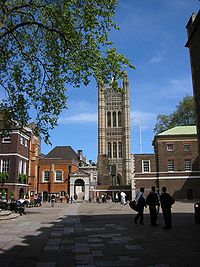 Elizabeth I re-founded the School in 1560, with new statutes to select 40 Queen's Scholars from boys who had already attended the school for a year. Queen Elizabeth frequently visited her scholars, although she never signed the statutes nor endowed her scholarships, and 1560 is now generally taken as the date that the school was "founded", although legal separation from the Abbey was only achieved with the Public Schools Act 1868
. There followed a scandalous public and parliamentary dispute over a further 25 years, to settle the transfer of the properties from the Canons of the Abbey to the School. Under the Act, the Dean of Westminster Abbey is ex officio the Chairman of the Governors; and school statutes have been made by Order in Council of Queen Elizabeth II
. Furthermore the Dean of Christ Church, Oxford
and the Master of Trinity College, Cambridge
are ex officio members of the school's governing body.
Camden
was a headmaster, but Dr Busby
, himself an Old Westminster, established the reputation of the school for several hundreds of years, as much by his classical learning as for his ruthless discipline of the birch
, immortalised in Pope
's Dunciad. Busby prayed publicly Up School for the safety of the Crown, on the very day of Charles I
's execution, and then locked the boys inside to prevent their going to watch the spectacle a few hundred yards away. Regardless of politics, he thrashed Royalist and Puritan boys alike without fear or favour. Busby also took part in Oliver Cromwell
's funeral procession in 1658; when Robert Uvedale, a Westminster schoolboy, succeeded in snatching the "Majesty Scutcheon" (white satin banner) draped on the coffin (it was given to the School by his family two hundred years later). Busby remained in office throughout the Civil War and the Commonwealth, when the school was governed by Parliamentary Commissioners, and well into the Restoration.
In 1679, a group of scholars killed a bailiff, ostensibly in defence of the Abbey's traditional right of sanctuary
, but possibly because the man was trying to arrest a consort of the boys. Dr Busby obtained a royal pardon for his scholars from Charles II
, and added the cost to the school bills.
During the 16th century the school educated writers including Ben Jonson
and Richard Hakluyt
; in the seventeenth, the poet John Dryden
, philosopher John Locke
, scientist Robert Hooke
, composer Henry Purcell
and architect Christopher Wren
were pupils; and in the 18th century, philosopher Jeremy Bentham
and several Whig Prime Ministers and other statesmen; recent Old Westminsters include prominent politicians of all parties, and many members of the arts and media.
 Until the 19th century, the curriculum was made up of Latin, Greek, Arabic, and Hebrew, all taught Up School. The Westminster boys were uncontrolled outside school hours and notoriously unruly about town, but the proximity of the School to the Palace of Westminster meant that politicians were well aware of the boys' exploits. After the Public Schools Act 1868
, in response to the Clarendon Report on the financial and other malpractices at nine pre-eminent public schools, the school began to approach its modern form. Unusually among the leading public schools
, however, Westminster did not adopt most of the broader changes associated with the Victorian
ethos of Thomas Arnold
, such as the emphasis on team over individual spirit, and the school retained much of its distinctive character. Despite many pressures, including evacuation and the destruction of the School roof during the Blitz
, the school also refused to move out of central London along with other prominent schools such as Charterhouse
and St. Paul's, and remains in its original location close by the centres of church and state.
Westminster Under School
was formed in 1943 at the evacuated school, as a distinct preparatory school for day pupils between the ages of 8 to 13 (now 7 to 13). Only the separation is new: for example, in the 18th century, Edward Gibbon
attended Westminster from the age of 11. The Under School has since moved to Vincent Square
, overlooking the School's playing fields. Its current Master is Mrs. Elizabeth Hill.
In 1967, the first female pupil was admitted to the Upper School, with girls becoming full members in all houses from 1973 onwards. In 1981, a single-sex boarding house, Purcell's, was created again, for girls. In 1997 the school expanded further with the creation of a new day house, Milne's at 6a, Dean's Yard.
In 2005 the school was one of fifty leading private schools guilty of running an illegal price-fixing cartel, exposed by The Times
, which had allowed them to drive up fees for thousands of customers. Each school agreed to pay a nominal penalty of £10,000 and ex-gratia payments totalling £3 million into a trust designed to benefit pupils who attended the schools during the period in respect of which fee information was shared. However, Mrs Jean Scott, the head of the Independent Schools Council, said that independent schools had always been exempt from anti-cartel rules applied to business, were following a long-established procedure in sharing the information with each other, and that they were unaware of the change to the law (on which they had not been consulted). She wrote to John Vickers, the OFT director-general, saying, "They are not a group of businessmen meeting behind closed doors to fix the price of their products to the disadvantage of the consumer. They are schools that have quite openly continued to follow a long-established practice because they were unaware that the law had changed."
In 2007, the school responded to an invitation to become the sponsor of Pimlico School
, which was due to be rebuilt as an academy but decided not to go ahead. Westminster City Council
chose John Nash, a businessman who owns the for-profit Alpha Plus schools group.
In 2010, the school and Westminster Abbey
hosted an event to celebrate the 450th anniversary of the granting of the institution's Royal Charter. Queen Elizabeth II, a guest of the occasion, unveiled a statue of her namesake in Dean's Yard. The Statue of The School's Foundress was created by sculptor and Old Westminster Matthew Spender.
, its main buildings surrounding its private square Little Dean's Yard
(known as 'Yard'), off Dean's Yard, where Church House, the headquarters of the Church of England
, is situated, along with some of the Houses, the Common Room, the new humanities building Weston's, and College Hall.
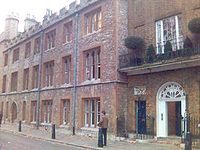 Immediately outside the Abbey precincts on Great College Street is Sutcliff's (named after the tuck shop in the building in the 19th century), where Geography, Art, Theology, Philosophy and Classics (Latin and Ancient Greek) are taught. The Robert Hooke
Science Centre is further away, just off Smith Square
. As part of an expansion programme funded by donations and a legacy from A. A. Milne
, the school has acquired the nearby Millicent Fawcett Hall for Drama and Theatre Studies lessons and performances; the Manoukian Centre for Music lessons (both timetabled and private) and recitals; and the Weston Building at 3 Dean's Yard. It also often uses St John's, Smith Square as a venue for major musical concerts.
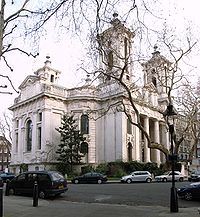 College Garden
, to the East of Little Dean's Yard, is believed to be the oldest garden in England, under continuous cultivation for around a millennium. Just beyond rises the Victoria Tower of the Houses of Parliament
; the Queen's Scholars have special rights of access to the House of Commons
. To the North, the Dark Cloister leads straight to the Abbey
, which serves as the School Chapel.
The playing fields are half a mile away at Vincent Square
, which Dean Vincent created for the School by hiring a horse and plough to carve 10 acres (40,468.6 m²) out of the open Tothill Fields. The boathouse is now some way from the school at Putney
, where it is also used for the Oxford and Cambridge boat race
; but the school's First Eight still returns annually to exercise its traditional right to land at Black Rod Steps of the Palace of Westminster
.
World Heritage Site of Westminster Abbey, St. Margaret’s, and the Palace of Westminster, has several buildings notable for unique qualities, age, and history.
'College Hall', the 14th-century Abbot's state dining hall, is one of the oldest and finest examples of mediæval refectory in existence, and is still in use for its original purpose every day in term-time; outside of term it reverts to the Dean, as the Abbot's successor. Queen Elizabeth Woodville
took sanctuary here in 1483 with 5 daughters and her son Richard, but failed to save him from his fate as one of the Princes in the Tower
. In the 1560s, Elizabeth I
several times came to see her scholars act their Latin Plays on a stage in front of the attractive Elizabethan gallery, which may have been first erected especially for the purpose. Lessons did take place within the hall during the 16th century also.
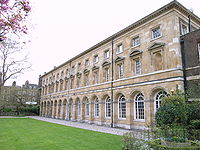 'College', now shared between the three Houses of College, Dryden's and Wren's, is a dressed stone building overlooking College Garden
, the former monastery's Infirmary garden which is still the property of the Collegiate Church of Westminster Abbey. College dates from 1729, and was designed by the Earl of Burlington
based on earlier designs from Sir Christopher Wren
(himself an Old Westminster).
'School', originally built in the 1090s as the monks' dormitory, is the School's main hall, used for Latin Prayers (a weekly assembly with prayers in the Westminster-dialect of Latin
), exams, and large concerts, plays and the like. From 1599 it was used to teach all the pupils, the Upper and Lower Schools being separated by a curtain hung from a 16th century pig iron
bar, which remains the largest piece of pig iron in the world. The stone steps and entranceway to School have been attributed to Inigo Jones
, and are engraved with the names of many pupils who used to hire a stonemason for the purpose. The panelling "up School" is similarly, but officially, painted with the coats of arms of many former pupils. The original shell-shaped apse at the North end of School gave its name to the Shell forms taught there and the corresponding classes at many other public schools
. The current shell displays a Latin epigram on the rebuilding of School, with the acrostic Semper Eadem, Elizabeth I's motto. The classroom door to the right of the Shell was recovered from the notorious Star Chamber
at its demolition.
 The building lies directly on top of the Westminster Abbey museum, and ends at the start or the Pyx Chamber.
Both School and College had their roofs destroyed during the Blitz by incendiary bombs in 1941. The buildings were re-opened by George VI
in 1950.
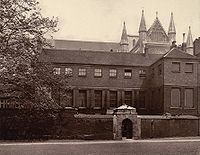 Ashburnham House
, which today houses the library the IT department and the Mathematics Department, was built by Inigo Jones or his pupil John Webb around the time of the Restoration as a London seat for the family who became the Earls of Ashburnham. It incorporates remains of the mediaeval Prior's House, and its garden is the site of the monks' refectory and some of the earliest sittings of the House of Commons
. In 1721 when Ashburnham housed the King's and Cottonian libraries, which form the basis of the British Library
, there was a disastrous fire, and many of the books and manuscripts still show the marks. After the Public Schools Act 1868
there was a scandalous parliamentary and legal battle between the Abbey and the School, until the School eventually obtained Ashburnham under the Act for £4,000. In 1881 William Morris
conducted a public campaign which succeeded in preventing its demolition but failed to save the neighbouring mediaeval buildings. During the Second World War
, the library was used for very senior military purposes, and the ground floor as an American officers' club.
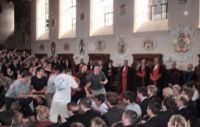 The 'Greaze' has been held "up School" (in the School Hall) on Shrove Tuesday
s since 1753: the head cook ceremoniously tosses a horsehair-reinforced pancake
over a high bar, which was used in the 16th century to curtain off the Lower School. Members of the school fight for the pancake for one minute, watched over by the Dean of Westminster Abbey (as Chairman of the Governors), the Head Master, the whole School and distinguished or even occasionally Royal visitors. The pupil who gets the largest weight is awarded a gold sovereign (promptly redeemed for use next year), and the Dean begs a half-holiday for the whole School. A cook who failed to get the 'pancake' over the bar would formerly have been "booked", or stoned with Latin primers, although that tradition has long lapsed.
The privilege of being the first commoners to acclaim each new sovereign at their coronation in Westminster Abbey is reserved for the Queen's (or King's) Scholars. Their shouts of "Vivat Regina" ("Long Live the Queen") are incorporated into the Coronation Anthem.
Despite the formal separation from the Abbey, the school remains Anglican
, with services in the Abbey attended by the entire school at least twice a week, and many other voluntary-attendance services of worship. The school was expressly exempted by the Act of Uniformity
to allow it to continue saying Latin prayers despite the Reformation
. Every Wednesday there is an assembly Up School known as Latin Prayers, which opens with the Headmaster leading all members of the school in chanting prayers in Latin
, followed by notices in English. The School's unique pronunciation of formal Latin is known as 'Westminster Latin', and descends from medieval English scholastic pronunciation: Queen Elizabeth I, who spoke fluent Latin, commanded that Latin was not to be said "in the monkish fashion", a significant warning upon loyalties between Church and State. A service called 'Little Commem' is given in Latin each year, in which the Queen's Scholars commemorate the school's benefactors, laying pink roses on the tomb of Elizabeth I
in Westminster Abbey
. In alternate years a much larger service called 'Big Commem' is given in its place, where the Praefectus (the Head Boy/Captain of the Queen's Scholars) lays a wreath of pink roses on the tomb of Elizabeth I. Prospective donors are particularly invited to note the School's gratitude to benefactors. From 2010 "Big Commem" will occur in every other year.
Since the monastic Christmas revels of mediæval times, Latin plays have been presented by the Scholars, with a prologue and witty epilogue on contemporary events. Annual plays, "either tragedy or comedy", were required by the school statutes in 1560, and some early plays were acted in College Hall before Elizabeth I
and her whole Council. However, in a more prudish age Queen Victoria did not accompany Prince Albert and the Prince of Wales to the play, and recorded in her diary that it was "very Improper". Today, the play is put on less frequently, any members of the school may take part, and the Master of the Queen's Scholars gives the Latin prologue. The 1938 play caused a diplomatic incident with the German ambassador withdrawing offended by the words 'Magna Germania' figuring in extenso on a map of Europe displayed.
The Queen's Scholars have privileged access to the House of Commons gallery, said to be a compromise recorded in the Standing Orders of the House in the 19th century, to stop the boys from climbing into the Palace over the roofs.
As well as the Queen's Scholar
ships which pay one half of boarding fees, and of which there are normally eight in each year, there are Honorary Scholarships for boys who pass the Challenge and could have been scholars but do not want to board. Stephen Hawking
was entered for the Challenge in 1952, but fell ill on the day of the Challenge examination.
Those entering the Lower School also have the opportunity to win scholarships based on musical talent, and bursaries for those whose parents are not able to fund their tuition.
, Westminster School had the highest average Oxbridge
acceptance rate over the period 2002–2007 of any school at 49.9% and had 77 pupils achieving Oxbridge places in 2005. It also has an 85.6% (5 year average) acceptance rate into the Sutton 13 elite list of the top 13 universities for research in the UK. The report claimed that, in general, independent schools achieve 16.3% more places at Sutton 13 universities than would be expected on merely from A-level grades, although it has been accepted that module grades were significantly better at Westminster and that the new A* at A-Level should provide more accurate differentiation.
The Lower and Upper Shell years are named after the shell-shaped alcove up School where they were originally taught; the name has been adopted by several other schools with a Westminster connection.
The first term of the academic year, from September to December, is known as Play Term. This is the term in which the Latin Play used to take place (see Customs). The second term, from January to Easter is the Lent Term. The third term of the academic year, from April to July is the Election Term. This is the term in which new scholars are elected, formerly in place of those examined and elected to the universities.
Begging a Play
The Challenge
Digniora
Election
Fields
The Greaze
Green
 Hurdle
Mill (obsolete)
Muzz (obsolete)
Order Sheets
The Pink List
Play
Praebendum (plural Praebenda)
Shag (Day)
Smug (obsolete)
Station
Up (house, School, etc.)
Water
Yard
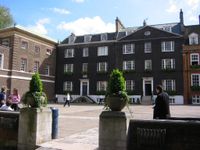 The school is split into 11 houses
, some of which are 'day houses' (and only admit day-pupils, those who go home after school), the others having a mix of day-pupils and boarders. The houses are named after people connected to the house or school in various ways — mainly prominent Old Westminsters but also former Head Masters and House Masters. Other than College, Grant's is the oldest house, not only of Westminster but of any public school.
Houses are a focus for pastoral care and social and sporting activities, as well as accommodation for boarders. All the day houses are mixed-sex, and all houses admit girls; only Busby's, Liddell's and Purcell's provide boarding accommodation for girls - the remainder admit day girls only.
Each house has associated colours, which are worn on ties awarded for various (usually sporting) achievement while representing the house. There are also pink-striped ties awarded for achievement while representing the whole school, with the amount of pink denoting the level of achievement. Wren's and Milne's use slightly different colours on house ties from those seen on their shirt.

College, the House of the Queen's Scholars (all of whom board), has assigned to it some of the non-boarding girls who enter the School in the VIth form.
 The School has three Eton Fives
courts, located behind Ashburnham House
. The school frequently fields pupils as national entries in international competitions in rowing
, or "Water", and fencing.
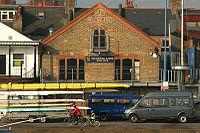
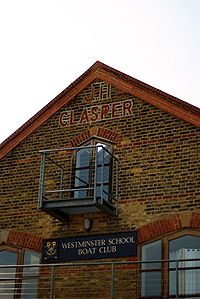 Westminster School has one of the oldest rowing clubs in the world, located on the River Thames
. The Oxford University Boat Club
uses Westminster's boat house at Putney as its HQ for the annual Oxford and Cambridge boat race
on the Thames. The boathouse was remodelled in 1997, and won a Wandsworth design award in 1999. The school's colour is pink; one suggested origin of this colour is that it was derived from washed-out red shirts worn by rowers. Another rumour is that Westminster rowers raced Eton College
for the right to wear pink. The story goes that, at one annual Eton-Westminster rowing race, both crews arrived wearing pink, which was fashionable at the time. The Eton crew bought some light-blue ribbon (which later became the standard Eton colours) to differentiate themselves, but the Westminster crew won the race and the right to wear pink in perpetuity. The premier Leander Club
at Henley, founded in London by a number of Old Westminster rowers, later adopted it, although they call the colour cerise. This unusual colour for sportsmen has occasionally provoked violent incidents in recent times, but usually removes any need for "away" kit; the only problems arise when racing against Abingdon School
, which also wears pink.
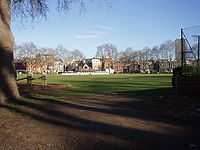 The School's main sports ground is nearby at Vincent Square, but it is limited to football and cricket on the main area and tennis and netball on the courts; it also hosts a playground for Westminster Under School. It is not large enough for all the pupils doing these sports to use simultaneously (the football pitches are made into cricket pitches for the summer). Therefore the school hires and owns other sporting facilities near the school. These include the oldest boating club in the world, an astroturf
ground in Battersea, and a fencing centre. 'Green' (Dean's Yard) is also used, as are the 2 school gyms (one in the Abbey Cloisters and one in the Weston's school building) and the three Fives courts, as well as informal "yard cricket", "yard football" and "Scuba Football" played in Little Dean's Yard.
Westminster played in the first school cricket match
against Charterhouse School
in 1794 and from 1796 played cricket against Eton.
Westminster has an historic joint claim to a major role in the development of Association Football
, which remains the school's largest sport. During the 1840s at both Westminster and Charterhouse
, pupils' surroundings meant they were confined to playing their football in the cloisters, making the rough and tumble of the handling game that was developing at other schools such as Rugby
impossible, and necessitating a new code of rules. During the formulation of the rules of Association Football in the 1860s, representatives of Westminster School and Charterhouse also pushed for a passing game, in particular rules that allowed forward passing ("passing on"). Other schools (in particular Eton College
and Harrow
) favoured a dribbling game with a tight off-side rule. By 1867 the Football Association
had chosen in favour of the Westminster and Charterhouse game and adopted an off-side rule that permitted forward passing. The modern forward-passing game was a direct consequence of Westminster and Charterhouse Football.
The school currently boasts two OWW professional footballers. Rafe Fletcher, who is at present signed to Conference Premier side Grimsby Town, and Patrick Meade who ended the 2010/2011 season with Peruvian second division team Hijos de Acosvinchos
In August 2009 the school's first XI gained a draw against the Chelsea Academy team. The result was seen as a shock, considering that football has not always been seen as the school's strength, but since then the team has beaten schools normally considered to be of a higher calibre, such as Millfield.

:
Westminster Abbey
The Collegiate Church of St Peter at Westminster, popularly known as Westminster Abbey, is a large, mainly Gothic church, in the City of Westminster, London, United Kingdom, located just to the west of the Palace of Westminster. It is the traditional place of coronation and burial site for English,...
in central London, and with a history stretching back to the 11th century, the school's notable alumni include Ben Jonson
Ben Jonson
Benjamin Jonson was an English Renaissance dramatist, poet and actor. A contemporary of William Shakespeare, he is best known for his satirical plays, particularly Volpone, The Alchemist, and Bartholomew Fair, which are considered his best, and his lyric poems...
, Robert Hooke
Robert Hooke
Robert Hooke FRS was an English natural philosopher, architect and polymath.His adult life comprised three distinct periods: as a scientific inquirer lacking money; achieving great wealth and standing through his reputation for hard work and scrupulous honesty following the great fire of 1666, but...
, Christopher Wren
Christopher Wren
Sir Christopher Wren FRS is one of the most highly acclaimed English architects in history.He used to be accorded responsibility for rebuilding 51 churches in the City of London after the Great Fire in 1666, including his masterpiece, St. Paul's Cathedral, on Ludgate Hill, completed in 1710...
, John Locke
John Locke
John Locke FRS , widely known as the Father of Liberalism, was an English philosopher and physician regarded as one of the most influential of Enlightenment thinkers. Considered one of the first of the British empiricists, following the tradition of Francis Bacon, he is equally important to social...
, Jeremy Bentham
Jeremy Bentham
Jeremy Bentham was an English jurist, philosopher, and legal and social reformer. He became a leading theorist in Anglo-American philosophy of law, and a political radical whose ideas influenced the development of welfarism...
, Edward Gibbon
Edward Gibbon
Edward Gibbon was an English historian and Member of Parliament...
, Henry Mayhew
Henry Mayhew
Henry Mayhew was an English social researcher, journalist, playwright and advocate of reform. He was one of the two founders of the satirical and humorous magazine Punch, and the magazine's joint-editor, with Mark Lemon, in its early days...
, A.A. Milne and Tony Benn
Tony Benn
Anthony Neil Wedgwood "Tony" Benn, PC is a British Labour Party politician and a former MP and Cabinet Minister.His successful campaign to renounce his hereditary peerage was instrumental in the creation of the Peerage Act 1963...
. The school traditionally encourages independent and individual thinking. Boys are admitted to the Under School
Westminster Under School
Westminster Under School is a private preparatory school for boys aged 7 to 13 and is attached to Westminster School in London.The school was founded in 1943 in the precincts of Westminster School in Little Dean’s Yard, just behind Westminster Abbey. In 1951 the Under School relocated to its own...
at age seven, and to the senior school at age thirteen; girls are admitted only at sixteen. The school has around 750 pupils; around a quarter are boarders
Boarding school
A boarding school is a school where some or all pupils study and live during the school year with their fellow students and possibly teachers and/or administrators. The word 'boarding' is used in the sense of "bed and board," i.e., lodging and meals...
, most of whom go home at weekends, after Saturday morning school. It is one of the original nine British public schools as defined by the Public Schools Act 1868
Public Schools Act 1868
The Public Schools Act 1868 was enacted by the British Parliament to reform and regulate nine of the leading English boys' schools. They were described as "public schools" as admission was open to boys from anywhere and was not limited to those living in a particular locality...
.
History
Although it is likely that schoolboys were taught by monks well beforehand, by 1179 Westminster School had certainly become a public schoolPublic School (UK)
A public school, in common British usage, is a school that is neither administered nor financed by the state or from taxpayer contributions, and is instead funded by a combination of endowments, tuition fees and charitable contributions, usually existing as a non profit-making charitable trust...
(i.e., a school available to members of the public from across the country, so long as they could pay their own costs, rather than private tuition provided to the nobility) as a decree of Pope Alexander III
Pope Alexander III
Pope Alexander III , born Rolando of Siena, was Pope from 1159 to 1181. He is noted in history for laying the foundation stone for the Notre Dame de Paris.-Church career:...
required the Benedictine
Benedictine
Benedictine refers to the spirituality and consecrated life in accordance with the Rule of St Benedict, written by Benedict of Nursia in the sixth century for the cenobitic communities he founded in central Italy. The most notable of these is Monte Cassino, the first monastery founded by Benedict...
monks of the Abbey at Westminster
Westminster Abbey
The Collegiate Church of St Peter at Westminster, popularly known as Westminster Abbey, is a large, mainly Gothic church, in the City of Westminster, London, United Kingdom, located just to the west of the Palace of Westminster. It is the traditional place of coronation and burial site for English,...
to provide a charity school to local boys. Parts of the school's buildings date back to the 11th century, older than the current Abbey.
This arrangement changed in 1540, when Henry VIII
Henry VIII of England
Henry VIII was King of England from 21 April 1509 until his death. He was Lord, and later King, of Ireland, as well as continuing the nominal claim by the English monarchs to the Kingdom of France...
ordered the dissolution of the monasteries
Dissolution of the Monasteries
The Dissolution of the Monasteries, sometimes referred to as the Suppression of the Monasteries, was the set of administrative and legal processes between 1536 and 1541 by which Henry VIII disbanded monasteries, priories, convents and friaries in England, Wales and Ireland; appropriated their...
in England, but personally ensured the School's survival by his royal charter. The College of St. Peter carried on with forty "King's Scholars" financed from the royal purse. During Mary I
Mary I of England
Mary I was queen regnant of England and Ireland from July 1553 until her death.She was the only surviving child born of the ill-fated marriage of Henry VIII and his first wife Catherine of Aragon. Her younger half-brother, Edward VI, succeeded Henry in 1547...
's brief reign the Abbey was reinstated as a Roman Catholic monastery. The School occupies a number of the buildings vacated by the monks.
Public Schools Act 1868
The Public Schools Act 1868 was enacted by the British Parliament to reform and regulate nine of the leading English boys' schools. They were described as "public schools" as admission was open to boys from anywhere and was not limited to those living in a particular locality...
. There followed a scandalous public and parliamentary dispute over a further 25 years, to settle the transfer of the properties from the Canons of the Abbey to the School. Under the Act, the Dean of Westminster Abbey is ex officio the Chairman of the Governors; and school statutes have been made by Order in Council of Queen Elizabeth II
Elizabeth II of the United Kingdom
Elizabeth II is the constitutional monarch of 16 sovereign states known as the Commonwealth realms: the United Kingdom, Canada, Australia, New Zealand, Jamaica, Barbados, the Bahamas, Grenada, Papua New Guinea, the Solomon Islands, Tuvalu, Saint Lucia, Saint Vincent and the Grenadines, Belize,...
. Furthermore the Dean of Christ Church, Oxford
Christ Church, Oxford
Christ Church or house of Christ, and thus sometimes known as The House), is one of the largest constituent colleges of the University of Oxford in England...
and the Master of Trinity College, Cambridge
Trinity College, Cambridge
Trinity College is a constituent college of the University of Cambridge. Trinity has more members than any other college in Cambridge or Oxford, with around 700 undergraduates, 430 graduates, and over 170 Fellows...
are ex officio members of the school's governing body.
Camden
William Camden
William Camden was an English antiquarian, historian, topographer, and officer of arms. He wrote the first chorographical survey of the islands of Great Britain and Ireland and the first detailed historical account of the reign of Elizabeth I of England.- Early years :Camden was born in London...
was a headmaster, but Dr Busby
Richard Busby
The Rev. Dr. Richard Busby was an English Anglican priest who served as head master of Westminster School for more than fifty-five years.-Life:...
, himself an Old Westminster, established the reputation of the school for several hundreds of years, as much by his classical learning as for his ruthless discipline of the birch
Birching
Birching is a corporal punishment with a birch rod, typically applied to the recipient's bare buttocks, although occasionally to the back and/or shoulders.-Implement:...
, immortalised in Pope
Alexander Pope
Alexander Pope was an 18th-century English poet, best known for his satirical verse and for his translation of Homer. He is the third-most frequently quoted writer in The Oxford Dictionary of Quotations, after Shakespeare and Tennyson...
's Dunciad. Busby prayed publicly Up School for the safety of the Crown, on the very day of Charles I
Charles I of England
Charles I was King of England, King of Scotland, and King of Ireland from 27 March 1625 until his execution in 1649. Charles engaged in a struggle for power with the Parliament of England, attempting to obtain royal revenue whilst Parliament sought to curb his Royal prerogative which Charles...
's execution, and then locked the boys inside to prevent their going to watch the spectacle a few hundred yards away. Regardless of politics, he thrashed Royalist and Puritan boys alike without fear or favour. Busby also took part in Oliver Cromwell
Oliver Cromwell
Oliver Cromwell was an English military and political leader who overthrew the English monarchy and temporarily turned England into a republican Commonwealth, and served as Lord Protector of England, Scotland, and Ireland....
's funeral procession in 1658; when Robert Uvedale, a Westminster schoolboy, succeeded in snatching the "Majesty Scutcheon" (white satin banner) draped on the coffin (it was given to the School by his family two hundred years later). Busby remained in office throughout the Civil War and the Commonwealth, when the school was governed by Parliamentary Commissioners, and well into the Restoration.
In 1679, a group of scholars killed a bailiff, ostensibly in defence of the Abbey's traditional right of sanctuary
Sanctuary
A sanctuary is any place of safety. They may be categorized into human and non-human .- Religious sanctuary :A religious sanctuary can be a sacred place , or a consecrated area of a church or temple around its tabernacle or altar.- Sanctuary as a sacred place :#Sanctuary as a sacred place:#:In...
, but possibly because the man was trying to arrest a consort of the boys. Dr Busby obtained a royal pardon for his scholars from Charles II
Charles II of England
Charles II was monarch of the three kingdoms of England, Scotland, and Ireland.Charles II's father, King Charles I, was executed at Whitehall on 30 January 1649, at the climax of the English Civil War...
, and added the cost to the school bills.
During the 16th century the school educated writers including Ben Jonson
Ben Jonson
Benjamin Jonson was an English Renaissance dramatist, poet and actor. A contemporary of William Shakespeare, he is best known for his satirical plays, particularly Volpone, The Alchemist, and Bartholomew Fair, which are considered his best, and his lyric poems...
and Richard Hakluyt
Richard Hakluyt
Richard Hakluyt was an English writer. He is principally remembered for his efforts in promoting and supporting the settlement of North America by the English through his works, notably Divers Voyages Touching the Discoverie of America and The Principal Navigations, Voiages, Traffiques and...
; in the seventeenth, the poet John Dryden
John Dryden
John Dryden was an influential English poet, literary critic, translator, and playwright who dominated the literary life of Restoration England to such a point that the period came to be known in literary circles as the Age of Dryden.Walter Scott called him "Glorious John." He was made Poet...
, philosopher John Locke
John Locke
John Locke FRS , widely known as the Father of Liberalism, was an English philosopher and physician regarded as one of the most influential of Enlightenment thinkers. Considered one of the first of the British empiricists, following the tradition of Francis Bacon, he is equally important to social...
, scientist Robert Hooke
Robert Hooke
Robert Hooke FRS was an English natural philosopher, architect and polymath.His adult life comprised three distinct periods: as a scientific inquirer lacking money; achieving great wealth and standing through his reputation for hard work and scrupulous honesty following the great fire of 1666, but...
, composer Henry Purcell
Henry Purcell
Henry Purcell – 21 November 1695), was an English organist and Baroque composer of secular and sacred music. Although Purcell incorporated Italian and French stylistic elements into his compositions, his legacy was a uniquely English form of Baroque music...
and architect Christopher Wren
Christopher Wren
Sir Christopher Wren FRS is one of the most highly acclaimed English architects in history.He used to be accorded responsibility for rebuilding 51 churches in the City of London after the Great Fire in 1666, including his masterpiece, St. Paul's Cathedral, on Ludgate Hill, completed in 1710...
were pupils; and in the 18th century, philosopher Jeremy Bentham
Jeremy Bentham
Jeremy Bentham was an English jurist, philosopher, and legal and social reformer. He became a leading theorist in Anglo-American philosophy of law, and a political radical whose ideas influenced the development of welfarism...
and several Whig Prime Ministers and other statesmen; recent Old Westminsters include prominent politicians of all parties, and many members of the arts and media.
Public Schools Act 1868
The Public Schools Act 1868 was enacted by the British Parliament to reform and regulate nine of the leading English boys' schools. They were described as "public schools" as admission was open to boys from anywhere and was not limited to those living in a particular locality...
, in response to the Clarendon Report on the financial and other malpractices at nine pre-eminent public schools, the school began to approach its modern form. Unusually among the leading public schools
Public School (UK)
A public school, in common British usage, is a school that is neither administered nor financed by the state or from taxpayer contributions, and is instead funded by a combination of endowments, tuition fees and charitable contributions, usually existing as a non profit-making charitable trust...
, however, Westminster did not adopt most of the broader changes associated with the Victorian
Victorian era
The Victorian era of British history was the period of Queen Victoria's reign from 20 June 1837 until her death on 22 January 1901. It was a long period of peace, prosperity, refined sensibilities and national self-confidence...
ethos of Thomas Arnold
Thomas Arnold
Dr Thomas Arnold was a British educator and historian. Arnold was an early supporter of the Broad Church Anglican movement...
, such as the emphasis on team over individual spirit, and the school retained much of its distinctive character. Despite many pressures, including evacuation and the destruction of the School roof during the Blitz
The Blitz
The Blitz was the sustained strategic bombing of Britain by Nazi Germany between 7 September 1940 and 10 May 1941, during the Second World War. The city of London was bombed by the Luftwaffe for 76 consecutive nights and many towns and cities across the country followed...
, the school also refused to move out of central London along with other prominent schools such as Charterhouse
Charterhouse School
Charterhouse School, originally The Hospital of King James and Thomas Sutton in Charterhouse, or more simply Charterhouse or House, is an English collegiate independent boarding school situated at Godalming in Surrey.Founded by Thomas Sutton in London in 1611 on the site of the old Carthusian...
and St. Paul's, and remains in its original location close by the centres of church and state.
Westminster Under School
Westminster Under School
Westminster Under School is a private preparatory school for boys aged 7 to 13 and is attached to Westminster School in London.The school was founded in 1943 in the precincts of Westminster School in Little Dean’s Yard, just behind Westminster Abbey. In 1951 the Under School relocated to its own...
was formed in 1943 at the evacuated school, as a distinct preparatory school for day pupils between the ages of 8 to 13 (now 7 to 13). Only the separation is new: for example, in the 18th century, Edward Gibbon
Edward Gibbon
Edward Gibbon was an English historian and Member of Parliament...
attended Westminster from the age of 11. The Under School has since moved to Vincent Square
Vincent Square
Vincent Square is a large grass-covered square in Westminster, London, England, covering 13 acres. It provides playing fields for Westminster School, which privately owns it....
, overlooking the School's playing fields. Its current Master is Mrs. Elizabeth Hill.
In 1967, the first female pupil was admitted to the Upper School, with girls becoming full members in all houses from 1973 onwards. In 1981, a single-sex boarding house, Purcell's, was created again, for girls. In 1997 the school expanded further with the creation of a new day house, Milne's at 6a, Dean's Yard.
In 2005 the school was one of fifty leading private schools guilty of running an illegal price-fixing cartel, exposed by The Times
The Times
The Times is a British daily national newspaper, first published in London in 1785 under the title The Daily Universal Register . The Times and its sister paper The Sunday Times are published by Times Newspapers Limited, a subsidiary since 1981 of News International...
, which had allowed them to drive up fees for thousands of customers. Each school agreed to pay a nominal penalty of £10,000 and ex-gratia payments totalling £3 million into a trust designed to benefit pupils who attended the schools during the period in respect of which fee information was shared. However, Mrs Jean Scott, the head of the Independent Schools Council, said that independent schools had always been exempt from anti-cartel rules applied to business, were following a long-established procedure in sharing the information with each other, and that they were unaware of the change to the law (on which they had not been consulted). She wrote to John Vickers, the OFT director-general, saying, "They are not a group of businessmen meeting behind closed doors to fix the price of their products to the disadvantage of the consumer. They are schools that have quite openly continued to follow a long-established practice because they were unaware that the law had changed."
In 2007, the school responded to an invitation to become the sponsor of Pimlico School
Pimlico School
Pimlico Academy is a secondary school in the Pimlico area of Westminster, London. The school is a specialist Arts College.-Architecture:The previous school building was designed by John Bancroft of the Greater London Council's architecture department and was built in 1967-70...
, which was due to be rebuilt as an academy but decided not to go ahead. Westminster City Council
Westminster City Council
Westminster City Council is the local authority for the City of Westminster in Greater London, England. It is a London borough council and is entitled to be known as a city council, which is a rare distinction in the United Kingdom. The city is divided into 20 wards, each electing three councillors...
chose John Nash, a businessman who owns the for-profit Alpha Plus schools group.
In 2010, the school and Westminster Abbey
Westminster Abbey
The Collegiate Church of St Peter at Westminster, popularly known as Westminster Abbey, is a large, mainly Gothic church, in the City of Westminster, London, United Kingdom, located just to the west of the Palace of Westminster. It is the traditional place of coronation and burial site for English,...
hosted an event to celebrate the 450th anniversary of the granting of the institution's Royal Charter. Queen Elizabeth II, a guest of the occasion, unveiled a statue of her namesake in Dean's Yard. The Statue of The School's Foundress was created by sculptor and Old Westminster Matthew Spender.
Location
The School is located primarily in the walled precincts of the former mediæval monastery at Westminster AbbeyWestminster Abbey
The Collegiate Church of St Peter at Westminster, popularly known as Westminster Abbey, is a large, mainly Gothic church, in the City of Westminster, London, United Kingdom, located just to the west of the Palace of Westminster. It is the traditional place of coronation and burial site for English,...
, its main buildings surrounding its private square Little Dean's Yard
Little Dean's Yard
Little Dean's Yard, known to Westminster School just as Yard, is a private gated yard at the heart of the school, within the precincts of the ancient monastery of Westminster....
(known as 'Yard'), off Dean's Yard, where Church House, the headquarters of the Church of England
Church of England
The Church of England is the officially established Christian church in England and the Mother Church of the worldwide Anglican Communion. The church considers itself within the tradition of Western Christianity and dates its formal establishment principally to the mission to England by St...
, is situated, along with some of the Houses, the Common Room, the new humanities building Weston's, and College Hall.
Robert Hooke
Robert Hooke FRS was an English natural philosopher, architect and polymath.His adult life comprised three distinct periods: as a scientific inquirer lacking money; achieving great wealth and standing through his reputation for hard work and scrupulous honesty following the great fire of 1666, but...
Science Centre is further away, just off Smith Square
Smith Square
Smith Square is a square in the Westminster district of London, just south of the Palace of Westminster. The centre of the square is occupied by St John's, Smith Square, a Baroque church now used as a concert hall...
. As part of an expansion programme funded by donations and a legacy from A. A. Milne
A. A. Milne
Alan Alexander Milne was an English author, best known for his books about the teddy bear Winnie-the-Pooh and for various children's poems. Milne was a noted writer, primarily as a playwright, before the huge success of Pooh overshadowed all his previous work.-Biography:A. A...
, the school has acquired the nearby Millicent Fawcett Hall for Drama and Theatre Studies lessons and performances; the Manoukian Centre for Music lessons (both timetabled and private) and recitals; and the Weston Building at 3 Dean's Yard. It also often uses St John's, Smith Square as a venue for major musical concerts.
College Garden
College Garden is a private garden of Westminster Abbey in London, open to the public on some Tuesday and Thursday afternoons.A thousand years ago it was the infirmary garden of the monastery, and it is said to be the oldest garden in England under continuous cultivation; the produce can have done...
, to the East of Little Dean's Yard, is believed to be the oldest garden in England, under continuous cultivation for around a millennium. Just beyond rises the Victoria Tower of the Houses of Parliament
Palace of Westminster
The Palace of Westminster, also known as the Houses of Parliament or Westminster Palace, is the meeting place of the two houses of the Parliament of the United Kingdom—the House of Lords and the House of Commons...
; the Queen's Scholars have special rights of access to the House of Commons
British House of Commons
The House of Commons is the lower house of the Parliament of the United Kingdom, which also comprises the Sovereign and the House of Lords . Both Commons and Lords meet in the Palace of Westminster. The Commons is a democratically elected body, consisting of 650 members , who are known as Members...
. To the North, the Dark Cloister leads straight to the Abbey
Westminster Abbey
The Collegiate Church of St Peter at Westminster, popularly known as Westminster Abbey, is a large, mainly Gothic church, in the City of Westminster, London, United Kingdom, located just to the west of the Palace of Westminster. It is the traditional place of coronation and burial site for English,...
, which serves as the School Chapel.
The playing fields are half a mile away at Vincent Square
Vincent Square
Vincent Square is a large grass-covered square in Westminster, London, England, covering 13 acres. It provides playing fields for Westminster School, which privately owns it....
, which Dean Vincent created for the School by hiring a horse and plough to carve 10 acres (40,468.6 m²) out of the open Tothill Fields. The boathouse is now some way from the school at Putney
Putney
Putney is a district in south-west London, England, located in the London Borough of Wandsworth. It is situated south-west of Charing Cross. The area is identified in the London Plan as one of 35 major centres in Greater London....
, where it is also used for the Oxford and Cambridge boat race
The Boat Race
The event generally known as "The Boat Race" is a rowing race in England between the Oxford University Boat Club and the Cambridge University Boat Club, rowed between competing eights each spring on the River Thames in London. It takes place generally on the last Saturday of March or the first...
; but the school's First Eight still returns annually to exercise its traditional right to land at Black Rod Steps of the Palace of Westminster
Palace of Westminster
The Palace of Westminster, also known as the Houses of Parliament or Westminster Palace, is the meeting place of the two houses of the Parliament of the United Kingdom—the House of Lords and the House of Commons...
.
Notable buildings
Westminster School, situated in the middle of the UNESCOUNESCO
The United Nations Educational, Scientific and Cultural Organization is a specialized agency of the United Nations...
World Heritage Site of Westminster Abbey, St. Margaret’s, and the Palace of Westminster, has several buildings notable for unique qualities, age, and history.
'College Hall', the 14th-century Abbot's state dining hall, is one of the oldest and finest examples of mediæval refectory in existence, and is still in use for its original purpose every day in term-time; outside of term it reverts to the Dean, as the Abbot's successor. Queen Elizabeth Woodville
Elizabeth Woodville
Elizabeth Woodville was Queen consort of England as the spouse of King Edward IV from 1464 until his death in 1483. Elizabeth was a key figure in the series of dynastic civil wars known as the Wars of the Roses. Her first husband, Sir John Grey of Groby was killed at the Second Battle of St Albans...
took sanctuary here in 1483 with 5 daughters and her son Richard, but failed to save him from his fate as one of the Princes in the Tower
Princes in the Tower
The Princes in the Tower is a term which refers to Edward V of England and Richard of Shrewsbury, 1st Duke of York. The two brothers were the only sons of Edward IV of England and Elizabeth Woodville alive at the time of their father's death...
. In the 1560s, Elizabeth I
Elizabeth I of England
Elizabeth I was queen regnant of England and Ireland from 17 November 1558 until her death. Sometimes called The Virgin Queen, Gloriana, or Good Queen Bess, Elizabeth was the fifth and last monarch of the Tudor dynasty...
several times came to see her scholars act their Latin Plays on a stage in front of the attractive Elizabethan gallery, which may have been first erected especially for the purpose. Lessons did take place within the hall during the 16th century also.
College Garden
College Garden is a private garden of Westminster Abbey in London, open to the public on some Tuesday and Thursday afternoons.A thousand years ago it was the infirmary garden of the monastery, and it is said to be the oldest garden in England under continuous cultivation; the produce can have done...
, the former monastery's Infirmary garden which is still the property of the Collegiate Church of Westminster Abbey. College dates from 1729, and was designed by the Earl of Burlington
Earl of Burlington
Earl of Burlington is a title that has been created twice, the first time in the Peerage of England and the second in the Peerage of the United Kingdom. The first creation was for Richard Boyle, 2nd Earl of Cork, on 20 March 1664...
based on earlier designs from Sir Christopher Wren
Christopher Wren
Sir Christopher Wren FRS is one of the most highly acclaimed English architects in history.He used to be accorded responsibility for rebuilding 51 churches in the City of London after the Great Fire in 1666, including his masterpiece, St. Paul's Cathedral, on Ludgate Hill, completed in 1710...
(himself an Old Westminster).
'School', originally built in the 1090s as the monks' dormitory, is the School's main hall, used for Latin Prayers (a weekly assembly with prayers in the Westminster-dialect of Latin
Latin
Latin is an Italic language originally spoken in Latium and Ancient Rome. It, along with most European languages, is a descendant of the ancient Proto-Indo-European language. Although it is considered a dead language, a number of scholars and members of the Christian clergy speak it fluently, and...
), exams, and large concerts, plays and the like. From 1599 it was used to teach all the pupils, the Upper and Lower Schools being separated by a curtain hung from a 16th century pig iron
Pig iron
Pig iron is the intermediate product of smelting iron ore with a high-carbon fuel such as coke, usually with limestone as a flux. Charcoal and anthracite have also been used as fuel...
bar, which remains the largest piece of pig iron in the world. The stone steps and entranceway to School have been attributed to Inigo Jones
Inigo Jones
Inigo Jones is the first significant British architect of the modern period, and the first to bring Italianate Renaissance architecture to England...
, and are engraved with the names of many pupils who used to hire a stonemason for the purpose. The panelling "up School" is similarly, but officially, painted with the coats of arms of many former pupils. The original shell-shaped apse at the North end of School gave its name to the Shell forms taught there and the corresponding classes at many other public schools
Public School (UK)
A public school, in common British usage, is a school that is neither administered nor financed by the state or from taxpayer contributions, and is instead funded by a combination of endowments, tuition fees and charitable contributions, usually existing as a non profit-making charitable trust...
. The current shell displays a Latin epigram on the rebuilding of School, with the acrostic Semper Eadem, Elizabeth I's motto. The classroom door to the right of the Shell was recovered from the notorious Star Chamber
Star Chamber
The Star Chamber was an English court of law that sat at the royal Palace of Westminster until 1641. It was made up of Privy Counsellors, as well as common-law judges and supplemented the activities of the common-law and equity courts in both civil and criminal matters...
at its demolition.
Both School and College had their roofs destroyed during the Blitz by incendiary bombs in 1941. The buildings were re-opened by George VI
George VI of the United Kingdom
George VI was King of the United Kingdom and the Dominions of the British Commonwealth from 11 December 1936 until his death...
in 1950.
Ashburnham House
Ashburnham House is an extended seventeenth-century house on Little Dean's Yard in Westminster, London, United Kingdom, and since 1882 has been part of Westminster School...
, which today houses the library the IT department and the Mathematics Department, was built by Inigo Jones or his pupil John Webb around the time of the Restoration as a London seat for the family who became the Earls of Ashburnham. It incorporates remains of the mediaeval Prior's House, and its garden is the site of the monks' refectory and some of the earliest sittings of the House of Commons
British House of Commons
The House of Commons is the lower house of the Parliament of the United Kingdom, which also comprises the Sovereign and the House of Lords . Both Commons and Lords meet in the Palace of Westminster. The Commons is a democratically elected body, consisting of 650 members , who are known as Members...
. In 1721 when Ashburnham housed the King's and Cottonian libraries, which form the basis of the British Library
British Library
The British Library is the national library of the United Kingdom, and is the world's largest library in terms of total number of items. The library is a major research library, holding over 150 million items from every country in the world, in virtually all known languages and in many formats,...
, there was a disastrous fire, and many of the books and manuscripts still show the marks. After the Public Schools Act 1868
Public Schools Act 1868
The Public Schools Act 1868 was enacted by the British Parliament to reform and regulate nine of the leading English boys' schools. They were described as "public schools" as admission was open to boys from anywhere and was not limited to those living in a particular locality...
there was a scandalous parliamentary and legal battle between the Abbey and the School, until the School eventually obtained Ashburnham under the Act for £4,000. In 1881 William Morris
William Morris
William Morris 24 March 18343 October 1896 was an English textile designer, artist, writer, and socialist associated with the Pre-Raphaelite Brotherhood and the English Arts and Crafts Movement...
conducted a public campaign which succeeded in preventing its demolition but failed to save the neighbouring mediaeval buildings. During the Second World War
World War II
World War II, or the Second World War , was a global conflict lasting from 1939 to 1945, involving most of the world's nations—including all of the great powers—eventually forming two opposing military alliances: the Allies and the Axis...
, the library was used for very senior military purposes, and the ground floor as an American officers' club.
Customs
Shrove Tuesday
Shrove Tuesday is a term used in English-speaking countries, especially in Ireland, United Kingdom, Canada, Australia, New Zealand, Philippines, Germany, and parts of the United States for the day preceding Ash Wednesday, the first day of the season of fasting and prayer called Lent.The...
s since 1753: the head cook ceremoniously tosses a horsehair-reinforced pancake
Pancake
A pancake is a thin, flat, round cake prepared from a batter, and cooked on a hot griddle or frying pan. Most pancakes are quick breads; some use a yeast-raised or fermented batter. Most pancakes are cooked one side on a griddle and flipped partway through to cook the other side...
over a high bar, which was used in the 16th century to curtain off the Lower School. Members of the school fight for the pancake for one minute, watched over by the Dean of Westminster Abbey (as Chairman of the Governors), the Head Master, the whole School and distinguished or even occasionally Royal visitors. The pupil who gets the largest weight is awarded a gold sovereign (promptly redeemed for use next year), and the Dean begs a half-holiday for the whole School. A cook who failed to get the 'pancake' over the bar would formerly have been "booked", or stoned with Latin primers, although that tradition has long lapsed.
The privilege of being the first commoners to acclaim each new sovereign at their coronation in Westminster Abbey is reserved for the Queen's (or King's) Scholars. Their shouts of "Vivat Regina" ("Long Live the Queen") are incorporated into the Coronation Anthem.
Despite the formal separation from the Abbey, the school remains Anglican
Anglicanism
Anglicanism is a tradition within Christianity comprising churches with historical connections to the Church of England or similar beliefs, worship and church structures. The word Anglican originates in ecclesia anglicana, a medieval Latin phrase dating to at least 1246 that means the English...
, with services in the Abbey attended by the entire school at least twice a week, and many other voluntary-attendance services of worship. The school was expressly exempted by the Act of Uniformity
Act of Uniformity
Over the course of English parliamentary history there were a number of acts of uniformity. All had the basic object of establishing some sort of religious orthodoxy within the English church....
to allow it to continue saying Latin prayers despite the Reformation
English Reformation
The English Reformation was the series of events in 16th-century England by which the Church of England broke away from the authority of the Pope and the Roman Catholic Church....
. Every Wednesday there is an assembly Up School known as Latin Prayers, which opens with the Headmaster leading all members of the school in chanting prayers in Latin
Latin
Latin is an Italic language originally spoken in Latium and Ancient Rome. It, along with most European languages, is a descendant of the ancient Proto-Indo-European language. Although it is considered a dead language, a number of scholars and members of the Christian clergy speak it fluently, and...
, followed by notices in English. The School's unique pronunciation of formal Latin is known as 'Westminster Latin', and descends from medieval English scholastic pronunciation: Queen Elizabeth I, who spoke fluent Latin, commanded that Latin was not to be said "in the monkish fashion", a significant warning upon loyalties between Church and State. A service called 'Little Commem' is given in Latin each year, in which the Queen's Scholars commemorate the school's benefactors, laying pink roses on the tomb of Elizabeth I
Elizabeth I of England
Elizabeth I was queen regnant of England and Ireland from 17 November 1558 until her death. Sometimes called The Virgin Queen, Gloriana, or Good Queen Bess, Elizabeth was the fifth and last monarch of the Tudor dynasty...
in Westminster Abbey
Westminster Abbey
The Collegiate Church of St Peter at Westminster, popularly known as Westminster Abbey, is a large, mainly Gothic church, in the City of Westminster, London, United Kingdom, located just to the west of the Palace of Westminster. It is the traditional place of coronation and burial site for English,...
. In alternate years a much larger service called 'Big Commem' is given in its place, where the Praefectus (the Head Boy/Captain of the Queen's Scholars) lays a wreath of pink roses on the tomb of Elizabeth I. Prospective donors are particularly invited to note the School's gratitude to benefactors. From 2010 "Big Commem" will occur in every other year.
Since the monastic Christmas revels of mediæval times, Latin plays have been presented by the Scholars, with a prologue and witty epilogue on contemporary events. Annual plays, "either tragedy or comedy", were required by the school statutes in 1560, and some early plays were acted in College Hall before Elizabeth I
Elizabeth I of England
Elizabeth I was queen regnant of England and Ireland from 17 November 1558 until her death. Sometimes called The Virgin Queen, Gloriana, or Good Queen Bess, Elizabeth was the fifth and last monarch of the Tudor dynasty...
and her whole Council. However, in a more prudish age Queen Victoria did not accompany Prince Albert and the Prince of Wales to the play, and recorded in her diary that it was "very Improper". Today, the play is put on less frequently, any members of the school may take part, and the Master of the Queen's Scholars gives the Latin prologue. The 1938 play caused a diplomatic incident with the German ambassador withdrawing offended by the words 'Magna Germania' figuring in extenso on a map of Europe displayed.
The Queen's Scholars have privileged access to the House of Commons gallery, said to be a compromise recorded in the Standing Orders of the House in the 19th century, to stop the boys from climbing into the Palace over the roofs.
Entry
There are four main points of entry for pupils:- For the Under SchoolWestminster Under SchoolWestminster Under School is a private preparatory school for boys aged 7 to 13 and is attached to Westminster School in London.The school was founded in 1943 in the precincts of Westminster School in Little Dean’s Yard, just behind Westminster Abbey. In 1951 the Under School relocated to its own...
, at ages 7, 8, and 11, judged by a combination of internal exam and interview. - For the Lower School, at age 13, judged by either Common EntranceCommon EntranceCommon Entrance Examinations are taken by some children in the UK as part of the admissions process for academically selective secondary schools at age 13 or 11. Most of the secondary schools that use Common Entrance for admission are public schools; most of the schools that routinely prepare...
, a standardised, national set of exams for entrance to independent schools, for standard entry; or the Challenge, an internal set of exams for scholarship entry; as well as interview. - For the Upper School, at age 16, judged by subject-specific exams and interviews and conditional upon GCSEGeneral Certificate of Secondary EducationThe General Certificate of Secondary Education is an academic qualification awarded in a specified subject, generally taken in a number of subjects by students aged 14–16 in secondary education in England, Wales and Northern Ireland and is equivalent to a Level 2 and Level 1 in Key Skills...
results. This is the only point of entry for girls, and only a handful of boys join at this point each year.
As well as the Queen's Scholar
Queen's Scholar
The longest-established Queen's Scholarships are the forty scholarships at Westminster School, founded in 1560 by Queen Elizabeth I. These scholars take part in the coronation in Westminster Abbey, acclaiming the new monarch by shouting "Vivat". They also have the right to observe parliament...
ships which pay one half of boarding fees, and of which there are normally eight in each year, there are Honorary Scholarships for boys who pass the Challenge and could have been scholars but do not want to board. Stephen Hawking
Stephen Hawking
Stephen William Hawking, CH, CBE, FRS, FRSA is an English theoretical physicist and cosmologist, whose scientific books and public appearances have made him an academic celebrity...
was entered for the Challenge in 1952, but fell ill on the day of the Challenge examination.
Those entering the Lower School also have the opportunity to win scholarships based on musical talent, and bursaries for those whose parents are not able to fund their tuition.
University applications
According to a report by the Sutton TrustSutton Trust
The Sutton Trust is an educational charity in the United Kingdom which aims to provide educational opportunities to young people from non-privileged backgrounds...
, Westminster School had the highest average Oxbridge
Oxbridge
Oxbridge is a portmanteau of the University of Oxford and the University of Cambridge in England, and the term is now used to refer to them collectively, often with implications of perceived superior social status...
acceptance rate over the period 2002–2007 of any school at 49.9% and had 77 pupils achieving Oxbridge places in 2005. It also has an 85.6% (5 year average) acceptance rate into the Sutton 13 elite list of the top 13 universities for research in the UK. The report claimed that, in general, independent schools achieve 16.3% more places at Sutton 13 universities than would be expected on merely from A-level grades, although it has been accepted that module grades were significantly better at Westminster and that the new A* at A-Level should provide more accurate differentiation.
Westminster jargon
Westminster has an unusual system for naming the school years, which can cause confusion to those not familiar with the system.- Year 9: Fifth Form
- Year 10: Lower Shell
- Year 11: Upper Shell (GCSE)
- Year 12: Sixth Form (AS)
- Year 13: Remove (A2)
The Lower and Upper Shell years are named after the shell-shaped alcove up School where they were originally taught; the name has been adopted by several other schools with a Westminster connection.
The first term of the academic year, from September to December, is known as Play Term. This is the term in which the Latin Play used to take place (see Customs). The second term, from January to Easter is the Lent Term. The third term of the academic year, from April to July is the Election Term. This is the term in which new scholars are elected, formerly in place of those examined and elected to the universities.
Other jargon and slang
Abbey- When used without an article, refers to the compulsory morning service in the Abbey on Mondays and Fridays; "It's time for Abbey".
Begging a Play
- Making a request for a Play (qv). The Dean annually begs a play at the Greaze, but other plays may also be begged especially by celebrities or in recognition of notable events in the life of the School.
The Challenge
- The exam sat by boys applying for scholarships. It was wholly oral until 1855, its name deriving from the practice of a candidate interrupting, or 'challenging' one already speaking.
Digniora
- An award given to a pupil for an outstanding piece of work. Previously issued to pupils from all years (Vth form - Remove), it is now only given to boys in the lower school (Vth, Lower Shell and Upper Shell). An award of a digniora was once an extremely rare event, normally unwitnessed over the course of a Westminster career. The teacher awarding one would write digniora on the work to be honoured with instructions for the pupil to proceed to his housemaster; his housemaster would then escort the pupil to the Headmaster's study where a beaming head would fish out from a cache of surplus Maundy moneyMaundy moneyRoyal Maundy is a religious service in the Church of England held on Maundy Thursday, the day before Good Friday. At the service, the British Monarch or a royal official ceremonially distributes small silver coins known as "Maundy money" as symbolic alms to elderly recipients...
a piece of silver coinage. More recently the custom has evolved where pupils who receive one go to the Head of Year to be given a silver threepenny piece, generally from the early 20th century, and once 3 dignioras have been earned they can go and see the Head Master to be given a £10 book token.
Election
- A year of scholars. The first election are the year 9 scholars, the second election are the year 10 scholars etc. There are usually eight scholars in each of 5 Elections.
Fields
- Vincent SquareVincent SquareVincent Square is a large grass-covered square in Westminster, London, England, covering 13 acres. It provides playing fields for Westminster School, which privately owns it....
. One is always "up Fields". See "Up".
The Greaze
- Annual pancake fight. See the section on customs.
Green
- Dean's YardDean's YardDean's Yard, Westminster, comprises most of the remaining precincts of the former monastery of Westminster, not occupied by the Abbey buildings. It is known to members of Westminster School as Green, and referred to without an article...
; The lawn in the middle of Dean's Yard; "The school has a legal right to play football on Green" (always without an articleArticle (grammar)An article is a word that combines with a noun to indicate the type of reference being made by the noun. Articles specify the grammatical definiteness of the noun, in some languages extending to volume or numerical scope. The articles in the English language are the and a/an, and some...
).
- End of term exams for the Upper School, first coined by the Classics department in the 1970s.
Mill (obsolete)
- A fight.
Muzz (obsolete)
- Swot (both noun and verb). This word was still in use in the 1920s and attempts were made to revive it in the 1970s.
- During the annual Anglican confirmation service, non-church goers are confined to their Houses. This is referred to as occupat.
Order Sheets
- School reports.
The Pink List
- The list of pupils and members of the Common Room of the school. This exists both as a small pink book (the source of the name) and as a computer database.
Play
- A day's holiday, especially in conjunction with a notable event. Annual plays are the Queen's Play and the Dean's Play. A recent extraordinary play was the "Pooh Play" in recognition of the School's selling the rights to Winnie the Pooh to the Walt Disney Corporation. The day on which a play is given is usually a Saturday. qv 'Begging a play'.
Praebendum (plural Praebenda)
- Essentially same as a Digniora, but issued to those boys and girls in the Upper School (VIth and Remove) who submit outstanding pieces of work, or attain well-above average test results.
Shag (Day)
- Pupils may attend school wearing clothes not specified by the uniform code, but are expected to give to charity if they do so. This is only permitted on certain days; "It's Shag Day on Friday." Compare mufti day. As a verb, it was widely used to mean "play truant", but fell into disuse due to the more widely known modern meaning.
Smug (obsolete)
- Noun meaning a self-satisfied person. Still in use in early 20th century
Station
- Sports which are compulsory and held on Tuesday and Thursday afternoon at various times; "He missed Station as he was sick". Originally it meant any compulsory engagement.
Up (house, School, etc.)
- "Inside" or "to". "You should be up house if you don't have a lesson", "Latin prayers take place up School". Events in Vincent Square are said to be "up Fields", particularly among the Common Room. Exceptions to the rule are that one is never "up College" only "in College", "in Yard" and "on Green".
Water
- Rowing Station (the Westminster School boat club is based in PutneyPutneyPutney is a district in south-west London, England, located in the London Borough of Wandsworth. It is situated south-west of Charing Cross. The area is identified in the London Plan as one of 35 major centres in Greater London....
)
Yard
- Little Dean's YardLittle Dean's YardLittle Dean's Yard, known to Westminster School just as Yard, is a private gated yard at the heart of the school, within the precincts of the ancient monastery of Westminster....
; "He was in Yard" (always without an articleArticle (grammar)An article is a word that combines with a noun to indicate the type of reference being made by the noun. Articles specify the grammatical definiteness of the noun, in some languages extending to volume or numerical scope. The articles in the English language are the and a/an, and some...
). This is also often used to refer to the period after Prep from 9pm to 10pm when boarders are free to entertain themselves in Yard.
Houses
House system
The house system is a traditional feature of British schools, and schools in the Commonwealth. Historically, it was associated with established public schools, where a 'house' refers to a boarding house or dormitory of a boarding school...
, some of which are 'day houses' (and only admit day-pupils, those who go home after school), the others having a mix of day-pupils and boarders. The houses are named after people connected to the house or school in various ways — mainly prominent Old Westminsters but also former Head Masters and House Masters. Other than College, Grant's is the oldest house, not only of Westminster but of any public school.
Houses are a focus for pastoral care and social and sporting activities, as well as accommodation for boarders. All the day houses are mixed-sex, and all houses admit girls; only Busby's, Liddell's and Purcell's provide boarding accommodation for girls - the remainder admit day girls only.
Each house has associated colours, which are worn on ties awarded for various (usually sporting) achievement while representing the house. There are also pink-striped ties awarded for achievement while representing the whole school, with the amount of pink denoting the level of achievement. Wren's and Milne's use slightly different colours on house ties from those seen on their shirt.
| House | Abbr. | Founded | Named after | Colours | Pupils | ||
|---|---|---|---|---|---|---|---|
| Boarding | Non-boarding | ||||||
| College | CC | 1560 | n/a | Dark green | Boys | Girls | |
| Grant's | GG | 1750 | The "mothers" Grant - landladies who owned the property and put up boys in the days before boarding existed, when the School only accommodated Scholars; the oldest house in any of the Public Schools. | ■ | Maroon on light blue | Boys | Mixed |
| Rigaud's | RR | pre-1896 (rebuilt) | Stephen Jordan Rigaud Stephen Jordan Rigaud Stephen Jordan Rigaud was an English clergyman and schoolmaster.He was appointed as the senior assistant master of Westminster School, and was put in charge of a boarding house from 1846 - 1850. The house in question is now known as Rigaud's... |
■ | Black on orange | Boys | Mixed |
| Busby's | BB | 1925 | Richard Busby Richard Busby The Rev. Dr. Richard Busby was an English Anglican priest who served as head master of Westminster School for more than fifty-five years.-Life:... |
■ | Dark blue on maroon | Mixed | Boys |
| Liddell's | LL | 1956 | Henry Liddell Henry Liddell Henry George Liddell was Vice-Chancellor of Oxford University, dean of Christ Church, Oxford, headmaster of Westminster School , author of A History of Rome , and co-author of the monumental work A Greek-English Lexicon, which is still used by students of Greek... |
■ | Blue on yellow | Mixed | Mixed |
| Purcell's | PP | 1981 | Henry Purcell Henry Purcell Henry Purcell – 21 November 1695), was an English organist and Baroque composer of secular and sacred music. Although Purcell incorporated Italian and French stylistic elements into his compositions, his legacy was a uniquely English form of Baroque music... |
Pink | Girls | Girls | |
| Ashburnham | AHH | 1881 | The Earls of Ashburnham Earl of Ashburnham The title Baron Ashburnham , of Ashburnham in the County of Sussex, was created in the Peerage of England in 1689 for John Ashburnham, grandson of the John Ashburnham who assisted King Charles I to escape from Oxford and Hampton Court Palace... whose London house is now part of the School |
■ | Light blue on dark blue | None | Mixed |
| Wren's | WW | 1948 | Christopher Wren Christopher Wren Sir Christopher Wren FRS is one of the most highly acclaimed English architects in history.He used to be accorded responsibility for rebuilding 51 churches in the City of London after the Great Fire in 1666, including his masterpiece, St. Paul's Cathedral, on Ludgate Hill, completed in 1710... |
■ | Pink on black (Blue and Maroon used on ties) | ||
| Dryden's | DD | 1976 | John Dryden John Dryden John Dryden was an influential English poet, literary critic, translator, and playwright who dominated the literary life of Restoration England to such a point that the period came to be known in literary circles as the Age of Dryden.Walter Scott called him "Glorious John." He was made Poet... |
■ | Silver on red | ||
| Hakluyt's | HH | 1987 | Richard Hakluyt Richard Hakluyt Richard Hakluyt was an English writer. He is principally remembered for his efforts in promoting and supporting the settlement of North America by the English through his works, notably Divers Voyages Touching the Discoverie of America and The Principal Navigations, Voiages, Traffiques and... |
■ | Yellow on blue | ||
| Milne's | MM | 1997 | A. A. Milne A. A. Milne Alan Alexander Milne was an English author, best known for his books about the teddy bear Winnie-the-Pooh and for various children's poems. Milne was a noted writer, primarily as a playwright, before the huge success of Pooh overshadowed all his previous work.-Biography:A. A... |
■ | Black on orange (Tie uses Red and Yellow) | ||
College, the House of the Queen's Scholars (all of whom board), has assigned to it some of the non-boarding girls who enter the School in the VIth form.
Sport ("Station")
Eton Fives
Eton Fives, one derivative of the British game of Fives, is a hand-ball game, similar to Rugby Fives, played as doubles in a three-sided court. The object is to force the other team to fail to hit the ball 'up' off the front wall, using any variety of wall or ledge combinations as long as the ball...
courts, located behind Ashburnham House
Ashburnham House
Ashburnham House is an extended seventeenth-century house on Little Dean's Yard in Westminster, London, United Kingdom, and since 1882 has been part of Westminster School...
. The school frequently fields pupils as national entries in international competitions in rowing
Sport rowing
Rowing is a sport in which athletes race against each other on rivers, on lakes or on the ocean, depending upon the type of race and the discipline. The boats are propelled by the reaction forces on the oar blades as they are pushed against the water...
, or "Water", and fencing.
River Thames
The River Thames flows through southern England. It is the longest river entirely in England and the second longest in the United Kingdom. While it is best known because its lower reaches flow through central London, the river flows alongside several other towns and cities, including Oxford,...
. The Oxford University Boat Club
Oxford University Boat Club
The Oxford University Boat Club is the rowing club of the University of Oxford, England, located on the River Thames at Oxford. The club was founded in the early 19th century....
uses Westminster's boat house at Putney as its HQ for the annual Oxford and Cambridge boat race
The Boat Race
The event generally known as "The Boat Race" is a rowing race in England between the Oxford University Boat Club and the Cambridge University Boat Club, rowed between competing eights each spring on the River Thames in London. It takes place generally on the last Saturday of March or the first...
on the Thames. The boathouse was remodelled in 1997, and won a Wandsworth design award in 1999. The school's colour is pink; one suggested origin of this colour is that it was derived from washed-out red shirts worn by rowers. Another rumour is that Westminster rowers raced Eton College
Eton College
Eton College, often referred to simply as Eton, is a British independent school for boys aged 13 to 18. It was founded in 1440 by King Henry VI as "The King's College of Our Lady of Eton besides Wyndsor"....
for the right to wear pink. The story goes that, at one annual Eton-Westminster rowing race, both crews arrived wearing pink, which was fashionable at the time. The Eton crew bought some light-blue ribbon (which later became the standard Eton colours) to differentiate themselves, but the Westminster crew won the race and the right to wear pink in perpetuity. The premier Leander Club
Leander Club
Leander Club, founded in 1818, is one of the oldest rowing clubs in the world. It is based in Remenham in the English county of Berkshire, adjoining Henley-on-Thames...
at Henley, founded in London by a number of Old Westminster rowers, later adopted it, although they call the colour cerise. This unusual colour for sportsmen has occasionally provoked violent incidents in recent times, but usually removes any need for "away" kit; the only problems arise when racing against Abingdon School
Abingdon School
Abingdon School is a British day and boarding independent school for boys situated in Abingdon, Oxfordshire , previously known as Roysse's School. In 1998 a formal merger took place between Abingdon School and Josca's, a preparatory school four miles to the west at Frilford...
, which also wears pink.
AstroTurf
AstroTurf is a brand of artificial turf. Although the term is a registered trademark, it is sometimes used as a generic description of any kind of artificial turf. The original AstroTurf product was a short pile synthetic turf while the current products incorporate modern features such as...
ground in Battersea, and a fencing centre. 'Green' (Dean's Yard) is also used, as are the 2 school gyms (one in the Abbey Cloisters and one in the Weston's school building) and the three Fives courts, as well as informal "yard cricket", "yard football" and "Scuba Football" played in Little Dean's Yard.
Westminster played in the first school cricket match
First school cricket match
The first school cricket match of which there is a record took place in London on 5 August 1794 between Westminster School and Charterhouse School.-Description:...
against Charterhouse School
Charterhouse School
Charterhouse School, originally The Hospital of King James and Thomas Sutton in Charterhouse, or more simply Charterhouse or House, is an English collegiate independent boarding school situated at Godalming in Surrey.Founded by Thomas Sutton in London in 1611 on the site of the old Carthusian...
in 1794 and from 1796 played cricket against Eton.
Westminster has an historic joint claim to a major role in the development of Association Football
Football (soccer)
Association football, more commonly known as football or soccer, is a sport played between two teams of eleven players with a spherical ball...
, which remains the school's largest sport. During the 1840s at both Westminster and Charterhouse
Charterhouse School
Charterhouse School, originally The Hospital of King James and Thomas Sutton in Charterhouse, or more simply Charterhouse or House, is an English collegiate independent boarding school situated at Godalming in Surrey.Founded by Thomas Sutton in London in 1611 on the site of the old Carthusian...
, pupils' surroundings meant they were confined to playing their football in the cloisters, making the rough and tumble of the handling game that was developing at other schools such as Rugby
Rugby School
Rugby School is a co-educational day and boarding school located in the town of Rugby, Warwickshire, England. It is one of the oldest independent schools in Britain.-History:...
impossible, and necessitating a new code of rules. During the formulation of the rules of Association Football in the 1860s, representatives of Westminster School and Charterhouse also pushed for a passing game, in particular rules that allowed forward passing ("passing on"). Other schools (in particular Eton College
Eton College
Eton College, often referred to simply as Eton, is a British independent school for boys aged 13 to 18. It was founded in 1440 by King Henry VI as "The King's College of Our Lady of Eton besides Wyndsor"....
and Harrow
Harrow School
Harrow School, commonly known simply as "Harrow", is an English independent school for boys situated in the town of Harrow, in north-west London.. The school is of worldwide renown. There is some evidence that there has been a school on the site since 1243 but the Harrow School we know today was...
) favoured a dribbling game with a tight off-side rule. By 1867 the Football Association
The Football Association
The Football Association, also known as simply The FA, is the governing body of football in England, and the Crown Dependencies of Jersey, Guernsey and the Isle of Man. It was formed in 1863, and is the oldest national football association...
had chosen in favour of the Westminster and Charterhouse game and adopted an off-side rule that permitted forward passing. The modern forward-passing game was a direct consequence of Westminster and Charterhouse Football.
The school currently boasts two OWW professional footballers. Rafe Fletcher, who is at present signed to Conference Premier side Grimsby Town, and Patrick Meade who ended the 2010/2011 season with Peruvian second division team Hijos de Acosvinchos
In August 2009 the school's first XI gained a draw against the Chelsea Academy team. The result was seen as a shock, considering that football has not always been seen as the school's strength, but since then the team has beaten schools normally considered to be of a higher calibre, such as Millfield.
Headmasters
Notable former pupils
The following people were educated at Westminster, amongst about 900 others listed in the ODNB:- Richard HakluytRichard HakluytRichard Hakluyt was an English writer. He is principally remembered for his efforts in promoting and supporting the settlement of North America by the English through his works, notably Divers Voyages Touching the Discoverie of America and The Principal Navigations, Voiages, Traffiques and...
(1553–1616), writer - Ben JonsonBen JonsonBenjamin Jonson was an English Renaissance dramatist, poet and actor. A contemporary of William Shakespeare, he is best known for his satirical plays, particularly Volpone, The Alchemist, and Bartholomew Fair, which are considered his best, and his lyric poems...
(1573–1637), poet and dramatist - Arthur DeeArthur DeeArthur Dee , the eldest son of Dr John Dee, was a physician and alchemist.He was the eldest son of John Dee, by his second wife, Jane, daughter of Bartholomew Fromond of East Cheam, Surrey, and was born at Mortlake on 13 July 1579. He accompanied his father in travels through Germany, Poland, and...
(1579–1651), alchemist and royal physician - George HerbertGeorge HerbertGeorge Herbert was a Welsh born English poet, orator and Anglican priest.Being born into an artistic and wealthy family, he received a good education that led to his holding prominent positions at Cambridge University and Parliament. As a student at Trinity College, Cambridge, Herbert excelled in...
(1593–1633), public orator and poet - John DrydenJohn DrydenJohn Dryden was an influential English poet, literary critic, translator, and playwright who dominated the literary life of Restoration England to such a point that the period came to be known in literary circles as the Age of Dryden.Walter Scott called him "Glorious John." He was made Poet...
(1631–1700), poet and playwright - John LockeJohn LockeJohn Locke FRS , widely known as the Father of Liberalism, was an English philosopher and physician regarded as one of the most influential of Enlightenment thinkers. Considered one of the first of the British empiricists, following the tradition of Francis Bacon, he is equally important to social...
(1632–1704), philosopher - Sir Christopher WrenChristopher WrenSir Christopher Wren FRS is one of the most highly acclaimed English architects in history.He used to be accorded responsibility for rebuilding 51 churches in the City of London after the Great Fire in 1666, including his masterpiece, St. Paul's Cathedral, on Ludgate Hill, completed in 1710...
(1632–1723), architect and scientist, co-founder of the Royal SocietyRoyal SocietyThe Royal Society of London for Improving Natural Knowledge, known simply as the Royal Society, is a learned society for science, and is possibly the oldest such society in existence. Founded in November 1660, it was granted a Royal Charter by King Charles II as the "Royal Society of London"... - Robert HookeRobert HookeRobert Hooke FRS was an English natural philosopher, architect and polymath.His adult life comprised three distinct periods: as a scientific inquirer lacking money; achieving great wealth and standing through his reputation for hard work and scrupulous honesty following the great fire of 1666, but...
FRSRoyal SocietyThe Royal Society of London for Improving Natural Knowledge, known simply as the Royal Society, is a learned society for science, and is possibly the oldest such society in existence. Founded in November 1660, it was granted a Royal Charter by King Charles II as the "Royal Society of London"...
(1635–1703), British scientist - Henry PurcellHenry PurcellHenry Purcell – 21 November 1695), was an English organist and Baroque composer of secular and sacred music. Although Purcell incorporated Italian and French stylistic elements into his compositions, his legacy was a uniquely English form of Baroque music...
(1659–1695), composer - Augustus Henry Fitzroy, 3rd Duke of Grafton (1735–1811), Prime Minister
- Charles WesleyCharles WesleyCharles Wesley was an English leader of the Methodist movement, son of Anglican clergyman and poet Samuel Wesley, the younger brother of Anglican clergyman John Wesley and Anglican clergyman Samuel Wesley , and father of musician Samuel Wesley, and grandfather of musician Samuel Sebastian Wesley...
(1707–1788), Methodist preacher and writer of over 6,000 hymns - Edward GibbonEdward GibbonEdward Gibbon was an English historian and Member of Parliament...
FRSRoyal SocietyThe Royal Society of London for Improving Natural Knowledge, known simply as the Royal Society, is a learned society for science, and is possibly the oldest such society in existence. Founded in November 1660, it was granted a Royal Charter by King Charles II as the "Royal Society of London"...
(1737 – 1794), historian - Jeremy BenthamJeremy BenthamJeremy Bentham was an English jurist, philosopher, and legal and social reformer. He became a leading theorist in Anglo-American philosophy of law, and a political radical whose ideas influenced the development of welfarism...
(1748–1832), lawyer, eccentric and philosopher - Thomas PinckneyThomas PinckneyThomas Pinckney was an early American statesman, diplomat and veteran of both the American Revolutionary War and the War of 1812.-Early life in the military:...
(1750–1828), American soldier, politician, and diplomat. - Charles Cotesworth PinckneyCharles Cotesworth PinckneyCharles Cotesworth “C. C.” Pinckney , was an early American statesman of South Carolina, Revolutionary War veteran, and delegate to the Constitutional Convention. He was twice nominated by the Federalist Party as their presidential candidate, but he did not win either election.-Early life and...
(1746–1825), ADC to WashingtonGeorge WashingtonGeorge Washington was the dominant military and political leader of the new United States of America from 1775 to 1799. He led the American victory over Great Britain in the American Revolutionary War as commander-in-chief of the Continental Army from 1775 to 1783, and presided over the writing of...
1777, defeated by JeffersonThomas JeffersonThomas Jefferson was the principal author of the United States Declaration of Independence and the Statute of Virginia for Religious Freedom , the third President of the United States and founder of the University of Virginia...
in 1804 in contest for Presidency - Matthew Gregory "Monk" LewisMatthew Gregory LewisMatthew Gregory Lewis was an English novelist and dramatist, often referred to as "Monk" Lewis, because of the success of his classic Gothic novel, The Monk.-Family:...
(1775–1818), novelist and dramatist - John Russell, 1st Earl RussellJohn Russell, 1st Earl RussellJohn Russell, 1st Earl Russell, KG, GCMG, PC , known as Lord John Russell before 1861, was an English Whig and Liberal politician who served twice as Prime Minister of the United Kingdom in the mid-19th century....
(1792–1878), Prime Minister - FitzRoy Somerset, 1st Baron RaglanFitzRoy Somerset, 1st Baron RaglanField Marshal FitzRoy James Henry Somerset, 1st Baron Raglan, GCB, PC , known before 1852 as Lord FitzRoy Somerset, was a British soldier.-Early life:...
(1788–1855), lost his right arm at WaterlooWaterloo, BelgiumWaterloo is a Walloon municipality located in the province of Walloon Brabant, Belgium. On December 31, 2009, Waterloo had a total population of 29,573. The total area is 21.03 km² which gives a population density of 1,407 inhabitants per km²...
, C-in-C in the CrimeaCrimean WarThe Crimean War was a conflict fought between the Russian Empire and an alliance of the French Empire, the British Empire, the Ottoman Empire, and the Kingdom of Sardinia. The war was part of a long-running contest between the major European powers for influence over territories of the declining...
who is honoured with a statue in Dean's Yard - Augustus ShortAugustus ShortAugustus Short , was the first Anglican bishop of Adelaide, South Australia.- Early life and career :Born at Bickham House, near Exeter, Devon, England, the third son of Charles Short, a London barrister, offspring of an old English county family, and his wife Grace, daughter of Humphrey Millett...
(11 June 1802 – 5 October 1883), the first Anglican bishop of AdelaideAdelaideAdelaide is the capital city of South Australia and the fifth-largest city in Australia. Adelaide has an estimated population of more than 1.2 million...
, South AustraliaSouth AustraliaSouth Australia is a state of Australia in the southern central part of the country. It covers some of the most arid parts of the continent; with a total land area of , it is the fourth largest of Australia's six states and two territories.South Australia shares borders with all of the mainland... - A. A. MilneA. A. MilneAlan Alexander Milne was an English author, best known for his books about the teddy bear Winnie-the-Pooh and for various children's poems. Milne was a noted writer, primarily as a playwright, before the huge success of Pooh overshadowed all his previous work.-Biography:A. A...
(QS) (1882–1956), author and journalist - Robert SoutheyRobert SoutheyRobert Southey was an English poet of the Romantic school, one of the so-called "Lake Poets", and Poet Laureate for 30 years from 1813 to his death in 1843...
(1774–1843), poet, historian and biographer - Oliver Lyttelton, 1st Viscount ChandosOliver Lyttelton, 1st Viscount ChandosOliver Lyttelton, 1st Viscount Chandos KG, PC, DSO, MC was a British businessman who was brought into government during the Second World War, holding a number of ministerial posts.-Background, education and military career:...
(1893–1972), CabinetCabinet (government)A Cabinet is a body of high ranking government officials, typically representing the executive branch. It can also sometimes be referred to as the Council of Ministers, an Executive Council, or an Executive Committee.- Overview :...
Minister during World War IIWorld War IIWorld War II, or the Second World War , was a global conflict lasting from 1939 to 1945, involving most of the world's nations—including all of the great powers—eventually forming two opposing military alliances: the Allies and the Axis...
, chaiman of the National Theatre BoardRoyal National TheatreThe Royal National Theatre in London is one of the United Kingdom's two most prominent publicly funded theatre companies, alongside the Royal Shakespeare Company... - Hossein Ala'Hossein Ala'Hosein Alā was a Prime Minister of Iran during 1951. He was born in 1882 in Tehran and spent his early years in London. He was educated at Westminster School and studied law at the University of London after which he was admitted to the bar at Inner Temple...
(1882–1964), former Prime Minister of Iran - Sir Adrian BoultAdrian BoultSir Adrian Cedric Boult CH was an English conductor. Brought up in a prosperous mercantile family he followed musical studies in England and at Leipzig, Germany, with early conducting work in London for the Royal Opera House and Sergei Diaghilev's ballet company. His first prominent post was...
(1889–1983), conductor - Charles William Anderson Scott (1903–1946), pioneer aviator
- Sir John GielgudJohn GielgudSir Arthur John Gielgud, OM, CH was an English actor, director, and producer. A descendant of the renowned Terry acting family, he achieved early international acclaim for his youthful, emotionally expressive Hamlet which broke box office records on Broadway in 1937...
(GG) (1904–2000), actor and director - Charles Harvard Gibbs-SmithCharles Harvard Gibbs-SmithCharles Harvard Gibbs-Smith was a British polymath historian of aeronautics and aviation. His obituary in the Times described him as "the recognised authority on the early development of flying in Europe and America" Richard P...
(1909–1981), Britain's foremost early aviation historian - Sir Andrew HuxleyAndrew HuxleySir Andrew Fielding Huxley, OM, FRS is an English physiologist and biophysicist, who won the 1963 Nobel Prize in Physiology or Medicine for his experimental and mathematical work with Sir Alan Lloyd Hodgkin on the basis of nerve action potentials, the electrical impulses that enable the activity...
(b. 1917), Nobel prizewinning physiologist - Sir Peter UstinovPeter UstinovPeter Alexander Ustinov CBE was an English actor, writer and dramatist. He was also renowned as a filmmaker, theatre and opera director, stage designer, author, screenwriter, comedian, humourist, newspaper and magazine columnist, radio broadcaster and television presenter...
(1921–2004), actor, writer, director and raconteur - Tony BennTony BennAnthony Neil Wedgwood "Tony" Benn, PC is a British Labour Party politician and a former MP and Cabinet Minister.His successful campaign to renounce his hereditary peerage was instrumental in the creation of the Peerage Act 1963...
(born 1925), politician - Peter BrookPeter BrookPeter Stephen Paul Brook CH, CBE is an English theatre and film director and innovator, who has been based in France since the early 1970s.-Life:...
(born 1925, LL 1937–1938), theatre director - Nigel LawsonNigel LawsonNigel Lawson, Baron Lawson of Blaby, PC , is a British Conservative politician and journalist. He was a Member of Parliament representing the constituency of Blaby from 1974–92, and served as the Chancellor of the Exchequer in the government of Margaret Thatcher from June 1983 to October 1989...
(born 1932, WW 1945–1950), former Chancellor of the Exchequer, father of Nigella LawsonNigella LawsonNigella Lucy Lawson is an English food writer, journalist and broadcaster. Lawson is the daughter of Nigel Lawson, the former Chancellor of the Exchequer, and Vanessa Salmon, whose family owned the J. Lyons and Co. empire... - Simon GraySimon GraySimon James Holliday Gray, CBE , was an English playwright and memoirist who also had a career as a university lecturer in English literature at Queen Mary, University of London, for 20 years...
(1936–2008, WW 1949–1954), playwright and diarist - Andrew Lloyd WebberAndrew Lloyd WebberAndrew Lloyd Webber, Baron Lloyd-Webber is an English composer of musical theatre.Lloyd Webber has achieved great popular success in musical theatre. Several of his musicals have run for more than a decade both in the West End and on Broadway. He has composed 13 musicals, a song cycle, a set of...
(born 1948, QS 1960–1965), composer and producer - Martin AmisMartin AmisMartin Louis Amis is a British novelist, the author of many novels including Money and London Fields . He is currently Professor of Creative Writing at the Centre for New Writing at the University of Manchester, but will step down at the end of the 2010/11 academic year...
(born 1949), novelist - Stephen PoliakoffStephen PoliakoffStephen Poliakoff, CBE, FRSL is an acclaimed British playwright, director and scriptwriter, widely judged amongst Britain's foremost television dramatists.-Early life and career:...
(born 1952, WW 1966–1970), director, playwright and television dramatist - Timothy WinterTimothy WinterTimothy John "Tim" Winter , also known as Abdal Hakim Murad, is a British Sufi Muslim researcher, writer and teacher. His profile and work have attracted media coverage both in the Muslim World and the West...
(born 1960), Shaykh Zayed Lecturer in Islamic Studies, Faculty of Divinity, Cambridge University - Ian BostridgeIan BostridgeIan Bostridge CBE is an English tenor, well known for his performances as an opera singer and as a song recitalist.-Early life and education:...
(born 1964), classical tenor - James RobbinsJames RobbinsJames Robbins is the BBC's Diplomatic Correspondent, a post he has held since January 1998. He previously served as its Southern Africa Correspondent and its Europe Correspondent . He led the BBC's coverage of 9/11, making the first report on that evening's BBC Ten O'Clock News, a report lasting...
(GG 1968–1972), broadcaster - Shane MacGowanShane MacGowanShane Patrick Lysaght MacGowan is an Irish musician and singer, best known as the original singer and songwriter of The Pogues.-History:...
(born 1957, AHH 1972–1973), musician - David HeymanDavid HeymanDavid Jonathan Heyman is a British film producer and the founder of Heyday Films. He obtained the film rights to the Harry Potter series in 1999 and has produced all eight installments in the series of films.-Life and career:...
(born 1961), film producer - Matt FreiMatt FreiMatthias Frei better known as Matt Frei is a German-born British television news journalist and writer, presently the Washington, D.C. correspondent for Channel 4 News.-Personal life:...
(born 1963, RR 1978–1981), broadcaster - Lucasta MillerLucasta MillerLucasta Frances Elizabeth Miller is an English writer and literary journalist.-Education:Miller was educated at Westminster School and Lady Margaret Hall Oxford, receiving a congratulatory first in English in 1988. She was awarded a PhD at the University of East Anglia in 2007.-Career:Miller...
(born 1966), writer and critic - Helena Bonham CarterHelena Bonham CarterHelena Bonham Carter is an English actress of film, stage, and television. She made her acting debut in a television adaptation of K. M. Peyton's A Pattern of Roses before winning her first film role as the titular character in Lady Jane...
(born 1966, LL 1982–1984), actress - Jason KouchakJason KouchakJason Kouchak is an internationally acclaimed pianist, composer and singer-songwriter whose works, interests, public contributions and charitable associations span the world including the United Kingdom, France, Japan, Singapore and Hong Kong.-Early life:...
(born 1967), pianist and composer - Noreena HertzNoreena HertzProfessor Noreena Hertz is an English economist, author and campaigner.In her 2002 book The Silent Takeover: Global Capitalism and The Death of Democracy, Hertz warned that unregulated markets, corporate greed, and over-powerful financial institutions would have serious global consequences that...
(born 1967, CC 1983-85), economist and campaigner - Nick CleggNick CleggNicholas William Peter "Nick" Clegg is a British Liberal Democrat politician who is currently the Deputy Prime Minister, Lord President of the Council and Minister for Constitutional and Political Reform in the coalition government of which David Cameron is the Prime Minister...
(born 1967, LL), Liberal Democrat leader, MP for Sheffield Hallam, Deputy Prime Minister - Ruth KellyRuth KellyRuth Maria Kelly is a British Labour Party politician of Irish descent who was the Member of Parliament for Bolton West from 1997 until she stood down in 2010...
(born 1968, DD 1984-86), Cabinet minister - Marcel TherouxMarcel TherouxMarcel Raymond Theroux is a British novelist and broadcaster. He wrote The Stranger in The Earth and The Confessions of Mycroft Holmes: a paper chase for which he won the Somerset Maugham Award in 2002. His third novel, A Blow to the Heart, was published by Faber in 2006. His fourth, Far North was...
(born 1968), novelist and broadcaster - Joe CornishJoe Cornish (comedian)Joseph Murray "Joe" Cornish is an English comedian, television and radio presenter, director, writer and actor, who along with his long-time comedy partner, Adam Buxton, form the comedy duo Adam and Joe....
(born 1968), broadcaster - Afshin Rattansi (born 1968), novelist and journalist
- Adam BuxtonAdam BuxtonAdam Offord Buxton is an English comedian and actor. With Joe Cornish, he forms one half of the duo Adam and Joe. The pair presented Adam and Joe on BBC 6 Music, whilst Buxton also presents his own show on 6 Music on Sundays, called Adam Buxton's Big Mix Tape, currently on hiatus.-Major work:His...
(born 1969), comedian - Louis TherouxLouis TherouxLouis Sebastian Theroux is an English broadcaster best known for his Gonzo style journalism on the television series Louis Theroux's Weird Weekends and When Louis Met.... His career started off in journalism and bears influences of notable writers in his family such as his father, Paul Theroux and...
(born 1970), broadcaster - Jonathan YeoJonathan YeoJonathan Yeo is a British artist who rose to prominence in the 2000s as a contemporary portraitist, responsible for iconic paintings of Nicole Kidman, Dennis Hopper, Prince Philip, Erin O'Connor, Tony Blair, and David Cameron among his sitters...
(born 1970), artist - Dido ArmstrongDido (singer)Dido Florian Cloud de Bounevialle O'Malley Armstrong , known as Dido, is an English singer-songwriter.Dido shot to worldwide success with her debut album, No Angel...
(born 1971, WW, 1987–1989), British musician under the name "Dido" - Martha Lane FoxMartha Lane FoxMartha Lane Fox is an English businesswoman and charity trustee, who has been engaged as a public servant chairperson on various e-commerce projects and investigations...
(born 1973), head of Digital Public Services - James ReynoldsJames Reynolds (correspondent)-Education:Reynolds was educated at Westminster School, an independent school for boys in central London, followed by Christ's College at the University of Cambridge.-Life and career:...
(born 1974), BBC Beijing Correspondent - Conrad ShawcrossConrad ShawcrossConrad Shawcross is a British artist, the son of the writers William Shawcross and Marina Warner. He specialises in wooden mechanical sculptures based on philosophical and scientific ideas.-Life and work:...
(born 1977), artist - Pinny GryllsPinny GryllsPinny Grylls is an award-winning documentary filmmaker.In 2001 Grylls co-founded Invisible Films with Rachel Millward. In the next year they founded the Birds Eye View Film Festival, which has since showcased films by emerging women filmmakers around the country, and is the UK's first major film...
(born 1978, HH 1994–1996), documentary film-maker - Benjamin YeohBenjamin YeohBenjamin Yeoh aka Ben Yeoh is one of the first British Chinese playwrights to have his plays performed and recognised in the UK.Born near London, England his father came from Ipoh, Malaysia and mother from Singapore...
(born 1978), playwright - Mica Penniman (born 1983, DD 1996–2001) musician under the name 'Mika'
Victoria Cross holders
Six former pupils of Westminster have won the Victoria CrossVictoria Cross
The Victoria Cross is the highest military decoration awarded for valour "in the face of the enemy" to members of the armed forces of various Commonwealth countries, and previous British Empire territories....
:
- Edmund Henry LenonEdmund Henry LenonLieutenant Colonel Edmund Henry Lenon VC was an English recipient of the Victoria Cross, the highest and most prestigious award for gallantry in the face of the enemy that can be awarded to British and Commonwealth forces....
VCVictoria CrossThe Victoria Cross is the highest military decoration awarded for valour "in the face of the enemy" to members of the armed forces of various Commonwealth countries, and previous British Empire territories....
(1830–1893) (at Westminster June 1851–1855). - William George Hawtry BankesWilliam George Hawtry BankesWilliam George Hawtry Bankes VC was an English recipient of the Victoria Cross, the highest and most prestigious award for gallantry in the face of the enemy that can be awarded to British and Commonwealth forces.He was 21 years old, and a Cornet in the 7th Hussars , British Army during the Indian...
VCVictoria CrossThe Victoria Cross is the highest military decoration awarded for valour "in the face of the enemy" to members of the armed forces of various Commonwealth countries, and previous British Empire territories....
(1836–1858) (at Westminster April 1850–1856) - Nevill Maskelyne SmythNevill Maskelyne SmythMajor General Sir Nevill Maskelyne Smyth, VC, KCB was an English recipient of the Victoria Cross, the highest and most prestigious award for gallantry in the face of the enemy that can be awarded to British and Commonwealth forces.-Early life:Born the son of Sir Warington Wilkinson Smyth, a noted...
VCVictoria CrossThe Victoria Cross is the highest military decoration awarded for valour "in the face of the enemy" to members of the armed forces of various Commonwealth countries, and previous British Empire territories....
(1868–1941) (at Westminster June 1882–1885). He served in the First World War, later Sir Nevill Maskelyne Smyth VCVictoria CrossThe Victoria Cross is the highest military decoration awarded for valour "in the face of the enemy" to members of the armed forces of various Commonwealth countries, and previous British Empire territories....
, KCBOrder of the BathThe Most Honourable Order of the Bath is a British order of chivalry founded by George I on 18 May 1725. The name derives from the elaborate mediæval ceremony for creating a knight, which involved bathing as one of its elements. The knights so created were known as Knights of the Bath...
, (Croix de GuerreCroix de guerreThe Croix de guerre is a military decoration of France. It was first created in 1915 and consists of a square-cross medal on two crossed swords, hanging from a ribbon with various degree pins. The decoration was awarded during World War I, again in World War II, and in other conflicts...
(Belgium), Legion d'HonneurLégion d'honneurThe Legion of Honour, or in full the National Order of the Legion of Honour is a French order established by Napoleon Bonaparte, First Consul of the Consulat which succeeded to the First Republic, on 19 May 1802...
(France)) - Arthur Martin-LeakeArthur Martin-LeakeLieutenant Colonel Arthur Martin-Leake, VC and Bar was an English double recipient of the Victoria Cross, the highest award for gallantry in the face of the enemy that can be awarded to British and Commonwealth forces...
VC and BarVictoria CrossThe Victoria Cross is the highest military decoration awarded for valour "in the face of the enemy" to members of the armed forces of various Commonwealth countries, and previous British Empire territories....
(1874–1953) (at Westminster June 1888–1891), one of only three to receive twice. - William Hew Clark-KennedyWilliam Hew Clark-KennedyWilliam Hew Clark-Kennedy VC, CMG, DSO & Bar , was a Canadian recipient of the Victoria Cross, the highest and most prestigious award for gallantry in the face of the enemy that can be awarded to British and Commonwealth forces.He was 39 years old, and a lieutenant colonel in the 24th Battalion,...
VCVictoria CrossThe Victoria Cross is the highest military decoration awarded for valour "in the face of the enemy" to members of the armed forces of various Commonwealth countries, and previous British Empire territories....
, CMGOrder of St Michael and St GeorgeThe Most Distinguished Order of Saint Michael and Saint George is an order of chivalry founded on 28 April 1818 by George, Prince Regent, later George IV of the United Kingdom, while he was acting as Prince Regent for his father, George III....
, DSO & BarDistinguished Service OrderThe Distinguished Service Order is a military decoration of the United Kingdom, and formerly of other parts of the British Commonwealth and Empire, awarded for meritorious or distinguished service by officers of the armed forces during wartime, typically in actual combat.Instituted on 6 September...
(1879–1961) (at Westminster June 1893–1896). - Richard WakefordRichard WakefordMajor Richard Wakeford VC was an English recipient of the Victoria Cross during World War II, the highest and most prestigious award for gallantry in the face of the enemy that can be awarded to British and Commonwealth forces....
VCVictoria CrossThe Victoria Cross is the highest military decoration awarded for valour "in the face of the enemy" to members of the armed forces of various Commonwealth countries, and previous British Empire territories....
. (1921–1972) (at Westminster June 1934–1940).
See also
- Old Westminsters F.C.Old Westminsters F.C.Old Westminsters F.C. is an association football club composed of former pupils of Westminster School, London, England.-History:The club was founded in 1885 and in its early years was very successful winning the London Senior Cup in 1887 , 1888, 1890, 1892 and 1893.Westminster has an historic joint...
- List of the oldest schools in the world
- List of Victoria Crosses by School
- Queen's ScholarQueen's ScholarThe longest-established Queen's Scholarships are the forty scholarships at Westminster School, founded in 1560 by Queen Elizabeth I. These scholars take part in the coronation in Westminster Abbey, acclaiming the new monarch by shouting "Vivat". They also have the right to observe parliament...
- Schools' Head of the River RaceSchools' Head of the River RaceThe Schools' Head of the River Race is a processional rowing race organised by Westminster School, held annually on the River Thames in London, England, on the 4¼ mile Championship Course from Mortlake to Putney....
- The Old Boys' NetworkThe Old Boys' NetworkThe Old Boys' Network: A Headmaster's Diaries 1970–1986 is the 2009 autobiography by the late headmaster of Westminster School, John Rae. It consists of the journal he kept for most of the period in which he was headmaster of Westminster School , edited by him shortly before his death in December...
Further reading
- Westminster School Almanack