

Queen regnant

Encyclopedia
A queen regnant is a female monarch
who reigns in her own right, in contrast to a queen consort
, who is the wife of a reigning king. An empress regnant is a female monarch who reigns in her own right over an empire
.
Queens regnant possess and exercise sovereign powers. The husbands of queens regnant do not usually share their wives' rank, title or sovereignty. Queens consort share their husbands' rank and titles, but do not share the sovereignty of their husbands.
A queen dowager
is the widow of a king who reigned in his own right. A queen mother
is a queen dowager who is also the mother of a reigning sovereign.
 In Ancient Egypt, Pacific cultures, and European countries, as noted below, women monarchs have been given the title king or its equivalent, such as pharaoh
, when gender is irrelevant to the office. Also the Byzantine
Empress Irene sometimes called herself basileus
(βασιλεύς), 'emperor', rather than basilissa (βασίλισσα), 'empress' and Jadwiga of Poland
was crowned as Rex Poloniae, King of Poland.
Among the Davidic Monarchs of the Kingdom of Judah
, there is mentioned a single queen regnant, Athaliah
, though the Hebrew Bible
regards her negatively as an usurper. The much later Hasmonean
Queen Salome Alexandra
(Shlom Tzion) was highly popular.
Technically a male king also may be a king regnant or a king consort
—but this distinction is unusual and, for example, has been used only twice in the history of the British monarchy and its predecessor monarchies. In all current monarchies that allow a queen to take the throne, the husband of such a queen is not titled king, generally ranking as a prince
. The husband of Queen Mary I of England
and the first two husbands of Mary I, Queen of Scotland, were all created kings consort of their wives' realms. The husband of Mary II, Queen of England and Ireland, and Queen of Scots
, was named king regnant co-sovereign with her, as William III and II
. The latter arrangement was the only occasion of co-sovereignty in Britain.
Accession of a regnant occurs as a nation's order of succession
permits. Methods of succession to queendoms, kingdoms, tribal
chiefships, and such include nomination when the sitting monarch or a council names an heir, primogeniture
when the children of a monarch or chief become regent
s in order of birth from eldest to youngest, and ultimogeniture
when the children become regents in the reverse order of birth from youngest to eldest. The scope of succession may be matrilineal, patrilineal, or both; or, rarely, open to general election when necessary. The right of succession may be open to men and women, or limited to men only or women only.
The most typical succession in European monarchies from the Late Middle Ages
through most of the twentieth century was male-preference primogeniture; i.e., the order of succession cycled through the sons of the monarch in order of their birth, followed by the daughters or grandsons. Historically, many realms forbade succession by women or through a female line in obedience to the Salic law
, and some still do. No queen regnant ever ruled France
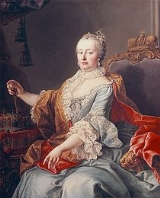
, for example. Only one woman, Maria Theresa
, ruled Austria. As noted in the list below of widely-known ruling queens, many ruled in European monarchies.
In the waning days of the 20th century and early days of the 21st, Sweden
, Norway
, Belgium
, the Netherlands
and Denmark
amended their acts of succession to primogeniture with no preference as to sex. In some cases the change does not take effect during the lifetimes of people already in the line of succession at the time the law was passed.
In China
, Wu Zetian
became the Chinese Empress Regnant and established the Zhou Dynasty after dismissing her sons and becoming the Empress Regnant. Although the Chrysanthemum Throne
of Japan
is barred to women, this has not always been the case; throughout Japanese history there have been eight empresses regnant.
Monarch
A monarch is the person who heads a monarchy. This is a form of government in which a state or polity is ruled or controlled by an individual who typically inherits the throne by birth and occasionally rules for life or until abdication...
who reigns in her own right, in contrast to a queen consort
Queen consort
A queen consort is the wife of a reigning king. A queen consort usually shares her husband's rank and holds the feminine equivalent of the king's monarchical titles. Historically, queens consort do not share the king regnant's political and military powers. Most queens in history were queens consort...
, who is the wife of a reigning king. An empress regnant is a female monarch who reigns in her own right over an empire
Empire
The term empire derives from the Latin imperium . Politically, an empire is a geographically extensive group of states and peoples united and ruled either by a monarch or an oligarchy....
.
Queens regnant possess and exercise sovereign powers. The husbands of queens regnant do not usually share their wives' rank, title or sovereignty. Queens consort share their husbands' rank and titles, but do not share the sovereignty of their husbands.
A queen dowager
Queen Dowager
A queen dowager or dowager queen is a title or status generally held by the widow of a deceased king. In the case of the widow of a deceased emperor, the title of empress dowager is used...
is the widow of a king who reigned in his own right. A queen mother
Queen mother
Queen Mother is a title or position reserved for a widowed queen consort whose son or daughter from that marriage is the reigning monarch. The term has been used in English since at least 1577...
is a queen dowager who is also the mother of a reigning sovereign.
History
Pharaoh
Pharaoh is a title used in many modern discussions of the ancient Egyptian rulers of all periods. The title originates in the term "pr-aa" which means "great house" and describes the royal palace...
, when gender is irrelevant to the office. Also the Byzantine
Byzantine
Byzantine usually refers to the Roman Empire during the Middle Ages.Byzantine may also refer to:* A citizen of the Byzantine Empire, or native Greek during the Middle Ages...
Empress Irene sometimes called herself basileus
Basileus
Basileus is a Greek term and title that has signified various types of monarchs in history. It is perhaps best known in English as a title used by the Byzantine Emperors, but also has a longer history of use for persons of authority and sovereigns in ancient Greece, as well as for the kings of...
(βασιλεύς), 'emperor', rather than basilissa (βασίλισσα), 'empress' and Jadwiga of Poland
Jadwiga of Poland
Jadwiga was monarch of Poland from 1384 to her death. Her official title was 'king' rather than 'queen', reflecting that she was a sovereign in her own right and not merely a royal consort. She was a member of the Capetian House of Anjou, the daughter of King Louis I of Hungary and Elizabeth of...
was crowned as Rex Poloniae, King of Poland.
Among the Davidic Monarchs of the Kingdom of Judah
Kingdom of Judah
The Kingdom of Judah was a Jewish state established in the Southern Levant during the Iron Age. It is often referred to as the "Southern Kingdom" to distinguish it from the northern Kingdom of Israel....
, there is mentioned a single queen regnant, Athaliah
Athaliah
Athaliah was the queen of Judah during the reign of King Jehoram, and later became sole ruler of Judah for six years. William F. Albright has dated her reign to 842–837 BC, while Edwin R. Thiele's dates, as taken from the third edition of his magnum opus, were 842/841 to 836/835 BC...
, though the Hebrew Bible
Hebrew Bible
The Hebrew Bible is a term used by biblical scholars outside of Judaism to refer to the Tanakh , a canonical collection of Jewish texts, and the common textual antecedent of the several canonical editions of the Christian Old Testament...
regards her negatively as an usurper. The much later Hasmonean
Hasmonean
The Hasmonean dynasty , was the ruling dynasty of Judea and surrounding regions during classical antiquity. Between c. 140 and c. 116 BCE, the dynasty ruled semi-autonomously from the Seleucids in the region of Judea...
Queen Salome Alexandra
Salome Alexandra
Salome Alexandra or Alexandra of Jerusalem , was the only Jewish regnant queen, with the exception of her own husband's mother whom he had prevented from ruling as his dying father had wished, and of the much earlier usurper Athaliah...
(Shlom Tzion) was highly popular.
Technically a male king also may be a king regnant or a king consort
King consort
King consort is an alternative title to the more usual "prince consort" - which is a position given in some monarchies to the husband of a reigning queen. It is a symbolic title only, the sole constitutional function of the holder being similar to a prince consort, which is the male equivalent of a...
—but this distinction is unusual and, for example, has been used only twice in the history of the British monarchy and its predecessor monarchies. In all current monarchies that allow a queen to take the throne, the husband of such a queen is not titled king, generally ranking as a prince
Prince
Prince is a general term for a ruler, monarch or member of a monarch's or former monarch's family, and is a hereditary title in the nobility of some European states. The feminine equivalent is a princess...
. The husband of Queen Mary I of England
Mary I of England
Mary I was queen regnant of England and Ireland from July 1553 until her death.She was the only surviving child born of the ill-fated marriage of Henry VIII and his first wife Catherine of Aragon. Her younger half-brother, Edward VI, succeeded Henry in 1547...
and the first two husbands of Mary I, Queen of Scotland, were all created kings consort of their wives' realms. The husband of Mary II, Queen of England and Ireland, and Queen of Scots
Mary II of England
Mary II was joint Sovereign of England, Scotland, and Ireland with her husband and first cousin, William III and II, from 1689 until her death. William and Mary, both Protestants, became king and queen regnant, respectively, following the Glorious Revolution, which resulted in the deposition of...
, was named king regnant co-sovereign with her, as William III and II
William III of England
William III & II was a sovereign Prince of Orange of the House of Orange-Nassau by birth. From 1672 he governed as Stadtholder William III of Orange over Holland, Zeeland, Utrecht, Guelders, and Overijssel of the Dutch Republic. From 1689 he reigned as William III over England and Ireland...
. The latter arrangement was the only occasion of co-sovereignty in Britain.
Accession of a regnant occurs as a nation's order of succession
Order of succession
An order of succession is a formula or algorithm that determines who inherits an office upon the death, resignation, or removal of its current occupant.-Monarchies and nobility:...
permits. Methods of succession to queendoms, kingdoms, tribal
Tribe
A tribe, viewed historically or developmentally, consists of a social group existing before the development of, or outside of, states.Many anthropologists use the term tribal society to refer to societies organized largely on the basis of kinship, especially corporate descent groups .Some theorists...
chiefships, and such include nomination when the sitting monarch or a council names an heir, primogeniture
Primogeniture
Primogeniture is the right, by law or custom, of the firstborn to inherit the entire estate, to the exclusion of younger siblings . Historically, the term implied male primogeniture, to the exclusion of females...
when the children of a monarch or chief become regent
Regent
A regent, from the Latin regens "one who reigns", is a person selected to act as head of state because the ruler is a minor, not present, or debilitated. Currently there are only two ruling Regencies in the world, sovereign Liechtenstein and the Malaysian constitutive state of Terengganu...
s in order of birth from eldest to youngest, and ultimogeniture
Ultimogeniture
Ultimogeniture, also known as postremogeniture or junior right, is the tradition of inheritance by the last-born of the entirety of, or a privileged position in, a parent's wealth, estate or office...
when the children become regents in the reverse order of birth from youngest to eldest. The scope of succession may be matrilineal, patrilineal, or both; or, rarely, open to general election when necessary. The right of succession may be open to men and women, or limited to men only or women only.
The most typical succession in European monarchies from the Late Middle Ages
Late Middle Ages
The Late Middle Ages was the period of European history generally comprising the 14th to the 16th century . The Late Middle Ages followed the High Middle Ages and preceded the onset of the early modern era ....
through most of the twentieth century was male-preference primogeniture; i.e., the order of succession cycled through the sons of the monarch in order of their birth, followed by the daughters or grandsons. Historically, many realms forbade succession by women or through a female line in obedience to the Salic law
Salic law
Salic law was a body of traditional law codified for governing the Salian Franks in the early Middle Ages during the reign of King Clovis I in the 6th century...
, and some still do. No queen regnant ever ruled France
France
The French Republic , The French Republic , The French Republic , (commonly known as France , is a unitary semi-presidential republic in Western Europe with several overseas territories and islands located on other continents and in the Indian, Pacific, and Atlantic oceans. Metropolitan France...
, for example. Only one woman, Maria Theresa
Maria Theresa of Austria
Maria Theresa Walburga Amalia Christina was the only female ruler of the Habsburg dominions and the last of the House of Habsburg. She was the sovereign of Austria, Hungary, Croatia, Bohemia, Mantua, Milan, Lodomeria and Galicia, the Austrian Netherlands and Parma...
, ruled Austria. As noted in the list below of widely-known ruling queens, many ruled in European monarchies.
In the waning days of the 20th century and early days of the 21st, Sweden
Sweden
Sweden , officially the Kingdom of Sweden , is a Nordic country on the Scandinavian Peninsula in Northern Europe. Sweden borders with Norway and Finland and is connected to Denmark by a bridge-tunnel across the Öresund....
, Norway
Norway
Norway , officially the Kingdom of Norway, is a Nordic unitary constitutional monarchy whose territory comprises the western portion of the Scandinavian Peninsula, Jan Mayen, and the Arctic archipelago of Svalbard and Bouvet Island. Norway has a total area of and a population of about 4.9 million...
, Belgium
Belgium
Belgium , officially the Kingdom of Belgium, is a federal state in Western Europe. It is a founding member of the European Union and hosts the EU's headquarters, and those of several other major international organisations such as NATO.Belgium is also a member of, or affiliated to, many...
, the Netherlands
Netherlands
The Netherlands is a constituent country of the Kingdom of the Netherlands, located mainly in North-West Europe and with several islands in the Caribbean. Mainland Netherlands borders the North Sea to the north and west, Belgium to the south, and Germany to the east, and shares maritime borders...
and Denmark
Denmark
Denmark is a Scandinavian country in Northern Europe. The countries of Denmark and Greenland, as well as the Faroe Islands, constitute the Kingdom of Denmark . It is the southernmost of the Nordic countries, southwest of Sweden and south of Norway, and bordered to the south by Germany. Denmark...
amended their acts of succession to primogeniture with no preference as to sex. In some cases the change does not take effect during the lifetimes of people already in the line of succession at the time the law was passed.
In China
China
Chinese civilization may refer to:* China for more general discussion of the country.* Chinese culture* Greater China, the transnational community of ethnic Chinese.* History of China* Sinosphere, the area historically affected by Chinese culture...
, Wu Zetian
Wu Zetian
Wu Zetian , personal name Wu Zhao , often referred to as Tian Hou during the Tang Dynasty and Empress Consort Wu in later times, was the only woman in the history of China to assume the title of Empress Regnant...
became the Chinese Empress Regnant and established the Zhou Dynasty after dismissing her sons and becoming the Empress Regnant. Although the Chrysanthemum Throne
Chrysanthemum Throne
The is the English term used to identify the throne of the Emperor of Japan. The term can refer to very specific seating, such as the takamikura throne in the Shishin-den at Kyoto Imperial Palace....
of Japan
Japan
Japan is an island nation in East Asia. Located in the Pacific Ocean, it lies to the east of the Sea of Japan, China, North Korea, South Korea and Russia, stretching from the Sea of Okhotsk in the north to the East China Sea and Taiwan in the south...
is barred to women, this has not always been the case; throughout Japanese history there have been eight empresses regnant.
Current queens regnant
| Queen | Countries | Date |
|---|---|---|
| Beatrix Beatrix of the Netherlands Beatrix is the Queen regnant of the Kingdom of the Netherlands comprising the Netherlands, Curaçao, Sint Maarten, and Aruba. She is the first daughter of Queen Juliana of the Netherlands and Prince Bernhard of Lippe-Biesterfeld. She studied law at Leiden University... 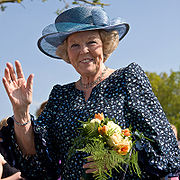 |
Kingdom of the Netherlands Kingdom of the Netherlands The Kingdom of the Netherlands is a sovereign state and constitutional monarchy with territory in Western Europe and in the Caribbean. The four parts of the Kingdom—Aruba, Curaçao, the Netherlands, and Sint Maarten—are referred to as "countries", and participate on a basis of equality... : Aruba Aruba Aruba is a 33 km-long island of the Lesser Antilles in the southern Caribbean Sea, located 27 km north of the coast of Venezuela and 130 km east of Guajira Peninsula... , Curaçao Curaçao Curaçao is an island in the southern Caribbean Sea, off the Venezuelan coast. The Country of Curaçao , which includes the main island plus the small, uninhabited island of Klein Curaçao , is a constituent country of the Kingdom of the Netherlands... , Netherlands Netherlands The Netherlands is a constituent country of the Kingdom of the Netherlands, located mainly in North-West Europe and with several islands in the Caribbean. Mainland Netherlands borders the North Sea to the north and west, Belgium to the south, and Germany to the east, and shares maritime borders... , Sint Maarten |
30 April 1980 |
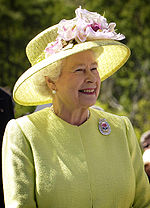
| Elizabeth II Elizabeth II of the United Kingdom Elizabeth II is the constitutional monarch of 16 sovereign states known as the Commonwealth realms: the United Kingdom, Canada, Australia, New Zealand, Jamaica, Barbados, the Bahamas, Grenada, Papua New Guinea, the Solomon Islands, Tuvalu, Saint Lucia, Saint Vincent and the Grenadines, Belize,... |
Antigua and Barbuda Antigua and Barbuda Antigua and Barbuda is a twin-island nation lying between the Caribbean Sea and the Atlantic Ocean. It consists of two major inhabited islands, Antigua and Barbuda, and a number of smaller islands... |
1 November 1981 |
| Australia Australia Australia , officially the Commonwealth of Australia, is a country in the Southern Hemisphere comprising the mainland of the Australian continent, the island of Tasmania, and numerous smaller islands in the Indian and Pacific Oceans. It is the world's sixth-largest country by total area... |
6 February 1952 | |
| Bahamas | 10 July 1973 | |
| Barbados Barbados Barbados is an island country in the Lesser Antilles. It is in length and as much as in width, amounting to . It is situated in the western area of the North Atlantic and 100 kilometres east of the Windward Islands and the Caribbean Sea; therein, it is about east of the islands of Saint... |
30 November 1966 | |
| Belize Belize Belize is a constitutional monarchy and the northernmost country in Central America. Belize has a diverse society, comprising many cultures and languages. Even though Kriol and Spanish are spoken among the population, Belize is the only country in Central America where English is the official... |
21 September 1981 | |
| Canada Canada Canada is a North American country consisting of ten provinces and three territories. Located in the northern part of the continent, it extends from the Atlantic Ocean in the east to the Pacific Ocean in the west, and northward into the Arctic Ocean... |
6 February 1952 | |
| Grenada Grenada Grenada is an island country and Commonwealth Realm consisting of the island of Grenada and six smaller islands at the southern end of the Grenadines in the southeastern Caribbean Sea... |
7 February 1974 | |
| Jamaica Jamaica Jamaica is an island nation of the Greater Antilles, in length, up to in width and 10,990 square kilometres in area. It is situated in the Caribbean Sea, about south of Cuba, and west of Hispaniola, the island harbouring the nation-states Haiti and the Dominican Republic... |
6 August 1962 | |
| New Zealand New Zealand New Zealand is an island country in the south-western Pacific Ocean comprising two main landmasses and numerous smaller islands. The country is situated some east of Australia across the Tasman Sea, and roughly south of the Pacific island nations of New Caledonia, Fiji, and Tonga... |
6 February 1952 | |
| Papua New Guinea Papua New Guinea Papua New Guinea , officially the Independent State of Papua New Guinea, is a country in Oceania, occupying the eastern half of the island of New Guinea and numerous offshore islands... |
16 September 1975 | |
| Saint Kitts and Nevis Saint Kitts and Nevis The Federation of Saint Kitts and Nevis , located in the Leeward Islands, is a federal two-island nation in the West Indies. It is the smallest sovereign state in the Americas, in both area and population.... |
19 September 1983 | |
| Saint Lucia Saint Lucia Saint Lucia is an island country in the eastern Caribbean Sea on the boundary with the Atlantic Ocean. Part of the Lesser Antilles, it is located north/northeast of the island of Saint Vincent, northwest of Barbados and south of Martinique. It covers a land area of 620 km2 and has an... |
22 February 1979 | |
| Saint Vincent and the Grenadines Saint Vincent and the Grenadines Saint Vincent and the Grenadines is an island country in the Lesser Antilles chain, namely in the southern portion of the Windward Islands, which lie at the southern end of the eastern border of the Caribbean Sea where the latter meets the Atlantic Ocean.... |
27 October 1979 | |
| Solomon Islands Solomon Islands Solomon Islands is a sovereign state in Oceania, east of Papua New Guinea, consisting of nearly one thousand islands. It covers a land mass of . The capital, Honiara, is located on the island of Guadalcanal... |
7 July 1978 | |
| Tuvalu Tuvalu Tuvalu , formerly known as the Ellice Islands, is a Polynesian island nation located in the Pacific Ocean, midway between Hawaii and Australia. Its nearest neighbours are Kiribati, Nauru, Samoa and Fiji. It comprises four reef islands and five true atolls... |
1 October 1978 | |
| United Kingdom United Kingdom The United Kingdom of Great Britain and Northern IrelandIn the United Kingdom and Dependencies, other languages have been officially recognised as legitimate autochthonous languages under the European Charter for Regional or Minority Languages... : England England England is a country that is part of the United Kingdom. It shares land borders with Scotland to the north and Wales to the west; the Irish Sea is to the north west, the Celtic Sea to the south west, with the North Sea to the east and the English Channel to the south separating it from continental... , Northern Ireland Northern Ireland Northern Ireland is one of the four countries of the United Kingdom. Situated in the north-east of the island of Ireland, it shares a border with the Republic of Ireland to the south and west... , Scotland Scotland Scotland is a country that is part of the United Kingdom. Occupying the northern third of the island of Great Britain, it shares a border with England to the south and is bounded by the North Sea to the east, the Atlantic Ocean to the north and west, and the North Channel and Irish Sea to the... , Wales Wales Wales is a country that is part of the United Kingdom and the island of Great Britain, bordered by England to its east and the Atlantic Ocean and Irish Sea to its west. It has a population of three million, and a total area of 20,779 km²... |
6 February 1952 | |
| Margrethe II Margrethe II of Denmark Margrethe II is the Queen regnant of the Kingdom of Denmark. In 1972 she became the first female monarch of Denmark since Margaret I, ruler of the Scandinavian countries in 1375-1412 during the Kalmar Union.-Early life:... |
Kingdom of Denmark Kingdom of Denmark The Kingdom of Denmark or the Danish Realm , is a constitutional monarchy and sovereign state consisting of Denmark proper in northern Europe and two autonomous constituent countries, the Faroe Islands in the North Atlantic and Greenland in North America. Denmark is the hegemonial part, where the... : Denmark Denmark Denmark is a Scandinavian country in Northern Europe. The countries of Denmark and Greenland, as well as the Faroe Islands, constitute the Kingdom of Denmark . It is the southernmost of the Nordic countries, southwest of Sweden and south of Norway, and bordered to the south by Germany. Denmark... , Faroe Islands Faroe Islands The Faroe Islands are an island group situated between the Norwegian Sea and the North Atlantic Ocean, approximately halfway between Scotland and Iceland. The Faroe Islands are a self-governing territory within the Kingdom of Denmark, along with Denmark proper and Greenland... , Greenland Greenland Greenland is an autonomous country within the Kingdom of Denmark, located between the Arctic and Atlantic Oceans, east of the Canadian Arctic Archipelago. Though physiographically a part of the continent of North America, Greenland has been politically and culturally associated with Europe for... |
14 January 1972 |