


Commonwealth Realm

Encyclopedia
A Commonwealth realm is a sovereign state
within the Commonwealth of Nations
that has Elizabeth II as its monarch
and head of state
. The sixteen current realm
s have a combined land area of 18.8 million km² (7.3 million mi², excluding Antarctic
claims), and a population of 134 million, of which all, except about two million, live in the six most populous
states: the United Kingdom
, Canada
, Australia
, Papua New Guinea
, New Zealand
and Jamaica
.
Fourteen of the current and all former realms were once British colonies that evolved into independent states
, the exceptions being the United Kingdom (UK) itself and Papua New Guinea
, which was formed in 1975 as a union of the former German New Guinea
administered by Australia as an international trusteeship before independence and the former British New Guinea legally the territory of Papua
, administered for the UK by Australia since 1905. The first realms to emerge were colonies
that had already previously attained the status of a self-governing Dominion
within the British Empire
.
For a time, the older term of Dominion was retained to refer to these non-British realms, even though their actual status had changed with the granting of full legislative independence. The word is still sometimes used today, though increasingly rarely, as the word realm
was formally introduced with Britain's proclamation of Elizabeth II as queen
in 1952 and acquired legal status with the adoption of the modern royal styles and titles by the individual countries. The qualified term Commonwealth realm is not official, and has not been used in law; rather, it is a term of convenience for distinguishing this group of realms from other countries in the Commonwealth that do not share the same monarch.
Under the 1981 Cook Islands
constitution, the Queen in Right of New Zealand is head of state of the Cook Islands, but no act passed by the Parliament of New Zealand after 1981 applies in the Cook Islands. For example, any change in the laws of succession to the New Zealand throne made by New Zealand would have no effect in the Cook Islands unless separately ratified there.
states, united only in the voluntary and symmetric sharing of the institution of the monarchy, the succession, and the Queen herself; the person of the sovereign and the Crown were said in 1936 to be "the most important and vital link" between the realms. This grouping of countries associated in this manner has been called "an achievement without parallel in the history of international relations or constitutional law." Terms such as personal union
, a form of personal union, and shared monarchy, amongst others, have all been advanced as definitions since the beginning of the Commonwealth itself, though there has been no agreement on which term is most accurate, or even whether personal union is applicable at all. The United Kingdom no longer holds any legislative power over any country besides itself, although some countries continue to use, by their own volition, the Judicial Committee of the British Privy Council
as part of their own judiciary; usually as the highest court of appeal.
Conflicts of interest have arisen from this relationship amongst independent states, ranging from minor diplomatic matters such as the monarch expressing on the advice of one of her cabinets
views that counter those of another of her cabinets to more serious conflicts regarding matters of armed conflict, wherein the monarch may be simultaneously at war and at peace with himself as head of two hostile nations. In such cases, viceroys have tended to act in manners that avoid placing the sovereign directly in the centre of the conflict, meaning that a governor-general may have to take controversial actions entirely on his or her own initiative through the exercise of the reserve powers.
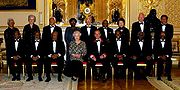
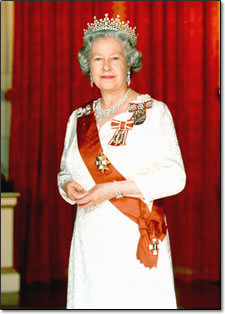 The evolution of the Commonwealth realms has led to the scenario wherein the Crown
has both a separate and a shared character; it is a singular institution with one sovereign, but also simultaneously operates separately within each country, with the Queen being equally a part of each state and acting in right of a particular realm as a distinct legal person guided only by the advice of the cabinet
of that jurisdiction. This means that in different contexts the term Crown may refer to the extra-national institution shared amongst all 16 countries, or to the Crown in each realm considered separately. However, though the monarchy is therefore no longer an exclusively British institution, having become "domesticated" in each of the realms, it may in the media and legal fields often still be elaborated as the British Crown for reasons historical, of convenience, or political, regardless of the different, specific, and official national titles and terms used when addressing the Queen of the citizenry in each jurisdiction; for example, in Barbados
the Queen is titled as Elizabeth II, Queen of Barbados, or simply the Queen of Barbados, with her full title making mention of her position as queen of the other Commonwealth realms. To guarantee the continuity of this arrangement, the preamble of the 1931 Statute of Westminster
stipulates that any alteration to the line of succession
in any one country must be voluntarily approved by the parliaments of all the realms, or, alternatively, a realm may choose to end its participation in the shared monarchy.
From a cultural standpoint, the shared nature of the Crown is less clear. In all realms, the sovereign's name and image and other royal symbols unique to each nation are visible in the emblems and insignia of governmental institutions and militia, leading to the argument that the Crown as a shared link between the Commonwealth realms, with the Crown in right of each country having unique domestic characteristics. The Queen's effigy, for example, appears on coins and banknotes in some countries, and an oath of allegiance to the Queen is usually required from politicians, judges, military members and new citizens. It is also asserted, however, that the Crown throughout the realms remains essentially British and primarily of the United Kingdom, despite the legal and cultural evolution of the Commonwealth since the 1930s. Indeed, by 1959 it was being asserted by Buckingham Palace officials that the Queen was "equally at home in all her realms."
, commanding the military forces, and creating and administering laws. However, each country now operates under the Westminster system
of parliamentary democracy and the concept of responsible government
, meaning that the monarch only exercises her powers on the advice
of her Crown ministers
, who are usually drawn from, and thus responsible to, the elected
lower house
of the relevant parliament
.
While this remains the case for all the Commonwealth realms, their sovereign resides predominantly in her oldest realm, the United Kingdom, and thus carries out her duties there mostly in person. In the other realms, the Queen normally exercises only those powers related to the appointment of her viceroy
s (a governor-general
in all cases, and a governor
in each of the Australian states
), usually on the advice of the prime minister of the country or state concerned, though this process may have additional requirements. In certain other cases, the extent to which varies from realm to realm, specific additional powers are reserved exclusively for the monarch such as the appointment of extra senators to the Canadian Senate, the creation of honours, or the issuance of letters patent
and on occasions of national importance, the Queen may be advised to perform in person her constitutional duties, such as granting Royal Assent
or issuing a royal proclamation
. Otherwise, all royal powers, including the Royal Prerogative
, are carried out on behalf of the sovereign by the relevant viceroy, which, apart from those already mentioned, include a lieutenant governor in each province of Canada
(appointed by the Governor General of Canada
) and the Queen's Representative
in the Cook Islands, who is appointed by the Queen herself. In the United Kingdom, the Queen appoints Counsellors of State
to perform her constitutional duties in her absence.
Similarly, the monarch or other members of the Royal Family will perform ceremonial duties in the Commonwealth realms to mark historically significant events. They do so most frequently in the United Kingdom, and in the other countries during tours at least once every five or six years, meaning the Queen is present in a number of her dominions outside the UK, or acting on behalf of those realms abroad, approximately every other year.
Citizens in Commonwealth realms or British overseas territories
may request birthday
or wedding anniversary
messages to be sent from the Sovereign. This is available for 100th, 110th, and beyond for birthdays; and 60th ("Diamond"), 65th, 70th ("Platinum"), and beyond for wedding anniversaries.
", a phrase that forms a part of her official title within those states. In Canada, the United Kingdom, and New Zealand, "Defender of the Faith
" (in Latin: fidei defensor) the ancient phrase first granted in 1521 by Pope
Leo X to King Henry VIII
is also included as a part of the royal title and the sovereign is anointed as such in the only coronation
that takes place in any of the realms, a ceremony in the context of a church service imbued with theological and constitutional symbolism and meaning, held at Westminster Abbey
in London
, United Kingdom.
However, it is solely in the United Kingdom that the Queen actually plays a role in organised religion. In England
, she acts as the Supreme Governor of the Church of England
and appoints its bishops and archbishops who thereafter act as her Lords Spiritual
. In Scotland
, she swears an oath to uphold and protect the Church of Scotland
and sends to meetings of the church's General Assembly
a Lord High Commissioner
as her representative, when she is not personally in attendance. Unusually for the Church of Scotland, Glasgow
and Dunblane Cathedral
s are both owned by the British Crown, though they are not like the Chapels Royal
, which exist in both the United Kingdom and Canada and form a part of the Ecclesiastical Household
in those two countries. In England and Scotland, these chapels are Royal Peculiar
s, and fall directly within the jurisdiction of the British monarch, as opposed to a diocese, as is the norm. To them, the Queen may also appoint her own chaplain
s from either the Church of England or of Scotland.
, sometimes causing conflict with official national titles, such as in Canada. Though there is no strict legal or formal definition of who is or is not a member of the Royal Family, the group is loosely defined as the extended family of the monarch. These persons constitute the apex of a modern royal court
, regularly performing public duties at hundreds of events throughout the 16 realms each year. For this work, the Royal Family members receive no salary from any state; instead, only the expenses incurred for each event (security, transportation, venue, etc.) are, due to the nature of the Crown in the realms, funded by the relevant state individually through the ordinary legislative budgeting process. These engagements are organised in order for the Crown to honour, encourage, and learn about the achievements or endeavours of individuals, institutions, and enterprises in a variety of areas of the lives of the Queen's subjects. As representatives of the monarch, Royal Family members often also join the nation in commemorating historical events, holidays, and celebratory and tragic occurrences, as well as sponsoring or participating in numerous charitable, cultural, and social activities. Their work, which is all formally recorded in the Court Circular
, draws public attention to amicable relations within and between the nations of the Commonwealth and beyond; the members of the Royal Family draw enormous media coverage in the form of photographic, written, and televised commentary on not only their activities and public roles, but also family relationships, rites of passage
, personalities, attire, and behaviour.
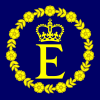 The Queen employs various royal standards
to mark her presence, the particular one used depending on which realm she is in or acting on behalf of at the time. There are currently unique flags for Australia
, Barbados
, Canada
, Jamaica
, New Zealand, and two variations for the United Kingdom one for Scotland
and another for the rest of the country. All are heraldic banners
displaying the shield of the sovereign's coat of arms
for that state, and each, save for those of the UK, are defaced
in the centre with the Queen's Personal Flag
, a crowned E for Elizabeth surrounded by a garland of roses representing the countries of the Commonwealth. This latter flag on its own is used for realms that do not have a unique personal standard for the monarch, as well as for general use in representing the Queen as Head of the Commonwealth
. The monarch previously held royal standards for Sierra Leone
, Mauritius
, Malta
, and Trinidad and Tobago
, but these banners became obsolete when the countries became republic
s.
The governors-general throughout the Commonwealth realms also each use a personal flag, which, like that of the sovereign, passes to each successive occupant of the office. Most feature a lion passant atop a St. Edward's
royal crown with the name of the country across a scroll underneath, all on a blue background. The two exceptions are those of, since 1981, Canada
(bearing on a blue background the crest
of the Royal Coat of Arms of Canada) and, since 2008, New Zealand
(a St. Edward's Crown above the shield of the Coat of Arms of New Zealand
). The lieutenant governors of the Canadian provinces each have their own personal standards, as do the governors of the Australian states
.
might become a new kingdom was first mooted in the 1860s, when it was proposed that the British North America
n territories of Nova Scotia
, New Brunswick
, and the Province of Canada
unite as a confederation
that might be known as the Kingdom of Canada. In light of geo-political circumstances at the time, however, the name was abandoned in favour of the Dominion of Canada
. As more British colonies followed Canada in gaining legislative independence from the United Kingdom, Prime Minister of Canada
Wilfrid Laurier
was led to insist at the 1907 Imperial Conference that a formula be created to differentiate between the Crown and the self-governing colonies. For the latter the Canadian precedent was followed, and the term Dominion
was extended to apply to Australia, New Zealand, Newfoundland
, and the colonies of the Cape
, Natal
, and Transvaal, before and after they merged in 1910 with the Orange River Colony
to form the Union of South Africa
. These countries were joined in 1921 by the Irish Free State
.
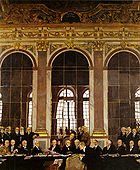
 Although the Dominions were capable of governing themselves internally, they technically remained especially in regards to foreign policy and defence subject to British authority, wherein the governor-general
of each Dominion represented the British monarch
-in-Council
reigning over these territories as a single imperial
domain. It was commonly held in some circles that the Crown was a monolithic element throughout all the monarch's territories; A.H. Lefroy wrote in 1918 that "the Crown is to be considered as one and indivisible throughout the Empire; and cannot be severed into as many kingships as there are Dominions, and self-governing colonies." This unitary model began to erode, however, when the Dominions gained more international prominence as a result of their participation and sacrifice in the First World War
, in 1919 prompting Canadian prime minister Robert Borden
and South African minister of defence Jan Smuts
to demand that the Dominions be given at the Versailles Conference
full recognition as "autonomous nations of an Imperial Commonwealth." The immediate result was that, though the King signed as High Contracting Party for the empire as a whole, the Dominions were also separate signatories to the Treaty of Versailles
, as well as, together with India
, founding members of the League of Nations
.
The pace of independence thereafter increased, with Canada exchanging envoys with the United States
the following year and in 1923 concluding in its own right the Halibut Fisheries Treaty, Prime Minister of the United Kingdom David Lloyd George
stating in 1921 that the "British Dominions have now been accepted fully into the community of nations," and, by 1925, the Dominions felt confident enough to refuse to be bound by Britain's adherence to the Treaty of Locarno. This, combined with a realisation that the Crown was already operating distinctly and separately within each of the jurisdictions of the Canadian provinces and Australian states, appeared to put to rest previous assertions that the Crown could never be divided amongst the Dominions.
refused the advice of his prime minister (William Lyon Mackenzie King
) in what came to be known colloquially as the King–Byng Affair. Mackenzie King, after resigning and then being reappointed as prime minister some months later, pushed at the Imperial Conference of 1926
for a reorganisation of the way the Dominions related to the British government, resulting in the Balfour Declaration, which declared formally that the Dominions were fully autonomous and equal in status to the United Kingdom. What this meant in practice was not at the time worked out; conflicting views existed, some in the United Kingdom not wishing to see a fracturing of the sacred unity of the Crown throughout the empire, and some in the Dominions not wishing to see their jurisdiction have to take on the full brunt of diplomatic and military responsibilities.
What did follow was that the Dominion governments gained a separate and direct relationship with the monarch, without the British Cabinet acting as an intermediary, and the governors-general now acted solely as a personal representative of the sovereign in right of that Dominion. Though no formal mechanism for tendering advice to the monarch had yet been established former Prime Minister of Australia
William Hughes
theorised that the Dominion cabinets would provide informal direction and the British Cabinet would offer formal advice the concepts were first put into legal practice with the passage in 1927 of the Royal and Parliamentary Titles Act
, which implicitly recognised the Irish Free State as separate from the UK, and the King as king of each Dominion uniquely, rather than as the British king in each Dominion. At the same time, terminology in foreign relations was altered to demonstrate the independent status of the Dominions, such as the dropping of the term "Britannic" from the King's style outside of the United Kingdom. Then, in 1930 George V's Australian ministers
employed a practice adopted by resolution at that year's Imperial Conference, directly advising the King to appoint Isaac Isaacs
as his Australian governor-general
, against the preferences of the British government.
These new developments were explicitly codified in 1931 with the passage of the Statute of Westminster
, through which Canada, the Union of South Africa, and the Irish Free State all immediately obtained formal legislative independence from the UK, while in the other Dominions' adoption of the statute was subject to ratification by the Dominion's parliament. Australia and New Zealand did so in 1942 and 1947, respectively, with the former's ratification back-dated to 1939, and, though originally covered by it, Newfoundland never ratified the bill and reverted to direct British rule in 1934. What resulted was the inability for the parliament at Westminster
to legislate for any Dominion unless requested to do so. Further, the Judicial Committee of the British Privy Council
was left available as the last court of appeal for some Dominions. This was all met with only minor trepidation either before or at the time, and the government of Ireland was confident that the relationship of these independent countries under the Crown would function as a personal union
, akin to that which had earlier existed between the United Kingdom and Hanover
(1801 to 1837), or between England
and Scotland
(1603 to 1707). The civil division of the Court of Appeal of England and Wales
later found in 1982 that the British parliament could have legislated for a Dominion simply by including in any new law a clause claiming the Dominion cabinet had requested and approved of the act, whether that was true or not. Further, the British parliament was not obliged to fulfill a Dominion's request for legislative change. However, the words in the Statute of Westminster became written expression of a conventional rule that developed whereby British law would not extend beyond the borders of the United Kingdom unless a Dominion supplicated otherwise. By 1937, the Appeal Division of the Supreme Court of South Africa
ruled unanimously that a repeal of the Statute of Westminster in the United Kingdom would have no effect in South Africa, stating: "We cannot take this argument seriously. Freedom once conferred cannot be revoked." Others in Canada upheld the same position.
The first prominent example of this arrangement working in practice came with the abdication of King Edward VIII
in 1936, for which it was necessary to gain the approval of all the Dominions of the Commonwealth before the resignation could take place; Canada, the Union of South Africa, and the Irish Free State even passed unique legislation to solidify the changes in succession within their jurisdictions. Following the accession of Edward's brother, George VI
, to the throne, the United Kingdom created legislation that would provide for a regency in the event of the incapacitation of the monarch. Though input was sought from the Dominions on this matter, all declined to make themselves bound by the British legislation, feeling instead that the governors-general could carry out royal functions in place of a debilitated sovereign.
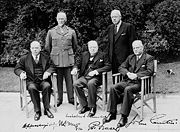 During his tenure as Governor General of Canada, the Lord Tweedsmuir
urged the organisation of a royal tour of the country by King George VI, so that he might not only appear in person before his people, but also personally perform constitutional duties and pay a state visit
to the United States as king of Canada. While the idea was embraced in Canada as a way to "translate the Statute of Westminster into the actualities of a tour," throughout the planning of the trip that took place in 1939, the British authorities resisted at numerous points the idea that the King be attended by his Canadian ministers instead of his British ones. The Canadian prime minister (still Mackenzie King) was ultimately successful, however, in being the minister in attendance, and the King did in public throughout the trip ultimately act solely in his capacity as the Canadian monarch. Yet, the international status of the Crown was also illustrated by George VI simultaneously bolstering from both Canada and the United States support for the UK in the looming war with Nazi Germany
.
When this threat became reality
, there was some uncertainty in the Dominions about the ramifications of Britain's declaration of war against Adolf Hitler
. Australia and New Zealand had not yet ratified the Statute of Westminster; the Australian prime minister, Robert Menzies
, considered the government bound by the British declaration of war, while New Zealand coordinated a declaration of war to be made simultaneously with Britain's. As late as 1937, some scholars were still of the mind that, when it came to declarations of war, if the King signed, he did so as king of the empire as a whole; at that time, W. Kennedy wrote: "in the final test of sovereignty that of war Canada is not a sovereign state... and it remains as true in 1937 as it was in 1914 that when the Crown is at war, Canada is legally at war," and, one year later, A. Berriedale Keith
argued that "issues of war or neutrality still are decided on the final authority of the British Cabinet." In 1939, however, Canada and South Africa made separate proclamations of war against Germany a few days after the UK's. Their example was followed more consistently by the other realms as further war was declared against Italy
, Rumania, Hungary
, Finland
, and Japan
. At the war's end, it was said by F.R. Scott that "it is firmly established as a basic constitutional principle that, so far as relates to Canada, the King is regulated by Canadian law and must act only on the advice and responsibility of Canadian ministers."
and Ceylon
became independent Dominions of the Commonwealth, though it was made clear at the time that India would soon move to a republican form of government. Unlike Ireland
and Burma at the time of their becoming republics, however, there was no desire on the part of India to give up its membership in the British Commonwealth
, prompting a Commonwealth Conference
and the issuance of the London Declaration
in 1949, which entrenched the idea of Canadian prime minister Louis St. Laurent
that different royal house
s and republic
s be allowed in the Commonwealth so long as they recognised as the international organisation's symbolic head
the shared sovereign of the UK and the Dominions. At approximately the same time, the tabling in 1946 of the Canadian parliament's Canadian Citizenship Act brought into question the homogeneity of the King's subjects, which, prior to that year, was uniformly defined in terms of allegiance to the sovereign, without regard to the individual's country of residence. Following negotiations, it was decided in 1947 that each Commonwealth member was free to pass its own citizenship legislation, so that its citizens owed allegiance only to the monarch in right of that country.
As these constitutional developments were taking place, the Dominion and British governments became increasingly concerned with how to represent the more commonly accepted notion that there was no distinction between the sovereign's role in the UK and his or her position in any of the Dominions, as summed up in Patrick Gordon Walker
's statement in the British House of Commons: "We in this country have to abandon... any sense of property in the Crown. The Queen, now, clearly, explicitly and according to title, belongs equally to all her realms and to the Commonwealth as a whole." Thus, at the 1948 Prime Ministers' Conference the term Dominion was avoided in favour of Commonwealth country, in order to avoid the subordination implied by the older designation. Then, with the British proclamation of Elizabeth II's accession
to the throne in 1952, the phrases Commonwealth realm and Head of the Commonwealth became established, deriving from the words that declared the monarch as "of this Realm, and of her other Realms and Territories Queen, Head of the Commonwealth." The Commonwealth realms' prime ministers thereafter discussed the matter of the new monarch's title, with St. Laurent stating at the 1953 Commonwealth Conference that it was important to agree on a format that would "emphasise the fact that the Queen is Queen of Canada, regardless of her sovereignty over other Commonwealth countries." The result was a new Royal Style and Titles Act
being passed in each of the seven realms then existing (excluding Pakistan), which all identically gave formal recognition to the separateness and equality of the countries involved, and replaced the phrase "British Dominions Beyond the Seas" with "Her Other Realms and Territories", the latter using the medieval French
word realm (from royaume) in place of dominion. Further, at her coronation, Elizabeth II's oath contained a provision requiring her to promise to govern according to the rules and customs of the realms, naming each one separately.
 In the same period, Walker also suggested to the British parliament that the Queen should annually spend an equal amount of time in each of her realms. The Lord Altrincham, who in 1957 criticised Queen Elizabeth II for having a court that encompassed mostly Britain and not the Commonwealth as a whole, was in favour of the idea, but it did not attract wide support. Another thought rasied was that viceregal appointments should become trans-Commonwealth; the Governor-General of Australia would be someone from South Africa, the Governor-General of Ceylon would come from New Zealand, and so on. The prime ministers of Canada and Australia, John Diefenbaker
and Robert Menzies
, respectively, were sympathetic to the concept, but, again, it was never put into practice.
The principle of fully separate and equal realms was followed in all future grants of independence, including those that came through the winds of change
that swept through Africa
in the 1960s, the collapse of the Federation of the West Indies in 1961, and at later dates. In post-colonial Africa, within a few years of their founding the realms drafted new constitutions in order to come under a different royal house or become republics within the Commonwealth; South Africa was the only exception, having been a Dominion and then a realm for 54 years before becoming a republic in 1961. The white minority government of Rhodesia
in 1965 issued its unilateral declaration of independence, and its members affirmed their loyalty to Elizabeth II as Queen of Rhodesia, a title to which she had not consented, did not accept, and was not recognised internationally. Her representative in the colony, Sir Humphrey Gibbs
, immediately dismissed his prime minister, Ian Smith
, but this action was ignored by Smith and he appointed, without the Queen's consent, an Officer Administrating the Government to perform the governor's constitutional duties until 1970, when Smith's government declared Rhodesia a republic. When Papua New Guinea
became independent of Australia in 1975, this was the first (and so far the last) time a Commonwealth realm was created from a territory that had never been made up of British colonies in its entirety. The country to most recently become a Commonwealth realm was Saint Kitts and Nevis
, achieving the status in 1983. At the same time, in other Commonwealth realms, including the United Kingdom, movements emerged advocating a republic
an government in place of constitutional monarchy
; they were, and continue to be, countered by monarchist leagues that support the existing system and/or celebrate the historical and modern connections the shared monarchy provides.
Queen Elizabeth II, on 6 July 2010, addressed the United Nations
in New York City
as queen of all 16 Commonwealth realms.
Sovereign state
A sovereign state, or simply, state, is a state with a defined territory on which it exercises internal and external sovereignty, a permanent population, a government, and the capacity to enter into relations with other sovereign states. It is also normally understood to be a state which is neither...
within the Commonwealth of Nations
Commonwealth of Nations
The Commonwealth of Nations, normally referred to as the Commonwealth and formerly known as the British Commonwealth, is an intergovernmental organisation of fifty-four independent member states...
that has Elizabeth II as its monarch
Monarch
A monarch is the person who heads a monarchy. This is a form of government in which a state or polity is ruled or controlled by an individual who typically inherits the throne by birth and occasionally rules for life or until abdication...
and head of state
Head of State
A head of state is the individual that serves as the chief public representative of a monarchy, republic, federation, commonwealth or other kind of state. His or her role generally includes legitimizing the state and exercising the political powers, functions, and duties granted to the head of...
. The sixteen current realm
Realm
A realm is a dominion of a monarch or other sovereign ruler.The Old French word reaume, modern French royaume, was the word first adopted in English; the fixed modern spelling does not appear until the beginning of the 17th century...
s have a combined land area of 18.8 million km² (7.3 million mi², excluding Antarctic
Antarctic
The Antarctic is the region around the Earth's South Pole, opposite the Arctic region around the North Pole. The Antarctic comprises the continent of Antarctica and the ice shelves, waters and island territories in the Southern Ocean situated south of the Antarctic Convergence...
claims), and a population of 134 million, of which all, except about two million, live in the six most populous
Population
A population is all the organisms that both belong to the same group or species and live in the same geographical area. The area that is used to define a sexual population is such that inter-breeding is possible between any pair within the area and more probable than cross-breeding with individuals...
states: the United Kingdom
United Kingdom
The United Kingdom of Great Britain and Northern IrelandIn the United Kingdom and Dependencies, other languages have been officially recognised as legitimate autochthonous languages under the European Charter for Regional or Minority Languages...
, Canada
Canada
Canada is a North American country consisting of ten provinces and three territories. Located in the northern part of the continent, it extends from the Atlantic Ocean in the east to the Pacific Ocean in the west, and northward into the Arctic Ocean...
, Australia
Australia
Australia , officially the Commonwealth of Australia, is a country in the Southern Hemisphere comprising the mainland of the Australian continent, the island of Tasmania, and numerous smaller islands in the Indian and Pacific Oceans. It is the world's sixth-largest country by total area...
, Papua New Guinea
Papua New Guinea
Papua New Guinea , officially the Independent State of Papua New Guinea, is a country in Oceania, occupying the eastern half of the island of New Guinea and numerous offshore islands...
, New Zealand
New Zealand
New Zealand is an island country in the south-western Pacific Ocean comprising two main landmasses and numerous smaller islands. The country is situated some east of Australia across the Tasman Sea, and roughly south of the Pacific island nations of New Caledonia, Fiji, and Tonga...
and Jamaica
Jamaica
Jamaica is an island nation of the Greater Antilles, in length, up to in width and 10,990 square kilometres in area. It is situated in the Caribbean Sea, about south of Cuba, and west of Hispaniola, the island harbouring the nation-states Haiti and the Dominican Republic...
.
Fourteen of the current and all former realms were once British colonies that evolved into independent states
Independence
Independence is a condition of a nation, country, or state in which its residents and population, or some portion thereof, exercise self-government, and usually sovereignty, over its territory....
, the exceptions being the United Kingdom (UK) itself and Papua New Guinea
Papua New Guinea
Papua New Guinea , officially the Independent State of Papua New Guinea, is a country in Oceania, occupying the eastern half of the island of New Guinea and numerous offshore islands...
, which was formed in 1975 as a union of the former German New Guinea
German New Guinea
German New Guinea was the first part of the German colonial empire. It was a protectorate from 1884 until 1914 when it fell to Australia following the outbreak of the First World War. It consisted of the northeastern part of New Guinea and several nearby island groups...
administered by Australia as an international trusteeship before independence and the former British New Guinea legally the territory of Papua
Papua (Australian territory)
The Territory of Papua comprised the southeastern quarter of the island of New Guinea from 1883 to 1949. It became a British Protectorate in the year 1884, and four years later it was formally annexed as British New Guinea...
, administered for the UK by Australia since 1905. The first realms to emerge were colonies
Colony
In politics and history, a colony is a territory under the immediate political control of a state. For colonies in antiquity, city-states would often found their own colonies. Some colonies were historically countries, while others were territories without definite statehood from their inception....
that had already previously attained the status of a self-governing Dominion
Dominion
A dominion, often Dominion, refers to one of a group of autonomous polities that were nominally under British sovereignty, constituting the British Empire and British Commonwealth, beginning in the latter part of the 19th century. They have included Canada, Australia, New Zealand, Newfoundland,...
within the British Empire
British Empire
The British Empire comprised the dominions, colonies, protectorates, mandates and other territories ruled or administered by the United Kingdom. It originated with the overseas colonies and trading posts established by England in the late 16th and early 17th centuries. At its height, it was the...
.
For a time, the older term of Dominion was retained to refer to these non-British realms, even though their actual status had changed with the granting of full legislative independence. The word is still sometimes used today, though increasingly rarely, as the word realm
Realm
A realm is a dominion of a monarch or other sovereign ruler.The Old French word reaume, modern French royaume, was the word first adopted in English; the fixed modern spelling does not appear until the beginning of the 17th century...
was formally introduced with Britain's proclamation of Elizabeth II as queen
Proclamation of accession of Elizabeth II
Queen Elizabeth II was proclaimed sovereign of each of the Commonwealth realms on 6 and 7 February 1952, after the death of her father, King George VI, in the night between 5 February and 6 February, and while the Princess was in Kenya....
in 1952 and acquired legal status with the adoption of the modern royal styles and titles by the individual countries. The qualified term Commonwealth realm is not official, and has not been used in law; rather, it is a term of convenience for distinguishing this group of realms from other countries in the Commonwealth that do not share the same monarch.
Current Commonwealth realms
| Country | | Pop. | | Monarchy | | Date | | Queen's Title | | Royal Standard |
|---|---|---|---|---|---|
 Antigua and Barbuda Antigua and BarbudaAntigua and Barbuda Antigua and Barbuda is a twin-island nation lying between the Caribbean Sea and the Atlantic Ocean. It consists of two major inhabited islands, Antigua and Barbuda, and a number of smaller islands... |
0.08 | Monarchy of Antigua and Barbuda | 1981 | Elizabeth the Second, by the Grace of God, Queen of Antigua and Barbuda and of Her other Realms and Territories, Head of the Commonwealth. | None |
 Australia AustraliaAustralia Australia , officially the Commonwealth of Australia, is a country in the Southern Hemisphere comprising the mainland of the Australian continent, the island of Tasmania, and numerous smaller islands in the Indian and Pacific Oceans. It is the world's sixth-largest country by total area... |
22.75 | Monarchy of Australia | 1942 Statute of Westminster Adoption Act 1942 The Statute of Westminster Adoption Act 1942 is an Act of the Australian Parliament that formally adopted the Statute of Westminster 1931, an Act of the British Imperial Parliament enabling the legislative independence of the various self-governing Dominions of the British Empire... |
Elizabeth the Second, by the Grace of God, Queen of Australia and Her other Realms and Territories, Head of the Commonwealth. |  |
 The Bahamas The BahamasThe Bahamas The Bahamas , officially the Commonwealth of the Bahamas, is a nation consisting of 29 islands, 661 cays, and 2,387 islets . It is located in the Atlantic Ocean north of Cuba and Hispaniola , northwest of the Turks and Caicos Islands, and southeast of the United States... |
0.35 | Monarchy of the Bahamas Monarchy of the Bahamas The monarchy of the Bahamas is a system of government in which a hereditary monarch is the sovereign and head of state of the Commonwealth of The Bahamas. The current monarch is Queen Elizabeth II, who has reigned since the country became independent on 10 July 1973. The Bahamas share the Sovereign... |
1973 | Elizabeth the Second, by the Grace of God, Queen of the Commonwealth of the Bahamas and of Her other Realms and Territories, Head of the Commonwealth. | None |
 Barbados BarbadosBarbados Barbados is an island country in the Lesser Antilles. It is in length and as much as in width, amounting to . It is situated in the western area of the North Atlantic and 100 kilometres east of the Windward Islands and the Caribbean Sea; therein, it is about east of the islands of Saint... |
0.28 | Monarchy of Barbados Monarchy of Barbados The monarchy of Barbados is a constitutional system of government in which a hereditary monarch is the sovereign and head of state of Barbados, forming the core of the country's Westminster style parliamentary democracy... |
1966 | Elizabeth the Second, by the Grace of God, Queen of Barbados and of Her other Realms and Territories, Head of the Commonwealth |  |
 Belize BelizeBelize Belize is a constitutional monarchy and the northernmost country in Central America. Belize has a diverse society, comprising many cultures and languages. Even though Kriol and Spanish are spoken among the population, Belize is the only country in Central America where English is the official... |
0.33 | Monarchy of Belize Monarchy of Belize The monarchy of Belize is a system of government in which a hereditary monarch is the sovereign of Belize, holding the position of head of state; the incumbent is Elizabeth II, officially called Queen of Belize, who has reigned since September 21, 1981... |
1981 | Elizabeth the Second, by the Grace of God, Queen of Belize and of Her Other Realms and Territories, Head of the Commonwealth | None |
 Canada CanadaCanada Canada is a North American country consisting of ten provinces and three territories. Located in the northern part of the continent, it extends from the Atlantic Ocean in the east to the Pacific Ocean in the west, and northward into the Arctic Ocean... |
34.63 | Monarchy of Canada | 1931 Statute of Westminster 1931 The Statute of Westminster 1931 is an Act of the Parliament of the United Kingdom. Passed on 11 December 1931, the Act established legislative equality for the self-governing dominions of the British Empire with the United Kingdom... |
English English language English is a West Germanic language that arose in the Anglo-Saxon kingdoms of England and spread into what was to become south-east Scotland under the influence of the Anglian medieval kingdom of Northumbria... : Elizabeth the Second, by the Grace of God, of the United Kingdom, Canada and Her other Realms and Territories Queen, Head of the Commonwealth, Defender of the Faith French French language French is a Romance language spoken as a first language in France, the Romandy region in Switzerland, Wallonia and Brussels in Belgium, Monaco, the regions of Quebec and Acadia in Canada, and by various communities elsewhere. Second-language speakers of French are distributed throughout many parts... : Elizabeth Deux, par la grâce de Dieu Reine du Royaume-Uni, du Canada et de ses autres royaumes et territoires, Chef du Commonwealth, Défenseur de la Foi |
 |
 Grenada GrenadaGrenada Grenada is an island country and Commonwealth Realm consisting of the island of Grenada and six smaller islands at the southern end of the Grenadines in the southeastern Caribbean Sea... |
0.11 | Monarchy of Grenada Monarchy of Grenada The monarchy of Grenada is a system of government in which a hereditary monarch is the sovereign of the Grenadas. The present monarch of Grenada is Queen Elizabeth II... |
1974 | Elizabeth the Second, by the Grace of God, Queen of the United Kingdom of Great Britain and Northern Ireland and of Grenada and Her other Realms and Territories, Head of the Commonwealth | None |
 Jamaica JamaicaJamaica Jamaica is an island nation of the Greater Antilles, in length, up to in width and 10,990 square kilometres in area. It is situated in the Caribbean Sea, about south of Cuba, and west of Hispaniola, the island harbouring the nation-states Haiti and the Dominican Republic... |
2.85 | Monarchy of Jamaica Monarchy of Jamaica The Monarchy of Jamaica is a constitutional system of government in which a hereditary monarch is the sovereign and head of state of Jamaica, forming the core of the country's Westminster-style parliamentary democracy... |
1962 | Elizabeth the Second, by the Grace of God, Queen of Jamaica and of Her other Realms and Territories, Head of the Commonwealth |  |
 New Zealand New ZealandNew Zealand New Zealand is an island country in the south-western Pacific Ocean comprising two main landmasses and numerous smaller islands. The country is situated some east of Australia across the Tasman Sea, and roughly south of the Pacific island nations of New Caledonia, Fiji, and Tonga... |
4.39 | Monarchy of New Zealand | 1947 Statute of Westminster Adoption Act 1947 The Statute of Westminster Adoption Act 1947 was a constitutional Act of the New Zealand Parliament that formally accepted the full external autonomy offered by the British Parliament... |
Elizabeth the Second, by the Grace of God, Queen of New Zealand and Her Other Realms and Territories, Head of the Commonwealth, Defender of the Faith |  |
 Papua New Guinea Papua New GuineaPapua New Guinea Papua New Guinea , officially the Independent State of Papua New Guinea, is a country in Oceania, occupying the eastern half of the island of New Guinea and numerous offshore islands... |
6.19 | Monarchy of Papua New Guinea Monarchy of Papua New Guinea The monarchy of Papua New Guinea is a system of government in which a hereditary monarch is the sovereign of Papua New Guinea. The present monarch of Papua New Guinea is Queen Elizabeth II. Papua New Guinea share the Sovereign with a number of Commonwealth realms... |
1975 | Elizabeth the Second, by the Grace of God, Queen of Papua New Guinea and Her other Realms and Territories, Head of the Commonwealth | None |
 Saint Kitts and Nevis Saint Kitts and NevisSaint Kitts and Nevis The Federation of Saint Kitts and Nevis , located in the Leeward Islands, is a federal two-island nation in the West Indies. It is the smallest sovereign state in the Americas, in both area and population.... |
0.05 | Monarchy of Saint Kitts and Nevis Monarchy of Saint Kitts and Nevis The monarchy of Saint Kitts and Nevis is a system of government in which a hereditary monarch is the sovereign of Saint Kitts and Nevis. The present monarch of Saint Kitts and Nevis is Queen Elizabeth II. Saint Kitts and Nevis share the Sovereign with a number of Commonwealth realms... |
1983 | Elizabeth the Second, by the Grace of God, Queen of Saint Christopher and Nevis and of Her other Realms and Territories, Head of the Commonwealth | None |
 Saint Lucia Saint LuciaSaint Lucia Saint Lucia is an island country in the eastern Caribbean Sea on the boundary with the Atlantic Ocean. Part of the Lesser Antilles, it is located north/northeast of the island of Saint Vincent, northwest of Barbados and south of Martinique. It covers a land area of 620 km2 and has an... |
0.17 | Monarchy of Saint Lucia Monarchy of Saint Lucia The monarchy of Saint Lucia is a system of government in which a hereditary, constitutional monarch is the sovereign of Saint Lucia. The present monarch of Saint Lucia is Queen Elizabeth II. Saint Lucia share the Sovereign with a number of Commonwealth realms... |
1979 | Elizabeth the Second, by the Grace of God, Queen of Saint Lucia and of Her other Realms and Territories, Head of the Commonwealth | None |
 Saint Vincent and the Grenadines Saint Vincent and the GrenadinesSaint Vincent and the Grenadines Saint Vincent and the Grenadines is an island country in the Lesser Antilles chain, namely in the southern portion of the Windward Islands, which lie at the southern end of the eastern border of the Caribbean Sea where the latter meets the Atlantic Ocean.... |
0.12 | Monarchy of Saint Vincent and the Grenadines Monarchy of Saint Vincent and the Grenadines The monarchy of Saint Vincent and the Grenadines is the constitutional system of government in which a hereditary monarch is the sovereign and head of state of Saint Vincent and the Grenadines, forming the core of the country's Westminster-style parliamentary democracy. The Crown is thus is the... |
1979 | Elizabeth the Second, by the Grace of God, Queen of Saint Vincent and the Grenadines and of Her other Realms and Territories, Head of the Commonwealth | None |
 Solomon Islands Solomon IslandsSolomon Islands Solomon Islands is a sovereign state in Oceania, east of Papua New Guinea, consisting of nearly one thousand islands. It covers a land mass of . The capital, Honiara, is located on the island of Guadalcanal... |
0.52 | Monarchy of the Solomon Islands | 1978 | Elizabeth the Second, by the Grace of God, Queen of the Solomon Islands and of Her other Realms and Territories, Head of the Commonwealth | None |
 Tuvalu TuvaluTuvalu Tuvalu , formerly known as the Ellice Islands, is a Polynesian island nation located in the Pacific Ocean, midway between Hawaii and Australia. Its nearest neighbours are Kiribati, Nauru, Samoa and Fiji. It comprises four reef islands and five true atolls... |
0.01 | Monarchy of Tuvalu Monarchy of Tuvalu The monarchy of Tuvalu is a system of government in which a hereditary monarch is the sovereign of Tuvalu. The present monarch of Tuvalu is Queen Elizabeth II. Tuvalu shares the sovereign with 15 other Commonwealth realms... |
1978 | Elizabeth the Second, by the Grace of God, Queen of Tuvalu and of Her other Realms and Territories, Head of the Commonwealth | None |
 United Kingdom United KingdomUnited Kingdom The United Kingdom of Great Britain and Northern IrelandIn the United Kingdom and Dependencies, other languages have been officially recognised as legitimate autochthonous languages under the European Charter for Regional or Minority Languages... |
62.26 | Monarchy of the United Kingdom Monarchy of the United Kingdom The monarchy of the United Kingdom is the constitutional monarchy of the United Kingdom and its overseas territories. The present monarch, Queen Elizabeth II, has reigned since 6 February 1952. She and her immediate family undertake various official, ceremonial and representational duties... |
n/a | Elizabeth the Second, by the Grace of God, of the United Kingdom of Great Britain and Northern Ireland and of Her other Realms and Territories Queen, Head of the Commonwealth, Defender of the Faith | 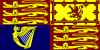 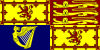 |
Under the 1981 Cook Islands
Cook Islands
The Cook Islands is a self-governing parliamentary democracy in the South Pacific Ocean in free association with New Zealand...
constitution, the Queen in Right of New Zealand is head of state of the Cook Islands, but no act passed by the Parliament of New Zealand after 1981 applies in the Cook Islands. For example, any change in the laws of succession to the New Zealand throne made by New Zealand would have no effect in the Cook Islands unless separately ratified there.
Relationship of the realms
The Commonwealth realms are sovereignSovereignty
Sovereignty is the quality of having supreme, independent authority over a geographic area, such as a territory. It can be found in a power to rule and make law that rests on a political fact for which no purely legal explanation can be provided...
states, united only in the voluntary and symmetric sharing of the institution of the monarchy, the succession, and the Queen herself; the person of the sovereign and the Crown were said in 1936 to be "the most important and vital link" between the realms. This grouping of countries associated in this manner has been called "an achievement without parallel in the history of international relations or constitutional law." Terms such as personal union
Personal union
A personal union is the combination by which two or more different states have the same monarch while their boundaries, their laws and their interests remain distinct. It should not be confused with a federation which is internationally considered a single state...
, a form of personal union, and shared monarchy, amongst others, have all been advanced as definitions since the beginning of the Commonwealth itself, though there has been no agreement on which term is most accurate, or even whether personal union is applicable at all. The United Kingdom no longer holds any legislative power over any country besides itself, although some countries continue to use, by their own volition, the Judicial Committee of the British Privy Council
Judicial Committee of the Privy Council
The Judicial Committee of the Privy Council is one of the highest courts in the United Kingdom. Established by the Judicial Committee Act 1833 to hear appeals formerly heard by the King in Council The Judicial Committee of the Privy Council (JCPC) is one of the highest courts in the United...
as part of their own judiciary; usually as the highest court of appeal.
Conflicts of interest have arisen from this relationship amongst independent states, ranging from minor diplomatic matters such as the monarch expressing on the advice of one of her cabinets
Cabinet (government)
A Cabinet is a body of high ranking government officials, typically representing the executive branch. It can also sometimes be referred to as the Council of Ministers, an Executive Council, or an Executive Committee.- Overview :...
views that counter those of another of her cabinets to more serious conflicts regarding matters of armed conflict, wherein the monarch may be simultaneously at war and at peace with himself as head of two hostile nations. In such cases, viceroys have tended to act in manners that avoid placing the sovereign directly in the centre of the conflict, meaning that a governor-general may have to take controversial actions entirely on his or her own initiative through the exercise of the reserve powers.
The Crown in the Commonwealth realms
The Crown
The Crown is a corporation sole that in the Commonwealth realms and any provincial or state sub-divisions thereof represents the legal embodiment of governance, whether executive, legislative, or judicial...
has both a separate and a shared character; it is a singular institution with one sovereign, but also simultaneously operates separately within each country, with the Queen being equally a part of each state and acting in right of a particular realm as a distinct legal person guided only by the advice of the cabinet
Cabinet (government)
A Cabinet is a body of high ranking government officials, typically representing the executive branch. It can also sometimes be referred to as the Council of Ministers, an Executive Council, or an Executive Committee.- Overview :...
of that jurisdiction. This means that in different contexts the term Crown may refer to the extra-national institution shared amongst all 16 countries, or to the Crown in each realm considered separately. However, though the monarchy is therefore no longer an exclusively British institution, having become "domesticated" in each of the realms, it may in the media and legal fields often still be elaborated as the British Crown for reasons historical, of convenience, or political, regardless of the different, specific, and official national titles and terms used when addressing the Queen of the citizenry in each jurisdiction; for example, in Barbados
Barbados
Barbados is an island country in the Lesser Antilles. It is in length and as much as in width, amounting to . It is situated in the western area of the North Atlantic and 100 kilometres east of the Windward Islands and the Caribbean Sea; therein, it is about east of the islands of Saint...
the Queen is titled as Elizabeth II, Queen of Barbados, or simply the Queen of Barbados, with her full title making mention of her position as queen of the other Commonwealth realms. To guarantee the continuity of this arrangement, the preamble of the 1931 Statute of Westminster
Statute of Westminster 1931
The Statute of Westminster 1931 is an Act of the Parliament of the United Kingdom. Passed on 11 December 1931, the Act established legislative equality for the self-governing dominions of the British Empire with the United Kingdom...
stipulates that any alteration to the line of succession
Line of succession to the British Throne
The line of succession to the British throne is the ordered sequence of those people eligible to succeed to the throne of the United Kingdom and the other 15 Commonwealth realms. By the terms of the Act of Settlement 1701, the succession is limited to the descendants of the Electress Sophia of...
in any one country must be voluntarily approved by the parliaments of all the realms, or, alternatively, a realm may choose to end its participation in the shared monarchy.
From a cultural standpoint, the shared nature of the Crown is less clear. In all realms, the sovereign's name and image and other royal symbols unique to each nation are visible in the emblems and insignia of governmental institutions and militia, leading to the argument that the Crown as a shared link between the Commonwealth realms, with the Crown in right of each country having unique domestic characteristics. The Queen's effigy, for example, appears on coins and banknotes in some countries, and an oath of allegiance to the Queen is usually required from politicians, judges, military members and new citizens. It is also asserted, however, that the Crown throughout the realms remains essentially British and primarily of the United Kingdom, despite the legal and cultural evolution of the Commonwealth since the 1930s. Indeed, by 1959 it was being asserted by Buckingham Palace officials that the Queen was "equally at home in all her realms."
Monarch's role in the realms
The monarch is, in theory, the supreme governor of each of the Commonwealth realms, charged with issuing executive ordersExecutive (government)
Executive branch of Government is the part of government that has sole authority and responsibility for the daily administration of the state bureaucracy. The division of power into separate branches of government is central to the idea of the separation of powers.In many countries, the term...
, commanding the military forces, and creating and administering laws. However, each country now operates under the Westminster system
Westminster System
The Westminster system is a democratic parliamentary system of government modelled after the politics of the United Kingdom. This term comes from the Palace of Westminster, the seat of the Parliament of the United Kingdom....
of parliamentary democracy and the concept of responsible government
Responsible government
Responsible government is a conception of a system of government that embodies the principle of parliamentary accountability which is the foundation of the Westminster system of parliamentary democracy...
, meaning that the monarch only exercises her powers on the advice
Advice (constitutional)
Advice, in constitutional law, is formal, usually binding, instruction given by one constitutional officer of state to another. Especially in parliamentary systems of government, Heads of state often act on the basis of advice issued by prime ministers or other government ministers...
of her Crown ministers
Minister of the Crown
Minister of the Crown is the formal constitutional term used in the Commonwealth realms to describe a minister to the reigning sovereign. The term indicates that the minister serves at His/Her Majesty's pleasure, and advises the monarch, or viceroy, on how to exercise the Crown prerogatives...
, who are usually drawn from, and thus responsible to, the elected
Election
An election is a formal decision-making process by which a population chooses an individual to hold public office. Elections have been the usual mechanism by which modern representative democracy operates since the 17th century. Elections may fill offices in the legislature, sometimes in the...
lower house
Lower house
A lower house is one of two chambers of a bicameral legislature, the other chamber being the upper house.Despite its official position "below" the upper house, in many legislatures worldwide the lower house has come to wield more power...
of the relevant parliament
Parliament
A parliament is a legislature, especially in those countries whose system of government is based on the Westminster system modeled after that of the United Kingdom. The name is derived from the French , the action of parler : a parlement is a discussion. The term came to mean a meeting at which...
.
While this remains the case for all the Commonwealth realms, their sovereign resides predominantly in her oldest realm, the United Kingdom, and thus carries out her duties there mostly in person. In the other realms, the Queen normally exercises only those powers related to the appointment of her viceroy
Viceroy
A viceroy is a royal official who runs a country, colony, or province in the name of and as representative of the monarch. The term derives from the Latin prefix vice-, meaning "in the place of" and the French word roi, meaning king. A viceroy's province or larger territory is called a viceroyalty...
s (a governor-general
Governor-General
A Governor-General, is a vice-regal person of a monarch in an independent realm or a major colonial circonscription. Depending on the political arrangement of the territory, a Governor General can be a governor of high rank, or a principal governor ranking above "ordinary" governors.- Current uses...
in all cases, and a governor
Governors of the Australian states
The Governors of the Australian states are the representatives of the Queen of Australia in each of that country's six states. The Governors perform the same constitutional and ceremonial functions at the state level as does the Governor-General of Australia at the national level...
in each of the Australian states
States and territories of Australia
The Commonwealth of Australia is a union of six states and various territories. The Australian mainland is made up of five states and three territories, with the sixth state of Tasmania being made up of islands. In addition there are six island territories, known as external territories, and a...
), usually on the advice of the prime minister of the country or state concerned, though this process may have additional requirements. In certain other cases, the extent to which varies from realm to realm, specific additional powers are reserved exclusively for the monarch such as the appointment of extra senators to the Canadian Senate, the creation of honours, or the issuance of letters patent
Letters patent
Letters patent are a type of legal instrument in the form of a published written order issued by a monarch or president, generally granting an office, right, monopoly, title, or status to a person or corporation...
and on occasions of national importance, the Queen may be advised to perform in person her constitutional duties, such as granting Royal Assent
Royal Assent
The granting of royal assent refers to the method by which any constitutional monarch formally approves and promulgates an act of his or her nation's parliament, thus making it a law...
or issuing a royal proclamation
Proclamation
A proclamation is an official declaration.-England and Wales:In English law, a proclamation is a formal announcement , made under the great seal, of some matter which the King in Council or Queen in Council desires to make known to his or her subjects: e.g., the declaration of war, or state of...
. Otherwise, all royal powers, including the Royal Prerogative
Royal Prerogative
The royal prerogative is a body of customary authority, privilege, and immunity, recognized in common law and, sometimes, in civil law jurisdictions possessing a monarchy as belonging to the sovereign alone. It is the means by which some of the executive powers of government, possessed by and...
, are carried out on behalf of the sovereign by the relevant viceroy, which, apart from those already mentioned, include a lieutenant governor in each province of Canada
Provinces and territories of Canada
The provinces and territories of Canada combine to make up the world's second-largest country by area. There are ten provinces and three territories...
(appointed by the Governor General of Canada
Governor General of Canada
The Governor General of Canada is the federal viceregal representative of the Canadian monarch, Queen Elizabeth II...
) and the Queen's Representative
Queen's Representative
The Queen's Representative is the formal title given to the representative of Queen Elizabeth II, as Queen of New Zealand, in the Cook Islands....
in the Cook Islands, who is appointed by the Queen herself. In the United Kingdom, the Queen appoints Counsellors of State
Counsellor of State
In the United Kingdom, Counsellors of State are senior members of the British royal family to whom the Monarch, currently Elizabeth II, delegates certain state functions and powers when she is in another Commonwealth realm, abroad or unavailable for other reasons...
to perform her constitutional duties in her absence.
Similarly, the monarch or other members of the Royal Family will perform ceremonial duties in the Commonwealth realms to mark historically significant events. They do so most frequently in the United Kingdom, and in the other countries during tours at least once every five or six years, meaning the Queen is present in a number of her dominions outside the UK, or acting on behalf of those realms abroad, approximately every other year.
Citizens in Commonwealth realms or British overseas territories
British overseas territories
The British Overseas Territories are fourteen territories of the United Kingdom which, although they do not form part of the United Kingdom itself, fall under its jurisdiction. They are remnants of the British Empire that have not acquired independence or have voted to remain British territories...
may request birthday
Birthday
A birthday is a day or anniversary where a person celebrates his or her date of birth. Birthdays are celebrated in numerous cultures, often with a gift, party or rite of passage. Although the major religions celebrate the birth of their founders , Christmas – which is celebrated widely by...
or wedding anniversary
Wedding anniversary
-Official recognition:In the Commonwealth realms, one can receive a message from the monarch for 60th, 65th, and 70th wedding anniversaries, and any wedding anniversary after that...
messages to be sent from the Sovereign. This is available for 100th, 110th, and beyond for birthdays; and 60th ("Diamond"), 65th, 70th ("Platinum"), and beyond for wedding anniversaries.
Religious role of the monarch
The sovereign's religious role differs from country to country. In all realms the Queen is sovereign "By the Grace of GodBy the Grace of God
By the Grace of God is an introductory part of the full styles of a monarch taken to be ruling by divine right, not a title in its own right....
", a phrase that forms a part of her official title within those states. In Canada, the United Kingdom, and New Zealand, "Defender of the Faith
Fidei defensor
Fidei defensor is a Latin title which translates to Defender of the Faith in English and Défenseur de la Foi in French...
" (in Latin: fidei defensor) the ancient phrase first granted in 1521 by Pope
Pope
The Pope is the Bishop of Rome, a position that makes him the leader of the worldwide Catholic Church . In the Catholic Church, the Pope is regarded as the successor of Saint Peter, the Apostle...
Leo X to King Henry VIII
Henry VIII of England
Henry VIII was King of England from 21 April 1509 until his death. He was Lord, and later King, of Ireland, as well as continuing the nominal claim by the English monarchs to the Kingdom of France...
is also included as a part of the royal title and the sovereign is anointed as such in the only coronation
Coronation
A coronation is a ceremony marking the formal investiture of a monarch and/or their consort with regal power, usually involving the placement of a crown upon their head and the presentation of other items of regalia...
that takes place in any of the realms, a ceremony in the context of a church service imbued with theological and constitutional symbolism and meaning, held at Westminster Abbey
Westminster Abbey
The Collegiate Church of St Peter at Westminster, popularly known as Westminster Abbey, is a large, mainly Gothic church, in the City of Westminster, London, United Kingdom, located just to the west of the Palace of Westminster. It is the traditional place of coronation and burial site for English,...
in London
London
London is the capital city of :England and the :United Kingdom, the largest metropolitan area in the United Kingdom, and the largest urban zone in the European Union by most measures. Located on the River Thames, London has been a major settlement for two millennia, its history going back to its...
, United Kingdom.
However, it is solely in the United Kingdom that the Queen actually plays a role in organised religion. In England
England
England is a country that is part of the United Kingdom. It shares land borders with Scotland to the north and Wales to the west; the Irish Sea is to the north west, the Celtic Sea to the south west, with the North Sea to the east and the English Channel to the south separating it from continental...
, she acts as the Supreme Governor of the Church of England
Supreme Governor of the Church of England
The Supreme Governor of the Church of England is a title held by the British monarchs which signifies their titular leadership over the Church of England. Although the monarch's authority over the Church of England is not strong, the position is still very relevant to the church and is mostly...
and appoints its bishops and archbishops who thereafter act as her Lords Spiritual
Lords Spiritual
The Lords Spiritual of the United Kingdom, also called Spiritual Peers, are the 26 bishops of the established Church of England who serve in the House of Lords along with the Lords Temporal. The Church of Scotland, which is Presbyterian, is not represented by spiritual peers...
. In Scotland
Scotland
Scotland is a country that is part of the United Kingdom. Occupying the northern third of the island of Great Britain, it shares a border with England to the south and is bounded by the North Sea to the east, the Atlantic Ocean to the north and west, and the North Channel and Irish Sea to the...
, she swears an oath to uphold and protect the Church of Scotland
Church of Scotland
The Church of Scotland, known informally by its Scots language name, the Kirk, is a Presbyterian church, decisively shaped by the Scottish Reformation....
and sends to meetings of the church's General Assembly
General Assembly of the Church of Scotland
The General Assembly of the Church of Scotland is the sovereign and highest court of the Church of Scotland, and is thus the Church's governing body[1] An Introduction to Practice and Procedure in the Church of Scotland, A Gordon McGillivray, 2nd Edition .-Church courts:As a Presbyterian church,...
a Lord High Commissioner
Lord High Commissioner
Lord High Commissioner is the style of High Commissioners, i.e. direct representatives of the monarch, in three cases in the Kingdom of Scotland and the United Kingdom, two of which are no longer extant...
as her representative, when she is not personally in attendance. Unusually for the Church of Scotland, Glasgow
Glasgow Cathedral
The church commonly known as Glasgow Cathedral is the Church of Scotland High Kirk of Glasgow otherwise known as St. Mungo's Cathedral.The other cathedrals in Glasgow are:* The Catholic Metropolitan Cathedral Church of Saint Andrew...
and Dunblane Cathedral
Dunblane Cathedral
Dunblane Cathedral is the larger of the two Church of Scotland parish churches serving Dunblane, near the city of Stirling, in central Scotland.-History:...
s are both owned by the British Crown, though they are not like the Chapels Royal
Chapel Royal
A Chapel Royal is a body of priests and singers who serve the spiritual needs of their sovereign wherever they are called upon to do so.-Austria:...
, which exist in both the United Kingdom and Canada and form a part of the Ecclesiastical Household
Ecclesiastical Household
The Ecclesiastical Household is a part of the Royal Household of the Sovereign of the United Kingdom. Reflecting the different constitutions of the Churches of England and of Scotland, there are separate Ecclesiastical Households in each nation.-England:...
in those two countries. In England and Scotland, these chapels are Royal Peculiar
Royal Peculiar
A Royal Peculiar is a place of worship that falls directly under the jurisdiction of the British monarch, rather than under a bishop. The concept dates from Anglo-Saxon times, when a church could ally itself with the monarch and therefore not be subject to the bishop of the area...
s, and fall directly within the jurisdiction of the British monarch, as opposed to a diocese, as is the norm. To them, the Queen may also appoint her own chaplain
Chaplain
Traditionally, a chaplain is a minister in a specialized setting such as a priest, pastor, rabbi, or imam or lay representative of a religion attached to a secular institution such as a hospital, prison, military unit, police department, university, or private chapel...
s from either the Church of England or of Scotland.
Royal family
As with the sovereign, a single royal family is shared by the Commonwealth realms, similarly being most frequently referred to in a casual fashion as the British Royal FamilyBritish Royal Family
The British Royal Family is the group of close relatives of the monarch of the United Kingdom. The term is also commonly applied to the same group of people as the relations of the monarch in her or his role as sovereign of any of the other Commonwealth realms, thus sometimes at variance with...
, sometimes causing conflict with official national titles, such as in Canada. Though there is no strict legal or formal definition of who is or is not a member of the Royal Family, the group is loosely defined as the extended family of the monarch. These persons constitute the apex of a modern royal court
Noble court
The court of a monarch, or at some periods an important nobleman, is a term for the extended household and all those who regularly attended on the ruler or central figure...
, regularly performing public duties at hundreds of events throughout the 16 realms each year. For this work, the Royal Family members receive no salary from any state; instead, only the expenses incurred for each event (security, transportation, venue, etc.) are, due to the nature of the Crown in the realms, funded by the relevant state individually through the ordinary legislative budgeting process. These engagements are organised in order for the Crown to honour, encourage, and learn about the achievements or endeavours of individuals, institutions, and enterprises in a variety of areas of the lives of the Queen's subjects. As representatives of the monarch, Royal Family members often also join the nation in commemorating historical events, holidays, and celebratory and tragic occurrences, as well as sponsoring or participating in numerous charitable, cultural, and social activities. Their work, which is all formally recorded in the Court Circular
Court Circular
The Court Circular is the official record that lists the engagements carried out by the Monarch of the United Kingdom and of the other Commonwealth Realms; the Royal Family; and appointments to their staff and to the court. It is issued by Buckingham Palace and printed a day in arrears at the back...
, draws public attention to amicable relations within and between the nations of the Commonwealth and beyond; the members of the Royal Family draw enormous media coverage in the form of photographic, written, and televised commentary on not only their activities and public roles, but also family relationships, rites of passage
Rites of Passage
Rites of Passage is an African American History program sponsored by the Stamford, Connecticut US public schools. The program consists of an extra day of schooling on Saturday for 12 weeks, service projects, and a culminating educational trip to Gambia and Senegal. Gambia and Senegal are the...
, personalities, attire, and behaviour.
Flags
Royal Standard
The Royal Standard of the United Kingdom is the flag used by Elizabeth II in her capacity as Sovereign of the United Kingdom and its overseas territories...
to mark her presence, the particular one used depending on which realm she is in or acting on behalf of at the time. There are currently unique flags for Australia
Queen's Personal Australian Flag
The Queen's Personal Australian Flag, sometimes known as the Royal Standard of Australia is the personal flag of Queen Elizabeth II in her role as Queen of Australia. The flag was approved for use in 1962. It is only used by the Queen when she is in Australia, or attending an event abroad in her...
, Barbados
Queen's Personal Barbadian Flag
The Queen's Personal Barbadian Flag, sometimes known as the Royal Standard of Barbados, is the personal flag of Queen Elizabeth II in her role as Queen of Barbados. The flag was approved for use in the 1970s and is only used by the Queen when she is in Barbados, or attending an event abroad in her...
, Canada
Queen's Personal Canadian Flag
The royal standards of Canada are personal standards, or official flags, employed to mark the presence of the bearer at any building or area or aboard any car, ship, or airplane, both in Canada and abroad. There are three royal standards, one each for the monarch, the Prince of Wales, and the Duke...
, Jamaica
Queen's Personal Jamaican Flag
The Queen's Personal Jamaican Flag, sometimes known as the Royal Standard of Jamaica is the personal flag of Queen Elizabeth II in her role as Queen of Jamaica. The flag was approved for use in 1962 and the proportion as approximately 4:7~. It is only used by the Queen when she is in Jamaica, or...
, New Zealand, and two variations for the United Kingdom one for Scotland
Royal Standard of Scotland
The Royal Standard of Scotland, , also known as the Banner of the King of Scots, or more commonly the Lion Rampant of Scotland, is the Scottish Royal Banner of Arms...
and another for the rest of the country. All are heraldic banners
Heraldic flag
In heraldry and vexillology, an heraldic flag is any of several types of flags, containing coats of arms, heraldic badges, or other devices, used for personal identification....
displaying the shield of the sovereign's coat of arms
Coat of arms
A coat of arms is a unique heraldic design on a shield or escutcheon or on a surcoat or tabard used to cover and protect armour and to identify the wearer. Thus the term is often stated as "coat-armour", because it was anciently displayed on the front of a coat of cloth...
for that state, and each, save for those of the UK, are defaced
Defacement (flag)
Defacement is a term used in heraldry and vexillology to refer to the addition of a symbol or charge to another flag. For example, the Australian flag is the British Blue Ensign defaced with the Southern Cross in the fly and the Commonwealth Star in the lower hoist quarter, beneath the Union...
in the centre with the Queen's Personal Flag
Personal Flag of Queen Elizabeth II
The Personal Flag of Queen Elizabeth II is used in Commonwealth of Nations countries which are not Commonwealth Realms. The flag was created in 1960 and first used in 1961 for the Queen's visit to India..-Description:...
, a crowned E for Elizabeth surrounded by a garland of roses representing the countries of the Commonwealth. This latter flag on its own is used for realms that do not have a unique personal standard for the monarch, as well as for general use in representing the Queen as Head of the Commonwealth
Head of the Commonwealth
The Head of the Commonwealth heads the Commonwealth of Nations, an intergovernmental organisation which currently comprises 54 sovereign states. The position is currently occupied by the individual who serves as monarch of each of the Commonwealth realms, but has no day-to-day involvement in the...
. The monarch previously held royal standards for Sierra Leone
Sierra Leone
Sierra Leone , officially the Republic of Sierra Leone, is a country in West Africa. It is bordered by Guinea to the north and east, Liberia to the southeast, and the Atlantic Ocean to the west and southwest. Sierra Leone covers a total area of and has an estimated population between 5.4 and 6.4...
, Mauritius
Mauritius
Mauritius , officially the Republic of Mauritius is an island nation off the southeast coast of the African continent in the southwest Indian Ocean, about east of Madagascar...
, Malta
Malta
Malta , officially known as the Republic of Malta , is a Southern European country consisting of an archipelago situated in the centre of the Mediterranean, south of Sicily, east of Tunisia and north of Libya, with Gibraltar to the west and Alexandria to the east.Malta covers just over in...
, and Trinidad and Tobago
Trinidad and Tobago
Trinidad and Tobago officially the Republic of Trinidad and Tobago is an archipelagic state in the southern Caribbean, lying just off the coast of northeastern Venezuela and south of Grenada in the Lesser Antilles...
, but these banners became obsolete when the countries became republic
Republic
A republic is a form of government in which the people, or some significant portion of them, have supreme control over the government and where offices of state are elected or chosen by elected people. In modern times, a common simplified definition of a republic is a government where the head of...
s.
The governors-general throughout the Commonwealth realms also each use a personal flag, which, like that of the sovereign, passes to each successive occupant of the office. Most feature a lion passant atop a St. Edward's
St. Edward's Crown
St Edward's Crown was one of the English Crown Jewels and remains one of the senior British Crown Jewels, being the official coronation crown used in the coronation of first English, then British, and finally Commonwealth realms monarchs...
royal crown with the name of the country across a scroll underneath, all on a blue background. The two exceptions are those of, since 1981, Canada
Flag of the Governor General of Canada
The Flag of the Governor General of Canada was adopted in 1981. It features Canada's royal crest; a crowned lion holding a red maple leaf in its paw, standing on a wreath of the official colours of Canada , on a blue background...
(bearing on a blue background the crest
Crest (heraldry)
A crest is a component of an heraldic display, so called because it stands on top of a helmet, as the crest of a jay stands on the bird's head....
of the Royal Coat of Arms of Canada) and, since 2008, New Zealand
Flag of the Governor-General of New Zealand
The Flag of the Governor-General of New Zealand is an official flag of New Zealand and is flown continuously in the presence of the Governor-General of New Zealand. The flag in its present from was adopted in 2008...
(a St. Edward's Crown above the shield of the Coat of Arms of New Zealand
Coat of arms of New Zealand
The coat of arms of New Zealand is the official symbol of New Zealand. The initial coat of arms was granted by King George V on the 26 August 1911, and the current version was granted by Queen Elizabeth II in 1956.-History and design:...
). The lieutenant governors of the Canadian provinces each have their own personal standards, as do the governors of the Australian states
Flags of the Governors of the Australian states
The Governors of the Australian states, who represent their respective Head of State , have a personal flag in that role. With the exception of Queensland’s, these flags originate from the 1970s and 1980s.- History :...
.
Dominions emerge
The possibility that a colony within the British EmpireBritish Empire
The British Empire comprised the dominions, colonies, protectorates, mandates and other territories ruled or administered by the United Kingdom. It originated with the overseas colonies and trading posts established by England in the late 16th and early 17th centuries. At its height, it was the...
might become a new kingdom was first mooted in the 1860s, when it was proposed that the British North America
British North America
British North America is a historical term. It consisted of the colonies and territories of the British Empire in continental North America after the end of the American Revolutionary War and the recognition of American independence in 1783.At the start of the Revolutionary War in 1775 the British...
n territories of Nova Scotia
Nova Scotia
Nova Scotia is one of Canada's three Maritime provinces and is the most populous province in Atlantic Canada. The name of the province is Latin for "New Scotland," but "Nova Scotia" is the recognized, English-language name of the province. The provincial capital is Halifax. Nova Scotia is the...
, New Brunswick
New Brunswick
New Brunswick is one of Canada's three Maritime provinces and is the only province in the federation that is constitutionally bilingual . The provincial capital is Fredericton and Saint John is the most populous city. Greater Moncton is the largest Census Metropolitan Area...
, and the Province of Canada
Province of Canada
The Province of Canada, United Province of Canada, or the United Canadas was a British colony in North America from 1841 to 1867. Its formation reflected recommendations made by John Lambton, 1st Earl of Durham in the Report on the Affairs of British North America following the Rebellions of...
unite as a confederation
Confederation
A confederation in modern political terms is a permanent union of political units for common action in relation to other units. Usually created by treaty but often later adopting a common constitution, confederations tend to be established for dealing with critical issues such as defense, foreign...
that might be known as the Kingdom of Canada. In light of geo-political circumstances at the time, however, the name was abandoned in favour of the Dominion of Canada
Canada
Canada is a North American country consisting of ten provinces and three territories. Located in the northern part of the continent, it extends from the Atlantic Ocean in the east to the Pacific Ocean in the west, and northward into the Arctic Ocean...
. As more British colonies followed Canada in gaining legislative independence from the United Kingdom, Prime Minister of Canada
Prime Minister of Canada
The Prime Minister of Canada is the primary minister of the Crown, chairman of the Cabinet, and thus head of government for Canada, charged with advising the Canadian monarch or viceroy on the exercise of the executive powers vested in them by the constitution...
Wilfrid Laurier
Wilfrid Laurier
Sir Wilfrid Laurier, GCMG, PC, KC, baptized Henri-Charles-Wilfrid Laurier was the seventh Prime Minister of Canada from 11 July 1896 to 6 October 1911....
was led to insist at the 1907 Imperial Conference that a formula be created to differentiate between the Crown and the self-governing colonies. For the latter the Canadian precedent was followed, and the term Dominion
Dominion
A dominion, often Dominion, refers to one of a group of autonomous polities that were nominally under British sovereignty, constituting the British Empire and British Commonwealth, beginning in the latter part of the 19th century. They have included Canada, Australia, New Zealand, Newfoundland,...
was extended to apply to Australia, New Zealand, Newfoundland
Dominion of Newfoundland
The Dominion of Newfoundland was a British Dominion from 1907 to 1949 . The Dominion of Newfoundland was situated in northeastern North America along the Atlantic coast and comprised the island of Newfoundland and Labrador on the continental mainland...
, and the colonies of the Cape
Cape Colony
The Cape Colony, part of modern South Africa, was established by the Dutch East India Company in 1652, with the founding of Cape Town. It was subsequently occupied by the British in 1795 when the Netherlands were occupied by revolutionary France, so that the French revolutionaries could not take...
, Natal
Colony of Natal
The Colony of Natal was a British colony in south-eastern Africa. It was proclaimed a British colony on May 4, 1843 after the British government had annexed the Boer Republic of Natalia, and on 31 May 1910 combined with three other colonies to form the Union of South Africa, as one of its...
, and Transvaal, before and after they merged in 1910 with the Orange River Colony
Orange River Colony
The Orange River Colony was the British colony created after this nation first occupied and then annexed the independent Orange Free State in the Second Boer War...
to form the Union of South Africa
Union of South Africa
The Union of South Africa is the historic predecessor to the present-day Republic of South Africa. It came into being on 31 May 1910 with the unification of the previously separate colonies of the Cape, Natal, Transvaal and the Orange Free State...
. These countries were joined in 1921 by the Irish Free State
Irish Free State
The Irish Free State was the state established as a Dominion on 6 December 1922 under the Anglo-Irish Treaty, signed by the British government and Irish representatives exactly twelve months beforehand...
.
Governor-General
A Governor-General, is a vice-regal person of a monarch in an independent realm or a major colonial circonscription. Depending on the political arrangement of the territory, a Governor General can be a governor of high rank, or a principal governor ranking above "ordinary" governors.- Current uses...
of each Dominion represented the British monarch
Monarchy of the United Kingdom
The monarchy of the United Kingdom is the constitutional monarchy of the United Kingdom and its overseas territories. The present monarch, Queen Elizabeth II, has reigned since 6 February 1952. She and her immediate family undertake various official, ceremonial and representational duties...
-in-Council
Queen-in-Council
The Queen-in-Council is, in each of the Commonwealth realms, the technical term of constitutional law that refers to the exercise of executive authority, denoting the monarch acting by and with the advice and consent of his or her privy council or executive council The Queen-in-Council (during...
reigning over these territories as a single imperial
Empire
The term empire derives from the Latin imperium . Politically, an empire is a geographically extensive group of states and peoples united and ruled either by a monarch or an oligarchy....
domain. It was commonly held in some circles that the Crown was a monolithic element throughout all the monarch's territories; A.H. Lefroy wrote in 1918 that "the Crown is to be considered as one and indivisible throughout the Empire; and cannot be severed into as many kingships as there are Dominions, and self-governing colonies." This unitary model began to erode, however, when the Dominions gained more international prominence as a result of their participation and sacrifice in the First World War
World War I
World War I , which was predominantly called the World War or the Great War from its occurrence until 1939, and the First World War or World War I thereafter, was a major war centred in Europe that began on 28 July 1914 and lasted until 11 November 1918...
, in 1919 prompting Canadian prime minister Robert Borden
Robert Borden
Sir Robert Laird Borden, PC, GCMG, KC was a Canadian lawyer and politician. He served as the eighth Prime Minister of Canada from October 10, 1911 to July 10, 1920, and was the third Nova Scotian to hold this office...
and South African minister of defence Jan Smuts
Jan Smuts
Jan Christiaan Smuts, OM, CH, ED, KC, FRS, PC was a prominent South African and British Commonwealth statesman, military leader and philosopher. In addition to holding various cabinet posts, he served as Prime Minister of the Union of South Africa from 1919 until 1924 and from 1939 until 1948...
to demand that the Dominions be given at the Versailles Conference
Paris Peace Conference, 1919
The Paris Peace Conference was the meeting of the Allied victors following the end of World War I to set the peace terms for the defeated Central Powers following the armistices of 1918. It took place in Paris in 1919 and involved diplomats from more than 32 countries and nationalities...
full recognition as "autonomous nations of an Imperial Commonwealth." The immediate result was that, though the King signed as High Contracting Party for the empire as a whole, the Dominions were also separate signatories to the Treaty of Versailles
Treaty of Versailles
The Treaty of Versailles was one of the peace treaties at the end of World War I. It ended the state of war between Germany and the Allied Powers. It was signed on 28 June 1919, exactly five years after the assassination of Archduke Franz Ferdinand. The other Central Powers on the German side of...
, as well as, together with India
India
India , officially the Republic of India , is a country in South Asia. It is the seventh-largest country by geographical area, the second-most populous country with over 1.2 billion people, and the most populous democracy in the world...
, founding members of the League of Nations
League of Nations
The League of Nations was an intergovernmental organization founded as a result of the Paris Peace Conference that ended the First World War. It was the first permanent international organization whose principal mission was to maintain world peace...
.
The pace of independence thereafter increased, with Canada exchanging envoys with the United States
United States
The United States of America is a federal constitutional republic comprising fifty states and a federal district...
the following year and in 1923 concluding in its own right the Halibut Fisheries Treaty, Prime Minister of the United Kingdom David Lloyd George
David Lloyd George
David Lloyd George, 1st Earl Lloyd-George of Dwyfor OM, PC was a British Liberal politician and statesman...
stating in 1921 that the "British Dominions have now been accepted fully into the community of nations," and, by 1925, the Dominions felt confident enough to refuse to be bound by Britain's adherence to the Treaty of Locarno. This, combined with a realisation that the Crown was already operating distinctly and separately within each of the jurisdictions of the Canadian provinces and Australian states, appeared to put to rest previous assertions that the Crown could never be divided amongst the Dominions.
Between the wars
Another catalyst for change came in 1926, when then Governor General of Canada the Lord Byng of VimyJulian Byng, 1st Viscount Byng of Vimy
Field Marshal Julian Hedworth George Byng, 1st Viscount Byng of Vimy was a British Army officer who served as Governor General of Canada, the 12th since Canadian Confederation....
refused the advice of his prime minister (William Lyon Mackenzie King
William Lyon Mackenzie King
William Lyon Mackenzie King, PC, OM, CMG was the dominant Canadian political leader from the 1920s through the 1940s. He served as the tenth Prime Minister of Canada from December 29, 1921 to June 28, 1926; from September 25, 1926 to August 7, 1930; and from October 23, 1935 to November 15, 1948...
) in what came to be known colloquially as the King–Byng Affair. Mackenzie King, after resigning and then being reappointed as prime minister some months later, pushed at the Imperial Conference of 1926
1926 Imperial Conference
The 1926 Imperial Conference was the sixth Imperial Conference held amongst the Prime Ministers of the dominions of the British Empire. It was held in London from 19 October to 22 November 1926...
for a reorganisation of the way the Dominions related to the British government, resulting in the Balfour Declaration, which declared formally that the Dominions were fully autonomous and equal in status to the United Kingdom. What this meant in practice was not at the time worked out; conflicting views existed, some in the United Kingdom not wishing to see a fracturing of the sacred unity of the Crown throughout the empire, and some in the Dominions not wishing to see their jurisdiction have to take on the full brunt of diplomatic and military responsibilities.
What did follow was that the Dominion governments gained a separate and direct relationship with the monarch, without the British Cabinet acting as an intermediary, and the governors-general now acted solely as a personal representative of the sovereign in right of that Dominion. Though no formal mechanism for tendering advice to the monarch had yet been established former Prime Minister of Australia
Prime Minister of Australia
The Prime Minister of the Commonwealth of Australia is the highest minister of the Crown, leader of the Cabinet and Head of Her Majesty's Australian Government, holding office on commission from the Governor-General of Australia. The office of Prime Minister is, in practice, the most powerful...
William Hughes
Billy Hughes
William Morris "Billy" Hughes, CH, KC, MHR , Australian politician, was the seventh Prime Minister of Australia from 1915 to 1923....
theorised that the Dominion cabinets would provide informal direction and the British Cabinet would offer formal advice the concepts were first put into legal practice with the passage in 1927 of the Royal and Parliamentary Titles Act
Royal and Parliamentary Titles Act 1927
The Royal and Parliamentary Titles Act 1927 [17 & 18 Geo. 5 c. 4] was an Act of Parliament of the United Kingdom that authorised the alteration of the British monarch's royal style and titles, and altered the formal name of the British Parliament, in recognition of much of Ireland separating from...
, which implicitly recognised the Irish Free State as separate from the UK, and the King as king of each Dominion uniquely, rather than as the British king in each Dominion. At the same time, terminology in foreign relations was altered to demonstrate the independent status of the Dominions, such as the dropping of the term "Britannic" from the King's style outside of the United Kingdom. Then, in 1930 George V's Australian ministers
Cabinet of Australia
The Cabinet of Australia is the council of senior ministers of the Crown, responsible to parliament. The Cabinet is appointed by the Governor-General, on the advice of the Prime Minister the Head of Her Majesty's Australian Government, and serves at the former's pleasure. The strictly private...
employed a practice adopted by resolution at that year's Imperial Conference, directly advising the King to appoint Isaac Isaacs
Isaac Isaacs
Sir Isaac Alfred Isaacs GCB GCMG KC was an Australian judge and politician, was the third Chief Justice of Australia, ninth Governor-General of Australia and the first born in Australia to occupy that post. He is the only person ever to have held both positions of Chief Justice of Australia and...
as his Australian governor-general
Governor-General of Australia
The Governor-General of the Commonwealth of Australia is the representative in Australia at federal/national level of the Australian monarch . He or she exercises the supreme executive power of the Commonwealth...
, against the preferences of the British government.
These new developments were explicitly codified in 1931 with the passage of the Statute of Westminster
Statute of Westminster 1931
The Statute of Westminster 1931 is an Act of the Parliament of the United Kingdom. Passed on 11 December 1931, the Act established legislative equality for the self-governing dominions of the British Empire with the United Kingdom...
, through which Canada, the Union of South Africa, and the Irish Free State all immediately obtained formal legislative independence from the UK, while in the other Dominions' adoption of the statute was subject to ratification by the Dominion's parliament. Australia and New Zealand did so in 1942 and 1947, respectively, with the former's ratification back-dated to 1939, and, though originally covered by it, Newfoundland never ratified the bill and reverted to direct British rule in 1934. What resulted was the inability for the parliament at Westminster
Parliament of the United Kingdom
The Parliament of the United Kingdom of Great Britain and Northern Ireland is the supreme legislative body in the United Kingdom, British Crown dependencies and British overseas territories, located in London...
to legislate for any Dominion unless requested to do so. Further, the Judicial Committee of the British Privy Council
Judicial Committee of the Privy Council
The Judicial Committee of the Privy Council is one of the highest courts in the United Kingdom. Established by the Judicial Committee Act 1833 to hear appeals formerly heard by the King in Council The Judicial Committee of the Privy Council (JCPC) is one of the highest courts in the United...
was left available as the last court of appeal for some Dominions. This was all met with only minor trepidation either before or at the time, and the government of Ireland was confident that the relationship of these independent countries under the Crown would function as a personal union
Personal union
A personal union is the combination by which two or more different states have the same monarch while their boundaries, their laws and their interests remain distinct. It should not be confused with a federation which is internationally considered a single state...
, akin to that which had earlier existed between the United Kingdom and Hanover
Hanover
Hanover or Hannover, on the river Leine, is the capital of the federal state of Lower Saxony , Germany and was once by personal union the family seat of the Hanoverian Kings of Great Britain, under their title as the dukes of Brunswick-Lüneburg...
(1801 to 1837), or between England
England
England is a country that is part of the United Kingdom. It shares land borders with Scotland to the north and Wales to the west; the Irish Sea is to the north west, the Celtic Sea to the south west, with the North Sea to the east and the English Channel to the south separating it from continental...
and Scotland
Scotland
Scotland is a country that is part of the United Kingdom. Occupying the northern third of the island of Great Britain, it shares a border with England to the south and is bounded by the North Sea to the east, the Atlantic Ocean to the north and west, and the North Channel and Irish Sea to the...
(1603 to 1707). The civil division of the Court of Appeal of England and Wales
Court of Appeal of England and Wales
The Court of Appeal of England and Wales is the second most senior court in the English legal system, with only the Supreme Court of the United Kingdom above it...
later found in 1982 that the British parliament could have legislated for a Dominion simply by including in any new law a clause claiming the Dominion cabinet had requested and approved of the act, whether that was true or not. Further, the British parliament was not obliged to fulfill a Dominion's request for legislative change. However, the words in the Statute of Westminster became written expression of a conventional rule that developed whereby British law would not extend beyond the borders of the United Kingdom unless a Dominion supplicated otherwise. By 1937, the Appeal Division of the Supreme Court of South Africa
Supreme Court of South Africa
The Supreme Court of South Africa was a superior court of law in South Africa from 1910 to 1996. It was made up of various provincial and local divisions with jurisdiction over specific geographical areas, and an Appellate Division which was the highest appellate court in the country...
ruled unanimously that a repeal of the Statute of Westminster in the United Kingdom would have no effect in South Africa, stating: "We cannot take this argument seriously. Freedom once conferred cannot be revoked." Others in Canada upheld the same position.
The first prominent example of this arrangement working in practice came with the abdication of King Edward VIII
Edward VIII abdication crisis
In 1936, a constitutional crisis in the British Empire was caused by King-Emperor Edward VIII's proposal to marry Wallis Simpson, a twice-divorced American socialite....
in 1936, for which it was necessary to gain the approval of all the Dominions of the Commonwealth before the resignation could take place; Canada, the Union of South Africa, and the Irish Free State even passed unique legislation to solidify the changes in succession within their jurisdictions. Following the accession of Edward's brother, George VI
George VI of the United Kingdom
George VI was King of the United Kingdom and the Dominions of the British Commonwealth from 11 December 1936 until his death...
, to the throne, the United Kingdom created legislation that would provide for a regency in the event of the incapacitation of the monarch. Though input was sought from the Dominions on this matter, all declined to make themselves bound by the British legislation, feeling instead that the governors-general could carry out royal functions in place of a debilitated sovereign.
John Buchan, 1st Baron Tweedsmuir
John Buchan, 1st Baron Tweedsmuir was a Scottish novelist, historian and Unionist politician who served as Governor General of Canada, the 15th since Canadian Confederation....
urged the organisation of a royal tour of the country by King George VI, so that he might not only appear in person before his people, but also personally perform constitutional duties and pay a state visit
State visit
A state visit is a formal visit by a foreign head of state to another nation, at the invitation of that nation's head of state. State visits are the highest form of diplomatic contact between two nations, and are marked by ceremonial pomp and diplomatic protocol. In parliamentary democracies, heads...
to the United States as king of Canada. While the idea was embraced in Canada as a way to "translate the Statute of Westminster into the actualities of a tour," throughout the planning of the trip that took place in 1939, the British authorities resisted at numerous points the idea that the King be attended by his Canadian ministers instead of his British ones. The Canadian prime minister (still Mackenzie King) was ultimately successful, however, in being the minister in attendance, and the King did in public throughout the trip ultimately act solely in his capacity as the Canadian monarch. Yet, the international status of the Crown was also illustrated by George VI simultaneously bolstering from both Canada and the United States support for the UK in the looming war with Nazi Germany
Nazi Germany
Nazi Germany , also known as the Third Reich , but officially called German Reich from 1933 to 1943 and Greater German Reich from 26 June 1943 onward, is the name commonly used to refer to the state of Germany from 1933 to 1945, when it was a totalitarian dictatorship ruled by...
.
When this threat became reality
World War II
World War II, or the Second World War , was a global conflict lasting from 1939 to 1945, involving most of the world's nations—including all of the great powers—eventually forming two opposing military alliances: the Allies and the Axis...
, there was some uncertainty in the Dominions about the ramifications of Britain's declaration of war against Adolf Hitler
Adolf Hitler
Adolf Hitler was an Austrian-born German politician and the leader of the National Socialist German Workers Party , commonly referred to as the Nazi Party). He was Chancellor of Germany from 1933 to 1945, and head of state from 1934 to 1945...
. Australia and New Zealand had not yet ratified the Statute of Westminster; the Australian prime minister, Robert Menzies
Robert Menzies
Sir Robert Gordon Menzies, , Australian politician, was the 12th and longest-serving Prime Minister of Australia....
, considered the government bound by the British declaration of war, while New Zealand coordinated a declaration of war to be made simultaneously with Britain's. As late as 1937, some scholars were still of the mind that, when it came to declarations of war, if the King signed, he did so as king of the empire as a whole; at that time, W. Kennedy wrote: "in the final test of sovereignty that of war Canada is not a sovereign state... and it remains as true in 1937 as it was in 1914 that when the Crown is at war, Canada is legally at war," and, one year later, A. Berriedale Keith
A. Berriedale Keith
Arthur Berriedale Keith was a Scottish constitutional lawyer, scholar of Sanskrit and Indologist. He became Regius Professor of Sanskrit and Lecturer in Constitutional History in the University of Edinburgh.-Biography:...
argued that "issues of war or neutrality still are decided on the final authority of the British Cabinet." In 1939, however, Canada and South Africa made separate proclamations of war against Germany a few days after the UK's. Their example was followed more consistently by the other realms as further war was declared against Italy
Italy
Italy , officially the Italian Republic languages]] under the European Charter for Regional or Minority Languages. In each of these, Italy's official name is as follows:;;;;;;;;), is a unitary parliamentary republic in South-Central Europe. To the north it borders France, Switzerland, Austria and...
, Rumania, Hungary
Hungary
Hungary , officially the Republic of Hungary , is a landlocked country in Central Europe. It is situated in the Carpathian Basin and is bordered by Slovakia to the north, Ukraine and Romania to the east, Serbia and Croatia to the south, Slovenia to the southwest and Austria to the west. The...
, Finland
Finland
Finland , officially the Republic of Finland, is a Nordic country situated in the Fennoscandian region of Northern Europe. It is bordered by Sweden in the west, Norway in the north and Russia in the east, while Estonia lies to its south across the Gulf of Finland.Around 5.4 million people reside...
, and Japan
Japan
Japan is an island nation in East Asia. Located in the Pacific Ocean, it lies to the east of the Sea of Japan, China, North Korea, South Korea and Russia, stretching from the Sea of Okhotsk in the north to the East China Sea and Taiwan in the south...
. At the war's end, it was said by F.R. Scott that "it is firmly established as a basic constitutional principle that, so far as relates to Canada, the King is regulated by Canadian law and must act only on the advice and responsibility of Canadian ministers."
Post-war evolution
Once the Second World War was over, IndiaIndia
India , officially the Republic of India , is a country in South Asia. It is the seventh-largest country by geographical area, the second-most populous country with over 1.2 billion people, and the most populous democracy in the world...
and Ceylon
Sri Lanka
Sri Lanka, officially the Democratic Socialist Republic of Sri Lanka is a country off the southern coast of the Indian subcontinent. Known until 1972 as Ceylon , Sri Lanka is an island surrounded by the Indian Ocean, the Gulf of Mannar and the Palk Strait, and lies in the vicinity of India and the...
became independent Dominions of the Commonwealth, though it was made clear at the time that India would soon move to a republican form of government. Unlike Ireland
Republic of Ireland
Ireland , described as the Republic of Ireland , is a sovereign state in Europe occupying approximately five-sixths of the island of the same name. Its capital is Dublin. Ireland, which had a population of 4.58 million in 2011, is a constitutional republic governed as a parliamentary democracy,...
and Burma at the time of their becoming republics, however, there was no desire on the part of India to give up its membership in the British Commonwealth
Commonwealth of Nations
The Commonwealth of Nations, normally referred to as the Commonwealth and formerly known as the British Commonwealth, is an intergovernmental organisation of fifty-four independent member states...
, prompting a Commonwealth Conference
Commonwealth Heads of Government Meeting
The Commonwealth Heads of Government Meeting, , is a biennial summit meeting of the heads of government from all Commonwealth nations. Every two years the meeting is held in a different member state, and is chaired by that nation's respective Prime Minister or President, who becomes the...
and the issuance of the London Declaration
London Declaration
The London Declaration was a declaration issued by the governments of the Commonwealth of Nations on the issue of India's continued membership of the Commonwealth. It was made in London on 28 April 1949, and marked the birth of the modern Commonwealth. The declaration had two main provisions...
in 1949, which entrenched the idea of Canadian prime minister Louis St. Laurent
Louis St. Laurent
Louis Stephen St. Laurent, PC, CC, QC , was the 12th Prime Minister of Canada from 15 November 1948, to 21 June 1957....
that different royal house
Royal House
A royal house or royal dynasty consists of at least one, but usually more monarchs who are related to one another, as well as their non-reigning descendants and spouses. Monarchs of the same realm who are not related to one another are usually deemed to belong to different houses, and each house is...
s and republic
Republic
A republic is a form of government in which the people, or some significant portion of them, have supreme control over the government and where offices of state are elected or chosen by elected people. In modern times, a common simplified definition of a republic is a government where the head of...
s be allowed in the Commonwealth so long as they recognised as the international organisation's symbolic head
Head of the Commonwealth
The Head of the Commonwealth heads the Commonwealth of Nations, an intergovernmental organisation which currently comprises 54 sovereign states. The position is currently occupied by the individual who serves as monarch of each of the Commonwealth realms, but has no day-to-day involvement in the...
the shared sovereign of the UK and the Dominions. At approximately the same time, the tabling in 1946 of the Canadian parliament's Canadian Citizenship Act brought into question the homogeneity of the King's subjects, which, prior to that year, was uniformly defined in terms of allegiance to the sovereign, without regard to the individual's country of residence. Following negotiations, it was decided in 1947 that each Commonwealth member was free to pass its own citizenship legislation, so that its citizens owed allegiance only to the monarch in right of that country.
As these constitutional developments were taking place, the Dominion and British governments became increasingly concerned with how to represent the more commonly accepted notion that there was no distinction between the sovereign's role in the UK and his or her position in any of the Dominions, as summed up in Patrick Gordon Walker
Patrick Gordon Walker
Patrick Chrestien Gordon Walker, Baron Gordon-Walker CH, PC was a British Labour Party politician. He was a Member of Parliament for nearly thirty years, and served twice as a Cabinet minister...
's statement in the British House of Commons: "We in this country have to abandon... any sense of property in the Crown. The Queen, now, clearly, explicitly and according to title, belongs equally to all her realms and to the Commonwealth as a whole." Thus, at the 1948 Prime Ministers' Conference the term Dominion was avoided in favour of Commonwealth country, in order to avoid the subordination implied by the older designation. Then, with the British proclamation of Elizabeth II's accession
Proclamation of accession of Elizabeth II
Queen Elizabeth II was proclaimed sovereign of each of the Commonwealth realms on 6 and 7 February 1952, after the death of her father, King George VI, in the night between 5 February and 6 February, and while the Princess was in Kenya....
to the throne in 1952, the phrases Commonwealth realm and Head of the Commonwealth became established, deriving from the words that declared the monarch as "of this Realm, and of her other Realms and Territories Queen, Head of the Commonwealth." The Commonwealth realms' prime ministers thereafter discussed the matter of the new monarch's title, with St. Laurent stating at the 1953 Commonwealth Conference that it was important to agree on a format that would "emphasise the fact that the Queen is Queen of Canada, regardless of her sovereignty over other Commonwealth countries." The result was a new Royal Style and Titles Act
Royal Style and Titles Act
In the Commonwealth realms, a Royal Style and Titles Act is passed in order to declare the Sovereign's formal title.The most significant of these Acts is the Royal and Parliamentary Titles Act 1927, which was passed in the United Kingdom in recognition of the creation of the Irish Free State, a...
being passed in each of the seven realms then existing (excluding Pakistan), which all identically gave formal recognition to the separateness and equality of the countries involved, and replaced the phrase "British Dominions Beyond the Seas" with "Her Other Realms and Territories", the latter using the medieval French
French language
French is a Romance language spoken as a first language in France, the Romandy region in Switzerland, Wallonia and Brussels in Belgium, Monaco, the regions of Quebec and Acadia in Canada, and by various communities elsewhere. Second-language speakers of French are distributed throughout many parts...
word realm (from royaume) in place of dominion. Further, at her coronation, Elizabeth II's oath contained a provision requiring her to promise to govern according to the rules and customs of the realms, naming each one separately.
John Diefenbaker
John George Diefenbaker, PC, CH, QC was the 13th Prime Minister of Canada, serving from June 21, 1957, to April 22, 1963...
and Robert Menzies
Robert Menzies
Sir Robert Gordon Menzies, , Australian politician, was the 12th and longest-serving Prime Minister of Australia....
, respectively, were sympathetic to the concept, but, again, it was never put into practice.
The principle of fully separate and equal realms was followed in all future grants of independence, including those that came through the winds of change
Wind of Change (speech)
The Wind of Change speech was a historically important address made by British Prime Minister Harold Macmillan to the Parliament of South Africa, on 3 February 1960 in Cape Town. He had spent a month in Africa visiting a number of British colonies, as they were at the time...
that swept through Africa
Africa
Africa is the world's second largest and second most populous continent, after Asia. At about 30.2 million km² including adjacent islands, it covers 6% of the Earth's total surface area and 20.4% of the total land area...
in the 1960s, the collapse of the Federation of the West Indies in 1961, and at later dates. In post-colonial Africa, within a few years of their founding the realms drafted new constitutions in order to come under a different royal house or become republics within the Commonwealth; South Africa was the only exception, having been a Dominion and then a realm for 54 years before becoming a republic in 1961. The white minority government of Rhodesia
Rhodesia
Rhodesia , officially the Republic of Rhodesia from 1970, was an unrecognised state located in southern Africa that existed between 1965 and 1979 following its Unilateral Declaration of Independence from the United Kingdom on 11 November 1965...
in 1965 issued its unilateral declaration of independence, and its members affirmed their loyalty to Elizabeth II as Queen of Rhodesia, a title to which she had not consented, did not accept, and was not recognised internationally. Her representative in the colony, Sir Humphrey Gibbs
Humphrey Gibbs
Sir Humphrey Vicary Gibbs, GCVO, KCMG, OBE was the penultimate Governor of the colony of Southern Rhodesia who served through, and opposed, the Unilateral Declaration of Independence in 1965....
, immediately dismissed his prime minister, Ian Smith
Ian Smith
Ian Douglas Smith GCLM ID was a politician active in the government of Southern Rhodesia, the Federation of Rhodesia and Nyasaland, Rhodesia, Zimbabwe Rhodesia and Zimbabwe from 1948 to 1987, most notably serving as Prime Minister of Rhodesia from 13 April 1964 to 1 June 1979...
, but this action was ignored by Smith and he appointed, without the Queen's consent, an Officer Administrating the Government to perform the governor's constitutional duties until 1970, when Smith's government declared Rhodesia a republic. When Papua New Guinea
Papua New Guinea
Papua New Guinea , officially the Independent State of Papua New Guinea, is a country in Oceania, occupying the eastern half of the island of New Guinea and numerous offshore islands...
became independent of Australia in 1975, this was the first (and so far the last) time a Commonwealth realm was created from a territory that had never been made up of British colonies in its entirety. The country to most recently become a Commonwealth realm was Saint Kitts and Nevis
Saint Kitts and Nevis
The Federation of Saint Kitts and Nevis , located in the Leeward Islands, is a federal two-island nation in the West Indies. It is the smallest sovereign state in the Americas, in both area and population....
, achieving the status in 1983. At the same time, in other Commonwealth realms, including the United Kingdom, movements emerged advocating a republic
Republic
A republic is a form of government in which the people, or some significant portion of them, have supreme control over the government and where offices of state are elected or chosen by elected people. In modern times, a common simplified definition of a republic is a government where the head of...
an government in place of constitutional monarchy
Constitutional monarchy
Constitutional monarchy is a form of government in which a monarch acts as head of state within the parameters of a constitution, whether it be a written, uncodified or blended constitution...
; they were, and continue to be, countered by monarchist leagues that support the existing system and/or celebrate the historical and modern connections the shared monarchy provides.
Queen Elizabeth II, on 6 July 2010, addressed the United Nations
United Nations
The United Nations is an international organization whose stated aims are facilitating cooperation in international law, international security, economic development, social progress, human rights, and achievement of world peace...
in New York City
New York City
New York is the most populous city in the United States and the center of the New York Metropolitan Area, one of the most populous metropolitan areas in the world. New York exerts a significant impact upon global commerce, finance, media, art, fashion, research, technology, education, and...
as queen of all 16 Commonwealth realms.
Former Commonwealth realms
| Country | | Dates | | Original system | | Method | | Royal Standard |
|---|---|---|---|---|
| Ceylon Sri Lanka Sri Lanka, officially the Democratic Socialist Republic of Sri Lanka is a country off the southern coast of the Indian subcontinent. Known until 1972 as Ceylon , Sri Lanka is an island surrounded by the Indian Ocean, the Gulf of Mannar and the Palk Strait, and lies in the vicinity of India and the... |
1948 1972 | Parliamentary republic Parliamentary system A parliamentary system is a system of government in which the ministers of the executive branch get their democratic legitimacy from the legislature and are accountable to that body, such that the executive and legislative branches are intertwined.... |
New constitution | |
 Fiji FijiFiji Fiji , officially the Republic of Fiji , is an island nation in Melanesia in the South Pacific Ocean about northeast of New Zealand's North Island... |
1970 1987 | Parliamentary republic Parliamentary system A parliamentary system is a system of government in which the ministers of the executive branch get their democratic legitimacy from the legislature and are accountable to that body, such that the executive and legislative branches are intertwined.... |
Military coup | |
 Gambia Gambia |
1965 1970 | Presidential republic Presidential system A presidential system is a system of government where an executive branch exists and presides separately from the legislature, to which it is not responsible and which cannot, in normal circumstances, dismiss it.... |
Referendum Gambian republic referendum, 1970 A referendum on becoming a republic was held in the Gambia in April 1970. The changes would result in the creation of the post of president to replace the Governor-General representing Elizabeth II as head of state. It was the second referendum on the issue, the first in 1965 failing because the... |
|
 Ghana GhanaGhana Ghana , officially the Republic of Ghana, is a country located in West Africa. It is bordered by Côte d'Ivoire to the west, Burkina Faso to the north, Togo to the east, and the Gulf of Guinea to the south... |
1957 1960 | Presidential republic Presidential system A presidential system is a system of government where an executive branch exists and presides separately from the legislature, to which it is not responsible and which cannot, in normal circumstances, dismiss it.... |
Referendum Ghanaian constitutional referendum, 1960 A constitutional referendum was held in Ghana on 27 April 1960. The main issue was a change in the country's status from a constitutional monarchy with Elizabeth II as head of state, to a republic with a presidential system of government.... |
|
 Guyana GuyanaGuyana Guyana , officially the Co-operative Republic of Guyana, previously the colony of British Guiana, is a sovereign state on the northern coast of South America that is culturally part of the Anglophone Caribbean. Guyana was a former colony of the Dutch and of the British... |
1966 1970 | Parliamentary republic Parliamentary system A parliamentary system is a system of government in which the ministers of the executive branch get their democratic legitimacy from the legislature and are accountable to that body, such that the executive and legislative branches are intertwined.... |
Constitutional amendment | |
 India IndiaDominion of India The Dominion of India, also known as the Union of India or the Indian Union , was a predecessor to modern-day India and an independent state that existed between 15 August 1947 and 26 January 1950... |
1947 1950 | Parliamentary republic Parliamentary system A parliamentary system is a system of government in which the ministers of the executive branch get their democratic legitimacy from the legislature and are accountable to that body, such that the executive and legislative branches are intertwined.... |
New constitution | |
 Ireland IrelandIrish Free State The Irish Free State was the state established as a Dominion on 6 December 1922 under the Anglo-Irish Treaty, signed by the British government and Irish representatives exactly twelve months beforehand... |
1931 1949 | Parliamentary republic Parliamentary system A parliamentary system is a system of government in which the ministers of the executive branch get their democratic legitimacy from the legislature and are accountable to that body, such that the executive and legislative branches are intertwined.... |
Act of parliament | |
 Kenya KenyaKenya Kenya , officially known as the Republic of Kenya, is a country in East Africa that lies on the equator, with the Indian Ocean to its south-east... |
1963 1964 | Presidential republic Presidential system A presidential system is a system of government where an executive branch exists and presides separately from the legislature, to which it is not responsible and which cannot, in normal circumstances, dismiss it.... |
New constitution | |
 Malawi MalawiMalawi The Republic of Malawi is a landlocked country in southeast Africa that was formerly known as Nyasaland. It is bordered by Zambia to the northwest, Tanzania to the northeast, and Mozambique on the east, south and west. The country is separated from Tanzania and Mozambique by Lake Malawi. Its size... |
1964 1966 | Single-party republic Single-party state A single-party state, one-party system or single-party system is a type of party system government in which a single political party forms the government and no other parties are permitted to run candidates for election... |
New constitution | |
 Malta MaltaMalta Malta , officially known as the Republic of Malta , is a Southern European country consisting of an archipelago situated in the centre of the Mediterranean, south of Sicily, east of Tunisia and north of Libya, with Gibraltar to the west and Alexandria to the east.Malta covers just over in... |
1964 1974 | Parliamentary republic Parliamentary system A parliamentary system is a system of government in which the ministers of the executive branch get their democratic legitimacy from the legislature and are accountable to that body, such that the executive and legislative branches are intertwined.... |
Constitutional amendment | .svg.png) |
 Mauritius MauritiusMauritius Mauritius , officially the Republic of Mauritius is an island nation off the southeast coast of the African continent in the southwest Indian Ocean, about east of Madagascar... |
1968 1992 | Parliamentary republic Parliamentary system A parliamentary system is a system of government in which the ministers of the executive branch get their democratic legitimacy from the legislature and are accountable to that body, such that the executive and legislative branches are intertwined.... |
Constitutional amendment |  |
 Nigeria NigeriaNigeria Nigeria , officially the Federal Republic of Nigeria, is a federal constitutional republic comprising 36 states and its Federal Capital Territory, Abuja. The country is located in West Africa and shares land borders with the Republic of Benin in the west, Chad and Cameroon in the east, and Niger in... |
1960 1963 | Parliamentary republic Parliamentary system A parliamentary system is a system of government in which the ministers of the executive branch get their democratic legitimacy from the legislature and are accountable to that body, such that the executive and legislative branches are intertwined.... |
Constitutional amendment | |
 Pakistan PakistanDominion of Pakistan The Dominion of Pakistan was an independent federal Commonwealth realm in South Asia that was established in 1947 on the partition of British India into two sovereign dominions . The Dominion of Pakistan, which included modern-day Pakistan and Bangladesh, was intended to be a homeland for the... |
1947 1956 | Parliamentary republic Parliamentary system A parliamentary system is a system of government in which the ministers of the executive branch get their democratic legitimacy from the legislature and are accountable to that body, such that the executive and legislative branches are intertwined.... |
New constitution | |
 Sierra Leone Sierra LeoneSierra Leone Sierra Leone , officially the Republic of Sierra Leone, is a country in West Africa. It is bordered by Guinea to the north and east, Liberia to the southeast, and the Atlantic Ocean to the west and southwest. Sierra Leone covers a total area of and has an estimated population between 5.4 and 6.4... |
1961 1971 | Presidential republic Presidential system A presidential system is a system of government where an executive branch exists and presides separately from the legislature, to which it is not responsible and which cannot, in normal circumstances, dismiss it.... |
New constitution | |
 South Africa South AfricaUnion of South Africa The Union of South Africa is the historic predecessor to the present-day Republic of South Africa. It came into being on 31 May 1910 with the unification of the previously separate colonies of the Cape, Natal, Transvaal and the Orange Free State... |
1931 1961 | Parliamentary republic Parliamentary system A parliamentary system is a system of government in which the ministers of the executive branch get their democratic legitimacy from the legislature and are accountable to that body, such that the executive and legislative branches are intertwined.... |
Referendum South African referendum, 1960 In 1960, the National Party government of South Africa held a referendum on whether or not the then Union of South Africa should abandon its status as a Commonwealth realm and become a republic... and new constitution South African Constitution of 1961 The Constitution of 1961 was the fundamental law of South Africa for two decades. Under the terms of the constitution South Africa left the Commonwealth and became a republic... |
|
 Tanganyika TanganyikaTanganyika Tanganyika , later formally the Republic of Tanganyika, was a sovereign state in East Africa from 1961 to 1964. It was situated between the Indian Ocean and the African Great Lakes of Lake Victoria, Lake Malawi and Lake Tanganyika... |
1961 1962 | Presidential republic Presidential system A presidential system is a system of government where an executive branch exists and presides separately from the legislature, to which it is not responsible and which cannot, in normal circumstances, dismiss it.... |
New constitution | |
 Trinidad and Tobago Trinidad and TobagoTrinidad and Tobago Trinidad and Tobago officially the Republic of Trinidad and Tobago is an archipelagic state in the southern Caribbean, lying just off the coast of northeastern Venezuela and south of Grenada in the Lesser Antilles... |
1962 1976 | Parliamentary republic Parliamentary system A parliamentary system is a system of government in which the ministers of the executive branch get their democratic legitimacy from the legislature and are accountable to that body, such that the executive and legislative branches are intertwined.... |
New constitution |  |
 Uganda UgandaUganda Uganda , officially the Republic of Uganda, is a landlocked country in East Africa. Uganda is also known as the "Pearl of Africa". It is bordered on the east by Kenya, on the north by South Sudan, on the west by the Democratic Republic of the Congo, on the southwest by Rwanda, and on the south by... |
1962 1963 | Parliamentary republic Parliamentary system A parliamentary system is a system of government in which the ministers of the executive branch get their democratic legitimacy from the legislature and are accountable to that body, such that the executive and legislative branches are intertwined.... |
Constitutional amendment | |
Republican referendums
Various Commonwealth realms have held referendums to consider whether they should become republics. These include:- Ghanaian constitutional referendum, 1960Ghanaian constitutional referendum, 1960A constitutional referendum was held in Ghana on 27 April 1960. The main issue was a change in the country's status from a constitutional monarchy with Elizabeth II as head of state, to a republic with a presidential system of government....
(passed) - South African republic referendum, 1960 (passed)
- Gambian republic referendum, 1965Gambian republic referendum, 1965A referendum on becoming a republic was held in the Gambia on 24 November 1965. The changes would result in the creation of the post of president to replace the Governor-General representing Elizabeth II as head of state....
(failed: majority not 2/3) - Gambian republic referendum, 1970Gambian republic referendum, 1970A referendum on becoming a republic was held in the Gambia in April 1970. The changes would result in the creation of the post of president to replace the Governor-General representing Elizabeth II as head of state. It was the second referendum on the issue, the first in 1965 failing because the...
(passed) - Australian republic referendum, 1999Australian republic referendum, 1999The Australian republic referendum held on 6 November 1999 was a two-question referendum to amend the Constitution of Australia. The first question asked whether Australia should become a republic with a President appointed by Parliament following a bi-partisan appointment model which had...
(failed) - Tuvaluan constitutional referendum, 2008Tuvaluan constitutional referendum, 2008A constitutional referendum was held in Tuvalu on 30 April 2008. Voters were asked whether to retain the parliamentary monarchy of Tuvalu, or abolish it in favour of a republic....
(failed) - Saint Vincent and the Grenadines constitutional referendum, 2009Saint Vincent and the Grenadines constitutional referendum, 2009A constitutional referendum was held in Saint Vincent and the Grenadines on 25 November 2009, which would have replaced the constitution in force since independence in 1979. The proposal was supported by only 43.13% of voters in the referendum, well short of the required two-thirds threshold...
(failed)
See also
- Commonwealth of NationsCommonwealth of NationsThe Commonwealth of Nations, normally referred to as the Commonwealth and formerly known as the British Commonwealth, is an intergovernmental organisation of fifty-four independent member states...
- Member states of the Commonwealth of Nations
- Commonwealth unification movementCommonwealth unification movementThe Commonwealth unification movement is a largely unorganised socio-political movement advocating closer political affiliation between member states of the Commonwealth of Nations. In some cases, this movement seeks the eventual formation of some type of supranational, federalist or economic union...
- States headed by Elizabeth IIStates headed by Elizabeth IIThe number of states headed by Queen Elizabeth II has varied during her years on the throne, altogether seeing her as head of state of a total of thirty-two independent countries during this period...
- Self-governing colonySelf-governing colonyA self-governing colony is a colony with an elected legislature, in which politicians are able to make most decisions without reference to the colonial power with formal or nominal control of the colony...
- British Overseas TerritoriesBritish overseas territoriesThe British Overseas Territories are fourteen territories of the United Kingdom which, although they do not form part of the United Kingdom itself, fall under its jurisdiction. They are remnants of the British Empire that have not acquired independence or have voted to remain British territories...