

Emperor of India

Encyclopedia
Emperor/Empress of India was used as a title
by the last Mughal
emperor Bahadur Shah II
, and revived by the colonial British monarchs
during the British Raj
in India
.
The term "Emperor of India" is also used to refer to Indian emperors such as Ashoka the Great of the Maurya Dynasty and Emperor Akbar the Great
of the Mughal
empire. For instance, Emperor Ashoka used the word 'Samrat' as his title, which means "emperor" in Indian languages.
dynasty ruled over most of the Indian subcontinent from the 16th century onwards, they simply used the title badshah (considered in the West to be equivalent to emperor) without geographic designation. During the Indian Rebellion of 1857
, the rebel sepoy
s seized Delhi
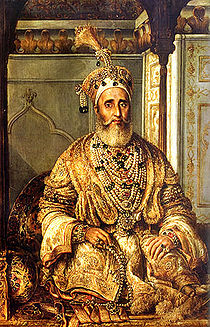
and proclaimed the Mughal Bahadur Shah II
as Badshah-i Hind, or Emperor of India. After the rebellion was crushed, he was captured and was exiled to Rangoon, Burma in 1858, and the Mughal dynasty came to an end.
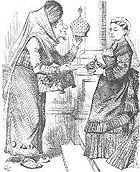 After the Mughal Emperor was deposed by the British East India Company
, and after the company itself was dissolved, the title "Empress of India" (or Kaiser-i-Hind, a form coined by the orientalist G.W. Leitner
in a deliberate attempt to dissociate British imperial rule from that of preceding dynasties) was taken by Queen Victoria from 1 May 1876, and proclaimed at the Delhi Durbar
of 1877. The title was introduced nineteen years after the formal incorporation into the British Empire
of Britain's possessions and protectorates on the Indian subcontinent
, comprising most of modern-day India
(excluding the Portuguese India
, the State of Sikkim
, and the enclaves of French India
), Pakistan
, Bangladesh
, Sri Lanka and Burma (though the latter would be made a separate colony in 1937). Prime Minister
Benjamin Disraeli is usually credited with the title's creation.
 There were several motivations for the instatement of the imperial title. It had become evident that Queen Victoria's daughter, Victoria, Princess Royal
, would become an empress when her husband ascended the German imperial throne; many at the time thought it wrong for the daughter to outrank her mother, a "mere" queen. Furthermore, Victoria's superiority to the various rulers who nominally controlled parts of British India was considered justification for the title "Empress".

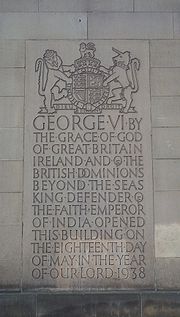 When Victoria died, and her son Edward VII
ascended the throne, his title became "Emperor of India". The title continued until India
and Pakistan
became independent from the United Kingdom
at midnight on 14/15 August 1947. The title itself was not formally abandoned until 22 June 1948 under George VI
, although the British monarch continued to be the monarch of India and Pakistan until they became republics in 1950 and 1956, respectively (see below).
When signing their name for Indian business, a British King-Emperor
or reigning Queen-Empress used the initials R I (Rex/Regina Imperator/Imperatrix) or the abbreviation Ind. Imp. (Indiae Imperator/Imperatrix) after their name (while the one reigning Queen-Empress, Victoria, used the initials R I, the three consorts of the married King-Emperors simply used R).
When a male monarch held the title his wife, the queen consort
, used the style Queen-Empress, but was not herself a reigning monarch.
British coins, and those of the Empire and Commonwealth dominions routinely included the abbreviated title Ind. Imp., although in India itself the coins said "Empress", and later "King Emperor". When in 1947 India became independent all coining dies had to be changed, which took up to a year and created some problems. Canadian coins, for example, were minted well into 1948 stamped "1947", the new year's issue indicated by a small maple leaf
in one corner. In Great Britain itself the title appeared on coinage through 1948.
of Lord Mountbatten
and of C. Rajagopalachari
until India became a republic on 26 January 1950. George VI remained as King of Pakistan until his death in 1952 and his successor Elizabeth II was Queen of Pakistan until Pakistan became a republic on 23 March 1956.
Title
A title is a prefix or suffix added to someone's name to signify either veneration, an official position or a professional or academic qualification. In some languages, titles may even be inserted between a first and last name...
by the last Mughal
Mughal Empire
The Mughal Empire , or Mogul Empire in traditional English usage, was an imperial power from the Indian Subcontinent. The Mughal emperors were descendants of the Timurids...
emperor Bahadur Shah II
Bahadur Shah II
His Royal Highness Abu Zafar Sirajuddin Muhammad Bahadur Shah Zafar , also known as Bahadur Shah or Bahadur Shah II was the last of the Mughal emperors in India, as well as the last ruler of the Timurid Dynasty.He was the son of Akbar Shah II and Lalbai, who was a Hindu Rajput...
, and revived by the colonial British monarchs
Monarchy of the United Kingdom
The monarchy of the United Kingdom is the constitutional monarchy of the United Kingdom and its overseas territories. The present monarch, Queen Elizabeth II, has reigned since 6 February 1952. She and her immediate family undertake various official, ceremonial and representational duties...
during the British Raj
British Raj
British Raj was the British rule in the Indian subcontinent between 1858 and 1947; The term can also refer to the period of dominion...
in India
India
India , officially the Republic of India , is a country in South Asia. It is the seventh-largest country by geographical area, the second-most populous country with over 1.2 billion people, and the most populous democracy in the world...
.
The term "Emperor of India" is also used to refer to Indian emperors such as Ashoka the Great of the Maurya Dynasty and Emperor Akbar the Great
Akbar the Great
Akbar , also known as Shahanshah Akbar-e-Azam or Akbar the Great , was the third Mughal Emperor. He was of Timurid descent; the son of Emperor Humayun, and the grandson of the Mughal Emperor Zaheeruddin Muhammad Babur, the ruler who founded the Mughal dynasty in India...
of the Mughal
Mughal Empire
The Mughal Empire , or Mogul Empire in traditional English usage, was an imperial power from the Indian Subcontinent. The Mughal emperors were descendants of the Timurids...
empire. For instance, Emperor Ashoka used the word 'Samrat' as his title, which means "emperor" in Indian languages.
Bahadur Shah II
Though the MughalMughal Empire
The Mughal Empire , or Mogul Empire in traditional English usage, was an imperial power from the Indian Subcontinent. The Mughal emperors were descendants of the Timurids...
dynasty ruled over most of the Indian subcontinent from the 16th century onwards, they simply used the title badshah (considered in the West to be equivalent to emperor) without geographic designation. During the Indian Rebellion of 1857
Indian Rebellion of 1857
The Indian Rebellion of 1857 began as a mutiny of sepoys of the British East India Company's army on 10 May 1857, in the town of Meerut, and soon escalated into other mutinies and civilian rebellions largely in the upper Gangetic plain and central India, with the major hostilities confined to...
, the rebel sepoy
Sepoy
A sepoy was formerly the designation given to an Indian soldier in the service of a European power. In the modern Indian Army, Pakistan Army and Bangladesh Army it remains in use for the rank of private soldier.-Etymology and Historical usage:...
s seized Delhi
Delhi
Delhi , officially National Capital Territory of Delhi , is the largest metropolis by area and the second-largest by population in India, next to Mumbai. It is the eighth largest metropolis in the world by population with 16,753,265 inhabitants in the Territory at the 2011 Census...
and proclaimed the Mughal Bahadur Shah II
Bahadur Shah II
His Royal Highness Abu Zafar Sirajuddin Muhammad Bahadur Shah Zafar , also known as Bahadur Shah or Bahadur Shah II was the last of the Mughal emperors in India, as well as the last ruler of the Timurid Dynasty.He was the son of Akbar Shah II and Lalbai, who was a Hindu Rajput...
as Badshah-i Hind, or Emperor of India. After the rebellion was crushed, he was captured and was exiled to Rangoon, Burma in 1858, and the Mughal dynasty came to an end.
British monarchs
British East India Company
The East India Company was an early English joint-stock company that was formed initially for pursuing trade with the East Indies, but that ended up trading mainly with the Indian subcontinent and China...
, and after the company itself was dissolved, the title "Empress of India" (or Kaiser-i-Hind, a form coined by the orientalist G.W. Leitner
Gottlieb Wilhelm Leitner
Gottlieb Wilhelm Leitner or Gottlieb William Leitner M.A.,Ph.D.,L.L.D.,D.O.L. was an Anglo-Hungarian orientalist.-Early life and education:...
in a deliberate attempt to dissociate British imperial rule from that of preceding dynasties) was taken by Queen Victoria from 1 May 1876, and proclaimed at the Delhi Durbar
Delhi Durbar
The Delhi Durbar , meaning "Court of Delhi", was a mass assembly at Coronation Park, Delhi, India, to mark the coronation of a King and Queen of the United Kingdom. Also known as the Imperial Durbar, it was held three times, in 1877, 1903, and 1911, at the height of the British Empire. The 1911...
of 1877. The title was introduced nineteen years after the formal incorporation into the British Empire
British Empire
The British Empire comprised the dominions, colonies, protectorates, mandates and other territories ruled or administered by the United Kingdom. It originated with the overseas colonies and trading posts established by England in the late 16th and early 17th centuries. At its height, it was the...
of Britain's possessions and protectorates on the Indian subcontinent
Indian subcontinent
The Indian subcontinent, also Indian Subcontinent, Indo-Pak Subcontinent or South Asian Subcontinent is a region of the Asian continent on the Indian tectonic plate from the Hindu Kush or Hindu Koh, Himalayas and including the Kuen Lun and Karakoram ranges, forming a land mass which extends...
, comprising most of modern-day India
India
India , officially the Republic of India , is a country in South Asia. It is the seventh-largest country by geographical area, the second-most populous country with over 1.2 billion people, and the most populous democracy in the world...
(excluding the Portuguese India
Portuguese India
The Portuguese Viceroyalty of India , later the Portuguese State of India , was the aggregate of Portugal's colonial holdings in India.The government started in 1505, six years after the discovery of a sea route to India by Vasco da Gama, with the nomination of the first Viceroy Francisco de...
, the State of Sikkim
Sikkim
Sikkim is a landlocked Indian state nestled in the Himalayan mountains...
, and the enclaves of French India
French India
French India is a general name for the former French possessions in India These included Pondichéry , Karikal and Yanaon on the Coromandel Coast, Mahé on the Malabar Coast, and Chandannagar in Bengal...
), Pakistan
Pakistan
Pakistan , officially the Islamic Republic of Pakistan is a sovereign state in South Asia. It has a coastline along the Arabian Sea and the Gulf of Oman in the south and is bordered by Afghanistan and Iran in the west, India in the east and China in the far northeast. In the north, Tajikistan...
, Bangladesh
Bangladesh
Bangladesh , officially the People's Republic of Bangladesh is a sovereign state located in South Asia. It is bordered by India on all sides except for a small border with Burma to the far southeast and by the Bay of Bengal to the south...
, Sri Lanka and Burma (though the latter would be made a separate colony in 1937). Prime Minister
Prime Minister of the United Kingdom
The Prime Minister of the United Kingdom of Great Britain and Northern Ireland is the Head of Her Majesty's Government in the United Kingdom. The Prime Minister and Cabinet are collectively accountable for their policies and actions to the Sovereign, to Parliament, to their political party and...
Benjamin Disraeli is usually credited with the title's creation.
Victoria, Princess Royal
The Princess Victoria, Princess Royal was the eldest child of Queen Victoria of the United Kingdom and Prince Albert. She was created Princess Royal of the United Kingdom in 1841. She became German Empress and Queen of Prussia by marriage to German Emperor Frederick III...
, would become an empress when her husband ascended the German imperial throne; many at the time thought it wrong for the daughter to outrank her mother, a "mere" queen. Furthermore, Victoria's superiority to the various rulers who nominally controlled parts of British India was considered justification for the title "Empress".
Edward VII of the United Kingdom
Edward VII was King of the United Kingdom and the British Dominions and Emperor of India from 22 January 1901 until his death in 1910...
ascended the throne, his title became "Emperor of India". The title continued until India
India
India , officially the Republic of India , is a country in South Asia. It is the seventh-largest country by geographical area, the second-most populous country with over 1.2 billion people, and the most populous democracy in the world...
and Pakistan
Pakistan
Pakistan , officially the Islamic Republic of Pakistan is a sovereign state in South Asia. It has a coastline along the Arabian Sea and the Gulf of Oman in the south and is bordered by Afghanistan and Iran in the west, India in the east and China in the far northeast. In the north, Tajikistan...
became independent from the United Kingdom
United Kingdom
The United Kingdom of Great Britain and Northern IrelandIn the United Kingdom and Dependencies, other languages have been officially recognised as legitimate autochthonous languages under the European Charter for Regional or Minority Languages...
at midnight on 14/15 August 1947. The title itself was not formally abandoned until 22 June 1948 under George VI
George VI of the United Kingdom
George VI was King of the United Kingdom and the Dominions of the British Commonwealth from 11 December 1936 until his death...
, although the British monarch continued to be the monarch of India and Pakistan until they became republics in 1950 and 1956, respectively (see below).
When signing their name for Indian business, a British King-Emperor
King-Emperor
A king-emperor, the female equivalent being queen-empress, is a sovereign ruler who is simultaneously a king of one territory and emperor of another...
or reigning Queen-Empress used the initials R I (Rex/Regina Imperator/Imperatrix) or the abbreviation Ind. Imp. (Indiae Imperator/Imperatrix) after their name (while the one reigning Queen-Empress, Victoria, used the initials R I, the three consorts of the married King-Emperors simply used R).
When a male monarch held the title his wife, the queen consort
Queen consort
A queen consort is the wife of a reigning king. A queen consort usually shares her husband's rank and holds the feminine equivalent of the king's monarchical titles. Historically, queens consort do not share the king regnant's political and military powers. Most queens in history were queens consort...
, used the style Queen-Empress, but was not herself a reigning monarch.
British coins, and those of the Empire and Commonwealth dominions routinely included the abbreviated title Ind. Imp., although in India itself the coins said "Empress", and later "King Emperor". When in 1947 India became independent all coining dies had to be changed, which took up to a year and created some problems. Canadian coins, for example, were minted well into 1948 stamped "1947", the new year's issue indicated by a small maple leaf
Maple leaf
The maple leaf is the characteristic leaf of the maple tree, and is the most widely recognized national symbol of Canada.-Use in Canada:At the beginning of the eighteenth century, the settlements of New France had attained a population of about 18,000...
in one corner. In Great Britain itself the title appeared on coinage through 1948.
King of India and Pakistan
George VI continued to hold the title King of India for two years during the short Governor-GeneralshipsGovernor-General of India
The Governor-General of India was the head of the British administration in India, and later, after Indian independence, the representative of the monarch and de facto head of state. The office was created in 1773, with the title of Governor-General of the Presidency of Fort William...
of Lord Mountbatten
Louis Mountbatten, 1st Earl Mountbatten of Burma
Admiral of the Fleet Louis Francis Albert Victor Nicholas George Mountbatten, 1st Earl Mountbatten of Burma, KG, GCB, OM, GCSI, GCIE, GCVO, DSO, PC, FRS , was a British statesman and naval officer, and an uncle of Prince Philip, Duke of Edinburgh...
and of C. Rajagopalachari
C. Rajagopalachari
Chakravarti Rajagopalachari , informally called Rajaji or C.R., was an Indian lawyer, independence activist, politician, writer and statesman. Rajagopalachari was the last Governor-General of India...
until India became a republic on 26 January 1950. George VI remained as King of Pakistan until his death in 1952 and his successor Elizabeth II was Queen of Pakistan until Pakistan became a republic on 23 March 1956.
Emperors and Empresses of India
| Monarch | Picture | Began | Ended | Consort |
|---|---|---|---|---|
| Emperor Bahadur Shah II Bahadur Shah II His Royal Highness Abu Zafar Sirajuddin Muhammad Bahadur Shah Zafar , also known as Bahadur Shah or Bahadur Shah II was the last of the Mughal emperors in India, as well as the last ruler of the Timurid Dynasty.He was the son of Akbar Shah II and Lalbai, who was a Hindu Rajput... |
 |
May 1857 proclaimed Emperor of India in Delhi; was the Mughal Emperor since 1837 |
14 September 1857 | Four - In chronological order of marriages - Begum Ashraf Mahal, Begum Akhtar Mahal, Begum Zeenat Mahal, Begum Taj Mahal. |
| Queen-Empress Victoria |  |
28 April 1876 proclaimed in Great Britain 1 January 1877 proclaimed in India |
22 January 1901 | Victoria was widowed in 1861, before her accession |
| King-Emperor Edward VII Edward VII of the United Kingdom Edward VII was King of the United Kingdom and the British Dominions and Emperor of India from 22 January 1901 until his death in 1910... |
22 January 1901 | 6 May 1910 | Queen-Empress Alexandra Alexandra of Denmark Alexandra of Denmark was the wife of Edward VII of the United Kingdom... (d. 20 Nov. 1925) |
|
| King-Emperor George V George V of the United Kingdom George V was King of the United Kingdom and the British Dominions, and Emperor of India, from 6 May 1910 through the First World War until his death in 1936.... |
6 May 1910 | 20 January 1936 | Queen-Empress Mary Mary of Teck Mary of Teck was the queen consort of the United Kingdom and the British Dominions, and Empress of India, as the wife of King-Emperor George V.... (d. 24 Mar. 1953) |
|
| King-Emperor Edward VIII Edward VIII of the United Kingdom Edward VIII was King of the United Kingdom and the Dominions of the British Commonwealth, and Emperor of India, from 20 January to 11 December 1936.Before his accession to the throne, Edward was Prince of Wales and Duke of Cornwall and Rothesay... |
 |
20 January 1936 | 11 December 1936 | Edward abdicated the throne before he married |
| King-Emperor George VI George VI of the United Kingdom George VI was King of the United Kingdom and the Dominions of the British Commonwealth from 11 December 1936 until his death... |
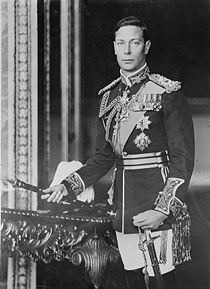 |
11 December 1936 | 22 June 1948 title abandoned |
Queen-Empress Elizabeth Elizabeth Bowes-Lyon Elizabeth Angela Marguerite Bowes-Lyon was the queen consort of King George VI from 1936 until her husband's death in 1952, after which she was known as Queen Elizabeth The Queen Mother, to avoid confusion with her daughter, Queen Elizabeth II... (d. 30 Mar. 2002) |
See also
- List of Indian monarchs
- List of Mughal emperors
- List of British monarchs
- Mughal EmpireMughal EmpireThe Mughal Empire , or Mogul Empire in traditional English usage, was an imperial power from the Indian Subcontinent. The Mughal emperors were descendants of the Timurids...
- President of IndiaPresident of IndiaThe President of India is the head of state and first citizen of India, as well as the Supreme Commander of the Indian Armed Forces. President of India is also the formal head of all the three branches of Indian Democracy - Legislature, Executive and Judiciary...
- President of PakistanPresident of PakistanThe President of Pakistan is the head of state, as well as figurehead, of the Islamic Republic of Pakistan. Recently passed an XVIII Amendment , Pakistan has a parliamentary democratic system of government. According to the Constitution, the President is chosen by the Electoral College to serve a...
- Governor-General of PakistanGovernor-General of PakistanThe Governor-General of Pakistan was the representative in Pakistan of the Crown from the country's independence in 1947. When Pakistan was proclaimed a republic in 1956 the connection with the British monarchy ended, and the office of Governor-General was abolished.-History:Pakistan gained...
- Governor-General of IndiaGovernor-General of IndiaThe Governor-General of India was the head of the British administration in India, and later, after Indian independence, the representative of the monarch and de facto head of state. The office was created in 1773, with the title of Governor-General of the Presidency of Fort William...
- Governor-GeneralGovernor-GeneralA Governor-General, is a vice-regal person of a monarch in an independent realm or a major colonial circonscription. Depending on the political arrangement of the territory, a Governor General can be a governor of high rank, or a principal governor ranking above "ordinary" governors.- Current uses...