


Presbyterianism

Encyclopedia
Presbyterianism refers to a number of Christian
churches adhering to the Calvinist
theological tradition within Protestantism
, which are organized according to a characteristic Presbyterian polity
. Presbyterian theology typically emphasizes the sovereignty
of God
, the authority of the Scriptures, and the necessity of grace
through faith in Christ
. Presbyterianism originated primarily in Scotland
. Scotland ensured Presbyterian "church government" in the Acts of Union
in 1707 which created "Great Britain". In fact, most Presbyterians found in England can trace a Scottish
connection, and the Presbyterian denomination was also taken to North America mostly by Scots and Scots-Irish immigrants. The Presbyterian denominations in Scotland hold to the theology of Calvin and his immediate successors, although there is a range of theological views within contemporary Presbyterianism.
Modern Presbyterianism traces its institutional roots back to the Scottish Reformation
. Local congregations are governed by Sessions
made up of representatives of the congregation, a conciliar approach which is found at other levels of decision-making (Presbytery, Synod
and General Assembly). Theoretically, there are no bishop
s in Presbyterianism; however, some groups in Eastern Europe, and in ecumenical groups, do have bishops. The office of elder is another distinctive mark of Presbyterianism: these are specially ordained non-clergy who take part in local pastoral care and decision-making at all levels. The office of deacon is geared toward the care of members, their families, and the surrounding community. In some congregations active elders and deacons serve a three-year term and then rotate off for at least a year. The offices of pastor, elder, and deacon all commence with ordination; once a person is ordained, he holds that title for the rest of his life. An individual may serve as both an elder and a deacon.
The roots of Presbyterianism lie in the European Reformation
of the 16th century, with the example of John Calvin
's Geneva being particularly influential. Most Reformed churches
who trace their history back to Scotland are either Presbyterian or Congregationalist
in government. In the twentieth century, some Presbyterians played an important role in the Ecumenical Movement, including the World Council of Churches
. Many Presbyterian denominations have found ways of working together with other Reformed
denominations and Christians of other traditions, especially in the World Communion of Reformed Churches
. Some Presbyterian churches have entered into unions with other churches, such as Congregationalists
, Lutherans, Anglicans, and Methodists.
word presbýteros , "elder." (Presbyterian church in Acts 14:23, 20:17, Titus 1:5).
The earliest Christian church consisted of Jews in the first century who had known Jesus Christ and heard his teachings. It gradually grew and spread from the Middle East to other parts of the world, though not without controversy and hardship among its supporters.
During the 4th century, after more than 300 years of repression and sometimes fierce persecution under various Roman emperors, the church became established as a political as well as a spiritual power under the Emperor Constantine. Theological and political disagreements, however, served to widen the rift between members of the eastern (Greek-speaking) and western (Latin-speaking) branches of the church. Eventually the western portions of Europe came under the religious and political authority of the Roman Catholic Church. Eastern Europe and parts of Asia came under the authority of the Eastern Orthodox Church.
In western Europe, the authority of the Roman Catholic Church remained largely unquestioned until the Renaissance in the 15th century. The invention of the printing press in Germany around 1440 made it possible for common people to have access to printed materials including the Bible. The public availability of the Bible encouraged private devotion away from the structure of the Roman Catholic Church. Printed materials also served to expose the populace to religious thinkers who had begun to question the authority and integrity of the Church. One such figure, Martin Luther
, a German Augustinian Friar and professor, enumerated this dissent in his 95 Theses
. In 1517, Martin Luther famously posted his grievances on a church door in Wittenberg, Germany. This moment is said to have marked the beginning of the Protestant Reformation
, a theological movement intended to reform the Church. As the Catholic Church resisted the reformers, the Church split and different theological movements bore different denominations. Presbyterianism was especially influenced by the French/Swiss theologian, John Calvin
, who is credited with the development of Reformed theology and the work of John Knox
, a Scotsman who studied with Calvin in Geneva, Switzerland and brought his teachings back to Scotland. The Presbyterian church traces its ancestry back primarily to England and Scotland. In August of 1560 the Scottish Parliament adopted the Protestant Confession of Faith as the creed of the Scottish Kingdom. In December of that year, the First Book of Discipline was published, outlining important doctrinal issues but also establishing regulations for church government, including the creation of ten ecclesiastical districts with pointed superintendents which later became known as presbyteries.
Among the early church fathers, it was noted that the offices of elder and bishop were identical, and were not differentiated until later, and that plurality
of elders was the norm for church government. St. Jerome (347-420) "In Epistle Titus", vol. iv, said, "Elder is identical with bishop; and before the urging of the devil gave rise to factionalism in religion, so much that it was being said among the people, 'I am of Paul, I of Apollos, I of Cephas', the churches were governed by a joint council of elders. After it was... decreed throughout the world that one chosen from among the presbyters should be placed over the others." This observation was also made by Chrysostom (349-407) in "Homilia i, in Phil. i, 1" and Theodoret
(393-457) in "Interpret ad. Phil. iii", 445.
Presbyterianism was first described in detail by Martin Bucer
of Strasbourg
, who believed that the early Christian church implemented presbyterian polity
. The first modern implementation was by the Geneva church under the leadership of John Calvin
in 1541.
, which is no longer emphasized in some contemporary branches. Many branches of Presbyterianism are remnants of previous splits from larger groups. Some of the splits have been due to doctrinal controversy, while some have been caused by disagreement concerning the degree to which those ordained to church office should be required to agree with the Westminster Confession of Faith
, which historically serves as an important confessional document - second only to the Bible, yet directing particularities in the standardization and translation of the Bible - in Presbyterian churches.
Presbyterians place great importance upon education and life-long learning. Continuous study of the scriptures, theological writings, and understanding and interpretation of church doctrine are embodied in several statements of faith and catechisms formally adopted by various branches of the church, often referred to as 'subordinate standards'. It is generally considered that the point of such learning is to enable one to put one's faith into practice; some Presbyterians generally exhibit their faith in action as well as words, by generosity, hospitality, and the constant pursuit of social justice and reform, as well as proclaiming the gospel of Christ.
Ruling elders are usually laymen (and laywomen in some denominations) who are elected by the congregation and ordained to serve with the teaching elders, assuming responsibility for nurture and leadership of the congregation. Often, especially in larger congregations, the elders delegate the practicalities of buildings, finance, and temporal ministry to the needy in the congregation to a distinct group of officers (sometimes called deacons, which are ordained in some denominations). This group may variously be known as a 'Deacon Board', 'Board of Deacons' 'Diaconate', or 'Deacons' Court'. These are sometimes known as "presbyters" to the full congregation.
Above the sessions exist presbyteries, which have area responsibilities. These are composed of teaching elders and ruling elders from each of the constituent congregations. The presbytery sends representatives to a broader regional or national assembly, generally known as the General Assembly, although an intermediate level of a synod
sometimes exists. This congregation / presbytery / synod
/ general assembly schema is based on the historical structure of the larger Presbyterian churches, such as the Church of Scotland
or the Presbyterian Church (U.S.A.)
; some bodies, such as the Presbyterian Church in America
and the Presbyterian Church in Ireland
, skip one of the steps between congregation and General Assembly, and usually the step skipped is the Synod. The Church of Scotland
has now abolished the Synod.
Presbyterian governance is practised by Presbyterian denominations and also by many other Reformed churches
.

 Presbyterianism is historically a confessional tradition. This has two implications. The obvious one is that confessional churches express their faith in the form of "confessions of faith," which have some level of authoritative status. However this is based on a more subtle point: In confessional churches, theology is not solely an individual matter. While individuals are encouraged to understand Scripture, and may challenge the current institutional understanding, theology is carried out by the community as whole. It is this community understanding of theology that is expressed in confessions.
However, there has arisen a spectrum of approaches to "confessionalism". The manner of subscription, or the degree to which the official standards establish the actual doctrine of the church, turns out to be a practical matter. That is, the decisions rendered in ordination and in the courts of the church largely determine what the church means, representing the whole, by its adherence to the doctrinal standard.
Some Presbyterian traditions adopt only the Westminster Confession of Faith
as the doctrinal standard to which teaching elders are required to subscribe, in contrast to the Larger
and Shorter
catechisms, which are approved for use in instruction. Many Presbyterian denominations, especially in North America, have adopted all of the Westminster Standards
as their standard of doctrine which is subordinate to the Bible. These documents are Calvinistic in their doctrinal orientation, although some versions of the Confession and the catechisms are more overtly Calvinist than some other, later American revisions. The Presbyterian Church in Canada retains the Westminster Confession of Faith in its original form, while admitting the historical period in which it was written should be understood when it is read.
The Westminster Confession is 'The principal subordinate standard of the Church of Scotland
' (Articles Declaratory of the Constitution of the Church of Scotland II), but 'with due regard to liberty of opinion in points which do not enter into the substance of the Faith' (V). This formulation represents many years of struggle over the extent to which the confession reflects the Word of God and the struggle of conscience of those who came to believe it did not fully do so (e.g., William Robertson Smith
). Some Presbyterian Churches, such as the Free Church of Scotland
, have no such 'conscience
clause'.
The Presbyterian Church USA has adopted the Book of Confessions
, which reflects the inclusion of other Reformed confessions in addition to the Westminster documents. These other documents include ancient creedal statements (the Nicene Creed
, the Apostles' Creed
), 16th century Reformed confessions (the Scots Confession
, the Heidelberg Catechism
, the Second Helvetic Confession, all of which were written before Calvinism had developed as a particular strand of Reformed doctrine), and 20th century documents (The Theological Declaration of Barmen
and the Confession of 1967
).
The Presbyterian Church in Canada developed the confessional document Living Faith [1984] and retains it as a subordinate standard of the denomination. It is confessional in format, yet like the Westminster Confession, draws attention back to original Bible text.
Presbyterians in Ireland who rejected Calvinism and the Westminster Confessions formed the Non-subscribing Presbyterian Church of Ireland
.
, developed by the Westminster Assembly
in the 1640s. This directory documented Reformed worship practices and theology adopted and developed over the preceding century by British Puritan
s, initially guided by John Calvin
and John Knox
. It was enacted as law by the Scottish Parliament, and became one of the foundational documents of Presbyterian church legislation elsewhere.
Historically, the driving principle in the development of the standards of Presbyterian worship is the Regulative principle of worship
, which specifies that (in worship), what is not commanded is forbidden.
Presbyterians traditionally have held the Worship position that there are only two sacraments:
Over subsequent centuries, many Presbyterian churches modified these prescriptions by introducing non-biblical hymns, instrumental accompaniment and ceremonial vestment
s in worship. Still, there is not one fixed "Presbyterian" worship style. Although there are set services for the "Lord's Day", one can find a service to be evangelical and even revivalist in tone (especially in some conservative denominations), or strongly liturgical, approximating the practices of Lutheranism
or Anglicanism
(especially where Scottish tradition is esteemed), or semi-formal, allowing for a balance of hymns, preaching, and congregational participation (favored by probably most American Presbyterians).
Among the Paleo-orthodoxy
and emerging church
movements in protestant and evangelical churches, which includes many Presbyterians, clergy are moving away from the traditional black Geneva gown
and reclaiming not only the more ancient Eucharist
vestments of alb
and chasuble
, but also cassock
and surplice
(typically a full length Old English style surplice which resembles the Celtic alb, an ungirdled liturgical tunic of the old Gallican Rite
).
s to support the worship of God. The decor in some instances was austere so as not to detract from worship. Early Presbyterian meeting-houses were extremely plain. No stained glass, no elaborate furnishings, and no images were to be found in the meeting-house. The pulpit, often raised so as only to be accessible by a staircase, was the centerpiece of the building. In the late 19th century a gradual shift began to occur. Prosperous congregations built imposing churches, such as St Vincent Street Church, Glasgow, Fourth Presbyterian in Chicago, Fifth Avenue Presbyterian in New York City, Shadyside Presbyterian Church
in Pittsburgh, First Presbyterian in Dallas, and many others. Usually a Presbyterian church will not have statues of saints, nor the ornate altar more typical of a Roman Catholic
church. In a Presbyterian (Reformed Church) one will not usually find a Crucifix hanging behind the Chancel. However, one may find stained glass windows that depict the crucifixion, behind a chancel.
(1505–1572), a Scot
who had spent time studying under Calvin
in Geneva
, returned to Scotland
and led the Parliament of Scotland
to embrace the Reformation
in 1560 (see Scottish Reformation Parliament
). The Church of Scotland was eventually reformed along Presbyterian lines, to become the national Church of Scotland
.
The Glorious Revolution
of 1688 and the Acts of Union 1707
between Scotland and England guaranteed the Church of Scotland's form of government. However, legislation by the United Kingdom parliament allowing patronage
led to splits in the Church, and finally the Disruption of 1843
led to the formation of the Free Church of Scotland
. Further splits took place, especially over theological issues, but most Presbyterians in Scotland were reunited by 1929 union of the established Church of Scotland and the United Free Church of Scotland
.
The Presbyterian denominations in Scotland today are the Church of Scotland
, the Free Church of Scotland
, the United Free Church of Scotland
, the Free Church of Scotland (Continuing)
, the Free Presbyterian Church of Scotland
, the Associated Presbyterian Church (Associated Presbyterian Churches
), and the Reformed Presbyterian Church of Scotland.
Within Scotland the term kirk
is usually used to refer to a local Presbyterian church. Informally the term 'The Kirk' refers to the
Church of Scotland.
, Presbyterianism was established in secret in 1572. Thomas Cartwright is thought to be the first Presbyterian in England. Cartwright's controversial lectures at Cambridge University condemning the episcopal hierarchy of the Elizabethan Church led to his deprivation of his post by Archbishop John Whitgift
and his emigration abroad. In 1647, by an act of the Long Parliament
under the control of Puritans, the Church of England
permitted Presbyterianism. The re-establishment of the monarchy in 1660 brought the return of Episcopal
church government in England (and in Scotland for a short time); but the Presbyterian church in England continued in non-conformity, outside of the established church. In 1719 a major split, the Salter's Hall controversy, occurred; with the majority siding with nontrinitarian views. Thomas Bradbury
published several sermons bearing on the controversy, and in 1719, "An answer to the reproaches cast on the dissenting ministers who subscribed their belief of the Eternal Trinity.". By the 18th century many English Presbyterian congregations had become Unitarian
in doctrine.
A number of new Presbyterian Churches were founded by Scottish
immigrants to England in the 19th century and later. Following the 'Disruption' in 1843 many of those linked to the Church of Scotland eventually joined what became the Presbyterian Church of England in 1876. Some, that is Crown Court (Covent Garden, London), St Andrew's (Stepney, London)) and Swallow Street (London), did not join the English denomination, which is why there are Church of Scotland congregations in England such as those at Crown Court
, and St Columba's
, Pont Street (Knightsbridge) in London.
In 1972, the Presbyterian Church of England (PCofE) united with the Congregational Church in England and Wales to form the United Reformed Church
(URC). Among the congregations the PCofE brought to the URC were Tunley (Lancashire) , Aston Tirrold
(Oxfordshire) and John Knox
Presbyterian Church, Stepney, London (now part of Stepney Meeting House URC) - these are among the sole survivors today of the English Presbyterian churches of the 17th century. The URC also has a presence in Scotland, mostly of former Congregationalist
Churches. Two former Presbyterian congregations, St Columba's, Cambridge (founded in 1879), and St Columba's, Oxford (founded as a chaplaincy by the PCofE and the Church of Scotland
in 1908 and as a congregation of the PCofE in 1929), continue as congregations of the URC and university chaplaincies of the Church of Scotland
.
In recent years a number of smaller denominations adopting Presbyterian forms of church government have organised in England, including the International Presbyterian Church planted by evangelical theologian Francis Schaeffer
of L'Abri Fellowship
in the 1970s, and the Evangelical Presbyterian Church in England and Wales
founded in the North of England in the late 1980s.
Presbyterianism is represented by the Presbyterian Church of Wales
, which was originally composed largely of Calvinistic Methodists who accepted Calvinist theology rather than the Armininianism of the Wesleyan Methodists. They broke off from the Church of England in 1811, ordaining their own ministers. They were originally known as the Calvinist Methodist connexion and in the 1920s it became alternatively known as the Presbyterian Church of Wales.
(after the Anglican Church of Ireland
), and was brought by Scottish plantation settlers
to Ulster
who had been strongly encouraged to emigrate by James VI of Scotland, later James I of England
. An estimated 100,000 Scottish Presbyterians moved to the northern counties of Ireland between 1607 and the Battle of the Boyne
in 1690. The Presbytery of Ulster was formed in 1642 separately from the established Anglican Church. Presbyterians, along with Roman Catholics in Ulster and the rest of Ireland, suffered under the discriminatory Penal Laws until they were revoked in the early 19th century. Presbyterianism is represented in Ireland by the Presbyterian Church in Ireland
, the Free Presbyterian Church of Ulster
, the Non-subscribing Presbyterian Church of Ireland
, the Reformed Presbyterian Church of Ireland
and the Evangelical Presbyterian Church
.
 In France
, Presbyterianism is represented by the Eglise Reformée de France, and Presbyterianism is the largest Protestant denomination in France. There are also Lutherans and Evangelicals. In France, people usually say Protestant (which is a common term for all Reformed Christians). The word Calviniste may be used to differentiate from Lutherans, but the word Presbyterian is not used at all. The logo is a Huguenot Cross (Croix Huguenote) with the burning bush.
There is also an Church of Scotland (Presbyterian) in central Paris The Scots Kirk, Paris
which is English-speaking, and is attended by many nationalities. It maintains close links with the Church of Scotland in Scotland itself, as well as with l'Eglise Reformée de France.
lie in the medieval Waldensian movement for religious reform. The Waldensians
adopted Calvinist theology during the Reformation
and became the Italian branch of the Reformed churches
. In 1975 the Waldensian Church joined with the Italian Methodist Church to form the Union of Waldensian and Methodist Churches, which is a member of the World Council of Churches
, the World Alliance of Reformed Churches
, and the World Methodist Council
.
which is a Calvinist strand, established in 1567, Debrecen, Hungary. Their confessional documents are the following:The Heidelberg Catechism, The Second Helvetian Confession.
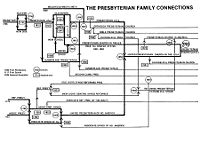 Even before Presbyterianism spread with immigrants abroad from Scotland, there were divisions in the larger Presbyterian family. Some later rejoined only to separate again. In what some interpret as rueful self-reproach, some Presbyterians refer to the divided Presbyterian churches as the "Split P's".
, because of past or current doctrinal differences, Presbyterian churches often overlap, with congregations of many different Presbyterian groups in any one place. The largest Presbyterian denomination in the United States is the Presbyterian Church (U.S.A.)
or PC(USA). Other Presbyterian bodies in the United States include the Presbyterian Church in America
, the Orthodox Presbyterian Church
, the Evangelical Presbyterian Church, the Reformed Presbyterian Church
, the Bible Presbyterian Church
, the Associate Reformed Presbyterian Church
(ARP Synod), the Cumberland Presbyterian Church
, the Cumberland Presbyterian Church in America
, the Westminster Presbyterian Church in the United States
(WPCUS), and the Reformed Presbyterian Church in the United States
(RPCUS).
The territory within about a 50 miles (80 km) radius of Charlotte, North Carolina
, is historically the greatest concentration of Presbyterianism in the Southern United States, while an almost identical geographic area around Pittsburgh, Pennsylvania
, contains probably the largest number of Presbyterians in the entire nation.
The PC (USA), beginning with its predecessor bodies, has, in common with other so-called "mainline" Protestant denominations, experienced a significant decline in members in recent years. Some estimates have placed that loss at nearly half in the last forty years.
In August 2011, the American National Middle Eastern Presbyterian Caucus (NMEPC) endorsed the boycott, divestment, and sanctions
(BDS) campaign against Israel.
, the largest Presbyterian denomination – and indeed the largest Protestant denomination – was the Presbyterian Church in Canada
, formed in 1875 with the merger of four regional groups. In 1925, the United Church of Canada
was formed with the Methodist Church, Canada, and the Congregational Union of Canada
. A sizable minority of Canadian Presbyterians, primarily in southern Ontario but also throughout the entire nation, withdrew, and reconstituted themselves as a non-concurring continuing Presbyterian body. They regained use of the original name in 1939.
in the 19th century. The biggest Presbyterian church is the National Presbyterian Church of Mexico ("Iglesia Nacional Presbyteriana de México"), which has around 2,500,000 members and associates, but there are other small denominations. In Brazil, the Presbyterian Church of Brazil
(Igreja Presbiteriana do Brasil) totals approximately 788.553 members; other presbyterian churches (Independents, United, Conservatives, Renovated - Charismatic, Free, Fundamentalist, Evangelical) in this nation have around 350,000 members. There are probably more than four million members of Presbyterian churches in all of Latin America. Presbyterian churches are also present in Peru, Bolivia, Cuba, Trinidad and Tobago, Venezuela, Colombia, Chile, Paraguay, Costa Rica, Nicaragua, Argentina and others, but with few members. Some Latin Americans in North America are active in the Presbyterian Cursillo Movement.
in the 19th century through the work of Scottish missionaries and founded churches such as St Michael and All Angels Church, Blantyre, Malawi
. The church has grown extensively and now has a presence in at least 23 countries in the region. The Presbyterian Church of East Africa
, based in Kenya, is particularly strong, with 500 clergy and 4 million members. African presbyterian churches often incorporate diaconal ministries, including social services, emergency relief, and the operation of mission hospitals. A number of partnerships exist between presbyteries in Africa and the PC(USA), including specific connections with Lesotho, Malawi, South Africa, and Ghana. For example, the Lackawanna Presbytery, located in Northeastern Pennsylvania, has a partnership with a presbytery in Ghana. Also, Southminster Presbyterian Church, located near Pittsburgh, has partnerships with churches in Malawi and Kenya.
In addition also there are a number of Presbyterian Churches in north Africa, the most known is the Nile Synod in Egypt and a recently founded synod for Sudan.
All Korean Presbyterian denominations share the same name in Korean, 대한예수교장로회, tracing its roots to the United Presbyterian Assembly before its long history of disputes and schisms. All major seminaries associated with each denomination claim heritage from the Pyung Yang Theological Seminary, therefore, both Jangsin University and Chongsin University both celebrated the 100th class in 2007, 100 years from the first graduates of Pyung Yang Theological Seminary.
Korean Presbyterian denominations are active in evangelism and many of its missionaries are being sent overseas, being the second biggest missionary sender in the world after the United States. GSM, the missionary body of the "Hapdong" General Assembly of Presbyterian Churches of Korea, is the single largest Presbyterian missionary organization in the Korea.
In Oryu-dong
, Pyungkang Cheil is one of the largest Christian churches in South Korea. Another congregation in Seoul, Myungsung Presbyterian Church
, claims to be the largest Presbyterian Church in the world. In addition there are many Korean-American Presbyterians in the United States, either with their own church sites or sharing space in pre-existing churches as is the case in Australia, New Zealand and even Muslim countries such as Saudi Arabia with Korean immigration.
, the Presbyterian Church in Taiwan
has been an important supporter of the use of Taiwanese languages in services as a consequence of its advocacy of vernacular scriptures and worship services. (Mandarin Chinese has become dominant since the Nationalists fled to the island in 1949.)
n state of Mizoram
, the Presbyterian denomination is the largest denomination; it was brought to the region with missionaries from Wales
in 1894. Prior to Mizoram, the Welsh Presbyterians (missionaries) started venturing into the north-east of India through the Khasi Hills
(presently located within the state of Meghalaya
in India) and established Presbyterian churches all over the Khasi Hills from 1840s onwards. Hence there is a strong presence of Presbyterians in Shillong
(the present capital of Meghalaya) and the areas adjoining it. The Welsh missionaries built their first church in Cherrapunji
(aka Sohra
) in 1846. Presbyterians participated in the mergers that resulted in the Church of North India
and the Church of South India
.
, Presbyterian is the dominant denomination in Otago and Southland due largely to the rich Scottish
and to a lesser extent Ulster-Scots
heritage in the region. The area around Christchurch, Canterbury, is dominated philosophically by the Anglican (Episcopalian) denomination.
Originally there were two branches of Presbyterianism in New Zealand, the northern Presbyterian church which existed in the North Island and the parts of the South Island north of the Waitaki River
, and the Synod of Otago and Southland
, founded by Free Church settlers in southern South Island. The two churches merged in 1901, forming what is now the Presbyterian Church of Aotearoa New Zealand
.
, Presbyterianism is the fourth largest denomination of Christianity, with nearly 600,000 Australians claiming to be Presbyterian in the 2006 Commonwealth Census. Presbyterian churches were founded in each colony, some with links to the Church of Scotland and others to the Free Church, including a number founded by John Dunmore Lang
. Some of these bodies merged in the 1860s. In 1901 the churches linked to the Church of Scotland in each state joined together forming the Presbyterian Church of Australia
but retaining their state assemblies.
In 1977, two thirds of the Presbyterian Church of Australia, along with the Congregational Union of Australia
and the Methodist Church of Australasia
, combined to form the Uniting Church in Australia
. The majority of the other third did not join due to disagreement with the Uniting Church's liberal views, though a portion remained due to cultural attachment. For example, although the Presbyterian Church of Australia reinstated the ban on the ordination of women to the ministry in 1991, one of the two women ordained prior to that date has kept her position in the denomination and is currently the Senior Minister of St Andrew's Presbyterian Church in Canberra.
is the largest denomination in the country, with approximately one-third of the population of Vanuatu members of the church. The PCV was taken to Vanuatu by missionaries from Scotland. The PCV (Presbyterian Church of Vanuatu) is headed by a moderator with offices in Port Vila
. The PCV is particularly strong in the provinces of Tafea, Shefa
, and Malampa. The Province of Sanma
is mainly Presbyterian with a strong Roman Catholic minority in the Francophone
areas of the province. There are some Presbyterian people, but no organised Presbyterian churches in Penama and Torba
, both of which are traditionally Anglican. Vanuatu is the only country in the South Pacific with a significant Presbyterian heritage and membership. The PCV is a founding member of the Vanuatu Christian Council (VCC). The PCV runs many primary schools and Onesua secondary school. Although the church has lost members to American fundamentalists, the church is still strong, especially in the rural villages.
Christian
A Christian is a person who adheres to Christianity, an Abrahamic, monotheistic religion based on the life and teachings of Jesus of Nazareth as recorded in the Canonical gospels and the letters of the New Testament...
churches adhering to the Calvinist
Calvinism
Calvinism is a Protestant theological system and an approach to the Christian life...
theological tradition within Protestantism
Protestantism
Protestantism is one of the three major groupings within Christianity. It is a movement that began in Germany in the early 16th century as a reaction against medieval Roman Catholic doctrines and practices, especially in regards to salvation, justification, and ecclesiology.The doctrines of the...
, which are organized according to a characteristic Presbyterian polity
Presbyterian polity
Presbyterian polity is a method of church governance typified by the rule of assemblies of presbyters, or elders. Each local church is governed by a body of elected elders usually called the session or consistory, though other terms, such as church board, may apply...
. Presbyterian theology typically emphasizes the sovereignty
Sovereignty
Sovereignty is the quality of having supreme, independent authority over a geographic area, such as a territory. It can be found in a power to rule and make law that rests on a political fact for which no purely legal explanation can be provided...
of God
God
God is the English name given to a singular being in theistic and deistic religions who is either the sole deity in monotheism, or a single deity in polytheism....
, the authority of the Scriptures, and the necessity of grace
Divine grace
In Christian theology, grace is God’s gift of God’s self to humankind. It is understood by Christians to be a spontaneous gift from God to man - "generous, free and totally unexpected and undeserved" - that takes the form of divine favour, love and clemency. It is an attribute of God that is most...
through faith in Christ
Christ
Christ is the English term for the Greek meaning "the anointed one". It is a translation of the Hebrew , usually transliterated into English as Messiah or Mashiach...
. Presbyterianism originated primarily in Scotland
Scotland
Scotland is a country that is part of the United Kingdom. Occupying the northern third of the island of Great Britain, it shares a border with England to the south and is bounded by the North Sea to the east, the Atlantic Ocean to the north and west, and the North Channel and Irish Sea to the...
. Scotland ensured Presbyterian "church government" in the Acts of Union
Acts of Union 1707
The Acts of Union were two Parliamentary Acts - the Union with Scotland Act passed in 1706 by the Parliament of England, and the Union with England Act passed in 1707 by the Parliament of Scotland - which put into effect the terms of the Treaty of Union that had been agreed on 22 July 1706,...
in 1707 which created "Great Britain". In fact, most Presbyterians found in England can trace a Scottish
Scottish people
The Scottish people , or Scots, are a nation and ethnic group native to Scotland. Historically they emerged from an amalgamation of the Picts and Gaels, incorporating neighbouring Britons to the south as well as invading Germanic peoples such as the Anglo-Saxons and the Norse.In modern use,...
connection, and the Presbyterian denomination was also taken to North America mostly by Scots and Scots-Irish immigrants. The Presbyterian denominations in Scotland hold to the theology of Calvin and his immediate successors, although there is a range of theological views within contemporary Presbyterianism.
Modern Presbyterianism traces its institutional roots back to the Scottish Reformation
Scottish Reformation
The Scottish Reformation was Scotland's formal break with the Papacy in 1560, and the events surrounding this. It was part of the wider European Protestant Reformation; and in Scotland's case culminated ecclesiastically in the re-establishment of the church along Reformed lines, and politically in...
. Local congregations are governed by Sessions
Presbyterian polity
Presbyterian polity is a method of church governance typified by the rule of assemblies of presbyters, or elders. Each local church is governed by a body of elected elders usually called the session or consistory, though other terms, such as church board, may apply...
made up of representatives of the congregation, a conciliar approach which is found at other levels of decision-making (Presbytery, Synod
Synod
A synod historically is a council of a church, usually convened to decide an issue of doctrine, administration or application. In modern usage, the word often refers to the governing body of a particular church, whether its members are meeting or not...
and General Assembly). Theoretically, there are no bishop
Bishop
A bishop is an ordained or consecrated member of the Christian clergy who is generally entrusted with a position of authority and oversight. Within the Catholic Church, Eastern Orthodox, Oriental Orthodox Churches, in the Assyrian Church of the East, in the Independent Catholic Churches, and in the...
s in Presbyterianism; however, some groups in Eastern Europe, and in ecumenical groups, do have bishops. The office of elder is another distinctive mark of Presbyterianism: these are specially ordained non-clergy who take part in local pastoral care and decision-making at all levels. The office of deacon is geared toward the care of members, their families, and the surrounding community. In some congregations active elders and deacons serve a three-year term and then rotate off for at least a year. The offices of pastor, elder, and deacon all commence with ordination; once a person is ordained, he holds that title for the rest of his life. An individual may serve as both an elder and a deacon.
The roots of Presbyterianism lie in the European Reformation
Protestant Reformation
The Protestant Reformation was a 16th-century split within Western Christianity initiated by Martin Luther, John Calvin and other early Protestants. The efforts of the self-described "reformers", who objected to the doctrines, rituals and ecclesiastical structure of the Roman Catholic Church, led...
of the 16th century, with the example of John Calvin
John Calvin
John Calvin was an influential French theologian and pastor during the Protestant Reformation. He was a principal figure in the development of the system of Christian theology later called Calvinism. Originally trained as a humanist lawyer, he broke from the Roman Catholic Church around 1530...
's Geneva being particularly influential. Most Reformed churches
Reformed churches
The Reformed churches are a group of Protestant denominations characterized by Calvinist doctrines. They are descended from the Swiss Reformation inaugurated by Huldrych Zwingli but developed more coherently by Martin Bucer, Heinrich Bullinger and especially John Calvin...
who trace their history back to Scotland are either Presbyterian or Congregationalist
Congregational church
Congregational churches are Protestant Christian churches practicing Congregationalist church governance, in which each congregation independently and autonomously runs its own affairs....
in government. In the twentieth century, some Presbyterians played an important role in the Ecumenical Movement, including the World Council of Churches
World Council of Churches
The World Council of Churches is a worldwide fellowship of 349 global, regional and sub-regional, national and local churches seeking unity, a common witness and Christian service. It is a Christian ecumenical organization that is based in the Ecumenical Centre in Geneva, Switzerland...
. Many Presbyterian denominations have found ways of working together with other Reformed
Reformed churches
The Reformed churches are a group of Protestant denominations characterized by Calvinist doctrines. They are descended from the Swiss Reformation inaugurated by Huldrych Zwingli but developed more coherently by Martin Bucer, Heinrich Bullinger and especially John Calvin...
denominations and Christians of other traditions, especially in the World Communion of Reformed Churches
World Communion of Reformed Churches
The World Communion of Reformed Churches is an ecumenical Christian body formed in June 2010 by the union of the World Alliance of Reformed Churches and the Reformed Ecumenical Council...
. Some Presbyterian churches have entered into unions with other churches, such as Congregationalists
Congregational church
Congregational churches are Protestant Christian churches practicing Congregationalist church governance, in which each congregation independently and autonomously runs its own affairs....
, Lutherans, Anglicans, and Methodists.
History
Presbyterian denominations derive their name from the GreekGreek language
Greek is an independent branch of the Indo-European family of languages. Native to the southern Balkans, it has the longest documented history of any Indo-European language, spanning 34 centuries of written records. Its writing system has been the Greek alphabet for the majority of its history;...
word presbýteros , "elder." (Presbyterian church in Acts 14:23, 20:17, Titus 1:5).
The earliest Christian church consisted of Jews in the first century who had known Jesus Christ and heard his teachings. It gradually grew and spread from the Middle East to other parts of the world, though not without controversy and hardship among its supporters.
During the 4th century, after more than 300 years of repression and sometimes fierce persecution under various Roman emperors, the church became established as a political as well as a spiritual power under the Emperor Constantine. Theological and political disagreements, however, served to widen the rift between members of the eastern (Greek-speaking) and western (Latin-speaking) branches of the church. Eventually the western portions of Europe came under the religious and political authority of the Roman Catholic Church. Eastern Europe and parts of Asia came under the authority of the Eastern Orthodox Church.
In western Europe, the authority of the Roman Catholic Church remained largely unquestioned until the Renaissance in the 15th century. The invention of the printing press in Germany around 1440 made it possible for common people to have access to printed materials including the Bible. The public availability of the Bible encouraged private devotion away from the structure of the Roman Catholic Church. Printed materials also served to expose the populace to religious thinkers who had begun to question the authority and integrity of the Church. One such figure, Martin Luther
Martin Luther
Martin Luther was a German priest, professor of theology and iconic figure of the Protestant Reformation. He strongly disputed the claim that freedom from God's punishment for sin could be purchased with money. He confronted indulgence salesman Johann Tetzel with his Ninety-Five Theses in 1517...
, a German Augustinian Friar and professor, enumerated this dissent in his 95 Theses
95 Theses
The Ninety-Five Theses on the Power and Efficacy of Indulgences , commonly known as , was written by Martin Luther, 1517 and is widely regarded as the primary catalyst for the Protestant Reformation...
. In 1517, Martin Luther famously posted his grievances on a church door in Wittenberg, Germany. This moment is said to have marked the beginning of the Protestant Reformation
Protestant Reformation
The Protestant Reformation was a 16th-century split within Western Christianity initiated by Martin Luther, John Calvin and other early Protestants. The efforts of the self-described "reformers", who objected to the doctrines, rituals and ecclesiastical structure of the Roman Catholic Church, led...
, a theological movement intended to reform the Church. As the Catholic Church resisted the reformers, the Church split and different theological movements bore different denominations. Presbyterianism was especially influenced by the French/Swiss theologian, John Calvin
John Calvin
John Calvin was an influential French theologian and pastor during the Protestant Reformation. He was a principal figure in the development of the system of Christian theology later called Calvinism. Originally trained as a humanist lawyer, he broke from the Roman Catholic Church around 1530...
, who is credited with the development of Reformed theology and the work of John Knox
John Knox
John Knox was a Scottish clergyman and a leader of the Protestant Reformation who brought reformation to the church in Scotland. He was educated at the University of St Andrews or possibly the University of Glasgow and was ordained to the Catholic priesthood in 1536...
, a Scotsman who studied with Calvin in Geneva, Switzerland and brought his teachings back to Scotland. The Presbyterian church traces its ancestry back primarily to England and Scotland. In August of 1560 the Scottish Parliament adopted the Protestant Confession of Faith as the creed of the Scottish Kingdom. In December of that year, the First Book of Discipline was published, outlining important doctrinal issues but also establishing regulations for church government, including the creation of ten ecclesiastical districts with pointed superintendents which later became known as presbyteries.
Among the early church fathers, it was noted that the offices of elder and bishop were identical, and were not differentiated until later, and that plurality
Plurality (church governance)
In Christianity, the term plurality refers to a system of church government or ecclesiastical polity wherein the local church's decisions are made by a committee, typically called elders...
of elders was the norm for church government. St. Jerome (347-420) "In Epistle Titus", vol. iv, said, "Elder is identical with bishop; and before the urging of the devil gave rise to factionalism in religion, so much that it was being said among the people, 'I am of Paul, I of Apollos, I of Cephas', the churches were governed by a joint council of elders. After it was... decreed throughout the world that one chosen from among the presbyters should be placed over the others." This observation was also made by Chrysostom (349-407) in "Homilia i, in Phil. i, 1" and Theodoret
Theodoret
Theodoret of Cyrus or Cyrrhus was an influential author, theologian, and Christian bishop of Cyrrhus, Syria . He played a pivotal role in many early Byzantine church controversies that led to various ecumenical acts and schisms...
(393-457) in "Interpret ad. Phil. iii", 445.
Presbyterianism was first described in detail by Martin Bucer
Martin Bucer
Martin Bucer was a Protestant reformer based in Strasbourg who influenced Lutheran, Calvinist, and Anglican doctrines and practices. Bucer was originally a member of the Dominican Order, but after meeting and being influenced by Martin Luther in 1518 he arranged for his monastic vows to be annulled...
of Strasbourg
Strasbourg
Strasbourg is the capital and principal city of the Alsace region in eastern France and is the official seat of the European Parliament. Located close to the border with Germany, it is the capital of the Bas-Rhin département. The city and the region of Alsace are historically German-speaking,...
, who believed that the early Christian church implemented presbyterian polity
Presbyterian polity
Presbyterian polity is a method of church governance typified by the rule of assemblies of presbyters, or elders. Each local church is governed by a body of elected elders usually called the session or consistory, though other terms, such as church board, may apply...
. The first modern implementation was by the Geneva church under the leadership of John Calvin
John Calvin
John Calvin was an influential French theologian and pastor during the Protestant Reformation. He was a principal figure in the development of the system of Christian theology later called Calvinism. Originally trained as a humanist lawyer, he broke from the Roman Catholic Church around 1530...
in 1541.
Characteristics
Presbyterians distinguish themselves from other denominations by doctrine, institutional organization (or "church order") and worship; often using a "Book of Order" to regulate common practice and order. The origins of the Presbyterian churches were in CalvinismCalvinism
Calvinism is a Protestant theological system and an approach to the Christian life...
, which is no longer emphasized in some contemporary branches. Many branches of Presbyterianism are remnants of previous splits from larger groups. Some of the splits have been due to doctrinal controversy, while some have been caused by disagreement concerning the degree to which those ordained to church office should be required to agree with the Westminster Confession of Faith
Westminster Confession of Faith
The Westminster Confession of Faith is a Reformed confession of faith, in the Calvinist theological tradition. Although drawn up by the 1646 Westminster Assembly, largely of the Church of England, it became and remains the 'subordinate standard' of doctrine in the Church of Scotland, and has been...
, which historically serves as an important confessional document - second only to the Bible, yet directing particularities in the standardization and translation of the Bible - in Presbyterian churches.
Presbyterians place great importance upon education and life-long learning. Continuous study of the scriptures, theological writings, and understanding and interpretation of church doctrine are embodied in several statements of faith and catechisms formally adopted by various branches of the church, often referred to as 'subordinate standards'. It is generally considered that the point of such learning is to enable one to put one's faith into practice; some Presbyterians generally exhibit their faith in action as well as words, by generosity, hospitality, and the constant pursuit of social justice and reform, as well as proclaiming the gospel of Christ.
Governance
Presbyterian government is by councils (known as courts) of elders. Teaching and ruling elders are ordained and convene in the lowest council known as a session or consistory responsible for the discipline, nurture, and mission of the local congregation. Teaching elders (pastors) have responsibility for teaching, worship, and performing sacraments. Pastors are called by individual congregations. A congregation issues a call for the pastor's service, but this call must be ratified by the local presbytery.Ruling elders are usually laymen (and laywomen in some denominations) who are elected by the congregation and ordained to serve with the teaching elders, assuming responsibility for nurture and leadership of the congregation. Often, especially in larger congregations, the elders delegate the practicalities of buildings, finance, and temporal ministry to the needy in the congregation to a distinct group of officers (sometimes called deacons, which are ordained in some denominations). This group may variously be known as a 'Deacon Board', 'Board of Deacons' 'Diaconate', or 'Deacons' Court'. These are sometimes known as "presbyters" to the full congregation.
Above the sessions exist presbyteries, which have area responsibilities. These are composed of teaching elders and ruling elders from each of the constituent congregations. The presbytery sends representatives to a broader regional or national assembly, generally known as the General Assembly, although an intermediate level of a synod
Synod
A synod historically is a council of a church, usually convened to decide an issue of doctrine, administration or application. In modern usage, the word often refers to the governing body of a particular church, whether its members are meeting or not...
sometimes exists. This congregation / presbytery / synod
Synod
A synod historically is a council of a church, usually convened to decide an issue of doctrine, administration or application. In modern usage, the word often refers to the governing body of a particular church, whether its members are meeting or not...
/ general assembly schema is based on the historical structure of the larger Presbyterian churches, such as the Church of Scotland
Church of Scotland
The Church of Scotland, known informally by its Scots language name, the Kirk, is a Presbyterian church, decisively shaped by the Scottish Reformation....
or the Presbyterian Church (U.S.A.)
Presbyterian Church (U.S.A.)
The Presbyterian Church , or PC, is a mainline Protestant Christian denomination in the United States. Part of the Reformed tradition, it is the largest Presbyterian denomination in the U.S...
; some bodies, such as the Presbyterian Church in America
Presbyterian Church in America
The Presbyterian Church in America is an evangelical Protestant Christian denomination, the second largest Presbyterian church body in the United States after the Presbyterian Church . The PCA professes a strong commitment to evangelism, missionary work, and Christian education...
and the Presbyterian Church in Ireland
Presbyterian Church in Ireland
The Presbyterian Church in Ireland , is the largest Presbyterian denomination in Ireland, and the largest Protestant denomination in Northern Ireland...
, skip one of the steps between congregation and General Assembly, and usually the step skipped is the Synod. The Church of Scotland
Church of Scotland
The Church of Scotland, known informally by its Scots language name, the Kirk, is a Presbyterian church, decisively shaped by the Scottish Reformation....
has now abolished the Synod.
Presbyterian governance is practised by Presbyterian denominations and also by many other Reformed churches
Reformed churches
The Reformed churches are a group of Protestant denominations characterized by Calvinist doctrines. They are descended from the Swiss Reformation inaugurated by Huldrych Zwingli but developed more coherently by Martin Bucer, Heinrich Bullinger and especially John Calvin...
.
Doctrine
However, there has arisen a spectrum of approaches to "confessionalism". The manner of subscription, or the degree to which the official standards establish the actual doctrine of the church, turns out to be a practical matter. That is, the decisions rendered in ordination and in the courts of the church largely determine what the church means, representing the whole, by its adherence to the doctrinal standard.
Some Presbyterian traditions adopt only the Westminster Confession of Faith
Westminster Confession of Faith
The Westminster Confession of Faith is a Reformed confession of faith, in the Calvinist theological tradition. Although drawn up by the 1646 Westminster Assembly, largely of the Church of England, it became and remains the 'subordinate standard' of doctrine in the Church of Scotland, and has been...
as the doctrinal standard to which teaching elders are required to subscribe, in contrast to the Larger
Westminster Larger Catechism
The Westminster Larger Catechism, along with the Westminster Shorter Catechism, is a central catechism of Calvinists in the English tradition throughout the world.- History :...
and Shorter
Westminster Shorter Catechism
The Westminster Shorter Catechism was written in the 1640s by English and Scottish divines. The assembly also produced the Westminster Confession of Faith and the Westminster Larger Catechism...
catechisms, which are approved for use in instruction. Many Presbyterian denominations, especially in North America, have adopted all of the Westminster Standards
Westminster Standards
The Westminster Standards is a collective name for the documents drawn up by the Westminster Assembly. These include the Westminster Confession of Faith, the Westminster Shorter Catechism, the Westminster Larger Catechism, the Directory of Public Worship, and the Form of Church Government, and...
as their standard of doctrine which is subordinate to the Bible. These documents are Calvinistic in their doctrinal orientation, although some versions of the Confession and the catechisms are more overtly Calvinist than some other, later American revisions. The Presbyterian Church in Canada retains the Westminster Confession of Faith in its original form, while admitting the historical period in which it was written should be understood when it is read.
The Westminster Confession is 'The principal subordinate standard of the Church of Scotland
Church of Scotland
The Church of Scotland, known informally by its Scots language name, the Kirk, is a Presbyterian church, decisively shaped by the Scottish Reformation....
' (Articles Declaratory of the Constitution of the Church of Scotland II), but 'with due regard to liberty of opinion in points which do not enter into the substance of the Faith' (V). This formulation represents many years of struggle over the extent to which the confession reflects the Word of God and the struggle of conscience of those who came to believe it did not fully do so (e.g., William Robertson Smith
William Robertson Smith
William Robertson Smith was a Scottish orientalist, Old Testament scholar, professor of divinity, and minister of the Free Church of Scotland. He was an editor of the Encyclopædia Britannica and contributor to the Encyclopaedia Biblica...
). Some Presbyterian Churches, such as the Free Church of Scotland
Free Church of Scotland (post 1900)
Free Church of Scotland is that part of the original Free Church of Scotland that remained outside of the union with the United Presbyterian Church of Scotland in 1900...
, have no such 'conscience
Conscience
Conscience is an aptitude, faculty, intuition or judgment of the intellect that distinguishes right from wrong. Moral judgement may derive from values or norms...
clause'.
The Presbyterian Church USA has adopted the Book of Confessions
Book of Confessions
The Book of Confessions is the book of doctrinal statements of the Presbyterian Church and is designated "Part 1" of the PCUSA Constitution, "Part 2" being the Book of Order. The BOC consists of eleven ecumenical, Reformed, and modern statements of the Christian faith. These are the updated...
, which reflects the inclusion of other Reformed confessions in addition to the Westminster documents. These other documents include ancient creedal statements (the Nicene Creed
Nicene Creed
The Nicene Creed is the creed or profession of faith that is most widely used in Christian liturgy. It is called Nicene because, in its original form, it was adopted in the city of Nicaea by the first ecumenical council, which met there in the year 325.The Nicene Creed has been normative to the...
, the Apostles' Creed
Apostles' Creed
The Apostles' Creed , sometimes titled Symbol of the Apostles, is an early statement of Christian belief, a creed or "symbol"...
), 16th century Reformed confessions (the Scots Confession
Scots Confession
The Scots Confession is a Confession of Faith written in 1560 by six leaders of the Protestant Reformation in Scotland. The Confession was the first Subordinate Standard for the Protestant church in Scotland....
, the Heidelberg Catechism
Heidelberg Catechism
The Heidelberg Catechism is a Protestant confessional document taking the form of a series of questions and answers, for use in teaching Reformed Christian doctrine...
, the Second Helvetic Confession, all of which were written before Calvinism had developed as a particular strand of Reformed doctrine), and 20th century documents (The Theological Declaration of Barmen
Barmen Declaration
The Barmen Declaration or The Theological Declaration of Barmen 1934 is a statement of the Confessing Church opposing the Nazi-supported "German Christians" movement known for its anti-Semitism and extreme nationalism...
and the Confession of 1967
Confession of 1967
The Confession of 1967 is a confessional standard of the Presbyterian Church . The Special Committee on a Brief Contemporary Statement of Faith began preparing the Confession of 1967 in 1958 as a response to the Presbytery of Amarillo's 1957 overture to the General Assembly of the Presbyterian...
).
The Presbyterian Church in Canada developed the confessional document Living Faith [1984] and retains it as a subordinate standard of the denomination. It is confessional in format, yet like the Westminster Confession, draws attention back to original Bible text.
Presbyterians in Ireland who rejected Calvinism and the Westminster Confessions formed the Non-subscribing Presbyterian Church of Ireland
Non-subscribing Presbyterian Church of Ireland
The Non-subscribing Presbyterian Church of Ireland derives its name and its liberal and tolerant identity from early 18th century Presbyterian ministers who refused to subscribe at their ordination to the Westminster Confession, a standard Reformed statement of faith; and who formed, in 1725, the...
.
Worship
Presbyterian Denominations who trace their heritage to the British Isles usually organise their church services inspired by the principles in the Directory of Public WorshipDirectory of Public Worship
The Directory for Public Worship was a manual of directions for worship approved by an ordinance of Parliament early in 1645 to replace the Book of Common Prayer .-Origins:The movement against the Book of Common...
, developed by the Westminster Assembly
Westminster Assembly
The Westminster Assembly of Divines was appointed by the Long Parliament to restructure the Church of England. It also included representatives of religious leaders from Scotland...
in the 1640s. This directory documented Reformed worship practices and theology adopted and developed over the preceding century by British Puritan
Puritan
The Puritans were a significant grouping of English Protestants in the 16th and 17th centuries. Puritanism in this sense was founded by some Marian exiles from the clergy shortly after the accession of Elizabeth I of England in 1558, as an activist movement within the Church of England...
s, initially guided by John Calvin
John Calvin
John Calvin was an influential French theologian and pastor during the Protestant Reformation. He was a principal figure in the development of the system of Christian theology later called Calvinism. Originally trained as a humanist lawyer, he broke from the Roman Catholic Church around 1530...
and John Knox
John Knox
John Knox was a Scottish clergyman and a leader of the Protestant Reformation who brought reformation to the church in Scotland. He was educated at the University of St Andrews or possibly the University of Glasgow and was ordained to the Catholic priesthood in 1536...
. It was enacted as law by the Scottish Parliament, and became one of the foundational documents of Presbyterian church legislation elsewhere.
Historically, the driving principle in the development of the standards of Presbyterian worship is the Regulative principle of worship
Regulative principle of worship
The regulative principle of worship is a teaching shared by some Calvinists and Anabaptists on how the Bible orders public worship. The substance of the doctrine regarding worship is that God institutes in the Scriptures everything he requires for worship in the Church and that everything else is...
, which specifies that (in worship), what is not commanded is forbidden.
Presbyterians traditionally have held the Worship position that there are only two sacraments:
- BaptismBaptismIn Christianity, baptism is for the majority the rite of admission , almost invariably with the use of water, into the Christian Church generally and also membership of a particular church tradition...
, in which they hold to the paedo-baptist (i.e. infant baptismInfant baptismInfant baptism is the practice of baptising infants or young children. In theological discussions, the practice is sometimes referred to as paedobaptism or pedobaptism from the Greek pais meaning "child." The practice is sometimes contrasted with what is called "believer's baptism", or...
as well as baptising unbaptised adults) and the AspersionAspersionAspersion , in a religious context, is the act of sprinkling with water, especially holy water. Aspersion is a method used in baptism as an alternative to immersion or affusion...
(sprinkling) or AffusionAffusionAffusion is a method of baptism where water is poured on the head of the person being baptized. The word "affusion" comes from the Latin affusio, meaning "to pour on" . Affusion is one of three or four methods of baptism, in addition to the greater wetting of total immersion baptism and...
(pouring) positions, rather than the Immersion position - The Lord's SupperEucharistThe Eucharist , also called Holy Communion, the Sacrament of the Altar, the Blessed Sacrament, the Lord's Supper, and other names, is a Christian sacrament or ordinance...
(also known as Communion)
Over subsequent centuries, many Presbyterian churches modified these prescriptions by introducing non-biblical hymns, instrumental accompaniment and ceremonial vestment
Vestment
Vestments are liturgical garments and articles associated primarily with the Christian religion, especially among Latin Rite and other Catholics, Eastern Orthodox, Anglicans, and Lutherans...
s in worship. Still, there is not one fixed "Presbyterian" worship style. Although there are set services for the "Lord's Day", one can find a service to be evangelical and even revivalist in tone (especially in some conservative denominations), or strongly liturgical, approximating the practices of Lutheranism
Lutheranism
Lutheranism is a major branch of Western Christianity that identifies with the theology of Martin Luther, a German reformer. Luther's efforts to reform the theology and practice of the church launched the Protestant Reformation...
or Anglicanism
Anglicanism
Anglicanism is a tradition within Christianity comprising churches with historical connections to the Church of England or similar beliefs, worship and church structures. The word Anglican originates in ecclesia anglicana, a medieval Latin phrase dating to at least 1246 that means the English...
(especially where Scottish tradition is esteemed), or semi-formal, allowing for a balance of hymns, preaching, and congregational participation (favored by probably most American Presbyterians).
Among the Paleo-orthodoxy
Paleo-Orthodoxy
Paleo-orthodoxy is a broad Christian theological movement of the late 20th and early 21st centuries which focuses on the consensual understanding of the faith among the Ecumenical Councils and Church Fathers...
and emerging church
Emerging Church
The emerging church is a Christian movement of the late 20th and early 21st century that crosses a number of theological boundaries: participants can be described as evangelical, Protestant, Catholic, post-evangelical, anabaptist, adventist, liberal, post-liberal, reformed, charismatic,...
movements in protestant and evangelical churches, which includes many Presbyterians, clergy are moving away from the traditional black Geneva gown
Geneva gown
The Geneva gown, also called a pulpit gown, pulpit robe, or preaching robe, is an ecclesiastical garment customarily worn by ordained ministers in the Christian churches that arose out of the historic Protestant Reformation.- Description :...
and reclaiming not only the more ancient Eucharist
Eucharist
The Eucharist , also called Holy Communion, the Sacrament of the Altar, the Blessed Sacrament, the Lord's Supper, and other names, is a Christian sacrament or ordinance...
vestments of alb
Alb
The alb , one of the liturgical vestments of the Roman Catholic, Anglican and many Protestant churches, is an ample white garment coming down to the ankles and usually girdled with a cincture. It is simply the long linen tunic used by the Romans...
and chasuble
Chasuble
The chasuble is the outermost liturgical vestment worn by clergy for the celebration of the Eucharist in Western-tradition Christian Churches that use full vestments, primarily in the Roman Catholic, Anglican and Lutheran churches, as well as in some parts of the United Methodist Church...
, but also cassock
Cassock
The cassock, an item of clerical clothing, is an ankle-length robe worn by clerics of the Roman Catholic Church, Eastern Orthodox Church, Anglican Church, Lutheran Church and some ministers and ordained officers of Presbyterian and Reformed churches. Ankle-length garment is the meaning of the...
and surplice
Surplice
A surplice is a liturgical vestment of the Western Christian Church...
(typically a full length Old English style surplice which resembles the Celtic alb, an ungirdled liturgical tunic of the old Gallican Rite
Gallican rite
The Gallican Rite is a historical sub-grouping of the Roman Catholic liturgy in western Europe; it is not a single rite but actually a family of rites within the Western Rite which comprised the majority use of most of Christianity in western Europe for the greater part of the 1st millennium AD...
).
Architecture
Early Presbyterians were careful to distinguish between the "church" (a term which designated the members) and the "meeting-house" which was the building in which the church met. Until the late 19th century, very few Presbyterians ever referred to their buildings as "churches." Presbyterians believed that meeting-houses (now called churches) are buildingBuilding
In architecture, construction, engineering, real estate development and technology the word building may refer to one of the following:...
s to support the worship of God. The decor in some instances was austere so as not to detract from worship. Early Presbyterian meeting-houses were extremely plain. No stained glass, no elaborate furnishings, and no images were to be found in the meeting-house. The pulpit, often raised so as only to be accessible by a staircase, was the centerpiece of the building. In the late 19th century a gradual shift began to occur. Prosperous congregations built imposing churches, such as St Vincent Street Church, Glasgow, Fourth Presbyterian in Chicago, Fifth Avenue Presbyterian in New York City, Shadyside Presbyterian Church
Shadyside Presbyterian Church
Shadyside Presbyterian Church is a large congregation of the Presbyterian Church in an historic part of Pittsburgh, Pennsylvania, United States...
in Pittsburgh, First Presbyterian in Dallas, and many others. Usually a Presbyterian church will not have statues of saints, nor the ornate altar more typical of a Roman Catholic
Roman Catholic Church
The Catholic Church, also known as the Roman Catholic Church, is the world's largest Christian church, with over a billion members. Led by the Pope, it defines its mission as spreading the gospel of Jesus Christ, administering the sacraments and exercising charity...
church. In a Presbyterian (Reformed Church) one will not usually find a Crucifix hanging behind the Chancel. However, one may find stained glass windows that depict the crucifixion, behind a chancel.
Scotland
John KnoxJohn Knox
John Knox was a Scottish clergyman and a leader of the Protestant Reformation who brought reformation to the church in Scotland. He was educated at the University of St Andrews or possibly the University of Glasgow and was ordained to the Catholic priesthood in 1536...
(1505–1572), a Scot
Scottish people
The Scottish people , or Scots, are a nation and ethnic group native to Scotland. Historically they emerged from an amalgamation of the Picts and Gaels, incorporating neighbouring Britons to the south as well as invading Germanic peoples such as the Anglo-Saxons and the Norse.In modern use,...
who had spent time studying under Calvin
John Calvin
John Calvin was an influential French theologian and pastor during the Protestant Reformation. He was a principal figure in the development of the system of Christian theology later called Calvinism. Originally trained as a humanist lawyer, he broke from the Roman Catholic Church around 1530...
in Geneva
Geneva
Geneva In the national languages of Switzerland the city is known as Genf , Ginevra and Genevra is the second-most-populous city in Switzerland and is the most populous city of Romandie, the French-speaking part of Switzerland...
, returned to Scotland
Scotland
Scotland is a country that is part of the United Kingdom. Occupying the northern third of the island of Great Britain, it shares a border with England to the south and is bounded by the North Sea to the east, the Atlantic Ocean to the north and west, and the North Channel and Irish Sea to the...
and led the Parliament of Scotland
Parliament of Scotland
The Parliament of Scotland, officially the Estates of Parliament, was the legislature of the Kingdom of Scotland. The unicameral parliament of Scotland is first found on record during the early 13th century, with the first meeting for which a primary source survives at...
to embrace the Reformation
Scottish Reformation
The Scottish Reformation was Scotland's formal break with the Papacy in 1560, and the events surrounding this. It was part of the wider European Protestant Reformation; and in Scotland's case culminated ecclesiastically in the re-establishment of the church along Reformed lines, and politically in...
in 1560 (see Scottish Reformation Parliament
Scottish Reformation Parliament
The Scottish Reformation Parliament is the name given to the Scottish Parliament commencing in 1560 that passed the major pieces of legislation leading to the Scottish Reformation, most importantly Confession of Faith Ratification Act 1560; and Papal Jurisdiction Act 1560 .right|thumb|[[John...
). The Church of Scotland was eventually reformed along Presbyterian lines, to become the national Church of Scotland
Church of Scotland
The Church of Scotland, known informally by its Scots language name, the Kirk, is a Presbyterian church, decisively shaped by the Scottish Reformation....
.
The Glorious Revolution
Glorious Revolution
The Glorious Revolution, also called the Revolution of 1688, is the overthrow of King James II of England by a union of English Parliamentarians with the Dutch stadtholder William III of Orange-Nassau...
of 1688 and the Acts of Union 1707
Acts of Union 1707
The Acts of Union were two Parliamentary Acts - the Union with Scotland Act passed in 1706 by the Parliament of England, and the Union with England Act passed in 1707 by the Parliament of Scotland - which put into effect the terms of the Treaty of Union that had been agreed on 22 July 1706,...
between Scotland and England guaranteed the Church of Scotland's form of government. However, legislation by the United Kingdom parliament allowing patronage
Patronage
Patronage is the support, encouragement, privilege, or financial aid that an organization or individual bestows to another. In the history of art, arts patronage refers to the support that kings or popes have provided to musicians, painters, and sculptors...
led to splits in the Church, and finally the Disruption of 1843
Disruption of 1843
The Disruption of 1843 was a schism within the established Church of Scotland, in which 450 ministers of the Church broke away, over the issue of the Church's relationship with the State, to form the Free Church of Scotland...
led to the formation of the Free Church of Scotland
Free Church of Scotland (1843-1900)
The Free Church of Scotland is a Scottish denomination which was formed in 1843 by a large withdrawal from the established Church of Scotland in a schism known as the "Disruption of 1843"...
. Further splits took place, especially over theological issues, but most Presbyterians in Scotland were reunited by 1929 union of the established Church of Scotland and the United Free Church of Scotland
United Free Church of Scotland
The United Free Church of Scotland is a Scottish Presbyterian denomination formed in 1900 by the union of the United Presbyterian Church of Scotland and the Free Church of Scotland...
.
The Presbyterian denominations in Scotland today are the Church of Scotland
Church of Scotland
The Church of Scotland, known informally by its Scots language name, the Kirk, is a Presbyterian church, decisively shaped by the Scottish Reformation....
, the Free Church of Scotland
Free Church of Scotland (post 1900)
Free Church of Scotland is that part of the original Free Church of Scotland that remained outside of the union with the United Presbyterian Church of Scotland in 1900...
, the United Free Church of Scotland
United Free Church of Scotland
The United Free Church of Scotland is a Scottish Presbyterian denomination formed in 1900 by the union of the United Presbyterian Church of Scotland and the Free Church of Scotland...
, the Free Church of Scotland (Continuing)
Free Church of Scotland (Continuing)
The Free Church of Scotland is a Scottish Presbyterian denomination which was formed in January 2000...
, the Free Presbyterian Church of Scotland
Free Presbyterian Church of Scotland
The Free Presbyterian Church of Scotland was formed in 1893 and claims to be the spiritual descendant of the Scottish Reformation...
, the Associated Presbyterian Church (Associated Presbyterian Churches
Associated Presbyterian Churches
The Associated Presbyterian Churches is a Scottish Christian denomination , formed in 1989 from part of the community of the Free Presbyterian Church of Scotland....
), and the Reformed Presbyterian Church of Scotland.
Within Scotland the term kirk
Kirk
Kirk can mean "church" in general or the Church of Scotland in particular. Many place names and personal names are also derived from it.-Basic meaning and etymology:...
is usually used to refer to a local Presbyterian church. Informally the term 'The Kirk' refers to the
Church of Scotland.
England
In EnglandEngland
England is a country that is part of the United Kingdom. It shares land borders with Scotland to the north and Wales to the west; the Irish Sea is to the north west, the Celtic Sea to the south west, with the North Sea to the east and the English Channel to the south separating it from continental...
, Presbyterianism was established in secret in 1572. Thomas Cartwright is thought to be the first Presbyterian in England. Cartwright's controversial lectures at Cambridge University condemning the episcopal hierarchy of the Elizabethan Church led to his deprivation of his post by Archbishop John Whitgift
John Whitgift
John Whitgift was the Archbishop of Canterbury from 1583 to his death. Noted for his hospitality, he was somewhat ostentatious in his habits, sometimes visiting Canterbury and other towns attended by a retinue of 800 horsemen...
and his emigration abroad. In 1647, by an act of the Long Parliament
Long Parliament
The Long Parliament was made on 3 November 1640, following the Bishops' Wars. It received its name from the fact that through an Act of Parliament, it could only be dissolved with the agreement of the members, and those members did not agree to its dissolution until after the English Civil War and...
under the control of Puritans, the Church of England
Church of England
The Church of England is the officially established Christian church in England and the Mother Church of the worldwide Anglican Communion. The church considers itself within the tradition of Western Christianity and dates its formal establishment principally to the mission to England by St...
permitted Presbyterianism. The re-establishment of the monarchy in 1660 brought the return of Episcopal
Episcopal polity
Episcopal polity is a form of church governance that is hierarchical in structure with the chief authority over a local Christian church resting in a bishop...
church government in England (and in Scotland for a short time); but the Presbyterian church in England continued in non-conformity, outside of the established church. In 1719 a major split, the Salter's Hall controversy, occurred; with the majority siding with nontrinitarian views. Thomas Bradbury
Thomas Bradbury
-Life:Bradbury was born in Yorkshire, and was educated for the congregational ministry Attercliffe Academy; Oliver Heywood gave him books. He preached his first sermon on 14 June 1696, and went to reside as assistant and domestic tutor with Thomas Whitaker, minister of the independent congregation,...
published several sermons bearing on the controversy, and in 1719, "An answer to the reproaches cast on the dissenting ministers who subscribed their belief of the Eternal Trinity.". By the 18th century many English Presbyterian congregations had become Unitarian
Unitarianism
Unitarianism is a Christian theological movement, named for its understanding of God as one person, in direct contrast to Trinitarianism which defines God as three persons coexisting consubstantially as one in being....
in doctrine.
A number of new Presbyterian Churches were founded by Scottish
Scottish people
The Scottish people , or Scots, are a nation and ethnic group native to Scotland. Historically they emerged from an amalgamation of the Picts and Gaels, incorporating neighbouring Britons to the south as well as invading Germanic peoples such as the Anglo-Saxons and the Norse.In modern use,...
immigrants to England in the 19th century and later. Following the 'Disruption' in 1843 many of those linked to the Church of Scotland eventually joined what became the Presbyterian Church of England in 1876. Some, that is Crown Court (Covent Garden, London), St Andrew's (Stepney, London)) and Swallow Street (London), did not join the English denomination, which is why there are Church of Scotland congregations in England such as those at Crown Court
Crown Court Church
A Scottish Presbyterian congregation was first established in London during the reign of King James I of England and VI of Scots, following the Union of the Crowns in 1603...
, and St Columba's
St Columba's Church, London
St Columba's Church is one of the two London congregations of the Church of Scotland. The church building is located in Pont Street, Knightsbridge, near Harrod's department store....
, Pont Street (Knightsbridge) in London.
In 1972, the Presbyterian Church of England (PCofE) united with the Congregational Church in England and Wales to form the United Reformed Church
United Reformed Church
The United Reformed Church is a Christian church in the United Kingdom. It has approximately 68,000 members in 1,500 congregations with some 700 ministers.-Origins and history:...
(URC). Among the congregations the PCofE brought to the URC were Tunley (Lancashire) , Aston Tirrold
Aston Tirrold
Aston Tirrold is a village and civil parish at the foot of the Berkshire Downs about southeast of Didcot. It was part of Berkshire until the 1974 boundary changes transferred it to Oxfordshire.-Origin of the name:...
(Oxfordshire) and John Knox
John Knox
John Knox was a Scottish clergyman and a leader of the Protestant Reformation who brought reformation to the church in Scotland. He was educated at the University of St Andrews or possibly the University of Glasgow and was ordained to the Catholic priesthood in 1536...
Presbyterian Church, Stepney, London (now part of Stepney Meeting House URC) - these are among the sole survivors today of the English Presbyterian churches of the 17th century. The URC also has a presence in Scotland, mostly of former Congregationalist
Congregational church
Congregational churches are Protestant Christian churches practicing Congregationalist church governance, in which each congregation independently and autonomously runs its own affairs....
Churches. Two former Presbyterian congregations, St Columba's, Cambridge (founded in 1879), and St Columba's, Oxford (founded as a chaplaincy by the PCofE and the Church of Scotland
Church of Scotland
The Church of Scotland, known informally by its Scots language name, the Kirk, is a Presbyterian church, decisively shaped by the Scottish Reformation....
in 1908 and as a congregation of the PCofE in 1929), continue as congregations of the URC and university chaplaincies of the Church of Scotland
Church of Scotland
The Church of Scotland, known informally by its Scots language name, the Kirk, is a Presbyterian church, decisively shaped by the Scottish Reformation....
.
In recent years a number of smaller denominations adopting Presbyterian forms of church government have organised in England, including the International Presbyterian Church planted by evangelical theologian Francis Schaeffer
Francis Schaeffer
Francis August Schaeffer was an American Evangelical Christian theologian, philosopher, and Presbyterian pastor. He is most famous for his writings and his establishment of the L'Abri community in Switzerland...
of L'Abri Fellowship
L'Abri
L'Abri is an evangelical Christian organization founded by Francis Schaeffer and his wife Edith in Huémoz-sur-Ollon, Switzerland on June 5, 1955. They opened their alpine home as a ministry to curious travellers and as a forum to discuss philosophical and religious beliefs.- The development of...
in the 1970s, and the Evangelical Presbyterian Church in England and Wales
Evangelical Presbyterian Church in England and Wales
The Evangelical Presbyterian Church in England and Wales is a reformed and conservative evangelical denomination in England and Wales....
founded in the North of England in the late 1980s.
Wales
In WalesWales
Wales is a country that is part of the United Kingdom and the island of Great Britain, bordered by England to its east and the Atlantic Ocean and Irish Sea to its west. It has a population of three million, and a total area of 20,779 km²...
Presbyterianism is represented by the Presbyterian Church of Wales
Presbyterian Church of Wales
The Presbyterian Church of Wales , also known as The Calvinistic Methodist Church , is a denomination of Protestant Christianity. It was born out of the Welsh Methodist revival and the preaching of Hywel Harris Howell Harris in the 18th century and seceded from the Church of England in 1811...
, which was originally composed largely of Calvinistic Methodists who accepted Calvinist theology rather than the Armininianism of the Wesleyan Methodists. They broke off from the Church of England in 1811, ordaining their own ministers. They were originally known as the Calvinist Methodist connexion and in the 1920s it became alternatively known as the Presbyterian Church of Wales.
Ireland
Presbyterianism is the second largest Protestant denomination in the island of IrelandIreland
Ireland is an island to the northwest of continental Europe. It is the third-largest island in Europe and the twentieth-largest island on Earth...
(after the Anglican Church of Ireland
Church of Ireland
The Church of Ireland is an autonomous province of the Anglican Communion. The church operates in all parts of Ireland and is the second largest religious body on the island after the Roman Catholic Church...
), and was brought by Scottish plantation settlers
Plantation of Ulster
The Plantation of Ulster was the organised colonisation of Ulster—a province of Ireland—by people from Great Britain. Private plantation by wealthy landowners began in 1606, while official plantation controlled by King James I of England and VI of Scotland began in 1609...
to Ulster
Ulster
Ulster is one of the four provinces of Ireland, located in the north of the island. In ancient Ireland, it was one of the fifths ruled by a "king of over-kings" . Following the Norman invasion of Ireland, the ancient kingdoms were shired into a number of counties for administrative and judicial...
who had been strongly encouraged to emigrate by James VI of Scotland, later James I of England
James I of England
James VI and I was King of Scots as James VI from 24 July 1567 and King of England and Ireland as James I from the union of the English and Scottish crowns on 24 March 1603...
. An estimated 100,000 Scottish Presbyterians moved to the northern counties of Ireland between 1607 and the Battle of the Boyne
Battle of the Boyne
The Battle of the Boyne was fought in 1690 between two rival claimants of the English, Scottish and Irish thronesthe Catholic King James and the Protestant King William across the River Boyne near Drogheda on the east coast of Ireland...
in 1690. The Presbytery of Ulster was formed in 1642 separately from the established Anglican Church. Presbyterians, along with Roman Catholics in Ulster and the rest of Ireland, suffered under the discriminatory Penal Laws until they were revoked in the early 19th century. Presbyterianism is represented in Ireland by the Presbyterian Church in Ireland
Presbyterian Church in Ireland
The Presbyterian Church in Ireland , is the largest Presbyterian denomination in Ireland, and the largest Protestant denomination in Northern Ireland...
, the Free Presbyterian Church of Ulster
Free Presbyterian Church of Ulster
The Free Presbyterian Church is a Presbyterian denomination founded by the Rev. Ian Paisley in 1951. Most of its members live in Northern Ireland...
, the Non-subscribing Presbyterian Church of Ireland
Non-subscribing Presbyterian Church of Ireland
The Non-subscribing Presbyterian Church of Ireland derives its name and its liberal and tolerant identity from early 18th century Presbyterian ministers who refused to subscribe at their ordination to the Westminster Confession, a standard Reformed statement of faith; and who formed, in 1725, the...
, the Reformed Presbyterian Church of Ireland
Reformed Presbyterian Church of Ireland
The Reformed Presbyterian Church of Ireland is a Presbyterian denomination in Ireland.-History:The denomination's roots date back to the 17th-century Plantation of Ulster by Scots Presbyterian settlers...
and the Evangelical Presbyterian Church
Evangelical Presbyterian Church (Ireland)
The Evangelical Presbyterian Church is denomination that is found in Northern Ireland. It broke away from Irish Presbyterian Church in 1927...
.
France
France
The French Republic , The French Republic , The French Republic , (commonly known as France , is a unitary semi-presidential republic in Western Europe with several overseas territories and islands located on other continents and in the Indian, Pacific, and Atlantic oceans. Metropolitan France...
, Presbyterianism is represented by the Eglise Reformée de France, and Presbyterianism is the largest Protestant denomination in France. There are also Lutherans and Evangelicals. In France, people usually say Protestant (which is a common term for all Reformed Christians). The word Calviniste may be used to differentiate from Lutherans, but the word Presbyterian is not used at all. The logo is a Huguenot Cross (Croix Huguenote) with the burning bush.
There is also an Church of Scotland (Presbyterian) in central Paris The Scots Kirk, Paris
The Scots Kirk, Paris
The Scots Kirk is situated at 17, rue Bayard, near the Champs-Elysées in Paris. It is the only congregation of the Church of Scotland in France. The church building is modern but somewhat inconspicuous from the street. The nearest Paris Métro station is Franklin D. Roosevelt.-History:The origins of...
which is English-speaking, and is attended by many nationalities. It maintains close links with the Church of Scotland in Scotland itself, as well as with l'Eglise Reformée de France.
Italy
The origins of the Waldensian Evangelical ChurchWaldensian Evangelical Church
The Waldensian Evangelical Church is an Italian historical Protestant denomination.After Protestant Reformation, the small church absorbed Calvinist theology and became the Italian branch of Reformed churches....
lie in the medieval Waldensian movement for religious reform. The Waldensians
Waldensians
Waldensians, Waldenses or Vaudois are names for a Christian movement of the later Middle Ages, descendants of which still exist in various regions, primarily in North-Western Italy. There is considerable uncertainty about the earlier history of the Waldenses because of a lack of extant source...
adopted Calvinist theology during the Reformation
Protestant Reformation
The Protestant Reformation was a 16th-century split within Western Christianity initiated by Martin Luther, John Calvin and other early Protestants. The efforts of the self-described "reformers", who objected to the doctrines, rituals and ecclesiastical structure of the Roman Catholic Church, led...
and became the Italian branch of the Reformed churches
Reformed churches
The Reformed churches are a group of Protestant denominations characterized by Calvinist doctrines. They are descended from the Swiss Reformation inaugurated by Huldrych Zwingli but developed more coherently by Martin Bucer, Heinrich Bullinger and especially John Calvin...
. In 1975 the Waldensian Church joined with the Italian Methodist Church to form the Union of Waldensian and Methodist Churches, which is a member of the World Council of Churches
World Council of Churches
The World Council of Churches is a worldwide fellowship of 349 global, regional and sub-regional, national and local churches seeking unity, a common witness and Christian service. It is a Christian ecumenical organization that is based in the Ecumenical Centre in Geneva, Switzerland...
, the World Alliance of Reformed Churches
World Alliance of Reformed Churches
The World Alliance of Reformed Churches is a fellowship of more than 200 churches with roots in the 16th-century Reformation, and particularly in the theology of John Calvin...
, and the World Methodist Council
World Methodist Council
The World Methodist Council, founded in 1881, is an association of churches in the Methodist tradition which comprises most of the world's Wesleyan denominations.- Extension and organization:...
.
Hungary
In the Karpathian Basin, formerly known Greater-Hungary there is a massive three-million Hungarian speaking crowd belonging to the Hungarian Reformed Church,which is a Calvinist strand, established in 1567, Debrecen, Hungary. Their confessional documents are the following:The Heidelberg Catechism, The Second Helvetian Confession.
North America
United States
In the United StatesUnited States
The United States of America is a federal constitutional republic comprising fifty states and a federal district...
, because of past or current doctrinal differences, Presbyterian churches often overlap, with congregations of many different Presbyterian groups in any one place. The largest Presbyterian denomination in the United States is the Presbyterian Church (U.S.A.)
Presbyterian Church (U.S.A.)
The Presbyterian Church , or PC, is a mainline Protestant Christian denomination in the United States. Part of the Reformed tradition, it is the largest Presbyterian denomination in the U.S...
or PC(USA). Other Presbyterian bodies in the United States include the Presbyterian Church in America
Presbyterian Church in America
The Presbyterian Church in America is an evangelical Protestant Christian denomination, the second largest Presbyterian church body in the United States after the Presbyterian Church . The PCA professes a strong commitment to evangelism, missionary work, and Christian education...
, the Orthodox Presbyterian Church
Orthodox Presbyterian Church
The Orthodox Presbyterian Church is a conservative Presbyterian denomination located primarily in the United States. It was founded by conservative members of the Presbyterian Church in the United States of America who strongly objected to the pervasive Modernist theology during the 1930s . Led...
, the Evangelical Presbyterian Church, the Reformed Presbyterian Church
Reformed Presbyterian Church of North America
The Reformed Presbyterian Church of North America , a Christian church, is a small Presbyterian denomination with churches throughout the United States, in southeastern Canada, and in a small part of Japan. Its beliefs place it in the conservative wing of the Reformed family of Protestant churches...
, the Bible Presbyterian Church
Bible Presbyterian Church
The Bible Presbyterian Church is an American Protestant denomination.-History:The Bible Presbyterian Church was formed in 1937, predominantly through the efforts of such conservative Presbyterian clergymen as Carl McIntire, J. Oliver Buswell and Allen A. MacRae. Francis Schaeffer was the first...
, the Associate Reformed Presbyterian Church
Associate Reformed Presbyterian Church
The Associate Reformed Presbyterian Church as it exists today is the remnant of a small denomination, which was formed from the Synod of the South, a division of the Associate Reformed Church...
(ARP Synod), the Cumberland Presbyterian Church
Cumberland Presbyterian Church
The Cumberland Presbyterian Church is a Presbyterian Christian denomination spawned by the Second Great Awakening. In 2007, it had an active membership of less than 50,000 and about 800 congregations, the majority of which are concentrated in the United States...
, the Cumberland Presbyterian Church in America
Cumberland Presbyterian Church in America
The Cumberland Presbyterian Church in America is a primarily African-American denomination which developed from the Cumberland Presbyterian Church in 1874....
, the Westminster Presbyterian Church in the United States
Westminster Presbyterian Church in the United States
The Westminster Presbyterian Church in the United States is a small Presbyterian denomination which was constituted in January 2006 in Lansdowne, Pennsylvania...
(WPCUS), and the Reformed Presbyterian Church in the United States
Reformed Presbyterian Church in the United States
The Reformed Presbyterian Church in the United States is a small Presbyterian denomination with twelve congregations in the United States. The RPCUS was established in 1983, subscribes to the unrevised Westminster Confession and upholds biblical inerrancy...
(RPCUS).
The territory within about a 50 miles (80 km) radius of Charlotte, North Carolina
Charlotte, North Carolina
Charlotte is the largest city in the U.S. state of North Carolina and the seat of Mecklenburg County. In 2010, Charlotte's population according to the US Census Bureau was 731,424, making it the 17th largest city in the United States based on population. The Charlotte metropolitan area had a 2009...
, is historically the greatest concentration of Presbyterianism in the Southern United States, while an almost identical geographic area around Pittsburgh, Pennsylvania
Pittsburgh, Pennsylvania
Pittsburgh is the second-largest city in the US Commonwealth of Pennsylvania and the county seat of Allegheny County. Regionally, it anchors the largest urban area of Appalachia and the Ohio River Valley, and nationally, it is the 22nd-largest urban area in the United States...
, contains probably the largest number of Presbyterians in the entire nation.
The PC (USA), beginning with its predecessor bodies, has, in common with other so-called "mainline" Protestant denominations, experienced a significant decline in members in recent years. Some estimates have placed that loss at nearly half in the last forty years.
In August 2011, the American National Middle Eastern Presbyterian Caucus (NMEPC) endorsed the boycott, divestment, and sanctions
Boycott, Divestment and Sanctions
Boycott, Divestment and Sanctions refers to a campaign first initiated on 9 July 2005 by 171 Palestinian non-governmental organizations in support of the Palestinian cause ".....
(BDS) campaign against Israel.
Canada
In CanadaCanada
Canada is a North American country consisting of ten provinces and three territories. Located in the northern part of the continent, it extends from the Atlantic Ocean in the east to the Pacific Ocean in the west, and northward into the Arctic Ocean...
, the largest Presbyterian denomination – and indeed the largest Protestant denomination – was the Presbyterian Church in Canada
Presbyterian Church in Canada
The Presbyterian Church in Canada is the name of a Protestant Christian church, of presbyterian and reformed theology and polity, serving in Canada under this name since 1875, although the United Church of Canada claimed the right to the name from 1925 to 1939...
, formed in 1875 with the merger of four regional groups. In 1925, the United Church of Canada
United Church of Canada
The United Church of Canada is a Protestant Christian denomination in Canada. It is the largest Protestant church and, after the Roman Catholic Church, the second-largest Christian church in Canada...
was formed with the Methodist Church, Canada, and the Congregational Union of Canada
Congregational church
Congregational churches are Protestant Christian churches practicing Congregationalist church governance, in which each congregation independently and autonomously runs its own affairs....
. A sizable minority of Canadian Presbyterians, primarily in southern Ontario but also throughout the entire nation, withdrew, and reconstituted themselves as a non-concurring continuing Presbyterian body. They regained use of the original name in 1939.
Latin America
Presbyterianism arrived in Latin AmericaLatin America
Latin America is a region of the Americas where Romance languages – particularly Spanish and Portuguese, and variably French – are primarily spoken. Latin America has an area of approximately 21,069,500 km² , almost 3.9% of the Earth's surface or 14.1% of its land surface area...
in the 19th century. The biggest Presbyterian church is the National Presbyterian Church of Mexico ("Iglesia Nacional Presbyteriana de México"), which has around 2,500,000 members and associates, but there are other small denominations. In Brazil, the Presbyterian Church of Brazil
Presbyterian Church of Brazil
The Presbyterian Church of Brazil is an Evangelical Protestant Christian denomination in Brazil. Part of the Reformed family of Protestantism, it is the largest Presbyterian denomination in the country, having an estimate 788.553 members, 3,162 ordained ministers and 4,212 churches...
(Igreja Presbiteriana do Brasil) totals approximately 788.553 members; other presbyterian churches (Independents, United, Conservatives, Renovated - Charismatic, Free, Fundamentalist, Evangelical) in this nation have around 350,000 members. There are probably more than four million members of Presbyterian churches in all of Latin America. Presbyterian churches are also present in Peru, Bolivia, Cuba, Trinidad and Tobago, Venezuela, Colombia, Chile, Paraguay, Costa Rica, Nicaragua, Argentina and others, but with few members. Some Latin Americans in North America are active in the Presbyterian Cursillo Movement.
Africa
Presbyterianism arrived in AfricaAfrica
Africa is the world's second largest and second most populous continent, after Asia. At about 30.2 million km² including adjacent islands, it covers 6% of the Earth's total surface area and 20.4% of the total land area...
in the 19th century through the work of Scottish missionaries and founded churches such as St Michael and All Angels Church, Blantyre, Malawi
St Michael and All Angels Church, Blantyre, Malawi
St Michael and All Angels Church was constructed from 1888 to 1891 of brick at the Blantyre Mission in Blantyre, Malawi. It is located on the original Scottish mission site, off Chileka Rd, and is in the Church of Central Africa, Presbyterian’s Blantyre Synod. Since 1991, it has been partnered with...
. The church has grown extensively and now has a presence in at least 23 countries in the region. The Presbyterian Church of East Africa
Presbyterian Church of East Africa
Presbyterian Church of East Africa is a Presbyterian denomination headquartered in Nairobi, Kenya. It was started by missionaries from Scotland, most notable of whom was Dr John Arthur. It has its headquarters in Nairobi South C....
, based in Kenya, is particularly strong, with 500 clergy and 4 million members. African presbyterian churches often incorporate diaconal ministries, including social services, emergency relief, and the operation of mission hospitals. A number of partnerships exist between presbyteries in Africa and the PC(USA), including specific connections with Lesotho, Malawi, South Africa, and Ghana. For example, the Lackawanna Presbytery, located in Northeastern Pennsylvania, has a partnership with a presbytery in Ghana. Also, Southminster Presbyterian Church, located near Pittsburgh, has partnerships with churches in Malawi and Kenya.
In addition also there are a number of Presbyterian Churches in north Africa, the most known is the Nile Synod in Egypt and a recently founded synod for Sudan.
South Korea
Presbyterian Churches are the biggest and by far the most influential Protestant denominations in South Korea, with close to 20,000 churches affiliated with the two largest Presbyterian denominations in the country.All Korean Presbyterian denominations share the same name in Korean, 대한예수교장로회, tracing its roots to the United Presbyterian Assembly before its long history of disputes and schisms. All major seminaries associated with each denomination claim heritage from the Pyung Yang Theological Seminary, therefore, both Jangsin University and Chongsin University both celebrated the 100th class in 2007, 100 years from the first graduates of Pyung Yang Theological Seminary.
Korean Presbyterian denominations are active in evangelism and many of its missionaries are being sent overseas, being the second biggest missionary sender in the world after the United States. GSM, the missionary body of the "Hapdong" General Assembly of Presbyterian Churches of Korea, is the single largest Presbyterian missionary organization in the Korea.
In Oryu-dong
Oryu-dong
Oryu-dong is a dong, neighbourhood of Guro-gu in Seoul, South Korea.-External links:* at the Guro-gu official website at the Guro-gu official website...
, Pyungkang Cheil is one of the largest Christian churches in South Korea. Another congregation in Seoul, Myungsung Presbyterian Church
Myungsung Presbyterian Church
Myung Sung Presbyterian Church is currently the largest Presbyterian church in the world. It was founded in 1980, and is located in Myung-il-dong, Seoul, South Korea, with its Prayer Sanctuary in Wonju...
, claims to be the largest Presbyterian Church in the world. In addition there are many Korean-American Presbyterians in the United States, either with their own church sites or sharing space in pre-existing churches as is the case in Australia, New Zealand and even Muslim countries such as Saudi Arabia with Korean immigration.
Taiwan
In TaiwanTaiwan
Taiwan , also known, especially in the past, as Formosa , is the largest island of the same-named island group of East Asia in the western Pacific Ocean and located off the southeastern coast of mainland China. The island forms over 99% of the current territory of the Republic of China following...
, the Presbyterian Church in Taiwan
Presbyterian Church in Taiwan
The Presbyterian Church in Taiwan was planted in Taiwan in the 19th century by Dr James Laidlaw Maxwell Snr of the Presbyterian Church of England and Dr George Leslie Mackay of the Presbyterian Church in Canada....
has been an important supporter of the use of Taiwanese languages in services as a consequence of its advocacy of vernacular scriptures and worship services. (Mandarin Chinese has become dominant since the Nationalists fled to the island in 1949.)
India
In the mainly Christian IndiaIndia
India , officially the Republic of India , is a country in South Asia. It is the seventh-largest country by geographical area, the second-most populous country with over 1.2 billion people, and the most populous democracy in the world...
n state of Mizoram
Mizoram
Mizoram is one of the Seven Sister States in North Eastern India, sharing borders with the states of Tripura, Assam, Manipur and with the neighbouring countries of Bangladesh and Burma. Mizoram became the 23rd state of India on 20 February 1987. Its capital is Aizawl. Mizoram is located in the...
, the Presbyterian denomination is the largest denomination; it was brought to the region with missionaries from Wales
Wales
Wales is a country that is part of the United Kingdom and the island of Great Britain, bordered by England to its east and the Atlantic Ocean and Irish Sea to its west. It has a population of three million, and a total area of 20,779 km²...
in 1894. Prior to Mizoram, the Welsh Presbyterians (missionaries) started venturing into the north-east of India through the Khasi Hills
Khasi Hills
The Khasi Hills are part of the Garo-Khasi range in the Indian state of Meghalaya, and is part of the Patkai range and of the Meghalaya subtropical forests ecoregion...
(presently located within the state of Meghalaya
Meghalaya
Meghalaya is a state in north-eastern India. The word "Meghalaya" literally means the Abode of Clouds in Sanskrit and other Indic languages. Meghalaya is a hilly strip in the eastern part of the country about 300 km long and 100 km wide, with a total area of about 8,700 sq mi . The...
in India) and established Presbyterian churches all over the Khasi Hills from 1840s onwards. Hence there is a strong presence of Presbyterians in Shillong
Shillong
-Connectivity:Although well connected by road, Shillong has no rail connection and a proper air connection. Umroi Airport exists but has only limited flights.-Roadways:Shillong is well connected by roads with all major north eastern states...
(the present capital of Meghalaya) and the areas adjoining it. The Welsh missionaries built their first church in Cherrapunji
Cherrapunji
Cherrapunji , is a subdivisional town in the East Khasi Hills district in the Indian state of Meghalaya. It is credited as being the second wettest place on Earth...
(aka Sohra
Sohra
Sohra, also known as Churra , is one of the hima in the present East Khasi Hills district of the Indian state of Meghalaya....
) in 1846. Presbyterians participated in the mergers that resulted in the Church of North India
Church of North India
The Church of North India , the dominant Protestant denomination in northern India, is a united church established on 29 November 1970 by bringing together the main Protestant churches working in northern India...
and the Church of South India
Church of South India
The Church of South India is the successor of the Church of England in India. It came into being in 1947 as a union of Anglican and Protestant churches in South India. With a membership of over 3.8 million, it is India's second largest Christian church after the Roman Catholic Church in India...
.
New Zealand
In New ZealandNew Zealand
New Zealand is an island country in the south-western Pacific Ocean comprising two main landmasses and numerous smaller islands. The country is situated some east of Australia across the Tasman Sea, and roughly south of the Pacific island nations of New Caledonia, Fiji, and Tonga...
, Presbyterian is the dominant denomination in Otago and Southland due largely to the rich Scottish
Scottish people
The Scottish people , or Scots, are a nation and ethnic group native to Scotland. Historically they emerged from an amalgamation of the Picts and Gaels, incorporating neighbouring Britons to the south as well as invading Germanic peoples such as the Anglo-Saxons and the Norse.In modern use,...
and to a lesser extent Ulster-Scots
Ulster-Scots
The Ulster Scots are an ethnic group in Ireland, descended from Lowland Scots and English from the border of those two countries, many from the "Border Reivers" culture...
heritage in the region. The area around Christchurch, Canterbury, is dominated philosophically by the Anglican (Episcopalian) denomination.
Originally there were two branches of Presbyterianism in New Zealand, the northern Presbyterian church which existed in the North Island and the parts of the South Island north of the Waitaki River
Waitaki River
The Waitaki River is a large river in the South Island of New Zealand, some 110 km long. It is the major river of the Mackenzie Basin.It is a braided river which flows through Lake Benmore, Lake Aviemore and Lake Waitaki. These are ultimately fed by three large glacial lakes, Pukaki, Tekapo,...
, and the Synod of Otago and Southland
Synod of Otago and Southland
The Synod of Otago and Southland is a synod of the Presbyterian Church of Aotearoa New Zealand . Originally independent, the Synod merged with the northern Presbyterian church in 1901 to form the Presbyterian Church of Aotearoa New Zealand.-History:...
, founded by Free Church settlers in southern South Island. The two churches merged in 1901, forming what is now the Presbyterian Church of Aotearoa New Zealand
Presbyterian Church of Aotearoa New Zealand
The Presbyterian Church of Aotearoa New Zealand is the main Presbyterian church in New Zealand.-History:The Presbyterian Church of New Zealand was formed in October 1901 with the amalgamation of churches in Synod of Otago and Southland with those north of the Waitaki River.Presbyterians had by and...
.
Australia
In AustraliaAustralia
Australia , officially the Commonwealth of Australia, is a country in the Southern Hemisphere comprising the mainland of the Australian continent, the island of Tasmania, and numerous smaller islands in the Indian and Pacific Oceans. It is the world's sixth-largest country by total area...
, Presbyterianism is the fourth largest denomination of Christianity, with nearly 600,000 Australians claiming to be Presbyterian in the 2006 Commonwealth Census. Presbyterian churches were founded in each colony, some with links to the Church of Scotland and others to the Free Church, including a number founded by John Dunmore Lang
John Dunmore Lang
John Dunmore Lang , Australian Presbyterian clergyman, writer, politician and activist, was the first prominent advocate of an independent Australian nation and of Australian republicanism.-Background and Family:...
. Some of these bodies merged in the 1860s. In 1901 the churches linked to the Church of Scotland in each state joined together forming the Presbyterian Church of Australia
Presbyterian Church of Australia
The Presbyterian Church of Australia is the largest Presbyterian denomination in Australia. .-Beginnings:...
but retaining their state assemblies.
In 1977, two thirds of the Presbyterian Church of Australia, along with the Congregational Union of Australia
Congregational Union of Australia
The Congregational Union of Australia was a Congregational denomination in Australia.Two hundred and sixty of its congregations joined the Uniting Church in Australia, which was formed in 1977 by the union of congregations of the Congregational Union, Methodist Church of Australasia, and...
and the Methodist Church of Australasia
Methodist Church of Australasia
The Methodist Church of Australasia was a Methodist denomination based in Australia.It ceased to exist in 1977 when most of its congregations joined with the many congregations of the Congregational Union of Australia and the Presbyterian Church of Australia to form the Uniting Church in...
, combined to form the Uniting Church in Australia
Uniting Church in Australia
The Uniting Church in Australia was formed on 22 June 1977 when many congregations of the Methodist Church of Australasia, the Presbyterian Church of Australia and the Congregational Union of Australia came together under the Basis of Union....
. The majority of the other third did not join due to disagreement with the Uniting Church's liberal views, though a portion remained due to cultural attachment. For example, although the Presbyterian Church of Australia reinstated the ban on the ordination of women to the ministry in 1991, one of the two women ordained prior to that date has kept her position in the denomination and is currently the Senior Minister of St Andrew's Presbyterian Church in Canberra.
Vanuatu
The Presbyterian Church of VanuatuVanuatu
Vanuatu , officially the Republic of Vanuatu , is an island nation located in the South Pacific Ocean. The archipelago, which is of volcanic origin, is some east of northern Australia, northeast of New Caledonia, west of Fiji, and southeast of the Solomon Islands, near New Guinea.Vanuatu was...
is the largest denomination in the country, with approximately one-third of the population of Vanuatu members of the church. The PCV was taken to Vanuatu by missionaries from Scotland. The PCV (Presbyterian Church of Vanuatu) is headed by a moderator with offices in Port Vila
Port Vila
Port Vila is the capital and largest city of Vanuatu. Situated on the south coast of the island of Efate, in Shefa Province, the city population at last was 29,356, an increase of 55% on the previous census result . This suggests a 2007 population of about 40,000 or around 65% of the province's...
. The PCV is particularly strong in the provinces of Tafea, Shefa
Shefa Province
Shefa is a province of Vanuatu, including the islands of Epi and Efate and the Shepherd Islands. The name Shefa is derived from the initial letters of Shepherd and Efate. It has a population of 45,280 people and an area of 1,455 km²...
, and Malampa. The Province of Sanma
Sanma Province
Sanma is a province located in the Northern part of the nation of Vanuatu, occupying the nation's largest island, Espiritu Santo, which is located approximately 2,500 km northeast of Sydney, Australia. The name Sanma is derived from the initial letters of the main islands of Santo and Malo...
is mainly Presbyterian with a strong Roman Catholic minority in the Francophone
Francophone
The adjective francophone means French-speaking, typically as primary language, whether referring to individuals, groups, or places. Often, the word is used as a noun to describe a natively French-speaking person....
areas of the province. There are some Presbyterian people, but no organised Presbyterian churches in Penama and Torba
Torba Province
Torba is the northernmost province of Vanuatu, including the Banks Islands and the Torres Islands. Its capital is Sola.The modern name Torba is derived from the initial letters of Torres and Banks.-Facts:...
, both of which are traditionally Anglican. Vanuatu is the only country in the South Pacific with a significant Presbyterian heritage and membership. The PCV is a founding member of the Vanuatu Christian Council (VCC). The PCV runs many primary schools and Onesua secondary school. Although the church has lost members to American fundamentalists, the church is still strong, especially in the rural villages.
Main features
- NarthexNarthexThe narthex of a church is the entrance or lobby area, located at the end of the nave, at the far end from the church's main altar. Traditionally the narthex was a part of the church building, but was not considered part of the church proper...
- PulpitPulpitPulpit is a speakers' stand in a church. In many Christian churches, there are two speakers' stands at the front of the church. Typically, the one on the left is called the pulpit...
- ChancelChancelIn church architecture, the chancel is the space around the altar in the sanctuary at the liturgical east end of a traditional Christian church building...
- Celtic crossCeltic crossA Celtic cross is a symbol that combines a cross with a ring surrounding the intersection. In the Celtic Christian world it was combined with the Christian cross and this design was often used for high crosses – a free-standing cross made of stone and often richly decorated...
- Communion tableAltarAn altar is any structure upon which offerings such as sacrifices are made for religious purposes. Altars are usually found at shrines, and they can be located in temples, churches and other places of worship...
- Baptismal fontBaptismal fontA baptismal font is an article of church furniture or a fixture used for the baptism of children and adults.-Aspersion and affusion fonts:...
- AisleAisleAn aisle is, in general, a space for walking with rows of seats on both sides or with rows of seats on one side and a wall on the other...
s - Stained glassStained glassThe term stained glass can refer to coloured glass as a material or to works produced from it. Throughout its thousand-year history, the term has been applied almost exclusively to the windows of churches and other significant buildings...
- Religious art
- LecternLecternA lectern is a reading desk with a slanted top, usually placed on a stand or affixed to some other form of support, on which documents or books are placed as support for reading aloud, as in a scripture reading, lecture, or sermon...
- KneelerKneelerKneeler is a piece of furniture used for resting in a kneeling position.-Prayer kneeler:In many churches, pews are equipped with kneelers in front of the seating bench so members of the congregation can kneel on them instead of the floor...
s - BannerBannerA banner is a flag or other piece of cloth bearing a symbol, logo, slogan or other message. Banner-making is an ancient craft.The word derives from late Latin bandum, a cloth out of which a flag is made...
s - FlagFlagA flag is a piece of fabric with a distinctive design that is usually rectangular and used as a symbol, as a signaling device, or decoration. The term flag is also used to refer to the graphic design employed by a flag, or to its depiction in another medium.The first flags were used to assist...
s
See also
- ChristianityChristianityChristianity is a monotheistic religion based on the life and teachings of Jesus as presented in canonical gospels and other New Testament writings...
- Ghost RanchGhost RanchGhost Ranch is a retreat and education center located close to the village of Abiquiu in Rio Arriba County in north central New Mexico. The conference center and lodgings at Ghost Ranch are run by the Presbyterian Church but open to the general public.-History:Ghost Ranch is part of Piedra...
- Reformed churchesReformed churchesThe Reformed churches are a group of Protestant denominations characterized by Calvinist doctrines. They are descended from the Swiss Reformation inaugurated by Huldrych Zwingli but developed more coherently by Martin Bucer, Heinrich Bullinger and especially John Calvin...
- Religion in ScotlandReligion in ScotlandChristianity is the largest religion in Scotland. At the 2001 census 65% of the Scottish population was Christian. The Church of Scotland, often known as The Kirk, is recognised in law as the national church of Scotland. It is not an established church and is independent of state control. However,...
- Presbyterian polityPresbyterian polityPresbyterian polity is a method of church governance typified by the rule of assemblies of presbyters, or elders. Each local church is governed by a body of elected elders usually called the session or consistory, though other terms, such as church board, may apply...
- Puritan's PitPuritan's PitPuritan's Pit is a large steep-sided pit in the south side of the valley of the River Lemon in Bradley Woods, just west of the town of Newton Abbot in Devon, England...
- Protestant ReformationProtestant ReformationThe Protestant Reformation was a 16th-century split within Western Christianity initiated by Martin Luther, John Calvin and other early Protestants. The efforts of the self-described "reformers", who objected to the doctrines, rituals and ecclesiastical structure of the Roman Catholic Church, led...
- Scots-Irish Americans
- Scottish ReformationScottish ReformationThe Scottish Reformation was Scotland's formal break with the Papacy in 1560, and the events surrounding this. It was part of the wider European Protestant Reformation; and in Scotland's case culminated ecclesiastically in the re-establishment of the church along Reformed lines, and politically in...
- World Communion of Reformed ChurchesWorld Communion of Reformed ChurchesThe World Communion of Reformed Churches is an ecumenical Christian body formed in June 2010 by the union of the World Alliance of Reformed Churches and the Reformed Ecumenical Council...
- World Alliance of Reformed ChurchesWorld Alliance of Reformed ChurchesThe World Alliance of Reformed Churches is a fellowship of more than 200 churches with roots in the 16th-century Reformation, and particularly in the theology of John Calvin...
Confession of Faith
- Nicene CreedNicene CreedThe Nicene Creed is the creed or profession of faith that is most widely used in Christian liturgy. It is called Nicene because, in its original form, it was adopted in the city of Nicaea by the first ecumenical council, which met there in the year 325.The Nicene Creed has been normative to the...
- Apostles Creed
- Westminster Confession of FaithWestminster Confession of FaithThe Westminster Confession of Faith is a Reformed confession of faith, in the Calvinist theological tradition. Although drawn up by the 1646 Westminster Assembly, largely of the Church of England, it became and remains the 'subordinate standard' of doctrine in the Church of Scotland, and has been...
- Larger Catechism
- Shorter Catechism
- Directory of Public WorshipDirectory of Public WorshipThe Directory for Public Worship was a manual of directions for worship approved by an ordinance of Parliament early in 1645 to replace the Book of Common Prayer .-Origins:The movement against the Book of Common...
- Scots ConfessionScots ConfessionThe Scots Confession is a Confession of Faith written in 1560 by six leaders of the Protestant Reformation in Scotland. The Confession was the first Subordinate Standard for the Protestant church in Scotland....
- The Heidelberg Catechism
- Helvetic Confession
- Theological Declaration of Barem
- Barmen DeclarationBarmen DeclarationThe Barmen Declaration or The Theological Declaration of Barmen 1934 is a statement of the Confessing Church opposing the Nazi-supported "German Christians" movement known for its anti-Semitism and extreme nationalism...
- Confession of 1967Confession of 1967The Confession of 1967 is a confessional standard of the Presbyterian Church . The Special Committee on a Brief Contemporary Statement of Faith began preparing the Confession of 1967 in 1958 as a response to the Presbytery of Amarillo's 1957 overture to the General Assembly of the Presbyterian...
- Brief Statement of Faith
- Belhar ConfessionBelhar ConfessionThe Belhar Confession is a Christian statement of belief originally written in Afrikaans in 1982. It was adopted as a confession of faith by the Dutch Reformed Mission Church in South Africa in 1986....
Churches
- List of Christian denominations#Reformed Churches
- St. Giles' CathedralSt. Giles' CathedralSt Giles' Cathedral, more properly termed the High Kirk of Edinburgh, is the principal place of worship of the Church of Scotland in Edinburgh. Its distinctive crown steeple is a prominent feature of the city skyline, at about a third of the way down the Royal Mile which runs from the Castle to...
, Edinburgh (Church of Scotland) - famous among Presbyterians worldwide for John Knox's success in preaching there
Colleges and seminaries
- Presbyterian universities and colleges
People
Clergy, or theologians:- John CalvinJohn CalvinJohn Calvin was an influential French theologian and pastor during the Protestant Reformation. He was a principal figure in the development of the system of Christian theology later called Calvinism. Originally trained as a humanist lawyer, he broke from the Roman Catholic Church around 1530...
- John KnoxJohn KnoxJohn Knox was a Scottish clergyman and a leader of the Protestant Reformation who brought reformation to the church in Scotland. He was educated at the University of St Andrews or possibly the University of Glasgow and was ordained to the Catholic priesthood in 1536...
- Alexander HendersonAlexander Henderson (theologian)Alexander Henderson was a Scottish theologian, and an important ecclesiastical statesman of his period. He is considered the second founder of the Reformed Church in Scotland, and its Presbyterian churches are largely indebted to him for the forms of their dogmas and organization.-Life:He was born...
- William GuthrieWilliam Guthrie (Puritan)William Guthrie was a Scottish Puritan minister and author. He was the first minister of Fenwick parish church in Ayrshire, Scotland. He is known primarily for his book on assurance, The Christian's Great Interest.- External links :...
(author of The Christian's Great Interest) - James Renwick (covenanter and martyr)
- Thomas BostonThomas BostonThomas Boston was a Scottish church leader.He was born at Duns. His father, John Boston, and his mother, Alison Trotter, were both Covenanters. He was educated at Edinburgh, and licensed in 1697 by the presbytery of Chirnside...
- Jay E. AdamsJay E. AdamsJay E. Adams is an American Reformed Christian author who is mostly known for his book, Competent to Counsel, in which he states that any Christian is more competent to counsel than any secular psychologist...
- Ralph ErskineRalph Erskine (preacher)Ralph Erskine was a Scottish churchman.Ralph Erskine was the brother of another prominent churchman, Ebenezer Erskine.After studying at the University of Edinburgh, Ralph was ordained assistant minister at Dunfermline in 1711...
(preacher and poet) - Thomas McCrieThomas M'Crie the ElderThomas M'Crie was a Scottish historian, writer, and preacher born in the town of Duns in November 1772. He was the eldest of a family of four sons and three daughters...
(wrote the Life of John Knox) - Robert Murray McCheyne
- John BarretJohn Barret (divine)John Barret was a prominent English Presbyterian divine and writer on religion.-Training:Barret was born in Nottingham in 1631 and admitted in 1646 to Clare College, Cambridge, where he graduated BA in 1650. He went on to be ordained at Wymeswold, Leicestershire by the Wirksworth classis in 1652...
- William Chalmers BurnsWilliam Chalmers BurnsWilliam Chalmers Burns was a Scottish Evangelist and Missionary to China with the English Presbyterian Mission who originated from Kilsyth, North Lanarkshire. He was the coordinator of the Overseas missions for the English Presbyterian church...
(revival preacher, missionary to China) - Eugene Carson BlakeEugene Carson BlakeEugene Carson Blake was an American Protestant Church leader in the 1950s and 60s, and President of the National Council of Churches in the United States, 1954—1957...
- Frederick BuechnerFrederick BuechnerFrederick Buechner is an American writer and theologian. Born July 11, 1926 in New York City, he is an ordained Presbyterian minister and the author of more than thirty published books thus far. His work encompasses different genres, including fiction, autobiography, essays and sermons, and his...
- Gordon ClarkGordon ClarkGordon Haddon Clark was an American philosopher and Calvinist theologian. He was a primary advocate for the idea of presuppositional apologetics and was chairman of the Philosophy Department at Butler University for 28 years...
- Robert Lewis DabneyRobert Lewis DabneyRobert Lewis Dabney was an American Christian theologian, a Southern Presbyterian pastor, and Confederate Army chaplain. He was also chief of staff and biographer to Stonewall Jackson. His biography of Jackson remains in print today.Dabney and James Henley Thornwell were two of Southern...
- J. Ligon Duncan
- George MacPherson DochertyGeorge MacPherson DochertyGeorge MacPherson Docherty was a Scottish-born American Presbyterian minister and principal initiator of the addition of the words "under God" to the Pledge of Allegiance to the Flag of the United States.-Early life:...
- Richard GaffinRichard GaffinRichard B. Gaffin, Jr. is a Calvinist theologian, Presbyterian minister, and Charles Krahe Professor of Biblical and Systematic Theology at Westminster Theological Seminary in Philadelphia, Pennsylvania.-Biography:...
- Sylvester GrahamSylvester GrahamThe Reverend Sylvester Graham was an American dietary reformer. He was born in Suffield, Connecticut as the 17th child of Reverend John Graham. Sylvester Graham was ordained in 1826 as a Presbyterian minister. He entered Amherst College in 1823 but did not graduate...
(nutritionist and pastor) - Archibald Alexander HodgeArchibald Alexander HodgeArchibald Alexander Hodge , an American Presbyterian leader, was the principal of Princeton Seminary between 1878 and 1886...
- Charles HodgeCharles HodgeCharles Hodge was the principal of Princeton Theological Seminary between 1851 and 1878. A Presbyterian theologian, he was a leading exponent of historical Calvinism in America during the 19th century. He was deeply rooted in the Scottish philosophy of Common Sense Realism...
- Tim Keller
- Bryan ChapellBryan ChapellBryan Chapell is the president of Covenant Theological Seminary in St. Louis, Missouri, the denominational seminary of the Presbyterian Church in America. He began teaching at Covenant in 1984 after ten years in pastoral ministry...
- D. James Kennedy
- J. Gresham Machen
- Peter MarshallPeter Marshall (preacher)Dr. Peter Marshall was a Scottish-American preacher, former pastor of Westminster Presbyterian Church in Atlanta, and twice served as Chaplain of the United States Senate...
- Donn MoomawDonn MoomawDonn Moomaw is a retired American football player and Presbyterian minister.Moomaw played for UCLA as the center and linebacker for the team. He was elected to the College Football Hall of Fame in 1973....
- John MurrayJohn Murray (theologian)John Murray was a Scottish-born Calvinist theologian who taught at Princeton Seminary and then left to help found Westminster Theological Seminary, where he taught for many years.-Life:...
- John G. Patton
- Ian PaisleyIan PaisleyIan Richard Kyle Paisley, Baron Bannside, PC is a politician and church minister in Northern Ireland. As the leader of the Democratic Unionist Party , he and Sinn Féin's Martin McGuinness were elected First Minister and deputy First Minister respectively on 8 May 2007.In addition to co-founding...
- Fred Rogers
- Francis SchaefferFrancis SchaefferFrancis August Schaeffer was an American Evangelical Christian theologian, philosopher, and Presbyterian pastor. He is most famous for his writings and his establishment of the L'Abri community in Switzerland...
- Billy SundayBilly SundayWilliam Ashley "Billy" Sunday was an American athlete who, after being a popular outfielder in baseball's National League during the 1880s, became the most celebrated and influential American evangelist during the first two decades of the 20th century.Born into poverty in Iowa, Sunday spent some...
- James Henley ThornwellJames Henley ThornwellJames Henley Thornwell was an American Presbyterian preacher and religious writer.Born in Marlboro District, South Carolina, on December 9, 1812; Thornwell graduated from South Carolina College at nineteen, studied briefly at Harvard, then entered the Presbyterian ministry...
- Thomas TorranceThomas TorranceThomas Forsyth Torrance was a 20th century Protestant Christian theologian who served for 27 years as Professor of Christian Dogmatics at New College, Edinburgh in the University of Edinburgh, during which time he was a leader in Protestant Christian theology...
- Cornelius Van TilCornelius Van TilCornelius Van Til , born in Grootegast, the Netherlands, was a Christian philosopher, Reformed theologian, and presuppositional apologist.-Biography:...
- R.J. Rushdoony
- John FrameJohn FrameJohn M. Frame is an American philosopher and Calvinist theologian especially noted for his work in epistemology and presuppositional apologetics, systematic theology, and ethics...
- Ralph WaiteRalph WaiteRalph Waite is an American actor, whose most notable role was playing John Walton Sr. on the 1970s CBS TV series The Waltons, which he also occasionally directed...
(actor and pastor) - Benjamin Breckinridge WarfieldBenjamin Breckinridge WarfieldBenjamin Breckinridge Warfield was professor of theology at Princeton Seminary from 1887 to 1921. Some conservative Presbyterians consider him to be the last of the great Princeton theologians before the split in 1929 that formed Westminster Seminary and the Orthodox Presbyterian Church.-Early...
- Robert Dick WilsonRobert Dick WilsonRobert Dick Wilson was an American linguist and Presbyterian scholar who devoted his life to prove the reliability of the Hebrew Bible...
- John WitherspoonJohn WitherspoonJohn Witherspoon was a signatory of the United States Declaration of Independence as a representative of New Jersey. As president of the College of New Jersey , he trained many leaders of the early nation and was the only active clergyman and the only college president to sign the Declaration...