


Thomas Cranmer

Encyclopedia
Thomas Cranmer was a leader of the English Reformation
and Archbishop of Canterbury
during the reigns of Henry VIII
, Edward VI
and, for a short time, Mary I. He helped build a favourable case for Henry's divorce from Catherine of Aragon
which resulted in the separation of the English Church from union with the Holy See
. Along with Thomas Cromwell
, he supported the principle of Royal Supremacy
, in which the king was considered sovereign over the Church within his realm.
During Cranmer's tenure as Archbishop of Canterbury, he was responsible for establishing the first doctrinal and liturgical structures of the reformed Church of England
. Under Henry's rule, Cranmer did not make many radical changes in the Church, due to power struggles between religious conservatives and reformers. However, he succeeded in publishing the first officially authorised vernacular
service, the Exhortation and Litany
.
When Edward came to the throne, Cranmer was able to promote major reforms. He wrote and compiled the first two editions of the Book of Common Prayer
, a complete liturgy for the English Church. With the assistance of several Continental reformers to whom he gave refuge, he developed new doctrinal standards in areas such as the Eucharist
, clerical celibacy
, the role of images
in places of worship, and the veneration of saints
. Cranmer promulgated the new doctrines through the Prayer Book, the Homilies and other publications.
Cranmer was tried for treason and heresy
after Mary I
, a Roman Catholic, came to the throne. Imprisoned for over two years and under pressure from Church authorities, he made several recantation
s and apparently reconciled himself with the Roman Catholic Church. However, on the day of his execution, he dramatically withdrew his recantations, to die a heretic to Roman Catholics and a martyr
to others. His legacy lives on within the Church of England through the Book of Common Prayer and the Thirty-Nine Articles
, an Anglican statement of faith derived from his work.
in Nottinghamshire
, England. His parents, Thomas and Agnes (née Hatfield) Cranmer, were of modest wealth and were not members of the aristocracy. Their oldest son, John, inherited the family estate, whereas Thomas and his younger brother Edmund were placed on the path to a clerical career. Cranmer’s early schooling remains a mystery. He probably attended a grammar school in his village. At the age of fourteen, two years after the death of his father, he was sent to the newly created Jesus College, Cambridge
. It took him a surprisingly long eight years to reach his Bachelor of Arts
degree following a curriculum of logic, classical literature and philosophy. During this time he began to collect medieval scholastic
books, which he preserved faithfully throughout his life. For his master’s degree he took a different course of study, concentrating on the humanists
, Jacques Lefèvre d'Étaples
and Erasmus. This time he progressed with no special delay, finishing the course in three years. Shortly after receiving his Master of Arts degree in 1515, he was elected to a Fellowship of Jesus College.
Sometime after Cranmer took his MA, he married a woman named Joan. Although he was not yet a priest, he was forced to forfeit his fellowship, resulting in the loss of his residence at Jesus College. In order to support himself and his wife, he took a job as a reader
at another college. When Joan died during her first childbirth, Jesus College showed its regard for Cranmer by reinstating his fellowship. He began studying theology and by 1520 he had been ordained
, the university already having named him as one of their preachers. He received his doctorate of divinity
in 1526.
Not much is known about Cranmer’s thoughts and experiences during his three decades at Cambridge. Traditionally, he has been portrayed as a humanist whose enthusiasm for biblical scholarship prepared him for the adoption of Lutheran ideas, which were spreading during the 1520s. However, a study of his marginalia
reveals an early antipathy to Martin Luther
and an admiration for Erasmus. When Cardinal Wolsey, the king's Lord Chancellor
, selected several Cambridge scholars, including Edward Lee, Stephen Gardiner
and Richard Sampson
, to be diplomats throughout Europe, Cranmer was chosen to take a minor role in the English embassy in Spain. In two recently discovered letters by Cranmer, an early encounter between Cranmer and the king, Henry VIII of England
, was revealed. Upon Cranmer's return from Spain, in June 1527, he was given a personal half-hour long interview with the king, whom he described as "the kindest of princes".
, died. Their father, Henry VII
then betrothed Arthur's widow, Catherine of Aragon
, to the future king. The betrothal immediately raised questions related to the biblical prohibition (in Leviticus 18 and 20) against marriage to a brother’s wife. The couple married in 1509 and after a series of miscarriages, a daughter, Mary
, was born in 1516. By the 1520s, Henry still did not have a son to name as heir and he took this as a sure sign of God’s anger and made overtures to the Vatican about an annulment
. He gave Cardinal Wolsey the task of prosecuting his case; Wolsey began by consulting university experts. From 1527, in addition to his duties as a Cambridge don, Cranmer assisted with the annulment proceedings.
 In the summer of 1529, Cranmer stayed with relatives in Waltham Holy Cross to avoid an outbreak of the plague in Cambridge. Two of his Cambridge associates, Stephen Gardiner and Edward Foxe
, joined him. The three discussed the annulment issue and Cranmer suggested putting aside the legal case in Rome in favour of a general canvassing of opinions from university theologians throughout Europe. Henry showed much interest in the idea when Gardiner and Foxe presented him this plan. It is not known whether the king or his Lord Chancellor, Thomas More
, explicitly approved the plan. Eventually it was implemented and Cranmer was requested to join the royal team in Rome to gather opinions from the universities. Edward Foxe coordinated the research effort and the team produced the Collectanea Satis Copiosa
("The Sufficiently Abundant Collections") and The Determinations, historical and theological support for the argument that the king exercised supreme jurisdiction within his realm.
Cranmer’s first contact with a Continental reformer was with Simon Grynaeus
, a humanist based in Basel
, Switzerland and a follower of the Swiss reformers, Huldrych Zwingli
and Johannes Oecolampadius
. In the summer of 1531, Grynaeus took an extended visit to England to offer himself as an intermediary between the king and the Continental reformers. He struck up a friendship with Cranmer and after his return to Basel, he wrote about Cranmer to the German reformer Martin Bucer
in Strasbourg
. Grynaeus' early contacts initiated Cranmer’s eventual relationship with the Strasbourg and Swiss reformers.
In January 1532, Cranmer was appointed the resident ambassador at the court of the Holy Roman Emperor
, Charles V
. As the emperor travelled throughout his realm, Cranmer had to follow him to his residence in Ratisbon (Regensburg). He passed through the Lutheran city of Nuremberg
and saw for the first time the effects of the Reformation
. When the Imperial Diet was moved to Nuremberg in the summer, he met the leading architect of the Nuremberg reforms, Andreas Osiander
. They became good friends, and during that July Cranmer took the surprising action of marrying Margarete, the niece of Osiander's wife. This was all the more remarkable given that the marriage required him to set aside his priestly vow of celibacy. He did not take her as his mistress, as was the prevailing custom with priests for whom celibacy was too rigorous. Scholars note that Cranmer had moved, however moderately at this stage, into identifying with certain Lutheran principles. This progress in his personal life, however, could not be matched in his political life as he was unable to persuade Charles, Catherine's nephew, to support the annulment of his aunt's marriage.
 While Cranmer was following Charles through Italy, he received a royal letter dated 1 October 1532 informing him that he had been appointed the new Archbishop of Canterbury
, following the death of archbishop William Warham
. Cranmer was ordered to return to England. The appointment had been secured by the family of Anne Boleyn
, who was being courted by Henry. When Cranmer's promotion became known in London, it caused great surprise as Cranmer had previously held only minor positions in the Church. Cranmer left Mantua
on 19 November and arrived in England at the beginning of January. Henry personally financed the papal bulls necessary for Cranmer’s promotion to Canterbury. The bulls were easily acquired because the papal nuncio was under orders from Rome to please the English in an effort to avert a final breach. The bulls arrived around 26 March 1533 and Cranmer was consecrated as archbishop on 30 March in St Stephen's Chapel
. Even while they were waiting for the bulls, Cranmer continued to work on the annulment proceedings, which required greater urgency after Anne announced her pregnancy. Henry and Anne were secretly married on 24 or 25 January 1533 in the presence of a handful of witnesses. Cranmer did not learn of the marriage until a fortnight later.
For the next few months, Cranmer and the king worked on establishing legal procedures on how the monarch's marriage would be judged by his most senior clergy. Several drafts of the procedures have been preserved in letters written between the two. Once the procedures were agreed, Cranmer opened his court on 10 May, inviting Henry and Catherine of Aragon to appear. Gardiner represented the king; Catherine did not appear or send a proxy. On 23 May Cranmer pronounced the judgement that Henry's marriage with Catherine was against the law of God. He even issued a threat of excommunication
if Henry did not stay away from Catherine. Henry was now free to marry and, on 28 May, Cranmer validated Henry and Anne’s marriage. On 1 June, Cranmer personally crowned and anointed Anne queen and delivered to her the sceptre and rod
. Pope Clement VII was furious at this defiance, but he could not take decisive action as he was pressured by other monarchs to avoid an irreparable breach with England. However, on 9 July he provisionally excommunicated Henry and his advisers (which included Cranmer) unless he repudiated Anne by the end of September. Henry kept Anne as his wife and, on 7 September, Anne gave birth to Elizabeth
. Cranmer baptised
her immediately afterwards and acted as one of her godparents.
It is difficult to assess how Cranmer’s theological views had evolved since his Cambridge days. There is evidence that he continued to support humanism; he renewed Erasmus' pension that had previously been granted by Archbishop Warham. In June 1533, he was confronted with the difficult task of not only disciplining a reformer, but also seeing him burnt at the stake. John Frith
was condemned to death for his views on the eucharist
: he denied the real presence
. Cranmer personally tried to persuade him to change his views without success. Although he rejected Frith’s radicalism, by 1534 he clearly signalled that he had broken with Rome and that he had set a new theological course. He supported the cause of reform by gradually replacing the old guard in his ecclesiastical province
with men who followed the new thinking such as Hugh Latimer
. He intervened in religious disputes, supporting reformers to the disappointment of religious conservatives who desired to maintain the link with Rome.
01.jpg) Cranmer was not immediately accepted by the bishops within his province. When he attempted a canonical visitation
Cranmer was not immediately accepted by the bishops within his province. When he attempted a canonical visitation
, he had to avoid locations where a resident conservative bishop might make an embarrassing personal challenge to his authority. In 1535, Cranmer had difficult encounters with several bishops, John Stokesley
, John Longland
, and Stephen Gardiner among others. They objected to Cranmer’s power and title and argued that the Act of Supremacy did not define his role. This prompted Thomas Cromwell, the king's chief minister, to activate and to take the office of the Vice-gerent
, the deputy supreme head of ecclesiastical affairs. He created another set of institutions that gave a clear structure to the royal supremacy. Hence, the archbishop was eclipsed by Vice-gerent Cromwell in regards to the king's spiritual jurisdiction. There is no evidence that Cranmer resented his position as junior partner. Although he was an exceptional scholar, he lacked the political ability to outface even clerical opponents. Those tasks were left to Cromwell.
On 29 January 1536, when Anne miscarried a son, the king began to reflect again on the biblical prohibitions that had haunted him during his marriage with Catherine of Aragon. Shortly after the miscarriage, the king started to take an interest in Jane Seymour
. By 24 April, he had commissioned Cromwell to prepare the case for a divorce. Unaware of these plans, Cranmer had continued to write letters to Cromwell on minor matters up to 22 April. Anne was sent to the Tower of London
on 2 May, and Cranmer was urgently summoned by Cromwell. On the very next day, Cranmer wrote a letter to the king expressing his doubts about the queen’s guilt, highlighting his own esteem for Anne. After it was delivered, Cranmer was resigned to the fact that the end of Anne's marriage was inevitable. On 16 May, he saw Anne in the Tower and heard her confession and the following day, he pronounced the marriage null and void. Two days later, Anne was executed.
The vice-gerency brought the pace of reforms under the control of the king. A balance was instituted between the conservatives and the reformers and this was seen in the Ten Articles, the first attempt at defining the beliefs of the Henrician Church. The articles had a two-part structure. The first five articles showed the influence of the reformers by recognising only three of the former seven
sacraments: baptism, eucharist, and penance
. The last five articles concerned the roles of images, saints
, rites
and ceremonies, and purgatory
, and they reflected the views of the traditionalists. Two early drafts of the document have been preserved and show different teams of theologians at work. The competition between the conservatives and reformers is revealed in rival editorial corrections made by Cranmer and Cuthbert Tunstall
, the bishop of Durham. The end product had something that pleased and annoyed both sides of the debate. By 11 July, Cranmer, Cromwell, and the Convocation
, the general assembly of the clergy, had subscribed to the Ten Articles.
In the autumn of 1536, the north of England was convulsed in a series of uprisings collectively known as the Pilgrimage of Grace
, the most serious opposition to Henry’s policies. Cromwell and Cranmer were the primary targets of the protesters’ fury. Cromwell and the king worked furiously to quell the rebellion, while Cranmer kept a low profile. After it was clear that Henry's regime was safe, the government took the initiative to remedy the evident inadequacy of the Ten Articles. The outcome after months of debate was The Institution of a Christian Man informally known from the first issue as the Bishops' Book. The book was initially proposed in February 1537 in the first vice-gerential synod, ordered by Cromwell, for the whole Church. Cromwell opened the proceedings, but as the synod progressed, Cranmer and Foxe took on the chairmanship and the co-ordination. Foxe did most of the final editing and the book was published in late September.
Even after publication, the book’s status remained vague because the king had not given his full support to it. In a draft letter, Henry noted that he had not read the book, but supported its printing. His attention was most likely occupied by the pregnancy of Jane Seymour and the birth of the male heir, Edward
, that Henry had sought for so long. Jane died shortly after giving birth and her funeral was held on 12 November. That month Henry started to work on the Bishops’ Book; his amendments were sent to Cranmer, Sampson, and others for comment. Cranmer's responses to the king were far more confrontational than his colleagues' and he wrote at much greater length. They reveal unambiguous statements supporting reformed theology such as justification by faith or sola fide
(faith alone) and predestination
. However, his words did not convince the king. A new statement of faith would be delayed until 1543 with the publication of the King’s Book.
In 1538, the king and Cromwell arranged with Lutheran princes to have detailed discussions on forming a political and religious alliance. Henry had been seeking a new embassy from the Schmalkaldic League
since summer 1537. The Lutherans were delighted by this and they sent a joint delegation from various German cities, including a colleague of Martin Luther, Friedrich Myconius
. The delegates arrived in England on 27 May 1538. After initial meetings with the king, Cromwell, and Cranmer, discussions on theological differences were transferred to Lambeth Palace
under Cranmer’s chairmanship. Progress on an agreement was slow partly due to Cromwell being too busy to help expedite the proceedings and partly due to the negotiating team on the English side which was evenly balanced between conservatives and reformers. The talks dragged on through the summer with the Germans becoming weary despite the Archbishop’s strenuous efforts. The negotiations, however, were fatally neutralised by an appointee of the king. Cranmer’s colleague, Edward Foxe, who sat on Henry’s Privy Council
, had died earlier in the year. The king chose as his replacement Cranmer’s conservative rival, Cuthbert Tunstall, who was told to stay near Henry to give advice. On 5 August, when the German delegates sent a letter to the king regarding three items that particularly worried them (compulsory clerical celibacy, the withholding of the chalice from the laity, and the maintenance of private masses
for the dead), Tunstall was able to intervene for the king and to influence the decision. The result was a thorough dismissal by the king of many of the Germans’ chief concerns. Although Cranmer begged the Germans to continue with the negotiations using the argument "to consider the many thousands of souls in England" at stake, they left on 1 October having made no substantial achievements.
was aware that he was very much admired by Henry. In early 1539, Melanchthon wrote several letters to Henry criticising his views on religion, in particular his support of clerical celibacy. By late April another delegation from the Lutheran princes arrived to build on Melanchthon’s exhortations. Cromwell wrote a letter to the king in support of the new Lutheran mission. However, the king had begun to change his stance and concentrated on wooing conservative opinion in England rather than reaching out to the Lutherans. On 28 April 1539, Parliament met for the first time in three years. Cranmer was present, but Cromwell was unable to attend due to ill health. On 5 May the House of Lords
created a committee with the customary religious balance between conservatives and reformers to examine and determine doctrine. However, the committee was given little time to do the detailed work needed for a thorough revision. On 16 May, the Duke of Norfolk
noted that the committee had not agreed on anything and proposed that the Lords examine six doctrinal questions which eventually became the basis of the Six Articles. They affirmed the conservative interpretation of doctrines such as the real presence, clerical celibacy, and the necessity of auricular confession, the private confession of sins to a priest. As the Act of the Six Articles neared passage in Parliament, Cranmer moved his wife and children out of England to safety. Up until this time, the family was kept quietly hidden, most likely in Ford Palace in Kent
. The Act passed Parliament at the end of June and it forced Latimer and Nicholas Shaxton
to resign their dioceses given their outspoken opposition to the measure.
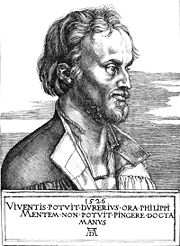 The setback for the reformers was short-lived. By September, Henry was displeased with the results of the Act and its promulgators; the ever-loyal Cranmer and Cromwell were back in favour. The king asked his archbishop to write a new preface for the Great Bible
, an English translation of the Bible that was first published in April 1539 under the direction of Cromwell. The preface was in the form of a sermon addressed to readers. As for Cromwell, he was delighted that his plan of a royal marriage between Henry and Anne of Cleves
, the sister of a German prince was accepted by the king. In Cromwell's view, the marriage could potentially bring back contacts with the Schmalkaldic League. Henry was dismayed with Anne when they first met on 1 January 1540 but married her reluctantly on 6 January in a ceremony officiated by Cranmer. However, the marriage ended in disaster as Henry decided shortly thereafter that he would request a royal divorce. This resulted in Henry being placed in an embarrassing position and Cromwell suffered the consequences. His old enemies, including the Duke of Norfolk, took advantage of the weakened Cromwell and he was arrested on 10 June. He immediately lost the support of all his friends, including Cranmer. However, as Cranmer had done for Anne Boleyn, he wrote a letter to the king defending the past work of Cromwell. Henry's marriage to Anne of Cleves was quickly annulled on 9 July by the vice-gerential synod, now led by Cranmer and Gardiner.
Following the annulment, Cromwell was executed on 28 July. Cranmer now found himself in a politically prominent position, with no one else to shoulder the burden. Throughout the rest of Henry’s reign, he clung to Henry’s authority. The king had total trust in him and in return, Cranmer could not conceal anything from the king. At the end of June 1541, Henry with his new wife, Catherine Howard
, left for his first visit to the north of England. Cranmer was left in London as a member of a council taking care of matters for the king in his absence. His colleagues were Lord Chancellor Thomas Audley
and Edward Seymour
, Earl of Hertford. This was Cranmer's first major piece of responsibility outside the Church. In October, while the king and queen were away, a reformer named John Lascelles
revealed to Cranmer that Catherine engaged in extramarital affairs. Cranmer gave the information to Audley and Seymour and they decided to wait until Henry’s return. Afraid of angering the king, Audley and Seymour suggested that Cranmer inform Henry. Cranmer slipped a message to Henry during mass on All Saints Day. An investigation revealed the truth of the marital indiscretions and Catherine was executed in February 1542.
and John Bland, before the Privy Council
. They prepared articles to present to the Council, but at the last moment, additional denunciations were added by Stephen Gardiner’s nephew, Germain Gardiner. These new articles attacked Cranmer and listed his misdeeds back to 1541. This document and the actions that followed were the basis of the so-called Prebendaries' Plot
. The articles were delivered to the Council in London and were probably read on 22 April 1543. The king most likely saw the articles against Cranmer that night. The archbishop, however, appeared unaware that an attack on his person was made. His commissioners in Lambeth dealt specifically with Turner’s case where he was acquitted, much to the fury of the conservatives.
While the plot against Cranmer was proceeding, the reformers were being attacked on other fronts. On 20 April, the Convocation reconvened to consider the revision of the Bishops’ Book. Cranmer presided over the sub-committees, but the conservatives were able to overturn any reforming ideas, including justification by faith. On 5 May, the new revision called A Necessary Doctrine and Erudition for any Christian Man or the King’s Book was released. Doctrinally, it was far more conservative than the Bishops’ Book. On 10 May, the reformers received another blow. Parliament passed the Act for the Advancement of True Religion, which abolished "erroneous books" and restricted the reading of the Bible in English to those of noble status. From May to August, reformers were examined, forced to recant, or imprisoned.
For five months, Henry took no action on the accusations against his archbishop. The conspiracy was finally revealed to Cranmer by the king himself. According to Cranmer’s secretary, Ralph Morice
, sometime in September 1543 the king showed Cranmer a paper summarising the accusations against him. An investigation was to be mounted and Cranmer was appointed chief investigator. Surprise raids were carried out, evidence was gathered, and ringleaders were identified. Typically, Cranmer put the clergymen involved in the conspiracy through immediate humiliation, but he eventually forgave them and continued to use their services. To show his trust in Cranmer, Henry gave Cranmer his personal ring. When the Privy Council arrested Cranmer at the end of November, the nobles were stymied by the symbol of the king’s trust in him. Cranmer’s victory ended with two second-rank leaders imprisoned and Germain Gardiner executed.
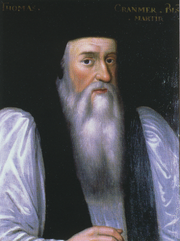 With the atmosphere in Cranmer’s favour, he pursued quiet efforts to reform the Church, particularly the liturgy. On 27 May 1544 the first officially authorised vernacular service was published, the processional service of intercession known as the Exhortation and Litany
. It survives today with minor modifications in the Book of Common Prayer
. The traditional litany
uses invocation
s to saints, but Cranmer thoroughly reformed this aspect by providing no opportunity in the text for such veneration
. Additional reformers were elected to the House of Commons
and new legislation was introduced to curb the effects of the Act of the Six Articles and the Act for the Advancement of True Religion.
In 1546, the conservatives in a coalition including Gardiner, the Duke of Norfolk, the Lord Chancellor Wriothesley
, and the bishop of London, Edmund Bonner
, made one last attempt to challenge the reformers. Several reformers with links to Cranmer were targeted. Some such as Lascelles were burnt at the stake. However, powerful reform-minded nobles Edward Seymour and John Dudley
returned to England during the summer from overseas and they were able to turn the tide against the conservatives. Two incidents in autumn tipped the balance. Gardiner was disgraced before the king when he refused to agree to exchange episcopal estates and the son of the Duke of Norfolk was charged with treason and executed. There is no evidence that Cranmer played any part in these political games and there were no further plots as the king's health ebbed in his final months. Cranmer performed his final duties for the king on 28 January 1547 when he gave a reformed statement of faith while gripping Henry’s hand instead of giving him his last rites
. Cranmer mourned Henry’s death and it was later said that he demonstrated his grief by growing a beard. The beard was also a sign of his break with the past. Continental reformers grew beards to mark their rejection of the old Church and this significance of clerical beards was well-understood in England. On 31 January, he was among the executors of the king’s final will that nominated Seymour as Lord Protector
and welcomed the boy king, Edward VI.
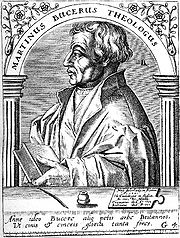 Under the regency of Seymour, the reformers were now part of the establishment. A royal visitation of the provinces took place in August 1547 and each parish that was visited was instructed to obtain a copy of the Homilies. This book consisted of twelve homilies of which four were written by Cranmer. His reassertion of the doctrine of justification by faith elicited a strong reaction from Gardiner. In the "Homily of Good Works annexed to Faith", Cranmer attacked monasticism
and the importance of various personal actions involved in liturgical recitations and ceremonies. Hence, he narrowed the range of good works that would be considered necessary and reinforced the primacy of faith. In each parish visited, injunctions were put in place that resolved to "eliminate any image which had any suspicion of devotion attached to it".
Cranmer’s eucharistic views, which had already moved away from official Catholic doctrine, received another push from Continental reformers. Cranmer had been in contact with Martin Bucer since the time when initial contacts were made with the Schmalkaldic League. However, Cranmer and Bucer's relationship became ever closer due to Charles V’s victory over the League at Mühlberg
which left England as the sole major nation providing sanctuary for persecuted reformers. Cranmer wrote a letter to Bucer (now lost) with questions on eucharistic theology. In Bucer's reply dated 28 November 1547, he denied the real presence and condemned transubstantiation
and the adoration
of the elements. The letter was delivered to Cranmer by two Italian reformed theologians, Peter Martyr
and Bernardino Ochino
who were invited to take refuge in England. Martyr also brought with him an epistle written allegedly by John Chrysostom
(now regarded as a forgery), Ad Caesarium Monachum, which appeared to provide patristic support against the real presence. These documents were to influence Cranmer’s thoughts on the eucharist.
In March 1549, the city of Strasbourg forced Martin Bucer and Paul Fagius
to leave. Cranmer immediately invited the men to come to England and promised that they would be placed in English universities. When they arrived on 25 April, Cranmer was especially delighted to meet Bucer face to face after eighteen years of correspondence. He needed these scholarly men to train a new generation of preachers as well as assist in the reform of liturgy and doctrine. Others who accepted his invitations include the Polish reformer, Jan Łaski, but Cranmer was unable to convince Osiander and Melanchthon to come to England.
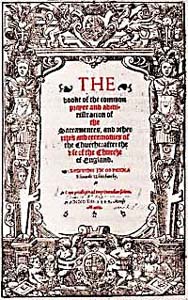 As the use of English in worship services spread, the need for a complete uniform liturgy for the Church became evident. Initial meetings to start what would eventually become the Book of Common Prayer were held in the former abbey of Chertsey
and in Windsor Castle
in September 1548. The list of participants can only be partially reconstructed, but it is known that the members were balanced between conservatives and reformers. These meetings were followed by a debate on the Eucharist in the House of Lords which took place between 14 and 19 December. Cranmer publicly revealed in this debate that he had abandoned the doctrine of the real presence and believed that the Eucharistic presence was only spiritual. Parliament backed the publication of the Prayer Book after Christmas by passing the Act of Uniformity 1549
; it then legalised clerical marriage.
It is difficult to ascertain how much of the Prayer Book is actually Cranmer’s personal composition. Generations of liturgical scholars have been able to track down the sources that he used, including the Sarum Rite
, writings from Hermann von Wied
, and several Lutheran sources including Osiander and Justus Jonas
. More problematic is determining how Cranmer worked on the book and with whom he worked. Despite the lack of knowledge of whom might have helped him, however, he is given the credit for the editorship and the overall structure of the book.
The use of the new Prayer Book was made compulsory on 9 June 1549. This triggered a series of protests in Devon
and Cornwall
, the Prayer Book Rebellion
. By early July, the uprising had spread to other parts in the east of England. Bucer had just taken up his duties in Cambridge when he found himself in the middle of the commotion and had to scurry to shelter. The rebels made a number of demands including the restoration of the Six Articles, the use of Latin for the mass with only the consecrated bread given to the laity, the restoration of prayers for souls in purgatory, and the rebuilding of abbeys. Cranmer wrote to the king a strong response to these demands in which he denounced the wickedness of the rebellion. On 21 July, Cranmer commandeered St Paul’s Cathedral where he vigorously defended the official Church line. A draft of his sermon, the only extant written sample of his preaching from his entire career, shows that he collaborated with Peter Martyr on dealing with the rebellion.
, and Thomas Smith
initially rallied behind Seymour. However, after a flurry of letters passed between the two sides, a bloodless coup d’état resulted in the end of Seymour’s Protectorship on 13 October 1549. Despite the support of religiously conservative politicians behind Dudley’s coup, the reformers managed to maintain control of the new government and the English Reformation continued to consolidate gains. Seymour was initially imprisoned in the Tower, but he was shortly released on 6 February 1550 and returned to the Council. The archbishop was able to transfer his former chaplain, Nicholas Ridley
from the minor see of Rochester to the diocese of London
, while John Ponet
took Ridley’s former position. Incumbent conservatives were uprooted and replaced with reformers.
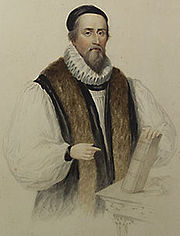 The first result of co-operation and consultation between Cranmer and Bucer was the Ordinal, the liturgy for the ordination of priests. This was missing in the first Prayer Book and was not published until 1550. Cranmer adopted Bucer’s draft and created three services for commissioning a deacon, a priest, and a bishop. In the same year, Cranmer produced the Defence of the True and Catholic Doctrine of the Sacrament of the Body and Blood of Christ
, a semi-official explanation of the eucharistic theology within the Prayer Book. It was the first full-length book to bear Cranmer’s name on the title-page. The preface summarises his quarrel with Rome in a well-known passage where he compared "beads, pardons, pilgrimages, and such other like popery" with weeds, but the roots of the weeds were transubstantiation, the real presence, and the sacrificial nature of the mass.
Although Bucer assisted in the development of the English Reformation, he was still quite concerned about the speed of its progress. Both Bucer and Fagius had noticed that the 1549 Prayer Book was not a remarkable step forward, although Cranmer assured Bucer that it was only a first step and that its initial form was only temporary. However, by the winter 1550, Bucer was becoming disillusioned. Cranmer, however, made sure that he did not feel alienated and kept in close touch with him. This attention paid off during the vestments controversy
. This incident was initiated by John Hooper
, a follower of Heinrich Bullinger
who had recently returned from Zürich
. Hooper was unhappy with Cranmer’s Prayer Book and Ordinal and he particularly objected to the use of ceremonies and vestments. When the Privy Council selected him to be the Bishop of Gloucester
on 15 May 1550, he laid down conditions that he would not wear the required vestments. He found an ally among the Continental reformers in Jan Laski. Laski had become a leader of the Stranger church in London, a designated place of worship for Continental Protestant refugees. His church’s forms and practices had taken reforms much further than Cranmer would have liked. However, Bucer and Peter Martyr, while they sympathised with Hooper’s position, supported Cranmer's arguments of timing and authority. Cranmer and Ridley stood their ground which resulted in Hooper’s imprisonment and he eventually gave in. He was consecrated on 8 March 1551 according to the Ordinal and he preached before the king in his episcopal garments. Cranmer’s vision of reform through careful steps under the authority of the government was maintained.
and put to death on 22 January 1552. This was the beginning of the breach between Cranmer and Dudley. It was aggravated during the year by the gradual appropriation of ecclesiastical property by the regency. However, even throughout this political turmoil, Cranmer worked simultaneously on three major projects in his reform programme: the revision of canon law
, the revision of the Prayer Book, and the formation of a statement of doctrine.
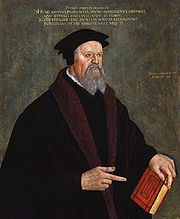 The original Roman canon law that defined governance within the Church clearly needed revision following Henry's break with Rome. Several revision attempts were made throughout Henry's reign, but these initial projects were shelved as the speed of reform outpaced the time required to work on a revision. As the reformation stabilised, Cranmer formed a committee in December 1551 to restart the work. He recruited Peter Martyr to the committee and he also asked Laski and Hooper to participate, demonstrating his usual ability to forgive past actions. Cranmer and Martyr realised that a successful enactment of a reformed ecclesiastical law-code in England would have international significance. Cranmer planned to draw together all the reformed churches of Europe under England’s leadership to counter the Council of Trent
, the Roman Catholic Church's response to the Protestant Reformation
. In March 1552, Cranmer invited the foremost Continental reformers, Bullinger, John Calvin
, and Melanchthon to come to England and to participate in an ecumenical council. The response was disappointing: Melanchthon did not respond, Bullinger stated that neither of them could leave Germany as it was riven by war between the Emperor and the Lutheran princes, and while Calvin showed some enthusiasm, he said he was unable to come. Cranmer acknowledged Calvin and replied stating, "Meanwhile we will reform the English Church to the utmost of our ability and give our labour that both its doctrines and laws will be improved after the model of holy scripture." One partial manuscript of the project survived that was annotated with corrections and comments by Cranmer and Martyr. When the final version was presented to Parliament, the breach between Cranmer and Dudley was complete and the regent effectively killed the canon law bill in the House of Lords.
As in the first Prayer Book, the origins and participants in the work of its revision are obscure, but it was clear that Cranmer led the project and steered its development. It had begun as early as the end of 1549 when the Convocation of Canterbury met to discuss the matter. Late in 1550, the opinions of Martyr and Bucer were sought on how the liturgy might be improved and they significantly influenced the revision. The spiritual presence view was clarified by the use of entirely different words when the communicants are offered the bread and the wine. New rubrics noted that any kind of bread could be used and any bread or wine that remained could be used by the curate
, thus disassociating the elements from any physical presence. The new book removed any possibility of prayers for the dead as such prayers would imply support for the doctrine of purgatory. The Act of Uniformity 1552
which authorised the book's use specified that it was to be exclusively used from 1 November. However, the final version was not officially published until nearly the last minute due to the intervention of Dudley. While traveling in the north of the country, he met the Scots reformer, John Knox
, then based in Newcastle
. Impressed by his preaching, Dudley selected him to be a royal chaplain and brought him south to participate in the reform projects. In a sermon before the king, Knox attacked the practice of kneeling during communion. On 27 September 1552, the Privy Council stopped the printing of the new Prayer Book and told Cranmer to revise it. He responded with a long letter using the argument that it was for Parliament with the royal assent to decide any changes in the liturgy. On 22 October, the council decided to keep the liturgy as it is and add the so-called "Black Rubric
" which explained that no adoration was intended when kneeling at communion.
The origins of the statement which eventually became the Forty-Two Articles are equally obscure. As early as December 1549, the archbishop was demanding from his bishops subscription to certain doctrinal articles. In 1551 Cranmer presented a version of a statement to the bishops, but its status remained ambiguous. Cranmer did not devote much effort into developing the articles, most likely due to work on the canon law revision. He became more interested once the hope for an ecumenical council began to fade. By September 1552, draft versions of the articles were being worked on by Cranmer and John Cheke
, his scholarly friend who was commissioned to translate them into Latin. When the Forty-Two Articles were finally published in May 1553, the title-page declared that the articles were agreed upon by the Convocation and were published by the authority of the king. This was not in fact the case and the mistake was likely caused by miscommunications between the archbishop and the Privy Council. Cranmer complained about this to the council but the authorities' response was to note that the articles were developed during the time of the Convocation, hence evading a direct answer. The council gave Cranmer the unfortunate task of requiring subscription to the articles from the bishops, many of whom opposed them and pointed out the anomaly of the title-page. It was while Cranmer was carrying out this duty that events unfolded that would render the subscriptions futile.
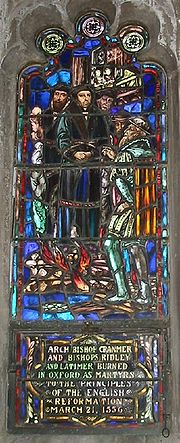 Edward VI
became seriously ill from tuberculosis
and the councillors were told that he did not have long to live. In May 1553, the council sent several letters to Continental reformers assuring them that Edward's health was improving. Among the letters was one addressed to Melanchthon inviting him to come to England to take up the Regius Chair
in Cambridge which was vacant since the death of Martin Bucer in February 1551. Both Henry VIII and Cranmer had previously failed to convince Melanchthon to come; this time the council made a serious effort by sending him an advance to cover his travel expenses. Cranmer sent a personal letter urging him to take the offer. Despite his plea, Melanchthon never made the voyage to England. While this effort to shore up the reformation was taking place, the council was working to convince several judges to put on the throne Lady Jane Grey
, Edward's cousin and a Protestant, instead of Mary, Henry and Catherine of Aragon's daughter and a Catholic. On 17 June 1553 the king made his will noting Jane would succeed him, contravening the Third Succession Act
. Cranmer tried to speak to Edward alone, but he was refused and his audience with Edward occurred in the presence of the councillors. Edward told him that he supported what he wrote in his will. Cranmer’s decision to support Jane must have occurred before 19 June when royal orders were sent to convene the Convocation for the recognition of the new succession.
By mid-July, there were serious provincial revolts in Mary’s favour and support for Jane in the council fell. As Mary was proclaimed queen, Dudley, Ridley, Cheke, and Jane’s father, the Duke of Suffolk
were imprisoned. However, no action was taken against the archbishop. On 8 August he led Edward’s funeral according to the rites of the Prayer Book. During these months, he advised others, including Peter Martyr, to flee England, but he himself chose to stay. Reformed bishops were removed from office and conservative clergy, such as Edmund Bonner, had their old positions restored. Cranmer did not go down without a fight. When rumours spread that he authorised the use of the mass in Canterbury Cathedral, he declared them to be false and said, "... all the doctrine and religion, by our said sovereign lord king Edward VI is more pure and according to God's word, than any that hath been used in England these thousand years." Not surprisingly, the government regarded Cranmer's declaration as tantamount to sedition. He was ordered to stand before the council in the Star Chamber
on 14 September and on that day he said his final goodbye to Martyr. Cranmer was sent straight to the Tower to join Hugh Latimer and Nicholas Ridley.
On 13 November 1553 Cranmer and four others were brought to trial for treason, found guilty, and condemned to death. Throughout February 1554 Jane Grey and other rebels were executed. It was now time to deal with the religious leaders of the reformation and so on 8 March 1554 the Privy Council ordered Cranmer, Ridley, and Latimer to be transferred to Bocardo prison
in Oxford to await a second trial for heresy. During this time Cranmer was able to smuggle out a letter to Martyr who had fled to Strasbourg, the last surviving document written in his own hand. He stated that the desperate situation of the church was proof that it will eventually be delivered and wrote, "I pray that God may grant that we may endure to the end!" Cranmer remained isolated in Bocardo prison for seventeen months before the trial started on 12 September 1555. Although it took place in England, the trial was under papal jurisdiction and the final verdict would come from Rome. Under interrogation, Cranmer admitted to every fact that was placed before him, but he denied any treachery, disobedience, or heresy. The trial of Latimer and Ridley started shortly after Cranmer's but their verdicts came almost immediately and they were burnt at the stake on 16 October. Cranmer was taken to a tower to watch the proceedings. On 4 December, Rome decided Cranmer's fate by depriving him of the archbishopric and giving permission to the secular authorities to carry out their sentence.
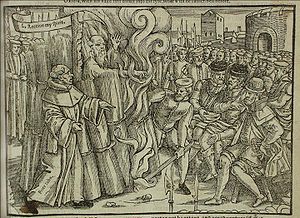 In his final days Cranmer's circumstances changed, which led to several recantation
s. On 11 December, Cranmer was taken out of Bocardo and placed in the house of the Dean of Christ Church
. This new environment was very different from that of his two years in prison. He was in an academic community and treated as a guest. Approached by a Dominican friar, Juan de Villagarcia
, he debated the issues of papal supremacy and purgatory. In his first four recantations, produced between the end of January and mid-February, Cranmer submitted himself to the authority of the king and queen and recognised the pope as head of the church. On 14 February 1556, he was degraded from holy orders and returned to Bocardo. He had conceded very little and Edmund Bonner was not satisfied with these admissions. On 24 February a writ was issued to the mayor of Oxford and the date of Cranmer's execution was set for 7 March. Two days after the writ was issued, a fifth statement, the first which could be called a true recantation was issued. Cranmer repudiated all Lutheran and Zwinglian theology, fully accepted Catholic theology including papal supremacy and transubstantiation, and stated that there was no salvation outside the Catholic Church. He announced his joy of returning to the Catholic faith, asked for and received sacramental absolution
, and participated in the mass. Cranmer's burning was postponed and under normal practice of canon law, he should have been absolved. Mary, however, decided that no further postponement was possible. His last recantation was issued on 18 March. It was a sign of a broken man, a sweeping confession of sin.
Cranmer had three more days to live. He was told that he would be able to make a final recantation but this time in public during a service at the University Church
. He wrote and submitted the speech in advance and it was published after his death. At the pulpit on the day of his execution, he opened with a prayer and an exhortation to obey the king and queen, but he ended his sermon totally unexpectedly, deviating from the prepared script. He renounced the recantations that he had written or signed with his own hand since his degradation and as such he stated his hand would be punished by being burnt first. He then said, "And as for the pope, I refuse him, as Christ's enemy, and Antichrist with all his false doctrine." He was pulled from the pulpit and taken to where Latimer
and Ridley
had been burnt six months before. As the flames drew around him, he fulfilled his promise by placing his right hand into the heart of the fire and his dying words were, "Lord Jesus, receive my spirit... I see the heavens open and Jesus standing at the right hand of God."
' propaganda concentrated on publishing various specimens of his writings. Eventually his story was effectively put to use in John Foxe
's book Acts and Monuments in 1559.
Cranmer’s family had been exiled to the Continent in 1539. It is not known exactly when they returned to England, but it was soon after the accession of Edward VI in 1547 that Cranmer publicly acknowledged their existence. Not much is known about the early years of the children. His daughter, Margaret, was likely born in the 1530s and his son, Thomas, came later probably during the reign of Edward. Sometime around Mary’s accession, Cranmer’s wife, Margarete, escaped to Germany, while his son was entrusted to his brother, Edmund Cranmer, who also took him to the Continent. Margarete Cranmer eventually married Cranmer’s favourite publisher, Edward Whitchurch
. The couple returned to England after Mary’s reign and settled in Surrey
. Whitchurch also negotiated for the marriage of Margaret to Thomas Norton
. Whitchurch died in 1562 and Margarete married for the third time to Bartholomew Scott. She died in the 1570s. Both of Cranmer’s children died without issue and his line became extinct.
When Elizabeth I
came to power, she restored the Church of England
's independence from Rome under the Elizabethan Religious Settlement
. The church that she re-established was, in effect, a snapshot of the Edwardian Church from September 1552. Thus the Elizabethan Prayer Book was basically Cranmer's 1552 edition but without the "Black Rubric". In the Convocation of 1563, the Forty-Two Articles which were never adopted by the Church were altered in the area of eucharistic doctrine to form the Thirty-Nine Articles
. Most of the exiles returned to England and resumed their careers in the Church. To some like Edmund Grindal
, an Archbishop of Canterbury during Elizabeth's reign, Cranmer was a shining example whose work needed to be upheld and extended.
Cranmer's greatest concerns were the maintenance of the royal supremacy and the diffusion of reformed theology and practice. But he is best remembered for his contribution to the realm of language and of cultural identity. His prose helped to guide the development of the English language and the Book of Common Prayer is a major contribution to English literature that influenced many lives in the Anglophone world. It was the vehicle that guided Anglican worship for four hundred years. Cranmer has many promoters and detractors, but no biography can do full justice to the complexity of his life and his age. Catholic biographers sometimes depict Cranmer as an unprincipled opportunist, a Nicodemite
, and a tool of royal tyranny, while neglecting to note that many other sixteenth-century clergymen and politicians fail to live up to modern standards. For their part, hagiographic Protestant biographers sometimes overlook the times that Cranmer betrayed his own principles. Yet both sides can agree that Cranmer was a committed scholar whose life showed the strengths and weaknesses of a very human and often under-appreciated reformer. He is commemorated in the Anglican Communion
on 21 March, the anniversary of his death. A square, Cranmer Square, is named after the man and is located in central Christchurch
, New Zealand
.
in the 1911 film Henry VIII. Subsequent portrayals include Lumsden Hare
(Young Bess
, 1953); Bernard Hepton
in The Six Wives of Henry VIII (1970), Elizabeth R
(1971), and Henry VIII and His Six Wives
(1972); David Waller
in the 1986 film Lady Jane
; and, most recently, Hans Matheson
in the 2008 TV serial The Tudors
.
English Reformation
The English Reformation was the series of events in 16th-century England by which the Church of England broke away from the authority of the Pope and the Roman Catholic Church....
and Archbishop of Canterbury
Archbishop of Canterbury
The Archbishop of Canterbury is the senior bishop and principal leader of the Church of England, the symbolic head of the worldwide Anglican Communion, and the diocesan bishop of the Diocese of Canterbury. In his role as head of the Anglican Communion, the archbishop leads the third largest group...
during the reigns of Henry VIII
Henry VIII of England
Henry VIII was King of England from 21 April 1509 until his death. He was Lord, and later King, of Ireland, as well as continuing the nominal claim by the English monarchs to the Kingdom of France...
, Edward VI
Edward VI of England
Edward VI was the King of England and Ireland from 28 January 1547 until his death. He was crowned on 20 February at the age of nine. The son of Henry VIII and Jane Seymour, Edward was the third monarch of the Tudor dynasty and England's first monarch who was raised as a Protestant...
and, for a short time, Mary I. He helped build a favourable case for Henry's divorce from Catherine of Aragon
Catherine of Aragon
Catherine of Aragon , also known as Katherine or Katharine, was Queen consort of England as the first wife of King Henry VIII of England and Princess of Wales as the wife to Arthur, Prince of Wales...
which resulted in the separation of the English Church from union with the Holy See
Holy See
The Holy See is the episcopal jurisdiction of the Catholic Church in Rome, in which its Bishop is commonly known as the Pope. It is the preeminent episcopal see of the Catholic Church, forming the central government of the Church. As such, diplomatically, and in other spheres the Holy See acts and...
. Along with Thomas Cromwell
Thomas Cromwell, 1st Earl of Essex
Thomas Cromwell, 1st Earl of Essex, , was an English statesman who served as chief minister of King Henry VIII of England from 1532 to 1540....
, he supported the principle of Royal Supremacy
Acts of Supremacy
The first Act of Supremacy was a piece of legislation that granted King Henry VIII of England Royal Supremacy, which means that he was declared the supreme head of the Church of England. It is still the legal authority of the Sovereign of the United Kingdom...
, in which the king was considered sovereign over the Church within his realm.
During Cranmer's tenure as Archbishop of Canterbury, he was responsible for establishing the first doctrinal and liturgical structures of the reformed Church of England
Church of England
The Church of England is the officially established Christian church in England and the Mother Church of the worldwide Anglican Communion. The church considers itself within the tradition of Western Christianity and dates its formal establishment principally to the mission to England by St...
. Under Henry's rule, Cranmer did not make many radical changes in the Church, due to power struggles between religious conservatives and reformers. However, he succeeded in publishing the first officially authorised vernacular
Vernacular
A vernacular is the native language or native dialect of a specific population, as opposed to a language of wider communication that is not native to the population, such as a national language or lingua franca.- Etymology :The term is not a recent one...
service, the Exhortation and Litany
Exhortation and Litany (1544)
In the Church of England, the "Exhortation and Litany" is chronologically the first officially authorized liturgy in English .-References:**-External links:*...
.
When Edward came to the throne, Cranmer was able to promote major reforms. He wrote and compiled the first two editions of the Book of Common Prayer
Book of Common Prayer
The Book of Common Prayer is the short title of a number of related prayer books used in the Anglican Communion, as well as by the Continuing Anglican, "Anglican realignment" and other Anglican churches. The original book, published in 1549 , in the reign of Edward VI, was a product of the English...
, a complete liturgy for the English Church. With the assistance of several Continental reformers to whom he gave refuge, he developed new doctrinal standards in areas such as the Eucharist
Eucharist
The Eucharist , also called Holy Communion, the Sacrament of the Altar, the Blessed Sacrament, the Lord's Supper, and other names, is a Christian sacrament or ordinance...
, clerical celibacy
Clerical celibacy
Clerical celibacy is the discipline by which some or all members of the clergy in certain religions are required to be unmarried. Since these religions consider deliberate sexual thoughts, feelings, and behavior outside of marriage to be sinful, clerical celibacy also requires abstension from these...
, the role of images
Religious image
A religious image is a work of visual art that is representational and has a religious purpose, subject or connection. All major historical religions have made some use of religious images, although their use is strictly controlled and often controversial in many religions, especially Abrahamic ones...
in places of worship, and the veneration of saints
Veneration
Veneration , or veneration of saints, is a special act of honoring a saint: an angel, or a dead person who has been identified by a church committee as singular in the traditions of the religion. It is practiced by the Eastern Orthodox Church, the Roman Catholic, and Eastern Catholic Churches...
. Cranmer promulgated the new doctrines through the Prayer Book, the Homilies and other publications.
Cranmer was tried for treason and heresy
Heresy
Heresy is a controversial or novel change to a system of beliefs, especially a religion, that conflicts with established dogma. It is distinct from apostasy, which is the formal denunciation of one's religion, principles or cause, and blasphemy, which is irreverence toward religion...
after Mary I
Mary I of England
Mary I was queen regnant of England and Ireland from July 1553 until her death.She was the only surviving child born of the ill-fated marriage of Henry VIII and his first wife Catherine of Aragon. Her younger half-brother, Edward VI, succeeded Henry in 1547...
, a Roman Catholic, came to the throne. Imprisoned for over two years and under pressure from Church authorities, he made several recantation
Recantation
The verb recant , and its derivative noun recantation, can mean:* To formally abandon a belief or a particular statement of belief, generally under order from an ecclesiastical authority to...
s and apparently reconciled himself with the Roman Catholic Church. However, on the day of his execution, he dramatically withdrew his recantations, to die a heretic to Roman Catholics and a martyr
Martyr
A martyr is somebody who suffers persecution and death for refusing to renounce, or accept, a belief or cause, usually religious.-Meaning:...
to others. His legacy lives on within the Church of England through the Book of Common Prayer and the Thirty-Nine Articles
Thirty-Nine Articles
The Thirty-Nine Articles of Religion are the historically defining statements of doctrines of the Anglican church with respect to the controversies of the English Reformation. First established in 1563, the articles served to define the doctrine of the nascent Church of England as it related to...
, an Anglican statement of faith derived from his work.
Early years (1489–1527)
Cranmer was born in 1489 in AslocktonAslockton
Aslockton is a village and civil parish twelve miles east of Nottingham, England and two miles east of Bingham on the north bank of the River Smite opposite Whatton. It has a population of around 1,000 ....
in Nottinghamshire
Nottinghamshire
Nottinghamshire is a county in the East Midlands of England, bordering South Yorkshire to the north-west, Lincolnshire to the east, Leicestershire to the south, and Derbyshire to the west...
, England. His parents, Thomas and Agnes (née Hatfield) Cranmer, were of modest wealth and were not members of the aristocracy. Their oldest son, John, inherited the family estate, whereas Thomas and his younger brother Edmund were placed on the path to a clerical career. Cranmer’s early schooling remains a mystery. He probably attended a grammar school in his village. At the age of fourteen, two years after the death of his father, he was sent to the newly created Jesus College, Cambridge
Jesus College, Cambridge
Jesus College is a constituent college of the University of Cambridge, England.The College was founded in 1496 on the site of a Benedictine nunnery by John Alcock, then Bishop of Ely...
. It took him a surprisingly long eight years to reach his Bachelor of Arts
Bachelor of Arts
A Bachelor of Arts , from the Latin artium baccalaureus, is a bachelor's degree awarded for an undergraduate course or program in either the liberal arts, the sciences, or both...
degree following a curriculum of logic, classical literature and philosophy. During this time he began to collect medieval scholastic
Scholasticism
Scholasticism is a method of critical thought which dominated teaching by the academics of medieval universities in Europe from about 1100–1500, and a program of employing that method in articulating and defending orthodoxy in an increasingly pluralistic context...
books, which he preserved faithfully throughout his life. For his master’s degree he took a different course of study, concentrating on the humanists
Renaissance humanism
Renaissance humanism was an activity of cultural and educational reform engaged by scholars, writers, and civic leaders who are today known as Renaissance humanists. It developed during the fourteenth and the beginning of the fifteenth centuries, and was a response to the challenge of Mediæval...
, Jacques Lefèvre d'Étaples
Jacques Lefèvre d'Étaples
Jacques Lefèvre d’Étaples or Jacob Faber Stapulensis was a French theologian and humanist. He was a precursor of the Protestant movement in France. The "d’Étaples" was not part of his name as such, but used to distinguish him from Jacques Lefèvre of Deventer, a less significant contemporary, a...
and Erasmus. This time he progressed with no special delay, finishing the course in three years. Shortly after receiving his Master of Arts degree in 1515, he was elected to a Fellowship of Jesus College.
Sometime after Cranmer took his MA, he married a woman named Joan. Although he was not yet a priest, he was forced to forfeit his fellowship, resulting in the loss of his residence at Jesus College. In order to support himself and his wife, he took a job as a reader
Reader (academic rank)
The title of Reader in the United Kingdom and some universities in the Commonwealth nations like Australia and New Zealand denotes an appointment for a senior academic with a distinguished international reputation in research or scholarship...
at another college. When Joan died during her first childbirth, Jesus College showed its regard for Cranmer by reinstating his fellowship. He began studying theology and by 1520 he had been ordained
Holy Orders
The term Holy Orders is used by many Christian churches to refer to ordination or to those individuals ordained for a special role or ministry....
, the university already having named him as one of their preachers. He received his doctorate of divinity
Doctor of Divinity
Doctor of Divinity is an advanced academic degree in divinity. Historically, it identified one who had been licensed by a university to teach Christian theology or related religious subjects....
in 1526.
Not much is known about Cranmer’s thoughts and experiences during his three decades at Cambridge. Traditionally, he has been portrayed as a humanist whose enthusiasm for biblical scholarship prepared him for the adoption of Lutheran ideas, which were spreading during the 1520s. However, a study of his marginalia
Marginalia
Marginalia are scribbles, comments, and illuminations in the margins of a book.- Biblical manuscripts :Biblical manuscripts have liturgical notes at the margin, for liturgical use. Numbers of texts' divisions are given at the margin...
reveals an early antipathy to Martin Luther
Martin Luther
Martin Luther was a German priest, professor of theology and iconic figure of the Protestant Reformation. He strongly disputed the claim that freedom from God's punishment for sin could be purchased with money. He confronted indulgence salesman Johann Tetzel with his Ninety-Five Theses in 1517...
and an admiration for Erasmus. When Cardinal Wolsey, the king's Lord Chancellor
Lord Chancellor
The Lord High Chancellor of Great Britain, or Lord Chancellor, is a senior and important functionary in the government of the United Kingdom. He is the second highest ranking of the Great Officers of State, ranking only after the Lord High Steward. The Lord Chancellor is appointed by the Sovereign...
, selected several Cambridge scholars, including Edward Lee, Stephen Gardiner
Stephen Gardiner
Stephen Gardiner was an English Roman Catholic bishop and politician during the English Reformation period who served as Lord Chancellor during the reign of Queen Mary I of England.-Early life:...
and Richard Sampson
Richard Sampson
Richard Sampson was an English clergyman and composer of sacred music, who was Anglican bishop of Chichester and subsequently of Coventry and Lichfield.-Biography:...
, to be diplomats throughout Europe, Cranmer was chosen to take a minor role in the English embassy in Spain. In two recently discovered letters by Cranmer, an early encounter between Cranmer and the king, Henry VIII of England
Henry VIII of England
Henry VIII was King of England from 21 April 1509 until his death. He was Lord, and later King, of Ireland, as well as continuing the nominal claim by the English monarchs to the Kingdom of France...
, was revealed. Upon Cranmer's return from Spain, in June 1527, he was given a personal half-hour long interview with the king, whom he described as "the kindest of princes".
In the service of Henry VIII (1527–1532)
Henry VIII's first marriage had its origins in 1502 when his elder brother, ArthurArthur, Prince of Wales
Arthur Tudor, Prince of Wales was the first son of King Henry VII of England and Elizabeth of York, and therefore, heir to the throne of England. As he predeceased his father, Arthur never became king...
, died. Their father, Henry VII
Henry VII of England
Henry VII was King of England and Lord of Ireland from his seizing the crown on 22 August 1485 until his death on 21 April 1509, as the first monarch of the House of Tudor....
then betrothed Arthur's widow, Catherine of Aragon
Catherine of Aragon
Catherine of Aragon , also known as Katherine or Katharine, was Queen consort of England as the first wife of King Henry VIII of England and Princess of Wales as the wife to Arthur, Prince of Wales...
, to the future king. The betrothal immediately raised questions related to the biblical prohibition (in Leviticus 18 and 20) against marriage to a brother’s wife. The couple married in 1509 and after a series of miscarriages, a daughter, Mary
Mary I of England
Mary I was queen regnant of England and Ireland from July 1553 until her death.She was the only surviving child born of the ill-fated marriage of Henry VIII and his first wife Catherine of Aragon. Her younger half-brother, Edward VI, succeeded Henry in 1547...
, was born in 1516. By the 1520s, Henry still did not have a son to name as heir and he took this as a sure sign of God’s anger and made overtures to the Vatican about an annulment
Annulment
Annulment is a legal procedure for declaring a marriage null and void. Unlike divorce, it is usually retroactive, meaning that an annulled marriage is considered to be invalid from the beginning almost as if it had never taken place...
. He gave Cardinal Wolsey the task of prosecuting his case; Wolsey began by consulting university experts. From 1527, in addition to his duties as a Cambridge don, Cranmer assisted with the annulment proceedings.
Edward Foxe
Edward Foxe was an English churchman, Bishop of Hereford. He was the most Lutheran of Henry VIII's bishops, and assisted in drafting the Ten Articles of 1536....
, joined him. The three discussed the annulment issue and Cranmer suggested putting aside the legal case in Rome in favour of a general canvassing of opinions from university theologians throughout Europe. Henry showed much interest in the idea when Gardiner and Foxe presented him this plan. It is not known whether the king or his Lord Chancellor, Thomas More
Thomas More
Sir Thomas More , also known by Catholics as Saint Thomas More, was an English lawyer, social philosopher, author, statesman and noted Renaissance humanist. He was an important councillor to Henry VIII of England and, for three years toward the end of his life, Lord Chancellor...
, explicitly approved the plan. Eventually it was implemented and Cranmer was requested to join the royal team in Rome to gather opinions from the universities. Edward Foxe coordinated the research effort and the team produced the Collectanea Satis Copiosa
Collectanea satis copiosa
The Collectanea satis copiosa of 1530 was a collection of historical documents compiled by Thomas Cranmer and Edward Foxe designed to prove that Kings of England, historically, had no superiors on Earth...
("The Sufficiently Abundant Collections") and The Determinations, historical and theological support for the argument that the king exercised supreme jurisdiction within his realm.
Cranmer’s first contact with a Continental reformer was with Simon Grynaeus
Simon Grynaeus
Simon Grynaeus , German scholar and theologian of the Reformation, son of Jacob Gryner, a Swabian peasant, was born at Veringendorf, in Hohenzollern-Sigmaringen.He adopted the name Grynaeus from the epithet of Apollo in Virgil...
, a humanist based in Basel
Basel
Basel or Basle In the national languages of Switzerland the city is also known as Bâle , Basilea and Basilea is Switzerland's third most populous city with about 166,000 inhabitants. Located where the Swiss, French and German borders meet, Basel also has suburbs in France and Germany...
, Switzerland and a follower of the Swiss reformers, Huldrych Zwingli
Huldrych Zwingli
Ulrich Zwingli was a leader of the Reformation in Switzerland. Born during a time of emerging Swiss patriotism and increasing criticism of the Swiss mercenary system, he attended the University of Vienna and the University of Basel, a scholarly centre of humanism...
and Johannes Oecolampadius
Johannes Oecolampadius
Johannes Œcolampadius was a German religious reformer. His real name was Hussgen or Heussgen .-Life:He was born in Weinsberg, then part of the Electoral Palatinate...
. In the summer of 1531, Grynaeus took an extended visit to England to offer himself as an intermediary between the king and the Continental reformers. He struck up a friendship with Cranmer and after his return to Basel, he wrote about Cranmer to the German reformer Martin Bucer
Martin Bucer
Martin Bucer was a Protestant reformer based in Strasbourg who influenced Lutheran, Calvinist, and Anglican doctrines and practices. Bucer was originally a member of the Dominican Order, but after meeting and being influenced by Martin Luther in 1518 he arranged for his monastic vows to be annulled...
in Strasbourg
Strasbourg
Strasbourg is the capital and principal city of the Alsace region in eastern France and is the official seat of the European Parliament. Located close to the border with Germany, it is the capital of the Bas-Rhin département. The city and the region of Alsace are historically German-speaking,...
. Grynaeus' early contacts initiated Cranmer’s eventual relationship with the Strasbourg and Swiss reformers.
In January 1532, Cranmer was appointed the resident ambassador at the court of the Holy Roman Emperor
Holy Roman Emperor
The Holy Roman Emperor is a term used by historians to denote a medieval ruler who, as German King, had also received the title of "Emperor of the Romans" from the Pope...
, Charles V
Charles V, Holy Roman Emperor
Charles V was ruler of the Holy Roman Empire from 1519 and, as Charles I, of the Spanish Empire from 1516 until his voluntary retirement and abdication in favor of his younger brother Ferdinand I and his son Philip II in 1556.As...
. As the emperor travelled throughout his realm, Cranmer had to follow him to his residence in Ratisbon (Regensburg). He passed through the Lutheran city of Nuremberg
Nuremberg
Nuremberg[p] is a city in the German state of Bavaria, in the administrative region of Middle Franconia. Situated on the Pegnitz river and the Rhine–Main–Danube Canal, it is located about north of Munich and is Franconia's largest city. The population is 505,664...
and saw for the first time the effects of the Reformation
Protestant Reformation
The Protestant Reformation was a 16th-century split within Western Christianity initiated by Martin Luther, John Calvin and other early Protestants. The efforts of the self-described "reformers", who objected to the doctrines, rituals and ecclesiastical structure of the Roman Catholic Church, led...
. When the Imperial Diet was moved to Nuremberg in the summer, he met the leading architect of the Nuremberg reforms, Andreas Osiander
Andreas Osiander
Andreas Osiander was a German Lutheran theologian.- Career :Born at Gunzenhausen in Franconia, Osiander studied at the University of Ingolstadt before being ordained as a priest in 1520. In the same year he began work at an Augustinian convent in Nuremberg as a Hebrew tutor. In 1522, he was...
. They became good friends, and during that July Cranmer took the surprising action of marrying Margarete, the niece of Osiander's wife. This was all the more remarkable given that the marriage required him to set aside his priestly vow of celibacy. He did not take her as his mistress, as was the prevailing custom with priests for whom celibacy was too rigorous. Scholars note that Cranmer had moved, however moderately at this stage, into identifying with certain Lutheran principles. This progress in his personal life, however, could not be matched in his political life as he was unable to persuade Charles, Catherine's nephew, to support the annulment of his aunt's marriage.
Appointed Archbishop of Canterbury (1532–1534)
Archbishop of Canterbury
The Archbishop of Canterbury is the senior bishop and principal leader of the Church of England, the symbolic head of the worldwide Anglican Communion, and the diocesan bishop of the Diocese of Canterbury. In his role as head of the Anglican Communion, the archbishop leads the third largest group...
, following the death of archbishop William Warham
William Warham
William Warham , Archbishop of Canterbury, belonged to a Hampshire family, and was educated at Winchester and New College, Oxford, afterwards practising and teaching law both in London and Oxford....
. Cranmer was ordered to return to England. The appointment had been secured by the family of Anne Boleyn
Anne Boleyn
Anne Boleyn ;c.1501/1507 – 19 May 1536) was Queen of England from 1533 to 1536 as the second wife of Henry VIII of England and Marquess of Pembroke in her own right. Henry's marriage to Anne, and her subsequent execution, made her a key figure in the political and religious upheaval that was the...
, who was being courted by Henry. When Cranmer's promotion became known in London, it caused great surprise as Cranmer had previously held only minor positions in the Church. Cranmer left Mantua
Mantua
Mantua is a city and comune in Lombardy, Italy and capital of the province of the same name. Mantua's historic power and influence under the Gonzaga family, made it one of the main artistic, cultural and notably musical hubs of Northern Italy and the country as a whole...
on 19 November and arrived in England at the beginning of January. Henry personally financed the papal bulls necessary for Cranmer’s promotion to Canterbury. The bulls were easily acquired because the papal nuncio was under orders from Rome to please the English in an effort to avert a final breach. The bulls arrived around 26 March 1533 and Cranmer was consecrated as archbishop on 30 March in St Stephen's Chapel
St Stephen's Chapel
St Stephen's Chapel was a chapel in the old Palace of Westminster. It was largely lost in the fire of 1834, but the Chapel of St Mary Undercroft in the crypt survived...
. Even while they were waiting for the bulls, Cranmer continued to work on the annulment proceedings, which required greater urgency after Anne announced her pregnancy. Henry and Anne were secretly married on 24 or 25 January 1533 in the presence of a handful of witnesses. Cranmer did not learn of the marriage until a fortnight later.
For the next few months, Cranmer and the king worked on establishing legal procedures on how the monarch's marriage would be judged by his most senior clergy. Several drafts of the procedures have been preserved in letters written between the two. Once the procedures were agreed, Cranmer opened his court on 10 May, inviting Henry and Catherine of Aragon to appear. Gardiner represented the king; Catherine did not appear or send a proxy. On 23 May Cranmer pronounced the judgement that Henry's marriage with Catherine was against the law of God. He even issued a threat of excommunication
Excommunication
Excommunication is a religious censure used to deprive, suspend or limit membership in a religious community. The word means putting [someone] out of communion. In some religions, excommunication includes spiritual condemnation of the member or group...
if Henry did not stay away from Catherine. Henry was now free to marry and, on 28 May, Cranmer validated Henry and Anne’s marriage. On 1 June, Cranmer personally crowned and anointed Anne queen and delivered to her the sceptre and rod
Crown Jewels of the United Kingdom
The collective term Crown Jewels denotes the regalia and vestments worn by the sovereign of the United Kingdom during the coronation ceremony and at other state functions...
. Pope Clement VII was furious at this defiance, but he could not take decisive action as he was pressured by other monarchs to avoid an irreparable breach with England. However, on 9 July he provisionally excommunicated Henry and his advisers (which included Cranmer) unless he repudiated Anne by the end of September. Henry kept Anne as his wife and, on 7 September, Anne gave birth to Elizabeth
Elizabeth I of England
Elizabeth I was queen regnant of England and Ireland from 17 November 1558 until her death. Sometimes called The Virgin Queen, Gloriana, or Good Queen Bess, Elizabeth was the fifth and last monarch of the Tudor dynasty...
. Cranmer baptised
Baptism
In Christianity, baptism is for the majority the rite of admission , almost invariably with the use of water, into the Christian Church generally and also membership of a particular church tradition...
her immediately afterwards and acted as one of her godparents.
It is difficult to assess how Cranmer’s theological views had evolved since his Cambridge days. There is evidence that he continued to support humanism; he renewed Erasmus' pension that had previously been granted by Archbishop Warham. In June 1533, he was confronted with the difficult task of not only disciplining a reformer, but also seeing him burnt at the stake. John Frith
John Frith
John Frith was an English Protestant priest, writer, and martyr.Frith was an important contributor to the Christian debate on persecution and toleration in favour of the principle of religious toleration...
was condemned to death for his views on the eucharist
Eucharist
The Eucharist , also called Holy Communion, the Sacrament of the Altar, the Blessed Sacrament, the Lord's Supper, and other names, is a Christian sacrament or ordinance...
: he denied the real presence
Real Presence
Real Presence is a term used in various Christian traditions to express belief that in the Eucharist, Jesus Christ is really present in what was previously just bread and wine, and not merely present in symbol, a figure of speech , or by his power .Not all Christian traditions accept this dogma...
. Cranmer personally tried to persuade him to change his views without success. Although he rejected Frith’s radicalism, by 1534 he clearly signalled that he had broken with Rome and that he had set a new theological course. He supported the cause of reform by gradually replacing the old guard in his ecclesiastical province
Ecclesiastical Province
An ecclesiastical province is a large jurisdiction of religious government, so named by analogy with a secular province, existing in certain hierarchical Christian churches, especially in the Catholic Church and Orthodox Churches and in the Anglican Communion...
with men who followed the new thinking such as Hugh Latimer
Hugh Latimer
Hugh Latimer was a Fellow of Clare College, Cambridge, Bishop of Worcester before the Reformation, and later Church of England chaplain to King Edward VI. In 1555, under Queen Mary, he was burnt at the stake, becoming one of the three Oxford Martyrs of Anglicanism.-Life:Latimer was born into a...
. He intervened in religious disputes, supporting reformers to the disappointment of religious conservatives who desired to maintain the link with Rome.
Under the vice-gerency (1535–1538)
Canonical Visitation
A canonical visitation is the act of an ecclesiastical superior who in the discharge of his office visits persons or places with a view of maintaining faith and discipline, and of correcting abuses by the application of proper remedies.-Catholic usage:...
, he had to avoid locations where a resident conservative bishop might make an embarrassing personal challenge to his authority. In 1535, Cranmer had difficult encounters with several bishops, John Stokesley
John Stokesley
John Stokesley was an English church leader who was Catholic Bishop of London during the reign of Henry VIII.He was born at Collyweston in Northamptonshire, and became a fellow of Magdalen College, Oxford in 1495, serving also as a lecturer. In 1498 he was made principal of Magdalen Hall, and in...
, John Longland
John Longland
John Longland was the English Dean of Salisbury from 1514 to 1521 and bishop of Lincoln from 1521 to his death in 1547.He was King Henry VIII's confessor and was said to have been one of those who first persuaded the King that he should annul his marriage to Katherine of Aragon.During the English...
, and Stephen Gardiner among others. They objected to Cranmer’s power and title and argued that the Act of Supremacy did not define his role. This prompted Thomas Cromwell, the king's chief minister, to activate and to take the office of the Vice-gerent
Vicegerent
Vicegerent is the official administrative deputy of a ruler or head of state: vice + gerere .-Related usage:*The Byzantine Emperors held as a title "God's Vicegerent on Earth"....
, the deputy supreme head of ecclesiastical affairs. He created another set of institutions that gave a clear structure to the royal supremacy. Hence, the archbishop was eclipsed by Vice-gerent Cromwell in regards to the king's spiritual jurisdiction. There is no evidence that Cranmer resented his position as junior partner. Although he was an exceptional scholar, he lacked the political ability to outface even clerical opponents. Those tasks were left to Cromwell.
On 29 January 1536, when Anne miscarried a son, the king began to reflect again on the biblical prohibitions that had haunted him during his marriage with Catherine of Aragon. Shortly after the miscarriage, the king started to take an interest in Jane Seymour
Jane Seymour
Jane Seymour was Queen of England as the third wife of King Henry VIII. She succeeded Anne Boleyn as queen consort following the latter's execution for trumped up charges of high treason, incest and adultery in May 1536. She died of postnatal complications less than two weeks after the birth of...
. By 24 April, he had commissioned Cromwell to prepare the case for a divorce. Unaware of these plans, Cranmer had continued to write letters to Cromwell on minor matters up to 22 April. Anne was sent to the Tower of London
Tower of London
Her Majesty's Royal Palace and Fortress, more commonly known as the Tower of London, is a historic castle on the north bank of the River Thames in central London, England. It lies within the London Borough of Tower Hamlets, separated from the eastern edge of the City of London by the open space...
on 2 May, and Cranmer was urgently summoned by Cromwell. On the very next day, Cranmer wrote a letter to the king expressing his doubts about the queen’s guilt, highlighting his own esteem for Anne. After it was delivered, Cranmer was resigned to the fact that the end of Anne's marriage was inevitable. On 16 May, he saw Anne in the Tower and heard her confession and the following day, he pronounced the marriage null and void. Two days later, Anne was executed.
The vice-gerency brought the pace of reforms under the control of the king. A balance was instituted between the conservatives and the reformers and this was seen in the Ten Articles, the first attempt at defining the beliefs of the Henrician Church. The articles had a two-part structure. The first five articles showed the influence of the reformers by recognising only three of the former seven
Sacraments of the Catholic Church
The Sacraments of the Catholic Church are, the Roman Catholic Church teaches, "efficacious signs of grace, instituted by Christ and entrusted to the Church, by which divine life is dispensed to us. The visible rites by which the sacraments are celebrated signify and make present the graces proper...
sacraments: baptism, eucharist, and penance
Penance
Penance is repentance of sins as well as the proper name of the Roman Catholic, Orthodox Christian, and Anglican Sacrament of Penance and Reconciliation/Confession. It also plays a part in non-sacramental confession among Lutherans and other Protestants...
. The last five articles concerned the roles of images, saints
Veneration
Veneration , or veneration of saints, is a special act of honoring a saint: an angel, or a dead person who has been identified by a church committee as singular in the traditions of the religion. It is practiced by the Eastern Orthodox Church, the Roman Catholic, and Eastern Catholic Churches...
, rites
Ritual
A ritual is a set of actions, performed mainly for their symbolic value. It may be prescribed by a religion or by the traditions of a community. The term usually excludes actions which are arbitrarily chosen by the performers....
and ceremonies, and purgatory
Purgatory
Purgatory is the condition or process of purification or temporary punishment in which, it is believed, the souls of those who die in a state of grace are made ready for Heaven...
, and they reflected the views of the traditionalists. Two early drafts of the document have been preserved and show different teams of theologians at work. The competition between the conservatives and reformers is revealed in rival editorial corrections made by Cranmer and Cuthbert Tunstall
Cuthbert Tunstall
Cuthbert Tunstall was an English Scholastic, church leader, diplomat, administrator and royal adviser...
, the bishop of Durham. The end product had something that pleased and annoyed both sides of the debate. By 11 July, Cranmer, Cromwell, and the Convocation
Convocation of the English Clergy
The Convocation of the English Clergy is a synodical assembly of the Church of England consisting of bishops and clergy.- Background and introduction :...
, the general assembly of the clergy, had subscribed to the Ten Articles.
In the autumn of 1536, the north of England was convulsed in a series of uprisings collectively known as the Pilgrimage of Grace
Pilgrimage of Grace
The Pilgrimage of Grace was a popular rising in York, Yorkshire during 1536, in protest against Henry VIII's break with the Roman Catholic Church and the Dissolution of the Monasteries, as well as other specific political, social and economic grievances. It was done in action against Thomas Cromwell...
, the most serious opposition to Henry’s policies. Cromwell and Cranmer were the primary targets of the protesters’ fury. Cromwell and the king worked furiously to quell the rebellion, while Cranmer kept a low profile. After it was clear that Henry's regime was safe, the government took the initiative to remedy the evident inadequacy of the Ten Articles. The outcome after months of debate was The Institution of a Christian Man informally known from the first issue as the Bishops' Book. The book was initially proposed in February 1537 in the first vice-gerential synod, ordered by Cromwell, for the whole Church. Cromwell opened the proceedings, but as the synod progressed, Cranmer and Foxe took on the chairmanship and the co-ordination. Foxe did most of the final editing and the book was published in late September.
Even after publication, the book’s status remained vague because the king had not given his full support to it. In a draft letter, Henry noted that he had not read the book, but supported its printing. His attention was most likely occupied by the pregnancy of Jane Seymour and the birth of the male heir, Edward
Edward VI of England
Edward VI was the King of England and Ireland from 28 January 1547 until his death. He was crowned on 20 February at the age of nine. The son of Henry VIII and Jane Seymour, Edward was the third monarch of the Tudor dynasty and England's first monarch who was raised as a Protestant...
, that Henry had sought for so long. Jane died shortly after giving birth and her funeral was held on 12 November. That month Henry started to work on the Bishops’ Book; his amendments were sent to Cranmer, Sampson, and others for comment. Cranmer's responses to the king were far more confrontational than his colleagues' and he wrote at much greater length. They reveal unambiguous statements supporting reformed theology such as justification by faith or sola fide
Sola fide
Sola fide , also historically known as the doctrine of justification by faith alone, is a Christian theological doctrine that distinguishes most Protestant denominations from Catholicism, Eastern Christianity, and some in the Restoration Movement.The doctrine of sola fide or "by faith alone"...
(faith alone) and predestination
Predestination
Predestination, in theology is the doctrine that all events have been willed by God. John Calvin interpreted biblical predestination to mean that God willed eternal damnation for some people and salvation for others...
. However, his words did not convince the king. A new statement of faith would be delayed until 1543 with the publication of the King’s Book.
In 1538, the king and Cromwell arranged with Lutheran princes to have detailed discussions on forming a political and religious alliance. Henry had been seeking a new embassy from the Schmalkaldic League
Schmalkaldic League
The Schmalkaldic League was a defensive alliance of Lutheran princes within the Holy Roman Empire during the mid-16th century. Although originally started for religious motives soon after the start of the Protestant Reformation, its members eventually intended for the League to replace the Holy...
since summer 1537. The Lutherans were delighted by this and they sent a joint delegation from various German cities, including a colleague of Martin Luther, Friedrich Myconius
Friedrich Myconius
Friedrich Myconius was a German Lutheran theologian. He was a colleague of Martin Luther....
. The delegates arrived in England on 27 May 1538. After initial meetings with the king, Cromwell, and Cranmer, discussions on theological differences were transferred to Lambeth Palace
Lambeth Palace
Lambeth Palace is the official London residence of the Archbishop of Canterbury in England. It is located in Lambeth, on the south bank of the River Thames a short distance upstream of the Palace of Westminster on the opposite shore. It was acquired by the archbishopric around 1200...
under Cranmer’s chairmanship. Progress on an agreement was slow partly due to Cromwell being too busy to help expedite the proceedings and partly due to the negotiating team on the English side which was evenly balanced between conservatives and reformers. The talks dragged on through the summer with the Germans becoming weary despite the Archbishop’s strenuous efforts. The negotiations, however, were fatally neutralised by an appointee of the king. Cranmer’s colleague, Edward Foxe, who sat on Henry’s Privy Council
Privy council
A privy council is a body that advises the head of state of a nation, typically, but not always, in the context of a monarchic government. The word "privy" means "private" or "secret"; thus, a privy council was originally a committee of the monarch's closest advisors to give confidential advice on...
, had died earlier in the year. The king chose as his replacement Cranmer’s conservative rival, Cuthbert Tunstall, who was told to stay near Henry to give advice. On 5 August, when the German delegates sent a letter to the king regarding three items that particularly worried them (compulsory clerical celibacy, the withholding of the chalice from the laity, and the maintenance of private masses
Sine populo
Sine populo is an expression that was used used in the Roman Rite liturgy to describe a Mass celebrated by a priest without a congregation.-The present Roman Missal:...
for the dead), Tunstall was able to intervene for the king and to influence the decision. The result was a thorough dismissal by the king of many of the Germans’ chief concerns. Although Cranmer begged the Germans to continue with the negotiations using the argument "to consider the many thousands of souls in England" at stake, they left on 1 October having made no substantial achievements.
Reforms reversed (1539–1542)
Continental reformer Philipp MelanchthonPhilipp Melanchthon
Philipp Melanchthon , born Philipp Schwartzerdt, was a German reformer, collaborator with Martin Luther, the first systematic theologian of the Protestant Reformation, intellectual leader of the Lutheran Reformation, and an influential designer of educational systems...
was aware that he was very much admired by Henry. In early 1539, Melanchthon wrote several letters to Henry criticising his views on religion, in particular his support of clerical celibacy. By late April another delegation from the Lutheran princes arrived to build on Melanchthon’s exhortations. Cromwell wrote a letter to the king in support of the new Lutheran mission. However, the king had begun to change his stance and concentrated on wooing conservative opinion in England rather than reaching out to the Lutherans. On 28 April 1539, Parliament met for the first time in three years. Cranmer was present, but Cromwell was unable to attend due to ill health. On 5 May the House of Lords
House of Lords
The House of Lords is the upper house of the Parliament of the United Kingdom. Like the House of Commons, it meets in the Palace of Westminster....
created a committee with the customary religious balance between conservatives and reformers to examine and determine doctrine. However, the committee was given little time to do the detailed work needed for a thorough revision. On 16 May, the Duke of Norfolk
Thomas Howard, 3rd Duke of Norfolk
Thomas Howard, 3rd Duke of Norfolk, KG, Earl Marshal was a prominent Tudor politician. He was uncle to Anne Boleyn and Catherine Howard, two of the wives of King Henry VIII, and played a major role in the machinations behind these marriages...
noted that the committee had not agreed on anything and proposed that the Lords examine six doctrinal questions which eventually became the basis of the Six Articles. They affirmed the conservative interpretation of doctrines such as the real presence, clerical celibacy, and the necessity of auricular confession, the private confession of sins to a priest. As the Act of the Six Articles neared passage in Parliament, Cranmer moved his wife and children out of England to safety. Up until this time, the family was kept quietly hidden, most likely in Ford Palace in Kent
Kent
Kent is a county in southeast England, and is one of the home counties. It borders East Sussex, Surrey and Greater London and has a defined boundary with Essex in the middle of the Thames Estuary. The ceremonial county boundaries of Kent include the shire county of Kent and the unitary borough of...
. The Act passed Parliament at the end of June and it forced Latimer and Nicholas Shaxton
Nicholas Shaxton
Nicholas Shaxton was an English Reformer and Bishop of Salisbury.-Early life:He was a native of the diocese of Norwich, and studied at Cambridge, where he graduated B.A. in 1507. M.A. in 1510, B.D. in 1521 and D.D. in 1531. He was elected a fellow of Gonville Hall in 1510. In 1520 he was appointed...
to resign their dioceses given their outspoken opposition to the measure.
Great Bible
The Great Bible was the first authorized edition of the Bible in English, authorized by King Henry VIII of England to be read aloud in the church services of the Church of England. The Great Bible was prepared by Myles Coverdale, working under commission of Sir Thomas Cromwell, Secretary to Henry...
, an English translation of the Bible that was first published in April 1539 under the direction of Cromwell. The preface was in the form of a sermon addressed to readers. As for Cromwell, he was delighted that his plan of a royal marriage between Henry and Anne of Cleves
Anne of Cleves
Anne of Cleves was a German noblewoman and the fourth wife of Henry VIII of England and as such she was Queen of England from 6 January 1540 to 9 July 1540. The marriage was never consummated, and she was not crowned queen consort...
, the sister of a German prince was accepted by the king. In Cromwell's view, the marriage could potentially bring back contacts with the Schmalkaldic League. Henry was dismayed with Anne when they first met on 1 January 1540 but married her reluctantly on 6 January in a ceremony officiated by Cranmer. However, the marriage ended in disaster as Henry decided shortly thereafter that he would request a royal divorce. This resulted in Henry being placed in an embarrassing position and Cromwell suffered the consequences. His old enemies, including the Duke of Norfolk, took advantage of the weakened Cromwell and he was arrested on 10 June. He immediately lost the support of all his friends, including Cranmer. However, as Cranmer had done for Anne Boleyn, he wrote a letter to the king defending the past work of Cromwell. Henry's marriage to Anne of Cleves was quickly annulled on 9 July by the vice-gerential synod, now led by Cranmer and Gardiner.
Following the annulment, Cromwell was executed on 28 July. Cranmer now found himself in a politically prominent position, with no one else to shoulder the burden. Throughout the rest of Henry’s reign, he clung to Henry’s authority. The king had total trust in him and in return, Cranmer could not conceal anything from the king. At the end of June 1541, Henry with his new wife, Catherine Howard
Catherine Howard
Catherine Howard , also spelled Katherine, Katheryn or Kathryn, was the fifth wife of Henry VIII of England, and sometimes known by his reference to her as his "rose without a thorn"....
, left for his first visit to the north of England. Cranmer was left in London as a member of a council taking care of matters for the king in his absence. His colleagues were Lord Chancellor Thomas Audley
Thomas Audley, 1st Baron Audley of Walden
Thomas Audley, 1st Baron Audley of Walden, KG, PC, KS , Lord Chancellor of England, born in Earls Colne, Essex, the son of Geoffrey Audley, is believed to have studied at Buckingham College, Cambridge...
and Edward Seymour
Edward Seymour, 1st Duke of Somerset
Edward Seymour, 1st Duke of Somerset, 1st Earl of Hertford, 1st Viscount Beauchamp of Hache, KG, Earl Marshal was Lord Protector of England in the period between the death of Henry VIII in 1547 and his own indictment in 1549....
, Earl of Hertford. This was Cranmer's first major piece of responsibility outside the Church. In October, while the king and queen were away, a reformer named John Lascelles
John Lascelles
John Lassells was a sixteenth century courtier and Protestant martyr. His report to Archbishop Thomas Cranmer initiated the investigation which led to the execution of Queen Katherine Howard.-Life:...
revealed to Cranmer that Catherine engaged in extramarital affairs. Cranmer gave the information to Audley and Seymour and they decided to wait until Henry’s return. Afraid of angering the king, Audley and Seymour suggested that Cranmer inform Henry. Cranmer slipped a message to Henry during mass on All Saints Day. An investigation revealed the truth of the marital indiscretions and Catherine was executed in February 1542.
Support from the king (1543–1547)
In 1543, several conservative clergymen in Kent banded together to attack and denounce two reformers, Richard TurnerRichard Turner (reformer)
Richard Turner was an English Protestant reformer and Marian exile.-Life:Born in Staffordshire, he was educated at Magdalen College, Oxford, of which he became a Fellow....
and John Bland, before the Privy Council
Privy council
A privy council is a body that advises the head of state of a nation, typically, but not always, in the context of a monarchic government. The word "privy" means "private" or "secret"; thus, a privy council was originally a committee of the monarch's closest advisors to give confidential advice on...
. They prepared articles to present to the Council, but at the last moment, additional denunciations were added by Stephen Gardiner’s nephew, Germain Gardiner. These new articles attacked Cranmer and listed his misdeeds back to 1541. This document and the actions that followed were the basis of the so-called Prebendaries' Plot
Prebendaries' Plot
The Prebendaries' Plot was an attempt made by religious conservatives in England to oust Thomas Cranmer from office as archbishop of Canterbury. The events took place in 1543 and saw Cranmer formally accused of being a heretic...
. The articles were delivered to the Council in London and were probably read on 22 April 1543. The king most likely saw the articles against Cranmer that night. The archbishop, however, appeared unaware that an attack on his person was made. His commissioners in Lambeth dealt specifically with Turner’s case where he was acquitted, much to the fury of the conservatives.
While the plot against Cranmer was proceeding, the reformers were being attacked on other fronts. On 20 April, the Convocation reconvened to consider the revision of the Bishops’ Book. Cranmer presided over the sub-committees, but the conservatives were able to overturn any reforming ideas, including justification by faith. On 5 May, the new revision called A Necessary Doctrine and Erudition for any Christian Man or the King’s Book was released. Doctrinally, it was far more conservative than the Bishops’ Book. On 10 May, the reformers received another blow. Parliament passed the Act for the Advancement of True Religion, which abolished "erroneous books" and restricted the reading of the Bible in English to those of noble status. From May to August, reformers were examined, forced to recant, or imprisoned.
For five months, Henry took no action on the accusations against his archbishop. The conspiracy was finally revealed to Cranmer by the king himself. According to Cranmer’s secretary, Ralph Morice
Ralph Morice
Ralph Morice was the secretary and biographer of Thomas Cranmer, Archbishop of Canterbury.-Life:Born about 1500, he is presumed to be the younger son of James Morice, clerk of the kitchen and master of the works to Margaret, Countess of Richmond. His father, who was living in 1537, amassed a...
, sometime in September 1543 the king showed Cranmer a paper summarising the accusations against him. An investigation was to be mounted and Cranmer was appointed chief investigator. Surprise raids were carried out, evidence was gathered, and ringleaders were identified. Typically, Cranmer put the clergymen involved in the conspiracy through immediate humiliation, but he eventually forgave them and continued to use their services. To show his trust in Cranmer, Henry gave Cranmer his personal ring. When the Privy Council arrested Cranmer at the end of November, the nobles were stymied by the symbol of the king’s trust in him. Cranmer’s victory ended with two second-rank leaders imprisoned and Germain Gardiner executed.
Exhortation and Litany (1544)
In the Church of England, the "Exhortation and Litany" is chronologically the first officially authorized liturgy in English .-References:**-External links:*...
. It survives today with minor modifications in the Book of Common Prayer
Book of Common Prayer
The Book of Common Prayer is the short title of a number of related prayer books used in the Anglican Communion, as well as by the Continuing Anglican, "Anglican realignment" and other Anglican churches. The original book, published in 1549 , in the reign of Edward VI, was a product of the English...
. The traditional litany
Litany
A litany, in Christian worship and some forms of Jewish worship, is a form of prayer used in services and processions, and consisting of a number of petitions...
uses invocation
Invocation
An invocation may take the form of:*Supplication or prayer.*A form of possession.*Command or conjuration.*Self-identification with certain spirits....
s to saints, but Cranmer thoroughly reformed this aspect by providing no opportunity in the text for such veneration
Veneration
Veneration , or veneration of saints, is a special act of honoring a saint: an angel, or a dead person who has been identified by a church committee as singular in the traditions of the religion. It is practiced by the Eastern Orthodox Church, the Roman Catholic, and Eastern Catholic Churches...
. Additional reformers were elected to the House of Commons
House of Commons of England
The House of Commons of England was the lower house of the Parliament of England from its development in the 14th century to the union of England and Scotland in 1707, when it was replaced by the House of Commons of Great Britain...
and new legislation was introduced to curb the effects of the Act of the Six Articles and the Act for the Advancement of True Religion.
In 1546, the conservatives in a coalition including Gardiner, the Duke of Norfolk, the Lord Chancellor Wriothesley
Thomas Wriothesley, 1st Earl of Southampton
Thomas Wriothesley, 1st Earl of Southampton, KG , known as The Lord Wriothesley between 1544 and 1547, was a politician of the Tudor period born in London to William Wrythe and Agnes Drayton....
, and the bishop of London, Edmund Bonner
Edmund Bonner
Edmund Bonner , Bishop of London, was an English bishop. Initially an instrumental figure in the schism of Henry VIII from Rome, he was antagonized by the Protestant reforms introduced by Somerset and reconciled himself to Roman Catholicism...
, made one last attempt to challenge the reformers. Several reformers with links to Cranmer were targeted. Some such as Lascelles were burnt at the stake. However, powerful reform-minded nobles Edward Seymour and John Dudley
John Dudley, 1st Duke of Northumberland
John Dudley, 1st Duke of Northumberland, KG was an English general, admiral, and politician, who led the government of the young King Edward VI from 1550 until 1553, and unsuccessfully tried to install Lady Jane Grey on the English throne after the King's death...
returned to England during the summer from overseas and they were able to turn the tide against the conservatives. Two incidents in autumn tipped the balance. Gardiner was disgraced before the king when he refused to agree to exchange episcopal estates and the son of the Duke of Norfolk was charged with treason and executed. There is no evidence that Cranmer played any part in these political games and there were no further plots as the king's health ebbed in his final months. Cranmer performed his final duties for the king on 28 January 1547 when he gave a reformed statement of faith while gripping Henry’s hand instead of giving him his last rites
Last Rites
The Last Rites are the very last prayers and ministrations given to many Christians before death. The last rites go by various names and include different practices in different Christian traditions...
. Cranmer mourned Henry’s death and it was later said that he demonstrated his grief by growing a beard. The beard was also a sign of his break with the past. Continental reformers grew beards to mark their rejection of the old Church and this significance of clerical beards was well-understood in England. On 31 January, he was among the executors of the king’s final will that nominated Seymour as Lord Protector
Lord Protector
Lord Protector is a title used in British constitutional law for certain heads of state at different periods of history. It is also a particular title for the British Heads of State in respect to the established church...
and welcomed the boy king, Edward VI.
Foreign divines and reformed doctrines (1547–1549)
Christian monasticism
Christian monasticism is a practice which began to develop early in the history of the Christian Church, modeled upon scriptural examples and ideals, including those in the Old Testament, but not mandated as an institution in the scriptures. It has come to be regulated by religious rules Christian...
and the importance of various personal actions involved in liturgical recitations and ceremonies. Hence, he narrowed the range of good works that would be considered necessary and reinforced the primacy of faith. In each parish visited, injunctions were put in place that resolved to "eliminate any image which had any suspicion of devotion attached to it".
Cranmer’s eucharistic views, which had already moved away from official Catholic doctrine, received another push from Continental reformers. Cranmer had been in contact with Martin Bucer since the time when initial contacts were made with the Schmalkaldic League. However, Cranmer and Bucer's relationship became ever closer due to Charles V’s victory over the League at Mühlberg
Battle of Mühlberg
The Battle of Mühlberg was a large battle at Mühlberg in the Electorate of Saxony during the Protestant Reformation at which the Catholic princes of the Holy Roman Empire led by the Emperor Charles I of Spain and V of the Holy Roman Empire decisively defeated the Lutheran Schmalkaldic League of...
which left England as the sole major nation providing sanctuary for persecuted reformers. Cranmer wrote a letter to Bucer (now lost) with questions on eucharistic theology. In Bucer's reply dated 28 November 1547, he denied the real presence and condemned transubstantiation
Transubstantiation
In Roman Catholic theology, transubstantiation means the change, in the Eucharist, of the substance of wheat bread and grape wine into the substance of the Body and Blood, respectively, of Jesus, while all that is accessible to the senses remains as before.The Eastern Orthodox...
and the adoration
Adoration
Adoration is love given with deep affection. The term comes from the Latin adōrātiō, meaning "to give homage or worship to someone or something."-Ancient Middle East:...
of the elements. The letter was delivered to Cranmer by two Italian reformed theologians, Peter Martyr
Pietro Martire Vermigli
Peter Martyr Vermigli , sometimes simply Peter Martyr, was an Italian theologian of the Reformation period.-Life:...
and Bernardino Ochino
Bernardino Ochino
Bernardino Ochino was an Italian Reformer.-Biography:Bernardino Ochino was born in Siena son of the barber Domenico Ochino, and at the age of 7 or 8 around 1504 was entrusted to the Minorite order of Franciscan Friars, then from 1510 he studied medicine at Perugia.-1534, transfer to the...
who were invited to take refuge in England. Martyr also brought with him an epistle written allegedly by John Chrysostom
John Chrysostom
John Chrysostom , Archbishop of Constantinople, was an important Early Church Father. He is known for his eloquence in preaching and public speaking, his denunciation of abuse of authority by both ecclesiastical and political leaders, the Divine Liturgy of St. John Chrysostom, and his ascetic...
(now regarded as a forgery), Ad Caesarium Monachum, which appeared to provide patristic support against the real presence. These documents were to influence Cranmer’s thoughts on the eucharist.
In March 1549, the city of Strasbourg forced Martin Bucer and Paul Fagius
Paul Fagius
Paul Fagius was a Renaissance scholar of Biblical Hebrew.-Life:Fagius was born at Rheinzabern in 1504. His father was a teacher and council clerk. In 1515 he went to study at the University of Heidelberg and in 1518 was present at the Heidelberg Disputation...
to leave. Cranmer immediately invited the men to come to England and promised that they would be placed in English universities. When they arrived on 25 April, Cranmer was especially delighted to meet Bucer face to face after eighteen years of correspondence. He needed these scholarly men to train a new generation of preachers as well as assist in the reform of liturgy and doctrine. Others who accepted his invitations include the Polish reformer, Jan Łaski, but Cranmer was unable to convince Osiander and Melanchthon to come to England.
Book of Common Prayer (1548–1549)
Chertsey Abbey
Chertsey Abbey, dedicated to St Peter, was a Benedictine monastery located at Chertsey in the English county of Surrey.It was founded by Saint Erkenwald, later Bishop of London, in 666 AD and he became the first abbot. In the 9th century it was sacked by the Danes and refounded from Abingdon Abbey...
and in Windsor Castle
Windsor Castle
Windsor Castle is a medieval castle and royal residence in Windsor in the English county of Berkshire, notable for its long association with the British royal family and its architecture. The original castle was built after the Norman invasion by William the Conqueror. Since the time of Henry I it...
in September 1548. The list of participants can only be partially reconstructed, but it is known that the members were balanced between conservatives and reformers. These meetings were followed by a debate on the Eucharist in the House of Lords which took place between 14 and 19 December. Cranmer publicly revealed in this debate that he had abandoned the doctrine of the real presence and believed that the Eucharistic presence was only spiritual. Parliament backed the publication of the Prayer Book after Christmas by passing the Act of Uniformity 1549
Act of Uniformity 1549
The Act of Uniformity 1549 established The Book of Common Prayer as the sole legal form of worship in England...
; it then legalised clerical marriage.
It is difficult to ascertain how much of the Prayer Book is actually Cranmer’s personal composition. Generations of liturgical scholars have been able to track down the sources that he used, including the Sarum Rite
Sarum Rite
The Sarum Rite was a variant of the Roman Rite widely used for the ordering of Christian public worship, including the Mass and the Divine Office...
, writings from Hermann von Wied
Hermann of Wied
Hermann of Wied was the Archbishop-Elector of Cologne from 1515 to 1546.-Biography:The fourth son of Frederick, count of Wied , Hermann was educated for the Church, he became elector and archbishop in 1515. He supported the claims of Charles V, whom he crowned at Aix-la-Chapelle in 1520...
, and several Lutheran sources including Osiander and Justus Jonas
Justus Jonas
Justus Jonas was a German Lutheran reformer.-Biography:Jonas was born at Nordhausen in Thuringia. His real name was Jodokus Koch, which he changed according to the common custom of German scholars in the sixteenth century, when at the University of Erfurt...
. More problematic is determining how Cranmer worked on the book and with whom he worked. Despite the lack of knowledge of whom might have helped him, however, he is given the credit for the editorship and the overall structure of the book.
The use of the new Prayer Book was made compulsory on 9 June 1549. This triggered a series of protests in Devon
Devon
Devon is a large county in southwestern England. The county is sometimes referred to as Devonshire, although the term is rarely used inside the county itself as the county has never been officially "shired", it often indicates a traditional or historical context.The county shares borders with...
and Cornwall
Cornwall
Cornwall is a unitary authority and ceremonial county of England, within the United Kingdom. It is bordered to the north and west by the Celtic Sea, to the south by the English Channel, and to the east by the county of Devon, over the River Tamar. Cornwall has a population of , and covers an area of...
, the Prayer Book Rebellion
Prayer Book Rebellion
The Prayer Book Rebellion, Prayer Book Revolt, Prayer Book Rising, Western Rising or Western Rebellion was a popular revolt in Cornwall and Devon, in 1549. In 1549 the Book of Common Prayer, presenting the theology of the English Reformation, was introduced...
. By early July, the uprising had spread to other parts in the east of England. Bucer had just taken up his duties in Cambridge when he found himself in the middle of the commotion and had to scurry to shelter. The rebels made a number of demands including the restoration of the Six Articles, the use of Latin for the mass with only the consecrated bread given to the laity, the restoration of prayers for souls in purgatory, and the rebuilding of abbeys. Cranmer wrote to the king a strong response to these demands in which he denounced the wickedness of the rebellion. On 21 July, Cranmer commandeered St Paul’s Cathedral where he vigorously defended the official Church line. A draft of his sermon, the only extant written sample of his preaching from his entire career, shows that he collaborated with Peter Martyr on dealing with the rebellion.
Consolidating gains (1549–1551)
The Prayer Book Rebellion and other events had a negative effect on the Seymour regency. The Privy Council became divided when a set of dissident Councillors banded together behind John Dudley in order to oust Seymour. Cranmer and two other councillors, William PagetWilliam Paget, 1st Baron Paget
William Paget, 1st Baron Paget of Beaudesert , was an English statesman and accountant who held prominent positions in the service of Henry VIII, Edward VI and Mary I.-Early life:...
, and Thomas Smith
Thomas Smith (diplomat)
Sir Thomas Smith was an English scholar and diplomat.He was born at Saffron Walden in Essex. He was educated at Queens' College, Cambridge, where he became a fellow in 1530, and in 1533 was appointed a public reader or professor. He lectured in the schools on natural philosophy, and on Greek in...
initially rallied behind Seymour. However, after a flurry of letters passed between the two sides, a bloodless coup d’état resulted in the end of Seymour’s Protectorship on 13 October 1549. Despite the support of religiously conservative politicians behind Dudley’s coup, the reformers managed to maintain control of the new government and the English Reformation continued to consolidate gains. Seymour was initially imprisoned in the Tower, but he was shortly released on 6 February 1550 and returned to the Council. The archbishop was able to transfer his former chaplain, Nicholas Ridley
Nicholas Ridley (martyr)
Nicholas Ridley was an English Bishop of London. Ridley was burned at the stake, as one of the Oxford Martyrs, during the Marian Persecutions, for his teachings and his support of Lady Jane Grey...
from the minor see of Rochester to the diocese of London
Diocese of London
The Anglican Diocese of London forms part of the Province of Canterbury in England.Historically the diocese covered a large area north of the Thames and bordered the dioceses of Norwich and Lincoln to the north and west. The present diocese covers and 17 London boroughs, covering most of Greater...
, while John Ponet
John Ponet
John Ponet was the Bishop of Winchester, the Bishop of Rochester, and a controversial Protestant religious leader.In his day, Ponet was an influential Protestant theologian...
took Ridley’s former position. Incumbent conservatives were uprooted and replaced with reformers.
Defence of the True and Catholic Doctrine of the Sacrament of the Body and Blood of Christ
The Defence of the True and Catholic Doctrine of the Sacrament of the Body and Blood of Christ is a book by Thomas Cranmer, Archbishop of Canterbury...
, a semi-official explanation of the eucharistic theology within the Prayer Book. It was the first full-length book to bear Cranmer’s name on the title-page. The preface summarises his quarrel with Rome in a well-known passage where he compared "beads, pardons, pilgrimages, and such other like popery" with weeds, but the roots of the weeds were transubstantiation, the real presence, and the sacrificial nature of the mass.
Although Bucer assisted in the development of the English Reformation, he was still quite concerned about the speed of its progress. Both Bucer and Fagius had noticed that the 1549 Prayer Book was not a remarkable step forward, although Cranmer assured Bucer that it was only a first step and that its initial form was only temporary. However, by the winter 1550, Bucer was becoming disillusioned. Cranmer, however, made sure that he did not feel alienated and kept in close touch with him. This attention paid off during the vestments controversy
Vestments controversy
The vestments controversy arose in the English Reformation, ostensibly concerning vestments, but more fundamentally concerned with English Protestant identity, doctrine, and various church practices...
. This incident was initiated by John Hooper
John Hooper
John Hooper, Johan Hoper, was an English churchman, Anglican Bishop of Gloucester and Worcester. A Protestant Reformer, he was killed during the Marian Persecutions.-Biography:...
, a follower of Heinrich Bullinger
Heinrich Bullinger
Heinrich Bullinger was a Swiss reformer, the successor of Huldrych Zwingli as head of the Zurich church and pastor at Grossmünster...
who had recently returned from Zürich
Zürich
Zurich is the largest city in Switzerland and the capital of the canton of Zurich. It is located in central Switzerland at the northwestern tip of Lake Zurich...
. Hooper was unhappy with Cranmer’s Prayer Book and Ordinal and he particularly objected to the use of ceremonies and vestments. When the Privy Council selected him to be the Bishop of Gloucester
Bishop of Gloucester
The Bishop of Gloucester is the Ordinary of the Church of England Diocese of Gloucester in the Province of Canterbury.The diocese covers the County of Gloucestershire and part of the County of Worcestershire and has its see in the City of Gloucester where the seat is located at the Cathedral Church...
on 15 May 1550, he laid down conditions that he would not wear the required vestments. He found an ally among the Continental reformers in Jan Laski. Laski had become a leader of the Stranger church in London, a designated place of worship for Continental Protestant refugees. His church’s forms and practices had taken reforms much further than Cranmer would have liked. However, Bucer and Peter Martyr, while they sympathised with Hooper’s position, supported Cranmer's arguments of timing and authority. Cranmer and Ridley stood their ground which resulted in Hooper’s imprisonment and he eventually gave in. He was consecrated on 8 March 1551 according to the Ordinal and he preached before the king in his episcopal garments. Cranmer’s vision of reform through careful steps under the authority of the government was maintained.
Final reform programme (1551–1553)
Cranmer’s role in politics was diminishing when on 16 October 1551 Seymour was arrested on charges of treason. In December he was put on trial and although acquitted of treason, he was judged guilty of felonyFelony
A felony is a serious crime in the common law countries. The term originates from English common law where felonies were originally crimes which involved the confiscation of a convicted person's land and goods; other crimes were called misdemeanors...
and put to death on 22 January 1552. This was the beginning of the breach between Cranmer and Dudley. It was aggravated during the year by the gradual appropriation of ecclesiastical property by the regency. However, even throughout this political turmoil, Cranmer worked simultaneously on three major projects in his reform programme: the revision of canon law
Canon law
Canon law is the body of laws & regulations made or adopted by ecclesiastical authority, for the government of the Christian organization and its members. It is the internal ecclesiastical law governing the Catholic Church , the Eastern and Oriental Orthodox churches, and the Anglican Communion of...
, the revision of the Prayer Book, and the formation of a statement of doctrine.
Council of Trent
The Council of Trent was the 16th-century Ecumenical Council of the Roman Catholic Church. It is considered to be one of the Church's most important councils. It convened in Trent between December 13, 1545, and December 4, 1563 in twenty-five sessions for three periods...
, the Roman Catholic Church's response to the Protestant Reformation
Protestant Reformation
The Protestant Reformation was a 16th-century split within Western Christianity initiated by Martin Luther, John Calvin and other early Protestants. The efforts of the self-described "reformers", who objected to the doctrines, rituals and ecclesiastical structure of the Roman Catholic Church, led...
. In March 1552, Cranmer invited the foremost Continental reformers, Bullinger, John Calvin
John Calvin
John Calvin was an influential French theologian and pastor during the Protestant Reformation. He was a principal figure in the development of the system of Christian theology later called Calvinism. Originally trained as a humanist lawyer, he broke from the Roman Catholic Church around 1530...
, and Melanchthon to come to England and to participate in an ecumenical council. The response was disappointing: Melanchthon did not respond, Bullinger stated that neither of them could leave Germany as it was riven by war between the Emperor and the Lutheran princes, and while Calvin showed some enthusiasm, he said he was unable to come. Cranmer acknowledged Calvin and replied stating, "Meanwhile we will reform the English Church to the utmost of our ability and give our labour that both its doctrines and laws will be improved after the model of holy scripture." One partial manuscript of the project survived that was annotated with corrections and comments by Cranmer and Martyr. When the final version was presented to Parliament, the breach between Cranmer and Dudley was complete and the regent effectively killed the canon law bill in the House of Lords.
As in the first Prayer Book, the origins and participants in the work of its revision are obscure, but it was clear that Cranmer led the project and steered its development. It had begun as early as the end of 1549 when the Convocation of Canterbury met to discuss the matter. Late in 1550, the opinions of Martyr and Bucer were sought on how the liturgy might be improved and they significantly influenced the revision. The spiritual presence view was clarified by the use of entirely different words when the communicants are offered the bread and the wine. New rubrics noted that any kind of bread could be used and any bread or wine that remained could be used by the curate
Curate
A curate is a person who is invested with the care or cure of souls of a parish. In this sense "curate" correctly means a parish priest but in English-speaking countries a curate is an assistant to the parish priest...
, thus disassociating the elements from any physical presence. The new book removed any possibility of prayers for the dead as such prayers would imply support for the doctrine of purgatory. The Act of Uniformity 1552
Act of Uniformity 1552
The Act of Uniformity 1552 was enacted in 1552 by Edward VI of England. It was one of the many steps taken by Edward and his councillors to make England a more Protestant country...
which authorised the book's use specified that it was to be exclusively used from 1 November. However, the final version was not officially published until nearly the last minute due to the intervention of Dudley. While traveling in the north of the country, he met the Scots reformer, John Knox
John Knox
John Knox was a Scottish clergyman and a leader of the Protestant Reformation who brought reformation to the church in Scotland. He was educated at the University of St Andrews or possibly the University of Glasgow and was ordained to the Catholic priesthood in 1536...
, then based in Newcastle
Newcastle upon Tyne
Newcastle upon Tyne is a city and metropolitan borough of Tyne and Wear, in North East England. Historically a part of Northumberland, it is situated on the north bank of the River Tyne...
. Impressed by his preaching, Dudley selected him to be a royal chaplain and brought him south to participate in the reform projects. In a sermon before the king, Knox attacked the practice of kneeling during communion. On 27 September 1552, the Privy Council stopped the printing of the new Prayer Book and told Cranmer to revise it. He responded with a long letter using the argument that it was for Parliament with the royal assent to decide any changes in the liturgy. On 22 October, the council decided to keep the liturgy as it is and add the so-called "Black Rubric
Black Rubric
The term Black Rubric is the popular name for the declaration found at the end of the "Order for the Administration of the Lord's Supper" in the Prayer Book of the Church of England which explains why the communicants should kneel and excludes possible misunderstandings of this action...
" which explained that no adoration was intended when kneeling at communion.
The origins of the statement which eventually became the Forty-Two Articles are equally obscure. As early as December 1549, the archbishop was demanding from his bishops subscription to certain doctrinal articles. In 1551 Cranmer presented a version of a statement to the bishops, but its status remained ambiguous. Cranmer did not devote much effort into developing the articles, most likely due to work on the canon law revision. He became more interested once the hope for an ecumenical council began to fade. By September 1552, draft versions of the articles were being worked on by Cranmer and John Cheke
John Cheke
Sir John Cheke was an English classical scholar and statesman, notable as the first Regius Professor of Greek at Cambridge University....
, his scholarly friend who was commissioned to translate them into Latin. When the Forty-Two Articles were finally published in May 1553, the title-page declared that the articles were agreed upon by the Convocation and were published by the authority of the king. This was not in fact the case and the mistake was likely caused by miscommunications between the archbishop and the Privy Council. Cranmer complained about this to the council but the authorities' response was to note that the articles were developed during the time of the Convocation, hence evading a direct answer. The council gave Cranmer the unfortunate task of requiring subscription to the articles from the bishops, many of whom opposed them and pointed out the anomaly of the title-page. It was while Cranmer was carrying out this duty that events unfolded that would render the subscriptions futile.
Trials, recantations, martyrdom (1553–1556)
Edward VI of England
Edward VI was the King of England and Ireland from 28 January 1547 until his death. He was crowned on 20 February at the age of nine. The son of Henry VIII and Jane Seymour, Edward was the third monarch of the Tudor dynasty and England's first monarch who was raised as a Protestant...
became seriously ill from tuberculosis
Tuberculosis
Tuberculosis, MTB, or TB is a common, and in many cases lethal, infectious disease caused by various strains of mycobacteria, usually Mycobacterium tuberculosis. Tuberculosis usually attacks the lungs but can also affect other parts of the body...
and the councillors were told that he did not have long to live. In May 1553, the council sent several letters to Continental reformers assuring them that Edward's health was improving. Among the letters was one addressed to Melanchthon inviting him to come to England to take up the Regius Chair
Regius Professor of Divinity
The Regius Professorship of Divinity is one of the oldest and most prestigious of the professorships at the University of Oxford and at the University of Cambridge.Both chairs were founded by Henry VIII...
in Cambridge which was vacant since the death of Martin Bucer in February 1551. Both Henry VIII and Cranmer had previously failed to convince Melanchthon to come; this time the council made a serious effort by sending him an advance to cover his travel expenses. Cranmer sent a personal letter urging him to take the offer. Despite his plea, Melanchthon never made the voyage to England. While this effort to shore up the reformation was taking place, the council was working to convince several judges to put on the throne Lady Jane Grey
Lady Jane Grey
Lady Jane Grey , also known as The Nine Days' Queen, was an English noblewoman who was de facto monarch of England from 10 July until 19 July 1553 and was subsequently executed...
, Edward's cousin and a Protestant, instead of Mary, Henry and Catherine of Aragon's daughter and a Catholic. On 17 June 1553 the king made his will noting Jane would succeed him, contravening the Third Succession Act
Third Succession Act
The Third Succession Act of Henry VIII's reign was passed by the Parliament of England in July 1543, and returned both Mary and Elizabeth to the line of the succession behind Prince Edward....
. Cranmer tried to speak to Edward alone, but he was refused and his audience with Edward occurred in the presence of the councillors. Edward told him that he supported what he wrote in his will. Cranmer’s decision to support Jane must have occurred before 19 June when royal orders were sent to convene the Convocation for the recognition of the new succession.
By mid-July, there were serious provincial revolts in Mary’s favour and support for Jane in the council fell. As Mary was proclaimed queen, Dudley, Ridley, Cheke, and Jane’s father, the Duke of Suffolk
Henry Grey, 1st Duke of Suffolk
Henry Grey, 1st Duke of Suffolk, 3rd Marquess of Dorset, KG was an English nobleman of the Tudor period and the father of Lady Jane Grey.-Henry VIII's reign:...
were imprisoned. However, no action was taken against the archbishop. On 8 August he led Edward’s funeral according to the rites of the Prayer Book. During these months, he advised others, including Peter Martyr, to flee England, but he himself chose to stay. Reformed bishops were removed from office and conservative clergy, such as Edmund Bonner, had their old positions restored. Cranmer did not go down without a fight. When rumours spread that he authorised the use of the mass in Canterbury Cathedral, he declared them to be false and said, "... all the doctrine and religion, by our said sovereign lord king Edward VI is more pure and according to God's word, than any that hath been used in England these thousand years." Not surprisingly, the government regarded Cranmer's declaration as tantamount to sedition. He was ordered to stand before the council in the Star Chamber
Star Chamber
The Star Chamber was an English court of law that sat at the royal Palace of Westminster until 1641. It was made up of Privy Counsellors, as well as common-law judges and supplemented the activities of the common-law and equity courts in both civil and criminal matters...
on 14 September and on that day he said his final goodbye to Martyr. Cranmer was sent straight to the Tower to join Hugh Latimer and Nicholas Ridley.
On 13 November 1553 Cranmer and four others were brought to trial for treason, found guilty, and condemned to death. Throughout February 1554 Jane Grey and other rebels were executed. It was now time to deal with the religious leaders of the reformation and so on 8 March 1554 the Privy Council ordered Cranmer, Ridley, and Latimer to be transferred to Bocardo prison
Bocardo Prison
The Bocardo Prison in Oxford, England existed until 1771. Its origins were medieval, and the most celebrated prisoners were the Protestant martyrs Thomas Cranmer, Hugh Latimer and Nicholas Ridley in 1555.-History:...
in Oxford to await a second trial for heresy. During this time Cranmer was able to smuggle out a letter to Martyr who had fled to Strasbourg, the last surviving document written in his own hand. He stated that the desperate situation of the church was proof that it will eventually be delivered and wrote, "I pray that God may grant that we may endure to the end!" Cranmer remained isolated in Bocardo prison for seventeen months before the trial started on 12 September 1555. Although it took place in England, the trial was under papal jurisdiction and the final verdict would come from Rome. Under interrogation, Cranmer admitted to every fact that was placed before him, but he denied any treachery, disobedience, or heresy. The trial of Latimer and Ridley started shortly after Cranmer's but their verdicts came almost immediately and they were burnt at the stake on 16 October. Cranmer was taken to a tower to watch the proceedings. On 4 December, Rome decided Cranmer's fate by depriving him of the archbishopric and giving permission to the secular authorities to carry out their sentence.
Recantation
The verb recant , and its derivative noun recantation, can mean:* To formally abandon a belief or a particular statement of belief, generally under order from an ecclesiastical authority to...
s. On 11 December, Cranmer was taken out of Bocardo and placed in the house of the Dean of Christ Church
Christ Church, Oxford
Christ Church or house of Christ, and thus sometimes known as The House), is one of the largest constituent colleges of the University of Oxford in England...
. This new environment was very different from that of his two years in prison. He was in an academic community and treated as a guest. Approached by a Dominican friar, Juan de Villagarcia
Juan de Villagarcía
Juan de Villagarcía was a Spanish Dominican from Valladolid, known as the witness to one of the statements of confession and recantation by Thomas Cranmer.-Life:...
, he debated the issues of papal supremacy and purgatory. In his first four recantations, produced between the end of January and mid-February, Cranmer submitted himself to the authority of the king and queen and recognised the pope as head of the church. On 14 February 1556, he was degraded from holy orders and returned to Bocardo. He had conceded very little and Edmund Bonner was not satisfied with these admissions. On 24 February a writ was issued to the mayor of Oxford and the date of Cranmer's execution was set for 7 March. Two days after the writ was issued, a fifth statement, the first which could be called a true recantation was issued. Cranmer repudiated all Lutheran and Zwinglian theology, fully accepted Catholic theology including papal supremacy and transubstantiation, and stated that there was no salvation outside the Catholic Church. He announced his joy of returning to the Catholic faith, asked for and received sacramental absolution
Absolution
Absolution is a traditional theological term for the forgiveness experienced in the Sacrament of Reconciliation. This concept is found in the Roman Catholic Church, as well as the Eastern Orthodox churches, the Anglican churches, and most Lutheran churches....
, and participated in the mass. Cranmer's burning was postponed and under normal practice of canon law, he should have been absolved. Mary, however, decided that no further postponement was possible. His last recantation was issued on 18 March. It was a sign of a broken man, a sweeping confession of sin.
Cranmer had three more days to live. He was told that he would be able to make a final recantation but this time in public during a service at the University Church
University Church of St Mary the Virgin
The University Church of St Mary the Virgin is the largest of Oxford's parish churches and the centre from which the University of Oxford grew...
. He wrote and submitted the speech in advance and it was published after his death. At the pulpit on the day of his execution, he opened with a prayer and an exhortation to obey the king and queen, but he ended his sermon totally unexpectedly, deviating from the prepared script. He renounced the recantations that he had written or signed with his own hand since his degradation and as such he stated his hand would be punished by being burnt first. He then said, "And as for the pope, I refuse him, as Christ's enemy, and Antichrist with all his false doctrine." He was pulled from the pulpit and taken to where Latimer
Hugh Latimer
Hugh Latimer was a Fellow of Clare College, Cambridge, Bishop of Worcester before the Reformation, and later Church of England chaplain to King Edward VI. In 1555, under Queen Mary, he was burnt at the stake, becoming one of the three Oxford Martyrs of Anglicanism.-Life:Latimer was born into a...
and Ridley
Nicholas Ridley (martyr)
Nicholas Ridley was an English Bishop of London. Ridley was burned at the stake, as one of the Oxford Martyrs, during the Marian Persecutions, for his teachings and his support of Lady Jane Grey...
had been burnt six months before. As the flames drew around him, he fulfilled his promise by placing his right hand into the heart of the fire and his dying words were, "Lord Jesus, receive my spirit... I see the heavens open and Jesus standing at the right hand of God."
Aftermath and legacy
Immediately after the death of Cranmer, the Marian government produced a pamphlet with all six recantations plus the text of the speech he was to have made in the University Church. No mention was made that he had withdrawn his recantations. However, what had actually happened became common knowledge and the account of the event ceased to be effective propaganda. Similarly on the Protestant side, there was difficulty making use of the event given his recantations. The exilesMarian exiles
The Marian Exiles were English Calvinist Protestants who fled to the continent during the reign of Queen Mary I.-Exile communities:According to English historian John Strype, more than 800 Protestants fled to the continent, mainly to the Low Countries, Germany, Switzerland, and France, and joined...
' propaganda concentrated on publishing various specimens of his writings. Eventually his story was effectively put to use in John Foxe
John Foxe
John Foxe was an English historian and martyrologist, the author of what is popularly known as Foxe's Book of Martyrs, , an account of Christian martyrs throughout Western history but emphasizing the sufferings of English Protestants and proto-Protestants from the fourteenth century through the...
's book Acts and Monuments in 1559.
Cranmer’s family had been exiled to the Continent in 1539. It is not known exactly when they returned to England, but it was soon after the accession of Edward VI in 1547 that Cranmer publicly acknowledged their existence. Not much is known about the early years of the children. His daughter, Margaret, was likely born in the 1530s and his son, Thomas, came later probably during the reign of Edward. Sometime around Mary’s accession, Cranmer’s wife, Margarete, escaped to Germany, while his son was entrusted to his brother, Edmund Cranmer, who also took him to the Continent. Margarete Cranmer eventually married Cranmer’s favourite publisher, Edward Whitchurch
Edward Whitchurch
Edward Whitchurch , was an English publisher of Protestant works.Whitchurch published the first complete version of the Bible in English. Other published works included The 1547 A Treatise of Morall Phylosophie, contayning the Sayinges of the Wyse, authored by William Baldwin.-References:Attribution...
. The couple returned to England after Mary’s reign and settled in Surrey
Surrey
Surrey is a county in the South East of England and is one of the Home Counties. The county borders Greater London, Kent, East Sussex, West Sussex, Hampshire and Berkshire. The historic county town is Guildford. Surrey County Council sits at Kingston upon Thames, although this has been part of...
. Whitchurch also negotiated for the marriage of Margaret to Thomas Norton
Thomas Norton
Thomas Norton was an English lawyer, politician, writer of verse — but not, as has been claimed, the chief interrogator of Queen Elizabeth I.-Official career:...
. Whitchurch died in 1562 and Margarete married for the third time to Bartholomew Scott. She died in the 1570s. Both of Cranmer’s children died without issue and his line became extinct.
When Elizabeth I
Elizabeth I of England
Elizabeth I was queen regnant of England and Ireland from 17 November 1558 until her death. Sometimes called The Virgin Queen, Gloriana, or Good Queen Bess, Elizabeth was the fifth and last monarch of the Tudor dynasty...
came to power, she restored the Church of England
Church of England
The Church of England is the officially established Christian church in England and the Mother Church of the worldwide Anglican Communion. The church considers itself within the tradition of Western Christianity and dates its formal establishment principally to the mission to England by St...
's independence from Rome under the Elizabethan Religious Settlement
Elizabethan Religious Settlement
The Elizabethan Religious Settlement was Elizabeth I’s response to the religious divisions created over the reigns of Henry VIII, Edward VI and Mary I. This response, described as "The Revolution of 1559", was set out in two Acts of the Parliament of England...
. The church that she re-established was, in effect, a snapshot of the Edwardian Church from September 1552. Thus the Elizabethan Prayer Book was basically Cranmer's 1552 edition but without the "Black Rubric". In the Convocation of 1563, the Forty-Two Articles which were never adopted by the Church were altered in the area of eucharistic doctrine to form the Thirty-Nine Articles
Thirty-Nine Articles
The Thirty-Nine Articles of Religion are the historically defining statements of doctrines of the Anglican church with respect to the controversies of the English Reformation. First established in 1563, the articles served to define the doctrine of the nascent Church of England as it related to...
. Most of the exiles returned to England and resumed their careers in the Church. To some like Edmund Grindal
Edmund Grindal
Edmund Grindal was an English church leader who successively held the posts of Bishop of London, Archbishop of York and Archbishop of Canterbury during the reign of Elizabeth I of England.-Early life to the death of Edward VI:...
, an Archbishop of Canterbury during Elizabeth's reign, Cranmer was a shining example whose work needed to be upheld and extended.
Cranmer's greatest concerns were the maintenance of the royal supremacy and the diffusion of reformed theology and practice. But he is best remembered for his contribution to the realm of language and of cultural identity. His prose helped to guide the development of the English language and the Book of Common Prayer is a major contribution to English literature that influenced many lives in the Anglophone world. It was the vehicle that guided Anglican worship for four hundred years. Cranmer has many promoters and detractors, but no biography can do full justice to the complexity of his life and his age. Catholic biographers sometimes depict Cranmer as an unprincipled opportunist, a Nicodemite
Nicodemite
Nicodemite is term that 'generally denotes a secret or timid adherent'. Most often it is used as a term of disparagement, applied to persons who are suspected of public misrepresentation of their actual religious beliefs by the practice of and dissimulation .Introduced into 16th century religious...
, and a tool of royal tyranny, while neglecting to note that many other sixteenth-century clergymen and politicians fail to live up to modern standards. For their part, hagiographic Protestant biographers sometimes overlook the times that Cranmer betrayed his own principles. Yet both sides can agree that Cranmer was a committed scholar whose life showed the strengths and weaknesses of a very human and often under-appreciated reformer. He is commemorated in the Anglican Communion
Anglican Communion
The Anglican Communion is an international association of national and regional Anglican churches in full communion with the Church of England and specifically with its principal primate, the Archbishop of Canterbury...
on 21 March, the anniversary of his death. A square, Cranmer Square, is named after the man and is located in central Christchurch
Christchurch
Christchurch is the largest city in the South Island of New Zealand, and the country's second-largest urban area after Auckland. It lies one third of the way down the South Island's east coast, just north of Banks Peninsula which itself, since 2006, lies within the formal limits of...
, New Zealand
New Zealand
New Zealand is an island country in the south-western Pacific Ocean comprising two main landmasses and numerous smaller islands. The country is situated some east of Australia across the Tasman Sea, and roughly south of the Pacific island nations of New Caledonia, Fiji, and Tonga...
.
Portrayal in film and television
Since the early 20th century, there have been numerous portrayals of Cranmer in film and television. The first of these was by Charles FullerCharles Fuller
Charles H. Fuller, Jr. is an American playwright, best known for his play, A Soldier's Play, for which he received the 1982 Pulitzer Prize for Drama.-Early years:...
in the 1911 film Henry VIII. Subsequent portrayals include Lumsden Hare
Lumsden Hare
Lumsden Hare was an Irish born film and theatre actor. He was also a theatre director and theatrical producer....
(Young Bess
Young Bess
Young Bess is a 1953 biographical film made by Metro-Goldwyn-Mayer about the early life of Elizabeth I, from her turbulent childhood to the eve of her accession to the throne of England...
, 1953); Bernard Hepton
Bernard Hepton
Bernard Hepton is a British actor of stage, film and television.Hepton is known as a particularly versatile character actor. He trained at Bradford Civic Theatre school under Esme Church along with actors such as Robert Stephens...
in The Six Wives of Henry VIII (1970), Elizabeth R
Elizabeth R
Elizabeth R is a BBC television drama serial of six 85-minute plays starring Glenda Jackson in the title role. It was first broadcast on BBC2 from February to March 1971, through the Australian Broadcasting Corporation in Australia and broadcast in America on PBS's Masterpiece Theatre.- Episodes...
(1971), and Henry VIII and His Six Wives
Henry VIII and His Six Wives
Henry VIII and His Six Wives is a 1972 film version of the famous BBC television series The Six Wives of Henry VIII, it was written by Ian Thorne and directed by Waris Hussein.-Description:...
(1972); David Waller
David Waller
David Waller was an English actor best known for his role as Inspector Jowett in the British television series Cribb...
in the 1986 film Lady Jane
Lady Jane (film)
Lady Jane is a 1986 British costume drama romance film directed by Trevor Nunn, written by David Edgar, and starring Helena Bonham Carter as the title character in her first major film role. It tells the story of Lady Jane Grey, the Nine Days' Queen, on her reign and romance with husband Lord...
; and, most recently, Hans Matheson
Hans Matheson
Hans Matheson is a British actor.-Life and career:Matheson was born in Stornoway, Scotland, the son of Sheena, a therapist, and Iain , a folk musician and painter. He made his feature film debut as Johnny Silver in Jez Butterworth's critically acclaimed directorial debut, Mojo...
in the 2008 TV serial The Tudors
The Tudors
The Tudors is a Canadian produced historical fiction television series filmed in Ireland, created by Michael Hirst and produced for the American premium cable television channel Showtime...
.
See also
- List of Archbishops of Canterbury
- Marian persecutionsMarian PersecutionsThe Marian Persecutions were carried out against religious reformers, Protestants, and other dissenters for their heretical beliefs during the reign of Mary I of England. The excesses of this period were mythologized in the historical record of Foxe's Book of Martyrs...
- Oxford MartyrsOxford MartyrsThe Oxford Martyrs were tried for heresy in 1555 and subsequently burnt at the stake in Oxford, England, for their religious beliefs and teachings....
Primary sources
Further reading
- Wilkinson; Richard. "Thomas Cranmer: The Yes-Man Who Said No: Richard Wilkinson Elucidates the Paradoxical Career of One of the Key Figures of English Protestantism," History Review, 2010 online edition
External links
- Memorials of the Most Reverend Father in God, Thomas Cranmer, Sometime Lord Archbishop of Canterbury by John StrypeJohn StrypeJohn Strype was an English historian and biographer. He was a cousin of Robert Knox, a famous sailor.Born in Houndsditch, London, he was the son of John Strype, or van Stryp, a member of a Huguenot family whom, in order to escape religious persecution within Brabant, had settled in East London...
(Oxford University PressOxford University PressOxford University Press is the largest university press in the world. It is a department of the University of Oxford and is governed by a group of 15 academics appointed by the Vice-Chancellor known as the Delegates of the Press. They are headed by the Secretary to the Delegates, who serves as...
, 1812): Volume I, Volume II - The execution of Archbishop Thomas Cranmer (1556) at EnglishHistory.net
- Thomas Cranmer biography at the BBCBBCThe British Broadcasting Corporation is a British public service broadcaster. Its headquarters is at Broadcasting House in the City of Westminster, London. It is the largest broadcaster in the world, with about 23,000 staff...
- Letter from Cranmer on Henry VIII's divorce at the Center for Medieval Studies at Fordham UniversityFordham UniversityFordham University is a private, nonprofit, coeducational research university in the United States, with three campuses in and around New York City. It was founded by the Roman Catholic Diocese of New York in 1841 as St...
- Thirty-Nine Articles from the Anglican Communion official website